EP0975791B1 - Meeres-bakterienstamm der gattung vibrio, davon hergestellte wasserlösliche polysaccharide und deren verwendung - Google Patents
Meeres-bakterienstamm der gattung vibrio, davon hergestellte wasserlösliche polysaccharide und deren verwendung Download PDFInfo
- Publication number
- EP0975791B1 EP0975791B1 EP98912545A EP98912545A EP0975791B1 EP 0975791 B1 EP0975791 B1 EP 0975791B1 EP 98912545 A EP98912545 A EP 98912545A EP 98912545 A EP98912545 A EP 98912545A EP 0975791 B1 EP0975791 B1 EP 0975791B1
- Authority
- EP
- European Patent Office
- Prior art keywords
- strain
- vibrio
- weight
- dna
- bacterial strain
- Prior art date
- Legal status (The legal status is an assumption and is not a legal conclusion. Google has not performed a legal analysis and makes no representation as to the accuracy of the status listed.)
- Expired - Lifetime
Links
Images



Classifications
-
- C—CHEMISTRY; METALLURGY
- C12—BIOCHEMISTRY; BEER; SPIRITS; WINE; VINEGAR; MICROBIOLOGY; ENZYMOLOGY; MUTATION OR GENETIC ENGINEERING
- C12N—MICROORGANISMS OR ENZYMES; COMPOSITIONS THEREOF; PROPAGATING, PRESERVING, OR MAINTAINING MICROORGANISMS; MUTATION OR GENETIC ENGINEERING; CULTURE MEDIA
- C12N1/00—Microorganisms; Compositions thereof; Processes of propagating, maintaining or preserving microorganisms or compositions thereof; Processes of preparing or isolating a composition containing a microorganism; Culture media therefor
- C12N1/20—Bacteria; Culture media therefor
- C12N1/205—Bacterial isolates
-
- A—HUMAN NECESSITIES
- A61—MEDICAL OR VETERINARY SCIENCE; HYGIENE
- A61K—PREPARATIONS FOR MEDICAL, DENTAL OR TOILETRY PURPOSES
- A61K47/00—Medicinal preparations characterised by the non-active ingredients used, e.g. carriers or inert additives; Targeting or modifying agents chemically bound to the active ingredient
- A61K47/30—Macromolecular organic or inorganic compounds, e.g. inorganic polyphosphates
- A61K47/36—Polysaccharides; Derivatives thereof, e.g. gums, starch, alginate, dextrin, hyaluronic acid, chitosan, inulin, agar or pectin
-
- C—CHEMISTRY; METALLURGY
- C12—BIOCHEMISTRY; BEER; SPIRITS; WINE; VINEGAR; MICROBIOLOGY; ENZYMOLOGY; MUTATION OR GENETIC ENGINEERING
- C12R—INDEXING SCHEME ASSOCIATED WITH SUBCLASSES C12C - C12Q, RELATING TO MICROORGANISMS
- C12R2001/00—Microorganisms ; Processes using microorganisms
- C12R2001/01—Bacteria or Actinomycetales ; using bacteria or Actinomycetales
- C12R2001/63—Vibrio
-
- Y—GENERAL TAGGING OF NEW TECHNOLOGICAL DEVELOPMENTS; GENERAL TAGGING OF CROSS-SECTIONAL TECHNOLOGIES SPANNING OVER SEVERAL SECTIONS OF THE IPC; TECHNICAL SUBJECTS COVERED BY FORMER USPC CROSS-REFERENCE ART COLLECTIONS [XRACs] AND DIGESTS
- Y10—TECHNICAL SUBJECTS COVERED BY FORMER USPC
- Y10S—TECHNICAL SUBJECTS COVERED BY FORMER USPC CROSS-REFERENCE ART COLLECTIONS [XRACs] AND DIGESTS
- Y10S435/00—Chemistry: molecular biology and microbiology
- Y10S435/8215—Microorganisms
- Y10S435/822—Microorganisms using bacteria or actinomycetales
-
- Y—GENERAL TAGGING OF NEW TECHNOLOGICAL DEVELOPMENTS; GENERAL TAGGING OF CROSS-SECTIONAL TECHNOLOGIES SPANNING OVER SEVERAL SECTIONS OF THE IPC; TECHNICAL SUBJECTS COVERED BY FORMER USPC CROSS-REFERENCE ART COLLECTIONS [XRACs] AND DIGESTS
- Y10—TECHNICAL SUBJECTS COVERED BY FORMER USPC
- Y10S—TECHNICAL SUBJECTS COVERED BY FORMER USPC CROSS-REFERENCE ART COLLECTIONS [XRACs] AND DIGESTS
- Y10S435/00—Chemistry: molecular biology and microbiology
- Y10S435/8215—Microorganisms
- Y10S435/822—Microorganisms using bacteria or actinomycetales
- Y10S435/909—Vibrio
Definitions
- the present invention relates to a new bacterial strain of the genus Vibrio , to the exopolysaccharides produced by said strain, and to their uses.
- biomolecules whose particular structure and composition give them properties of great industrial interest potential; among these biomolecules, there is a large variety of polysaccharides, some of which have already is being studied to determine their structures and their properties.
- EPS exopolysaccharides
- EPS-1545 exopolysaccharide
- HYD-1545 exopolysaccharide
- the EPS obtained by ethanol precipitation comprises between 49 and 55% of neutral oses, and between 32.5 and 39% of uronic acids.
- group 1 consists of EPS comprising between 50 and 60% approximately neutral sugars, about 10% uronic acids, between 0.5 and 3.7% osamines, and between 11.5 and 21.5% sulphates
- group 2 consists of EPS comprising about 50% of neutral oses, having a low content of uronic acids (8%), comprising between 1 and 3.2% of osamines, and whose sulphate content is between less than 10% and 13%
- group 3 PSA comprises between 40% and 50% neutral sugars, has a very low uronic acid content (between 5 and 7%), comprises between 1.2 and 1.7% of osamines, and has a content in sulphates ranging from 8.9 to 17.2
- group 4 consists of EPS comprising 46 to 49% neutral oses, having a high content of
- RAGUÉN ⁇ S et al. Appl. About. Microbiol. 62, 67-73 (1996)] have described an EPS, different from previous ones, obtained from a bacterium of the genus Alteromonas (Alteromonas macleodii subsp. Fijiensis).
- This EPS comprises about 38% neutral sugars, 38% uronic acids, 2.3% osamines, and about 5% sulphates.
- Vibrio diabolicus is a gram-negative bacillus, about 0.8 ⁇ m wide and 2.2 ⁇ m long; it is mobile by means of a polar flagellum in liquid medium and peritrichous flagella in solid medium; it is a non-encapsulated, non-pigmented, non-luminescent bacterium.
- substrates carbonaceous it uses a wide variety of substrates carbonaceous; she can use especially as single carbon source any of the following substrates : glycerol, ribose, galactose, glucose, fructose, mannose, mannitol, N-acetyl glucosamine, maltose, sucrose, trehalose, starch, glycogen, gluconate, caprate, citrate, and malate.
- the G + C content of its DNA is 49.6%.
- Phylogenetic analysis of the 16S rRNA gene (according to the protocol established by RUIMY et al., J. Syst.Bacteriol 44, 416-426 (1994)), established that it belongs to a well-defined taxon. which also includes Vibrio mytili, Vibrio nereis, and Vibrio tubiashii.The results of this analysis are illustrated in Figure 1.
- the homology percentage of the DNA of the HE800 strain with that of the 3 closest Vibrio mentioned above is respectively 27%, 15%, and 5%.
- Table I below illustrates the metabolic properties of the HE800 strain (Only positive responses are included in this table) Use of glycerol + Using ribose + Use of galactose + Use of glucose + Use of fructose + Use of mannose + Use of mannitol + Use of N-acetylglucosamine + Use of maltose + Using sucrose + Use of trehalose + Use of starch + Use of glycogen + Use of gluconate + Use of caprate + Using citrate + Use of malate + Reduction of nitrates to nitrite + Indole production + Glucose acidification + Hydrolysis of esculin ( ⁇ -glucosidase) + Hydrolysis of gelatin (protease) + b-galactosidase (PNPG) + Lysine decarboxylase + Ornithine decarboxylase + Tryptophan deaminase + Alkaline phosphatase ++ Esterase (C4) +
- the HE800 strain can be considered as representing a new species of Vibrio [WAYNE et al., Report of the Ad Hoc Committee on Reconciliation of Approaches to Bacterial Systematics, Int. J. Syst. Bacteriol. 463-464, (1987)], for which the name: Vibrio diabolicus is proposed.
- the present invention relates to strains of bacteria having the characteristics defined above, of the Vibrio diabolicus species, and in particular of the HE800 strain; this includes, in particular, bacteria whose DNA has a percentage of homology greater than 30%, and advantageously greater than 50%, with the DNA of strain HE800.
- This object also includes bacteria obtained from bacteria of the Vibrio diabolicus species, and in particular of the HE800 strain, by mutation, or by genetic recombination, such as, for example, bacteria of the Vibrio diabolicus species harboring a plasmid carrying a heterologous gene.
- the present invention also encompasses the various products that can be obtained from said bacteria, which notably comprises polysaccharides obtainable from the supernatants of cultures of Vibrio diabolicus , and in particular an exopolysaccharide obtainable by precipitation. with ethanol, from supernatants of cultures of strain HE800.
- This polysaccharide has a similar composition of that of heparin, which is commonly used in the pharmaceutical industry, particularly for its properties anticoagulant and anti-thrombotic. He differs however in particular by the presence of N-acetyl galactosamine and the absence of sulfate groups.
- this polysaccharide is usable especially in the context of industry pharmaceutical, for example as a raw material in the context of obtaining drugs. For this reason, it can for example be modified, in particular by chemical means or enzymatic to obtain sulphated fractions, and / or low molecular weight, usable by as anti-viral, antitumor, or anti-thrombotic agents.
- the HE800 strain is grown on 2216E medium [OPPENHEIMER, J. Mar. Res. 11, 10-18 (1952)] enriched with glucose (30 g / l). Production is carried out at 30 ° C and at pH 7.4 in a 2-liter fermenter containing 1 liter 2216E-glucose medium. After 48 hours of culture, the must has a low viscosity (of the order of 40 centipoise at 60rpm).
- the bacteria are separated from the must by a centrifugation at 20,000 g for 2 hours, then the polysaccharide is precipitated from the supernatant using pure ethanol, then several washes ethanol / water in increasing proportions of ethanol, depending on the method described by TALMONT et al. [Food Hydrocolloids 5, 171-172 (1991)] or VINCENT et al. [Appl. About. Microbiol., 60, 4134-4141 (1994)].
- the polymer obtained is dried at 30 ° C and stored at room temperature. 2.5 g of polysaccharide purified per liter of culture were thus obtained.
- composition in monosaccharides Composition in monosaccharides.
- the polysaccharide is subjected to acid methanolysis in order to put them in the form of N-acetylated and O-trimethylsilyl methyl glycosides according to the method of KAMERLING et al., [Biochem. J., 151, 491-495, (1975)], modified by MONTREUIL [MONTREUIL et al., Glycoproteins, in Carbohydrate Analysis: A Practical Approach: Eds CHAPLIN and KENNEDY, IRL Press, Oxford, Washington DC, p. 143-204, (1986)].
- the various sugars obtained are then analyzed by gas chromatography, where appropriate by gas chromatography / mass spectrometry coupling. These analyzes show the presence of glucuronic acid, N-acetyl glucosamine, and N-acetyl galactosamine, in proportions by weight of 11.2%, 18%, and 7.9%, respectively. Galacturonic acid is also detected in a small amount (0.5% by weight). Neutral oses (glucose and mannose) are only detected in trace amounts, probably reflecting contamination.
- the NMR analyzes ( 13 C and 1 H) also confirm the presence of the constituents evidenced by the chromatographic analysis, and the absence of substituents such as pyruvate or succinate.
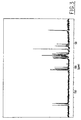
- the 13 C-NMR spectrum shown in FIG. 3, shows 4 anomeric carbons (100.3, 103.7, 104.9, and 106.3 ppm) as well as 4 carboxylic carbons (173.6, 174.2, 177.0, and 177.3 ppm). Signals at 25.0 ppm and 25.5 ppm can be assigned to methyl or acetyl groups, indicating N-acetylation of hexosamines.
- Intrinsic viscosity [ ⁇ ] (hydrodynamic volume occupied by one gram of polymer in a solvent given) of the preparation of polysaccharides obtained as described in Example 1, in solution in distilled water added with NaCl at a concentration of 0.1 M, was determined by the establishment of flow curves diluted at different concentrations.
- the intrinsic viscosity has thus been evaluated at 570 ml / g.
Landscapes
- Health & Medical Sciences (AREA)
- Chemical & Material Sciences (AREA)
- Life Sciences & Earth Sciences (AREA)
- Engineering & Computer Science (AREA)
- Biotechnology (AREA)
- Zoology (AREA)
- Organic Chemistry (AREA)
- Wood Science & Technology (AREA)
- General Health & Medical Sciences (AREA)
- Genetics & Genomics (AREA)
- Bioinformatics & Cheminformatics (AREA)
- Medicinal Chemistry (AREA)
- Microbiology (AREA)
- General Engineering & Computer Science (AREA)
- Virology (AREA)
- Veterinary Medicine (AREA)
- Biomedical Technology (AREA)
- Public Health (AREA)
- Epidemiology (AREA)
- Animal Behavior & Ethology (AREA)
- Tropical Medicine & Parasitology (AREA)
- Biochemistry (AREA)
- Inorganic Chemistry (AREA)
- Pharmacology & Pharmacy (AREA)
- Preparation Of Compounds By Using Micro-Organisms (AREA)
- Polysaccharides And Polysaccharide Derivatives (AREA)
Claims (6)
- Bakterienstamm der Gattung Vibrio, dadurch charakterisiert, dass er zur Art mit dem Namen Vibrio diabolicus gehört und die folgenden Charakteristika besitzt:ein gerades gramnegatives Bazillus, welches ungefähr 0,8 µm breit und 2,2 µm lang ist;beweglich mit Hilfe eines polaren Flagellums im flüssigen Kulturmedium und mit Hilfe peritricher Flagellen in festem Kulturmedium;keine Kapsel, nicht pigmentiert und nicht luminiszierend;fakultativ anaerob, Catalase +, fermentativ, Cytochrom-Oxidase +, Chitinase +, reduzierend Nitrate in Nitrite, und empfindlich gegen 2,4 Diamino-6-7-diisopropylpteridin;in der Lage als einzige Kohlenstoffquelle eines der folgenden Substrate zu verwenden: Glycerol, Ribose, Galactose, Glucose, Fructose, Mannose, Mannitol, N-Acetylglucosamin, Maltose, Saccharose, Trehalose, Amidon, Glycogen, Gluconat, Caprat, Citrat, Malat;DNA mit einem Gehalt an G+C von 49,6%, einem Homologie-Prozentsatz von 27% mit der DNA von Vibrio mytili, einem Homologie-Prozentsatz von 15% mit der DNA von Vibrio nereis, und einem Homologie-Prozentsatz von 5% mit der DNA von Vibrio tubiashii.
- Bakterienstamm nach Anspruch 1, welcher die Charakteristika des Stammes HE800 besitzt, hinterlegt am 17. Oktober 1995 bei der CNCM unter der Nummer I-1629.
- Bakterienstamm, dadurch gekennzeichnet, dass seine DNA mehr als 30% Homologie mit der DNA des Stammes HE800 besitzt.
- Exopolysaccharid, welches mit Hilfe von Ethanol-Präzipitation erhältlich sein kann, ausgehend von einem Kulturüberstand eines Bakterienstamms nach einem der Ansprüche 1 bis 3 und weiterhin dadurch gekennzeichnet, dass:es keine neutralen Monosaccharide enthält;sein Gehalt an Osaminen ungefähr 30 ± 5 Gew.-% ist;sein Gehalt an Uronsäuren ungefähr 32 ± 5 Gew.-% ist;seine Zusammensetzung an Monosacchariden, bestimmt gemäß saurer Methanolyse, die folgende ist: ungefähr 11,2 Gew.-% an Glucuronsäure, ungefähr 18 Gew.-% an N-Acetylglucosamin, ungefähr 7,9 Gew.-% an N-Acetylgalactosamin, entsprechend 1,4 Mol an N-Acetylglucosamin und 0,6 Mol an N-Acetylgalactosamin pro ein Mol Glucuronsäure;es keine sulfatierten Saccharideinheiten umfasst;seine intrinsische Viskosität im Bereich von 570 ml/g ist;sein mittleres Molekulargewicht im Bereich von 800 000 Da ist.
- Exopolysaccharid nach Anspruch 4, dadurch gekennzeichnet, dass es erhältlich sein kann aus einem Kulturüberstand des Stammes HE800, hinterlegt am 17. Oktober 1995 bei der CNCM unter der Nummer I-1629.
- Verwendung eines Polysaccharids nach einem der Ansprüche 4 oder 5 zum Erhalt eines Medikaments.
Applications Claiming Priority (3)
| Application Number | Priority Date | Filing Date | Title |
|---|---|---|---|
| FR9702199 | 1997-02-25 | ||
| FR9702199A FR2760022B1 (fr) | 1997-02-25 | 1997-02-25 | Souche bacterienne marine du genre vibrio, polysaccharides hydrosolubles produits par cette souche, et leurs utilisations |
| PCT/FR1998/000368 WO1998038327A1 (fr) | 1997-02-25 | 1998-02-25 | Souche bacterienne marine du genre vibrio, polysaccharides hydrosolubles produits par cette souche, et leurs utilisations |
Publications (2)
| Publication Number | Publication Date |
|---|---|
| EP0975791A1 EP0975791A1 (de) | 2000-02-02 |
| EP0975791B1 true EP0975791B1 (de) | 2005-10-12 |
Family
ID=9504124
Family Applications (1)
| Application Number | Title | Priority Date | Filing Date |
|---|---|---|---|
| EP98912545A Expired - Lifetime EP0975791B1 (de) | 1997-02-25 | 1998-02-25 | Meeres-bakterienstamm der gattung vibrio, davon hergestellte wasserlösliche polysaccharide und deren verwendung |
Country Status (5)
| Country | Link |
|---|---|
| US (1) | US6436680B1 (de) |
| EP (1) | EP0975791B1 (de) |
| DE (1) | DE69831864T2 (de) |
| FR (1) | FR2760022B1 (de) |
| WO (1) | WO1998038327A1 (de) |
Families Citing this family (9)
| Publication number | Priority date | Publication date | Assignee | Title |
|---|---|---|---|---|
| FR2811229B1 (fr) * | 2000-07-04 | 2003-08-01 | Ifremer | Utilisation d'un polysaccharide excrete par l'espece vibrio diabolicus en cicatrisation osseuse |
| US7090856B2 (en) * | 2003-06-19 | 2006-08-15 | Hong Kong University Of Science And Technology | Anti-fouling exopolysaccharides isolated from cultures of Vibrio alginolyticus and Vibrio proteolyticus |
| FR2871379B1 (fr) | 2004-06-14 | 2006-09-29 | Ifremer | Utilisation de derives polysaccharidiques hautement sulfates et de faible masse molaire pour moduler l'angiogenese |
| FR2964014B1 (fr) * | 2010-08-31 | 2013-04-05 | Ifremer | Nucleus enrobe d'un revetement filmogene aux proprietes antibacteriennes et cicatrisantes et procede d'obtention. |
| ES2390033B1 (es) | 2010-11-30 | 2013-10-31 | Lipotec S.A. | Exopolisacárido para el tratamiento y/o cuidado de la piel, mucosas, cabello y/o uñas. |
| ES2424294B1 (es) * | 2012-03-22 | 2014-07-21 | Lipotec, S.A. | Exopolisacárido para el tratamiento y/o cuidado de la piel, mucosas, cabello y/o uñas |
| BR112015024221A2 (pt) | 2013-03-22 | 2017-07-18 | Lipotec Sa | exopolissacarídeo, uso do exopolissacarídeio, e, composição cosmética ou dermofarmacêutica |
| US9670395B2 (en) | 2013-04-22 | 2017-06-06 | Halliburton Energy Services, Inc. | Treatment of a subterranean formation with composition including a microorganism or compound generated by the same |
| EP4112060A1 (de) * | 2021-07-01 | 2023-01-04 | Institut Francais de Recherche pour l'Exploitation de la Mer (IFREMER) | Niedermolekulare he800-exopolysaccharidderivate mit antikrebs-eigenschaften und ihre verwendungen |
Family Cites Families (5)
| Publication number | Priority date | Publication date | Assignee | Title |
|---|---|---|---|---|
| JPS5337437B2 (de) * | 1974-04-10 | 1978-10-09 | ||
| JPS59220197A (ja) * | 1983-05-30 | 1984-12-11 | Snow Brand Milk Prod Co Ltd | 新規な含窒素多糖体およびその製造方法 |
| JPH0322994A (ja) * | 1989-06-20 | 1991-01-31 | Sagami Chem Res Center | 抗腫瘍活性物質sats6504 |
| US5393777A (en) * | 1990-11-15 | 1995-02-28 | State Of Oregon Acting By And Through The State Board Of Higher Education On Behalf Of Oregon Health Sciences University | Deferration using anguibactin siderophore |
| FR2701488B1 (fr) * | 1993-02-15 | 1995-05-05 | Ifremer | Bactéries du type Alteromonas, polysaccharides produits par ces bactéries, ose contenu dans ces polysaccharides et applications. |
-
1997
- 1997-02-25 FR FR9702199A patent/FR2760022B1/fr not_active Expired - Lifetime
-
1998
- 1998-02-25 EP EP98912545A patent/EP0975791B1/de not_active Expired - Lifetime
- 1998-02-25 WO PCT/FR1998/000368 patent/WO1998038327A1/fr not_active Ceased
- 1998-02-25 US US09/380,079 patent/US6436680B1/en not_active Expired - Lifetime
- 1998-02-25 DE DE69831864T patent/DE69831864T2/de not_active Expired - Lifetime
Also Published As
| Publication number | Publication date |
|---|---|
| EP0975791A1 (de) | 2000-02-02 |
| WO1998038327A1 (fr) | 1998-09-03 |
| DE69831864D1 (de) | 2006-02-23 |
| FR2760022A1 (fr) | 1998-08-28 |
| FR2760022B1 (fr) | 1999-04-30 |
| US6436680B1 (en) | 2002-08-20 |
| DE69831864T2 (de) | 2006-07-20 |
Similar Documents
| Publication | Publication Date | Title |
|---|---|---|
| Srikanth et al. | Antioxidant and anti-inflammatory levan produced from Acetobacter xylinum NCIM2526 and its statistical optimization | |
| Vincent et al. | Production and characterization of an exopolysaccharide excreted by a deep-sea hydrothermal vent bacterium isolated from the polychaete annelid Alvinella pompejana | |
| Kim et al. | Enhanced production of (1→ 3)-β-D-glucan by a mutant strain of Agrobacterium species | |
| FR2564859A1 (fr) | Procede de preparation d'acide hyaluronique par fermentation. | |
| EP0975791B1 (de) | Meeres-bakterienstamm der gattung vibrio, davon hergestellte wasserlösliche polysaccharide und deren verwendung | |
| Srivastava et al. | Isolation, purification, and characterization of a novel exopolysaccharide isolated from marine bacteria Brevibacillus borstelensis M42 | |
| EP1212448B1 (de) | Verfahren zur herstellung von exopolysaccharide | |
| FR2471387A1 (fr) | Procede de preparation de derives de moranoline, nouveaux produits ainsi obtenus et leur utilisation pour controler l'augmentation des niveaux de sucre dans le sang | |
| EP0682713B1 (de) | Bakterien vom alteromonastyp, durch diese bakterien hergestellte polysaccharide, in diesen polysacchariden enthaltene ose und ihre anwendungen | |
| FR2681601A1 (fr) | Polysaccharide, ses applications, son obtention par fermentation, souche de pseudomonas le produisant. | |
| JP5314955B2 (ja) | 新規微生物、イヌリナーゼ、イヌリン分解剤、イヌロオリゴ糖の製造方法及びイヌリナーゼの製造方法 | |
| US5332667A (en) | Method for producing biologically active polysaccharide RON substance | |
| JP4132297B2 (ja) | オリゴ糖の製造方法 | |
| CN100575478C (zh) | 一种新的弧菌科弧菌属菌株及其应用 | |
| FR2755142A1 (fr) | Souche bacterienne marine du genre alteromonas, exopolysaccharides hydrosolubles produits par cette souche, et leurs utilisations | |
| EP2376621B1 (de) | Bakterienstamm sowie mischung aus bakterien mit fucan abbauender aktivität | |
| BE1004569A3 (fr) | Exopolymere extracellulaire, son procede de preparation et compositions pharmaceutiques le contenant. | |
| EP0084333B1 (de) | Polysaccharidsubstanz, Verfahren zu deren Herstellung, dieselbe enthaltende pharmazeutische Zusammensetzungen sowie deren Verwendung als Medikamente | |
| Manzoni et al. | Influence of the culture conditions on extracellular lyase activity related to K5 polysaccharide | |
| JP4826824B2 (ja) | オリゴ糖 | |
| Byun et al. | Isolation and characterization of marine bacterium producing arylsulfatase | |
| JP3079183B2 (ja) | 褐藻分解物の製造法 | |
| CA2009194A1 (en) | Method for producing biologically active polysaccharide ron substance | |
| KR100450277B1 (ko) | 베타-1,3-글루칸을 고농도로 생산하는 신균주 | |
| JPS58121799A (ja) | 多糖類mp−86物質およびその製造法 |
Legal Events
| Date | Code | Title | Description |
|---|---|---|---|
| PUAI | Public reference made under article 153(3) epc to a published international application that has entered the european phase |
Free format text: ORIGINAL CODE: 0009012 |
|
| 17P | Request for examination filed |
Effective date: 19990816 |
|
| AK | Designated contracting states |
Kind code of ref document: A1 Designated state(s): BE CH DE GB IT LI LU NL |
|
| 17Q | First examination report despatched |
Effective date: 20040107 |
|
| GRAP | Despatch of communication of intention to grant a patent |
Free format text: ORIGINAL CODE: EPIDOSNIGR1 |
|
| GRAS | Grant fee paid |
Free format text: ORIGINAL CODE: EPIDOSNIGR3 |
|
| GRAA | (expected) grant |
Free format text: ORIGINAL CODE: 0009210 |
|
| AK | Designated contracting states |
Kind code of ref document: B1 Designated state(s): BE CH DE GB IT LI LU NL |
|
| REG | Reference to a national code |
Ref country code: GB Ref legal event code: FG4D Free format text: NOT ENGLISH |
|
| REG | Reference to a national code |
Ref country code: CH Ref legal event code: EP |
|
| REG | Reference to a national code |
Ref country code: CH Ref legal event code: NV Representative=s name: ISLER & PEDRAZZINI AG |
|
| GBT | Gb: translation of ep patent filed (gb section 77(6)(a)/1977) |
Effective date: 20060125 |
|
| REF | Corresponds to: |
Ref document number: 69831864 Country of ref document: DE Date of ref document: 20060223 Kind code of ref document: P |
|
| PLBE | No opposition filed within time limit |
Free format text: ORIGINAL CODE: 0009261 |
|
| STAA | Information on the status of an ep patent application or granted ep patent |
Free format text: STATUS: NO OPPOSITION FILED WITHIN TIME LIMIT |
|
| 26N | No opposition filed |
Effective date: 20060713 |
|
| REG | Reference to a national code |
Ref country code: CH Ref legal event code: PCAR Free format text: ISLER & PEDRAZZINI AG;POSTFACH 1772;8027 ZUERICH (CH) |
|
| PGFP | Annual fee paid to national office [announced via postgrant information from national office to epo] |
Ref country code: NL Payment date: 20170112 Year of fee payment: 20 |
|
| PGFP | Annual fee paid to national office [announced via postgrant information from national office to epo] |
Ref country code: DE Payment date: 20170210 Year of fee payment: 20 Ref country code: CH Payment date: 20170214 Year of fee payment: 20 |
|
| PGFP | Annual fee paid to national office [announced via postgrant information from national office to epo] |
Ref country code: GB Payment date: 20170214 Year of fee payment: 20 Ref country code: LU Payment date: 20170116 Year of fee payment: 20 Ref country code: BE Payment date: 20170223 Year of fee payment: 20 |
|
| PGFP | Annual fee paid to national office [announced via postgrant information from national office to epo] |
Ref country code: IT Payment date: 20170217 Year of fee payment: 20 |
|
| REG | Reference to a national code |
Ref country code: DE Ref legal event code: R071 Ref document number: 69831864 Country of ref document: DE |
|
| REG | Reference to a national code |
Ref country code: CH Ref legal event code: PL Ref country code: NL Ref legal event code: MK Effective date: 20180224 |
|
| REG | Reference to a national code |
Ref country code: BE Ref legal event code: MK Effective date: 20180225 |
|
| REG | Reference to a national code |
Ref country code: GB Ref legal event code: PE20 Expiry date: 20180224 |
|
| PG25 | Lapsed in a contracting state [announced via postgrant information from national office to epo] |
Ref country code: GB Free format text: LAPSE BECAUSE OF EXPIRATION OF PROTECTION Effective date: 20180224 |