EP0970552B1 - Electrical wiring frame - Google Patents
Electrical wiring frame Download PDFInfo
- Publication number
- EP0970552B1 EP0970552B1 EP98917228A EP98917228A EP0970552B1 EP 0970552 B1 EP0970552 B1 EP 0970552B1 EP 98917228 A EP98917228 A EP 98917228A EP 98917228 A EP98917228 A EP 98917228A EP 0970552 B1 EP0970552 B1 EP 0970552B1
- Authority
- EP
- European Patent Office
- Prior art keywords
- groove
- horizontal rail
- frame according
- stirrup
- designed
- Prior art date
- Legal status (The legal status is an assumption and is not a legal conclusion. Google has not performed a legal analysis and makes no representation as to the accuracy of the status listed.)
- Expired - Lifetime
Links
- 238000009429 electrical wiring Methods 0.000 title claims abstract description 6
- 210000001520 comb Anatomy 0.000 claims description 8
- 229920002994 synthetic fiber Polymers 0.000 claims description 7
- 229910000838 Al alloy Inorganic materials 0.000 claims description 3
- 229910000831 Steel Inorganic materials 0.000 claims description 3
- 229910052782 aluminium Inorganic materials 0.000 claims description 3
- XAGFODPZIPBFFR-UHFFFAOYSA-N aluminium Chemical compound [Al] XAGFODPZIPBFFR-UHFFFAOYSA-N 0.000 claims description 3
- 238000001125 extrusion Methods 0.000 claims description 3
- 239000010935 stainless steel Substances 0.000 claims description 3
- 229910001220 stainless steel Inorganic materials 0.000 claims description 3
- 239000010959 steel Substances 0.000 claims description 3
- 239000000463 material Substances 0.000 claims description 2
- 210000002105 tongue Anatomy 0.000 claims 3
- 230000000284 resting effect Effects 0.000 claims 1
- 210000001331 nose Anatomy 0.000 description 9
- 230000000295 complement effect Effects 0.000 description 4
- 239000011324 bead Substances 0.000 description 3
- 230000000903 blocking effect Effects 0.000 description 2
- 210000003128 head Anatomy 0.000 description 2
- 238000009434 installation Methods 0.000 description 2
- 230000004048 modification Effects 0.000 description 2
- 238000012986 modification Methods 0.000 description 2
- 230000008878 coupling Effects 0.000 description 1
- 238000010168 coupling process Methods 0.000 description 1
- 238000005859 coupling reaction Methods 0.000 description 1
- 239000003989 dielectric material Substances 0.000 description 1
- 230000005489 elastic deformation Effects 0.000 description 1
- 238000004519 manufacturing process Methods 0.000 description 1
- 210000002445 nipple Anatomy 0.000 description 1
- 239000004033 plastic Substances 0.000 description 1
- 229920003023 plastic Polymers 0.000 description 1
Images
Classifications
-
- H—ELECTRICITY
- H02—GENERATION; CONVERSION OR DISTRIBUTION OF ELECTRIC POWER
- H02B—BOARDS, SUBSTATIONS OR SWITCHING ARRANGEMENTS FOR THE SUPPLY OR DISTRIBUTION OF ELECTRIC POWER
- H02B1/00—Frameworks, boards, panels, desks, casings; Details of substations or switching arrangements
- H02B1/20—Bus-bar or other wiring layouts, e.g. in cubicles, in switchyards
- H02B1/202—Cable lay-outs
-
- H—ELECTRICITY
- H02—GENERATION; CONVERSION OR DISTRIBUTION OF ELECTRIC POWER
- H02B—BOARDS, SUBSTATIONS OR SWITCHING ARRANGEMENTS FOR THE SUPPLY OR DISTRIBUTION OF ELECTRIC POWER
- H02B1/00—Frameworks, boards, panels, desks, casings; Details of substations or switching arrangements
- H02B1/01—Frameworks
- H02B1/013—Profiles for cabinet frames
Definitions
- the present invention relates to an electrical wiring frame for receiving electrical apparatus and their electrical wiring, this chassis comprising at least two vertical uprights arranged in parallel planes and at least one horizontal rail coupled to the vertical uprights by at least two stirrups of general shape in omega, the base of the stirrups determining the spacing of the horizontal rail relative to the vertical uprights, the interior space defined by these stirrups being used as a cable duct, the horizontal rail being provided with a standardized support intended for receive electrical appliances and at least one wire clamp comb arranged parallel to the support arranged to fix the electrical cables in position connected to said electrical devices.
- This type of wiring frame is well known and generally used in cabinets electric controls. It allows you to organize the wiring in an orderly fashion, clear and clean, the cables being positioned in the wire clamp combs and grouped in the side chutes formed by the omega-shaped stirrups. The wiring is greatly facilitated, as well as access to electrical devices and their cables.
- the known frames are produced by means of profiles assembled by screw-nut systems which require relatively long assembly times and a adapted tools. These assembly times are doubled when it is necessary to modify or adapt the position of the uprights and rails relative to each other. Otherwise, the distance between two consecutive horizontal rails is not infinitely adjustable being since the fixing holes are provided at regular intervals. It is therefore not always possible to achieve an optimal installation of the electrical cabinet. Of more, the number of parts required to make this type of chassis is relatively high considering the multiple possible variants.
- the present invention proposes to improve the chassis currently known in proposing an assembly system which is fast, simple and without tools allowing significantly reduce costs and assembly times.
- this system allows you to modify and adapt the position of the parts one by one with respect to each other, to modify their spacings continuously, in particular by sliding relative to each other, and modulating the architecture of the chassis as required.
- the parts making up this chassis have been studied for adapt to different variants so as to limit their number and therefore the cost of manufacture of the assembly.
- a chassis as defined in the preamble and characterized in that assembling the stirrups on the vertical uprights, the horizontal rail on the stirrups, the support and wire clamp comb on the horizontal rail is an assembly by interlocking and locking, removable, the elements to be joined together comprising respectively interlocking and locking means complementary arranged to cooperate with each other.
- These complementary means of interlocking and locking can be arranged to cooperate with each other by bringing said elements together in a movement of translation perpendicular to said elements and / or according to a rotational movement.
- the vertical post is formed of a profile, one side of which has a rounded pivot on one of the edges and on the other edge a groove.
- This vertical upright can have a general section substantially square, symmetrical with respect to a median plane parallel to said side provided with pivot and groove.
- the stirrup comprises, on its branch arranged with the side of the vertical upright, an external projection forming a rounded hook arranged to fit on the pivot provided on said vertical upright and a free end curved outwards forming an elastic tongue provided with a nose arranged to lock in the groove provided on said vertical upright by interlocking after rotation of the stirrup around said pivot, the spacing between the hook and the nose being less than or equal to the distance between the pivot and the groove, the stirrup and / or the vertical upright comprising, in the nesting zone, reliefs arranged for form stops.
- the stirrup advantageously has on its branch arranged on the side of the upright vertical at least one hole for receiving a sliding mounted fixing member in a groove provided in the vertical upright and arranged to lock the position of said stirrup.
- This stirrup also has, on its branch arranged on the side of the horizontal rail, a free end bent outwards, forming an angle of about 90 ° with its branch and provided with a groove.
- the horizontal rail is formed of a profile comprising on the rear face a longitudinal C-shaped groove, the free end of one of the branches being curved and carrying a bead arranged to fit on a first edge of the corresponding branch of said stirrup and the free end of the other branch forming a elastic tongue provided with a nose arranged to lock on the second edge of the corresponding branch of said bracket by fitting after rotation of said rail horizontal around said first edge, the spacing between the two branches of the C-shaped groove being at most equal to the width of the stirrup branch, the stirrup and / or the horizontal rail comprising, in the nesting zone, reliefs arranged to form stops.
- This horizontal rail also comprises on the front face a inverted T-shaped longitudinal groove.
- the support is formed of a profile and comprises in rear side two elastic hooking lugs and a boss, the lugs being arranged to fit into the T-shaped groove provided in the front face of the horizontal rail after a rotational movement around the boss bearing on said rail, the end of one of the legs being curved to press on the bottom of the groove and the end of the other tab having a hook to lock at the back of the corresponding free edge of said groove, the external distance defined by the two tabs being at least equal to the spacing between the two free edges of the groove and the distance between the boss and the hook of the tab being at most equal to the thickness of said free edge.
- the horizontal rail comprises, on its longitudinal edges, at least one U-shaped longitudinal groove with at least one recess longitudinal in one of its branches and the wire clamp comb has a foot attachment fitted with two elastic tabs, one of which carries a notch intended to lock in the longitudinal recess provided in said U-shaped groove by fitting of the foot after a translation of the wire clamp comb towards the rail horizontal.
- This wire clip comb preferably has a rear extension terminated by a heel intended to fit on the rear part of the horizontal rail the spacing between the heel and the attachment foot being less than or equal to the width of said rail in the nesting area.
- the wire clamp comb also has a plurality of teeth parallel to each other, each tooth having on its flanks at least one socket forming between two teeth consecutive housing to receive and hold in position an electric cable.
- the chassis comprises an insulating cover intended to cover at least partially said stirrup and comprising at least one large branch coupled to the branch arranged on the side of the vertical upright and provided on its free end of a groove.
- This chassis may also include at least one cover arranged to cover the gap between two frames arranged side by side, said cover comprising on its longitudinal edges at least one groove arranged to fit onto the corresponding free ends of the stirrup arms and the insulating cover.
- this cover comprises, at least in a central zone, deformable longitudinal corrugations arranged to adapt the width of the cover at the interval between the two chassis and to make up for the difference in levels between the two chassis.
- the latter advantageously comprises at least a lateral flange comprising on its longitudinal edges at least one groove arranged to fit on the free ends of the corresponding branches of the bracket and the insulating cover.
- Vertical uprights, horizontal rails, brackets and supports can be produced by extrusion in a material chosen from the group comprising aluminum, aluminum alloy, stainless steel, steel, plastics.
- insulating covers, wire clamp combs, covers and flanges side can be made of a dielectric synthetic material.
- the vertical upright 2 shown in Figures 3 and 4 has a flat profile or general square section, or of another suitable form. It includes, side, on one of the edges a rounded pivot 21 provided at the end of an angled arm 22 and on the other edge a groove 23.
- the vertical upright 2 is symmetrical with respect to its median plane parallel to the side provided with the pivot 21 and the groove 23. Consequently, this vertical upright 2 comprises a pivot 21 and a groove 23 on each side allowing it to be usable as well upright as left upright.
- the stirrup 3, represented by FIG. 5, comprises a profile in the shape of an omega allowing the mounting of the horizontal rails 4 on the vertical uprights 2 and perpendicular to these.
- the base 30 of the stirrup 3 defines the spacing of the rails 4 relative to the uprights 2 and the space defined between the branches 31, 32 of the bracket is used to store the harnesses of electric cables.
- This stirrup 3 comprises, on its branch 31 disposed on the side of the vertical upright 3, a projection outer forming a rounded hook 33 and a free end bent towards the outside forming a tongue 34 provided with a nose 35.
- the hook 33 is intended to fit on the pivot 21 and the nose 35 is intended to lock in the groove 23 after a rotational movement of the stirrup 3 around said pivot 21, thanks to the elastic deformation of the tongue 34.
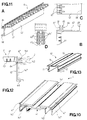
- This rotational movement allowing the fitting and locking of the stirrup 3 on the vertical upright 2 is shown clearly by Figure 1B.
- the spacing provided between the hook 33 and the nose 35 is at most equal and preferably slightly less than that provided between the pivot 21 and the groove 23, stressing said interlocking.
- the bracket 3 and the vertical upright 2 have in their area interlocking reliefs formed by bosses or ribs respectively 36 and 24 arranged to form abutments bearing against one another, which put also under constraint said socket.
- the stirrup 3 also has two. opposite oblong holes 37, provided in branch 31 and intended to receive screws blocking (not shown) for blocking said stirrup in a fixed position on the vertical upright 2.
- the vertical upright 2 has a groove 25 in T shape overturned and arranged to receive the head of the locking screws or the nuts associated with these screws. This groove 25 being provided over the entire length of the upright vertical 2, it is easily understood that the stirrups 3 can be placed at any place along said amount. The edges of this groove 25 also form the stops 24 mentioned above.
- the stirrup 3 also has on its branch 32 disposed on the side of the horizontal rail 4 a free end 38 curved outwards and forming an angle of approximately 90 ° with its branch 32, provided with a groove 39.
- the design of this stirrup 3 allows it to be placed on the upright as well vertical left than on the vertical upright.
- the insulating cover 8 represented by FIG. 6, is intended to partially cover the bracket 3 for electrically isolating the horizontal rails 4 from the vertical uprights 2. It is made of a molded dielectric material and has an L-shape whose small branch 81 fits on base 30 and large branch 82 fits on base branch 31 of the stirrup 3. This large branch 82 has at its free end a groove 83 which can receive the lateral flange 7 or the cover 9 as detailed more far.
- This insulating cover 8 is extended laterally by flanges 84 provided with small pins 85 which fit into the rear of the stirrup 3 and maintain the cover 8 on the stirrup 3.
- the large branch 82 has a raised area 82 'to leave a free space in the area of the oblong holes 37 for the head of the fixing screws or the nuts associated with these screws.
- the horizontal rail 4 represented by FIGS. 7, 8 and 10, comprises, on the rear face, a C-shaped groove 41 intended to receive between its branches 42, 43, the branch 32 of the stirrup 3.
- the free end of its branch 42 is curved and has a bead 44 and the free end of its branch 43 forms a tongue provided with a nose 45.
- the spacing provided between the branches 42 and 43 of the groove 41 is at most equal and preferably slightly less than the width of the branch 32 stressing said socket.
- bosses 46 are provided in the bottom of this groove 41 to form abutments bearing against the branch 32 also putting under stress said interlocking.
- This horizontal rail 4 has on its front face a groove 141 in inverted T shape, parallel to the C-shaped groove 41, these grooves being arranged substantially back to back.
- This groove 141 is intended to receive the support 5, the free edges 142 and 143 of the T-shaped groove having a chamfer 144 intended to facilitate the fitting of said support 5.
- the longitudinal edges of the rail horizontal 8 also have a U-shaped groove 145, the opening of which is substantially perpendicular to those of grooves 41 and 141, groove 145 comprising at least on one of its branches a longitudinal recess 146 and designed to receive a wire clamp comb for holding cables in position electrical devices connected to said electrical devices carried by the support 5.
- This rail horizontal 8 can have variable widths according to needs while being compatible with the other profiles, the grooves 41, 141 and 145 remaining identical.
- the horizontal rail 8 of FIG. 8 has an average width while that of Figures 7 and 10 have a width almost double that of the rail of Figure 8. In this case, the horizontal rail 8 has longitudinal free edges 147 folded backwards substantially parallel to the branches 42 and 43 of the groove 41 in C shape.
- This horizontal rail 4 also has two grooves on the front parallel plates 47 arranged on either side of the groove 141 and arranged for receive identification labels intended to identify the electrical equipment worn by chassis 1.
- the support 5 with reference to FIG. 9, comprises a standardized U-shaped profile and provided on the rear face with two hooking lugs 51, 52 arranged to be housed in the inverted T-shaped groove 141 provided in the front face of the rail horizontal 4.
- the tab 51 is longer than the tab 52 and its free end curved is intended to bear on the bottom of the groove 141.
- the tab 52 has at its free end a hook arranged to lock at the rear of the free edge 143 corresponding to the groove 141.
- This support 5 also has a longitudinal boss 53 parallel to lug 52 and arranged to press on the face outside of the free edge 143. The interval between the boss 53 and the hook the tab 52 is at most equal to the thickness of said free edge 143 so as to put under constrain said nesting.
- the support 5 is fitted into the groove 141 of the rail horizontal 4 by a rotational movement around the point or the support line formed by the boss 53 bearing on the rail 4 until the tab 52 is locked the rear of the free edge 143, the end of the tab 51 coming to bear on the bottom of the groove 141 to stabilize the position of the support 5 horizontally relative to said rail 4.
- the rounded and bevelled shape respectively of the free ends of the legs attachment 51, 52 as well as the chamfer 144 provided on the free edges 142, 143 of said groove 141 facilitate the introduction of the hooking lugs 51, 52.
- the external spacing defined by the tabs of attachment 51 and 52 is at least equal and preferably slightly greater than the spacing between the two free edges 142, 143 of the groove 141 putting under constrain said nesting.
- the front face of this support 5 is standardized and known skilled in the art since all types of electrical apparatus intended for be installed in an electrical cabinet have forms on the back complementary arranged to cooperate with said support 5.
- the wire clamp comb 6 is represented by FIGS. 11 A to D and 12.
- This comb 6 has a plurality of teeth 61 parallel and spaced at regular intervals integral with a longitudinal body 62.
- Each tooth 61 bears on its flanks at least one and preferably three notches 63, a first notch provided at the base and two others provided on the height of the tooth. These notches define between two teeth consecutive housings to receive electric cables 63 'maintained by pinching.
- This comb 6 comprises a hooking foot 64 arranged to be housed in the groove 145 in the form of a U provided in the horizontal rail 4, by fitting after a translation of the comb 6 towards the horizontal rail 4 substantially perpendicularly to said groove 145.
- This attachment foot 64 which can be longitudinal or under the form of regularly distributed nipples, has two parallel tabs 65, 66 one of which carries a notch 67 intended to fit into the corresponding recess 146 provided in groove 145, thus locking this assembly.
- the body 62 of the comb 6 extends backwards and ends with a heel 68 disposed substantially at an angle straight and intended to fit on one of the longitudinal edges 147 of the horizontal rail 4, as illustrated in FIG. 12, or on the branches 42, 43 of said horizontal rail 4 if it has a smaller width.
- the distance between the foot 64 and the heel 68 is at most equal and preferably slightly less than the width of the free edge 147 or branches 42, 43 stressing said socket.
- a cover 10, shown in FIG. 13, is provided for coupling two wire clamp combs 6 superimposed to avoid free intervals.
- This cover 10 comprises a profile in U-shaped whose branches 11, 12 are terminated by locking noses 13 arranged to fit and lock on the free end of the teeth 61 opposite.
- the base 14 of the cover 10 extends laterally beyond the branches 11, 12 forming a stop which presses on the rear of said teeth 61, ending aesthetically the assembly between two combs 6.
- a flat groove 15 is provided on the base 14 of the cover 10 and allows to receive identification labels to identify the devices electric carried by said chassis 1.
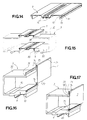
- a cover 9, represented by FIGS. 14 and 15, makes it possible to aesthetically connect two consecutive frames 1 by closing the empty intervals provided between them.
- This cover 9 has on its free longitudinal edges a groove 91 and a tab hook 92 substantially perpendicular to the latter, provided with a rib 93 longitudinal.
- a first cover 9 is fitted on the free ends of the large branches 82 of the insulating covers 8 and a second cover 9 is fitted on the free curved ends 38 of branches 32 of stirrups 3 by a translation of covers in the direction of the insulating covers 8 and the stirrups 3 respectively.
- first assembly the groove 91 fits into the groove 83 and the rib 93 fits at the back of this groove thus locking this assembly thanks to the elasticity of the fastening tab 92.
- the groove 91 fits on the edge of the free end 38 and the rib 93 fits in the groove 39 thus locking this assembly thanks to the elasticity of the hooking lug 92.
- This cover 9 has longitudinal corrugations 94 in a central zone and deformable to adapt the width of the cover 9 to the gap between the two chassis 1 consecutive and even make up for the difference in levels between these frame. It is made of a molded synthetic material allowing this permanent deformation and can of course extend over the entire height of the chassis 1.
- the lateral flange 7, represented by FIGS. 16 and 17, makes it possible to close the sides of the chassis 1 to obtain a finished aesthetic chassis.
- This lateral flange 7 comprises a plate made of substantially rectangular molded synthetic material, provided with two longitudinal free edges 71, 72. It has on the free edge 71 a longitudinal groove 73 and a rib 74 intended to fit respectively on the free curved edge 38 and in the groove 39 of the branch 32 of the stirrup 3. It comprises, on the free edge 72, a longitudinal tab 75 folded in L intended for fit into the groove 83 provided on the insulating cover 8.
- the installation of this lateral flange 7 is produced by translation of the flange in the direction of the stirrup and nesting of the flange in the grooves thanks to its elasticity. This flange 7 may well sure to extend over the entire height of the chassis 1.
- the chassis are designed to be assembled easily without tools while ensuring high rigidity of assembly and a reliable and durable support for electrical appliances, to adapt and modulate to the specific needs of each user, to also be able to easily disassemble in case of modification or complement, to slide relative to each other and allow their precise positioning, etc.
- All the profiles making up the vertical uprights 2, the brackets 3, the horizontal rails 4 and the supports 5 are advantageously made of extruded aluminum. However, they could also be produced by extrusion in steel, stainless steel, aluminum alloy, synthetic material.
- the other parts such that the wire clamp combs 6, the side flanges 7, the insulating covers 8 and the covers 9 are advantageously made of molded synthetic material.
Landscapes
- Power Engineering (AREA)
- Engineering & Computer Science (AREA)
- Installation Of Indoor Wiring (AREA)
- Insulation, Fastening Of Motor, Generator Windings (AREA)
- Insulated Conductors (AREA)
- Non-Portable Lighting Devices Or Systems Thereof (AREA)
- Synchronisation In Digital Transmission Systems (AREA)
- Coupling Device And Connection With Printed Circuit (AREA)
- Connector Housings Or Holding Contact Members (AREA)
- Mounting Of Printed Circuit Boards And The Like (AREA)
- Casings For Electric Apparatus (AREA)
- Patch Boards (AREA)
- Manufacturing Of Printed Wiring (AREA)
- Liquid Crystal (AREA)
- Connections Arranged To Contact A Plurality Of Conductors (AREA)
Abstract
Description
La présente invention concerne un châssis de câblage électrique destiné à recevoir des appareils électriques et leur câblage électrique, ce chàssis comportant au moins deux montants verticaux disposés dans des plans parallèles et au moins un rail horizontal couplé aux montants verticaux par au moins deux étriers de forme générale en oméga, la base des étriers déterminant l'écartement du rail horizontal par rapport aux montants verticaux, l'espace intérieur défini par ces étriers étant utilisé comme une goulotte de câbles, le rail horizontal étant pourvu d'un support normalisé destiné à recevoir les appareils électriques et d'au moins un peigne pince-fils disposé parallèlement au support agencé pour fixer en position les câbles électriques connectés auxdits appareils électriques.The present invention relates to an electrical wiring frame for receiving electrical apparatus and their electrical wiring, this chassis comprising at least two vertical uprights arranged in parallel planes and at least one horizontal rail coupled to the vertical uprights by at least two stirrups of general shape in omega, the base of the stirrups determining the spacing of the horizontal rail relative to the vertical uprights, the interior space defined by these stirrups being used as a cable duct, the horizontal rail being provided with a standardized support intended for receive electrical appliances and at least one wire clamp comb arranged parallel to the support arranged to fix the electrical cables in position connected to said electrical devices.
Ce type de châssis de câblage est bien connu et généralement utilisé dans les armoires électriques de commande. Il permet d'organiser le câblage d'une façon ordonnée, claire et propre, les câbles étant positionnés dans les peignes pince-fils et regroupés dans les goulottes latérales formées par les étriers en forme d'oméga. Le câblage est grandement facilité, de même que l'accès aux appareils électriques et à leurs câbles. Néanmoins, les châssis connus sont réalisés au moyen de profilés assemblés par des systèmes vis-écrous qui nécessitent des temps de montage relativement longs et un outillage adapté. Ces temps de montage sont doublés quand il faut modifier ou adapter la position des montants et des rails l'un par rapport à l'autre. Par ailleurs, l'entraxe entre deux rails horizontaux consécutifs n'est pas réglable en continu étant donné que les trous de fixation sont prévus à intervalle régulier. Il n'est donc pas toujours possible de réaliser une implantation optimale de l'armoire électrique. De plus, le nombre de pièces nécessaires pour réaliser ce type de châssis est relativement élevé compte tenu des multiples variantes envisageables.This type of wiring frame is well known and generally used in cabinets electric controls. It allows you to organize the wiring in an orderly fashion, clear and clean, the cables being positioned in the wire clamp combs and grouped in the side chutes formed by the omega-shaped stirrups. The wiring is greatly facilitated, as well as access to electrical devices and their cables. However, the known frames are produced by means of profiles assembled by screw-nut systems which require relatively long assembly times and a adapted tools. These assembly times are doubled when it is necessary to modify or adapt the position of the uprights and rails relative to each other. Otherwise, the distance between two consecutive horizontal rails is not infinitely adjustable being since the fixing holes are provided at regular intervals. It is therefore not always possible to achieve an optimal installation of the electrical cabinet. Of more, the number of parts required to make this type of chassis is relatively high considering the multiple possible variants.
La présente invention se propose d'améliorer les châssis actuellement connus en proposant un système d'assemblage qui soit rapide, simple et sans outillage permettant de réduire considérablement les coûts et les temps de montage. De plus, ce système d'assemblage permet de modifier et d'adapter à loisir la position des pièces l'une par rapport à l'autre, de modifier leurs entraxes d'une manière continue, notamment en les faisant coulisser les unes par rapport aux autres, et de moduler l'architecture du châssis en fonction des besoins. Les pièces composant ce châssis ont été étudiées pour s'adapter à différentes variantes de manière à limiter leur nombre et donc le coût de fabrication de l'ensemble.The present invention proposes to improve the chassis currently known in proposing an assembly system which is fast, simple and without tools allowing significantly reduce costs and assembly times. In addition, this system allows you to modify and adapt the position of the parts one by one with respect to each other, to modify their spacings continuously, in particular by sliding relative to each other, and modulating the architecture of the chassis as required. The parts making up this chassis have been studied for adapt to different variants so as to limit their number and therefore the cost of manufacture of the assembly.
Ce but est atteint par un châssis tel que défini en préambule et caractérisé en ce que l'assemblage des étriers sur les montants verticaux, du rail horizontal sur les étriers, du support et du peigne pince-fils sur le rail horizontal est un assemblage par emboítement et verrouillage, démontable, les éléments à assembler mutuellement comportant respectivement des moyens d'emboítement et de verrouillage complémentaires agencés pour coopérer entre eux.This object is achieved by a chassis as defined in the preamble and characterized in that assembling the stirrups on the vertical uprights, the horizontal rail on the stirrups, the support and wire clamp comb on the horizontal rail is an assembly by interlocking and locking, removable, the elements to be joined together comprising respectively interlocking and locking means complementary arranged to cooperate with each other.
Ces moyens d'emboítement et de verrouillage complémentaires peuvent être agencés pour coopérer entre eux en rapprochant lesdits éléments selon un mouvement de translation perpendiculaire auxdits éléments et/ou selon un mouvement de rotation.These complementary means of interlocking and locking can be arranged to cooperate with each other by bringing said elements together in a movement of translation perpendicular to said elements and / or according to a rotational movement.
Dans une forme de réalisation préférée de l'invention, le montant vertical est formé d'un profilé dont un côté comporte sur un des bords un pivot arrondi et sur l'autre bord une rainure. Ce montant vertical peut présenter une section générale sensiblement carrée, symétrique par rapport à un plan médian parallèle audit côté pourvu du pivot et de la rainure.In a preferred embodiment of the invention, the vertical post is formed of a profile, one side of which has a rounded pivot on one of the edges and on the other edge a groove. This vertical upright can have a general section substantially square, symmetrical with respect to a median plane parallel to said side provided with pivot and groove.
Dans la forme de réalisation préférée, l'étrier comporte, sur sa branche disposée du côté du montant vertical, une projection extérieure formant un crochet arrondi agencé pour s'emboíter sur le pivot prévu sur ledit montant vertical et une extrémité libre recourbée vers l'extérieur formant une languette élastique pourvue d'un nez agencé pour se verrouiller dans la rainure prévue sur ledit montant vertical par emboítement après rotation de l'étrier autour dudit pivot, l'écartement entre le crochet et le nez étant inférieure ou égale à l'écartement entre le pivot et la rainure, l'étrier et/ou le montant vertical comportant, dans la zone d'emboítement, des reliefs agencés pour former des butées.In the preferred embodiment, the stirrup comprises, on its branch arranged with the side of the vertical upright, an external projection forming a rounded hook arranged to fit on the pivot provided on said vertical upright and a free end curved outwards forming an elastic tongue provided with a nose arranged to lock in the groove provided on said vertical upright by interlocking after rotation of the stirrup around said pivot, the spacing between the hook and the nose being less than or equal to the distance between the pivot and the groove, the stirrup and / or the vertical upright comprising, in the nesting zone, reliefs arranged for form stops.
L'étrier comporte avantageusement sur sa branche disposée du côté du montant vertical au moins un trou destiné à recevoir un organe de fixation monté coulissant dans une rainure prévue dans le montant vertical et agencé pour bloquer la position dudit étrier. The stirrup advantageously has on its branch arranged on the side of the upright vertical at least one hole for receiving a sliding mounted fixing member in a groove provided in the vertical upright and arranged to lock the position of said stirrup.
Cet étrier comporte également, sur sa branche disposée du côté du rail horizontal, une extrémité libre recourbée vers l'extérieur, formant un angle d'environ 90° avec sa branche et pourvue d'une rainure.This stirrup also has, on its branch arranged on the side of the horizontal rail, a free end bent outwards, forming an angle of about 90 ° with its branch and provided with a groove.
De préférence, le rail horizontal est formé d'un profilé comportant en face arrière une rainure longitudinale en forme de C, l'extrémité libre d'une des branches étant recourbée et portant un bourrelet agencé pour s'emboíter sur un premier bord de la branche correspondante dudit étrier et l'extrémité libre de l'autre branche formant une languette élastique pourvue d'un nez agencé pour se verrouiller sur le second bord de la branche correspondante dudit étrier par emboítement après rotation dudit rail horizontal autour dudit premier bord, l'écartement entre les deux branches de la rainure en forme de C étant au plus égal à la largeur de la branche de l'étrier, l'étrier et/ou le rail horizontal comportant, dans la zone d'emboítement, des reliefs agencés pour former des butées. Ce rail horizontal comporte également en face avant une rainure longitudinale en forme de T renversé.Preferably, the horizontal rail is formed of a profile comprising on the rear face a longitudinal C-shaped groove, the free end of one of the branches being curved and carrying a bead arranged to fit on a first edge of the corresponding branch of said stirrup and the free end of the other branch forming a elastic tongue provided with a nose arranged to lock on the second edge of the corresponding branch of said bracket by fitting after rotation of said rail horizontal around said first edge, the spacing between the two branches of the C-shaped groove being at most equal to the width of the stirrup branch, the stirrup and / or the horizontal rail comprising, in the nesting zone, reliefs arranged to form stops. This horizontal rail also comprises on the front face a inverted T-shaped longitudinal groove.
Dans la forme de réalisation préférée, le support est formé d'un profilé et comporte en face arrière deux pattes d'accrochage élastiques et un bossage, les pattes étant agencées pour s'emboíter dans la rainure en forme de T prévue dans la face avant du rail horizontal après un mouvement de rotation autour du bossage en appui sur ledit rail, l'extrémité de l'une des pattes étant recourbée pour appuyer sur le fond de la rainure et l'extrémité de l'autre patte ayant un crochet pour se verrouiller à l'arriére du bord libre correspondant de ladite rainure, la distance extérieure définie par les deux pattes étant au moins égale à l'écartement entre les deux bords libres de la rainure et la distance entre le bossage et le crochet de la patte étant au plus égale à l'épaisseur dudit bord libre.In the preferred embodiment, the support is formed of a profile and comprises in rear side two elastic hooking lugs and a boss, the lugs being arranged to fit into the T-shaped groove provided in the front face of the horizontal rail after a rotational movement around the boss bearing on said rail, the end of one of the legs being curved to press on the bottom of the groove and the end of the other tab having a hook to lock at the back of the corresponding free edge of said groove, the external distance defined by the two tabs being at least equal to the spacing between the two free edges of the groove and the distance between the boss and the hook of the tab being at most equal to the thickness of said free edge.
D'une manière avantageuse, le rail horizontal comporte, sur ses bords longitudinaux, au moins une rainure longitudinale en forme de U pourvue d'au moins un évidement longitudinal dans une de ses branches et le peigne pince-fils comporte un pied d'accrochage pourvu de deux languettes élastiques dont l'une porte un cran destiné à se verrouiller dans l'évidement longitudinal prévu dans ladite rainure en U par emboítement du pied après une translation du peigne pince-fils en direction du rail horizontal. Advantageously, the horizontal rail comprises, on its longitudinal edges, at least one U-shaped longitudinal groove with at least one recess longitudinal in one of its branches and the wire clamp comb has a foot attachment fitted with two elastic tabs, one of which carries a notch intended to lock in the longitudinal recess provided in said U-shaped groove by fitting of the foot after a translation of the wire clamp comb towards the rail horizontal.
Ce peigne pince-fils comporte de préférence un prolongement arrière terminé par un talon destiné à s'emboíter sur la partie arrière du rail horizontaL l'écartement entre le talon et le pied d'accrochage étant inférieure ou égale à la largeur dudit rail dans la zone d'emboítement.This wire clip comb preferably has a rear extension terminated by a heel intended to fit on the rear part of the horizontal rail the spacing between the heel and the attachment foot being less than or equal to the width of said rail in the nesting area.
Le peigne pince-fils comporte également une pluralité de dents parallèles entre elles, chaque dent comportant sur ses flancs au moins une alvéole formant entre deux dents consécutives un logement pour recevoir et maintenir en position un câble électrique.The wire clamp comb also has a plurality of teeth parallel to each other, each tooth having on its flanks at least one socket forming between two teeth consecutive housing to receive and hold in position an electric cable.
Dans la forme de réalisation préférée, le châssis comporte un cache isolant destiné à recouvrir au moins partiellement ledit étrier et comportant au moins une grande branche couplée à la branche disposée du côté du montant vertical et pourvue sur son extrémité libre d'une rainure.In the preferred embodiment, the chassis comprises an insulating cover intended to cover at least partially said stirrup and comprising at least one large branch coupled to the branch arranged on the side of the vertical upright and provided on its free end of a groove.
Ce châssis peut également comporter au moins un couvercle agencé pour recouvrir l'intervalle existant entre deux châssis disposés côte à côté, ledit couvercle comportant sur ses bords longitudinaux au moins une rainure agencée pour s'emboíter sur les extrémités libres correspondantes des branches de l'étrier et du cache isolant.This chassis may also include at least one cover arranged to cover the gap between two frames arranged side by side, said cover comprising on its longitudinal edges at least one groove arranged to fit onto the corresponding free ends of the stirrup arms and the insulating cover.
De préférence, ce couvercle comporte au moins dans une zone centrale des ondulations longitudinales déformables agencées pour adapter la largeur du couvercle à l'intervalle existant entre les deux châssis et pour rattraper la différence de niveaux entre les deux châssis.Preferably, this cover comprises, at least in a central zone, deformable longitudinal corrugations arranged to adapt the width of the cover at the interval between the two chassis and to make up for the difference in levels between the two chassis.
Pour fermer les côtés dudit châssis, ce dernier comporte avantageusement au moins un flasque latéral comportant sur ses bords longitudinaux au moins une rainure agencée pour s'emboíter sur les extrémités libres des branches correspondantes de l'étrier et du cache isolant.To close the sides of said chassis, the latter advantageously comprises at least a lateral flange comprising on its longitudinal edges at least one groove arranged to fit on the free ends of the corresponding branches of the bracket and the insulating cover.
Les montants verticaux, les rails horizontaux, les étriers et les supports peuvent être réalisés par extrusion dans un matériau choisi parmi le groupe comportant de l'aluminium, de l'alliage d'aluminium, de l'inox, de l'acier, des matières synthétiques.Vertical uprights, horizontal rails, brackets and supports can be produced by extrusion in a material chosen from the group comprising aluminum, aluminum alloy, stainless steel, steel, plastics.
De même, les caches isolants, les peignes pince-fils, les couvercles et les flasques latéraux peuvent être réalisés dans une matière synthétique diélectrique. Likewise, insulating covers, wire clamp combs, covers and flanges side can be made of a dielectric synthetic material.
La présente invention et ses avantages apparaítront mieux dans la description suivante d'un exemple de réalisation, en référence aux dessins annexés, dans lesquels :
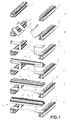
- les figures 1 A à F représentent les différentes étapes de montage d'un châssis selon l'invention,
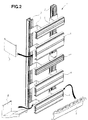
- la figure 2 est une vue en perspective d'un châssis monté,
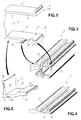
- la figure 3 est une vue en perspective d'un montant vertical du chàssis,
- la figure 4 est une vue en perspective d'un autre montant vertical,
- la figure 5 est une vue en perspective d'un étrier,
- la figure 6 est une vue en perspective d'un cache isolant pour un étrier,
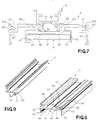
- la figure 7 est une vue en bout d'un support monté sur un rail horizontal du châssis,
- la figure 8 est une vue en perspective d'un rail horizontal du châssis,
- la figure 9 est une vue en perspective d'un profilé support,
- la figure 10 est une vue en perspective d'un autre rail horizontal du châssis,
- les figures 11 A à D sont des vues du peigne pince-fils du châssis, respectivement en perspective, en vue de face, en vue de dessous et en vue droite,
- la figure 12 est une vue partielle d'un peigne pince-fils monté dans un rail horizontal du châssis,
- la figure 13 est une vue en perspective d'un capot entre deux peignes pince-fils,
- la figure 14 est une vue en perspective d'un couvercle entre deux châssis,
- la figure 15 est une vue partielle en perspective de deux couvercles montés sur des étriers de deux châssis adjacents,
- la figure 16 est une vue en perspective d'un flasque latéral à monter sur un étrier, et
- la figure 17 est une vue partielle en perspective d'un flasque latéral monté sur un étrier.
- FIGS. 1 A to F represent the different stages of mounting a chassis according to the invention,
- FIG. 2 is a perspective view of a mounted chassis,
- FIG. 3 is a perspective view of a vertical upright of the chassis,
- FIG. 4 is a perspective view of another vertical upright,
- FIG. 5 is a perspective view of a stirrup,
- FIG. 6 is a perspective view of an insulating cover for a stirrup,
- FIG. 7 is an end view of a support mounted on a horizontal rail of the chassis,
- FIG. 8 is a perspective view of a horizontal rail of the chassis,
- FIG. 9 is a perspective view of a support profile,
- FIG. 10 is a perspective view of another horizontal rail of the chassis,
- FIGS. 11 A to D are views of the wire clamp comb of the chassis, respectively in perspective, in front view, in bottom view and in right view,
- FIG. 12 is a partial view of a wire clamp comb mounted in a horizontal rail of the chassis,
- FIG. 13 is a perspective view of a cover between two wire clamp combs,
- FIG. 14 is a perspective view of a cover between two frames,
- FIG. 15 is a partial perspective view of two covers mounted on stirrups of two adjacent chassis,
- FIG. 16 is a perspective view of a lateral flange to be mounted on a stirrup, and
- Figure 17 is a partial perspective view of a side flange mounted on a bracket.
En référence aux figures 1 et 2, le châssis de câblage 1 est obtenu en assemblant différents profilés le composant selon les étapes de montage énumérées ci-dessous et conformément aux figures 1 A à F :
- figure 1A : on place deux montants verticaux 2 parallèlement, à plat ou verticalement sur une base de travail (non représentée), distants d'un intervalle prédéterminé.
- figures 1B et 1C : sur chaque montant vertical 2, on
emboíte un étrier 3 en forme d'oméga destiné à recevoirun rail horizontal 4. Bien sûr, on mettra en place autant d'étriers que l'on prévoit de rails horizontaux. - figures 1D et 1E : on emboíte ensuite sur chaque paire d'étriers 3, un rail horizontal 4 de dimensions adaptées au besoin, en longueur et en largeur.
- figure 1F : on emboíte enfin sur chaque
rail horizontal 4,un support 5 destiné à recevoir des appareils électriques, tels que des commutateurs, relais, disjoncteurs, etc. Si besoin,ce support 5 peut s'étendre sur une longueur inférieure à celle du rail horizontal.
Le châssis de câblage 1 obtenu et représenté par la figure 2 est ensuite complété par des peignes pince-fils 6 montés sur les rails horizontaux 4 et dont le rôle est de maintenir en position des câbles électriques raccordés auxdits appareils, des flasques latéraux 7 pour fermer les côtés du châssis, des caches isolants 8 montés sur les étriers 3. Si plusieurs châssis de câblage sont placés côte à côte, des couvercles 9 (décrits plus loin) sont prévus pour les relier et obturer ainsi les espaces vides. Ensuite,ce châssis 1 peut être monté dans une armoire électrique de commande (non représentée) par des moyens de fixation connus ou dans tout autre logement approprié.
- FIG. 1A: two
vertical uprights 2 are placed parallel, flat or vertically on a working base (not shown), spaced by a predetermined interval. - Figures 1B and 1C: on each
vertical upright 2, there is astirrup 3 in the shape of an omega intended to receive ahorizontal rail 4. Of course, we will put in place as many stirrups as is expected from horizontal rails. - Figures 1D and 1E: then fits on each pair of
stirrups 3, ahorizontal rail 4 of dimensions adapted to the need, in length and in width. - Figure 1F: finally fits on each
horizontal rail 4, asupport 5 for receiving electrical devices, such as switches, relays, circuit breakers, etc. If necessary, thissupport 5 can extend over a length less than that of the horizontal rail.
Thewiring frame 1 obtained and represented by FIG. 2 is then completed by wire clamp combs 6 mounted on thehorizontal rails 4 and whose role is to keep in position electrical cables connected to said devices,lateral flanges 7 to close the sides of the chassis, insulatingcovers 8 mounted on thebrackets 3. If several wiring frames are placed side by side, covers 9 (described below) are provided to connect them and thus seal the empty spaces. Then, thisframe 1 can be mounted in an electrical control cabinet (not shown) by known fixing means or in any other suitable housing.
Les différents profilés mentionnés sont à présent détaillés en référence aux figures 3 à 17.The various profiles mentioned are now detailed with reference to FIGS. 3 to 17.
Le montant vertical 2, représenté par les figures 3 et 4, comporte un profilé plat ou de
section générale carrée, ou encore d'une autre forme appropriée. Il comporte, d'un
côté, sur un des bords un pivot 21 arrondi prévu à l'extrémité d'un bras 22 coudé et
sur l'autre bord une rainure 23. Dans le cas d'un profilé carré, le montant vertical 2 est
symétrique par rapport à son plan médian parallèle au côté pourvu du pivot 21 et de la
rainure 23. Par conséquent, ce montant vertical 2 comporte un pivot 21 et une rainure
23 de chaque côté lui permettant d'être utilisable aussi bien en montant droit qu'en
montant gauche.The
L'étrier 3, représenté par la figure 5, comporte un profilé en forme d'oméga
permettant le montage des rails horizontaux 4 sur les montants verticaux 2 et
perpendiculairement à ces derniers. La base 30 de l'étrier 3 définit l'écartement des
rails 4 par rapport aux montants 2 et l'espace défini entre les branches 31, 32 de
l'étrier est utilisé pour y ranger les faisceaux de câbles électriques. Cet étrier 3
comporte, sur sa branche 31 disposée du côté du montant vertical 3, une projection
extérieure formant un crochet arrondi 33 et une extrémité libre recourbée vers
l'extérieur formant une languette 34 pourvue d'un nez 35. Le crochet 33 est destiné à
s'emboíter sur le pivot 21 et le nez 35 est destiné à se verrouiller dans la rainure 23
après un mouvement de rotation de l'étrier 3 autour dudit pivot 21, grâce à la
déformation élastique de la languette 34. Ce mouvement de rotation permettant
l'emboítement et le verrouillage de l'étrier 3 sur le montant vertical 2 est représenté
clairement par la figure 1B. Pour assurer un assemblage rigide de ces deux pièces et
éviter tout risque de déverrouillage et de déboítement intempestifs, l'écartement prévu
entre le crochet 33 et le nez 35 est au plus égal et de préférence légèrement inférieur à
celui prévu entre le pivot 21 et la rainure 23, mettant sous contrainte ledit
emboítement. De même, l'étrier 3 et le montant vertical 2 comportent dans leur zone
d'emboítement des reliefs formés par des bossages ou des nervures respectivement 36
et 24 agencés pour former des butées en appui l'une contre l'autre, qui mettent
également sous contrainte ledit emboítement. L'étrier 3 comporte également deux.
trous oblongs 37 opposés, prévus dans la branche 31 et destinés à recevoir des vis de
blocage (non représentées) permettant de bloquer ledit étrier en position fixe sur le
montant vertical 2. A cet effet, le montant vertical 2 comporte une rainure 25 en
forme de T renversé et agencée pour recevoir la tête des vis de blocage ou les écrous
associés à ces vis. Cette rainure 25 étant prévue sur toute la longueur du montant
vertical 2, on comprend aisément que les étriers 3 peuvent être placés à n'importe quel
endroit le long dudit montant. Les bords de cette rainure 25 forment également les
butées 24 mentionnées plus haut. L'étrier 3 comporte également sur sa branche 32
disposée du côté du rail horizontal 4 une extrémité libre 38 recourbée vers l'extérieur
et formant un angle d'environ 90° avec sa branche 32, pourvue d'une rainure 39. La
conception de cet étrier 3 lui permet de pouvoir se placer aussi bien sur le montant
vertical gauche que sur le montant vertical droit.The
Le cache isolant 8, représenté par la figure 6, est destiné à recouvrir partiellement
l'étrier 3 pour isoler électriquement les rails horizontaux 4 des montants verticaux 2. Il
est réalisé dans une matière diélectrique moulée et présente une forme en L dont la
petite branche 81 s'emboíte sur la base 30 et la grande branche 82 s'emboíte sur la
branche 31 de l'étrier 3. Cette grande branche 82 comporte à son extrémité libre une
rainure 83 qui peut recevoir le flasque latéral 7 ou le couvercle 9 comme détaillé plus
loin. Ce cache isolant 8 est prolongé latéralement par des rebords 84 munis de petits
ergots 85 qui s'emboítent à l'arrière de l'étrier 3 et assurent le maintien du cache 8 sur
l'étrier 3. La grande branche 82 comporte une zone surélevée 82' pour laisser un
espace libre dans la zone des trous oblongs 37 pour la tête des vis de fixation ou les
écrous associés à ces vis.The insulating
Le rail horizontal 4, représenté par les figures 7, 8 et 10, comporte, en face arrière,
une rainure 41 en forme de C destinée à recevoir entre ses branches 42, 43, la branche
32 de l'étrier 3. L'extrémité libre de sa branche 42 est recourbée et comporte un
bourrelet 44 et l'extrémité libre de sa branche 43 forme une languette pourvue d'un
nez 45. Pour emboíter le rail horizontal 4 sur la branche 32 de l'étrier 3, on emboíte la
branche 42 munie de son bourrelet 44 sur un des bords de cette branche 32 et on fait
tourner le rail horizontal 4 jusqu'à emboíter l'autre bord de la branche 32 de l'étrier 3
dans la branche 43, le nez 45 verrouillant cet assemblage, grâce à l'élasticité de la
languette 43. Pour assurer un assemblage rigide de ces deux pièces et éviter tout
risque de déboítement et de déverrouillage intempestifs, l'écartement prévu entre les
branches 42 et 43 de la rainure 41 est au plus égal et de préférence légèrement
inférieur à la largeur de la branche 32 mettant sous contrainte ledit emboítement. De
même, des bossages 46 sont prévus dans le fond de cette rainure 41 pour former des
butées en appui contre la branche 32 mettant également sous contrainte ledit
emboítement. Ce rail horizontal 4 comporte sur sa face avant une rainure 141 en
forme de T renversé, parallèle à la rainure 41 en forme de C, ces rainures étant
disposées sensiblement dos à dos. Cette rainure 141 est destinée à recevoir le support
5, les bords libres 142 et 143 de la rainure en forme de T présentant un chanfrein 144
destiné à faciliter l'emboítement dudit support 5. Les bords longitudinaux du rail
horizontal 8 comportent également une rainure 145 en forme de U dont l'ouverture
est sensiblement perpendiculaire à celles des rainures 41 et 141, la rainure 145
comportant au moins sur une de ses branches un évidement longitudinal 146 et
destinée à recevoir un peigne pince-fils pour le maintien en position des câbles
électriques connectés auxdits appareils électriques portés par le support 5. Ce rail
horizontal 8 peut présenter des largeurs variables en fonction des besoins tout en étant
compatible avec les autres profilés, les rainures 41, 141 et 145 restant identiques. Le
rail horizontal 8 de la figure 8 présente une largeur moyenne tandis que celui des
figures 7 et 10 présente une largeur presque double de celle du rail de la figure 8.
Dans ce cas, le rail horizontal 8 comporte des bords libres longitudinaux 147 repliés
vers l'arrière sensiblement parallèlement aux branches 42 et 43 de la rainure 41 en
forme de C. Ce rail horizontal 4 comporte également en face avant deux rainures
plates 47 parallèles disposées de part et d'autre de la rainure 141 et agencées pour
recevoir des étiquettes de repérage destinées à identifier l'appareillage électrique porté
par le châssis 1.The
Le support 5, en référence à la figure 9, comporte un profilé normalisé en forme de U
et pourvu en face arrière de deux pattes d'accrochage 51, 52 agencées pour se loger
dans la rainure 141 en forme de T renversé prévue dans la face avant du rail
horizontal 4. La patte 51 est plus longue que la patte 52 et son extrémité libre
recourbée est destinée à prendre appui sur le fond de la rainure 141. La patte 52
comporte à son extrémité libre un crochet agencé pour se verrouiller à l'arrière du
bord libre 143 correspondant de la rainure 141. Ce support 5 comporte en plus un
bossage longitudinal 53 parallèle à la patte 52 et agencé pour appuyer sur la face
extérieure du bord libre 143. L'intervalle existant entre le bossage 53 et le crochet de
la patte 52 est au plus égal à l'épaisseur dudit bord libre 143 de manière à mettre sous
contrainte ledit emboítement. Le support 5 est emboíté dans la rainure 141 du rail
horizontal 4 par un mouvement de rotation autour du point ou de la ligne d'appui
formé par le bossage 53 en appui sur le rail 4 jusqu'à verrouillage de la patte 52 à
l'arrière du bord libre 143, l'extrémité de la patte 51 venant en appui sur le fond de la
rainure 141 pour stabiliser la position du support 5 horizontalement par rapport audit
rail 4. La forme arrondie et biseautée respectivement des extrémités libres des pattes
d'accrochage 51, 52 de même que le chanfrein 144 prévu sur les bords libres 142, 143
de ladite rainure 141 facilitent l'introduction des pattes d'accrochage 51, 52. Pour
assurer un assemblage rigide de ces deux pièces et éviter tout risque de déboítement
et de déverrouillage intempestifs, l'écartement extérieur défini par les pattes
d'accrochage 51 et 52 est au moins égal et de préférence légèrement supérieur à
l'écartement entre les deux bords libres 142, 143 de la rainure 141 mettant sous
contrainte ledit emboítement. La face avant de ce support 5 est normalisée et connue
de l'homme de métier étant donné que tous les types d'appareils électriques destinés à
être installés dans une armoire électrique comportent en face arrière des formes
complémentaires agencées pour coopérer à ledit support 5.The
Le peigne pince-fils 6 est représenté par les figures 11 A à D et 12. Ce peigne 6
comporte une pluralité de dents 61 parallèles et espacées à intervalles réguliers
solidaires d'un corps longitudinal 62. Chaque dent 61 porte sur ses flancs au moins
une et de préférence trois encoches 63, une première encoche prévue à la base et deux
autres prévues sur la hauteur de la dent. Ces encoches définissent entre deux dents
consécutives des logements pour recevoir des câbles électriques 63' maintenus par
pincement. Ce peigne 6 comporte un pied d'accrochage 64 agencé pour se loger dans
la rainure 145 en forme de U prévue dans le rail horizontal 4, par emboítement après
une translation du peigne 6 vers le rail horizontal 4 sensiblement perpendiculairement
à ladite rainure 145. Ce pied d'accrochage 64, pouvant être longitudinal ou sous la
forme de tétons régulièrement répartis, comporte deux languettes parallèles 65, 66
dont l'une porte un cran 67 destiné à s'emboíter dans l'évidement 146 correspondant
prévu dans la rainure 145, verrouillant ainsi cet assemblage. Le corps 62 du peigne 6
se prolonge vers l'arrière et se termine par un talon 68 disposé sensiblement à angle
droit et destiné à s'emboíter sur un des bords longitudinaux 147 du rail horizontal 4,
comme illustré par la figure 12, ou sur les branches 42, 43 dudit rail horizontal 4 s'il
présente une largeur moindre. Pour assurer un assemblage rigide de ces deux pièces et
éviter tout risque de déboítement intempestif, l'écartement entre le pied 64 et le talon
68 est au plus égal et de préférence légèrement inférieur à la largeur du bord libre 147
ou des branches 42, 43 mettant sous contrainte ledit emboítement. The
Un capot 10, représenté par la figure 13, est prévu pour coupler deux peignes pince-fils
6 superposés afin d'éviter les intervalles libres. Ce capot 10 comporte un profilé en
forme de U dont les branches 11, 12 sont terminées par des nez de verrouillage 13
agencés pour s'emboíter et se verrouiller sur l'extrémité libre des dents 61 en regard.
La base 14 du capot 10 se prolonge latéralement au-delà des branches 11, 12 formant
une butée qui appuie sur l'arrière desdites dents 61, terminant esthétiquement
l'assemblage entre deux peignes 6. Une rainure plate 15 est prévue sur la base 14 du
capot 10 et permet de recevoir des étiquettes de repérage pour identifier les appareils
électriques portés par ledit châssis 1.A
Un couvercle 9, représenté par les figures 14 et 15, permet de relier esthétiquement
deux châssis 1 consécutifs en obturant les intervalles vides prévus entre eux. Ce
couvercle 9 comporte sur ses bords longitudinaux libres une rainure 91 et une patte
d'accrochage 92 sensiblement perpendiculaire à cette dernière, pourvue d'une nervure
93 longitudinale. Un premier couvercle 9 est emboíté sur les extrémités libres des
grandes branches 82 des caches isolants 8 et un second couvercle 9 est emboíté sur les
extrémités libres recourbées 38 des branches 32 des étriers 3 par une translation des
couvercles en direction respectivement des caches isolants 8 et des étriers 3. Dans le
premier assemblage, la rainure 91 s'emboíte dans la rainure 83 et la nervure 93
s'emboíte à l'arrière de cette rainure verrouillant ainsi cet assemblage grâce à
l'élasticité de la patte d'accrochage 92. Dans le second assemblage, la rainure 91
s'emboíte sur le bord de l'extrémité libre 38 et la nervure 93 s'emboíte dans la rainure
39 verrouillant ainsi cet assemblage grâce à l'élasticité de la patte d'accrochage 92. Ce
couvercle 9 comporte dans une zone centrale des ondulations 94 longitudinales et
déformables permettant d'adapter la largeur du couvercle 9 à l'intervalle existant entre
les deux châssis 1 consécutifs et même de rattraper la différence de niveaux entre ces
châssis. Il est réalisé dans une matière synthétique moulée autorisant cette
déformation permanente et peut bien sûr s'étendre sur toute la hauteur des châssis 1.A
Le flasque latéral 7, représenté par les figures 16 et 17, permet de fermer les flancs du
châssis 1 pour obtenir un châssis terminé esthétique. Ce flasque latéral 7 comporte
une plaque réalisée en matière synthétique moulée sensiblement rectangulaire,
pourvue de deux bords libres longitudinaux 71, 72. Il comporte sur le bord libre 71
une rainure 73 longitudinale et une nervure 74 destinées à s'emboíter respectivement
sur le bord libre recourbé 38 et dans la rainure 39 de la branche 32 de l'étrier 3. Il
comporte, sur le bord libre 72, une patte 75 longitudinale repliée en L destinée à
s'emboíter dans la rainure 83 prévue sur le cache isolant 8. La mise en place de ce
flasque latéral 7 est réalisée par translation du flasque en direction de l'étrier et
emboítement du flasque dans les rainures grâce à son élasticité. Ce flasque 7 peut bien
sûr s'étendre sur toute la hauteur du châssis 1.The
Il ressort clairement de cette description que les différents profilés et différentes pièces
composant le châssis sont conçus pour s'assembler aisément sans outillage tout en
garantissant une grande rigidité d'assemblage et un support fiable et durable pour les
appareils électriques, pour s'adapter et se moduler aux besoins spécifiques de chaque
utilisateur, pour pouvoir également se démonter aisément en cas de modification ou
de complément, pour coulisser les uns par rapport aux autres et permettre leur
positionnement précis, etc. Tous les profilés composant les montants verticaux 2, les
étriers 3, les rails horizontaux 4 et les supports 5 sont avantageusement réalisés en
aluminium extrudé. Néanmoins, ils pourraient être réalisés également par extrusion en
acier, en inox, en alliage d'aluminium, en matière synthétique. Les autres pièces telles
que les peignes pince-fils 6, les flasques latéraux 7, les caches isolants 8 et les
couvercles 9 sont avantageusement réalisés en matière synthétique moulée.It is clear from this description that the different profiles and different parts
component the chassis are designed to be assembled easily without tools while
ensuring high rigidity of assembly and a reliable and durable support for
electrical appliances, to adapt and modulate to the specific needs of each
user, to also be able to easily disassemble in case of modification or
complement, to slide relative to each other and allow their
precise positioning, etc. All the profiles making up the
Modifications et variantes sont possibles dans le cadre des revendications ci-après.Modifications and variants are possible within the scope of the claims below.
Claims (20)
- Electrical wiring frame (I) designed to house electrical devices and the wiring thereof, comprising at least two vertical members (2) arranged in parallel planes and at least one horizontal rail (4) coupled to the vertical members by at least two generally omega-shaped stirrups (3), the base of the stirrups determining the distance between the horizontal rail and the vertical members, the internal space defined by these stirrups being used as a cable duct, the horizontal rail being provided with a standardized support (5) designed to house the electrical devices and with at least one binding post comb (6) arranged parallel to the support designed to fix in position the electric cables connected to said electrical devices, characterized in that the assembly of the stirrups (3) on the vertical members (2), the horizontal rail (4) on the stirrups, the support (5) and the binding post comb (6) on the horizontal rail is achieved by fitting and locking them together in a removable manner, the elements to be assembled together respectively comprising matching fitting and locking means designed to co-operate with one another.
- Frame according to claim 1, characterized in that matching fitting and locking means are arranged to co-operate with one another by bringing said elements together in a movement of translation perpendicular to said elements
- Frame according to claim 1, characterized in that characterized in that matching fitting and locking means are arranged to co-operate with one another by bringing said elements together in a movement of rotation.
- Frame according to claim 3, characterized in that the vertical member (2) is formed by a section, one side of which comprises a rounded pivot (21) on one of the edges and a groove (23) on the other edge.
- Frame according to claim 4, characterized in that vertical member (2) presents a substantially square overall cross-sectional area which is symmetrical in relation to a center plane parallel to said side provided with the pivot and the groove.
- Frame according to claim 4, characterized in that on its branch (31) located on the vertical member (2) side, the stirrup (3) comprises an external projection forming a rounded hook (33) designed to fit onto the pivot (21) provided on said vertical member (2) and an outwardly curved free end forming an elastic tongue (34) provided with a nose (35) arranged to lock into the groove (23) provided on said vertical member by fitting into it after the stirrup has rotated around said pivot, the distance between the hook and the nose being less than or equal to the distance between the pivot and the groove, the stirrup and/or the vertical member comprising reliefs (24, 36) in the interlocking zone, designed to form stops.
- Frame according to claim 6, characterized in that on its branch (31) located on the vertical member (2) side, the stirrup (3) comprises at least one hole (37) designed to receive a fastening device mounted to slide in a groove (25) provided in the vertical member (2) and designed to lock the position of said stirrup.
- Frame according to claim 6, characterized in that on its branch (32) located on the horizontal rail (4) side, the stirrup (3) comprises a free end (38) which is outwardly curved forming an angle of approximately 90° with its branch and is provided with a groove (39).
- Frame according to claim 8, characterized in that the horizontal rail (4) is formed by a section comprising a C-shaped longitudinal groove (41) on its rear face, the free end of one of the branches (42) being curved and having an enlargement (44) designed to fit onto a first edge of the corresponding branch (32) of said stirrup and the free end of the other branch (43) forming an elastic tongue provided with a nose (45) designed to lock onto the second edge of the corresponding branch (32) of said stirrup by fitting onto it after said horizontal rail has rotated around said first edge, the distance between the two branches of the C-shaped groove being at most equal to the width of the stirrup's branch, the stirrup and/or the horizontal rail comprising reliefs (46) in the interlocking zone, designed to form stops.
- Frame according to claim 9, characterized in that the horizontal rail (4) comprises an upside down T-shaped longitudinal groove (141) on the front.
- , Frame according to claim 10, characterized in that the support (5) is formed by a section and on the rear face it comprises two elastic catching tabs (51, 52) and a boss (53), the tabs (51, 52) are arranged to fit into the T-shaped groove (141) provided on the front of the horizontal rail (4) after a rotation around the boss (53) while resting on said rail (4), the end of one of the tabs (51) being curved to rest on the bottom of the groove (141) and the end of the other tab (52) having a hook to lock itself at the rear of the corresponding free end (143) of said groove (141), the outside distance defined by the two tabs (51, 52) being at least equal to the space between the two free edges (142, 143) of the groove (141) and the distance between the boss (53) and the tab's (52) hook being at most equal to the thickness of said free edge (143).
- Frame according to claims 2 and 9, characterized in that the horizontal rail (4) comprises, on its longitudinal edges, at least one U-shaped longitudinal groove (145) provided with at least one longitudinal recess (146) in one of its branches, and the binding post comb (6) comprises a fastening foot (64) provided with two elastic tongues (65, 66) one of which has a notch (67) designed to lock into the longitudinal recess (146) provided in said U-shaped groove by fitting the foot after the binding post comb translates in the direction of the horizontal rail.
- Frame according to claim 12, characterized in that the binding post comb (6) comprises a rear extension (62) ended with a heel (68) designed to fit onto the rear part of the horizontal rail (4), the space between the heel (68) and the fastening foot (64) being less than or equal to the width of said rail in the interlocking zone.
- Frame according to claim 13, characterized in that the binding post comb (6) comprises a plurality of teeth (61) parallel to one another, each of which comprises on its sides at least one cell (63) forming a housing between two consecutive teeth to receive an electrical cable (63') and keep it in position.
- Frame according to claim 8, characterized in that it comprises an insulating cover (8) designed to cover at least partially said stirrup (3), comprising at least one large branch (82) coupled to the branch (31) located on the vertical member (2) side and provided with a groove (83) on its free end.
- Frame according to claim 15, characterized in that it comprises at least one cover (9) arranged to cover the gap between two frames (1) placed side by side, said cover comprising at least one groove (91) on its longitudinal edges, which is designed to fit onto the corresponding free ends of the branches (32, 82) of the stirrup (3) and the insulating cover (8).
- Frame according to claim 16, characterized in that the cover (9) comprises at least in a central zone, deformable longitudinal undulations (94) arranged to adapt the width of the cover (9) to the gap between the two frames (1) and make up the difference in levels between the two frames.
- Frame according to claim 15, characterized in that it comprises at least one side plate (7) arranged to close the sides of said frame (1), said flange comprising on its longitudinal edges (71, 72) at least one groove (73) arranged to fit onto the free ends of the corresponding branches (32, 82) of the stirrup (3) and the insulating cover (8).
- Frame according to any of the previous claims, characterized in that the vertical members (2), the horizontal rails (4), the stirrups (3) and the supports (5) are made by extrusion, from a material chosen from the group which includes aluminum, aluminum alloy, stainless steel, steel and synthetic materials.
- Frame according to any of the previous claims, characterized in that the insulating covers (8), the binding post combs (6), the covers (9) and the side plates (7) are made from a dielectric synthetic material.
Applications Claiming Priority (3)
| Application Number | Priority Date | Filing Date | Title |
|---|---|---|---|
| FR9704169 | 1997-03-27 | ||
| FR9704169A FR2761569B1 (en) | 1997-03-27 | 1997-03-27 | ELECTRIC WIRING CHASSIS |
| PCT/FR1998/000599 WO1998044609A1 (en) | 1997-03-27 | 1998-03-25 | Electrical wiring frame |
Publications (2)
| Publication Number | Publication Date |
|---|---|
| EP0970552A1 EP0970552A1 (en) | 2000-01-12 |
| EP0970552B1 true EP0970552B1 (en) | 2001-10-10 |
Family
ID=9505554
Family Applications (1)
| Application Number | Title | Priority Date | Filing Date |
|---|---|---|---|
| EP98917228A Expired - Lifetime EP0970552B1 (en) | 1997-03-27 | 1998-03-25 | Electrical wiring frame |
Country Status (13)
| Country | Link |
|---|---|
| US (1) | US6246004B1 (en) |
| EP (1) | EP0970552B1 (en) |
| JP (1) | JP2001516560A (en) |
| CN (1) | CN1159812C (en) |
| AT (1) | ATE206848T1 (en) |
| AU (1) | AU7050798A (en) |
| BR (1) | BR9809059B1 (en) |
| CA (1) | CA2285103C (en) |
| DE (1) | DE69801988T2 (en) |
| EA (1) | EA001300B1 (en) |
| ES (1) | ES2165674T3 (en) |
| FR (1) | FR2761569B1 (en) |
| WO (1) | WO1998044609A1 (en) |
Cited By (1)
| Publication number | Priority date | Publication date | Assignee | Title |
|---|---|---|---|---|
| WO2014015988A1 (en) * | 2012-07-25 | 2014-01-30 | Friedrich Lütze GmbH | Mounting system for arranging electric devices, for example, especially in switchgear cabinets |
Families Citing this family (33)
| Publication number | Priority date | Publication date | Assignee | Title |
|---|---|---|---|---|
| DE19935445C1 (en) * | 1999-07-28 | 2001-03-22 | Hager Electro Gmbh | Module for installation in a housing of an electrical distributor |
| DE19961343A1 (en) * | 1999-12-17 | 2001-06-21 | Schenck Pegasus Gmbh | Support for electrical and electromechanical components, has base body with fixing tongues at ends and support rail with cable fixing surface on each side having insertion openings for cable clips |
| KR100378341B1 (en) * | 2000-08-07 | 2003-03-29 | 유도실업주식회사 | Injection molding machine |
| US6515224B1 (en) | 2000-11-21 | 2003-02-04 | Equinix, Inc. | Cascading cable tray system with pre-fabricated support structure |
| JP4592047B2 (en) * | 2001-07-26 | 2010-12-01 | 河村電器産業株式会社 | Equipment storage rack |
| DE10204934A1 (en) * | 2002-02-07 | 2003-09-04 | Abb Patent Gmbh | Connection or distribution device for electrical installation devices |
| FR2846158B1 (en) * | 2002-10-22 | 2004-12-24 | Schneider Electric Ind Sas | CHASSIS FOR ELECTRICAL EQUIPMENT |
| DE10314937B4 (en) * | 2003-04-02 | 2019-10-10 | Friedrich Lütze GmbH | Plastic profile strip for holding a plurality of electrical lines |
| DE10325936A1 (en) * | 2003-06-07 | 2004-12-23 | Hager Electro Gmbh | Distributors, especially small distributors |
| ITMI20050709A1 (en) * | 2005-04-20 | 2006-10-21 | Coepte S R L | DEVICE FOR SUPPORTING ELECTRICAL COMPONENTS AND WIRING ACCESSORIES WITH HIGH PRACTICAL USE |
| ITMI20050708A1 (en) * | 2005-04-20 | 2006-10-21 | Coepte S R L | PROFILE FOR SUPPORTING HIGH VERSATILITY ELECTRICAL COMPONENTS |
| DE102005032872B4 (en) * | 2005-07-14 | 2007-12-06 | Adc Gmbh | Modular housing wall for telecommunications equipment |
| USD562327S1 (en) * | 2006-01-23 | 2008-02-19 | Nextronics Engineering Corp. | Cross rail |
| FR2926409B1 (en) * | 2008-01-14 | 2010-02-05 | Inovac | ELECTRICAL CHUTE WITH BRAKING MEANS OF ELECTRICAL EQUIPMENT OR ACCESSORIES RAISED ON ITS BASE |
| DK2124302T3 (en) * | 2008-05-21 | 2010-04-19 | Klaus Wurmhoeringer | Capable of a sample cell |
| CN102149263B (en) * | 2011-05-04 | 2013-07-31 | 株洲南车时代电气股份有限公司 | Case wiring device and method thereof |
| FR2979758B1 (en) * | 2011-09-06 | 2014-05-09 | Schneider Electric Ind Sas | DEVICE FOR STORING THE WIRING CONDUCTORS OF THE EQUIPMENT IN AN ELECTRICAL CABINET EQUIPPED WITH RAILS FOR THE MOUNTING OF SUCH APPARATUSES |
| USD687782S1 (en) * | 2012-03-16 | 2013-08-13 | Enduro Composites, Inc. | Conduit tray |
| USD696206S1 (en) * | 2012-03-16 | 2013-12-24 | Enduro Composites, Inc. | Brace member |
| US9365092B2 (en) * | 2012-03-30 | 2016-06-14 | Toyota Motor Engineering & Manufacturing North America, Inc. | Console duct hook and snap feature |
| DE102012014980A1 (en) * | 2012-07-25 | 2014-05-15 | Friedrich Lütze GmbH | Mounting system for the arrangement of, for example, electrical devices, especially in cabinets |
| DE102012014979A1 (en) * | 2012-07-25 | 2014-05-15 | Friedrich Lütze GmbH | Mounting system for the arrangement of, for example, electrical devices, especially in cabinets |
| FR3023424B1 (en) * | 2014-07-03 | 2016-07-22 | Abb France | MOUNTING A STARTING SYSTEM ON A PLURALITY OF FASTENING RAILS |
| CN104264982B (en) * | 2014-10-09 | 2016-08-17 | 深圳汇林达科技有限公司 | A kind of scattered spelling early tears down and build building mould system and building method thereof |
| CN106358406A (en) * | 2016-11-17 | 2017-01-25 | 广州市科迅电子科技有限公司 | A vertical distribution frame and a cabinet equipped with the vertical distribution frame |
| DE102017108523B4 (en) * | 2017-04-21 | 2019-01-03 | Rittal Gmbh & Co. Kg | Mounting plate arrangement for a control cabinet |
| DE102017130232A1 (en) * | 2017-12-15 | 2019-06-19 | Abb Schweiz Ag | Arrangement comprising a rail and a cover |
| US10799041B1 (en) * | 2019-03-26 | 2020-10-13 | Tag Hardware Systems Ltd. | Wall mounted organizer rack |
| CN109861153B (en) * | 2019-04-15 | 2024-09-27 | 重庆浙升科技有限公司 | A equipment apron for cable pit |
| CN111541165B (en) * | 2020-05-11 | 2021-06-29 | 吉林盛辉电气有限公司 | Wiring-free distribution box |
| CN115441350A (en) * | 2022-09-30 | 2022-12-06 | 华翔翔能科技股份有限公司 | An adjustable cable support for an inflatable cabinet |
| CN118040512B (en) * | 2024-04-11 | 2024-06-04 | 宝利阳光(福建)新能源有限公司 | An intelligent reactive power compensation distribution box |
| CN121216325B (en) * | 2025-11-26 | 2026-03-03 | 四川铁道职业学院 | An auxiliary positioning and separating device for laying power cables |
Family Cites Families (5)
| Publication number | Priority date | Publication date | Assignee | Title |
|---|---|---|---|---|
| DE2330166C3 (en) * | 1973-06-14 | 1980-04-17 | Friedrich 7050 Waiblingen Luetze | Kit for quick assembly of switch and control panels |
| DE7824434U1 (en) * | 1978-08-16 | 1978-12-21 | Friedrich Luetze Gmbh & Co, 7056 Weinstadt | Mounting bracket made of profile steel for a wiring frame |
| FR2633784B1 (en) * | 1988-07-04 | 1991-04-26 | Telemecanique Electrique | SUPPORT DEVICE FOR ELECTRICAL APPLIANCES |
| FR2682229B1 (en) * | 1991-10-04 | 1994-01-14 | Fournie Grospaud | CHANNEL FOR WIRING FOR THE CONNECTION, PARTICULARLY TO A TERMINAL BOARD, OF WIRES OF AN ELECTRIC CABLE. |
| US5982610A (en) * | 1998-05-27 | 1999-11-09 | Reltec Corporation | Multisided communication distribution cabinet having adjustable tie rod |
-
1997
- 1997-03-27 FR FR9704169A patent/FR2761569B1/en not_active Expired - Fee Related
-
1998
- 1998-03-25 AT AT98917228T patent/ATE206848T1/en active
- 1998-03-25 CA CA002285103A patent/CA2285103C/en not_active Expired - Lifetime
- 1998-03-25 ES ES98917228T patent/ES2165674T3/en not_active Expired - Lifetime
- 1998-03-25 BR BRPI9809059-3A patent/BR9809059B1/en not_active IP Right Cessation
- 1998-03-25 US US09/402,043 patent/US6246004B1/en not_active Expired - Lifetime
- 1998-03-25 CN CNB988037041A patent/CN1159812C/en not_active Expired - Fee Related
- 1998-03-25 AU AU70507/98A patent/AU7050798A/en not_active Abandoned
- 1998-03-25 EA EA199900870A patent/EA001300B1/en not_active IP Right Cessation
- 1998-03-25 JP JP54122498A patent/JP2001516560A/en not_active Ceased
- 1998-03-25 DE DE69801988T patent/DE69801988T2/en not_active Expired - Lifetime
- 1998-03-25 WO PCT/FR1998/000599 patent/WO1998044609A1/en not_active Ceased
- 1998-03-25 EP EP98917228A patent/EP0970552B1/en not_active Expired - Lifetime
Cited By (2)
| Publication number | Priority date | Publication date | Assignee | Title |
|---|---|---|---|---|
| WO2014015988A1 (en) * | 2012-07-25 | 2014-01-30 | Friedrich Lütze GmbH | Mounting system for arranging electric devices, for example, especially in switchgear cabinets |
| US9515458B2 (en) | 2012-07-25 | 2016-12-06 | Friedrich Luetze Gmbh | Mounting system for arranging electric devices, for example, especially in switchgear cabinets |
Also Published As
| Publication number | Publication date |
|---|---|
| AU7050798A (en) | 1998-10-22 |
| CA2285103C (en) | 2008-11-18 |
| WO1998044609A1 (en) | 1998-10-08 |
| EP0970552A1 (en) | 2000-01-12 |
| FR2761569B1 (en) | 1999-06-11 |
| JP2001516560A (en) | 2001-09-25 |
| FR2761569A1 (en) | 1998-10-02 |
| EA001300B1 (en) | 2000-12-25 |
| BR9809059A (en) | 2000-08-01 |
| DE69801988T2 (en) | 2002-05-29 |
| DE69801988D1 (en) | 2001-11-15 |
| ES2165674T3 (en) | 2002-03-16 |
| CN1251220A (en) | 2000-04-19 |
| US6246004B1 (en) | 2001-06-12 |
| ATE206848T1 (en) | 2001-10-15 |
| EA199900870A1 (en) | 2000-04-24 |
| CN1159812C (en) | 2004-07-28 |
| CA2285103A1 (en) | 1998-10-08 |
| BR9809059B1 (en) | 2013-06-04 |
Similar Documents
| Publication | Publication Date | Title |
|---|---|---|
| CA2285103C (en) | Electrical wiring frame | |
| EP0169289B1 (en) | Accessory for the fixing of an item to a support | |
| FR2530275A3 (en) | FLOORING IN ELEMENTS ASSEMBLES FOR FENCING AND SIMILAR SPORTS | |
| FR2768867A1 (en) | WIRE CONTAINMENT SYSTEM FOR MOUNTING ON A WALL STRUCTURE | |
| EP3138167A2 (en) | Secured assembly electrical apparatus | |
| EP0473481B1 (en) | Mounting box with variable distances between axis, for electrical apparatus | |
| EP0785606A1 (en) | Mounting device for an electrical apparatus | |
| FR2665044A1 (en) | Label holder device for telephony distributor | |
| EP0762585B1 (en) | Support accessory for mounting on a chassis, especially for the support of electrical apparatus | |
| EP1320163A1 (en) | Locking accessory for a direct snap-on electrical apparatus in a raceway base | |
| EP1376807B1 (en) | Quick mounting system for a wall cable duct | |
| FR2634326A1 (en) | Distribution cabinet | |
| EP4404403A1 (en) | Accessory for mounting bases of electrical and/or electronic equipment mechanisms in a profiled duct and multi-equipment block or electrical duct equipped with a plurality of such an accessory | |
| FR3104840A1 (en) | Equipment support to be mounted in a thin wall and equipment module comprising such a support | |
| FR2755310A1 (en) | RETAINING CLIP FOR CHUTE, AND CHUTE EQUIPPED WITH SUCH RETAINING CLIP | |
| FR2786616A1 (en) | SUPPORT FOR APPARATUS ARRANGED ALONG A CHUTE WITH CANOPY IN MULTIPLE PARTS | |
| EP1744424B1 (en) | Accessory with variable length for electrical duct and electric assembly comprising an electrical duct as well as such an accessory | |
| BE1005508A3 (en) | Home connector box | |
| EP1211773B1 (en) | Support for an apparatus, especially an electrical apparatus, to be mounted on a cable duct | |
| EP0473482B1 (en) | Mounting box for electrical apparatus | |
| FR2589291A1 (en) | CONNECTION FRAME | |
| EP0459860A2 (en) | Modular terminal block for electric connection | |
| FR2728401A1 (en) | HOLDING BARRET TO RETAIN CABLES IN A CHUTE | |
| EP0848470B1 (en) | Electrical distribution raceway and use | |
| FR2924535A1 (en) | ELECTRICAL DEVICE RECESSED WITH QUICK CONNECTION |
Legal Events
| Date | Code | Title | Description |
|---|---|---|---|
| PUAI | Public reference made under article 153(3) epc to a published international application that has entered the european phase |
Free format text: ORIGINAL CODE: 0009012 |
|
| 17P | Request for examination filed |
Effective date: 19990917 |
|
| AK | Designated contracting states |
Kind code of ref document: A1 Designated state(s): AT BE CH DE DK ES FI FR GB GR IE IT LI LU MC NL PT SE |
|
| 111L | Licence recorded |
Free format text: 20000520 0100 SATIE, SOCIETE ANONYME |
|
| GRAG | Despatch of communication of intention to grant |
Free format text: ORIGINAL CODE: EPIDOS AGRA |
|
| 17Q | First examination report despatched |
Effective date: 20001123 |
|
| GRAG | Despatch of communication of intention to grant |
Free format text: ORIGINAL CODE: EPIDOS AGRA |
|
| GRAH | Despatch of communication of intention to grant a patent |
Free format text: ORIGINAL CODE: EPIDOS IGRA |
|
| GRAH | Despatch of communication of intention to grant a patent |
Free format text: ORIGINAL CODE: EPIDOS IGRA |
|
| GRAA | (expected) grant |
Free format text: ORIGINAL CODE: 0009210 |
|
| AK | Designated contracting states |
Kind code of ref document: B1 Designated state(s): AT BE CH DE DK ES FI FR GB GR IE IT LI LU MC NL PT SE |
|
| PG25 | Lapsed in a contracting state [announced via postgrant information from national office to epo] |
Ref country code: NL Free format text: LAPSE BECAUSE OF FAILURE TO SUBMIT A TRANSLATION OF THE DESCRIPTION OR TO PAY THE FEE WITHIN THE PRESCRIBED TIME-LIMIT Effective date: 20011010 Ref country code: IE Free format text: LAPSE BECAUSE OF FAILURE TO SUBMIT A TRANSLATION OF THE DESCRIPTION OR TO PAY THE FEE WITHIN THE PRESCRIBED TIME-LIMIT Effective date: 20011010 Ref country code: FI Free format text: LAPSE BECAUSE OF FAILURE TO SUBMIT A TRANSLATION OF THE DESCRIPTION OR TO PAY THE FEE WITHIN THE PRESCRIBED TIME-LIMIT Effective date: 20011010 |
|
| REF | Corresponds to: |
Ref document number: 206848 Country of ref document: AT Date of ref document: 20011015 Kind code of ref document: T |
|
| REG | Reference to a national code |
Ref country code: CH Ref legal event code: EP |
|
| REG | Reference to a national code |
Ref country code: IE Ref legal event code: FG4D Free format text: FRENCH |
|
| REF | Corresponds to: |
Ref document number: 69801988 Country of ref document: DE Date of ref document: 20011115 |
|
| REG | Reference to a national code |
Ref country code: GB Ref legal event code: IF02 |
|
| PG25 | Lapsed in a contracting state [announced via postgrant information from national office to epo] |
Ref country code: SE Free format text: LAPSE BECAUSE OF FAILURE TO SUBMIT A TRANSLATION OF THE DESCRIPTION OR TO PAY THE FEE WITHIN THE PRESCRIBED TIME-LIMIT Effective date: 20020110 Ref country code: PT Free format text: LAPSE BECAUSE OF FAILURE TO SUBMIT A TRANSLATION OF THE DESCRIPTION OR TO PAY THE FEE WITHIN THE PRESCRIBED TIME-LIMIT Effective date: 20020110 Ref country code: DK Free format text: LAPSE BECAUSE OF FAILURE TO SUBMIT A TRANSLATION OF THE DESCRIPTION OR TO PAY THE FEE WITHIN THE PRESCRIBED TIME-LIMIT Effective date: 20020110 |
|
| PG25 | Lapsed in a contracting state [announced via postgrant information from national office to epo] |
Ref country code: GR Free format text: LAPSE BECAUSE OF FAILURE TO SUBMIT A TRANSLATION OF THE DESCRIPTION OR TO PAY THE FEE WITHIN THE PRESCRIBED TIME-LIMIT Effective date: 20020111 |
|
| GBT | Gb: translation of ep patent filed (gb section 77(6)(a)/1977) |
Effective date: 20020105 |
|
| REG | Reference to a national code |
Ref country code: CH Ref legal event code: NV Representative=s name: CABINET ROLAND NITHARDT CONSEILS EN PROPRIETE INDU |
|
| NLV1 | Nl: lapsed or annulled due to failure to fulfill the requirements of art. 29p and 29m of the patents act | ||
| REG | Reference to a national code |
Ref country code: ES Ref legal event code: FG2A Ref document number: 2165674 Country of ref document: ES Kind code of ref document: T3 |
|
| PG25 | Lapsed in a contracting state [announced via postgrant information from national office to epo] |
Ref country code: MC Free format text: LAPSE BECAUSE OF NON-PAYMENT OF DUE FEES Effective date: 20020325 Ref country code: LU Free format text: LAPSE BECAUSE OF NON-PAYMENT OF DUE FEES Effective date: 20020325 |
|
| REG | Reference to a national code |
Ref country code: IE Ref legal event code: FD4D |
|
| PLBE | No opposition filed within time limit |
Free format text: ORIGINAL CODE: 0009261 |
|
| STAA | Information on the status of an ep patent application or granted ep patent |
Free format text: STATUS: NO OPPOSITION FILED WITHIN TIME LIMIT |
|
| 26N | No opposition filed | ||
| REG | Reference to a national code |
Ref country code: FR Ref legal event code: CL |
|
| PGFP | Annual fee paid to national office [announced via postgrant information from national office to epo] |
Ref country code: GB Payment date: 20120328 Year of fee payment: 15 |
|
| PGFP | Annual fee paid to national office [announced via postgrant information from national office to epo] |
Ref country code: ES Payment date: 20120323 Year of fee payment: 15 Ref country code: AT Payment date: 20130327 Year of fee payment: 16 |
|
| PGFP | Annual fee paid to national office [announced via postgrant information from national office to epo] |
Ref country code: BE Payment date: 20130327 Year of fee payment: 16 |
|
| GBPC | Gb: european patent ceased through non-payment of renewal fee |
Effective date: 20130325 |
|
| PG25 | Lapsed in a contracting state [announced via postgrant information from national office to epo] |
Ref country code: GB Free format text: LAPSE BECAUSE OF NON-PAYMENT OF DUE FEES Effective date: 20130325 |
|
| REG | Reference to a national code |
Ref country code: ES Ref legal event code: FD2A Effective date: 20140606 |
|
| PG25 | Lapsed in a contracting state [announced via postgrant information from national office to epo] |
Ref country code: ES Free format text: LAPSE BECAUSE OF NON-PAYMENT OF DUE FEES Effective date: 20130326 |
|
| REG | Reference to a national code |
Ref country code: AT Ref legal event code: MM01 Ref document number: 206848 Country of ref document: AT Kind code of ref document: T Effective date: 20140325 |
|
| PG25 | Lapsed in a contracting state [announced via postgrant information from national office to epo] |
Ref country code: AT Free format text: LAPSE BECAUSE OF NON-PAYMENT OF DUE FEES Effective date: 20140325 |
|
| REG | Reference to a national code |
Ref country code: FR Ref legal event code: PLFP Year of fee payment: 19 |
|
| PG25 | Lapsed in a contracting state [announced via postgrant information from national office to epo] |
Ref country code: IT Free format text: LAPSE BECAUSE OF NON-PAYMENT OF DUE FEES Effective date: 20160325 |
|
| REG | Reference to a national code |
Ref country code: FR Ref legal event code: PLFP Year of fee payment: 20 |
|
| PGFP | Annual fee paid to national office [announced via postgrant information from national office to epo] |
Ref country code: DE Payment date: 20170324 Year of fee payment: 20 Ref country code: CH Payment date: 20170331 Year of fee payment: 20 |
|
| PG25 | Lapsed in a contracting state [announced via postgrant information from national office to epo] |
Ref country code: BE Free format text: LAPSE BECAUSE OF NON-PAYMENT OF DUE FEES Effective date: 20140331 |
|
| PGFP | Annual fee paid to national office [announced via postgrant information from national office to epo] |
Ref country code: FR Payment date: 20170324 Year of fee payment: 20 |
|
| REG | Reference to a national code |
Ref country code: DE Ref legal event code: R071 Ref document number: 69801988 Country of ref document: DE |
|
| REG | Reference to a national code |
Ref country code: CH Ref legal event code: PL |
|
| PG25 | Lapsed in a contracting state [announced via postgrant information from national office to epo] |
Ref country code: IT Free format text: LAPSE BECAUSE OF NON-PAYMENT OF DUE FEES Effective date: 20170325 |
|
| PGFP | Annual fee paid to national office [announced via postgrant information from national office to epo] |
Ref country code: IT Payment date: 20160330 Year of fee payment: 19 |
|
| PGRI | Patent reinstated in contracting state [announced from national office to epo] |
Ref country code: IT Effective date: 20180207 |
|
| PG25 | Lapsed in a contracting state [announced via postgrant information from national office to epo] |
Ref country code: IT Free format text: LAPSE BECAUSE OF NON-PAYMENT OF DUE FEES Effective date: 20170331 |
|
| PGRI | Patent reinstated in contracting state [announced from national office to epo] |
Ref country code: IT Effective date: 20180207 |