EP0968420B1 - Verfahren zum messen von sorbatgehalten in substraten - Google Patents
Verfahren zum messen von sorbatgehalten in substraten Download PDFInfo
- Publication number
- EP0968420B1 EP0968420B1 EP98966212A EP98966212A EP0968420B1 EP 0968420 B1 EP0968420 B1 EP 0968420B1 EP 98966212 A EP98966212 A EP 98966212A EP 98966212 A EP98966212 A EP 98966212A EP 0968420 B1 EP0968420 B1 EP 0968420B1
- Authority
- EP
- European Patent Office
- Prior art keywords
- sorbate
- temperature
- carrier medium
- substrate
- partial pressure
- Prior art date
- Legal status (The legal status is an assumption and is not a legal conclusion. Google has not performed a legal analysis and makes no representation as to the accuracy of the status listed.)
- Expired - Lifetime
Links
- 239000000758 substrate Substances 0.000 title claims abstract description 102
- WSWCOQWTEOXDQX-MQQKCMAXSA-M (E,E)-sorbate Chemical compound C\C=C\C=C\C([O-])=O WSWCOQWTEOXDQX-MQQKCMAXSA-M 0.000 title claims abstract description 85
- 229940075554 sorbate Drugs 0.000 title claims abstract description 85
- 238000000034 method Methods 0.000 title claims abstract description 58
- 238000013459 approach Methods 0.000 claims abstract description 12
- XLYOFNOQVPJJNP-UHFFFAOYSA-N water Substances O XLYOFNOQVPJJNP-UHFFFAOYSA-N 0.000 claims description 70
- 238000005259 measurement Methods 0.000 claims description 17
- 229920006395 saturated elastomer Polymers 0.000 claims description 15
- 238000009264 composting Methods 0.000 claims description 6
- 238000010521 absorption reaction Methods 0.000 claims description 4
- 238000011088 calibration curve Methods 0.000 claims description 2
- 230000001419 dependent effect Effects 0.000 claims description 2
- 230000001678 irradiating effect Effects 0.000 claims description 2
- 239000002609 medium Substances 0.000 description 88
- 239000002361 compost Substances 0.000 description 4
- 239000000523 sample Substances 0.000 description 4
- 238000001179 sorption measurement Methods 0.000 description 4
- 239000000126 substance Substances 0.000 description 3
- 230000000035 biogenic effect Effects 0.000 description 2
- 239000004020 conductor Substances 0.000 description 2
- 238000009792 diffusion process Methods 0.000 description 2
- 238000001035 drying Methods 0.000 description 2
- 239000007788 liquid Substances 0.000 description 2
- BASFCYQUMIYNBI-UHFFFAOYSA-N platinum Chemical compound [Pt] BASFCYQUMIYNBI-UHFFFAOYSA-N 0.000 description 2
- 230000005855 radiation Effects 0.000 description 2
- 239000007787 solid Substances 0.000 description 2
- 238000005496 tempering Methods 0.000 description 2
- 239000002699 waste material Substances 0.000 description 2
- 238000004847 absorption spectroscopy Methods 0.000 description 1
- 230000031018 biological processes and functions Effects 0.000 description 1
- 239000012876 carrier material Substances 0.000 description 1
- 239000000470 constituent Substances 0.000 description 1
- 238000009795 derivation Methods 0.000 description 1
- 230000007613 environmental effect Effects 0.000 description 1
- 239000004744 fabric Substances 0.000 description 1
- 230000002349 favourable effect Effects 0.000 description 1
- 239000007789 gas Substances 0.000 description 1
- 238000010438 heat treatment Methods 0.000 description 1
- 238000003754 machining Methods 0.000 description 1
- 238000007726 management method Methods 0.000 description 1
- 238000004519 manufacturing process Methods 0.000 description 1
- 238000000691 measurement method Methods 0.000 description 1
- 244000005700 microbiome Species 0.000 description 1
- 229910052697 platinum Inorganic materials 0.000 description 1
- 238000012545 processing Methods 0.000 description 1
- 230000001105 regulatory effect Effects 0.000 description 1
- 238000012552 review Methods 0.000 description 1
- 238000003860 storage Methods 0.000 description 1
- 238000012546 transfer Methods 0.000 description 1
- 239000006163 transport media Substances 0.000 description 1
Images

Classifications
-
- G—PHYSICS
- G01—MEASURING; TESTING
- G01N—INVESTIGATING OR ANALYSING MATERIALS BY DETERMINING THEIR CHEMICAL OR PHYSICAL PROPERTIES
- G01N25/00—Investigating or analyzing materials by the use of thermal means
- G01N25/56—Investigating or analyzing materials by the use of thermal means by investigating moisture content
- G01N25/58—Investigating or analyzing materials by the use of thermal means by investigating moisture content by measuring changes of properties of the material due to heat, cold or expansion
-
- C—CHEMISTRY; METALLURGY
- C05—FERTILISERS; MANUFACTURE THEREOF
- C05F—ORGANIC FERTILISERS NOT COVERED BY SUBCLASSES C05B, C05C, e.g. FERTILISERS FROM WASTE OR REFUSE
- C05F17/00—Preparation of fertilisers characterised by biological or biochemical treatment steps, e.g. composting or fermentation
- C05F17/70—Controlling the treatment in response to process parameters
-
- G—PHYSICS
- G01—MEASURING; TESTING
- G01N—INVESTIGATING OR ANALYSING MATERIALS BY DETERMINING THEIR CHEMICAL OR PHYSICAL PROPERTIES
- G01N7/00—Analysing materials by measuring the pressure or volume of a gas or vapour
- G01N7/14—Analysing materials by measuring the pressure or volume of a gas or vapour by allowing the material to emit a gas or vapour, e.g. water vapour, and measuring a pressure or volume difference
- G01N7/16—Analysing materials by measuring the pressure or volume of a gas or vapour by allowing the material to emit a gas or vapour, e.g. water vapour, and measuring a pressure or volume difference by heating the material
-
- G—PHYSICS
- G01—MEASURING; TESTING
- G01N—INVESTIGATING OR ANALYSING MATERIALS BY DETERMINING THEIR CHEMICAL OR PHYSICAL PROPERTIES
- G01N33/00—Investigating or analysing materials by specific methods not covered by groups G01N1/00 - G01N31/00
- G01N33/24—Earth materials
- G01N33/246—Earth materials for water content
-
- Y—GENERAL TAGGING OF NEW TECHNOLOGICAL DEVELOPMENTS; GENERAL TAGGING OF CROSS-SECTIONAL TECHNOLOGIES SPANNING OVER SEVERAL SECTIONS OF THE IPC; TECHNICAL SUBJECTS COVERED BY FORMER USPC CROSS-REFERENCE ART COLLECTIONS [XRACs] AND DIGESTS
- Y02—TECHNOLOGIES OR APPLICATIONS FOR MITIGATION OR ADAPTATION AGAINST CLIMATE CHANGE
- Y02P—CLIMATE CHANGE MITIGATION TECHNOLOGIES IN THE PRODUCTION OR PROCESSING OF GOODS
- Y02P20/00—Technologies relating to chemical industry
- Y02P20/141—Feedstock
- Y02P20/145—Feedstock the feedstock being materials of biological origin
-
- Y—GENERAL TAGGING OF NEW TECHNOLOGICAL DEVELOPMENTS; GENERAL TAGGING OF CROSS-SECTIONAL TECHNOLOGIES SPANNING OVER SEVERAL SECTIONS OF THE IPC; TECHNICAL SUBJECTS COVERED BY FORMER USPC CROSS-REFERENCE ART COLLECTIONS [XRACs] AND DIGESTS
- Y02—TECHNOLOGIES OR APPLICATIONS FOR MITIGATION OR ADAPTATION AGAINST CLIMATE CHANGE
- Y02W—CLIMATE CHANGE MITIGATION TECHNOLOGIES RELATED TO WASTEWATER TREATMENT OR WASTE MANAGEMENT
- Y02W30/00—Technologies for solid waste management
- Y02W30/40—Bio-organic fraction processing; Production of fertilisers from the organic fraction of waste or refuse
Definitions
- the invention relates to a method for measuring sorbate contents in substrates, in particular of water content in compost, and also a sensor for performing the method.
- Sorbates i.e. substances absorbed during sorption, in particular water, represent in the Production, processing, transportation and storage of substrates an important Factor. So you can adjust the moisture of the substrate Machining properties, weight, volume and possible biological processes often take place strongly influence. Therefore, for example, an exact determination of the moisture of the substrate is like also the environment, of great importance.
- the method of gravimetric determination of the water content of a substrate is e.g. B. Basis of the device described in DE 38 19 335 A1 and the associated Process. This method involves taking samples and then drying them or thermal expulsion of the volatile constituents from the sample and by collecting the escaping water determines its mass. This method has the disadvantage that with it no results can be obtained for a desired predictive process management can, for example, technically more complex for economical operation Composting plants is absolutely necessary.
- Another disadvantage of gravimetric Measuring method is that not only the moisture content of the substrate by a physicochemical or mechanical sorption or binding (see e.g. A. W. Lykow: “Experimental and theoretical basics of drying", VEB Verlagtechnik Berlin, pp. 62-63) is caused and is biologically relevant, is measured, but also the chemically bound Water that is very tightly bound and therefore not biologically relevant is included in the measurement place.
- a tensiometric measuring method is known from the food industry, in which a Sensor having measuring chamber inserted, for example, on a measuring lance into the substrate (W. Lück: “Moisture - Basics, Measuring, Regulating", R. Oldenbourg, Kunststoff, Vienna, 1964, pp. 179-182).
- Moisture measurement takes place due to diffusion of water molecules a balance between the water vapor partial pressure of the substrate and the Water vapor partial pressure of the air as a carrier medium in the measuring chamber instead.
- the humidity of the air in the measuring chamber is therefore constant for a certain time. With this humidity, the so-called equilibrium moisture, the air in the measuring chamber is in equilibrium, d. H. it as many water molecules leave the substrate as there are in the substrate.
- This equilibrium humidity represents a certain value of the relative air humidity (ratio of absolute to maximum air humidity), from which to the moisture content of the substrate can be inferred if the temperature of the substrate is known.
- This method is based on the use of the properties of the equilibrium moisture in various forms, such. B. also using a Surface sensor for flat fabrics. Such a system is u. a. in DE 36 34 518 A1 described.
- the known tensiometric method has the gravimetric method Advantage that the chemically bound water does not find its way into the measurement. Rather it will measured only the moisture content of the substrate that is biologically relevant.
- a disadvantage of However, the method for measuring moisture using equilibrium moisture is that it is only at hygroscopically moist substances can be used, but not with wet substances, because of the latter the air is saturated with water vapor (see W. Lück, op. cit.). So the known procedure So far they have only been used in areas where relatively low moisture levels have to be determined or had to be checked. So this measurement method z. B. only with garbage compost up to one Moisture content of the substrate of about 40% can be applied. Measurements are made with organic compost only possible up to approx.
- the invention is therefore based on the object of a method for measuring sorbate contents in To provide substrates based on the measurement of equilibrium moisture and also enables a measurement of a relatively high sorbate content of the substrate, and also one To provide sensor for performing the method with which the influencing of the Substrate by the measurement is low.
- the invention uses the physical principle that the capacity of a medium for a sorbate changes with temperature. For example, air is saturated The higher the temperature of the air, the later water molecules enter. As an illustration 1 is the maximum water vapor pressure of air as a function of the temperature of the Air shown.
- a sensor with a measuring chamber which is a Contains carrier medium, whose sorbate partial pressure is determined, taking into account the measured, substantially constant temperature of the substrate, the sorbate content of the Substrate is determined, characterized in that the temperature of the carrier medium in the measuring chamber is varied to a value and somewhat beyond this, at which the sorbate partial pressure no longer changes in the measuring chamber depending on the temperature of the carrier medium, it is achieved that a temperature is set at which the carrier medium in the measuring chamber is not saturated with sorbate molecules. From this sorbate partial pressure can thus on Sorbate content of the substrate can be inferred.
- the temperature of the Carrier medium independent sorbate partial pressure of the carrier medium is equal to the steam or Partial solution pressure of the sorbate in the substrate, depending on whether the substrate is from a gas or is surrounded by a liquid. Taking into account the temperature of the The substrate can be influenced by the vapor or solution partial pressure of the sorbate in the substrate Exclude the sorbate content of the substrate.
- the process according to the invention has the advantage that relatively high sorbate contents, in particular moisture content, of substrates based on the determination of the thermodynamic equilibrium, and thus in the composting of biogenic Waste can be measured without including the biologically irrelevant water.
- the method according to the invention is particularly useful when determining the relatively high Moisture content of composting plants is an advantage. Influencing the substrate temperature by a warmer carrier medium in the measuring chamber will be kept low by the fact that it is not constantly at a high temperature level.
- the temperature of the carrier medium is in the measuring chamber initially a value at which the carrier medium is saturated with the sorbate.
- the temperature of the carrier medium usually one Increasing the temperature increases the sorbate partial pressure of the carrier medium in the measuring chamber first on.
- the carrier medium remains saturated with sorbate until the temperature of the Carrier medium is reached at which the saturation sorbate partial pressure of the carrier medium is the same is the vapor or solution partial pressure of the sorbate in the substrate.
- the temperature of the sorbate partial pressure of the carrier medium no longer increases, but instead stay constant. This constant sorbate partial pressure of the carrier medium becomes the above described determination of the moisture content of the substrate.
- the sorbate partial pressure of the carrier medium can be measured directly, but it can also via one recorded as a function of the temperature of the carrier medium Calibration curve can be determined.
- the object is further achieved by the features of claim 6.
- the method according to the invention is also used with a sensor having a measuring chamber Contains carrier medium, whose sorbate partial pressure is determined, taking into account the measured, essentially constant temperature of the sorbate the sorbate content of the Substrate is determined.
- a substantially constant temperature of the carrier medium in the Measuring chamber is the speed of an approximation of the sorbate partial pressure of the Carrier medium determined to a stable final value. Since this approach speed of the vapor or solution pressure of the sorbate in the substrate depends on the Approach speed to the vapor or solution partial pressure of the sorbate in the substrate be inferred.
- the substrate can be controlled via the vapor or solution partial pressure of the sorbate in the substrate sought sorbate content of the substrate can be determined.
- This method according to the invention also has the advantage that relatively high moisture contents of substrates can be measured based on the determination of equilibrium moisture can.
- the surface of the substrate is chosen so large that it does not affect the speed of the Transport of the sorbate molecules into the measuring chamber and thus the speed of approach limited. Whether the surface of the substrate is sufficiently large can be determined on the basis of Measurements of the approach speed for several temperature values of the carrier medium determine. Even if this method is applied at a temperature of the carrier medium in which the carrier medium is saturated with sorbate at the stable end value, it is but advantageous to adjust the temperature of the carrier medium in the measuring chamber so that the Carrier medium is not saturated at the stable end value.
- the sorbate partial pressure of the Carrier medium in both methods with the help of a measurement of the absorption of laser light the sorbate molecules determined.
- Advantages of measuring the Sorbate partial printing with the help of laser light lies in the accuracy and speed of the Measuring method.
- Air is particularly suitable as a carrier medium.
- other media are also possible, such as. B. another gas, liquid or solid.
- the choice of a suitable carrier medium takes place from the point of view, a favorable ratio of the dependence of the relative Obtain sorbate content in the carrier medium and the sorbate content in the substrate from each other. This dependency ratio is called the sorption isotherm.
- This sensor contains a temperature control unit temperature-controlled measuring chamber, which is surrounded by a heat-insulating layer and with Openings in the form of bores which are small in relation to the volume of the measuring chamber, is provided. For example, the ratio of the total cross-sectional area of all holes should of the total area of the measuring chamber wall does not exceed 15% or does not significantly exceed it.
- the sensor has at least one temperature sensor for measuring the temperature in the Measuring chamber, at least one temperature sensor for measuring the temperature of the substrate and a measuring device for determining the sorbate partial pressure.
- the heat insulating Layer can for example be an air layer, which is between an inner and an outer shell of the measuring chamber is located.
- the temperature sensor for measuring the temperature in the measuring chamber is indeed desirable but not mandatory.
- the senor if it is a radiolucent Carrier medium contains a laser measurement section with a laser for irradiating the Measuring chamber and a detector.
- a control device is provided to control the sensor. It can be provided that it is not only used for the electrical supply to the sensor, but also when used known means is designed so that it runs an automatic flow of the respective method allows
- the temperature of the carrier medium T 0 in the measuring chamber is chosen so low that the carrier medium is saturated.
- the temperature of the carrier medium in the measuring chamber is then increased, with a further subsequent delivery of water molecules from the substrate into the carrier material.
- the carrier medium remains saturated.
- the associated course section of the water vapor partial pressure in the carrier medium is designated in FIG. 2 by the reference number 1.
- the course section 1 of the water vapor partial pressure is linear and is always 100% relative humidity of the carrier medium. This course of the water vapor partial pressure changes only at the temperature of the carrier medium at which the saturation vapor pressure is equal to the water vapor partial pressure of the substrate. This temperature is designated T 1 in FIG.
- the water vapor partial pressure of the carrier medium With a further increase in the temperature of the carrier medium in the measuring chamber, the water vapor partial pressure of the carrier medium remains constant; it is below the saturation water vapor partial pressure of the carrier medium.
- the course of the water vapor partial pressure of the carrier medium, denoted S 1 is thus obtained for the substrate.
- the value of p 1 of the water vapor partial pressure of the carrier medium is equal to the water vapor partial pressure of the substrate.
- This water vapor partial pressure of the substrate is proportional to the absolute moisture of the substrate. Since the proportionality factor is known, the absolute moisture of the substrate sought can be determined from the water vapor partial pressure p 1 .
- the chemically bound water is not taken into account because it does not contribute to the water vapor partial pressure of the substrate due to the firm binding.
- FIG. 2 shows a further profile S 2 of the water vapor partial pressure of the carrier medium, which was measured on the same substrate, but with a different moisture content.
- This substrate has a higher water vapor partial pressure than the first substrate, so that the carrier medium only comes out of the saturation region at a higher temperature, namely the temperature T 2 .
- the water vapor partial pressure p 2 is thus measured for this substrate.
- the temperature of the air in the measuring chamber i.e. the carrier medium
- Carrier medium is no longer saturated.
- the excellent value of the Water vapor partial pressure from a certain temperature a stable water vapor partial pressure receive. While there is no conclusion on the saturation of the carrier medium Water vapor partial pressure of the substrate is possible, is the stable value of the Water vapor partial pressure of the carrier medium is equal to the water vapor partial pressure of the Substrate and can thus be used to determine the absolute humidity.
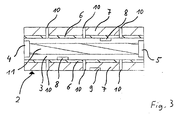
- the sensor 2 according to the invention shown in FIG. 3 has a measuring chamber 3 which is a Carrier medium (not shown) contains.
- the measuring chamber 3 is made of a thermally conductive material surround.
- a laser source 4 with a focus (not shown) attached.
- a detector 5 Located on the opposite end of the measuring chamber 3 a detector 5, which also has a focus (not shown).
- the measuring chamber 3 is in Longitudinal direction essentially limited by temperature control elements 6 in the form of heating wires. These temperature control elements 6 can also be Peltier elements. Between Temperature control elements 6 and the outer wall of the sensor 2 are heat-insulating Layers 7, which are formed by closed chambers filled with air.
- Two Temperature sensors 8 in the form of platinum resistors are inside the measuring chamber 3 to the Tempering elements 6 attached.
- Another temperature sensor 9 is within one of the heat-insulating layers 7 attached to the outer wall of the sensor 2.
- On each long side There are three bores 10 of the sensor 2, which are through the heat-insulating Extend layer 7 and the temperature control element 6. Allow the holes 10 an exchange of the sorbate, but are impermeable to the substrate.
- the laser source 4 and the detector 5 represent a laser measuring section 11
- Tempering elements 6 and the temperature sensors 8 is the temperature of the Carrier medium of the measuring chamber 3 set by means of a control device, not shown.
- the temperature sensor 9 which is in contact with the substrate (not shown here), can measure the temperature of the substrate can be measured.
- the heat insulating layers 7 ensure that a heat transfer from the measuring chamber 3 or the temperature control elements 6 is as low as possible on the substrate takes place. Because the measuring chamber is surrounded by heat-conducting material is achieved that in the shortest possible time a uniform temperature in the measuring chamber 3rd is created.
- the holes 10 provide diffusion channels for the exchange between the Transport medium surrounding the substrate, through which the sorbate molecules into the measuring chamber 3rd are transported, and the carrier medium.
- the bores 10 have a ratio for the longitudinal expansion of the measuring chamber 3 small diameter.
- the laser measuring section 11 can determine the sorbate content in the carrier medium by absorption spectroscopy become.
- the carrier medium with a first laser beam of a wavelength Absorbs maximum of the water molecules contained in the carrier medium and the non-absorbed laser radiation measured with a detector.
- a second Laser beam used a wavelength that is not absorbed by the water molecules. This laser radiation is also measured with a detector. The measured values are is recorded, and the difference in the measured values becomes the water content of the carrier medium calculated.
- the sensor can be inserted into the substrate by means of a measuring probe and thus at any point of the substrate can be used to measure the sorbate content.
- a Embodiment of the measuring probe contain several of these sensors and thus the measurement of Allow sorbates in several levels of the substrate with only one measuring probe.
- the sensor 2 described above is used for this purpose, air being again the carrier medium is chosen.
- the temperature of the carrier medium in the measuring chamber is set so that no saturation of the carrier medium in the measuring chamber is to be expected at the time when the stable final value of the water vapor partial pressure of the carrier medium is present.
- the sensor 2 is inserted into the substrate. Because the water vapor partial pressure is higher in the substrate is as in the carrier medium, again finds a directed transport of water molecules in the measuring chamber 3 instead.
- the water vapor partial pressure is constantly being measured by the laser measuring section 11 recorded depending on the measured time.
- the speed of approach results from the first derivation of the change in the water vapor partial pressure of the Carrier medium over time, which is graphically the increase in the recorded measurement curve equivalent. This means that at least two values of the water vapor partial pressure are measured of the carrier medium, taking into account the time interval between the measured values during the Compensation process the conclusion on the water content in the substrate possible.
- Limiting conditions can be a small surface of the substrate or a small one Molecular mobility of the sorbate in the carrier medium. Basically, therefore, should be as possible care must be taken that the surface of the substrate is so large that it does not Approach speed to the stable final value of the sorbate partial pressure of the carrier medium limited.
- the calibration of the measured values of the sorbate partial pressure in the measuring chamber 3 is carried out as in the A method according to claim 1 by the sorption isotherm.
Landscapes
- Chemical & Material Sciences (AREA)
- Life Sciences & Earth Sciences (AREA)
- Biochemistry (AREA)
- Health & Medical Sciences (AREA)
- Physics & Mathematics (AREA)
- Pathology (AREA)
- Immunology (AREA)
- General Physics & Mathematics (AREA)
- General Health & Medical Sciences (AREA)
- Analytical Chemistry (AREA)
- Biotechnology (AREA)
- Organic Chemistry (AREA)
- Molecular Biology (AREA)
- Microbiology (AREA)
- General Chemical & Material Sciences (AREA)
- Chemical Kinetics & Catalysis (AREA)
- Engineering & Computer Science (AREA)
- Investigating Or Analysing Materials By Optical Means (AREA)
- Investigating Or Analyzing Materials Using Thermal Means (AREA)
- Investigating Or Analyzing Non-Biological Materials By The Use Of Chemical Means (AREA)
Description
Claims (13)
- Verfahren zum Messen von Sorbatgehalten in Substraten, insbesondere von Wassergehalten in Kompostanlagen, bei dem ein Sensor mit einer Meßkammer verwendet wird, die ein Trägermedium enthält, dessen Sorbatpartialdruck bestimmt wird, aus dem unter Berücksichtigung der gemessenen, im wesentlichen konstanten Temperatur des Substrats der Sorbatgehalt des Substrats ermittelt wird, wobei die Temperatur des Trägermediums in der Meßkammer bis zu einem Wert und etwas über diesen hinaus variiert wird, bei welchem sich der Sorbatpartialdruck in der Meßkammer nicht mehr in Abhängigkeit von der Temperatur des Trägermediums ändert, und dieser Sorbatpartialdruck zur Ermittlung des Sorbatgehalts des Substrats herangezogen wird.
- Verfahren nach Anspruch 1, dadurch gekennzeichnet, daß die Temperatur des Trägermediums in der Meßkammer von einem Wert ausgehend, bei dem das Trägermedium mit dem Sorbat gesättigt ist, erhöht wird.
- Verfahren nach Anspruch 1 oder 2, dadurch gekennzeichnet, daß kontinuierlich die Temperatur des Trägermediums in der Meßkammer verändert und der jeweils zugehörige Sorbatpartialdruck des Trägermediums ermittelt wird.
- Verfahren nach einem oder mehreren der vorhergehenden Ansprüche, dadurch gekennzeichnet, daß der Sorbatpartialdruck des Trägermediums unmittelbar gemessen wird.
- Verfahren nach einem oder mehreren der vorhergehenden Ansprüche, dadurch gekennzeichnet, daß der Sorbatpartialdruck des Trägermediums über eine in Abhängigkeit von der Temperatur des Trägermediums aufgenommene Kalibrierungskurve bestimmt wird.
- Verfahren zum Messen von Sorbatgehalten in Substraten, insbesondere von Wassergehalten in Kompostanlagen, bei dem ein Sensor mit einer Meßkammer verwendet wird, die ein Trägermedium enthält, dessen Sorbatpartialdruck bestimmt wird, aus dem unter Berücksichtigung der gemessenen, im wesentlichen konstanten Temperatur des Substrats der Sorbatgehalt des Substrats ermittelt wird, wobei bei im wesentlichen konstanter Temperatur des Trägermediums in der Meßkammer die Geschwindigkeit der Annäherung des Sorbatpartialdrucks des Trägermediums an den stabilen Endwert ermittelt wird und unter Berücksichtigung des bekannten Abhängigkeitsverhältnisses der Annäherungsgeschwindigkeit und des Dampf- bzw. Lösungspartialdrucks des Sorbats im Substrat der Sorbatgehalt des Substrats ermittelt wird.
- Verfahren nach Anspruch 6, dadurch gekennzeichnet, daß die Oberfläche des Substrats so groß gewählt ist, daß sie nicht die Annäherungsgeschwindigkeit limitiert.
- Verfahren nach Anspruch 6 oder 7, dadurch gekennzeichnet, daß die Temperatur des Trägermediums in der Meßkammer so eingestellt wird, daß es bei dem stabilen Endwert nicht gesättigt ist.
- Verfahren nach einem der vorhergehenden Ansprüche, dadurch gekennzeichnet, daß der Sorbatpartialdruck des Trägermediums mit Hilfe einer Messung der Absorption von Laserlicht durch die Sorbatmoleküle bestimmt wird.
- Verfahren nach einem der vorhergehenden Ansprüche, dadurch gekennzeichnet, daß das Trägermedium Luft ist.
- Sensor zur Durchführung des Verfahrens nach Anspruch 1 oder Anspruch 6, gekennzeichnet durch eine über eine Temperiereinheit (6) temperierbare Meßkammer (3), die von einer wärmeisolierenden Schicht (7) umgeben und mit Öffnungen in Form von Bohrungen (10), die im Verhältnis zu dem Volumen der Meßkammer (3) klein sind, versehen ist, sowie durch mindestens einen Temperatursensor (8) zur Messung der Temperatur in der Meßkammer (3), mindestens einen Temperatursensor (9) zur Messung der Temperatur des Substrats und eine Meßeinrichtung (4, 5, 11) zur Bestimmung des Sorbatpartialdruckes.
- Sensor zur Durchführung des Verfahrens nach Anspruch 6, gekennzeichnet durch eine über eine Temperiereinheit (6) temperierbare Meßkammer (3), die von einer wärmeisolierenden Schicht (7) umgeben und mit Öffnungen in Form von Bohrungen (10), die im Verhältnis zu dem Volumen der Meßkammer (3) klein sind, versehen ist, sowie durch mindestens einen Temperatursensor (9) zur Messung der Temperatur des Substrats und eine Meßeinrichtung (4, 5, 11) zur Bestimmung des Sorbatpartialdruckes.
- Sensor nach Anspruch 11 oder 12, dadurch gekennzeichnet, daß die Meßeinrichtung zur Bestimmung des Sorbatpartialdruckes eine Lasermeßstrecke (11) mit einer Laserquelle (4) zur Durchstrahlung der Meßkammer (3) und einem Detektor (5) aufweist.
Applications Claiming Priority (3)
| Application Number | Priority Date | Filing Date | Title |
|---|---|---|---|
| DE19756170 | 1997-12-17 | ||
| DE19756170A DE19756170C2 (de) | 1997-12-17 | 1997-12-17 | Verfahren zum Messen von Sorbatgehalten in Substraten |
| PCT/DE1998/003691 WO1999031502A1 (de) | 1997-12-17 | 1998-12-15 | Verfahren zum messen von sorbatgehalten in substraten |
Publications (2)
| Publication Number | Publication Date |
|---|---|
| EP0968420A1 EP0968420A1 (de) | 2000-01-05 |
| EP0968420B1 true EP0968420B1 (de) | 2002-09-11 |
Family
ID=7852302
Family Applications (1)
| Application Number | Title | Priority Date | Filing Date |
|---|---|---|---|
| EP98966212A Expired - Lifetime EP0968420B1 (de) | 1997-12-17 | 1998-12-15 | Verfahren zum messen von sorbatgehalten in substraten |
Country Status (5)
| Country | Link |
|---|---|
| EP (1) | EP0968420B1 (de) |
| JP (1) | JP3229337B2 (de) |
| AT (1) | ATE224057T1 (de) |
| DE (2) | DE19756170C2 (de) |
| WO (1) | WO1999031502A1 (de) |
Cited By (1)
| Publication number | Priority date | Publication date | Assignee | Title |
|---|---|---|---|---|
| DE10337306A1 (de) * | 2003-08-14 | 2005-03-10 | Il Metronic Sensortechnik Gmbh | Verfahren und Anordnung zur Messung der Wasseraktivität |
Families Citing this family (1)
| Publication number | Priority date | Publication date | Assignee | Title |
|---|---|---|---|---|
| DE102016114918B3 (de) * | 2016-08-11 | 2017-11-02 | Pyro Science Gmbh | Vorrichtung zur Ermittlung der Konzentration eines Analyten in einem gasförmigen Medium |
Family Cites Families (5)
| Publication number | Priority date | Publication date | Assignee | Title |
|---|---|---|---|---|
| US3739629A (en) * | 1971-02-09 | 1973-06-19 | Wescor Inc | Psychrometer and method |
| US4215568A (en) | 1979-05-31 | 1980-08-05 | The United States Of America As Represented By The Secretary Of The Army | Rapid water activity determining device and method |
| DE3634518A1 (de) * | 1986-10-10 | 1988-04-14 | Agfa Gevaert Ag | Verfahren und vorrichtung zur messung der gleichgewichtsfeuchte in einem hygroskopischen, flaechenhaften, beidseitig beschichteten material |
| US4838705A (en) * | 1987-06-08 | 1989-06-13 | Arizona Instrument Corporation | Apparatus for determining percent of moisture |
| DE4345238C2 (de) * | 1993-10-08 | 1997-03-27 | Herhof Umwelttechnik Gmbh | Verfahren zur Ermittlung der Energie, die bei der Kompostierung von organischen Stoffen erzeugt wird |
-
1997
- 1997-12-17 DE DE19756170A patent/DE19756170C2/de not_active Expired - Fee Related
-
1998
- 1998-12-15 WO PCT/DE1998/003691 patent/WO1999031502A1/de not_active Ceased
- 1998-12-15 DE DE59805513T patent/DE59805513D1/de not_active Expired - Fee Related
- 1998-12-15 JP JP53190099A patent/JP3229337B2/ja not_active Expired - Fee Related
- 1998-12-15 AT AT98966212T patent/ATE224057T1/de not_active IP Right Cessation
- 1998-12-15 EP EP98966212A patent/EP0968420B1/de not_active Expired - Lifetime
Cited By (1)
| Publication number | Priority date | Publication date | Assignee | Title |
|---|---|---|---|---|
| DE10337306A1 (de) * | 2003-08-14 | 2005-03-10 | Il Metronic Sensortechnik Gmbh | Verfahren und Anordnung zur Messung der Wasseraktivität |
Also Published As
| Publication number | Publication date |
|---|---|
| ATE224057T1 (de) | 2002-09-15 |
| DE59805513D1 (de) | 2002-10-17 |
| DE19756170C2 (de) | 2001-06-13 |
| DE19756170A1 (de) | 1999-07-01 |
| JP3229337B2 (ja) | 2001-11-19 |
| EP0968420A1 (de) | 2000-01-05 |
| WO1999031502A1 (de) | 1999-06-24 |
| JP2000510600A (ja) | 2000-08-15 |
Similar Documents
| Publication | Publication Date | Title |
|---|---|---|
| DE69007305T2 (de) | Verfahren und Vorrichtung zur Schnellregulierung einer Wandtemperatur. | |
| DE19821321C2 (de) | Verfahren zum Messen der Dampfdurchlaßgeschwindigkeit eines Testmaterials | |
| DE19636673C2 (de) | Verfahren und Vorrichtung zur Messung thermophysikalischer Kennwerte von plattenförmigen Proben, insbesondere von textilen Flächengebilden, unter verschiedenen Meßbedingungen | |
| DE19644575C1 (de) | Verfahren und Vorrichtung zur Messung der Wasserdampfdiffusion durch plattenförmige, poröse Proben, insbesondere durch textile Flächengebilde, unter verschiedenen Meßbedingungen | |
| DE69015838T2 (de) | Verfahren und Vorrichtung zur Messung der Wärmeleitfähigkeit von Gasen. | |
| WO2000044876A2 (de) | Verfahren, gefäss und vorrichtung zur überwachung der stoffwechselaktivität von zellkulturen in flüssigen medien | |
| DE1598927B2 (de) | Verfahren und Vorrichtung zur Analyse von Gasgemischen | |
| DE69514509T2 (de) | Vorrichtung zur flussigkeitsanalyse | |
| DE4142064A1 (de) | Vorrichtung zur messung von gaspermeation | |
| EP0801302A1 (de) | Verfahren zum Ermitteln der absoluten Luftfeuchtigkeit | |
| EP2877842A1 (de) | Kapazitive bodenfeuchtigkeits -messvorrichtung mit porösem zugangselement | |
| DE3638789A1 (de) | Konzentrationssensor sowie konzentrationsregelanordnung | |
| DE1598497C3 (de) | Verfahren zum Messen der Konzentration eines Bestandteiles eines unbekannten Gases und Vorrichtung zur Durchführung dieses Verfahrens | |
| EP0847523B1 (de) | Vorrichtung und verfahren zur entnahme und bestimmung flüchtiger oder gelöster komponenten in flüssigkeiten oder gasen | |
| DE102004006650A1 (de) | Verfahren und Vorrichtung zur Bestimmung der Permeationsrate von Gasen und Dämpfen | |
| DE19756170C2 (de) | Verfahren zum Messen von Sorbatgehalten in Substraten | |
| DE102012206476A1 (de) | Verfahren zum Betrieb eines Sensorelements zur Erfassung eines Sauerstoffanteils eines Gases in einem Messgasraum | |
| DE102012201432A1 (de) | Verfahren zur Steuerung einer Trocknungsphase in einem Sterilisationsprozess sowie Sterilisationsgerät für ein solches Verfahren | |
| DE19858366B4 (de) | Verfahren zum Herstellen und Abfüllen von quantitativ definierbaren Gasgemischen mit Komponenten in sehr geringer Konzentration | |
| CH627846A5 (de) | Verfahren zur differenzthermoanalyse. | |
| DE60313521T2 (de) | Verfahren zur Messung der effektiven Temperatur in einem abgeschlossenen Behälter | |
| DE1604292A1 (de) | Vorrichtung zur Regulierung der Feuchte in einer Klimakammer und Verfahren zu ihrem Betrieb | |
| DE102016119079A1 (de) | Verfahren und vorrichtung zum kalibrieren eines feuchtesensors | |
| DE102009000391A1 (de) | Verfahren und Vorrichtung zur Erzeugung komplexer Gasgemische | |
| DE102014223528B4 (de) | Verfahren zur Bestimmung der Porengrößenverteilung eines porösen Materials |
Legal Events
| Date | Code | Title | Description |
|---|---|---|---|
| PUAI | Public reference made under article 153(3) epc to a published international application that has entered the european phase |
Free format text: ORIGINAL CODE: 0009012 |
|
| 17P | Request for examination filed |
Effective date: 19990813 |
|
| AK | Designated contracting states |
Kind code of ref document: A1 Designated state(s): AT BE CH DE ES FR GB IT LI NL SE |
|
| RIN1 | Information on inventor provided before grant (corrected) |
Inventor name: IMKENBERG, FRANK Inventor name: SCHULZ, OLAF Inventor name: KICKELHAIN, JOERG |
|
| GRAG | Despatch of communication of intention to grant |
Free format text: ORIGINAL CODE: EPIDOS AGRA |
|
| GRAG | Despatch of communication of intention to grant |
Free format text: ORIGINAL CODE: EPIDOS AGRA |
|
| GRAH | Despatch of communication of intention to grant a patent |
Free format text: ORIGINAL CODE: EPIDOS IGRA |
|
| 17Q | First examination report despatched |
Effective date: 20020308 |
|
| GRAH | Despatch of communication of intention to grant a patent |
Free format text: ORIGINAL CODE: EPIDOS IGRA |
|
| GRAA | (expected) grant |
Free format text: ORIGINAL CODE: 0009210 |
|
| AK | Designated contracting states |
Kind code of ref document: B1 Designated state(s): AT BE CH DE ES FR GB IT LI NL SE |
|
| PG25 | Lapsed in a contracting state [announced via postgrant information from national office to epo] |
Ref country code: NL Free format text: LAPSE BECAUSE OF FAILURE TO SUBMIT A TRANSLATION OF THE DESCRIPTION OR TO PAY THE FEE WITHIN THE PRESCRIBED TIME-LIMIT Effective date: 20020911 Ref country code: IT Free format text: LAPSE BECAUSE OF FAILURE TO SUBMIT A TRANSLATION OF THE DESCRIPTION OR TO PAY THE FEE WITHIN THE PRESCRIBED TIME-LIMIT;WARNING: LAPSES OF ITALIAN PATENTS WITH EFFECTIVE DATE BEFORE 2007 MAY HAVE OCCURRED AT ANY TIME BEFORE 2007. THE CORRECT EFFECTIVE DATE MAY BE DIFFERENT FROM THE ONE RECORDED. Effective date: 20020911 |
|
| REF | Corresponds to: |
Ref document number: 224057 Country of ref document: AT Date of ref document: 20020915 Kind code of ref document: T |
|
| REG | Reference to a national code |
Ref country code: GB Ref legal event code: FG4D Free format text: NOT ENGLISH |
|
| REG | Reference to a national code |
Ref country code: CH Ref legal event code: EP |
|
| REF | Corresponds to: |
Ref document number: 59805513 Country of ref document: DE Date of ref document: 20021017 |
|
| GBT | Gb: translation of ep patent filed (gb section 77(6)(a)/1977) |
Effective date: 20021101 |
|
| PG25 | Lapsed in a contracting state [announced via postgrant information from national office to epo] |
Ref country code: LI Free format text: LAPSE BECAUSE OF NON-PAYMENT OF DUE FEES Effective date: 20021231 Ref country code: CH Free format text: LAPSE BECAUSE OF NON-PAYMENT OF DUE FEES Effective date: 20021231 Ref country code: BE Free format text: LAPSE BECAUSE OF NON-PAYMENT OF DUE FEES Effective date: 20021231 |
|
| NLV1 | Nl: lapsed or annulled due to failure to fulfill the requirements of art. 29p and 29m of the patents act | ||
| PG25 | Lapsed in a contracting state [announced via postgrant information from national office to epo] |
Ref country code: ES Free format text: LAPSE BECAUSE OF FAILURE TO SUBMIT A TRANSLATION OF THE DESCRIPTION OR TO PAY THE FEE WITHIN THE PRESCRIBED TIME-LIMIT Effective date: 20030328 |
|
| ET | Fr: translation filed | ||
| BERE | Be: lapsed |
Owner name: *LPKF LASER & ELECTRONICS A.G. Effective date: 20021231 |
|
| PLBE | No opposition filed within time limit |
Free format text: ORIGINAL CODE: 0009261 |
|
| STAA | Information on the status of an ep patent application or granted ep patent |
Free format text: STATUS: NO OPPOSITION FILED WITHIN TIME LIMIT |
|
| REG | Reference to a national code |
Ref country code: CH Ref legal event code: PL |
|
| 26N | No opposition filed |
Effective date: 20030612 |
|
| PGFP | Annual fee paid to national office [announced via postgrant information from national office to epo] |
Ref country code: GB Payment date: 20031121 Year of fee payment: 6 |
|
| PGFP | Annual fee paid to national office [announced via postgrant information from national office to epo] |
Ref country code: FR Payment date: 20031218 Year of fee payment: 6 |
|
| PGFP | Annual fee paid to national office [announced via postgrant information from national office to epo] |
Ref country code: AT Payment date: 20031223 Year of fee payment: 6 |
|
| PGFP | Annual fee paid to national office [announced via postgrant information from national office to epo] |
Ref country code: SE Payment date: 20031229 Year of fee payment: 6 |
|
| PGFP | Annual fee paid to national office [announced via postgrant information from national office to epo] |
Ref country code: DE Payment date: 20040105 Year of fee payment: 6 |
|
| PG25 | Lapsed in a contracting state [announced via postgrant information from national office to epo] |
Ref country code: GB Free format text: LAPSE BECAUSE OF NON-PAYMENT OF DUE FEES Effective date: 20041215 Ref country code: AT Free format text: LAPSE BECAUSE OF NON-PAYMENT OF DUE FEES Effective date: 20041215 |
|
| PG25 | Lapsed in a contracting state [announced via postgrant information from national office to epo] |
Ref country code: SE Free format text: LAPSE BECAUSE OF NON-PAYMENT OF DUE FEES Effective date: 20041216 |
|
| PG25 | Lapsed in a contracting state [announced via postgrant information from national office to epo] |
Ref country code: DE Free format text: LAPSE BECAUSE OF NON-PAYMENT OF DUE FEES Effective date: 20050701 |
|
| EUG | Se: european patent has lapsed | ||
| GBPC | Gb: european patent ceased through non-payment of renewal fee |
Effective date: 20041215 |
|
| PG25 | Lapsed in a contracting state [announced via postgrant information from national office to epo] |
Ref country code: FR Free format text: LAPSE BECAUSE OF NON-PAYMENT OF DUE FEES Effective date: 20050831 |
|
| REG | Reference to a national code |
Ref country code: FR Ref legal event code: ST |