EP0963728B1 - Hand soap dispenser with usage related data collection and display capabilities - Google Patents
Hand soap dispenser with usage related data collection and display capabilities Download PDFInfo
- Publication number
- EP0963728B1 EP0963728B1 EP99111299A EP99111299A EP0963728B1 EP 0963728 B1 EP0963728 B1 EP 0963728B1 EP 99111299 A EP99111299 A EP 99111299A EP 99111299 A EP99111299 A EP 99111299A EP 0963728 B1 EP0963728 B1 EP 0963728B1
- Authority
- EP
- European Patent Office
- Prior art keywords
- dispenser
- data
- usage
- block
- data output
- Prior art date
- Legal status (The legal status is an assumption and is not a legal conclusion. Google has not performed a legal analysis and makes no representation as to the accuracy of the status listed.)
- Expired - Lifetime
Links
- 239000000344 soap Substances 0.000 title claims description 57
- 238000013480 data collection Methods 0.000 title description 6
- 239000007788 liquid Substances 0.000 claims description 25
- 239000012263 liquid product Substances 0.000 claims description 11
- 230000004044 response Effects 0.000 claims description 10
- 230000003213 activating effect Effects 0.000 claims description 9
- 238000009825 accumulation Methods 0.000 claims description 8
- 238000013479 data entry Methods 0.000 claims description 5
- 230000007958 sleep Effects 0.000 description 16
- 239000000126 substance Substances 0.000 description 16
- 230000006835 compression Effects 0.000 description 12
- 238000007906 compression Methods 0.000 description 12
- 239000012528 membrane Substances 0.000 description 10
- 239000000463 material Substances 0.000 description 9
- 238000005406 washing Methods 0.000 description 9
- 230000004913 activation Effects 0.000 description 7
- 238000001994 activation Methods 0.000 description 7
- 239000011344 liquid material Substances 0.000 description 7
- -1 polyethylene Polymers 0.000 description 7
- 238000010586 diagram Methods 0.000 description 5
- 238000009434 installation Methods 0.000 description 4
- 239000000047 product Substances 0.000 description 4
- 229920001169 thermoplastic Polymers 0.000 description 4
- 239000004416 thermosoftening plastic Substances 0.000 description 4
- 239000004698 Polyethylene Substances 0.000 description 3
- 239000004743 Polypropylene Substances 0.000 description 3
- 239000004793 Polystyrene Substances 0.000 description 3
- 239000002131 composite material Substances 0.000 description 3
- 230000006870 function Effects 0.000 description 3
- 230000036541 health Effects 0.000 description 3
- 238000007726 management method Methods 0.000 description 3
- 238000012544 monitoring process Methods 0.000 description 3
- 229920003023 plastic Polymers 0.000 description 3
- 239000004033 plastic Substances 0.000 description 3
- 229920000573 polyethylene Polymers 0.000 description 3
- 229920001155 polypropylene Polymers 0.000 description 3
- 229920002223 polystyrene Polymers 0.000 description 3
- 230000000007 visual effect Effects 0.000 description 3
- 229920000122 acrylonitrile butadiene styrene Polymers 0.000 description 2
- 239000011111 cardboard Substances 0.000 description 2
- 230000000994 depressogenic effect Effects 0.000 description 2
- 238000013461 design Methods 0.000 description 2
- 239000000645 desinfectant Substances 0.000 description 2
- 239000010408 film Substances 0.000 description 2
- 235000013305 food Nutrition 0.000 description 2
- 239000011521 glass Substances 0.000 description 2
- 230000003993 interaction Effects 0.000 description 2
- 238000004519 manufacturing process Methods 0.000 description 2
- 230000007246 mechanism Effects 0.000 description 2
- 238000002360 preparation method Methods 0.000 description 2
- 238000011012 sanitization Methods 0.000 description 2
- 239000007787 solid Substances 0.000 description 2
- 238000003860 storage Methods 0.000 description 2
- 229920001187 thermosetting polymer Polymers 0.000 description 2
- 239000004677 Nylon Substances 0.000 description 1
- 239000004676 acrylonitrile butadiene styrene Substances 0.000 description 1
- 239000012190 activator Substances 0.000 description 1
- 229910052782 aluminium Inorganic materials 0.000 description 1
- XAGFODPZIPBFFR-UHFFFAOYSA-N aluminium Chemical compound [Al] XAGFODPZIPBFFR-UHFFFAOYSA-N 0.000 description 1
- 230000003466 anti-cipated effect Effects 0.000 description 1
- 238000013459 approach Methods 0.000 description 1
- 238000000071 blow moulding Methods 0.000 description 1
- 230000001186 cumulative effect Effects 0.000 description 1
- 230000000881 depressing effect Effects 0.000 description 1
- 238000007599 discharging Methods 0.000 description 1
- 238000005516 engineering process Methods 0.000 description 1
- 239000003822 epoxy resin Substances 0.000 description 1
- 235000013410 fast food Nutrition 0.000 description 1
- LNEPOXFFQSENCJ-UHFFFAOYSA-N haloperidol Chemical compound C1CC(O)(C=2C=CC(Cl)=CC=2)CCN1CCCC(=O)C1=CC=C(F)C=C1 LNEPOXFFQSENCJ-UHFFFAOYSA-N 0.000 description 1
- 238000001746 injection moulding Methods 0.000 description 1
- 238000003780 insertion Methods 0.000 description 1
- 230000037431 insertion Effects 0.000 description 1
- 238000012423 maintenance Methods 0.000 description 1
- 229910052751 metal Inorganic materials 0.000 description 1
- 239000007769 metal material Substances 0.000 description 1
- 239000011104 metalized film Substances 0.000 description 1
- 239000011140 metalized polyester Substances 0.000 description 1
- 238000000034 method Methods 0.000 description 1
- 239000000203 mixture Substances 0.000 description 1
- 229920001778 nylon Polymers 0.000 description 1
- 239000000123 paper Substances 0.000 description 1
- 239000011087 paperboard Substances 0.000 description 1
- 229920000647 polyepoxide Polymers 0.000 description 1
- 229920000139 polyethylene terephthalate Polymers 0.000 description 1
- 239000005020 polyethylene terephthalate Substances 0.000 description 1
- 239000004800 polyvinyl chloride Substances 0.000 description 1
- 229920000915 polyvinyl chloride Polymers 0.000 description 1
- 238000003825 pressing Methods 0.000 description 1
- 230000001737 promoting effect Effects 0.000 description 1
- 238000005086 pumping Methods 0.000 description 1
- 230000001105 regulatory effect Effects 0.000 description 1
- 229920005989 resin Polymers 0.000 description 1
- 239000011347 resin Substances 0.000 description 1
- 238000003856 thermoforming Methods 0.000 description 1
- 229920002803 thermoplastic polyurethane Polymers 0.000 description 1
- XLYOFNOQVPJJNP-UHFFFAOYSA-N water Substances O XLYOFNOQVPJJNP-UHFFFAOYSA-N 0.000 description 1
Images









Classifications
-
- A—HUMAN NECESSITIES
- A47—FURNITURE; DOMESTIC ARTICLES OR APPLIANCES; COFFEE MILLS; SPICE MILLS; SUCTION CLEANERS IN GENERAL
- A47K—SANITARY EQUIPMENT NOT OTHERWISE PROVIDED FOR; TOILET ACCESSORIES
- A47K5/00—Holders or dispensers for soap, toothpaste, or the like
- A47K5/06—Dispensers for soap
- A47K5/12—Dispensers for soap for liquid or pasty soap
- A47K5/1202—Dispensers for soap for liquid or pasty soap dispensing dosed volume
- A47K5/1208—Dispensers for soap for liquid or pasty soap dispensing dosed volume by means of a flexible dispensing chamber
-
- A—HUMAN NECESSITIES
- A47—FURNITURE; DOMESTIC ARTICLES OR APPLIANCES; COFFEE MILLS; SPICE MILLS; SUCTION CLEANERS IN GENERAL
- A47K—SANITARY EQUIPMENT NOT OTHERWISE PROVIDED FOR; TOILET ACCESSORIES
- A47K5/00—Holders or dispensers for soap, toothpaste, or the like
- A47K5/06—Dispensers for soap
- A47K5/12—Dispensers for soap for liquid or pasty soap
- A47K5/1217—Electrical control means for the dispensing mechanism
Definitions
- the invention is directed generally to usage data competent dispensers for liquid materials used in personal sanitary practices including hand soap or sanitizer compositions. More specifically, the invention is directed to a dispenser for a liquid product that includes means for usage monitoring and usage data collection. The invention is directed specifically to assisting in monitoring or enforcing compliance of personnel with hygiene control regulations, particularly in the health care and food preparation industries using a system that collects usage data and presents the data in a useful and accessible form.
- the prior art describes commercially available hand soap dispensers. Such dispensers are generally wall mounted and include a cover which is usually hinged to the mounting base.
- the dispenser includes a disposable liquid product container such as a cartridge or flexible bag.
- the soap is frequently available in valved disposable container that dispenses the product upon user input.
- U.S. Patent No. 5,248,066, issued to Olson et al describes a typical hand soap dispenser of the type which would be useful with the present invention.
- Other hand soap dispensers are disclosed in U.S. Patents No. 4,765,515 issued to Lippman ; U.S. Patents No. 4,921,131 issued to Binderbauer et al ; U.S. Patents No.
- U.S. Patent No. 4,265,370 issued to Reilly
- U.S. Patent No. 3,119,557 discloses a counter suitable for detecting applications of spray paint.
- Morrone U.S. Patent No. 3,606,084 discloses a counter for detecting the number of drinks dispensed.
- Sears U.S. Patent No. 5,625,659 , discloses a device which can count total usage of a given hand soap dispenser. This device attempts to resolve usage of individual employees by selectively disabling the counter during periods ascribed to multiple inputs or usages by a single individual.
- Usage counters can fail to account for situations in which data is missed during periods of no data accumulation in disabled periods. Further, the mere presence of hand soap dispensers which are capable of dispensing a predetermined amount of soap is inadequate in assuring compliance with hand washing regulations. Even the use of dispensers which are capable of tracking total use can fail to ensure compliance since they are incapable of resolving all usage by individual employees. Consequently, there are examples in the art of various attempts to force compliance with the hand washing regulations required for compliance with hygiene guidelines.
- GB-A-2 298 851 relates to a soap dispenser according to the preamble of claim 1.
- the invention provides a dispenser for a liquid product used in personal sanitary practice, as defined by the appended claims.
- the invention provides a usage competent data collecting hand soap dispenser which can be used as part of an overall hygiene compliance program.
- the dispenser can monitor usage by each individual employee and may also monitor total usage without accounting for individual usage data.
- a self-contained battery operated keypad/display module is used that is attached to a standard hand soap dispenser.
- An employee can enter a unique personal ID code and then can activate the dispenser within a predetermined time period in order for the usage to be properly recorded.
- the dispenser then counts the usage by the employee and discriminates that use from the use of previous and subsequent employee users.
- the displayed data can include the employee identification, the current employee usage count per day, per week, etc., employee inputs per use, the total usage count, frequency of use (per individual or per period), dispenser operation data, etc.
- a push button can be provided which triggers the data display.
- a supervisor can be enable to retrieve all data including employee counts via a special code input. Such data can be taken in the form of an electronic record or file, a print-out or as a visual display.
- the device of the invention is designed for use with existing hand soap dispenser technology and can be incorporated into new units during OEM manufacture or can be installed in existing units during maintenance.
- the unit cost is low enough to permit its installation on or its use in all dispensers in a facility.
- the design minimises the interaction necessary to ensure compliance and as such reduce potential abuse or avoidance.
- This device does not require employees to wear tags or other identification devices. There are no parts which can be lost or stolen, and there are no special installation requirements.
- the device of the invention involves a hand soap dispenser having an integral apparatus for electronically measuring the usage of a dispenser which is actuated by pressure on an activating member which, in turn, triggers the discharge of material from the dispenser upon movement of the activating member from a starting position to a dispensing position.
- the apparatus includes a counting apparatus carried by the dispenser; a numerical display, numerical storage and data manipulation capability and a data entry keypad electrically connected to said counting apparatus; a movable switch actuator operative with a switch receptacle communicative with said counting apparatus.
- Usage can be monitored also in terms of total requests for product, specifically liquid product (soap) use or consumption (per input, per use or per period). Soap is dispensed in response to a pressure input.
- the design minimises the interaction necessary to ensure compliance and as such reduce potential abuse or avoidance.
- This device does not require employees to wear tags or other identification devices. There are no parts which can be lost or stolen, and there are no special installation requirements.
- the dispenser of the invention may also involve a hand soap dispenser having an integral apparatus for electronically measuring the usage of a dispenser which is actuated by pressure on an activating member which, in turn, triggers the discharge of material from the dispenser upon movement of the activating member from a starting position to a dispensing position.
- the apparatus includes a counting apparatus carried by the dispenser, numerical storage and data manipulation means and a movable switch actuator operative with a switch receptacle communicative with said counting apparatus.
- Said counting apparatus counting and accumulating one switch closure upon the activating member moving into a dispensing position so as to move said switch activator into a closed position with said switch receptacle and wherein a single use is determined to have occurred if a predetermined amount of time has elapsed since the previous activation.
- the dispenser collects input and then the counter counts all switch closures but is able to discriminate between subsequent users and can calculate total usage (the number of people using the device), total soap consumption, soap consumption per person or use, frequency of switch closure in a single use by one individual, or other such data.
- the electronic counters can be calibrated and programmed to generate any data set useful for site managers.
- the data is collected from an input comprising each application of pressure on a lever or bar that compresses a portion of the dispensing means producing a volume of the liquid. In typical uses the lever or bar is compressed two three or more times.
- the housing can be a removable housing placed directly over and enclosing, partially or completely, the internal working components of the dispenser.
- the housing can simply be a removable or replaceable shelf that can be placed over an intact dispenser using removable housing attachments.
- the housing, and the important structural components of the dispenser can be molded of a variety of useful materials.
- Thermoplastic and thermosetting or composite materials can be used to make the housing.
- the housing can be made from metallic elements, however, polymeric thermoplastic or thermosetting (composite) materials are preferred.
- the housing, dispenser components, etc. can be molded in one or more unitary pieces through the use of conventional plastic injection molding, thermoforming, blow molding, etc. techniques.
- a variety of plastic polymeric materials can be used in fabricating the holder including polyethylene, polypropylene, polystyrene, ABS plastics, urethane resins, epoxy resins, nylon resins and others.
- Preferred plastic materials include styrenic materials such as polystyrene or ABS, polyethylene, and polypropylene.
- the dispenser contains both a source of a liquid chemical and the means to dispense it.
- the chemical can be provided in the form of a cartridge or flexible bag containing the chemical.
- the cartridge or flexible bag has a dispensing port from which the liquid chemical can be delivered to the user.
- Such a port can work cooperatively with dispensing means actuated by the user.
- the dispensing means can be a simple mechanical valve or pump, an electrical generated pump, or any other known device that can produce a useful volume of the liquid chemical.
- the amount of soap can range from about 0.2 to about 5 milliliters, preferably about 0.5 to 3 milliliters in volume.
- a preferred means of delivering the liquid from the container dispenser comprises a flexible compressible tube, attached to a flexible container, that can act as a pump portion.
- a flexible compressible tube When used, the user compresses a bar or other feature on the front of the housing. Such compression forces a compressing surface against the flexible tube.
- the flexible tube contains internal valve means that prevent backflow of the liquid from the tube into the bag or cartridge. The compression of the tube and the valves cooperate to ensure that the liquid is expressed from the flexible tube into the hands of the user.
- the flexible tube is typically positioned in the housing in a location convenient to the location of the housing portion that triggers dispensing of the liquid.
- the shell or case also comprises a containment means or holding means for the chemical.
- a holding means can comprise a reservoir or chamber that can contain a sufficient quantity of chemical to satisfy requirements for a period of use of the chemical.
- a period of use can comprise one day, two days, a week, two weeks or a month or more of use. The period of use depends on the type of chemical, its shelf life and rate of use.
- Such holding means can comprise a volume within the case of at least 50 ml, preferably 100 ml to 5 liters of volume. Most preferably, the volume of the holding means is about 150 to 1000 ml for reasons of convenience and ease of insertion.
- the chemical is encased in a flexible bag or cartridge that can be inserted into the holding means of the case.
- a cartridge can have any arbitrary shape. Useful shapes include cylinders, cubes, rectangular solids, triangular solids, cones, truncated cones, bottle shapes, or any arbitrary shape designed to fit particularly in a holding means of a particular dispenser. Such bags or cartridge shapes can have unique shapes to ensure that a cartridge is designed to fit in a particular dispenser and intended to dispense a particular chemical.
- Such bags or cartridges can be made from cardboard, paperboard, etc.; metallic substances such as aluminum, metallized polyester; thermoplastic films such as polyethylene, polypropylene, polyethylene terephthalate, polyvinyl chloride, polystyrene, a thermoplastic composite material, etc.
- Such bags or cartridges can be sized as discussed above to contain a sufficient volume or weight of chemical to satisfy requirements for a given period.
- the liquid chemical can be provided in the form of the contents of a flexible bag.
- the contents can be removed by applying pressure to the bag or by pumping liquid from a tube attached to the bag.
- the bag or cartridge of the invention is typically equipped with a closed chemical port.
- the port comprises a flexible tube from which the liquid can be dispensed.
- the bag or cartridge is designed to deliver the chemical through the port after the closed port is opened.
- the port can be opened by removal of a closing membrane, piercing a membrane, removing a screw cap, or separating any of a variety of conventional closing means from the cartridge portal.
- the portal is covered by a cap or a paper, film, metallized film, or other thin piercable web closure.
- the opening means is shaped and configured to provide a sufficient aperture in the web closure to permit a sufficient volume of the chemical to be dispensed for appropriate operation.
- the opening means can be configured to remove the portion of the opening means away from the portal to ensure that the opening does not become plugged.
- a bag or cartridge can be loosely fitted into the holding means of the case or can be shaped to conform exactly to the exterior shape of the cartridge.
- the holding means can also include a lid or cover such that the cartridge is fully enclosed by the case and cover. Such a cover can be removable or can be hingedly attached or slidingly attached to the case.
- the dispenser of the invention involves means to dispense a liquid product such as a sanitizer material or a hand soap.
- a liquid product such as a sanitizer material or a hand soap.
- Such means includes a movable surface or pressure plate which compresses a soap delivery tube, thereby expressing hand soap into the user's hand.
- the counting means of the invention is operably connected to the dispenser means operated by the user to dispense the liquid.
- a membrane pressure switch which is activated each time the delivery tube is compressed.
- the device includes a counting apparatus which is connected electrically to the pressure switch. Data about every contact between the user (i.e.) each pressure plate depression (i.e. every pressure switch closing) is counted or captured by the counting apparatus.
- a membrane pressure switch which is activated each time the delivery tube is compressed.
- the device includes a counting apparatus which is connected electrically to the pressure switch. Data about every contact between the user (i.e.) each pressure plate depression (i.e. every pressure switch closing) is counted or captured by the counting apparatus. While the device of the invention records all pressure switch activations, that data can be manipulated in several different ways to generate several different pieces of information. In this particular embodiment, the device maintains a cumulative sum total of dispenser usage, average activations per use and number of uses. This data could comprise total number of pressure plate depressions or alternatively could comprise total volume of hand soap dispensed
- An embodiment of the invention includes a numerical display capable of showing any data set generated by the device. Each employee's total usage counts can be displayed individually or in a data set of all employees. In addition, the display could also provide total daily soap usage individual soap usage, etc. Preferably, an LCD display with four to six digits is used to conserve energy. In an alternative embodiment, the invention can comprise an internal display, accessible via a supervisor's key. In this situation, only total-usage figures could be displayed.
- the dispenser of the invention includes a keypad suitable for entering data including employee ID codes and supervisory codes as well.
- this keypad would have four buttons, bearing the numbers one through four. This limitation is due to the typical size of hand soap dispensers. Four buttons is the most which fit easily onto the front of a dispenser while retaining adequate button size. Since ID codes could theoretically be of any length, four numbers would provide a sufficient number of unique IDs.
- This keypad would be used for an employee to enter his/her own ID code in order to obtain a dispensation of hand soap.
- the keypad would also be used by supervisors in order to obtain total usage figures, as well as usage counts broken down by individual employees.
- the counting apparatus of the presently claimed invention registers all switch closures, regardless of frequency. It is necessary, however, to be able to distinguish between multiple closures caused by a single employee requesting additional hand soap and multiple closures caused by multiple employees each making in short succession single requests for soap.
- the invention includes a microprocessor.
- This microprocessor would permit the generation of several different pieces of data. First, it would determine the purpose of multiple switch closures and would act accordingly. In general, multiple switch closures are assumed to be the work of a single employee if less than a predetermined amount of time has elapsed since the previous activation.
- the invention involves data collection or manipulation systems that monitors the usage of preferably a liquid product dispenser or a hand soap dispenser to report total number of hand soap doses dispensed between supervisor reset operations of the data collection system.
- the hand soap dispenser determines the trends of usage including average number of uses, liquid doses dispensed per use, total volume of hand soap dispensed during a use, volume of hand soap dispensed between resets, volume of soap dispensed per unit time and other similar data.
- the dispenser uses a compression switch sensor to detect the user input such as pressure on a dispensing bar in the dispenser.
- the dispenser can be placed into a data acquisition mode by inputting on the key pad a code causing the microprocessor to return data to the supervisor in response to such an appropriate input.
- the supervisor would input a code into the four position key pay of the dispenser.
- the dispenser readout or display would display nothing.
- the supervisor at that point could hit the dispensing lever or any data input button with a single impact and the display would read total number of all inputs, pushes or doses recorded by the dispenser electronics.
- Such data would record a "hit" each time a user contacted the dispenser with a single push.
- the average number of touches or pushes per user would display on the readout.
- a third press of the push button or input would cause the dispenser to display the number of users inputting to the machine.
- the last input would cause the microprocessor to return to its data accumulation mode.
- a data accumulation mode of the dispenser counts data inputs from the users.
- a data acquisition mode permits the supervisor or other management personnel to obtain the usage data accumulated or calculated by the dispenser in a printed, visual or electronic format.
- the simple counting device of this embodiment consists of a compression switch which can be compressed as a user compresses the bar that dispenses the liquid material such as liquid hand soap from a dispensing tube in the dispenser.
- Microchip PIC16C923 microcontroller can be installed with a replaceable battery and a user interface module is installed in the dispenser.
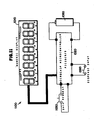
- the interface module consists of a numeric display and a push button switch (see Figures 10-11 ).
- the compression switch can be located behind the delivery tube of the liquid material dispensed. The switch is connected to an input of the microcontroller which counts all inputs.
- An input consists of a compression of the delivery tube by a user causing the contacts of the switch to close notifying the microcontroller that a single dose of hand soap was dispensed in response to a single input or compression of the dispenser components by a user.
- the microprocessor recognizes multiple doses within a short period of time and counts each dose but recognizes that the multiple doses involves a single use and a single user of the dispenser.
- the user interface module data can be collected by a user interface module.
- the count data can be displayed on the numeric display of the dispenser or read to the user interface module and its memory or printed on a printer attached or included in the module.
- a push button would be provided which permits the user to request a display of personalized use data.
- the device would reset to 0 for accumulation of new data after accumulated data is transferred in useful formats.
- the device will contain the following components.
- the dispensing device contains a stationary switch mounted behind the delivery tube which can be compressed as the user obtains a dose of the liquid material. The placement of the switch would be such that the switch would go from a normally open position to a normally closed position whenever the delivery tube is compressed.
- the microprocessor controller monitor is reopened or closed status of the switch and in response to the switches manipulates data according to programmed instructions within the microprocessor that maintains a running total of switch closures, a running total of switch closures per use and based on these data calculates other important usage information.
- the dispenser needs calibration to establish the volume of liquid dispensed per dose. The condition for determining if a single use had occurred will be any two or more switch closures within a ten second interval.
- the dispenser would have a push button with two functions; a first function acts as a request or prompt with the delivery of stored data to a supervisor, and secondly, acts as a reset to zero out old totals and to begin accumulating new data at the end of a week, month, quarter, six month period or annually. Reset occurs when the push button is pressed and held for two or more seconds or other known reset mode well known to those of ordinary skill in the art.
- the dispenser could contain a visual read out such as a LED, LCD or other display to display usage data. The display could alternate between a calculated average of switch closures per use, total number of switch closures, a quotient of closures divided by calculated average of switch closures or any other data generated by the microprocessor.
- the invention involves data collection or manipulation systems that monitors the usage of preferably a liquid product dispenser or a hand soap dispenser to report total number of hand soap doses dispensed between supervisor reset operations of the data collection system.
- the dispenser uses a compression switch sensor to detect the user input such as pressure on a dispensing bar in the dispenser.
- the simple counting device of the alternative embodiment consists of a compression switch which can be compressed as a user compresses the bar that dispenses the liquid material such as liquid hand soap from a dispensing tube in the dispenser.
- Microchip PIC16C923 microcontroller can be installed with a replaceable battery.
- the compression switch can located behind the delivery tube of the liquid material dispensed.
- the switch is connected to an input of the microcontroller which counts all inputs.
- An input consists of a compression of the delivery tube by a user causing the contacts of the switch to close notifying the microcontroller that a single dose of hand soap was dispensed in response to a single input or compression of the dispenser components by a user.
- the microprocessor recognizes multiple doses within a short period of time and counts each dose but recognizes that the multiple doses involves a single use and a single user of the dispenser.
- the dispensing device contains a stationary switch mounted behind the delivery tube which can be compressed as the user obtains a dose of the liquid material. The placement of the switch would be such that the switch would go from a normally open position to a normally closed position whenever the delivery tube is compressed.
- the microprocessor controller monitors the reopened or closed status of the switch and in response to the switches manipulates data according to programmed instructions within the microprocessor that maintains a running total of switch closures.
- FIG 1 is a perspective view of a dispenser 100. This figure generally shows a housing 110 along with several key components. These components include a four-button keypad 120 for inputting data. Also shown is a sight-glass window 130, permitting easy assessment of the quantity of soap remaining. Pushbar 140 serves to activate the electronics contained within the dispenser and, of course, permits the dispensing of soap.
- the last feature seen in Figure 1 is the LCD display 150. This is generally a four- to six-digit LCD display.
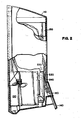
- FIG. 2 is a cutaway side elevation of the dispenser shown in Figure 1 . This shows different views of some of the same features found in Figure 1 . Specifically, the housing 110 is seen, along with a side view of a keypad 120 and the LCD display 150. New features shown in Figure 2 include a power supply 210, which in this instance is a 9-volt battery. Also seen here is the cooperative relationship among the dispensing tube 220, membrane switch 230 and the pushbar hinge mechanism 240, which is actually shown in phantom. When pushbar 140 is depressed, moving according to the hinged mechanism 240, two things happen simultaneously. The dispensing tube 220 is pinched, which provides for the dispensing of a predetermined amount of soap. Also, membrane switch 230 registers the dispensing.
- FIG 3 is a block diagram 300 of the dispenser of Figure 1 . This shows the general components of the invention. Previously discussed is the keypad 120, LCD display 150, power supply 210 and pushbar switch or membrane switch 230. This figure shows how each of these general devices communicate with the processor 320 which is mounted on a circuit board 310.
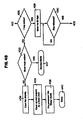
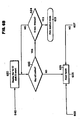
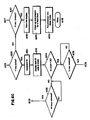
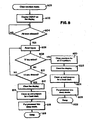
- FIGS. 4-8 combined show a detailed flow sheet 400. These flow charts represent the software necessary to control the processor of the first embodiment. Each figure will be described in detail.
- Figure 4A shows the beginning of the main flow chart.
- Flow starts in block 402 and then proceeds to block 404 which is an initialization step.
- "Init" is displayed on the LCD display in block 406.
- Control then passes to block 408 which instructs the device to read the inputs.
- Block 410 is a decision block where the device decides if there are any active inputs. If yes, control passes to the bottom of Figure 4A to point 401. If not control passes to decision block 412 which determines if there has been a ten second timeout. If not, control passes back up to block 408 where inputs are read again. If yes, control passes to block 414 where the display is cleared. Control then passes to block 416 where the processor is put into sleep mode.
- Figure 4B begins at point 401 where control then passes to decision block 426 where the device determines if a single key is active. If not, control passes to decision block 432 where the device determines if the mode keys are active. If yes, control passes to block 407 which describes the service mode which is described in detail in Figure 5 . If not, control passes to block 434 where the display is cleared. Flow continues to block 436 where the device cleans up and prepares for a fresh start. In block 438 the processor is put into sleep mode as indicated by block 440. Now returning to decision block 426, if a single key is active, control passes to block 428 where the device saves the first ID digit, then to block 430 where the device determines if the key has been released. If yes, control continues to point 403, which is continued on Figure 4C .
- Figure 4C begins at control point 403 and is continued from the previous figure.
- Control passes to decision block 442 where the device determines if there has been a ten second timeout. If yes, control passes to block 460 where the display is cleared and then passes to block 462 where the device prepares for a fresh start and finally passes to block 464 where the processor is put into sleep mode as denoted by block 466. If there has not been a ten second timeout in decision block 442, control passes to decision block 444 where the device determines if a second ID digit has been entered. If yes, the device saves the second ID digit in block 446.
- Block 448 is a decision block where the device determines if the key has been released.
- Figure 4D is the fourth and final portion of the main flow sheet. From point 405 control passes to decision block 476 where the device determines if there is a ten second timeout. If yes, control passes to block 478 where the display is cleared. The device then cleans up and prepares for a fresh start in block 480. The processor is put into a sleep mode at 482 and sleeps as shown at block 484.
- Figure 5 shows the service mode of the invention.
- the flow begins at block 407 and passes to block 502 wherein the device displays "Mode?" Flow then passes to decision block 504 where the device asks if all keys have been released. If yes, control continues flows to 506 where the device reads inputs. At decision block 508 the device asks if the one key is active. If yes, control passes to the read-out counts mode 501. If not, the device asks in decision block 510 if the two key is active. If yes, control passes to the clear counters mode 503. If not, control passes to decision block 512 where the device asks if there is a ten second timeout. If not, control passes back to block 506 where the inputs are read.
- Figure 6A is the beginning of the readout counts mode as mentioned in previous figure. From block 501 control passes to block 602 where "Read" is displayed on the LED display. From here control passes to decision block 604 where the device asks if all keys have been released. If yes, flow continues to block 606 where the inputs are read. Block 608 is a decision block where the device asks if the one key is active. If yes, control passes to point 540 which is continued on Figure 6B . If not, control passes to decision block 610 where the device asks if there is a ten second timeout. If not, it returns to block 606 where the inputs are read. If yes, the display is cleared in block 612. In block 614 the device prepares for a fresh start. Flow continues to block 616 where the processor is put into sleep mode as indicated by block 618.
- Figure 6B is a continuation of the previous figure. From point 540 flow passes to block 620 where the device displays a first ID code and count. Flow then continues to decision block 622 where the device asks if the key is still active. If yes, control passes to decision block 624 where the device asks if there is a ten second timeout. If yes, control is passed to the auto readout mode indicated by block 601 and which is described in Figure 7 . If, however, at block 622 the key is not still active, control passes to block 626 where inputs are read. At this point control is at point 605, which is continued on Figure 6C . Points 603 and 607 are return points which are linked to Figure 6C .
- Figure 6C begins at point 605 where flow continues to decision block 628 where the device asks if the one key is active. If not, control passes to decision block 640 where the device asks if there is a ten second timeout. If not, control passes back to point 607 as referenced on Figure 6B . If, however, there is a ten second timeout, control passes to block 642 where the device clears the display. Flow then passes to block 644 where the device cleans up and prepares for a fresh start. In block 646 the processor is put into sleep mode as indicated by block 648. Returning to decision block 628, if the one key is active, control passes to block 630 where the device increments the ID.
- control passes to decision block 634 where the device asks if the ID count equals 20. If not, the device then asks in decision block 638 if all keys have been released. If yes, control passes to point 603 which is referenced in Figure 6B . If however the ID count in block 634 is equal to 20, control passes to block 636 where the device asks if there is a ten second timeout. If yes, control passes to point 609 which is referenced in Figure 6D .
- Figure 6D begins at point 609 as referenced in Figure 6C .
- Flow then passes to block 650 where the device clears the display.
- the device cleans up and prepares for a fresh start and is put into sleep mode in 654 as indicated by block 656.
- Figure 7 shows the auto readout mode and begins at point 601. Control passes then to block 702 where the device displays the word "Auto" on the LED readout. Control then passes to block 704 where the device asks if there was a ten second timeout. If yes, control passes to block 706 where the count and ID are displayed starting with the first ID. From here, control passes to block 708 where again the device asks if there is a ten second timeout. If yes, the device increments the ID in block 710. Control then passes to decision block 712 where the device asks if the ID count is greater than 20. If not, control passes to block 714 where the next ID code and count are displayed. Then at block 716 the device asks if there is a ten second timeout.
- the device cleans up and prepares for a fresh start and then proceeds to block 722 where the processor is put into sleep mode as shown by block 724.
- Figure 8 shows the clear counters mode and begins at point 503. From point 503 control passes to block 802 where the device displays the word "zero" on the display. The flow then passes to decision block 804 where the device asks if all keys have been released. If yes, it continues to block 806 where the inputs are read. Control then passes to decision block 808 where the device asks if the two key is active. If yes, control passes to block 820 where the counters for all ID numbers are cleared. Then control passes to block 822 where the display is cleared, and in block 824 the device prepares for a fresh start and is put into a sleep mode in 826 as indicated by block 828.
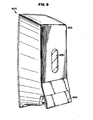
- FIG. 9 is a perspective view of a dispenser 900.
- This alternative embodiment generally shows a housing 910 along with several key components. These components include a sight-glass window 930, permitting easy assessment of the quantity of soap remaining.
- Pushbar 940 serves to activate the electronics contained within the dispenser and, of course, permits the dispensing of soap
- Figure 10 is a cutaway side elevation of the dispenser shown in Figure 9 and shows different views of some of the same features found in that Figure. Specifically, the housing 910 is seen, along with a side view of the push bar 940. New features shown in Figure 10 include a power supply, which is a 6-volt battery 1050 and the membrane switch 1060. Also seen in this figure are the microprocessor 1020, a data request input 1030 and an internal display 1010. When pushbar 940 is depressed, two things happen simultaneously. The dispensing tube is pinched, which provides for the dispensing of a predetermined amount of soap. Also, membrane switch 1060 registers the dispensing.
- FIG 11 is a block diagram 1100 of the alternative embodiment. It shows an LCD display 1010, a power supply 1050 and a particular microprocessor 1020.
- the dispenser input 1060 is the previously discussed membrane switch.
- Data request 1030 is typically a push button interface.
- Figure 12 is a logical flow sheet 1200 which describes the overall logic flow of the alternative embodiment.
- the diagram starts at block 1202.
- Block 1204 shows the device idle while waiting for either input or request.
- block 1206 is a decision block where the device determines if there has been a request. If yes, flow continues to block 1208 where the device displays total usage. Flow then continues to block 1210 where the device displays the running average. Finally flow continues to block 1212 where additional information is displayed. After this flow returns to block 1204 to wait for input or request.
- block 1214 is a decision block where the device determines if any input has been entered. If yes, the total number of dispenses is incremented by one in block 1216. Flow then continues to decision block 1218 which concerns time elapsed since last input. If the time interval has been exceeded, flow continues to block 1220 where the device recalculates the running average. If not, control returns to block 1204 where the device sleeps and waits for input or request.
Landscapes
- Health & Medical Sciences (AREA)
- Public Health (AREA)
- Containers And Packaging Bodies Having A Special Means To Remove Contents (AREA)
- Management, Administration, Business Operations System, And Electronic Commerce (AREA)
- Devices For Dispensing Beverages (AREA)
- Loading And Unloading Of Fuel Tanks Or Ships (AREA)
- Infusion, Injection, And Reservoir Apparatuses (AREA)
- Apparatus For Disinfection Or Sterilisation (AREA)
Applications Claiming Priority (2)
| Application Number | Priority Date | Filing Date | Title |
|---|---|---|---|
| US96079 | 1979-11-20 | ||
| US09/096,079 US6404837B1 (en) | 1998-06-11 | 1998-06-11 | Usage competent hand soap dispenser with data collection and display capabilities |
Publications (3)
| Publication Number | Publication Date |
|---|---|
| EP0963728A2 EP0963728A2 (en) | 1999-12-15 |
| EP0963728A3 EP0963728A3 (en) | 2001-01-03 |
| EP0963728B1 true EP0963728B1 (en) | 2008-08-13 |
Family
ID=22255178
Family Applications (1)
| Application Number | Title | Priority Date | Filing Date |
|---|---|---|---|
| EP99111299A Expired - Lifetime EP0963728B1 (en) | 1998-06-11 | 1999-06-10 | Hand soap dispenser with usage related data collection and display capabilities |
Country Status (8)
| Country | Link |
|---|---|
| US (2) | US6404837B1 (enExample) |
| EP (1) | EP0963728B1 (enExample) |
| JP (1) | JP2000023871A (enExample) |
| CN (1) | CN1123316C (enExample) |
| AU (1) | AU754913B2 (enExample) |
| BR (1) | BR9902237A (enExample) |
| CA (1) | CA2274277C (enExample) |
| DE (1) | DE69939294D1 (enExample) |
Cited By (2)
| Publication number | Priority date | Publication date | Assignee | Title |
|---|---|---|---|---|
| US11918158B2 (en) | 2021-01-20 | 2024-03-05 | Ecolab Usa Inc. | Product dispenser holder with compliance module |
| US12075954B2 (en) | 2015-04-01 | 2024-09-03 | Ecolab Usa Inc. | Flexible mounting system for hand hygiene dispensers |
Families Citing this family (129)
| Publication number | Priority date | Publication date | Assignee | Title |
|---|---|---|---|---|
| US6727818B1 (en) | 1999-10-29 | 2004-04-27 | Hill-Rom Services, Inc. | Hygiene monitoring system |
| US6542568B1 (en) | 1999-12-09 | 2003-04-01 | Ecolab Inc. | Soap dispenser having reward program |
| US6519505B2 (en) * | 2000-06-28 | 2003-02-11 | Georgia-Pacific Corporation | Integrated dispenser and business machine system |
| US6832916B2 (en) * | 2000-11-20 | 2004-12-21 | Venture Management Alliance, Llc | Soap dispenser hand wash interval timer |
| US8249295B2 (en) * | 2001-03-13 | 2012-08-21 | Johnson Raymond C | System for monitoring hand cleaning compliance |
| US7597122B1 (en) | 2001-07-26 | 2009-10-06 | Smith Judson L | Apparatus and method to monitor the usage of a network system of personal hand sanitizing dispensers |
| US20030019620A1 (en) * | 2001-07-30 | 2003-01-30 | Pineo Gregory Merle | Plug bypass valves and heat exchangers |
| US6883563B2 (en) | 2001-07-26 | 2005-04-26 | Judson L. Smith | Apparatus and method to monitor the usage of a network system of personal hand sanitizing dispensers |
| US7293645B2 (en) * | 2003-01-30 | 2007-11-13 | Judith Lee Harper | Method for monitoring hand hygiene compliance |
| US20040162850A1 (en) * | 2003-02-19 | 2004-08-19 | Sanville Katherine M. | Managing operations of a product dispense system |
| US20040226959A1 (en) * | 2003-05-12 | 2004-11-18 | Mehus Richard J. | Methods of dispensing |
| US20040230339A1 (en) * | 2003-05-12 | 2004-11-18 | Bryan Maser | Methods of managing based on measurements of actual use of product |
| US7201290B2 (en) * | 2003-05-12 | 2007-04-10 | Ecolab Inc. | Method and apparatus for mass based dispensing |
| US9518899B2 (en) | 2003-08-11 | 2016-12-13 | Sakura Finetek U.S.A., Inc. | Automated reagent dispensing system and method of operation |
| US7213782B2 (en) | 2004-01-30 | 2007-05-08 | Charles Agnew Osborne | Intelligent dispensing system |
| ES2526909T5 (es) | 2004-06-23 | 2020-06-19 | Ecolab Inc | Método para la dosificación múltiple de productos líquidos, aparato de dosificación y sistema de dosificación |
| CA2478578C (en) * | 2004-08-19 | 2013-01-29 | Hygiene-Technik Inc. | Dispenser with sensor |
| USD512648S1 (en) | 2004-12-15 | 2005-12-13 | Smith Judson L | Dispenser for fluid material |
| CA2496418C (en) * | 2005-02-09 | 2013-07-30 | Hygiene-Technik Inc. | Dispenser with thumbprint reader |
| US7803321B2 (en) * | 2005-03-18 | 2010-09-28 | Ecolab Inc. | Formulating chemical solutions based on volumetric and weight based control measurements |
| US7466788B2 (en) * | 2005-03-28 | 2008-12-16 | Tyco Electronics Corporation | Electronic applicator counter |
| DE102005023232A1 (de) * | 2005-05-20 | 2006-11-23 | Krauss-Maffei Kunststofftechnik Gmbh | Integrierter Schusszähler für Mischkopf |
| US20060277065A1 (en) * | 2005-06-06 | 2006-12-07 | Guten Sharon M | Method for institutionally effecting hand hygiene practices |
| US7616122B2 (en) | 2005-06-20 | 2009-11-10 | Biovigil, Llc | Hand cleanliness |
| US7286057B2 (en) * | 2005-06-20 | 2007-10-23 | Biovigil Llc | Hand cleanliness |
| US8502681B2 (en) | 2005-06-20 | 2013-08-06 | Biovigil, Llc | Hand cleanliness |
| US7936275B2 (en) * | 2005-06-20 | 2011-05-03 | Biovigil, Llc | Hand cleanliness |
| US20080019489A1 (en) * | 2005-07-06 | 2008-01-24 | Lynn John M | Entertaining or advertising hygiene apparatus |
| GB2432353B (en) * | 2005-11-22 | 2009-07-15 | James Howard Burton | Intelligent dispensing unit (I.D.U.) |
| US20080019490A1 (en) * | 2005-12-30 | 2008-01-24 | Lynn John M | Entertaining or advertising hygiene apparatus |
| US7825812B2 (en) * | 2006-03-16 | 2010-11-02 | Kirk Ogrin | System and method for hand hygiene compliance management and horizontal pump dispenser therefor |
| US9446924B2 (en) * | 2006-04-14 | 2016-09-20 | San Jamar, Inc. | Exclusivity system and method |
| US20080031838A1 (en) * | 2006-08-03 | 2008-02-07 | Bolling Steven F | Tracing hand cleaner |
| GB2442471B (en) * | 2006-10-03 | 2012-02-22 | Matthew David Weeks | An electronic mandatory alcohol dispenser |
| US7698770B2 (en) * | 2006-10-31 | 2010-04-20 | Resurgent Health & Medical, Llc | Automated appendage cleaning apparatus with brush |
| US7818083B2 (en) * | 2006-10-31 | 2010-10-19 | Resurgent Health & Medical, Llc | Automated washing system with compliance verification and automated compliance monitoring reporting |
| US7607442B2 (en) * | 2006-10-31 | 2009-10-27 | Resurgent Health & Medical, Llc | Wash chamber for automated appendage-washing apparatus |
| FR2907654B1 (fr) | 2006-10-31 | 2010-01-29 | Georgia Pacific France | Procede, dispositif de fabrication et rouleaux associes formes de feuilles a decoupes et predecoupes alternees |
| US7682464B2 (en) * | 2006-10-31 | 2010-03-23 | Resurgent Health & Medical, Llc | Automated washing system with compliance verification |
| US11297984B2 (en) | 2006-10-31 | 2022-04-12 | Gpcp Ip Holdings Llc | Automatic napkin dispenser |
| KR100835878B1 (ko) * | 2007-03-06 | 2008-06-09 | 김재연 | 디스플레이 장치가 구비된 벽면 부착용 손 소독기 |
| US8277745B2 (en) * | 2007-05-02 | 2012-10-02 | Ecolab Inc. | Interchangeable load cell assemblies |
| US20090100593A1 (en) * | 2007-10-22 | 2009-04-23 | Lincoln Danny F | Automatic hand washing system |
| US8261950B2 (en) | 2007-10-22 | 2012-09-11 | Georgia-Pacific Consumer Products Lp | Pumping dispenser |
| EP2220611A4 (en) | 2007-11-05 | 2014-01-15 | Sloan Valve Co | SUPRERETTE OF PUBLIC TOILET |
| US9555429B2 (en) * | 2007-11-14 | 2017-01-31 | Gojo Industries, Inc. | Method and device for indicating future need for product replacement of random-use dispensing |
| US7694589B2 (en) * | 2007-12-12 | 2010-04-13 | Ecolab Inc. | Low and empty product detection using load cell and load cell bracket |
| US8433535B2 (en) * | 2008-01-30 | 2013-04-30 | Cws-Boco Supply Ag | Housing or housing part for sanitary product dispenser |
| US8783511B2 (en) * | 2008-04-25 | 2014-07-22 | Ultraclenz, Llc | Manual and touch-free convertible fluid dispenser |
| WO2009134931A2 (en) | 2008-04-29 | 2009-11-05 | Meritech, Inc. | Complete hand care |
| US8639527B2 (en) | 2008-04-30 | 2014-01-28 | Ecolab Usa Inc. | Validated healthcare cleaning and sanitizing practices |
| JP5539964B2 (ja) | 2008-04-30 | 2014-07-02 | エコラボ インコーポレイティド | 有効な医療機関清掃及び消毒実施 |
| WO2010042193A1 (en) * | 2008-10-06 | 2010-04-15 | Rodney Ogrin Dba Sprixx | Method for tracking and reporting personal hand hygiene dispenser electronic time-stamp data |
| DE202008013903U1 (de) * | 2008-10-17 | 2010-04-15 | Ophardt Hygiene-Technik Gmbh + Co. Kg | Spender mit elektronischem Zähler |
| US20100274640A1 (en) * | 2009-04-24 | 2010-10-28 | Ecolab Usa Inc. | Management of cleaning processes via monitoring of chemical product usage |
| USRE48951E1 (en) | 2015-08-05 | 2022-03-01 | Ecolab Usa Inc. | Hand hygiene compliance monitoring |
| WO2010143092A2 (en) | 2009-06-12 | 2010-12-16 | Ecolab Usa Inc. | Hand hygiene compliance monitoring |
| US8350706B2 (en) * | 2009-06-30 | 2013-01-08 | Gojo Industries, Inc. | Hygiene compliance monitoring system |
| US9102509B2 (en) | 2009-09-25 | 2015-08-11 | Ecolab Inc. | Make-up dispense in a mass based dispensing system |
| CN102549627A (zh) * | 2009-09-25 | 2012-07-04 | 3M创新有限公司 | 卫生监控系统和方法 |
| US9051163B2 (en) * | 2009-10-06 | 2015-06-09 | Ecolab Inc. | Automatic calibration of chemical product dispense systems |
| JP2013508820A (ja) * | 2009-10-15 | 2013-03-07 | スリーエム イノベイティブ プロパティズ カンパニー | 医療送達監視システム及び方法 |
| DE202009015766U1 (de) | 2009-11-17 | 2010-03-25 | Ingo-Manufacturing Ltd., Ballymote | Fluidspender |
| US8511512B2 (en) | 2010-01-07 | 2013-08-20 | Ecolab Usa Inc. | Impact load protection for mass-based product dispensers |
| US20110196720A1 (en) * | 2010-02-08 | 2011-08-11 | Guten Sharon M | Method for effecting good hand hygiene practices |
| WO2011119695A2 (en) * | 2010-03-23 | 2011-09-29 | Harkap Partners, LLC | Hand hygiene compliance device |
| US10540881B2 (en) | 2010-04-07 | 2020-01-21 | Clean Hands Safe Hands Llc | Systems and methods for pattern recognition and individual detection |
| US10467884B2 (en) | 2010-04-07 | 2019-11-05 | Clean Hands Safe Hands Llc | Systems for monitoring hand sanitization |
| US10223895B2 (en) | 2010-04-07 | 2019-03-05 | Clean Hands Safe Hands Llc | Systems for monitoring hand sanitization |
| US9123233B2 (en) | 2010-04-07 | 2015-09-01 | Clean Hands Safe Hands | Systems for monitoring hand sanitization |
| DE102010016381B4 (de) * | 2010-04-09 | 2012-07-05 | Ille Papier-Service Gmbh | Spendervorrichtung mit Anzeigeeinheit |
| US9000930B2 (en) | 2010-05-24 | 2015-04-07 | Georgia-Pacific Consumer Products Lp | Hand hygiene compliance system |
| US8427323B2 (en) | 2010-06-25 | 2013-04-23 | Pibed Limited | Monitoring system |
| US8564444B2 (en) | 2010-07-30 | 2013-10-22 | Toyota Motor Engineering & Manufacturing North America, Inc. | Mobile sanitizing devices and systems for dispensing sanitizer solution |
| US8353427B2 (en) | 2010-10-11 | 2013-01-15 | Konrad Landauer | Automatic dispenser for hand-sanitizer lotion |
| US8558701B2 (en) * | 2010-11-08 | 2013-10-15 | Gojo Industries, Inc. | Hygiene compliance module |
| WO2012064718A2 (en) | 2010-11-08 | 2012-05-18 | Georgia-Pacific Consumer Products Lp | Hand hygiene compliance monitoring system |
| US20140210620A1 (en) | 2013-01-25 | 2014-07-31 | Ultraclenz Llc | Wireless communication for dispenser beacons |
| US8752732B2 (en) * | 2011-02-01 | 2014-06-17 | Sakura Finetek U.S.A., Inc. | Fluid dispensing system |
| US8651328B2 (en) | 2011-07-14 | 2014-02-18 | Georgia-Pacific Consumer Products Lp | Pumping dispenser shield |
| US8932543B2 (en) | 2011-09-21 | 2015-01-13 | Sakura Finetek U.S.A., Inc. | Automated staining system and reaction chamber |
| US10467718B2 (en) | 2011-11-07 | 2019-11-05 | Deb Ip Limited | Method for determining benchmarks for hand product use and compliance |
| EP2777249A4 (en) | 2011-11-07 | 2015-08-19 | Debmed Usa Llc | METHOD FOR DETERMINING CONFORMITY OF HAND HYGIENE |
| ITMO20110306A1 (it) * | 2011-11-29 | 2013-05-30 | Alltissue Australasia Pty Ltd | Sistema di controllo delle riserve di prodotti in distributori di prodotti |
| US10383489B2 (en) | 2012-02-10 | 2019-08-20 | Gpcp Ip Holdings Llc | Automatic napkin dispenser |
| US9340337B2 (en) | 2012-05-01 | 2016-05-17 | Ecolab Usa Inc. | Dispenser with lockable pushbutton |
| US8944286B2 (en) | 2012-11-27 | 2015-02-03 | Ecolab Usa Inc. | Mass-based dispensing using optical displacement measurement |
| US9265384B2 (en) | 2013-01-16 | 2016-02-23 | Gojo Industries, Inc. | Point-of-care compliance module |
| US8991655B2 (en) | 2013-02-15 | 2015-03-31 | Ecolab Usa Inc. | Fluid dispensers with increased mechanical advantage |
| US20140231460A1 (en) * | 2013-02-15 | 2014-08-21 | Ecolab Usa Inc. | Focusing location of antimicrobial additives in fluid dispensers |
| CN103110384B (zh) * | 2013-02-22 | 2015-10-28 | 深圳市同朗科技有限公司 | 一种皂液器及其装液瓶的使用方法 |
| US9486115B2 (en) * | 2013-03-12 | 2016-11-08 | Ecolab Usa Inc. | Product and dispensing equipment housing |
| US9183729B2 (en) * | 2013-03-13 | 2015-11-10 | Debmed Usa Llc | Hand care reporting panel |
| US9756992B2 (en) | 2013-03-15 | 2017-09-12 | Vsi Import Solutions, Llc | Electronic residential tissue dispenser |
| WO2014205283A1 (en) * | 2013-06-19 | 2014-12-24 | Clean Hands Safe Hands | System and methods for wireless hand hygiene monitoring |
| US9497428B2 (en) | 2013-07-19 | 2016-11-15 | Versus Technology, Inc. | Automatic hygiene compliance assistance |
| KR101462261B1 (ko) * | 2013-08-14 | 2014-11-21 | 주식회사 프로텍 | 수명 계산형 압전 디스펜서 |
| US9604811B2 (en) | 2013-10-01 | 2017-03-28 | Georgia-Pacific Consumer Products Lp | Automatic paper product dispenser with data collection and method |
| US10743720B2 (en) | 2013-11-27 | 2020-08-18 | Archer Manufacturing, Inc. | Tamper-resistant devices and systems for wall-mounted dispensers |
| US10123661B2 (en) * | 2013-11-27 | 2018-11-13 | Archer Manufacturing, Inc. | Tamper-proof and ligation resistant dispenser for liquids |
| US10743721B2 (en) | 2013-11-27 | 2020-08-18 | Archer Manufacturing, Inc. | Tamper-resistant devices and systems for wall-mounted dispensers |
| WO2015085195A1 (en) * | 2013-12-05 | 2015-06-11 | Gojo Industries, Inc. | Product dispensing system |
| GB2521844A (en) * | 2014-01-03 | 2015-07-08 | Fluke Corp | A method and system for monitoring hand washing |
| US9907441B2 (en) | 2014-04-18 | 2018-03-06 | Vsi Import Solutions, Llc | Electronic residential tissue dispenser |
| US10636321B2 (en) * | 2014-07-02 | 2020-04-28 | Gojo Industries, Inc. | Methods and systems for improving hand hygiene |
| US10276029B2 (en) | 2014-11-13 | 2019-04-30 | Gojo Industries, Inc. | Methods and systems for obtaining more accurate compliance metrics |
| WO2016137458A1 (en) * | 2015-02-25 | 2016-09-01 | Kimberly-Clark Worldwide, Inc. | Method and system for consumer award program for washroom usage |
| BR112017018568B1 (pt) | 2015-03-30 | 2023-03-21 | Kimberly-Clark Worldwide, Inc | Método para a manutenção de uma pluralidade de instalações sanitárias por funcionários da manutenção |
| US9773403B2 (en) | 2015-07-28 | 2017-09-26 | Hill-Rom Services, Inc. | Hygiene compliance system |
| GB201517000D0 (en) | 2015-09-25 | 2015-11-11 | Deb Ip Ltd | Systems and methods for reducing occupational dermatitis |
| US10607471B2 (en) | 2015-10-06 | 2020-03-31 | Hill-Rom Services, Inc. | Hand hygiene monitoring system with customizable thresholds |
| US10732021B2 (en) * | 2016-05-17 | 2020-08-04 | Gojo Industries, Inc. | Method and apparatus for calibrating remaining doses in a refillable dispenser |
| USD862107S1 (en) | 2016-12-08 | 2019-10-08 | Hankscraft, Inc. | Dispenser cover |
| CN110383355B (zh) | 2017-03-07 | 2021-08-27 | 埃科莱布美国股份有限公司 | 用于手部卫生分配器的监测模块 |
| US10548435B2 (en) * | 2017-04-10 | 2020-02-04 | Robert Wise | Solution dispensing device |
| CN114947592A (zh) | 2017-05-10 | 2022-08-30 | Gpcp知识产权控股有限责任公司 | 自动纸产品分配器及相关联的方法 |
| ES1186958Y (es) * | 2017-06-16 | 2017-09-26 | Rajaram Govindarajan Kamatchi | Dispensador inteligente de gel desinfectante para conexion a sistema de monitorizacion de habitos de desinfeccion |
| US11069220B2 (en) | 2017-07-10 | 2021-07-20 | Biovigil Hygiene Technologies, Llc | Hand cleanliness monitoring |
| US10529219B2 (en) | 2017-11-10 | 2020-01-07 | Ecolab Usa Inc. | Hand hygiene compliance monitoring |
| BR102018015529B1 (pt) * | 2018-07-30 | 2024-01-23 | Mw Automação Ltda - Epp | Equipamento dispensador de produtos com controle de utilização e respectivos métodos de controles operacionais |
| EP3636348B1 (de) * | 2018-10-08 | 2023-01-04 | Aptar Radolfzell GmbH | Set aus einem pumpspender und einer auswerteeinheit |
| USD887171S1 (en) * | 2018-10-29 | 2020-06-16 | Edward GOLDFARB | Dispensing container |
| EP3900307A1 (en) | 2018-12-20 | 2021-10-27 | Ecolab USA, Inc. | Adaptive route, bi-directional network communication |
| US12151927B2 (en) * | 2019-11-06 | 2024-11-26 | Stephen E. Decker | System for customized formulation and production of cleaning products and associated methods |
| CA3099061A1 (en) * | 2019-11-15 | 2021-05-15 | Op-Hygiene Ip Gmbh | Fluid dispenser with wake up sensor |
| US20210388585A1 (en) * | 2020-06-10 | 2021-12-16 | Shanreka Hamilton | Hand Washing Timer Kit |
| USD962673S1 (en) * | 2020-07-29 | 2022-09-06 | Dongguan Fengjie Bathroom Co., Ltd. | Sensor soap dispenser |
| US11744413B2 (en) | 2021-10-07 | 2023-09-05 | Deb Ip Limited | Dispenser assembly |
| CN113970934A (zh) * | 2021-10-22 | 2022-01-25 | 深圳市瓴风科技有限公司 | 多位感应出液调控方法、系统及装置 |
Family Cites Families (30)
| Publication number | Priority date | Publication date | Assignee | Title |
|---|---|---|---|---|
| US3119557A (en) | 1961-10-05 | 1964-01-28 | United States Steel Corp | Counter operator for pressurized paint can |
| US3606084A (en) | 1969-12-15 | 1971-09-20 | John J Morrone | Drink dispensers and counter |
| GB1596661A (en) | 1977-08-16 | 1981-08-26 | Lyall R | Dispenser |
| US4265370A (en) | 1979-03-22 | 1981-05-05 | Reilly David H | Portable liquid metering device |
| US4349133A (en) | 1979-09-12 | 1982-09-14 | Christine William C | Dispenser and refill package |
| US4394938A (en) | 1980-08-11 | 1983-07-26 | Sani-Fresh International, Inc. | Dispenser and package for liquid or granular materials |
| US4621749A (en) | 1984-02-21 | 1986-11-11 | Go-Jo Industries | Dispensing apparatus |
| US4606085A (en) | 1985-03-27 | 1986-08-19 | Davies Joseph R | Hand washing device |
| US4765515A (en) | 1986-04-28 | 1988-08-23 | Jerome Lippman | Liquid dispensing combination |
| US4715517A (en) | 1986-06-26 | 1987-12-29 | Go-Jo Industries, Inc. | Dispenser having a roller for squeezing material from a tube |
| JPS6384688U (enExample) * | 1986-11-21 | 1988-06-03 | ||
| US4774916A (en) | 1987-02-11 | 1988-10-04 | The Budd Company | Measured shot ether system |
| US4921131A (en) | 1988-07-27 | 1990-05-01 | Horst Binderbauer | Liquid dispenser |
| US4896144A (en) | 1988-09-29 | 1990-01-23 | Bogstad Naomi C | Hand washing alert |
| US4989755A (en) | 1988-12-20 | 1991-02-05 | Shiau Guey Chuan | Automatic cleaning-liquid dispensing device |
| JPH02171769A (ja) * | 1988-12-26 | 1990-07-03 | Toshiba Corp | 画像形成装置 |
| US4938384A (en) | 1989-01-17 | 1990-07-03 | Sloan Valve Company | Liquid dispenser |
| US5031258A (en) | 1989-07-12 | 1991-07-16 | Bauer Industries Inc. | Wash station and method of operation |
| US5199118A (en) | 1991-02-11 | 1993-04-06 | World Dryer, Division Of Specialty Equipment Companies, Inc. | Hand wash station |
| US6125482A (en) * | 1991-11-22 | 2000-10-03 | H.M.S.I. Limited | Hand washing unit |
| US5248066A (en) | 1992-03-27 | 1993-09-28 | Ecolab Inc. | Liquid dispenser with collapsible reservoir holder |
| US5397028A (en) | 1992-04-29 | 1995-03-14 | Jesadanont; Mongkol | Automatic fluid dispenser and method |
| US5370267A (en) | 1993-10-04 | 1994-12-06 | Gojo Industries Inc. | Method and apparatus for measuring dispenser usage |
| US5411173A (en) * | 1993-12-17 | 1995-05-02 | Weinstein; Albert | Counter attachment for product dispensers |
| US5793653A (en) | 1994-07-12 | 1998-08-11 | Segal; Noel B. | Apparatus and method for monitoring compliance with handsink use regimen |
| GB2298851B (en) | 1995-03-14 | 1997-02-05 | Handwash Management | Hygiene station |
| US5625659A (en) | 1995-05-19 | 1997-04-29 | Gojo Industries, Inc. | Method and apparatus for electronically measuring dispenser usage |
| US5860437A (en) * | 1996-08-07 | 1999-01-19 | Csia Research Foundation | Self-cleaning hand washer |
| JPH1058796A (ja) * | 1996-08-21 | 1998-03-03 | Fuji Xerox Co Ltd | サービス利用許諾管理機能付き複合機 |
| US5945910A (en) | 1998-02-11 | 1999-08-31 | Simoniz Usa, Inc. | Method and apparatus for monitoring and reporting handwashing |
-
1998
- 1998-06-11 US US09/096,079 patent/US6404837B1/en not_active Expired - Lifetime
-
1999
- 1999-05-28 AU AU32321/99A patent/AU754913B2/en not_active Expired
- 1999-06-10 BR BR9902237-0A patent/BR9902237A/pt not_active IP Right Cessation
- 1999-06-10 EP EP99111299A patent/EP0963728B1/en not_active Expired - Lifetime
- 1999-06-10 CA CA002274277A patent/CA2274277C/en not_active Expired - Lifetime
- 1999-06-10 DE DE69939294T patent/DE69939294D1/de not_active Expired - Lifetime
- 1999-06-10 JP JP11163355A patent/JP2000023871A/ja active Pending
- 1999-06-11 CN CN99108377A patent/CN1123316C/zh not_active Expired - Lifetime
-
2002
- 2002-06-05 US US10/163,923 patent/US6707873B2/en not_active Expired - Lifetime
Cited By (2)
| Publication number | Priority date | Publication date | Assignee | Title |
|---|---|---|---|---|
| US12075954B2 (en) | 2015-04-01 | 2024-09-03 | Ecolab Usa Inc. | Flexible mounting system for hand hygiene dispensers |
| US11918158B2 (en) | 2021-01-20 | 2024-03-05 | Ecolab Usa Inc. | Product dispenser holder with compliance module |
Also Published As
| Publication number | Publication date |
|---|---|
| AU3232199A (en) | 1999-12-23 |
| CA2274277A1 (en) | 1999-12-11 |
| EP0963728A3 (en) | 2001-01-03 |
| BR9902237A (pt) | 2000-03-28 |
| US6707873B2 (en) | 2004-03-16 |
| US6404837B1 (en) | 2002-06-11 |
| EP0963728A2 (en) | 1999-12-15 |
| US20020150198A1 (en) | 2002-10-17 |
| JP2000023871A (ja) | 2000-01-25 |
| CN1238933A (zh) | 1999-12-22 |
| AU754913B2 (en) | 2002-11-28 |
| CA2274277C (en) | 2008-07-22 |
| DE69939294D1 (de) | 2008-09-25 |
| CN1123316C (zh) | 2003-10-08 |
Similar Documents
| Publication | Publication Date | Title |
|---|---|---|
| EP0963728B1 (en) | Hand soap dispenser with usage related data collection and display capabilities | |
| US6206238B1 (en) | Fingerprint activated fluids mixer and dispenser | |
| US6542568B1 (en) | Soap dispenser having reward program | |
| US5960991A (en) | Fingerprint activated soap dispenser | |
| US7477148B2 (en) | Soap dispenser and method for assuring clean hands | |
| US20020175182A1 (en) | Self contained dispenser incorporating a user monitoring system | |
| WO1998003107A1 (en) | Interactive dispenser for personal use chemical or personal care chemical that provides a message prompted by user proximity | |
| US11793365B2 (en) | Dispenser for use with refill cartridge | |
| WO2005117672A1 (en) | Soap dispenser and method for assuring clean hands | |
| CN115697154B (zh) | 包括分配器和可更换液体容器的分配器系统 | |
| MXPA99005381A (en) | Hand soap dispenser with usage related data collection and display capabilities | |
| CN115697155B (zh) | 包括可更换的液体容器的分配器 | |
| CN115697153A (zh) | 分配器中的插入模块 | |
| HK40083394A (en) | A dispenser system comprising a dispenser and a replaceable liquid container | |
| HK40084820A (en) | A dispenser comprising a replaceable liquid container | |
| HK40084489A (en) | An insert module in a dispenser |
Legal Events
| Date | Code | Title | Description |
|---|---|---|---|
| PUAI | Public reference made under article 153(3) epc to a published international application that has entered the european phase |
Free format text: ORIGINAL CODE: 0009012 |
|
| AK | Designated contracting states |
Kind code of ref document: A2 Designated state(s): DE FR GB IT NL |
|
| AX | Request for extension of the european patent |
Free format text: AL;LT;LV;MK;RO;SI |
|
| PUAL | Search report despatched |
Free format text: ORIGINAL CODE: 0009013 |
|
| AK | Designated contracting states |
Kind code of ref document: A3 Designated state(s): AT BE CH CY DE DK ES FI FR GB GR IE IT LI LU MC NL PT SE |
|
| AX | Request for extension of the european patent |
Free format text: AL;LT;LV;MK;RO;SI |
|
| RIC1 | Information provided on ipc code assigned before grant |
Free format text: 7A 47K 5/12 A, 7G 01F 11/08 B, 7G 01F 13/00 B |
|
| 17P | Request for examination filed |
Effective date: 20010608 |
|
| AKX | Designation fees paid |
Free format text: AT BE CH CY DE LI |
|
| RBV | Designated contracting states (corrected) |
Designated state(s): DE FR GB IT NL |
|
| 17Q | First examination report despatched |
Effective date: 20040811 |
|
| GRAP | Despatch of communication of intention to grant a patent |
Free format text: ORIGINAL CODE: EPIDOSNIGR1 |
|
| GRAS | Grant fee paid |
Free format text: ORIGINAL CODE: EPIDOSNIGR3 |
|
| GRAA | (expected) grant |
Free format text: ORIGINAL CODE: 0009210 |
|
| AK | Designated contracting states |
Kind code of ref document: B1 Designated state(s): DE FR GB IT NL |
|
| REG | Reference to a national code |
Ref country code: GB Ref legal event code: FG4D |
|
| REF | Corresponds to: |
Ref document number: 69939294 Country of ref document: DE Date of ref document: 20080925 Kind code of ref document: P |
|
| PLBE | No opposition filed within time limit |
Free format text: ORIGINAL CODE: 0009261 |
|
| STAA | Information on the status of an ep patent application or granted ep patent |
Free format text: STATUS: NO OPPOSITION FILED WITHIN TIME LIMIT |
|
| 26N | No opposition filed |
Effective date: 20090514 |
|
| REG | Reference to a national code |
Ref country code: FR Ref legal event code: PLFP Year of fee payment: 18 |
|
| REG | Reference to a national code |
Ref country code: FR Ref legal event code: PLFP Year of fee payment: 19 |
|
| REG | Reference to a national code |
Ref country code: FR Ref legal event code: PLFP Year of fee payment: 20 |
|
| PGFP | Annual fee paid to national office [announced via postgrant information from national office to epo] |
Ref country code: NL Payment date: 20180613 Year of fee payment: 20 Ref country code: DE Payment date: 20180530 Year of fee payment: 20 |
|
| PGFP | Annual fee paid to national office [announced via postgrant information from national office to epo] |
Ref country code: FR Payment date: 20180511 Year of fee payment: 20 |
|
| PGFP | Annual fee paid to national office [announced via postgrant information from national office to epo] |
Ref country code: GB Payment date: 20180403 Year of fee payment: 20 Ref country code: IT Payment date: 20180625 Year of fee payment: 20 |
|
| REG | Reference to a national code |
Ref country code: DE Ref legal event code: R071 Ref document number: 69939294 Country of ref document: DE |
|
| REG | Reference to a national code |
Ref country code: NL Ref legal event code: MK Effective date: 20190609 |
|
| REG | Reference to a national code |
Ref country code: GB Ref legal event code: PE20 Expiry date: 20190609 |
|
| PG25 | Lapsed in a contracting state [announced via postgrant information from national office to epo] |
Ref country code: GB Free format text: LAPSE BECAUSE OF EXPIRATION OF PROTECTION Effective date: 20190609 |