EP0958801A1 - Verfahren zur Herstellung von Saugkörpern - Google Patents
Verfahren zur Herstellung von Saugkörpern Download PDFInfo
- Publication number
- EP0958801A1 EP0958801A1 EP99303652A EP99303652A EP0958801A1 EP 0958801 A1 EP0958801 A1 EP 0958801A1 EP 99303652 A EP99303652 A EP 99303652A EP 99303652 A EP99303652 A EP 99303652A EP 0958801 A1 EP0958801 A1 EP 0958801A1
- Authority
- EP
- European Patent Office
- Prior art keywords
- material layer
- absorbent material
- absorbent
- cover sheet
- production method
- Prior art date
- Legal status (The legal status is an assumption and is not a legal conclusion. Google has not performed a legal analysis and makes no representation as to the accuracy of the status listed.)
- Granted
Links
Images




Classifications
-
- A—HUMAN NECESSITIES
- A61—MEDICAL OR VETERINARY SCIENCE; HYGIENE
- A61F—FILTERS IMPLANTABLE INTO BLOOD VESSELS; PROSTHESES; DEVICES PROVIDING PATENCY TO, OR PREVENTING COLLAPSING OF, TUBULAR STRUCTURES OF THE BODY, e.g. STENTS; ORTHOPAEDIC, NURSING OR CONTRACEPTIVE DEVICES; FOMENTATION; TREATMENT OR PROTECTION OF EYES OR EARS; BANDAGES, DRESSINGS OR ABSORBENT PADS; FIRST-AID KITS
- A61F13/00—Bandages or dressings; Absorbent pads
- A61F13/15—Absorbent pads, e.g. sanitary towels, swabs or tampons for external or internal application to the body; Supporting or fastening means therefor; Tampon applicators
- A61F13/15577—Apparatus or processes for manufacturing
- A61F13/15617—Making absorbent pads from fibres or pulverulent material with or without treatment of the fibres
- A61F13/15658—Forming continuous, e.g. composite, fibrous webs, e.g. involving the application of pulverulent material on parts thereof
-
- A—HUMAN NECESSITIES
- A61—MEDICAL OR VETERINARY SCIENCE; HYGIENE
- A61F—FILTERS IMPLANTABLE INTO BLOOD VESSELS; PROSTHESES; DEVICES PROVIDING PATENCY TO, OR PREVENTING COLLAPSING OF, TUBULAR STRUCTURES OF THE BODY, e.g. STENTS; ORTHOPAEDIC, NURSING OR CONTRACEPTIVE DEVICES; FOMENTATION; TREATMENT OR PROTECTION OF EYES OR EARS; BANDAGES, DRESSINGS OR ABSORBENT PADS; FIRST-AID KITS
- A61F13/00—Bandages or dressings; Absorbent pads
- A61F13/15—Absorbent pads, e.g. sanitary towels, swabs or tampons for external or internal application to the body; Supporting or fastening means therefor; Tampon applicators
- A61F13/15577—Apparatus or processes for manufacturing
- A61F13/15617—Making absorbent pads from fibres or pulverulent material with or without treatment of the fibres
- A61F13/15634—Making fibrous pads between sheets or webs
-
- Y—GENERAL TAGGING OF NEW TECHNOLOGICAL DEVELOPMENTS; GENERAL TAGGING OF CROSS-SECTIONAL TECHNOLOGIES SPANNING OVER SEVERAL SECTIONS OF THE IPC; TECHNICAL SUBJECTS COVERED BY FORMER USPC CROSS-REFERENCE ART COLLECTIONS [XRACs] AND DIGESTS
- Y10—TECHNICAL SUBJECTS COVERED BY FORMER USPC
- Y10T—TECHNICAL SUBJECTS COVERED BY FORMER US CLASSIFICATION
- Y10T156/00—Adhesive bonding and miscellaneous chemical manufacture
- Y10T156/10—Methods of surface bonding and/or assembly therefor
- Y10T156/1002—Methods of surface bonding and/or assembly therefor with permanent bending or reshaping or surface deformation of self sustaining lamina
- Y10T156/1028—Methods of surface bonding and/or assembly therefor with permanent bending or reshaping or surface deformation of self sustaining lamina by bending, drawing or stretch forming sheet to assume shape of configured lamina while in contact therewith
- Y10T156/103—Encasing or enveloping the configured lamina
-
- Y—GENERAL TAGGING OF NEW TECHNOLOGICAL DEVELOPMENTS; GENERAL TAGGING OF CROSS-SECTIONAL TECHNOLOGIES SPANNING OVER SEVERAL SECTIONS OF THE IPC; TECHNICAL SUBJECTS COVERED BY FORMER USPC CROSS-REFERENCE ART COLLECTIONS [XRACs] AND DIGESTS
- Y10—TECHNICAL SUBJECTS COVERED BY FORMER USPC
- Y10T—TECHNICAL SUBJECTS COVERED BY FORMER US CLASSIFICATION
- Y10T156/00—Adhesive bonding and miscellaneous chemical manufacture
- Y10T156/10—Methods of surface bonding and/or assembly therefor
- Y10T156/1002—Methods of surface bonding and/or assembly therefor with permanent bending or reshaping or surface deformation of self sustaining lamina
- Y10T156/1028—Methods of surface bonding and/or assembly therefor with permanent bending or reshaping or surface deformation of self sustaining lamina by bending, drawing or stretch forming sheet to assume shape of configured lamina while in contact therewith
- Y10T156/1031—Methods of surface bonding and/or assembly therefor with permanent bending or reshaping or surface deformation of self sustaining lamina by bending, drawing or stretch forming sheet to assume shape of configured lamina while in contact therewith with preshaping of lamina
-
- Y—GENERAL TAGGING OF NEW TECHNOLOGICAL DEVELOPMENTS; GENERAL TAGGING OF CROSS-SECTIONAL TECHNOLOGIES SPANNING OVER SEVERAL SECTIONS OF THE IPC; TECHNICAL SUBJECTS COVERED BY FORMER USPC CROSS-REFERENCE ART COLLECTIONS [XRACs] AND DIGESTS
- Y10—TECHNICAL SUBJECTS COVERED BY FORMER USPC
- Y10T—TECHNICAL SUBJECTS COVERED BY FORMER US CLASSIFICATION
- Y10T156/00—Adhesive bonding and miscellaneous chemical manufacture
- Y10T156/10—Methods of surface bonding and/or assembly therefor
- Y10T156/1089—Methods of surface bonding and/or assembly therefor of discrete laminae to single face of additional lamina
- Y10T156/1092—All laminae planar and face to face
- Y10T156/1093—All laminae planar and face to face with covering of discrete laminae with additional lamina
Definitions
- This invention relates to a production method of an absorbent body to be used for pet sheets, disposable diapers, sanitary napkins, or the like.
- a carrier tissue 2 is drawn from a roll 2a which is supported by an axis 1 and is forwarded continuously.
- a pulp supplier 3 is provided above the carrier tissue 2 which is forwarded continuously. Crushed pulps are supplied from the pulp supplier 3 to be poured on the carrier tissue 2 .
- a supply nozzle 4 for supplying particulate SAP (super-absorbent polymers) is provided above the carrier tissue 2 and supplies the SAP on the carrier tissue 2 which is forwarded continuously.
- a suction chamber 6 is provided in the opposite side of the pulp supplier 3 and the supply nozzle 4 with the carrier tissue 2 interposed. Crushed pulps and the SAP are sucked by the suction chamber 6 to form a strip of an absorbent material layer 5 comprised of a mixture of crushed pulps and SAP on the carrier tissue 2 .
- crushed pulps and SAP are continuously supplied onto the carrier tissue 2 to form a strip of an absorbent material layer 5 .
- a cover tissue (not shown) is supplied onto the strip of the absorbent material layer 5 to form a laminated body comprised of the carrier tissue 2 , a cover tissue and the absorbent material layer 5 interposed between the tissues.
- both sides of the laminated body are cut by a cutter such as a rotary cutter and thereafter the laminated body is cut into individual absorbent bodies.
- the carrier tissue 2 drawn from the roll 2a are forwarded continuously.
- a circular pattern drum 7 is provided above the carrier tissue 2 which is forwarded continuously.
- the pattern drum 7 rotates in the clockwise direction around the axis 8 at a speed adapted to the running speed of the carrier tissue 2 .
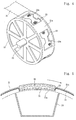
- Concavities 9 are provided on the outer face of the pattern drum 7 at predetermined intervals. Mesh 9a of a predetermined screen dimension is provided at the bottom of the concavity 9 .
- the concavity 9 is formed in a predetermined shape such as the shape of a sand-glass.
- a pulp supplier 11 is provided above the pattern drum 7 , facing the outer surface of the pattern drum 7 .
- a supply nozzle 12 for supplying SAP is provided also facing the outer surface of the pattern drum 7 .
- crushed pulps are supplied from the pulp supplier 11 into the concavity 9 which is provided on the outer surface of the rotating pattern drum 7 . Also, SAP are supplied from the nozzle 12 into the concavity 9 in the same manner.
- a suction means is provided inside of the pattern drum 7 facing the pulp supplier 11 and the supply nozzle 12 for sucking air through the openings of the mesh 9a provided at the bottom of the concavity 9 .
- the crushed pulps and the particulate SAP are sucked to be placed onto the concavity 9 thereby forming the absorbent material layer 13 having the same shape as that of the concavity 9 .
- the absorbent material layer 13 can be formed in the same shape as that of the concavity 9 formed on the outer face of the pattern drum 7 .
- the opening size of the mesh 9a is 60 meshes (according to the standard of Tyler, U.S.A., the opening size of such mesh is equal to 0.246mm).
- the particle size of SAP to be contained in the absorbent material layer must be formed very small.
- the mesh 9a having the opening size of 60 meshes can hardly prevent such fine SAP from passing through into the pattern drum 7 . Therefore, it is almost impossible for the mesh 9a to hold the SAP having a small particle size such as 100 mesh or less (which passes through a mesh having an opening size of 0.147mm) at the concavity 9 .
- the absorbent material layer 13 must be sucked through the carrier tissue 2 by the suction means provided below the carrier tissue 2 at the time the concavity 9 faces the carrier tissue 2 .
- the suction means provided below the carrier tissue 2 at the time the concavity 9 faces the carrier tissue 2 .
- a very strong suction force is needed in order to suck the absorbent material layer formed in the concavity 9 through the carrier tissue 2 . Consequently, the facility of the suction means inevitably becomes large, making the production cost very high.
- the production method of the present invention comprises the following steps of:
- Another production method of the absorbent body according to the present invention comprises the following steps of:
- Fig. 1 is a schematic diagram of the production method of the absorbent body showing the first embodiment of the present invention.
- Fig. 2 is a schematic diagram of the production method of the absorbent body showing the second embodiment of the present invention.
- Fig. 3 is a schematic diagram of the production method of the absorbent body showing the third embodiment of the present invention.
- Fig. 4 is a partial perspective view of the outer surface of the pattern drum of the present invention.
- Fig. 5 is a partial sectional view of the pattern drum showing the state of absorbent material layer formed on the outer surface thereof.
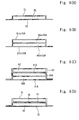
- Fig. 6(A) is a sectional view of the absorbent body produced according to the production method of the present invention.
- Fig. 6(B) is a sectional view of the absorbent body produced according to the production method of the present invention.
- Fig. 6(C) is a sectional view of the absorbent body produced according to the production method of the present invention.
- Fig. 6(D) is a sectional view of the absorbent body produced according to the production method of the present invention.
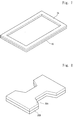
- Fig. 7 is a perspective view of the absorbent material layer produced according to the production method of the present invention as shown in Fig. 2 .
- Fig. 8 is a perspective view of the absorbent material layer produced according to the production method of the present invention as shown in Fig. 3 .
- Fig. 9 is a perspective view of the absorbent material layer produced according to the production method of the present invention as shown in Fig. 3 .
- Fig. 10 is a perspective view of the absorbent material layer produced according to the production method of the present invention as shown in Fig. 3 .
- Fig. 11 is a perspective view of the absorbent material layer produced according to the production method of the present invention as shown in Fig. 3 .
- Fig. 12 is a perspective view of the absorbent material layer produced according to the production method of the present invention as shown in Fig. 3 .
- Fig. 13 is a schematic diagram showing the conventional production method of the absorbent body.
- Fig. 14 is a schematic diagram showing the conventional production method of the absorbent body.
- Fig. 1 is an explanatory diagram showing the first embodiment of the present invention.
- an absorbent body comprising a single absorbent material layer held between two cover sheets is produced.
- a pattern drum 21 is continuously rotated around an axis 22 in the clockwise direction at a certain rotating speed.
- concavities 23 are formed on an outer surface 21a of the pattern drum 21 by predetermined intervals.
- the shape of the concavity 23 is like a sand-glass.
- Mesh 23a are formed at the bottom of the concavity 23 having a screen of 60 meshes (having an opening of 0.246mm) according to the standard of Tyler, U.S.A.
- a pulp supplier 24 for supplying absorbent fibers such as crushed pulps and a supply nozzle 25 for supplying particulate SAP (super-absorbent polymers) are provided above the pattern drum 21 , facing the outer surface 21a thereof.
- the relative position between the supply nozzle 25 and the pulp supplier 24 can be determined appropriately depending on the desired position of supplying the SAP to the crushed pulps.
- the SAP can be made of polyacrylic acid, sodium polyacrylate, polyacrylamide, polyacrylonitrile, polyvinyl alcohol, an additional polymer of maleic anhydride, a polyether, a condensed polymer, a polysaccharide such as starch or cellulose, a protein such as collagen, or the like.
- the SAPs include: a cross-linked compound of sodium polyacrylate, a graft copolymer of starch having sodium polyacrylate or a graft copolymer of cellulose having polyacrylonitrile chains.
- a suction chamber 26 is provided inside the pattern drum 21 , facing the pulp supplier 24 and the supply nozzle 25 . Also, a pressure chamber 27 is provided inside the pattern drum 21 , facing the inside face of the concavity 23 which is moved to the bottom of the pattern drum 21 .
- the suction chamber 26 sucks the air through the mesh 23a of the concavity 23 when the concavity 23 is moved to the top position.
- the pressure chamber 27 pressures the air through the mesh 23a of the concavity 23 when the concavity 23 is moved to the bottom position.
- a cover tissue 31 which becomes a first cover sheet of the absorbent body is drawn from a roll 31a rotating around an axis 32 , wound around the outer surface 21a of the pattern drum 21 and thereafter forwarded to the left as shown in Fig. 1 .
- a carrier tissue 33 which becomes a second cover sheet of the absorbent body is drawn from a roll 33a rotating around an axis 34 and thereafter forwarded continuously to the left at a certain speed as shown in Fig. 1 .
- the carrier tissue 33 is forwarded at the speed of V1 by the force of a conveyor (not shown) being proceeded by the rotation of conveyor rolls provided at the left of the pattern drum 21 .
- the cover tissue 31 is forwarded to the left at the speed of V2 , after going around the outer surface 21a of the pattern drum 21 .
- the speed V1 and V2 are set equal to each other.
- the cover tissue 31 drawn from the roll 31a is laid along (or adapted to) the inner surface of the concavity 23 to form a concave shape and thereafter goes around in the clockwise direction together with the outer surface 21a of the pattern drum 21 .
- the rotating speed of the outer surface 21a of the pattern drum 21 is set almost equal to the forwarding speed V1 of the carrier tissue 33 .
- the speed V3 of drawing out the cover tissue 31 from the roll 31a is set slightly faster than the speed V1 or V2 .
- the pattern drum 21 is rotated in the clockwise direction at a certain speed, and the cover tissue 31 which becomes the first cover sheet of the absorbent body is supplied to the outer surface 21a of the pattern drum 21 .
- the concavity 23 is moved to the top of the pattern drum 21 (i.e., above the suction chamber 26 )
- the sucking force of the suction chamber 26 is applied to the cover tissue 31 through the mesh 23a , and thereby the cover tissue 31 is laid along the surface of the concavity 23 to be deformed in a concave shape.
- the crushed pulps are supplied into the concavity 23 by the pulp supplier 24 and the particulate SAP are supplied into the concavity 23 from the supply nozzle 25 .
- the crushed pulps and the SAP are sucked into the concavity 23 through the mesh 23a and the cover tissue 31 . Consequently, the cover tissue 31 is laid along the inner surface of the mesh 23a in the concavity 23 and thereby the absorbent material layer 35 comprised of a mixture of the crushed pulps and the SAP is formed on the cover tissue 31 as shown in Fig. 5 .
- the shape of this absorbent material layer 35 is the same as the shape of the concavity 23 opening upward.
- the shape of this absorbent material layer 35 can be formed in a sand-glass shape.
- the content of SAP in the absorbent material layer 35 can be arranged such that more of the SAP exist at the position proximate to the cover tissue 31 .
- the carrier tissue 33 is supplied from the roll 33a and is forwarded toward underneath the pattern drum 21 .
- the absorbent material layer 35 and the cover tissue 31 are separated from the concavity 23 by the pressure chamber 27 .
- the absorbent material layer 35 is transferred to the carrier tissue 33 together with the cover tissue 31 .
- an air pressure force is applied to the cover tissue 31 by the pressure chamber 27 to push out the absorbent material layer 35 and the cover tissue 31 from the concavity 23 of the pattern drum 21 .
- the absorbent material layer 35 may be separated from the concavity 23 by applying some other force to the cover tissue 31 in the direction of the carrier tissue 33 .
- a laminated body comprising the carrier tissue 33 and the cover tissue 31 having the absorbent material layers 35 at predetermined intervals between them is produced.
- a cutter such as a rotary cutter, the individual absorbent bodies are produced.
- a hot melt type adhesive can be applied between the absorbent material layer 35 and the cover tissue 31 and/or between the absorbent material layer 35 and the carrier tissue 33 . Also, the cover tissue 31 and the carrier tissue 33 can be adhered with each other at the peripheral of the absorbent material layer 35 .
- the cover tissue 31 is laid on the mesh 23a at the bottom of the concavity 23 of the pattern drum 21 and the crushed pulps and the particulate SAP are supplied thereon, the particulate SAP do not pass into inside of the pattern drum 21 through the screen of mesh 23a , thereby improving the yield ratio of SAP. Also, since the SAP content in the absorbent material layer 35 can be increased, water retention property of the absorbent material layer 35 can be improved. Further, since the SAP are prevented from passing through the screen of mesh 23a , the SAP content in the absorbent material layer 35 can be freely determined and the scattering of the SAP content among the absorbent bodies can be decreased.
- the SAP having a small particle size of 100 mesh or less (which pass through a screen having an opening of 0.147mm) or 200 mesh or less (which pass through a screen having an opening of 0.074mm) can be introduced into the absorbent material layer 35 , liquid absorption speed of the absorbent material layer 35 can be accelerated.
- the SAP having the particle size in the range of 60mesh-200mesh can be introduced into the absorbent material layer 35 in the range of 20%-90% by weight. It is even possible to mix the SAP having smaller particle size than 200mesh into the absorbent material layer 35 .
- Fig. 2 is an explanatory drawing showing the second production method of the absorbent body of the present invention.
- the carrier tissue 33 which becomes the second cover sheet of the absorbent body is drawn from the roll 33a and forwarded continuously at a certain speed V1 .
- Crushed pulps are supplied on the carrier tissue 33 from the pulp supplier 36 . These crushed pulps are sucked to the carrier tissue 33 by the air suction force generated by the suction chamber 37 to form another absorbent material layer 40 in a continuous strip shape on the carrier tissue 33 .
- the absorbent material layer 35 formed at the concavity 23 of the pattern drum 21 is separated from the concavity 23 together with the cover tissue 31 to be laid on the absorbent material layer 40 .
- a double layered absorbent material can be formed between the carrier tissue 33 and the cover tissue 31 . Consequently, a laminated body, comprised of the carrier tissue 33 and cover tissue 31 with the absorbent material having a double layered structure interposed between them, can be produced.
- a cutter such as a rotary cutter in a predetermined dimension
- the absorbent material layer 35 and the cover tissue 31 can be adhered with each other by using a hot melt type adhesive. Also, the absorbent material layer 40 and the carrier tissue 33 can be adhered with each other by using the same type of adhesive. Further, the cover tissue 31 and the carrier tissue 33 can be adhered with each other at the peripheral of the double layered absorbent material formed of the absorbent material layer 35 and the absorbent material layer 40 .
- an absorbent body having an absorbent material layer of a double layer structure can be produced at low cost.
- SAP can be introduced only into the absorbent material layer 35 while introducing no SAP into the absorbent material layer 40 .
- the absorbent material layer 40 also can be formed of the mixture of crushed pulps and SAP by installing another supply nozzle of SAP with the pulp supplier 36 .
- the absorbent material layer 35 is formed of crushed pulps alone while the absorbent material layer 40 is formed of the mixture of crushed pulps and SAP.
- Fig. 3 is an explanatory drawing showing the third production method of the absorbent body of the present invention.
- a first pattern drum 21A and a second pattern drum 21B which have the same structure as that of the pattern drum 21 shown in Figs. 1, 2, 4 and 5, are provided in parallel.
- the first pattern drum 21A is continuously rotating in the clockwise direction
- the second pattern drum 21B is continuously rotating in the counterclockwise direction both at the same speed.
- concavities 23A and concavities 23B are provided on the outer surface of the pattern drum 21A and on the outer surface of the pattern drum 21B respectively.
- the concavity 23A and the concavity 23B may be formed in the same or different shapes.
- a pulp supplier 24A and a supply nozzle 25A for SAP are provided above the pattern drum 21A and a suction chamber 26A is provided inside the pattern drum 21A .
- a pulp supplier 24B and a supply nozzle 25B for SAP are provided above the pattern drum 21B and a suction chamber 26B is provided inside the pattern drum 21B .
- a pressure chamber 27A and a pressure chamber 27B are provided inside the pattern drum 21A and the pattern drum 21B respectively.
- the pressure chambers 27A and 27B are facing each other at the position where the outer surfaces of the pattern drum 21A and the pattern drum 21B are facing each other with the cover tissues 31A and 31B interposed between them.
- the cover tissue 31A is supplied to the outer surface of the first pattern drum 21A and laid along the inside of the concavity 23A .
- Crushed pulps and SAP are supplied from the pulp supplier 24A and supply nozzle 25A respectively into the concavity 23A to form a first absorbent layer 35A comprised of a mixture of crushed pulps and SAP on the cover tissue 31A , the shape of which is the same as that of the concavity 23A .
- the cover tissue 31B is supplied to the outer surface of the second pattern drum 21B . This cover tissue 31B is laid along the inside of the concavity 23B of the second pattern drum 21B .
- Crushed pulps and SAP are supplied from the pulp supplier 24B and the supply nozzle 25B respectively to form a second absorbent material layer 35B , the shape of which is the same as that of the concavity 23B .
- the cover tissue 31A is separated from the concavity 23A together with the absorbent material layer 35A by the pressure chamber 27A
- the cover tissue 31B is separated from the concavity 23B together with the absorbent material layer 35B by the pressure chamber 27B .
- the absorbent material layer 35A and the absorbent material layer 35B are superposed with each other to have a double layer structure, between the cover tissue 31A and the cover tissue 31B , thereby forming a laminated body.
- Such laminated body is cut into pieces in a predetermined dimension to produce the individual absorbent bodies.
- the absorbent material layer 35A and the cover tissue 31A can be adhered each other by using a hot melt type adhesive. Also, the absorbent material layer 35B and the cover tissue 31B can be adhered each other by using the same type of adhesive. It is also possible that the cover tissue 31A and the cover tissue 31B are adhered each other at the peripheral of the absorbent material having a double layer structure formed of the absorbent material layer 35A and the absorbent material layer 35B .
- SAP can be introduced only into either one of the absorbent material layer 35A or the absorbent material layer 35B . Also, it is possible to make the contents and particle sizes of the SAP different between the absorbent material layer 35A and the absorbent material layer 35B .
- Fig. 6(A) shows the absorbent body produced according to the production method shown in Fig. 1 .
- This absorbent body is comprised of the carrier tissue 33 and the cover tissue 31 with the absorbent material layer 35 interposed between them.
- the absorbent material layer 35 is formed of crushed pulps or the mixture of crushed pulps and SAP.
- Fig. 6(B) shows the absorbent body produced according to the production method shown in Fig. 2 or Fig. 3 .
- the absorbent material layer 40 and the absorbent material layer 35 formed in the concavity 23 of the pattern drum 21 are laminated each other and such laminated layers are held between the carrier tissue 33 and the cover tissue 31 .
- the absorbent material layer 35 in a rectangular framework shape is laminated on the absorbent material layer 40 .
- This absorbent material layer 35 in a rectangular framework shape can be formed by forming the concavity 23 of the pattern drum 21 in a rectangular framework shape.
- the absorbent body having the laminated layers shown in Fig. 7 may be used for an excrement absorption sheet for pets, or the like, which can be produced by providing a liquid non-permeable backing sheet at the bottom of the absorbent body and a liquid permeable top sheet on the top of the same.
- the absorbent material layer 40 is formed of crushed pulps alone or the mixture of crushed pulps and SAP, and the absorbent material layer 35 in a rectangular framework shape is formed of the mixture of crushed pulps and SAP. In this case, it is desirable that the absorbent material layer 35 contains more and/or finer SAP than the absorbent material layer 40 .
- the SAP contained in the absorbent material layer 35 preferably have a particle size below 60 mesh, more preferably below 100 mesh, and the SAP content in the absorbent material layer 35 is 20% by weight or more, preferably 30% by weight or more, and more preferably, in the range of 50% -90% by weight.
- the absorption sheet can prevent the urine excrement from leaking outside because the absorbent material layer 35 in a rectangular framework shape absorbs the urine excreted on the absorbent material layer 40 very quickly.
- a colored tissue 51 may be supplied on the absorbent material layer 40 such that the colored tissue 51 is placed between the absorbent material layer 40 and the absorbent material layer 35 as shown in Fig. 6(D) , if the absorbent body is used for the excrement absorption sheet for pets.
- the colored tissue 51 at the area surrounded by the framework shaped absorbent material layer 35 can be seen from outside through the cover tissue 31 and the top sheet.
- the structure of the absorbent body produced according to the production method shown in Fig. 3 is such that the absorbent material layer 35B formed at the concavity 23B is placed on the cover tissue 31B and the absorbent material layer 35A formed at the concavity 23A is laminated on the absorbent material layer 35B and the cover tissue 31A covers the top face thereof, as shown in Fig. 6(B) .
- both the absorbent material layers 35A and 35B can be formed in any desired shapes.
- Fig. 8 and Fig. 9 each show an example of the shape formed by the absorbent material layer 35B and the absorbent material layer 35A in the absorbent body produced according to the production method as shown in Fig. 3 .
- the absorbent material layer 35A and the absorbent material layer 35B are both formed in a sand-glass shape having the same dimensions.
- This combination of absorbent material layers can be made by forming the concavity 23A of the first pattern drum 21A and the concavity 23B of the second pattern drum 21B in the same sand-glass shape and size.
- the absorbent material layer 35A at the upper side is in a sand-glass shape and the absorbent material layer 35B at the lower side is in a rectangular shape.
- the absorbent material layer 35B at the lower side is attached to the absorbent material layer 35A at the upper side only at the central portion in the transversal direction.
- the absorbent bodies having such layers 35A and 35B as shown in Figs. 8 and 9 can be used for a disposable diaper, sanitary napkin, urine absorption pad or the like, which can be produced by providing a liquid non-permeable backing sheet at the bottom of the absorbent body, and a liquid permeable top sheet at the top thereof.
- the absorbent material layer 35A at the upper side is comprised of crushed pulps alone or the mixture of crushed pulps and SAP
- the absorbent material layer 35B at the lower side is comprised of the mixture of the crushed pulps and SAP.
- the absorbent material layer 35B at the lower side contains more and/or finer SAP than the absorbent material layer 35A at the upper side.
- the SAP contained in the absorbent material layer 35B preferably have a particle size below 60 mesh, more preferably below 100 mesh, and the SAP content in the absorbent material layer 35B is 20% by weight or more, preferably 30% by weight or more, and more preferably, in the range of 50% -90% by weight.
- the excrement or secretion liquid introduced to the absorbent material layer 35A at the upper side is moved toward the absorbent material layer 35B at the lower side owing to the strong absorption ability of the more and/or finer SAP contained in the absorbent material layer 35B , before the excrement or secretion liquid spreads all over the absorbent material layer 35A at the upper side. Therefore, the excrement or secretion liquid is prevented from flowing back to the top sheet.
- an absorbent body having such a three layered absorbent material as shown in Fig. 6(C) can be produced. That is, by providing and laminating another absorbent material layer 52 formed on another cover tissue 53 onto the laminated body produced by the production method shown in Fig. 3 , the absorbent body having a three layered absorbent material can be produced.
- the absorbent material layers 35A and 35B have different absorption properties from each other, so that the resulting flat absorbent material layer has partially different absorption property.
- the absorbent material layer 35A is formed in a rectangular shape, while the absorbent material layer 35B is formed of four separate parts, each two of them are lined in parallel in left and right.
- the absorbent material layer 35A is mated with the absorbent material layer 35B within the space provided by the four separate parts of the absorbent material layer 35B to form a flat absorbent material layer.
- the absorbent material layer 35A is formed in a rectangular shape, while the absorbent material layer 35B is formed of two separate absorbent material layers in a rectangular shape lined in parallel.
- the absorbent material layer 35A is mated with the absorbent material layer 35B within the space provided by the two separate rectangular parts of the absorbent material layer 35B to form a flat absorbent material layer.
- the absorbent material layer 35A is formed in a rectangular shape, while the absorbent material layer 35B is formed in a rectangular framework shape.
- the absorbent material layer 35A is mated with the absorbent material layer 35B within the space provided by the rectangular framework shape of the absorbent material layer 35B to form a flat absorbent material layer.
- the absorbent material layer 35B contains crushed pulps alone or the mixture of crushed pulps and SAP
- the absorbent material layer 35A contains the mixture of crushed pulps and more and/or finer SAP than the absorbent material layer 35B
- the particle size of the SAP in the absorbent material layer 35A is for instance less than 60 mesh or less, preferably less than 100 mesh
- the contents of the SAP in the absorbent material layer 35A is 20% by weight or more, preferably 30% by weight or more and more preferably, in the range of 50%- 90% by weight.
- the excrement or secretion liquid is absorbed rapidly by the absorbent material layer 35A placed at the central position and the volume of liquid retention at the absorbent material layer 35A becomes large. Therefore, the spreading of the liquid to the direction of absorbent material layer 35B is slowed and the leakage of the liquid to the side is prevented.
- the absorbent material layer 35A contains crushed pulps alone or the mixture of crushed pulps and SAP
- the absorbent material layer 35B contains the mixture of crushed pulps and more and/or finer SAP than the absorbent material layer 35A .
- the liquid introduced to the absorbent material layer 35A at the central position is moved to the absorbent material layer 35B at the sides and dispersed, the liquid introduced to the absorbent material layer 35A is prevented from flowing back to the top sheet and from leaking outside.
- the flat absorbent material layer shown in Fig. 12 is a modification of the laminated layers composed of absorbent material layers 35 and 40 shown in Fig. 7 , so that the excrement liquid introduced to the absorbent material layer 35A is absorbed by the absorbent material layer 35B formed in a rectangular framework shape.
- the carrier tissue 33 and the cover tissue 31 are used as the cover sheets in the production methods shown in Fig. 1 and Fig. 2
- the cover tissues 31A and 31B are used as the cover sheets in the production method shown in Fig. 3
- air permeable non-woven fabrics or woven fabrics can be used as the cover sheets to produce an absorbent body instead of using the tissues.
- the cover sheet is laid along the concavity of the pattern drum and the absorbent material layer is formed on this cover sheet, the absorbent material layer can be easily separated from the concavity of the pattern drum.
- the particulate SAP is prevented from passing into the pattern drum through the mesh at the bottom of the concavity at the time of introducing the SAP into the absorbent material layer, the yield ratio of SAP at the production of the absorbent body can be improved. Also, it makes possible to introduce very fine SAP and increase the SAP content in the absorbent material layer, so that the liquid retention property and the liquid absorption speed of the absorbent body can be easily improved.
- the absorbent material layers can be easily laminated to each other without providing tissues between the layers. Also, it makes possible to vary the shapes between the absorbent material layers and to mate the absorbent material layers with each other into a single-flat layer.
Landscapes
- Health & Medical Sciences (AREA)
- Engineering & Computer Science (AREA)
- Vascular Medicine (AREA)
- Epidemiology (AREA)
- Biomedical Technology (AREA)
- Heart & Thoracic Surgery (AREA)
- Manufacturing & Machinery (AREA)
- Life Sciences & Earth Sciences (AREA)
- Animal Behavior & Ethology (AREA)
- General Health & Medical Sciences (AREA)
- Public Health (AREA)
- Veterinary Medicine (AREA)
- Absorbent Articles And Supports Therefor (AREA)
- Orthopedics, Nursing, And Contraception (AREA)
Applications Claiming Priority (3)
| Application Number | Priority Date | Filing Date | Title |
|---|---|---|---|
| JP12866598 | 1998-05-12 | ||
| JP12866598A JP3909953B2 (ja) | 1998-05-12 | 1998-05-12 | 吸収体の製造方法 |
| CA002282969A CA2282969C (en) | 1998-05-12 | 1999-09-22 | Production method of absorbent body |
Publications (2)
| Publication Number | Publication Date |
|---|---|
| EP0958801A1 true EP0958801A1 (de) | 1999-11-24 |
| EP0958801B1 EP0958801B1 (de) | 2004-09-08 |
Family
ID=25681210
Family Applications (1)
| Application Number | Title | Priority Date | Filing Date |
|---|---|---|---|
| EP99303652A Expired - Lifetime EP0958801B1 (de) | 1998-05-12 | 1999-05-11 | Verfahren zur Herstellung von Saugkörpern |
Country Status (5)
| Country | Link |
|---|---|
| US (1) | US6811642B2 (de) |
| EP (1) | EP0958801B1 (de) |
| JP (1) | JP3909953B2 (de) |
| CA (1) | CA2282969C (de) |
| TW (1) | TW397681B (de) |
Cited By (20)
| Publication number | Priority date | Publication date | Assignee | Title |
|---|---|---|---|---|
| WO2002049565A3 (en) * | 2000-12-20 | 2003-12-24 | Kimberly Clark Co | Thin, high capacity absorbent structure and method for producing same |
| US6832905B2 (en) * | 2002-01-16 | 2004-12-21 | Paragon Trade Brands, Inc. | System and method for dry forming absorbent cores |
| WO2008010751A1 (en) * | 2006-07-20 | 2008-01-24 | Sca Hygiene Products Ab | An apparatus and method for forming air-laid absorbent cores |
| WO2008010754A1 (en) * | 2006-07-20 | 2008-01-24 | Sca Hygiene Products Ab | An apparatus and method for forming air-laid absorbent cores |
| WO2008010752A1 (en) * | 2006-07-20 | 2008-01-24 | Sca Hygiene Products Ab | An apparatus and method for forming air-laid absorbent cores |
| US7411110B2 (en) | 2000-12-20 | 2008-08-12 | Kimberly-Clark Worldwide, Inc. | Thin, high capacity absorbent structure and method for producing same |
| WO2008061178A3 (en) * | 2006-11-15 | 2008-09-12 | Procter & Gamble | Apparatus for making air-laid structures |
| US7524449B2 (en) | 2005-08-17 | 2009-04-28 | The Procter & Gamble Company | Method and apparatus for forming a batt of particulate material for use as a component in an absorbent core assembly |
| US7759540B2 (en) | 2002-07-23 | 2010-07-20 | Paragon Trade Brands, Llc | Absorbent articles containing absorbent cores having zoned absorbency and methods of making same |
| US7981355B2 (en) | 2006-07-20 | 2011-07-19 | Sca Hygiene Products Ab | Mat-forming wheel |
| EP2818147A1 (de) * | 2013-06-24 | 2014-12-31 | Winkler + Dünnebier GmbH | Verfahren und Anlage zur Herstellung von Hygieneartikeln |
| CN105073078A (zh) * | 2013-01-18 | 2015-11-18 | 尤妮佳股份有限公司 | 吸收性物品 |
| US10966882B2 (en) | 2017-12-21 | 2021-04-06 | Essity Hygiene And Health Aktiebolag | Absorbent article and method for manufacturing absorbent article |
| US11007095B2 (en) | 2017-12-21 | 2021-05-18 | Essity Hygiene And Health Aktiebolag | Absorbent article and method for manufacturing an absorbent article |
| US11147721B2 (en) | 2017-12-21 | 2021-10-19 | Essity Hygiene And Health Aktiebolag | Absorbent article and method for manufacturing an absorbent article |
| US11229561B2 (en) | 2017-12-21 | 2022-01-25 | Essity Hygiene And Health Aktiebolag | Absorbent article and method for manufacturing an absorbent article |
| US11612525B2 (en) | 2017-12-21 | 2023-03-28 | Essity Hygiene And Health Aktiebolag | Absorbent article and method for manufacturing an absorbent article |
| US11793683B2 (en) | 2017-12-21 | 2023-10-24 | Essity Hygiene And Health Aktiebolag | Absorbent article and method for manufacturing an absorbent article |
| US11833015B2 (en) | 2017-12-21 | 2023-12-05 | Essity Hygiene And Health Aktiebolag | Absorbent article and method for manufacturing an absorbent article |
| US12102514B2 (en) | 2017-12-21 | 2024-10-01 | Essity Hygiene And Health Aktiebolag | Absorbent article and method for manufacturing an absorbent article |
Families Citing this family (83)
| Publication number | Priority date | Publication date | Assignee | Title |
|---|---|---|---|---|
| JP3628526B2 (ja) * | 1998-10-07 | 2005-03-16 | 花王株式会社 | 成形体の製造装置 |
| KR20010016259A (ko) * | 2000-11-28 | 2001-03-05 | 이종덕 | 생리대 제조장치 |
| JP4070661B2 (ja) * | 2002-06-10 | 2008-04-02 | 花王株式会社 | 吸収体の製造方法 |
| DE60323810D1 (de) | 2003-02-12 | 2008-11-13 | Procter & Gamble | Bequem Windel |
| EP1911425B1 (de) | 2003-02-12 | 2014-01-15 | The Procter and Gamble Company | Saugfähiger Kern für einen saugfähigen Artikel |
| DE602004026566D1 (de) * | 2004-07-28 | 2010-05-27 | Procter & Gamble | Indirekter Druck von AMG |
| PL1621166T5 (pl) * | 2004-07-28 | 2019-06-28 | The Procter And Gamble Company | Proces wytwarzania struktur wkładów chłonnych |
| US20060264861A1 (en) | 2005-05-20 | 2006-11-23 | Lavon Gary D | Disposable absorbent article having breathable side flaps |
| US7962993B2 (en) | 2005-09-30 | 2011-06-21 | First Quality Retail Services, Llc | Surface cleaning pad having zoned absorbency and method of making same |
| US7694379B2 (en) | 2005-09-30 | 2010-04-13 | First Quality Retail Services, Llc | Absorbent cleaning pad and method of making same |
| RU2405516C2 (ru) * | 2006-07-20 | 2010-12-10 | Ска Хайджин Продактс Аб | Устройство и способ формирования получаемых пневмоукладкой абсорбирующих сердцевин |
| RU2405515C2 (ru) * | 2006-07-20 | 2010-12-10 | Ска Хайджин Продактс Аб | Устройство и способ образования получаемых пневмоукладкой поглощающих сердцевин |
| US7704441B2 (en) | 2006-11-15 | 2010-04-27 | The Procter & Gamble Company | Method for making air-laid structures |
| US7549853B2 (en) | 2006-11-15 | 2009-06-23 | The Procter & Gamble Company | Apparatus for making air-laid structures |
| US7553146B2 (en) | 2006-11-15 | 2009-06-30 | The Procter & Gamble Company | Apparatus for making air-laid structures |
| US9550306B2 (en) | 2007-02-21 | 2017-01-24 | Curt G. Joa, Inc. | Single transfer insert placement and apparatus with cross-direction insert placement control |
| US9944487B2 (en) | 2007-02-21 | 2018-04-17 | Curt G. Joa, Inc. | Single transfer insert placement method and apparatus |
| GB2460727B (en) | 2007-06-18 | 2012-04-11 | Procter & Gamble | Disposable absorbent article with substantially continously distributed absorbent particulate polymer material and method |
| MX2009013906A (es) | 2007-06-18 | 2010-01-28 | Procter & Gamble | Articulo absorbente desechable con nucleo absorbente sellado con material polimerico particulado absorbente practicamente distribuido en forma continua. |
| JP2009291475A (ja) * | 2008-06-06 | 2009-12-17 | Zuiko Corp | 衛生用品用吸収性コア及びその製造方法 |
| US8206533B2 (en) * | 2008-08-26 | 2012-06-26 | The Procter & Gamble Company | Method and apparatus for making disposable absorbent article with absorbent particulate polymer material and article made therewith |
| US7906065B1 (en) | 2009-08-18 | 2011-03-15 | The Procter & Gamble Company | Method and apparatus for forming a batt of particulate material for use as a component in an absorbent core assembly |
| US9089453B2 (en) | 2009-12-30 | 2015-07-28 | Curt G. Joa, Inc. | Method for producing absorbent article with stretch film side panel and application of intermittent discrete components of an absorbent article |
| EP2386277B1 (de) * | 2010-04-20 | 2013-11-13 | The Procter and Gamble Company | Verfahren und Vorrichtung zum Empfangen und Übertragen von Massivmaterial |
| ITBO20110186A1 (it) * | 2011-04-08 | 2012-10-09 | Gdm Spa | Metodo e unità per la realizzazione di imbottiture per articoli assorbenti igienici. |
| BR112013030599A2 (pt) | 2011-06-10 | 2016-09-27 | Procter & Gamble | núcleo absorvente para artigos absorventes descartáveis |
| EP2532332B2 (de) | 2011-06-10 | 2017-10-04 | The Procter and Gamble Company | Einwegwindel mit reduzierter Befestigung zwischen saugfähigem Kern und äusserer Schicht |
| PL2532328T3 (pl) | 2011-06-10 | 2014-07-31 | Procter & Gamble | Sposób i urządzenie do wytworzenia struktur chłonnych z materiałem chłonnym |
| RU2568565C2 (ru) | 2011-06-10 | 2015-11-20 | Дзе Проктер Энд Гэмбл Компани | Одноразовые подгузники |
| EP3287110B1 (de) | 2011-06-10 | 2019-03-20 | The Procter and Gamble Company | Verfahren zur herstellung von saugfähigen strukturen für saugfähige artikel |
| PH12013502575A1 (en) | 2011-06-10 | 2014-02-10 | Procter & Gamble | Absorbent structure for absorbent articles |
| EP2532329B1 (de) * | 2011-06-10 | 2018-09-19 | The Procter and Gamble Company | Verfahren und vorrichtung zum herstellen von absorptionsstrukturen mit absorptionsmaterial |
| JP5885963B2 (ja) * | 2011-08-11 | 2016-03-16 | ユニ・チャーム株式会社 | 使い捨て着用物品 |
| JP6005916B2 (ja) * | 2011-08-29 | 2016-10-12 | ユニ・チャーム株式会社 | 吸収性物品の製造方法 |
| US10828204B2 (en) * | 2011-09-08 | 2020-11-10 | Curt G. Joa, Inc. | Apparatus and method for forming absorbent cores |
| DK2628472T3 (en) | 2012-02-20 | 2016-04-11 | Joa Curt G Inc | A method of forming bonds between the separate components of the disposable |
| US9809414B2 (en) | 2012-04-24 | 2017-11-07 | Curt G. Joa, Inc. | Elastic break brake apparatus and method for minimizing broken elastic rethreading |
| CN104780885A (zh) | 2012-11-13 | 2015-07-15 | 宝洁公司 | 具有通道和标志的吸收制品 |
| US9216116B2 (en) | 2012-12-10 | 2015-12-22 | The Procter & Gamble Company | Absorbent articles with channels |
| EP2740452B1 (de) | 2012-12-10 | 2021-11-10 | The Procter & Gamble Company | Saugfähiger Artikel mit hohem Anteil an Absorptionsmaterial |
| US8979815B2 (en) | 2012-12-10 | 2015-03-17 | The Procter & Gamble Company | Absorbent articles with channels |
| EP2740450A1 (de) | 2012-12-10 | 2014-06-11 | The Procter & Gamble Company | Saugfähiger Artikel mit hohem Anteil an Superabsorptionsmaterial |
| EP2740449B1 (de) | 2012-12-10 | 2019-01-23 | The Procter & Gamble Company | Saugfähiger artikel mit hohem anteil an absorptionsmaterial |
| US9216118B2 (en) | 2012-12-10 | 2015-12-22 | The Procter & Gamble Company | Absorbent articles with channels and/or pockets |
| US10639215B2 (en) | 2012-12-10 | 2020-05-05 | The Procter & Gamble Company | Absorbent articles with channels and/or pockets |
| PL2813201T3 (pl) | 2013-06-14 | 2018-04-30 | The Procter And Gamble Company | Wyrób chłonny i wkład chłonny tworzący kanały w stanie mokrym |
| US9283683B2 (en) | 2013-07-24 | 2016-03-15 | Curt G. Joa, Inc. | Ventilated vacuum commutation structures |
| USD703712S1 (en) | 2013-08-23 | 2014-04-29 | Curt G. Joa, Inc. | Ventilated vacuum commutation structure |
| USD703248S1 (en) | 2013-08-23 | 2014-04-22 | Curt G. Joa, Inc. | Ventilated vacuum commutation structure |
| USD703711S1 (en) | 2013-08-23 | 2014-04-29 | Curt G. Joa, Inc. | Ventilated vacuum communication structure |
| USD704237S1 (en) | 2013-08-23 | 2014-05-06 | Curt G. Joa, Inc. | Ventilated vacuum commutation structure |
| USD703247S1 (en) | 2013-08-23 | 2014-04-22 | Curt G. Joa, Inc. | Ventilated vacuum commutation structure |
| US9987176B2 (en) | 2013-08-27 | 2018-06-05 | The Procter & Gamble Company | Absorbent articles with channels |
| MX2016002608A (es) | 2013-08-27 | 2016-06-17 | Procter & Gamble | Articulos absorbentes con canales. |
| US11207220B2 (en) | 2013-09-16 | 2021-12-28 | The Procter & Gamble Company | Absorbent articles with channels and signals |
| MX2016003391A (es) | 2013-09-16 | 2016-06-24 | Procter & Gamble | Articulos absorbentes con canales y señales. |
| EP2851048B1 (de) | 2013-09-19 | 2018-09-05 | The Procter and Gamble Company | Absorbierende Kerne mit materialfreien Bereichen |
| US9289329B1 (en) | 2013-12-05 | 2016-03-22 | Curt G. Joa, Inc. | Method for producing pant type diapers |
| ES2606320T3 (es) | 2013-12-19 | 2017-03-23 | The Procter & Gamble Company | Núcleos absorbentes que tienen áreas formadoras de canal y juntas de envoltura en c |
| US9789009B2 (en) | 2013-12-19 | 2017-10-17 | The Procter & Gamble Company | Absorbent articles having channel-forming areas and wetness indicator |
| EP2905001B1 (de) | 2014-02-11 | 2017-01-04 | The Procter and Gamble Company | Verfahren und Vorrichtung zum Herstellen von absorbierenden Strukturen mit Kanälen |
| EP2949300B1 (de) | 2014-05-27 | 2017-08-02 | The Procter and Gamble Company | Saugfähiger Kern mit saugfähiger Materialstruktur |
| EP2949301B1 (de) | 2014-05-27 | 2018-04-18 | The Procter and Gamble Company | Saugfähiger Kern mit gebogenen und geraden Absorptionsmaterialbereichen |
| PL2949299T3 (pl) | 2014-05-27 | 2018-01-31 | Procter & Gamble | Wkład chłonny z układem rozmieszczenia materiału chłonnego |
| EP2949302B1 (de) | 2014-05-27 | 2018-04-18 | The Procter and Gamble Company | Saugfähiger Kern mit gebogenen, kanalbildenden Bereichen |
| JP2018508292A (ja) | 2015-03-16 | 2018-03-29 | ザ プロクター アンド ギャンブル カンパニー | 改善されたコアを有する吸収性物品 |
| CN107405223B (zh) | 2015-03-16 | 2021-03-02 | 宝洁公司 | 具有改善的强度的吸收制品 |
| CA2985807A1 (en) | 2015-05-12 | 2016-11-17 | The Procter & Gamble Company | Absorbent article with improved core-to-backsheet adhesive |
| WO2016196069A1 (en) | 2015-05-29 | 2016-12-08 | The Procter & Gamble Company | Absorbent articles having channels and wetness indicator |
| US10167156B2 (en) | 2015-07-24 | 2019-01-01 | Curt G. Joa, Inc. | Vacuum commutation apparatus and methods |
| ITUB20154187A1 (it) * | 2015-10-06 | 2016-01-06 | Fameccanica Data Spa | Procedimento ed apparecchiatura per la produzione di una struttura assorbente |
| EP3167859B1 (de) | 2015-11-16 | 2020-05-06 | The Procter and Gamble Company | Absorbierende kerne mit materialfreien bereichen |
| EP3238678B1 (de) | 2016-04-29 | 2019-02-27 | The Procter and Gamble Company | Saugfähiger kern mit transversalen faltlinien |
| EP3238676B1 (de) | 2016-04-29 | 2019-01-02 | The Procter and Gamble Company | Saugkern mit profilierter verteilung von absorbierendem material |
| IT201800002181A1 (it) * | 2018-01-30 | 2019-07-30 | Gdm Spa | Apparato e metodo di formatura di una imbottitura assorbente |
| EP3626214B1 (de) * | 2018-09-20 | 2021-08-25 | GDM S.p.A. | Verfahren und einheit zur bildung eines saugfähigen artikel |
| CN114269305B (zh) * | 2019-09-11 | 2023-08-25 | 株式会社瑞光 | 吸收体的制造装置以及方法 |
| CN111685935B (zh) * | 2019-12-24 | 2022-05-13 | 北京倍舒特妇幼用品有限公司 | 一种高透气性医用敷料芯体及其生产设备 |
| US11737930B2 (en) | 2020-02-27 | 2023-08-29 | Curt G. Joa, Inc. | Configurable single transfer insert placement method and apparatus |
| WO2023009016A1 (en) * | 2021-07-26 | 2023-02-02 | Ghost - Corporate Management, S.A. | Absorbent underpad with drawings obtained by vacuum and its manufacturing process |
| CN119110714A (zh) * | 2022-03-28 | 2024-12-10 | 株式会社瑞光 | 吸收体的生产方法 |
| CN114886667B (zh) * | 2022-04-29 | 2023-07-18 | 雀氏(福建)实业发展有限公司 | 一种吸收芯体成型工艺 |
| WO2025116614A1 (ko) * | 2023-11-29 | 2025-06-05 | 주식회사 엘지화학 | 고흡수성 수지의 제조 방법 |
Citations (6)
| Publication number | Priority date | Publication date | Assignee | Title |
|---|---|---|---|---|
| DE1510427B1 (de) * | 1966-11-02 | 1970-10-08 | Schickedanz Ver Papierwerk | Verfahren und Vorrichtung zum Herstellen von Faserstoff-Formkoerpern,insbesondere Saugkoerpern fuer Damenbinden |
| EP0297180A1 (de) * | 1986-05-28 | 1989-01-04 | The Procter & Gamble Company | Vorrichtung und Verfahren zur Lieferung einer Mehrzahl von Strömen aus luftgetriebenen Fasern |
| EP0478182A1 (de) * | 1990-09-12 | 1992-04-01 | McNEIL-PPC, INC. | Verfahren und Vorrichtung zur Herstellung eines Kissens |
| FR2690843A1 (fr) * | 1992-05-07 | 1993-11-12 | Peaudouce | Procédé et dispositif de fabrication de matelas absorbants multicouches, notamment pour couches-culottes. |
| EP0627211A1 (de) * | 1993-06-02 | 1994-12-07 | McNEIL-PPC, INC. | Verfahren und Vorrichtung zum Herstellen von absorbierenden Erzeugnissen die ein in einem zweiten Material dispergiertes Ausgangsmaterial enthalten |
| US5422169A (en) * | 1991-04-12 | 1995-06-06 | The Procter & Gamble Company | Absorbent structures containing specific particle size distributions of superabsorbent hydrogel-forming materials in relatively high concentrations |
Family Cites Families (3)
| Publication number | Priority date | Publication date | Assignee | Title |
|---|---|---|---|---|
| IL82511A (en) * | 1986-05-28 | 1992-09-06 | Procter & Gamble | Apparatus for and methods of airlaying fibrous webs having discrete particles therein |
| US5226991A (en) * | 1991-10-09 | 1993-07-13 | Mike Svaighert | Method of fabricating airlaid articles and apparatus for performing the method |
| SE508244C2 (sv) * | 1994-02-24 | 1998-09-21 | Moelnlycke Ab | Absorptionskropp samt anordning för framställning av en sådan absorptionskropp |
-
1998
- 1998-05-12 JP JP12866598A patent/JP3909953B2/ja not_active Expired - Lifetime
-
1999
- 1999-05-11 EP EP99303652A patent/EP0958801B1/de not_active Expired - Lifetime
- 1999-05-12 TW TW088107809A patent/TW397681B/zh not_active IP Right Cessation
- 1999-09-22 CA CA002282969A patent/CA2282969C/en not_active Expired - Fee Related
-
2002
- 2002-01-03 US US10/038,322 patent/US6811642B2/en not_active Expired - Lifetime
Patent Citations (6)
| Publication number | Priority date | Publication date | Assignee | Title |
|---|---|---|---|---|
| DE1510427B1 (de) * | 1966-11-02 | 1970-10-08 | Schickedanz Ver Papierwerk | Verfahren und Vorrichtung zum Herstellen von Faserstoff-Formkoerpern,insbesondere Saugkoerpern fuer Damenbinden |
| EP0297180A1 (de) * | 1986-05-28 | 1989-01-04 | The Procter & Gamble Company | Vorrichtung und Verfahren zur Lieferung einer Mehrzahl von Strömen aus luftgetriebenen Fasern |
| EP0478182A1 (de) * | 1990-09-12 | 1992-04-01 | McNEIL-PPC, INC. | Verfahren und Vorrichtung zur Herstellung eines Kissens |
| US5422169A (en) * | 1991-04-12 | 1995-06-06 | The Procter & Gamble Company | Absorbent structures containing specific particle size distributions of superabsorbent hydrogel-forming materials in relatively high concentrations |
| FR2690843A1 (fr) * | 1992-05-07 | 1993-11-12 | Peaudouce | Procédé et dispositif de fabrication de matelas absorbants multicouches, notamment pour couches-culottes. |
| EP0627211A1 (de) * | 1993-06-02 | 1994-12-07 | McNEIL-PPC, INC. | Verfahren und Vorrichtung zum Herstellen von absorbierenden Erzeugnissen die ein in einem zweiten Material dispergiertes Ausgangsmaterial enthalten |
Cited By (26)
| Publication number | Priority date | Publication date | Assignee | Title |
|---|---|---|---|---|
| US7411110B2 (en) | 2000-12-20 | 2008-08-12 | Kimberly-Clark Worldwide, Inc. | Thin, high capacity absorbent structure and method for producing same |
| WO2002049565A3 (en) * | 2000-12-20 | 2003-12-24 | Kimberly Clark Co | Thin, high capacity absorbent structure and method for producing same |
| US7955536B2 (en) | 2001-08-24 | 2011-06-07 | Kimberly-Clark Worldwide, Inc. | Method for producing thin, high capacity absorbent structure |
| US6832905B2 (en) * | 2002-01-16 | 2004-12-21 | Paragon Trade Brands, Inc. | System and method for dry forming absorbent cores |
| US7759540B2 (en) | 2002-07-23 | 2010-07-20 | Paragon Trade Brands, Llc | Absorbent articles containing absorbent cores having zoned absorbency and methods of making same |
| US7524449B2 (en) | 2005-08-17 | 2009-04-28 | The Procter & Gamble Company | Method and apparatus for forming a batt of particulate material for use as a component in an absorbent core assembly |
| US8182735B2 (en) | 2006-07-20 | 2012-05-22 | Sca Hygiene Products Ab | Apparatus and method for forming air-laid absorbent cores |
| WO2008010751A1 (en) * | 2006-07-20 | 2008-01-24 | Sca Hygiene Products Ab | An apparatus and method for forming air-laid absorbent cores |
| WO2008010754A1 (en) * | 2006-07-20 | 2008-01-24 | Sca Hygiene Products Ab | An apparatus and method for forming air-laid absorbent cores |
| WO2008010752A1 (en) * | 2006-07-20 | 2008-01-24 | Sca Hygiene Products Ab | An apparatus and method for forming air-laid absorbent cores |
| US7981355B2 (en) | 2006-07-20 | 2011-07-19 | Sca Hygiene Products Ab | Mat-forming wheel |
| EP2043574A4 (de) * | 2006-07-20 | 2011-08-31 | Sca Hygiene Prod Ab | Gerät und verfahren zur bildung von luftgelegten saugfähigen kernen |
| WO2008061178A3 (en) * | 2006-11-15 | 2008-09-12 | Procter & Gamble | Apparatus for making air-laid structures |
| CN105073078A (zh) * | 2013-01-18 | 2015-11-18 | 尤妮佳股份有限公司 | 吸收性物品 |
| EP2946755A4 (de) * | 2013-01-18 | 2016-01-20 | Unicharm Corp | Saugfähiger artikel |
| US9675502B2 (en) | 2013-01-18 | 2017-06-13 | Unicharm Corporation | Absorbent article |
| CN105073078B (zh) * | 2013-01-18 | 2019-06-28 | 尤妮佳股份有限公司 | 吸收性物品 |
| EP2818147A1 (de) * | 2013-06-24 | 2014-12-31 | Winkler + Dünnebier GmbH | Verfahren und Anlage zur Herstellung von Hygieneartikeln |
| US11007095B2 (en) | 2017-12-21 | 2021-05-18 | Essity Hygiene And Health Aktiebolag | Absorbent article and method for manufacturing an absorbent article |
| US10966882B2 (en) | 2017-12-21 | 2021-04-06 | Essity Hygiene And Health Aktiebolag | Absorbent article and method for manufacturing absorbent article |
| US11147721B2 (en) | 2017-12-21 | 2021-10-19 | Essity Hygiene And Health Aktiebolag | Absorbent article and method for manufacturing an absorbent article |
| US11229561B2 (en) | 2017-12-21 | 2022-01-25 | Essity Hygiene And Health Aktiebolag | Absorbent article and method for manufacturing an absorbent article |
| US11612525B2 (en) | 2017-12-21 | 2023-03-28 | Essity Hygiene And Health Aktiebolag | Absorbent article and method for manufacturing an absorbent article |
| US11793683B2 (en) | 2017-12-21 | 2023-10-24 | Essity Hygiene And Health Aktiebolag | Absorbent article and method for manufacturing an absorbent article |
| US11833015B2 (en) | 2017-12-21 | 2023-12-05 | Essity Hygiene And Health Aktiebolag | Absorbent article and method for manufacturing an absorbent article |
| US12102514B2 (en) | 2017-12-21 | 2024-10-01 | Essity Hygiene And Health Aktiebolag | Absorbent article and method for manufacturing an absorbent article |
Also Published As
| Publication number | Publication date |
|---|---|
| TW397681B (en) | 2000-07-11 |
| US20020056516A1 (en) | 2002-05-16 |
| CA2282969A1 (en) | 2001-03-22 |
| US6811642B2 (en) | 2004-11-02 |
| EP0958801B1 (de) | 2004-09-08 |
| JP3909953B2 (ja) | 2007-04-25 |
| JPH11318977A (ja) | 1999-11-24 |
| CA2282969C (en) | 2005-11-29 |
Similar Documents
| Publication | Publication Date | Title |
|---|---|---|
| EP0958801B1 (de) | Verfahren zur Herstellung von Saugkörpern | |
| CN1177574C (zh) | 具备高吸收区的吸收性物件 | |
| JP4109350B2 (ja) | 吸収体 | |
| EP1110528B1 (de) | Absorbierender Artikel mit mehreren hochabsorbierenden Zonen | |
| KR100705186B1 (ko) | 입자 퇴적체의 제조 방법 | |
| EP0926287B1 (de) | Verfahren zum Herstellen von Vliesstoffen mit Öffnungen | |
| EP1371348B2 (de) | Ein absorbierender Kern und Verfahren zu dessen Herstellung | |
| US4027672A (en) | Absorbent article with improved pad and method | |
| KR940004020B1 (ko) | 이산 입자의 층의 균일 분포방법 및 장치 | |
| CA2292802C (en) | Absorbent article with superabsorbent particles and densified region | |
| CN1089128A (zh) | 把吸收性物料密封在吸收性用品中的方法和设备 | |
| WO2011040043A1 (en) | Absorbent article and manufacturing apparatus for absorbent article | |
| AU2009311042A1 (en) | Liquid-absorbent structure for wearing article | |
| TWM528734U (zh) | 吸收性物品 | |
| JP2003159276A (ja) | 吸収体の製造方法 | |
| KR100623465B1 (ko) | 흡수체 제조 방법 | |
| JP2022106039A (ja) | 吸収性物品 | |
| JPH10337304A (ja) | 吸収性物品用の吸収体及びその製造方法 | |
| CN115105301A (zh) | 一种扩散快、防堆积的吸收芯体的制造方法 | |
| CN1137583A (zh) | 不织布纸成品制造方法 | |
| HK1030349B (en) | Absorbent article with high absorbency zone | |
| HK1038305B (en) | Absorbent article with multiple high absorbency zones | |
| HK1029732A (en) | Absorbent article with superabsorbent particles and with densified region and manufacturing method |
Legal Events
| Date | Code | Title | Description |
|---|---|---|---|
| PUAI | Public reference made under article 153(3) epc to a published international application that has entered the european phase |
Free format text: ORIGINAL CODE: 0009012 |
|
| AK | Designated contracting states |
Kind code of ref document: A1 Designated state(s): DE FR GB IT |
|
| AX | Request for extension of the european patent |
Free format text: AL;LT;LV;MK;RO;SI |
|
| 17P | Request for examination filed |
Effective date: 20000518 |
|
| AKX | Designation fees paid |
Free format text: DE FR GB IT |
|
| 17Q | First examination report despatched |
Effective date: 20030228 |
|
| GRAP | Despatch of communication of intention to grant a patent |
Free format text: ORIGINAL CODE: EPIDOSNIGR1 |
|
| RBV | Designated contracting states (corrected) |
Designated state(s): DE FR GB IT |
|
| GRAS | Grant fee paid |
Free format text: ORIGINAL CODE: EPIDOSNIGR3 |
|
| GRAA | (expected) grant |
Free format text: ORIGINAL CODE: 0009210 |
|
| AK | Designated contracting states |
Kind code of ref document: B1 Designated state(s): DE FR GB IT |
|
| REG | Reference to a national code |
Ref country code: GB Ref legal event code: FG4D |
|
| RAP2 | Party data changed (patent owner data changed or rights of a patent transferred) |
Owner name: UNICHARM PETCARE CORPORATION |
|
| REF | Corresponds to: |
Ref document number: 69919934 Country of ref document: DE Date of ref document: 20041014 Kind code of ref document: P |
|
| PLAQ | Examination of admissibility of opposition: information related to despatch of communication + time limit deleted |
Free format text: ORIGINAL CODE: EPIDOSDOPE2 |
|
| PLBQ | Unpublished change to opponent data |
Free format text: ORIGINAL CODE: EPIDOS OPPO |
|
| PLAQ | Examination of admissibility of opposition: information related to despatch of communication + time limit deleted |
Free format text: ORIGINAL CODE: EPIDOSDOPE2 |
|
| PLAR | Examination of admissibility of opposition: information related to receipt of reply deleted |
Free format text: ORIGINAL CODE: EPIDOSDOPE4 |
|
| PLBI | Opposition filed |
Free format text: ORIGINAL CODE: 0009260 |
|
| PLBQ | Unpublished change to opponent data |
Free format text: ORIGINAL CODE: EPIDOS OPPO |
|
| PLAX | Notice of opposition and request to file observation + time limit sent |
Free format text: ORIGINAL CODE: EPIDOSNOBS2 |
|
| ET | Fr: translation filed | ||
| 26 | Opposition filed |
Opponent name: THE PROCTER & GAMBLE COMPANY Effective date: 20050606 |
|
| PLAF | Information modified related to communication of a notice of opposition and request to file observations + time limit |
Free format text: ORIGINAL CODE: EPIDOSCOBS2 |
|
| PLBB | Reply of patent proprietor to notice(s) of opposition received |
Free format text: ORIGINAL CODE: EPIDOSNOBS3 |
|
| PLCK | Communication despatched that opposition was rejected |
Free format text: ORIGINAL CODE: EPIDOSNREJ1 |
|
| PLBN | Opposition rejected |
Free format text: ORIGINAL CODE: 0009273 |
|
| STAA | Information on the status of an ep patent application or granted ep patent |
Free format text: STATUS: OPPOSITION REJECTED |
|
| 27O | Opposition rejected |
Effective date: 20080804 |
|
| PLAB | Opposition data, opponent's data or that of the opponent's representative modified |
Free format text: ORIGINAL CODE: 0009299OPPO |
|
| REG | Reference to a national code |
Ref country code: GB Ref legal event code: 732E Free format text: REGISTERED BETWEEN 20101118 AND 20101124 |
|
| REG | Reference to a national code |
Ref country code: FR Ref legal event code: TP |
|
| REG | Reference to a national code |
Ref country code: DE Ref legal event code: R082 Ref document number: 69919934 Country of ref document: DE Representative=s name: STREHL, SCHUEBEL-HOPF & PARTNER, DE |
|
| REG | Reference to a national code |
Ref country code: DE Ref legal event code: R082 Ref document number: 69919934 Country of ref document: DE Representative=s name: STREHL SCHUEBEL-HOPF & PARTNER MBB PATENTANWAE, DE Effective date: 20111207 Ref country code: DE Ref legal event code: R082 Ref document number: 69919934 Country of ref document: DE Representative=s name: PATENTANWAELTE STREHL, SCHUEBEL-HOPF & PARTNER, DE Effective date: 20111207 Ref country code: DE Ref legal event code: R081 Ref document number: 69919934 Country of ref document: DE Owner name: UNI-CHARM CORP., SHIKOKUCHUO-SHI, JP Free format text: FORMER OWNER: UNICHARM PETCARE CORP., TOKYO, JP Effective date: 20111207 Ref country code: DE Ref legal event code: R081 Ref document number: 69919934 Country of ref document: DE Owner name: UNI-CHARM CORP., JP Free format text: FORMER OWNER: UNICHARM PETCARE CORP., TOKYO, JP Effective date: 20111207 |
|
| REG | Reference to a national code |
Ref country code: FR Ref legal event code: PLFP Year of fee payment: 18 |
|
| REG | Reference to a national code |
Ref country code: FR Ref legal event code: PLFP Year of fee payment: 19 |
|
| REG | Reference to a national code |
Ref country code: FR Ref legal event code: PLFP Year of fee payment: 20 |
|
| PGFP | Annual fee paid to national office [announced via postgrant information from national office to epo] |
Ref country code: GB Payment date: 20180329 Year of fee payment: 20 |
|
| PGFP | Annual fee paid to national office [announced via postgrant information from national office to epo] |
Ref country code: DE Payment date: 20180502 Year of fee payment: 20 |
|
| PGFP | Annual fee paid to national office [announced via postgrant information from national office to epo] |
Ref country code: FR Payment date: 20180411 Year of fee payment: 20 Ref country code: IT Payment date: 20180522 Year of fee payment: 20 |
|
| REG | Reference to a national code |
Ref country code: DE Ref legal event code: R071 Ref document number: 69919934 Country of ref document: DE |
|
| REG | Reference to a national code |
Ref country code: GB Ref legal event code: PE20 Expiry date: 20190510 |
|
| PG25 | Lapsed in a contracting state [announced via postgrant information from national office to epo] |
Ref country code: GB Free format text: LAPSE BECAUSE OF EXPIRATION OF PROTECTION Effective date: 20190510 |