EP0952114B1 - Verwittertes hermatypisches korallenmaterial - Google Patents
Verwittertes hermatypisches korallenmaterial Download PDFInfo
- Publication number
- EP0952114B1 EP0952114B1 EP97944123A EP97944123A EP0952114B1 EP 0952114 B1 EP0952114 B1 EP 0952114B1 EP 97944123 A EP97944123 A EP 97944123A EP 97944123 A EP97944123 A EP 97944123A EP 0952114 B1 EP0952114 B1 EP 0952114B1
- Authority
- EP
- European Patent Office
- Prior art keywords
- weathered reef
- building coral
- weathered
- washing
- water
- Prior art date
- Legal status (The legal status is an assumption and is not a legal conclusion. Google has not performed a legal analysis and makes no representation as to the accuracy of the status listed.)
- Expired - Lifetime
Links
- 235000014653 Carica parviflora Nutrition 0.000 title claims description 200
- 241000243321 Cnidaria Species 0.000 title claims description 199
- 239000000463 material Substances 0.000 title claims description 116
- XLYOFNOQVPJJNP-UHFFFAOYSA-N water Substances O XLYOFNOQVPJJNP-UHFFFAOYSA-N 0.000 claims description 98
- 238000005406 washing Methods 0.000 claims description 88
- 239000003513 alkali Substances 0.000 claims description 80
- BQCADISMDOOEFD-UHFFFAOYSA-N Silver Chemical compound [Ag] BQCADISMDOOEFD-UHFFFAOYSA-N 0.000 claims description 43
- 238000004519 manufacturing process Methods 0.000 claims description 43
- 238000000034 method Methods 0.000 claims description 43
- 229910052709 silver Inorganic materials 0.000 claims description 43
- 239000004332 silver Substances 0.000 claims description 43
- HEMHJVSKTPXQMS-UHFFFAOYSA-M Sodium hydroxide Chemical compound [OH-].[Na+] HEMHJVSKTPXQMS-UHFFFAOYSA-M 0.000 claims description 33
- 239000002245 particle Substances 0.000 claims description 31
- 235000013305 food Nutrition 0.000 claims description 23
- 239000003638 chemical reducing agent Substances 0.000 claims description 13
- 238000010438 heat treatment Methods 0.000 claims description 11
- 238000007654 immersion Methods 0.000 claims description 10
- 239000000843 powder Substances 0.000 claims description 8
- KWYUFKZDYYNOTN-UHFFFAOYSA-M Potassium hydroxide Chemical compound [OH-].[K+] KWYUFKZDYYNOTN-UHFFFAOYSA-M 0.000 claims description 6
- CDBYLPFSWZWCQE-UHFFFAOYSA-L Sodium Carbonate Chemical compound [Na+].[Na+].[O-]C([O-])=O CDBYLPFSWZWCQE-UHFFFAOYSA-L 0.000 claims description 4
- BWHMMNNQKKPAPP-UHFFFAOYSA-L potassium carbonate Chemical compound [K+].[K+].[O-]C([O-])=O BWHMMNNQKKPAPP-UHFFFAOYSA-L 0.000 claims description 4
- 229910000027 potassium carbonate Inorganic materials 0.000 claims description 2
- 229910000029 sodium carbonate Inorganic materials 0.000 claims description 2
- 239000000243 solution Substances 0.000 description 88
- 239000007788 liquid Substances 0.000 description 18
- 239000000126 substance Substances 0.000 description 14
- 241000894006 Bacteria Species 0.000 description 12
- 238000001035 drying Methods 0.000 description 11
- 230000000694 effects Effects 0.000 description 11
- 238000004659 sterilization and disinfection Methods 0.000 description 11
- CIWBSHSKHKDKBQ-JLAZNSOCSA-N Ascorbic acid Chemical compound OC[C@H](O)[C@H]1OC(=O)C(O)=C1O CIWBSHSKHKDKBQ-JLAZNSOCSA-N 0.000 description 10
- 244000005700 microbiome Species 0.000 description 10
- SQGYOTSLMSWVJD-UHFFFAOYSA-N silver(1+) nitrate Chemical compound [Ag+].[O-]N(=O)=O SQGYOTSLMSWVJD-UHFFFAOYSA-N 0.000 description 10
- 241000195493 Cryptophyta Species 0.000 description 9
- 230000001954 sterilising effect Effects 0.000 description 8
- CXKWCBBOMKCUKX-UHFFFAOYSA-M methylene blue Chemical compound [Cl-].C1=CC(N(C)C)=CC2=[S+]C3=CC(N(C)C)=CC=C3N=C21 CXKWCBBOMKCUKX-UHFFFAOYSA-M 0.000 description 7
- 229960000907 methylthioninium chloride Drugs 0.000 description 7
- 241000607598 Vibrio Species 0.000 description 6
- 239000011248 coating agent Substances 0.000 description 6
- 238000000576 coating method Methods 0.000 description 6
- 230000018044 dehydration Effects 0.000 description 6
- 238000006297 dehydration reaction Methods 0.000 description 6
- 238000001179 sorption measurement Methods 0.000 description 6
- 229960005070 ascorbic acid Drugs 0.000 description 5
- 235000010323 ascorbic acid Nutrition 0.000 description 5
- 239000011668 ascorbic acid Substances 0.000 description 5
- 229910052500 inorganic mineral Inorganic materials 0.000 description 5
- 239000011707 mineral Substances 0.000 description 5
- 229910001961 silver nitrate Inorganic materials 0.000 description 5
- VTYYLEPIZMXCLO-UHFFFAOYSA-L Calcium carbonate Chemical compound [Ca+2].[O-]C([O-])=O VTYYLEPIZMXCLO-UHFFFAOYSA-L 0.000 description 4
- 238000001816 cooling Methods 0.000 description 4
- 238000010828 elution Methods 0.000 description 4
- 235000019750 Crude protein Nutrition 0.000 description 3
- 241000238631 Hexapoda Species 0.000 description 3
- 239000002253 acid Substances 0.000 description 3
- 230000000052 comparative effect Effects 0.000 description 3
- 239000008187 granular material Substances 0.000 description 3
- 230000007935 neutral effect Effects 0.000 description 3
- 238000004806 packaging method and process Methods 0.000 description 3
- 150000003839 salts Chemical class 0.000 description 3
- 239000002689 soil Substances 0.000 description 3
- 229920001817 Agar Polymers 0.000 description 2
- IJGRMHOSHXDMSA-UHFFFAOYSA-N Atomic nitrogen Chemical compound N#N IJGRMHOSHXDMSA-UHFFFAOYSA-N 0.000 description 2
- 241000193738 Bacillus anthracis Species 0.000 description 2
- 239000008272 agar Substances 0.000 description 2
- 238000013019 agitation Methods 0.000 description 2
- 238000007605 air drying Methods 0.000 description 2
- 239000007864 aqueous solution Substances 0.000 description 2
- 229910000019 calcium carbonate Inorganic materials 0.000 description 2
- 210000001072 colon Anatomy 0.000 description 2
- 238000000354 decomposition reaction Methods 0.000 description 2
- 239000012634 fragment Substances 0.000 description 2
- 239000011796 hollow space material Substances 0.000 description 2
- 239000012535 impurity Substances 0.000 description 2
- 230000002906 microbiologic effect Effects 0.000 description 2
- 238000012009 microbiological test Methods 0.000 description 2
- 102000004169 proteins and genes Human genes 0.000 description 2
- 108090000623 proteins and genes Proteins 0.000 description 2
- 239000013535 sea water Substances 0.000 description 2
- 239000007858 starting material Substances 0.000 description 2
- IHPMURIXWRKEKD-KSSFIOAISA-N (2r,13bs)-2,11-dimethoxy-2,6,8,9-tetrahydro-1h-indolo[7a,1-a]isoquinolin-12-ol Chemical compound COC1=C(O)C=C2[C@]34C[C@@H](OC)C=CC3=CCN4CCC2=C1 IHPMURIXWRKEKD-KSSFIOAISA-N 0.000 description 1
- OYPRJOBELJOOCE-UHFFFAOYSA-N Calcium Chemical compound [Ca] OYPRJOBELJOOCE-UHFFFAOYSA-N 0.000 description 1
- 244000132059 Carica parviflora Species 0.000 description 1
- 241000196324 Embryophyta Species 0.000 description 1
- 241000194033 Enterococcus Species 0.000 description 1
- 241000588724 Escherichia coli Species 0.000 description 1
- 206010016952 Food poisoning Diseases 0.000 description 1
- 208000019331 Foodborne disease Diseases 0.000 description 1
- WQZGKKKJIJFFOK-GASJEMHNSA-N Glucose Natural products OC[C@H]1OC(O)[C@H](O)[C@@H](O)[C@@H]1O WQZGKKKJIJFFOK-GASJEMHNSA-N 0.000 description 1
- 238000007696 Kjeldahl method Methods 0.000 description 1
- 241000607142 Salmonella Species 0.000 description 1
- 241000191967 Staphylococcus aureus Species 0.000 description 1
- 230000001133 acceleration Effects 0.000 description 1
- 238000009825 accumulation Methods 0.000 description 1
- 230000004913 activation Effects 0.000 description 1
- 239000013543 active substance Substances 0.000 description 1
- 229940065181 bacillus anthracis Drugs 0.000 description 1
- 239000011575 calcium Substances 0.000 description 1
- 229910052791 calcium Inorganic materials 0.000 description 1
- 238000006243 chemical reaction Methods 0.000 description 1
- 238000007796 conventional method Methods 0.000 description 1
- 238000005260 corrosion Methods 0.000 description 1
- 230000007797 corrosion Effects 0.000 description 1
- 238000007599 discharging Methods 0.000 description 1
- 239000003814 drug Substances 0.000 description 1
- 235000013399 edible fruits Nutrition 0.000 description 1
- IHPMURIXWRKEKD-UHFFFAOYSA-N erysovine Natural products COC1=C(O)C=C2C34CC(OC)C=CC3=CCN4CCC2=C1 IHPMURIXWRKEKD-UHFFFAOYSA-N 0.000 description 1
- 238000000605 extraction Methods 0.000 description 1
- 239000008103 glucose Substances 0.000 description 1
- 229910052751 metal Inorganic materials 0.000 description 1
- 239000002184 metal Substances 0.000 description 1
- 229910052757 nitrogen Inorganic materials 0.000 description 1
- 230000001717 pathogenic effect Effects 0.000 description 1
- 238000005086 pumping Methods 0.000 description 1
- 230000000717 retained effect Effects 0.000 description 1
- 239000002904 solvent Substances 0.000 description 1
- 235000013599 spices Nutrition 0.000 description 1
- 238000005507 spraying Methods 0.000 description 1
- 229910001220 stainless steel Inorganic materials 0.000 description 1
- 239000010935 stainless steel Substances 0.000 description 1
- 230000001502 supplementing effect Effects 0.000 description 1
Images



Classifications
-
- C—CHEMISTRY; METALLURGY
- C02—TREATMENT OF WATER, WASTE WATER, SEWAGE, OR SLUDGE
- C02F—TREATMENT OF WATER, WASTE WATER, SEWAGE, OR SLUDGE
- C02F1/00—Treatment of water, waste water, or sewage
- C02F1/50—Treatment of water, waste water, or sewage by addition or application of a germicide or by oligodynamic treatment
-
- A—HUMAN NECESSITIES
- A23—FOODS OR FOODSTUFFS; TREATMENT THEREOF, NOT COVERED BY OTHER CLASSES
- A23L—FOODS, FOODSTUFFS OR NON-ALCOHOLIC BEVERAGES, NOT OTHERWISE PROVIDED FOR; PREPARATION OR TREATMENT THEREOF
- A23L33/00—Modifying nutritive qualities of foods; Dietetic products; Preparation or treatment thereof
- A23L33/10—Modifying nutritive qualities of foods; Dietetic products; Preparation or treatment thereof using additives
- A23L33/16—Inorganic salts, minerals or trace elements
-
- A—HUMAN NECESSITIES
- A23—FOODS OR FOODSTUFFS; TREATMENT THEREOF, NOT COVERED BY OTHER CLASSES
- A23L—FOODS, FOODSTUFFS OR NON-ALCOHOLIC BEVERAGES, NOT OTHERWISE PROVIDED FOR; PREPARATION OR TREATMENT THEREOF
- A23L33/00—Modifying nutritive qualities of foods; Dietetic products; Preparation or treatment thereof
- A23L33/20—Reducing nutritive value; Dietetic products with reduced nutritive value
- A23L33/21—Addition of substantially indigestible substances, e.g. dietary fibres
- A23L33/29—Mineral substances, e.g. mineral oils or clays
-
- B—PERFORMING OPERATIONS; TRANSPORTING
- B01—PHYSICAL OR CHEMICAL PROCESSES OR APPARATUS IN GENERAL
- B01D—SEPARATION
- B01D39/00—Filtering material for liquid or gaseous fluids
- B01D39/02—Loose filtering material, e.g. loose fibres
- B01D39/06—Inorganic material, e.g. asbestos fibres, glass beads or fibres
-
- B—PERFORMING OPERATIONS; TRANSPORTING
- B01—PHYSICAL OR CHEMICAL PROCESSES OR APPARATUS IN GENERAL
- B01J—CHEMICAL OR PHYSICAL PROCESSES, e.g. CATALYSIS OR COLLOID CHEMISTRY; THEIR RELEVANT APPARATUS
- B01J3/00—Processes of utilising sub-atmospheric or super-atmospheric pressure to effect chemical or physical change of matter; Apparatus therefor
- B01J3/006—Processes utilising sub-atmospheric pressure; Apparatus therefor
-
- C—CHEMISTRY; METALLURGY
- C02—TREATMENT OF WATER, WASTE WATER, SEWAGE, OR SLUDGE
- C02F—TREATMENT OF WATER, WASTE WATER, SEWAGE, OR SLUDGE
- C02F1/00—Treatment of water, waste water, or sewage
- C02F1/28—Treatment of water, waste water, or sewage by sorption
- C02F1/286—Treatment of water, waste water, or sewage by sorption using natural organic sorbents or derivatives thereof
Definitions
- This invention relates to a process for manufacturing a weathered reef-building coral material suitable for food materials, filter mediums and so forth, by removing organic substances originating from marine algae, microorganism and so forth held in porous tissue of weathered reef-building coral, and also relates to a weathered reef-building coral material obtained by this process.
- Coral insects inhabiting sea areas in the temperate zone, the subtropical zone and the tropical zone form coral reefs.
- the coral reefs weather and one after another turn into spalls or particles with lapse of thousands to tens of thousands of years after the death of coral insects living in the coral reefs.
- Such spalls or particles are carried by ocean currents, and they settle on the sea bed according to particle size by the action of the levigation in ocean currents and accumulate there.
- the weathered reef-building coral is an accumulation of such spalls or particles.
- the weathered reef-building coral have a very porous fine structure.
- This porous fine structure is a dwelling site of the inhabitation of coral insects, and organic substances originating from various marine algae and microorganisms (e.g., Vibrio bacteria) inhabiting the ocean are held therein while the weathered reef-building coral exists at the sea bed for many years.
- the weathered reef-building coral is utilized as food materials for supplementing calcium, or as filter mediums for water purifiers, agricultural soil conditioners and so forth.
- it is required to remove the above organic substances from the viewpoint of safety, and is also required to take measures for disinfection or sterilization so that microbiological safety can be ensured.
- the weathered reef-building coral is collected from the sea bed by a pumping boat, and is classified according to manufacture purposes into portions with predetermined particle or grain size [e.g., passing a 10-mesh sieve (particle diameters of 2.0 mm or smaller) and leaving on a 80-mesh sieve (particle diameters of 0.18 mm or larger)].
- the weathered reef-building coral thus classified is landed and thereafter stored in a stockyard, and the greater part of sea water salt is removed therefrom by spraying city water over the whole, followed by air-drying.
- This is then brought into a factory, and is sieved in the factory yard by a vibrating sifter according to the predetermined particle or grain size, which is again washed with water using a washing machine, followed by dehydration and drying and further followed by dry heat disinfection or dry sterilization usually at 100 to 200°C.
- the resultant material is pulverized and sifted to adjust their particle or grain size to a predetermined particle or grain size, and then packaged for commercialization.
- the material brought into a factory, sieved, and washed with water followed by dehydration and drying is then roasted at a temperature within the rage where calcium carbonate, the main component of the weathered reef-building coral, is not decomposed (250 to 600°C), and this is pulverized and sifted to adjust their particle or grain size to a predetermined particle or grain size and then packaged for commercialization.
- the weathered reef-building coral material for food thus obtained is made to have particle diameters small enough to pass a 300-mesh sieve, i.e. particle diameters of 45 ⁇ m or smaller.
- the weathered reef-building coral is collected, sieved in the factory yard by a vibrating sifter to sift grains to have a predetermined size to thereby uniform their grain size to a size suitable for the filter mediums for water purifiers, followed by washing with water, dehydration and drying. Subsequently, the resultant weathered reef-building coral is roasted (250 to 600°C) so as to be activated to enhance mineral elution quantity, which is then sifted to adjust the grain size to a predetermined size, and packaged for commercialization Japanese Patent Publication No. Hei 3-12983.
- Silver-added materials prepared by coating the weathered reef-building coral with silver are known to be improved in sterilizing ability (Japanese Patent Application Laid-open No. 51-179107, etc.).
- the silver-added materials those having grain diameters of 0.71 mm or larger which are used chiefly as filter mediums for water purifiers and those having grain diameters smaller than 0.71 mm which are used for other purposes are manufactured.
- the filter mediums for water purifiers described above the weathered reef-building coral is roasted in the same manner as in the case of the filter mediums for water purifiers described above. Thereafter, it is immersed in an aqueous silver solution, immersed in a reducing agent solution such as an ascorbic acid solution, and heated at 400°C for about 30 minutes to cause silver to deposit, followed by washing with water, drying and packaging for commercialization.
- an object thereof is to provide a weathered reef-building coral material from which various marine algae, various microorganisms including Vibrio bacteria inhabiting the ocean and other various organic substances held in the inner fine structure of weathered reef-building coral have been removed and thereby its safety required as food materials has been ensured, and also to provide a process for manufacturing such a weathered reef-building coral material.
- Another object is to provide food materials and filter mediums comprised of such a weathered reef-building coral material.
- Still another object is to provide a silver-added weathered reef-building coral material coated with silver on its surface and also throughout its fine structure inside the porous tissue, and also to provide a process for manufacturing such a weathered reef-building coral material.
- the present invention firstly provides a process for manufacturing a weathered reef-building coral material, comprising the steps of;
- the present invention provides a weathered reef-building coral material obtained by the above process for manufacturing a weathered reef-building coral material.
- the present invention provides a food material comprising powdery weathered reef-building coral having a particle size of 500 meshes or greater (diameters of 27.28 ⁇ m or smaller), obtained by the above process for manufacturing a weathered reef-building coral material in which, after the washing with water, the weathered reef-building coral is further pulverized and sifted into it.
- the present invention provides a filter medium comprising weathered reef-building coral obtained by the above process for manufacturing a weathered reef-building coral material.
- the present invention provides a process for manufacturing a silver-added weathered reef-building coral material, comprising, after the washing with water in the above process for manufacturing a weathered reef-building coral material; roasting at 100 - 750°C, followed by immersion in an aqueous silver solution under reduced pressure to make the aqueous silver solution penetrate into the weathered reef-building coral throughout its fine structure inside the porous tissue; and reducing the silver with a reducing agent to coat the weathered reef-building coral with silver throughout its fine structure inside the porous tissue; and also provides a silver-added weathered reef-building coral material obtained by this manufacturing process.
- the weathered reef-building coral is immersed in an aqueous alkali solution under reduced pressure to carry out alkali washing to make the aqueous alkali solution penetrate into the weathered reef-building coral throughout its fine structure inside the porous tissue.
- the various marine algae, various microorganisms including Vibrio bacteria inhabiting the ocean and other various organic substances held in the inner fine structure of weathered reef-building coral can be removed.
- a weathered reef-building coral material can be obtained whose safety required as food materials has been ensured.
- its powdery material obtained by subjecting the weathered reef-building coral to roasting so as to have a particle size of 500 meshes or greater (diameters of 27.28 ⁇ m or smaller) can ensure the safety required for food, and is preferable as food materials as being free from rough feeling when eaten.
- the product obtained by roasting this weathered reef-building coral material at 100 to 750°C is highly activated and is improved in adsorptivity of impurities, and hence can be a good filter medium.
- the weathered reef-building coral may be subjected to roasting, followed by immersion in an aqueous silver solution under reduced pressure to make the aqueous silver solution penetrate into the weathered reef-building coral throughout its fine structure inside the porous tissue, and subsequently the silver is reduced with a reducing agent, whereby a silver-added weathered reef-building coral material can be obtained which has been coated with silver also throughout its fine structure inside the porous tissue.
- the weathered reef-building coral is put into the basket, and the aqueous alkali solution or water can be forcibly passed through the weathered reef-building coral held in the basket.
- the weathered reef-building coral can be completely immersed in the aqueous alkali solution or water throughout the former's inside of the porous tissue, so that the weathered reef-building coral can be washed in a good efficiency.
- the weathered reef-building coral itself can also be washed without agitating it, and hence the weathered reef-building coral can be prevented from turning into fine powder after washing, so that the desired particle or grain diameter can be retained.
- Fig. 1 is a flow chart of a process for manufacturing the weathered reef-building coral material and silver-added weathered reef-building coral material of the present invention. This flow chart shows steps subsequent to the factory yard step in the conventional process for manufacturing weathered reef-building coral materials as shown in Fig. 4.
- Steps prior to the factory yard step are the same as those shown in Fig. 4 as the flow chart of the conventional process.
- the weathered reef-building coral collected from the sea bed which is then classified according to particle or grain size, and sprinkled with water to remove sea water salt, followed by air-drying, can be used as the weathered reef-building coral to be washed in the manufacturing process of the present invention.
- the weathered reef-building coral to be washed is first immersed in an aqueous alkali solution under reduced pressure to carry out alkali washing to make the aqueous alkali solution penetrate into the weathered reef-building coral throughout its fine structure inside the porous tissue.
- Optimum pressure in the system at the time of alkali washing depends on the particle or grain size of weathered reef-building coral having the shape of fragments, granules or powder.
- the pressure may preferably be controlled to be 70 mmHg or below.
- the pressure may preferably be controlled to be 30 mmHg or below.
- aqueous alkali solution an aqueous solution of NaOH, KOH, Na 2 CO 3 , K 2 CO 3 or the like may preferably be used.
- a solution of a single alkali or a two or more, mixed alkali solution may also be used.
- concentration of the alkali There are no particular limitations on the concentration of the alkali.
- the aqueous alkali solution may be preferably in a concentration of from 0.01N to 6N, and more preferably from 0.1N to 1N. If the aqueous alkali solution has a concentration lower than 0.01N, it is difficult to completely elute organic substances such as the marine algae or proteins originating from microorganisms and so forth held in the fine structure inside the porous tissue.
- the aqueous alkali solution has a concentration higher than 6N, in the water washing in the later stage, the washing until the pH of the effluent becomes neutral must be carried out in a greatly larger number of times, bringing about a possibility of a decrease in operating efficiency.
- the aqueous alkali solution in which the weathered reef-building coral has been immersed may preferably be heated to 80 to 100°C for about 30 to 60 minutes. This enables acceleration of the alkali decomposition of the organic substances such as proteins held in the weathered reef-building coral.
- the weathered reef-building coral may be finely powdered
- the inside of the system is restored to normal pressure to discharge the washing solution, and the next step is taken.
- the alkali washing carried out under reduced pressure as described above may be repeated several times.
- the water washing is, like the above alkali washing, carried out by immersing the weathered reef-building coral under reduced pressure in water.
- city water may be used as the water, and hot water with a temperature of from about 40 to 60°C may preferably be used.
- hot water with a temperature of from about 40 to 60°C may preferably be used.
- the inside of the system is restored to normal pressure to discharge the water, where the water washing is repeatedly operated until the pH of the effluent turn neutral.
- the step of water washing may be enough when carried out twice. In some instances, it must be carried out three to five times.
- the washing step comprising the alkali washing and the water washing may be completed usually in 30 to 60 minutes in total.
- the weathered reef-building coral is dehydrated by means of a dehydrator (centrifugal separator) or the like, followed by drying.
- the weathered reef-building coral material is subjected to roasting in order to ensure the microbiological safety.
- the weathered reef-building coral is roasted at 100 to 750°C, and may preferably be roasted at 250 to 750°C.
- the weathered reef-building coral thus obtained can be a weathered reef-building coral material usable in various purposes such as food materials, filter mediums and soil conditioners.
- the weathered reef-building coral is adjusted in particle or grain size according to such purposes, and then packaged so as to be sent to market as food materials, filter mediums or soil conditioners.
- the weathered reef-building coral material of the present invention requires no particular limitations on its shape and size, and may have the form of, e.g., blocks, granules or powder.
- the weathered reef-building coral material may preferably be prepared in the form of a powder with a particle size of 500 meshes or greater (particle diameter of 27.28 ⁇ m or smaller) so that its texture as a food can be improved. This makes the food have a roughness-free, very smooth texture.
- Conventional weathered reef-building coral powders have been prepared in the form of powders with a particle size ranging from 150 meshes to 500 meshes (particle diameter of from 103 ⁇ m to 27.28 ⁇ m). Those having such a particle size give rough feeling in mouths when eaten, having a poor texture.
- the "mesh” used in the present invention with regard to the prescription of this particle or grain size is a unit according to the ASTM sieve, called Tyler or Tyler sieve, which is widely used not only in The United States of America but also in other countries including Japan.
- ASTM sieve a unit according to the ASTM sieve, called Tyler or Tyler sieve, which is widely used not only in The United States of America but also in other countries including Japan.
- Fig. 3 the relationship between “mesh” and “particle or grain size ( ⁇ m)" is shown in Fig. 3.
- the weathered reef-building coral material when used as filter mediums, it is roasted at a temperature of from 100 to 750°C, and may preferably be roasted at a temperature of from 250 to 750°C. This makes it possible to activate various properties such as smell adsorptivity, mineral elution performance and coloring-matter adsorptivity and to more improve the usefulness as filter mediums for water purifiers.
- the weathered reef-building coral material can also be useful as materials for silver-added materials. More specifically, since in the weathered reef-building coral material of the present invention the material from which organic substances originating from the marine algae, microorganisms and so forth have been removed from all the fine structure inside the porous tissue, it is possible to coat the weathered reef-building coral with silver on its particle or grain surfaces and also throughout its fine structure inside the porous tissue. Hence, the silver-added material obtained by coating the weathered reef-building coral with silver according to the present invention can have a longer lifetime as filter mediums than conventional silver-added materials.
- bacteria belonging to the genus of Escherichia coli such as colon bacteria and pathogenic colon bacteria
- diatopathogenic bacteria such as Salmonella, Vibrio parahaemoliticus and Staphilococcus aureus
- Bacillus anthracis anthrax bacilli
- Enterococcus bacteria belonging to the genus of Escherichia coli, such as colon bacteria and pathogenic colon bacteria
- diatopathogenic bacteria such as Salmonella, Vibrio parahaemoliticus and Staphilococcus aureus
- the weathered reef-building coral As a process for manufacturing the silver-added material from the weathered reef-building coral material, like the above process for manufacturing food materials or filter mediums, the weathered reef-building coral washed with water after the alkali washing and then dried is further subjected to roasting.
- the weathered reef-building coral used it is preferable to use those sifted according to the purposes for which the silver-added material is used.
- the silver-added material is used as filter mediums, it is preferable to use those having a grain size of 0.71 mm or larger.
- the weathered reef-building coral is immersed in an aqueous silver solution under reduced pressure, whereby the aqueous silver solution is penetrated into the weathered reef-building coral throughout its fine structure inside the porous tissue.
- an aqueous silver nitrate solution or the like may preferably be used as the aqueous silver solution. Its concentration may be appropriately determined in accordance with the amount silver to be coated. Usually it may be controlled to be from 4 to 6% by weight.
- the degree of vacuum to be set when the weathered reef-building coral is immersed in the aqueous silver solution may be the same as the one in the case of the alkali washing or water washing described above.
- the aqueous silver solution is discharged, and a reducing agent is introduced so that the silver in the aqueous silver solution adhering to the weathered reef-building coral is reduced and deposited.
- a reducing agent an aqueous solution of reducing agent such as an ascorbic acid solution, an erysovine solution or a glucose solution may be used.
- the weathered reef-building coral In order for the weathered reef-building coral to be well coated with silver, it must be immersed in the reducing agent solution usually for a time of from about 30 to 60 minutes.
- any excess reducing agent solution is discharged, followed by heating, e.g., at about 400°C for 30 to 60 minutes to complete the reduction of silver.
- the heating may preferably be carried out after the weathered reef-building coral is moved from the reactor in which the reducing agent has been introduced, to an electric furnace or the like separately provided.
- the time for which the weathered reef-building coral is immersed in the aqueous silver solution which has had to be done for about 96 hours in conventional processes for manufacturing silver-added materials, can be shortened to about 30 to 60 minutes, and hence it becomes possible to dramatically improve the productivity of silver-added materials.
- the immersion treating apparatus for carrying out the process for manufacturing the weathered reef-building coral material of the present invention will be described below.
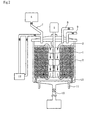
- Fig. 2 illustrates an immersion treating apparatus for treating the weathered reef-building coral according to the present invention.
- the apparatus shown in Fig. 2 comprises an enclosed container 2 for internally holding weathered reef-building coral 1 to be treated; a hollow cylindrical basket 3 made of stainless steel, into which the weathered reef-building coral 1 is put inside the enclosed container; an agitator blade 4 positioned at the central hollow space of the basket 3; and a motor 5 for rotating the agitator blade 4.
- An aqueous alkali solution storage vessel 6 is also juxtaposed with the enclosed container 2.
- the enclosed container 2 is provided with a feed pipe 7 for introducing the aqueous alkali solution into the enclosed container 2 from the storage vessel 6.
- the enclosed container 2 is also provided with a feed pipe 8 for introducing the water or aqueous silver solution into the enclosed container 2, a feed pipe 9 for introducing the reducing agent into the enclosed container 2 and a liquid discharge pipe 10 for discharging the effluent from the enclosed container 2.
- feed pipes 7, 8 and 9 and liquid discharge pipe 10 are further provided with valves for controlling the quantity of liquid to be introduced or discharged.
- a heating pipe 11 for heating the inside of the enclosed container 2 is internally provided.
- a vacuum pump 12 for evacuating its inside is connected to the enclosed container 2 .
- the basket 3 is supported by four to six supports 13.
- the feed pipes 7, 8 and 9 and the liquid discharge pipe 10 it is necessary for them to be formed of a metal having corrosion resistance to the aqueous alkali solution.
- a vacuum pump is used which can evacuate the inside of the enclosed container 2 to a vacuum of 70 mmHg or below, and preferably 30 mmHg or below.
- the weathered reef-building coral 1 is put in the basket 3 inside the enclosed container 2.
- the aqueous alkali solution is introduced through the feed pipe 7.
- the vacuum pump 12 is operated to evacuate the inside of the enclosed container 2 to a vacuum of 70 mmHg or below, and preferably 30 mmHg or below.
- the motor 5 is driven to rotate the agitator blade 4, to thereby form liquid flows moving in the up and down vertical directions inside the basket 3, as shown by the arrow in Fig. 3, thus the aqueous alkali solution is forcibly passed through the weathered reef-building coral 1 put in the basket 3.
- Hot water is also passed through the heating pipe 11 to heat the enclosed container 2 to 80 to 100°C.
- Such alkali washing is usually carried out for 30 to 60 minutes.
- the marine algae, organic substances originating from microorganisms and so forth present on the surface and in the fine structure inside the porous tissue of the weathered reef-building coral 1 can be dissolved in the aqueous alkali solution and removed.
- the step of immersing the weathered reef-building coral 1 in the aqueous alkali solution and the step of evacuating the inside of the enclosed container 2 may be replaced with each other so that the inside of the enclosed container 2 is evacuated by means of the vacuum pump 12 and thereafter the aqueous alkali solution is introduced to immerse the weathered reef-building coral 1 in the aqueous alkali solution.
- the alkali washing of the weathered reef-building coral 1 can be carried out in a good operability.
- the aqueous alkali solution can be spread also throughout the fine structure inside the porous tissue in a short time.
- the aqueous alkali solution having been used is discharged through the liquid discharge pipe 10.
- the aqueous alkali solution used in the alkali washing may be replaced with water, and the same operation as the above may be repeated. More specifically, the water is introduced into the enclosed container 2 through the feed pipe 8 to immerse the weathered reef-building coral 1 in the water, and then the inside of the enclosed container 2 is evacuated. Alternatively, the inside of the enclosed container 2 holding the weathered reef-building coral 1 is previously evacuated and thereafter the water is introduced into it through the feed pipe 8 to immerse the weathered reef-building coral 1 in the water.
- the agitator blade 4 is rotated to forcibly pass the water through the weathered reef-building coral 1 put in the basket 3. Thereafter, the washing water having been used is discharged through the liquid discharge pipe 10. This water washing is repeated until the pH of the washing water having been used from the liquid discharge pipe 10 turns neutral.
- the apparatus shown in Fig. 2 may be used also for manufacturing the silver-added weathered reef-building coral material.
- the weathered reef-building coral 1 to be coated with silver is preferably subjected to the alkali washing and water washing described above, followed by drying, and is further subjected to dry heat disinfection or dry sterilization, or roasting.
- the resultant weathered reef-building coral 1 is put in the basket 3.
- the aqueous silver solution is introduced into the enclosed container 2 through the feed pipe 8 to well immerse the weathered reef-building coral in this aqueous silver solution under reduced pressure.
- the excess aqueous silver solution is discharged through the liquid discharge pipe 10, and thereafter the reducing agent solution such as an ascorbic acid solution is introduced through the feed pipe 9 under reduced pressure to reduce the aqueous silver solution having adhered to the surface and fine structure inside the porous tissue of the weathered reef-building coral 1.
- the remaining reducing agent solution is discharged through the liquid discharge pipe 10.
- the resultant weathered reef-building coral is moved to a heating means such as an electric furnace separately provided, and is heated there at about 400°C for 30 to 60 minutes.
- the immersion treating apparatus is useful for the alkali washing of the weathered reef-building coral and for manufacturing the silver-added material as described above. Besides, it can also be useful for any treatment accompanied by immersion, e.g., for washing, coating or extracting various materials to be treated. Stated specifically, it can be used as, e.g., an appratus for extracting useful intended substances or physiologically active substances by immersing spices, plant roots or bark and dried products thereof, fruits or seeds, or other starting materials for food or medicine in an extraction solvent to extract such substances contained in the respective starting materials.
- the immersion treating apparatus may be modified in various forms in accordance with the purposes for which the apparatus is used, so long as it has the enclosed container whose interior can be evacuated; the hollow cylindrical basket for holding the material to be processed, provided in the container; and the agitator blade which rotates within the hollow space to form a vertical liquid flow in the basket.
- the basket may be made of a material appropriately selected from those which are not attacked by the washing solution or treating solution used on the materials to be treated.
- the net material constituting the basket may have any mesh size which may be appropriately determined in accordance with the size of the materials to be treated.
- the feed pipes for introducing the washing solution or treating solution and the liquid discharge pipe may also not necessarily be provided on the enclosed container.
- the vacuum pump 12 was driven to evacuate the inside of the enclosed container 2 to a vacuum of 10 mmH2O, and 25 liters of an aqueous 0.1N sodium hydroxide solution beforehand prepared in the storage vessel 6 was introduced into the enclosed container 2 through the feed pipe 7. Thereafter, hot water with a temperature of 80°C was passed through the heating pipe 11 to heat for 30 minutes the inside of the enclosed container 2 in which the aqueous sodium hydroxide solution was being forcibly passed through the weathered reef-building coral. After this alkali washing was completed, the hot water was stopped being fed to the heating pipe 11 and also the vacuum state of the inside of the enclosed container 2 was restored to normal pressure. Then, the aqueous sodium hydroxide solution in the enclosed container 2 was completely discharged through the liquid discharge pipe 10.
- City water was again introduced through the feed pipe 8, and the same operation as the above was repeated except for using the city water in place of the above aqueous alkali solution, to carry out water washing.
- This water washing was repeatedly carried out twice. More specifically, after the first-time water washing, the water discharged through the liquid discharge pipe 10 was collected to measure its pH to find that it was 8.1. The pH of the effluent after the second-time water washing turned to 7.0. Accordingly, the water washing was stopped after that.
- a sample obtained after the water washing followed by dehydration and drying was used as a specimen, and its crude protein content and the number of general bacteria (cells/g) were measured.
- the crude protein content was calculated from the total nitrogen by the semimicro-Kjeldahl method, and the number of general bacteria (cells/g) was measured by a microbiological test (the standard agar medium method).
- the crude protein content and the number of general bacteria were also measured on the parent material weathered reef-building coral.
- the number of general bacteria (cells/g) of the filter medium for water purifiers thus obtained were measured in the same manner as in Reference - Example 1 by a microbiological test (the standard agar medium method).
- 50 g of this filter medium was put into a column of 130 mm in inner diameter and 130 mm in height to make a decoloring test using 100 ml of 0.002% methylene blue. Then the rate of adsorption of methylene blue present in the methylene blue solution having passed through the column was determined according to the following expression:
- the number of general bacteria (cells/g) of the filter medium for water purifiers thus obtained were measured in the same manner as in Example 1.
- the decoloring test was made in the same manner as in Example 1, to determine the rate of adsorption of methylene blue and the activity.
- Filter mediums for water purifiers were obtained in the same manner as in Example 2 except that the concentration of the aqueous sodium hydroxide solution used in the alkali washing was changed. In respect of the filter mediums thus obtained, the decoloring test was carried out to determine the rate of adsorption of methylene blue and the activity.
- the activity increases with an increase in the concentration of the aqueous sodium hydroxide solution, and the microorganisms and other organic substances in the water can be adsorbed to purify the water.
- Example 1 The parent material weathered reef-building coral used in Example 1 was only pre-washed. Then, in respect of the weathered reef-building coral thus obtained, in the same manner as in Example 1, the number of general bacteria (cells/g) was measured and the decoloring test was carried out to determine the rate of adsorption of methylene blue and the activity. Results obtained on these are shown in Table 1.
- Example 1 The parent material weathered reef-building coral used in Example 1 was pre-washed, and the resultant weathered reef-building coral was roasted in the same manner as in Example 1. Then, in respect of the weathered reef-building coral thus obtained, in the same manner as in Example 1, the number of general bacteria (cells/g) was measured and the decoloring test was carried out to determine the rate of adsorption of methylene blue and the activity. Results obtained on these are shown in Table 1.
- Example 2 Using the filter medium for water purifiers obtained in Example 1, this was put in the basket 3 in the enclosed container 2 of the apparatus shown in Fig. 2, the inside of the enclosed container 2 was evacuated, 20 liters of an aqueous silver nitrate solution with 5% silver was introduced into it, and the agitator blade 4 was rotated for 30 minutes to forcibly pass the aqueous silver nitrate solution through the filter medium.
- aqueous silver nitrate solution After the aqueous silver nitrate solution was discharged, 20 liters of an aqueous 1.5% ascorbic acid solution was introduced through the feed pipe 9, and the agitator blade 4 was rotated for 30 minutes to forcibly pass the aqueous silver nitrate solution through the filter medium. Subsequently, the ascorbic acid solution was discharged through the liquid discharge pipe 10, and the resultant weathered reef-building coral was taken out of the enclosed container 2 and put into a 400°C electric furnace to heat it for 50 minutes. After the heating was completed, cooling, water washing, drying and grain size adjustment were successively carried out, followed by packaging to obtain a product of a silver-added material. The silver-added material thus obtained had a silver coating weight as shown in Table 2.
- a silver-added material was obtained in the same manner as in Example 5 except that the weathered reef-building coral material obtained in Example 2 was used.
- the silver-added material thus obtained had a silver coating weight as shown in Table 2.
- a silver-added material was obtained in the same manner as in Example 5 except for using one obtained by only pre-washing the parent material weathered reef-building coral used in Example 1.
- the silver-added material thus obtained had a silver coating weight as shown in Table 2.
- a weathered reef-building coral material can be obtained from which the various marine algae, various microorganisms including Vibrio bacteria inhabiting the ocean and other various organic substances held in the inner fine structure of weathered reef-building coral have been removed and whose safety has been ensured.
- This weathered reef-building coral material can be used in various purposes. In particular, it is suitable for food materials.
- a filter medium for water purifiers can also be obtained which has a high mineral elution quantity and a high activity.
- a silver-added material can also be obtained whose weathered reef-building coral has been coated with silver on its surface and also throughout its fine structure inside the porous tissue.
Landscapes
- Chemical & Material Sciences (AREA)
- Life Sciences & Earth Sciences (AREA)
- Engineering & Computer Science (AREA)
- Organic Chemistry (AREA)
- Food Science & Technology (AREA)
- Chemical Kinetics & Catalysis (AREA)
- Nutrition Science (AREA)
- Mycology (AREA)
- Health & Medical Sciences (AREA)
- Polymers & Plastics (AREA)
- Inorganic Chemistry (AREA)
- Hydrology & Water Resources (AREA)
- Environmental & Geological Engineering (AREA)
- Water Supply & Treatment (AREA)
- Oil, Petroleum & Natural Gas (AREA)
- Geology (AREA)
- Dispersion Chemistry (AREA)
- Agricultural Chemicals And Associated Chemicals (AREA)
- Farming Of Fish And Shellfish (AREA)
Claims (13)
- Verfahren zum Herstellen eines verwitterten, riffbildenden Korallenmaterials, umfassend die Schritte
des Eintauchens einer verwitterten, riffbildenden Koralle in eine wäßrige Alkalilösung unter reduziertem Druck zum Ausführen eines alkalischen Waschens, um ein Eindringen der wäßrigen Alkalilösung in die verwitterte, riffbildende Koralle überall in ihre Feinstruktur innerhalb des porösen Gewebes hervorzurufen und
deren Waschens mit Wasser bis Waschwasser aus dem Inneren des porösen Gewebes neutralisiert ist, wobei nach dem Waschen mit Wasser das verwitterte, riffbildende Korallenmaterial bei 100 bis 750°C geröstet wird. - Verfahren zum Herstellen eines verwitterten, riffbildenden Korallenmaterials nach Anspruch 1, worin das alkalische Waschen durch kräftiges Durchleiten der wäßrigen Alkalilösung durch die in die wäßrige Alkalilösung eingetauchte, verwitterte, riffbildende Koralle ausgeführt wird.
- Verfahren zum Herstellen eines verwitterten, riffbildenden Korallenmaterials nach Anspruch 1, worin das alkalische Waschen durch Hin- und Herbewegen der verwitterten, riffbildenden Koralle in der wäßrigen Alkalilösung ausgeführt wird.
- Verfahren zum Herstellen eines verwitterten, riffbildenden Korallenmaterials nach Anspruch 1, worin das alkalische Waschen während des Erwärmens der wäßrige Alkalilösung ausgeführt wird.
- Verfahren zum Herstellen eines verwitterten, riffbildenden Korallenmaterials nach Anspruch 1, wobei die wäßrige Alkalilösung eine wäßrige 0,01 bis 6 N alkalische Lösung von NaOH, KOH, Na2CO3 oder K2CO3 umfaßt.
- Verfahren zum Herstellen eines verwitterten, riffbildenden Korallenmaterials nach Anspruch 2, worin das Waschen mit Wasser durch Eintauchen der verwitterten, riffbildenden Koralle in Wasser unter reduziertem Druck und durch kräftiges Durchleiten des Wassers durch die verwitterte, riffbildende Koralle ausgeführt wird.
- Verfahren zum Herstellen eines verwitterten, riffbildenden Korallenmaterials nach Anspruch 3, worin das Waschen mit Wasser durch Eintauchen der verwitterten, riffbildenden Koralle in Wasser unter reduziertem Druck und durch Hin- und Herbewegen der verwitterten, riffbildenden Koralle im Wasser ausgeführt wird.
- Verfahren zum Herstellen eines verwitterten, riffbildenden Korallenmaterials nach Anspruch 1, worin nach dem Waschen mit Wasser und nach dem Rösten die verwitterte, riffbildende Koralle pulverisiert und gesiebt wird, um sie zu einem Pulver zu verarbeiten, das eine Teilchengröße von 500 Mesh oder größer aufweist (Teilchendurchmesser von 27,28 µm oder kleiner).
- Verfahren zum Herstellen eines mit Silber versetzten, verwitterten, riffbildenden Korallenmaterials, welches nach dem Waschen mit Wasser und dem Rösten im Verfahren zur Herstellung eines verwitterten, riffbildenden Korallenmaterials nach Anspruch 1
das Unterwerfen der verwitterten, riffbildenden Koralle einem Eintauchen in eine wäßrige Silberlösung unter reduziertem Druck, um ein Eindringen der wäßrigen Silberlösung in die verwitterte, riffbildende Koralle überall in ihre Feinstruktur innerhalb des porösen Gewebes hervorzurufen und
das Reduzieren des Silbers mit einem Reduktionsmittel, um die verwitterte, riffbildende Koralle mit Silber überall in ihrer Feinstruktur innerhalb des porösen Gewebes zu beschichten, umfaßt - Verwittertes riffbildendes Korallenmaterial, das durch das Herstellungsverfahren nach Anspruch 1 erhalten wird.
- Lebensmittelmaterial, welches das verwitterte, riffbildende Korallenmaterial, das durch das Herstellungsverfahren nach Anspruch 8 erhalten worden ist, umfaßt.
- Filtermedium, welches das verwitterte, riffbildende Korallenmaterial, das durch das Herstellungsverfahren nach Anspruch 1 erhalten worden ist, umfaßt.
- Mit Silber versetztes Material, welches das verwitterte, riffbildende Korallenmaterial, das durch den Herstellungsprozeß nach Anspruch 9 erhalten worden ist, umfaßt.
Priority Applications (1)
| Application Number | Priority Date | Filing Date | Title |
|---|---|---|---|
| DK97944123T DK0952114T3 (da) | 1997-10-15 | 1997-10-15 | Materiale på grundlag af forvitret hermatypisk koral |
Applications Claiming Priority (2)
| Application Number | Priority Date | Filing Date | Title |
|---|---|---|---|
| PCT/JP1997/003718 WO1999019259A1 (en) | 1997-10-15 | 1997-10-15 | Weathered hermatypic coral material |
| CA002229055A CA2229055C (en) | 1997-10-15 | 1997-10-15 | Weathered reef-building coral material |
Publications (3)
| Publication Number | Publication Date |
|---|---|
| EP0952114A1 EP0952114A1 (de) | 1999-10-27 |
| EP0952114A4 EP0952114A4 (de) | 2001-11-21 |
| EP0952114B1 true EP0952114B1 (de) | 2004-07-14 |
Family
ID=25680029
Family Applications (1)
| Application Number | Title | Priority Date | Filing Date |
|---|---|---|---|
| EP97944123A Expired - Lifetime EP0952114B1 (de) | 1997-10-15 | 1997-10-15 | Verwittertes hermatypisches korallenmaterial |
Country Status (5)
| Country | Link |
|---|---|
| US (1) | US6033730A (de) |
| EP (1) | EP0952114B1 (de) |
| AU (1) | AU4572597A (de) |
| ES (1) | ES2225990T3 (de) |
| WO (1) | WO1999019259A1 (de) |
Cited By (1)
| Publication number | Priority date | Publication date | Assignee | Title |
|---|---|---|---|---|
| RU2467809C1 (ru) * | 2011-07-06 | 2012-11-27 | Меграбян Казарос Аршалуйсович | Способ приготовления материала из песка выветрившегося рифового коралла |
Families Citing this family (5)
| Publication number | Priority date | Publication date | Assignee | Title |
|---|---|---|---|---|
| CN1528953A (zh) * | 2003-06-20 | 2004-09-15 | 制品覆层的方法及其层构造及一种挤胶枪推杆 | |
| ES2536633T3 (es) * | 2007-11-19 | 2015-05-27 | Ben Gurion University Of The Negev Research And Development Authority | Efectos mediados por calcio de corales y métodos de uso de los mismos |
| JP4233601B1 (ja) * | 2007-11-22 | 2009-03-04 | 有限責任中間法人 ソルベントサイエンスラボラトリー | 珊瑚粉の製造方法 |
| JP2013031419A (ja) * | 2011-08-02 | 2013-02-14 | Junji Mori | 食医用サンゴ等の生産方法(3) |
| CN109248839A (zh) * | 2018-11-14 | 2019-01-22 | 徐州美世通电动车有限公司 | 一种电动车喷漆预处理加工工艺 |
Family Cites Families (20)
| Publication number | Priority date | Publication date | Assignee | Title |
|---|---|---|---|---|
| US3622379A (en) * | 1968-08-08 | 1971-11-23 | Ocean Research Corp | Barrier coatings |
| US3690333A (en) * | 1971-05-17 | 1972-09-12 | Hans Kierner | Machine for cleaning small parts |
| JPS4938889A (de) * | 1972-08-18 | 1974-04-11 | ||
| US3890107A (en) * | 1972-09-25 | 1975-06-17 | Research Corp | Materials useful for prosthetic devices and the like |
| US3929971A (en) * | 1973-03-30 | 1975-12-30 | Research Corp | Porous biomaterials and method of making same |
| US3955018A (en) * | 1974-07-22 | 1976-05-04 | Aqualine Products, Inc. | Method for forming a decorative coated porous mass and the article produced thereby |
| US4314380A (en) * | 1980-09-26 | 1982-02-09 | Koken Co., Ltd. | Artificial bone |
| JPS58116405A (ja) * | 1981-12-29 | 1983-07-11 | Someya Hideo | 飲料水等の防腐剤 |
| JPS59120078A (ja) * | 1982-12-28 | 1984-07-11 | Norio Someya | 健康増進剤 |
| JPS59228990A (ja) * | 1983-06-10 | 1984-12-22 | Norio Someya | 飲料水用防腐剤 |
| JPH0759182B2 (ja) * | 1985-03-13 | 1995-06-28 | マリーンバイオ株式会社 | 食品の防腐剤 |
| DE3542744C1 (de) * | 1985-12-03 | 1987-05-27 | Ewers Rolf | Poroeses Hydroxylapatit-Material |
| US4940540A (en) * | 1987-07-08 | 1990-07-10 | Tri-Bio, Inc. | Submerged biological wastewater treatment system |
| FR2637502A1 (fr) * | 1988-10-12 | 1990-04-13 | Duroselle Patrick | Materiau de xenogreffe osseuse et procede d'obtention |
| US5169682A (en) * | 1990-03-28 | 1992-12-08 | Coral Biotech Co., Ltd. | Method of providing silver on calcium carbonate material such as coral sand |
| JPH0757347B2 (ja) * | 1991-04-25 | 1995-06-21 | コーラルバイオテック株式会社 | 滅菌用浄化剤の製造方法 |
| JP2915645B2 (ja) * | 1991-08-16 | 1999-07-05 | コーラルバイオテック株式会社 | 精製コ−ラルサンドの製造方法 |
| US5355901A (en) * | 1992-10-27 | 1994-10-18 | Autoclave Engineers, Ltd. | Apparatus for supercritical cleaning |
| JPH08155470A (ja) * | 1994-12-05 | 1996-06-18 | Kooraru Biotech Kk | 水溶性サンゴカルシウム |
| JP2893525B2 (ja) * | 1997-10-06 | 1999-05-24 | コーラルバイオテック株式会社 | 風化造礁サンゴ粒・粉およびその製造方法並びに製造装置 |
-
1997
- 1997-10-15 EP EP97944123A patent/EP0952114B1/de not_active Expired - Lifetime
- 1997-10-15 ES ES97944123T patent/ES2225990T3/es not_active Expired - Lifetime
- 1997-10-15 US US09/077,890 patent/US6033730A/en not_active Expired - Lifetime
- 1997-10-15 WO PCT/JP1997/003718 patent/WO1999019259A1/ja not_active Ceased
- 1997-10-15 AU AU45725/97A patent/AU4572597A/en not_active Abandoned
Cited By (1)
| Publication number | Priority date | Publication date | Assignee | Title |
|---|---|---|---|---|
| RU2467809C1 (ru) * | 2011-07-06 | 2012-11-27 | Меграбян Казарос Аршалуйсович | Способ приготовления материала из песка выветрившегося рифового коралла |
Also Published As
| Publication number | Publication date |
|---|---|
| EP0952114A4 (de) | 2001-11-21 |
| US6033730A (en) | 2000-03-07 |
| EP0952114A1 (de) | 1999-10-27 |
| WO1999019259A1 (en) | 1999-04-22 |
| AU4572597A (en) | 1999-05-03 |
| ES2225990T3 (es) | 2005-03-16 |
Similar Documents
| Publication | Publication Date | Title |
|---|---|---|
| Nag et al. | Removal of chromium (VI) from aqueous solutions using rubber leaf powder: batch and column studies | |
| EP1707266A1 (de) | Anionenadsorbierendes kohlenstoffmaterial und verfahren und vorrichtung zur herstellung davon | |
| US6033730A (en) | Weathered reef-building coral material | |
| JPH045519B2 (de) | ||
| KR20010085059A (ko) | 기능성 쌀 및 그 제조 방법 | |
| CA2229055C (en) | Weathered reef-building coral material | |
| HK1023329A1 (en) | Weathered hermatypic coral material | |
| HK1023329B (en) | Weathered hermatypic coral material | |
| JP2893525B2 (ja) | 風化造礁サンゴ粒・粉およびその製造方法並びに製造装置 | |
| JP4000346B1 (ja) | 重金属を含有する有機物から重金属を除去する方法、及びそれによって得られる食品の製造方法 | |
| EP3459360A1 (de) | Verfahren zur herstellung einer paste mit einem hohen gehalt an nährstoffen aus gekeimtem korn | |
| CA2089168A1 (en) | Method of decolourising water | |
| JP3534297B2 (ja) | 海水からの培養液の製造方法およびその利用方法 | |
| TW201804913A (zh) | 從稻米除去重金屬 | |
| Ioseliani et al. | Copper ions adsorption from aqueous solution using perlite | |
| El-Adawy et al. | Evaluation of Calotropis procera fruits as a bioadsorbent for removing of Acid Red 73 dye from the aqueous solutions | |
| CN100553493C (zh) | 一种猕猴桃果粒果汁饮料的加工工艺方法 | |
| JPH07173466A (ja) | 土壌・水質改良剤の製造方法 | |
| CN108208537A (zh) | 一种解除黄曲霉毒素b1的方法 | |
| Parlayıcı et al. | Removal of Hazardous Methylene Blue from Aqueous Solutions by Green Citrus Mold (Penicillium digitatum)@ Chitosan Hydrogel Beads | |
| JPS5832805A (ja) | 赤潮処理剤およびその製造方法 | |
| RU2799342C1 (ru) | Способ получения сорбентов из отходов глубокой переработки подсолнечного шрота | |
| RU2819217C1 (ru) | Способ получения энтеросорбента из лузги подсолнечника | |
| KR101984551B1 (ko) | 머드의 유효성분이 함유된 곡물의 발아방법 및 이를 이용하여 제조되는 발아 곡물 | |
| JP3393132B2 (ja) | 細胞膜の破壊されたクロレラの製造法 |
Legal Events
| Date | Code | Title | Description |
|---|---|---|---|
| PUAI | Public reference made under article 153(3) epc to a published international application that has entered the european phase |
Free format text: ORIGINAL CODE: 0009012 |
|
| 17P | Request for examination filed |
Effective date: 19980218 |
|
| AK | Designated contracting states |
Kind code of ref document: A1 Designated state(s): DE DK ES FR GB SE |
|
| A4 | Supplementary search report drawn up and despatched |
Effective date: 20011010 |
|
| AK | Designated contracting states |
Kind code of ref document: A4 Designated state(s): DE DK ES FR GB SE |
|
| 17Q | First examination report despatched |
Effective date: 20020412 |
|
| GRAP | Despatch of communication of intention to grant a patent |
Free format text: ORIGINAL CODE: EPIDOSNIGR1 |
|
| GRAP | Despatch of communication of intention to grant a patent |
Free format text: ORIGINAL CODE: EPIDOSNIGR1 |
|
| GRAS | Grant fee paid |
Free format text: ORIGINAL CODE: EPIDOSNIGR3 |
|
| GRAA | (expected) grant |
Free format text: ORIGINAL CODE: 0009210 |
|
| AK | Designated contracting states |
Kind code of ref document: B1 Designated state(s): DE DK ES FR GB SE |
|
| REG | Reference to a national code |
Ref country code: GB Ref legal event code: FG4D |
|
| REF | Corresponds to: |
Ref document number: 69729883 Country of ref document: DE Date of ref document: 20040819 Kind code of ref document: P |
|
| REG | Reference to a national code |
Ref country code: SE Ref legal event code: TRGR |
|
| REG | Reference to a national code |
Ref country code: DK Ref legal event code: T3 |
|
| ET | Fr: translation filed | ||
| REG | Reference to a national code |
Ref country code: HK Ref legal event code: GR Ref document number: 1023329 Country of ref document: HK |
|
| REG | Reference to a national code |
Ref country code: ES Ref legal event code: FG2A Ref document number: 2225990 Country of ref document: ES Kind code of ref document: T3 |
|
| PLBE | No opposition filed within time limit |
Free format text: ORIGINAL CODE: 0009261 |
|
| STAA | Information on the status of an ep patent application or granted ep patent |
Free format text: STATUS: NO OPPOSITION FILED WITHIN TIME LIMIT |
|
| 26N | No opposition filed |
Effective date: 20050415 |
|
| PGFP | Annual fee paid to national office [announced via postgrant information from national office to epo] |
Ref country code: ES Payment date: 20091026 Year of fee payment: 13 Ref country code: DK Payment date: 20091023 Year of fee payment: 13 Ref country code: DE Payment date: 20091026 Year of fee payment: 13 |
|
| PGFP | Annual fee paid to national office [announced via postgrant information from national office to epo] |
Ref country code: GB Payment date: 20091023 Year of fee payment: 13 |
|
| PGFP | Annual fee paid to national office [announced via postgrant information from national office to epo] |
Ref country code: FR Payment date: 20101112 Year of fee payment: 14 |
|
| PGFP | Annual fee paid to national office [announced via postgrant information from national office to epo] |
Ref country code: SE Payment date: 20101027 Year of fee payment: 14 |
|
| REG | Reference to a national code |
Ref country code: DK Ref legal event code: EBP |
|
| GBPC | Gb: european patent ceased through non-payment of renewal fee |
Effective date: 20101015 |
|
| REG | Reference to a national code |
Ref country code: DE Ref legal event code: R119 Ref document number: 69729883 Country of ref document: DE Effective date: 20110502 |
|
| PG25 | Lapsed in a contracting state [announced via postgrant information from national office to epo] |
Ref country code: GB Free format text: LAPSE BECAUSE OF NON-PAYMENT OF DUE FEES Effective date: 20101015 |
|
| PG25 | Lapsed in a contracting state [announced via postgrant information from national office to epo] |
Ref country code: DK Free format text: LAPSE BECAUSE OF NON-PAYMENT OF DUE FEES Effective date: 20101031 |
|
| REG | Reference to a national code |
Ref country code: ES Ref legal event code: FD2A Effective date: 20111118 |
|
| PG25 | Lapsed in a contracting state [announced via postgrant information from national office to epo] |
Ref country code: ES Free format text: LAPSE BECAUSE OF NON-PAYMENT OF DUE FEES Effective date: 20101016 |
|
| REG | Reference to a national code |
Ref country code: SE Ref legal event code: EUG |
|
| REG | Reference to a national code |
Ref country code: FR Ref legal event code: ST Effective date: 20120629 |
|
| PG25 | Lapsed in a contracting state [announced via postgrant information from national office to epo] |
Ref country code: FR Free format text: LAPSE BECAUSE OF NON-PAYMENT OF DUE FEES Effective date: 20111102 |
|
| PG25 | Lapsed in a contracting state [announced via postgrant information from national office to epo] |
Ref country code: SE Free format text: LAPSE BECAUSE OF NON-PAYMENT OF DUE FEES Effective date: 20111016 |
|
| PG25 | Lapsed in a contracting state [announced via postgrant information from national office to epo] |
Ref country code: DE Free format text: LAPSE BECAUSE OF NON-PAYMENT OF DUE FEES Effective date: 20110502 |