EP0945010B1 - Encoded video signal formatting - Google Patents
Encoded video signal formatting Download PDFInfo
- Publication number
- EP0945010B1 EP0945010B1 EP98945467A EP98945467A EP0945010B1 EP 0945010 B1 EP0945010 B1 EP 0945010B1 EP 98945467 A EP98945467 A EP 98945467A EP 98945467 A EP98945467 A EP 98945467A EP 0945010 B1 EP0945010 B1 EP 0945010B1
- Authority
- EP
- European Patent Office
- Prior art keywords
- sequence
- data block
- data
- coded
- image
- Prior art date
- Legal status (The legal status is an assumption and is not a legal conclusion. Google has not performed a legal analysis and makes no representation as to the accuracy of the status listed.)
- Expired - Lifetime
Links
- 238000000034 method Methods 0.000 claims description 14
- 230000003287 optical effect Effects 0.000 claims description 5
- 230000006835 compression Effects 0.000 description 2
- 238000007906 compression Methods 0.000 description 2
- 239000010410 layer Substances 0.000 description 2
- 238000012986 modification Methods 0.000 description 2
- 230000004048 modification Effects 0.000 description 2
- 238000012544 monitoring process Methods 0.000 description 2
- 230000008569 process Effects 0.000 description 2
- 239000012790 adhesive layer Substances 0.000 description 1
- 238000013459 approach Methods 0.000 description 1
- 238000013461 design Methods 0.000 description 1
- 238000010586 diagram Methods 0.000 description 1
- 230000000977 initiatory effect Effects 0.000 description 1
- 238000004519 manufacturing process Methods 0.000 description 1
- 230000000737 periodic effect Effects 0.000 description 1
- 230000004044 response Effects 0.000 description 1
- 239000000758 substrate Substances 0.000 description 1
- 230000009466 transformation Effects 0.000 description 1
Images

Classifications
-
- H—ELECTRICITY
- H04—ELECTRIC COMMUNICATION TECHNIQUE
- H04N—PICTORIAL COMMUNICATION, e.g. TELEVISION
- H04N5/00—Details of television systems
- H04N5/76—Television signal recording
- H04N5/78—Television signal recording using magnetic recording
- H04N5/782—Television signal recording using magnetic recording on tape
- H04N5/783—Adaptations for reproducing at a rate different from the recording rate
-
- H—ELECTRICITY
- H04—ELECTRIC COMMUNICATION TECHNIQUE
- H04N—PICTORIAL COMMUNICATION, e.g. TELEVISION
- H04N5/00—Details of television systems
- H04N5/76—Television signal recording
- H04N5/84—Television signal recording using optical recording
- H04N5/85—Television signal recording using optical recording on discs or drums
-
- H—ELECTRICITY
- H04—ELECTRIC COMMUNICATION TECHNIQUE
- H04N—PICTORIAL COMMUNICATION, e.g. TELEVISION
- H04N9/00—Details of colour television systems
- H04N9/79—Processing of colour television signals in connection with recording
- H04N9/80—Transformation of the television signal for recording, e.g. modulation, frequency changing; Inverse transformation for playback
- H04N9/804—Transformation of the television signal for recording, e.g. modulation, frequency changing; Inverse transformation for playback involving pulse code modulation of the colour picture signal components
- H04N9/8042—Transformation of the television signal for recording, e.g. modulation, frequency changing; Inverse transformation for playback involving pulse code modulation of the colour picture signal components involving data reduction
Definitions
- the present invention relates to the formatting of predictive-encoded digital video signals for storage on a recording medium, especially but not exclusively an optical or magnetic disc, as well as to storage media carrying the particularly formatted signals, and encoding and decoding apparatus supporting the particular signal format.
- MPEG and H.261 are digital coding systems conventionally used for storing and compressing natural picture sequences, with the decoders being designed to interpret such encoded data and reproduce the same original sequence of images.
- the MPEG standard recognises three types of pictures (frames) namely intra-pictures, predicted pictures and interpolated pictures, generally referred to as I-, P-, and B-pictures respectively.
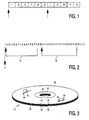
- a typical MPEG picture sequence is shown in Figure 1 of the accompanying drawings.
- I-pictures are specifically intended to provide access points for random pictures and as such they are coded complete, with only limited compression.
- P-pictures are coded with reference to a past (I or P) picture and often form a reference for future P-pictures.
- B-pictures have the highest degree of compression but require both a past and future reference for their generation.
- MPEG compressed video stored on an optical or magnetic disc (CD, DVD, DVD-RAM, hard-disk etc.) or other linearly-read digital storage means may be seen as a replacement for analog video storage systems such as video tape and laser disc.
- One of the known problems with using predictively coded video is how to implement the so-called trick modes that users take for granted (fast-forward and reverse play being the best known examples). As it is not generally possible to speed up or reverse the conventional display process, it becomes necessary to skip through the encoded data, at the same time seeking suitable access points: in the Figure 1 example, it is only possible to start decompressing the video data stream at the points indicated, where the I-frames do not rely on contributions from prior to the access point.
- the step of locating these access points brings another problem, in that the compressed frames in the sequence are of varying lengths and hence the procedure involves more than simply counting bits from the start of a previous frame.
- Some systems solve the problem by introducing data into the video stream with pointers to future access points (as I-frames are indicated in DVD-Video).
- I-frames are indicated in DVD-Video.
- An MPEG disk for high-speed reproduction contains position information for successive I-frames in a recording area of a first I-frame.
- the problem with this approach is that a second pass is needed to fill in these pointers. This makes real-time recording (one pass as with conventional VCR) impossible.
- a method for formatting a sequence of video images comprising the steps of: encoding successive images of the sequence according to a predetermined coding scheme in which some images of the sequence are intra-coded, without reference to any other image of the sequence, and the remainder are respectively coded with reference to at least one further image of the sequence; formatting the encoded data for each image frame into one or a sequence of data blocks and outputting a data block stream formed of the data block or blocks from successive ones of the sequence of video images; characterised in that the step of formatting comprises the further steps of identifying intra-coded frames and of inserting additional data blocks in said data block stream, each of said additional data blocks carrying data identifying the location in the data block stream of the first or only data block of a preceding intra-coded image frame relative to the location of that additional data block.
- a single additional data block (also referred to herein as an information block) is inserted in the data block stream at fixed periodically repeated intervals, such as for example every 25th data block of the stream; where the data blocks are all of a common size, skipping from one information block to another becomes a relatively simple matter.
- Each additional data block may store data identifying the first or only data block in the data block stream of the closest previously formatted intra-coded image frame, and may also store further data identifying the length of the said closest previously formatted intra-coded image frame.
- the image frames may be encoded in accordance with MPEG standards, or another predictive coding scheme may be employed.
- a sequentially-readable storage device carrying an encoded and formatted sequence of video image frames wherein some images of the sequence are intra-coded, without reference to any other image of the sequence, and the remainder are respectively coded with reference to at least one further image of the sequence, and the encoded data for the succession of image frames is formatted into a sequence of fixed size data blocks, with at least one data block per encoded image frame, with the stored sequence of data blocks including additional data blocks, with each such additional data block identifying the storage device storage location of the first or only data block of a preceding intra-coded image frame.
- the said additional data blocks are suitably provided at fixed periodically repeated intervals within the stored sequence of encoded image data blocks, with each said additional data block containing data identifying the storage device storage location of the first or only data block of the closest previously formatted intra-coded image frame.
- the said additional data blocks may identify the location of the first or only data block of the closest preceding intra-coded image frame in terms of the location on disc at which said data block is stored.
- each said additional data block may further carry data identifying the storage device storage location of the auxiliary data associated with the particularly indicated intra-coded image frame.
- the auxiliary data may be included in the trick-play.
- an encoder apparatus operable to implement the formatting method set forth above, the apparatus comprising means for encoding successive images of a video image sequence according to a predetermined coding scheme in which some images of the sequence are intra-coded, without reference to any other image of the sequence, and the remainder are respectively coded with reference to at least one further image of the sequence; means for formatting the encoded data for each image frame into one or a sequence of fixed size data blocks and outputting a data block stream formed of the data block or blocks from successive ones of the sequence of video images, said means for formatting being operable to identify intra-coded frames, and being configured to insert additional data blocks in said data block stream, each of said additional data blocks carrying data identifying the location in the data block stream of the first or only data block of an intra-coded image frame relative to the location of that additional data block.
- a video image player configured to receive and read the sequence of data blocks from a sequentially-readabte storage device as set forth above, said player comprising a decoder arranged to receive the stream of data blocks, decode the image data and output a sequence of video image frames, said player being operable to output selected ones of said sequence in a fast-forward or fast reverse mode, the player comprising means for selecting frames by selecting every N th additional data block and displaying the respectively identified intra-coded image frame.
- the method for formatting starts with the encoding of successive images of the sequence as MPEG I-, B-, or P-frames to generate a sequence of encoded frames such as that of Figure 1.
- fields rather than frames may be the basic encoded entity, although the technique is unchanged: the following example refers just to frames although the skilled reader will recognise that this is not intended as in any way limiting.
- the formatting operation itself divides the encoded data for each image frame into one, or more usually several, data blocks which would conventionally be output in sequence as a data block stream. For convenience of handling, these data blocks are chosen to be of a common size, although this is not a prerequisite to successful operation.
- additional data blocks are inserted at regular intervals in the data block stream, for example at every 25th or 30th block.
- the encoded video is embedded within a multiplexed steam when recorded to disc, with the information blocks being classed as "private" data such that a demultiplexer will generally ignore them and thus avoid disturbing the MPEG sequence.
- Each of these information blocks carries data identifying the starting location (and preferably also length) of the previous I-frame as it appears in the data block stream.
- a suitably configured player will seek to an arbitrary information block and, using the data therein, locate the preceding I-frame and decode it. Depending on the speed of fast-forward, the player then skips to the next (or Nth) information block and repeats the process, thus skipping through the video stream at an increased speed.
- the speed of viewing depends on the number of information blocks skipped as, although the compressed video frames are of variable length, the overall compressed bit rate remains approximately constant.
- Figure 2 represents the data block sequence for a video image sequence compressed as: IBPBPBPBIBPBPBPBI
- each of the letters appearing in the sequence in Figure 2 represents one data block on the storage medium: as can be seen, the I-frames (being coded complete) require the greatest number of data blocks for recording. As also shown, the sequence is interrupted every 25th block by the inclusion of an information block (represented by i) with arrows 10;12 representing how the information block identifies the first data block of the immediately preceding I-frame.
- Figure 3 represents a sequentially-readable storage device, in the form of a DVD disc 14, carrying the encoded and formatted sequence of video image frames.
- the disc has the conventional centre hole 16 and clamping area 18 surrounded by a pair of read-out surfaces 20 provided by respective transparent substrates 22 over recorded layers 24, with the upper and lower layers being separated by an adhesive layer 26.
- the periodically spaced information blocks 28 contain the location of the start of the preceding I-frame 30.
- Figure 4 schematically represents an encoding and formatting apparatus operable to generate the streams of data blocks such as that in Figure 2.
- an MPEG encoder 42 From an image data source 40 an MPEG encoder 42 generates the compressed I-, P-, and B-frame data and outputs it to frame data store 44.
- a monitoring stage 46 which detects I-frames.
- formatting stage 48 which forms the sequential stream of data blocks: the formatting stage is also coupled to receive indication of I-frames from the monitoring stage 46 and, based on this information, it generates the periodic information frames and inserts them in the output block stream to a storage apparatus write/recording stage 50.
- Figure 5 schematically represents a video image player configured to receive and read the sequence of data blocks, including information blocks, from a suitable sequentially-readable storage device such as the disc of Figure 3.
- the player comprises a disc reader 60 operating under control of a CPU 62 to read data from disc 14 to decoder stage 64 (via the CPU).
- the decoder stage 64 coupled with a frame store 66, the video image sequence is recreated in the frame store before being output to a display, such as a television 68.
- User input means 70 are coupled with the player CPU 62 and include controls for initiating the various trick-modes supported: as will be well understood, these controls may be provided on the player itself or on a remote control handset coupled by infra-red link.
- the CPU On entering a trick-mode, such as fast-forward, the CPU directs the decoder 64 to skip frames by selecting every N th additional data block and displaying just the respectively identified I-frame.
- the value of N may be fixed (constant fast-forward/reverse rate): in professional/studio apparatus, however, it may be variable in response to user input.
Landscapes
- Engineering & Computer Science (AREA)
- Multimedia (AREA)
- Signal Processing (AREA)
- Television Signal Processing For Recording (AREA)
- Signal Processing For Digital Recording And Reproducing (AREA)
- Compression Or Coding Systems Of Tv Signals (AREA)
- Management Or Editing Of Information On Record Carriers (AREA)
Applications Claiming Priority (3)
| Application Number | Priority Date | Filing Date | Title |
|---|---|---|---|
| GBGB9721662.6A GB9721662D0 (en) | 1997-10-14 | 1997-10-14 | Encoded video signal formatting |
| GB9721662 | 1997-10-14 | ||
| PCT/IB1998/001573 WO1999020045A2 (en) | 1997-10-14 | 1998-10-08 | Encoded video signal formatting |
Publications (2)
| Publication Number | Publication Date |
|---|---|
| EP0945010A1 EP0945010A1 (en) | 1999-09-29 |
| EP0945010B1 true EP0945010B1 (en) | 2006-03-08 |
Family
ID=10820463
Family Applications (1)
| Application Number | Title | Priority Date | Filing Date |
|---|---|---|---|
| EP98945467A Expired - Lifetime EP0945010B1 (en) | 1997-10-14 | 1998-10-08 | Encoded video signal formatting |
Country Status (7)
| Country | Link |
|---|---|
| US (1) | US7046916B1 (https=) |
| EP (1) | EP0945010B1 (https=) |
| JP (1) | JP4726267B2 (https=) |
| KR (1) | KR100614507B1 (https=) |
| DE (1) | DE69833775T2 (https=) |
| GB (1) | GB9721662D0 (https=) |
| WO (1) | WO1999020045A2 (https=) |
Cited By (1)
| Publication number | Priority date | Publication date | Assignee | Title |
|---|---|---|---|---|
| CN1939054B (zh) * | 2004-04-02 | 2010-07-21 | Nds有限公司 | 用于在pvr窍门模式回放期间提供可见消息的系统 |
Families Citing this family (15)
| Publication number | Priority date | Publication date | Assignee | Title |
|---|---|---|---|---|
| JP3372221B2 (ja) * | 1999-06-16 | 2003-01-27 | 日本ビクター株式会社 | 記録装置 |
| JP3557371B2 (ja) | 1999-07-15 | 2004-08-25 | 松下電器産業株式会社 | Avデコーダ制御方法、及びavデコーダ制御装置 |
| GB9930788D0 (en) | 1999-12-30 | 2000-02-16 | Koninkl Philips Electronics Nv | Method and apparatus for converting data streams |
| KR100748495B1 (ko) * | 2001-04-20 | 2007-08-13 | 엘지전자 주식회사 | 복수 참조 프레임을 이용한 b프레임 코딩시 직접 예측 방법 |
| US7266150B2 (en) | 2001-07-11 | 2007-09-04 | Dolby Laboratories, Inc. | Interpolation of video compression frames |
| US8111754B1 (en) | 2001-07-11 | 2012-02-07 | Dolby Laboratories Licensing Corporation | Interpolation of video compression frames |
| KR20050026052A (ko) * | 2002-07-30 | 2005-03-14 | 코닌클리케 필립스 일렉트로닉스 엔.브이. | 사용자에 의해 제어되는 트릭 플레이 동작 |
| US8812852B2 (en) * | 2003-03-19 | 2014-08-19 | Sony Corporation | Method and system for marking digital content |
| US7471724B2 (en) * | 2003-06-23 | 2008-12-30 | Vichip Corp. Limited | Method and apparatus for adaptive multiple-dimensional signal sequences encoding/decoding |
| US6980650B2 (en) * | 2003-10-27 | 2005-12-27 | Nds Limited | System for providing keys |
| CN101848381B (zh) * | 2004-04-02 | 2014-04-16 | Nds有限公司 | 用于在pvr窍门模式回放期间提供可见消息的系统 |
| CN101945250A (zh) * | 2005-04-26 | 2011-01-12 | 皇家飞利浦电子股份有限公司 | 用于处理具有分组序列和与分组有关的定时信息的数据流的设备和方法 |
| CN102113326A (zh) | 2008-08-04 | 2011-06-29 | 杜比实验室特许公司 | 重叠块差异估计和补偿体系结构 |
| CN113938705B (zh) * | 2020-07-13 | 2024-08-27 | 阿里巴巴集团控股有限公司 | 用于视频编解码的方法、装置、服务器、终端设备及系统 |
| CN117150059B (zh) * | 2023-10-27 | 2024-02-13 | 湖南视觉伟业智能科技有限公司 | 一种基于nvr设备的碎片化图像数据存储方法 |
Family Cites Families (14)
| Publication number | Priority date | Publication date | Assignee | Title |
|---|---|---|---|---|
| JPH038086A (ja) * | 1989-06-06 | 1991-01-16 | Pioneer Electron Corp | 静止画信号再生装置 |
| US5249053A (en) * | 1991-02-05 | 1993-09-28 | Dycam Inc. | Filmless digital camera with selective image compression |
| JP3264290B2 (ja) * | 1992-09-22 | 2002-03-11 | ソニー株式会社 | 復号方法および復号装置 |
| JP2785220B2 (ja) * | 1992-09-22 | 1998-08-13 | ソニー株式会社 | データ符号化装置および方法、並びにデータ復号化装置および方法 |
| JP3551447B2 (ja) * | 1992-09-22 | 2004-08-04 | ソニー株式会社 | データ符号化装置および方法、データ復号化装置および方法 |
| JP3261844B2 (ja) * | 1993-01-13 | 2002-03-04 | 株式会社日立製作所 | デジタルビデオ記録装置及び記録方法 |
| US5535008A (en) * | 1993-03-16 | 1996-07-09 | Victor Company Of Japan, Ltd. | Method for jump-reproducing video data of moving picture coded with high efficiency |
| EP0632653B1 (en) * | 1993-05-27 | 2000-09-06 | Matsushita Electric Industrial Co., Ltd. | Digital high definition video recorder having high definition display in trick-play modes |
| CN1187977C (zh) | 1993-07-09 | 2005-02-02 | 索尼公司 | 图象信号译码方法和装置 |
| WO1995008823A1 (en) * | 1993-09-21 | 1995-03-30 | Sony Corporation | Method and device for transmitting data, data decoder, and data recording medium |
| JP3491365B2 (ja) * | 1995-01-31 | 2004-01-26 | ソニー株式会社 | 符号化データ復号方法および復号装置 |
| JPH08242452A (ja) * | 1995-03-02 | 1996-09-17 | Matsushita Electric Ind Co Ltd | 映像信号圧縮符号化装置 |
| KR100268546B1 (ko) * | 1995-03-20 | 2000-10-16 | 모리시타 요이찌 | 영상 정보 기록 장치 및 그 방법 |
| KR100223163B1 (ko) * | 1995-12-11 | 1999-10-15 | 윤종용 | 배속재생을 위한 디스크포맷 및 이를 이용한 동화상데이타의 배속재생방법 및 그장치 |
-
1997
- 1997-10-14 GB GBGB9721662.6A patent/GB9721662D0/en not_active Ceased
-
1998
- 1998-10-08 KR KR1019997005226A patent/KR100614507B1/ko not_active Expired - Lifetime
- 1998-10-08 DE DE69833775T patent/DE69833775T2/de not_active Expired - Lifetime
- 1998-10-08 WO PCT/IB1998/001573 patent/WO1999020045A2/en not_active Ceased
- 1998-10-08 JP JP52136399A patent/JP4726267B2/ja not_active Expired - Lifetime
- 1998-10-08 EP EP98945467A patent/EP0945010B1/en not_active Expired - Lifetime
- 1998-10-14 US US09/172,435 patent/US7046916B1/en not_active Expired - Lifetime
Cited By (1)
| Publication number | Priority date | Publication date | Assignee | Title |
|---|---|---|---|---|
| CN1939054B (zh) * | 2004-04-02 | 2010-07-21 | Nds有限公司 | 用于在pvr窍门模式回放期间提供可见消息的系统 |
Also Published As
| Publication number | Publication date |
|---|---|
| KR20000069436A (ko) | 2000-11-25 |
| WO1999020045A3 (en) | 1999-07-08 |
| EP0945010A1 (en) | 1999-09-29 |
| GB9721662D0 (en) | 1997-12-10 |
| JP4726267B2 (ja) | 2011-07-20 |
| US7046916B1 (en) | 2006-05-16 |
| DE69833775T2 (de) | 2006-11-02 |
| JP2001506111A (ja) | 2001-05-08 |
| KR100614507B1 (ko) | 2006-08-22 |
| WO1999020045A2 (en) | 1999-04-22 |
| DE69833775D1 (de) | 2006-05-04 |
Similar Documents
| Publication | Publication Date | Title |
|---|---|---|
| CN100424776C (zh) | 光盘重放方法 | |
| JP3254924B2 (ja) | データ再生方法およびデータ再生装置 | |
| KR100219748B1 (ko) | 디스크 매체와 디스크 매체에 있어서의 정보 기록재생 방법 및 장치 | |
| JP3491366B2 (ja) | 符号化データの特殊再生方法および特殊再生装置 | |
| EP0945010B1 (en) | Encoded video signal formatting | |
| KR0185932B1 (ko) | 고속재생을 위한 비디오데이타 복호방법 및 그 장치 | |
| US6795640B1 (en) | Data recording device, data reproducing device and data recording medium for managing encoded data over a plurality of recording media | |
| KR100223163B1 (ko) | 배속재생을 위한 디스크포맷 및 이를 이용한 동화상데이타의 배속재생방법 및 그장치 | |
| US6069993A (en) | Image information decoding and reproducing apparatus and method | |
| JP3253530B2 (ja) | 動画像記録装置 | |
| KR19980080442A (ko) | 디지털 신호 재생 방법 및 장치 | |
| JPWO1995002300A1 (ja) | 画像信号復号化方法及び画像信号復号化装置 | |
| CN1750627B (zh) | 盘介质和在其上记录和重放信息的方法和设备 | |
| EP0674445B1 (en) | Moving picture decoding device | |
| JP3248366B2 (ja) | データ再生方法およびデータ再生装置 | |
| EP1005226A2 (en) | MPEG reproducing apparatus and methods | |
| JP3511312B2 (ja) | 光ディスク、および光ディスクの再生装置および方法 | |
| JP3507990B2 (ja) | 動画像再生装置及び動画像記録再生装置 | |
| US5892883A (en) | Recording of a data reduced digital video signal in slant tracks on a record carrier | |
| JPH06339113A (ja) | 動画像記録再生装置 | |
| JP3375616B2 (ja) | 光ディスク、記録方法及び記録装置 | |
| JP3375615B2 (ja) | 光ディスクの再生方法及び再生装置 | |
| JP3277757B2 (ja) | ビデオデータ再生装置 | |
| EP1474920A2 (en) | An apparatus and a record carrier for, and a method of recording a sequence of video data signals | |
| KR19990048833A (ko) | 고속재생장치, 방법 및 그 데이터 구조 |
Legal Events
| Date | Code | Title | Description |
|---|---|---|---|
| PUAI | Public reference made under article 153(3) epc to a published international application that has entered the european phase |
Free format text: ORIGINAL CODE: 0009012 |
|
| 17P | Request for examination filed |
Effective date: 19990714 |
|
| AK | Designated contracting states |
Kind code of ref document: A1 Designated state(s): DE FR GB |
|
| 17Q | First examination report despatched |
Effective date: 20040223 |
|
| GRAP | Despatch of communication of intention to grant a patent |
Free format text: ORIGINAL CODE: EPIDOSNIGR1 |
|
| GRAS | Grant fee paid |
Free format text: ORIGINAL CODE: EPIDOSNIGR3 |
|
| GRAA | (expected) grant |
Free format text: ORIGINAL CODE: 0009210 |
|
| AK | Designated contracting states |
Kind code of ref document: B1 Designated state(s): DE FR GB |
|
| REG | Reference to a national code |
Ref country code: GB Ref legal event code: FG4D |
|
| REF | Corresponds to: |
Ref document number: 69833775 Country of ref document: DE Date of ref document: 20060504 Kind code of ref document: P |
|
| ET | Fr: translation filed | ||
| PLBE | No opposition filed within time limit |
Free format text: ORIGINAL CODE: 0009261 |
|
| STAA | Information on the status of an ep patent application or granted ep patent |
Free format text: STATUS: NO OPPOSITION FILED WITHIN TIME LIMIT |
|
| 26N | No opposition filed |
Effective date: 20061211 |
|
| REG | Reference to a national code |
Ref country code: DE Ref legal event code: R082 Ref document number: 69833775 Country of ref document: DE Representative=s name: MEISSNER, BOLTE & PARTNER GBR, DE |
|
| REG | Reference to a national code |
Ref country code: DE Ref legal event code: R082 Ref document number: 69833775 Country of ref document: DE Representative=s name: MEISSNER BOLTE PATENTANWAELTE RECHTSANWAELTE P, DE Effective date: 20140328 Ref country code: DE Ref legal event code: R082 Ref document number: 69833775 Country of ref document: DE Representative=s name: MEISSNER, BOLTE & PARTNER GBR, DE Effective date: 20140328 Ref country code: DE Ref legal event code: R081 Ref document number: 69833775 Country of ref document: DE Owner name: KONINKLIJKE PHILIPS N.V., NL Free format text: FORMER OWNER: KONINKLIJKE PHILIPS ELECTRONICS N.V., EINDHOVEN, NL Effective date: 20140328 |
|
| REG | Reference to a national code |
Ref country code: FR Ref legal event code: CD Owner name: KONINKLIJKE PHILIPS N.V., NL Effective date: 20141126 Ref country code: FR Ref legal event code: CA Effective date: 20141126 |
|
| REG | Reference to a national code |
Ref country code: FR Ref legal event code: PLFP Year of fee payment: 18 |
|
| REG | Reference to a national code |
Ref country code: FR Ref legal event code: PLFP Year of fee payment: 19 |
|
| REG | Reference to a national code |
Ref country code: FR Ref legal event code: PLFP Year of fee payment: 20 |
|
| PGFP | Annual fee paid to national office [announced via postgrant information from national office to epo] |
Ref country code: FR Payment date: 20171031 Year of fee payment: 20 |
|
| PGFP | Annual fee paid to national office [announced via postgrant information from national office to epo] |
Ref country code: GB Payment date: 20171101 Year of fee payment: 20 |
|
| PGFP | Annual fee paid to national office [announced via postgrant information from national office to epo] |
Ref country code: DE Payment date: 20171229 Year of fee payment: 20 |
|
| REG | Reference to a national code |
Ref country code: DE Ref legal event code: R071 Ref document number: 69833775 Country of ref document: DE |
|
| REG | Reference to a national code |
Ref country code: GB Ref legal event code: PE20 Expiry date: 20181007 |
|
| PG25 | Lapsed in a contracting state [announced via postgrant information from national office to epo] |
Ref country code: GB Free format text: LAPSE BECAUSE OF EXPIRATION OF PROTECTION Effective date: 20181007 |