EP0944088B1 - Optical disk - Google Patents
Optical disk Download PDFInfo
- Publication number
- EP0944088B1 EP0944088B1 EP99301906A EP99301906A EP0944088B1 EP 0944088 B1 EP0944088 B1 EP 0944088B1 EP 99301906 A EP99301906 A EP 99301906A EP 99301906 A EP99301906 A EP 99301906A EP 0944088 B1 EP0944088 B1 EP 0944088B1
- Authority
- EP
- European Patent Office
- Prior art keywords
- clock
- data
- track
- optical disk
- write
- Prior art date
- Legal status (The legal status is an assumption and is not a legal conclusion. Google has not performed a legal analysis and makes no representation as to the accuracy of the status listed.)
- Expired - Lifetime
Links
- 230000003287 optical effect Effects 0.000 title claims description 81
- 238000000034 method Methods 0.000 claims description 12
- 230000000875 corresponding effect Effects 0.000 description 18
- 238000013459 approach Methods 0.000 description 11
- 230000007704 transition Effects 0.000 description 11
- 230000008859 change Effects 0.000 description 7
- 230000008569 process Effects 0.000 description 4
- 230000001360 synchronised effect Effects 0.000 description 4
- 230000007547 defect Effects 0.000 description 3
- 230000008901 benefit Effects 0.000 description 2
- 238000012937 correction Methods 0.000 description 2
- 230000006870 function Effects 0.000 description 2
- 238000013507 mapping Methods 0.000 description 2
- PCTMTFRHKVHKIS-BMFZQQSSSA-N (1s,3r,4e,6e,8e,10e,12e,14e,16e,18s,19r,20r,21s,25r,27r,30r,31r,33s,35r,37s,38r)-3-[(2r,3s,4s,5s,6r)-4-amino-3,5-dihydroxy-6-methyloxan-2-yl]oxy-19,25,27,30,31,33,35,37-octahydroxy-18,20,21-trimethyl-23-oxo-22,39-dioxabicyclo[33.3.1]nonatriaconta-4,6,8,10 Chemical compound C1C=C2C[C@@H](OS(O)(=O)=O)CC[C@]2(C)[C@@H]2[C@@H]1[C@@H]1CC[C@H]([C@H](C)CCCC(C)C)[C@@]1(C)CC2.O[C@H]1[C@@H](N)[C@H](O)[C@@H](C)O[C@H]1O[C@H]1/C=C/C=C/C=C/C=C/C=C/C=C/C=C/[C@H](C)[C@@H](O)[C@@H](C)[C@H](C)OC(=O)C[C@H](O)C[C@H](O)CC[C@@H](O)[C@H](O)C[C@H](O)C[C@](O)(C[C@H](O)[C@H]2C(O)=O)O[C@H]2C1 PCTMTFRHKVHKIS-BMFZQQSSSA-N 0.000 description 1
- 230000002596 correlated effect Effects 0.000 description 1
- 230000001186 cumulative effect Effects 0.000 description 1
- 238000010586 diagram Methods 0.000 description 1
- 238000004519 manufacturing process Methods 0.000 description 1
- 238000011084 recovery Methods 0.000 description 1
- 238000012546 transfer Methods 0.000 description 1
- 238000013519 translation Methods 0.000 description 1
Images




Classifications
-
- G—PHYSICS
- G11—INFORMATION STORAGE
- G11B—INFORMATION STORAGE BASED ON RELATIVE MOVEMENT BETWEEN RECORD CARRIER AND TRANSDUCER
- G11B7/00—Recording or reproducing by optical means, e.g. recording using a thermal beam of optical radiation by modifying optical properties or the physical structure, reproducing using an optical beam at lower power by sensing optical properties; Record carriers therefor
- G11B7/002—Recording, reproducing or erasing systems characterised by the shape or form of the carrier
- G11B7/0037—Recording, reproducing or erasing systems characterised by the shape or form of the carrier with discs
-
- G—PHYSICS
- G11—INFORMATION STORAGE
- G11B—INFORMATION STORAGE BASED ON RELATIVE MOVEMENT BETWEEN RECORD CARRIER AND TRANSDUCER
- G11B7/00—Recording or reproducing by optical means, e.g. recording using a thermal beam of optical radiation by modifying optical properties or the physical structure, reproducing using an optical beam at lower power by sensing optical properties; Record carriers therefor
- G11B7/007—Arrangement of the information on the record carrier, e.g. form of tracks, actual track shape, e.g. wobbled, or cross-section, e.g. v-shaped; Sequential information structures, e.g. sectoring or header formats within a track
- G11B7/0079—Zoned data area, e.g. having different data structures or formats for the user data within data layer, Zone Constant Linear Velocity [ZCLV], Zone Constant Angular Velocity [ZCAV], carriers with RAM and ROM areas
-
- G—PHYSICS
- G11—INFORMATION STORAGE
- G11B—INFORMATION STORAGE BASED ON RELATIVE MOVEMENT BETWEEN RECORD CARRIER AND TRANSDUCER
- G11B7/00—Recording or reproducing by optical means, e.g. recording using a thermal beam of optical radiation by modifying optical properties or the physical structure, reproducing using an optical beam at lower power by sensing optical properties; Record carriers therefor
- G11B7/24—Record carriers characterised by shape, structure or physical properties, or by the selection of the material
- G11B7/2407—Tracks or pits; Shape, structure or physical properties thereof
- G11B7/24073—Tracks
- G11B7/24082—Meandering
-
- G—PHYSICS
- G11—INFORMATION STORAGE
- G11B—INFORMATION STORAGE BASED ON RELATIVE MOVEMENT BETWEEN RECORD CARRIER AND TRANSDUCER
- G11B7/00—Recording or reproducing by optical means, e.g. recording using a thermal beam of optical radiation by modifying optical properties or the physical structure, reproducing using an optical beam at lower power by sensing optical properties; Record carriers therefor
- G11B7/24—Record carriers characterised by shape, structure or physical properties, or by the selection of the material
- G11B7/2407—Tracks or pits; Shape, structure or physical properties thereof
- G11B7/24085—Pits
-
- G—PHYSICS
- G11—INFORMATION STORAGE
- G11B—INFORMATION STORAGE BASED ON RELATIVE MOVEMENT BETWEEN RECORD CARRIER AND TRANSDUCER
- G11B7/00—Recording or reproducing by optical means, e.g. recording using a thermal beam of optical radiation by modifying optical properties or the physical structure, reproducing using an optical beam at lower power by sensing optical properties; Record carriers therefor
- G11B7/007—Arrangement of the information on the record carrier, e.g. form of tracks, actual track shape, e.g. wobbled, or cross-section, e.g. v-shaped; Sequential information structures, e.g. sectoring or header formats within a track
- G11B7/00745—Sectoring or header formats within a track
-
- G—PHYSICS
- G11—INFORMATION STORAGE
- G11B—INFORMATION STORAGE BASED ON RELATIVE MOVEMENT BETWEEN RECORD CARRIER AND TRANSDUCER
- G11B7/00—Recording or reproducing by optical means, e.g. recording using a thermal beam of optical radiation by modifying optical properties or the physical structure, reproducing using an optical beam at lower power by sensing optical properties; Record carriers therefor
- G11B7/08—Disposition or mounting of heads or light sources relatively to record carriers
Definitions
- the invention relates generally to a digital optical disk, for example to erasable and rewriteable digital optical disks.
- FIG. 1A shows a plan-view of a prior art optical disk 10 in which data stored along a servo track 12 is divided into sectors 14.
- Figure 1B shows an expanded view of a sector 14 of the optical disk of Figure 1A.
- the sector 14 includes a header 16, a data field 18 having a predetermined length, and an edit gap 20.
- FIG. 1C shows an expanded view of the header 16 of Figure 1B.
- the header 16 includes synchronization information 22 and track address information 24.
- the synchronization information 22 is also referred to as the sync field.
- the synchronization information 22 is permanently encoded on the recording layer of the optical disk 10 within the sectors 14.
- Data written onto the recording layer of the optical disk is synchronized to a write clock.
- the write clock is synchronized to a reference clock signal which is generated periodically as the synchronization information passes by an optical transducer while the optical disk is rotated.
- the reference clock signal provides information regarding the position of the optical transducer with respect to the synchronization information.
- the reference clock signal may drift in frequency and phase.
- the frequency and phase of the write clock can drift with respect to the synchronization information located within sectors.
- Drift of the write clock with respect to the synchronization information can be caused by disk rotation speed variations, servo track eccentricity and the cumulative effect of other variations in an optical disk recorder such as clock frequency drift.
- the edit gap 20 shown in Figure 1B is included within the sector 14.
- a data field 18, which includes a fixed number of data bits, is typically written to the sector 14 of the recording layer of the optical disk 10.
- the edit gap 20 accommodates variations in the placement of the last data bit of the data field which is written to the sector. That is, although all data fields normally contain the same number of data bits, the edit gap allows the placement of the last data bit of a data field to be different each time the data field is rewritten. Therefore, placement of data bits written to the recording layer is not required to be as precise as the placement would be required to be if the edit gap did not exist. Edit gaps are needed to accommodate for drift of the write clock in prior art rewriteable optical disks.
- the DVD-ROM format specification organizes data into fixed-length data fields for error correction code (ECC) purposes.
- ECC error correction code
- Each data field has an associated header containing synchronization and address information to facilitate data readout.
- the synchronization and address information is stored on the disk in the form of data pits which are indistinguishable from the data pits used to encode user data.
- a DVD-ROM data field together with its associated header information, makes up a "physical sector” for the purpose of a read-only memory, it does not satisfy the requirements of a physical sector for the purposes of a rewriteable optical disk memory. For this reason, all sectoring of the DVD-ROM format is treated as "logical sectoring." A logical sector is contained within the data, whereas a physical sector contains the data. Therefore, all synchronization information, addressing and other DVD-ROM formatting are treated in the same manner as user data, and are written on the disk in the form of data marks at the same time user data is written.
- writing data to the recording layer of a rewriteable optical disk which is compatible with DVD-ROM formats requires data to be written to a disk having no physical sectors on the unwritten disk, and consequently, no address or synchronization information in dedicated areas within such physical sectors. Furthermore, edit gaps cannot be included. Without edit gaps, the data marks must be written with sub-bit accuracy during overwriting of pre-existing data.
- the DVD-ROM format specification also describes a constant linear velocity (CLV) disk format which maximizes storage capacity but requires a continuously varying spindle speed.
- CAV constant angular velocity
- Short length seek operations on a zoned CAV disk can be completed very quickly, because there is no need to change spindle speed as long as the seek does not cross a zone boundary. Since most seeks in a disk drive are short in length, zoned CAV provides much shorter average seek times than CLV, with essentially no loss of capacity.
- standard DVD-ROM drives can read zoned CAV disks because the fractional change in clock frequency across a zone boundary is only about 1%. In a DVD-ROM drive, the clock frequency change is within the acquisition range of the spindle speed servo loop and the data readout clock's phase-locked loop.
- Document EP 0 825 591 discloses a rewritable optical disk having a single clock track for generating write clock signals. When the disk is divided into a plurality of radial zones, a clock signal from the clock track is ratioed for each radial zone.
- optical disk and optical disk recorder capable of recording data on the optical disk, wherein the recorded disk is compatible with DVD-ROM standard formats, and is readable by a standard DVD reader, and wherein pre-existing data on the optical disk can be rewritten (sometimes called over-written) with new data with sub-bit accuracy.
- the optical disk and optical disk recorder should be capable of generating a write clock which is synchronized with sub-bit accuracy to absolute positions along the servo tracks of the optical disk. Further, it is desirable to be able to write using standard DVD data formats.
- the present invention seeks to provide an improved optical disk.
- an optical disk as specified in claim 1.
- the preferred embodiment provides a system and method for generating a write clock for writing data onto servo tracks of an erasable/rewriteable optical disk which utilizes clock patterns that have a one-to-one correspondence with designated data zones on an optical disk.
- the clock patterns are located in one or more clock tracks and are dedicated to providing reference clock information.
- an optical disk is divided radially into constant angular velocity (CAV) data zones and corresponding corresponding circular clock tracks are located near the outer edge of the disk.
- the circular clock tracks have a one-to-one correspondence to the CAV data zones, and the unique clock patterns within the clock tracks are utilized to generate write clock signals.
- Data is written in CAV data zones based upon write clock signals that correspond to the particular CAV data zones.
- the servo tracks and clock tracks are located on the same side of a disk, but the servo tracks and clock tracks may be located on opposite sides of a disk.
- redundant clock tracks are provided on a disk.
- three redundant clock tracks are embossed side-by-side for each CAV data zone. Redundant adjacent clock tracks provide greater reliability during seek operations, because there are three identical clock tracks that can be located instead of only one clock track.
- the redundant clock tracks are arranged into complete sets of clock tracks. That is, each redundant set includes one clock track corresponding to each of the CAV data zones and the resulting redundant sets are located adjacent to each other in a clock zone. Redundant sets of clock tracks provide protection in the event that a particular set of clock tracks is damaged.
- the disk there is a single clock track formed into a continuous spiral clock track, instead of multiple circular clock tracks.
- the spiral clock track has a unique clock pattern in each revolution of the spiral, with each revolution of the spiral corresponding to a particular CAV data zone on the disk.
- an optical disk drive is equipped with a read/write transducer that reads data from and writes data to servo tracks on an optical disk that has been divided into CAV data zones.
- the read/write transducer has coarse and fine positioners similar to those customarily used in the art that allow the transducer to access the radial extent of the disk.
- the optical disk drive is also equipped with a reference clock transducer that reads data from clock tracks on an optical disk, where the clock tracks have clock patterns that correspond on a one-to-one basis to the CAV data zones.
- a clock circuit is attached between the read/write transducer and the reference clock transducer. The clock circuit receives a reference clock signal from the reference clock transducer and generates a uniquely corresponding write clock signal that is used by the read/write transducer for writing data into a target CAV data zone.
- the reference clock transducer may have an enlarged focused spot for simultaneously reading two adjacent clock tracks.
- the clock circuit may contain circuitry for simultaneously generating two write clock signals from a single clock track containing patterns that correspond to two CAV data zones.
- a preferred method involves generating write clock signals in the situation in which data is written across boundaries between CAV data zones of a rewriteable optical disk.
- the method includes identifying a first servo track in a first CAV data zone in which data is to be written, and then reading from a clock track that contains clock patterns uniquely corresponding to the first CAV data zone.
- the method involves identifying a second servo track in a second CAV data zone in which data is to be written and reading from a clock track that contains clock patterns uniquely corresponding to the second CAV data zone.
- Unique write clock signals are generated for each of the write operations.
- An advantage of the preferred embodiment is that synchronisation fields and edit blocks are not required to be located on the writeable portion of an erasable/rewriteable optical disk.
- an optical disk and disk drive system are compatible with standard DVD-ROM formats and an optical disk has similar storage capacity to a DVD-ROM disk.
- Another advantage is that the reference clock transducer can read from all of the clock tracks using only a fine positioner, thereby lowering the overall cost and complexity of the disk drive system:
- Fig. 2 is a plan view of an optical disk 30 that has been divided into concentric data zones 32, 34, 36 and 38, with each data zone containing multiple servo tracks (not depicted).
- the data zones are arranged such that when the disk is rotated at a constant angular velocity (CAV), the servo tracks within a particular CAV data zone travel at linear velocities which differ by only a small amount between the inside and outside boundaries of the data zone.
- the servo tracks are permanent physical features on the surface of a disk to provide a track-following reference and to define a path along which data is read or written.
- a groove is an example of a servo track.
- Servo tracks may be arranged concentrically or as a continuous spiral, and for description purposes, reference to a servo track includes a single circular servo track or a single revolution of a spiral servo track, unless specifically designated otherwise.
- a clock pattern is associated with each CAV data zone.
- the clock patterns are contained in a clock zone 40 and consist of permanently embossed marks, pits, width-modulated pre-grooves, and/or wobble grooves that generate reference clock signals specific to the corresponding CAV data zone.
- the clock patterns are contained in one or more clock tracks, typically either a spiral clock track or a series of circular clock tracks. Referring to Fig. 2, in a preferred embodiment the clock tracks represented by the dashed lines 42, 44, 46 and 48 are circular and are located near the outer edge of the CAV data zones.
- each one of the 100 CAV data zones has a corresponding clock track and, therefore, a 100 zone disk has 100 embossed clock tracks.
- the 100 clock tracks occupy a radial distance on the disk of 0.074 mm. All of the clock tracks are accessible by a reference clock transducer using only a fine positioner without the need to use a coarse positioner.
- reference to a clock track includes a single circular clock track or a single revolution of a spiral clock track, unless specifically designated otherwise.
- one or more redundant clock tracks may be provided for each CAV data zone.
- the redundant clock tracks are adjacent to the initial clock track.
- Providing redundant clock tracks can improve disk yield during manufacture and disk reliability during operation. Disk reliability is improved because the reference clock transducer has a greater chance of finding a clock track in one seek operation if more than one clock track are present. If two redundant clock tracks are provided for each data zone, in the case of a 100 zone disk, 200 additional clock tracks would be present and the radial extent of the 300 clock tracks would increase to 0.222 mm.
- the fine positioner of a reference clock transducer is able to span 0.222 mm without requiring a coarse positioner.
- redundant tracks can be located next to each other in groups of two or more tracks, or redundant circular tracks may be grouped into complete redundant sets of clock tracks.
- a spiral clock track two spiral tracks can spiral together side-by-side or one complete spiral can be placed before or after a first spiral.
- Multiple complete sets of clock tracks may provide more effective redundancy than multiple adjacent redundant clock tracks, because the multiple complete sets of clock tracks are farther apart and therefore less vulnerable to corruption by the same defect.
- Fig. 3 is a diagram of an optical disk drive system 50 and a partially depicted optical disk 52 with recording layer 56.
- the partially depicted optical disk is connected to a conventional spindle motor 54 at the center of the disk.
- the preferred disk drive system has the ability to read and/or write data on only one side of a disk at a time, although alternative embodiments of the system include the ability to read and/or write data on both sides of a disk without flipping the disk.
- a read/write transducer 58 is provided to read data from and write to the servo tracks of the disk.
- the read/write transducer is a conventional system that typically utilizes laser light to read and write data on a disk.
- the read/write transducer is electrically connected to a data read system 60 and a data write system 64 which are both conventional systems.
- a reference clock transducer 68 is provided to read clock patterns from clock tracks on the disk.
- the reference clock transducer is electrically connected to a clock circuit 70 and the clock circuit is electrically connected to the data write system.
- the clock circuit receives the reference clock signals that are read from the clock tracks and generates write clock signals that are used by the write system to write data along servo tracks of the optical disk at the proper frequency and phase.
- the disk drive system 50 includes other conventional electrical and mechanical components that control the rotation of the optical disk and the radial translation of the two transducer systems across the disk.
- an additional circuit can control the radial positioning of the reference clock transducer in order to locate the transducer over the clock track corresponding to the CAV data zone that is targeted for writing.
- the two iaser systems may be integrated into a single laser system that generates two distinct laser beams.
- the reference clock transducer 68 reads clock patterns from a clock track that corresponds to the particular CAV data zone in which data is to be written. As the optical disk rotates, the clock patterns pass by the reference clock transducer and the transducer generates a reference clock signal 78 as shown in Fig. 4.
- the reference clock signal is then processed by the clock circuit 70 into a square wave reference clock signal 82.
- the square wave reference clock signal is further processed by the clock circuit to produce a write clock signal 86 that is a function of the reference clock signal.
- the frequency of the write clock signal is typically an integer multiple of the frequency of the reference clock signal and the write clock signal is phase locked to the reference clock signal.
- the write clock signal remains phase synchronized with the reference clock signal regardless of the rotational speed of the disk, and the write clock signal is continuously utilized by the data write system throughout all write operations.
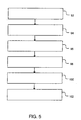
- FIG. 5 A general approach for generating reference clock signals for writing data across CAV data zone boundaries on an optical disk is depicted in Fig. 5.
- the approach is independent of whether or not the read/write and clock transducers are separate systems or an integrated system that generates two distinct laser beams.
- the approach involves a first step 92 of identifying a first data zone on the optical disk in which data is to be written by a data writing laser beam.
- the next step 94 is reading, with a clock reading laser beam, a clock track containing clock patterns that uniquely correspond to the first data zone. Reading the clock track allows a first reference clock signal to be generated.
- the next step 96 is generating a first write clock signal from the first reference clock signal.
- step 98 a second data zone on the optical disk is identified for the writing of data by the data writing laser beam.
- the next step 100 is to read, with the clock reading laser beam, a clock track containing clock patterns that uniquely correspond to the second data zone. Reading the clock track allows a second reference clock signal to be generated.
- the last step 102 is generating a second write clock signal from the second reference clock signal.
- the first and second write clock signals correspond directly to the first and second data zones, and the signals are utilized by the data write system to set the frequency and the phase of data writing in the data zones.
- clock transition point The position on a disk at which a transition is made from one reference clock signal to a second reference clock signal during writing is referred to as a clock transition point.
- a clock transition point defines the boundary between adjacent CAV data zones.
- clock transition points are determined when a disk is first recorded and do not change with subsequent rewriting of the disk.
- Most data formats, including the DVD data format require data files to be partitioned into fixed-length data blocks for error correction and other purposes. In the DVD format, for example, these data blocks are 32Kbytes in length.
- the new data is written in integral multiples of the data block length, with the beginning and ending of new data blocks coinciding with the beginning and ending of previously written data blocks.
- the points at which one data block ends and the next one begins are called edit points. These are the only points at which an edit or over-write is permitted to begin or end.
- Data write system 64 in Fig. 3 may be programmed to place clock transition points at particular locations with respect to edit point locations. It may be desirable, for example, to place each clock transition point within a data block and near the beginning the data block. By making the clock transition points distant from the next following edit points, a possible temporary drift in the phase relationship between recorded data and the reference clock signal at these points will not cause problems when the data is later edited.
- the disk drive system 50 utilizes an optical disk 30 as depicted in Fig. 2 that has CAV data zones 32-38, and corresponding circular clock tracks 42-48 located near the outer edge of the disk.
- Each CAV data zone has only one corresponding clock track, and each clock track contains a permanently embossed clock pattern that is unique to the corresponding data zone.
- the reference clock transducer 68 is first positioned into optical contact with a first clock track 48 that corresponds to a first CAV data zone 38.
- a first reference clock signal is generated from reading the first clock track 48 and data is written in the first CAV data zone 38 using a write clock that is generated from the reference clock signal.
- the reference clock transducer 58 may be moved to an adjacent clock track by adjusting the position of the reference clock transducer over a relatively short distance along a radius of the disk.
- two or more reference clock frequencies can be encoded into a single clock track.
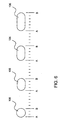
- a first clock pattern consists of the leading edge of each pit of the clock track and a second clock pattern consists of the trailing edge of each pit.
- Fig. 6 depicts a series of pits 106 along a clock track where each pit edge determines a zero crossing of the reference clock signal.
- the leading edge of each pit, A determines a first reference clock pattern
- the trailing edge of each pit, B determines a second reference clock pattern.
- a clock track encoded with two clock patterns provides a reference clock signal from which the clock circuit can generate two corresponding write clock signals.
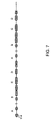
- FIG. 7 is a depiction of a clock track with pits 114 that are arranged to create a repeating sequence of clock patterns such as ABCD. Although only two pits are shown for each repeating pattern, typically many more pits would be utilized. As shown, clock pattern A encodes a first repeating clock signal, clock pattern B encodes a second repeating clock signal, and so forth. The clock patterns are continuously repeated at a high frequency to maintain accurate phase synchronization of each of the four write clock signals that are being continuously generated by the clock circuit at four different frequencies.
- the ability to generate two or more write clock signals from a single clock track makes it possible to write across one or more CAV data zone boundaries without interrupting the data writing process.
- Write clock frequency changes are accomplished by switching from one write clock signal to another between clock cycles at the location of the CAV data zone boundaries.
- a position reference signal may also be encoded into a clock track.
- the additional position reference signal has various potential uses, such as verifying the accuracy of clock recovery in the event that a defect in a clock track makes it necessary for the write clock to operate in an open loop manner for multiple clock cycles.
- Another alternative embodiment for making write clock frequency changes at the boundary between CAV data zones includes utilizing adjacent clock tracks without intervening redundant clock tracks.
- the reference clock transducer 68 In applying the optical disk of Fig. 2 to the disk drive system of Fig. 3, the reference clock transducer 68 generates a laser beam with an enlarged or elliptical focused spot. The focused spot is large enough that two adjacent clock tracks can be read simultaneously with a single clock reading laser beam.
- the clock reading transducer positions its laser beam midway between the clock track for the current CAV data zone and the clock track for the next CAV data zone thereby enabling the simultaneous reading of two clock tracks.
- Clock circuit 70 then separates two simultaneously generated reference clock signals generated from the two clock tracks and simultaneously generates two write clock signals, switching from the current write clock to the new write clock at the boundary between CAV data zones. Since the patterns used to encode the reference clock signals change at least once per revolution and are never the same on adjacent tracks, the clock circuit is able to separate the two clock signals even where the frequency difference between the signals is small.
- an optical disk has CAV data zones on one side of the disk and corresponding clock tracks on the other side of the disk.
- a compatible disk drive has a read/write transducer on the CAV data zone side of the disk and a clock transducer on the clock track side of the disk.
- Repeatable mapping is achieved by providing a mechanical connection between the read/write transducer and the reference clock transducer that is rigid in the in-track direction. Providing the read/write and reference clock transducers on opposite sides of an optical disk greatly reduces mechanical interferences between the two optical systems.
- an optical disk 130 has a spiral clock track 132, as depicted in Fig. 8.
- the spiral clock track 132 is encoded with one clock frequency in each revolution of the spiral, so that a disk with for example four CAV data zones 134, 136, 138 and 140 requires a clock track with four revolutions 144, 146, 148 and 150 in the spiral.
- the reference clock transducer 68 of Fig. 3 remains on the particular revolution of the spiral that is encoded with the appropriate clock frequency for that zone. Once per revolution of the disk, the reference clock transducer performs a one track seek to return to the beginning of the current revolution of the spiral.
- the reference clock transducer In order to maintain continuity of the write clock signal during the one track seek, the reference clock transducer simultaneously generates reference clock signals from two adjacent revolutions or "tracks" during the course of the seek.
- the clock pattern used to encode the clock information changes during each revolution of the disk and never repeats itself on adjacent tracks. Therefore, the clock circuit can distinguish signals from adjacent tracks to correctly decode two or more reference clock signals at once.
- the one track seek can then be performed without losing the signal from either track, and a repeatable electronic transfer from one reference clock signal to the other can be made.
- the reference clock transducer 68 When making a write clock frequency change at the boundary between CAV data zones, the reference clock transducer 68 continues to follow the spiral of the clock track 132 into the next revolution, thus making an uninterrupted and repeatable transition from one reference clock frequency to another. Protection against mastering defects in a spiral clock track can be obtained by providing two or more complete clock track spirals, each containing all of the clock patterns needed to record the entire disk.
- phase discontinuity may occur between the beginning of a circular clock track and the end of the circular clock track.
- the phase discontinuity is created because the clock pattern cannot be spaced perfectly in phase at the transition from the end of the circular clock track to the beginning of the circular clock track.
- Possible approaches to correcting the phase discontinuity include an electronic approach and an optical approach.
- an algorithm is applied to the reference clock signal to correct the phase error.
- adjacent redundant circular clock tracks 162 and 164 of an optical disk 160 are staggered, so that the end points 166 and 168 of the clock tracks are not radially aligned.
- An enlarged focused spot is then used to read both clock tracks simultaneously and a reference clock signal can be determined from the adjacent continuous clock track when a clock track end point on an adjacent clock track is encountered by the reference clock transducer.
- Disk centering errors occur when a disk is written a first time while rotating about a first center point and then written a second time while rotating about a second center point.
- An approach to solving this problem can include adding clock tracks at the inner and outer edges of the disk with separate clock transducers reading the tracks. The two clock signals are then correlated to correct the phase of the write clock, thus correcting for any disk centering errors.
Landscapes
- Engineering & Computer Science (AREA)
- Software Systems (AREA)
- Theoretical Computer Science (AREA)
- Optical Recording Or Reproduction (AREA)
- Signal Processing For Digital Recording And Reproducing (AREA)
- Optical Record Carriers And Manufacture Thereof (AREA)
- Rotational Drive Of Disk (AREA)
Applications Claiming Priority (2)
| Application Number | Priority Date | Filing Date | Title |
|---|---|---|---|
| US09/040,142 US6046969A (en) | 1998-03-17 | 1998-03-17 | Multiple clock tracks for erasable and rewriteable optical disks |
| US40142 | 1998-03-17 |
Publications (3)
| Publication Number | Publication Date |
|---|---|
| EP0944088A2 EP0944088A2 (en) | 1999-09-22 |
| EP0944088A3 EP0944088A3 (en) | 2001-02-07 |
| EP0944088B1 true EP0944088B1 (en) | 2004-09-08 |
Family
ID=21909352
Family Applications (1)
| Application Number | Title | Priority Date | Filing Date |
|---|---|---|---|
| EP99301906A Expired - Lifetime EP0944088B1 (en) | 1998-03-17 | 1999-03-12 | Optical disk |
Country Status (4)
| Country | Link |
|---|---|
| US (1) | US6046969A (https=) |
| EP (1) | EP0944088B1 (https=) |
| JP (1) | JPH11328681A (https=) |
| DE (1) | DE69919922T2 (https=) |
Cited By (1)
| Publication number | Priority date | Publication date | Assignee | Title |
|---|---|---|---|---|
| US7324415B2 (en) | 2002-11-12 | 2008-01-29 | Koninklijke Philips Electronics N.V. | Storing control information using spacers |
Families Citing this family (13)
| Publication number | Priority date | Publication date | Assignee | Title |
|---|---|---|---|---|
| US6118753A (en) * | 1996-08-13 | 2000-09-12 | Hewlett-Packard Company | Erasable digital video disk with reference clock track |
| US6388833B1 (en) * | 1998-06-29 | 2002-05-14 | Western Digital Technologies, Inc. | Method for manufacturing a disk drive having an overwriteable clock track |
| US6501721B2 (en) * | 1999-01-14 | 2002-12-31 | Hewlett-Packard Company | Spliceless editing of a read/write optical medium |
| US6636467B1 (en) * | 2000-06-30 | 2003-10-21 | Hewlett-Packard Development Company, L.P. | Method and apparatus for accurately calibrating the timing of a write onto storage media |
| JP4185659B2 (ja) * | 2000-11-06 | 2008-11-26 | パイオニア株式会社 | 光記録媒体、情報記録装置および情報再生装置 |
| JP2002298360A (ja) * | 2001-03-30 | 2002-10-11 | Canon Inc | 情報記録媒体への情報記録方法及び情報記録装置 |
| KR100408282B1 (ko) * | 2001-05-16 | 2003-12-03 | 삼성전자주식회사 | 헤더정보가 실린 워블신호가 기록된 광 기록매체, 그워블신호 기록장치, 기록방법, 재생장치 및 재생방법 |
| JP2003162874A (ja) * | 2001-11-27 | 2003-06-06 | Toshiba Corp | ヘッド位置決め情報書き込み装置及び方法 |
| US6765739B2 (en) | 2002-03-18 | 2004-07-20 | Hewlett-Packard Development Company, L.P. | Method and apparatus for discouraging duplication of digital data |
| US20060072425A1 (en) * | 2004-09-30 | 2006-04-06 | Hanks Darwin M | Array-based optical head |
| US7468815B2 (en) * | 2004-09-30 | 2008-12-23 | Hewlett-Packard Development Company, L.P. | Optical data processing using photo-detector array and framing marks on optical media |
| WO2006048813A1 (en) * | 2004-11-03 | 2006-05-11 | Koninklijke Philips Electronics N.V. | Portable hybrid storage medium |
| US7646557B2 (en) * | 2005-07-05 | 2010-01-12 | Xyratex Technology Limited | Methods and apparatus for generating a clock signal, for writing servo tracks, and for characterising timing errors in a servo track writer |
Family Cites Families (10)
| Publication number | Priority date | Publication date | Assignee | Title |
|---|---|---|---|---|
| GB8906353D0 (en) * | 1989-03-20 | 1989-05-04 | Dewar Productions Inc | Semi-timing optic lathe |
| US5193034A (en) * | 1989-07-17 | 1993-03-09 | Hitachi, Ltd. | Magnetic disk apparatus of constant-density recording type, magnetic disk used therefor and servo-writing device for patterning on the magnetic disk |
| JP3078686B2 (ja) * | 1992-10-05 | 2000-08-21 | 三菱電機株式会社 | 光ディスク、光ディスク駆動装置および光ディスクの書き込み読み出し方法 |
| DE69426226T2 (de) * | 1993-05-18 | 2001-04-05 | Sony Corp., Tokio/Tokyo | Plattenvorrichtung |
| JPH0798876A (ja) * | 1993-09-29 | 1995-04-11 | Toshiba Corp | 情報記憶装置、情報再生装置および情報記憶再生装置 |
| JPH07211004A (ja) * | 1994-01-20 | 1995-08-11 | Fujitsu Ltd | 磁気ディスク装置および記録媒体 |
| JPH07272275A (ja) * | 1994-03-29 | 1995-10-20 | Sony Corp | 光ディスク装置 |
| US5689479A (en) * | 1995-09-25 | 1997-11-18 | Sony Corporation | Magneto-optical recording apparatus |
| US6118753A (en) * | 1996-08-13 | 2000-09-12 | Hewlett-Packard Company | Erasable digital video disk with reference clock track |
| US6046968A (en) * | 1997-07-24 | 2000-04-04 | Hewlett-Packard Company | Re-writable optical disk having reference clock information permanently formed on the disk |
-
1998
- 1998-03-17 US US09/040,142 patent/US6046969A/en not_active Expired - Lifetime
-
1999
- 1999-03-12 EP EP99301906A patent/EP0944088B1/en not_active Expired - Lifetime
- 1999-03-12 DE DE69919922T patent/DE69919922T2/de not_active Expired - Lifetime
- 1999-03-12 JP JP11066817A patent/JPH11328681A/ja not_active Withdrawn
Cited By (1)
| Publication number | Priority date | Publication date | Assignee | Title |
|---|---|---|---|---|
| US7324415B2 (en) | 2002-11-12 | 2008-01-29 | Koninklijke Philips Electronics N.V. | Storing control information using spacers |
Also Published As
| Publication number | Publication date |
|---|---|
| DE69919922D1 (de) | 2004-10-14 |
| US6046969A (en) | 2000-04-04 |
| EP0944088A2 (en) | 1999-09-22 |
| DE69919922T2 (de) | 2005-09-08 |
| JPH11328681A (ja) | 1999-11-30 |
| EP0944088A3 (en) | 2001-02-07 |
Similar Documents
| Publication | Publication Date | Title |
|---|---|---|
| EP0628952B1 (en) | Optical disk, and information recording/reproduction apparatus | |
| US5933410A (en) | Optical disc and optical disc driving apparatus | |
| CN1501365B (zh) | 记录载体和提供记录载体的方法 | |
| EP1271490B1 (en) | Optical disk | |
| US5838658A (en) | Optical disc | |
| EP0944088B1 (en) | Optical disk | |
| US6603729B1 (en) | Optical disc having plural zones of constant density | |
| EP0825591A2 (en) | Erasable digital video disk with reference clock track | |
| US20040047279A1 (en) | Disk-shaped storage medium and tracking method using the same | |
| US6580680B1 (en) | Optical disc and apparatus for scanning the optical disc | |
| EA005453B1 (ru) | Носитель записи и устройство для сканирования носителя записи | |
| KR20020091259A (ko) | 기록 재생 장치 | |
| WO2003044793A1 (en) | Method and apparatus for rapidly accessing a physical position on an optical disc | |
| JP4348873B2 (ja) | 光ディスク | |
| JP2000200468A (ja) | デ―タ再生装置及びデ―タ再生方法 | |
| HK1019532B (en) | Optical disc | |
| MXPA98010734A (en) | Opt disc | |
| JPH0223554A (ja) | 光滋気ディスク及び光滋気ディスクを用いた記録再生方式 | |
| HK1019499B (en) | Optical disc and optical disc driving apparatus | |
| JP2004071155A (ja) | 光ディスク、及び、光ディスク装置 | |
| JP2004087121A (ja) | 光ディスク、及び、光ディスク装置 | |
| JP2004071157A (ja) | 光ディスク、及び、光ディスク装置 | |
| JP2004071156A (ja) | 光ディスク、及び、光ディスク装置 | |
| MXPA99003772A (en) | Optical disc | |
| CZ20001212A3 (cs) | Optický disk a zařízení pro záznam na disk a čtení disku |
Legal Events
| Date | Code | Title | Description |
|---|---|---|---|
| PUAI | Public reference made under article 153(3) epc to a published international application that has entered the european phase |
Free format text: ORIGINAL CODE: 0009012 |
|
| AK | Designated contracting states |
Kind code of ref document: A2 Designated state(s): DE FR GB |
|
| AX | Request for extension of the european patent |
Free format text: AL;LT;LV;MK;RO;SI |
|
| PUAL | Search report despatched |
Free format text: ORIGINAL CODE: 0009013 |
|
| AK | Designated contracting states |
Kind code of ref document: A3 Designated state(s): AT BE CH CY DE DK ES FI FR GB GR IE IT LI LU MC NL PT SE |
|
| AX | Request for extension of the european patent |
Free format text: AL;LT;LV;MK;RO;SI |
|
| RAP1 | Party data changed (applicant data changed or rights of an application transferred) |
Owner name: HEWLETT-PACKARD COMPANY, A DELAWARE CORPORATION |
|
| 17P | Request for examination filed |
Effective date: 20010430 |
|
| AKX | Designation fees paid |
Free format text: DE FR GB |
|
| GRAP | Despatch of communication of intention to grant a patent |
Free format text: ORIGINAL CODE: EPIDOSNIGR1 |
|
| GRAS | Grant fee paid |
Free format text: ORIGINAL CODE: EPIDOSNIGR3 |
|
| GRAA | (expected) grant |
Free format text: ORIGINAL CODE: 0009210 |
|
| AK | Designated contracting states |
Kind code of ref document: B1 Designated state(s): DE FR GB |
|
| PG25 | Lapsed in a contracting state [announced via postgrant information from national office to epo] |
Ref country code: FR Free format text: LAPSE BECAUSE OF NON-PAYMENT OF DUE FEES Effective date: 20040908 |
|
| REG | Reference to a national code |
Ref country code: GB Ref legal event code: FG4D |
|
| REF | Corresponds to: |
Ref document number: 69919922 Country of ref document: DE Date of ref document: 20041014 Kind code of ref document: P |
|
| PGFP | Annual fee paid to national office [announced via postgrant information from national office to epo] |
Ref country code: FR Payment date: 20050321 Year of fee payment: 7 |
|
| PLBE | No opposition filed within time limit |
Free format text: ORIGINAL CODE: 0009261 |
|
| STAA | Information on the status of an ep patent application or granted ep patent |
Free format text: STATUS: NO OPPOSITION FILED WITHIN TIME LIMIT |
|
| 26N | No opposition filed |
Effective date: 20050609 |
|
| EN | Fr: translation not filed | ||
| PGFP | Annual fee paid to national office [announced via postgrant information from national office to epo] |
Ref country code: GB Payment date: 20100326 Year of fee payment: 12 |
|
| PGFP | Annual fee paid to national office [announced via postgrant information from national office to epo] |
Ref country code: DE Payment date: 20100329 Year of fee payment: 12 |
|
| GBPC | Gb: european patent ceased through non-payment of renewal fee |
Effective date: 20110312 |
|
| PG25 | Lapsed in a contracting state [announced via postgrant information from national office to epo] |
Ref country code: DE Free format text: LAPSE BECAUSE OF NON-PAYMENT OF DUE FEES Effective date: 20111001 |
|
| PG25 | Lapsed in a contracting state [announced via postgrant information from national office to epo] |
Ref country code: GB Free format text: LAPSE BECAUSE OF NON-PAYMENT OF DUE FEES Effective date: 20110312 |
|
| REG | Reference to a national code |
Ref country code: DE Ref legal event code: R119 Ref document number: 69919922 Country of ref document: DE Effective date: 20111001 |