EP0931360B1 - Method of manufacturing a lead acid cell paste having tin compounds - Google Patents
Method of manufacturing a lead acid cell paste having tin compounds Download PDFInfo
- Publication number
- EP0931360B1 EP0931360B1 EP97941073A EP97941073A EP0931360B1 EP 0931360 B1 EP0931360 B1 EP 0931360B1 EP 97941073 A EP97941073 A EP 97941073A EP 97941073 A EP97941073 A EP 97941073A EP 0931360 B1 EP0931360 B1 EP 0931360B1
- Authority
- EP
- European Patent Office
- Prior art keywords
- tin
- electrode
- lead
- cells
- active material
- Prior art date
- Legal status (The legal status is an assumption and is not a legal conclusion. Google has not performed a legal analysis and makes no representation as to the accuracy of the status listed.)
- Expired - Lifetime
Links
- 239000002253 acid Substances 0.000 title claims abstract description 18
- 238000004519 manufacturing process Methods 0.000 title claims abstract description 9
- 150000003606 tin compounds Chemical class 0.000 title description 6
- ATJFFYVFTNAWJD-UHFFFAOYSA-N Tin Chemical compound [Sn] ATJFFYVFTNAWJD-UHFFFAOYSA-N 0.000 claims abstract description 95
- QAOWNCQODCNURD-UHFFFAOYSA-N Sulfuric acid Chemical compound OS(O)(=O)=O QAOWNCQODCNURD-UHFFFAOYSA-N 0.000 claims abstract description 48
- 239000011888 foil Substances 0.000 claims description 40
- 238000000034 method Methods 0.000 claims description 16
- 229910000375 tin(II) sulfate Inorganic materials 0.000 claims description 15
- 229910000464 lead oxide Inorganic materials 0.000 claims description 11
- 150000001875 compounds Chemical class 0.000 claims description 10
- 239000011262 electrochemically active material Substances 0.000 claims description 9
- 229910001128 Sn alloy Inorganic materials 0.000 claims description 8
- 229910000978 Pb alloy Inorganic materials 0.000 claims description 7
- 239000011248 coating agent Substances 0.000 claims description 3
- 238000000576 coating method Methods 0.000 claims description 3
- IUTCEZPPWBHGIX-UHFFFAOYSA-N tin(2+) Chemical class [Sn+2] IUTCEZPPWBHGIX-UHFFFAOYSA-N 0.000 claims description 3
- SYRHIZPPCHMRIT-UHFFFAOYSA-N tin(4+) Chemical class [Sn+4] SYRHIZPPCHMRIT-UHFFFAOYSA-N 0.000 claims description 2
- 238000002360 preparation method Methods 0.000 claims 3
- YEXPOXQUZXUXJW-UHFFFAOYSA-N oxolead Chemical compound [Pb]=O YEXPOXQUZXUXJW-UHFFFAOYSA-N 0.000 claims 2
- 235000011149 sulphuric acid Nutrition 0.000 claims 2
- 239000001117 sulphuric acid Substances 0.000 claims 2
- 238000004804 winding Methods 0.000 claims 1
- 239000000463 material Substances 0.000 abstract description 10
- 230000007797 corrosion Effects 0.000 description 27
- 238000005260 corrosion Methods 0.000 description 27
- 238000002161 passivation Methods 0.000 description 18
- 238000012360 testing method Methods 0.000 description 17
- 238000003860 storage Methods 0.000 description 13
- HTUMBQDCCIXGCV-UHFFFAOYSA-N lead oxide Chemical compound [O-2].[Pb+2] HTUMBQDCCIXGCV-UHFFFAOYSA-N 0.000 description 12
- FAKFSJNVVCGEEI-UHFFFAOYSA-J tin(4+);disulfate Chemical compound [Sn+4].[O-]S([O-])(=O)=O.[O-]S([O-])(=O)=O FAKFSJNVVCGEEI-UHFFFAOYSA-J 0.000 description 9
- XOLBLPGZBRYERU-UHFFFAOYSA-N SnO2 Inorganic materials O=[Sn]=O XOLBLPGZBRYERU-UHFFFAOYSA-N 0.000 description 8
- 239000011149 active material Substances 0.000 description 8
- 239000003792 electrolyte Substances 0.000 description 8
- 230000001351 cycling effect Effects 0.000 description 7
- 229910045601 alloy Inorganic materials 0.000 description 6
- 239000000956 alloy Substances 0.000 description 6
- 239000000203 mixture Substances 0.000 description 6
- 239000007774 positive electrode material Substances 0.000 description 6
- XLYOFNOQVPJJNP-UHFFFAOYSA-N water Substances O XLYOFNOQVPJJNP-UHFFFAOYSA-N 0.000 description 6
- 238000002474 experimental method Methods 0.000 description 5
- 229910052751 metal Inorganic materials 0.000 description 5
- 239000002184 metal Substances 0.000 description 5
- 230000015572 biosynthetic process Effects 0.000 description 4
- 230000006866 deterioration Effects 0.000 description 4
- 230000000694 effects Effects 0.000 description 4
- 230000000717 retained effect Effects 0.000 description 4
- 238000013461 design Methods 0.000 description 3
- 230000008569 process Effects 0.000 description 3
- 229910001887 tin oxide Inorganic materials 0.000 description 3
- BUGBHKTXTAQXES-UHFFFAOYSA-N Selenium Chemical compound [Se] BUGBHKTXTAQXES-UHFFFAOYSA-N 0.000 description 2
- 239000000654 additive Substances 0.000 description 2
- 229910052787 antimony Inorganic materials 0.000 description 2
- WATWJIUSRGPENY-UHFFFAOYSA-N antimony atom Chemical compound [Sb] WATWJIUSRGPENY-UHFFFAOYSA-N 0.000 description 2
- 229910052785 arsenic Inorganic materials 0.000 description 2
- RQNWIZPPADIBDY-UHFFFAOYSA-N arsenic atom Chemical compound [As] RQNWIZPPADIBDY-UHFFFAOYSA-N 0.000 description 2
- TZCXTZWJZNENPQ-UHFFFAOYSA-L barium sulfate Chemical compound [Ba+2].[O-]S([O-])(=O)=O TZCXTZWJZNENPQ-UHFFFAOYSA-L 0.000 description 2
- 238000006243 chemical reaction Methods 0.000 description 2
- 238000010276 construction Methods 0.000 description 2
- YADSGOSSYOOKMP-UHFFFAOYSA-N dioxolead Chemical compound O=[Pb]=O YADSGOSSYOOKMP-UHFFFAOYSA-N 0.000 description 2
- 238000009826 distribution Methods 0.000 description 2
- 230000002349 favourable effect Effects 0.000 description 2
- 229910052732 germanium Inorganic materials 0.000 description 2
- GNPVGFCGXDBREM-UHFFFAOYSA-N germanium atom Chemical compound [Ge] GNPVGFCGXDBREM-UHFFFAOYSA-N 0.000 description 2
- 230000006872 improvement Effects 0.000 description 2
- 229910052738 indium Inorganic materials 0.000 description 2
- APFVFJFRJDLVQX-UHFFFAOYSA-N indium atom Chemical compound [In] APFVFJFRJDLVQX-UHFFFAOYSA-N 0.000 description 2
- PIJPYDMVFNTHIP-UHFFFAOYSA-L lead sulfate Chemical compound [PbH4+2].[O-]S([O-])(=O)=O PIJPYDMVFNTHIP-UHFFFAOYSA-L 0.000 description 2
- WABPQHHGFIMREM-UHFFFAOYSA-N lead(0) Chemical compound [Pb] WABPQHHGFIMREM-UHFFFAOYSA-N 0.000 description 2
- 238000012545 processing Methods 0.000 description 2
- 229910052711 selenium Inorganic materials 0.000 description 2
- 239000011669 selenium Substances 0.000 description 2
- 239000004065 semiconductor Substances 0.000 description 2
- QJZYHAIUNVAGQP-UHFFFAOYSA-N 3-nitrobicyclo[2.2.1]hept-5-ene-2,3-dicarboxylic acid Chemical compound C1C2C=CC1C(C(=O)O)C2(C(O)=O)[N+]([O-])=O QJZYHAIUNVAGQP-UHFFFAOYSA-N 0.000 description 1
- 229910000882 Ca alloy Inorganic materials 0.000 description 1
- OYPRJOBELJOOCE-UHFFFAOYSA-N Calcium Chemical compound [Ca] OYPRJOBELJOOCE-UHFFFAOYSA-N 0.000 description 1
- GYHNNYVSQQEPJS-UHFFFAOYSA-N Gallium Chemical compound [Ga] GYHNNYVSQQEPJS-UHFFFAOYSA-N 0.000 description 1
- 229920001410 Microfiber Polymers 0.000 description 1
- PMZURENOXWZQFD-UHFFFAOYSA-L Sodium Sulfate Chemical compound [Na+].[Na+].[O-]S([O-])(=O)=O PMZURENOXWZQFD-UHFFFAOYSA-L 0.000 description 1
- QAOWNCQODCNURD-UHFFFAOYSA-L Sulfate Chemical compound [O-]S([O-])(=O)=O QAOWNCQODCNURD-UHFFFAOYSA-L 0.000 description 1
- 229910021626 Tin(II) chloride Inorganic materials 0.000 description 1
- 230000009471 action Effects 0.000 description 1
- 230000009286 beneficial effect Effects 0.000 description 1
- 239000011575 calcium Substances 0.000 description 1
- 229910052791 calcium Inorganic materials 0.000 description 1
- UHZZMRAGKVHANO-UHFFFAOYSA-M chlormequat chloride Chemical compound [Cl-].C[N+](C)(C)CCCl UHZZMRAGKVHANO-UHFFFAOYSA-M 0.000 description 1
- 230000000052 comparative effect Effects 0.000 description 1
- 238000007906 compression Methods 0.000 description 1
- 230000006835 compression Effects 0.000 description 1
- 239000004020 conductor Substances 0.000 description 1
- 230000001419 dependent effect Effects 0.000 description 1
- 230000001627 detrimental effect Effects 0.000 description 1
- 230000003292 diminished effect Effects 0.000 description 1
- 239000002270 dispersing agent Substances 0.000 description 1
- 230000005518 electrochemistry Effects 0.000 description 1
- 239000011152 fibreglass Substances 0.000 description 1
- 238000009472 formulation Methods 0.000 description 1
- 229910052733 gallium Inorganic materials 0.000 description 1
- 239000011521 glass Substances 0.000 description 1
- 239000003365 glass fiber Substances 0.000 description 1
- 230000005484 gravity Effects 0.000 description 1
- 239000001999 grid alloy Substances 0.000 description 1
- 239000004021 humic acid Substances 0.000 description 1
- 150000002611 lead compounds Chemical class 0.000 description 1
- LQBJWKCYZGMFEV-UHFFFAOYSA-N lead tin Chemical compound [Sn].[Pb] LQBJWKCYZGMFEV-UHFFFAOYSA-N 0.000 description 1
- 230000007774 longterm Effects 0.000 description 1
- 230000007246 mechanism Effects 0.000 description 1
- 239000012528 membrane Substances 0.000 description 1
- 229910001092 metal group alloy Inorganic materials 0.000 description 1
- 239000003658 microfiber Substances 0.000 description 1
- 238000006386 neutralization reaction Methods 0.000 description 1
- 239000000615 nonconductor Substances 0.000 description 1
- 230000003647 oxidation Effects 0.000 description 1
- 238000007254 oxidation reaction Methods 0.000 description 1
- 239000002245 particle Substances 0.000 description 1
- 239000004033 plastic Substances 0.000 description 1
- 230000002028 premature Effects 0.000 description 1
- 230000001105 regulatory effect Effects 0.000 description 1
- 229910052938 sodium sulfate Inorganic materials 0.000 description 1
- 235000011152 sodium sulphate Nutrition 0.000 description 1
- 229910052714 tellurium Inorganic materials 0.000 description 1
- PORWMNRCUJJQNO-UHFFFAOYSA-N tellurium atom Chemical compound [Te] PORWMNRCUJJQNO-UHFFFAOYSA-N 0.000 description 1
- 229910001432 tin ion Inorganic materials 0.000 description 1
Images


Classifications
-
- H—ELECTRICITY
- H01—ELECTRIC ELEMENTS
- H01M—PROCESSES OR MEANS, e.g. BATTERIES, FOR THE DIRECT CONVERSION OF CHEMICAL ENERGY INTO ELECTRICAL ENERGY
- H01M4/00—Electrodes
- H01M4/02—Electrodes composed of, or comprising, active material
- H01M4/14—Electrodes for lead-acid accumulators
- H01M4/16—Processes of manufacture
- H01M4/20—Processes of manufacture of pasted electrodes
-
- H—ELECTRICITY
- H01—ELECTRIC ELEMENTS
- H01M—PROCESSES OR MEANS, e.g. BATTERIES, FOR THE DIRECT CONVERSION OF CHEMICAL ENERGY INTO ELECTRICAL ENERGY
- H01M4/00—Electrodes
- H01M4/02—Electrodes composed of, or comprising, active material
- H01M4/36—Selection of substances as active materials, active masses, active liquids
- H01M4/48—Selection of substances as active materials, active masses, active liquids of inorganic oxides or hydroxides
- H01M4/56—Selection of substances as active materials, active masses, active liquids of inorganic oxides or hydroxides of lead
-
- H—ELECTRICITY
- H01—ELECTRIC ELEMENTS
- H01M—PROCESSES OR MEANS, e.g. BATTERIES, FOR THE DIRECT CONVERSION OF CHEMICAL ENERGY INTO ELECTRICAL ENERGY
- H01M4/00—Electrodes
- H01M4/02—Electrodes composed of, or comprising, active material
- H01M4/64—Carriers or collectors
- H01M4/66—Selection of materials
- H01M4/68—Selection of materials for use in lead-acid accumulators
- H01M4/685—Lead alloys
-
- Y—GENERAL TAGGING OF NEW TECHNOLOGICAL DEVELOPMENTS; GENERAL TAGGING OF CROSS-SECTIONAL TECHNOLOGIES SPANNING OVER SEVERAL SECTIONS OF THE IPC; TECHNICAL SUBJECTS COVERED BY FORMER USPC CROSS-REFERENCE ART COLLECTIONS [XRACs] AND DIGESTS
- Y02—TECHNOLOGIES OR APPLICATIONS FOR MITIGATION OR ADAPTATION AGAINST CLIMATE CHANGE
- Y02E—REDUCTION OF GREENHOUSE GAS [GHG] EMISSIONS, RELATED TO ENERGY GENERATION, TRANSMISSION OR DISTRIBUTION
- Y02E60/00—Enabling technologies; Technologies with a potential or indirect contribution to GHG emissions mitigation
- Y02E60/10—Energy storage using batteries
-
- Y—GENERAL TAGGING OF NEW TECHNOLOGICAL DEVELOPMENTS; GENERAL TAGGING OF CROSS-SECTIONAL TECHNOLOGIES SPANNING OVER SEVERAL SECTIONS OF THE IPC; TECHNICAL SUBJECTS COVERED BY FORMER USPC CROSS-REFERENCE ART COLLECTIONS [XRACs] AND DIGESTS
- Y02—TECHNOLOGIES OR APPLICATIONS FOR MITIGATION OR ADAPTATION AGAINST CLIMATE CHANGE
- Y02P—CLIMATE CHANGE MITIGATION TECHNOLOGIES IN THE PRODUCTION OR PROCESSING OF GOODS
- Y02P70/00—Climate change mitigation technologies in the production process for final industrial or consumer products
- Y02P70/50—Manufacturing or production processes characterised by the final manufactured product
-
- Y—GENERAL TAGGING OF NEW TECHNOLOGICAL DEVELOPMENTS; GENERAL TAGGING OF CROSS-SECTIONAL TECHNOLOGIES SPANNING OVER SEVERAL SECTIONS OF THE IPC; TECHNICAL SUBJECTS COVERED BY FORMER USPC CROSS-REFERENCE ART COLLECTIONS [XRACs] AND DIGESTS
- Y10—TECHNICAL SUBJECTS COVERED BY FORMER USPC
- Y10T—TECHNICAL SUBJECTS COVERED BY FORMER US CLASSIFICATION
- Y10T29/00—Metal working
- Y10T29/49—Method of mechanical manufacture
- Y10T29/49002—Electrical device making
- Y10T29/49108—Electric battery cell making
- Y10T29/4911—Electric battery cell making including sealing
-
- Y—GENERAL TAGGING OF NEW TECHNOLOGICAL DEVELOPMENTS; GENERAL TAGGING OF CROSS-SECTIONAL TECHNOLOGIES SPANNING OVER SEVERAL SECTIONS OF THE IPC; TECHNICAL SUBJECTS COVERED BY FORMER USPC CROSS-REFERENCE ART COLLECTIONS [XRACs] AND DIGESTS
- Y10—TECHNICAL SUBJECTS COVERED BY FORMER USPC
- Y10T—TECHNICAL SUBJECTS COVERED BY FORMER US CLASSIFICATION
- Y10T29/00—Metal working
- Y10T29/49—Method of mechanical manufacture
- Y10T29/49002—Electrical device making
- Y10T29/49108—Electric battery cell making
- Y10T29/49115—Electric battery cell making including coating or impregnating
Definitions
- the present invention relates to the field of manufacturing lead-acid electrochemical cells, and more particularly to a lead acid cell paste formulation including tin compounds and methods of manufacturing and using the same in an electrochemical cell.
- each positive electrode in known valve-regulated lead-acid (VRLA) batteries, each positive electrode, sometimes called a positive “Plate,” includes a grid or foil sandwiched between an electrochemically active paste. A number of positive electrodes are alternately interleafed with a number of negative electrodes, sometimes called the negative “Plate,” with each electrode of one polarity separated from the adjacent electrode of opposite polarity by a porous separator material, typically a glass microfiber mat. The cell is completed by adding electrolyte and subjecting it to a formation charging process that activates it. The entire apparatus is typically contained within a suitable plastic case or other container.
- the interface between the grid or foil and the paste is known as the corrosion layer. While all of the chemistry/electrochemistry that takes place here is not well understood, the establishment of a strong, well-defined corrosion layer is felt to be necessary for long cycle life in lead-acid batteries. With some grid/foil alloys, in particular pure lead, lead/calcium and lead/low tin compositions, there is not sufficient corrosion to establish a strong layer and in place of this a so-called "passivation" layer is created by alkaline oxidation of the grid/foil surface. This corrosion/passivation layer is composed primarily of PbO which is protected from neutralization by the sulfuric acid electrolyte by a layer of mixed lead compounds, but primarily lead sulfate.
- This corrosion/passivation layer acts as a perm-selective membrane that allows the underlying PbO to exist in an alkaline environment.
- This corrosion/passivation layer can act as an electrical insulator or at least reduce the conductivity between the grid/foil and the active material paste and thus can have a dramatic impact on the electrochemical properties of the cell.
- the corrosion/passivation layer appears to play an integral role in at least two important characteristics of cell performance: self-discharge and cycle life.
- self discharge refers to a series of different chemical reactions within the cell that can reduce the storage time, or shelf life, due to consumption of electrolyte.
- the open-circuit voltage directly reflects the specific gravity, or concentration of electrolyte within the cell, and it is also linearly proportional to discharge capacity. Any self-discharge reaction that consumes electrolyte reduces both storage time and discharge capacity. corrosion of the positive grid/foil on open- circuit stand is one mode of self discharge and does consume electrolyte.
- cycle life refers to the number of usable cycles of discharge and recharge available from the cell. The cycle life figure is dependent upon a number of conditions under which it is determined, as well as the basic cell construction.
- a cell which achieves 80% of its initial amp-hour rating after 500 cycles and reaches 50% after 1,000 cycles will have two different "cycle life” values, depending upon the criterion used for termination (80 or 50% of initial capacity).
- Another measure, related to cycle life, is total usable capacity. This term refers to the sum of the cycles over the life of the cell multiplied by the amp-hours at each cycle. It can also be expressed as the area under the curve produced by a plot of data showing discharge capacity (in amp-hours) versus cycle number.
- both the grid/foil and the active material include lead in various compositions along with smaller quantities of other materials.
- tin and tin compounds have been used in lead-acid electrochemical cells.
- U.S. Pat. No. 5,368,961 discloses a cell having a grid alloy of about 2.5% tin. The use of tin in previous cells has generally been confined to having it in the grid/foil metallic alloy, as opposed to including some form of tin in the paste.
- This tin acts as a conductor to ameliorate the insulative effects of the passivation layer and to thereby enhance the conductivity, and thus the current flow, between the grid/foil and the positive active material.
- tin percentages at or below about 1.1-1.3%, true alloys are formed and the tin distribution is relatively uniform. Above about 1.3%, the solubility of tin in lead is exceeded and the grain boundaries and the grains contain relatively high concentrations of tin. In the former case, passivation layers tend to form and dominate cell performance due to the low amount of corrosion of the grid/foil and, hence, low levels of tin compounds in the passivation layer.
- grids/foils having 2-3% tin levels have certain desirable performance characteristics, in comparison with grids/foils such as pure lead or those having about 0.5% tin or less.
- a cell with a positive grid/foil with 2-3% tin provides very good cycling performance, i.e., the cell is able to produce many discharge/recharge cycles with good capacity and a high total usable amp-hours.
- such a cell has an undesirably high self- discharge rate such that the storage time is unacceptable for most commercial applications. It is believed that this high self-discharge rate is due to corrosion of the high tin areas and the grain boundaries, thus consuming significant quantities of the sulfuric acid electrolyte and thereby increasing the rate of decrease of the open-circuit voltage.
- Cells with grids/foils having about 1% tin or less exhibit much improved self-discharge characteristics, but do not provide the excellent cycle life of cells having grids/foils with 2-3% tin. Because they are true alloys, it is believed that the foils with 1% tin or less have a much reduced corrosion rate compared to the foils with 2-3% tin. It is believed that this is due to the tin distribution being more or less homogeneous in the true alloys, with no areas of high tin concentrations in the bodies of the grains and a low level of tin enrichment in the grain boundaries (relative to 2-3% tin foils). The 1% tin (or less) foils thus reduce the self-discharge levels of the cells due to limited tin corrosion, but because of this they do not release sufficient tin into the corrosion/passivation layer to improve markedly the cycling performance.
- Japanese patent publication 1979-49538 published April 18, 1979 describes a "ready-to-use lead-acid battery pole plate" in which SnS0 4 or SnO was added to "non-activated paste material.”
- This publication is directed toward a system for reducing the storage deterioration in certain kinds of cells. Such deterioration, according to the publication, is due to the production of non-conductive lead oxide between the pole(grid) and the active material. This is now a well understood phenomenon called “storage passivation” that occurs in the processing of so-called “dry charged” plates.
- the publication asserts that such deterioration is diminished by the addition of SnSO 4 or SnO of less than 400 mesh to the active material. The mechanism and chemistry of the asserted effect is not specified.
- the asserted advantages based on the experimental results set forth in the publication are marginal at best.
- the publication indicates that the voltage of a prior art test cell was 1.55V when subjected to a high-rate discharge while the voltages of the cells in accordance with the asserted invention were 1.57 to 1.59V.
- the "self-sustaining period" until the voltage dropped to 1.00 V was 3 min. 54 sec. for the prior art test cells and 4 min. 01 sec. to 4 min. 05 sec. for the cells in accordance with the asserted invention. This represents an improvement of only a few percent, which is probably well within the margin of error of the experiment.
- the experimental results in the Japanese publication were also less than dramatic for tests conducted after a month storage period.
- the prior art test cell showed an initial voltage on high-current load of 1.23V and a self-sustaining period until 1.00 V of 3 min. 25 sec., while the cells in accordance with the asserted invention showed an initial load voltage of 1.27 to 1.50V and a self-sustaining period until 1.00 V of 3 min. 35 sec. to 3 min. 47 sec.
- the Japanese publication teaches that the addition of SnSO 4 or SnO is to occur prior to the addition of sulfuric acid:
- the invention provides a method of manufacturing a lead-acid electrochemical cell, comprising:
- Embodiments of cells made by the above method exhibit excellent cycling performance in terms of cycle life, maximum discharge capacity and total usable amp-hours while at the same time furnishing very low self-discharge levels (i.e., long storage times).
- tin in the form of SnS0 4 or SnO or metallic powdered tin, is introduced into the positive paste material. Different concentrations of tin may be used. It has been observed that paste having 0.3 wt% soluble tin sulfate combined with plate foils having 1% tin produces good results. It is expected that adding tin to the paste will produce good results with foils having lower tin contents, or even with foils having-no tin whatsoever such as substantially pure lead.
- foils have very low corrosion rates, and thus result in cells with low self-discharge rates. However, they also tend to form a passivation layer between the foil and positive active material, resulting in very short cycle life.
- the invention may also utilize elements other than tin such as compounds containing antimony, arsenic, germanium, indium, selenium, gallium, tellurium or other semiconductors or combinations thereof.
- tin to the active material is believed to serve two purposes that dramatically increase cycle life while having no detrimental effect on self discharge.
- tin will be incorporated within the passivation layer and by its semiconductor action will allow electronic conduction through the normally poorly conducting PbO passivation layers.
- the soluble tin distributed throughout the positive active material will be converted to SnO 2 during formation. This SnO 2 will plate out on the electroactive lead dioxide active material and will provide a conductive "skeleton" that will result in slightly higher discharge capacity and longer cycle life.
- Tin in the form of SnSO 4 or other forms must be introduced after the sulfuric acid is added to the paste. It has been found that adding the tin prior to the introduction of sulfuric acid results in an unsuitable paste that performs poorly relative to pastes mixed by the introduction of tin after the addition of sulfuric acid. For paste mixes that do not require the addition of sulfuric acid (i.e., so-called "un-sulfated" pastes) the tin form used can be introduced at any time during mixing.
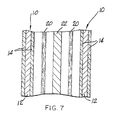
- a lead-acid cell includes positive electrodes or "plates” 10, interleafed with negative electrodes or “plates” 22.
- the positive and negative plates are separated from one another by a separator 20.
- the electrodes may be arranged in any physical configuration with respect to one another. Commonly used configurations are to combine a series of stacked electrode plates, or to spirally wind a continuous positive electrode with a continuous negative electrode separated by a porous separator (known as the "spirally wound" configuration).
- the positive electrodes are electrically connected to a common positive terminal, and the negative electrodes are electrically connected to a negative terminal.
- the combination is enclosed within a case containing electrolyte (not shown).
- the cell is of the TMF brand thin metallic film type, as disclosed in U.S. Patent No. 5,368, 961 by Juergens.
- the Juergens design utilizes very thin plates on the order of 0.025 cm (0.01 inches) or less in thickness, with film thickness on the order of 0.13 cm (0.005 inches) or less.
- the "plate” is used to refer to the metallic film in combination with the paste coated thereon.
- Juergens type lead acid cells are characterized by exceptionally high discharge and charge rates, and are well suited to the system of the present invention. However, the present invention is not limited to Juergens type thin plate cells.
- the positive electrode 10 of the present invention includes a film 12 coated on each side by active paste material 14.
- the film 12 is preferably a lead-tin alloy, having about 1% tin.
- the amount of tin may be varied without departing from the invention. For example, films of up to 3% or more tin may be feasible, and films of less than 0.5% tin or even substantially pure lead may be feasible.
- the active paste material 14 preferably includes a mixture of dispersant, sodium sulfate, sulfuric acid, lead oxide., tin sulfate, tin oxide, tin(II) salts or tin(IV) salts or combinations thereof.
- a content of 0.3% tin sulfate by weight has been found to provide good results.
- Alternate embodiments of the invention substitute metallic tin for tin sulfate or tin oxide. It is possible that tin introduced via other compounds may also provide acceptable results. Further, similar compounds containing antimony, arsenic, germanium, indium, selenium or combinations thereof in place of or in addition to tin may produce acceptable results.
- Sulfuric acid is added into the bulk of the water.
- Lead oxide is added following the sulfuric acid addition which then reacts with the sulfuric acid to produce lead sulfate. When 1/3 of the total lead oxide is introduced the sulfuric acid is nearly completely reacted. Tin sulfate is pre-dissolved in water. The tin ion and sulfate ion, now resident in the water, are added to the mix after 2/3 of the lead oxide has been introduced. The remainder of the lead oxide is added to complete the mix operation. All components are weighed out as a percentage of the total amount of lead oxide which is to be converted to positive paste: 1.67% water in pre-mix with tin sulfate, 0.27% tin sulfate, 17.43% water for primary mixing, and 0.24% 1.320 s.g.
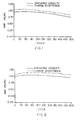
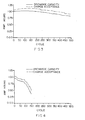
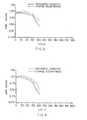
- FIGS. 1-6 comparatively illustrate the performance of Juergens-type thin metal film cells according to the present invention and Juergens-type thin metal film cells not having any tin additives in the paste.
- the capacity of the cells (in amp hours) is plotted as a function of the number of times that the cell is cycled (i.e. discharged and recharged). In these experiments, the discharges were at the 8C rate and the depth of discharge was 100%. The number of cycles multiplied by the amp hours obtained for each cycle yields the total useable capacity of the cell. Cycling is not continued after the amp hours of a cell falls below a nominal percentage of the initial amp hours of the cell, typically 80% or 50%.
- FIGS. 1-3 illustrate cycle performance of Juergens-type thin metal film cells having positive films including 1% tin, and positive active paste including 0.3% tin sulfate.
- the batteries tested in FIGS. 1-3 all achieved over 440 cycles of at least 80% of initial amp hour values, and achieved over 740 cycles of at least 50% of initial amp hour values.
- FIGS. 4-6 illustrate cells similar to the cells of FIGS. 1-3, except that tin sulfate has not been added to the active paste.
- the cells of FIG. 6 all reached less than 170 cycles at 80% of initial amp hours, and less than 210 cycles at 50% of initial amp hours.
- the positive electrode may also contain tin as part of a lead/tin alloy. It is believed that the optimum amount of tin in the lead/tin alloy of the positive electrode is on the order of 1%. This figure is based on experiments, which are described below, conducted on cells not having any tin in the paste but it is believed that cells with tin in the paste will produce similar results in this regard.
- FIGS. 8-11 For reference purposes, the self discharge performance of cells having varying amounts of tin in lead/tin alloy electrodes is shown in FIGS. 8-11. All data in these four graphs are from cells with paste material not having any tin compounds. The vertical axis on each graph shows open cell voltage in volts, and the horizontal axis shows the number of elapsed days since formation.
- FIG. 8 shows the self discharge of a set of 16 test samples having positive electrodes of a lead/tin alloy with approximately 1% tin by weight.
- the test samples are labeled "Series 1, Series 2....
- the cells for which the data of FIG. 8 was collected were stored at room temperature. It can be seen that there is no appreciable drop-off in open circuit voltage for any of the test samples over a storage period of 180 days.
- FIG. 9 shows the self discharge of 4 test samples stored at room temperature over a period of 180 days, where the test samples had positive electrodes of lead/tin alloys with approximately 3% tin.
- the pertinent distinction between the cells of FIG. 8 and the cells of FIG. 9 was the tin content of the positive electrodes; the cells of FIG. 8 had 1% tin while the cells of FIG. 9 had 3% tin.
- cells with 3% tin in the positive electrode had greater self discharge than the cells of FIG. 8 with 1% tin in the positive electrode.
- the open circuit voltage dropped abruptly at to 140 days of storage. Although these cells did not have tin in the paste, these results imply that the positive electrode in cells having SnSO 4 paste material in accordance with the present invention should also be on the order of 1% tin rather than 3% tin.
- FIG. 10 shows the self discharge of a set of three test samples over a period of 105 days at an elevated temperature of 50°C. It is believed that this elevated temperature accelerates the self discharge of lead acid cells by a factor of about 6. It can be seen that even at this elevated temperature the test samples did not exhibit any abrupt drop-off in open circuit voltage over a period of 105 days. This suggests that the cells would not exhibit abrupt drop-off in open circuit voltage at room temperature over a period in excess of 600 days. This is well beyond the expected storage life of commercial lead acid cells.
- FIG. 11 shows that the self discharge performance is less favorable if the positive electrodes contain 3% rather than 1% tin.
- the three test samples of FIG. 11 are essentially the same as those of FIG. 10, except that the positive electrode of the FIG. 11 cells is approximately 3% tin. It can be seen that the open circuit voltage of the FIG. 11 cells drops off abruptly at 40 to 60 days under 50°C storage.
Landscapes
- Engineering & Computer Science (AREA)
- Manufacturing & Machinery (AREA)
- Chemical & Material Sciences (AREA)
- Chemical Kinetics & Catalysis (AREA)
- Electrochemistry (AREA)
- General Chemical & Material Sciences (AREA)
- Battery Electrode And Active Subsutance (AREA)
- Cell Electrode Carriers And Collectors (AREA)
- Secondary Cells (AREA)
- Preparation Of Compounds By Using Micro-Organisms (AREA)
Applications Claiming Priority (3)
| Application Number | Priority Date | Filing Date | Title |
|---|---|---|---|
| US08/717,279 US5820639A (en) | 1996-09-20 | 1996-09-20 | Method of manufacturing lead acid cell paste having tin compounds |
| US717279 | 1996-09-20 | ||
| PCT/US1997/016278 WO1998012760A1 (en) | 1996-09-20 | 1997-09-15 | Lead acid cell paste having tin compounds and method of manufacturing and using same |
Publications (3)
| Publication Number | Publication Date |
|---|---|
| EP0931360A1 EP0931360A1 (en) | 1999-07-28 |
| EP0931360A4 EP0931360A4 (en) | 2000-12-06 |
| EP0931360B1 true EP0931360B1 (en) | 2007-05-30 |
Family
ID=24881394
Family Applications (1)
| Application Number | Title | Priority Date | Filing Date |
|---|---|---|---|
| EP97941073A Expired - Lifetime EP0931360B1 (en) | 1996-09-20 | 1997-09-15 | Method of manufacturing a lead acid cell paste having tin compounds |
Country Status (8)
| Country | Link |
|---|---|
| US (4) | US5820639A (enExample) |
| EP (1) | EP0931360B1 (enExample) |
| JP (1) | JP4444373B2 (enExample) |
| AT (1) | ATE363738T1 (enExample) |
| AU (1) | AU719061B2 (enExample) |
| CA (1) | CA2266595A1 (enExample) |
| DE (1) | DE69737770T2 (enExample) |
| WO (1) | WO1998012760A1 (enExample) |
Families Citing this family (30)
| Publication number | Priority date | Publication date | Assignee | Title |
|---|---|---|---|---|
| US6284411B1 (en) * | 1996-10-02 | 2001-09-04 | Japan Storage Battery Co., Ltd. | Valve regulated type battery and producing method thereof |
| CN1161857C (zh) * | 1996-12-19 | 2004-08-11 | 日本电池株式会社 | 铅酸蓄电池及其生产方法 |
| WO2000055932A1 (en) * | 1999-03-15 | 2000-09-21 | Bolder Technologies Corporation | Tin-clad substrates for use as current collectors, batteries comprised thereof and methods for preparing same |
| US6531248B1 (en) | 1999-10-06 | 2003-03-11 | Squannacook Technologies Llc | Battery paste |
| MXPA02003570A (es) * | 1999-10-06 | 2003-10-14 | Squannacook Technologies Llc | Pasta de bateria. |
| US6534212B1 (en) | 2000-05-05 | 2003-03-18 | Hawker Energy Products, Inc. | High performance battery and current collector therefor |
| US6316148B1 (en) | 2000-08-31 | 2001-11-13 | Condord Battery Corporation | Foil-encapsulated, lightweight, high energy electrodes for lead-acid batteries |
| US6566010B1 (en) | 2000-11-16 | 2003-05-20 | Concorde Battery Corporation | High energy, lightweight, lead-acid storage battery |
| US6586136B1 (en) | 2000-11-16 | 2003-07-01 | Concorde Battery Corporation | Lightweight, low resistance electrode plate for lead-acid batteries |
| US6699620B2 (en) | 2001-07-19 | 2004-03-02 | Delphi Technologies, Inc. | Lead alloy surface coating for positive lead-acid battery grids and methods of use |
| US6803151B2 (en) * | 2002-02-21 | 2004-10-12 | Delphi Technologies, Inc. | Electrode |
| US7159805B2 (en) * | 2002-03-25 | 2007-01-09 | Evanite Fiber Corporation | Methods of modifying fibers |
| US6929858B2 (en) * | 2002-03-25 | 2005-08-16 | Squannacook Technologies Llc | Glass fibers |
| RU2237316C2 (ru) * | 2002-06-10 | 2004-09-27 | Закрытое акционерное общество "Астрин-Холдинг" | Паста для положительного электрода свинцового аккумулятора и способ ее приготовления |
| US7118830B1 (en) | 2004-03-23 | 2006-10-10 | Hammond Group, Inc. | Battery paste additive and method for producing battery plates |
| US8021784B2 (en) * | 2004-03-23 | 2011-09-20 | Hammond Group, Inc. | Cureless battery paste and method for producing battery plates |
| RU2276820C2 (ru) * | 2004-08-18 | 2006-05-20 | ОАО "НИИСТА" Открытое акционерное общество "Научно-исследовательский проектно-конструкторский и технологический институт стартерных аккумуляторов" | Паста положительного электрода свинцового аккумулятора (батареи) для транспортных средств |
| AU2005336806B2 (en) * | 2005-09-27 | 2010-09-09 | The Furukawa Battery Co., Ltd. | Lead storage battery and process for producing the same |
| US8404382B2 (en) * | 2008-04-08 | 2013-03-26 | Trojan Battery Company | Flooded lead-acid battery and method of making the same |
| TW201121680A (en) * | 2009-12-18 | 2011-07-01 | Metal Ind Res & Dev Ct | Electrochemical machining device and machining method and electrode unit thereof. |
| TWI498308B (zh) * | 2010-05-04 | 2015-09-01 | 杜邦股份有限公司 | 含有鉛-碲-鋰-鈦-氧化物之厚膜膏及其在半導體裝置之製造中的用途 |
| JP5656068B2 (ja) * | 2010-12-07 | 2015-01-21 | 株式会社Gsユアサ | 液式鉛蓄電池 |
| US8927143B2 (en) * | 2011-12-06 | 2015-01-06 | John E. Stauffer | Aluminum storage battery |
| US9923242B2 (en) | 2014-01-23 | 2018-03-20 | John E. Stauffer | Lithium bromide battery |
| US9666898B2 (en) | 2014-07-22 | 2017-05-30 | John E. Stauffer | Storage battery using a uniform mix of conductive and nonconductive granules in a lithium bromide electrolyte |
| US9509017B2 (en) | 2014-07-22 | 2016-11-29 | John E. Stauffer | Lithium storage battery |
| US10319990B2 (en) | 2016-08-05 | 2019-06-11 | Trojan Battery Ireland Ltd. | Coated lead acid battery electrode plates; method for making coated electrode plates and lead acid batteries containing coated electrode plates |
| KR102187679B1 (ko) * | 2019-07-19 | 2020-12-07 | 주식회사 한국아트라스비엑스 | 방전 용량 향상과 내구성 향상을 제공하기 위한 납축전지의 전해액 제조방법 |
| CN111600027A (zh) * | 2020-05-07 | 2020-08-28 | 浙江埃登达新能源材料有限公司 | 一种蓄电池极板铅膏、蓄电池极板以及蓄电池 |
| CN111678566B (zh) * | 2020-06-19 | 2022-02-22 | 超威电源集团有限公司 | 一种铅酸蓄电池含酸量的快速测试方法 |
Family Cites Families (11)
| Publication number | Priority date | Publication date | Assignee | Title |
|---|---|---|---|---|
| US3050577A (en) * | 1960-06-29 | 1962-08-21 | Gen Motors Corp | Method of control |
| JPS5449538A (en) * | 1977-09-26 | 1979-04-18 | Japan Storage Battery Co Ltd | Positive plate for dry charged lead storage battery |
| US4625395A (en) * | 1983-11-14 | 1986-12-02 | California Institute Of Technology | Battery plate containing filler with conductive coating |
| JPH0815081B2 (ja) * | 1987-06-19 | 1996-02-14 | 松下電器産業株式会社 | 鉛蓄電池用極板の製造法 |
| US5096611A (en) * | 1989-05-25 | 1992-03-17 | Globe-Union Inc. | Process for the production of battery paste |
| US5368961A (en) * | 1989-06-14 | 1994-11-29 | Bolder Battery, Inc. | Thin plate electrochemical cell |
| JP2504317B2 (ja) * | 1990-09-21 | 1996-06-05 | 新神戸電機株式会社 | 鉛蓄電池極板用ペ―ストの製造法 |
| JP3178015B2 (ja) * | 1991-08-23 | 2001-06-18 | 松下電器産業株式会社 | 鉛蓄電池用正極板およびその製造法 |
| JP3435796B2 (ja) * | 1994-04-25 | 2003-08-11 | 新神戸電機株式会社 | 密閉形鉛蓄電池用ペースト式正極板の製造方法 |
| JP3505850B2 (ja) * | 1994-07-26 | 2004-03-15 | 新神戸電機株式会社 | 鉛蓄電池及びその製造法 |
| CN1161857C (zh) * | 1996-12-19 | 2004-08-11 | 日本电池株式会社 | 铅酸蓄电池及其生产方法 |
-
1996
- 1996-09-20 US US08/717,279 patent/US5820639A/en not_active Expired - Fee Related
-
1997
- 1997-09-15 JP JP51478498A patent/JP4444373B2/ja not_active Expired - Fee Related
- 1997-09-15 DE DE69737770T patent/DE69737770T2/de not_active Expired - Fee Related
- 1997-09-15 AT AT97941073T patent/ATE363738T1/de not_active IP Right Cessation
- 1997-09-15 CA CA002266595A patent/CA2266595A1/en not_active Abandoned
- 1997-09-15 WO PCT/US1997/016278 patent/WO1998012760A1/en not_active Ceased
- 1997-09-15 AU AU42706/97A patent/AU719061B2/en not_active Ceased
- 1997-09-15 EP EP97941073A patent/EP0931360B1/en not_active Expired - Lifetime
- 1997-12-24 US US08/998,421 patent/US6117196A/en not_active Expired - Lifetime
-
2001
- 2001-05-16 US US09/859,963 patent/US20020068219A1/en not_active Abandoned
-
2003
- 2003-04-11 US US10/412,926 patent/US6833216B2/en not_active Expired - Fee Related
Non-Patent Citations (1)
| Title |
|---|
| None * |
Also Published As
| Publication number | Publication date |
|---|---|
| US20020068219A1 (en) | 2002-06-06 |
| JP2001501019A (ja) | 2001-01-23 |
| AU719061B2 (en) | 2000-05-04 |
| CA2266595A1 (en) | 1998-03-26 |
| ATE363738T1 (de) | 2007-06-15 |
| EP0931360A1 (en) | 1999-07-28 |
| WO1998012760A1 (en) | 1998-03-26 |
| EP0931360A4 (en) | 2000-12-06 |
| DE69737770D1 (de) | 2007-07-12 |
| AU4270697A (en) | 1998-04-14 |
| US20030215713A1 (en) | 2003-11-20 |
| JP4444373B2 (ja) | 2010-03-31 |
| US5820639A (en) | 1998-10-13 |
| DE69737770T2 (de) | 2007-10-11 |
| US6833216B2 (en) | 2004-12-21 |
| US6117196A (en) | 2000-09-12 |
Similar Documents
| Publication | Publication Date | Title |
|---|---|---|
| EP0931360B1 (en) | Method of manufacturing a lead acid cell paste having tin compounds | |
| EP0127301B1 (en) | Improved positive battery plate | |
| Weininger et al. | Lead‐Acid Batteries: Use of Carbon Fiber‐Lead Wire Grids at the Positive Electrode | |
| US5368960A (en) | Utilization efficiencies by using high sulfate starting materials | |
| US5510213A (en) | Method of preparing electrodes for lead-acid electrode battery | |
| Rogachev et al. | Influence of cycling on the nature of the positive active mass of lead/acid batteries and effect of CaSO4 on the behaviour of the positive plates | |
| GB2077029A (en) | Lead-acid storage batteries and lead oxide compositions for use therein | |
| JPH11126604A (ja) | 密閉形鉛蓄電池およびその製造方法 | |
| JP3091167B2 (ja) | 鉛蓄電池 | |
| CA1323397C (en) | Lead accumulators | |
| JP2000200598A (ja) | 密閉形鉛蓄電池 | |
| JP3498560B2 (ja) | 鉛蓄電池 | |
| WO2000046868A1 (en) | Lead-tin alloy current collectors, batteries made thereof and methods for manufacturing same | |
| JP3196556B2 (ja) | 鉛蓄電池 | |
| JP3102000B2 (ja) | 鉛蓄電池 | |
| JP3475650B2 (ja) | 鉛蓄電池用集電体の製造法 | |
| JP3040718B2 (ja) | 鉛蓄電池 | |
| JP2808685B2 (ja) | 鉛蓄電池 | |
| JPH1092462A (ja) | 密閉形鉛蓄電池 | |
| WO2024035663A2 (en) | Titanium dioxide in flooded deep cycle lead-acid batteries | |
| JPH0676825A (ja) | 密閉式鉛蓄電池 | |
| De Marco | Influence of lead (II) carbonate films of non-antimonial grids on the deep discharge cycling behaviour of maintenance-free lead/acid batteries | |
| JPH0589873A (ja) | 鉛蓄電池用負極板 | |
| GB2238159A (en) | Lead accumulator | |
| JPH10106574A (ja) | 密閉形鉛蓄電池 |
Legal Events
| Date | Code | Title | Description |
|---|---|---|---|
| PUAI | Public reference made under article 153(3) epc to a published international application that has entered the european phase |
Free format text: ORIGINAL CODE: 0009012 |
|
| 17P | Request for examination filed |
Effective date: 19990420 |
|
| AK | Designated contracting states |
Kind code of ref document: A1 Designated state(s): AT BE CH DE DK ES FI FR GB GR IE IT LI LU MC NL PT SE |
|
| A4 | Supplementary search report drawn up and despatched |
Effective date: 20001020 |
|
| AK | Designated contracting states |
Kind code of ref document: A4 Designated state(s): AT BE CH DE DK ES FI FR GB GR IE IT LI LU MC NL PT SE |
|
| RAP1 | Party data changed (applicant data changed or rights of an application transferred) |
Owner name: GP BATTERIES INTERNATIONAL LIMITED |
|
| 17Q | First examination report despatched |
Effective date: 20040622 |
|
| GRAP | Despatch of communication of intention to grant a patent |
Free format text: ORIGINAL CODE: EPIDOSNIGR1 |
|
| RTI1 | Title (correction) |
Free format text: METHOD OF MANUFACTURING A LEAD ACID CELL PASTE HAVING TIN COMPOUNDS |
|
| GRAS | Grant fee paid |
Free format text: ORIGINAL CODE: EPIDOSNIGR3 |
|
| GRAA | (expected) grant |
Free format text: ORIGINAL CODE: 0009210 |
|
| AK | Designated contracting states |
Kind code of ref document: B1 Designated state(s): AT BE CH DE DK ES FI FR GB GR IE IT LI LU MC NL PT SE |
|
| PG25 | Lapsed in a contracting state [announced via postgrant information from national office to epo] |
Ref country code: LI Free format text: LAPSE BECAUSE OF FAILURE TO SUBMIT A TRANSLATION OF THE DESCRIPTION OR TO PAY THE FEE WITHIN THE PRESCRIBED TIME-LIMIT Effective date: 20070530 Ref country code: FI Free format text: LAPSE BECAUSE OF FAILURE TO SUBMIT A TRANSLATION OF THE DESCRIPTION OR TO PAY THE FEE WITHIN THE PRESCRIBED TIME-LIMIT Effective date: 20070530 Ref country code: CH Free format text: LAPSE BECAUSE OF FAILURE TO SUBMIT A TRANSLATION OF THE DESCRIPTION OR TO PAY THE FEE WITHIN THE PRESCRIBED TIME-LIMIT Effective date: 20070530 |
|
| REG | Reference to a national code |
Ref country code: GB Ref legal event code: FG4D |
|
| REG | Reference to a national code |
Ref country code: CH Ref legal event code: EP |
|
| REG | Reference to a national code |
Ref country code: IE Ref legal event code: FG4D |
|
| REF | Corresponds to: |
Ref document number: 69737770 Country of ref document: DE Date of ref document: 20070712 Kind code of ref document: P |
|
| PG25 | Lapsed in a contracting state [announced via postgrant information from national office to epo] |
Ref country code: ES Free format text: LAPSE BECAUSE OF FAILURE TO SUBMIT A TRANSLATION OF THE DESCRIPTION OR TO PAY THE FEE WITHIN THE PRESCRIBED TIME-LIMIT Effective date: 20070910 |
|
| ET | Fr: translation filed | ||
| REG | Reference to a national code |
Ref country code: SE Ref legal event code: TRGR |
|
| PG25 | Lapsed in a contracting state [announced via postgrant information from national office to epo] |
Ref country code: AT Free format text: LAPSE BECAUSE OF FAILURE TO SUBMIT A TRANSLATION OF THE DESCRIPTION OR TO PAY THE FEE WITHIN THE PRESCRIBED TIME-LIMIT Effective date: 20070530 |
|
| NLV1 | Nl: lapsed or annulled due to failure to fulfill the requirements of art. 29p and 29m of the patents act | ||
| REG | Reference to a national code |
Ref country code: CH Ref legal event code: PL |
|
| PG25 | Lapsed in a contracting state [announced via postgrant information from national office to epo] |
Ref country code: BE Free format text: LAPSE BECAUSE OF FAILURE TO SUBMIT A TRANSLATION OF THE DESCRIPTION OR TO PAY THE FEE WITHIN THE PRESCRIBED TIME-LIMIT Effective date: 20070530 |
|
| PG25 | Lapsed in a contracting state [announced via postgrant information from national office to epo] |
Ref country code: PT Free format text: LAPSE BECAUSE OF FAILURE TO SUBMIT A TRANSLATION OF THE DESCRIPTION OR TO PAY THE FEE WITHIN THE PRESCRIBED TIME-LIMIT Effective date: 20071030 Ref country code: NL Free format text: LAPSE BECAUSE OF FAILURE TO SUBMIT A TRANSLATION OF THE DESCRIPTION OR TO PAY THE FEE WITHIN THE PRESCRIBED TIME-LIMIT Effective date: 20070530 Ref country code: DK Free format text: LAPSE BECAUSE OF FAILURE TO SUBMIT A TRANSLATION OF THE DESCRIPTION OR TO PAY THE FEE WITHIN THE PRESCRIBED TIME-LIMIT Effective date: 20070530 |
|
| PGFP | Annual fee paid to national office [announced via postgrant information from national office to epo] |
Ref country code: IT Payment date: 20070918 Year of fee payment: 11 Ref country code: DE Payment date: 20070928 Year of fee payment: 11 |
|
| PLBE | No opposition filed within time limit |
Free format text: ORIGINAL CODE: 0009261 |
|
| STAA | Information on the status of an ep patent application or granted ep patent |
Free format text: STATUS: NO OPPOSITION FILED WITHIN TIME LIMIT |
|
| PG25 | Lapsed in a contracting state [announced via postgrant information from national office to epo] |
Ref country code: MC Free format text: LAPSE BECAUSE OF NON-PAYMENT OF DUE FEES Effective date: 20070930 Ref country code: GR Free format text: LAPSE BECAUSE OF FAILURE TO SUBMIT A TRANSLATION OF THE DESCRIPTION OR TO PAY THE FEE WITHIN THE PRESCRIBED TIME-LIMIT Effective date: 20070831 |
|
| PGFP | Annual fee paid to national office [announced via postgrant information from national office to epo] |
Ref country code: FR Payment date: 20070913 Year of fee payment: 11 |
|
| 26N | No opposition filed |
Effective date: 20080303 |
|
| PG25 | Lapsed in a contracting state [announced via postgrant information from national office to epo] |
Ref country code: IE Free format text: LAPSE BECAUSE OF NON-PAYMENT OF DUE FEES Effective date: 20070917 |
|
| REG | Reference to a national code |
Ref country code: FR Ref legal event code: ST Effective date: 20090529 |
|
| PG25 | Lapsed in a contracting state [announced via postgrant information from national office to epo] |
Ref country code: LU Free format text: LAPSE BECAUSE OF NON-PAYMENT OF DUE FEES Effective date: 20070915 Ref country code: IT Free format text: LAPSE BECAUSE OF NON-PAYMENT OF DUE FEES Effective date: 20080915 Ref country code: DE Free format text: LAPSE BECAUSE OF NON-PAYMENT OF DUE FEES Effective date: 20090401 |
|
| PG25 | Lapsed in a contracting state [announced via postgrant information from national office to epo] |
Ref country code: FR Free format text: LAPSE BECAUSE OF NON-PAYMENT OF DUE FEES Effective date: 20080930 |
|
| PGFP | Annual fee paid to national office [announced via postgrant information from national office to epo] |
Ref country code: SE Payment date: 20100927 Year of fee payment: 14 |
|
| PGFP | Annual fee paid to national office [announced via postgrant information from national office to epo] |
Ref country code: GB Payment date: 20100922 Year of fee payment: 14 |
|
| GBPC | Gb: european patent ceased through non-payment of renewal fee |
Effective date: 20110915 |
|
| REG | Reference to a national code |
Ref country code: SE Ref legal event code: EUG |
|
| PG25 | Lapsed in a contracting state [announced via postgrant information from national office to epo] |
Ref country code: GB Free format text: LAPSE BECAUSE OF NON-PAYMENT OF DUE FEES Effective date: 20110915 |
|
| PG25 | Lapsed in a contracting state [announced via postgrant information from national office to epo] |
Ref country code: SE Free format text: LAPSE BECAUSE OF NON-PAYMENT OF DUE FEES Effective date: 20110916 |