EP0920426B1 - Neue thiazol-derivate mit phosphodiesterase inhibierender wirkung - Google Patents
Neue thiazol-derivate mit phosphodiesterase inhibierender wirkung Download PDFInfo
- Publication number
- EP0920426B1 EP0920426B1 EP97940080A EP97940080A EP0920426B1 EP 0920426 B1 EP0920426 B1 EP 0920426B1 EP 97940080 A EP97940080 A EP 97940080A EP 97940080 A EP97940080 A EP 97940080A EP 0920426 B1 EP0920426 B1 EP 0920426B1
- Authority
- EP
- European Patent Office
- Prior art keywords
- compounds
- formula
- acid
- salts
- methoxy
- Prior art date
- Legal status (The legal status is an assumption and is not a legal conclusion. Google has not performed a legal analysis and makes no representation as to the accuracy of the status listed.)
- Expired - Lifetime
Links
Classifications
-
- C—CHEMISTRY; METALLURGY
- C07—ORGANIC CHEMISTRY
- C07D—HETEROCYCLIC COMPOUNDS
- C07D417/00—Heterocyclic compounds containing two or more hetero rings, at least one ring having nitrogen and sulfur atoms as the only ring hetero atoms, not provided for by group C07D415/00
- C07D417/02—Heterocyclic compounds containing two or more hetero rings, at least one ring having nitrogen and sulfur atoms as the only ring hetero atoms, not provided for by group C07D415/00 containing two hetero rings
- C07D417/04—Heterocyclic compounds containing two or more hetero rings, at least one ring having nitrogen and sulfur atoms as the only ring hetero atoms, not provided for by group C07D415/00 containing two hetero rings directly linked by a ring-member-to-ring-member bond
-
- A—HUMAN NECESSITIES
- A61—MEDICAL OR VETERINARY SCIENCE; HYGIENE
- A61P—SPECIFIC THERAPEUTIC ACTIVITY OF CHEMICAL COMPOUNDS OR MEDICINAL PREPARATIONS
- A61P11/00—Drugs for disorders of the respiratory system
-
- A—HUMAN NECESSITIES
- A61—MEDICAL OR VETERINARY SCIENCE; HYGIENE
- A61P—SPECIFIC THERAPEUTIC ACTIVITY OF CHEMICAL COMPOUNDS OR MEDICINAL PREPARATIONS
- A61P11/00—Drugs for disorders of the respiratory system
- A61P11/08—Bronchodilators
-
- A—HUMAN NECESSITIES
- A61—MEDICAL OR VETERINARY SCIENCE; HYGIENE
- A61P—SPECIFIC THERAPEUTIC ACTIVITY OF CHEMICAL COMPOUNDS OR MEDICINAL PREPARATIONS
- A61P29/00—Non-central analgesic, antipyretic or antiinflammatory agents, e.g. antirheumatic agents; Non-steroidal antiinflammatory drugs [NSAID]
-
- C—CHEMISTRY; METALLURGY
- C07—ORGANIC CHEMISTRY
- C07D—HETEROCYCLIC COMPOUNDS
- C07D417/00—Heterocyclic compounds containing two or more hetero rings, at least one ring having nitrogen and sulfur atoms as the only ring hetero atoms, not provided for by group C07D415/00
- C07D417/14—Heterocyclic compounds containing two or more hetero rings, at least one ring having nitrogen and sulfur atoms as the only ring hetero atoms, not provided for by group C07D415/00 containing three or more hetero rings
Definitions
- the invention relates to new thiazole derivatives which are used in the pharmaceutical industry for the production of Medicines are used.
- Japanese patent JP 46-15935 describes substituted 4- (carboxyphenyl) thiazoles and their use for the treatment of thrombosis, arteriosclerosis, gastric ulcers and hypersecretion.
- European patent applications EP 0 513387, EP 0 600 092 and J. Med. Chem. 38 , 353-358 (1995) include 2- (substituted phenyl) thiazole derivatives, 2- (substituted 2,3-dihydrobenzofuran) thiazole derivatives and their use as inhibitors of oxygen radical release by neutrophils. The compounds are therefore described as being suitable for the treatment of acute inflammatory processes such as ischemia and reperfusion damage.
- 1 -4C-alkoxy represents a radical which, in addition to the oxygen atom, is a straight-chain or branched one Contains alkyl radical with 1 to 4 carbon atoms.
- alkyl radicals with 1 to 4 carbon atoms are here for example called the butyl, iso-butyl, sec-butyl, tert-bulyl, propyl, isopropyl, ethyl and the methyl radical.
- 1-4C-Alkyl stands for straight-chain or branched alkyl radicals with 1 to 4 carbon atoms.
- alkyl radicals with 1 to 4 carbon atoms.
- 1-4C-alkoxycarbonyl stands for a carbonyl group to which one of the above-mentioned 1-4C-alkoxy radicals is attached. Examples include methoxycarbonyl (CH 3 O-CO-) and ethoxycarbonyl (CH 3 CH 2 O-CO-).
- R4 are the radicals phenyl, 3-acetoxyphenyl, 3-acetylphenyl, 2-carboxyphenyl, 3-carboxyphenyl, 4-carboxyphenyl, 2-hydroxyphenyl, 3-hydroxyphenyl, 4-hydroxyphenyl, 2-ethoxycarbonylphenyl, 3-ethoxycarbonylphenyl, 4-ethoxycarbonylphenyl, 2-carbamoylphenyl, 3-carbamoylphenyl, 4-carbamoylphenyl, 2-sulfamoylphenyl, 3-sulfamoylphenyl, 4-sulfamoylphenyl, 3-methoxycarbonylpyridin-5-yl, 2-methoxycarbonylpyridin-4-yl, 2-methoxycarbonylpyridin-5-yl, 6-carboxypyridin-2-yl, 6-ethoxycarbonylpyridin-2-yl, 3-carboxypyridin-5-
- the salts for compounds of the formula I - depending on the substitution - are all acid addition salts or all salts with bases into consideration.
- the pharmacologically acceptable salts should be mentioned in particular the inorganic and organic acids and bases commonly used in galenics.
- water-soluble and water-insoluble acid addition salts with acids such as for example hydrochloric acid, hydrobromic acid, phosphoric acid, nitric acid, sulfuric acid, acetic acid.
- Citric acid D-gluconic acid, benzoic acid, 2- (4-hydroxybenzoyl) benzoic acid, butyric acid, Sulfosalicylic acid, maleic acid, lauric acid, malic acid, fumaric acid, succinic acid, oxalic acid, Tartaric acid, embonic acid, stearic acid, toluenesulfonic acid, methanesulfonic acid or 3-hydroxy-2-naphthoic acid, the acids used in salt production - depending on whether it is a single or polyacid and depending on which salt is desired - in the equimolar or one differing proportions are used.
- salts with bases can also be used.
- examples of salts with bases are alkali (Lithium, sodium, potassium) or calcium, aluminum, magnesium, titanium, ammonium, meglumine or guanidinium salts mentioned, the bases in the equimolar also here in the salt production or a quantity ratio deviating therefrom.
- the compounds of the formula I are chiral compounds.
- the invention therefore encompasses both the pure enantiomers and their mixtures in any mixing ratio, including the racemates.
- the enantiomers can be separated in a manner known per se (for example by preparing and separating corresponding diastereoisomeric compounds).
- the invention further relates to a process for the preparation of the compounds of the formula 1 and their salts.
- the process is characterized in that compounds of the formula II (see attached formula sheet) in which R1, R2 and R3 have the meanings given above and Z denotes the group —C (S) —NH 2 with compounds of the formula III (see attached formula sheet), in which R4, R5 and n have the meanings given above and Y represents a suitable leaving group, and that, if desired, subsequently obtained compounds of the formula I in their salts or, if desired, subsequently obtained salts of the compounds of the formula I. transferred into the free connections.
- Suitable solvents are for example alcohols such as methanol, ethanol or propanol, cyclic hydrocarbons such as toluene or xylene, ethers such as diethyl ether, tetrahydrofuran or dioxane, halogenated hydrocarbons such as Dichloromethane or chloroform, polar solvents such as dimethylformamide, acetonitrile or dimethyl sulfoxide or, if desired, mixtures of the solvents mentioned.
- Preferred bases the Nitrogen bases such as triethylamine, ethyldiisopropylamine, N-methylmorpholine or are used Pyridine. The bases can be in an equimolar ratio (based on compounds of the formula III) or preferably in excess.
- compounds of the formula I obtained can also be used by a person skilled in the art known methods can be converted into other compounds of formula I.
- known methods can be converted into other compounds of formula I.
- carboxamides of the formula I from the corresponding carboxylic acids of the formula called l.
- the carboxylic acids of formula I with suitable amines in a manner such as it is known to the person skilled in the art for the synthesis of carboxamides.
- the carboxylic acid of formula 1 is converted into a suitably activated derivative, for example, before aminolysis a corresponding acid halide is converted.
- suitable amines that are used may be mentioned, for example, ammonia, methylamine or ethylamine.
- the substances according to the invention are isolated and purified in a manner known per se e.g. such that the solvent is distilled off in vacuo and the residue obtained recrystallized from a suitable solvent or one of the usual cleaning methods, such as column chromatography on a suitable support.
- Salts are obtained by dissolving the free compound in a suitable solvent, e.g. in a chlorinated hydrocarbon such as methylene chloride or chloroform, or a low molecular weight aliphatic alcohol (ethanol, isopropanol), which contains the desired acid or base, or to which the desired acid or base is then added.
- a suitable solvent e.g. in a chlorinated hydrocarbon such as methylene chloride or chloroform, or a low molecular weight aliphatic alcohol (ethanol, isopropanol), which contains the desired acid or base, or to which the desired acid or base is then added.
- the salts are filtered Reprecipitation, precipitation with a non-solvent for the addition salt or by evaporation of the solvent.
- Salts obtained can be alkalized or acidified into the free compounds are converted, which in turn can be converted into salts. On in this way, pharmacologically incompatible salts can be converted into pharmacologically acceptable ones Convert salts
- the compounds of the formula II, in which Z represents the group —C (S) —NH 2 can be prepared in a manner known to those skilled in the art, for example by adding hydrogen sulfide to compounds of the formula II in which Z represents a nitrile group (—CN) [eg as described in: W. Christ, D. Rakow, S. Strauss, J. Heterocycl. Chem. 11, 397 (1974)].
- the compounds of the formula II in which Z has the meaning carbamoyl can be derived from the compounds of the formula II, in which Z has the meaning carboxyl, in a manner familiar to the person skilled in the art, for example, as described in the examples below.
- R5 is hydrogen and Y in particular chlorine or bromine also by reaction of Compounds of the formula IIla (see attached formula sheet) in which R4 and n are those given above Have meanings and A is a suitable leaving group, in particular chlorine or bromine. with diazomethane and subsequent treatment with HCI or HBr.
- mp stands for melting point, h for hour (s), RT for room temperature, min for Minute (s), Tol. for toluene, EA for ethyl acetate and PE for petroleum ether.
- mp stands for melting point, h for hour (s), RT for room temperature, min for Minute (s), Tol. for toluene, EA for ethyl acetate and PE for petroleum ether.
- the compounds of the invention have valuable pharmacological properties that they make commercially usable.
- selective cyclic nucleotide phosphodiesterase (PDE) inhibitors and of type IV
- they are suitable on the one hand as bronchial therapeutic agents (for the treatment of airway obstructions due to their dilating but also due to their increasing breathing frequency or breathing drive Effect) and to remedy erectile dysfunction due to the vascular dilating Effect, on the other hand, however, especially for the treatment of diseases, especially inflammatory Nature, e.g.
- the compounds according to the invention are notable for low toxicity, a good enteral absorption (high bioavailability), a wide therapeutic range and the absence significant side effects.
- the compounds according to the invention can be used in the Human and veterinary medicine are used as therapeutic agents, for example for treatment and prophylaxis of the following diseases can be used: Acute and chronic (especially inflammatory and allergen-induced) respiratory diseases of various origins (Bronchitis, allergic bronchitis, bronchial asthma); Dermatoses (especially proliferative, inflammatory and allergic type) such as psoriasis (vulgaris), toxic and allergic contact dermatitis, atopic eczema, seborrheic eczema, lichen simplex, sunburn, pruritus in the genito-anal area, Alopecia areata, hypertrophic scars, discoid lupus erythematosus, follicular and areal Pyoderma, endogenous and exogenous acne, acne rosacea and other proliferative, inflammatory and allergic skin diseases; Diseases due to excessive release of TNF and leukotis
- Another object of the invention is a method of treating mammals including People who suffer from one of the above-mentioned diseases.
- the procedure is characterized in that the sick mammal has a therapeutically effective and pharmacological tolerated amount of one or more of the compounds of the invention administered.
- the invention further relates to the compounds according to the invention for use in the Treatment and / or prophylaxis of the diseases mentioned.
- the invention also relates to the use of the compounds according to the invention for the preparation of drugs used to treat and / or prevent the aforementioned diseases become.
- medicines for the treatment and / or prophylaxis of the diseases mentioned are one Contain or more of the compounds of the invention, subject of the invention.
- the pharmaceuticals are produced by methods known per se and familiar to the person skilled in the art.
- active substances are either medicinal products as such, or preferably in combination with suitable pharmaceutical excipients e.g. in the form of tablets, Coated tablets, capsules, suppositories, plasters, emulsions, suspensions, gels or solutions are used, the active substance content advantageously being between 0.1 and 95%.
- Active substance carriers can, for example, antioxidants, dispersants, emulsifiers, preservatives, Solubilizers or permeation promoters can be used.
- the compounds according to the invention are used for the treatment of diseases of the respiratory tract preferably also administered by inhalation.
- these are either directly as a powder (preferably in micronized form) or by atomizing solutions or suspensions that they included, administered.
- preparations and dosage forms for example the statements in European Patent 163 965 referenced.
- the compounds according to the invention are used for the treatment of dermatoses in particular in the form of those drugs that are suitable for topical application.
- suitable pharmaceutical formulations include, for example, powders, emulsions, suspensions, Sprays, oils, ointments, fatty ointments, creams, pastes, gels or solutions called.
- the pharmaceuticals according to the invention are produced by methods known per se.
- the dosage the active ingredients are of the order of magnitude customary for PDE inhibitors. So contain topical Application forms (such as ointments) for the treatment of dermatoses the active ingredients in a concentration for example 0.1-99%.
- the dose for inhalation administration is usually between 0.01 and 1 mg per spray.
- the usual dose for systemic therapy p.o. or i.v. lies between 0.1 and 200 mg per application.
- Substances that inhibit chemiluminescence and cytokine secretion and secretion of inflammatory mediators on inflammatory cells, particularly neutrophils and eosinophils, are those that inhibit PDE IV.
- This isoenzyme of the phosphodiesterase families is particularly represented in granulocytes. Its inhibition leads to an increase in the intracellular cyclic AMP concentration and thus to the inhibition of cellular activation.
- the PDE IV inhibition by the substances according to the invention is thus a central indicator for the suppression of inflammatory processes.
- Giembycz MA could isoenzyme-selective phosphodiesterase inhibitors render bronchodilatory therapy redundant in the treatment of bronchial asthma?.
- the activity test was carried out according to the Bauer and Schwabe method, which was carried out on microtiter plates was adapted (Naunyn-Schmiedeberg's Arch. Pharmacol. 311, 193-198, 1980).
- the first step is the PDE reaction.
- the resulting 5'-nucleotide by a 5'-nucleotidase of the snake venom from ophiophagus hannah (King Cobra) to the uncharged Nucleoside cleaved.
- the nucleoside is left on the ion exchange columns charged substrate separately. The columns are formated with 2 ml of 30 mM ammonium (pH 6.0) eluted directly into minivials, into which 2 ml scintillator liquid is added for counting.
Landscapes
- Chemical & Material Sciences (AREA)
- Organic Chemistry (AREA)
- Health & Medical Sciences (AREA)
- Life Sciences & Earth Sciences (AREA)
- Public Health (AREA)
- General Chemical & Material Sciences (AREA)
- Medicinal Chemistry (AREA)
- Nuclear Medicine, Radiotherapy & Molecular Imaging (AREA)
- Chemical Kinetics & Catalysis (AREA)
- Pharmacology & Pharmacy (AREA)
- Veterinary Medicine (AREA)
- Animal Behavior & Ethology (AREA)
- General Health & Medical Sciences (AREA)
- Bioinformatics & Cheminformatics (AREA)
- Engineering & Computer Science (AREA)
- Pulmonology (AREA)
- Pain & Pain Management (AREA)
- Rheumatology (AREA)
- Pharmaceuticals Containing Other Organic And Inorganic Compounds (AREA)
- Thiazole And Isothizaole Compounds (AREA)
- Plural Heterocyclic Compounds (AREA)
- Heterocyclic Carbon Compounds Containing A Hetero Ring Having Oxygen Or Sulfur (AREA)
Description
- R1
- 1-4C-Alkoxy bedeutet,
- R2 und R3
- gemeinsam und unter Einschluß der beiden Kohlenstoffatome, an die sie gebunden sind; einen Cyclopentanring darstellen,
- R4
- einen durch R41 substituierten Phenylring bedeutet oder durch R44 substituiertes Pyridin darstellt, wobei
- R41
- Wasserstoff, Carboxyl, 1-4C-Alkoxycarbonyl, Carbamoyl, Hydroxysulfonyl, Sulfamoyl oder Hydroxy, und
- R44
- Wasserstoff, Carboxyl, 1-4C-Alkoxycarbonyl, Carbamoyl, Hydroxysulfonyl, Sulfamoyl oder Hydroxy bedeutet,
- R5
- Wasserstoff bedeutet,
- n
- 0 bedeutet,
- R1
- Methoxy,
- R2 und R3
- gemeinsam und unter Einschluß der beiden Kohlenstoffatome, an die sie gebunden sind, einen Cyclopentanring darstellen,
- R4
- einen durch R41 substituierten Phenylring bedeutet oder durch R44 substituiertes Pyridin darstellt, wobei
- R41
- Carboxyl oder Carbamoyl und
- R44
- Wasserstoff, Carboxyl oder 1-4C-Alkoxycarbonyl bedeuten,
- R5
- Wasserstoff bedeutet,
- n
- 0 bedeutet,
| Verbindungen der Formel l mit R4 = 3-Pyridyl, 4-Pyridyl, 5-Carboxypyrid-3-yl, 5-Carbamoylpyrid-3-yl oder 5-Methoxycarbonylpyrid-3-yl, R5 = H, n = 0 und den folgenden weiteren Substituentenbedeutungen: | ||
| R1 | R2 | R3 |
| OCH3 | CH2CH2CH2 | |
| OC2H5 | CH2CH2CH2 | |
| OCH2C3H5 | CH2CH2CH2 |
| Verbindungen der Formel l mit R4 = Phenyl, 3-Carboxyphenyl, 4-Carboxyphenyl, 3-Carbamoylphenyl oder 4-Carbamoylphenyl, R5 = H, n = 0 und den folgenden weiteren Substituentenbedeutungen: | ||
| R1 | R2 | R3 |
| OCH3 | CH2CH2CH2 | |
| OC2H5 | CH2CH2CH2 | |
| OCH2C3H5 | CH2CH2CH2 |
| Hemmung der PDE lV-Aktivität | |
| Verbindung | -log IC50 |
| 1 | 7.75 |
| 2 | 7.09 |
Claims (5)
- Verbindungen der Formel l.worin
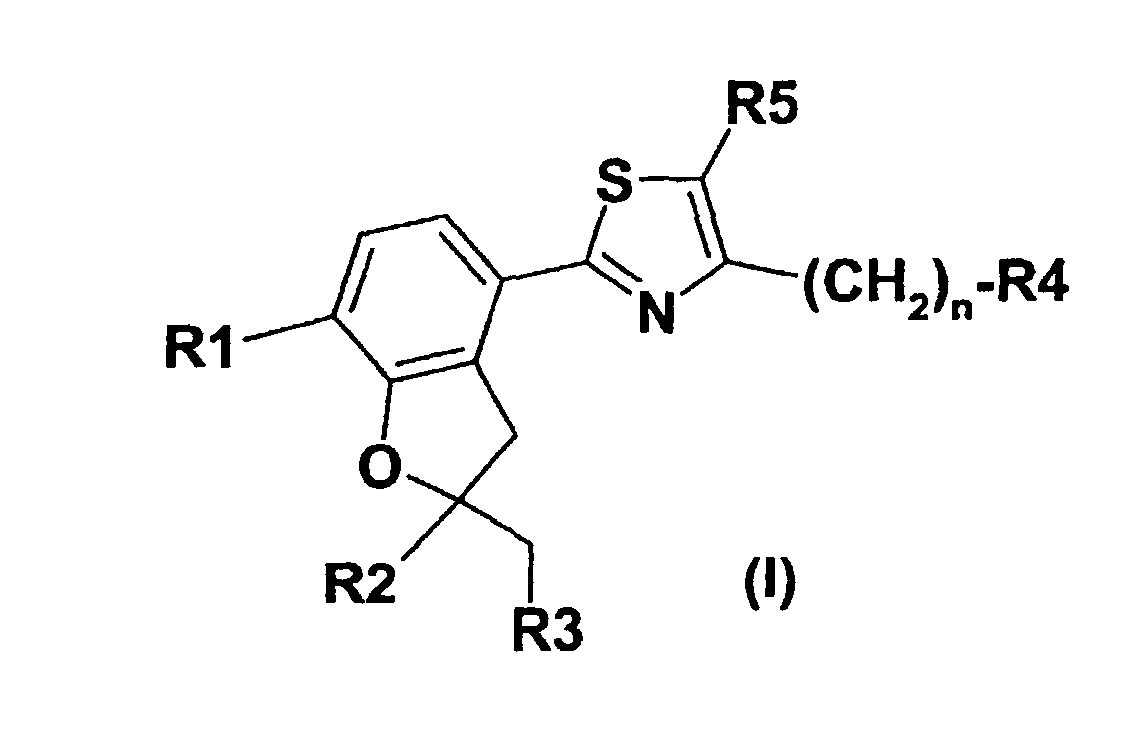
- R1
- 1-4C-Alkoxy bedeutet,
- R2 und R3
- gemeinsam und unter Einschluß der beiden Kohlenstoffatome, an die sie gebunden sind, einen Cyclopentanring darstellen,
- R4
- einen durch R41 substituierten Phenylring bedeutet oder durch R44 substituiertes Pyridin darstellt, wobei
- R41
- Wasserstoff, Carboxyl, 1-4C-Alkoxycarbonyl, Carbamoyl, Hydroxysulfonyl, Sulfamoyl oder Hydroxy, und
- R44
- Wasserstoff, Carboxyl, 1-4C-Alkoxycarbonyl, Carbamoyl, Hydroxysulfonyl, Sulfamoyl oder Hydroxy bedeutet,
- R5
- Wasserstoff bedeutet,
- n
- 0 bedeutet,
- Verbindungen der Formel I nach Anspruch 1, in denen
- R1
- Methoxy,
- R2 und R3
- gemeinsam und unter Einschluß der beiden Kohlenstoffatome, an die sie gebunden sind, einen Cyclopentanring darstellen,
- R4
- einen durch R41 substituierten Phenylring bedeutet oder durch R44 substituiertes Pyridin darstellt, wobei
- R41
- Carboxyl oder Carbamoyl und .
- R44
- Wasserstoff, Carboxyl oder 1-4C-Alkoxycarbonyl bedeuten,
- R5
- Wasserstoff bedeutet,
- n
- 0 bedeutet,
- Arzneimittel enthaltend eine oder mehrere Verbindungen nach Anspruch 1, zusammen mit üblichen pharmazeutischen Hilfs- und/oder Trägerstoffen.
- Verbindungen nach Anspruch 1 zur Anwendung bei der Behandlung von Krankheiten.
- Verwendung von Verbindungen nach Anspruch 1 zur Herstellung von Arzneimitteln für die Behandlung von Atemwegserkrankungen.
Priority Applications (2)
| Application Number | Priority Date | Filing Date | Title |
|---|---|---|---|
| SI9730611T SI0920426T1 (en) | 1996-08-26 | 1997-08-13 | New thiazole derivatives with phosphodiesterase-inhibiting effect |
| EP97940080A EP0920426B9 (de) | 1996-08-26 | 1997-08-13 | Neue thiazol-derivate mit phosphodiesterase inhibierender wirkung |
Applications Claiming Priority (6)
| Application Number | Priority Date | Filing Date | Title |
|---|---|---|---|
| DE19634411 | 1996-08-26 | ||
| DE19634411 | 1996-08-26 | ||
| EP96113737 | 1996-08-28 | ||
| EP96113737 | 1996-08-28 | ||
| PCT/EP1997/004435 WO1998008841A1 (de) | 1996-08-26 | 1997-08-13 | Neue thiazol-derivate mit phosphodiesterase inhibierender wirkung |
| EP97940080A EP0920426B9 (de) | 1996-08-26 | 1997-08-13 | Neue thiazol-derivate mit phosphodiesterase inhibierender wirkung |
Publications (3)
| Publication Number | Publication Date |
|---|---|
| EP0920426A1 EP0920426A1 (de) | 1999-06-09 |
| EP0920426B1 true EP0920426B1 (de) | 2003-10-01 |
| EP0920426B9 EP0920426B9 (de) | 2005-04-06 |
Family
ID=26028746
Family Applications (1)
| Application Number | Title | Priority Date | Filing Date |
|---|---|---|---|
| EP97940080A Expired - Lifetime EP0920426B9 (de) | 1996-08-26 | 1997-08-13 | Neue thiazol-derivate mit phosphodiesterase inhibierender wirkung |
Country Status (12)
| Country | Link |
|---|---|
| US (1) | US6011037A (de) |
| EP (1) | EP0920426B9 (de) |
| JP (1) | JP2000516940A (de) |
| AT (1) | ATE251153T1 (de) |
| AU (1) | AU4205197A (de) |
| CY (1) | CY2509B1 (de) |
| DE (1) | DE59710816D1 (de) |
| DK (1) | DK0920426T3 (de) |
| ES (1) | ES2208950T3 (de) |
| PT (1) | PT920426E (de) |
| SI (1) | SI0920426T1 (de) |
| WO (1) | WO1998008841A1 (de) |
Families Citing this family (20)
| Publication number | Priority date | Publication date | Assignee | Title |
|---|---|---|---|---|
| CA2715683A1 (en) | 1999-08-21 | 2001-03-01 | Nycomed Gmbh | Synergistic combination |
| WO2003015776A1 (en) | 2001-08-13 | 2003-02-27 | Janssen Pharmaceutica N.V. | 2,4,5-trisubstituted thiazolyl derivatives and their antiinflammatory activity |
| EA200501548A1 (ru) | 2003-04-01 | 2006-02-24 | Апплайд Резеч Системз Арс Холдинг Н.В. | Ингибиторы фосфодиэстераз при бесплодии |
| EP2258359A3 (de) | 2005-08-26 | 2011-04-06 | Braincells, Inc. | Neurogenese durch Modulation des Muscarinrezeptors mit Sabcomelin |
| JP2009506069A (ja) | 2005-08-26 | 2009-02-12 | ブレインセルス,インコーポレイティド | ムスカリン性受容体調節による神経発生 |
| US7985756B2 (en) | 2005-10-21 | 2011-07-26 | Braincells Inc. | Modulation of neurogenesis by PDE inhibition |
| WO2007053596A1 (en) | 2005-10-31 | 2007-05-10 | Braincells, Inc. | Gaba receptor mediated modulation of neurogenesis |
| US20100216734A1 (en) * | 2006-03-08 | 2010-08-26 | Braincells, Inc. | Modulation of neurogenesis by nootropic agents |
| CA2643199A1 (en) * | 2006-03-08 | 2007-09-13 | Braincells, Inc. | Modulation of neurogenesis by nootropic agents |
| WO2007134136A2 (en) | 2006-05-09 | 2007-11-22 | Braincells, Inc. | Neurogenesis by modulating angiotensin |
| US20100009983A1 (en) * | 2006-05-09 | 2010-01-14 | Braincells, Inc. | 5 ht receptor mediated neurogenesis |
| WO2007134077A2 (en) | 2006-05-09 | 2007-11-22 | Braincells, Inc. | 5 ht receptor mediated neurogenesis |
| EP2068872A1 (de) * | 2006-09-08 | 2009-06-17 | Braincells, Inc. | Kombinationen mit einem 4-acylaminopyridin-derivat |
| US20100184806A1 (en) | 2006-09-19 | 2010-07-22 | Braincells, Inc. | Modulation of neurogenesis by ppar agents |
| EP2066355A2 (de) * | 2006-09-19 | 2009-06-10 | Braincells, Inc. | Kombination aus einem durch einen peroxisom-proliferator aktivierten rezeptor-mittel und einem zweiten neurogenen mittel zur behandlung von erkrankungen des nervensystems sowie zur förderung von neuraler differenzierung und neurogenese |
| WO2010099217A1 (en) | 2009-02-25 | 2010-09-02 | Braincells, Inc. | Modulation of neurogenesis using d-cycloserine combinations |
| CA2834062A1 (en) | 2011-05-10 | 2012-11-15 | Merck Sharp & Dohme Corp. | Pyridyl aminopyridines as syk inhibitors |
| US9145391B2 (en) | 2011-05-10 | 2015-09-29 | Merck Sharp & Dohme Corp. | Bipyridylaminopyridines as Syk inhibitors |
| AU2012253885A1 (en) | 2011-05-10 | 2013-10-31 | Merck Sharp & Dohme Corp. | Aminopyrimidines as Syk inhibitors |
| EP2804603A1 (de) | 2012-01-10 | 2014-11-26 | President and Fellows of Harvard College | Betazellen-replikation für promoterverbindungen und verwendungsverfahren dafür |
Family Cites Families (4)
| Publication number | Priority date | Publication date | Assignee | Title |
|---|---|---|---|---|
| CA2074933C (en) * | 1990-11-30 | 2002-12-03 | Masatoshi Chihiro | Thiazole derivatives as active superoxide radical inhibitors |
| WO1993024472A1 (fr) * | 1992-05-29 | 1993-12-09 | Otsuka Pharmaceutical Co., Ltd. | Derive de thiazole |
| GB9315017D0 (en) * | 1993-07-20 | 1993-09-01 | Glaxo Lab Sa | Chemical compounds |
| WO1996003392A1 (en) * | 1994-07-27 | 1996-02-08 | G.D. Searle & Co. | Substituted thiazoles for the treatment of inflammation |
-
1997
- 1997-08-13 SI SI9730611T patent/SI0920426T1/xx unknown
- 1997-08-13 AT AT97940080T patent/ATE251153T1/de not_active IP Right Cessation
- 1997-08-13 EP EP97940080A patent/EP0920426B9/de not_active Expired - Lifetime
- 1997-08-13 DK DK97940080T patent/DK0920426T3/da active
- 1997-08-13 AU AU42051/97A patent/AU4205197A/en not_active Abandoned
- 1997-08-13 JP JP10511228A patent/JP2000516940A/ja active Pending
- 1997-08-13 WO PCT/EP1997/004435 patent/WO1998008841A1/de not_active Ceased
- 1997-08-13 PT PT97940080T patent/PT920426E/pt unknown
- 1997-08-13 ES ES97940080T patent/ES2208950T3/es not_active Expired - Lifetime
- 1997-08-13 DE DE59710816T patent/DE59710816D1/de not_active Expired - Fee Related
- 1997-08-13 US US09/147,740 patent/US6011037A/en not_active Expired - Fee Related
-
2005
- 2005-03-23 CY CY0500019A patent/CY2509B1/xx unknown
Also Published As
| Publication number | Publication date |
|---|---|
| AU4205197A (en) | 1998-03-19 |
| DK0920426T3 (da) | 2004-02-02 |
| ES2208950T3 (es) | 2004-06-16 |
| EP0920426A1 (de) | 1999-06-09 |
| SI0920426T1 (en) | 2004-04-30 |
| JP2000516940A (ja) | 2000-12-19 |
| CY2509B1 (en) | 2005-12-23 |
| WO1998008841A1 (de) | 1998-03-05 |
| ATE251153T1 (de) | 2003-10-15 |
| US6011037A (en) | 2000-01-04 |
| PT920426E (pt) | 2004-02-27 |
| EP0920426B9 (de) | 2005-04-06 |
| DE59710816D1 (de) | 2003-11-06 |
Similar Documents
| Publication | Publication Date | Title |
|---|---|---|
| EP0772610B9 (de) | Dihydrobenzofurane | |
| EP0920426B9 (de) | Neue thiazol-derivate mit phosphodiesterase inhibierender wirkung | |
| EP0706513B1 (de) | Fluoralkoxy substituierte benzamide und ihre verwendung als zyklisch-nukleotid phosphodiesterase-inhibitoren | |
| EP0828728B1 (de) | Phenyldihydrobenzofurane | |
| DE69717827T2 (de) | Benzofuran-4-carboxamide | |
| EP1075477B1 (de) | Neue Benzonaphtyridin-N-oxide | |
| EP0882021B1 (de) | Neue phenanthridine | |
| EP0889886B1 (de) | Neue in 6-position substituierte phenanthridine | |
| DE69822162T2 (de) | Neue tetrazolderivate | |
| DE69719778T2 (de) | Benzonaphthyridine als bronchialtherapeutika | |
| EP1109810B1 (de) | Benzonaphthyridin-n-oxide mit pde3 und pde4 inhibierender aktivität | |
| EP1086096B1 (de) | Benzamide mit tetrahydrofuranyloxy-substituenten als inhibitoren der phosphodiesterase 4 | |
| DE69817548T2 (de) | Tetrazole derivate | |
| EP0941226A1 (de) | (2,3-dihydrobenzofuranyl)-thiazole als phosphodiesterasehemmer | |
| WO1998008830A1 (de) | Thiazol-derivate als selektive inhibitoren der pde-iv | |
| DE69811492T2 (de) | Benzonaphthyridine | |
| DE69808099T2 (de) | Substituierte 6-alkylphenanthridine | |
| DE60025327T2 (de) | 6-arylphenanthridine mit pde-iv hemmender wirkung | |
| DE60202669T2 (de) | 6-phenylbenzonaphthyidine | |
| DE60108758T2 (de) | 6-heteroarylphenanthridine | |
| EP0819688A1 (de) | 4-substituierte Benzofurane | |
| DE69717277T2 (de) | Imidazopyridine | |
| EP0937075B1 (de) | Neue Imidazo- und Oxazolopyridine als Phosphodiesterase Inhibitoren. | |
| WO1998008844A1 (de) | Thiazol-derivate als selektive inhibitoren der pde-iv | |
| EP1075476B1 (de) | Benzimidazole und oxazole |
Legal Events
| Date | Code | Title | Description |
|---|---|---|---|
| PUAI | Public reference made under article 153(3) epc to a published international application that has entered the european phase |
Free format text: ORIGINAL CODE: 0009012 |
|
| 17P | Request for examination filed |
Effective date: 19990326 |
|
| AK | Designated contracting states |
Kind code of ref document: A1 Designated state(s): AT BE CH DE DK ES FI FR GB GR IE IT LI LU MC NL PT SE |
|
| AX | Request for extension of the european patent |
Free format text: AL PAYMENT 19990326;LT PAYMENT 19990326;LV PAYMENT 19990326;RO PAYMENT 19990326;SI PAYMENT 19990326 |
|
| 17Q | First examination report despatched |
Effective date: 20010824 |
|
| RAP1 | Party data changed (applicant data changed or rights of an application transferred) |
Owner name: ALTANA PHARMA AG |
|
| GRAH | Despatch of communication of intention to grant a patent |
Free format text: ORIGINAL CODE: EPIDOS IGRA |
|
| GRAS | Grant fee paid |
Free format text: ORIGINAL CODE: EPIDOSNIGR3 |
|
| RIN1 | Information on inventor provided before grant (corrected) |
Inventor name: ULRICH, WOLF-RUEDIGER Inventor name: BAER, THOMAS Inventor name: BEUME, ROLF Inventor name: KLEY, HANS-PETER Inventor name: HAEFNER, DIETRICH Inventor name: BOSS, HILDEGARD Inventor name: HATZELMANN, ARMIN Inventor name: THIBAUT, ULRICH Inventor name: SCHMIDT, BEATE Inventor name: FLOCKERZI, DIETER Inventor name: MARTIN, THOMAS Inventor name: AMSCHLER, HERMANN |
|
| GRAA | (expected) grant |
Free format text: ORIGINAL CODE: 0009210 |
|
| AK | Designated contracting states |
Kind code of ref document: B1 Designated state(s): AT BE CH DE DK ES FI FR GB GR IE IT LI LU MC NL PT SE |
|
| AX | Request for extension of the european patent |
Extension state: AL LT LV RO SI |
|
| REG | Reference to a national code |
Ref country code: GB Ref legal event code: FG4D Free format text: NOT ENGLISH |
|
| REG | Reference to a national code |
Ref country code: CH Ref legal event code: EP |
|
| REG | Reference to a national code |
Ref country code: IE Ref legal event code: FG4D Free format text: GERMAN |
|
| REF | Corresponds to: |
Ref document number: 59710816 Country of ref document: DE Date of ref document: 20031106 Kind code of ref document: P |
|
| REG | Reference to a national code |
Ref country code: CH Ref legal event code: NV Representative=s name: ALTANA PHARMA AG |
|
| REG | Reference to a national code |
Ref country code: GR Ref legal event code: EP Ref document number: 20030404611 Country of ref document: GR |
|
| REG | Reference to a national code |
Ref country code: SE Ref legal event code: TRGR |
|
| REG | Reference to a national code |
Ref country code: DK Ref legal event code: T3 |
|
| GBT | Gb: translation of ep patent filed (gb section 77(6)(a)/1977) |
Effective date: 20040121 |
|
| REG | Reference to a national code |
Ref country code: ES Ref legal event code: FG2A Ref document number: 2208950 Country of ref document: ES Kind code of ref document: T3 |
|
| ET | Fr: translation filed | ||
| PLBE | No opposition filed within time limit |
Free format text: ORIGINAL CODE: 0009261 |
|
| STAA | Information on the status of an ep patent application or granted ep patent |
Free format text: STATUS: NO OPPOSITION FILED WITHIN TIME LIMIT |
|
| 26N | No opposition filed |
Effective date: 20040702 |
|
| REG | Reference to a national code |
Ref country code: SI Ref legal event code: IF |
|
| REG | Reference to a national code |
Ref country code: SE Ref legal event code: RPOT |
|
| REG | Reference to a national code |
Ref country code: CH Ref legal event code: PFA Owner name: ALTANA PHARMA AG Free format text: ALTANA PHARMA AG#BYK-GULDEN-STRASSE 2#78467 KONSTANZ (DE) -TRANSFER TO- ALTANA PHARMA AG#BYK-GULDEN-STRASSE 2#78467 KONSTANZ (DE) |
|
| PGFP | Annual fee paid to national office [announced via postgrant information from national office to epo] |
Ref country code: PT Payment date: 20080812 Year of fee payment: 12 Ref country code: NL Payment date: 20080803 Year of fee payment: 12 Ref country code: LU Payment date: 20080826 Year of fee payment: 12 Ref country code: ES Payment date: 20080922 Year of fee payment: 12 Ref country code: DK Payment date: 20080815 Year of fee payment: 12 Ref country code: DE Payment date: 20080829 Year of fee payment: 12 Ref country code: CH Payment date: 20080912 Year of fee payment: 12 |
|
| PGFP | Annual fee paid to national office [announced via postgrant information from national office to epo] |
Ref country code: MC Payment date: 20080731 Year of fee payment: 12 Ref country code: IT Payment date: 20080828 Year of fee payment: 12 Ref country code: IE Payment date: 20080818 Year of fee payment: 12 Ref country code: FR Payment date: 20080818 Year of fee payment: 12 Ref country code: FI Payment date: 20080815 Year of fee payment: 12 Ref country code: AT Payment date: 20080814 Year of fee payment: 12 |
|
| REG | Reference to a national code |
Ref country code: CH Ref legal event code: PFA Owner name: NYCOMED GMBH Free format text: ALTANA PHARMA AG#BYK-GULDEN-STRASSE 2#78467 KONSTANZ (DE) -TRANSFER TO- NYCOMED GMBH#BYK-GULDEN-STRASSE 2#78467 KONSTANZ (DE) |
|
| PGFP | Annual fee paid to national office [announced via postgrant information from national office to epo] |
Ref country code: GB Payment date: 20080820 Year of fee payment: 12 |
|
| PGFP | Annual fee paid to national office [announced via postgrant information from national office to epo] |
Ref country code: SE Payment date: 20080807 Year of fee payment: 12 |
|
| PGFP | Annual fee paid to national office [announced via postgrant information from national office to epo] |
Ref country code: GR Payment date: 20080716 Year of fee payment: 12 |
|
| PGFP | Annual fee paid to national office [announced via postgrant information from national office to epo] |
Ref country code: BE Payment date: 20090119 Year of fee payment: 12 |
|
| REG | Reference to a national code |
Ref country code: PT Ref legal event code: MM4A Free format text: LAPSE DUE TO NON-PAYMENT OF FEES Effective date: 20100215 |
|
| BERE | Be: lapsed |
Owner name: *ALTANA PHARMA A.G. Effective date: 20090831 |
|
| LTLA | Lt: lapse of european patent or patent extension |
Effective date: 20090813 |
|
| PG25 | Lapsed in a contracting state [announced via postgrant information from national office to epo] |
Ref country code: MC Free format text: LAPSE BECAUSE OF NON-PAYMENT OF DUE FEES Effective date: 20090831 |
|
| REG | Reference to a national code |
Ref country code: NL Ref legal event code: V1 Effective date: 20100301 Ref country code: CH Ref legal event code: PL |
|
| REG | Reference to a national code |
Ref country code: DK Ref legal event code: EBP |
|
| GBPC | Gb: european patent ceased through non-payment of renewal fee |
Effective date: 20090813 |
|
| PG25 | Lapsed in a contracting state [announced via postgrant information from national office to epo] |
Ref country code: PT Free format text: LAPSE BECAUSE OF NON-PAYMENT OF DUE FEES Effective date: 20100215 Ref country code: LI Free format text: LAPSE BECAUSE OF NON-PAYMENT OF DUE FEES Effective date: 20090831 Ref country code: FI Free format text: LAPSE BECAUSE OF NON-PAYMENT OF DUE FEES Effective date: 20090813 Ref country code: CH Free format text: LAPSE BECAUSE OF NON-PAYMENT OF DUE FEES Effective date: 20090831 |
|
| REG | Reference to a national code |
Ref country code: FR Ref legal event code: ST Effective date: 20100430 |
|
| REG | Reference to a national code |
Ref country code: IE Ref legal event code: MM4A |
|
| PG25 | Lapsed in a contracting state [announced via postgrant information from national office to epo] |
Ref country code: BE Free format text: LAPSE BECAUSE OF NON-PAYMENT OF DUE FEES Effective date: 20090831 Ref country code: AT Free format text: LAPSE BECAUSE OF NON-PAYMENT OF DUE FEES Effective date: 20090813 |
|
| REG | Reference to a national code |
Ref country code: SI Ref legal event code: KO00 Effective date: 20100430 |
|
| PG25 | Lapsed in a contracting state [announced via postgrant information from national office to epo] |
Ref country code: NL Free format text: LAPSE BECAUSE OF NON-PAYMENT OF DUE FEES Effective date: 20100301 Ref country code: IE Free format text: LAPSE BECAUSE OF NON-PAYMENT OF DUE FEES Effective date: 20090813 Ref country code: FR Free format text: LAPSE BECAUSE OF NON-PAYMENT OF DUE FEES Effective date: 20090831 Ref country code: DK Free format text: LAPSE BECAUSE OF NON-PAYMENT OF DUE FEES Effective date: 20090831 Ref country code: DE Free format text: LAPSE BECAUSE OF NON-PAYMENT OF DUE FEES Effective date: 20100302 |
|
| REG | Reference to a national code |
Ref country code: ES Ref legal event code: FD2A Effective date: 20090814 |
|
| PG25 | Lapsed in a contracting state [announced via postgrant information from national office to epo] |
Ref country code: GR Free format text: LAPSE BECAUSE OF NON-PAYMENT OF DUE FEES Effective date: 20100303 |
|
| PG25 | Lapsed in a contracting state [announced via postgrant information from national office to epo] |
Ref country code: GB Free format text: LAPSE BECAUSE OF NON-PAYMENT OF DUE FEES Effective date: 20090813 |
|
| PG25 | Lapsed in a contracting state [announced via postgrant information from national office to epo] |
Ref country code: IT Free format text: LAPSE BECAUSE OF NON-PAYMENT OF DUE FEES Effective date: 20090813 |
|
| PG25 | Lapsed in a contracting state [announced via postgrant information from national office to epo] |
Ref country code: LU Free format text: LAPSE BECAUSE OF NON-PAYMENT OF DUE FEES Effective date: 20090813 |
|
| PG25 | Lapsed in a contracting state [announced via postgrant information from national office to epo] |
Ref country code: SE Free format text: LAPSE BECAUSE OF NON-PAYMENT OF DUE FEES Effective date: 20090814 |
|
| PG25 | Lapsed in a contracting state [announced via postgrant information from national office to epo] |
Ref country code: ES Free format text: LAPSE BECAUSE OF NON-PAYMENT OF DUE FEES Effective date: 20090814 |