EP0914397B1 - Wässriger dispersions-klebstoff auf basis von polyvinylacetat - Google Patents
Wässriger dispersions-klebstoff auf basis von polyvinylacetat Download PDFInfo
- Publication number
- EP0914397B1 EP0914397B1 EP97932804A EP97932804A EP0914397B1 EP 0914397 B1 EP0914397 B1 EP 0914397B1 EP 97932804 A EP97932804 A EP 97932804A EP 97932804 A EP97932804 A EP 97932804A EP 0914397 B1 EP0914397 B1 EP 0914397B1
- Authority
- EP
- European Patent Office
- Prior art keywords
- dispersion
- adhesive
- silica
- polyvinyl acetate
- dispersion adhesive
- Prior art date
- Legal status (The legal status is an assumption and is not a legal conclusion. Google has not performed a legal analysis and makes no representation as to the accuracy of the status listed.)
- Expired - Lifetime
Links
Classifications
-
- C—CHEMISTRY; METALLURGY
- C09—DYES; PAINTS; POLISHES; NATURAL RESINS; ADHESIVES; COMPOSITIONS NOT OTHERWISE PROVIDED FOR; APPLICATIONS OF MATERIALS NOT OTHERWISE PROVIDED FOR
- C09J—ADHESIVES; NON-MECHANICAL ASPECTS OF ADHESIVE PROCESSES IN GENERAL; ADHESIVE PROCESSES NOT PROVIDED FOR ELSEWHERE; USE OF MATERIALS AS ADHESIVES
- C09J131/00—Adhesives based on homopolymers or copolymers of compounds having one or more unsaturated aliphatic radicals, each having only one carbon-to-carbon double bond, and at least one being terminated by an acyloxy radical of a saturated carboxylic acid, of carbonic acid, or of a haloformic acid; Adhesives based on derivatives of such polymers
- C09J131/02—Homopolymers or copolymers of esters of monocarboxylic acids
- C09J131/04—Homopolymers or copolymers of vinyl acetate
-
- C—CHEMISTRY; METALLURGY
- C08—ORGANIC MACROMOLECULAR COMPOUNDS; THEIR PREPARATION OR CHEMICAL WORKING-UP; COMPOSITIONS BASED THEREON
- C08L—COMPOSITIONS OF MACROMOLECULAR COMPOUNDS
- C08L2666/00—Composition of polymers characterized by a further compound in the blend, being organic macromolecular compounds, natural resins, waxes or and bituminous materials, non-macromolecular organic substances, inorganic substances or characterized by their function in the composition
- C08L2666/54—Inorganic substances
Definitions
- the invention relates to an aqueous dispersion adhesive based on Polyvinyl acetate with more than 80 wt .-% of vinyl acetate as a binder and an addition of pyrogenic silica and its preparation and Use.
- Dispersion adhesives based on polyvinyl acetate are used, among other things, for Gluing wood used (wood glue). Their viscosity is between 6 and 25 Pas to Brookfield. With this viscosity range are the following advantages connected: The dispersions can easily be spread over large areas by hand to distribute. They are machine-compatible. They partially penetrate into it gluing substrate and therefore lead to high strength. A disadvantage of this viscosity range is that the adhesives run after application, Form noses on vertical surfaces and when processing in the groove and Spring area either run out of the groove again or deep into the groove into running. In the first case, running or running is undesirable because the glue is no longer where it should be when the parts are joined should.
- aqueous dispersion adhesives based on polyvinyl acetate with a pasty consistency.
- such an adhesive is obtained if 1 to 2% of pyrogenic silica and 4 to 15% of a high-boiling solvent are added to a PVAc dispersion.
- This known adhesive has the disadvantage that the open time is extended, but so does the setting time. Depending on the application, this extends the time until a next processing step is possible.
- the water resistance and the heat resistance are reduced below the permissible or necessary values.
- EP 0056622 A1 also describes a polymer composition which consists of 98.0 to 99.9% by weight of a water-dispersible vinyl ester polymer and 2.0 up to 0.1 wt .-% of a hydrophobic silica.
- the polymer composition is powdery and can be used for the production of adhesives, especially for Wallpaper can be used.
- the task was to provide a practical paste-like dispersion adhesive based on polyvinyl acetate with a long "open time” but with a “short setting time", which also meets the other requirements for wood glue , These include, for example, that the water resistance class of the glue, measured according to EN 204, is retained, the heat resistance according to Watt 91 of more than 6 N / mm 2 is achieved and the hardwood gluing is also good. Furthermore, the following properties are included: practical, simple processing and, as far as possible, freedom from solvents as well as a minimum film-forming temperature (MFT) of 6 ° C to enable processing even at low temperatures. Of course, the dispersion adhesive should also be sufficiently stable in storage.
- MFT minimum film-forming temperature
- an adhesive that is suitable for climatic area T according to DIN 50019, Part 1 (indoor use with frequent short-term exposure to draining water or condensed water and / or long-term exposure to high air humidity or outdoor use with appropriate protection against weather) an adhesive meets the requirements of EN204 D3.
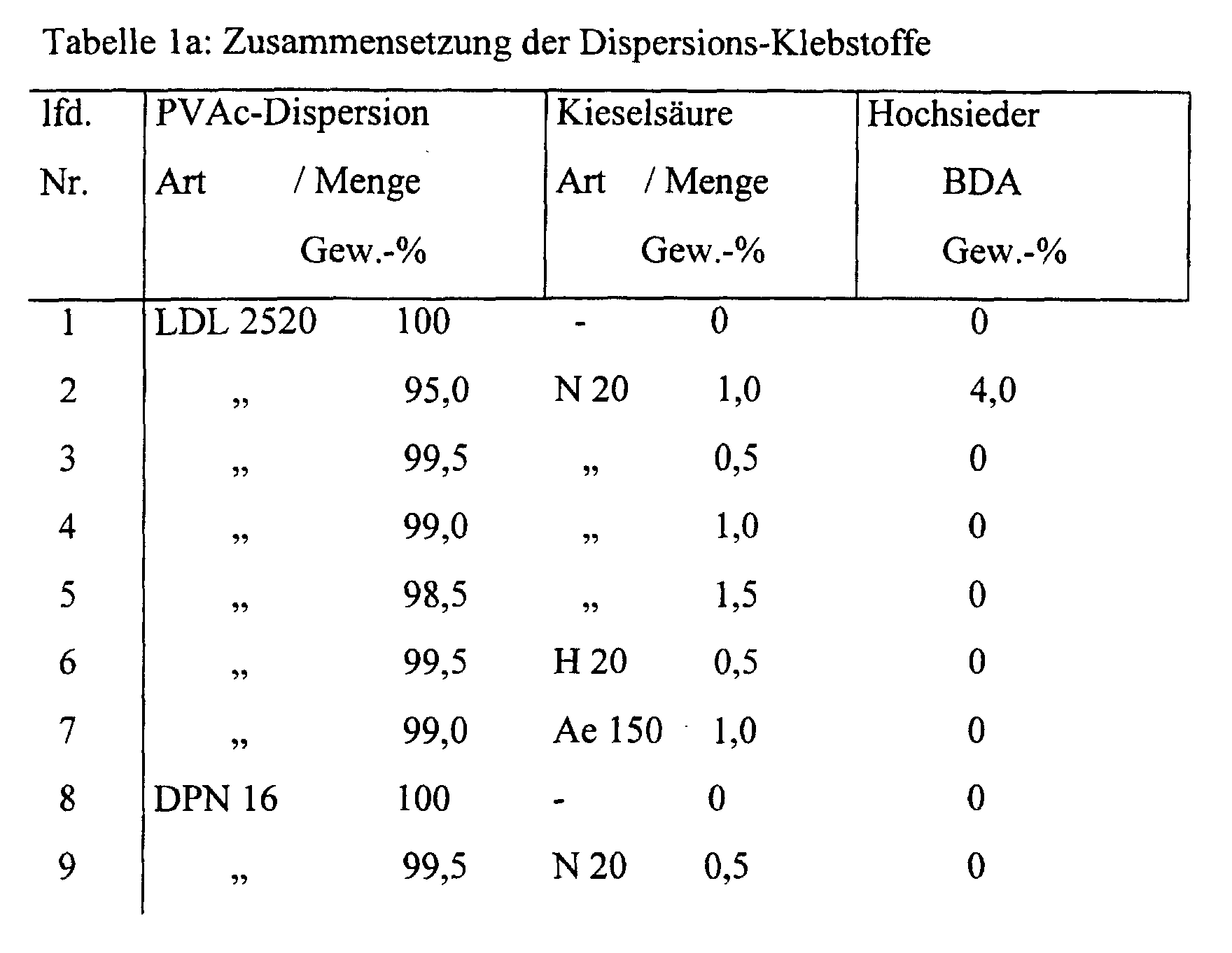
- she consists essentially in that the PVAc dispersion in less than 4 wt .-% high-boiling solvent with a boiling point at normal pressure of more than 160 ° C and 0.1 to 2.0 wt .-%, based on the dispersion, of pyrogenic Contains silica, the silica being wettable with mixtures which is at least 40 parts by volume of water and a maximum of 60 parts by volume Contain methanol.
- high-boiling solvent such as Butyldiglykolacetal added. Because such high-boiling solvents are already in the PVAo dispersions may be included is the amount of high boiling Solvent in the adhesive according to the invention less than 4 and above all less than 3% by weight, based on the dispersion. Under a "high-boiling Solvent "is intended to mean a solvent with a boiling point at normal pressure of more than 160 ° C, in particular more than 200 ° C and above all more than 240 ° C understood become. Suitable solvents include: diethylene glycol and its esters or Ether with a total of up to 18 carbon atoms.
- Butyl diglycol acetate, polysolvan O dibutyl phthalate, dimethyl phthalate, di (butyl glycol) phthalate, Benzyl butyl phthalate, propyl glycol benzoate, Diisobutyl phthalate, citric acid, benzoic acid ester, sebacic acid ester, Diisoxylylphthalate, Diglykol, Me-Diglykol, Diglyme, Carbitol, Di-Et-Diglykol, Et-Diglykol-Ac, Bu-diglycol, di-Bu-diglycol and Bu-diglycol-Ac.
- “Fumed silica” is to be understood as a highly disperse silica which can be produced by flame hydrolysis.
- the one caused by the silanol groups Hydrophilicity is beneficial, but not essential compared to one water-repellent silica, which can be obtained by chlorosilanes.
- Hydrophobic silicas are also obtained by adding hydrophilic silicas in react with organosilanes in a second process step. Finally there is nor the mixed oxides, which are caused by joint flame hydrolysis with a second volatile compound that form oxides.
- the amount of fumed silica should range from 0.1 to 2.0, preferably in the range from 0.3 to less than 1, in particular in the range from 0.3 to 0.8 wt .-%, based on the dispersion. Smaller shares lead in general only to effects that increase viscosity or a change in Rheology, higher proportions generally lead to the thickening Effect can be so high that processing is impossible or that Dispersions are not stable on storage and e.g. break.
- Polyvinyl acetate means homopolymers and copolymers of vinyl acetate with more than 80, in particular more than 88% by weight of vinyl acetate, based on the monomers as a whole.
- Possible comonomers are: ethylene (poly-ethylene vinyl acetate) and maleic acid esters with alcohols up to 12 C atoms and the esters of vinyl alcohol with carboxylic acids with 2 to 12, in particular 2 to 5, carbon atoms. Comonomers can be used for various reasons, for example to lower the glass temperature. The elasticity is also increased.
- Reactive comonomers are expediently used to improve the water resistance, such as, for example, isobutoxymethylacrylamide or other esters of polyhydric alcohols, but above all N-methylol-acrylamide.
- the dispersion generally contains polyvinyl alcohol as a protective colloid and acidic salts of, for example, Lewis acids in small amounts as a catalyst.
- the polyvinyl acetate has to be crosslinked with, for example, blocked formaldehyde derivatives or dialdehydes.
- the group of "methylol derivatives" but also glutardialdehyde and malondialdehyde bisdiethylacetal are suitable.
- a D3 glue has, for example, the following composition: main component with about 45 to 48% of a copolymer consisting of, for example, 94% Vinyl acetate and 6% N-methylolacrylamide. 2 to 5% by weight of polyvinyl alcohol with a degree of hydrolysis of 88 to 98% are used as the protective colloid.
- 1.5 to 2.5% by weight of, for example, butyl diglycol acetate are used as film-forming aids and small amounts of acidic salts of Lewis acids are used as catalysts.
- the rest is water. Small amounts of preservatives, wetting agents or defoamers are also usually used.
- the copolymer or polymer is - apart from water - the main component of the dispersion adhesive, in particular its proportion is 40 to 60 and especially 45 to 55% by weight, based on the dispersion. It can also happen that up to 20% by weight of fillers are added to the glues.
- the adhesive according to the invention is produced from the above components, by introducing the dispersion and incorporating the silica. It is to make sure that the intensity of the shear effect strongly influences the Final viscosity or on the rheology. So at the same concentration Silica but different shear effects get different final viscosities. It is favorable to incorporate the silica briefly with a dissolver without reducing the To destroy dispersion. However, it is also possible to use a silica Slowly incorporate planetary mixer in approx. 30 to 40 min.
- the dispersion adhesive according to the invention is so thixotropic and creamy that it as Assembly adhesive from the cartridge, from the tubular bag, from one Two-chamber aerosol can, from a two-chamber pressure can, from dispensers like can be applied to toothpaste or soaps or from the tube without it vertical surfaces runs off or drips overhead when applied. He can too via feed pumps such as Gear pumps or airless systems promoted become. It is stable and still allows the necessary penetration into the wood.
- the advantages of this adhesive are better application, e.g. in the groove and Spring area, in model construction or during assembly. But also the Body gluing, the dowel connections, the Lamello connections, the Solid wood width gluing and machine application of the adhesive nozzles are possible, that is, all the usual constructional connection techniques.
- the adhesive can also be used in the high-frequency field (HF drying) or used in the heat sealing process.
- HF drying high-frequency field
- Such adhesives also offer Advantages when gluing rough sawn wood, e.g. because rough sawn wood requires significantly higher adhesive application than planed wood. The advantage is that much more adhesive can be applied without this runs away. Rather, it remains steadfast at the recesses.
- the Pressing pressure when gluing rough sawn wood can be reduced because more Glue is available. In a way it can be easy gap-bridging properties are spoken.
- thixotropic water-resistant dispersion adhesives according to the invention can Generally speaking - be used wherever there is not necessarily one large-scale order is required. But it is also generally possible, e.g. With to apply across a glue comb.
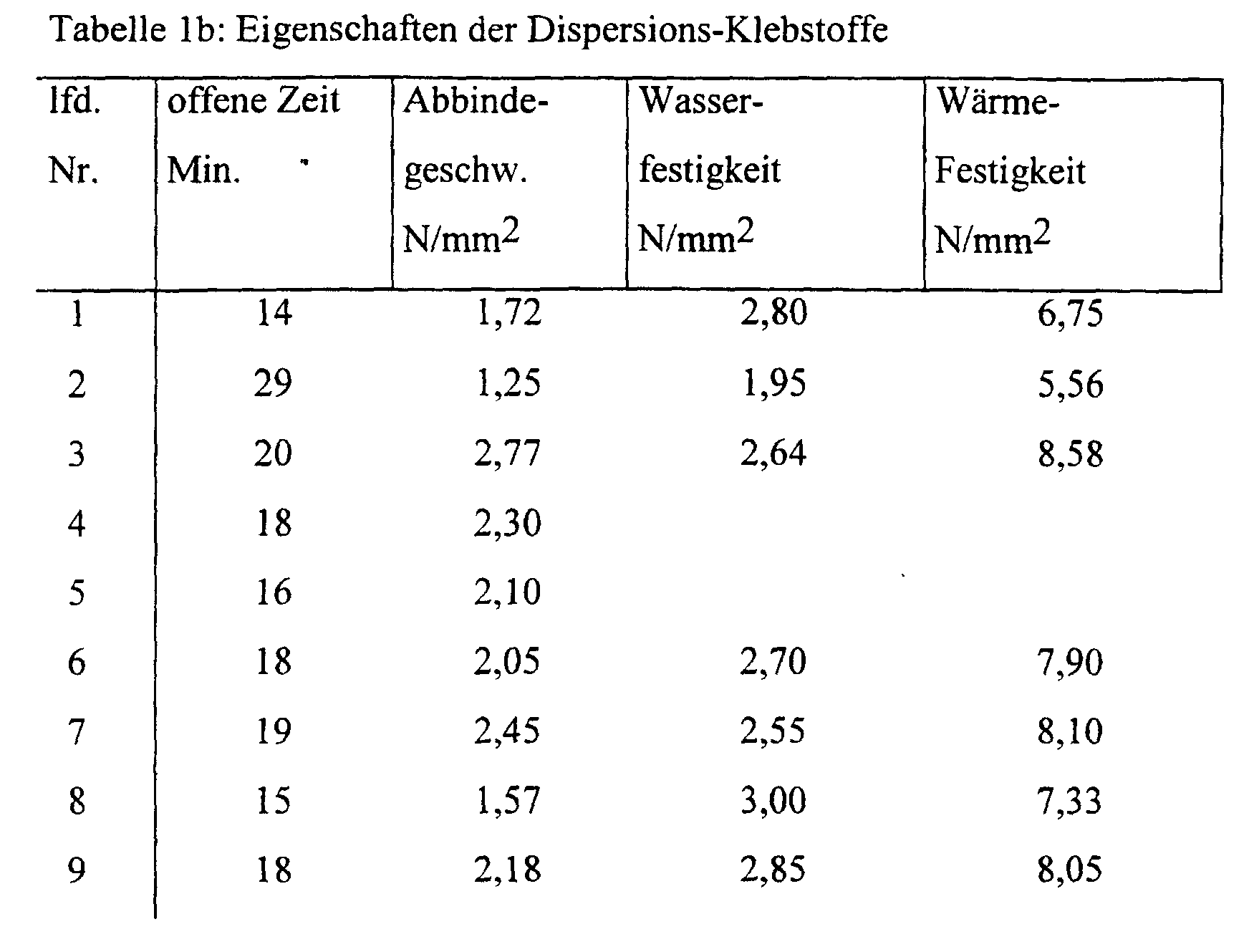
- the setting speed values are approx. 20 to 60% above the values the unmodified dispersion and even more than the values of the known modified dispersion according to DE 35 01 791. This is particularly useful if if rapid further processing, especially in industry or in the trade from the economic point of view. With fast Setting speeds can be continued quickly because the Adhesion reaches the necessary initial strengths in less time.
- the open time is up to 43% longer than with the unmodified dispersion. This is useful because it fixes the parts to be glued in one reasonable time is possible. So it is e.g. possible to use very complicated parts To glue, then put them together and finally finally under Pressure to stick together. Such requirements are, for example posed when building a staircase. The open time would be exceeded Carry out gluing without sufficient strength.
- the silica and optionally the butyl diglycol acetate are added a laboratory stirrer at 350 revolutions per minute within 15 to 20 Min. Worked into the dispersion. There is also a planetary dissolver appropriate. Generally, the incorporation of the silica with the different stirring units possible. Depending on the The time required for digestion of the silica can shear either lengthen or shorten it. So the digestion times are one Dissolver at about 5 min, that of a planetary mixer at 30 to 40 min. Has been Air is added during the induction phase Evacuation phase of around 10 min at 100 mbar necessary. The control takes place via a density measurement, the density ⁇ the density of the should be unmodified dispersion. The compositions are that Take the table.
- the adhesives according to the invention have a thixotropic, supple and creamy Consistency.
- Their solids content measured according to DIN 53189, is approx. 50% by weight, your minimum film forming temperature (MFT), measured according to DIN 53787 below 6 ° C.
- MFT minimum film forming temperature
- the storage stability is greater than 12 months at 20 ° C and longer than 3 months at 40 ° C. A shortened storage test over 3 months 40 ° C was used for this purpose.
- the hardwood gluing was measured on solid, undamped red beech (Fagus Silvatica) with a wood moisture content of 8 to 10% and a bulk density of> 0.65 g / cm 3 , using 5 strips with the dimensions 20 cm x 4 cm x 2 cm were glued so that a format of 20 x 20 cm was created.
- the annual rings for the sample width were 65 to 90 °.
- the adhesive application was 150 g / m 2 on one side, the waiting time until the parts were joined and pressed was 5 minutes at 23 ° C. and 50% relative atmospheric humidity. The pressure was 0.5 N / mm 2 .
- the test specimen was then stored in a standard atmosphere (23 ° C., 50% relative atmospheric humidity) for 7 days and then subjected to a break test.
- the "open time” was determined, in which the adhesive at 23 ° C and 50% relative humidity with the aid of a doctor blade 200 ⁇ m on undamped red beech (Fagus Silvatica) with a bulk density of> 0.65 g / cm 3 and a wood moisture between 8 to 12% was applied.
- the annual rings on the broad side ran between 65 and 90 °.
- the time from the application of the adhesive to the time of film formation or the formation of a skin on the surface of the adhesive was measured. It was important that wind movement could be excluded at the time of the test. The time was defined so that there was still wet adhesive, so that in practice it would still have resulted in good adhesive bonds.
- the "setting time” was determined in accordance with DIN 53253 "Determination of the Bond Strength of Shank Gluing in the Tensile Test”. The test was carried out under air-conditioned conditions at 23 ° C and 50% RH. All materials, test timbers and adhesives were conditioned under these conditions. The adhesive application was 200 ⁇ m (thickness), the pressing pressure was 0.35 N / mm 2 and the pressing time was 20 min. The test specimens were then torn in a tearing machine at a feed rate of 50 mm / min and the maximum value was determined. The arithmetic mean of 15 test specimens was then calculated.
- the "water resistance” was determined in accordance with DIN EN 204 D3, the test specimens being produced in accordance with DIN 53254.
- the required minimum value is 2.00 N / mm 2 for the bearing sequence 3.
- the heat resistance was determined on the basis of tensile shear strength after 1 hour at 80 ° C. on undamped red beech according to Watt 91 (Wood Adhesive Temperature Test).
- the test specimens were produced in accordance with DIN 53204. Experience has shown that the value should be above 6 N / mm 2 .
- the density was determined according to DIN 53217 T2, the viscosity according to Brookfield RTV ISO 2555 at 23 ° C and the pH value according to DIN 53785 at 23 ° C.
- hydrophobic a silica the higher the concentration must be Be methanol.
- hydrophilic silicas already show in water without an addition of methanol a significant wetting.
- silica is usable. With a mixture of 40 VT methanol and 60 VT Water-wettable silicas are preferred. Leave excellent silicas wet with pure water (100 VT). One becomes "predominantly hydrophilic" Silicic acid refers to when it is wettable with mixtures that at least Contain 60 VT water and a maximum of 40 VT methanol.
Landscapes
- Chemical & Material Sciences (AREA)
- Organic Chemistry (AREA)
- Adhesives Or Adhesive Processes (AREA)
- Processes Of Treating Macromolecular Substances (AREA)
Description
Dieser bekannte Klebstoff hat den Nachteil, daß die offene Zeit zwar verlängert wird, aber die Abbindezeit ebenfalls. Dadurch wird die Dauer - je nach Anwendung -, bis ein nächster Verarbeitungsschritt möglich ist, hinausgezogen Außerdem werden auch noch - verglichen mit der unmodifizierten Dispersion - die Wasserfestigkeit und die Wärmefestigkeit unter die zulässigen bzw. notwendigen Werte verringert.
Das Copolymer bzw. Polymer stellt - abgesehen vom Wasser - die Hauptkomponente des Dispersions-Klebstoffes dar, insbesondere beträgt sein Anteil 40 bis 60 und vor allem 45 bis 55 Gew.-%, bezogen auf die Dispersion. Es kann ebenfalls vorkommen, daß die Leime mit bis zu 20 Gew.-% an Füllstoffen versetzt werden.
- thixotrope, cremige Konsistenz,
- lange offene Zeit,
- schnelles Abbindeverhalten,
- hohe Wärmestandfestigkeit und
- geringer oder kein Gehalt an hochsiedenden Lösemitteln.
| Hauptkomponente | Vinylacetat | ca. 42 - 45 % |
| Vernetzungskomponente | N-Methylolacrylamid | ca. 3 % |
| Schutzkolloid | Polyvinylalkohol mit Hydrolysegrad 88 - 98 % | ca. 4 % |
| Filmbildehilfsmittel | Butyldiglykolacetat | 1,5 - 2,5 % |
| Katalysator | saure Salze, nämlich AlCl3 (Lewissäuren) | geringe Mengen |
| Lösemittel | Wasser |
Beurteilt wurde das Bruchbild und der Faserausriß. Die Hartholzverleimung war in allen Fällen des erfindungsgemäßen Klebstoffes gut, d.h. der Faserausriß lag oberhalb 50 %.
| Volumenteile | Aerosil | |||||||
| Methanol | Wasser | R 202 | R 812 | R 805 | R 972 | HDK H20 | HDK N20 | Aerosil 150 |
| 100 | 0 | + | + | + | + | + | + | + |
| 90 | 10 | + | + | + | + | + | + | + |
| 80 | 20 | + | + | + | + | + | + | + |
| 70 | 30 | - | + | + | + | + | + | + |
| 60 | 40 | - | + | + | + | + | + | + |
| 50 | 50 | - | - | - | + | + | + | + |
| 40 | 60 | - | - | - | - | + | + | + |
| 30 | 70 | - | - | - | - | - | + | + |
| 20 | 80 | - | - | - | - | - | + | + |
| 10 | 90 | - | - | - | - | - | + | + |
| 0 | 100 | - | - | - | - | - | + | + |

Claims (9)
- Wäßriger Dispersions-Klebstoff auf der Basis von Polyvinylacetat mit mehr als 80 Gew.% an Vinylacetat als Bindemittel sowie einem Zusatz an pyrogener Kieselsäure, dadurch gekennzeichnet, daß er weniger als 4 Gew.-% an hochsiedendem Lösemittel mit einem Siedepunkt bei Normaldruck von mehr als 160 °C und 0,1 bis 2,0 Gew.-%, bezogen auf die Dispersion, an pyrogener Kieselsäure enthält, wobei die Kieselsäure mit Mischungen benetzbar ist, die mindestens 40 Volumen-Teile Wasser und höchstens 60 Volumenteile Methanol enthalten.
- Dispersions-Klebstoff nach Anspruch 1, dadurch gekennzeichnet, daß das Polyvinylacetat ein Copolymer von Vinylacetat und Acrylamid, insbesondere N-Methylol-acrylamid ist, und zwar in einer Gewichtsmenge von bis zu 20 %, insbesondere bis zu 12 Gew.-%, bezogen auf die Monomeren insgesamt.
- Dispersions-Klebstoff nach Anspruch 2, dadurch gekennzeichnet, daß die Polyvinylacetat-Dispersion einen pH-Wert nach DIN 53785 von weniger als 5,5, insbesondere weniger als 4,5 hat.
- Dispersions-Klebstoff nach Anspruch 3, dadurch gekennzeichnet, daß Polyvinylalkohol als Schutzkolloid verwendet wird.
- Dispersions-Klebstoff nach mindestens einem der Ansprüche 1 bis 4, dadurch gekennzeichnet, daß die Polyvinylacetat-Dispersion vernetzungsfähige Gruppen enthält, die zum Teil schon in dem Klebstoff reagiert haben und zum Teil erst nach dessen Auftrag reagieren.
- Dispersions-Klebstoff nach mindestens einem der vorangegangenen Ansprüche, dadurch gekennzeichnet, daß die pyrogene Kieselsäure überwiegend hydrophil ist, wobei die Kieselsäure mit Mischungen benetzbar ist, die mindestens 60 Volumen-Teile Wasser und höchstens 40 Volumen-Teile Methanol enthalten.
- Herstellung des Dispersions-Klebstoffes nach mindestens einem der vorangegangenen Ansprüche, dadurch gekennzeichnet, daß man die Dispersion vorlegt und die Kieselsäure einarbeitet.
- Verwendung des Dispersions-Klebstoffes nach mindestens einem der Ansprüche 1 bis 6 in Kartuschen, Tuben, in Schlauchbeuteln oder Zweikammer-Aerosoldosen.
- Verwendung des Dispersions-Klebstoffes nach mindestens einem der Ansprüche 1 bis 6 zum Verkleben von Holz- und Holzwerkstoffen oder deren Kombinationsverklebungen wie z.B. HPL - Holz (= high-pressure-laminate).
Applications Claiming Priority (3)
| Application Number | Priority Date | Filing Date | Title |
|---|---|---|---|
| DE19629320 | 1996-07-20 | ||
| DE19629320 | 1996-07-20 | ||
| PCT/EP1997/003675 WO1998003604A1 (de) | 1996-07-20 | 1997-07-11 | Wässriger dispersions-klebstoff auf basis von polyvinylacetat |
Publications (2)
| Publication Number | Publication Date |
|---|---|
| EP0914397A1 EP0914397A1 (de) | 1999-05-12 |
| EP0914397B1 true EP0914397B1 (de) | 2002-05-15 |
Family
ID=7800359
Family Applications (1)
| Application Number | Title | Priority Date | Filing Date |
|---|---|---|---|
| EP97932804A Expired - Lifetime EP0914397B1 (de) | 1996-07-20 | 1997-07-11 | Wässriger dispersions-klebstoff auf basis von polyvinylacetat |
Country Status (7)
| Country | Link |
|---|---|
| EP (1) | EP0914397B1 (de) |
| AT (1) | ATE217646T1 (de) |
| CZ (1) | CZ8499A3 (de) |
| DE (2) | DE19728555A1 (de) |
| PL (1) | PL331100A1 (de) |
| SK (1) | SK7099A3 (de) |
| WO (1) | WO1998003604A1 (de) |
Families Citing this family (3)
| Publication number | Priority date | Publication date | Assignee | Title |
|---|---|---|---|---|
| DE102005057645A1 (de) * | 2005-12-01 | 2007-06-06 | Celanese Emulsions Gmbh | Polyvinylesterdispersionen mit niedriger Filmbildtemperatur und hoher Wasserbeständigkeit sowie deren Verwendung |
| DE102007033596A1 (de) | 2007-07-19 | 2009-01-22 | Celanese Emulsions Gmbh | Beschichtungsmittel mit hoher Bewitterungsbeständigkeit, Verfahren zu deren Herstellung und deren Verwendung |
| DE102007033595A1 (de) | 2007-07-19 | 2009-01-22 | Celanese Emulsions Gmbh | Polyvinylesterdispersionen, Verfahren zu deren Herstellung und deren Verwendung |
Family Cites Families (2)
| Publication number | Priority date | Publication date | Assignee | Title |
|---|---|---|---|---|
| DE3101413C2 (de) * | 1981-01-17 | 1983-10-20 | Hoechst Ag, 6230 Frankfurt | Pulverförmige Polymerisatmasse, Verfahren zu ihrer Herstellung und ihre Verwendung |
| DE3501791A1 (de) * | 1985-01-21 | 1986-07-24 | Klebchemie, M.G. Becker GmbH & Co KG, 7504 Weingarten | Dispersionsklebstoff |
-
1997
- 1997-07-04 DE DE19728555A patent/DE19728555A1/de not_active Withdrawn
- 1997-07-11 CZ CZ9984A patent/CZ8499A3/cs unknown
- 1997-07-11 SK SK70-99A patent/SK7099A3/sk unknown
- 1997-07-11 EP EP97932804A patent/EP0914397B1/de not_active Expired - Lifetime
- 1997-07-11 DE DE59707292T patent/DE59707292D1/de not_active Expired - Lifetime
- 1997-07-11 PL PL97331100A patent/PL331100A1/xx unknown
- 1997-07-11 AT AT97932804T patent/ATE217646T1/de not_active IP Right Cessation
- 1997-07-11 WO PCT/EP1997/003675 patent/WO1998003604A1/de not_active Ceased
Also Published As
| Publication number | Publication date |
|---|---|
| EP0914397A1 (de) | 1999-05-12 |
| DE59707292D1 (de) | 2002-06-20 |
| ATE217646T1 (de) | 2002-06-15 |
| SK7099A3 (en) | 1999-07-12 |
| WO1998003604A1 (de) | 1998-01-29 |
| PL331100A1 (en) | 1999-06-21 |
| CZ8499A3 (cs) | 1999-07-14 |
| DE19728555A1 (de) | 1998-01-22 |
Similar Documents
| Publication | Publication Date | Title |
|---|---|---|
| DE2947818C2 (de) | Zweikomponenten-Klebstoff und Verfahren zum Kleben | |
| DE60302780T2 (de) | Auf stärke basierende leimpastezusammensetzung | |
| DE69902545T2 (de) | Verfahren zum getrennten auftragen eines harzes und eines härters | |
| DE1569894A1 (de) | Klebstoffemulsion | |
| EP0597920A1 (de) | Wasserhaltiger klebstoff auf basis von casein. | |
| EP0041212B1 (de) | Kleber und/oder Beschichtungsmassen auf Basis von Alkalimetallsilikatlösungen und deren Verwendung | |
| EP0487497A1 (de) | Verfahren zur Verringerung der Wasserdampfdurchlässigkeit | |
| EP0778870A2 (de) | Physikalisch und/oder chemisch abbindende bindemittel | |
| EP2931823B1 (de) | Verfahren zum herstellen einer polyvinylacetatdispersion | |
| DE2820907C3 (de) | Verleimungsverfahren mit härtbaren Klebern auf Formaldehydbasis und Härterzusammensetzung | |
| EP0597904B1 (de) | Wasserhaltiger klebstoff | |
| EP0315070A2 (de) | Wässriger Kontaktkleber auf Basis von EVA-Copolymeren | |
| EP0914397A1 (de) | Wässriger dispersions-klebstoff auf basis von polyvinylacetat | |
| DE1569930A1 (de) | Bindemittel und Verfahren zur Herstellung von Schichtstoffen | |
| CH624141A5 (de) | ||
| DE1953582B2 (de) | Klebemasse für gummierte Streifen auf Basis von Mischpolymeren aus Vinylacetat und Alkylacrylat | |
| DE1569960A1 (de) | Silikathaltige Klebstoffe | |
| DE4008699C2 (de) | ||
| DE2452211B2 (de) | Wäßrige Klebstoff-Dispersion und deren Verwendung | |
| EP0248366B1 (de) | Glättmittel für Fugendichtungsmassen | |
| DE964628C (de) | Verfahren zur Herstellung von selbstklebenden Blaettern oder Baendern | |
| EP4133022B1 (de) | Klebstoffzusammensetzung für einen klebestift | |
| DE2214004A1 (de) | Versiegelungszusammensetzung | |
| DE1719159A1 (de) | Kleber und Verfahren zur Herstellung | |
| EP0184646A2 (de) | Härter für Aminoplast-Harze, seine Verwendung bei der Kaschierung und Furnierung von Holzwerkstoffen sowie Verfahren zum Kaschieren und Furnieren von Holzwerkstoffen |
Legal Events
| Date | Code | Title | Description |
|---|---|---|---|
| PUAI | Public reference made under article 153(3) epc to a published international application that has entered the european phase |
Free format text: ORIGINAL CODE: 0009012 |
|
| 17P | Request for examination filed |
Effective date: 19990111 |
|
| AK | Designated contracting states |
Kind code of ref document: A1 Designated state(s): AT BE CH DE DK ES FI FR GB GR IE IT LI LU MC NL PT SE |
|
| 17Q | First examination report despatched |
Effective date: 19990609 |
|
| GRAG | Despatch of communication of intention to grant |
Free format text: ORIGINAL CODE: EPIDOS AGRA |
|
| RTI1 | Title (correction) |
Free format text: AQUEOUS ADHESIVE DISPERSION BASED ON POLYVINYL ACETATE |
|
| GRAG | Despatch of communication of intention to grant |
Free format text: ORIGINAL CODE: EPIDOS AGRA |
|
| GRAH | Despatch of communication of intention to grant a patent |
Free format text: ORIGINAL CODE: EPIDOS IGRA |
|
| GRAH | Despatch of communication of intention to grant a patent |
Free format text: ORIGINAL CODE: EPIDOS IGRA |
|
| GRAA | (expected) grant |
Free format text: ORIGINAL CODE: 0009210 |
|
| AK | Designated contracting states |
Kind code of ref document: B1 Designated state(s): AT BE CH DE DK ES FI FR GB GR IE IT LI LU MC NL PT SE |
|
| PG25 | Lapsed in a contracting state [announced via postgrant information from national office to epo] |
Ref country code: IE Free format text: LAPSE BECAUSE OF FAILURE TO SUBMIT A TRANSLATION OF THE DESCRIPTION OR TO PAY THE FEE WITHIN THE PRESCRIBED TIME-LIMIT Effective date: 20020515 Ref country code: FI Free format text: LAPSE BECAUSE OF FAILURE TO SUBMIT A TRANSLATION OF THE DESCRIPTION OR TO PAY THE FEE WITHIN THE PRESCRIBED TIME-LIMIT Effective date: 20020515 |
|
| REF | Corresponds to: |
Ref document number: 217646 Country of ref document: AT Date of ref document: 20020615 Kind code of ref document: T |
|
| REG | Reference to a national code |
Ref country code: GB Ref legal event code: FG4D Free format text: NOT ENGLISH Ref country code: CH Ref legal event code: EP |
|
| REG | Reference to a national code |
Ref country code: IE Ref legal event code: FG4D Free format text: GERMAN |
|
| REF | Corresponds to: |
Ref document number: 59707292 Country of ref document: DE Date of ref document: 20020620 |
|
| PGFP | Annual fee paid to national office [announced via postgrant information from national office to epo] |
Ref country code: SE Payment date: 20020705 Year of fee payment: 6 |
|
| PGFP | Annual fee paid to national office [announced via postgrant information from national office to epo] |
Ref country code: AT Payment date: 20020711 Year of fee payment: 6 |
|
| PGFP | Annual fee paid to national office [announced via postgrant information from national office to epo] |
Ref country code: DK Payment date: 20020716 Year of fee payment: 6 |
|
| PGFP | Annual fee paid to national office [announced via postgrant information from national office to epo] |
Ref country code: CH Payment date: 20020717 Year of fee payment: 6 |
|
| PGFP | Annual fee paid to national office [announced via postgrant information from national office to epo] |
Ref country code: ES Payment date: 20020726 Year of fee payment: 6 |
|
| PGFP | Annual fee paid to national office [announced via postgrant information from national office to epo] |
Ref country code: IE Payment date: 20020729 Year of fee payment: 6 |
|
| PG25 | Lapsed in a contracting state [announced via postgrant information from national office to epo] |
Ref country code: SE Free format text: LAPSE BECAUSE OF FAILURE TO SUBMIT A TRANSLATION OF THE DESCRIPTION OR TO PAY THE FEE WITHIN THE PRESCRIBED TIME-LIMIT Effective date: 20020815 Ref country code: DK Free format text: LAPSE BECAUSE OF FAILURE TO SUBMIT A TRANSLATION OF THE DESCRIPTION OR TO PAY THE FEE WITHIN THE PRESCRIBED TIME-LIMIT Effective date: 20020815 |
|
| PG25 | Lapsed in a contracting state [announced via postgrant information from national office to epo] |
Ref country code: PT Free format text: LAPSE BECAUSE OF FAILURE TO SUBMIT A TRANSLATION OF THE DESCRIPTION OR TO PAY THE FEE WITHIN THE PRESCRIBED TIME-LIMIT Effective date: 20020816 Ref country code: GR Free format text: LAPSE BECAUSE OF FAILURE TO SUBMIT A TRANSLATION OF THE DESCRIPTION OR TO PAY THE FEE WITHIN THE PRESCRIBED TIME-LIMIT Effective date: 20020816 |
|
| ET | Fr: translation filed | ||
| GBT | Gb: translation of ep patent filed (gb section 77(6)(a)/1977) |
Effective date: 20020918 |
|
| PG25 | Lapsed in a contracting state [announced via postgrant information from national office to epo] |
Ref country code: ES Free format text: LAPSE BECAUSE OF FAILURE TO SUBMIT A TRANSLATION OF THE DESCRIPTION OR TO PAY THE FEE WITHIN THE PRESCRIBED TIME-LIMIT Effective date: 20021128 |
|
| REG | Reference to a national code |
Ref country code: IE Ref legal event code: FD4D Ref document number: 0914397E Country of ref document: IE |
|
| PLBE | No opposition filed within time limit |
Free format text: ORIGINAL CODE: 0009261 |
|
| STAA | Information on the status of an ep patent application or granted ep patent |
Free format text: STATUS: NO OPPOSITION FILED WITHIN TIME LIMIT |
|
| 26N | No opposition filed |
Effective date: 20030218 |
|
| PG25 | Lapsed in a contracting state [announced via postgrant information from national office to epo] |
Ref country code: AT Free format text: LAPSE BECAUSE OF NON-PAYMENT OF DUE FEES Effective date: 20030711 |
|
| PG25 | Lapsed in a contracting state [announced via postgrant information from national office to epo] |
Ref country code: LI Free format text: LAPSE BECAUSE OF NON-PAYMENT OF DUE FEES Effective date: 20030731 Ref country code: CH Free format text: LAPSE BECAUSE OF NON-PAYMENT OF DUE FEES Effective date: 20030731 |
|
| PGFP | Annual fee paid to national office [announced via postgrant information from national office to epo] |
Ref country code: MC Payment date: 20030731 Year of fee payment: 7 |
|
| REG | Reference to a national code |
Ref country code: CH Ref legal event code: PL |
|
| PG25 | Lapsed in a contracting state [announced via postgrant information from national office to epo] |
Ref country code: MC Free format text: LAPSE BECAUSE OF NON-PAYMENT OF DUE FEES Effective date: 20040731 |
|
| PGFP | Annual fee paid to national office [announced via postgrant information from national office to epo] |
Ref country code: NL Payment date: 20060703 Year of fee payment: 10 |
|
| PGFP | Annual fee paid to national office [announced via postgrant information from national office to epo] |
Ref country code: GB Payment date: 20060705 Year of fee payment: 10 |
|
| PGFP | Annual fee paid to national office [announced via postgrant information from national office to epo] |
Ref country code: LU Payment date: 20060713 Year of fee payment: 10 |
|
| PGFP | Annual fee paid to national office [announced via postgrant information from national office to epo] |
Ref country code: FR Payment date: 20060719 Year of fee payment: 10 |
|
| PGFP | Annual fee paid to national office [announced via postgrant information from national office to epo] |
Ref country code: IT Payment date: 20060731 Year of fee payment: 10 |
|
| PGFP | Annual fee paid to national office [announced via postgrant information from national office to epo] |
Ref country code: BE Payment date: 20060912 Year of fee payment: 10 |
|
| BERE | Be: lapsed |
Owner name: *HENKEL K.G.A.A. Effective date: 20070731 |
|
| GBPC | Gb: european patent ceased through non-payment of renewal fee |
Effective date: 20070711 |
|
| NLV4 | Nl: lapsed or anulled due to non-payment of the annual fee |
Effective date: 20080201 |
|
| PG25 | Lapsed in a contracting state [announced via postgrant information from national office to epo] |
Ref country code: NL Free format text: LAPSE BECAUSE OF NON-PAYMENT OF DUE FEES Effective date: 20080201 |
|
| PG25 | Lapsed in a contracting state [announced via postgrant information from national office to epo] |
Ref country code: GB Free format text: LAPSE BECAUSE OF NON-PAYMENT OF DUE FEES Effective date: 20070711 |
|
| REG | Reference to a national code |
Ref country code: FR Ref legal event code: ST Effective date: 20080331 |
|
| PG25 | Lapsed in a contracting state [announced via postgrant information from national office to epo] |
Ref country code: BE Free format text: LAPSE BECAUSE OF NON-PAYMENT OF DUE FEES Effective date: 20070731 |
|
| PG25 | Lapsed in a contracting state [announced via postgrant information from national office to epo] |
Ref country code: FR Free format text: LAPSE BECAUSE OF NON-PAYMENT OF DUE FEES Effective date: 20070731 |
|
| PG25 | Lapsed in a contracting state [announced via postgrant information from national office to epo] |
Ref country code: LU Free format text: LAPSE BECAUSE OF NON-PAYMENT OF DUE FEES Effective date: 20070711 |
|
| PG25 | Lapsed in a contracting state [announced via postgrant information from national office to epo] |
Ref country code: IT Free format text: LAPSE BECAUSE OF NON-PAYMENT OF DUE FEES Effective date: 20070711 |
|
| PGFP | Annual fee paid to national office [announced via postgrant information from national office to epo] |
Ref country code: DE Payment date: 20110706 Year of fee payment: 15 |
|
| PG25 | Lapsed in a contracting state [announced via postgrant information from national office to epo] |
Ref country code: DE Free format text: LAPSE BECAUSE OF NON-PAYMENT OF DUE FEES Effective date: 20130201 |
|
| REG | Reference to a national code |
Ref country code: DE Ref legal event code: R119 Ref document number: 59707292 Country of ref document: DE Effective date: 20130201 |