EP0908902A2 - PTC-Element, Schutzvorrichtung und elektrische Leiterplatte - Google Patents
PTC-Element, Schutzvorrichtung und elektrische Leiterplatte Download PDFInfo
- Publication number
- EP0908902A2 EP0908902A2 EP98308088A EP98308088A EP0908902A2 EP 0908902 A2 EP0908902 A2 EP 0908902A2 EP 98308088 A EP98308088 A EP 98308088A EP 98308088 A EP98308088 A EP 98308088A EP 0908902 A2 EP0908902 A2 EP 0908902A2
- Authority
- EP
- European Patent Office
- Prior art keywords
- ptc
- conductor material
- protective device
- crystalline polymer
- conductive crystalline
- Prior art date
- Legal status (The legal status is an assumption and is not a legal conclusion. Google has not performed a legal analysis and makes no representation as to the accuracy of the status listed.)
- Granted
Links
Images


Classifications
-
- H—ELECTRICITY
- H01—ELECTRIC ELEMENTS
- H01C—RESISTORS
- H01C7/00—Non-adjustable resistors formed as one or more layers or coatings; Non-adjustable resistors made from powdered conducting material or powdered semi-conducting material with or without insulating material
- H01C7/02—Non-adjustable resistors formed as one or more layers or coatings; Non-adjustable resistors made from powdered conducting material or powdered semi-conducting material with or without insulating material having positive temperature coefficient
- H01C7/027—Non-adjustable resistors formed as one or more layers or coatings; Non-adjustable resistors made from powdered conducting material or powdered semi-conducting material with or without insulating material having positive temperature coefficient consisting of conducting or semi-conducting material dispersed in a non-conductive organic material
-
- H—ELECTRICITY
- H01—ELECTRIC ELEMENTS
- H01H—ELECTRIC SWITCHES; RELAYS; SELECTORS; EMERGENCY PROTECTIVE DEVICES
- H01H85/00—Protective devices in which the current flows through a part of fusible material and this current is interrupted by displacement of the fusible material when this current becomes excessive
- H01H85/02—Details
- H01H85/46—Circuit arrangements not adapted to a particular application of the protective device
- H01H2085/466—Circuit arrangements not adapted to a particular application of the protective device with remote controlled forced fusing
-
- H—ELECTRICITY
- H10—SEMICONDUCTOR DEVICES; ELECTRIC SOLID-STATE DEVICES NOT OTHERWISE PROVIDED FOR
- H10W—GENERIC PACKAGES, INTERCONNECTIONS, CONNECTORS OR OTHER CONSTRUCTIONAL DETAILS OF DEVICES COVERED BY CLASS H10
- H10W90/00—Package configurations
- H10W90/701—Package configurations characterised by the relative positions of pads or connectors relative to package parts
- H10W90/761—Package configurations characterised by the relative positions of pads or connectors relative to package parts of strap connectors
- H10W90/764—Package configurations characterised by the relative positions of pads or connectors relative to package parts of strap connectors between a chip and a stacked insulating package substrate, interposer or RDL
Definitions
- the present invention relates to a Positive Temperature Coefficient element (hereafter abbreviated as PTC-element) having a positive temperature coefficient of electric resistance, especially a PTC-element usable as a protective device for protecting against overcurrent, overvoltage and other phenomena involving heat evolution; as well as to a protective device and electric circuit board using such PTC-element.
- PTC-element Positive Temperature Coefficient element
- a PTC-element also called a PTC-thermistor, has a positive temperature coefficient of electric resistance, wherein the electric resistance thereof increases as the temperature is elevated, and is used as a protective device for protecting against overcurrent, overvoltage and other phenomena involving heat evolution.
- PTC-element is composed of a matrix of a non-conductive crystalline polymer and of, dispersed therein, an electroconductive particulate material.
- the electric resistance of such a PTC-element is low at lower temperatures since the particles of the conductor material are held in contact with each other at lower temperatures.
- the electric resistance becomes increased by a possible occurrence of separation of the particles of the conductor from their contact due to thermal expansion of the non-conductive crystalline polymer and reaches finally a current shutoff.
- Such PTC-elements using a spherical particulate conductor material are said to have a low volume resistivity, a high electric resistance at the peak and a capability of steep increase in the resistance within a narrow range of temperature.
- the initial volume resistivity of the PTC-element is, in some cases, set at a high value due to a possible temperature elevation upon the assemblage thereof, when a high temperature processing, such as reflowing treatment of the solder, is employed, whereby its use as an assembled PTC-element becomes difficult.
- An object of the present invention is to provide a PTC-element having a low volume resistivity, a high electric resistance at the peak, a capability of an abrupt elevation of the electric resistance within a narrow temperature range, a low initial value of the volume resistivity even after having been subjected to a high temperature processing, such as reflowing treatment of solder, and a capability of preserving the low volume resistivity after repeated trippings.
- Another object of the present invention is to provide a protective device using the PTC-element mentioned above.
- a further object of the present invention is to provide an electric circuit board equipped with such a protective device as mentioned above.
- the PTC-element according to the present invention comprises a non-conductive crystalline polymer and a particulate conductor material dispersed in the non-conductive crystalline polymer, wherein the conductor material comprises electroconductive particles having irregular surface contours.
- the protective device according to the present invention comprises
- the electric circuit board according to the present invention comprises, installed therein, a protective device which comprises
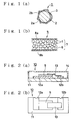
- Fig. 1(a) illustrates the particle of the particulate conductor material according to the present invention in a schematic cross-sectional view.
- Fig. 1(b) illustrates an embodiment of the PTC-element according to the present invention in a schematic longitudinal cross-sectional view.
- Figs. 2(a) and 2(b) show an embodiment of the protective element according to the present invention in a schematic vertical cross-sectional view and in a schematic plan view with exclusion of its cover plate, respectively.
- Figs. 3(a) and 3(b) show an embodiment of the electric circuit board according to the present invention in a plan and in a vertical cross section along the line A-A of the former, respectively.
- Figs. 4(a) and 4(b) show another embodiment of the electric circuit board according to the present invention in a plan and in a vertical cross section along the line B-B of the former, respectively.
- Figs. 5(a) and 5(b) give each a circuit diagram for embodying, as a protective device, the electric circuit board shown in Figs. 3(a), 3(b) or in Figs. 4(a), 4(b), respectively.
- Fig. 6 is a graph representing the experimental results of the inventive Examples and of Comparative Examples.
- any conventional polymer can be used for the crystalline polymer according to the present invention without limitation, as far as they are of organic polymers which are non-conductive and can expand as the temperature increases, wherein preference is given, in particular, to those which can expand abruptly within a narrow temperature range.
- crystalline polymers there may be enumerated, for example, polyolefins, such as polyethylene and polypropylene, and polycaprolactone, wherein the preferred are polyethylene and ethylene/methacrylate copolymers.
- the particulate conductor material according to the present invention may be composed of microspherical particles of an electroconductive substance provided on each particle with irregular surface contours, wherein the shape of the base particle is sphere, preferably perfect sphere, on which micronous irregular contours are formed.
- the particle size may range between 5 and 50 ⁇ m, preferably between 10 and 40 ⁇ m.
- the height of protrusions of such surface irregularity may range between 0.01 and 10 ⁇ m, preferably between 0.1 and 1 ⁇ m, corresponding to the proportion in the range of 1/5 to 1/1,000, preferably 1/10 to 1/100, relative to the particle size.
- the specific weight of the particle may be in the range from 2 to 5, preferably from 2 to 3.5.
- every electroconductive particulate material for example, metals, such as silver and others, carbon and so on.
- a preferred material is particulate carbon, especially particulate graphite or one in which each particle of graphite is coated with a layer of a metal by, for example, plating.
- the metal of the coating layer for example, gold, silver, copper and nickel may be enumerated. Gold is preferable, while a double-layered coating of nickel/gold is more preferable in view of better adhesion on the base particle of carbon.
- the carbon particles having irregular surface contours may be produced by forming on each spherical particle of a particulate thermosetting resin or a carbonized product thereof irregular surface contours by pitch-coating or the like and subjecting the resulting particles to carbonization, while other method may also be employed for producing the carbon particles having irregular surface contours, for example, a method in which each of the spherical carbon particles is coated with a layer of carbon powder.
- a metal layer over the surface of the carbon particle having irregular surface contours physical methods including vacuum deposition ion plating and thermal splaying may be employed, wherein preference is given to plating techniques, such as electrolytic plating and currentless plating.
- plating techniques such as electrolytic plating and currentless plating.
- nickel and gold are preferred.
- the thickness of the metal layer may vary in accordance with each specific technique used, while it may range favorably between 0.02 and 0.2 ⁇ m, in particular, between 0.1 and 0,15 ⁇ m.
- the PTC-element according to the present invention is one in which a kneaded mixture containing the particles of the conductor material dispersed in the matrix consisting of the non-conductive crystalline polymer is arranged between the electrodes.
- the proportion of the particulate conductor material relative to the total mixture may be in the range from 25 to 60 %, preferably from 40 to 50 %, on the volume basis. No satisfactorily low initial value for the volume resistivity can be obtained at a proportion of the particulate conductor material lower than 25 % by volume and, on the other hand, the PTC-element exhibits no satisfactory material properties at a proportion of the particulate conductor material higher than 60 % by volume.
- the PTC-element according to the present invention may contain, in addition to the crystalline non-conductive polymer and the particualte conductor material, other ingredients, such as a heat resistance stabilizer, a weathering stabilizer and so on.
- the PTC-element according to the present invention can be produced by mixing the crystalline non-conductive polymer and the particualte conductor material together with the optionally incorporated additional ingredients, kneading the resulting premix in a molten state and subjecting the kneaded mass to a forming, so as to permit the formed product to be disposed between the electrodes. It is possible to prepare the PTC-element in a form of an integrated unit with the electrodes by press molding the kneaded mass together with two metal foils to be served as the electrodes fitted to the kneaded mass.
- the volume resistivity of the PTC-element according to the present invention obtained in the manner as above does not exceed over 1 ⁇ 10 -1 ⁇ cm before and after the reflowing treatment of solder and such low volume resistivity can be preserved even after repeated tripping thereof. Therefore, the PTC-element according to the present invention is suitable to serve itself for a protective element to be assembled on an electric circuit board which is subjected to a reflowing treatment of the solder, though it finds, of course, general use for protective element for usual purposes.
- the PTC-element according to the present invention has a positive temperature coefficient of electric resistance. At lower temperatures, the particles of the conductor material are held in contact with each other, whereby the electroconductivity of the PTC-element is secured and the volume resistivity thereof is kept low. However, at higher temperatures, especially within a certain specific temperature range, an abrupt expansion of volume of the non-conductive crystalline polymer takes place, whereby the particles of the conductor material become separated from each other, resulting in an abrupt increase in the volume resistivity of the element to thereby cause tripping of the PTC-element and to bring about a current shutoff.
- the PTC-element according to the present invention can, thus, be used as a protective element having a function of detecting any abnormal condition caused from heat evolution in an electric system due to an overcurrent or overvoltage or due to an abnormal electrode reaction in a battery and causing shutoff of current.
- the tripping temperature of the PTC-element according to the present invention can be adjusted in a similar way as in a conventional PTC-element by, for example, selecting each specific non-conductive crystalline polymer and the proportion of the amount of particulate conductor material relative to the non-conductive crystalline polymer.
- the protective device is constructed from the PTC-element mentioned above, a heating element for transmitting a Joule's heat to the PTC-element and a detecting element for detecting any abnormal condition and causing a current to flow through the heating element.
- the heating element is arranged in the protective device according to the present invention in such a manner that the PTC-element and the heating element are held in a thermally joined state under interposition of an electric insulator therebetween.
- One or more PTC-elements may be incorporated in one single protective device.
- the detecting element is arranged to reliably detect any abnormal condition and to cause a current to flow through the heating element when detected.
- a voltage detecting element may be employed by connecting it so as to detect an overvoltage and to cause a current to flow through the heating element when an overvoltage is detected.
- the heating element is actuated upon detection of an abnormal condition, such as an overvoltage, by the detecting element to develop a Joule's heat which is transmitted to the PTC-element to cause tripping thereof, resulting in current shutoff.
- an abnormal condition such as an overvoltage
- the principle of the function of protective device is as above.
- the current shutoff of the PTC-element is actuated by an overvoltage to effect the protecting function.
- the PTC-element or the protective device given above can be mounted on an electric circuit board together with other constituent circuit elements in order to obtain an electric circuit board assembly equipped with the PTC-element or the protective device.
- the PTC-element will not be obstructed by a possible high temperature processing by, such as reflowing of the solder, and the proper function thereof is maintained.
- the electric circuit board according to the present invention is provided with a protective device described above which is composed of the above-mentioned PTC-element, a heating element and a detecting element.
- This electric circuit board can be actuated even in the event of such an abnormal condition as overdischarge or overvoltage other than heat evolution, by detecting it and causing a current to flow through the heating element so as to effect tripping of the PTC-element.
- the PTC-element according to the present invention incorporates microspherical conductive particles with irregular surface contours as the particulate conductor material under dispersion in the matrix of the non-conductive crystalline polymer. It is made possible thereby to obtain a PTC-element having a low volume resistivity at lower temperatrues, a high resistance at the peak and a capability of causing an abrupt increase of the volume resistivity within a narrow temperature range with assurance of a low volume resistivity even after having been subjected to a high temperature heat treatment, such as the reflowing of solder, together with preservation of a low volume resistivity even after repeated trippings thereof.
- a PTC-element exhibiting a low volume resistivity upon current conduction can be obtained.
- a PTC-element exhibiting a low volume resistivity upon current conduction can be obtained in an easy and economic way.
- the protective device comprises the PTC-element(s) described above, the heating element(s) and the detecting element in combination. It functions to protect a current-conducting apparatus or system by detecting an abnormal condition, such as an overvoltage, overcurrent or the like, which is not able to detect by using only the PTC-element.
- an abnormal condition such as an overvoltage, overcurrent or the like
- the initial volume resistivity remains low after having been subjected to a high temperature processing, such as reflowing of solder, and is preserved even after repeated trippings of the PTC-element.
- the volume resistivity of the so-assembled PTC-element(s) will not differ from the initial low value after having been subjected to a high temperature processing by reflowing of the solder upon the assemblage and can be preserved for long term under operation of the circuit with repeated trippings of the PTC-element(s).
- Fig. 1(a) illustrates a typical particle of the particulate conductor material coated with a metal layer according to the present invention in a schematic cross-sectional view.
- Fig. 1(b) shows schematically the PTC-element in a cross-sectional view.
- the particle of the conductor material 1 comprises a microspherical carbon particle 2 having irregular surface contours, which is coated with a metal layer 3.
- the irregular contour of the carbon particle 2 is obtained by providing a layer having irregular protrudings 2b on a base particle 2a of nearly perfect sphere by a pitch-coating with subsequent carbonization.
- the metal layer 3 is plated over the entire surface of the carbon particle 2 by plating first with nickel and then with gold thereon to form a double layered metal coating, though only a single layer is shown in the Drawing.
- the metal layer is shown here in an enlarged thickness for easier view.
- the PTC-element 5 is shown in a construction in which two electrodes 8a ans 8b, each consisting of a metal foil, are attached to both sides of a solid mass 7 composed of a non-conductive matrix of the crystalline polymer 6 and the particulate conductor material 1 dispersed in the matrix.
- the PTC-element 5 is formed as an integrated unit which is produced by kneading the crystalline polymer 6 together with the particulate conductor material 1 into a heterogeneous mixture 7, placing the mixture 7 in between two electrorodes 8a and 8b each consistsing of a metal foil, press-molding the mixture together with the electrodes attached thereto into a molded product and cutting this molded product into the integrated unit of a predetermined size.
- the so-obtained PTC-element 5 can serve for a practical use by inserting it in a detecting or protecting circuit by connecting the electrodes 8a and 8b to the circuit. At lower temperatures, the particles of the particulate conductor material are held in contact with each other to assure electroconductance therethrough, whereas they become separated from each other by expansion of the non-conductive crystalline polymer 6 when heated and the volume resistivity of the PTC-element 5 reaches a high value within a narrow temperature range and, at last, tripping thereof will occur.
- the PTC-element 5 can be used as a detecting element when it is used for observing and displaying the volume resistivity value of the PTC-element, or can be used as a protective element against heat evolution, when it is used for controlling or cutting off the electric current to the heating element.
- the PTC-element 5 can also serve as a detecting or protecting element against occurrence of an overcurrent, since the resistance thereof increases when it is heated by the overcurrent.
- FIGs. 2(a) and 2(b) One enbodiment of the protective device according to the present invention is shown in Figs. 2(a) and 2(b) in a schematic vertical cross-sectional view and in a schematic plan view with removed cover plate, respectively.
- the protective element is indicated by the numeral 10 and the electrodes therefor 12a and 12b are disposed on a substrate board 11.
- the PTC-element 5 is attached to one of the electrodes (12a) so as to connect it to one of the electrodes (8b) of the PTC-element 5, while the other electrode 8a of the PTC-element 5 is connected with the other electrode 12b of the protective element 10 on the board 11 by a metal foil 13 bridging therebetween.
- the entire protective element is covered by a cap 14.
- the substrate board 11 is made of an insulating material, for example, a glass fiber-reinforced epoxy resin, on which the electrodes 12a and 12b, each made of, for example, a metal foil of copper or the like, are disposed.
- the electrodes 8a and 8b of the PTC-element 5, the electrodes 12a and 12b of the protective element 10 and the metal foil 13 are mounted by reflowing of solder.
- the protective element 10 may be disposed close to the heating element for transmitting heat to the PTC-element in order to attain tripping of the PTC-element due to increase in the volume resistivity thereof by being heated by the transmitted heat to cause current shutoff, whereby the current conducting apparatus or system provided with the protective device according to the present invention can reliable be protected.
- FIGs. 3(a) and 3(b) an embodiment of the electric circuit board according to the present invention is shown in a schematic plan view and in a schematic vertical cross-sectional view along the line A-A of the former, respectively.
- the electrodes 12a and 12b for the PTC-elements and the electrodes 15a and 15b for the heating element 16 are arranged on the substrate board 11 as patterned conductor segments.
- the electrodes 12a and 12b for PTC-elements are connected to the PTC-elements 5a and 5b and a metal foil 13 is disposed to connect the PTC-elements by bridging between them, so as to build up the protective element.
- a heating element 16 is arranged between the PTC-elements 5a and 5b so as to hold an electric connection with the electrodes 15a and 15b for the heating element but is insulated from other elements by being surrounded by an insulators 17.
- the entire protective element is covered by a cap or sealing member 14.
- the electrodes 12a and 12b, the PTC-elements 5a and 5b and the metal foil 13 in the electric circuit board 20 are interconnected with solder by reflowing of the solder.
- the PTC-elements 5a and 5b are brought to tripping when the heating element 16 becomes heated, whereby the current through the electrodes 12a and 12b becomes reduced.
- Fig. 4(a) shows an alternative embodiment of the electric circuit board according to the present invention in a schematic plan view.
- Fig. 4(b) shows the embodiment of Fig. 4(a) in a schematic vertical cross-sectional view along the line B-B of the former.
- an intermediate electrode 12c is disposed between the electrodes 12a and 12b for the PTC-elements in such a manner that the heating elements 16a and 16b are arranged separately so as to connect the intermediate electrode 12c with the electrode 12a or with the electrode 12b, respectively, wherein the PTC-element 5a and the PTC-element 5b are interconnected by a metal foil 13 via the intermediate electrode 12c.
- the electrodes 12a, 12b and 12c, the PTC-elements 5a and 5b and the metal foil 13 in the above electric circuit board 20 are interconnected with solder by reflowing of the solder.
- the PTC-elements 5a and 5b are brought to tripping when the heating elements 16a and 16b become heated, whereby the current through the electrodes 12a and 12b becomes reduced, so that a protection of a current conducting apparatus or system employing this circuit board assembly can be attained by the reduction of heat evolution in the heating elements 16a and 16b due to the so-decreased current through the electrodes 15a and 15b.
- Figs. 5(a) shows a circuit diagram embodying the electric circuit board shown in Figs. 3(a) and 3(b) as the protective device according to the present invention.
- This protective device comprises PTC-elements 5a and 5b, a heating element 16 and a detecting element 21.
- the PTC-elements 5a and 5b, the heating element 16 and a transistor 22 of the detecting element 21 are connected in series between the terminals f and g, wherein a Zener diode 23 and a resistor 24 which constitute the detecting element 21 are interposed between the terminal f and the base of the transistor 22.
- Each of the constituent members of the detecting element 21 assembled in this electric circuit board 20 is not shown in Figs. 3(a) and 3(b).
- the protective device of this embodiment can be used for protecting against an overvoltage in, for example, a charging circuit of a storage battery or the like.
- Fig. 5(b) shows a circuit diagram embodying the electric circuit board shown in Figs. 4(a) and 4(b) as a protective device according to the present invention.
- This protective device comprises PTC-elements 5a and 5b, heating elements 16a and 16b and a detecting element 21.
- wiring is realized in the same manner as that in Fig. 5(a), except that the PTC-elements 5a and 5b and the heating elements 16a and 16b are arranged under separation by an intermediate electrode 12c.
- the detecting element 21 will be actuated when an overvoltage occurs both in the case where the current conduction occurs on the side of the terminals f and g and in the case where the current conduction is effected through the terminals h and i, to thereby cause both the heating elements 16a and 16b to be heated by the Joule's heat, whereby both the PTC-elements are brought to tripping and to effect shutoff of the current to the heating elements 16a and 16b.
- the protective device of this embodiment can thus be utelized in, for example, a charging circuit of a storage battery for protecting against overvoltage.
- Each a particulate conductor material (Conductor 1 or Conductor 2) was prepared by processing a product of microspherical carbon particles of spherical particle form ⁇ CARBON MICROBEADS PC (trademark), a product of Nippon Carbon K.K. ⁇ by providing on each particle with surface irregularities by means of pitch-coating (Examples 1 and 2), onto which a metal coating layer was applied by a currentless plating first with nickel and then with gold thereon.
- HDPE high dencity polyethylene product
- EOA ethylene/ethyl acrylate copolymer
- NUC 6170 product of Nippon Unicar Co., Ltd.
- Each of the particulate conductor materials prepared as above and the above non-conductive crystalline polymer were blended in a proportion as given in Table 1 by kneading on a press kneader at 190 °C and the resulting mass was press-molded on a hot press under a condition of 190°C, 0.49 MPa (5 kgf/cm 2 ) for 20 sec. into a film having a thickness of 300 ⁇ m. This film was placed between two nickel foils and the resulting lamination was further processed by a hot press (190 °C, 0.49 MPa, for 30 sec.) into a PTC-element having a thickness of 200 ⁇ m.
- the increase in the electric resistance is lower for the inventive Examples 1 and 2 in which particulate conductor particles having surface irregularyties are used, as compared with the Comparative Examples 1 and 2.
- the increase in the resistance was found to be low in particular for Example 2 in which a particulate conductor material with a particle size of 10 ⁇ m was employed.
Landscapes
- Engineering & Computer Science (AREA)
- Microelectronics & Electronic Packaging (AREA)
- Chemical & Material Sciences (AREA)
- Dispersion Chemistry (AREA)
- Ceramic Engineering (AREA)
- Physics & Mathematics (AREA)
- Electromagnetism (AREA)
- Thermistors And Varistors (AREA)
- Structures For Mounting Electric Components On Printed Circuit Boards (AREA)
Applications Claiming Priority (3)
| Application Number | Priority Date | Filing Date | Title |
|---|---|---|---|
| JP27465797 | 1997-10-07 | ||
| JP274657/97 | 1997-10-07 | ||
| JP27465797 | 1997-10-07 |
Publications (3)
| Publication Number | Publication Date |
|---|---|
| EP0908902A2 true EP0908902A2 (de) | 1999-04-14 |
| EP0908902A3 EP0908902A3 (de) | 1999-09-22 |
| EP0908902B1 EP0908902B1 (de) | 2006-04-19 |
Family
ID=17544751
Family Applications (1)
| Application Number | Title | Priority Date | Filing Date |
|---|---|---|---|
| EP98308088A Expired - Lifetime EP0908902B1 (de) | 1997-10-07 | 1998-10-05 | PTC-Element, Schutzvorrichtung und elektrische Leiterplatte |
Country Status (5)
| Country | Link |
|---|---|
| US (1) | US6114672A (de) |
| EP (1) | EP0908902B1 (de) |
| JP (1) | JP3257521B2 (de) |
| KR (1) | KR100551099B1 (de) |
| DE (1) | DE69834231T2 (de) |
Cited By (4)
| Publication number | Priority date | Publication date | Assignee | Title |
|---|---|---|---|---|
| WO2002063739A1 (fr) * | 2001-02-06 | 2002-08-15 | Sony Chemicals Corp. | Batterie auxiliaire avec circuit de protection |
| EP1047092A3 (de) * | 1999-04-23 | 2002-11-27 | Sony Chemicals Corporation | Überstromschutzvorrichtung |
| EP1156527A3 (de) * | 2000-05-17 | 2005-11-02 | Sony Chemicals Corporation | Schutzsicherung |
| EP1577906A3 (de) * | 2004-03-20 | 2007-12-12 | Wilhelm Pudenz GmbH | Sicherung mit einem seinen elektrischen Widerstand bei einer Temperaturerhöhung vergrössernden Bauelement |
Families Citing this family (37)
| Publication number | Priority date | Publication date | Assignee | Title |
|---|---|---|---|---|
| WO2001017320A1 (en) | 1999-08-27 | 2001-03-08 | Lex Kosowsky | Current carrying structure using voltage switchable dielectric material |
| US6606228B1 (en) * | 2000-11-27 | 2003-08-12 | Ametek, Inc. | Fault detection circuit for use with a power control device |
| TW487272U (en) * | 2001-03-20 | 2002-05-11 | Polytronics Technology Corp | Multilayer circuit boards |
| US6462317B1 (en) * | 2001-05-03 | 2002-10-08 | Hewlett-Packard Company | Heater bar utilizing a positive temperature coefficient heating element |
| KR100411778B1 (ko) * | 2001-10-12 | 2003-12-24 | 주식회사 쎄라텍 | 중합체 양성온도계수 써미스터 제조방법 |
| JP2004214033A (ja) * | 2002-12-27 | 2004-07-29 | Sony Chem Corp | 保護素子 |
| WO2004084270A2 (en) * | 2003-03-14 | 2004-09-30 | Bourns, Inc. | Multi-layer polymeric electronic device and method of manufacturing same |
| JP2005038974A (ja) * | 2003-07-18 | 2005-02-10 | Nec Tokin Corp | 高分子ptc素子及びその製造方法 |
| DE102004016619A1 (de) * | 2004-04-03 | 2005-10-13 | Daimlerchrysler Ag | Elektrisches Bauteil |
| KR100622598B1 (ko) * | 2004-12-08 | 2006-09-19 | 엘에스전선 주식회사 | 피티씨 특성을 갖는 이방 도전성 접착제 |
| KR20080084812A (ko) | 2005-11-22 | 2008-09-19 | 쇼킹 테크놀로지스 인코포레이티드 | 과전압 보호를 위해 전압 변환가능 재료를 포함하는 반도체디바이스 |
| US20080029405A1 (en) * | 2006-07-29 | 2008-02-07 | Lex Kosowsky | Voltage switchable dielectric material having conductive or semi-conductive organic material |
| US7968010B2 (en) | 2006-07-29 | 2011-06-28 | Shocking Technologies, Inc. | Method for electroplating a substrate |
| CN101595535A (zh) * | 2006-09-24 | 2009-12-02 | 肖克科技有限公司 | 利用电压可切换电介质材料和光辅助进行电镀衬底器件的技术 |
| JP2010521058A (ja) | 2006-09-24 | 2010-06-17 | ショッキング テクノロジーズ,インコーポレイテッド | ステップ電圧応答を有する電圧切り換え可能な誘電体材料の組成及び該誘電体材料の製造方法 |
| US20090050856A1 (en) * | 2007-08-20 | 2009-02-26 | Lex Kosowsky | Voltage switchable dielectric material incorporating modified high aspect ratio particles |
| US8206614B2 (en) * | 2008-01-18 | 2012-06-26 | Shocking Technologies, Inc. | Voltage switchable dielectric material having bonded particle constituents |
| US20090220771A1 (en) * | 2008-02-12 | 2009-09-03 | Robert Fleming | Voltage switchable dielectric material with superior physical properties for structural applications |
| US7973533B2 (en) | 2008-02-27 | 2011-07-05 | Vertical Power, Inc. | In-circuit testing for integrity of solid-state switches |
| WO2010039902A2 (en) | 2008-09-30 | 2010-04-08 | Shocking Technologies, Inc. | Voltage switchable dielectric material containing conductive core shelled particles |
| US9208931B2 (en) | 2008-09-30 | 2015-12-08 | Littelfuse, Inc. | Voltage switchable dielectric material containing conductor-on-conductor core shelled particles |
| US8399773B2 (en) * | 2009-01-27 | 2013-03-19 | Shocking Technologies, Inc. | Substrates having voltage switchable dielectric materials |
| US9226391B2 (en) | 2009-01-27 | 2015-12-29 | Littelfuse, Inc. | Substrates having voltage switchable dielectric materials |
| US8272123B2 (en) | 2009-01-27 | 2012-09-25 | Shocking Technologies, Inc. | Substrates having voltage switchable dielectric materials |
| EP2412212A1 (de) * | 2009-03-26 | 2012-02-01 | Shocking Technologies Inc | Komponenten mit spannungsumschaltbaren dielektrischen materialien |
| US9053844B2 (en) | 2009-09-09 | 2015-06-09 | Littelfuse, Inc. | Geometric configuration or alignment of protective material in a gap structure for electrical devices |
| US8531263B2 (en) * | 2009-11-24 | 2013-09-10 | Littelfuse, Inc. | Circuit protection device |
| US9320135B2 (en) | 2010-02-26 | 2016-04-19 | Littelfuse, Inc. | Electric discharge protection for surface mounted and embedded components |
| US9224728B2 (en) | 2010-02-26 | 2015-12-29 | Littelfuse, Inc. | Embedded protection against spurious electrical events |
| US9082622B2 (en) | 2010-02-26 | 2015-07-14 | Littelfuse, Inc. | Circuit elements comprising ferroic materials |
| US9019674B2 (en) | 2010-11-23 | 2015-04-28 | Fairchild Semiconductor Corporation | Input power port protection component |
| US8861164B2 (en) | 2011-02-04 | 2014-10-14 | Fairchild Semiconductor Corporation | Integrated overdrive and overvoltage protection device |
| US9112346B2 (en) | 2013-03-14 | 2015-08-18 | Fairchild Semiconductor Corporation | Input power protection |
| US9172239B2 (en) | 2013-03-15 | 2015-10-27 | Fairchild Semiconductor Corporation | Methods and apparatus related to a precision input power protection device |
| WO2015084240A1 (en) * | 2013-12-03 | 2015-06-11 | Conflux Ab | Heating arrangement, method for heating, and arrangement and method for controlling an electric current |
| US9735147B2 (en) | 2014-09-15 | 2017-08-15 | Fairchild Semiconductor Corporation | Fast and stable ultra low drop-out (LDO) voltage clamp device |
| USD994888S1 (en) * | 2021-07-15 | 2023-08-08 | Hearx Usa Inc. | Hearing aid |
Family Cites Families (17)
| Publication number | Priority date | Publication date | Assignee | Title |
|---|---|---|---|---|
| US4017715A (en) * | 1975-08-04 | 1977-04-12 | Raychem Corporation | Temperature overshoot heater |
| US4591700A (en) * | 1980-05-19 | 1986-05-27 | Raychem Corporation | PTC compositions |
| US4400614A (en) * | 1980-05-19 | 1983-08-23 | Raychem Corporation | PTC Devices and their preparation |
| US5093898A (en) * | 1981-09-09 | 1992-03-03 | Raychem Corporation | Electrical device utilizing conductive polymer composition |
| JPS59199756A (ja) * | 1983-04-27 | 1984-11-12 | Toshiba Silicone Co Ltd | 導電性シリコ−ンゴム組成物 |
| US4859836A (en) * | 1983-10-07 | 1989-08-22 | Raychem Corporation | Melt-shapeable fluoropolymer compositions |
| US4780598A (en) * | 1984-07-10 | 1988-10-25 | Raychem Corporation | Composite circuit protection devices |
| AU589714B2 (en) * | 1985-12-06 | 1989-10-19 | Sunbeam Corp. | PTC compositions containing a non-surface treated carbon black having an intermediate resistivity for reduced annealing |
| US4910389A (en) * | 1988-06-03 | 1990-03-20 | Raychem Corporation | Conductive polymer compositions |
| US5072327A (en) * | 1990-01-24 | 1991-12-10 | At&T Bell Laboratories | Electronic protection device for use with a fuse mount |
| JPH04167501A (ja) * | 1990-10-31 | 1992-06-15 | Daito Tsushinki Kk | Ptc素子 |
| JP3101048B2 (ja) * | 1992-01-20 | 2000-10-23 | ティーディーケイ株式会社 | 有機質正特性サーミスタ |
| DE4232969A1 (de) * | 1992-10-01 | 1994-04-07 | Abb Research Ltd | Elektrisches Widerstandselement |
| US5712610C1 (en) * | 1994-08-19 | 2002-06-25 | Sony Chemicals Corp | Protective device |
| JP3122000B2 (ja) * | 1994-12-16 | 2001-01-09 | ソニーケミカル株式会社 | Ptc素子及びこれを用いた保護回路、回路基板 |
| US5939217A (en) * | 1996-10-29 | 1999-08-17 | Sony Chemicals Corporation | Battery and protecting element therefor |
| US5841617A (en) * | 1997-04-07 | 1998-11-24 | Bpw, Inc. | Electrical safety device with conductive polymer sensor |
-
1998
- 1998-10-01 JP JP27977898A patent/JP3257521B2/ja not_active Expired - Fee Related
- 1998-10-02 KR KR1019980041656A patent/KR100551099B1/ko not_active Expired - Fee Related
- 1998-10-05 EP EP98308088A patent/EP0908902B1/de not_active Expired - Lifetime
- 1998-10-05 DE DE69834231T patent/DE69834231T2/de not_active Expired - Lifetime
- 1998-10-06 US US09/167,140 patent/US6114672A/en not_active Expired - Lifetime
Cited By (5)
| Publication number | Priority date | Publication date | Assignee | Title |
|---|---|---|---|---|
| EP1047092A3 (de) * | 1999-04-23 | 2002-11-27 | Sony Chemicals Corporation | Überstromschutzvorrichtung |
| EP1156527A3 (de) * | 2000-05-17 | 2005-11-02 | Sony Chemicals Corporation | Schutzsicherung |
| WO2002063739A1 (fr) * | 2001-02-06 | 2002-08-15 | Sony Chemicals Corp. | Batterie auxiliaire avec circuit de protection |
| US6917505B2 (en) | 2001-02-06 | 2005-07-12 | Sony Chemicals Corp. | Secondary batteries having a protective circuit |
| EP1577906A3 (de) * | 2004-03-20 | 2007-12-12 | Wilhelm Pudenz GmbH | Sicherung mit einem seinen elektrischen Widerstand bei einer Temperaturerhöhung vergrössernden Bauelement |
Also Published As
| Publication number | Publication date |
|---|---|
| EP0908902A3 (de) | 1999-09-22 |
| JPH11176610A (ja) | 1999-07-02 |
| KR100551099B1 (ko) | 2006-05-22 |
| DE69834231T2 (de) | 2007-01-04 |
| US6114672A (en) | 2000-09-05 |
| EP0908902B1 (de) | 2006-04-19 |
| JP3257521B2 (ja) | 2002-02-18 |
| KR19990036855A (ko) | 1999-05-25 |
| DE69834231D1 (de) | 2006-05-24 |
Similar Documents
| Publication | Publication Date | Title |
|---|---|---|
| EP0908902B1 (de) | PTC-Element, Schutzvorrichtung und elektrische Leiterplatte | |
| US5886324A (en) | Electrode attachment for high power current limiting polymer devices | |
| CA1177739A (en) | Devices comprising conductive polymers | |
| US4777351A (en) | Devices comprising conductive polymer compositions | |
| US4719335A (en) | Devices comprising conductive polymer compositions | |
| US4761541A (en) | Devices comprising conductive polymer compositions | |
| US5580493A (en) | Conductive polymer composition and device | |
| KR960011153B1 (ko) | 도전성 중합체를 포함하고 있는 전기장치 | |
| CA1331399C (en) | Assemblies of ptc circuit protection devices | |
| US5247276A (en) | Ptc device | |
| US6074576A (en) | Conductive polymer materials for high voltage PTC devices | |
| WO1995034081A1 (en) | Electrical devices containing conductive polymers | |
| EP0918339A3 (de) | Elektrische Vorrichtung mit einer PTC-Widerstandszusammensetzung und Verfahren zu deren Herstellung | |
| KR20060043601A (ko) | 일체형 용접 플레이트를 갖는 표면 마운트가능한 pptc장치 | |
| JPH11502374A (ja) | 電気デバイス | |
| JP2001503561A (ja) | 回路保護デバイス | |
| US4876420A (en) | Continuous flexible electric conductor capable of functioning as an electric switch | |
| EP0277362B1 (de) | Verfahren zur Herstellung von elektrischen Widerständen mit weiten Werten der spezifischen Widerstände | |
| JP3122000B2 (ja) | Ptc素子及びこれを用いた保護回路、回路基板 | |
| EP1042765B1 (de) | Verfahren zur herstellung einer elektrischen vorrichtung | |
| CA2373531A1 (en) | Electrical device | |
| JP2000294406A (ja) | Ptc回路保護装置 | |
| CA2292935A1 (en) | Current limiting device with reduced resistance | |
| JPS6387702A (ja) | リ−ドの固定法 | |
| JPS63138703A (ja) | Ptc素子 |
Legal Events
| Date | Code | Title | Description |
|---|---|---|---|
| PUAI | Public reference made under article 153(3) epc to a published international application that has entered the european phase |
Free format text: ORIGINAL CODE: 0009012 |
|
| AK | Designated contracting states |
Kind code of ref document: A2 Designated state(s): DE FR GB |
|
| AX | Request for extension of the european patent |
Free format text: AL;LT;LV;MK;RO;SI |
|
| PUAL | Search report despatched |
Free format text: ORIGINAL CODE: 0009013 |
|
| AK | Designated contracting states |
Kind code of ref document: A3 Designated state(s): AT BE CH CY DE DK ES FI FR GB GR IE IT LI LU MC NL PT SE |
|
| AX | Request for extension of the european patent |
Free format text: AL;LT;LV;MK;RO;SI |
|
| 17P | Request for examination filed |
Effective date: 20000228 |
|
| AKX | Designation fees paid |
Free format text: DE FR GB |
|
| 17Q | First examination report despatched |
Effective date: 20041105 |
|
| GRAP | Despatch of communication of intention to grant a patent |
Free format text: ORIGINAL CODE: EPIDOSNIGR1 |
|
| GRAS | Grant fee paid |
Free format text: ORIGINAL CODE: EPIDOSNIGR3 |
|
| GRAA | (expected) grant |
Free format text: ORIGINAL CODE: 0009210 |
|
| AK | Designated contracting states |
Kind code of ref document: B1 Designated state(s): DE FR GB |
|
| REG | Reference to a national code |
Ref country code: GB Ref legal event code: FG4D |
|
| REF | Corresponds to: |
Ref document number: 69834231 Country of ref document: DE Date of ref document: 20060524 Kind code of ref document: P |
|
| ET | Fr: translation filed | ||
| PLBE | No opposition filed within time limit |
Free format text: ORIGINAL CODE: 0009261 |
|
| STAA | Information on the status of an ep patent application or granted ep patent |
Free format text: STATUS: NO OPPOSITION FILED WITHIN TIME LIMIT |
|
| 26N | No opposition filed |
Effective date: 20070122 |
|
| REG | Reference to a national code |
Ref country code: DE Ref legal event code: R082 Ref document number: 69834231 Country of ref document: DE Representative=s name: MEISSNER BOLTE PATENTANWAELTE RECHTSANWAELTE P, DE Ref country code: DE Ref legal event code: R082 Ref document number: 69834231 Country of ref document: DE Representative=s name: MEISSNER, BOLTE & PARTNER GBR, DE |
|
| REG | Reference to a national code |
Ref country code: DE Ref legal event code: R082 Ref document number: 69834231 Country of ref document: DE Representative=s name: MEISSNER, BOLTE & PARTNER GBR, DE |
|
| REG | Reference to a national code |
Ref country code: FR Ref legal event code: PLFP Year of fee payment: 18 |
|
| PGFP | Annual fee paid to national office [announced via postgrant information from national office to epo] |
Ref country code: GB Payment date: 20150930 Year of fee payment: 18 |
|
| PGFP | Annual fee paid to national office [announced via postgrant information from national office to epo] |
Ref country code: FR Payment date: 20150908 Year of fee payment: 18 |
|
| PGFP | Annual fee paid to national office [announced via postgrant information from national office to epo] |
Ref country code: DE Payment date: 20150929 Year of fee payment: 18 |
|
| REG | Reference to a national code |
Ref country code: DE Ref legal event code: R119 Ref document number: 69834231 Country of ref document: DE |
|
| GBPC | Gb: european patent ceased through non-payment of renewal fee |
Effective date: 20161005 |
|
| REG | Reference to a national code |
Ref country code: FR Ref legal event code: ST Effective date: 20170630 |
|
| PG25 | Lapsed in a contracting state [announced via postgrant information from national office to epo] |
Ref country code: FR Free format text: LAPSE BECAUSE OF NON-PAYMENT OF DUE FEES Effective date: 20161102 Ref country code: DE Free format text: LAPSE BECAUSE OF NON-PAYMENT OF DUE FEES Effective date: 20170503 Ref country code: GB Free format text: LAPSE BECAUSE OF NON-PAYMENT OF DUE FEES Effective date: 20161005 |