EP0907684B1 - Materiau a base de silicone reticule comportant un photoamorceur fixe, son procede de preparation, produit polymerique hydrophile obtenu a partir de ce materiau et son procede de preparation, et nouveaux photoamorceurs - Google Patents
Materiau a base de silicone reticule comportant un photoamorceur fixe, son procede de preparation, produit polymerique hydrophile obtenu a partir de ce materiau et son procede de preparation, et nouveaux photoamorceurs Download PDFInfo
- Publication number
- EP0907684B1 EP0907684B1 EP97930600A EP97930600A EP0907684B1 EP 0907684 B1 EP0907684 B1 EP 0907684B1 EP 97930600 A EP97930600 A EP 97930600A EP 97930600 A EP97930600 A EP 97930600A EP 0907684 B1 EP0907684 B1 EP 0907684B1
- Authority
- EP
- European Patent Office
- Prior art keywords
- groups
- matrix
- photoinitiator
- solution
- hydrophilic
- Prior art date
- Legal status (The legal status is an assumption and is not a legal conclusion. Google has not performed a legal analysis and makes no representation as to the accuracy of the status listed.)
- Expired - Lifetime
Links
- 238000000034 method Methods 0.000 title claims abstract description 59
- 239000000463 material Substances 0.000 title claims abstract description 42
- 238000002360 preparation method Methods 0.000 title description 21
- 239000002210 silicon-based material Substances 0.000 title 1
- 239000011159 matrix material Substances 0.000 claims abstract description 51
- 150000001875 compounds Chemical class 0.000 claims abstract description 46
- 239000000178 monomer Substances 0.000 claims abstract description 45
- 229920005573 silicon-containing polymer Polymers 0.000 claims abstract description 39
- 239000002904 solvent Substances 0.000 claims abstract description 36
- 229920000642 polymer Polymers 0.000 claims abstract description 28
- 230000008961 swelling Effects 0.000 claims abstract description 28
- 239000003431 cross linking reagent Substances 0.000 claims abstract description 6
- 230000000379 polymerizing effect Effects 0.000 claims abstract description 3
- WYURNTSHIVDZCO-UHFFFAOYSA-N Tetrahydrofuran Chemical compound C1CCOC1 WYURNTSHIVDZCO-UHFFFAOYSA-N 0.000 claims description 88
- 229920000435 poly(dimethylsiloxane) Polymers 0.000 claims description 80
- 229920001296 polysiloxane Polymers 0.000 claims description 53
- YLQBMQCUIZJEEH-UHFFFAOYSA-N tetrahydrofuran Natural products C=1C=COC=1 YLQBMQCUIZJEEH-UHFFFAOYSA-N 0.000 claims description 44
- -1 polydimethylsiloxane Polymers 0.000 claims description 43
- 239000000203 mixture Substances 0.000 claims description 37
- YXFVVABEGXRONW-UHFFFAOYSA-N Toluene Natural products CC1=CC=CC=C1 YXFVVABEGXRONW-UHFFFAOYSA-N 0.000 claims description 33
- 239000003921 oil Substances 0.000 claims description 29
- 238000006243 chemical reaction Methods 0.000 claims description 26
- NIXOWILDQLNWCW-UHFFFAOYSA-N acrylic acid group Chemical group C(C=C)(=O)O NIXOWILDQLNWCW-UHFFFAOYSA-N 0.000 claims description 22
- 239000003999 initiator Substances 0.000 claims description 19
- XDTMQSROBMDMFD-UHFFFAOYSA-N Cyclohexane Chemical compound C1CCCCC1 XDTMQSROBMDMFD-UHFFFAOYSA-N 0.000 claims description 16
- 229920001477 hydrophilic polymer Polymers 0.000 claims description 14
- 239000003054 catalyst Substances 0.000 claims description 12
- 239000004205 dimethyl polysiloxane Substances 0.000 claims description 8
- 238000006459 hydrosilylation reaction Methods 0.000 claims description 8
- CERQOIWHTDAKMF-UHFFFAOYSA-N Methacrylic acid Chemical compound CC(=C)C(O)=O CERQOIWHTDAKMF-UHFFFAOYSA-N 0.000 claims description 7
- 125000004429 atom Chemical group 0.000 claims description 5
- 125000004432 carbon atom Chemical group C* 0.000 claims description 5
- 125000004435 hydrogen atom Chemical group [H]* 0.000 claims description 5
- 125000002496 methyl group Chemical group [H]C([H])([H])* 0.000 claims description 5
- 238000006116 polymerization reaction Methods 0.000 claims description 5
- 125000004169 (C1-C6) alkyl group Chemical group 0.000 claims description 4
- XUIMIQQOPSSXEZ-UHFFFAOYSA-N Silicon Chemical group [Si] XUIMIQQOPSSXEZ-UHFFFAOYSA-N 0.000 claims description 4
- SNRUBQQJIBEYMU-UHFFFAOYSA-N dodecane Chemical compound CCCCCCCCCCCC SNRUBQQJIBEYMU-UHFFFAOYSA-N 0.000 claims description 4
- 229920002554 vinyl polymer Polymers 0.000 claims description 4
- 150000001252 acrylic acid derivatives Chemical class 0.000 claims description 3
- 150000002430 hydrocarbons Chemical group 0.000 claims description 3
- 229910018540 Si C Inorganic materials 0.000 claims description 2
- 125000002768 hydroxyalkyl group Chemical group 0.000 claims description 2
- 229910010271 silicon carbide Inorganic materials 0.000 claims description 2
- 229910052710 silicon Inorganic materials 0.000 claims 2
- 239000010703 silicon Substances 0.000 claims 2
- 238000012719 thermal polymerization Methods 0.000 claims 1
- 125000003944 tolyl group Chemical group 0.000 claims 1
- 230000008569 process Effects 0.000 abstract description 16
- 238000004519 manufacturing process Methods 0.000 abstract description 12
- 239000000243 solution Substances 0.000 description 107
- 235000013870 dimethyl polysiloxane Nutrition 0.000 description 77
- 239000000047 product Substances 0.000 description 56
- XKRFYHLGVUSROY-UHFFFAOYSA-N Argon Chemical compound [Ar] XKRFYHLGVUSROY-UHFFFAOYSA-N 0.000 description 46
- XLYOFNOQVPJJNP-UHFFFAOYSA-N water Substances O XLYOFNOQVPJJNP-UHFFFAOYSA-N 0.000 description 37
- OKKJLVBELUTLKV-UHFFFAOYSA-N Methanol Chemical compound OC OKKJLVBELUTLKV-UHFFFAOYSA-N 0.000 description 30
- 230000015572 biosynthetic process Effects 0.000 description 28
- UHOVQNZJYSORNB-UHFFFAOYSA-N Benzene Chemical compound C1=CC=CC=C1 UHOVQNZJYSORNB-UHFFFAOYSA-N 0.000 description 27
- 238000003786 synthesis reaction Methods 0.000 description 27
- LYCAIKOWRPUZTN-UHFFFAOYSA-N Ethylene glycol Chemical compound OCCO LYCAIKOWRPUZTN-UHFFFAOYSA-N 0.000 description 24
- 238000003756 stirring Methods 0.000 description 24
- 229910052786 argon Inorganic materials 0.000 description 23
- ZMANZCXQSJIPKH-UHFFFAOYSA-N Triethylamine Chemical compound CCN(CC)CC ZMANZCXQSJIPKH-UHFFFAOYSA-N 0.000 description 22
- 239000012429 reaction media Substances 0.000 description 19
- VLKZOEOYAKHREP-UHFFFAOYSA-N n-Hexane Chemical compound CCCCCC VLKZOEOYAKHREP-UHFFFAOYSA-N 0.000 description 18
- SMZOUWXMTYCWNB-UHFFFAOYSA-N 2-(2-methoxy-5-methylphenyl)ethanamine Chemical compound COC1=CC=C(C)C=C1CCN SMZOUWXMTYCWNB-UHFFFAOYSA-N 0.000 description 16
- RTZKZFJDLAIYFH-UHFFFAOYSA-N Diethyl ether Chemical compound CCOCC RTZKZFJDLAIYFH-UHFFFAOYSA-N 0.000 description 16
- 238000005481 NMR spectroscopy Methods 0.000 description 16
- YMWUJEATGCHHMB-UHFFFAOYSA-N Dichloromethane Chemical compound ClCCl YMWUJEATGCHHMB-UHFFFAOYSA-N 0.000 description 12
- DHKHKXVYLBGOIT-UHFFFAOYSA-N acetaldehyde Diethyl Acetal Natural products CCOC(C)OCC DHKHKXVYLBGOIT-UHFFFAOYSA-N 0.000 description 12
- 150000001241 acetals Chemical class 0.000 description 11
- VYPSYNLAJGMNEJ-UHFFFAOYSA-N Silicium dioxide Chemical compound O=[Si]=O VYPSYNLAJGMNEJ-UHFFFAOYSA-N 0.000 description 10
- 239000013078 crystal Substances 0.000 description 10
- 239000000386 donor Substances 0.000 description 10
- 229910052739 hydrogen Inorganic materials 0.000 description 10
- 239000012074 organic phase Substances 0.000 description 10
- 229920002818 (Hydroxyethyl)methacrylate Polymers 0.000 description 9
- DBCAQXHNJOFNGC-UHFFFAOYSA-N 4-bromo-1,1,1-trifluorobutane Chemical compound FC(F)(F)CCCBr DBCAQXHNJOFNGC-UHFFFAOYSA-N 0.000 description 9
- FYYHWMGAXLPEAU-UHFFFAOYSA-N Magnesium Chemical compound [Mg] FYYHWMGAXLPEAU-UHFFFAOYSA-N 0.000 description 9
- 0 NC(CC1)CCC1*(C1CCCCC1)*=O Chemical compound NC(CC1)CCC1*(C1CCCCC1)*=O 0.000 description 9
- STVZJERGLQHEKB-UHFFFAOYSA-N ethylene glycol dimethacrylate Substances CC(=C)C(=O)OCCOC(=O)C(C)=C STVZJERGLQHEKB-UHFFFAOYSA-N 0.000 description 9
- LFQSCWFLJHTTHZ-UHFFFAOYSA-N Ethanol Chemical compound CCO LFQSCWFLJHTTHZ-UHFFFAOYSA-N 0.000 description 8
- WOBHKFSMXKNTIM-UHFFFAOYSA-N Hydroxyethyl methacrylate Chemical compound CC(=C)C(=O)OCCO WOBHKFSMXKNTIM-UHFFFAOYSA-N 0.000 description 8
- 238000004566 IR spectroscopy Methods 0.000 description 8
- 238000010586 diagram Methods 0.000 description 8
- 239000007788 liquid Substances 0.000 description 8
- 239000011777 magnesium Substances 0.000 description 8
- 239000002244 precipitate Substances 0.000 description 8
- 150000003254 radicals Chemical class 0.000 description 8
- 229920002125 Sokalan® Polymers 0.000 description 7
- BHELZAPQIKSEDF-UHFFFAOYSA-N allyl bromide Chemical compound BrCC=C BHELZAPQIKSEDF-UHFFFAOYSA-N 0.000 description 7
- 239000012300 argon atmosphere Substances 0.000 description 7
- 239000012965 benzophenone Substances 0.000 description 7
- KPUWHANPEXNPJT-UHFFFAOYSA-N disiloxane Chemical class [SiH3]O[SiH3] KPUWHANPEXNPJT-UHFFFAOYSA-N 0.000 description 7
- 238000010438 heat treatment Methods 0.000 description 7
- 125000002734 organomagnesium group Chemical group 0.000 description 7
- 239000011541 reaction mixture Substances 0.000 description 7
- KFZMGEQAYNKOFK-UHFFFAOYSA-N Isopropanol Chemical compound CC(C)O KFZMGEQAYNKOFK-UHFFFAOYSA-N 0.000 description 6
- RWCCWEUUXYIKHB-UHFFFAOYSA-N benzophenone Chemical compound C=1C=CC=CC=1C(=O)C1=CC=CC=C1 RWCCWEUUXYIKHB-UHFFFAOYSA-N 0.000 description 6
- 239000011521 glass Substances 0.000 description 6
- UBJFKNSINUCEAL-UHFFFAOYSA-N lithium;2-methylpropane Chemical compound [Li+].C[C-](C)C UBJFKNSINUCEAL-UHFFFAOYSA-N 0.000 description 6
- 229910052749 magnesium Inorganic materials 0.000 description 6
- BASFCYQUMIYNBI-UHFFFAOYSA-N platinum Chemical compound [Pt] BASFCYQUMIYNBI-UHFFFAOYSA-N 0.000 description 6
- 238000010992 reflux Methods 0.000 description 6
- KEOLYBMGRQYQTN-UHFFFAOYSA-N (4-bromophenyl)-phenylmethanone Chemical compound C1=CC(Br)=CC=C1C(=O)C1=CC=CC=C1 KEOLYBMGRQYQTN-UHFFFAOYSA-N 0.000 description 5
- VXNZUUAINFGPBY-UHFFFAOYSA-N 1-Butene Chemical compound CCC=C VXNZUUAINFGPBY-UHFFFAOYSA-N 0.000 description 5
- 238000013019 agitation Methods 0.000 description 5
- 125000000217 alkyl group Chemical group 0.000 description 5
- 238000005859 coupling reaction Methods 0.000 description 5
- 238000010511 deprotection reaction Methods 0.000 description 5
- UAOMVDZJSHZZME-UHFFFAOYSA-N diisopropylamine Chemical compound CC(C)NC(C)C UAOMVDZJSHZZME-UHFFFAOYSA-N 0.000 description 5
- 238000000605 extraction Methods 0.000 description 5
- 239000000706 filtrate Substances 0.000 description 5
- 125000000524 functional group Chemical group 0.000 description 5
- 230000002209 hydrophobic effect Effects 0.000 description 5
- 239000012071 phase Substances 0.000 description 5
- 239000002861 polymer material Substances 0.000 description 5
- 239000010453 quartz Substances 0.000 description 5
- NGNBDVOYPDDBFK-UHFFFAOYSA-N 2-[2,4-di(pentan-2-yl)phenoxy]acetyl chloride Chemical compound CCCC(C)C1=CC=C(OCC(Cl)=O)C(C(C)CCC)=C1 NGNBDVOYPDDBFK-UHFFFAOYSA-N 0.000 description 4
- ZCYVEMRRCGMTRW-UHFFFAOYSA-N 7553-56-2 Chemical compound [I] ZCYVEMRRCGMTRW-UHFFFAOYSA-N 0.000 description 4
- CSCPPACGZOOCGX-UHFFFAOYSA-N Acetone Chemical compound CC(C)=O CSCPPACGZOOCGX-UHFFFAOYSA-N 0.000 description 4
- 239000004971 Cross linker Substances 0.000 description 4
- CSNNHWWHGAXBCP-UHFFFAOYSA-L Magnesium sulfate Chemical compound [Mg+2].[O-][S+2]([O-])([O-])[O-] CSNNHWWHGAXBCP-UHFFFAOYSA-L 0.000 description 4
- 229910004298 SiO 2 Inorganic materials 0.000 description 4
- XXROGKLTLUQVRX-UHFFFAOYSA-N allyl alcohol Chemical compound OCC=C XXROGKLTLUQVRX-UHFFFAOYSA-N 0.000 description 4
- HUMNYLRZRPPJDN-UHFFFAOYSA-N benzaldehyde Chemical compound O=CC1=CC=CC=C1 HUMNYLRZRPPJDN-UHFFFAOYSA-N 0.000 description 4
- 125000002915 carbonyl group Chemical group [*:2]C([*:1])=O 0.000 description 4
- ISAOCJYIOMOJEB-UHFFFAOYSA-N desyl alcohol Natural products C=1C=CC=CC=1C(O)C(=O)C1=CC=CC=C1 ISAOCJYIOMOJEB-UHFFFAOYSA-N 0.000 description 4
- 238000009792 diffusion process Methods 0.000 description 4
- 239000012153 distilled water Substances 0.000 description 4
- 238000001914 filtration Methods 0.000 description 4
- 239000001257 hydrogen Substances 0.000 description 4
- 229910052740 iodine Inorganic materials 0.000 description 4
- 239000011630 iodine Substances 0.000 description 4
- 238000001953 recrystallisation Methods 0.000 description 4
- 150000003839 salts Chemical class 0.000 description 4
- 229920006395 saturated elastomer Polymers 0.000 description 4
- 125000003808 silyl group Chemical group [H][Si]([H])([H])[*] 0.000 description 4
- 239000011734 sodium Substances 0.000 description 4
- KQRKFAUAIYNBDW-UHFFFAOYSA-N 2-chloroethenyl(dimethyl)silane Chemical compound C[SiH](C)C=CCl KQRKFAUAIYNBDW-UHFFFAOYSA-N 0.000 description 3
- SVVZXVWJFYDKNR-UHFFFAOYSA-N 2-trimethylsilyloxyacetonitrile Chemical compound C[Si](C)(C)OCC#N SVVZXVWJFYDKNR-UHFFFAOYSA-N 0.000 description 3
- WKBOTKDWSSQWDR-UHFFFAOYSA-N Bromine atom Chemical compound [Br] WKBOTKDWSSQWDR-UHFFFAOYSA-N 0.000 description 3
- CERQOIWHTDAKMF-UHFFFAOYSA-M Methacrylate Chemical compound CC(=C)C([O-])=O CERQOIWHTDAKMF-UHFFFAOYSA-M 0.000 description 3
- FAPWRFPIFSIZLT-UHFFFAOYSA-M Sodium chloride Chemical class [Na+].[Cl-] FAPWRFPIFSIZLT-UHFFFAOYSA-M 0.000 description 3
- RYULULVJWLRDQH-UHFFFAOYSA-N [4-(bromomethyl)phenyl]-phenylmethanone Chemical compound C1=CC(CBr)=CC=C1C(=O)C1=CC=CC=C1 RYULULVJWLRDQH-UHFFFAOYSA-N 0.000 description 3
- YZHGHGHCDSLOBP-UHFFFAOYSA-N [4-(hydroxymethyl)phenyl]-phenylmethanone Chemical compound C1=CC(CO)=CC=C1C(=O)C1=CC=CC=C1 YZHGHGHCDSLOBP-UHFFFAOYSA-N 0.000 description 3
- 239000002253 acid Substances 0.000 description 3
- DSVRVHYFPPQFTI-UHFFFAOYSA-N bis(ethenyl)-methyl-trimethylsilyloxysilane;platinum Chemical compound [Pt].C[Si](C)(C)O[Si](C)(C=C)C=C DSVRVHYFPPQFTI-UHFFFAOYSA-N 0.000 description 3
- GDTBXPJZTBHREO-UHFFFAOYSA-N bromine Substances BrBr GDTBXPJZTBHREO-UHFFFAOYSA-N 0.000 description 3
- 229910052794 bromium Inorganic materials 0.000 description 3
- 239000003795 chemical substances by application Substances 0.000 description 3
- 230000001143 conditioned effect Effects 0.000 description 3
- 238000004132 cross linking Methods 0.000 description 3
- 239000012043 crude product Substances 0.000 description 3
- 238000002425 crystallisation Methods 0.000 description 3
- 230000008025 crystallization Effects 0.000 description 3
- 239000000839 emulsion Substances 0.000 description 3
- 238000003760 magnetic stirring Methods 0.000 description 3
- 238000002156 mixing Methods 0.000 description 3
- 229910052697 platinum Inorganic materials 0.000 description 3
- 239000007787 solid Substances 0.000 description 3
- 239000000126 substance Substances 0.000 description 3
- LEIMLDGFXIOXMT-UHFFFAOYSA-N trimethylsilyl cyanide Chemical compound C[Si](C)(C)C#N LEIMLDGFXIOXMT-UHFFFAOYSA-N 0.000 description 3
- 125000000391 vinyl group Chemical group [H]C([*])=C([H])[H] 0.000 description 3
- UKRDPEFKFJNXQM-UHFFFAOYSA-N vinylsilane Chemical compound [SiH3]C=C UKRDPEFKFJNXQM-UHFFFAOYSA-N 0.000 description 3
- WXPWZZHELZEVPO-UHFFFAOYSA-N (4-methylphenyl)-phenylmethanone Chemical compound C1=CC(C)=CC=C1C(=O)C1=CC=CC=C1 WXPWZZHELZEVPO-UHFFFAOYSA-N 0.000 description 2
- ZWEHNKRNPOVVGH-UHFFFAOYSA-N 2-Butanone Chemical compound CCC(C)=O ZWEHNKRNPOVVGH-UHFFFAOYSA-N 0.000 description 2
- DTAFQWDNWAXRLX-UHFFFAOYSA-N 2-phenyl-2-trimethylsilyloxyacetonitrile Chemical compound C[Si](C)(C)OC(C#N)C1=CC=CC=C1 DTAFQWDNWAXRLX-UHFFFAOYSA-N 0.000 description 2
- CPELXLSAUQHCOX-UHFFFAOYSA-M Bromide Chemical compound [Br-] CPELXLSAUQHCOX-UHFFFAOYSA-M 0.000 description 2
- KAKZBPTYRLMSJV-UHFFFAOYSA-N Butadiene Chemical group C=CC=C KAKZBPTYRLMSJV-UHFFFAOYSA-N 0.000 description 2
- 239000004215 Carbon black (E152) Substances 0.000 description 2
- HEDRZPFGACZZDS-UHFFFAOYSA-N Chloroform Chemical compound ClC(Cl)Cl HEDRZPFGACZZDS-UHFFFAOYSA-N 0.000 description 2
- BDAGIHXWWSANSR-UHFFFAOYSA-M Formate Chemical compound [O-]C=O BDAGIHXWWSANSR-UHFFFAOYSA-M 0.000 description 2
- UFHFLCQGNIYNRP-UHFFFAOYSA-N Hydrogen Chemical compound [H][H] UFHFLCQGNIYNRP-UHFFFAOYSA-N 0.000 description 2
- DGAQECJNVWCQMB-PUAWFVPOSA-M Ilexoside XXIX Chemical compound C[C@@H]1CC[C@@]2(CC[C@@]3(C(=CC[C@H]4[C@]3(CC[C@@H]5[C@@]4(CC[C@@H](C5(C)C)OS(=O)(=O)[O-])C)C)[C@@H]2[C@]1(C)O)C)C(=O)O[C@H]6[C@@H]([C@H]([C@@H]([C@H](O6)CO)O)O)O.[Na+] DGAQECJNVWCQMB-PUAWFVPOSA-M 0.000 description 2
- SECXISVLQFMRJM-UHFFFAOYSA-N N-Methylpyrrolidone Chemical compound CN1CCCC1=O SECXISVLQFMRJM-UHFFFAOYSA-N 0.000 description 2
- 239000004952 Polyamide Substances 0.000 description 2
- 239000004743 Polypropylene Substances 0.000 description 2
- JUJWROOIHBZHMG-UHFFFAOYSA-N Pyridine Chemical compound C1=CC=NC=C1 JUJWROOIHBZHMG-UHFFFAOYSA-N 0.000 description 2
- 244000028419 Styrax benzoin Species 0.000 description 2
- 235000000126 Styrax benzoin Nutrition 0.000 description 2
- QAOWNCQODCNURD-UHFFFAOYSA-N Sulfuric acid Chemical compound OS(O)(=O)=O QAOWNCQODCNURD-UHFFFAOYSA-N 0.000 description 2
- 235000008411 Sumatra benzointree Nutrition 0.000 description 2
- 150000001412 amines Chemical class 0.000 description 2
- 239000008346 aqueous phase Substances 0.000 description 2
- 239000007864 aqueous solution Substances 0.000 description 2
- 229960002130 benzoin Drugs 0.000 description 2
- 238000012512 characterization method Methods 0.000 description 2
- 238000009833 condensation Methods 0.000 description 2
- 230000005494 condensation Effects 0.000 description 2
- 239000000470 constituent Substances 0.000 description 2
- FNXVRKAAKSJEIQ-UHFFFAOYSA-N cyclohexane;prop-2-enoic acid Chemical compound OC(=O)C=C.C1CCCCC1 FNXVRKAAKSJEIQ-UHFFFAOYSA-N 0.000 description 2
- 238000010908 decantation Methods 0.000 description 2
- 238000004821 distillation Methods 0.000 description 2
- 239000003480 eluent Substances 0.000 description 2
- 238000001704 evaporation Methods 0.000 description 2
- 230000008020 evaporation Effects 0.000 description 2
- 235000019382 gum benzoic Nutrition 0.000 description 2
- 210000003128 head Anatomy 0.000 description 2
- 239000012535 impurity Substances 0.000 description 2
- 238000010348 incorporation Methods 0.000 description 2
- 230000001678 irradiating effect Effects 0.000 description 2
- 229910052943 magnesium sulfate Inorganic materials 0.000 description 2
- 235000019341 magnesium sulphate Nutrition 0.000 description 2
- 229910052751 metal Inorganic materials 0.000 description 2
- 239000002184 metal Substances 0.000 description 2
- IJJSYKQZFFGIEE-UHFFFAOYSA-N naphthalene;potassium Chemical compound [K].C1=CC=CC2=CC=CC=C21 IJJSYKQZFFGIEE-UHFFFAOYSA-N 0.000 description 2
- VJHGSLHHMIELQD-UHFFFAOYSA-N nona-1,8-diene Chemical compound C=CCCCCCC=C VJHGSLHHMIELQD-UHFFFAOYSA-N 0.000 description 2
- HVFSJXUIRWUHRG-UHFFFAOYSA-N oic acid Natural products C1CC2C3CC=C4CC(OC5C(C(O)C(O)C(CO)O5)O)CC(O)C4(C)C3CCC2(C)C1C(C)C(O)CC(C)=C(C)C(=O)OC1OC(COC(C)=O)C(O)C(O)C1OC(C(C1O)O)OC(COC(C)=O)C1OC1OC(CO)C(O)C(O)C1O HVFSJXUIRWUHRG-UHFFFAOYSA-N 0.000 description 2
- QNGNSVIICDLXHT-UHFFFAOYSA-N para-ethylbenzaldehyde Natural products CCC1=CC=C(C=O)C=C1 QNGNSVIICDLXHT-UHFFFAOYSA-N 0.000 description 2
- 229920002647 polyamide Polymers 0.000 description 2
- 238000010926 purge Methods 0.000 description 2
- 230000000717 retained effect Effects 0.000 description 2
- 239000000377 silicon dioxide Substances 0.000 description 2
- 229910052708 sodium Inorganic materials 0.000 description 2
- 238000012360 testing method Methods 0.000 description 2
- JOXIMZWYDAKGHI-UHFFFAOYSA-N toluene-4-sulfonic acid Chemical compound CC1=CC=C(S(O)(=O)=O)C=C1 JOXIMZWYDAKGHI-UHFFFAOYSA-N 0.000 description 2
- 238000011282 treatment Methods 0.000 description 2
- ABEVIHIQUUXDMS-UHFFFAOYSA-N (2-bromophenyl)-phenylmethanone Chemical compound BrC1=CC=CC=C1C(=O)C1=CC=CC=C1 ABEVIHIQUUXDMS-UHFFFAOYSA-N 0.000 description 1
- WNXJIVFYUVYPPR-UHFFFAOYSA-N 1,3-dioxolane Chemical compound C1COCO1 WNXJIVFYUVYPPR-UHFFFAOYSA-N 0.000 description 1
- QRIMLDXJAPZHJE-UHFFFAOYSA-N 2,3-dihydroxypropyl 2-methylprop-2-enoate Chemical compound CC(=C)C(=O)OCC(O)CO QRIMLDXJAPZHJE-UHFFFAOYSA-N 0.000 description 1
- NIOPZPCMRQGZCE-WEVVVXLNSA-N 2,4-dinitro-6-(octan-2-yl)phenyl (E)-but-2-enoate Chemical compound CCCCCCC(C)C1=CC([N+]([O-])=O)=CC([N+]([O-])=O)=C1OC(=O)\C=C\C NIOPZPCMRQGZCE-WEVVVXLNSA-N 0.000 description 1
- 125000003903 2-propenyl group Chemical group [H]C([*])([H])C([H])=C([H])[H] 0.000 description 1
- VWTCXRRXBCYFHA-UHFFFAOYSA-N 4-bromo-2-ethenyl-n,n-dimethylaniline Chemical compound CN(C)C1=CC=C(Br)C=C1C=C VWTCXRRXBCYFHA-UHFFFAOYSA-N 0.000 description 1
- XYZWMVYYUIMRIZ-UHFFFAOYSA-N 4-bromo-n,n-dimethylaniline Chemical compound CN(C)C1=CC=C(Br)C=C1 XYZWMVYYUIMRIZ-UHFFFAOYSA-N 0.000 description 1
- 239000004604 Blowing Agent Substances 0.000 description 1
- YXWWHNCQZBVZPV-UHFFFAOYSA-N CC(c1c(C)cccc1)=O Chemical compound CC(c1c(C)cccc1)=O YXWWHNCQZBVZPV-UHFFFAOYSA-N 0.000 description 1
- SPPZPJZNQSHAON-UHFFFAOYSA-N CS(C)(C=C)c(cc1)ccc1N=C Chemical compound CS(C)(C=C)c(cc1)ccc1N=C SPPZPJZNQSHAON-UHFFFAOYSA-N 0.000 description 1
- VEXZGXHMUGYJMC-UHFFFAOYSA-M Chloride anion Chemical compound [Cl-] VEXZGXHMUGYJMC-UHFFFAOYSA-M 0.000 description 1
- VEXZGXHMUGYJMC-UHFFFAOYSA-N Hydrochloric acid Chemical compound Cl VEXZGXHMUGYJMC-UHFFFAOYSA-N 0.000 description 1
- ISWSIDIOOBJBQZ-UHFFFAOYSA-N Phenol Chemical compound OC1=CC=CC=C1 ISWSIDIOOBJBQZ-UHFFFAOYSA-N 0.000 description 1
- 239000004698 Polyethylene Substances 0.000 description 1
- BLRPTPMANUNPDV-UHFFFAOYSA-N Silane Chemical compound [SiH4] BLRPTPMANUNPDV-UHFFFAOYSA-N 0.000 description 1
- MCBSQDOGJSTPJG-UHFFFAOYSA-N [2-(bromomethyl)phenyl]-phenylmethanone Chemical compound BrCC1=CC=CC=C1C(=O)C1=CC=CC=C1 MCBSQDOGJSTPJG-UHFFFAOYSA-N 0.000 description 1
- 239000006096 absorbing agent Substances 0.000 description 1
- 238000010521 absorption reaction Methods 0.000 description 1
- 150000008062 acetophenones Chemical class 0.000 description 1
- 238000007171 acid catalysis Methods 0.000 description 1
- 238000005903 acid hydrolysis reaction Methods 0.000 description 1
- FZEYVTFCMJSGMP-UHFFFAOYSA-N acridone Chemical class C1=CC=C2C(=O)C3=CC=CC=C3NC2=C1 FZEYVTFCMJSGMP-UHFFFAOYSA-N 0.000 description 1
- 125000003158 alcohol group Chemical group 0.000 description 1
- 150000001298 alcohols Chemical class 0.000 description 1
- 125000000746 allylic group Chemical group 0.000 description 1
- 150000001413 amino acids Chemical class 0.000 description 1
- 238000004458 analytical method Methods 0.000 description 1
- 125000000129 anionic group Chemical group 0.000 description 1
- 150000008425 anthrones Chemical class 0.000 description 1
- 239000012223 aqueous fraction Substances 0.000 description 1
- 239000012298 atmosphere Substances 0.000 description 1
- QVGXLLKOCUKJST-UHFFFAOYSA-N atomic oxygen Chemical compound [O] QVGXLLKOCUKJST-UHFFFAOYSA-N 0.000 description 1
- WPYMKLBDIGXBTP-UHFFFAOYSA-N benzoic acid Chemical compound OC(=O)C1=CC=CC=C1 WPYMKLBDIGXBTP-UHFFFAOYSA-N 0.000 description 1
- 150000008366 benzophenones Chemical class 0.000 description 1
- 125000001797 benzyl group Chemical group [H]C1=C([H])C([H])=C(C([H])=C1[H])C([H])([H])* 0.000 description 1
- KFSZGBHNIHLIAA-UHFFFAOYSA-M benzyl(trimethyl)azanium;fluoride Chemical compound [F-].C[N+](C)(C)CC1=CC=CC=C1 KFSZGBHNIHLIAA-UHFFFAOYSA-M 0.000 description 1
- 239000008280 blood Substances 0.000 description 1
- 210000004369 blood Anatomy 0.000 description 1
- 238000009835 boiling Methods 0.000 description 1
- XSDCTSITJJJDPY-UHFFFAOYSA-N chloro-ethenyl-dimethylsilane Chemical compound C[Si](C)(Cl)C=C XSDCTSITJJJDPY-UHFFFAOYSA-N 0.000 description 1
- 238000004040 coloring Methods 0.000 description 1
- 238000007796 conventional method Methods 0.000 description 1
- 239000002826 coolant Substances 0.000 description 1
- 238000001816 cooling Methods 0.000 description 1
- 210000004087 cornea Anatomy 0.000 description 1
- 230000008878 coupling Effects 0.000 description 1
- 238000010168 coupling process Methods 0.000 description 1
- 230000007423 decrease Effects 0.000 description 1
- 230000018044 dehydration Effects 0.000 description 1
- 238000006297 dehydration reaction Methods 0.000 description 1
- 238000007865 diluting Methods 0.000 description 1
- 238000004090 dissolution Methods 0.000 description 1
- 238000009826 distribution Methods 0.000 description 1
- 229940082150 encore Drugs 0.000 description 1
- 150000002170 ethers Chemical class 0.000 description 1
- 125000001495 ethyl group Chemical group [H]C([H])([H])C([H])([H])* 0.000 description 1
- 150000008376 fluorenones Chemical class 0.000 description 1
- 239000012634 fragment Substances 0.000 description 1
- 238000007306 functionalization reaction Methods 0.000 description 1
- 230000036571 hydration Effects 0.000 description 1
- 238000006703 hydration reaction Methods 0.000 description 1
- 229930195733 hydrocarbon Natural products 0.000 description 1
- 239000000852 hydrogen donor Substances 0.000 description 1
- 230000006872 improvement Effects 0.000 description 1
- 230000000977 initiatory effect Effects 0.000 description 1
- 150000002632 lipids Chemical class 0.000 description 1
- OTCKOJUMXQWKQG-UHFFFAOYSA-L magnesium bromide Chemical compound [Mg+2].[Br-].[Br-] OTCKOJUMXQWKQG-UHFFFAOYSA-L 0.000 description 1
- 229910001623 magnesium bromide Inorganic materials 0.000 description 1
- 230000014759 maintenance of location Effects 0.000 description 1
- 230000007246 mechanism Effects 0.000 description 1
- QSHDDOUJBYECFT-UHFFFAOYSA-N mercury Chemical compound [Hg] QSHDDOUJBYECFT-UHFFFAOYSA-N 0.000 description 1
- FQPSGWSUVKBHSU-UHFFFAOYSA-N methacrylamide Chemical compound CC(=C)C(N)=O FQPSGWSUVKBHSU-UHFFFAOYSA-N 0.000 description 1
- 125000005395 methacrylic acid group Chemical group 0.000 description 1
- VHRYZQNGTZXDNX-UHFFFAOYSA-N methacryloyl chloride Chemical compound CC(=C)C(Cl)=O VHRYZQNGTZXDNX-UHFFFAOYSA-N 0.000 description 1
- 239000012046 mixed solvent Substances 0.000 description 1
- 238000000465 moulding Methods 0.000 description 1
- 125000005375 organosiloxane group Chemical group 0.000 description 1
- 230000003647 oxidation Effects 0.000 description 1
- 238000007254 oxidation reaction Methods 0.000 description 1
- MPQXHAGKBWFSNV-UHFFFAOYSA-N oxidophosphanium Chemical class [PH3]=O MPQXHAGKBWFSNV-UHFFFAOYSA-N 0.000 description 1
- 239000001301 oxygen Substances 0.000 description 1
- 229910052760 oxygen Inorganic materials 0.000 description 1
- 101150093826 par1 gene Proteins 0.000 description 1
- 239000002245 particle Substances 0.000 description 1
- 230000035699 permeability Effects 0.000 description 1
- 238000005191 phase separation Methods 0.000 description 1
- 125000001997 phenyl group Chemical group [H]C1=C([H])C([H])=C(*)C([H])=C1[H] 0.000 description 1
- YYJZQPMPMIUTQV-UHFFFAOYSA-N phenyl-(4-prop-2-enylphenyl)methanone Chemical compound C1=CC(CC=C)=CC=C1C(=O)C1=CC=CC=C1 YYJZQPMPMIUTQV-UHFFFAOYSA-N 0.000 description 1
- 239000003504 photosensitizing agent Substances 0.000 description 1
- 239000002504 physiological saline solution Substances 0.000 description 1
- 229920000573 polyethylene Polymers 0.000 description 1
- 239000003505 polymerization initiator Substances 0.000 description 1
- 229920001155 polypropylene Polymers 0.000 description 1
- 239000002243 precursor Substances 0.000 description 1
- 230000037452 priming Effects 0.000 description 1
- 238000012545 processing Methods 0.000 description 1
- 108090000623 proteins and genes Proteins 0.000 description 1
- 102000004169 proteins and genes Human genes 0.000 description 1
- 238000000746 purification Methods 0.000 description 1
- UMJSCPRVCHMLSP-UHFFFAOYSA-N pyridine Natural products COC1=CC=CN=C1 UMJSCPRVCHMLSP-UHFFFAOYSA-N 0.000 description 1
- 238000010526 radical polymerization reaction Methods 0.000 description 1
- 238000006479 redox reaction Methods 0.000 description 1
- 238000009877 rendering Methods 0.000 description 1
- 150000003283 rhodium Chemical class 0.000 description 1
- 229910000077 silane Inorganic materials 0.000 description 1
- 239000000741 silica gel Substances 0.000 description 1
- 229910002027 silica gel Inorganic materials 0.000 description 1
- 229920002545 silicone oil Polymers 0.000 description 1
- 239000011780 sodium chloride Substances 0.000 description 1
- 238000000638 solvent extraction Methods 0.000 description 1
- 238000001179 sorption measurement Methods 0.000 description 1
- 238000007514 turning Methods 0.000 description 1
- 238000002211 ultraviolet spectrum Methods 0.000 description 1
- 238000005406 washing Methods 0.000 description 1
- 150000007964 xanthones Chemical class 0.000 description 1
Classifications
-
- G—PHYSICS
- G02—OPTICS
- G02B—OPTICAL ELEMENTS, SYSTEMS OR APPARATUS
- G02B1/00—Optical elements characterised by the material of which they are made; Optical coatings for optical elements
- G02B1/04—Optical elements characterised by the material of which they are made; Optical coatings for optical elements made of organic materials, e.g. plastics
- G02B1/041—Lenses
- G02B1/043—Contact lenses
-
- C—CHEMISTRY; METALLURGY
- C07—ORGANIC CHEMISTRY
- C07C—ACYCLIC OR CARBOCYCLIC COMPOUNDS
- C07C49/00—Ketones; Ketenes; Dimeric ketenes; Ketonic chelates
- C07C49/76—Ketones containing a keto group bound to a six-membered aromatic ring
- C07C49/794—Ketones containing a keto group bound to a six-membered aromatic ring having unsaturation outside an aromatic ring
- C07C49/796—Ketones containing a keto group bound to a six-membered aromatic ring having unsaturation outside an aromatic ring polycyclic
-
- C—CHEMISTRY; METALLURGY
- C07—ORGANIC CHEMISTRY
- C07C—ACYCLIC OR CARBOCYCLIC COMPOUNDS
- C07C49/00—Ketones; Ketenes; Dimeric ketenes; Ketonic chelates
- C07C49/76—Ketones containing a keto group bound to a six-membered aromatic ring
- C07C49/84—Ketones containing a keto group bound to a six-membered aromatic ring containing ether groups, groups, groups, or groups
-
- C—CHEMISTRY; METALLURGY
- C08—ORGANIC MACROMOLECULAR COMPOUNDS; THEIR PREPARATION OR CHEMICAL WORKING-UP; COMPOSITIONS BASED THEREON
- C08G—MACROMOLECULAR COMPOUNDS OBTAINED OTHERWISE THAN BY REACTIONS ONLY INVOLVING UNSATURATED CARBON-TO-CARBON BONDS
- C08G77/00—Macromolecular compounds obtained by reactions forming a linkage containing silicon with or without sulfur, nitrogen, oxygen or carbon in the main chain of the macromolecule
- C08G77/04—Polysiloxanes
- C08G77/38—Polysiloxanes modified by chemical after-treatment
-
- C—CHEMISTRY; METALLURGY
- C08—ORGANIC MACROMOLECULAR COMPOUNDS; THEIR PREPARATION OR CHEMICAL WORKING-UP; COMPOSITIONS BASED THEREON
- C08L—COMPOSITIONS OF MACROMOLECULAR COMPOUNDS
- C08L83/00—Compositions of macromolecular compounds obtained by reactions forming in the main chain of the macromolecule a linkage containing silicon with or without sulfur, nitrogen, oxygen or carbon only; Compositions of derivatives of such polymers
- C08L83/04—Polysiloxanes
-
- C—CHEMISTRY; METALLURGY
- C08—ORGANIC MACROMOLECULAR COMPOUNDS; THEIR PREPARATION OR CHEMICAL WORKING-UP; COMPOSITIONS BASED THEREON
- C08G—MACROMOLECULAR COMPOUNDS OBTAINED OTHERWISE THAN BY REACTIONS ONLY INVOLVING UNSATURATED CARBON-TO-CARBON BONDS
- C08G77/00—Macromolecular compounds obtained by reactions forming a linkage containing silicon with or without sulfur, nitrogen, oxygen or carbon in the main chain of the macromolecule
- C08G77/04—Polysiloxanes
- C08G77/045—Polysiloxanes containing less than 25 silicon atoms
-
- C—CHEMISTRY; METALLURGY
- C08—ORGANIC MACROMOLECULAR COMPOUNDS; THEIR PREPARATION OR CHEMICAL WORKING-UP; COMPOSITIONS BASED THEREON
- C08G—MACROMOLECULAR COMPOUNDS OBTAINED OTHERWISE THAN BY REACTIONS ONLY INVOLVING UNSATURATED CARBON-TO-CARBON BONDS
- C08G77/00—Macromolecular compounds obtained by reactions forming a linkage containing silicon with or without sulfur, nitrogen, oxygen or carbon in the main chain of the macromolecule
- C08G77/04—Polysiloxanes
- C08G77/12—Polysiloxanes containing silicon bound to hydrogen
-
- C—CHEMISTRY; METALLURGY
- C08—ORGANIC MACROMOLECULAR COMPOUNDS; THEIR PREPARATION OR CHEMICAL WORKING-UP; COMPOSITIONS BASED THEREON
- C08G—MACROMOLECULAR COMPOUNDS OBTAINED OTHERWISE THAN BY REACTIONS ONLY INVOLVING UNSATURATED CARBON-TO-CARBON BONDS
- C08G77/00—Macromolecular compounds obtained by reactions forming a linkage containing silicon with or without sulfur, nitrogen, oxygen or carbon in the main chain of the macromolecule
- C08G77/04—Polysiloxanes
- C08G77/20—Polysiloxanes containing silicon bound to unsaturated aliphatic groups
-
- C—CHEMISTRY; METALLURGY
- C08—ORGANIC MACROMOLECULAR COMPOUNDS; THEIR PREPARATION OR CHEMICAL WORKING-UP; COMPOSITIONS BASED THEREON
- C08G—MACROMOLECULAR COMPOUNDS OBTAINED OTHERWISE THAN BY REACTIONS ONLY INVOLVING UNSATURATED CARBON-TO-CARBON BONDS
- C08G77/00—Macromolecular compounds obtained by reactions forming a linkage containing silicon with or without sulfur, nitrogen, oxygen or carbon in the main chain of the macromolecule
- C08G77/42—Block-or graft-polymers containing polysiloxane sequences
-
- Y—GENERAL TAGGING OF NEW TECHNOLOGICAL DEVELOPMENTS; GENERAL TAGGING OF CROSS-SECTIONAL TECHNOLOGIES SPANNING OVER SEVERAL SECTIONS OF THE IPC; TECHNICAL SUBJECTS COVERED BY FORMER USPC CROSS-REFERENCE ART COLLECTIONS [XRACs] AND DIGESTS
- Y10—TECHNICAL SUBJECTS COVERED BY FORMER USPC
- Y10S—TECHNICAL SUBJECTS COVERED BY FORMER USPC CROSS-REFERENCE ART COLLECTIONS [XRACs] AND DIGESTS
- Y10S522/00—Synthetic resins or natural rubbers -- part of the class 520 series
- Y10S522/904—Monomer or polymer contains initiating group
-
- Y—GENERAL TAGGING OF NEW TECHNOLOGICAL DEVELOPMENTS; GENERAL TAGGING OF CROSS-SECTIONAL TECHNOLOGIES SPANNING OVER SEVERAL SECTIONS OF THE IPC; TECHNICAL SUBJECTS COVERED BY FORMER USPC CROSS-REFERENCE ART COLLECTIONS [XRACs] AND DIGESTS
- Y10—TECHNICAL SUBJECTS COVERED BY FORMER USPC
- Y10S—TECHNICAL SUBJECTS COVERED BY FORMER USPC CROSS-REFERENCE ART COLLECTIONS [XRACs] AND DIGESTS
- Y10S522/00—Synthetic resins or natural rubbers -- part of the class 520 series
- Y10S522/904—Monomer or polymer contains initiating group
- Y10S522/905—Benzophenone group
-
- Y—GENERAL TAGGING OF NEW TECHNOLOGICAL DEVELOPMENTS; GENERAL TAGGING OF CROSS-SECTIONAL TECHNOLOGIES SPANNING OVER SEVERAL SECTIONS OF THE IPC; TECHNICAL SUBJECTS COVERED BY FORMER USPC CROSS-REFERENCE ART COLLECTIONS [XRACs] AND DIGESTS
- Y10—TECHNICAL SUBJECTS COVERED BY FORMER USPC
- Y10S—TECHNICAL SUBJECTS COVERED BY FORMER USPC CROSS-REFERENCE ART COLLECTIONS [XRACs] AND DIGESTS
- Y10S525/00—Synthetic resins or natural rubbers -- part of the class 520 series
- Y10S525/903—Interpenetrating network
Definitions
- the invention relates to a process for preparing products.
- hydrophilic polymers obtained from a polymer-based material silicone, comprising a crosslinked silicone polymer matrix and photoinitiator groups dispersed and fixed within the matrix of silicone, and their application to the manufacture of hydrophilic contact lenses.
- the invention also relates to new photoinitiators. specially adapted for incorporation into polymer-based material of crosslinked silicone above and for carrying out the process leading hydrophilic polymer products.
- silicone or polysiloxanes are well known for their very high oxygen permeability, especially polydimethylsiloxanes (PDMS).
- PDMS polydimethylsiloxanes
- the use of pure polysiloxanes is not however not possible for the production of contact lenses because this material has the disadvantage of being hydrophobic and therefore has a absence of surface wettability which causes a rupture of the tear film.
- contact lenses made of pure silicone cause suction cup (adhesion to the cornea of the eye).
- Some techniques aim to treat the surface of the lens to make it hydrophilic.
- the contact lenses thus obtained have a very high level low acrylic or methacrylic polymer incorporated on the surface of the silicone matrix.
- IPN interpenetrating lattice type
- hydrophobic prepolymers organosiloxanes and hydrophilic monomers of the monoester type or acrylic or methacrylic acid monoamide The type material IPN is a material in which hydrophobic prepolymers and hydrophilic monomers are mixed together and react simultaneously to form two nested networks by a independent polymerization of hydrophobic prepolymers and hydrophilic monomers, respectively.
- This technique has drawbacks because there are problems of solubility of the hydrophilic monomer in the prepolymer hydrophobic. It is therefore difficult to obtain homogeneous materials and this technique is not suitable for obtaining materials high concentration of hydrophilic polymer and therefore at levels high in water in the final material.
- US Pat. No. 4,921,589 describes a linked photosensitizer to a polysiloxane polymer and its use in a process oxidation of undesirable oxidizable compounds present in a hydrocarbon or aqueous fraction.
- crosslinked silicone polymer comprising a matrix of crosslinked silicone polymer, i.e. the polymer network of which is three-dimensional, and whose characteristic is to include photoinitiator groups dispersed and fixed within the matrix of silicone.
- the crosslinked silicone matrix comprises homogeneously distributed photoinitiator groups or fragments in all its volume and to the very heart of the matrix.
- the photoinitiator groups can be fixed by the following techniques:
- the photoinitiator groups are attached to the silicone matrix by a covalent chemical bond.
- This double bond can be of vinyl, (meth) acrylic or allyl.
- the photoinitiator compound is grafted onto the network polysiloxane via a covalent Si-C bond.
- a compound is used long chain photoinitiator.
- This chain is preferably a polysiloxane chain on which the group (s) photoinitiator (s) is (are) grafted.
- This photoinitiator compound is, in the same way as in the previous technique, introduced in the liquid mixture of polysiloxane precursors.
- the polysiloxane chain of photoinitiator compound is physically immobilized within of the crosslinked silicone polymer matrix obtained.
- the photoinitiator groups remain fixed in the matrix of polysiloxane even when it is subjected to treatments solvent extraction. In other words, it is not possible to separate the groups by extraction with solvents photoinitiators of the matrix, whether these are grafted to the polymer forming the matrix or simply carried by a long compound chain physically immobilized within the matrix.
- a cross-linked silicone polymer material having a crosslinked silicone polymer matrix in which are distributed photoinitiator groups capable of generating free radicals by light irradiation.
- liquid silicone compositions used to obtain the silicone polymer matrix are preferably two-component polydimethylsiloxane oils, the essential constituent units of which are shown below:
- silicone oils are crosslinked using a catalyst hydrosilylation.
- catalysts are well known to those skilled in the art job.
- Platinum-based catalysts are generally used for concentrations from 10 ppm to 500 ppm, preferably from 50 to 300 ppm.
- Reaction temperatures range from room temperature to 250 ° C depending on the concentration and the type of catalyst used. Preferential temperatures vary from 50 ° C to 150 ° C.
- Components A and B are used in such proportions that their mixture contains from 0.8 to 1.9 SiH bonds per 1 Si-Vinyl bond.
- the polydimethylsiloxane polymer is prepared by mixing two siloxane prepolymers developed by Rhône-Poulenc under the reference RTV 141 A and B and the photoinitiator functionalized in the desired proportions.
- Oil A consists of mono- and divinyl PDMS and a platinum catalyst. This part contains around 3.10 x 10 -4 vinyl functions per gram of RTV 141 A and its number average molecular weight is 31200.
- Oil B is preferably a hydrogen methyl PDMS and contains 4.07 x 10 -3 SiH functions per gram of RTV 141 B and its number average molecular mass is 1770.
- the photoinitiator compounds comprise, on the one hand, a functional group intended to react with SiH groups or Si-vinyls of PDMS oils, and, on the other hand, a photoinitiator group.
- Such compounds can be obtained by functionalizing conventional photoinitiators, namely: any compound producing free radicals under irradiation, either by itself or by cooperation with another proton or electron donor compound.
- photoinitiators used, or initiators of photopolymerization can also be of photocleavable type only of photo-activatable type, with however a preference for those which are active to initiate the photopolymerization of the monomer for irradiation wavelengths in the UV range.
- a photocleavable photoinitiator has one or more compounds that work by directly generating one or more free radicals polymerization initiators, while a photoinitiator photoactivatable is formed by a system producing such radicals by a photo-assisted redox reaction between a light absorbing compound and a hydrogen donor or of electrons both present in the system.
- a photoinitiator photoactivatable is formed by a system producing such radicals by a photo-assisted redox reaction between a light absorbing compound and a hydrogen donor or of electrons both present in the system.
- photocleavable compounds known per se are chosen from alkoxyacetophenone derivatives, benzoin ethers, phosphine-oxides, benzoyloxime derivatives.
- photoinitiators known photoactivators include an absorber producer of free radicals chosen from benzophenones, benzyles, xanthones, anthrones, thioxanthones, fluorenones, suberones, acridones, in association with, as a proton donor, a compound of the type of ethers, alcohols, amines, amino acids, or oraganometallic compounds.
- Such photoinitiators can be functionalized by techniques known to those skilled in the art.
- Z represents the following divalent chains: in which R "and R"'independently of one another represent an alkyl group, preferably C 1 -C 6 , and in particular a methyl group, n 1 and n 2 are integers from 1 to 6, n 3 and n 5 are integers from 0 to 4, n 4 is 0 or 1, and n 6 is an integer from 0 to 5.
- the group A m is chosen from the groups corresponding to the formulas: provided that Z has at least two carbon atoms; and in which R 1 , R 2 , R 3 and R 4 , identical or different, are chosen from hydrogen and alkyl groups having from 1 to 6 carbon atoms, preferably a methyl group.
- the present invention therefore also relates to these new photoinitiators specially adapted for incorporation in the material based on crosslinked silicone polymer, according to the invention, as well as for the implementation of the process leading to the products hydrophilic polymers of the present invention.
- photoinitiators respond to one of the following formulas: in which R, R ", R"', R 1 , R 2 , R 3 , R 4 , n 2 , n 3 , n 4 , n 5 and n 6 have the same meanings as above.
- the photoinitiators preferably used in the context of the invention are: allyl-4 benzophenone (ALBP) 4-allyloxymethyl benzophenone (ALOBP)
- Such photoinitiators are introduced as mentioned previously in the mixture of the siloxane prepolymers at a rate more than 0.1% by weight, preferably 0.5 to 10% by weight and better still from 0.5 to 4% by weight.
- the photoinitiator will thus be fixed by covalent bond to the silicone final.
- a polysiloxane oil preferably with a chain linear
- hydrosilylation reaction preferably the oil polysiloxane is a PDMS oil whose molecular mass is between 132 and 50,000 g / mole, preferably between 250 and 10,000 g / mole.
- the long chain photoinitiator is introduced into the PDMS oil at a concentration such that the fraction by weight of the photoinitiating functional groups is equal to that used for conventional photoinitiators, typically from 0.05 to 5% by weight of photoinitiating functional groups preferably from 0.05 to 2% by weight.
- the hydrogen or electron donor compound can be introduced into the swelling solution used in the first step of the hydrophilization process.
- the donor compound can also be attached to the network of the PDMS matrix, i.e. introduced into the mixture of siloxane prepolymers, to the extent that the donor compound has been previously functionalized.
- the donor compound will be attached to the network of the matrix of silicone by a covalent bond.
- a donor or co-initiator compound is ethyl dimethyl-amino-4 benzoate (DMABE)
- a functionalized co-initiator which can be used is 4-dimethylvinylsilane-N, N-dimethylaniline.
- the amount of co-initiator used is depending on the amount of photoinitiator used. We use concentrations in co-initiating units chosen from the same concentration ranges than photoinitiators.
- the above photoinitiators can be prepared by conventional methods well known to those skilled in the art job.
- the mixture obtained is then washed with 100 ml of water supplemented with a few milliliters of HCl, then with 100 ml of water and finally with 100 ml of water supplemented with a few grams of NaHCO 3 .
- the product obtained is dried over MgSO 4 , filtered and evaporated to dryness to obtain 23.5 g of the expected product. (Yield: 83%).
- the 4-bromomethylbenzophenone obtained in the previous step (2 g, 7.27 mmol) is introduced.
- a 15% by volume solution of water and N-methyl-2-pyrrolidone (5.6 / 31.5 ml) is prepared. There is a slight heating.
- This solution is then introduced into a dropping funnel, and added dropwise over 1 hour 45 minutes to 4-bromomethylbenzophenone while heating the reaction medium to 80 ° C. At the end of the addition, the temperature of the solution is gradually raised to 110 ° C. Heating is maintained for 18 hours. At the end of the reaction, the temperature of the reaction medium returns to ambient.
- the pentene-4 oic acid chloride (0.77 g, 6.5 mmol) and the 4-hydroxymethylbenzophenone (1.16 g, 5.5 mmol) are introduced into 20 ml of anhydrous THF in a flask.
- Pyridine (0.56 g, 7 mmol) is added dropwise.
- a white precipitate forms as it is added (pyridinium salt).
- the reaction continues for 3 hours with magnetic stirring.
- the salt is filtered and washed with ether. Then the filtrate is collected and water is added. The aqueous phase is washed, then extracted 3 times with 30 ml of ether.
- the photoinitiator compound obtained corresponds to the formula:
- the first step is to protect the carbonyl function of the bromobenzophenone by the formation of a cyclic acetal.
- this reaction is carried out in solution in the benzene using a Dean Starck device to remove water released in the process.
- the operating conditions are as follows:
- the reaction mixture is heated to 110 ° C using a bath oil.
- the theoretical amount of water released in the process in the case of a quantitative yield is 5.15 ml.
- the reaction is continued for 56 hours.
- the initially cloudy reaction mixture is clear and has a slight yellow coloring. 9.478 g of water were collected in full while the reaction releases only 5.15 g. The difference is attributed to the presence of water in raw benzene used.
- the solvent is then evaporated at 60 ° C using a Rotary evaporator. Micro drops of water or ethylene glycol residual seem to be present in the middle.
- An additional devolatilization is carried out using a oil bath thermostatically controlled at 50 ° C coupled to the vacuum of a vane pump.
- the product is a viscous oil slightly yellowish which begins to crystallize. After a day at rest, the product has solidified in its entirety. We then add 100 ml of ethanol and the product is dissolved therein at a temperature close to 50 ° C. No crystallization is induced during cooling of the solution. We then add a few crystals of 4-bromobenzophenone and we put the mixture in a refrigerator for about thirty minutes. This treatment makes it possible to obtain beautiful white crystals in glitter shape. Recrystallization is then continued according to the usual techniques and the purity of the compound thus obtained is checked by NMR.
- the total mass of pure acetal collected after recrystallization is 70.0 g.
- the synthesis yield, including recrystallization, calculated by compared to the initial amount of committed 4-bromobenzophenone is therefore 74.9%.
- This second step consists in reacting the acetal of 4-bromobenzophenone with magnesium in turnings, in order to prepare the organomagnesium intermediate derivative which will be used later during the coupling reaction with allyl bromide.
- the operating conditions are as follows:
- the reaction is carried out under a light flow of argon in a three-necked 250 ml flask, equipped with a ball cooler surmounted by a CaCl 2 tube, a 100 ml addition funnel, and a connection in Y fitted with a thermometer and an argon inlet.
- the reactor is purged with argon for about 15 minutes.
- magnesium 10 ml of THF anhydrous and an iodine crystal.
- the acetal solution is prepared in a Erlenmeyer flask, transferred to the addition funnel, then the latter is mounted on the reactor.
- the reactor is purged again with argon for a few minutes.
- About 5 ml of the acetal solution is then poured into the reactor, then without stirring, this mixture is then heated with a hair dryer until the appearance of bubbles on the surface of the magnesium turnings, there is a slight cloudy in the reaction medium, then the rapid onset of blood-red color of the organomagnesium formed. Agitation is then start-up and the acetal solution added dropwise.
- the rate of addition is adjusted by so as to keep the temperature of the reaction medium close to 45 ° C. If necessary, the thermostatically controlled water bath can be used.
- the total duration of the addition is 90 minutes, then the reaction is still continued under these conditions for 90 minutes additional. At the end of the reaction, there is still a slight amount of magnesium turnings not consumed in the environment and the solution thus obtained is blood red in color.
- reaction mixture Before proceeding with the coupling reaction with bromide allyl, the reaction mixture is allowed to cool to temperature room.
- the operating conditions are as follows:
- a solution of allyl bromide in THF is prepared in a 100 ml addition vial by dissolving 5.8 ml of bromide (8.108 g, or 0.0671 mole) in 25 ml of anhydrous THF. We go up then the bulb on the reactor and the addition is started dropwise drop.
- the color reaction mixture is diluted orange with a little THF then filtered through a sintered glass in order to separate the residual magnesium and the precipitated salt formed during synthesis.
- the THF is then evaporated by means of an evaporator rotary.
- the residue thus obtained is oily and contains a proportion not negligible of an insoluble compound, probably a residue of magnesium bromide.
- the residue is taken up in 250 ml of dichloromethane (clear orange-yellow solution) and then extracted successively three times with 50 ml of distilled water.
- phase separation is not clean, but consists of an emulsion which is very difficult to break. A significant amount of the synthesized compound is most likely trapped in this emulsion and must be recovered.
- the phases aqueous and emulsified are therefore re-extracted with a little dichloromethane.
- the reaction temperature is set by the temperature boiling acetone.
- the total duration of the reaction is 2 hours.
- the initially yellow-orange solution turns red.
- the solvent is evaporated by means of a rotary evaporator, then a additional devolatilization using a single-vane vane pump temperature close to 45 ° C. 26.92 g of an oil are thus collected opaque brown color.
- the distillate is centrifuged to separate the ethylene glycol (30 minutes at 10,000 rpm), then redistilled at 185 ° C under (10 -2 mmHg) 1.33 Pa. A small amount of ethylene glycol is released again and the distillate is slightly yellow.
- the apparatus and the operating conditions are similar.
- thermostatically controlled water bath as a backup heater and the rate of addition is adjusted so as to maintain the temperature between 43 and 47 ° C.
- the total duration of the addition is 2 hours, after which it there is still an uneaten magnesium residue. We continue the reaction under the same conditions for an additional 2 hours.
- An allyl bromide solution is prepared by diluting 6.0 ml allyl bromide (0.0692 mole) in 50 ml of anhydrous THF.
- this solution is diluted with a little THF, then filter on sintered glass of porosity 4, in order to separate the salt insoluble as well as residual magnesium.
- the filtrate is then evaporated by means of a rotary evaporator at 50 ° C. and a residue is isolated orange-colored paste which is taken up in approximately 250 ml of dichloromethane, then extracted several times with distilled water.
- the phase is then dried orange-yellow organic on magnesium sulfate, then evaporates the solvent.
- a 1 H NMR of control confirms the nature of the compound thus prepared, as well as the presence of impurities which will have to be eliminated after the deprotection step of the carbonyl function.
- THF is then removed and taken up with benzene. A significant precipitate remains. Wash with water and filter the organic phase. Dry, then remove the benzene.
- the distillate comprises a solid part at room temperature.
- the distillate is filtered on a Millipore® filter (0.5 ⁇ m) and finally 1.05 g (23%) of the expected product is collected, corresponding to the formula:
- the assembly is placed under an inert argon atmosphere and the mixture is heated under reflux to 90 ° C. After 10 hours of stirring, the solvent is evaporated and the residue distilled at 80 ° C 13.3 Pa (0.1 mmHg) in a ball oven.
- the expected product is obtained with a yield of 95%.
- the mixture is kept under stirring. After 2 hours at -78 ° C, the ice bath is removed. When the temperature of the flask reaches 0 ° C., 300 ml of water are added. The solution obtained is introduced into a separatory funnel and extracted with 400 ml of CH 2 Cl 2 after several shakes.
- the expected product is obtained with a yield of 35%.
- the assembly is placed under an inert argon atmosphere and the mixture is heated under reflux to 90 ° C. After 10 hours of stirring, the solvent is evaporated and the residue distilled at 130 ° C, 13.3 Pa (0.1 mm Hg) in a ball oven.
- the expected product is obtained with a yield of 85%.
- the mixture is kept under stirring. After 3 hours at -78 ° C, the ice bath is removed. When the temperature of the flask reaches 0 ° C., 100 ml of water are added. The solution obtained is introduced into a separatory funnel and extracted with 400 ml of CH 2 Cl 2 after several shakes.
- the organic solution recovered is concentrated and then distilled to 125 ° C, 13.3 Pa (0.1 mmHg) in the ball oven.
- the expected product is obtained with a yield of 35%.
- the product structure was confirmed by IR and NMR spectrometries.
- the mixture is kept under stirring. After 3 hours at -78 ° C, the ice bath is removed. When the temperature of the flask reaches 0 ° C., 400 ml of water are added. The solution obtained is introduced into a separatory funnel and extracted with 400 ml of CH 2 Cl 2 after several shakes.
- the organic solution recovered is concentrated and then distilled to 150 ° C, 13.3 Pa (0.1 mmHg) in the ball oven.
- the expected product is obtained with a yield of 45%.
- the expected product is obtained with a yield of 65%.
- the mixture is kept under stirring. After 3 hours at -78 ° C, the ice bath is removed.
- the organic solution recovered is concentrated and then distilled to 150 ° C, 13.3 Pa (0.1 mmHg) in the ball oven.
- the expected product is obtained with a yield of 30%.
- the assembly is placed under an inert argon atmosphere and the mixture is heated under reflux to 90 ° C. After 10 hours of stirring, the solvent is evaporated and the residue distilled at 175 ° C 13.3 Pa (0.1 mmHg) in a ball oven.
- the expected product is obtained with a yield of 75%.
- the solution is clear.
- the solvent is evaporated and then we observe the presence of some solid particles (catalyst) which are removed by filtration on a Millipore® filter from 0.5 ⁇ m. 8.01 g of the expected product are collected.
- THF is distilled under argon, on sodium wire, at pressure atmospheric.
- 4-bromo-N, N-dimethylaniline (Aldrich) is conditioned under argon.
- a coolant and from a thermometer 2.673 g (0.11 mole) of magnesium are introduced, as well as an iodine crystal.
- the assembly is then conditioned under argon. 30 ml of THF are introduced under a stream of argon. The solution becomes then yellow-brown. 1/10 maximum of the bromine / THF solution is then added under argon. After 1/2 hour of reaction, the solution becomes colorless, then purple after 3/4 hour. We then observe a slight heating and reflux is formed.
- the brominated solution is then added dropwise, under argon. At the end of the addition, the reaction medium is heated to 50 ° C. for two o'clock. The temperature of the solution is allowed to return to ambient.
- the monomer hydrophilic to use, as long as it is soluble in a solvent swelling of the silicone polymer material and that it is also light-curing.
- Certain monomers making it possible to avoid lipid deposits or protein can be incorporated, such as, for example, glyceryl methacrylate and (meth) acrylate derivatives of the acid glucuronic or galacturonic.
- the ratio [hydrophilic monomer] / [solvent] is preferably less than 0.5, and more preferably, less than 0.2.
- the solvent used must be able, at least partially, to dissolve the hydrophilic monomer and be a blowing agent of the material silicone. It is preferably not very volatile. We will use, for example, the toluene, cyclohexane, tetrahydrofuran, dodecane or a fluorinated solvent.
- the crosslinker used must, like the hydrophilic monomer, be photopolymerizable and at least partially soluble in the solvent.
- ethylene glycol dimethacrylate (EGDMA) ethylene glycol dimethacrylate
- hydrophilic polymer products obtained have structures different outcomes which depend in particular on the nature of the photoinitiator group used and the fact that the groups photoinitiators are or are not attached to silicon atoms of the silicone polymer crosslinked from the matrix by covalent bonds, and that the photoinitiating entity formed during the photopolymerization remains attached or not to the silicone polymer of the matrix.
- the polymer resulting from the photopolymerization of the hydrophilic monomer is, at least partially, grafted onto this silicone polymer.
- the hydrophilic polymer products obtained have a structure mainly and sometimes even only IPN type.
- Irgacure® vinylsilane is used as photoinitiator
- this photoinitiator is grafted via the vinyl functions onto the crosslinked PDMS of the matrix during crosslinking.
- the photoinitiator forms a free radical C (Me 2 ) OH, however, that the photoinitiating entity remains attached to the crosslinked PDMS of the matrix. Therefore, the hydrophilic polymer resulting from the photopolymerization of the hydrophilic monomer, for example acrylic acid, will be, at least partially, grafted to the crosslinked PDMS of the matrix via the photoinitiating entities grafted to this crosslinked PDMS.
- the invention therefore also relates to a polymeric product.
- hydrophilic obtained by the process described above in which photoinitiator groups are fixed by covalent bonds to Si atoms of the crosslinked silicone polymer in the matrix and the hydrophilic polymer obtained by photopolymerization of the monomer hydrophilic photopolymerizable is, at least partially, grafted onto the crosslinked silicone polymer of the matrix.
- Hydrophilic polymeric products are particularly suitable for the manufacture of ophthalmic articles such as lenses of contact.
- silicone discs (integrating the photoinitiator) of 14 mm in diameter and 0.2 mm thick.
- the photoinitiator is added to the mixture of prepolymers siloxane (10% by weight oil A + 1% by weight oil B) mentioned previously.
- the molds are then heated under pressure for 8 hours at 64 ° C and 15 hours at 83 ° C.
- the discs obtained are transparent, flexible and elastic.
- the discs obtained are then extracted with cyclohexane, so as to remove the unreacted constituents.
- the sample is wiped and placed between two parts of the quartz mold (to avoid backscatter of solvent and monomer) covered with a film of polyethylene (in order to avoid adhesion of the hydrophilic polymer, in especially poly (acrylic acid) on glass).
- the irradiation source is a mercury vapor lamp (100 W) kept at a distance of 12 to 13 cm.
- the irradiation is maintained for 15 minutes.
- the sample After irradiation, the sample is dried in order to remove the solvent. This is then extracted with water in order to remove the monomer and oligomers.
- the sample is then hydrated to equilibrium in water distilled.
- the silicone disc is introduced into a 0.4 mm thick quartz, containing the hydrophilic monomer, crosslinker and solvent.
- Irradiation is carried out after swelling and obtaining diffusion balance.
- the irradiation lasts 30 minutes.
- the distance from the irradiation source to the sample is 12 to 13 cm.
- Quartz molds - hydrophilic acrylic acid monomer Quartz molds - hydrophilic acrylic acid monomer.
- the swelling solution is identical to that used for the examples 1 to 16.
- the priming mechanism will be different.
- the radical responsible for the initiation is the radical derived from the amine, and therefore the PAA chains which will form will be attached to the PDMS matrix.
- the samples After light-curing, the samples remain transparent and relatively flexible.
- the percentage of polymer was obtained by determining initially the mass m of the discs made of polymer-based material of silicone crosslinked before the photopolymerization step.
- a certain amount of polymer may have polymerized on the surface of the disc.
- This polymer can be removed by extraction in an appropriate medium, for example distilled water in the case of AAP. After dehydration, the new mass m "of disc is determined, as well as the actual amount of polymer incorporated and the quantity of polymerized surface polymer extracted.
Landscapes
- Chemical & Material Sciences (AREA)
- Organic Chemistry (AREA)
- Medicinal Chemistry (AREA)
- Health & Medical Sciences (AREA)
- Chemical Kinetics & Catalysis (AREA)
- Physics & Mathematics (AREA)
- Polymers & Plastics (AREA)
- Optics & Photonics (AREA)
- General Physics & Mathematics (AREA)
- General Chemical & Material Sciences (AREA)
- Polymerisation Methods In General (AREA)
- Silicon Polymers (AREA)
- Compositions Of Macromolecular Compounds (AREA)
- Organic Low-Molecular-Weight Compounds And Preparation Thereof (AREA)
- Eyeglasses (AREA)
Description
- une huile A d'un monomère ou d'un oligomère de polysiloxane porteur de groupements Si-Vinyle ;
- une huile B d'un monomère ou d'un oligomère de polysiloxane porteur de groupements Si-H ;
- un catalyseur métallique pour la réaction d'hydrosilylation.


- le brevet US 4507187 décrivant la fabrication d'un photoamorceur de type formiate d'aryoyle fonctionnalisé par des groupements alcéniques ou acétyléniques;
- les brevets US 4477326 et US 4587276 décrivant l'obtention de photoamorceurs de type benzoïne fonctionnalisés par des groupements allyliques;
- le brevet US 4536265 décrivant l'obtention d'acétophénones à fonctionnalité oléfinique ou acétylénique; et
- le document "Photoinitiator with functional group" J.M.S - Pure Appl - Chem A 31 (3) pp 305-318 (1994) - KOLAR, GRUBE, GREBER, qui décrit des photoamorceurs fonctionnalisés par un groupe silyle, à savoir la 2-hydroxy (ou 2-méthoxy)-2-méthyl-1-(4-diméthylsilyl)phényl-propane-1-one.


n2, n3, n4, n5 et n6 ont les mêmes significations que précédemment.
l'allyl-4 benzophénone (ALBP)


Lorsqu'on utilise des photoamorceurs photoactivables, le composé donneur d'hydrogène ou d'électrons peut être introduit dans la solution de gonflement utilisée dans la première étape du procédé d'hydrophilisation.


| 4-bromobenzophénone | 80,0 g | soit 0,306 mole |
| Ethylèneglycol | 18,8 ml | soit 0,337 mole (10% en excès) |
| Benzène | 130 ml | |
| Acide p-toluène sulfonique | 100 mg |
| Acétal de la 4-BrPh | 20,097 g | dissout dans 40 ml de THF anhydre (0,0686 mole) |
| Mg en tournures | 1,71 g | dans 10 ml de THF anhydre (0,0704 mole) |
| Iode | un cristal |
| Acétal fonctionalisé | 29,92 g |
| Acétone | 150 ml |
| H2SO4 95% | 0,05 ml |
Acétal de la bromobenzophénone : 20,0 g (0,0683 mole) dans 75 ml de THF anhydre.
| Mg en tournures | 1,63 g (0,0671 mole) |
| THF anhydre | 15 ml |
| un cristal d'iode |


rendement = 50%.

- Le premier procédé consiste à réaliser l'étape b) de photopolymérisation en comprimant le disque de matériau à base de polymère réticulé de silicone dans un moule transparent aux UV et correspondant à la zone d'irradiation du photoamorceur.
- Le second procédé, préférentiellement utilisé, notamment pour une exploitation industrielle, consiste à irradier le matériau gonflé alors que celui-ci est immergé dans la solution de gonflement.

- soit des moules en polyamide (mPA)
- soit des moules en polypropylène (mPP).
- Méthacrylate de Darocure®
- VSI
- VSI - PDMS - VSI
- ALBP
- ALOBP
- le monomère hydrophile
- le solvant mixte du monomère hydrophile et du matériau de silicone
- le réticulant EGDMA.
| Ex. n° | Matériau à base de polymère de silicone réticulé | Moule | % PAA | % H2O |
| 1 | PDMS+1% en poids ALOBP | mPA | 25 | 38 |
| 2 | PDMS+1% en poids ALOBP | mPA | 23 | 32 |
| 3 | PDMS+1% en poids ALOBP | mPA | 26 | 49 |
| 4 | PDMS+1% en poids ALOBP | mPA | 25 | 40 |
| 5 | PDMS+1% en poids ALOBP | mPA | 20 | 43 |
| 6 | PDMS+0,5% en poids ALBP | mPA | 5 | 22 |
| 7 | PDMS+1% en poids ALBP | mPA | 29 | 40 |
| 8 | PDMS+1% en poids ALBP | mPP | 26 | 46 |
| 9 | PDMS+1% en poids ALBP | mPP | 17 | 31 |
| 10 | PDMS+3% en poids ALBP | mPA | 21 | 34 |
| Ex. n° | Matériau à base de polymère de silicone réticulé | Moule | % PAA | % H2O |
| 11 | PDMS+1% en poids ALOBP | mPA | 42 | 58 |
| 12 | PDMS+1% en poids ALOBP | mPA | 22 | 47 |
| 13 | PDMS+1% en poids ALOBP | mPA | 29 | 57 |
| 14 | PDMS+1% en poids ALOBP | mPA | 44 | 47 |
| 15 | PDMS+1% en poids ALOBP | mPA | 25 | 31 |
| 16 | PDMS+1% en poids ALBP | mPP | 33 | 40 |
| Ex. n° | Monomère hydrophile | Moule | % polymère | % H2O | % gonflement |
| 17 | HEMA | mPP | 5 | 10 | 51 |
| 18 | HEMA | mPA | 9 | 19 | 47 |
| 19 | Acide méthacrylique (AM) | mPP | 31 | 30 | 71 |
| 20 | Acide méthacrylique (AM) | mPA | 24 | 22 | 64 |
| 21 | AA | mPP | 31 | 37 | 74 |
| 22 | AA | mPA | 22 | 29 | 61 |
| Ex. n° | Monomère hydrophile | Matériau à base de polymère de silicone réticulé | Moule | % polymère | % H2O |
| 23 | HEMA | PDMS+3% ALBP | mPP | 25 | 12 |
| 24 | HEMA | PDMS+3% ALBP | mPP | 60 | 25 |
| 25 | HEMA | PDMS+1% ALBP | mPP | 12 | 7 |
| 26 | HEMA | PDMS+1 % ALBP | mPP | 57 | 21 |
| Réseau 1 | Réseau 2 | Moule | Contrainte MPa | Allongement % | |
| Produit art antérieur | PDMS | PAA | mPP | 0,45 ± 0,26 | 62 ± 39 |
| Produit selon l'invention | PDMS + 1% ALOBP | PAA | mPP | 0,73 ± 0,31 | 95 ± 66 |
| Produit selon l'invention | PDMS + 1% ALOBP | PAA | mPA | 2,12 ± 0,13 | 111 ± 11 |
| Produit selon l'invention | PDMS + 1% ALOBP | PMA | mPP | 2,51 ± 0,33 | 163 ± 29 |

MM = 205
U.V. 269 nm
| Résultats : | |||
| Echantillons PDMS-Coam-ALBP | Gonflement dans la solution % | % PAA | % H2O |
| Exemple 27 | 71 | 27 | 28 |
| Exemple 28 | 75 | 30 | 30 |
Claims (24)
- Procédé de fabrication d'un produit polymérique hydrophile,
caractérisé en ce qu'il consiste à :(a) faire gonfler un matériau comprenant une matrice de polymère de silicone réticulé et des groupements photoamorceurs dispersés et fixés au sein de la matrice dans une solution de gonflement comprenant un solvant de gonflement du polymère de silicone réticulé de la matrice du matériau, un monomère hydrophile photopolymérisable, et éventuellement :1) un agent de réticulation ; et2) un composé co-amorceur donneur de protons ou d'électrons lorsque le matériau à base de polymère de silicone réticulé comprend des groupements photoamorceurs photoactivables et ne comprend pas de groupements co-amorceurs donneurs de protons ou d'électrons ;(b) faire diffuser le monomère hydrophile photopolymérisable dans le matériau gonflé ; et(c) polymériser par irradiation. le monomère hydrophile photopolymérisable. - Procédé selon la revendication 1, caractérisée en ce que le monomère hydrophile photopolymérisable est choisi parmi l'acide acrylique, l'acide méthacrylique et les hydroxyalkyl(méth)acrylates.
- Procédé selon la revendication 1 ou 2, caractérisé en ce que le rapport monomère hydrophile / solvant est inférieur à 0,5.
- Procédé selon la revendication 1 ou 2, caractérisé en ce que le rapport monomère hydrophile / solvant est inférieur à 0,2.
- Procédé selon l'une quelconque des revendications 1 à 4, caractérisé en ce que le solvant est choisi parmi le toluène, le cyclohexane, le dodécane, le tétrahydrofuranne et les solvants fluorés.
- Procédé selon l'une quelconque des revendications 1 à 5, caractérisé en ce que la polymérisation du matériau gonflé s'effectue hors de la solution de gonflement.
- Procédé selon l'une quelconque des revendications 1 à 5, caractérisé en ce que la polymérisation du matériau gonflé s'effectue avec la matériau immergé dans la solution de gonflement.
- Procédé selon l'une quelconque des revendications 1 à 7 caractérisé en ce que les groupements photoamorceurs sont fixés sur le polymère de silicone réticulé constituant la matrice par des liaisons covalentes Si-C.
- Procédé selon l'une quelconque des revendications 1 à 7 caractérisé en ce que les groupements photoamorceurs sont portés par un composé à longue chaíne dispersé et physiquement immobilisé au sein de la matrice.
- Procédé selon la revendication 9 caractérisé en ce que le composé à longue chaíne est un polydiméthylsiloxane (PDMS).
- Procédé selon l'une quelconque des revendications précédentes, caractérisé en ce que les groupements photoamorceurs sont des groupements photoclivables.
- Procédé selon l'une quelconque des revendications 1 à 10 caractérisé en ce que les groupements photoamorceurs sont des groupements photoactivables.
- Procédé selon la revendication 12 caractérisé en ce qu'il comprend en outre des groupements coamorceurs donneurs de protons ou d'électrons.
- Procédé selon la revendication 13 caractérisé en ce que les groupements coamorceurs sont fixés chimiquement sur le polymère de silicone réticulé de la matrice.
- Procédé selon la revendication 13 caractérisé en ce que les groupements coamorceurs sont portés par un composé à longue chaíne dispersé et immobilisé au sein de la matrice.
- Procédé selon l'une quelconque des revendications précédentes, caractérisé en ce que le polymère de silicone réticulé de la matrice est un polydiméthylsiloxane.
- Procédé selon la revendication 16 caractérisé en ce que le polymère de silicone réticulé de la matrice résulte de la polymérisation thermique d'un mélange d'une huile d'un monomère ou d'un oligomère de polysiloxane porteur de groupements Si-vinyle et d'une huile d'un monomère ou d'un oligomère de polysiloxane porteur de groupements Si-H en présence d'un catalyseur d'hydrosilylation.
- Procédé selon la revendication 12 caractérisé en ce que le mélange des huiles de polysiloxane comprend 0,8 à 1,9 liaisons Si-H pour 1 liaison Si-vinyle.
- Produit polymérique hydrophile obtenu par le procédé selon la revendication 1, dans lequel des groupements photoamorceurs sont fixés par des liaisons covalentes à des atomes de silicium du polymère de silicone réticulé de la matrice, et caractérisé en ce que le polymère hydrophile obtenu après photopolymérisation du monomère hydrophile polymérisable est, au moins partiellement, greffé sur le polymère de silicone réticulé de la matrice.
- Photoamorceur fonctionnalisé, caractérisé en ce qu'il répond à la formule (I):dans laquelle :

R représente un atome d'hydrogène ou un groupe méthyle, Z est une chaíne hydrocarbonée divalente comportant de 1 à 10 atomes de carbone, qui peut être interrompue par 1 à 3 atomes choisis parmi - O - etou R' est indépendamment un atome d'hydrogène ou un groupe alkyle en C1-C6,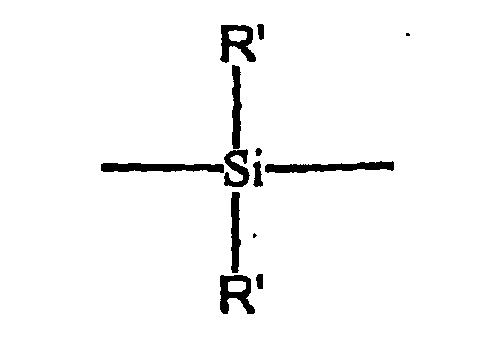
et
Am est un radical choisi parmi les radicaux de formules :à condition que Z comporte au moins deux atomes de carbone ;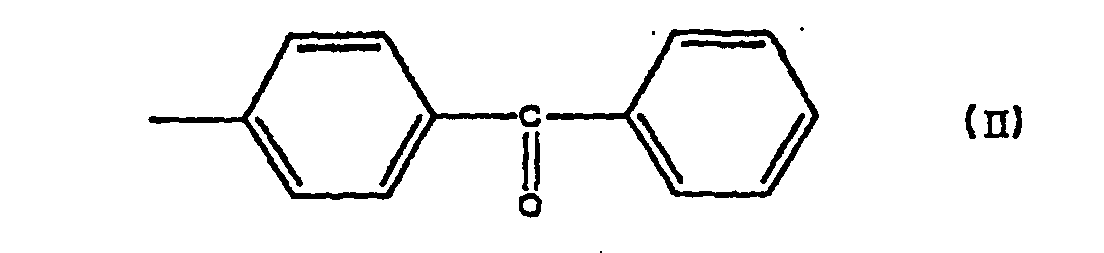 et
et dans lesquelles R1, R2, R3 et R4, identiques ou différents, représentent un atome d'hydrogène ou un radical alkyle en C1-C6.
- Photoamorceurs selon la revendication 20 caractérisés en ce que Z est une chaíne divalente choisie dans le groupe constitué par :et
 dans lesquelles R" et R"' représentent indépendamment l'un de l'autre un groupe alkyle en C1-C6, n1 et n2 sont des entiers de 1 à 6, n3 et n5 sont des entiers de 0 à 4, n4 est égal à 0 ou 1, et n6 est un entier de 0 à 5.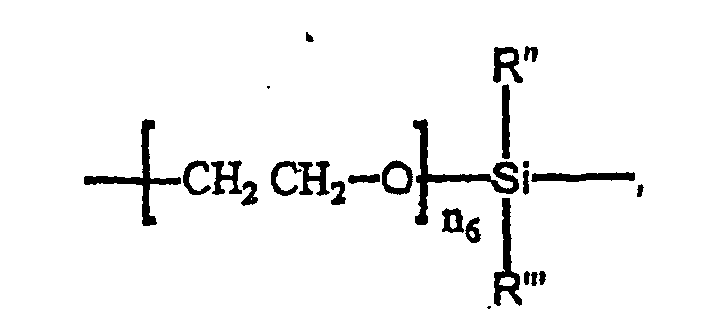
- Photoamorceur répondant à la formule :

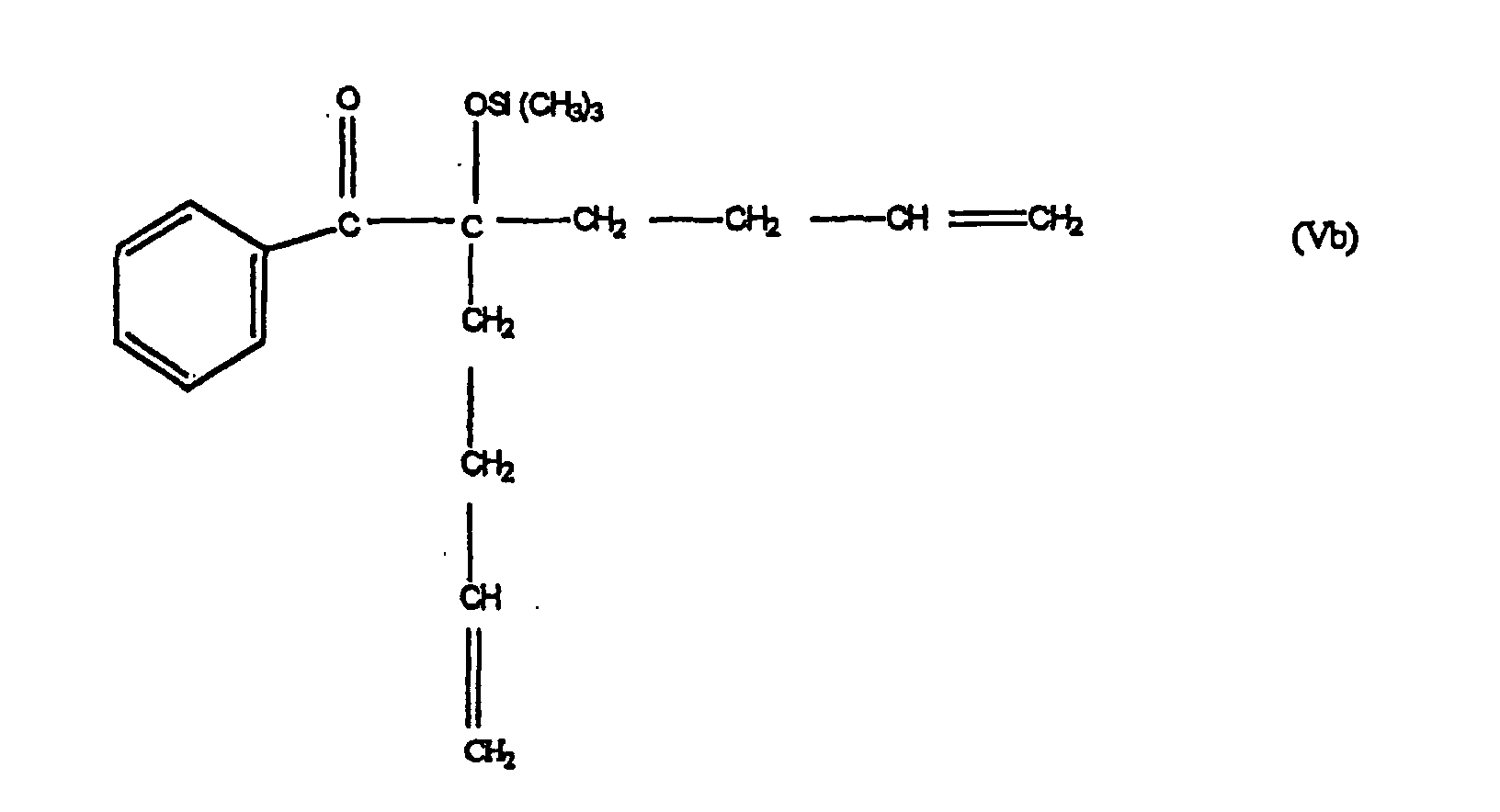
- Photoamorceurs répondant aux formules :


- Macrophotoamorceurs, caractérisés par le fait qu'ils résultent de la réaction entre un hydrogénodiméthylpolysiloxane et un composé selon l'une quelconque des revendications 20 à 23.
Applications Claiming Priority (3)
| Application Number | Priority Date | Filing Date | Title |
|---|---|---|---|
| FR9608031A FR2750429B1 (fr) | 1996-06-27 | 1996-06-27 | Materiau a base de silicone reticule comportant un photoamorceur fixe, son procede de preparation, produit polymerique hydrophile obtenu a partir de ce materiau et son procede de preparation, et nouveaux photoamorceurs |
| FR9608031 | 1996-06-27 | ||
| PCT/FR1997/001147 WO1997049768A1 (fr) | 1996-06-27 | 1997-06-26 | Materiau a base de silicone reticule comportant un photoamorceur fixe, son procede de preparation, produit polymerique hydrophile obtenu a partir de ce materiau et son procede de preparation, et nouveaux photoamorceurs |
Publications (2)
| Publication Number | Publication Date |
|---|---|
| EP0907684A1 EP0907684A1 (fr) | 1999-04-14 |
| EP0907684B1 true EP0907684B1 (fr) | 2002-03-27 |
Family
ID=9493493
Family Applications (1)
| Application Number | Title | Priority Date | Filing Date |
|---|---|---|---|
| EP97930600A Expired - Lifetime EP0907684B1 (fr) | 1996-06-27 | 1997-06-26 | Materiau a base de silicone reticule comportant un photoamorceur fixe, son procede de preparation, produit polymerique hydrophile obtenu a partir de ce materiau et son procede de preparation, et nouveaux photoamorceurs |
Country Status (7)
| Country | Link |
|---|---|
| US (2) | US6197842B1 (fr) |
| EP (1) | EP0907684B1 (fr) |
| JP (1) | JP2001503788A (fr) |
| AT (1) | ATE215112T1 (fr) |
| DE (1) | DE69711380D1 (fr) |
| FR (1) | FR2750429B1 (fr) |
| WO (1) | WO1997049768A1 (fr) |
Families Citing this family (22)
| Publication number | Priority date | Publication date | Assignee | Title |
|---|---|---|---|---|
| US6376568B1 (en) | 1999-07-29 | 2002-04-23 | Ciba Specialty Chemicals Corporation | Surface-active photoinitiators |
| TW557298B (en) | 2000-08-14 | 2003-10-11 | Ciba Sc Holding Ag | A compound, a photopolymerizible composition, a process for producing coatings and a method for causing a photoinitiator to accumulate at the surface of coatings |
| CA2430705A1 (fr) * | 2000-12-13 | 2002-06-20 | Ciba Specialty Chemicals Holding Inc. | Photo-initiateurs tensio-actifs |
| WO2002048204A1 (fr) * | 2000-12-13 | 2002-06-20 | Ciba Specialty Chemicals Holding Inc. | Photoamorceurs tensioactifs |
| DE10248111A1 (de) | 2002-10-15 | 2004-04-29 | Goldschmidt Ag | Verwendung von Photoinitiatoren vom Typ Hydroxyalkylphenon in strahlenhärtbaren Organopolysiloxanen für die Herstellung von abhäsiven Beschichtungen |
| US7122290B2 (en) * | 2004-06-15 | 2006-10-17 | General Electric Company | Holographic storage medium |
| JP4941657B2 (ja) * | 2007-04-06 | 2012-05-30 | 信越化学工業株式会社 | 有機ケイ素化合物及びその製造方法並びに光重合性組成物及び無機材料 |
| US8470906B2 (en) * | 2008-09-30 | 2013-06-25 | Johnson & Johnson Vision Care, Inc. | Ionic silicone hydrogels having improved hydrolytic stability |
| US20130203812A1 (en) | 2008-09-30 | 2013-08-08 | Johnson & Johnson Vision Care, Inc. | Ionic silicone hydrogels comprising pharmaceutical and/or nutriceutical components and having improved hydrolytic stability |
| EP3598181B1 (fr) * | 2008-11-13 | 2021-06-23 | Alcon Inc. | Monomère vinylique et prépolymère le comprenant |
| GB2476976A (en) | 2010-01-18 | 2011-07-20 | Lintfield Ltd | Protected aryl ketones and their use as photoinitiators |
| RU2576622C2 (ru) | 2010-07-30 | 2016-03-10 | Новартис Аг | Амфифильные полисилоксановые преполимеры и их применение |
| CN102807539B (zh) * | 2011-06-02 | 2015-01-07 | 广东华润涂料有限公司 | 可自动氧化的、自引发的可辐射固化树脂体系及其制备方法 |
| EP2791187A4 (fr) * | 2011-12-16 | 2015-07-15 | Univ Akron | Molécules à phénacyle substitué et polymères photosensibles |
| JP6596075B2 (ja) | 2014-08-29 | 2019-10-23 | ヘンケル・アクチェンゲゼルシャフト・ウント・コムパニー・コマンディットゲゼルシャフト・アウフ・アクチェン | オルガノシリコン変性光開始剤およびその光硬化性接着剤組成物 |
| CN105646224A (zh) * | 2016-02-23 | 2016-06-08 | 广东工业大学 | 一种可聚合的羟烷基苯酮衍生物光引发剂及其制备方法 |
| US11021558B2 (en) | 2016-08-05 | 2021-06-01 | Johnson & Johnson Vision Care, Inc. | Polymer compositions containing grafted polymeric networks and processes for their preparation and use |
| CN106916312B (zh) * | 2017-03-16 | 2020-02-07 | 西南科技大学 | 一种可热交联的超支化聚碳硅烷苯并环丁烯树脂及其制备方法 |
| US11034789B2 (en) | 2018-01-30 | 2021-06-15 | Johnson & Johnson Vision Care, Inc. | Ophthalmic devices containing localized grafted networks and processes for their preparation and use |
| US10961341B2 (en) * | 2018-01-30 | 2021-03-30 | Johnson & Johnson Vision Care, Inc. | Ophthalmic devices derived from grafted polymeric networks and processes for their preparation and use |
| WO2023172029A1 (fr) * | 2022-03-07 | 2023-09-14 | 주식회사 엘지화학 | Composé |
| JP7722248B2 (ja) * | 2022-04-22 | 2025-08-13 | 信越化学工業株式会社 | 光反応性オルガノポリシロキサン、その製造方法および光硬化性組成物 |
Family Cites Families (13)
| Publication number | Priority date | Publication date | Assignee | Title |
|---|---|---|---|---|
| US3745042A (en) | 1969-12-15 | 1973-07-10 | Ceskoslovenska Akademie Ved | Method of hydrophilization of transparent objects made of hydrophobic organic polymers |
| US4362895A (en) * | 1980-03-03 | 1982-12-07 | California Institute Of Technology | Ultraviolet absorbing copolymers |
| JPS57131230A (en) * | 1981-02-06 | 1982-08-14 | Toray Silicone Co Ltd | Photo-polymerization sensitizer and its production |
| EP0088842B1 (fr) * | 1982-03-16 | 1986-01-02 | Toray Silicone Company Limited | Photosensibilisateurs d'organopolysiloxane et méthodes pour leur préparation |
| EP0108037B1 (fr) * | 1982-10-01 | 1989-06-07 | Ciba-Geigy Ag | Dérivés de propiophénone comme photo-initiateurs dans la photo-polymérisation |
| US4477326A (en) * | 1983-06-20 | 1984-10-16 | Loctite Corporation | Polyphotoinitiators and compositions thereof |
| US4534838A (en) * | 1984-04-16 | 1985-08-13 | Loctite Corporation | Siloxane polyphotoinitiators of the substituted acetophenone type |
| US4536265A (en) * | 1984-04-19 | 1985-08-20 | Loctite Corporation | Siloxane polyphotoinitiators of the substituted acetophenone type |
| US4587137A (en) * | 1984-09-28 | 1986-05-06 | General Electric Company | Novel dual cure silicone compositions |
| US4666953A (en) * | 1985-03-28 | 1987-05-19 | Loctite Corporation | Silicone polyphotoinitiators |
| US5100689A (en) * | 1987-04-10 | 1992-03-31 | University Of Florida | Surface modified surgical instruments, devices, implants, contact lenses and the like |
| US4921589A (en) * | 1988-12-20 | 1990-05-01 | Allied-Signal Inc. | Polysiloxane bound photosensitizer for producing singlet oxygen |
| FR2709756B1 (fr) | 1993-09-10 | 1995-10-20 | Essilor Int | Matériau hydrophile, transparent à haute perméabilité à l'oxygène, à base d'un polymère à réseaux interpénétrés, son mode de préparation et fabrication de lentilles de contact souples à haute perméabilité à l'oxygène. |
-
1996
- 1996-06-27 FR FR9608031A patent/FR2750429B1/fr not_active Expired - Fee Related
-
1997
- 1997-06-26 US US09/202,844 patent/US6197842B1/en not_active Expired - Fee Related
- 1997-06-26 EP EP97930600A patent/EP0907684B1/fr not_active Expired - Lifetime
- 1997-06-26 DE DE69711380T patent/DE69711380D1/de not_active Expired - Lifetime
- 1997-06-26 JP JP50245998A patent/JP2001503788A/ja active Pending
- 1997-06-26 AT AT97930600T patent/ATE215112T1/de not_active IP Right Cessation
- 1997-06-26 WO PCT/FR1997/001147 patent/WO1997049768A1/fr not_active Ceased
-
2000
- 2000-12-28 US US09/750,196 patent/US20010007880A1/en not_active Abandoned
Also Published As
| Publication number | Publication date |
|---|---|
| JP2001503788A (ja) | 2001-03-21 |
| ATE215112T1 (de) | 2002-04-15 |
| US6197842B1 (en) | 2001-03-06 |
| WO1997049768A1 (fr) | 1997-12-31 |
| FR2750429A1 (fr) | 1998-01-02 |
| US20010007880A1 (en) | 2001-07-12 |
| EP0907684A1 (fr) | 1999-04-14 |
| FR2750429B1 (fr) | 1998-08-07 |
| DE69711380D1 (de) | 2002-05-02 |
Similar Documents
| Publication | Publication Date | Title |
|---|---|---|
| EP0907684A1 (fr) | Materiau a base de silicone reticule comportant un photoamorceur fixe, son procede de preparation, produit polymerique hydrophile obtenu a partir de ce materiau et son procede de preparation, et nouveaux photoamorceurs | |
| EP0643083B1 (fr) | Matériau hydrophile,transparent à haute perméabilité à l'oxygène, à base d'un polymère à réseaux interpénétrés, son mode de préparation et fabrication de lentilles de contact souples à haute perméabilité à l'oxygène. | |
| BE1001638A4 (fr) | Compositions de polymeres sequences. | |
| EP0052381B1 (fr) | Procédé de préparation de compositions organopolysiloxaniques photopolymérisables et utilisation de ces compositions | |
| CN1070494C (zh) | 用于降低低水聚硅氧烷组合物的模量的单体 | |
| FR2733507A1 (fr) | Compositions pour revetement a base de silicone, durcissables par les rayons ultraviolets | |
| FR2584724A1 (fr) | Composition nouvelle a base de silicate acrylique, son procede de production et son application a la fabrication de lentilles de contact | |
| FR2500001A1 (fr) | Procede de production de polyorganosiloxanes et application des polyorganosiloxanes ainsi obtenus a une copolymerisation avec un monomere olefinique ou acrylique | |
| MC1015A1 (fr) | Nouvelle composition pour obturations dentaires | |
| EP1036102A1 (fr) | Procede de fabrication d'un materiau polymere transparent resistant au depot de proteines, materiau obtenu par ce procede, lentilles de contact et implants intraoculaires faits de ce materiau | |
| WO2003042222A1 (fr) | Monomere, polymere et lentille oculaire les comprenant | |
| CA1334604C (fr) | Diorganopolysiloxane a fonction benzotriazole | |
| FR2641785A1 (fr) | Composition de polymeres transparents pour lentilles de contact de type rigide, permeables a l'oxygene | |
| JP5076256B2 (ja) | モノマー組成物、それを用いたポリマーおよび眼用レンズ | |
| EP0755960A1 (fr) | Polyorganosiloxanes perhalogénés polyfonctionnels et leurs procédés d'obtention | |
| WO2012095293A2 (fr) | Procédé pour la synthèse de composés à partir de carbonates cycliques | |
| EP2046865B1 (fr) | Greffons et co-réseaux amphiphiles et procédé de fabrication de ceux-ci | |
| JPS60252604A (ja) | オルガノポリシロキサン光開始剤 | |
| EP4397694A1 (fr) | Monomère contenant du polydiméthylsiloxane ayant un groupe phosphorylcholine et un groupe hydroxyle | |
| FR2735135A1 (fr) | Fluides silicone substitues par des groupes aryle presentant des indices de refraction eleves et leur procede de fabrication | |
| FR2757528A1 (fr) | Reseaux de polymeres a interpenetration | |
| JP4273885B2 (ja) | シリコーンモノマー組成物の製造方法 | |
| EP0755961B1 (fr) | Polyorganosiloxanes halogénés et leurs procédés d'obtention | |
| EP1248789B1 (fr) | Composes organosilicies, leur procede de preparation et leurs utilisations | |
| EP0435751A1 (fr) | Procédé de synthèse de polysilsesquioxanes et applications des produits obtenus |
Legal Events
| Date | Code | Title | Description |
|---|---|---|---|
| PUAI | Public reference made under article 153(3) epc to a published international application that has entered the european phase |
Free format text: ORIGINAL CODE: 0009012 |
|
| 17P | Request for examination filed |
Effective date: 19981111 |
|
| AK | Designated contracting states |
Kind code of ref document: A1 Designated state(s): AT BE CH DE DK ES FR GB IT LI SE |
|
| 17Q | First examination report despatched |
Effective date: 19990504 |
|
| GRAG | Despatch of communication of intention to grant |
Free format text: ORIGINAL CODE: EPIDOS AGRA |
|
| GRAG | Despatch of communication of intention to grant |
Free format text: ORIGINAL CODE: EPIDOS AGRA |
|
| GRAG | Despatch of communication of intention to grant |
Free format text: ORIGINAL CODE: EPIDOS AGRA |
|
| GRAH | Despatch of communication of intention to grant a patent |
Free format text: ORIGINAL CODE: EPIDOS IGRA |
|
| REG | Reference to a national code |
Ref country code: GB Ref legal event code: IF02 |
|
| GRAH | Despatch of communication of intention to grant a patent |
Free format text: ORIGINAL CODE: EPIDOS IGRA |
|
| GRAA | (expected) grant |
Free format text: ORIGINAL CODE: 0009210 |
|
| AK | Designated contracting states |
Kind code of ref document: B1 Designated state(s): AT BE CH DE DK ES FR GB IT LI SE |
|
| PG25 | Lapsed in a contracting state [announced via postgrant information from national office to epo] |
Ref country code: IT Free format text: LAPSE BECAUSE OF FAILURE TO SUBMIT A TRANSLATION OF THE DESCRIPTION OR TO PAY THE FEE WITHIN THE PRE;WARNING: LAPSES OF ITALIAN PATENTS WITH EFFECTIVE DATE BEFORE 2007 MAY HAVE OCCURRED AT ANY TIME BEFORE 2007. THE CORRECT EFFECTIVE DATE MAY BE DIFFERENT FROM THE ONE RECORDED.SCRIBED TIME-LIMIT Effective date: 20020327 Ref country code: GB Free format text: LAPSE BECAUSE OF FAILURE TO SUBMIT A TRANSLATION OF THE DESCRIPTION OR TO PAY THE FEE WITHIN THE PRESCRIBED TIME-LIMIT Effective date: 20020327 Ref country code: AT Free format text: LAPSE BECAUSE OF FAILURE TO SUBMIT A TRANSLATION OF THE DESCRIPTION OR TO PAY THE FEE WITHIN THE PRESCRIBED TIME-LIMIT Effective date: 20020327 |
|
| REF | Corresponds to: |
Ref document number: 215112 Country of ref document: AT Date of ref document: 20020415 Kind code of ref document: T |
|
| REG | Reference to a national code |
Ref country code: CH Ref legal event code: EP |
|
| REF | Corresponds to: |
Ref document number: 69711380 Country of ref document: DE Date of ref document: 20020502 |
|
| PG25 | Lapsed in a contracting state [announced via postgrant information from national office to epo] |
Ref country code: SE Free format text: LAPSE BECAUSE OF FAILURE TO SUBMIT A TRANSLATION OF THE DESCRIPTION OR TO PAY THE FEE WITHIN THE PRESCRIBED TIME-LIMIT Effective date: 20020627 Ref country code: DK Free format text: LAPSE BECAUSE OF FAILURE TO SUBMIT A TRANSLATION OF THE DESCRIPTION OR TO PAY THE FEE WITHIN THE PRESCRIBED TIME-LIMIT Effective date: 20020627 |
|
| PG25 | Lapsed in a contracting state [announced via postgrant information from national office to epo] |
Ref country code: DE Free format text: LAPSE BECAUSE OF FAILURE TO SUBMIT A TRANSLATION OF THE DESCRIPTION OR TO PAY THE FEE WITHIN THE PRESCRIBED TIME-LIMIT Effective date: 20020628 |
|
| PG25 | Lapsed in a contracting state [announced via postgrant information from national office to epo] |
Ref country code: LI Free format text: LAPSE BECAUSE OF NON-PAYMENT OF DUE FEES Effective date: 20020630 Ref country code: CH Free format text: LAPSE BECAUSE OF NON-PAYMENT OF DUE FEES Effective date: 20020630 Ref country code: BE Free format text: LAPSE BECAUSE OF NON-PAYMENT OF DUE FEES Effective date: 20020630 |
|
| GBV | Gb: ep patent (uk) treated as always having been void in accordance with gb section 77(7)/1977 [no translation filed] |
Effective date: 20020327 |
|
| PG25 | Lapsed in a contracting state [announced via postgrant information from national office to epo] |
Ref country code: ES Free format text: LAPSE BECAUSE OF FAILURE TO SUBMIT A TRANSLATION OF THE DESCRIPTION OR TO PAY THE FEE WITHIN THE PRESCRIBED TIME-LIMIT Effective date: 20020925 |
|
| BERE | Be: lapsed |
Owner name: *ESSILOR INTERNATIONAL CIE GENERALE D'OPTIQUE Effective date: 20020630 |
|
| PLBE | No opposition filed within time limit |
Free format text: ORIGINAL CODE: 0009261 |
|
| STAA | Information on the status of an ep patent application or granted ep patent |
Free format text: STATUS: NO OPPOSITION FILED WITHIN TIME LIMIT |
|
| REG | Reference to a national code |
Ref country code: CH Ref legal event code: PL |
|
| PG25 | Lapsed in a contracting state [announced via postgrant information from national office to epo] |
Ref country code: FR Free format text: LAPSE BECAUSE OF NON-PAYMENT OF DUE FEES Effective date: 20030228 |
|
| 26N | No opposition filed |
Effective date: 20021230 |
|
| REG | Reference to a national code |
Ref country code: FR Ref legal event code: ST |