EP0904495B1 - Dispositif a soupape, en particulier dispositif combine valve proportionnelle-distributeur - Google Patents
Dispositif a soupape, en particulier dispositif combine valve proportionnelle-distributeur Download PDFInfo
- Publication number
- EP0904495B1 EP0904495B1 EP98919169A EP98919169A EP0904495B1 EP 0904495 B1 EP0904495 B1 EP 0904495B1 EP 98919169 A EP98919169 A EP 98919169A EP 98919169 A EP98919169 A EP 98919169A EP 0904495 B1 EP0904495 B1 EP 0904495B1
- Authority
- EP
- European Patent Office
- Prior art keywords
- valve
- force
- valve piston
- piston
- pin
- Prior art date
- Legal status (The legal status is an assumption and is not a legal conclusion. Google has not performed a legal analysis and makes no representation as to the accuracy of the status listed.)
- Expired - Lifetime
Links
- 238000004146 energy storage Methods 0.000 claims description 32
- 230000006835 compression Effects 0.000 claims description 6
- 238000007906 compression Methods 0.000 claims description 6
- 230000009471 action Effects 0.000 claims description 4
- 239000004020 conductor Substances 0.000 claims description 3
- 239000012528 membrane Substances 0.000 claims description 3
- 230000000903 blocking effect Effects 0.000 abstract 1
- 230000001105 regulatory effect Effects 0.000 abstract 1
- 238000010586 diagram Methods 0.000 description 7
- 238000000034 method Methods 0.000 description 7
- 230000008569 process Effects 0.000 description 7
- 238000013461 design Methods 0.000 description 4
- 238000005429 filling process Methods 0.000 description 4
- 230000008901 benefit Effects 0.000 description 3
- 230000005540 biological transmission Effects 0.000 description 3
- 230000008859 change Effects 0.000 description 3
- 230000001419 dependent effect Effects 0.000 description 2
- 238000010438 heat treatment Methods 0.000 description 2
- 230000036316 preload Effects 0.000 description 2
- 238000012546 transfer Methods 0.000 description 2
- 230000004323 axial length Effects 0.000 description 1
- 230000015572 biosynthetic process Effects 0.000 description 1
- 238000010276 construction Methods 0.000 description 1
- 238000011109 contamination Methods 0.000 description 1
- 238000011161 development Methods 0.000 description 1
- 230000018109 developmental process Effects 0.000 description 1
- 238000006073 displacement reaction Methods 0.000 description 1
- 238000012986 modification Methods 0.000 description 1
- 230000004048 modification Effects 0.000 description 1
- 238000007639 printing Methods 0.000 description 1
- 230000009467 reduction Effects 0.000 description 1
- 238000007493 shaping process Methods 0.000 description 1
- 230000007704 transition Effects 0.000 description 1
Images

Classifications
-
- F—MECHANICAL ENGINEERING; LIGHTING; HEATING; WEAPONS; BLASTING
- F15—FLUID-PRESSURE ACTUATORS; HYDRAULICS OR PNEUMATICS IN GENERAL
- F15B—SYSTEMS ACTING BY MEANS OF FLUIDS IN GENERAL; FLUID-PRESSURE ACTUATORS, e.g. SERVOMOTORS; DETAILS OF FLUID-PRESSURE SYSTEMS, NOT OTHERWISE PROVIDED FOR
- F15B13/00—Details of servomotor systems ; Valves for servomotor systems
- F15B13/02—Fluid distribution or supply devices characterised by their adaptation to the control of servomotors
- F15B13/04—Fluid distribution or supply devices characterised by their adaptation to the control of servomotors for use with a single servomotor
- F15B13/044—Fluid distribution or supply devices characterised by their adaptation to the control of servomotors for use with a single servomotor operated by electrically-controlled means, e.g. solenoids, torque-motors
-
- G—PHYSICS
- G05—CONTROLLING; REGULATING
- G05D—SYSTEMS FOR CONTROLLING OR REGULATING NON-ELECTRIC VARIABLES
- G05D16/00—Control of fluid pressure
- G05D16/14—Control of fluid pressure with auxiliary non-electric power
- G05D16/16—Control of fluid pressure with auxiliary non-electric power derived from the controlled fluid
- G05D16/166—Control of fluid pressure with auxiliary non-electric power derived from the controlled fluid using pistons within the main valve
-
- G—PHYSICS
- G05—CONTROLLING; REGULATING
- G05D—SYSTEMS FOR CONTROLLING OR REGULATING NON-ELECTRIC VARIABLES
- G05D16/00—Control of fluid pressure
- G05D16/20—Control of fluid pressure characterised by the use of electric means
- G05D16/2006—Control of fluid pressure characterised by the use of electric means with direct action of electric energy on controlling means
- G05D16/2013—Control of fluid pressure characterised by the use of electric means with direct action of electric energy on controlling means using throttling means as controlling means
- G05D16/2024—Control of fluid pressure characterised by the use of electric means with direct action of electric energy on controlling means using throttling means as controlling means the throttling means being a multiple-way valve
-
- Y—GENERAL TAGGING OF NEW TECHNOLOGICAL DEVELOPMENTS; GENERAL TAGGING OF CROSS-SECTIONAL TECHNOLOGIES SPANNING OVER SEVERAL SECTIONS OF THE IPC; TECHNICAL SUBJECTS COVERED BY FORMER USPC CROSS-REFERENCE ART COLLECTIONS [XRACs] AND DIGESTS
- Y10—TECHNICAL SUBJECTS COVERED BY FORMER USPC
- Y10T—TECHNICAL SUBJECTS COVERED BY FORMER US CLASSIFICATION
- Y10T137/00—Fluid handling
- Y10T137/8593—Systems
- Y10T137/86493—Multi-way valve unit
- Y10T137/86574—Supply and exhaust
- Y10T137/86622—Motor-operated
Definitions
- the invention relates to a valve device, in particular a combination the functions of a proportional and a directional valve, in detail with the features from the preamble of claim 1.
- Proportional valves also called continuous valves, as well as directional valves are in a variety of designs and for different purposes known.
- Directional valves are directional valves whose Valve pistons, which are also referred to as control pistons, in different fixed switching positions can be brought, whereby different connections, i.e. Ways, the connected lines can be manufactured for equipment management. So that becomes a Changing the flow direction of a volume flow causes.
- These valves are determined by the nominal size, the nominal pressure and the possible Path variants marked.
- the main assembly of a directional valve forms the control unit. This contains in a valve or control housing the valve piston that changes the direction of the volume flow.
- valve piston To actuate the valve piston, this is on at least one of the two An actuating device for applying the actuating force on the end faces assigned.
- a frequently used variant is the so-called Gate valve, the valve closure caused by overlap by sliding the individual valve parts on or into one another, in particular of the valve piston in the valve housing.
- these valves are in rotary slide valves, Longitudinal slide valves and longitudinal rotary slide valves divided.
- the control or valve units are always classified accordingly according to the number of connections, i.e. of the possible lines, and after the Number of possible switch positions.
- Control edges of the valve piston and that of the valve housing Affect you the throttling of the passage cross-section and thus the speed of the consumer, usually an implement. By appropriate Shapes of these control edges can be achieved by moving the Valve piston different from the valve housing Achieve flow characteristics.
- Directional valves have a specific one Number of switch positions on.
- the proportional valves designed in this way have the disadvantage that the Actuating force, which is electromagnetic, hydraulic, can be applied mechanically or otherwise, so be selected must be the maximum pressure that occurs in the valve downstream consumers can be kept permanently.
- the size of the The effective area of the pressure is determined from this requirement. This has however, the consequence is that smaller pressures with correspondingly smaller ones Operating forces must be controlled. If you want smaller ones Pressures therefore have to purchase larger pressure variations in the control be taken.
- An increase in the range of force that can be applied usually results in an enlargement of the adjusting devices, for example, has an actuating device in the form of a Electromagnets a fundamental increase in the amount to be applied Magnetic force results in an enlargement of the solenoid coil, which however increased space requirements. Furthermore, the cost is greater electrical conductor higher and the power consumption increases. In general are also limits for the size of the Valve device and the actuator set so that an accurate Adjustment of the pressure at the consumer is not always possible.
- the invention is therefore based on the object of a valve device to develop the type mentioned at the outset such that the aforementioned Disadvantages are avoided.
- the pressure scatter should the lowest possible pressures to be set are avoided.
- the valve device is also intended for applications to which Requirements, for example, as in a shaft gearbox, at which relatively low pressures in a switching element as precisely as possible should be controlled, but on the other hand by high moments in the Converter operation a high transmission capacity of the switching elements is necessary to be suitable.
- the valve device should at least in a first pressure range (the proportional range), which also the Total work area can correspond, for example, an order of magnitude from 1 to 5 bar, as precisely as possible, i.e.
- valve taking advantage of the maximum permissible actuation force, with the greatest possible actuation forces can be controlled proportionally to an electric current.
- the valve should be in a second higher pressure range, for example from 6 to 20 bar, then work as a normal directional valve, i.e. regardless of the existing pressure level in the consumer, always the full one Transfer pressure.
- the valve device should be reproducible as precisely as possible Switching operations with the least possible influence of hydraulic Can enable clamping forces and mechanical friction. The design effort and the costs are to be kept low.
- the valve device comprises at least an inlet channel and an outlet channel, one, axially in the valve housing movable and control edges having valve piston for releasing and shutting off the connection of the cross sections of the inlet and outlet channels and an actuating device for loading the valve piston with a Operating force.
- this first part can also correspond to the overall work area, is the possible operating force range compared to Pressure range on the consumer increased, so that a more sensitive Coordination between the pressure to be set on the consumer and the Actuating force becomes possible, i.e. a certain pressure range on Consumer or in the drain channel is a larger actuation force range assignable compared to a conventional proportional valve. This is achieved by moving the valve piston into a control position Creating a balance between the operating force and one Compressive force, which depends on the pressure in the consumer on a certain surface acts that is opposite to the actuating force, achieved.
- the means preferably comprise one arranged in the valve piston and up to the end facing away from the actuating device extending interior, a valve pin arranged in the interior, wherein Valve pin and valve piston are relatively movable against each other, one that Stop assigned to the valve pin, on which the valve pin is supported, and a connection channel between the interior of the valve piston and the outer periphery of the valve piston, the mouth of the Connection channel arranged on the outer circumference of the valve piston in this way is that this in the part of the total work area, the Proportional area corresponds to the drain channel.
- This design enables the ratio of operating forces to To choose friction forces as large as possible. Determine the frictional forces mainly from the pressure differences across the valve, the Equipment contamination, the valve diameter or other constructive features.
- the operating forces are limited mainly in the size of the actuators, especially one electromagnetic drive in the size of the electromagnet. Also for small ranges of the actuation forces to be applied can be small Pressure values at the consumer or that coupled to the consumer Drain channel can be set.
- the valve designed according to the invention is preferably a combined one Proportional directional valve device implemented.
- the valve device further comprises a device, which limits the magnitude of the force opposing the actuating force and compensated.
- This device is in the form of an energy storage unit executed, which is assigned to the stop for the valve pin and its support force for the valve pin is limited in size.
- Exceeds the pressure force resulting from the pressure in the drain line and the pin area is determined by the energy storage unit counterforce that can be applied to support the valve pin acts as the Stop no longer as a fixed stop but becomes under the action of force shifted by the valve pin. This shift is caused by a limited further stop between valve pin and valve piston.
- To Achieving the stop position of the valve pin in relation to the valve piston i.e. the valve pin is no longer opposite the valve piston in the direction of the The valve piston is then only correspondingly displaceable the applied operating force shifted.
- At least one first valve device lower pressure range at the consumer which is a first part of the Total working range of the valve device determined, with approximately maximum possible actuation forces controlled while in an upper Print area, which is another second part of the Overall working range of the valve device determines the valve as pure Directional control valve functions.
- the switchover point can be designed by force of the valve device be determined.
- the valve device has at least one Valve housing, which comprises a central bore in the Valve piston is movable in the axial direction.
- the central hole forms with this associated chamber so-called pressure chambers, which accordingly the position of the valve piston in the central bore a connection between an inlet line and an outlet line, preferably the Drain line, which is coupled to a consumer, enables.
- the Valve piston also has an interior in which a so-called valve pin is axially movable.
- the valve pin is in Direction of movement assigned a stop, which on a Energy storage unit is supported.
- valve pin or its from Stop facing away from the inside of the valve piston protrudes through a connecting channel, preferably in the form of a Connection hole, from the interior of the valve piston to the outside Scope of the valve piston, which is in the proportional work area of the drain, with the pressure in the drain line, i.e. the Connection line to the consumer, acted upon.
- the valve is like this designed that in a first end position the connection between the Inlet and outlet, i.e. the connecting line to the consumer, Is blocked.
- the valve piston can be adjusted in the valve housing by means of an adjusting device.
- This actuating device is preferably designed in the form of an electromagnetic actuating device, ie an electromagnet. Other possibilities are also conceivable, for example an electro-hydraulic or a mechanical adjustment device.
- an actuating force F actuation is applied to the valve piston on the part of the actuating device .
- a connection is established between the pressure chambers formed by the chamber connected to the central bore and the inlet and the central bore and a chamber at the outlet. The equipment can therefore flow from the inlet to the consumer.
- a pressure is created via the connecting bore between the interior and the outer circumference of the valve piston when in position in the area of the drain, which acts on the end face of the valve pin and is supported on the stop in the valve housing.
- This creates an equilibrium state, which means that the actuation force corresponds to the pressure force which results from consumer pressure on the valve pin surface. If a further energy storage unit is provided between the valve piston and the valve pin in the interior of the valve piston, the force thereby applied adds up to the pressure force.
- the valve pin is supported on the stop assigned Energy storage unit.
- the one applied by the energy storage unit Force preferably corresponds to the force of the valve pin at maximum desired proportional pressure, so that in the entire proportional range no change in the power of the energy storage unit or the position of the Attack takes place.
- As an immediate manipulated variable for the one to be set maximum desired proportional pressure thus results in the Preload force by the energy storage unit. Only when the scheduled one Pressure in the consumer, i.e. in the process, in the interior a force on the Valve pin generated, which is higher than that assigned to the stop Energy storage unit, the valve pin presses the energy storage unit together until it has at least one trained on its circumference Protrusion comes to rest against the stop on the valve piston. Once this Condition is reached, the pressure in the consumer can no longer affect that Impact valve. The position of the valve piston is then only determined solely due to the external forces of the actuator and energy storage unit like a directional valve.
- the switching pressure can be designed such that, for example, all Switching processes are in the proportional range and the upper pressure range only serves to transfer moments.
- valve device there are significant advantages of such a valve device in that, in addition to a more precise pressure setting, a universal Use can be made with multiple requirements optimal size can be met by a valve device. This would be a fine-tuning of actuation forces and final pressure on Consumers with small size of the print and the deployment and safe holding of a high pressure at the consumer.
- the energy storage units are preferably in the form of Pressure storage units, for example individual compression springs or Spring packs executed.
- the use of elastic is also conceivable Membranes.
- the valve device can be dispensed with without the energy storage unit Stop operated as a purely proportional valve or at Design of the energy storage unit so that the operating force immediately to move the valve piston into an end position, which in a low biasing force of the energy storage unit is made possible as pure Directional control valve operated.
- a low preload Energy storage unit results in a small proportional area, a large one Biasing force of the energy storage unit results in a large one Proportional range.
- the valve device designed according to the invention can be of any type Actuator include, i.e. the use of electromagnetic, mechanical, Hydraulic or otherwise operable actuators are conceivable.
- Electromagnetic actuators include at least one Electromagnet with a coil and an armature.
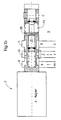
- FIG. 1 illustrates in a simplified representation using a Section of a valve device, the structure and functionality of a proportional directional valve 1 designed according to the invention a preferred embodiment electromagnetically controlled.
- An electromagnet 2 is provided for this purpose.
- the proportional directional valve 1 comprises a valve body 3, which comprises a central bore 4, in which a valve piston 5 is arranged movable in the axial direction.
- the central bore 4 are a variety of connections, at least however two, assigned. These are here in the form of connecting channels 6, 7 and 8, which extends from the outer circumference of the valve piston 5 preferably extend in the radial direction to the central bore 4.
- the connecting channel 6 acts as an inlet channel and Connection channel 7 as a drain channel.
- the connecting channels 6, 7 and 8 open into the central bore 4, which additional in the area of the channels Chambers, here 9, 10 and 11, having the central bore 4th connected, extend circumferentially and a larger one Have diameter D as the central bore 4.
- Valve housing 3 incorporated chambers 9, 10 and 11 form with the central bore 4, the control edges of the valve housing 3.
- the valve piston 5 has its axial length l different dimensions in the radial direction.
- two areas of smaller diameter d here with 12 and 13 designated, provided.
- the change between larger and larger areas smaller diameter d leads to the formation of the control edges 14, 15 and 16 on the valve piston 5.
- the control edges 14, 15 and 16 of the valve piston 5 and the control edges of the valve housing 3 have a special influence on the accuracy of the control processes. These affect the throttling the passage cross-sections and thus the speed of the work equipment or that of the valve device in the form of a proportional directional valve 1 subordinate consumers.
- the chambers 9, 10 and 11 form with the central bore 4 and the outer contour of the valve piston 5th variable pressure rooms. By shaping the individual accordingly Control edges have different flow characteristics.
- connection channel 6 serves the connection between the pressure chamber formed by the chamber 9 and the central bore 4 at least indirectly with a pressure medium supply source.
- the Connection channel 7 is used to connect the chamber 10 and the central bore 4 formed pressure chamber with one here in detail consumers not shown.
- the valve piston 5 has an interior 20, which is in the axial Direction in the direction of the valve piston 5 up to its end face 22 extends.
- This interior 20 is a movable in the axial direction Valve pin 21 arranged.
- the valve pin 21 can be different Take positions, especially this can be completely in the valve piston 5 are integrated or protrude from the valve piston 5, i.e. he extends in the axial direction over the end face 22 of the valve piston 5. So that the valve pin 21 does not come out of the interior 20 of the valve piston 5 slips out, this is in the area of its from the end face 22 of the Valve piston 5 opposite and pioneering face 23 with with a head start.
- valve pin 21 can either be a separate, the component assigned to the valve pin 21, for example in Form of a push-on, press or screwable element, preferably in Shape of a ring or the valve pin 21 can be designed such that this is designed as a one-piece component with a corresponding projection. There is at least one projection extending in the circumferential direction provided or a variety of at certain intervals in Projections arranged circumferentially.
- the interior 20 is different in two areas Diameter divided - a first area of larger diameter, here designated 24, and a second area of smaller diameter, here designated with 26.
- the area of smaller diameter 26 serves the purpose Picking up and guiding the valve pin 21.
- Diameter 25 is an energy storage unit 27 in the form of a compression spring arranged.
- an axially movable stop 28 is provided which the end face or at least part of the end face 30 of the Valve pin 21 attacks, the stop 28 on a Energy storage unit 31, supported here by a compression spring device.
- the present embodiment has two limit positions.
- the first Limit position is shown in Figure 1a.
- the connecting channel 7 the drain channel, at least indirectly connectable consumers relieved and the pressure supply via the Connection channel 6 blocked as a feed channel. This is caused by the fact that the control edges 14 to 16 the pressure chamber, which from the chamber 9 and the central bore 4 is formed, not with the corresponding Pressure chamber, which can be coupled to the consumer, connects.
- the Drain channel, i.e. the connecting line 7 to the consumer is blocked.
- FIG. 1b shows the proportional directional control valve 1 according to the invention in a switch position in which it works as a so-called proportional valve.
- the actuating device comprising an electromagnet 2 comprises at least one conductor, for example in the form of a coil, which is assigned to the electromagnet 2 and through which a current with the current intensity l flows.
- This current value I corresponds to a setpoint to be set for a desired pressure value to be applied to the consumer and to be set.
- the specification of the desired pressure value to be set at the consumer which is also referred to as signal pressure W pASoll , can be done by simple calculation or simple assignment using characteristic curves or tables stored in a storage unit. The possibility described below is not shown in the figure and is only one of many.
- the pressure setting or pressure control via the valve device 1 takes place, for example, in a first control circuit, not shown here.
- the input variables of such a control circuit are a desired signal pressure W PASOll which is set at the outlet, ie in the discharge line, and an actual value of the signal pressure in the output line P A which is continuously determined .
- the valve device 1 acts as an actuator for setting this signal pressure.
- the manipulated variable for influencing this actuator in the present case is the magnitude of the magnetic force F magnet influencing the position of the valve piston 5.
- the magnetic force F magnet corresponds to the actuating force required for the displacement of the valve piston 5 of the valve device 1 to release the individual flow cross sections between the connecting channels 6, 7 and 8.
- the setting of the magnetic force F magnet takes place via a further control loop, which is subordinate to the pressure control loop.
- the input variable of this second control circuit is a reference variable for the magnetic force F magnet target formed by the pressure regulator .
- the valve piston is displaced in the axial direction relative to the valve pin 21, the pressure spaces which are formed by the chamber 9 and the central bore 4 or the chamber 10 and the central bore 4 being connected to one another and
- This connection of the pressure chambers enables a connection between the inlet 6 and the connecting channel 7 coupled to the consumer.
- a certain pressure P lst is established in the connection channel 7.
- This pressure propagates through a connecting bore 36, which extends from the circumference 35 of the valve piston 21 in the radial direction in the direction of the interior 20, into the interior 20. This pressure acts in the interior 20 on the surface of the valve pin 21 formed by the end face 23.
- the actuating force in the form of the magnetic force F magnet always corresponds to the force applied by the energy storage unit 25 plus the pressure force F pressure which results from the consumer pressure P actual and the area A of the valve pin in the region of the end face 23.
- the valve pin 21 is supported on the prestressed energy storage unit 31 in the form of a spring unit designed as a compression spring.
- the bias of the spring unit corresponds to the force of the valve pin 21 at the maximum desired proportional pressure, so that there is no change in the spring unit in the entire proportional range.
- valve pin 21 presses 21 the spring unit 31, in particular the spring assembly, until it comes into contact with its shoulder S or the stop in the region of its end in the valve piston 5.
- the pressure in the consumer or the connecting line which is coupled to the connecting channel 7 and the consumer, can no longer affect the valve device 1.
- the position of the valve piston 5 is now determined solely on the basis of the external forces of the magnet, in particular the electromagnet 2 and the energy storage unit 31, in particular the spring unit, as in a directional control valve.
- valve piston 5 now goes with a further slight increase in the magnetic force F magnet in the axial direction up to the stop 28 and releases the unthrottled path of the equipment, in particular the oil, to the consumer.
- valve pin 21 which is dependent on the pressure in the Connecting line 7 is applied, the actuating force on the Valve piston 5 always assigned a counterforce in the proportional range, which causes 5 lower actuating forces to be effective on the valve piston have to be to allow a shift in the axial direction as in a solution without a valve pin with direct attack on the actuating force the valve piston.
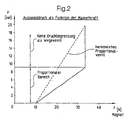
- FIG. 2 schematically illustrates the characteristic diagram of a proportional directional control valve according to the invention in a diagram which shows the dependence of the outlet pressure or the pressure provided for the consumer in channel 7 on the magnetic force F magnet .
- the magnetic force F magnet in the X direction and the output pressure P actual in the Y direction are plotted in the coordinate system.
- the characteristic curve of a conventional proportional valve is drawn with l. It can be seen from this that the pressure P actual changes linearly as a function of the magnetic force F magnet .
- the solution according to the invention makes it possible, as also shown in the characteristic curve II, to make the proportional range wider, ie to keep the increase in the characteristic curve smaller, the so-called travel range following the proportional range, in that there is no pressure limitation.
- This broadening of the proportional range over a larger magnetic force range F magnet makes it possible to fine tune the pressure to be set on the consumer in accordance with the applied magnetic force F magnet .
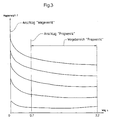
- FIG. 3 illustrates the characteristic curves for the using a diagram required magnetic force of the actuator according to Further development of the basic idea of the invention, the Actuating force is applied electro-magnetically.
- the actuator includes at least one electromagnet with a coil and one Magnetic armature, the armature under the action of the from the coil generated magnetic field is movable. From the different uses of the Magnetic force characteristic in the individual functional states "proportional valve” and “directional valve” results in the possibility of energizing the solenoid in the "directional valve” state.
- the reduction of the current supply Magnetic coil is particularly advantageous because the second part of the Overall working area, the function as a directional control valve, usually the has the largest secondary share and for the heating and durability of the coil as well as the most important for the control hardware.
- the travel range of the valve piston is in first part of the total work area, the state "proportional valve” approx. 80% or more and in the second part of the work area, the state “directional valve” approximately 20% or less of the total range. Minor deviations of these values are conceivable.
- the control position of the Valve piston usually in the middle of the path area of the valve piston.
- the pressure curve must be independent of the previous position of the spool. This means that the pressure curve from below to the desired value without Pressure increases during the fill-control transition.
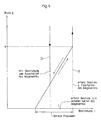
- FIG. 4 illustrates the course of the pressure characteristic curve over the current supply for the functions "proportional valve” and "directional valve".
- l the Range of the required current supply to the magnetic coil for safe holding of the directional control valve
- II the current required to switch on the Directional control valves
- valve device goes from the stop to the Tax position or remains in the same. It is then possible to use to set descending pressures.
- the valve is brought safely into the directional control valve state by briefly applying more current.
- the solenoid coil goes to zero position, the pressure on the valve switches off.
- the current can then be reduced to a low holding current in the zero position due to the increased magnetic forces.
Landscapes
- Physics & Mathematics (AREA)
- Engineering & Computer Science (AREA)
- Fluid Mechanics (AREA)
- Automation & Control Theory (AREA)
- General Physics & Mathematics (AREA)
- Mechanical Engineering (AREA)
- Power Engineering (AREA)
- General Engineering & Computer Science (AREA)
- Magnetically Actuated Valves (AREA)
- Servomotors (AREA)
- Fluid-Driven Valves (AREA)
- Valve Housings (AREA)
- Multiple-Way Valves (AREA)
Claims (18)
- Dispositif valve à actions combinées de commandes proportionnelle et/ou de distribution (1)caractérisé par la disposition suivante :1.1 avec une cage de soupape (3) comportant au moins un canal d'arrivée (6) et un canal de décharge (7) ;1.2 avec un piston soupape (5) mobile axialement dans la cage de soupape (3) et muni d'arêtes pilotes (14, 15, 16), destinées à libérer et arrêter le débouché des sections des canaux d'arrivée (6) et de décharge (7) ;1.3 avec un dispositif de réglage destiné à solliciter le piston soupape (5) par une force d'actionnement;1.4 il est prévu des moyens pour produire une force dirigée dans le sens inverse de la force d'actionnement sur au moins une première partie de la zone de travail totale du dispositif valve (1), en fonction de la pression présente dans le canal de décharge (7), comportant1.4.1 un espace intérieur (1) ménagé dans le piston soupape (5) ;1.4.2 une tige de soupape (21) agencée au moins partiellement dans l'espace intérieur (20), la tige de soupape (21) et le piston soupape (5) étant mobiles l'un par rapport à l'autre en direction axiale ;1.4.3 un canal de raccordement (36) entre l'espace intérieur (20) du piston soupape (5) et le pourtour extérieur du piston soupape (5), l'ouverture du canal de raccordement (36) sur le pourtour extérieur du piston soupape (5) étant disposée en sorte que celle-ci soit au moins indirectement en liaison avec le canal de décharge (7) dans la première partie de la zone de travail totale et sollicite la tige de soupape (21) avec la pression qui règne dans le canal de décharge (7);1.4.4 un dispositif d'accumulation d'énergie (31, F2) exerçant sur la tige de soupape (21) dans la cage de soupape (3). une force opposée à la force d'actionnement et/ou à la force exercée sur la tige de soupape (21) ;1.4.5 une butée mobile (28) associée à la tige de soupape (21) dans la cage de soupape (3), destinée à limiter le mouvement axial dans la direction d'action de la force déterminable par la pression dans le canal de décharge et agissant sur la tige de soupape (21), laquelle butée prend appui sur le dispositif d'accumulation d'énergie (31, F2) ;la tige de soupape (21) présente sur le pourtour de sa zone disposée dans l'espace intérieur (20) au moins une saillie (S) à laquelle est associée une butée dans le piston soupape (5) ,où dans la première partie de la zone de travail totale, le piston soupape (5) est déplacé dans la direction axiale et dans une deuxième partie de la zone de travail totale, le déplacement en direction axiale se poursuit et pour la tige de soupape (21) jusqu'à la butée dans le piston soupape (5) et pour le piston soupape (5).
- Dispositif valve (1) selon la revendication 1, caractérisé en ce que les moyens précités comprennent en outre un dispositif d'accumulation d'énergie (F1) placé dans l'espace intérieur (20) du piston soupape (5) entre le piston soupape (5) et la tige de soupape (21).
- Dispositif valve (1) selon l'une des revendications 1 ou 2, caractérisé en ce que lesdits moyens produisent une force directement proportionnelle à la pression dans le canal de décharge (7)et opposée à celle-ci.
- Dispositif valve (1) selon l'une des revendications 1 à 3, caractérisé en ce que les unités d'accumulation d'énergie (31, F2, F1) comprennent au moins une unité à ressort de pression.
- Dispositif valve (1) selon l'une des revendications 1 à 3, caractérisé en ce que les unités d'accumulation d'énergie (31, F2, F1) comprennent des membranes élastiques.
- Dispositif valve (1) selon l'une des revendications 1 à 4, caractérisé en ce que la tige de soupape (21) et l'espace intérieur (20) du piston soupape (5) présentent une section circulaire.
- Dispositif valve (1) selon l'une des revendications 1 à 6, caractérisé en ce que le dispositif de réglage est réalisé sous la forme d'un dispositif de réglage électromécanique.
- Dispositif valve (1) selon l'une des revendications 1 à 6 , caractérisé en ce que le dispositif de réglage est réalisé sous la forme d'un dispositif de réglage hydraulique.
- Dispositif valve (1) selon l'une des revendications 1 à 6, caractérisé en ce que le dispositif de réglage est réalisé sous la forme d'un dispositif de réglage élèctromagnétique (2), comportant un électro-aimant avec un conducteur affecté.
- Dispositif valve (1) selon la revendication 9, caractérisé par les dispositions suivantes :10.1 le dispositif de réglage électromagnétique (2) comprend au moins un électro-aimant avec une bobine et une armature qui est mobile sous l'effet du champ magnétique que peut produire la bobine et est couplée au moins indirectement avec le piston soupape (5) ;10.2 à l'armature de l'aimant, sont affectés au moins indirectement pour les différentes zones partielles de la zone de travail totale, à chaque fois un dispositif limiteur de course, - un premier limiteur et un deuxième limiteur de course - , le premier limiteur de course agissant pour la première partie de la zone de travail totale dans une plage située entre 70 et environ 80 % de la course et le deuxième limiteur dans une plage située entre 70, voire 80, et 100 %.
- Dispositif valve (1) selon la revendication 10, caractérisé en ce que le premier limiteur de course est réalisé par l'intermédiaire du dispositif à ressort (F1) et le deuxième limiteur de course par l'intermédiaire d'une butée associée à l'armature de l'aimant.
- Dispositif valve (1) selon l'une des revendications 1 à 11, caractérisé en ce que la tension initiale du dispositif d'accumulation d'énergie (31, F2) correspond à la force exercée sur la tige de commande (21) à, une pression proportionnelle maximale déterminée.
- Unité de base à soupape13.1 avec une cage de soupape (3) comportant au moins un canal d'arrivée (6) et un canal de décharge (7) ;13.2 avec un piston soupape (5) mobile axialement dans la cage de soupape (3) et muni d'arêtes pilotes (14, 15, 16) destinées à libérer et arrêter le débouché des sections des canaux d'arrivée (6) et de décharge (7) ;13.3 avec un dispositif de réglage destiné à solliciter le piston soupape (5) par une force d'actionnement ;13.4 avec un espace intérieur (20) agencé dans le piston soupape (5) et s'étendant jusqu'à la face frontale de ce dernier, dirigée dans le sens opposé à celui du dispositif de réglage ;13.5 avec une tige de soupape (.21) agencée au moins partiellement dans l'espace intérieur (20), la tige de soupape (21) et le piston soupape (5) étant mobiles l'un par rapport à l'autre, dans la direction axiale ;13.6 avec un canal de raccordement (36) entre l'espace intérieur (20) du piston soupape (5) et le pourtour extérieur du piston soupape (5), l'ouverture du canal de raccordement (36) sur le pourtour extérieur du piston soupape (5) étant disposée en sorte que celle-ci soit au moins indirectement en liaison avec le canal de décharge (7) dans la première partie de la zone de travail totale et sollicite la tige de soupape (21) avec la pression qui règne dans le canal de décharge (7);13.7 avec une butée associée à la tige de soupape (21) dans la cage de soupape (3) ;
caractérisée par la disposition suivante :13.8 la tige de soupape (21) présente sur le pourtour de sa zone agencée dans l'espace intérieur (20), au moins une saillie (S) à laquelle est associée une butée dans le piston soupape (5). - Unité de base à soupape selon la revendication 13, caractérisée par la disposition suivante :14.1 avec un dispositif d'accumulation d'énergie (31, F2) associé à la butée (28) dans le piston soupape (3) et à la tige de soupape (21), destiné à supporter au moins indirectement la tige de soupape (21).
- Unité de base à soupape selon l'une des revendications 13 ou 14, caractérisée par les dispositions suivantes :15.1 dans l'espace intérieur (20) du piston soupape (5), on a agencé un dispositif d'accumulation d'énergie supplémentaire destiné à produire une deuxième force supplémentaire dirigée dans le sens inverse de celui de la force d'actionnement15.2 le dispositif d'accumulation d'énergie supplémentaire est agencé entre la paroi intérieure de l'espace intérieur (20) et la tige de soupape (21) pour produire une deuxième force supplémentaire dirigée dans le sens opposé à celui de la force d'actionnement.
- Unité de base à soupape selon l'une des revendications 13 à 15, caractérisée en ce que les dispositifs d'accumulation d'énergie sont réalisés sous la forme d'unités à ressorts de pression.
- Unité de base à soupape selon l'une des revendications 13 à 16, caractérisée en ce que les dispositifs d'accumulation d'énergie sont réalisés sous la forme de membranes élastiques.
- Unité de base à soupape selon l'une des revendications 13 à 17, caractérisée en ce que le dispositif d'accumulation d'énergie associé à la butée, est choisi de sorte qu'en position montée, la force d'appui pouvant être produite corresponde à la force de la tige de soupape, à la pression proportionnelle maximale souhaitée.
Applications Claiming Priority (5)
| Application Number | Priority Date | Filing Date | Title |
|---|---|---|---|
| DE29705635U | 1997-04-02 | ||
| DE29705635U DE29705635U1 (de) | 1997-04-02 | 1997-04-02 | Ventileinrichtung, insbesondere kombinierte Proportional-Wegeventileinrichtung |
| DE19719557 | 1997-05-09 | ||
| DE19719557A DE19719557A1 (de) | 1997-04-02 | 1997-05-09 | Ventileinrichtung, insbesondere kombinierte Proportional-Wegeventileinrichtung |
| PCT/EP1998/001810 WO1998044266A1 (fr) | 1997-04-02 | 1998-03-27 | Dispositif a soupape, en particulier dispositif combine valve proportionnelle-distributeur |
Publications (2)
| Publication Number | Publication Date |
|---|---|
| EP0904495A1 EP0904495A1 (fr) | 1999-03-31 |
| EP0904495B1 true EP0904495B1 (fr) | 2003-06-04 |
Family
ID=26036435
Family Applications (1)
| Application Number | Title | Priority Date | Filing Date |
|---|---|---|---|
| EP98919169A Expired - Lifetime EP0904495B1 (fr) | 1997-04-02 | 1998-03-27 | Dispositif a soupape, en particulier dispositif combine valve proportionnelle-distributeur |
Country Status (6)
| Country | Link |
|---|---|
| US (1) | US6374856B1 (fr) |
| EP (1) | EP0904495B1 (fr) |
| JP (2) | JP3600936B2 (fr) |
| AT (1) | ATE242432T1 (fr) |
| CA (1) | CA2257134C (fr) |
| WO (1) | WO1998044266A1 (fr) |
Cited By (1)
| Publication number | Priority date | Publication date | Assignee | Title |
|---|---|---|---|---|
| US7260462B2 (en) * | 2003-02-06 | 2007-08-21 | Robert Bosch Gmbh | Method for controlling an electromagnetic valve, in particular for an automatic transmission of a motor vehicle |
Families Citing this family (10)
| Publication number | Priority date | Publication date | Assignee | Title |
|---|---|---|---|---|
| US6739293B2 (en) * | 2000-12-04 | 2004-05-25 | Sturman Industries, Inc. | Hydraulic valve actuation systems and methods |
| JP3994871B2 (ja) * | 2002-12-19 | 2007-10-24 | いすゞ自動車株式会社 | 圧力比例制御弁 |
| US7156115B2 (en) * | 2003-01-28 | 2007-01-02 | Lancer Partnership, Ltd | Method and apparatus for flow control |
| JP4406292B2 (ja) * | 2004-01-20 | 2010-01-27 | 株式会社フジキン | 流体通路のウォータハンマーレス開放方法及びこれを用いたウォータハンマーレス開放装置 |
| DE102005001055A1 (de) * | 2005-01-07 | 2006-07-20 | Voith Turbo Gmbh & Co. Kg | Redundante elektrohydraulische Ventilanordnung |
| US8375982B2 (en) * | 2009-09-28 | 2013-02-19 | The United States Of America, As Represented By The Administrator Of The U.S. Environmental Protection Agency | Hydraulic circuit and manifold with multifunction valve |
| JP5547004B2 (ja) * | 2010-09-07 | 2014-07-09 | 瓜生製作株式会社 | 油圧式トルクレンチの打撃トルク調節装置 |
| US11242041B2 (en) * | 2018-04-23 | 2022-02-08 | Safran Landing Systems Canada Inc. | Slow response solenoid hydraulic valve, and associated systems and methods |
| CN108716493B (zh) * | 2018-07-25 | 2024-05-03 | 台州东仪机械制造有限公司 | 气缸节能系统 |
| CN119467739B (zh) * | 2024-11-20 | 2025-11-04 | 韶关博尔兹阀门工业有限公司 | 一种比例阀 |
Family Cites Families (15)
| Publication number | Priority date | Publication date | Assignee | Title |
|---|---|---|---|---|
| FR2236132B1 (fr) | 1973-07-03 | 1983-11-18 | Messier Hispano Sa | |
| GB2076125B (en) * | 1980-05-17 | 1984-03-07 | Expert Ind Controls Ltd | Electro-hydraulic control valve |
| DE3114437C2 (de) * | 1981-04-09 | 1989-10-12 | Mannesmann Rexroth GmbH, 8770 Lohr | Druckregelventil |
| DE3406794A1 (de) * | 1984-02-24 | 1985-09-05 | Mannesmann Rexroth GmbH, 8770 Lohr | Druckregelventil |
| DE3807583C1 (fr) | 1988-03-08 | 1989-03-09 | Heilmeier & Weinlein Fabrik Fuer Oel-Hydraulik Gmbh & Co Kg, 8000 Muenchen, De | |
| DE3844412A1 (de) * | 1988-12-30 | 1990-07-05 | Rexroth Mannesmann Gmbh | Einseitig angesteuertes proportionalventil mit sicherheitseinrichtung |
| DE3844413A1 (de) | 1988-12-30 | 1990-07-05 | Rexroth Mannesmann Gmbh | Magnet mit mehrfachanker |
| US5251671A (en) * | 1989-11-07 | 1993-10-12 | Atsugi Unisia Corporation | Pressure control valve assembly with feature of easy adjustment of set load |
| US5191827A (en) * | 1990-04-12 | 1993-03-09 | Bendix Europe Services Techniques | Electrically controlled pressure-regulating system for a hydraulic circuit |
| DE4206210A1 (de) | 1992-02-28 | 1993-09-02 | Rexroth Mannesmann Gmbh | Elektromagnetisch betaetigbares druckbegrenzungs- oder druckregelventil |
| DE4212550C2 (de) | 1992-04-15 | 1998-12-10 | Hydraulik Ring Gmbh | Ventilanordnung mit einem Wegeventil |
| IT1260476B (it) | 1992-05-28 | 1996-04-09 | Dispositivo azionatore a comando elettromagnetico in particolare per valvole ed applicazioni elettroidrauliche | |
| US5571248A (en) * | 1995-03-10 | 1996-11-05 | General Motors Corporation | Pressure regulator |
| US5577534A (en) * | 1995-06-02 | 1996-11-26 | Applied Power Inc. | Load sensing proportional pressure control valve |
| DE19631803B4 (de) * | 1996-08-07 | 2007-08-02 | Bosch Rexroth Aktiengesellschaft | Hydraulische Steuervorrichtung |
-
1998
- 1998-03-27 JP JP54114598A patent/JP3600936B2/ja not_active Expired - Fee Related
- 1998-03-27 EP EP98919169A patent/EP0904495B1/fr not_active Expired - Lifetime
- 1998-03-27 WO PCT/EP1998/001810 patent/WO1998044266A1/fr not_active Ceased
- 1998-03-27 AT AT98919169T patent/ATE242432T1/de not_active IP Right Cessation
- 1998-03-27 CA CA002257134A patent/CA2257134C/fr not_active Expired - Fee Related
- 1998-03-27 US US09/194,660 patent/US6374856B1/en not_active Expired - Fee Related
-
2004
- 2004-05-10 JP JP2004140026A patent/JP3955580B2/ja not_active Expired - Fee Related
Cited By (1)
| Publication number | Priority date | Publication date | Assignee | Title |
|---|---|---|---|---|
| US7260462B2 (en) * | 2003-02-06 | 2007-08-21 | Robert Bosch Gmbh | Method for controlling an electromagnetic valve, in particular for an automatic transmission of a motor vehicle |
Also Published As
| Publication number | Publication date |
|---|---|
| EP0904495A1 (fr) | 1999-03-31 |
| CA2257134A1 (fr) | 1998-10-08 |
| CA2257134C (fr) | 2008-06-17 |
| JP3955580B2 (ja) | 2007-08-08 |
| JP2000511620A (ja) | 2000-09-05 |
| US6374856B1 (en) | 2002-04-23 |
| ATE242432T1 (de) | 2003-06-15 |
| JP3600936B2 (ja) | 2004-12-15 |
| WO1998044266A1 (fr) | 1998-10-08 |
| JP2005114157A (ja) | 2005-04-28 |
Similar Documents
| Publication | Publication Date | Title |
|---|---|---|
| DE69109951T2 (de) | Ventilstellglied mit hydraulischem Antrieb und pneumatischem Rücklauf. | |
| EP0864794A2 (fr) | Soupape d'étranglement proportionnelle | |
| EP0681128A1 (fr) | Electrovanne | |
| EP1370773B1 (fr) | Distributeur | |
| DE19716856B4 (de) | Baueinheit für ein Hydraulikventil | |
| EP0904495A1 (fr) | Dispositif a soupape, en particulier dispositif combine valve proportionnelle-distributeur | |
| EP1148251A2 (fr) | Soupape de commande de pression | |
| EP0100973B1 (fr) | Soupape proportionnelle pour commande de précision hydraulique | |
| EP0955472B1 (fr) | Soupape à siège | |
| DE10241449A1 (de) | Elektromagnetisches Druckregelventil | |
| EP3240966B1 (fr) | Dispositif soupape | |
| DE19719557A1 (de) | Ventileinrichtung, insbesondere kombinierte Proportional-Wegeventileinrichtung | |
| DE2361591A1 (de) | Schieberventil zur steuerung des arbeitsdrucks eines arbeitsmediums | |
| EP0241870A2 (fr) | Dispositif de commande hydraulique | |
| EP1302958B1 (fr) | Soupape à siège pour vérin différentiel pour sectionneur | |
| DE4418514B4 (de) | Elektrohydraulisches Wegeventil | |
| DE3039002A1 (de) | Druckregelventil | |
| DE102008058589A1 (de) | Modulares Ventil- und Kennlinienkonzept | |
| DE19702948C2 (de) | Ventilanordnung | |
| DE3408593A1 (de) | Hydraulisches dreiwege-stetigventil fuer blockeinbau | |
| EP0528103B2 (fr) | Dispositif de commande électro-hydraulique | |
| DE3524728C2 (de) | Ventilanordnung | |
| DE3012044A1 (de) | 2-wege-proportionaldrosselventil | |
| DE3909433A1 (de) | Elektrohydraulische stelleinrichtung | |
| DE10243284B4 (de) | Steuerungsvorrichtung zur Betätigung eines hydraulischen Stellantriebes |
Legal Events
| Date | Code | Title | Description |
|---|---|---|---|
| PUAI | Public reference made under article 153(3) epc to a published international application that has entered the european phase |
Free format text: ORIGINAL CODE: 0009012 |
|
| 17P | Request for examination filed |
Effective date: 19981104 |
|
| AK | Designated contracting states |
Kind code of ref document: A1 Designated state(s): AT BE CH DE ES FI FR GB IT LI NL SE |
|
| 17Q | First examination report despatched |
Effective date: 20000927 |
|
| GRAH | Despatch of communication of intention to grant a patent |
Free format text: ORIGINAL CODE: EPIDOS IGRA |
|
| RAP1 | Party data changed (applicant data changed or rights of an application transferred) |
Owner name: VOITH TURBO GMBH & CO. KG |
|
| GRAH | Despatch of communication of intention to grant a patent |
Free format text: ORIGINAL CODE: EPIDOS IGRA |
|
| GRAA | (expected) grant |
Free format text: ORIGINAL CODE: 0009210 |
|
| AK | Designated contracting states |
Designated state(s): AT BE CH DE ES FI FR GB IT LI NL SE |
|
| PG25 | Lapsed in a contracting state [announced via postgrant information from national office to epo] |
Ref country code: NL Free format text: LAPSE BECAUSE OF FAILURE TO SUBMIT A TRANSLATION OF THE DESCRIPTION OR TO PAY THE FEE WITHIN THE PRESCRIBED TIME-LIMIT Effective date: 20030604 Ref country code: IT Free format text: LAPSE BECAUSE OF FAILURE TO SUBMIT A TRANSLATION OF THE DESCRIPTION OR TO PAY THE FEE WITHIN THE PRE;WARNING: LAPSES OF ITALIAN PATENTS WITH EFFECTIVE DATE BEFORE 2007 MAY HAVE OCCURRED AT ANY TIME BEFORE 2007. THE CORRECT EFFECTIVE DATE MAY BE DIFFERENT FROM THE ONE RECORDED.SCRIBED TIME-LIMIT Effective date: 20030604 Ref country code: FI Free format text: LAPSE BECAUSE OF FAILURE TO SUBMIT A TRANSLATION OF THE DESCRIPTION OR TO PAY THE FEE WITHIN THE PRESCRIBED TIME-LIMIT Effective date: 20030604 |
|
| REG | Reference to a national code |
Ref country code: GB Ref legal event code: FG4D Free format text: NOT ENGLISH |
|
| REG | Reference to a national code |
Ref country code: CH Ref legal event code: EP |
|
| GBT | Gb: translation of ep patent filed (gb section 77(6)(a)/1977) | ||
| REF | Corresponds to: |
Ref document number: 59808592 Country of ref document: DE Date of ref document: 20030710 Kind code of ref document: P |
|
| REG | Reference to a national code |
Ref country code: SE Ref legal event code: TRGR |
|
| PG25 | Lapsed in a contracting state [announced via postgrant information from national office to epo] |
Ref country code: ES Free format text: LAPSE BECAUSE OF FAILURE TO SUBMIT A TRANSLATION OF THE DESCRIPTION OR TO PAY THE FEE WITHIN THE PRESCRIBED TIME-LIMIT Effective date: 20030915 |
|
| NLV1 | Nl: lapsed or annulled due to failure to fulfill the requirements of art. 29p and 29m of the patents act | ||
| ET | Fr: translation filed | ||
| PG25 | Lapsed in a contracting state [announced via postgrant information from national office to epo] |
Ref country code: LI Free format text: LAPSE BECAUSE OF NON-PAYMENT OF DUE FEES Effective date: 20040331 Ref country code: CH Free format text: LAPSE BECAUSE OF NON-PAYMENT OF DUE FEES Effective date: 20040331 Ref country code: BE Free format text: LAPSE BECAUSE OF NON-PAYMENT OF DUE FEES Effective date: 20040331 |
|
| PLBE | No opposition filed within time limit |
Free format text: ORIGINAL CODE: 0009261 |
|
| STAA | Information on the status of an ep patent application or granted ep patent |
Free format text: STATUS: NO OPPOSITION FILED WITHIN TIME LIMIT |
|
| 26N | No opposition filed |
Effective date: 20040305 |
|
| BERE | Be: lapsed |
Owner name: *VOITH TURBO G.M.B.H. & CO. K.G. Effective date: 20040331 |
|
| REG | Reference to a national code |
Ref country code: CH Ref legal event code: PL |
|
| PGFP | Annual fee paid to national office [announced via postgrant information from national office to epo] |
Ref country code: AT Payment date: 20090324 Year of fee payment: 12 |
|
| PGFP | Annual fee paid to national office [announced via postgrant information from national office to epo] |
Ref country code: GB Payment date: 20090324 Year of fee payment: 12 |
|
| PGFP | Annual fee paid to national office [announced via postgrant information from national office to epo] |
Ref country code: SE Payment date: 20090324 Year of fee payment: 12 Ref country code: DE Payment date: 20090330 Year of fee payment: 12 |
|
| PGFP | Annual fee paid to national office [announced via postgrant information from national office to epo] |
Ref country code: FR Payment date: 20090325 Year of fee payment: 12 |
|
| EUG | Se: european patent has lapsed | ||
| GBPC | Gb: european patent ceased through non-payment of renewal fee |
Effective date: 20100327 |
|
| PG25 | Lapsed in a contracting state [announced via postgrant information from national office to epo] |
Ref country code: AT Free format text: LAPSE BECAUSE OF NON-PAYMENT OF DUE FEES Effective date: 20100327 |
|
| REG | Reference to a national code |
Ref country code: FR Ref legal event code: ST Effective date: 20101130 |
|
| PG25 | Lapsed in a contracting state [announced via postgrant information from national office to epo] |
Ref country code: FR Free format text: LAPSE BECAUSE OF NON-PAYMENT OF DUE FEES Effective date: 20100331 |
|
| PG25 | Lapsed in a contracting state [announced via postgrant information from national office to epo] |
Ref country code: DE Free format text: LAPSE BECAUSE OF NON-PAYMENT OF DUE FEES Effective date: 20101001 |
|
| PG25 | Lapsed in a contracting state [announced via postgrant information from national office to epo] |
Ref country code: GB Free format text: LAPSE BECAUSE OF NON-PAYMENT OF DUE FEES Effective date: 20100327 |
|
| PG25 | Lapsed in a contracting state [announced via postgrant information from national office to epo] |
Ref country code: SE Free format text: LAPSE BECAUSE OF NON-PAYMENT OF DUE FEES Effective date: 20100328 |