EP0899686A2 - Rechnerprogrammprodukt zum Erfassen von roten Augen - Google Patents
Rechnerprogrammprodukt zum Erfassen von roten Augen Download PDFInfo
- Publication number
- EP0899686A2 EP0899686A2 EP98202756A EP98202756A EP0899686A2 EP 0899686 A2 EP0899686 A2 EP 0899686A2 EP 98202756 A EP98202756 A EP 98202756A EP 98202756 A EP98202756 A EP 98202756A EP 0899686 A2 EP0899686 A2 EP 0899686A2
- Authority
- EP
- European Patent Office
- Prior art keywords
- color
- computer program
- redeye
- eye
- image
- Prior art date
- Legal status (The legal status is an assumption and is not a legal conclusion. Google has not performed a legal analysis and makes no representation as to the accuracy of the status listed.)
- Withdrawn
Links
Images



Classifications
-
- G—PHYSICS
- G06—COMPUTING OR CALCULATING; COUNTING
- G06V—IMAGE OR VIDEO RECOGNITION OR UNDERSTANDING
- G06V40/00—Recognition of biometric, human-related or animal-related patterns in image or video data
- G06V40/10—Human or animal bodies, e.g. vehicle occupants or pedestrians; Body parts, e.g. hands
- G06V40/18—Eye characteristics, e.g. of the iris
- G06V40/193—Preprocessing; Feature extraction
-
- G—PHYSICS
- G06—COMPUTING OR CALCULATING; COUNTING
- G06T—IMAGE DATA PROCESSING OR GENERATION, IN GENERAL
- G06T7/00—Image analysis
- G06T7/0002—Inspection of images, e.g. flaw detection
-
- G—PHYSICS
- G06—COMPUTING OR CALCULATING; COUNTING
- G06T—IMAGE DATA PROCESSING OR GENERATION, IN GENERAL
- G06T7/00—Image analysis
- G06T7/90—Determination of colour characteristics
-
- H—ELECTRICITY
- H04—ELECTRIC COMMUNICATION TECHNIQUE
- H04N—PICTORIAL COMMUNICATION, e.g. TELEVISION
- H04N1/00—Scanning, transmission or reproduction of documents or the like, e.g. facsimile transmission; Details thereof
- H04N1/46—Colour picture communication systems
- H04N1/56—Processing of colour picture signals
- H04N1/60—Colour correction or control
- H04N1/62—Retouching, i.e. modification of isolated colours only or in isolated picture areas only
- H04N1/624—Red-eye correction
-
- G—PHYSICS
- G06—COMPUTING OR CALCULATING; COUNTING
- G06T—IMAGE DATA PROCESSING OR GENERATION, IN GENERAL
- G06T2207/00—Indexing scheme for image analysis or image enhancement
- G06T2207/10—Image acquisition modality
- G06T2207/10024—Color image
-
- G—PHYSICS
- G06—COMPUTING OR CALCULATING; COUNTING
- G06T—IMAGE DATA PROCESSING OR GENERATION, IN GENERAL
- G06T2207/00—Indexing scheme for image analysis or image enhancement
- G06T2207/30—Subject of image; Context of image processing
- G06T2207/30196—Human being; Person
- G06T2207/30201—Face
-
- G—PHYSICS
- G06—COMPUTING OR CALCULATING; COUNTING
- G06T—IMAGE DATA PROCESSING OR GENERATION, IN GENERAL
- G06T2207/00—Indexing scheme for image analysis or image enhancement
- G06T2207/30—Subject of image; Context of image processing
- G06T2207/30216—Redeye defect
Definitions
- the invention relates generally to the field of digital image processing and, more particular to a method for detecting redeye in digital images.
- redeye When flash illumination is used for the capture of an image sometimes the pupils of people in the image appear red. This is caused by light from the flash unit entering the pupil, multiply reflecting off the retina, and finally exiting back through the pupil. Because light is partially absorbed by capillaries in the retina the pupil appears red in the image. This phenomena is referred to as "redeye.” The probability of redeye being observed increases the closer the flash unit is to the optical axis of the lens. Therefore, redeye is commonly observed in images captured by a small camera with an integral flash unit.
- the present invention is directed to overcoming one or more of the problems set forth above.
- the invention resides in a computer program product for detecting eye color defects of a subject in an image due to flash illumination, comprising : a computer readable storage medium having a computer program stored thereon for performing the steps of: (a) detecting skin colored regions in a digital image; (b) searching the skin colored regions for groups of pixels with color characteristic of redeye defect; and (c) correcting color of the pixels based on a location of redeye defect found in step (b).
- Fig. 1 is a grayscale image 10 of a color image illustrating two pairs of redeyes 20.
- a color digital image is input to the software program residing on a computer system, such computer systems being well known in the art.
- the code values of the digital image are preferably proportional to the log of the amount of exposure of the film used to capture the image by the original scene S2.
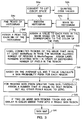
- the program begins by identifying all separate continuous skin colored regions in the image S4.
- step S4 there is illustrated a detail flowchart of step S4 in Fig. 2.
- the next step is to build a three-dimensional histogram.
- the L , S , and T code values are quantized by dividing them by 8.0 x sqrt(3), 2.0, and 2.0, respectively S4b. These quantized code values are referred to as L , S , and T .
- Each combination of L , S , and T values is referred to as a "bin" of the histogram.
- the value of the histogram H ( L , S , T ) S4c is equal to the number of pixels in the image that have quantized code values of L , S , and T .
- An alternative way of stating this is that the histogram tell us the number of pixels in the image that fall into each bin. This number is referred to as the value of the bin.
- the histogram is smoothed S4d by replacing the value of each bin by a weighted average of the value of that bin and the values of immediate neighboring bins.
- the peak values in the histogram are found S4e and each bin in the histogram is assigned S4f the peak value that is located closest to it.
- a peak is assigned to each pixel in the color image S4g.
- the single band image in which a pixel's code value is equal to the number of the peak that it was assigned to is referred to as the segmented image.
- a unique number is assigned to all such regions in the segmented image S4h. The numbers are sequentially assigned starting with 1 for the region with the greatest number of pixels.
- the single band image in which code values correspond to the label of the region that the pixel belongs to is called the labeled image.
- the program decides which of the continuous regions in the segmented image corresponds to a region in the color image that has a color that is typical of human skin.
- the average L , S , and T code values of each region is calculated and, based on this, each region is assigned a score P skin S4i.
- a high value of P skin indicates that the region is of a color that is typical of human skin.
- a low number indicates that the color of the region is atypical of skin.
- Regions for which P skin exceeds a threshold T skin of 0.10 are referred to as skin-colored regions S4j.
- One final step is necessary to associate each face in the color image with a single skin colored region.
- the process described above will often result in a single face being associated with more that one skin colored region because due to complexion, shadows, and etc., the color of the face is not uniform.
- Two skin colored regions are merged into a single skin colored region if two conditions are satisfied S4k.
- the first condition requires that the two regions be inter-connected.
- a pixel in region i has a connection to region j if a pixel belonging to region j is one of the eight nearest neighbor pixels.
- a function Q(i , j) is calculated which is proportional to the number of connections between pixels of region i and j .
- the function is normalized so that Q(i , i) is equal to 1.0.
- MinMergerFraction regions i and j will be merged into a single region if the second condition is also satisfied, for example a threshold of 0.005 may be used.
- the process of merging skin colored regions begins with the smallest region which, if the two conditions are satisfied, is merged with a larger region. If region i is merged with larger region j it may then happen that region j gets merged with an even larger region k . When this occurs regions i , j , and k are merged into a single region. Note that regions i and k may be merged together even though the above two conditions are not satisfied for these two regions. They are merged because of their mutual connection to region j .
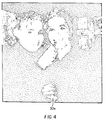
- the result of skin color detection is a map of the skin colored regions in the color image S41. Areas that are not skin colored are given a code value of zero. The separate continuous skin colored regions are numbered consecutively in order of decreasing region size beginning with the number 1.
- Fig. 4 shows a map of the skin colored regions in Fig. 1.
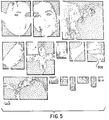
- a sub-map of each skin colored region is formed by cutting out from the skin map (Fig. 4) the smallest rectangular section that contains all of that skin region S6.
- skin region 30b in Fig. 5 corresponds to skin region 30a in Fig. 4.
- Fig. 5 shows the map of each separate continuous skin colored regions as an individual sub-map.
- the column and row of the skin map that correspond to the top left corner of the sub-map are referred to as Col cutout and Row cutout , respectively.
- code values of 255 (white) indicates that the pixel is located at a position at which skin color is present.
- a code value of 0 (black) indicates the absence of skin color.
- an ellipse 35 is fitted S8 to the individual skin color sub-maps found in step S6 (Fig. 5).
- a method of fitting an ellipse to a binary image is described in Computer and Robot Vision, Volume I, by Robert M. Haralick and Linda G. Shapiro, Addison-Wesley (1992), pp. 639-658.
- a human face is approximately elliptical. Therefore, if the skin color sub-map is of a human face, then the ellipse should fit the skin color map well and the minor axis of the ellipse should approximately equal the width of the face.
- N is the number of skin colored pixels (code value 255) in the map
- N out is the number of skin colored pixels that fall outside the ellipse
- N in is the number of skin colored pixels that are inside the ellipse
- A is the number of pixels in the ellipse.
- A is also referred to as the area of the ellipse. If all of the skin colored pixels are in the ellipse and the number of skin colored pixels equals the area of the ellipse then Fit is equal to one and the fit is perfect.
- AspectRatio D major D minor where D major is the major axis of the ellipse and D minor is the minor axis in pixels. If AspectRatio is greater than MaxAspectRatio which is set equal to 3.0 the skin colored region corresponds to an object in the image that is too long and thin to be a face. The program determines that the skin colored region is not a face and does not process it further S10.
- the map potentially indicates the position of a face.
- S prescale AimEyeDistance x FaceWidthEyeDistanceRatio D minor where AimEyeDistance which is set equal to 75 pixels is the desired distance between eyes, and FaceWidthEyeDistanceRatio which is set equal to 2.0 is the ratio between the width and eye distance for a typical face. If S prescale is less than MinPrescale 0.10 or greater than MaxPrescale 1.50 the skin colored region is not processed further S10.
- the next step is to cut-out from the color image a sub-color-image that corresponds exactly to the location of the sub-map S12. If the minor axis of the ellipse is approximately equal to the width of the face then the distance between the eyes in the face should be close to AimEyeDistance .
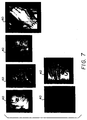
- Fig. 7 shows the sub-color-images 40 after they have been resized in this manner. It is instructive to note that Fig. 7 is illustrated as a gray scale drawing, although the actual image is a color image.
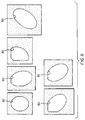
- Fig. 8 shows the ellipses 50 that correspond to each of these sub-color-images that have also been resized S14.
- the sub-color-images 40 are processed so as to identify small red features.
- Redeyes in the new image will appear as small elliptical areas of high code value possibly with a small low code value region in the middle that is due to glint in the pupil.
- the affect of glint is removed by performing a gray scale morphological closing S16b using a W _ close x W _ close kernel, for example a 3 x 3 kernal although other sizes may also be used.
- Gray scale morphological operations are disclosed in Image Analysis and Mathematical Morphology Volume 1 , by Jean Serra, Academic Press (1982), pp. 424-478.
- the small regions of high code value are removed by a gray scale morphological opening operation using a W _ open x W _ open kernel, for example a 5 x 5 kernal although other sizes may also be used S16c.
- the opened image is then subtracted from the closed image in order to form a residual image S16d.
- This image shows what was in the opened image, but not in the closed image. Namely, small regions of high code value which correspond to small red features in the sub-color-image.
- the residual image is smoothed S16e with a linear filter having the kernel shown below. 1 2 1 2 4 2 1 2 1 For each pixel in the smoothed residual image, a 7x7 window centered at that pixel is examined.
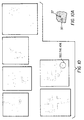
- Fig. 10 shows the peaks 37 for all of the sub-color-images in Fig. 7. After all the peaks in the smoothed residual image have been found the individual peaks are examined S16g. First, if a pixel has been classified as a peak and a neighboring pixel that is west, north-west, north, or north-east of this pixel has also been classified as a peak, the peak is eliminated S16h.
- a pixel that has been classified as a peak is a candidate redeye pixel. It is possible however that the location of the peak coincides with glint in the pupil and not the red defect. For this reason, pixels within a distance GlintRadius equal to 2 from the peak are examined S16i. The candidate redeye pixel is moved to the nearby pixel with the highest color score P color which will be defined below.
- the candidate redeye pixel is used as a seed to grow a continuous region of pixels of simular color. If the number of pixels in the region is less than MinSize or greater than MaxSize the region is not of a size that is characteristic of a redeye defect and the candidate redeye pixel is eliminated S16j.
- the result of the above processing is a map of candidate redeye pixels for each sub-color-image S16k.
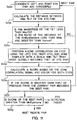
- the ellipses in Fig. 8 are approximate maps of the region in the corresponding sub-color-images in Fig. 7 that have been identified as potentially being a face. Therefore, only the candidate redeye pixels that fall inside of the ellipse are considered in the next phase eye detection which is outlined in Fig. 11.
- the purpose of eye detection is to determine whether the candidate redeye pixels are indeed part of an eye.
- the eye detection procedure requires a monotone version of the color image S18.
- This monocolor version of the color image will be referred to as the luminance image.
- the eye detection procedure S20 in Fig. 2 is based on the process of template matching. It facilitates understanding to note that any image of an eye can be used a the template.
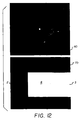
- the top image 60 in Fig. 12 shows a left-eye template.
- the bottom image 70 shows a division of the template into zones. Zone 1 is the eyebrow region. Zones 2 and 3 are the left and right sides of the eye, respectively. Zone 4 includes the pupil and iris. Zone 0 is not used.
- the eye template was taken from an image in which the distance between the eyes is TemplateEyeDistance equal to 306 pixels and the tilt of the two eyes is close to zero.
- the estimation of the face width from the minor axis of the ellipse will not always be accurate. Also, the eyes may be tilted. For this reason starting with the original left-eye template and the zone map, a collection of left-eye, right-eye (mirror image of left-eye), and zone maps are generated that span a range of sizes and orientations S22.
- the original eye template and zone map are resized from a factor of S 0 x Narrow to S 0 x Wide in increments of SStep .
- Preferred values of Narrow , Wide , and Sstep are 1.5, 0.50, and 0.05, respectively.
- a series of tilted templates and zone maps are generated that range from - MaxTilt degrees (clock-wise tilt) to MaxTilt degrees in increments of TStep degrees S22.
- the preferred value of MaxTilt is 30 degrees and of TStep is 2.0 degrees.
- step S20 of Fig. 2 A pair of candidate redeye pixels are considered that hypothetically belong to a left and right redeye pair S20a.
- an ensemble of eye templates and zone map templates were made that span a range of resize factors from S 0 x Narrow to S 0 x Wide with resolution SStep and with a tilt from - MaxTilt degrees to MaxTilt degrees with a resolution TStep .
- the left-eye template, right-eye template, and zone map that most closely match the value of S pair and Tilt for the pair of candidate redeye pixels is used in the correlation step that follows. If S pair or Tilt are outside of this range, this pair is not processed further S20c.
- the next step is to determine if the region around the redeye pixel matches an eye. This is done by performing a correlation of the left-eye template with a region around the left candidate redeye pixel and the right-eye template with a region around the right candidate redeye pixel of the luminance image S20d.
- One step of the correlation process is to match up pixels of the template and luminance image and calculate the product of their code values.
- the center of the template images corresponds to the center of the eye. Since the candidate redeye pixels are close, but not necessarily at the center of an eye, we perform the correlation several times with the center of the template matched to all of the pixels within a square that extends a distance LookAround equal to 3 about the candidate redeye pixel.
- the correlation is performed separately for zones 1 through 4 of the template (see Fig. 12). These correlations are referred to as Cz1 , Cz2 , Cz3 , and Cz4 .
- an overall correlation is calculated for a region that consists of the sum of zones 1 through 4. This overall correlation is referred to as C .
- the pixel in the square around the candidate redeye pixel with the highest value of the overall correlation C is the best guess of the center of an eye which contains the candidate redeye pixel. This pixel is referred to as the eye-center pixel. Both the left and right candidate redeye pixels have an associated eye-center pixel.
- the template image is denoted by the function ⁇ ( p , l ) where p is the column number and l is the row number.
- the number of columns and rows in the template is w and h , respectively.
- the center of the eye template is approximately the location of the center of the eye.
- a zone of the template is correlated with the luminance image which we denote by ⁇ ( p , l ) at column p o and row l o by calculating the product ⁇ given by.
- ⁇ 1 N z p ⁇ z / ⁇ z ⁇ ( p + p o - w /2-1,/+/ o - h /2-1) ⁇ ( p,l )
- p ⁇ Z means that column p is in zone Z
- l ⁇ Z means that row l is in zone Z
- N z is the number of pixels in the zone.
- M ⁇ 1 N z p ⁇ z / ⁇ z ⁇ ( p,l ) is also calculated.
- the standard deviation of the template in zone Z is calculated according to the equation.
- ⁇ ⁇ 1 N z p ⁇ z / ⁇ z ( ⁇ ( p,l )- M ⁇ ) 2 1/2
- the values of C , C z1 , C z2 , C z3 , and C z4 for the eye-center pixels are used in the calculation of a score that is a measure of the likelihood that the pair of candidate redeye pixels are part of a redeye defect in the sub-color-image S20e.
- Each of the correlations are used as a variable in an associated scoring function that ranges from 0.0 to 1.0.
- the scoring function associated with the overall correlation C which we refer to as pC(C) is 0.0 if the value of C for an eye-center pixel indicates that it is very unlikely that the pixel actually is located at the center of an eye.
- Scores are defined based on these scoring functions which will be combined later into an overall score for a candidate redeye pair.
- the score P zone associated with the zone correlations is a weighted average of the zone correlation scoring functions. It has been found that the correlation in zone 4 (the pupil) is a much more reliable indicator of the presence of an eye than the other zones. For this reason it is given more weight than other zones. Typical we set the weight W equal to 6.0.
- P zone pC z 1 ( C Z1 )+ pC z 2 ( C z 2 )+ pC z 3 ( C z 3 )+ WpC z 4 ( C z 4 ) W +3
- the color of the candidate redeye pixel must be indicative of a real redeye defect.
- code values of the candidate redeye pixel is convert into luminance ( Lum ), hue ( Hue ), and saturation ( Sat ) values.
- the value of Lum for a pixel ranges from zero to the highest possible code value.
- the hue is defined as in Computer Graphics Principles and Practice 2nd ed.
- the color red is shifted to a hue angle of 120 degrees.
- the value of Hue may range from 0 to 360 degrees.
- P eye P corr P zone P sigma P color Its value is in the range of 0.0 to 1.0.
- the pair of candidate redeye pixels for which P pair is the largest is referred to as the best pair of candidate redeye pixels S20f. If P pair exceeds the threshold MinEyeScore equal to 0.05, then the program processes further. Otherwise, the program concludes that a pair of redeyes is not present in the sub-color-image S20g.
- One method of confirming that a pair of redeyes has indeed been located is to use the fact that a human face is approximately symmetric about a line that bisects the face S24 in Fig. 2.
- the sub-color-image is rotated so that the tilt of a line connecting the best pair of candidate redeye pixels is equal to zero.
- an image centered at the midpoint between the eyes is cut-out of the sub-color-image. This image has a width of 1.5 times the distance between the candidate redeye pixels and a height equal to a quarter of its width. This image is in turn cut in half.
- the left half-image we refer to as E x left (p,l) and the right half-image by E x right (p,l) where the superscript x refers to a band of the color image.
- E r left (p,l) refers to the red band of the image.
- the columns in the right half-image are inverted (the first column becomes the last column, etc.) so that it becomes a mirror image of itself.
- C x sym ⁇ x sym - M x left M x right ⁇ x left ⁇ x right where M x left and M x right are the mean code values of band x of the half-images and ⁇ x left and ⁇ x right are the standard deviations.
- the final score P is simply the product of P sym and P pair .
- P P sym P pair If this score which may range between 0.0 and 1.0 exceeds a threshold MinScore which is set equal to 0.05 S26, then the candidate redeye pixel pair is assumed to mark the location of a pair of redeye defects in the resized sub-color-image.
Landscapes
- Engineering & Computer Science (AREA)
- Physics & Mathematics (AREA)
- Computer Vision & Pattern Recognition (AREA)
- Theoretical Computer Science (AREA)
- General Physics & Mathematics (AREA)
- Multimedia (AREA)
- Ophthalmology & Optometry (AREA)
- Human Computer Interaction (AREA)
- General Health & Medical Sciences (AREA)
- Health & Medical Sciences (AREA)
- Quality & Reliability (AREA)
- Signal Processing (AREA)
- Image Processing (AREA)
- Stroboscope Apparatuses (AREA)
- Editing Of Facsimile Originals (AREA)
- Facsimile Image Signal Circuits (AREA)
- Image Analysis (AREA)
- Color Television Image Signal Generators (AREA)
Applications Claiming Priority (2)
| Application Number | Priority Date | Filing Date | Title |
|---|---|---|---|
| US919560 | 1997-08-29 | ||
| US08/919,560 US6292574B1 (en) | 1997-08-29 | 1997-08-29 | Computer program product for redeye detection |
Publications (2)
| Publication Number | Publication Date |
|---|---|
| EP0899686A2 true EP0899686A2 (de) | 1999-03-03 |
| EP0899686A3 EP0899686A3 (de) | 2000-06-14 |
Family
ID=25442312
Family Applications (1)
| Application Number | Title | Priority Date | Filing Date |
|---|---|---|---|
| EP98202756A Withdrawn EP0899686A3 (de) | 1997-08-29 | 1998-08-17 | Rechnerprogrammprodukt zum Erfassen von roten Augen |
Country Status (3)
| Country | Link |
|---|---|
| US (1) | US6292574B1 (de) |
| EP (1) | EP0899686A3 (de) |
| JP (1) | JP4428737B2 (de) |
Cited By (10)
| Publication number | Priority date | Publication date | Assignee | Title |
|---|---|---|---|---|
| WO2000067204A3 (en) * | 1999-05-03 | 2001-03-01 | Pictuality Inc | Image analysis process |
| EP1293933A1 (de) * | 2001-09-03 | 2003-03-19 | Agfa-Gevaert AG | Verfahren zum automatischen Erkennen von rote-Augen-Defekten in fotografischen Bilddaten |
| AU769886B2 (en) * | 2000-03-01 | 2004-02-05 | Canon Kabushiki Kaisha | Segmenting an image |
| EP1271394A3 (de) * | 2001-06-19 | 2004-02-11 | Eastman Kodak Company | Verfahren zum automatischen Lokalisieren von Augen in einem Bild |
| EP1255225A3 (de) * | 2001-05-01 | 2004-03-31 | Eastman Kodak Company | Verfahren zur Detektion von Augen- und Mundpositionen in einem Digitalbild |
| EP1229493A3 (de) * | 2000-12-19 | 2004-12-15 | Eastman Kodak Company | Multimodales Bildverarbeitungsverfahren zur Augendetektion |
| US6980691B2 (en) | 2001-07-05 | 2005-12-27 | Corel Corporation | Correction of “red-eye” effects in images |
| EP1530158A3 (de) * | 2003-11-05 | 2006-05-24 | Omron Corporation | Vorrichtung zur Schätzung der Pupillenfarbe |
| EP2051210A1 (de) * | 2007-10-17 | 2009-04-22 | Qualcomm Incorporated | Wirksame Eliminierung roter Augen auf digitalen Bildern ohne Gesichtsdetektion |
| EP1365357A4 (de) * | 2001-02-19 | 2009-11-25 | Nec Corp | Einrichtung zur erzeugung eines bildmerkmals aus einem bild mit beliebiger form |
Families Citing this family (114)
| Publication number | Priority date | Publication date | Assignee | Title |
|---|---|---|---|---|
| US6786420B1 (en) | 1997-07-15 | 2004-09-07 | Silverbrook Research Pty. Ltd. | Data distribution mechanism in the form of ink dots on cards |
| US6618117B2 (en) | 1997-07-12 | 2003-09-09 | Silverbrook Research Pty Ltd | Image sensing apparatus including a microcontroller |
| US20040160524A1 (en) * | 1997-07-15 | 2004-08-19 | Kia Silverbrook | Utilising exposure information for image processing in a digital image camera |
| US7551202B2 (en) * | 1997-07-15 | 2009-06-23 | Silverbrook Research Pty Ltd | Digital camera with integrated inkjet printer |
| AUPO799997A0 (en) | 1997-07-15 | 1997-08-07 | Silverbrook Research Pty Ltd | Image processing method and apparatus (ART10) |
| US6948794B2 (en) | 1997-07-15 | 2005-09-27 | Silverbrook Reserach Pty Ltd | Printhead re-capping assembly for a print and demand digital camera system |
| US6690419B1 (en) | 1997-07-15 | 2004-02-10 | Silverbrook Research Pty Ltd | Utilising eye detection methods for image processing in a digital image camera |
| US6879341B1 (en) | 1997-07-15 | 2005-04-12 | Silverbrook Research Pty Ltd | Digital camera system containing a VLIW vector processor |
| US7705891B2 (en) | 1997-07-15 | 2010-04-27 | Silverbrook Research Pty Ltd | Correction of distortions in digital images |
| US6985207B2 (en) | 1997-07-15 | 2006-01-10 | Silverbrook Research Pty Ltd | Photographic prints having magnetically recordable media |
| US7714889B2 (en) * | 1997-07-15 | 2010-05-11 | Silverbrook Research Pty Ltd | Digital camera using exposure information for image processing |
| US7077515B2 (en) | 1997-07-15 | 2006-07-18 | Silverbrook Research Pty Ltd | Media cartridge for inkjet printhead |
| AUPO850597A0 (en) | 1997-08-11 | 1997-09-04 | Silverbrook Research Pty Ltd | Image processing method and apparatus (art01a) |
| US6624848B1 (en) | 1997-07-15 | 2003-09-23 | Silverbrook Research Pty Ltd | Cascading image modification using multiple digital cameras incorporating image processing |
| US7246897B2 (en) | 1997-07-15 | 2007-07-24 | Silverbrook Research Pty Ltd | Media cartridge for inkjet printhead |
| AUPO802797A0 (en) | 1997-07-15 | 1997-08-07 | Silverbrook Research Pty Ltd | Image processing method and apparatus (ART54) |
| US7110024B1 (en) | 1997-07-15 | 2006-09-19 | Silverbrook Research Pty Ltd | Digital camera system having motion deblurring means |
| US7593058B2 (en) * | 1997-07-15 | 2009-09-22 | Silverbrook Research Pty Ltd | Digital camera with integrated inkjet printer having removable cartridge containing ink and media substrate |
| US7352394B1 (en) | 1997-10-09 | 2008-04-01 | Fotonation Vision Limited | Image modification based on red-eye filter analysis |
| US7738015B2 (en) | 1997-10-09 | 2010-06-15 | Fotonation Vision Limited | Red-eye filter method and apparatus |
| US7630006B2 (en) | 1997-10-09 | 2009-12-08 | Fotonation Ireland Limited | Detecting red eye filter and apparatus using meta-data |
| US7042505B1 (en) * | 1997-10-09 | 2006-05-09 | Fotonation Ireland Ltd. | Red-eye filter method and apparatus |
| JPH11175699A (ja) * | 1997-12-12 | 1999-07-02 | Fuji Photo Film Co Ltd | 画像処理装置 |
| US6631208B1 (en) * | 1998-05-29 | 2003-10-07 | Fuji Photo Film Co., Ltd. | Image processing method |
| JP2000048184A (ja) * | 1998-05-29 | 2000-02-18 | Canon Inc | 画像処理方法及び顔領域抽出方法とその装置 |
| AUPP400998A0 (en) | 1998-06-10 | 1998-07-02 | Canon Kabushiki Kaisha | Face detection in digital images |
| AUPP702098A0 (en) | 1998-11-09 | 1998-12-03 | Silverbrook Research Pty Ltd | Image creation method and apparatus (ART73) |
| AUPQ056099A0 (en) | 1999-05-25 | 1999-06-17 | Silverbrook Research Pty Ltd | A method and apparatus (pprint01) |
| US7092122B2 (en) * | 2000-07-18 | 2006-08-15 | Fuji Photo Film Co., Ltd. | Image processing device and method |
| JP2002043200A (ja) * | 2000-07-24 | 2002-02-08 | Mitsubishi Electric Corp | 異常原因検出装置及び異常原因検出方法 |
| US6728401B1 (en) * | 2000-08-17 | 2004-04-27 | Viewahead Technology | Red-eye removal using color image processing |
| US6711286B1 (en) * | 2000-10-20 | 2004-03-23 | Eastman Kodak Company | Method for blond-hair-pixel removal in image skin-color detection |
| US6920237B2 (en) * | 2000-12-19 | 2005-07-19 | Eastman Kodak Company | Digital image processing method and computer program product for detecting human irises in an image |
| US20020081003A1 (en) * | 2000-12-27 | 2002-06-27 | Sobol Robert E. | System and method for automatically enhancing graphical images |
| US6895112B2 (en) * | 2001-02-13 | 2005-05-17 | Microsoft Corporation | Red-eye detection based on red region detection with eye confirmation |
| US20020172419A1 (en) * | 2001-05-15 | 2002-11-21 | Qian Lin | Image enhancement using face detection |
| JP4778158B2 (ja) * | 2001-05-31 | 2011-09-21 | オリンパス株式会社 | 画像選出支援装置 |
| US7058209B2 (en) * | 2001-09-20 | 2006-06-06 | Eastman Kodak Company | Method and computer program product for locating facial features |
| US7133070B2 (en) * | 2001-09-20 | 2006-11-07 | Eastman Kodak Company | System and method for deciding when to correct image-specific defects based on camera, scene, display and demographic data |
| US7155058B2 (en) * | 2002-04-24 | 2006-12-26 | Hewlett-Packard Development Company, L.P. | System and method for automatically detecting and correcting red eye |
| JP2004053324A (ja) * | 2002-07-17 | 2004-02-19 | Denso Corp | 自動車用衝突安全制御装置 |
| US7035461B2 (en) * | 2002-08-22 | 2006-04-25 | Eastman Kodak Company | Method for detecting objects in digital images |
| US7035462B2 (en) * | 2002-08-29 | 2006-04-25 | Eastman Kodak Company | Apparatus and method for processing digital images having eye color defects |
| US7397969B2 (en) * | 2002-08-30 | 2008-07-08 | Fujifilm Corporation | Red eye compensation method, image processing apparatus and method for implementing the red eye compensation method, as well as printing method and printer |
| US20040093432A1 (en) * | 2002-11-07 | 2004-05-13 | Eastman Kodak Company | Method and system for conducting image processing from a mobile client device |
| US7116820B2 (en) * | 2003-04-28 | 2006-10-03 | Hewlett-Packard Development Company, Lp. | Detecting and correcting red-eye in a digital image |
| US7224850B2 (en) * | 2003-05-13 | 2007-05-29 | Microsoft Corporation | Modification of red-eye-effect in digital image |
| EP1482724B1 (de) * | 2003-05-19 | 2007-07-11 | STMicroelectronics S.A. | Bildverarbeitungsverfahren für numerische Bilder mit Belichtungskorrektur durch Erkennung von Hautbereichen des Gegenstandes |
| US20040239968A1 (en) * | 2003-06-02 | 2004-12-02 | Gondek Jay S. | Color correction in images |
| US8036458B2 (en) | 2007-11-08 | 2011-10-11 | DigitalOptics Corporation Europe Limited | Detecting redeye defects in digital images |
| US7920723B2 (en) | 2005-11-18 | 2011-04-05 | Tessera Technologies Ireland Limited | Two stage detection for photographic eye artifacts |
| US8170294B2 (en) | 2006-11-10 | 2012-05-01 | DigitalOptics Corporation Europe Limited | Method of detecting redeye in a digital image |
| US7689009B2 (en) | 2005-11-18 | 2010-03-30 | Fotonation Vision Ltd. | Two stage detection for photographic eye artifacts |
| US8254674B2 (en) | 2004-10-28 | 2012-08-28 | DigitalOptics Corporation Europe Limited | Analyzing partial face regions for red-eye detection in acquired digital images |
| US7574016B2 (en) | 2003-06-26 | 2009-08-11 | Fotonation Vision Limited | Digital image processing using face detection information |
| US7970182B2 (en) | 2005-11-18 | 2011-06-28 | Tessera Technologies Ireland Limited | Two stage detection for photographic eye artifacts |
| US7536036B2 (en) | 2004-10-28 | 2009-05-19 | Fotonation Vision Limited | Method and apparatus for red-eye detection in an acquired digital image |
| US7587085B2 (en) | 2004-10-28 | 2009-09-08 | Fotonation Vision Limited | Method and apparatus for red-eye detection in an acquired digital image |
| US7792970B2 (en) | 2005-06-17 | 2010-09-07 | Fotonation Vision Limited | Method for establishing a paired connection between media devices |
| US20050031224A1 (en) * | 2003-08-05 | 2005-02-10 | Yury Prilutsky | Detecting red eye filter and apparatus using meta-data |
| US8520093B2 (en) | 2003-08-05 | 2013-08-27 | DigitalOptics Corporation Europe Limited | Face tracker and partial face tracker for red-eye filter method and apparatus |
| US9412007B2 (en) | 2003-08-05 | 2016-08-09 | Fotonation Limited | Partial face detector red-eye filter method and apparatus |
| US7454040B2 (en) * | 2003-08-29 | 2008-11-18 | Hewlett-Packard Development Company, L.P. | Systems and methods of detecting and correcting redeye in an image suitable for embedded applications |
| US7333653B2 (en) * | 2003-08-29 | 2008-02-19 | Hewlett-Packard Development Company, L.P. | Detecting and correcting redeye in an image |
| US7835572B2 (en) * | 2003-09-30 | 2010-11-16 | Sharp Laboratories Of America, Inc. | Red eye reduction technique |
| US7684642B2 (en) * | 2004-03-03 | 2010-03-23 | Eastman Kodak Company | Correction of redeye defects in images of humans |
| JP2005316958A (ja) * | 2004-03-30 | 2005-11-10 | Fuji Photo Film Co Ltd | 赤目検出装置および方法並びにプログラム |
| JP4505362B2 (ja) * | 2004-03-30 | 2010-07-21 | 富士フイルム株式会社 | 赤目検出装置および方法並びにプログラム |
| US7852377B2 (en) * | 2004-04-16 | 2010-12-14 | Arcsoft, Inc. | Automatic red eye removal |
| JP4496465B2 (ja) * | 2004-04-23 | 2010-07-07 | ノーリツ鋼機株式会社 | 赤目補正方法、プログラム、及びこの方法を実施する装置 |
| US20050248664A1 (en) * | 2004-05-07 | 2005-11-10 | Eastman Kodak Company | Identifying red eye in digital camera images |
| JP4574249B2 (ja) * | 2004-06-29 | 2010-11-04 | キヤノン株式会社 | 画像処理装置及びその方法、プログラム、撮像装置 |
| JP4599110B2 (ja) * | 2004-07-30 | 2010-12-15 | キヤノン株式会社 | 画像処理装置及びその方法、撮像装置、プログラム |
| EP1774466A4 (de) * | 2004-07-30 | 2009-10-21 | Canon Kk | Bildverarbeitungsverfahren und -vorrichtung, bilderfassungsvorrichtung und programm |
| US8000505B2 (en) * | 2004-09-01 | 2011-08-16 | Eastman Kodak Company | Determining the age of a human subject in a digital image |
| WO2006041426A2 (en) | 2004-09-15 | 2006-04-20 | Adobe Systems Incorporated | Locating a feature in a digital image |
| US7623707B2 (en) * | 2004-09-15 | 2009-11-24 | Adobe Systems Incorporated | Hierarchically locating a feature in a digital image |
| US7444017B2 (en) * | 2004-11-10 | 2008-10-28 | Eastman Kodak Company | Detecting irises and pupils in images of humans |
| JP4420459B2 (ja) * | 2005-06-14 | 2010-02-24 | キヤノン株式会社 | 画像処理装置およびその方法 |
| JP4498224B2 (ja) * | 2005-06-14 | 2010-07-07 | キヤノン株式会社 | 画像処理装置およびその方法 |
| JP4405942B2 (ja) | 2005-06-14 | 2010-01-27 | キヤノン株式会社 | 画像処理装置およびその方法 |
| US20070036438A1 (en) * | 2005-08-15 | 2007-02-15 | Lexmark International, Inc. | Methods and systems for identifying red eye pairs |
| US7747071B2 (en) * | 2005-10-27 | 2010-06-29 | Hewlett-Packard Development Company, L.P. | Detecting and correcting peteye |
| US7599577B2 (en) | 2005-11-18 | 2009-10-06 | Fotonation Vision Limited | Method and apparatus of correcting hybrid flash artifacts in digital images |
| GB2432659A (en) * | 2005-11-28 | 2007-05-30 | Pixology Software Ltd | Face detection in digital images |
| JP4712563B2 (ja) * | 2006-01-16 | 2011-06-29 | 富士フイルム株式会社 | 顔検出方法および装置並びにプログラム |
| EP1987475A4 (de) | 2006-02-14 | 2009-04-22 | Fotonation Vision Ltd | Automatische erkennung und korrektur von fehlern des blitzes mit rote-augen-effekt |
| WO2008023280A2 (en) | 2006-06-12 | 2008-02-28 | Fotonation Vision Limited | Advances in extending the aam techniques from grayscale to color images |
| US8064694B2 (en) * | 2006-06-21 | 2011-11-22 | Hewlett-Packard Development Company, L.P. | Nonhuman animal integument pixel classification |
| US20080170778A1 (en) * | 2007-01-15 | 2008-07-17 | Huitao Luo | Method and system for detection and removal of redeyes |
| US8055067B2 (en) | 2007-01-18 | 2011-11-08 | DigitalOptics Corporation Europe Limited | Color segmentation |
| US7995804B2 (en) | 2007-03-05 | 2011-08-09 | Tessera Technologies Ireland Limited | Red eye false positive filtering using face location and orientation |
| US20090024687A1 (en) * | 2007-07-20 | 2009-01-22 | Thomas Quigley | Method and system for formatting returned result from remote processing resource in wireless system |
| US7755802B2 (en) * | 2007-08-24 | 2010-07-13 | Eastman Kodak Company | Toner-based noise reduction in electrostatography |
| US8031970B2 (en) * | 2007-08-27 | 2011-10-04 | Arcsoft, Inc. | Method of restoring closed-eye portrait photo |
| JP2009080522A (ja) * | 2007-09-25 | 2009-04-16 | Mitsubishi Electric Corp | 物体画像認識装置 |
| US8503818B2 (en) | 2007-09-25 | 2013-08-06 | DigitalOptics Corporation Europe Limited | Eye defect detection in international standards organization images |
| US8212864B2 (en) | 2008-01-30 | 2012-07-03 | DigitalOptics Corporation Europe Limited | Methods and apparatuses for using image acquisition data to detect and correct image defects |
| JP2011511358A (ja) * | 2008-02-01 | 2011-04-07 | ヒューレット−パッカード デベロップメント カンパニー エル.ピー. | 自動赤目検出 |
| US8331666B2 (en) * | 2008-03-03 | 2012-12-11 | Csr Technology Inc. | Automatic red eye artifact reduction for images |
| US8081254B2 (en) | 2008-08-14 | 2011-12-20 | DigitalOptics Corporation Europe Limited | In-camera based method of detecting defect eye with high accuracy |
| JP4912374B2 (ja) * | 2008-09-10 | 2012-04-11 | 富士フイルム株式会社 | 顔イラスト画生成方法及び顔イラスト画生成装置 |
| JP4640490B2 (ja) * | 2008-10-24 | 2011-03-02 | コニカミノルタビジネステクノロジーズ株式会社 | 画像中の赤目を補正するプログラム、記録媒体および赤目補正方法 |
| US8837822B2 (en) | 2011-03-21 | 2014-09-16 | Apple Inc. | Red-eye removal using multiple recognition channels |
| US8837785B2 (en) * | 2011-03-21 | 2014-09-16 | Apple Inc. | Red-eye removal using multiple recognition channels |
| US8837827B2 (en) | 2011-03-21 | 2014-09-16 | Apple Inc. | Red-eye removal using multiple recognition channels |
| US8786735B2 (en) * | 2011-03-21 | 2014-07-22 | Apple Inc. | Red-eye removal using multiple recognition channels |
| US8818091B2 (en) | 2011-03-21 | 2014-08-26 | Apple Inc. | Red-eye removal using multiple recognition channels |
| US8571271B2 (en) | 2011-05-26 | 2013-10-29 | Microsoft Corporation | Dual-phase red eye correction |
| US8811683B2 (en) | 2011-06-02 | 2014-08-19 | Apple Inc. | Automatic red-eye repair using multiple recognition channels |
| US9041954B2 (en) | 2011-06-07 | 2015-05-26 | Hewlett-Packard Development Company, L.P. | Implementing consistent behavior across different resolutions of images |
| US8970902B2 (en) | 2011-09-19 | 2015-03-03 | Hewlett-Packard Development Company, L.P. | Red-eye removal systems and method for variable data printing (VDP) workflows |
| US9378564B2 (en) * | 2013-03-01 | 2016-06-28 | Colormodules Inc. | Methods for color correcting digital images and devices thereof |
| JP6188453B2 (ja) | 2013-06-28 | 2017-08-30 | キヤノン株式会社 | 画像処理装置、画像処理方法、及びプログラム |
Citations (1)
| Publication number | Priority date | Publication date | Assignee | Title |
|---|---|---|---|---|
| EP0635972A2 (de) | 1993-07-19 | 1995-01-25 | Eastman Kodak Company | Automatische Erkennung und Korrektion von Augenfarbfehlern, die durch Blitzlichtbeleuchtung verursacht wurden |
Family Cites Families (25)
| Publication number | Priority date | Publication date | Assignee | Title |
|---|---|---|---|---|
| JPS60217353A (ja) * | 1984-04-13 | 1985-10-30 | Fuji Photo Film Co Ltd | 肌色検出方法 |
| US5130935A (en) * | 1986-03-31 | 1992-07-14 | Canon Kabushiki Kaisha | Color image processing apparatus for extracting image data having predetermined color information from among inputted image data and for correcting inputted image data in response to the extracted image data |
| US5128711A (en) * | 1989-04-28 | 1992-07-07 | Fuji Photo Film Co., Ltd. | Apparatus for recording position information of principal image and method of detecting principal image |
| US5150433A (en) * | 1989-12-01 | 1992-09-22 | Eastman Kodak Company | Histogram/variance mechanism for detecting presence of an edge within block of image data |
| US5130789A (en) * | 1989-12-13 | 1992-07-14 | Eastman Kodak Company | Localized image recoloring using ellipsoid boundary function |
| US5089976A (en) * | 1990-07-18 | 1992-02-18 | Friends Of The Ucsd Library, Inc. | Color normalization process |
| JP2522859B2 (ja) * | 1990-12-14 | 1996-08-07 | 日産自動車株式会社 | 眼位置検出装置 |
| JP3030126B2 (ja) * | 1991-07-15 | 2000-04-10 | 三洋電機株式会社 | 画像処理方法 |
| JP3346799B2 (ja) * | 1992-08-24 | 2002-11-18 | 株式会社日立製作所 | 手話通訳装置 |
| US5680481A (en) * | 1992-05-26 | 1997-10-21 | Ricoh Corporation | Facial feature extraction method and apparatus for a neural network acoustic and visual speech recognition system |
| JP3036285B2 (ja) * | 1993-03-05 | 2000-04-24 | ミノルタ株式会社 | 赤目位置検出装置 |
| JP3387071B2 (ja) * | 1993-04-20 | 2003-03-17 | ソニー株式会社 | 画像識別装置および方法 |
| JP3358033B2 (ja) * | 1993-06-25 | 2002-12-16 | オリンパス光学工業株式会社 | 画像修正装置及び画像修正方法 |
| JP2757756B2 (ja) * | 1993-12-24 | 1998-05-25 | 日本電気株式会社 | 目尻検出装置 |
| JP3395344B2 (ja) * | 1994-04-20 | 2003-04-14 | 日産自動車株式会社 | 画像処理装置およびそれを用いた居眠り警報装置 |
| JPH08138024A (ja) * | 1994-11-04 | 1996-05-31 | Konica Corp | 画像の向き判定方法 |
| JPH08149480A (ja) * | 1994-11-25 | 1996-06-07 | Matsushita Electric Ind Co Ltd | 画像符号化装置 |
| DE69507594T2 (de) * | 1995-03-31 | 1999-09-02 | Hitachi Europe Ltd. | Bildverarbeitungsverfahren zur Ermittlung von Gesichtsmerkmalen |
| US5724456A (en) * | 1995-03-31 | 1998-03-03 | Polaroid Corporation | Brightness adjustment of images using digital scene analysis |
| JP3355068B2 (ja) * | 1995-07-14 | 2002-12-09 | 三菱電機株式会社 | 顔画像処理装置 |
| JPH0950528A (ja) * | 1995-08-09 | 1997-02-18 | Nippon Telegr & Teleph Corp <Ntt> | 人物検出装置 |
| JP3510040B2 (ja) | 1996-03-26 | 2004-03-22 | コニカミノルタホールディングス株式会社 | 画像処理方法 |
| JP2907120B2 (ja) * | 1996-05-29 | 1999-06-21 | 日本電気株式会社 | 赤目検出補正装置 |
| US6009209A (en) | 1997-06-27 | 1999-12-28 | Microsoft Corporation | Automated removal of red eye effect from a digital image |
| US6016354A (en) | 1997-10-23 | 2000-01-18 | Hewlett-Packard Company | Apparatus and a method for reducing red-eye in a digital image |
-
1997
- 1997-08-29 US US08/919,560 patent/US6292574B1/en not_active Expired - Lifetime
-
1998
- 1998-08-17 EP EP98202756A patent/EP0899686A3/de not_active Withdrawn
- 1998-08-28 JP JP24327598A patent/JP4428737B2/ja not_active Expired - Lifetime
Patent Citations (2)
| Publication number | Priority date | Publication date | Assignee | Title |
|---|---|---|---|---|
| EP0635972A2 (de) | 1993-07-19 | 1995-01-25 | Eastman Kodak Company | Automatische Erkennung und Korrektion von Augenfarbfehlern, die durch Blitzlichtbeleuchtung verursacht wurden |
| US5432863A (en) | 1993-07-19 | 1995-07-11 | Eastman Kodak Company | Automated detection and correction of eye color defects due to flash illumination |
Non-Patent Citations (2)
| Title |
|---|
| OIAN CHEN ET AL.: "Real-time face detection", PROCEEDINGS OF THE SECOND ASIAN CONFERENCE ON COMPUTER VISION, pages 479 - 483 |
| QIAN CHEN ET AL., PROCEEDINGS OF THE SECOND ASIAN CONFERENCE ON COMPUTER VISION, pages 479 - 483 |
Cited By (16)
| Publication number | Priority date | Publication date | Assignee | Title |
|---|---|---|---|---|
| WO2000067204A3 (en) * | 1999-05-03 | 2001-03-01 | Pictuality Inc | Image analysis process |
| AU769886B2 (en) * | 2000-03-01 | 2004-02-05 | Canon Kabushiki Kaisha | Segmenting an image |
| EP1229493A3 (de) * | 2000-12-19 | 2004-12-15 | Eastman Kodak Company | Multimodales Bildverarbeitungsverfahren zur Augendetektion |
| EP1365357A4 (de) * | 2001-02-19 | 2009-11-25 | Nec Corp | Einrichtung zur erzeugung eines bildmerkmals aus einem bild mit beliebiger form |
| US7697753B2 (en) | 2001-02-19 | 2010-04-13 | Nec Corporation | Device for creating image feature from image having any shape |
| EP1255225A3 (de) * | 2001-05-01 | 2004-03-31 | Eastman Kodak Company | Verfahren zur Detektion von Augen- und Mundpositionen in einem Digitalbild |
| US7092554B2 (en) | 2001-05-01 | 2006-08-15 | Eastman Kodak Company | Method for detecting eye and mouth positions in a digital image |
| EP1271394A3 (de) * | 2001-06-19 | 2004-02-11 | Eastman Kodak Company | Verfahren zum automatischen Lokalisieren von Augen in einem Bild |
| US6895103B2 (en) | 2001-06-19 | 2005-05-17 | Eastman Kodak Company | Method for automatically locating eyes in an image |
| US6980691B2 (en) | 2001-07-05 | 2005-12-27 | Corel Corporation | Correction of “red-eye” effects in images |
| EP1293933A1 (de) * | 2001-09-03 | 2003-03-19 | Agfa-Gevaert AG | Verfahren zum automatischen Erkennen von rote-Augen-Defekten in fotografischen Bilddaten |
| EP1530158A3 (de) * | 2003-11-05 | 2006-05-24 | Omron Corporation | Vorrichtung zur Schätzung der Pupillenfarbe |
| US7590284B2 (en) | 2003-11-05 | 2009-09-15 | Omron Corporation | Pupil color estimating device |
| WO2009052402A1 (en) * | 2007-10-17 | 2009-04-23 | Qualcomm Incorporated | Effective red eye removal in digital images without face detection |
| EP2051210A1 (de) * | 2007-10-17 | 2009-04-22 | Qualcomm Incorporated | Wirksame Eliminierung roter Augen auf digitalen Bildern ohne Gesichtsdetektion |
| US8391596B2 (en) | 2007-10-17 | 2013-03-05 | Qualcomm Incorporated | Effective red eye removal in digital images without face detection |
Also Published As
| Publication number | Publication date |
|---|---|
| JPH11136498A (ja) | 1999-05-21 |
| US6292574B1 (en) | 2001-09-18 |
| JP4428737B2 (ja) | 2010-03-10 |
| EP0899686A3 (de) | 2000-06-14 |
Similar Documents
| Publication | Publication Date | Title |
|---|---|---|
| US6292574B1 (en) | Computer program product for redeye detection | |
| EP0961225A2 (de) | Programmprodukt zur Erfassung von roten Augen | |
| US7035461B2 (en) | Method for detecting objects in digital images | |
| US7444017B2 (en) | Detecting irises and pupils in images of humans | |
| US7116820B2 (en) | Detecting and correcting red-eye in a digital image | |
| US5864630A (en) | Multi-modal method for locating objects in images | |
| US5805745A (en) | Method for locating a subject's lips in a facial image | |
| US7599519B2 (en) | Method and apparatus for detecting structural elements of subjects | |
| US7403654B2 (en) | Enhanced automatic red eye removal | |
| US5995639A (en) | Apparatus for identifying person | |
| US6320973B2 (en) | Animal identification system based on irial granule analysis | |
| US7454040B2 (en) | Systems and methods of detecting and correcting redeye in an image suitable for embedded applications | |
| EP0932114B1 (de) | Verfahren und Gerät zum Detektieren eines gesichtsähnlichen Gebiets | |
| US8295593B2 (en) | Method of detecting red-eye objects in digital images using color, structural, and geometric characteristics | |
| US20080170778A1 (en) | Method and system for detection and removal of redeyes | |
| US20050232481A1 (en) | Automatic red eye removal | |
| JP2004348733A (ja) | デジタル画像における赤目領域の検出方法及び装置 | |
| US6829383B1 (en) | Stochastic adjustment of differently-illuminated images | |
| Radu et al. | A robust sclera segmentation algorithm | |
| US7848545B2 (en) | Method of and system for image processing and computer program | |
| EP1970859B1 (de) | Detektionsverfahren und detektionssystem für positionen von gesichtsteilen | |
| CN120976155B (zh) | 基于眼底彩照的rop病变检测及分区定位方法 | |
| KR20010013501A (ko) | 안정적인 인식을 수행하기 위한 방법 및 장치 | |
| CN119379577A (zh) | 用于眼底图像差异分析的方法及相关产品 | |
| Khachatryan | FLID Color Based Iterative Face Detection |
Legal Events
| Date | Code | Title | Description |
|---|---|---|---|
| PUAI | Public reference made under article 153(3) epc to a published international application that has entered the european phase |
Free format text: ORIGINAL CODE: 0009012 |
|
| AK | Designated contracting states |
Kind code of ref document: A2 Designated state(s): DE FR GB |
|
| AX | Request for extension of the european patent |
Free format text: AL;LT;LV;MK;RO;SI |
|
| PUAL | Search report despatched |
Free format text: ORIGINAL CODE: 0009013 |
|
| AK | Designated contracting states |
Kind code of ref document: A3 Designated state(s): AT BE CH CY DE DK ES FI FR GB GR IE IT LI LU MC NL PT SE |
|
| AX | Request for extension of the european patent |
Free format text: AL;LT;LV;MK;RO;SI |
|
| RIC1 | Information provided on ipc code assigned before grant |
Free format text: 7G 06T 7/00 A, 7H 04N 1/62 B |
|
| 17P | Request for examination filed |
Effective date: 20001207 |
|
| AKX | Designation fees paid |
Free format text: DE FR GB |
|
| 17Q | First examination report despatched |
Effective date: 20071017 |
|
| RAP1 | Party data changed (applicant data changed or rights of an application transferred) |
Owner name: INTELLECTUAL VENTURES FUND 83 LLC |
|
| STAA | Information on the status of an ep patent application or granted ep patent |
Free format text: STATUS: THE APPLICATION IS DEEMED TO BE WITHDRAWN |
|
| 18D | Application deemed to be withdrawn |
Effective date: 20140301 |