EP0895084A2 - Vorrichtung und Verfahren zu erreichen von klinischen wichtigen Analytverhältnissen - Google Patents
Vorrichtung und Verfahren zu erreichen von klinischen wichtigen Analytverhältnissen Download PDFInfo
- Publication number
- EP0895084A2 EP0895084A2 EP98112964A EP98112964A EP0895084A2 EP 0895084 A2 EP0895084 A2 EP 0895084A2 EP 98112964 A EP98112964 A EP 98112964A EP 98112964 A EP98112964 A EP 98112964A EP 0895084 A2 EP0895084 A2 EP 0895084A2
- Authority
- EP
- European Patent Office
- Prior art keywords
- analyte
- region
- binding partner
- concentration
- band
- Prior art date
- Legal status (The legal status is an assumption and is not a legal conclusion. Google has not performed a legal analysis and makes no representation as to the accuracy of the status listed.)
- Granted
Links
- 239000012491 analyte Substances 0.000 title claims abstract description 160
- 238000000034 method Methods 0.000 title claims abstract description 37
- 230000004044 response Effects 0.000 claims abstract description 42
- 238000012360 testing method Methods 0.000 claims abstract description 35
- 239000012530 fluid Substances 0.000 claims abstract description 28
- 230000009870 specific binding Effects 0.000 claims abstract description 26
- 210000001124 body fluid Anatomy 0.000 claims abstract description 24
- 239000010839 body fluid Substances 0.000 claims abstract description 24
- DDRJAANPRJIHGJ-UHFFFAOYSA-N creatinine Chemical compound CN1CC(=O)NC1=N DDRJAANPRJIHGJ-UHFFFAOYSA-N 0.000 claims description 90
- 230000027455 binding Effects 0.000 claims description 49
- 229940109239 creatinine Drugs 0.000 claims description 45
- 238000001514 detection method Methods 0.000 claims description 45
- ZAHDXEIQWWLQQL-IHRRRGAJSA-N Deoxypyridinoline Chemical compound OC(=O)[C@@H](N)CCCC[N+]1=CC(O)=C(C[C@H](N)C([O-])=O)C(CC[C@H](N)C(O)=O)=C1 ZAHDXEIQWWLQQL-IHRRRGAJSA-N 0.000 claims description 38
- 239000011159 matrix material Substances 0.000 claims description 27
- 210000002700 urine Anatomy 0.000 claims description 22
- 102100036475 Alanine aminotransferase 1 Human genes 0.000 claims description 8
- 108010082126 Alanine transaminase Proteins 0.000 claims description 8
- 108010003415 Aspartate Aminotransferases Proteins 0.000 claims description 7
- 102000004625 Aspartate Aminotransferases Human genes 0.000 claims description 7
- 102000007066 Prostate-Specific Antigen Human genes 0.000 claims description 6
- 108010072866 Prostate-Specific Antigen Proteins 0.000 claims description 6
- 239000000463 material Substances 0.000 claims description 6
- 210000004369 blood Anatomy 0.000 claims description 5
- 239000008280 blood Substances 0.000 claims description 5
- ZPUCINDJVBIVPJ-LJISPDSOSA-N cocaine Chemical compound O([C@H]1C[C@@H]2CC[C@@H](N2C)[C@H]1C(=O)OC)C(=O)C1=CC=CC=C1 ZPUCINDJVBIVPJ-LJISPDSOSA-N 0.000 claims description 4
- 239000002158 endotoxin Substances 0.000 claims description 4
- 229920006008 lipopolysaccharide Polymers 0.000 claims description 4
- 210000002966 serum Anatomy 0.000 claims description 4
- 239000000126 substance Substances 0.000 claims description 4
- 102000001554 Hemoglobins Human genes 0.000 claims description 3
- 108010054147 Hemoglobins Proteins 0.000 claims description 3
- 229940088597 hormone Drugs 0.000 claims description 3
- 239000005556 hormone Substances 0.000 claims description 3
- 239000004382 Amylase Substances 0.000 claims description 2
- 102000013142 Amylases Human genes 0.000 claims description 2
- 241000498849 Chlamydiales Species 0.000 claims description 2
- 102000011022 Chorionic Gonadotropin Human genes 0.000 claims description 2
- 108010062540 Chorionic Gonadotropin Proteins 0.000 claims description 2
- 102000012673 Follicle Stimulating Hormone Human genes 0.000 claims description 2
- 102000008100 Human Serum Albumin Human genes 0.000 claims description 2
- 108091006905 Human Serum Albumin Proteins 0.000 claims description 2
- 229920001202 Inulin Polymers 0.000 claims description 2
- 102000003855 L-lactate dehydrogenase Human genes 0.000 claims description 2
- 108700023483 L-lactate dehydrogenases Proteins 0.000 claims description 2
- 102000018614 Uromodulin Human genes 0.000 claims description 2
- 108010027007 Uromodulin Proteins 0.000 claims description 2
- 235000019418 amylase Nutrition 0.000 claims description 2
- 102000015736 beta 2-Microglobulin Human genes 0.000 claims description 2
- 108010081355 beta 2-Microglobulin Proteins 0.000 claims description 2
- 108010019077 beta-Amylase Proteins 0.000 claims description 2
- 229960003920 cocaine Drugs 0.000 claims description 2
- 229940028334 follicle stimulating hormone Drugs 0.000 claims description 2
- 229940084986 human chorionic gonadotropin Drugs 0.000 claims description 2
- 229940029339 inulin Drugs 0.000 claims description 2
- JYJIGFIDKWBXDU-MNNPPOADSA-N inulin Chemical compound O[C@H]1[C@H](O)[C@@H](CO)O[C@@]1(CO)OC[C@]1(OC[C@]2(OC[C@]3(OC[C@]4(OC[C@]5(OC[C@]6(OC[C@]7(OC[C@]8(OC[C@]9(OC[C@]%10(OC[C@]%11(OC[C@]%12(OC[C@]%13(OC[C@]%14(OC[C@]%15(OC[C@]%16(OC[C@]%17(OC[C@]%18(OC[C@]%19(OC[C@]%20(OC[C@]%21(OC[C@]%22(OC[C@]%23(OC[C@]%24(OC[C@]%25(OC[C@]%26(OC[C@]%27(OC[C@]%28(OC[C@]%29(OC[C@]%30(OC[C@]%31(OC[C@]%32(OC[C@]%33(OC[C@]%34(OC[C@]%35(OC[C@]%36(O[C@@H]%37[C@@H]([C@@H](O)[C@H](O)[C@@H](CO)O%37)O)[C@H]([C@H](O)[C@@H](CO)O%36)O)[C@H]([C@H](O)[C@@H](CO)O%35)O)[C@H]([C@H](O)[C@@H](CO)O%34)O)[C@H]([C@H](O)[C@@H](CO)O%33)O)[C@H]([C@H](O)[C@@H](CO)O%32)O)[C@H]([C@H](O)[C@@H](CO)O%31)O)[C@H]([C@H](O)[C@@H](CO)O%30)O)[C@H]([C@H](O)[C@@H](CO)O%29)O)[C@H]([C@H](O)[C@@H](CO)O%28)O)[C@H]([C@H](O)[C@@H](CO)O%27)O)[C@H]([C@H](O)[C@@H](CO)O%26)O)[C@H]([C@H](O)[C@@H](CO)O%25)O)[C@H]([C@H](O)[C@@H](CO)O%24)O)[C@H]([C@H](O)[C@@H](CO)O%23)O)[C@H]([C@H](O)[C@@H](CO)O%22)O)[C@H]([C@H](O)[C@@H](CO)O%21)O)[C@H]([C@H](O)[C@@H](CO)O%20)O)[C@H]([C@H](O)[C@@H](CO)O%19)O)[C@H]([C@H](O)[C@@H](CO)O%18)O)[C@H]([C@H](O)[C@@H](CO)O%17)O)[C@H]([C@H](O)[C@@H](CO)O%16)O)[C@H]([C@H](O)[C@@H](CO)O%15)O)[C@H]([C@H](O)[C@@H](CO)O%14)O)[C@H]([C@H](O)[C@@H](CO)O%13)O)[C@H]([C@H](O)[C@@H](CO)O%12)O)[C@H]([C@H](O)[C@@H](CO)O%11)O)[C@H]([C@H](O)[C@@H](CO)O%10)O)[C@H]([C@H](O)[C@@H](CO)O9)O)[C@H]([C@H](O)[C@@H](CO)O8)O)[C@H]([C@H](O)[C@@H](CO)O7)O)[C@H]([C@H](O)[C@@H](CO)O6)O)[C@H]([C@H](O)[C@@H](CO)O5)O)[C@H]([C@H](O)[C@@H](CO)O4)O)[C@H]([C@H](O)[C@@H](CO)O3)O)[C@H]([C@H](O)[C@@H](CO)O2)O)[C@@H](O)[C@H](O)[C@@H](CO)O1 JYJIGFIDKWBXDU-MNNPPOADSA-N 0.000 claims description 2
- 210000002381 plasma Anatomy 0.000 claims description 2
- 210000003296 saliva Anatomy 0.000 claims description 2
- 108010079345 Follicle Stimulating Hormone Proteins 0.000 claims 1
- XEEYBQQBJWHFJM-UHFFFAOYSA-N iron Substances [Fe] XEEYBQQBJWHFJM-UHFFFAOYSA-N 0.000 claims 1
- 229910052742 iron Inorganic materials 0.000 claims 1
- 210000004243 sweat Anatomy 0.000 claims 1
- 238000003556 assay Methods 0.000 abstract description 33
- 230000003993 interaction Effects 0.000 abstract description 3
- 230000014759 maintenance of location Effects 0.000 abstract description 3
- 239000003153 chemical reaction reagent Substances 0.000 description 13
- 102000004190 Enzymes Human genes 0.000 description 10
- 108090000790 Enzymes Proteins 0.000 description 10
- 238000004458 analytical method Methods 0.000 description 5
- PCHJSUWPFVWCPO-UHFFFAOYSA-N gold Chemical compound [Au] PCHJSUWPFVWCPO-UHFFFAOYSA-N 0.000 description 5
- 229910052737 gold Inorganic materials 0.000 description 5
- 239000010931 gold Substances 0.000 description 5
- 208000006386 Bone Resorption Diseases 0.000 description 4
- 239000000427 antigen Substances 0.000 description 4
- 102000036639 antigens Human genes 0.000 description 4
- 108091007433 antigens Proteins 0.000 description 4
- 230000024279 bone resorption Effects 0.000 description 4
- 230000007423 decrease Effects 0.000 description 4
- 239000007788 liquid Substances 0.000 description 4
- 238000005259 measurement Methods 0.000 description 4
- 239000000758 substrate Substances 0.000 description 4
- 230000009466 transformation Effects 0.000 description 4
- 239000000020 Nitrocellulose Substances 0.000 description 3
- 238000004364 calculation method Methods 0.000 description 3
- 238000012937 correction Methods 0.000 description 3
- 238000003018 immunoassay Methods 0.000 description 3
- 230000004048 modification Effects 0.000 description 3
- 238000012986 modification Methods 0.000 description 3
- 229920001220 nitrocellulos Polymers 0.000 description 3
- 230000000704 physical effect Effects 0.000 description 3
- 239000008279 sol Substances 0.000 description 3
- 239000012085 test solution Substances 0.000 description 3
- 101150077194 CAP1 gene Proteins 0.000 description 2
- KRKNYBCHXYNGOX-UHFFFAOYSA-K Citrate Chemical compound [O-]C(=O)CC(O)(CC([O-])=O)C([O-])=O KRKNYBCHXYNGOX-UHFFFAOYSA-K 0.000 description 2
- DHCLVCXQIBBOPH-UHFFFAOYSA-N Glycerol 2-phosphate Chemical compound OCC(CO)OP(O)(O)=O DHCLVCXQIBBOPH-UHFFFAOYSA-N 0.000 description 2
- DHMQDGOQFOQNFH-UHFFFAOYSA-N Glycine Chemical compound NCC(O)=O DHMQDGOQFOQNFH-UHFFFAOYSA-N 0.000 description 2
- 206010019799 Hepatitis viral Diseases 0.000 description 2
- 101100245221 Mus musculus Prss8 gene Proteins 0.000 description 2
- DRBBFCLWYRJSJZ-UHFFFAOYSA-N N-phosphocreatine Chemical compound OC(=O)CN(C)C(=N)NP(O)(O)=O DRBBFCLWYRJSJZ-UHFFFAOYSA-N 0.000 description 2
- 208000001132 Osteoporosis Diseases 0.000 description 2
- 238000013459 approach Methods 0.000 description 2
- 238000011088 calibration curve Methods 0.000 description 2
- 238000006243 chemical reaction Methods 0.000 description 2
- CVSVTCORWBXHQV-UHFFFAOYSA-N creatine Chemical compound NC(=[NH2+])N(C)CC([O-])=O CVSVTCORWBXHQV-UHFFFAOYSA-N 0.000 description 2
- 230000008021 deposition Effects 0.000 description 2
- 238000011161 development Methods 0.000 description 2
- 201000010099 disease Diseases 0.000 description 2
- 208000037265 diseases, disorders, signs and symptoms Diseases 0.000 description 2
- 230000003100 immobilizing effect Effects 0.000 description 2
- 238000003317 immunochromatography Methods 0.000 description 2
- 238000013198 immunometric assay Methods 0.000 description 2
- 239000000123 paper Substances 0.000 description 2
- 239000002245 particle Substances 0.000 description 2
- 235000018102 proteins Nutrition 0.000 description 2
- 102000004169 proteins and genes Human genes 0.000 description 2
- 108090000623 proteins and genes Proteins 0.000 description 2
- 238000011084 recovery Methods 0.000 description 2
- 230000035945 sensitivity Effects 0.000 description 2
- DAJSVUQLFFJUSX-UHFFFAOYSA-M sodium;dodecane-1-sulfonate Chemical compound [Na+].CCCCCCCCCCCCS([O-])(=O)=O DAJSVUQLFFJUSX-UHFFFAOYSA-M 0.000 description 2
- 239000000243 solution Substances 0.000 description 2
- 241000894007 species Species 0.000 description 2
- 201000001862 viral hepatitis Diseases 0.000 description 2
- SBUBPFHJZHQNNT-UHFFFAOYSA-N 1,2-di(propan-2-yl)benzene hydrogen peroxide Chemical compound OO.OO.CC(C)C1=CC=CC=C1C(C)C SBUBPFHJZHQNNT-UHFFFAOYSA-N 0.000 description 1
- UAIUNKRWKOVEES-UHFFFAOYSA-N 3,3',5,5'-tetramethylbenzidine Chemical compound CC1=C(N)C(C)=CC(C=2C=C(C)C(N)=C(C)C=2)=C1 UAIUNKRWKOVEES-UHFFFAOYSA-N 0.000 description 1
- IWKGJTDSJPLUCE-UHFFFAOYSA-N 3,7,10-trimethyl-4,6,11-trioxa-1-aza-5-borabicyclo[3.3.3]undecane Chemical compound C1C(C)OB2OC(C)CN1CC(C)O2 IWKGJTDSJPLUCE-UHFFFAOYSA-N 0.000 description 1
- OORQUAGUOJMPCS-UHFFFAOYSA-N 4-[[4-(diethylamino)phenyl]diazenyl]benzenesulfonic acid Chemical compound C1=CC(N(CC)CC)=CC=C1N=NC1=CC=C(S(O)(=O)=O)C=C1 OORQUAGUOJMPCS-UHFFFAOYSA-N 0.000 description 1
- 208000008964 Chemical and Drug Induced Liver Injury Diseases 0.000 description 1
- 239000004471 Glycine Substances 0.000 description 1
- 108010082302 Human Follicle Stimulating Hormone Proteins 0.000 description 1
- MHAJPDPJQMAIIY-UHFFFAOYSA-N Hydrogen peroxide Chemical compound OO MHAJPDPJQMAIIY-UHFFFAOYSA-N 0.000 description 1
- IMQLKJBTEOYOSI-GPIVLXJGSA-N Inositol-hexakisphosphate Chemical compound OP(O)(=O)O[C@H]1[C@H](OP(O)(O)=O)[C@@H](OP(O)(O)=O)[C@H](OP(O)(O)=O)[C@H](OP(O)(O)=O)[C@@H]1OP(O)(O)=O IMQLKJBTEOYOSI-GPIVLXJGSA-N 0.000 description 1
- 206010023126 Jaundice Diseases 0.000 description 1
- 239000004677 Nylon Substances 0.000 description 1
- IMQLKJBTEOYOSI-UHFFFAOYSA-N Phytic acid Natural products OP(O)(=O)OC1C(OP(O)(O)=O)C(OP(O)(O)=O)C(OP(O)(O)=O)C(OP(O)(O)=O)C1OP(O)(O)=O IMQLKJBTEOYOSI-UHFFFAOYSA-N 0.000 description 1
- 239000002202 Polyethylene glycol Substances 0.000 description 1
- 239000004793 Polystyrene Substances 0.000 description 1
- 239000004699 Ultra-high molecular weight polyethylene Substances 0.000 description 1
- XSQUKJJJFZCRTK-UHFFFAOYSA-N Urea Chemical compound NC(N)=O XSQUKJJJFZCRTK-UHFFFAOYSA-N 0.000 description 1
- 230000006978 adaptation Effects 0.000 description 1
- 239000012736 aqueous medium Substances 0.000 description 1
- QVGXLLKOCUKJST-UHFFFAOYSA-N atomic oxygen Chemical compound [O] QVGXLLKOCUKJST-UHFFFAOYSA-N 0.000 description 1
- 229940125717 barbiturate Drugs 0.000 description 1
- 210000000941 bile Anatomy 0.000 description 1
- 230000003139 buffering effect Effects 0.000 description 1
- 239000004202 carbamide Substances 0.000 description 1
- 125000003178 carboxy group Chemical group [H]OC(*)=O 0.000 description 1
- 125000003636 chemical group Chemical group 0.000 description 1
- 238000009535 clinical urine test Methods 0.000 description 1
- 238000012875 competitive assay Methods 0.000 description 1
- 230000002860 competitive effect Effects 0.000 description 1
- 229910000365 copper sulfate Inorganic materials 0.000 description 1
- ARUVKPQLZAKDPS-UHFFFAOYSA-L copper(II) sulfate Chemical compound [Cu+2].[O-][S+2]([O-])([O-])[O-] ARUVKPQLZAKDPS-UHFFFAOYSA-L 0.000 description 1
- 229960003624 creatine Drugs 0.000 description 1
- 239000006046 creatine Substances 0.000 description 1
- 238000010790 dilution Methods 0.000 description 1
- 239000012895 dilution Substances 0.000 description 1
- 238000007598 dipping method Methods 0.000 description 1
- 239000003814 drug Substances 0.000 description 1
- 229940079593 drug Drugs 0.000 description 1
- 238000001035 drying Methods 0.000 description 1
- 230000000694 effects Effects 0.000 description 1
- 238000004836 empirical method Methods 0.000 description 1
- 238000005516 engineering process Methods 0.000 description 1
- 230000035558 fertility Effects 0.000 description 1
- 238000009472 formulation Methods 0.000 description 1
- 239000003365 glass fiber Substances 0.000 description 1
- FYAQQULBLMNGAH-UHFFFAOYSA-N hexane-1-sulfonic acid Chemical compound CCCCCCS(O)(=O)=O FYAQQULBLMNGAH-UHFFFAOYSA-N 0.000 description 1
- 229920001903 high density polyethylene Polymers 0.000 description 1
- 239000004700 high-density polyethylene Substances 0.000 description 1
- 238000005470 impregnation Methods 0.000 description 1
- 230000006872 improvement Effects 0.000 description 1
- 208000015181 infectious disease Diseases 0.000 description 1
- 150000002500 ions Chemical class 0.000 description 1
- 210000003734 kidney Anatomy 0.000 description 1
- 208000017169 kidney disease Diseases 0.000 description 1
- 238000012417 linear regression Methods 0.000 description 1
- 239000002502 liposome Substances 0.000 description 1
- 208000019423 liver disease Diseases 0.000 description 1
- 230000007246 mechanism Effects 0.000 description 1
- 239000002207 metabolite Substances 0.000 description 1
- 239000000203 mixture Substances 0.000 description 1
- 230000004118 muscle contraction Effects 0.000 description 1
- 208000010125 myocardial infarction Diseases 0.000 description 1
- 229920001778 nylon Polymers 0.000 description 1
- 239000001301 oxygen Substances 0.000 description 1
- 229910052760 oxygen Inorganic materials 0.000 description 1
- 229940068041 phytic acid Drugs 0.000 description 1
- 235000002949 phytic acid Nutrition 0.000 description 1
- 239000000467 phytic acid Substances 0.000 description 1
- 229920001223 polyethylene glycol Polymers 0.000 description 1
- 229920002223 polystyrene Polymers 0.000 description 1
- 230000035935 pregnancy Effects 0.000 description 1
- 238000002731 protein assay Methods 0.000 description 1
- 238000000159 protein binding assay Methods 0.000 description 1
- 238000012205 qualitative assay Methods 0.000 description 1
- 230000009103 reabsorption Effects 0.000 description 1
- 230000009467 reduction Effects 0.000 description 1
- 238000012206 semi-quantitative assay Methods 0.000 description 1
- 238000001228 spectrum Methods 0.000 description 1
- 230000009897 systematic effect Effects 0.000 description 1
- 210000001519 tissue Anatomy 0.000 description 1
- 231100000331 toxic Toxicity 0.000 description 1
- 230000002588 toxic effect Effects 0.000 description 1
- 229920000785 ultra high molecular weight polyethylene Polymers 0.000 description 1
- 230000002485 urinary effect Effects 0.000 description 1
- 208000019206 urinary tract infection Diseases 0.000 description 1
- 230000000007 visual effect Effects 0.000 description 1
Images
Classifications
-
- G—PHYSICS
- G01—MEASURING; TESTING
- G01N—INVESTIGATING OR ANALYSING MATERIALS BY DETERMINING THEIR CHEMICAL OR PHYSICAL PROPERTIES
- G01N33/00—Investigating or analysing materials by specific methods not covered by groups G01N1/00 - G01N31/00
- G01N33/48—Biological material, e.g. blood, urine; Haemocytometers
- G01N33/50—Chemical analysis of biological material, e.g. blood, urine; Testing involving biospecific ligand binding methods; Immunological testing
- G01N33/53—Immunoassay; Biospecific binding assay; Materials therefor
- G01N33/543—Immunoassay; Biospecific binding assay; Materials therefor with an insoluble carrier for immobilising immunochemicals
- G01N33/54366—Apparatus specially adapted for solid-phase testing
- G01N33/54386—Analytical elements
- G01N33/54387—Immunochromatographic test strips
- G01N33/54388—Immunochromatographic test strips based on lateral flow
-
- Y—GENERAL TAGGING OF NEW TECHNOLOGICAL DEVELOPMENTS; GENERAL TAGGING OF CROSS-SECTIONAL TECHNOLOGIES SPANNING OVER SEVERAL SECTIONS OF THE IPC; TECHNICAL SUBJECTS COVERED BY FORMER USPC CROSS-REFERENCE ART COLLECTIONS [XRACs] AND DIGESTS
- Y10—TECHNICAL SUBJECTS COVERED BY FORMER USPC
- Y10S—TECHNICAL SUBJECTS COVERED BY FORMER USPC CROSS-REFERENCE ART COLLECTIONS [XRACs] AND DIGESTS
- Y10S435/00—Chemistry: molecular biology and microbiology
- Y10S435/973—Simultaneous determination of more than one analyte
-
- Y—GENERAL TAGGING OF NEW TECHNOLOGICAL DEVELOPMENTS; GENERAL TAGGING OF CROSS-SECTIONAL TECHNOLOGIES SPANNING OVER SEVERAL SECTIONS OF THE IPC; TECHNICAL SUBJECTS COVERED BY FORMER USPC CROSS-REFERENCE ART COLLECTIONS [XRACs] AND DIGESTS
- Y10—TECHNICAL SUBJECTS COVERED BY FORMER USPC
- Y10S—TECHNICAL SUBJECTS COVERED BY FORMER USPC CROSS-REFERENCE ART COLLECTIONS [XRACs] AND DIGESTS
- Y10S436/00—Chemistry: analytical and immunological testing
- Y10S436/909—Nephelometry
-
- Y—GENERAL TAGGING OF NEW TECHNOLOGICAL DEVELOPMENTS; GENERAL TAGGING OF CROSS-SECTIONAL TECHNOLOGIES SPANNING OVER SEVERAL SECTIONS OF THE IPC; TECHNICAL SUBJECTS COVERED BY FORMER USPC CROSS-REFERENCE ART COLLECTIONS [XRACs] AND DIGESTS
- Y10—TECHNICAL SUBJECTS COVERED BY FORMER USPC
- Y10T—TECHNICAL SUBJECTS COVERED BY FORMER US CLASSIFICATION
- Y10T436/00—Chemistry: analytical and immunological testing
- Y10T436/14—Heterocyclic carbon compound [i.e., O, S, N, Se, Te, as only ring hetero atom]
- Y10T436/145555—Hetero-N
- Y10T436/147777—Plural nitrogen in the same ring [e.g., barbituates, creatinine, etc.]
Definitions
- Immunochromatographic strip formats have become increasingly popular for qualitative and semi-quantitative assays which use visual detection schemes.
- This type of immunoassay involves the application of a liquid test sample suspected of containing an analyte to be detected to an application zone of an immunochromatographic test strip.
- the strip is comprised of a matrix material through which the test fluid and analyte suspended or dissolved therein can flow by capillarity from the application zone to a capture zone where a detectable signal, or the absence of such, reveals the presence of the analyte.
- the strip will include means for immunospecifically binding the analyte to be detected with its specific binding partner which bears the detectable label. In one such scheme, as disclosed in U.S.
- the strip contains an enzyme labeled, mobile binding partner for the analyte which is in a zone downstream from the sample application zone. If analyte is present in the test sample, it will combine with its labeled binding partner to form a complex which will flow along the strip to a detection zone which contains a substrate for the enzyme label which is capable of providing a colored response in the presence of the enzyme label.
- the strip may contain a zone in which analyte is immobilized, so that labeled binding partner which does not combine with analyte, due to the absence of analyte in the sample, will be captured and thereby inhibited from reaching the detection zone.
- an alternative to the above described immunometric assay which detects the free labeled antibody is the so called sandwich format in which the capture zone contains immobilized antibodies against an epitope of the analyte which is different than the epitope to which the labeled antibody is specific.
- sandwich format in which the capture zone contains immobilized antibodies against an epitope of the analyte which is different than the epitope to which the labeled antibody is specific.
- sandwich format there is formed a sandwich of the analyte between the immobilized and labeled antibodies and it is therefore an immunometric assay which detects the bound labeled antibody species.
- U.S. Patent 4,806,311 there is disclosed a multizone test device for the specific binding assay determination of an analyte and an immobilized binding partner therefore together with a capture zone for receiving labeled reagent which migrates thereto from the reagent zone.
- the capture zone contains an immobilized form of a binding substance for the labeled reagent.
- the labeled reagent bears a chemical group having a detectable physical property which is detectable on the basis of its own physical properties, so that it does not require a chemical reaction with another substance. Exemplary of such groups are colored species of fluorescers, phosphorescent molecules, radioisotopes and electroactive moieties.
- a device for determining a target analyte and creatinine in a fluid test sample which device has an assay strip for the detection of creatinine and a second assay strip for the detection of the target analyte.
- the creatinine concentration may be determined colorimetrically or by the specific capture of labeled creatinine binding partners.
- the concentration of the target analyte is corrected based on the sample's creatinine concentration which correction can either be done manually or by means of a properly programmed reflectance analyzer.
- EP 0 462 376 A 2 discloses an immunochromatographic procedure in which signal at the capture site and the conjugate recovery site of the strip are detected and the analyte concentration is determined by the intensity of the signal at the capture site relative to the signal at the conjugate recovery site. Also of interest in this regard is U.S. Patent 5,569,608.
- Immunochromatographic strip formats provide a viable system for the determination of various analytes (whether they be antigens or antibodies) but suffer from the limitation that they yield results which are at best semi-quantitative when, for some analytes, more precise, quantitative results are required. Accordingly, it would be desirable and it is an object of the present invention to provide a means for quantifying the results of analyses carried out by the use of immunochromatographic strip formats.
- the present invention involves a method for determination of an analyte in a sample of body fluid which comprises the steps of:
- the present invention is practiced by first providing the test matrix through which the fluid test sample can flow by capillarity.
- the matrix will be in the form of a strip through which the test fluid flows horizontally. While the matrix could be assembled in a layered format through which the test fluid could flow vertically from top to bottom or vice-versa, the following discussion is focused on the preferred strip format.
- the strip can be prepared from any matrix material through which the test fluid and an analyte contained therein can flow by capillarity and can be of a material which is capable of supporting non-bibulous lateral flow.
- This type of flow is described in U.S. Patent 4,943,522 as liquid flow in which all of the dissolved or dispersed components of the liquid are carried through the matrix at substantially equal rates and with relatively unimpaired flow, as contrasted to preferential retention of one or more components as would be the case if the matrix material were capable of absorbing or imbibing one or more of the components.
- An example of such a matrix material is the high density or ultra high molecular weight polyethylene sheet material from Porex Technologies. Equally suitable for use as the matrix from which the chromatographic strips can be fabricated are bibulous materials such as paper, nitrocellulose and nylon.
- immunochromatographic strip formats are suitable for use in conjunction with the present invention.
- a particularly suitable format is that which is disclosed in U.S. Patent 4,446,232 in which there is described a device for the determination of the presence of antigens, which device comprises a strip of matrix material having a first zone in which there are provided immobilized analyte and enzyme linked antibodies specific to the analyte to be determined.
- the labeled antibodies can flow to a second zone when reacted with analyte introduced into the first zone via the test sample but will not so flow in the absence of analyte in the test fluid due to their being bound in the first region by interaction with the immobilized analyte.
- the analyte is typically antigen, although the format can be designed to detect the presence of antibodies as analyte. Modifications to this format are disclosed in U.S. Patent 4,868,108.
- the enzyme substrate is disposed in the region of a second, immobilized antibody to thereby capture the complex formed between the enzyme labeled binding partner and the analyte.
- This sort of format is particularly suitable for adaptation to the present invention, although any physically detectable signal generator may be used as the label since the present invention need not be limited to the interaction of an enzyme and its substrate to provide the detectable signal.
- the conjugate by immobilizing the conjugate in a discrete detection zone located downstream on the strip from the zone in which the labeled binding partner for the analyte is captured, there are provided two regions from which the physically detectable property of the label can be measured to determine its concentration.
- the signal from the detectable label in the second region of the matrix sometimes referred to as the capture zone
- the signal from the physically detectable property of the label in the third region sometimes referred to as the detection zone
- an immobilized antibody against the labeled binding partner e.g. anti-mouse IgG when the labeled binding partner is an antibody
- the accuracy is increased because this technique corrects for inaccuracies in labeled conjugate deposition and/or non-uniform flow through the matrix. More particularly, since the aforementioned inaccuracies of labeled conjugate deposition and non-uniform fluid flow are usually of small but significant magnitude, they do not substantially disturb the binding equilibrium. Therefore the ratio of the signals in the two binding regions is a more accurate measure of the analyte concentration than is the signal from either region by itself. This principle applies with equal force when the previously described sandwich format is used.
- the second and third zones of the matrix used in the present invention may each be divided into two or more bands with the second region preferably containing 1 to 3 discrete bands and the third region having 1 to 2 bands.
- the second and third regions of the matrix used in the present invention may each be divided into two or more bands with the second region preferably containing 1 to 3 discrete bands and the third region having 1 to 2 bands.
- Dynamic range refers to the fact that the overall signal can be increased if one focuses on more than a single capture or detection band within a zone.
- the detectable label is one which is detectable by a reflectance meter
- the difference between 70%R and 75%R represents a fairly small amount of detected label whereas the difference between 30%R and 35%R represents a high percentage of detected label.
- the error in reflectance reading stays constant or increases as the reflectance value decreases.
- it can be advantageous to use one or more additional capture or detection bands if this places the reflectance reading at a higher value where it is more sensitive to particle concentration.
- Example 1 In those assays in which a wide dynamic range is not necessary, simply reading and ratioing a single capture and a single detection region can give good quantitative results.
- Example 1 in which deoxypyridinoline is the first analyte, the capture zone is divided into 3 bands (P 1 , P 2 and P 3 ) while the detection zone is a single band (P 4 ) and the decode algorithm for the DPD assay is T/P n where T is the summation of the signal from all four bands. Algorithms using these reagent band reflectance values are constructed in such a way as to maximize the signal to noise ratio and thereby increase the quantitation of the assay by reducing coefficients of variation (CV).
- CV coefficients of variation
- the particular algorithm chosen will depend upon the number of reagent bands on the particular test strip being used and the sensitivity and/or precision of the assay.
- the relationship between the algorithm value and the analyte concentration is determined and fitted to a non-linear regression function. The purpose of such fitting is to minimize the error relating the chosen algorithm value to that of the analyte concentration.
- the regression function is used in order to determine a calibration curve which is used to relate the determined algorithm value to that of the analyte concentration. Once this relationship has been established, the calibration curve, which can be stored as an equation in the reflectance instrument, is used to calculate the analyte concentration.
- the capture and detection zones' reflectance changes opposite to one another i.e. the greater the signal from the capture zone the less the signal from the detection zone
- the use of multiple capture and/or detection bands is designed to alter this range of reflectance values.
- the mechanism by which analyte concentration changes the band's reflectance is a function of the chemistry of a particular assay. For sandwich assays, with increasing analyte concentration, the capture band reflectance increases and the detection band reflectance band reflectance decreases. For competitive assays, the capture band reflectance decreases and detection band reflectance increases with increasing amounts of analyte in the fluid test sample.
- additional capture and/or detection bands depends on whether changes in an additional band are significantly larger in a given analyte region than in any of the other bands.
- additional capture bands will also reduce the signal changes at the detection zone.
- a second capture band simply mirrors the first capture band but with reduced signal changes, and, in such cases, its need can be questioned.
- the addition of capture bands can reduce the signal in this zone.
- the crux of the present invention involves choosing a particular algorithm and additional capture and/or detection bands so as to alter the signal in such a way that it can be read with greater precision by a reflectance meter.
- the first is to increase the signal to noise ratio to as high a level as possible.
- Table 1 shows the Figure of Merit (FOM) differences between DPD levels of the various band reflectance changes and the use of various reflectance changes and the use of various algorithms.
- the FOM is calculated as (Avg1-Avg2)/(SD1+SD2) where Avg1 and Avg2 are the mean measured values for analyte level 1 and analyte level 2 and SD1 and SD2 are the standard deviations of the mean values for analyte level 1 and analyte level 2.
- Capture 1 is the IR corrected reflectance data for the Capture 1 band
- detection band 1 is the IR corrected reflectance data for detection band 2
- Cap1/Det1 is the K/S transformed data of Capture 1 divided by Detection 1
- the detection band performance decreases as the DPD concentration increases, whereas larger signal changes are noted for the capture band.
- the goal is to weight the reflectance values in such a way that the signal to noise ratio in the region most critical to the assay is maximized.
- This can be accomplished by use of FOM analysis and Algor 1 is designed to weight the differences of the two capture bands higher at low analyte concentrations where this difference is greatest with that weighting of the collection band over the total at higher analyte concentrations.
- the other goal of Algor 1 is to place this weighting in a way which allows fitting to a common four parameter fit used in many immunoassays.
- the second step in algorithm development is to use an equation which can be easily fitted and give accurate analyte concentrations for in between values. While FOM is a good method for distinguishing between two discrete analyte levels, it gives no information about the shape of the curve.
- the best approach is often one that uses an analysis which mimics the chemistry of the particular assay. For immunoassays this is often a four parameter fit equation.
- the test for any fitted equation and algorithm is the use of random samples with various analyte concentrations and the calculation of the error (% CV) and bias. The goal is to seek the lowest % CV with minimal bias throughout the expected range of the assay.
- a comparison of the DPD results 0-250 nM/mM in urine for two types of analyses is shown in Tables 2 and 3 for the three band immunostrips used in this illustration.
- the first algorithm has less error, as measured by the % CV, at all DPD values.
- This example illustrates the somewhat empirical method for finding a correct algorithm.
- the chosen algorithm will be one which has the lowest error associated with it for a given strip formulation and format and a given clinical range for the analyte.
- the instrument uses the reflectance value at one or more wavelengths of the reagent pad for the second analyte to determine the concentration of this analyte in the fluid test sample.
- the precision or the reduction of signal to noise
- the resulting error will produce a test which has little medical significance since as little as a two fold increase in the DPD/creatinine ratio occurs between the normal and osteoporosis states.
- the second analyte is selected from those materials in the body fluid which are clinically related to the first analyte.
- the most notable example of a second analyte is creatinine, the end metabolite when creatine becomes creatine phosphate which is used as an energy source for muscle contraction.
- the creatinine produced is filtered by the kidney glomeruli and then excreted into the urine without reabsorption.
- analyte/creatinine ratios are used in urine protein assays to normalize the urine concentration.
- creatinine assays include the alkaline Jaffe and Benedict-Behre methods which are run at a high pH, typically in the range of from 11.5 to 12.5. More recently, there has been developed a creatinine assay in which the urine sample is contacted with cupric ions in the presence of citrate, a hydroperoxide and an oxidizable dye which provides a colored response in the presence of oxygen free radicals and a pseudoperoxide. This method is more fully described in U.S. Patent 5,374,561. Creatinine quantitation may also be accomplished immunologically as described in WO-96/34271.
- the body fluid tested can be whole blood
- the first (target) analyte can be HbA 1c
- the second analyte can be total hemoglobin since the apparent concentration of HbA 1c can be adjusted to the whole blood's total hemoglobin concentration to factor out bias in the HbA 1c assay.
- Inulin, administered intravenously, is, like creatinine, an indicator of renal flow.
- the first analyte can be total prostate specific antigen and the second analyte free prostate specific antigen.
- Another pair of analytes whose concentrations are clinically related are alanine aminotransferase (ALT) and aspartate aminotransferase (AST) which are widely distributed in human tissues. Both AST and ALT are normally present in human plasma, bile and saliva. With viral hepatitis and other forms of liver disease, levels of AST and ALT are elevated even before clinical signs of disease, such as jaundice, appear. In toxic or viral hepatitis, ALT is characteristically as high or higher than the ALT and the ALT/AST ratio, which is normally ⁇ 1, approaches or becomes greater than unity. Furthermore, AST concentrations increase after myocardial infarction thereby changing the ratio of these two enzymes and their activity. Thus, clinically significant results can be obtained by determining the ratio of these two analytes in serum.
- DPD deoxypyridinoline
- human serum albumin drugs of abuse such as amphetamines/barbiturates/cocaine
- clinically important protein markers such as prostate specific antigen
- kidney disease proteins such as lactate dehydrogenase, N-acetyl-B-D-glucosamindase
- pregnancy or fertility associated hormones such as human chorionic gonadotropin, follicle-stimulating hormone and lutenizing hormone
- markers of urinary tract infection such as Tamm-Horsfall protein or lipopolysaccharide, beta-2-microglobulin, amylase and chlamydial LPS. Determining the ratio of IgA/IgG to assess infection can be accomplished by means of the present invention. Correcting their absolute concentrations for variations in renal flow by ratioing these concentrations to observed creatinine concentrations increases the precision and accuracy of the measurements.
- a reflectance meter with means for moving the strip or the meter's detector element relative to each other such as by use of a specimen table for the strip which can be moved laterally under the readhead of the detector. This technique will assist in providing accurate quantitation for regions of the strip which may not have been precisely located with respect to the detection means of the reflectance meter. More specifically, the location of the strip relative to the detector can be under microprocessor control, so that the reflectance from the second, third or fourth regions of the strip, and individual bands within these regions, can be individually determined.
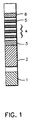
- a test strip for the determination of creatinine and deoxypyridinoline (DPD) containing six distinct areas assembled together onto a polystyrene backing of 4 inches (101.6 mm) in length and 0.2 inch (5.0 mm) in width is illustrated by Fig. 1.
- area 1 is the creatinine pad with a size of 0.2 x 0.2 inch.
- the creatinine pad was prepared as follows to render it suitable for the colorimetric determination of creatinine: Whatman 3 mm filter paper was first treated by dipping it to a depth of 0.2 inch into a solution containing 30 mM copper sulfate, 50 mM citrate, 750 mM glycerol-2-phosphate, 0.2% hexane sulfonic acid, 50 mM phytic acid and 0.2% sodium dodecyl sulfonate (SDS) at pH 6.94.
- the strip was dipped into a solution containing 33 mM 3,3',5,5'-tetramethylbenzidine, 73 mM diisopropylbenzene dihydroperoxide, 63 mM triisopropanolamine borate, 0.5% plasonde and 0.032% ethyl orange.
- the intensity of the colored response produced when the strip is contacted with an aqueous medium containing creatinine is proportionate to the concentration of creatinine.
- Area 2 is the buffer pad, prepared by impregnation of Whatman F075-07 glass fiber with 0.5 to 1 M glycine and 175 to 350 mM urea and having a size of 0.2 x 0.5 inch (12.7 mm).
- the buffer pad serves the purpose of buffering the pH of urine samples to the desired value.
- the pH of urine can range from 4.5 to 8 and a buffer pad can be used to keep the samples at a pH >7 to favor the antigen/antibody bonding reaction.
- Area 3 is a gold sol-DPD antibody pad (first region containing a labeled binding partner specific for the analyte).
- Areas 4 and 5 are the immunochromatography development area where the capture and detection reagents are deposited onto one piece of nitrocellulose having a size of 0.2 x 1.25 inch (31.75 mm).
- Area 4 contains three capture bands (second region containing immobilized analyte) with DPD immobilized to carboxyl terminated polyethylene glycol with a band width of about 0.059 inch (1.5 mm) per band and a 0.2 inch space between the bands (from center to center).
- area 5 consisting of one anti-IgG collection band (third region for immobilizing unreacted labeled binding partner) with a band width of about 0.059 inch (1.5 mm).
- the absorbant pad 6 which serves to absorb the liquid which migrates from the nitrocellulose area of the strip having a size of 0.2 inch x 0.5 inch (12.7 mm).
- the strip was dipped into the test solution, i.e. a urine sample containing the DPD analyte to be determined, for 3 seconds to a depth such that only the creatinine zone and buffer pad were below the surface of the test solution which allowed the test solution to flow up the strip by capillarity through the capture bands of the capture region, the single band of the detection region and to the absorbant pad.
- the strip was placed on the read table of a CLINITEK® 50 reflectance spectrometer and the device's start button pressed. The creatinine pad reflectance was recorded at 3 minutes and the reflectance of the immuno DPD strip (all 4 bands) was measured and recorded at 3 minutes.
- Reflectance signals for the DPD assay were measured with IR and green filters whereas reflectance for the creatinine assay was measured using red and green filters.
- the device gives a response in decode values which is derived by equations 1 to 5. where [R] green is the reflectance measured with the green filter, [R] red is the reflectance measured with the red filter.
- the band response signals were designated as indicated in Table 4.
- the reflectance with the green filter is ratioed to the reflectance with the IR filter to reduce the error from the variations between strips such as height and surface variations.
- the reflectance at the IR wave-length remains fairly constant regardless of the gold sol intensity of the band.
- the corrected reflectance, [Rn], is calculated according to Equation 2. where n is the band number 1, 2, 3 or 4, [Rn] green is the reflectance of band n with green filter, [Rn] IR is the reflectance of band n with IR filter.
- the number 65 is the assigned corrected reference value since the % reflectance with the IR filter is about 65%.
- the IR corrected reflectance value, [Rn] is then converted to K/S according to Equation 3 to give the band response signal for each band: where band signal, Pn, is the K/S transformation reflectance value, [Rn].
- T is the summation of the band signal for all bands (Equation 5).
- N is the total number of capture bands and collection bands which is 4 in the present example, Pn is the band signal n and n is 1, 2, 3 or 4.
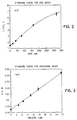
- Standard curves for DPD and creatinine were generated using calibrators containing six levels of analyte concentrations. Examples of standard curves are shown in Fig. 2 for the DPD assay and Fig. 3 for the creatinine assay.
- the DPD and creatinine concentrations for the urine test sample were calculated from the DPD and creatinine standard curves respectively.
- the DPD/creatinine ratio in nM/mM was then calculated for urine sample A as per the following calculation:
- the cutoff for determination of a state of high bone resorption is a DPD/creatinine ratio is 7.4 nM/mM. Lower than 7.4 is normal and larger than 7.4 is at the state of high bone resorption. Therefore, in this example, the result indicates a state of high bone resorption.
- a second urine sample was analyzed in a similar manner and gave the following results:
- the band signals require reflectance measurement at different wavelengths (IR, green and red) using an instrument with the capability to measure and record the reflectance at these wavelengths.
- the reflectance measurements are ratioed based on a predetermined a]gorithm using the instrument's software.
- the analyte concentrations are determined using standard curves stored in the instrument and the DPD/creatinine ratio is computed using the software set up in the instrument.
- the use of this algorithm enhances the accuracy of the assay because ratioing the band signal minimizes the systematic error such as error introduced by instrument to instrument variation.
- Other algorithms may be used to determine the final response signal.
- the final response signal can be calculated as: [Capture Band 1/Detection Band 1] where all signals are K/S transformation reflectance values.
- W cap and W det are weighting functions which weight the capture bands and detection bands differently.
- the calculation of the response signal by ratioing the signals from the labeled binding partner immobilized in the second (capture) region of the strip and the labeled binding partner immobilized in the third (detection) region is critical to increasing the precision of the assay by reducing the signal to noise ratio. This enhanced precision is necessary for the test to have clinical significance since only a two-fold increase in the DPD/creatinine ratio occurs between the normal and disease indicating osteoporosis states.
- Tables 8-10 Further evidence of the improvement in analytical results that can be achieved by the present invention is presented in Tables 8-10. These table were prepared using the same data set but 3 different algorithms ([T/P 1 ] with band ratioing, % reflectance of first capture band with no IR correction and no band ratioing and % reflectance of first capture band with no band ratioing but with IR correction) are compared.
Landscapes
- Health & Medical Sciences (AREA)
- Immunology (AREA)
- Life Sciences & Earth Sciences (AREA)
- Engineering & Computer Science (AREA)
- Molecular Biology (AREA)
- Biomedical Technology (AREA)
- Chemical & Material Sciences (AREA)
- Hematology (AREA)
- Urology & Nephrology (AREA)
- Biotechnology (AREA)
- Microbiology (AREA)
- Cell Biology (AREA)
- Food Science & Technology (AREA)
- Medicinal Chemistry (AREA)
- Physics & Mathematics (AREA)
- Analytical Chemistry (AREA)
- Biochemistry (AREA)
- General Health & Medical Sciences (AREA)
- General Physics & Mathematics (AREA)
- Pathology (AREA)
- Investigating Or Analysing Biological Materials (AREA)
Applications Claiming Priority (2)
| Application Number | Priority Date | Filing Date | Title |
|---|---|---|---|
| US900586 | 1986-08-26 | ||
| US08/900,586 US6436721B1 (en) | 1997-07-25 | 1997-07-25 | Device and method for obtaining clinically significant analyte ratios |
Publications (3)
| Publication Number | Publication Date |
|---|---|
| EP0895084A2 true EP0895084A2 (de) | 1999-02-03 |
| EP0895084A3 EP0895084A3 (de) | 2000-03-15 |
| EP0895084B1 EP0895084B1 (de) | 2004-09-29 |
Family
ID=25412759
Family Applications (1)
| Application Number | Title | Priority Date | Filing Date |
|---|---|---|---|
| EP98112964A Expired - Lifetime EP0895084B1 (de) | 1997-07-25 | 1998-07-13 | Vorrichtung und Verfahren zum Erreichen von klinischen wichtigen Analytverhältnissen |
Country Status (7)
| Country | Link |
|---|---|
| US (1) | US6436721B1 (de) |
| EP (1) | EP0895084B1 (de) |
| JP (1) | JP4183308B2 (de) |
| AU (1) | AU729380B2 (de) |
| CA (1) | CA2236135A1 (de) |
| DE (1) | DE69826583T2 (de) |
| ES (1) | ES2229421T3 (de) |
Cited By (10)
| Publication number | Priority date | Publication date | Assignee | Title |
|---|---|---|---|---|
| WO1999045140A1 (en) * | 1998-03-03 | 1999-09-10 | Pepex Biomedical, Llc | Apparatus for monitoring a level of a chemical species in a body fluid |
| WO2000000826A1 (en) * | 1998-06-30 | 2000-01-06 | Cambridge Sensors Limited | Immunometric assay |
| EP0909953A3 (de) * | 1997-10-14 | 2000-03-15 | Bayer Corporation | Verfahren zur Verbesserung der Genauigkeit von der semi-quantitativen Bestimmung eines Analyts in flüssigen Proben |
| EP0987551A3 (de) * | 1998-07-27 | 2000-04-12 | Bayer Corporation | Verfahren zur Bestimmung von Analytkonzentration in ein Hochdosis Hook-Effekt aufweisendes Querfluss-Sandwichimmunoassay |
| EP1046913A3 (de) * | 1999-04-22 | 2000-11-29 | Bayer Corporation | Immunochromatographisches Assay |
| EP1113263A2 (de) | 1999-12-23 | 2001-07-04 | Roche Diagnostics Corporation | Mikrokugel-enthaltender Sensor |
| WO2006013329A1 (en) * | 2004-08-06 | 2006-02-09 | Inverness Medical Switzerland Gmbh | Assay device & method |
| EP1489420A4 (de) * | 2002-03-07 | 2006-05-03 | Enbiotec Lab Co Ltd | Instrumente zum nachweis einer niedermolekularen substanz |
| US7192784B2 (en) * | 2000-05-08 | 2007-03-20 | Matsushita Electric Industrial Co., Ltd. | Method of measurement in chromatography |
| WO2014164633A1 (en) | 2013-03-12 | 2014-10-09 | Epinex Diagnostics, Inc. | Rapid test for urine albumin and urine creatinine |
Families Citing this family (92)
| Publication number | Priority date | Publication date | Assignee | Title |
|---|---|---|---|---|
| US6036924A (en) | 1997-12-04 | 2000-03-14 | Hewlett-Packard Company | Cassette of lancet cartridges for sampling blood |
| US6391005B1 (en) | 1998-03-30 | 2002-05-21 | Agilent Technologies, Inc. | Apparatus and method for penetration with shaft having a sensor for sensing penetration depth |
| AUPP713498A0 (en) * | 1998-11-17 | 1998-12-10 | Chandler, Howard Milne | A method of detecting blood |
| US8641644B2 (en) | 2000-11-21 | 2014-02-04 | Sanofi-Aventis Deutschland Gmbh | Blood testing apparatus having a rotatable cartridge with multiple lancing elements and testing means |
| US20030162236A1 (en) * | 2001-03-26 | 2003-08-28 | Response Biomedical Corporation | Compensation for variability in specific binding in quantitative assays |
| AU2002348683A1 (en) | 2001-06-12 | 2002-12-23 | Pelikan Technologies, Inc. | Method and apparatus for lancet launching device integrated onto a blood-sampling cartridge |
| WO2002100461A2 (en) | 2001-06-12 | 2002-12-19 | Pelikan Technologies, Inc. | Method and apparatus for improving success rate of blood yield from a fingerstick |
| US9226699B2 (en) | 2002-04-19 | 2016-01-05 | Sanofi-Aventis Deutschland Gmbh | Body fluid sampling module with a continuous compression tissue interface surface |
| US8337419B2 (en) | 2002-04-19 | 2012-12-25 | Sanofi-Aventis Deutschland Gmbh | Tissue penetration device |
| US7041068B2 (en) | 2001-06-12 | 2006-05-09 | Pelikan Technologies, Inc. | Sampling module device and method |
| US7682318B2 (en) | 2001-06-12 | 2010-03-23 | Pelikan Technologies, Inc. | Blood sampling apparatus and method |
| WO2002100460A2 (en) | 2001-06-12 | 2002-12-19 | Pelikan Technologies, Inc. | Electric lancet actuator |
| CA2448902C (en) | 2001-06-12 | 2010-09-07 | Pelikan Technologies, Inc. | Self optimizing lancing device with adaptation means to temporal variations in cutaneous properties |
| US7537571B2 (en) | 2001-06-12 | 2009-05-26 | Pelikan Technologies, Inc. | Integrated blood sampling analysis system with multi-use sampling module |
| US9795747B2 (en) | 2010-06-02 | 2017-10-24 | Sanofi-Aventis Deutschland Gmbh | Methods and apparatus for lancet actuation |
| US7981056B2 (en) | 2002-04-19 | 2011-07-19 | Pelikan Technologies, Inc. | Methods and apparatus for lancet actuation |
| US9427532B2 (en) | 2001-06-12 | 2016-08-30 | Sanofi-Aventis Deutschland Gmbh | Tissue penetration device |
| US7344507B2 (en) | 2002-04-19 | 2008-03-18 | Pelikan Technologies, Inc. | Method and apparatus for lancet actuation |
| US7344894B2 (en) | 2001-10-16 | 2008-03-18 | Agilent Technologies, Inc. | Thermal regulation of fluidic samples within a diagnostic cartridge |
| US7175992B2 (en) * | 2002-04-10 | 2007-02-13 | Response Biomedical Corporation | Sensitive immunochromatographic assay |
| JP4532121B2 (ja) * | 2002-04-10 | 2010-08-25 | レスポンス バイオメディカル コーポレイション | 高感度の免疫クロマトグラフィーアッセイ法 |
| US7410468B2 (en) | 2002-04-19 | 2008-08-12 | Pelikan Technologies, Inc. | Method and apparatus for penetrating tissue |
| AU2003231749A1 (en) | 2002-04-19 | 2003-11-03 | Pelikan Technologies, Inc. | Device and method for variable speed lancet |
| US9795334B2 (en) | 2002-04-19 | 2017-10-24 | Sanofi-Aventis Deutschland Gmbh | Method and apparatus for penetrating tissue |
| US7892185B2 (en) | 2002-04-19 | 2011-02-22 | Pelikan Technologies, Inc. | Method and apparatus for body fluid sampling and analyte sensing |
| US7371247B2 (en) | 2002-04-19 | 2008-05-13 | Pelikan Technologies, Inc | Method and apparatus for penetrating tissue |
| US7892183B2 (en) | 2002-04-19 | 2011-02-22 | Pelikan Technologies, Inc. | Method and apparatus for body fluid sampling and analyte sensing |
| US7291117B2 (en) | 2002-04-19 | 2007-11-06 | Pelikan Technologies, Inc. | Method and apparatus for penetrating tissue |
| US7232451B2 (en) | 2002-04-19 | 2007-06-19 | Pelikan Technologies, Inc. | Method and apparatus for penetrating tissue |
| US7909778B2 (en) | 2002-04-19 | 2011-03-22 | Pelikan Technologies, Inc. | Method and apparatus for penetrating tissue |
| US7976476B2 (en) | 2002-04-19 | 2011-07-12 | Pelikan Technologies, Inc. | Device and method for variable speed lancet |
| US7331931B2 (en) | 2002-04-19 | 2008-02-19 | Pelikan Technologies, Inc. | Method and apparatus for penetrating tissue |
| US7901362B2 (en) | 2002-04-19 | 2011-03-08 | Pelikan Technologies, Inc. | Method and apparatus for penetrating tissue |
| US8221334B2 (en) | 2002-04-19 | 2012-07-17 | Sanofi-Aventis Deutschland Gmbh | Method and apparatus for penetrating tissue |
| US7547287B2 (en) | 2002-04-19 | 2009-06-16 | Pelikan Technologies, Inc. | Method and apparatus for penetrating tissue |
| US7374544B2 (en) | 2002-04-19 | 2008-05-20 | Pelikan Technologies, Inc. | Method and apparatus for penetrating tissue |
| US7141058B2 (en) | 2002-04-19 | 2006-11-28 | Pelikan Technologies, Inc. | Method and apparatus for a body fluid sampling device using illumination |
| US8702624B2 (en) | 2006-09-29 | 2014-04-22 | Sanofi-Aventis Deutschland Gmbh | Analyte measurement device with a single shot actuator |
| US8360992B2 (en) | 2002-04-19 | 2013-01-29 | Sanofi-Aventis Deutschland Gmbh | Method and apparatus for penetrating tissue |
| US7674232B2 (en) | 2002-04-19 | 2010-03-09 | Pelikan Technologies, Inc. | Method and apparatus for penetrating tissue |
| US7485128B2 (en) | 2002-04-19 | 2009-02-03 | Pelikan Technologies, Inc. | Method and apparatus for penetrating tissue |
| US9248267B2 (en) | 2002-04-19 | 2016-02-02 | Sanofi-Aventis Deustchland Gmbh | Tissue penetration device |
| US8267870B2 (en) | 2002-04-19 | 2012-09-18 | Sanofi-Aventis Deutschland Gmbh | Method and apparatus for body fluid sampling with hybrid actuation |
| US7582099B2 (en) | 2002-04-19 | 2009-09-01 | Pelikan Technologies, Inc | Method and apparatus for penetrating tissue |
| US7229458B2 (en) | 2002-04-19 | 2007-06-12 | Pelikan Technologies, Inc. | Method and apparatus for penetrating tissue |
| US7563232B2 (en) | 2002-04-19 | 2009-07-21 | Pelikan Technologies, Inc. | Method and apparatus for penetrating tissue |
| US9314194B2 (en) | 2002-04-19 | 2016-04-19 | Sanofi-Aventis Deutschland Gmbh | Tissue penetration device |
| US7491178B2 (en) | 2002-04-19 | 2009-02-17 | Pelikan Technologies, Inc. | Method and apparatus for penetrating tissue |
| US8579831B2 (en) | 2002-04-19 | 2013-11-12 | Sanofi-Aventis Deutschland Gmbh | Method and apparatus for penetrating tissue |
| US7524293B2 (en) | 2002-04-19 | 2009-04-28 | Pelikan Technologies, Inc. | Method and apparatus for penetrating tissue |
| US7244265B2 (en) | 2002-04-19 | 2007-07-17 | Pelikan Technologies, Inc. | Method and apparatus for penetrating tissue |
| US8784335B2 (en) | 2002-04-19 | 2014-07-22 | Sanofi-Aventis Deutschland Gmbh | Body fluid sampling device with a capacitive sensor |
| US7297122B2 (en) | 2002-04-19 | 2007-11-20 | Pelikan Technologies, Inc. | Method and apparatus for penetrating tissue |
| US7226461B2 (en) | 2002-04-19 | 2007-06-05 | Pelikan Technologies, Inc. | Method and apparatus for a multi-use body fluid sampling device with sterility barrier release |
| US7717863B2 (en) | 2002-04-19 | 2010-05-18 | Pelikan Technologies, Inc. | Method and apparatus for penetrating tissue |
| US7648468B2 (en) | 2002-04-19 | 2010-01-19 | Pelikon Technologies, Inc. | Method and apparatus for penetrating tissue |
| US8574895B2 (en) | 2002-12-30 | 2013-11-05 | Sanofi-Aventis Deutschland Gmbh | Method and apparatus using optical techniques to measure analyte levels |
| WO2004072097A2 (en) * | 2003-02-05 | 2004-08-26 | The General Hospital Corporation | A microchip-based system for hiv diagnostics |
| CA2517198C (en) * | 2003-03-21 | 2016-06-21 | The Government Of The United States Of America As Represented By The Secretary Of The Department Of Health And Human Services, Centers For Disease Control And Prevention | Determining a concentration of a substance in a sample using a usable portion of a sigmoid curve |
| CA2521904A1 (en) * | 2003-04-01 | 2004-10-21 | Proactive Oral Solutions, Inc. | Caries risk test for predicting and assessing the risk of disease |
| EP2238892A3 (de) | 2003-05-30 | 2011-02-09 | Pelikan Technologies Inc. | Vorrichtung zur Entnahme von Körperflüssigkeit |
| US8101429B2 (en) * | 2003-06-03 | 2012-01-24 | Siemens Healthcare Diagnostics Inc. | Native analyte as a reference in lateral flow assays |
| ES2490740T3 (es) | 2003-06-06 | 2014-09-04 | Sanofi-Aventis Deutschland Gmbh | Aparato para toma de muestras de fluido sanguíneo y detección de analitos |
| WO2006001797A1 (en) | 2004-06-14 | 2006-01-05 | Pelikan Technologies, Inc. | Low pain penetrating |
| US7604592B2 (en) | 2003-06-13 | 2009-10-20 | Pelikan Technologies, Inc. | Method and apparatus for a point of care device |
| EP1671096A4 (de) | 2003-09-29 | 2009-09-16 | Pelikan Technologies Inc | Verfahren und apparatur für eine verbesserte probeneinfangvorrichtung |
| EP1680014A4 (de) | 2003-10-14 | 2009-01-21 | Pelikan Technologies Inc | Verfahren und gerät für eine variable anwenderschnittstelle |
| WO2005065414A2 (en) | 2003-12-31 | 2005-07-21 | Pelikan Technologies, Inc. | Method and apparatus for improving fluidic flow and sample capture |
| US7822454B1 (en) | 2005-01-03 | 2010-10-26 | Pelikan Technologies, Inc. | Fluid sampling device with improved analyte detecting member configuration |
| US8828203B2 (en) | 2004-05-20 | 2014-09-09 | Sanofi-Aventis Deutschland Gmbh | Printable hydrogels for biosensors |
| US9775553B2 (en) | 2004-06-03 | 2017-10-03 | Sanofi-Aventis Deutschland Gmbh | Method and apparatus for a fluid sampling device |
| EP1765194A4 (de) | 2004-06-03 | 2010-09-29 | Pelikan Technologies Inc | Verfahren und gerät für eine flüssigkeitsentnahmenvorrichtung |
| US20060024722A1 (en) | 2004-07-30 | 2006-02-02 | Mark Fischer-Colbrie | Samples for detection of oncofetal fibronectin and uses thereof |
| CA2588230A1 (en) * | 2004-11-23 | 2006-08-10 | Response Biomedical Corporation | Immunoassay employing two-step internal calibration reaction |
| US8652831B2 (en) | 2004-12-30 | 2014-02-18 | Sanofi-Aventis Deutschland Gmbh | Method and apparatus for analyte measurement test time |
| WO2006089027A2 (en) * | 2005-02-18 | 2006-08-24 | Charm Sciences, Inc. | Lateral flow test kit and method for detecting an analyte |
| US8709792B2 (en) * | 2005-02-18 | 2014-04-29 | Charm Sciences, Inc. | Lateral flow test kit and method for detecting an analyte |
| JP4750052B2 (ja) * | 2007-02-07 | 2011-08-17 | パナソニック株式会社 | バイオセンサを用いた測定方法 |
| EP2132571B1 (de) * | 2007-02-26 | 2014-09-03 | Response Biomedical Corporation | Komparativer test mit mehreren analyten |
| GB2450351B (en) | 2007-06-20 | 2012-01-18 | Cozart Bioscience Ltd | Monitoring an Immunoassay |
| EP2265324B1 (de) | 2008-04-11 | 2015-01-28 | Sanofi-Aventis Deutschland GmbH | Integriertes System zur Messung von Analyten |
| JP4600787B2 (ja) * | 2008-06-18 | 2010-12-15 | アイシン精機株式会社 | クロマトデバイス |
| US8260556B2 (en) * | 2008-08-21 | 2012-09-04 | Bio-Rad Laboratories, Inc. | Calibration surface method for determination on of analyte ratios |
| US8446463B2 (en) | 2008-08-22 | 2013-05-21 | Genprime, Inc. | Apparatus, method and article to perform assays using assay strips |
| JP4722977B2 (ja) * | 2008-08-27 | 2011-07-13 | シャープ株式会社 | 検出器具、分析装置、検出方法および検出器具の制御方法 |
| US9375169B2 (en) | 2009-01-30 | 2016-06-28 | Sanofi-Aventis Deutschland Gmbh | Cam drive for managing disposable penetrating member actions with a single motor and motor and control system |
| US8965476B2 (en) | 2010-04-16 | 2015-02-24 | Sanofi-Aventis Deutschland Gmbh | Tissue penetration device |
| US8620590B2 (en) * | 2010-09-30 | 2013-12-31 | Bio-Rad Laboratories, Inc. | Dose surface method for determination of analyte ratios |
| ES2686542T3 (es) * | 2012-10-18 | 2018-10-18 | Metanomics Gmbh | Medios y procedimientos para determinar una cantidad normalizada de aclaramiento de un biomarcador de enfermedad metabólica en una muestra |
| IN2015DN04062A (de) | 2012-11-15 | 2015-10-09 | Ortho Clinical Diagnostics Inc | |
| US10576475B2 (en) | 2016-09-15 | 2020-03-03 | Genprime, Inc. | Diagnostic assay strip cassette |
| RU2712249C1 (ru) * | 2018-11-28 | 2020-01-27 | Общество С Ограниченной Ответственностью "Синтэко-Групп" | Способ проведения количественного иммунохроматографического анализа |
Family Cites Families (18)
| Publication number | Priority date | Publication date | Assignee | Title |
|---|---|---|---|---|
| US3615229A (en) * | 1969-05-26 | 1971-10-26 | Searle Reference Lab Inc | Use of oxalic acid for the hydrolysis of steroid conjugates in pregnancy analysis |
| US4446232A (en) | 1981-10-13 | 1984-05-01 | Liotta Lance A | Enzyme immunoassay with two-zoned device having bound antigens |
| US4703017C1 (en) | 1984-02-14 | 2001-12-04 | Becton Dickinson Co | Solid phase assay with visual readout |
| US5500350A (en) * | 1985-10-30 | 1996-03-19 | Celltech Limited | Binding assay device |
| US4868108A (en) | 1985-12-12 | 1989-09-19 | Hygeia Sciences, Incorporated | Multiple-antibody detection of antigen |
| US4943522A (en) | 1987-06-01 | 1990-07-24 | Quidel | Lateral flow, non-bibulous membrane assay protocols |
| EP0462376B1 (de) | 1990-05-09 | 1996-07-24 | Abbott Laboratories | Bindungsnachweisverfahren mit Konjugatrückgewinnung |
| FR2667943B1 (fr) * | 1990-10-11 | 1994-05-13 | Jacques Toledano | Dispositif et procede pour la determination qualitative et quantitative rapide d'un ligand dans un fluide. |
| CA2074752A1 (en) * | 1991-07-29 | 1993-01-30 | Tadakazu Yamauchi | Process and device for specific binding assay |
| WO1993015230A1 (en) * | 1992-01-22 | 1993-08-05 | Abbott Laboratories | Calibration reagents for semi-quantitative binding assays and devices |
| US5342790A (en) * | 1992-10-30 | 1994-08-30 | Becton Dickinson And Company | Apparatus for indirect fluorescent assay of blood samples |
| US5385847A (en) * | 1993-12-02 | 1995-01-31 | Miles Inc. | Method for the determination of urinary protein and creatinine |
| AUPM717694A0 (en) | 1994-08-01 | 1994-08-25 | Sand Institute | A test strip for the rapid quantification of urinary calcium loss |
| US5569608A (en) | 1995-01-30 | 1996-10-29 | Bayer Corporation | Quantitative detection of analytes on immunochromatographic strips |
| US5804452A (en) | 1995-04-27 | 1998-09-08 | Quidel Corporation | One step urine creatinine assays |
| US5876944A (en) * | 1996-06-10 | 1999-03-02 | Bayer Corporation | Method for amplification of the response signal in a sandwich immunoassay |
| US5895765A (en) * | 1997-06-30 | 1999-04-20 | Bayer Corporation | Method for the detection of an analyte by immunochromatography |
| TW591230B (en) * | 1997-10-14 | 2004-06-11 | Bayer Ag | Method for improving the accuracy of the semi-quantitative determination of analyte in fluid samples |
-
1997
- 1997-07-25 US US08/900,586 patent/US6436721B1/en not_active Expired - Lifetime
-
1998
- 1998-04-29 CA CA002236135A patent/CA2236135A1/en not_active Abandoned
- 1998-07-13 DE DE69826583T patent/DE69826583T2/de not_active Expired - Lifetime
- 1998-07-13 EP EP98112964A patent/EP0895084B1/de not_active Expired - Lifetime
- 1998-07-13 ES ES98112964T patent/ES2229421T3/es not_active Expired - Lifetime
- 1998-07-22 JP JP20619398A patent/JP4183308B2/ja not_active Expired - Lifetime
- 1998-07-22 AU AU77440/98A patent/AU729380B2/en not_active Ceased
Cited By (18)
| Publication number | Priority date | Publication date | Assignee | Title |
|---|---|---|---|---|
| EP0909953A3 (de) * | 1997-10-14 | 2000-03-15 | Bayer Corporation | Verfahren zur Verbesserung der Genauigkeit von der semi-quantitativen Bestimmung eines Analyts in flüssigen Proben |
| US6479015B1 (en) | 1998-03-03 | 2002-11-12 | Pepex Biomedical, Llc | Apparatus for monitoring a level of a chemical species in a body fluid |
| GB2350190A (en) * | 1998-03-03 | 2000-11-22 | Pepex Biomedical Llc | Apparatus for monitoring a level of a chemical species in a body fluid |
| GB2350190B (en) * | 1998-03-03 | 2002-02-27 | Pepex Biomedical Llc | Apparatus for monitoring a level of a chemical species in a body fluid |
| WO1999045140A1 (en) * | 1998-03-03 | 1999-09-10 | Pepex Biomedical, Llc | Apparatus for monitoring a level of a chemical species in a body fluid |
| WO2000000826A1 (en) * | 1998-06-30 | 2000-01-06 | Cambridge Sensors Limited | Immunometric assay |
| EP0987551A3 (de) * | 1998-07-27 | 2000-04-12 | Bayer Corporation | Verfahren zur Bestimmung von Analytkonzentration in ein Hochdosis Hook-Effekt aufweisendes Querfluss-Sandwichimmunoassay |
| EP1046913A3 (de) * | 1999-04-22 | 2000-11-29 | Bayer Corporation | Immunochromatographisches Assay |
| EP1113263A2 (de) | 1999-12-23 | 2001-07-04 | Roche Diagnostics Corporation | Mikrokugel-enthaltender Sensor |
| US6627057B1 (en) | 1999-12-23 | 2003-09-30 | Roche Diagnostic Corporation | Microsphere containing sensor |
| US7192784B2 (en) * | 2000-05-08 | 2007-03-20 | Matsushita Electric Industrial Co., Ltd. | Method of measurement in chromatography |
| EP1489420A4 (de) * | 2002-03-07 | 2006-05-03 | Enbiotec Lab Co Ltd | Instrumente zum nachweis einer niedermolekularen substanz |
| WO2006013329A1 (en) * | 2004-08-06 | 2006-02-09 | Inverness Medical Switzerland Gmbh | Assay device & method |
| GB2431988A (en) * | 2004-08-06 | 2007-05-09 | Inverness Medical Switzerland | Assay device & method |
| WO2014164633A1 (en) | 2013-03-12 | 2014-10-09 | Epinex Diagnostics, Inc. | Rapid test for urine albumin and urine creatinine |
| CN105358986A (zh) * | 2013-03-12 | 2016-02-24 | 埃皮纳克诊断公司 | 用于尿白蛋白和尿肌酸酐的快速检测 |
| EP2972395A4 (de) * | 2013-03-12 | 2016-08-17 | Epinex Diagnostics Inc | Schnelltest für albumin und kreatinin im urin |
| US9804154B2 (en) | 2013-03-12 | 2017-10-31 | Epinex Diagnostics, Inc. | Rapid test for urine albumin and urine creatinine |
Also Published As
| Publication number | Publication date |
|---|---|
| EP0895084B1 (de) | 2004-09-29 |
| US6436721B1 (en) | 2002-08-20 |
| EP0895084A3 (de) | 2000-03-15 |
| DE69826583T2 (de) | 2006-03-09 |
| JP4183308B2 (ja) | 2008-11-19 |
| JPH1183856A (ja) | 1999-03-26 |
| DE69826583D1 (de) | 2004-11-04 |
| ES2229421T3 (es) | 2005-04-16 |
| CA2236135A1 (en) | 1999-01-25 |
| AU7744098A (en) | 1999-02-04 |
| AU729380B2 (en) | 2001-02-01 |
Similar Documents
| Publication | Publication Date | Title |
|---|---|---|
| EP0895084B1 (de) | Vorrichtung und Verfahren zum Erreichen von klinischen wichtigen Analytverhältnissen | |
| US5569608A (en) | Quantitative detection of analytes on immunochromatographic strips | |
| EP0987551B1 (de) | Verfahren zur Bestimmung von Analytkonzentration in ein Hochdosis Hook-Effekt aufweisendes Querfluss-Sandwichimmunoassay | |
| US6844200B2 (en) | Device for carrying out lateral-flow assays involving more than one analyte | |
| EP1634078B1 (de) | Nativer analyt als referenz in lateralfluss-assays | |
| US20120028245A1 (en) | Quantitative analyte assay device and method | |
| EP0902287B1 (de) | Verfahren und Teststreife zur Veringerung des Harnstoffeinflusses bei immunochromatographischen Messungen unter Verwendung von Urinproben | |
| US20060246522A1 (en) | C-reactive protein immunoassay and method | |
| EP0909953B1 (de) | Verfahren zur Verbesserung der Genauigkeit von der semi-quantitativen Bestimmung eines Analyts in flüssigen Proben | |
| US8101429B2 (en) | Native analyte as a reference in lateral flow assays | |
| EP1540343B1 (de) | Verfahren zur beseitigung von störungen in immunochromatographischen assays | |
| CA2198948A1 (en) | Quantitative detection of analytes on immunochromatographic strips | |
| WO1992018869A1 (en) | Colorfast reference device for immunoassays | |
| Monroe | Enzyme Channelling Immunoassay (ECIA): A Unique and Rapid Quantitative Technique |
Legal Events
| Date | Code | Title | Description |
|---|---|---|---|
| PUAI | Public reference made under article 153(3) epc to a published international application that has entered the european phase |
Free format text: ORIGINAL CODE: 0009012 |
|
| AK | Designated contracting states |
Kind code of ref document: A2 Designated state(s): BE CH DE ES FI FR GB IE IT LI NL SE |
|
| AX | Request for extension of the european patent |
Free format text: AL;LT;LV;MK;RO;SI |
|
| PUAL | Search report despatched |
Free format text: ORIGINAL CODE: 0009013 |
|
| AK | Designated contracting states |
Kind code of ref document: A3 Designated state(s): AT BE CH CY DE DK ES FI FR GB GR IE IT LI LU MC NL PT SE |
|
| AX | Request for extension of the european patent |
Free format text: AL;LT;LV;MK;RO;SI |
|
| 17P | Request for examination filed |
Effective date: 20000915 |
|
| AKX | Designation fees paid |
Free format text: BE CH DE ES FI FR GB IE IT LI NL SE |
|
| 17Q | First examination report despatched |
Effective date: 20030224 |
|
| GRAP | Despatch of communication of intention to grant a patent |
Free format text: ORIGINAL CODE: EPIDOSNIGR1 |
|
| GRAS | Grant fee paid |
Free format text: ORIGINAL CODE: EPIDOSNIGR3 |
|
| GRAA | (expected) grant |
Free format text: ORIGINAL CODE: 0009210 |
|
| AK | Designated contracting states |
Kind code of ref document: B1 Designated state(s): BE CH DE ES FI FR GB IE IT LI NL SE |
|
| REG | Reference to a national code |
Ref country code: GB Ref legal event code: FG4D |
|
| REG | Reference to a national code |
Ref country code: CH Ref legal event code: NV Representative=s name: E. BLUM & CO. PATENTANWAELTE Ref country code: CH Ref legal event code: EP |
|
| REG | Reference to a national code |
Ref country code: IE Ref legal event code: FG4D |
|
| REF | Corresponds to: |
Ref document number: 69826583 Country of ref document: DE Date of ref document: 20041104 Kind code of ref document: P |
|
| REG | Reference to a national code |
Ref country code: SE Ref legal event code: TRGR |
|
| REG | Reference to a national code |
Ref country code: ES Ref legal event code: FG2A Ref document number: 2229421 Country of ref document: ES Kind code of ref document: T3 |
|
| PGFP | Annual fee paid to national office [announced via postgrant information from national office to epo] |
Ref country code: NL Payment date: 20050616 Year of fee payment: 8 |
|
| PGFP | Annual fee paid to national office [announced via postgrant information from national office to epo] |
Ref country code: SE Payment date: 20050720 Year of fee payment: 8 |
|
| PGFP | Annual fee paid to national office [announced via postgrant information from national office to epo] |
Ref country code: FI Payment date: 20050721 Year of fee payment: 8 Ref country code: CH Payment date: 20050721 Year of fee payment: 8 |
|
| ET | Fr: translation filed | ||
| PLBE | No opposition filed within time limit |
Free format text: ORIGINAL CODE: 0009261 |
|
| STAA | Information on the status of an ep patent application or granted ep patent |
Free format text: STATUS: NO OPPOSITION FILED WITHIN TIME LIMIT |
|
| PGFP | Annual fee paid to national office [announced via postgrant information from national office to epo] |
Ref country code: BE Payment date: 20050819 Year of fee payment: 8 |
|
| 26N | No opposition filed |
Effective date: 20050630 |
|
| PG25 | Lapsed in a contracting state [announced via postgrant information from national office to epo] |
Ref country code: FI Free format text: LAPSE BECAUSE OF NON-PAYMENT OF DUE FEES Effective date: 20060713 |
|
| PG25 | Lapsed in a contracting state [announced via postgrant information from national office to epo] |
Ref country code: SE Free format text: LAPSE BECAUSE OF NON-PAYMENT OF DUE FEES Effective date: 20060714 |
|
| PGFP | Annual fee paid to national office [announced via postgrant information from national office to epo] |
Ref country code: IE Payment date: 20060717 Year of fee payment: 9 |
|
| PG25 | Lapsed in a contracting state [announced via postgrant information from national office to epo] |
Ref country code: LI Free format text: LAPSE BECAUSE OF NON-PAYMENT OF DUE FEES Effective date: 20060731 Ref country code: CH Free format text: LAPSE BECAUSE OF NON-PAYMENT OF DUE FEES Effective date: 20060731 Ref country code: BE Free format text: LAPSE BECAUSE OF NON-PAYMENT OF DUE FEES Effective date: 20060731 |
|
| PG25 | Lapsed in a contracting state [announced via postgrant information from national office to epo] |
Ref country code: NL Free format text: LAPSE BECAUSE OF NON-PAYMENT OF DUE FEES Effective date: 20070201 |
|
| REG | Reference to a national code |
Ref country code: CH Ref legal event code: PL |
|
| EUG | Se: european patent has lapsed | ||
| NLV4 | Nl: lapsed or anulled due to non-payment of the annual fee |
Effective date: 20070201 |
|
| BERE | Be: lapsed |
Owner name: *BAYER CORP. Effective date: 20060731 |
|
| REG | Reference to a national code |
Ref country code: IE Ref legal event code: MM4A |
|
| PG25 | Lapsed in a contracting state [announced via postgrant information from national office to epo] |
Ref country code: IE Free format text: LAPSE BECAUSE OF NON-PAYMENT OF DUE FEES Effective date: 20070713 |
|
| PGFP | Annual fee paid to national office [announced via postgrant information from national office to epo] |
Ref country code: IT Payment date: 20100728 Year of fee payment: 13 |
|
| REG | Reference to a national code |
Ref country code: GB Ref legal event code: 732E Free format text: REGISTERED BETWEEN 20101104 AND 20101110 |
|
| REG | Reference to a national code |
Ref country code: FR Ref legal event code: TP |
|
| PG25 | Lapsed in a contracting state [announced via postgrant information from national office to epo] |
Ref country code: IT Free format text: LAPSE BECAUSE OF NON-PAYMENT OF DUE FEES Effective date: 20110713 |
|
| REG | Reference to a national code |
Ref country code: FR Ref legal event code: PLFP Year of fee payment: 19 |
|
| REG | Reference to a national code |
Ref country code: FR Ref legal event code: PLFP Year of fee payment: 20 |
|
| PGFP | Annual fee paid to national office [announced via postgrant information from national office to epo] |
Ref country code: GB Payment date: 20170713 Year of fee payment: 20 Ref country code: DE Payment date: 20170919 Year of fee payment: 20 Ref country code: FR Payment date: 20170713 Year of fee payment: 20 |
|
| PGFP | Annual fee paid to national office [announced via postgrant information from national office to epo] |
Ref country code: ES Payment date: 20171026 Year of fee payment: 20 |
|
| REG | Reference to a national code |
Ref country code: DE Ref legal event code: R071 Ref document number: 69826583 Country of ref document: DE |
|
| REG | Reference to a national code |
Ref country code: GB Ref legal event code: PE20 Expiry date: 20180712 |
|
| PG25 | Lapsed in a contracting state [announced via postgrant information from national office to epo] |
Ref country code: GB Free format text: LAPSE BECAUSE OF EXPIRATION OF PROTECTION Effective date: 20180712 |
|
| REG | Reference to a national code |
Ref country code: ES Ref legal event code: FD2A Effective date: 20201202 |
|
| PG25 | Lapsed in a contracting state [announced via postgrant information from national office to epo] |
Ref country code: ES Free format text: LAPSE BECAUSE OF EXPIRATION OF PROTECTION Effective date: 20180714 |