EP0894010B1 - Vergällungsstoffe für sympathomimetische aminsalze - Google Patents
Vergällungsstoffe für sympathomimetische aminsalze Download PDFInfo
- Publication number
- EP0894010B1 EP0894010B1 EP97920079A EP97920079A EP0894010B1 EP 0894010 B1 EP0894010 B1 EP 0894010B1 EP 97920079 A EP97920079 A EP 97920079A EP 97920079 A EP97920079 A EP 97920079A EP 0894010 B1 EP0894010 B1 EP 0894010B1
- Authority
- EP
- European Patent Office
- Prior art keywords
- denaturant
- substituted
- unsubstituted
- composition
- sympathomimetic amine
- Prior art date
- Legal status (The legal status is an assumption and is not a legal conclusion. Google has not performed a legal analysis and makes no representation as to the accuracy of the status listed.)
- Expired - Lifetime
Links
- 239000003398 denaturant Substances 0.000 title claims abstract description 170
- 239000000150 Sympathomimetic Substances 0.000 title claims abstract description 126
- 230000001975 sympathomimetic effect Effects 0.000 title claims abstract description 106
- -1 amine salts Chemical class 0.000 title claims abstract description 83
- 239000000203 mixture Substances 0.000 claims abstract description 122
- 150000001412 amines Chemical class 0.000 claims abstract description 66
- 238000000034 method Methods 0.000 claims abstract description 31
- 238000000746 purification Methods 0.000 claims abstract description 27
- 239000000126 substance Substances 0.000 claims abstract description 9
- 230000000704 physical effect Effects 0.000 claims abstract description 7
- 239000000463 material Substances 0.000 claims description 72
- XLYOFNOQVPJJNP-UHFFFAOYSA-N water Substances O XLYOFNOQVPJJNP-UHFFFAOYSA-N 0.000 claims description 58
- KWGRBVOPPLSCSI-UHFFFAOYSA-N d-ephedrine Natural products CNC(C)C(O)C1=CC=CC=C1 KWGRBVOPPLSCSI-UHFFFAOYSA-N 0.000 claims description 49
- 239000004034 viscosity adjusting agent Substances 0.000 claims description 49
- KWGRBVOPPLSCSI-WCBMZHEXSA-N pseudoephedrine Chemical compound CN[C@@H](C)[C@@H](O)C1=CC=CC=C1 KWGRBVOPPLSCSI-WCBMZHEXSA-N 0.000 claims description 43
- 239000004094 surface-active agent Substances 0.000 claims description 34
- 239000002904 solvent Substances 0.000 claims description 33
- 150000001875 compounds Chemical class 0.000 claims description 29
- 239000012458 free base Substances 0.000 claims description 29
- 229960003908 pseudoephedrine Drugs 0.000 claims description 29
- 150000003839 salts Chemical class 0.000 claims description 28
- 239000002253 acid Substances 0.000 claims description 27
- BALXUFOVQVENIU-KXNXZCPBSA-N pseudoephedrine hydrochloride Chemical compound [H+].[Cl-].CN[C@@H](C)[C@@H](O)C1=CC=CC=C1 BALXUFOVQVENIU-KXNXZCPBSA-N 0.000 claims description 24
- 125000004400 (C1-C12) alkyl group Chemical group 0.000 claims description 22
- 238000006243 chemical reaction Methods 0.000 claims description 22
- 239000000344 soap Substances 0.000 claims description 21
- 125000004642 (C1-C12) alkoxy group Chemical group 0.000 claims description 20
- 239000002243 precursor Substances 0.000 claims description 19
- 235000014113 dietary fatty acids Nutrition 0.000 claims description 18
- 239000000194 fatty acid Substances 0.000 claims description 18
- 229930195729 fatty acid Natural products 0.000 claims description 18
- 229960003447 pseudoephedrine hydrochloride Drugs 0.000 claims description 18
- LOUPRKONTZGTKE-WZBLMQSHSA-N Quinine Chemical compound C([C@H]([C@H](C1)C=C)C2)C[N@@]1[C@@H]2[C@H](O)C1=CC=NC2=CC=C(OC)C=C21 LOUPRKONTZGTKE-WZBLMQSHSA-N 0.000 claims description 16
- 235000021355 Stearic acid Nutrition 0.000 claims description 16
- 150000004665 fatty acids Chemical class 0.000 claims description 16
- 125000000623 heterocyclic group Chemical group 0.000 claims description 16
- QIQXTHQIDYTFRH-UHFFFAOYSA-N octadecanoic acid Chemical compound CCCCCCCCCCCCCCCCCC(O)=O QIQXTHQIDYTFRH-UHFFFAOYSA-N 0.000 claims description 16
- OQCDKBAXFALNLD-UHFFFAOYSA-N octadecanoic acid Natural products CCCCCCCC(C)CCCCCCCCC(O)=O OQCDKBAXFALNLD-UHFFFAOYSA-N 0.000 claims description 16
- 239000008117 stearic acid Substances 0.000 claims description 16
- 229920003171 Poly (ethylene oxide) Polymers 0.000 claims description 15
- VEXZGXHMUGYJMC-UHFFFAOYSA-N Hydrochloric acid Chemical compound Cl VEXZGXHMUGYJMC-UHFFFAOYSA-N 0.000 claims description 14
- 239000001257 hydrogen Substances 0.000 claims description 14
- 229910052739 hydrogen Inorganic materials 0.000 claims description 14
- 125000002887 hydroxy group Chemical group [H]O* 0.000 claims description 14
- 125000003118 aryl group Chemical group 0.000 claims description 13
- 238000002955 isolation Methods 0.000 claims description 13
- DBMJMQXJHONAFJ-UHFFFAOYSA-M Sodium laurylsulphate Chemical group [Na+].CCCCCCCCCCCCOS([O-])(=O)=O DBMJMQXJHONAFJ-UHFFFAOYSA-M 0.000 claims description 12
- 235000019333 sodium laurylsulphate Nutrition 0.000 claims description 12
- 229910052736 halogen Inorganic materials 0.000 claims description 11
- 150000002367 halogens Chemical class 0.000 claims description 11
- NINIDFKCEFEMDL-UHFFFAOYSA-N Sulfur Chemical group [S] NINIDFKCEFEMDL-UHFFFAOYSA-N 0.000 claims description 10
- 239000000850 decongestant Substances 0.000 claims description 9
- 239000011593 sulfur Chemical group 0.000 claims description 9
- 229910052717 sulfur Inorganic materials 0.000 claims description 9
- IJGRMHOSHXDMSA-UHFFFAOYSA-N Atomic nitrogen Chemical compound N#N IJGRMHOSHXDMSA-UHFFFAOYSA-N 0.000 claims description 8
- 235000001258 Cinchona calisaya Nutrition 0.000 claims description 8
- LOUPRKONTZGTKE-UHFFFAOYSA-N cinchonine Natural products C1C(C(C2)C=C)CCN2C1C(O)C1=CC=NC2=CC=C(OC)C=C21 LOUPRKONTZGTKE-UHFFFAOYSA-N 0.000 claims description 8
- 230000002209 hydrophobic effect Effects 0.000 claims description 8
- 239000002736 nonionic surfactant Substances 0.000 claims description 8
- 229960000948 quinine Drugs 0.000 claims description 8
- CAVQBDOACNULDN-NRCOEFLKSA-N (1s,2s)-2-(methylamino)-1-phenylpropan-1-ol;sulfuric acid Chemical compound OS(O)(=O)=O.CN[C@@H](C)[C@@H](O)C1=CC=CC=C1.CN[C@@H](C)[C@@H](O)C1=CC=CC=C1 CAVQBDOACNULDN-NRCOEFLKSA-N 0.000 claims description 7
- 229960004159 pseudoephedrine sulfate Drugs 0.000 claims description 7
- DYWNLSQWJMTVGJ-KUSKTZOESA-N Phenylpropanolamine hydrochloride Chemical compound Cl.C[C@H](N)[C@H](O)C1=CC=CC=C1 DYWNLSQWJMTVGJ-KUSKTZOESA-N 0.000 claims description 6
- 229960002305 phenylpropanolamine hydrochloride Drugs 0.000 claims description 6
- 229920001992 poloxamer 407 Polymers 0.000 claims description 6
- 239000001301 oxygen Substances 0.000 claims description 5
- 229910052760 oxygen Inorganic materials 0.000 claims description 5
- 235000013343 vitamin Nutrition 0.000 claims description 5
- 239000011782 vitamin Substances 0.000 claims description 5
- 229940088594 vitamin Drugs 0.000 claims description 5
- 229930003231 vitamin Natural products 0.000 claims description 5
- QGZKDVFQNNGYKY-UHFFFAOYSA-N Ammonia Chemical compound N QGZKDVFQNNGYKY-UHFFFAOYSA-N 0.000 claims description 4
- NLXLAEXVIDQMFP-UHFFFAOYSA-N Ammonia chloride Chemical compound [NH4+].[Cl-] NLXLAEXVIDQMFP-UHFFFAOYSA-N 0.000 claims description 4
- BALXUFOVQVENIU-GNAZCLTHSA-N Ephedrine hydrochloride Chemical compound Cl.CN[C@@H](C)[C@H](O)C1=CC=CC=C1 BALXUFOVQVENIU-GNAZCLTHSA-N 0.000 claims description 4
- CSNNHWWHGAXBCP-UHFFFAOYSA-L Magnesium sulfate Chemical compound [Mg+2].[O-][S+2]([O-])([O-])[O-] CSNNHWWHGAXBCP-UHFFFAOYSA-L 0.000 claims description 4
- RAHZWNYVWXNFOC-UHFFFAOYSA-N Sulphur dioxide Chemical compound O=S=O RAHZWNYVWXNFOC-UHFFFAOYSA-N 0.000 claims description 4
- 229920013820 alkyl cellulose Polymers 0.000 claims description 4
- QVGXLLKOCUKJST-UHFFFAOYSA-N atomic oxygen Chemical group [O] QVGXLLKOCUKJST-UHFFFAOYSA-N 0.000 claims description 4
- 229960002534 ephedrine hydrochloride Drugs 0.000 claims description 4
- 239000002563 ionic surfactant Substances 0.000 claims description 4
- 229910052757 nitrogen Inorganic materials 0.000 claims description 4
- 125000001997 phenyl group Chemical group [H]C1=C([H])C([H])=C(*)C([H])=C1[H] 0.000 claims description 4
- 150000003722 vitamin derivatives Chemical class 0.000 claims description 4
- RWSOTUBLDIXVET-UHFFFAOYSA-N Dihydrogen sulfide Chemical compound S RWSOTUBLDIXVET-UHFFFAOYSA-N 0.000 claims description 3
- 230000000954 anitussive effect Effects 0.000 claims description 3
- 239000000739 antihistaminic agent Substances 0.000 claims description 3
- 229940124584 antitussives Drugs 0.000 claims description 3
- 125000004435 hydrogen atom Chemical group [H]* 0.000 claims description 3
- 239000012454 non-polar solvent Substances 0.000 claims description 3
- OCYSGIYOVXAGKQ-FVGYRXGTSA-N phenylephrine hydrochloride Chemical compound [H+].[Cl-].CNC[C@H](O)C1=CC=CC(O)=C1 OCYSGIYOVXAGKQ-FVGYRXGTSA-N 0.000 claims description 3
- 229960003733 phenylephrine hydrochloride Drugs 0.000 claims description 3
- OKTJSMMVPCPJKN-UHFFFAOYSA-N Carbon Chemical group [C] OKTJSMMVPCPJKN-UHFFFAOYSA-N 0.000 claims description 2
- PMZURENOXWZQFD-UHFFFAOYSA-L Sodium Sulfate Chemical compound [Na+].[Na+].[O-]S([O-])(=O)=O PMZURENOXWZQFD-UHFFFAOYSA-L 0.000 claims description 2
- GUGOEEXESWIERI-UHFFFAOYSA-N Terfenadine Chemical compound C1=CC(C(C)(C)C)=CC=C1C(O)CCCN1CCC(C(O)(C=2C=CC=CC=2)C=2C=CC=CC=2)CC1 GUGOEEXESWIERI-UHFFFAOYSA-N 0.000 claims description 2
- 229910021529 ammonia Inorganic materials 0.000 claims description 2
- 235000019270 ammonium chloride Nutrition 0.000 claims description 2
- BFNBIHQBYMNNAN-UHFFFAOYSA-N ammonium sulfate Chemical compound N.N.OS(O)(=O)=O BFNBIHQBYMNNAN-UHFFFAOYSA-N 0.000 claims description 2
- 229910052921 ammonium sulfate Inorganic materials 0.000 claims description 2
- 235000011130 ammonium sulphate Nutrition 0.000 claims description 2
- 230000001387 anti-histamine Effects 0.000 claims description 2
- SNCZNSNPXMPCGN-UHFFFAOYSA-N butanediamide Chemical compound NC(=O)CCC(N)=O SNCZNSNPXMPCGN-UHFFFAOYSA-N 0.000 claims description 2
- 125000005265 dialkylamine group Chemical group 0.000 claims description 2
- 150000004985 diamines Chemical class 0.000 claims description 2
- 229910000037 hydrogen sulfide Inorganic materials 0.000 claims description 2
- 229910052943 magnesium sulfate Inorganic materials 0.000 claims description 2
- 235000019341 magnesium sulphate Nutrition 0.000 claims description 2
- RCCYSVYHULFYHE-UHFFFAOYSA-N pentanediamide Chemical compound NC(=O)CCCC(N)=O RCCYSVYHULFYHE-UHFFFAOYSA-N 0.000 claims description 2
- 229910052938 sodium sulfate Inorganic materials 0.000 claims description 2
- 235000011152 sodium sulphate Nutrition 0.000 claims description 2
- 150000002431 hydrogen Chemical class 0.000 claims 8
- 125000003107 substituted aryl group Chemical group 0.000 claims 3
- PCHPORCSPXIHLZ-UHFFFAOYSA-N diphenhydramine hydrochloride Chemical compound [Cl-].C=1C=CC=CC=1C(OCC[NH+](C)C)C1=CC=CC=C1 PCHPORCSPXIHLZ-UHFFFAOYSA-N 0.000 claims 1
- 125000005313 fatty acid group Chemical group 0.000 claims 1
- 125000005270 trialkylamine group Chemical group 0.000 claims 1
- 238000000605 extraction Methods 0.000 abstract description 33
- 239000003814 drug Substances 0.000 abstract description 31
- 229940079593 drug Drugs 0.000 abstract description 28
- 238000002360 preparation method Methods 0.000 abstract description 12
- 239000002117 illicit drug Substances 0.000 abstract description 10
- 239000000825 pharmaceutical preparation Substances 0.000 abstract description 10
- 229940127557 pharmaceutical product Drugs 0.000 abstract description 10
- 238000004519 manufacturing process Methods 0.000 abstract description 8
- 239000007858 starting material Substances 0.000 abstract description 7
- 238000000926 separation method Methods 0.000 abstract description 5
- 229940126534 drug product Drugs 0.000 abstract 1
- YXFVVABEGXRONW-UHFFFAOYSA-N Toluene Chemical compound CC1=CC=CC=C1 YXFVVABEGXRONW-UHFFFAOYSA-N 0.000 description 75
- 239000003826 tablet Substances 0.000 description 55
- 238000009472 formulation Methods 0.000 description 35
- 239000000047 product Substances 0.000 description 31
- 230000000670 limiting effect Effects 0.000 description 24
- 239000000243 solution Substances 0.000 description 21
- HEMHJVSKTPXQMS-UHFFFAOYSA-M Sodium hydroxide Chemical compound [OH-].[Na+] HEMHJVSKTPXQMS-UHFFFAOYSA-M 0.000 description 18
- HQKMJHAJHXVSDF-UHFFFAOYSA-L magnesium stearate Substances [Mg+2].CCCCCCCCCCCCCCCCCC([O-])=O.CCCCCCCCCCCCCCCCCC([O-])=O HQKMJHAJHXVSDF-UHFFFAOYSA-L 0.000 description 15
- LBSFSRMTJJPTCW-DSXUQNDKSA-N (r)-[(2s,4s,5r)-5-ethenyl-1-azabicyclo[2.2.2]octan-2-yl]-(6-methoxyquinolin-4-yl)methanol;hydrochloride Chemical compound Cl.C([C@H]([C@H](C1)C=C)C2)CN1[C@@H]2[C@H](O)C1=CC=NC2=CC=C(OC)C=C21 LBSFSRMTJJPTCW-DSXUQNDKSA-N 0.000 description 13
- VYPSYNLAJGMNEJ-UHFFFAOYSA-N Silicium dioxide Chemical compound O=[Si]=O VYPSYNLAJGMNEJ-UHFFFAOYSA-N 0.000 description 13
- 229940089453 sudafed Drugs 0.000 description 13
- 230000015572 biosynthetic process Effects 0.000 description 12
- MYWUZJCMWCOHBA-VIFPVBQESA-N methamphetamine Chemical compound CN[C@@H](C)CC1=CC=CC=C1 MYWUZJCMWCOHBA-VIFPVBQESA-N 0.000 description 12
- 238000003786 synthesis reaction Methods 0.000 description 12
- 239000001993 wax Substances 0.000 description 12
- 239000001096 (4-ethenyl-1-azabicyclo[2.2.2]octan-7-yl)-(6-methoxyquinolin-4-yl)methanol hydrochloride Substances 0.000 description 10
- RTZKZFJDLAIYFH-UHFFFAOYSA-N Diethyl ether Chemical compound CCOCC RTZKZFJDLAIYFH-UHFFFAOYSA-N 0.000 description 10
- 229960001252 methamphetamine Drugs 0.000 description 10
- 229960001811 quinine hydrochloride Drugs 0.000 description 10
- 239000002002 slurry Substances 0.000 description 10
- 125000003976 glyceryl group Chemical group [H]C([*])([H])C(O[H])([H])C(O[H])([H])[H] 0.000 description 9
- 125000004432 carbon atom Chemical group C* 0.000 description 8
- 150000002148 esters Chemical class 0.000 description 8
- 235000019359 magnesium stearate Nutrition 0.000 description 8
- 230000008569 process Effects 0.000 description 8
- 239000007787 solid Substances 0.000 description 8
- 239000000706 filtrate Substances 0.000 description 7
- 238000001914 filtration Methods 0.000 description 7
- 238000011084 recovery Methods 0.000 description 7
- 229920002261 Corn starch Polymers 0.000 description 6
- PEDCQBHIVMGVHV-UHFFFAOYSA-N Glycerine Chemical compound OCC(O)CO PEDCQBHIVMGVHV-UHFFFAOYSA-N 0.000 description 6
- GUBGYTABKSRVRQ-QKKXKWKRSA-N Lactose Natural products OC[C@H]1O[C@@H](O[C@H]2[C@H](O)[C@@H](O)C(O)O[C@@H]2CO)[C@H](O)[C@@H](O)[C@H]1O GUBGYTABKSRVRQ-QKKXKWKRSA-N 0.000 description 6
- 239000008120 corn starch Substances 0.000 description 6
- 230000000694 effects Effects 0.000 description 6
- 239000003995 emulsifying agent Substances 0.000 description 6
- IPCSVZSSVZVIGE-UHFFFAOYSA-N hexadecanoic acid Chemical compound CCCCCCCCCCCCCCCC(O)=O IPCSVZSSVZVIGE-UHFFFAOYSA-N 0.000 description 6
- 239000008101 lactose Substances 0.000 description 6
- 239000003960 organic solvent Substances 0.000 description 6
- 239000002245 particle Substances 0.000 description 6
- 229920000663 Hydroxyethyl cellulose Polymers 0.000 description 5
- 239000004354 Hydroxyethyl cellulose Substances 0.000 description 5
- WHNWPMSKXPGLAX-UHFFFAOYSA-N N-Vinyl-2-pyrrolidone Chemical compound C=CN1CCCC1=O WHNWPMSKXPGLAX-UHFFFAOYSA-N 0.000 description 5
- YDBYJHTYSHBBAU-YFKPBYRVSA-N S-methyl-L-methioninate Chemical class C[S+](C)CC[C@H](N)C([O-])=O YDBYJHTYSHBBAU-YFKPBYRVSA-N 0.000 description 5
- 238000004090 dissolution Methods 0.000 description 5
- 239000012065 filter cake Substances 0.000 description 5
- 239000013020 final formulation Substances 0.000 description 5
- 235000019447 hydroxyethyl cellulose Nutrition 0.000 description 5
- 239000000820 nonprescription drug Substances 0.000 description 5
- 230000001105 regulatory effect Effects 0.000 description 5
- KWGRBVOPPLSCSI-WPRPVWTQSA-N (-)-ephedrine Chemical compound CN[C@@H](C)[C@H](O)C1=CC=CC=C1 KWGRBVOPPLSCSI-WPRPVWTQSA-N 0.000 description 4
- VBICKXHEKHSIBG-UHFFFAOYSA-N 1-monostearoylglycerol Chemical compound CCCCCCCCCCCCCCCCCC(=O)OCC(O)CO VBICKXHEKHSIBG-UHFFFAOYSA-N 0.000 description 4
- IZHVBANLECCAGF-UHFFFAOYSA-N 2-hydroxy-3-(octadecanoyloxy)propyl octadecanoate Chemical compound CCCCCCCCCCCCCCCCCC(=O)OCC(O)COC(=O)CCCCCCCCCCCCCCCCC IZHVBANLECCAGF-UHFFFAOYSA-N 0.000 description 4
- 229920003084 Avicel® PH-102 Polymers 0.000 description 4
- 229920002907 Guar gum Polymers 0.000 description 4
- 229920002472 Starch Polymers 0.000 description 4
- 229940024606 amino acid Drugs 0.000 description 4
- 235000001014 amino acid Nutrition 0.000 description 4
- 239000007864 aqueous solution Substances 0.000 description 4
- 239000002585 base Substances 0.000 description 4
- 239000004204 candelilla wax Substances 0.000 description 4
- 235000013868 candelilla wax Nutrition 0.000 description 4
- 229940073532 candelilla wax Drugs 0.000 description 4
- 229910052681 coesite Inorganic materials 0.000 description 4
- 229910052906 cristobalite Inorganic materials 0.000 description 4
- 125000005456 glyceride group Chemical group 0.000 description 4
- 239000000665 guar gum Substances 0.000 description 4
- 235000010417 guar gum Nutrition 0.000 description 4
- 229960002154 guar gum Drugs 0.000 description 4
- IUJAMGNYPWYUPM-UHFFFAOYSA-N hentriacontane Chemical compound CCCCCCCCCCCCCCCCCCCCCCCCCCCCCCC IUJAMGNYPWYUPM-UHFFFAOYSA-N 0.000 description 4
- 230000036571 hydration Effects 0.000 description 4
- 238000006703 hydration reaction Methods 0.000 description 4
- 239000001866 hydroxypropyl methyl cellulose Substances 0.000 description 4
- 229920003088 hydroxypropyl methyl cellulose Polymers 0.000 description 4
- 235000010979 hydroxypropyl methyl cellulose Nutrition 0.000 description 4
- UFVKGYZPFZQRLF-UHFFFAOYSA-N hydroxypropyl methyl cellulose Chemical compound OC1C(O)C(OC)OC(CO)C1OC1C(O)C(O)C(OC2C(C(O)C(OC3C(C(O)C(O)C(CO)O3)O)C(CO)O2)O)C(CO)O1 UFVKGYZPFZQRLF-UHFFFAOYSA-N 0.000 description 4
- 239000007788 liquid Substances 0.000 description 4
- 238000002844 melting Methods 0.000 description 4
- QJGQUHMNIGDVPM-UHFFFAOYSA-N nitrogen group Chemical group [N] QJGQUHMNIGDVPM-UHFFFAOYSA-N 0.000 description 4
- 239000000377 silicon dioxide Substances 0.000 description 4
- 235000012239 silicon dioxide Nutrition 0.000 description 4
- 239000008107 starch Substances 0.000 description 4
- 235000019698 starch Nutrition 0.000 description 4
- 229910052682 stishovite Inorganic materials 0.000 description 4
- 229910052905 tridymite Inorganic materials 0.000 description 4
- DCXXMTOCNZCJGO-UHFFFAOYSA-N tristearoylglycerol Chemical compound CCCCCCCCCCCCCCCCCC(=O)OCC(OC(=O)CCCCCCCCCCCCCCCCC)COC(=O)CCCCCCCCCCCCCCCCC DCXXMTOCNZCJGO-UHFFFAOYSA-N 0.000 description 4
- 239000000080 wetting agent Substances 0.000 description 4
- UFHFLCQGNIYNRP-UHFFFAOYSA-N Hydrogen Chemical compound [H][H] UFHFLCQGNIYNRP-UHFFFAOYSA-N 0.000 description 3
- 229920002153 Hydroxypropyl cellulose Polymers 0.000 description 3
- 241000124008 Mammalia Species 0.000 description 3
- 235000021314 Palmitic acid Nutrition 0.000 description 3
- 125000000217 alkyl group Chemical group 0.000 description 3
- 150000001413 amino acids Chemical class 0.000 description 3
- 230000003190 augmentative effect Effects 0.000 description 3
- 239000004203 carnauba wax Substances 0.000 description 3
- 235000013869 carnauba wax Nutrition 0.000 description 3
- 230000007423 decrease Effects 0.000 description 3
- 238000001704 evaporation Methods 0.000 description 3
- 239000000284 extract Substances 0.000 description 3
- 239000001863 hydroxypropyl cellulose Substances 0.000 description 3
- 235000010977 hydroxypropyl cellulose Nutrition 0.000 description 3
- 230000008018 melting Effects 0.000 description 3
- POULHZVOKOAJMA-UHFFFAOYSA-N methyl undecanoic acid Natural products CCCCCCCCCCCC(O)=O POULHZVOKOAJMA-UHFFFAOYSA-N 0.000 description 3
- 239000001788 mono and diglycerides of fatty acids Substances 0.000 description 3
- WQEPLUUGTLDZJY-UHFFFAOYSA-N n-Pentadecanoic acid Natural products CCCCCCCCCCCCCCC(O)=O WQEPLUUGTLDZJY-UHFFFAOYSA-N 0.000 description 3
- 239000003921 oil Substances 0.000 description 3
- 235000019198 oils Nutrition 0.000 description 3
- 235000019271 petrolatum Nutrition 0.000 description 3
- 239000008194 pharmaceutical composition Substances 0.000 description 3
- 239000000546 pharmaceutical excipient Substances 0.000 description 3
- 235000019640 taste Nutrition 0.000 description 3
- 238000003828 vacuum filtration Methods 0.000 description 3
- YQSHYGCCYVPRDI-UHFFFAOYSA-N (4-propan-2-ylphenyl)methanamine Chemical compound CC(C)C1=CC=C(CN)C=C1 YQSHYGCCYVPRDI-UHFFFAOYSA-N 0.000 description 2
- WRIDQFICGBMAFQ-UHFFFAOYSA-N (E)-8-Octadecenoic acid Natural products CCCCCCCCCC=CCCCCCCC(O)=O WRIDQFICGBMAFQ-UHFFFAOYSA-N 0.000 description 2
- KWTSXDURSIMDCE-QMMMGPOBSA-N (S)-amphetamine Chemical compound C[C@H](N)CC1=CC=CC=C1 KWTSXDURSIMDCE-QMMMGPOBSA-N 0.000 description 2
- LJOQGZACKSYWCH-LHHVKLHASA-N (s)-[(2r,4s,5r)-5-ethyl-1-azabicyclo[2.2.2]octan-2-yl]-(6-methoxyquinolin-4-yl)methanol Chemical compound C1=C(OC)C=C2C([C@H](O)[C@H]3C[C@@H]4CCN3C[C@@H]4CC)=CC=NC2=C1 LJOQGZACKSYWCH-LHHVKLHASA-N 0.000 description 2
- GFAZGHREJPXDMH-UHFFFAOYSA-N 1,3-dipalmitoylglycerol Chemical compound CCCCCCCCCCCCCCCC(=O)OCC(O)COC(=O)CCCCCCCCCCCCCCC GFAZGHREJPXDMH-UHFFFAOYSA-N 0.000 description 2
- LPLLVINFLBSFRP-UHFFFAOYSA-N 2-methylamino-1-phenylpropan-1-one Chemical compound CNC(C)C(=O)C1=CC=CC=C1 LPLLVINFLBSFRP-UHFFFAOYSA-N 0.000 description 2
- LQJBNNIYVWPHFW-UHFFFAOYSA-N 20:1omega9c fatty acid Natural products CCCCCCCCCCC=CCCCCCCCC(O)=O LQJBNNIYVWPHFW-UHFFFAOYSA-N 0.000 description 2
- MCSXGCZMEPXKIW-UHFFFAOYSA-N 3-hydroxy-4-[(4-methyl-2-nitrophenyl)diazenyl]-N-(3-nitrophenyl)naphthalene-2-carboxamide Chemical compound Cc1ccc(N=Nc2c(O)c(cc3ccccc23)C(=O)Nc2cccc(c2)[N+]([O-])=O)c(c1)[N+]([O-])=O MCSXGCZMEPXKIW-UHFFFAOYSA-N 0.000 description 2
- QSBYPNXLFMSGKH-UHFFFAOYSA-N 9-Heptadecensaeure Natural products CCCCCCCC=CCCCCCCCC(O)=O QSBYPNXLFMSGKH-UHFFFAOYSA-N 0.000 description 2
- RZVAJINKPMORJF-UHFFFAOYSA-N Acetaminophen Chemical compound CC(=O)NC1=CC=C(O)C=C1 RZVAJINKPMORJF-UHFFFAOYSA-N 0.000 description 2
- DBAKFASWICGISY-BTJKTKAUSA-N Chlorpheniramine maleate Chemical compound OC(=O)\C=C/C(O)=O.C=1C=CC=NC=1C(CCN(C)C)C1=CC=C(Cl)C=C1 DBAKFASWICGISY-BTJKTKAUSA-N 0.000 description 2
- IAYPIBMASNFSPL-UHFFFAOYSA-N Ethylene oxide Chemical group C1CO1 IAYPIBMASNFSPL-UHFFFAOYSA-N 0.000 description 2
- HEFNNWSXXWATRW-UHFFFAOYSA-N Ibuprofen Chemical compound CC(C)CC1=CC=C(C(C)C(O)=O)C=C1 HEFNNWSXXWATRW-UHFFFAOYSA-N 0.000 description 2
- 229920000168 Microcrystalline cellulose Polymers 0.000 description 2
- 239000005642 Oleic acid Substances 0.000 description 2
- ZQPPMHVWECSIRJ-UHFFFAOYSA-N Oleic acid Natural products CCCCCCCCC=CCCCCCCCC(O)=O ZQPPMHVWECSIRJ-UHFFFAOYSA-N 0.000 description 2
- IDIDJDIHTAOVLG-VKHMYHEASA-N S-methylcysteine Chemical class CSC[C@H](N)C(O)=O IDIDJDIHTAOVLG-VKHMYHEASA-N 0.000 description 2
- GWEVSGVZZGPLCZ-UHFFFAOYSA-N Titan oxide Chemical compound O=[Ti]=O GWEVSGVZZGPLCZ-UHFFFAOYSA-N 0.000 description 2
- 206010047139 Vasoconstriction Diseases 0.000 description 2
- NDAUXUAQIAJITI-UHFFFAOYSA-N albuterol Chemical compound CC(C)(C)NCC(O)C1=CC=C(O)C(CO)=C1 NDAUXUAQIAJITI-UHFFFAOYSA-N 0.000 description 2
- 229940025084 amphetamine Drugs 0.000 description 2
- 238000004458 analytical method Methods 0.000 description 2
- 125000000129 anionic group Chemical group 0.000 description 2
- 239000003945 anionic surfactant Substances 0.000 description 2
- 239000007900 aqueous suspension Substances 0.000 description 2
- 125000002619 bicyclic group Chemical group 0.000 description 2
- VHRGRCVQAFMJIZ-UHFFFAOYSA-N cadaverine Chemical compound NCCCCCN VHRGRCVQAFMJIZ-UHFFFAOYSA-N 0.000 description 2
- 150000001721 carbon Chemical group 0.000 description 2
- 229910052799 carbon Inorganic materials 0.000 description 2
- PUAQLLVFLMYYJJ-ZETCQYMHSA-N cathinone Chemical compound C[C@H](N)C(=O)C1=CC=CC=C1 PUAQLLVFLMYYJJ-ZETCQYMHSA-N 0.000 description 2
- 229950002698 cathinone Drugs 0.000 description 2
- 125000002091 cationic group Chemical group 0.000 description 2
- 229920002678 cellulose Polymers 0.000 description 2
- 239000001913 cellulose Substances 0.000 description 2
- 235000010980 cellulose Nutrition 0.000 description 2
- 229940046978 chlorpheniramine maleate Drugs 0.000 description 2
- 230000001010 compromised effect Effects 0.000 description 2
- 239000012050 conventional carrier Substances 0.000 description 2
- 229920001577 copolymer Polymers 0.000 description 2
- 239000013058 crude material Substances 0.000 description 2
- 229940124581 decongestants Drugs 0.000 description 2
- 229960003782 dextromethorphan hydrobromide Drugs 0.000 description 2
- LJOQGZACKSYWCH-UHFFFAOYSA-N dihydro quinine Natural products C1=C(OC)C=C2C(C(O)C3CC4CCN3CC4CC)=CC=NC2=C1 LJOQGZACKSYWCH-UHFFFAOYSA-N 0.000 description 2
- ZZVUWRFHKOJYTH-UHFFFAOYSA-N diphenhydramine Chemical compound C=1C=CC=CC=1C(OCCN(C)C)C1=CC=CC=C1 ZZVUWRFHKOJYTH-UHFFFAOYSA-N 0.000 description 2
- UKMSUNONTOPOIO-UHFFFAOYSA-N docosanoic acid Chemical compound CCCCCCCCCCCCCCCCCCCCCC(O)=O UKMSUNONTOPOIO-UHFFFAOYSA-N 0.000 description 2
- 238000004945 emulsification Methods 0.000 description 2
- 229960002179 ephedrine Drugs 0.000 description 2
- 230000008020 evaporation Effects 0.000 description 2
- 238000002474 experimental method Methods 0.000 description 2
- 239000003925 fat Substances 0.000 description 2
- 235000019197 fats Nutrition 0.000 description 2
- 150000002191 fatty alcohols Chemical class 0.000 description 2
- 239000003349 gelling agent Substances 0.000 description 2
- 229940074045 glyceryl distearate Drugs 0.000 description 2
- 229920000591 gum Polymers 0.000 description 2
- 238000010438 heat treatment Methods 0.000 description 2
- 125000005842 heteroatom Chemical group 0.000 description 2
- 238000004128 high performance liquid chromatography Methods 0.000 description 2
- 229960004251 hydroquinine Drugs 0.000 description 2
- 229960001680 ibuprofen Drugs 0.000 description 2
- CGIGDMFJXJATDK-UHFFFAOYSA-N indomethacin Chemical compound CC1=C(CC(O)=O)C2=CC(OC)=CC=C2N1C(=O)C1=CC=C(Cl)C=C1 CGIGDMFJXJATDK-UHFFFAOYSA-N 0.000 description 2
- QXJSBBXBKPUZAA-UHFFFAOYSA-N isooleic acid Natural products CCCCCCCC=CCCCCCCCCC(O)=O QXJSBBXBKPUZAA-UHFFFAOYSA-N 0.000 description 2
- 229960001913 mecysteine Drugs 0.000 description 2
- 238000002483 medication Methods 0.000 description 2
- 229940016286 microcrystalline cellulose Drugs 0.000 description 2
- 235000019813 microcrystalline cellulose Nutrition 0.000 description 2
- 239000008108 microcrystalline cellulose Substances 0.000 description 2
- 125000002950 monocyclic group Chemical group 0.000 description 2
- 229940021182 non-steroidal anti-inflammatory drug Drugs 0.000 description 2
- 239000012875 nonionic emulsifier Substances 0.000 description 2
- ZQPPMHVWECSIRJ-KTKRTIGZSA-N oleic acid Chemical compound CCCCCCCC\C=C/CCCCCCCC(O)=O ZQPPMHVWECSIRJ-KTKRTIGZSA-N 0.000 description 2
- 125000006353 oxyethylene group Chemical group 0.000 description 2
- 239000012188 paraffin wax Substances 0.000 description 2
- 229920001223 polyethylene glycol Polymers 0.000 description 2
- 229920000036 polyvinylpyrrolidone Polymers 0.000 description 2
- 235000013855 polyvinylpyrrolidone Nutrition 0.000 description 2
- 229940069328 povidone Drugs 0.000 description 2
- 239000000843 powder Substances 0.000 description 2
- 239000002244 precipitate Substances 0.000 description 2
- 239000003755 preservative agent Substances 0.000 description 2
- KIDHWZJUCRJVML-UHFFFAOYSA-N putrescine Chemical compound NCCCCN KIDHWZJUCRJVML-UHFFFAOYSA-N 0.000 description 2
- 229960002052 salbutamol Drugs 0.000 description 2
- 229920006395 saturated elastomer Polymers 0.000 description 2
- 238000004062 sedimentation Methods 0.000 description 2
- 239000011343 solid material Substances 0.000 description 2
- 238000006467 substitution reaction Methods 0.000 description 2
- ZFXYFBGIUFBOJW-UHFFFAOYSA-N theophylline Chemical compound O=C1N(C)C(=O)N(C)C2=C1NC=N2 ZFXYFBGIUFBOJW-UHFFFAOYSA-N 0.000 description 2
- 239000002562 thickening agent Substances 0.000 description 2
- DUXYWXYOBMKGIN-UHFFFAOYSA-N trimyristin Chemical compound CCCCCCCCCCCCCC(=O)OCC(OC(=O)CCCCCCCCCCCCC)COC(=O)CCCCCCCCCCCCC DUXYWXYOBMKGIN-UHFFFAOYSA-N 0.000 description 2
- PVNIQBQSYATKKL-UHFFFAOYSA-N tripalmitin Chemical compound CCCCCCCCCCCCCCCC(=O)OCC(OC(=O)CCCCCCCCCCCCCCC)COC(=O)CCCCCCCCCCCCCCC PVNIQBQSYATKKL-UHFFFAOYSA-N 0.000 description 2
- CBEQULMOCCWAQT-WOJGMQOQSA-N triprolidine Chemical compound C1=CC(C)=CC=C1C(\C=1N=CC=CC=1)=C/CN1CCCC1 CBEQULMOCCWAQT-WOJGMQOQSA-N 0.000 description 2
- 229960001128 triprolidine Drugs 0.000 description 2
- 230000025033 vasoconstriction Effects 0.000 description 2
- 235000015112 vegetable and seed oil Nutrition 0.000 description 2
- 239000008158 vegetable oil Substances 0.000 description 2
- XWTYSIMOBUGWOL-UHFFFAOYSA-N (+-)-Terbutaline Chemical compound CC(C)(C)NCC(O)C1=CC(O)=CC(O)=C1 XWTYSIMOBUGWOL-UHFFFAOYSA-N 0.000 description 1
- SFLSHLFXELFNJZ-QMMMGPOBSA-N (-)-norepinephrine Chemical compound NC[C@H](O)C1=CC=C(O)C(O)=C1 SFLSHLFXELFNJZ-QMMMGPOBSA-N 0.000 description 1
- AKNNEGZIBPJZJG-MSOLQXFVSA-N (-)-noscapine Chemical compound CN1CCC2=CC=3OCOC=3C(OC)=C2[C@@H]1[C@@H]1C2=CC=C(OC)C(OC)=C2C(=O)O1 AKNNEGZIBPJZJG-MSOLQXFVSA-N 0.000 description 1
- OQQOAWVKVDAJOI-UHFFFAOYSA-N (2-dodecanoyloxy-3-hydroxypropyl) dodecanoate Chemical compound CCCCCCCCCCCC(=O)OCC(CO)OC(=O)CCCCCCCCCCC OQQOAWVKVDAJOI-UHFFFAOYSA-N 0.000 description 1
- CJAUUNYSILCIDO-LURJTMIESA-N (2s)-2-(ethylamino)-4-methylsulfanylbutanoic acid Chemical compound CCN[C@H](C(O)=O)CCSC CJAUUNYSILCIDO-LURJTMIESA-N 0.000 description 1
- JNHATNWAMGXQJQ-AKGZTFGVSA-N (2s)-2-amino-3-methyl-4-methylsulfanylbutanoic acid Chemical compound CSCC(C)[C@H](N)C(O)=O JNHATNWAMGXQJQ-AKGZTFGVSA-N 0.000 description 1
- JXYWFNAQESKDNC-BTJKTKAUSA-N (z)-4-hydroxy-4-oxobut-2-enoate;2-[(4-methoxyphenyl)methyl-pyridin-2-ylamino]ethyl-dimethylazanium Chemical compound OC(=O)\C=C/C(O)=O.C1=CC(OC)=CC=C1CN(CCN(C)C)C1=CC=CC=N1 JXYWFNAQESKDNC-BTJKTKAUSA-N 0.000 description 1
- QHZLMUACJMDIAE-SFHVURJKSA-N 1-hexadecanoyl-sn-glycerol Chemical compound CCCCCCCCCCCCCCCC(=O)OC[C@@H](O)CO QHZLMUACJMDIAE-SFHVURJKSA-N 0.000 description 1
- RZRNAYUHWVFMIP-KTKRTIGZSA-N 1-oleoylglycerol Chemical compound CCCCCCCC\C=C/CCCCCCCC(=O)OCC(O)CO RZRNAYUHWVFMIP-KTKRTIGZSA-N 0.000 description 1
- WFXURHIXPXVPGM-UHFFFAOYSA-N 2,3-dihydroxybutanedioic acid;2-methyl-9-phenyl-1,3,4,9-tetrahydroindeno[2,1-c]pyridine Chemical compound OC(=O)C(O)C(O)C(O)=O.C1N(C)CCC(C2=CC=CC=C22)=C1C2C1=CC=CC=C1 WFXURHIXPXVPGM-UHFFFAOYSA-N 0.000 description 1
- RRZWKUGIZRDCPB-UHFFFAOYSA-N 2,3-dihydroxypropyl hexanoate Chemical compound CCCCCC(=O)OCC(O)CO RRZWKUGIZRDCPB-UHFFFAOYSA-N 0.000 description 1
- FMKIFJLNOGNQJR-UHFFFAOYSA-N 2,3-dihydroxypropyl tridec-2-enoate Chemical compound CCCCCCCCCCC=CC(=O)OCC(O)CO FMKIFJLNOGNQJR-UHFFFAOYSA-N 0.000 description 1
- CIVCELMLGDGMKZ-UHFFFAOYSA-N 2,4-dichloro-6-methylpyridine-3-carboxylic acid Chemical compound CC1=CC(Cl)=C(C(O)=O)C(Cl)=N1 CIVCELMLGDGMKZ-UHFFFAOYSA-N 0.000 description 1
- ZZYHCCDMBJTROG-UHFFFAOYSA-N 2-(2-benzylphenoxy)ethyl-dimethylazanium;3-carboxy-3,5-dihydroxy-5-oxopentanoate Chemical compound OC(=O)CC(O)(C(O)=O)CC([O-])=O.C[NH+](C)CCOC1=CC=CC=C1CC1=CC=CC=C1 ZZYHCCDMBJTROG-UHFFFAOYSA-N 0.000 description 1
- ULXKXLZEOGLCRJ-UHFFFAOYSA-N 2-azaniumyl-3-ethylsulfanylpropanoate Chemical compound CCSCC(N)C(O)=O ULXKXLZEOGLCRJ-UHFFFAOYSA-N 0.000 description 1
- WXBXVVIUZANZAU-UHFFFAOYSA-N 2E-decenoic acid Natural products CCCCCCCC=CC(O)=O WXBXVVIUZANZAU-UHFFFAOYSA-N 0.000 description 1
- DCARPOVHBQKEJV-UHFFFAOYSA-N 3-butyl-2-hydroxybenzoic acid Chemical class CCCCC1=CC=CC(C(O)=O)=C1O DCARPOVHBQKEJV-UHFFFAOYSA-N 0.000 description 1
- BSYNRYMUTXBXSQ-FOQJRBATSA-N 59096-14-9 Chemical compound CC(=O)OC1=CC=CC=C1[14C](O)=O BSYNRYMUTXBXSQ-FOQJRBATSA-N 0.000 description 1
- ZCYVEMRRCGMTRW-UHFFFAOYSA-N 7553-56-2 Chemical compound [I] ZCYVEMRRCGMTRW-UHFFFAOYSA-N 0.000 description 1
- HBAQYPYDRFILMT-UHFFFAOYSA-N 8-[3-(1-cyclopropylpyrazol-4-yl)-1H-pyrazolo[4,3-d]pyrimidin-5-yl]-3-methyl-3,8-diazabicyclo[3.2.1]octan-2-one Chemical class C1(CC1)N1N=CC(=C1)C1=NNC2=C1N=C(N=C2)N1C2C(N(CC1CC2)C)=O HBAQYPYDRFILMT-UHFFFAOYSA-N 0.000 description 1
- 108060003345 Adrenergic Receptor Proteins 0.000 description 1
- 102000017910 Adrenergic receptor Human genes 0.000 description 1
- 235000019489 Almond oil Nutrition 0.000 description 1
- 235000019737 Animal fat Nutrition 0.000 description 1
- 235000003911 Arachis Nutrition 0.000 description 1
- 244000105624 Arachis hypogaea Species 0.000 description 1
- BSYNRYMUTXBXSQ-UHFFFAOYSA-N Aspirin Chemical compound CC(=O)OC1=CC=CC=C1C(O)=O BSYNRYMUTXBXSQ-UHFFFAOYSA-N 0.000 description 1
- 235000021357 Behenic acid Nutrition 0.000 description 1
- AKJDEXBCRLOVTH-UHFFFAOYSA-N Carbetapentane citrate Chemical compound OC(=O)CC(O)(C(O)=O)CC(O)=O.C=1C=CC=CC=1C1(C(=O)OCCOCCN(CC)CC)CCCC1 AKJDEXBCRLOVTH-UHFFFAOYSA-N 0.000 description 1
- XYGSFNHCFFAJPO-UHFFFAOYSA-N Chlophedianol hydrochloride Chemical compound Cl.C=1C=CC=C(Cl)C=1C(O)(CCN(C)C)C1=CC=CC=C1 XYGSFNHCFFAJPO-UHFFFAOYSA-N 0.000 description 1
- 229920001353 Dextrin Polymers 0.000 description 1
- 239000004375 Dextrin Substances 0.000 description 1
- 235000019739 Dicalciumphosphate Nutrition 0.000 description 1
- KBAUFVUYFNWQFM-UHFFFAOYSA-N Doxylamine succinate Chemical compound OC(=O)CCC(O)=O.C=1C=CC=NC=1C(C)(OCCN(C)C)C1=CC=CC=C1 KBAUFVUYFNWQFM-UHFFFAOYSA-N 0.000 description 1
- PWWVAXIEGOYWEE-UHFFFAOYSA-N Isophenergan Chemical compound C1=CC=C2N(CC(C)N(C)C)C3=CC=CC=C3SC2=C1 PWWVAXIEGOYWEE-UHFFFAOYSA-N 0.000 description 1
- FORGMRSGVSYZQR-YFKPBYRVSA-N L-leucinamide Chemical class CC(C)C[C@H](N)C(N)=O FORGMRSGVSYZQR-YFKPBYRVSA-N 0.000 description 1
- FFEARJCKVFRZRR-BYPYZUCNSA-N L-methionine Chemical compound CSCC[C@H](N)C(O)=O FFEARJCKVFRZRR-BYPYZUCNSA-N 0.000 description 1
- MKXZASYAUGDDCJ-SZMVWBNQSA-N LSM-2525 Chemical compound C1CCC[C@H]2[C@@]3([H])N(C)CC[C@]21C1=CC(OC)=CC=C1C3 MKXZASYAUGDDCJ-SZMVWBNQSA-N 0.000 description 1
- 239000004166 Lanolin Substances 0.000 description 1
- 239000005639 Lauric acid Substances 0.000 description 1
- 240000007472 Leucaena leucocephala Species 0.000 description 1
- 235000010643 Leucaena leucocephala Nutrition 0.000 description 1
- 240000006240 Linum usitatissimum Species 0.000 description 1
- 235000004431 Linum usitatissimum Nutrition 0.000 description 1
- FYYHWMGAXLPEAU-UHFFFAOYSA-N Magnesium Chemical compound [Mg] FYYHWMGAXLPEAU-UHFFFAOYSA-N 0.000 description 1
- 239000005913 Maltodextrin Substances 0.000 description 1
- 229920002774 Maltodextrin Polymers 0.000 description 1
- SBDNJUWAMKYJOX-UHFFFAOYSA-N Meclofenamic Acid Chemical compound CC1=CC=C(Cl)C(NC=2C(=CC=CC=2)C(O)=O)=C1Cl SBDNJUWAMKYJOX-UHFFFAOYSA-N 0.000 description 1
- 241001465754 Metazoa Species 0.000 description 1
- YPIGGYHFMKJNKV-UHFFFAOYSA-N N-ethylglycine Chemical class CC[NH2+]CC([O-])=O YPIGGYHFMKJNKV-UHFFFAOYSA-N 0.000 description 1
- CMWTZPSULFXXJA-UHFFFAOYSA-N Naproxen Natural products C1=C(C(C)C(O)=O)C=CC2=CC(OC)=CC=C21 CMWTZPSULFXXJA-UHFFFAOYSA-N 0.000 description 1
- 235000019482 Palm oil Nutrition 0.000 description 1
- QHZLMUACJMDIAE-UHFFFAOYSA-N Palmitic acid monoglyceride Natural products CCCCCCCCCCCCCCCC(=O)OCC(O)CO QHZLMUACJMDIAE-UHFFFAOYSA-N 0.000 description 1
- 239000004264 Petrolatum Substances 0.000 description 1
- RVGRUAULSDPKGF-UHFFFAOYSA-N Poloxamer Chemical compound C1CO1.CC1CO1 RVGRUAULSDPKGF-UHFFFAOYSA-N 0.000 description 1
- 229920002675 Polyoxyl Polymers 0.000 description 1
- 239000005700 Putrescine Substances 0.000 description 1
- 240000000111 Saccharum officinarum Species 0.000 description 1
- 235000007201 Saccharum officinarum Nutrition 0.000 description 1
- 239000004141 Sodium laurylsulphate Substances 0.000 description 1
- 229920002125 Sokalan® Polymers 0.000 description 1
- 239000004163 Spermaceti wax Substances 0.000 description 1
- 208000025371 Taste disease Diseases 0.000 description 1
- FSQKKOOTNAMONP-UHFFFAOYSA-N acemetacin Chemical compound CC1=C(CC(=O)OCC(O)=O)C2=CC(OC)=CC=C2N1C(=O)C1=CC=C(Cl)C=C1 FSQKKOOTNAMONP-UHFFFAOYSA-N 0.000 description 1
- 229960004892 acemetacin Drugs 0.000 description 1
- 229960001138 acetylsalicylic acid Drugs 0.000 description 1
- NIXOWILDQLNWCW-UHFFFAOYSA-N acrylic acid group Chemical class C(C=C)(=O)O NIXOWILDQLNWCW-UHFFFAOYSA-N 0.000 description 1
- 230000004913 activation Effects 0.000 description 1
- 239000000853 adhesive Substances 0.000 description 1
- 230000001070 adhesive effect Effects 0.000 description 1
- 230000001800 adrenalinergic effect Effects 0.000 description 1
- 239000000464 adrenergic agent Substances 0.000 description 1
- 239000002156 adsorbate Substances 0.000 description 1
- 239000003463 adsorbent Substances 0.000 description 1
- 150000001298 alcohols Chemical class 0.000 description 1
- 125000001931 aliphatic group Chemical group 0.000 description 1
- 125000003545 alkoxy group Chemical group 0.000 description 1
- 239000008168 almond oil Substances 0.000 description 1
- ZYVMPHJZWXIFDQ-LURJTMIESA-N alpha-methylmethionine Chemical compound CSCC[C@](C)(N)C(O)=O ZYVMPHJZWXIFDQ-LURJTMIESA-N 0.000 description 1
- AKNNEGZIBPJZJG-UHFFFAOYSA-N alpha-noscapine Natural products CN1CCC2=CC=3OCOC=3C(OC)=C2C1C1C2=CC=C(OC)C(OC)=C2C(=O)O1 AKNNEGZIBPJZJG-UHFFFAOYSA-N 0.000 description 1
- CEGOLXSVJUTHNZ-UHFFFAOYSA-K aluminium tristearate Chemical compound [Al+3].CCCCCCCCCCCCCCCCCC([O-])=O.CCCCCCCCCCCCCCCCCC([O-])=O.CCCCCCCCCCCCCCCCCC([O-])=O CEGOLXSVJUTHNZ-UHFFFAOYSA-K 0.000 description 1
- 229940063655 aluminum stearate Drugs 0.000 description 1
- FQPFAHBPWDRTLU-UHFFFAOYSA-N aminophylline Chemical compound NCCN.O=C1N(C)C(=O)N(C)C2=C1NC=N2.O=C1N(C)C(=O)N(C)C2=C1NC=N2 FQPFAHBPWDRTLU-UHFFFAOYSA-N 0.000 description 1
- 229960003556 aminophylline Drugs 0.000 description 1
- 229940035676 analgesics Drugs 0.000 description 1
- 239000012164 animal wax Substances 0.000 description 1
- 239000000730 antalgic agent Substances 0.000 description 1
- 239000000924 antiasthmatic agent Substances 0.000 description 1
- 229940125715 antihistaminic agent Drugs 0.000 description 1
- 239000003434 antitussive agent Substances 0.000 description 1
- 235000013871 bee wax Nutrition 0.000 description 1
- 239000012166 beeswax Substances 0.000 description 1
- 229940116226 behenic acid Drugs 0.000 description 1
- 230000009286 beneficial effect Effects 0.000 description 1
- VVCLBQFBKZQOAF-NSHDSACASA-N benzyl (2s)-pyrrolidine-2-carboxylate Chemical class O=C([C@H]1NCCC1)OCC1=CC=CC=C1 VVCLBQFBKZQOAF-NSHDSACASA-N 0.000 description 1
- 125000002618 bicyclic heterocycle group Chemical group 0.000 description 1
- 239000011230 binding agent Substances 0.000 description 1
- 230000004071 biological effect Effects 0.000 description 1
- 210000004204 blood vessel Anatomy 0.000 description 1
- 229950008847 broxaterol Drugs 0.000 description 1
- JBRBWHCVRGURBA-UHFFFAOYSA-N broxaterol Chemical compound CC(C)(C)NCC(O)C1=CC(Br)=NO1 JBRBWHCVRGURBA-UHFFFAOYSA-N 0.000 description 1
- 239000000872 buffer Substances 0.000 description 1
- 239000001506 calcium phosphate Substances 0.000 description 1
- CJZGTCYPCWQAJB-UHFFFAOYSA-L calcium stearate Chemical compound [Ca+2].CCCCCCCCCCCCCCCCCC([O-])=O.CCCCCCCCCCCCCCCCCC([O-])=O CJZGTCYPCWQAJB-UHFFFAOYSA-L 0.000 description 1
- 235000013539 calcium stearate Nutrition 0.000 description 1
- 239000008116 calcium stearate Substances 0.000 description 1
- 239000002775 capsule Substances 0.000 description 1
- 229940098391 carbetapentane citrate Drugs 0.000 description 1
- 125000003178 carboxy group Chemical group [H]OC(*)=O 0.000 description 1
- 150000001735 carboxylic acids Chemical class 0.000 description 1
- 229960001386 carbuterol Drugs 0.000 description 1
- KEMXXQOFIRIICG-UHFFFAOYSA-N carbuterol Chemical compound CC(C)(C)NCC(O)C1=CC=C(O)C(NC(N)=O)=C1 KEMXXQOFIRIICG-UHFFFAOYSA-N 0.000 description 1
- 239000004359 castor oil Substances 0.000 description 1
- 235000019438 castor oil Nutrition 0.000 description 1
- 239000003153 chemical reaction reagent Substances 0.000 description 1
- 239000003795 chemical substances by application Substances 0.000 description 1
- 239000012174 chinese wax Substances 0.000 description 1
- 229940020114 chlophedianol hydrochloride Drugs 0.000 description 1
- 239000003240 coconut oil Substances 0.000 description 1
- 235000019864 coconut oil Nutrition 0.000 description 1
- 239000003086 colorant Substances 0.000 description 1
- 239000013066 combination product Substances 0.000 description 1
- 229940127555 combination product Drugs 0.000 description 1
- 238000013329 compounding Methods 0.000 description 1
- 239000000470 constituent Substances 0.000 description 1
- 238000013270 controlled release Methods 0.000 description 1
- 229960000913 crospovidone Drugs 0.000 description 1
- 230000003247 decreasing effect Effects 0.000 description 1
- 239000008367 deionised water Substances 0.000 description 1
- 229910021641 deionized water Inorganic materials 0.000 description 1
- 230000001066 destructive effect Effects 0.000 description 1
- 235000019425 dextrin Nutrition 0.000 description 1
- 229960001985 dextromethorphan Drugs 0.000 description 1
- NEFBYIFKOOEVPA-UHFFFAOYSA-K dicalcium phosphate Chemical compound [Ca+2].[Ca+2].[O-]P([O-])([O-])=O NEFBYIFKOOEVPA-UHFFFAOYSA-K 0.000 description 1
- 229940038472 dicalcium phosphate Drugs 0.000 description 1
- 229910000390 dicalcium phosphate Inorganic materials 0.000 description 1
- 230000029087 digestion Effects 0.000 description 1
- 239000003085 diluting agent Substances 0.000 description 1
- 229960000520 diphenhydramine Drugs 0.000 description 1
- 229960000525 diphenhydramine hydrochloride Drugs 0.000 description 1
- 239000007884 disintegrant Substances 0.000 description 1
- 238000007922 dissolution test Methods 0.000 description 1
- KFEVDPWXEVUUMW-UHFFFAOYSA-N docosanoic acid Natural products CCCCCCCCCCCCCCCCCCCCCC(=O)OCCC1=CC=C(O)C=C1 KFEVDPWXEVUUMW-UHFFFAOYSA-N 0.000 description 1
- 229960005008 doxylamine succinate Drugs 0.000 description 1
- 239000003937 drug carrier Substances 0.000 description 1
- 230000000095 emetic effect Effects 0.000 description 1
- 230000002708 enhancing effect Effects 0.000 description 1
- UTBDYLQPXTWUDG-UHFFFAOYSA-N ethene;octadecanoic acid Chemical compound C=C.CCCCCCCCCCCCCCCCCC(O)=O UTBDYLQPXTWUDG-UHFFFAOYSA-N 0.000 description 1
- BEFDCLMNVWHSGT-UHFFFAOYSA-N ethenylcyclopentane Chemical compound C=CC1CCCC1 BEFDCLMNVWHSGT-UHFFFAOYSA-N 0.000 description 1
- YVKSGVDJQXLXDV-BYPYZUCNSA-N ethyl (2r)-2-amino-3-sulfanylpropanoate Chemical class CCOC(=O)[C@@H](N)CS YVKSGVDJQXLXDV-BYPYZUCNSA-N 0.000 description 1
- GKCXXDSWWDWUHS-BYPYZUCNSA-N ethyl (2s)-2-amino-3-hydroxypropanoate Chemical class CCOC(=O)[C@@H](N)CO GKCXXDSWWDWUHS-BYPYZUCNSA-N 0.000 description 1
- ARJXIGOIOGJAKR-LURJTMIESA-N ethyl L-methioninate Chemical class CCOC(=O)[C@@H](N)CCSC ARJXIGOIOGJAKR-LURJTMIESA-N 0.000 description 1
- 229940031005 ethyl cysteine Drugs 0.000 description 1
- 125000001495 ethyl group Chemical group [H]C([H])([H])C([H])([H])* 0.000 description 1
- 235000003599 food sweetener Nutrition 0.000 description 1
- 125000000524 functional group Chemical group 0.000 description 1
- YQEMORVAKMFKLG-UHFFFAOYSA-N glycerine monostearate Natural products CCCCCCCCCCCCCCCCCC(=O)OC(CO)CO YQEMORVAKMFKLG-UHFFFAOYSA-N 0.000 description 1
- RZRNAYUHWVFMIP-HXUWFJFHSA-N glycerol monolinoleate Natural products CCCCCCCCC=CCCCCCCCC(=O)OC[C@H](O)CO RZRNAYUHWVFMIP-HXUWFJFHSA-N 0.000 description 1
- SVUQHVRAGMNPLW-UHFFFAOYSA-N glycerol monostearate Natural products CCCCCCCCCCCCCCCCC(=O)OCC(O)CO SVUQHVRAGMNPLW-UHFFFAOYSA-N 0.000 description 1
- ZEMPKEQAKRGZGQ-XOQCFJPHSA-N glycerol triricinoleate Natural products CCCCCC[C@@H](O)CC=CCCCCCCCC(=O)OC[C@@H](COC(=O)CCCCCCCC=CC[C@@H](O)CCCCCC)OC(=O)CCCCCCCC=CC[C@H](O)CCCCCC ZEMPKEQAKRGZGQ-XOQCFJPHSA-N 0.000 description 1
- 229940074049 glyceryl dilaurate Drugs 0.000 description 1
- 229940075507 glyceryl monostearate Drugs 0.000 description 1
- 239000008187 granular material Substances 0.000 description 1
- 125000001475 halogen functional group Chemical group 0.000 description 1
- 229930195733 hydrocarbon Natural products 0.000 description 1
- 150000002430 hydrocarbons Chemical class 0.000 description 1
- 150000003840 hydrochlorides Chemical class 0.000 description 1
- 239000010514 hydrogenated cottonseed oil Substances 0.000 description 1
- 239000012729 immediate-release (IR) formulation Substances 0.000 description 1
- 230000006872 improvement Effects 0.000 description 1
- 238000010348 incorporation Methods 0.000 description 1
- 229960000905 indomethacin Drugs 0.000 description 1
- 239000004615 ingredient Substances 0.000 description 1
- 238000001990 intravenous administration Methods 0.000 description 1
- 229910052740 iodine Inorganic materials 0.000 description 1
- 239000011630 iodine Substances 0.000 description 1
- 239000012182 japan wax Substances 0.000 description 1
- DKYWVDODHFEZIM-UHFFFAOYSA-N ketoprofen Chemical compound OC(=O)C(C)C1=CC=CC(C(=O)C=2C=CC=CC=2)=C1 DKYWVDODHFEZIM-UHFFFAOYSA-N 0.000 description 1
- 229960000991 ketoprofen Drugs 0.000 description 1
- 235000019388 lanolin Nutrition 0.000 description 1
- 229940039717 lanolin Drugs 0.000 description 1
- 239000007937 lozenge Substances 0.000 description 1
- 239000000314 lubricant Substances 0.000 description 1
- 229910052749 magnesium Inorganic materials 0.000 description 1
- 238000003760 magnetic stirring Methods 0.000 description 1
- 229940035034 maltodextrin Drugs 0.000 description 1
- 239000011159 matrix material Substances 0.000 description 1
- 229960003803 meclofenamic acid Drugs 0.000 description 1
- 235000019656 metallic taste Nutrition 0.000 description 1
- 229930182817 methionine Natural products 0.000 description 1
- KCUNTYMNJVXYKZ-JTQLQIEISA-N methyl (2s)-2-amino-3-(1h-indol-3-yl)propanoate Chemical class C1=CC=C2C(C[C@H](N)C(=O)OC)=CNC2=C1 KCUNTYMNJVXYKZ-JTQLQIEISA-N 0.000 description 1
- 125000002496 methyl group Chemical group [H]C([H])([H])* 0.000 description 1
- 239000004200 microcrystalline wax Substances 0.000 description 1
- 235000019808 microcrystalline wax Nutrition 0.000 description 1
- 229940114937 microcrystalline wax Drugs 0.000 description 1
- 239000004570 mortar (masonry) Substances 0.000 description 1
- 210000004400 mucous membrane Anatomy 0.000 description 1
- 229960002009 naproxen Drugs 0.000 description 1
- CMWTZPSULFXXJA-VIFPVBQESA-N naproxen Chemical compound C1=C([C@H](C)C(O)=O)C=CC2=CC(OC)=CC=C21 CMWTZPSULFXXJA-VIFPVBQESA-N 0.000 description 1
- PLPRGLOFPNJOTN-UHFFFAOYSA-N narcotine Natural products COc1ccc2C(OC(=O)c2c1OC)C3Cc4c(CN3C)cc5OCOc5c4OC PLPRGLOFPNJOTN-UHFFFAOYSA-N 0.000 description 1
- 239000000133 nasal decongestant Substances 0.000 description 1
- 210000002850 nasal mucosa Anatomy 0.000 description 1
- 210000001640 nerve ending Anatomy 0.000 description 1
- 239000002687 nonaqueous vehicle Substances 0.000 description 1
- 231100000252 nontoxic Toxicity 0.000 description 1
- 230000003000 nontoxic effect Effects 0.000 description 1
- 229960002748 norepinephrine Drugs 0.000 description 1
- SFLSHLFXELFNJZ-UHFFFAOYSA-N norepinephrine Natural products NCC(O)C1=CC=C(O)C(O)=C1 SFLSHLFXELFNJZ-UHFFFAOYSA-N 0.000 description 1
- 229960004708 noscapine Drugs 0.000 description 1
- 235000021313 oleic acid Nutrition 0.000 description 1
- 230000001590 oxidative effect Effects 0.000 description 1
- 230000020477 pH reduction Effects 0.000 description 1
- 239000002540 palm oil Substances 0.000 description 1
- 229960005489 paracetamol Drugs 0.000 description 1
- 235000019809 paraffin wax Nutrition 0.000 description 1
- 229940066842 petrolatum Drugs 0.000 description 1
- 239000012169 petroleum derived wax Substances 0.000 description 1
- 235000019381 petroleum wax Nutrition 0.000 description 1
- 229960003956 phenindamine tartrate Drugs 0.000 description 1
- 229960002254 phenyltoloxamine citrate Drugs 0.000 description 1
- QYSPLQLAKJAUJT-UHFFFAOYSA-N piroxicam Chemical compound OC=1C2=CC=CC=C2S(=O)(=O)N(C)C=1C(=O)NC1=CC=CC=N1 QYSPLQLAKJAUJT-UHFFFAOYSA-N 0.000 description 1
- 229960002702 piroxicam Drugs 0.000 description 1
- 239000003495 polar organic solvent Substances 0.000 description 1
- 229920001983 poloxamer Polymers 0.000 description 1
- 229960000502 poloxamer Drugs 0.000 description 1
- 235000013809 polyvinylpolypyrrolidone Nutrition 0.000 description 1
- 229920000523 polyvinylpolypyrrolidone Polymers 0.000 description 1
- 229910052573 porcelain Inorganic materials 0.000 description 1
- 230000002335 preservative effect Effects 0.000 description 1
- 229960003910 promethazine Drugs 0.000 description 1
- 125000001436 propyl group Chemical group [H]C([*])([H])C([H])([H])C([H])([H])[H] 0.000 description 1
- ZUFQODAHGAHPFQ-UHFFFAOYSA-N pyridoxine hydrochloride Chemical compound Cl.CC1=NC=C(CO)C(CO)=C1O ZUFQODAHGAHPFQ-UHFFFAOYSA-N 0.000 description 1
- 229960004172 pyridoxine hydrochloride Drugs 0.000 description 1
- 235000019171 pyridoxine hydrochloride Nutrition 0.000 description 1
- 239000011764 pyridoxine hydrochloride Substances 0.000 description 1
- 229940018203 pyrilamine maleate Drugs 0.000 description 1
- 229960001463 quinine bisulfate Drugs 0.000 description 1
- RONWGALEIBILOG-VMJVVOMYSA-N quinine sulfate Chemical compound [H+].[H+].[O-]S([O-])(=O)=O.C([C@H]([C@H](C1)C=C)C2)C[N@@]1[C@@H]2[C@H](O)C1=CC=NC2=CC=C(OC)C=C21.C([C@H]([C@H](C1)C=C)C2)C[N@@]1[C@@H]2[C@H](O)C1=CC=NC2=CC=C(OC)C=C21 RONWGALEIBILOG-VMJVVOMYSA-N 0.000 description 1
- DCBSHORRWZKAKO-UHFFFAOYSA-N rac-1-monomyristoylglycerol Chemical compound CCCCCCCCCCCCCC(=O)OCC(O)CO DCBSHORRWZKAKO-UHFFFAOYSA-N 0.000 description 1
- 239000000376 reactant Substances 0.000 description 1
- 239000011541 reaction mixture Substances 0.000 description 1
- 230000009467 reduction Effects 0.000 description 1
- 230000002829 reductive effect Effects 0.000 description 1
- 210000002345 respiratory system Anatomy 0.000 description 1
- 239000012176 shellac wax Substances 0.000 description 1
- 238000007086 side reaction Methods 0.000 description 1
- WXMKPNITSTVMEF-UHFFFAOYSA-M sodium benzoate Chemical compound [Na+].[O-]C(=O)C1=CC=CC=C1 WXMKPNITSTVMEF-UHFFFAOYSA-M 0.000 description 1
- 235000010234 sodium benzoate Nutrition 0.000 description 1
- 239000004299 sodium benzoate Substances 0.000 description 1
- 235000010199 sorbic acid Nutrition 0.000 description 1
- 239000004334 sorbic acid Substances 0.000 description 1
- 229940075582 sorbic acid Drugs 0.000 description 1
- 239000003549 soybean oil Substances 0.000 description 1
- 235000012424 soybean oil Nutrition 0.000 description 1
- 235000019385 spermaceti wax Nutrition 0.000 description 1
- 239000007921 spray Substances 0.000 description 1
- 230000004936 stimulating effect Effects 0.000 description 1
- 125000001424 substituent group Chemical group 0.000 description 1
- MLKXDPUZXIRXEP-MFOYZWKCSA-N sulindac Chemical compound CC1=C(CC(O)=O)C2=CC(F)=CC=C2\C1=C/C1=CC=C(S(C)=O)C=C1 MLKXDPUZXIRXEP-MFOYZWKCSA-N 0.000 description 1
- 229960000894 sulindac Drugs 0.000 description 1
- 239000006228 supernatant Substances 0.000 description 1
- 238000013268 sustained release Methods 0.000 description 1
- 239000012730 sustained-release form Substances 0.000 description 1
- 239000003765 sweetening agent Substances 0.000 description 1
- 210000002820 sympathetic nervous system Anatomy 0.000 description 1
- 229940127230 sympathomimetic drug Drugs 0.000 description 1
- 208000024891 symptom Diseases 0.000 description 1
- 239000000454 talc Substances 0.000 description 1
- 229910052623 talc Inorganic materials 0.000 description 1
- 229960000195 terbutaline Drugs 0.000 description 1
- SJMDMGHPMLKLHQ-UHFFFAOYSA-N tert-butyl 2-aminoacetate Chemical class CC(C)(C)OC(=O)CN SJMDMGHPMLKLHQ-UHFFFAOYSA-N 0.000 description 1
- TUNFSRHWOTWDNC-HKGQFRNVSA-N tetradecanoic acid Chemical compound CCCCCCCCCCCCC[14C](O)=O TUNFSRHWOTWDNC-HKGQFRNVSA-N 0.000 description 1
- 229960000278 theophylline Drugs 0.000 description 1
- DPJRMOMPQZCRJU-UHFFFAOYSA-M thiamine hydrochloride Chemical compound Cl.[Cl-].CC1=C(CCO)SC=[N+]1CC1=CN=C(C)N=C1N DPJRMOMPQZCRJU-UHFFFAOYSA-M 0.000 description 1
- 229960000344 thiamine hydrochloride Drugs 0.000 description 1
- 235000019190 thiamine hydrochloride Nutrition 0.000 description 1
- 239000011747 thiamine hydrochloride Substances 0.000 description 1
- 210000001519 tissue Anatomy 0.000 description 1
- 239000004408 titanium dioxide Substances 0.000 description 1
- WXBXVVIUZANZAU-CMDGGOBGSA-N trans-2-decenoic acid Chemical compound CCCCCCC\C=C\C(O)=O WXBXVVIUZANZAU-CMDGGOBGSA-N 0.000 description 1
- MAYCICSNZYXLHB-UHFFFAOYSA-N tricaproin Chemical compound CCCCCC(=O)OCC(OC(=O)CCCCC)COC(=O)CCCCC MAYCICSNZYXLHB-UHFFFAOYSA-N 0.000 description 1
- VMPHSYLJUKZBJJ-UHFFFAOYSA-N trilaurin Chemical compound CCCCCCCCCCCC(=O)OCC(OC(=O)CCCCCCCCCCC)COC(=O)CCCCCCCCCCC VMPHSYLJUKZBJJ-UHFFFAOYSA-N 0.000 description 1
- 230000002792 vascular Effects 0.000 description 1
- 235000019871 vegetable fat Nutrition 0.000 description 1
- 239000012178 vegetable wax Substances 0.000 description 1
- 239000003981 vehicle Substances 0.000 description 1
- 150000003718 vitamin K5 derivatives Chemical class 0.000 description 1
- 239000000230 xanthan gum Substances 0.000 description 1
- 235000010493 xanthan gum Nutrition 0.000 description 1
- 229920001285 xanthan gum Polymers 0.000 description 1
- 229940082509 xanthan gum Drugs 0.000 description 1
Classifications
-
- A—HUMAN NECESSITIES
- A61—MEDICAL OR VETERINARY SCIENCE; HYGIENE
- A61K—PREPARATIONS FOR MEDICAL, DENTAL OR TOILETRY PURPOSES
- A61K9/00—Medicinal preparations characterised by special physical form
- A61K9/20—Pills, tablets, discs, rods
- A61K9/2004—Excipients; Inactive ingredients
- A61K9/2013—Organic compounds, e.g. phospholipids, fats
-
- A—HUMAN NECESSITIES
- A61—MEDICAL OR VETERINARY SCIENCE; HYGIENE
- A61K—PREPARATIONS FOR MEDICAL, DENTAL OR TOILETRY PURPOSES
- A61K31/00—Medicinal preparations containing organic active ingredients
- A61K31/13—Amines
- A61K31/135—Amines having aromatic rings, e.g. ketamine, nortriptyline
- A61K31/137—Arylalkylamines, e.g. amphetamine, epinephrine, salbutamol, ephedrine or methadone
-
- A—HUMAN NECESSITIES
- A61—MEDICAL OR VETERINARY SCIENCE; HYGIENE
- A61K—PREPARATIONS FOR MEDICAL, DENTAL OR TOILETRY PURPOSES
- A61K47/00—Medicinal preparations characterised by the non-active ingredients used, e.g. carriers or inert additives; Targeting or modifying agents chemically bound to the active ingredient
- A61K47/06—Organic compounds, e.g. natural or synthetic hydrocarbons, polyolefins, mineral oil, petrolatum or ozokerite
- A61K47/08—Organic compounds, e.g. natural or synthetic hydrocarbons, polyolefins, mineral oil, petrolatum or ozokerite containing oxygen, e.g. ethers, acetals, ketones, quinones, aldehydes, peroxides
- A61K47/10—Alcohols; Phenols; Salts thereof, e.g. glycerol; Polyethylene glycols [PEG]; Poloxamers; PEG/POE alkyl ethers
-
- A—HUMAN NECESSITIES
- A61—MEDICAL OR VETERINARY SCIENCE; HYGIENE
- A61K—PREPARATIONS FOR MEDICAL, DENTAL OR TOILETRY PURPOSES
- A61K47/00—Medicinal preparations characterised by the non-active ingredients used, e.g. carriers or inert additives; Targeting or modifying agents chemically bound to the active ingredient
- A61K47/06—Organic compounds, e.g. natural or synthetic hydrocarbons, polyolefins, mineral oil, petrolatum or ozokerite
- A61K47/16—Organic compounds, e.g. natural or synthetic hydrocarbons, polyolefins, mineral oil, petrolatum or ozokerite containing nitrogen, e.g. nitro-, nitroso-, azo-compounds, nitriles, cyanates
- A61K47/18—Amines; Amides; Ureas; Quaternary ammonium compounds; Amino acids; Oligopeptides having up to five amino acids
-
- A—HUMAN NECESSITIES
- A61—MEDICAL OR VETERINARY SCIENCE; HYGIENE
- A61K—PREPARATIONS FOR MEDICAL, DENTAL OR TOILETRY PURPOSES
- A61K47/00—Medicinal preparations characterised by the non-active ingredients used, e.g. carriers or inert additives; Targeting or modifying agents chemically bound to the active ingredient
- A61K47/06—Organic compounds, e.g. natural or synthetic hydrocarbons, polyolefins, mineral oil, petrolatum or ozokerite
- A61K47/20—Organic compounds, e.g. natural or synthetic hydrocarbons, polyolefins, mineral oil, petrolatum or ozokerite containing sulfur, e.g. dimethyl sulfoxide [DMSO], docusate, sodium lauryl sulfate or aminosulfonic acids
-
- A—HUMAN NECESSITIES
- A61—MEDICAL OR VETERINARY SCIENCE; HYGIENE
- A61K—PREPARATIONS FOR MEDICAL, DENTAL OR TOILETRY PURPOSES
- A61K47/00—Medicinal preparations characterised by the non-active ingredients used, e.g. carriers or inert additives; Targeting or modifying agents chemically bound to the active ingredient
- A61K47/06—Organic compounds, e.g. natural or synthetic hydrocarbons, polyolefins, mineral oil, petrolatum or ozokerite
- A61K47/22—Heterocyclic compounds, e.g. ascorbic acid, tocopherol or pyrrolidones
-
- A—HUMAN NECESSITIES
- A61—MEDICAL OR VETERINARY SCIENCE; HYGIENE
- A61K—PREPARATIONS FOR MEDICAL, DENTAL OR TOILETRY PURPOSES
- A61K9/00—Medicinal preparations characterised by special physical form
- A61K9/14—Particulate form, e.g. powders, Processes for size reducing of pure drugs or the resulting products, Pure drug nanoparticles
- A61K9/141—Intimate drug-carrier mixtures characterised by the carrier, e.g. ordered mixtures, adsorbates, solid solutions, eutectica, co-dried, co-solubilised, co-kneaded, co-milled, co-ground products, co-precipitates, co-evaporates, co-extrudates, co-melts; Drug nanoparticles with adsorbed surface modifiers
- A61K9/146—Intimate drug-carrier mixtures characterised by the carrier, e.g. ordered mixtures, adsorbates, solid solutions, eutectica, co-dried, co-solubilised, co-kneaded, co-milled, co-ground products, co-precipitates, co-evaporates, co-extrudates, co-melts; Drug nanoparticles with adsorbed surface modifiers with organic macromolecular compounds
-
- A—HUMAN NECESSITIES
- A61—MEDICAL OR VETERINARY SCIENCE; HYGIENE
- A61K—PREPARATIONS FOR MEDICAL, DENTAL OR TOILETRY PURPOSES
- A61K9/00—Medicinal preparations characterised by special physical form
- A61K9/20—Pills, tablets, discs, rods
- A61K9/2004—Excipients; Inactive ingredients
- A61K9/2022—Organic macromolecular compounds
- A61K9/2031—Organic macromolecular compounds obtained otherwise than by reactions only involving carbon-to-carbon unsaturated bonds, e.g. polyethylene glycol, polyethylene oxide, poloxamers
-
- A—HUMAN NECESSITIES
- A61—MEDICAL OR VETERINARY SCIENCE; HYGIENE
- A61P—SPECIFIC THERAPEUTIC ACTIVITY OF CHEMICAL COMPOUNDS OR MEDICINAL PREPARATIONS
- A61P25/00—Drugs for disorders of the nervous system
-
- A—HUMAN NECESSITIES
- A61—MEDICAL OR VETERINARY SCIENCE; HYGIENE
- A61P—SPECIFIC THERAPEUTIC ACTIVITY OF CHEMICAL COMPOUNDS OR MEDICINAL PREPARATIONS
- A61P25/00—Drugs for disorders of the nervous system
- A61P25/02—Drugs for disorders of the nervous system for peripheral neuropathies
Definitions
- the denaturant(s) exhibit chemical or physical properties which make the isolation of the pure sympathomimetic amine salt difficult or essentially infeasible from a product containing a combination of the denaturant(s) and the sympathomimetic amine salt. Because the isolation of pure sympathomimetic amine salt is rendered impractical, attempts to use compositions proposed in this invention as a source of starting material for the synthesis of illegal drugs will result in compromised yields of adulterated product.
- the term “denaturant” refers to a compound whose separation from sympathomimetic amine salts is difficult or essentially infeasible, so that the synthesis of illegal drugs from the compositions of the invention is rendered impracticable and/or produces illegal drugs in an adulterated form.
- the term “denaturant” refers to materials that physically interfere with the extraction of the sympathomimetic amine salts from the pharmaceutical products (i.e., emulsifies and/or alters viscosity of the pharmaceutical products in solution), so that the purification of the sympathomimetic amine salts from the pharmaceutical products is rendered impractical.
- the denaturant is understandably pharmacologically and biologically acceptable to mammals due to its presence in OTC medications.
- Sympathomimetic compounds exert biological effects similar to those produced by activation of the sympathetic nervous system.
- the pharmaceutical compound pseudoephedrine acts as an indirect sympathomimetic agent by causing adrenergic nerve endings to release norepinephrine, thereby stimulating ⁇ and ⁇ norepinephrine receptors, particularly in blood vessels of the upper respiratory tract. This, in turn, results in vasoconstriction and shrinkage of swollen tissues in the sinuses and nasal passages.
- Methamphetamine is a powerful and destructive drug sold illegally on the street as “crack, "meth” and “speed”. Illegal use of methamphetamine is becoming increasingly common. In California alone, hospitals have seen more than a 300 percent increase in emergency room admissions from methamphetamine abuse in the last ten years.
- ephedrine One of the most efficient starting materials in the synthesis of methamphetamine is ephedrine, which is heavily regulated and therefore difficult to obtain.
- pseudoephedrine an enantiomer of ephedrine
- Pseudoephedrine can be obtained from a pseudoephedrine salt, such as pseudoephedrine hydrochloride, which is a common ingredient in over-the-counter (“OTC”) medications.
- OTC over-the-counter
- Pseudoephedrine hydrochloride may be isolated from OTC medications by suspending/dissolving the commercial products in water. The resulting slurry/solution is filtered and then treated with base to neutralize the amine salt, pseudoephedrine hydrochloride, thereby producing pseudoephedrine free base. The free base, which has limited water solubility, is then extracted into a water immiscible solvent such as ether. This extraction serves as a purification step. Acidification to regenerate the amine hydrochloride followed by extraction into water is normally adequate to produce suitably pure pseudoephedrine hydrochloride.
- WO 94/28870 discloses a chewable cold/sinus preparation comprising a bitter tasting mixture of a decongestant such as pseudoephedrine and an antihistamine such as diphenhydramine and/or chlorpheniramine maleate which is made with no bitter, metallic taste or unpleasant mouthful by adsorbing the active drug mixture onto a silicone dioxide carrier.
- a truly multi-symptom relief formula is prepared through the optional addition of an antitussive such as dextromethorphan hydrobromide and/or anelgesic such as meclofenamic acid, aspirin or ibuprofen.
- the present invention is directed to the addition of one or more pharmaceutically and biologically acceptable denaturants to sympathomimetic amine salt-containing pharmaceutical products to make these products less suitable as starting materials for the production of illegal drugs.
- the denaturant(s) exhibit chemical or physical properties which make the isolation of the pure sympathomimetic amine salt difficult or essentially infeasible from a product containing a combination of the denatuant(s) and the sympathomimetic amine salt. Because the isolation of pure sympathomimetic amine salt is rendered impractical, attempts to use compositions proposed in this invention as a source of starting material for the synthesis of illegal drugs will result in compromised yields of adulterated product.
- the term “denaturant” refers to a compound whose separation from sympathomimetic amine salts is difficult or essentially infeasible, so that the synthesis of illegal drugs from the compositions of the invention is rendered impracticable and/or produces illegal drugs in an adulterated form.
- the term “denaturant” refers to materials that physically interfere with the extraction of the sympathomimetic amine salts from the pharmaceutical products (i.e., emulsifies and/or alters viscosity of the pharmaceutical products in solution), so that the purification of the sympathomimetic amine salts from the pharmaceutical products is rendered impractical.
- the denaturant is understandably pharmacologically and biologically acceptable to mammals due to its presence in OTC medications.
- the present invention is directed to denaturant-containing sympathomimetic amine products and to methods for their preparation.
- the denaturant-containing sympathomimetic amine products are used for known indications treated by sympathomimetic amines.
- the term "denaturant” refers to a compound which has (i) a physical property which renders its separation from a sympathomimetic amine difficult or essentially infeasible and/or (ii) a chemical property which interferes with illegal sympathomimetic amine-based drug synthesis.
- the isolation of sympathomimetic amines from OTC preparations generally comprises the steps of (i) dissolving the OTC preparation in aqueous solution; (ii) filtering; (iii) adding base to produce the relatively water insoluble, hydrophobic free base form of the sympathomimetic amine; (iv) filtering the precipitate free base; (v) extracting the remaining free base into lipophilic solvent; (vi) evaporating the solvent; and (vii) dissolving the free base in acid to regenerate the acid salt of the sympathomimetic amine.
- a denaturant having similar solubility's during each of these steps would be difficult or impossible to separate from sympathomimetic amine.
- it may or may not be substantially altered by the addition of base or acid or by exposure to aqueous or lipophilic solvents. What is desirable is that at each step of the purification process, the solubility of the denaturant (in whatever form) parallels that of the sympathomimetic amine.
- Solubility may be quantified by means of solubility constants for particular solvents, for example, as set forth in (The Handbook of Chemistry and Physics, 77th edition, copyright 1996)
- the solubility constant for the denaturant at each step of the purification process may vary from the solubility constant of the sympathomimetic amine by ⁇ 50 percent or less, preferably ⁇ 30 percent or less, more preferably ⁇ 20 percent or less, and still more preferably ⁇ 10 percent or less. These variances may differ from step to step of the purification process.
- the denaturant may have physical properties which differ from that of the sympathomimetic amine but that nevertheless render the purification of sympathomimetic amine difficult to achieve.
- the denaturant may be a substance which is sparingly soluble in aqueous solution such that compositions comprising both denaturant and sympathomimetic amine are difficult to dissolve (e.g., denaturant - coated particles comprising sympathomimetic amine, and sympathomimetic amine embedded in a denaturant matrix).
- a denaturant may have one or more chemical properties that interfere with illegal drug synthesis. Such interference may occur at any one or several steps of either the purification of sympathomimetic amine or its conversion into an illegal drug.
- the terms "interfere” and “interference” refer to an impedance of the purification and/or conversion process as a result of a chemical reaction involving the denaturant.
- chemical reaction of denaturant may produce a product compound which is nontoxic but which may have an unpleasant taste, smell, emetic effect, etc.
- the presence of denaturant may exhaust reactants intended to be directed toward sympathomimetic amine, thereby decreasing the efficiency of purification and/or conversion.
- the amount of a denaturant extracted along with the sympathomimetic amine salt may be assessed analytically.
- the amount of free base denaturant a solvent extracts along with the sympathomimetic amine may be greater than 50% of the initial amount of denaturant; more preferably, the amount of denaturant extracted may be from about 60% to about 100% of the initial amount of denaturant; and most preferably, the amount of denaturant extracted may be from about 90% to about 100% of the initial amount of denaturant.
- the amount of denaturant extracted along with the sympathomimetic amine salts may be expected to vary depending on the particular extraction method employed.
- the extent to which the denaturants effect the ease and efficiency of the recovery of sympathomimetic amine salts from sympathomimetic amine-containing formulations can be quantified.
- the extraction method is that described by Uncle Fester in " The Secrets of Methamphetamine Manufacture" , Fourth Edition, pages 158-159
- the yield of sympathomimetic amine salt from the formulation is no more than about 70 % of the total amount of sympathomimetic amine salt in the formulation.
- the yield is no more than about 50%, and in a more preferred embodiment of the present invention, the yield is no more than about 30%, and in the most preferred embodiment, the yield is no more than about 10%.
- Non-limiting examples of denaturants that may be used according to the invention are set forth below.
- acid salts of amine compounds that exist as substantially water soluble hydrophilic acid salts and substantially water insoluble hydrophobic free bases may be used as denaturants of the present invention. These amine compounds exhibit physical and chemical properties similar to sympathomimetic amine salts.
- amine compound denaturants are discussed herein, it should be understood that any amine compound which exist as a substantially water soluble hydrophilic acid salt and a substantially water insoluble hydrophobic free base may be used as a denaturant.
- amine-containing denaturant compounds may have asymmetric centers and occur as racemates, racemic mixtures, individual diastereomers, or enatiomers, with all isomeric forms being included in the present invention.
- the solubility of the amine compound denaturant and its free base is about the same as the solubility of the sympathomimetic amine salt and its free base, respectively.
- the denaturant and its free base will have similar solubility's in water and lipophilic solvent relative to sympathomimetic amines; the denaturant preferably being soluble in water and practically insoluble in a lipophilic solvent and its free base being sparingly soluble in water and freely soluble in a lipophilic solvent.
- a preferred amine that meets the foregoing criteria is an acid addition salt of quinine (e.g., quinine monohydrochloride or quinine bisulfate).
- quinine e.g., quinine monohydrochloride or quinine bisulfate
- Quinine is very water soluble as a salt and is nearly insoluble in water as a free base. The free base, however, is quite soluble in a wide variety of organic solvents.
- quinine has several functional groups which are reactive under the reduction conditions normally used to produce the illegal drug from pseudoephedrine hydrochloride or phenylpropanolamine hydrochloride. These additional side reactions make the general reaction mixture much more complicated and make it more difficult to purify the product.
- Quinine is also listed in the American "Generally Regarded as Safe" ("G.R.A.S.”) list, and therefore may be considered to be pharmacologically and biologically acceptable to mammals.
- the amine compound denaturant is an acid salt of a compound haying structural formula I: wherein R 1 , R 2 , R 3 , R 4 , and R 5 are selected from one of the following: hydrogen; substituted or unsubstituted C 1-12 alkyl; substituted or unsubstituted C 1-12 alkoxy; hydroxyl; halogen; substituted or unsubstituted aryl; and substituted or unsubstituted heterocycle.
- R 3 and R 4 may also be -CH 2 -SY, where Y is hydrogen; substituted or unsubstituted C 1-12 alkyl; substituted or unsubstituted C 1-12 alkoxy; hydroxyl; halogen; substituted or unsubstituted aryl; and substituted or unsubstituted heterocycle.
- X may be oxygen, sulfur or nitrogen-R 6 wherein R 6 is the same as R 1 .
- M is an integer from zero to five. Notwithstanding the foregoing, R 1 and R 2 cannot be halogen, R 3 and R 4 cannot be phenyl, and R 5 cannot be hydrogen or halogen.
- alkyl is intended to include both branched- and straight-chain saturated or unsaturated aliphatic hydrocarbon groups having the specified number of carbon atoms; "alkoxy” represents an alkyl group of indicated number of carbon atoms attached through an oxygen bridge.
- Halogen or "halo” as used herein, means fluoro-, chloro-, bromo-, and iodine or iodo-.
- aryl is intended to mean any stable monocyclic, bicyclic or tricyclic carbon ring having up to 7 members in each ring, wherein at least one ring is aromatic.
- heterocycle or heterocyclic represents a stable 5- to 7- membered monocyclic or stable 8-to 11-membered bicyclic heterocyclic ring which is either saturated or unsaturated, and which comprises carbon atoms and from one to three heteroatoms selected from the group consisting of nitrogen, oxygen and sulfur, wherein the nitrogen and sulfur heteroatoms may optionally be oxidized, and the nitrogen heteroatom may optionally be quaternized, and including any bicyclic group in which any of the above-defined heterocyclic rings is fused to a benzene ring.
- the heterocyclic ring may be attached at any heteroatom or carbon atom which results in the creation of a stable structure.
- Preferred amine compound denaturants which are acid salts of compounds of structural formula I are salts of amino acid amides.
- Amino acid esters and amino acid amides are well known to those of skill in the art.
- Preferred examples of these denaturants include but are not limited to salts of cysteine ethyl ester, glycine t-butyl ester, leucinamide, methionine ethyl ester, methyl cysteine, methyl methionine, proline benzyl ester, serine ethyl ester, tryptophan methyl ester, and ethylglycine.
- Additional denaturants suitable for the present invention include water soluble vitamins, including but not limited to vitamin B-1(thiamine hydrochloride), vitamin B-6(pyridoxine hydrochloride) and salts of vitamin K5.
- denaturants used according to the invention may be compounds which become odoriferous during purification and/or conversion of sympathomimetic amines in illegal drug synthesis.
- the odor is preferably unpleasant and pungent.
- the odor may be released during the preparation of illegal drugs, and thereby render such preparation distasteful and/or serve as a recognizable signal to law enforcement that illegal drugs are being prepared at a particular location.
- Illegal drugs prepared from starting materials that comprise odor-producing denaturant may themselves retain a distasteful odor and/or taste. However, such denaturants do not produce the unpleasant taste or odor when products comprising said denaturants are used in the legally intended manner.
- the odor-producing denaturant may contain sulfur, such that a sulfurous odor may be produced during purification/conversion.
- sulfur-containing odor-producing denaturants include magnesium sulfate, sodium sulfate, the acid salts of sulfur-containing amino acids such as methionine HCl, ethyl cysteine HCl, ethyl methionine HCl, methyl cysteine HCl and methyl methionine HCI.
- the odor-producing denaturant may contain nitrogen.
- nitrogen-containing odor-producing denaturants include ammonium chloride, ammonium sulfate, mono, di and trialkylamine hydrochlorides, succinamide and glutaric acid diamide.
- odoriferous ammonia, low molecular weight amines and low molecular weight diamines such as putrescine and cadaverine can be produced.
- the foregoing nitrogen-containing denaturants can develop their unpleasant odor during the alkaline extraction and isolation steps of the conversion process.
- denaturants used according to the invention may be compounds which are gums and/or viscosity modifiers.
- the denaturant comprises one or more gum and viscosity modifier.
- the gums and viscosity modifiers employed in the present invention are those which possess (i) good water solubility and/or swellability; and (ii) poor organic solvent solubility to prevent their preferential extraction.
- Gums and viscosity modifiers are known to those of skill in the art, but in a specific, non-limiting example, the material used is a polyethylene oxide compound which has very good water solubility and very poor lipophilic solvent solubility, and which forms a slimy, mucus-like gel in water.
- Polyethylene oxide compounds having a molecular weight of about 2,000,000 are particularly preferred ( e.g. , Polyox N-60K, Union Carbide).
- gums and/or viscosity modifiers include xanthane gum, guar gum, and alkyl celluloses such as hydroxypropyl cellulose, hydroxypropylmethyl cellulose and hydroxyethyl cellulose.
- a combination of denaturants may be used which comprises one or more gum/viscosity modifier and one or more surfactant. While not intending to be bound by theory, the combination of the surfactant and the gum/viscosity modifier increases the rate of hydration of the gum/viscosity modifier and attempts to extract in organic solvents results in emulsification. Like the gum/viscosity modifier, the surfactant has very good water solubility and very poor lipophilic solvent solubility.
- Surfactants are known to those of skill in the art and may be non-ionic, cationic, anionic, soaps, precursors to soaps and amphoterics.
- the surfactant is (a) a poly(oxypropylene)poly(oxyethylene) copolymer which is a non-ionic surfactant/emulsifier/gelling agent with very good water solubility, and which forms a gel in water (e.g. , Pluronic F 127 (BASF)), has poor solubility in lipophilic solvents at elevated levels of ethylene oxide substitution); and/or (b) sodium lauryl sulfate, an anionic surfactant/wetting agent with very good water solubility and very poor lipophilic solvent solubility, which accelerates both the rate as well as the extent of hydration of gum/viscosity modifier and some surfactants.
- a poly(oxypropylene)poly(oxyethylene) copolymer which is a non-ionic surfactant/emulsifier/gelling agent with very good water solubility, and which forms a gel in water (e.g. , Pluronic F 127 (BASF)), has poor solubility
- a combination of denaturants may be used which comprises one or more gum/viscosity modifier, one or more surfactant, and one or more emulsifier, the combination of which is more difficult to separate, during purification procedures, from sympathomimetic amine, than any one of such denaturants used alone.
- a combination of two non-ionic surfactants/emulsifiers/thickeners and an ionic surfactant/emulsifier/wetting agent may be used.
- the materials used in combination are (a) a polyethylene oxide compound; (b) a poly(oxypropylene)poly/oxyethylene)copolymer, and (c) sodium lauryl sulfate.
- the amount of gums and/or viscosity modifiers added to the compositions of the present invention is that amount which is sufficient to have a denaturing effect.
- the amount of gums and/or viscosity modifiers is that amount which is sufficient to have a denaturing effect on the composition, but ineffective to provide "controlled or sustained release” as these terms are generally understood to those skilled in the art.
- the amount of gums and/or viscosity modifiers is that amount which is sufficient to have a denaturing effect on the composition without compromising the immediate release nature of, or the bioavailability or dosing frequency associated with, over-the-counter sympathomimetic amine-containing compositions.
- Such combinations of denaturants which physically interfere with sympathomimetic amine purification, offer the following advantages.
- Each of the foregoing features tends to render illegal drug synthesis from products of the invention impractical due to poor efficiency, high cost, and augmented risk of discovery.
- denaturants used according to the invention may be compounds which are encapsulated gums and/or viscosity modifiers.
- the denaturant comprises more than one encapsulated gum and/or viscosity modifier.
- the combination of the encapsulating material and the gum and/or viscosity modifier allows the presence of high amounts of gum and/or viscosity modifier in denaturant-containing formulations.
- gums and/or viscosity modifiers act as denaturants in sympathomimetic amine-containing formulations.
- the presence of high amounts of gums and/or viscosity modifiers in the formulations can interfere with the dissolution of sympathomimetic amines from the formulations in their normal intended and regulated use. It is possible that over-the-counter medications containing high amounts of gums and/or viscosity modifiers will fail USP dissolution tests and raise regulatory concerns.
- gums and/or viscosity modifiers can be present in sympathomimetic amine-containing formulations if the denaturants are encapsulated in material that is either soluble in non-polar organics and insoluble in aqueous solutions or hydrophobic materials that have a moderately low melting temperature (i.e. , between about 50°C and about 90°C).
- the gums and/or viscosity modifiers would be free to act as denaturants when the sympathomimetic amine-containing formulations are misused in illegal operations, but would be relatively unavailable to interfere with dissolution and/or bioavailability when the formulations are used in their normal intended and regulated use.
- the concept can best be explained by the following non-limiting examples.
- sympathomimetic amine-containing formulations are treated to a pre-soak in a non-polar organic like toluene which can remove any gums and/or viscosity modifiers in the formulations. It is proposed to encapsulate a denaturant like polyethylene oxide in a material that is soluble in toluene and insoluble in water. If the product is used in its normal intended and regulated use ( i.e. , no exposure to non-polar organics in the human body) the denaturant will remain encapsulated and there is little or no interference with dissolution and/or bioavailability. If the product is misused ( i.e . , illegal drug operations), the toluene will extract the encapsulating material and release the polyethylene oxide to make purification of the sympathomimetic amine from the formulation extremely difficult.
- Such combinations of encapsulated denaturants which physically interfere with sympathomimetic amine purification, offer the following advantages.
- the gums and viscosity modifiers employed in the present invention are those which possess (i) good water solubility and/or swellability; and (ii) poor organic solvent solubility to prevent their preferential extraction.
- Gums and viscosity modifiers are known to those of skill in the art, but in a specific, non-limiting example, the material used is a polyethylene oxide compound which has very good water solubility and very poor lipophilic solvent solubility, and which forms a slimy, mucus-like gel in water.
- Polyethylene oxide compounds having a molecular weight of about 2,000,000 are particularly preferred ( e.g. , Polyox N-60K, Union Carbide).
- gums and/or viscosity modifiers include xanthane gum, guar gum, and alkyl celluloses such as hydroxypropyl cellulose, hydroxypropylmethyl cellulose and hydroxyethyl cellulose.
- a combination of denaturants may be used which comprises one or more gum/viscosity modifier and one or more surfactant. While not intending to be bound by theory, the combination of the surfactant and the gum/viscosity modifier increases the rate of hydration of the gum/viscosity modifier and attempts to extract in organic solvents results in emulsification. Like the gum/viscosity modifier, the surfactant has very good water solubility and very poor lipophilic solvent solubility.
- Surfactants are known to those of skill in the art and may be non-ionic, cationic, anionic, soaps, precursors to soaps and amphoterics.
- the surfactant is (a) a poly(oxypropylene)poly(oxyethylene) copolymer which is a non-ionic surfactant/emulsifier/gelling agent with very good water solubility, and which forms a gel in water (e.g. , Pluronic F 127 (BASF)), has poor solubility in lipophilic solvents at elevated levels of ethylene oxide substitution); and/or (b) sodium lauryl sulfate, an anionic surfactant/wetting agent with very good water solubility and very poor lipophilic solvent solubility, which accelerates both the rate as well as the extent of hydration of gum/viscosity modifier and some surfactants.
- a poly(oxypropylene)poly(oxyethylene) copolymer which is a non-ionic surfactant/emulsifier/gelling agent with very good water solubility, and which forms a gel in water (e.g. , Pluronic F 127 (BASF)), has poor solubility
- a combination of denaturants may be used which comprises one or more gum/viscosity modifier, one or more surfactant, and one or more emulsifier, the combination of which is more difficult to separate, during purification procedures, from sympathomimetic amine, than any one of such denaturants used alone.
- a combination of two non-ionic surfactants/emulsifiers/thickeners and an ionic surfactant/emulsifier/wetting agent may be used.
- the materials used in combination are (a) a polyethylene oxide compound; (b) a poly(oxypropylene)poly/oxyethylene)copolymer, and (c) sodium lauryl sulfate.
- the encapsulating material employed in the present invention is one which is very soluble in non-polar organics, such as toluene and insoluble in water and/or a hydrophobic material that is low-melting ( i.e. , between about 50°C and about 90°C).
- Encapsulating materials are known to those of skill in the art, but in a specific, non-limiting examples, the encapsulating material used include fatty acids, natural waxes, synthetic waxes, and the like, and mixtures thereof.
- Fatty acids are generally defined in the following section. Particularly preferred fatty acids include hydrogenated palm oil, hydrogenated castor oil, hydrogenated cottonseed oil, stearic acid, palmitic acid, and mixtures thereof.
- Waxes are low melting organic mixtures or compounds having a high molecular weight, are solid at room temperature and generally are similar in composition to fats and oils except that waxes contain no glycerides. Waxes may be hydrocarbons or esters of fatty acids and alcohols. Waxes useful in the present invention include natural waxes, such as animal waxes, vegetable waxes, and petroleum waxes (i.e. , paraffin wax, spermaceti wax, carnauba wax, Japan wax, baberry wax, flax wax, beeswax, Chinese wax, shellac wax, lanolin wax, sugarcane wax, candelilla wax, microcrystalline wax, petrolatum wax, carbowax, and the like, and mixtures thereof).
- natural waxes such as animal waxes, vegetable waxes, and petroleum waxes ( i.e. , paraffin wax, spermaceti wax, carnauba wax, Japan wax, baberry wax, flax wax, beeswa
- the amount of encapsulating material used to encapsulate the gum and/or viscosity modifier is that amount which is effective to resist or prevent the release of the gum and/or viscosity modifier during normal human digestion of the denaturant-containing formulations, yet allows the removal of the gum and/or viscosity modifier from the formulations during misuse ( i.e. , a non-polar pre-soak phase of the normal clandestine procedure to produce illegal drugs from sympathomimetic amines or through increase temperatures to circumvent a viscosity modifying denaturant system).
- the encapsulating material should be a material that can coat the gum and/or viscosity modifier and be extracted in substantial amounts from the gum and/or viscosity modifier in a formulation by a non-polar organic, i.e ., for about 30 to about 40 minutes in a toluene pre-soak.
- denaturants used according to the invention may be compounds which are encapsulated soap precursors and/or surfactants that are soluble in non-polar organic solvents, including but not limited to encapsulated fatty acids.
- the denaturant comprises more than one encapsulated solvent soluble soap precursor/surfactant.
- the combination of the encapsulating material and the solvent soluble soap precursor and/or surfactant prevents or resists the extraction of the soap precursor and/or surfactant from sympathomimetic amine-containing formulations if the formulations are treated to a pre-soak of a non-polar organic like toluene during the normal clandestine procedure to produce illegal drugs from sympathomimetic amine-containing formulations.
- Soap precursors and surfactants themselves act as denaturants, but are susceptible to extraction by a pre-soak of a non-polar organic.
- soap precursors and surfactants are encapsulated in a material that is poorly soluble in non-polar solvents, but soluble in water, they will remain in the sympathomimetic amine--containing formulations during the solvent wash. Later if the formulations are slurried in water the encapsulated material is dissolved and the soap precursors and/or surfactants are released to physically interfere with the sympathomimetic amine purification.
- fatty acids are soap precursors that are soluble in non-polar organics like toluene.
- Fatty acids are carboxylic acids derived from or contained in an animal or vegetable fat or oil. Fatty acids are composed of a chain of alkyl groups containing from 4 to 22 carbon atoms and are characterized by a terminal carboxyl group.
- Fatty acids useful in the present invention are selected from the group consisting of decenoic acid, docosanoic acid, stearic acid, palmitic acid, lauric acid, myristic acid, oleic acid, and the like, and mixtures thereof.
- the preferred fatty acids are selected from the group consisting of stearic acid, palmitic acid, oleic acid, and mixtures thereof.
- the most preferred fatty acid is stearic acid.
- esters of fatty acids or fatty alcohols act as surfactants that are soluble in non-polar organics like toluene.
- fatty acid esters examples include monglyceryl ester, diglyceryl ester, or triglyceryl ester (glycerides) which is an ester formed from a fatty acid having from about 10 to about 31 carbon atoms and glycerol, wherein one or more of the hydroxyl groups of glycerol is substituted by a fatty acid.
- glycerides which is an ester formed from a fatty acid having from about 10 to about 31 carbon atoms and glycerol, wherein one or more of the hydroxyl groups of glycerol is substituted by a fatty acid.
- Examples of useful glycerides include glyceryl monostrearate, glyceryl distearate, glyceryl tristearate, glyceryl dipalmitate, glyceryl tripalmitate, glyceryl monopalmitate, glyceryl dilaurate, glyceryl trilaurate, glyceryl monolaurage, glyceryl didocosanoate, glyceryl tridocosanoate, glyceryl monodocosancate, glyceryl monocaproate, glyceryl dicaproate, glyceryl tricaproate, glyceryl monomyristate, glyceryl dimyristate, glyceryl trimyristate, glyceryl monodcenoate, glyceryl didecenoate, glyceryl tridecenoat, and the like, and mixtures thereof.
- the solvent soluble soap precursor and/or surfactant is selected from the group consisting of stearic acid, glycerol monooleate and glycerol monostearate. More preferably, the solvent soluble soap precursor and/or surfactant is stearic acid.
- the encapsulating material employed in the present invention is one which is poorly soluble in non-polar organics, such as toluene and soluble in water.
- Encapsulating materials are known to those of skill in the art, but in a specific, non-limiting example, the encapsulating material used is maltodextrin, dextrin, acacia, and alkyl celluloses such as hydroxyproplylmethyl cellulose, hydroxypropyl cellulose and hydroxyethyl cellulose.
- the amount of encapsulating material used to encapsulate the solvent soluble soap precursors and/or surfactants is that amount which is effective to resist or prevent the removal of the soap precursors and surfactants from the formulations during a non-polar pre-soak phase of the normal clandestine procedure to produce illegal drugs from sympathomimetic amines.
- the encapsulating material should be a material that can coat the soap precursors and surfactants, and prevent the extraction of a substantial amount of the soap precursors and surfactants from a formulation by a non-polar organic, i.e ., for about 30 to about 40 minutes in a toluene pre-soak.
- the encapsulated denaturants which physically interfere with sympathomimetic amine purification, offer the following advantages.
- the difficulty of isolating sympathomimetic amine from products containing such denaturants is greatly increased.
- the quantity of solvents and time needed to achieve adequate purification of sympathomimetic amines is increased.
- the denaturant mixture decreases the yield of sympathomimetic amine produced per reaction.
- Sympathomimetic amines are those compounds which cause vasoconstriction in the vascular bed of the nasal mucosa which results in a shrinking of the engorged mucous membranes and thus promote drainage and improve nasal air flow.
- the sympathomimetic amines of the present invention are those with structural formula II: wherein R 7 , R 8 , R 9 , R 10 , R 11 , R 12 and R 13 are selected from the following: hydrogen; substituted or unsubstituted C 1-12 alkyl; substituted or unsubstituted C 1-12 alkoxy; hydroxy; and halogen. Notwithstanding the foregoing, R 11 and R 12 are not halogens.
- the term "sympathomimetic amine” may refer to a pharmaceutically acceptable acid addition salt of a compound which may have asymmetric centers and occur as racemates, racemic mixtures, individual diastereomers, or enantiomers, with all isomeric forms being included in the present invention.
- the sympathomimetic amines are used commercially as nasal decongestants.
- acid salts of sympathomimetic amine decongestants commonly found in OTC medications include: phenylephrine hydrochloride, phenylpropanolamine hydrochloride, pseudoephedrine hydrochloride, pseudoephedrine sulfate and ephedrine hydrochloride.
- Examples of illegal drugs which are converted from sympathomimetic amines include, but are not limited to, methamphetamine, amphetamine, methcathinone, and cathinone.
- the conversion of illegal drugs from sympathomimetic amine-containing amines is known to those of skill in the art and occurs through a variety of oxidative or reductive reactions.
- the amount of denaturant(s) and sympathomimetic amine salts in any composition of the present invention is in a ratio from about 100:1 to about 1:100, preferably from about 10:1 to about 1:10. More preferably, the amount of denaturant(s) and sympathomimetic amine salts in any composition of the present invention is in a ratio from about 3:1 to about 1:3. Most preferably, the amount of denaturant(s) and sympathomimetic amine salts in any composition of the present invention is in a ratio from about 2:1 to about 1:2.
- the total quantity of denaturant(s) in a unit dose preparation may be varied or adjusted from about 0.1 mg to about 750 mg according to the particular application and the potency of the sympathomimetic amine salt.
- concentration of the denaturant(s) is in a range from about 0.3 mg to about 300 mg; most preferably, in a range from about 10 mg to about 90 mg; and most preferably, in a range from about 15 mg to about 60 mg.
- the concentration of the denaturant(s) is in the range from about 7.5 mg to about 750 mg; more preferably, in the range from about 25 mg to about 225 mg; most preferably, in the range from about 37.5 mg to about 75 mg.
- the present invention is also directed to methods of preparing the denaturant/sympathomimetic amine salt combinations.
- the combinations are prepared by adding an effective amount of at least one denaturant to a sympathomimetic amine salt-containing pharmaceutical composition.
- the denaturant(s) may be added individually or as a mixture to the pharmaceutical composition.
- the present invention is also directed to products made by such methods of preparation.
- compositions comprising the denaturant(s) and the sympathomimetic amine salt(s) (and when desired other pharmaceutical actives in an intimate admixture with a pharmaceutical carrier) may be prepared according to conventional pharmaceutical compounding techniques.
- the compositions may take a wide variety of forms depending on the form of preparation desired for administration, e.g., intravenous, oral or parenteral.
- the compositions according to this invention may, for example, take the form of tablets, capsules, granules, powders, or lozenges, or liquid preparations such as solutions and non-aqueous suspensions.
- compositions may be formulated using conventional carriers or excipients and well established techniques.
- conventional carriers or excipients include diluents, binders and adhesives (e.g. , cellulose derivatives and acrylic derivatives), lubricants (e.g. , magnesium or calcium stearate, or vegetable oils, polyethylene glycols, talc, sodium lauryl sulphate, polyoxyl ethylene monostearate), disintegrants, colorants, flavorings, preservatives, sweeteners and miscellaneous materials such as buffers and adsorbents (some of which would be considered denaturants) in order to prepare a particular composition.
- diluents e.g. , cellulose derivatives and acrylic derivatives
- lubricants e.g. , magnesium or calcium stearate, or vegetable oils, polyethylene glycols, talc, sodium lauryl sulphate, polyoxyl ethylene monostearate
- disintegrants e.g. ,
- Non-aqueous suspensions may be obtained by dispersing the denaturant/sympathomimetic amine compositions in a suitable non-aqueous based vehicle, optionally with the addition of suitable viscosity enhancing agent(s) (e.g. , hydrogenated edible fats, aluminum stearate, etc.).
- suitable non-aqueous vehicles include, for example, almond oil, arachis oil, soybean oil or fractionated vegetable oils such as fractionated coconut oil.
- Preservative(s) e.g. , methyl, ethyl, propyl or butyl-hydroxybenzoates, sodium benzoate or sorbic acid, etc.
- Preservative(s) e.g. , methyl, ethyl, propyl or butyl-hydroxybenzoates, sodium benzoate or sorbic acid, etc.
- a wide variety of medicaments may further be present in the denaturant/sympathomimetic amine combinations of the present invention.
- the medicament drugs may be selected from a wide variety of drugs and their acid addition salts. Suitable categories of drugs that may be employed may vary widely.
- Illustrative categories and specific examples include a) antitussives, such as dextromethorphan, dextromethorphan hydrobromide, noscapine, carbetapentane citrate, and chlophedianol hydrochloride; b) antihistamines, such as chlorpheniramine maleate, phenindamine tartrate, pyrilamine maleate, doxylamine succinate, phenyltoloxamine citrate, diphenhydramine hydrochloride, promethazine and triprolidine; c) antiasthmatic drugs, J2-adrenergics, e.g.
- antitussives such as dextromethorphan, dextromethorphan hydrobromide, noscapine, carbetapentane citrate, and chlophedianol hydrochloride
- antihistamines such as chlorpheniramine maleate, phenindamine tartrate, pyrilamine maleate, doxylamine succinate,
- salbutamol (albuterol), terbutaline, carbuterol, broxaterol, aminophylline, theophylline; d) analgesics such as acetaminophen; and e) non-steroidal antiinflammatory drugs (NSAID), such as acetylsalicylic acid, indomethacin, acemethacin, sulindac, piroxicam, ibuprofen, naproxen, ketoprofen.
- NSAID non-steroidal antiinflammatory drugs
- compositions or products described herein are used for known indications treated by sympathomimetic amines.
- Example 1 tablets containing pseudoephedrine hydrochloride and quinine hydrochloride in ratios 30:25 and 30:12.5 were submitted for determining the separability of the two components from each other.
- the sample was first dissolved in water and the insoluble excipients were allowed to settle.
- the pseudoephedrine hydrochloride and quinine hydrochloride content in this solution was determined by HPLC. An aliquot of the supernatant liquid was then transferred to a separating funnel, sodium hydroxide solution was added and the solution was shaken. A precipitate was formed and the solution became cloudy indicating formation of pseudoephedrine free base.
- two extractions with ethyl ether were made to extract pseudoephedrine free base and quinine into the ether phase.
- an aliquot of the ether phase was extracted with two portions of 1.0 N hydrochloride to reform the hydrochloride salts.
- Blended, Screen 30 mesh. B Combined 5 and 8. Blended. C To C added 4, blended, added 7, blended. Screen 30 mesh. D Added B to C. E Screen 30 mesh. F Combined 12 and 13. Screen 30 mesh. G Added F to batch and blended. Tablet weight 92 mg/tablet.
- the denaturant system was effective in preventing the isolation of PSE from the tablets.
- the Generic 30 mg Tablets w/ denaturant were the ground Generic 30 mg Tablets to which the denaturant mixture was added during the initial toluene extraction.
- Exp Product Lot # Supplier Exp. Date A SUDAFED 30 mg Tablet B SUDAFED 30 mg Tablet w/ denaturant E Generic 30 mg Tablets (10%)6HA095 CVS Pharm. 6/98 (40%)6KA008 K-Mart 9/98 (50%)5G02096 Walgreen Co. 9/97
- F Generic 30 mg Tablets (10%)6HA095 CVS Pharm. 6/98 (40%)6KA008 K-Mart 9/98 (50%)5G02096 Walgreen Co. 9/97
- the toluene was reagent grade.
- the sodium hydroxide 20% solution was prepared with deionized water and sodium hydroxide NF. All water was deionized.
- the toluene extraction of the ground tablets filtered very quickly ( ⁇ 30 seconds).
- the aqueous slurry of the ground tablets was viscous, and very slimy. This was due to both the sugar and the Polyox. There was no significant sedimentation even after standing for 24 hours.
- the slurry was not filterable in either the 7.5 cm funnel with #1 paper or the 11 cm funnel with the Mr. Coffee filters After the slurry was first placed in the funnel, a small amount of water passed through. Within 10 minutes, the flow rate was down to less than one drop per 15 seconds and slowing. Neither filter produced more than 20 ml of filtrate before slowing to a near stop. The filtration and thus ready isolation of the free base is not feasible from this formulation.
- the toluene extraction of the ground tablets filtered very quickly ( ⁇ 30 seconds).
- the aqueous slurry of the ground tablets was viscous, and very slimy. This was due to the Polyox. There was slight sedimentation after standing for 24 hours. The settled material appeared to be dicalcium phosphate.
- the slurry was not filterable in either the 7.5 cm funnel with #1 paper or the 11 cm funnel with the Mr. Coffee filters After the slurry was first placed in the funnel, a small amount of water passed through. Within 10 minutes, the flow rate was down to less than one drop per 15 seconds and slowing. Neither filter produced more than 20 ml of filtrate before slowing to a near stop. The filtration and thus ready isolation of the free base is not feasible from this formulation.
Landscapes
- Health & Medical Sciences (AREA)
- Chemical & Material Sciences (AREA)
- Life Sciences & Earth Sciences (AREA)
- Pharmacology & Pharmacy (AREA)
- Veterinary Medicine (AREA)
- Public Health (AREA)
- General Health & Medical Sciences (AREA)
- Animal Behavior & Ethology (AREA)
- Medicinal Chemistry (AREA)
- Epidemiology (AREA)
- Engineering & Computer Science (AREA)
- Chemical Kinetics & Catalysis (AREA)
- General Chemical & Material Sciences (AREA)
- Bioinformatics & Cheminformatics (AREA)
- Oil, Petroleum & Natural Gas (AREA)
- Molecular Biology (AREA)
- Nuclear Medicine, Radiotherapy & Molecular Imaging (AREA)
- Biomedical Technology (AREA)
- Neurosurgery (AREA)
- Biophysics (AREA)
- Organic Chemistry (AREA)
- Emergency Medicine (AREA)
- Neurology (AREA)
- Proteomics, Peptides & Aminoacids (AREA)
- Acyclic And Carbocyclic Compounds In Medicinal Compositions (AREA)
- Medicinal Preparation (AREA)
- Organic Low-Molecular-Weight Compounds And Preparation Thereof (AREA)
- Nitrogen Condensed Heterocyclic Rings (AREA)
- Pharmaceuticals Containing Other Organic And Inorganic Compounds (AREA)
Claims (40)
- Zusammensetzung, umfassend eine wirksame Menge eines Vergällungsstoffs und das Säuresalz eines sympathomimetischen Amins, wobei der Vergällungsstoff eine Aminverbindung ist, die als ein in Wasser lösliches, hydrophiles Säuresalz und eine in Wasser unlösliche, hydrophobe, freie Base vorliegt, mit der Maßgabe, dass der Vergällungsstoff kein Aminhydrochlorid-Antihistamin oder Antitussivum ist.
- Zusammensetzung nach Anspruch 1, worin der Vergällungsstoff chemische oder physikalische Eigenschaften aufweist, die die Isolierung und/oder Umwandlung des sympathomimetischen Aminsalzes aus einem Produkt, das eine Kombination aus dem Denaturierungsstoff und dem sympathomimetischen Aminsalz enthält, schwierig oder im Wesentlichen undurchführbar macht.
- Zusammensetzung nach Anspruch 1, worin der Vergällungsstoff Strukturformel I aufweist:worin:
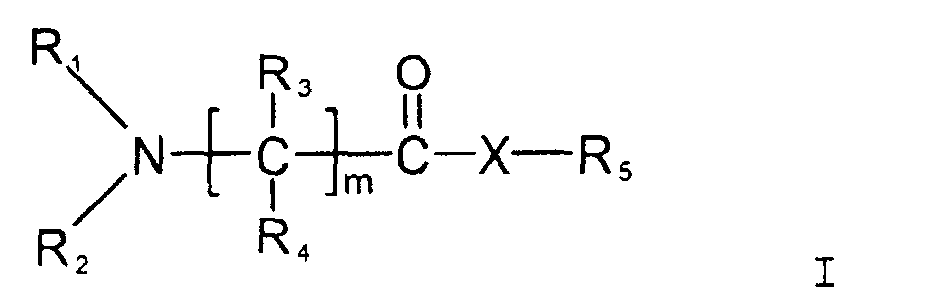 (i) R1 und R2 aus der Gruppe, bestehend aus Wasserstoff, substituiertem C1-12-Alkyl, unsubstituiertem C1-12-Alkyl, substituiertem C1-12-Alkoxy, unsubstituiertem C1-12-Alkoxy, Hydroxyl, substituiertem Aryl, unsubstituiertem Aryl, substituiertem Heterocyclus und unsubstituiertem Heterocyclus, ausgewählt sind;(ii) R3 und R4 aus der Gruppe, bestehend aus Wasserstoff, substituiertem und unsubstituiertem C1-12-Alkyl, substituiertem und unsubstituiertem C1-12-Alkoxy, Hydroxyl, Halogen, substituiertem und unsubstituiertem Aryl, substituiertem und unsubstituiertem Heterocyclus, jedoch nicht Phenyl sein dürfen; und -CH2-S-Y, worin Y Wasserstoff, substituiertes oder unsubstituiertes C1-12-Alkyl, substituiertes oder unsubstituiertes C1-12-Alkoxy, substituiertes oder unsubstituiertes Aryl, substituierter oder unsubstituierter Heterocyclus bedeutet, ausgewählt sind;(iii) R5 aus der Gruppe, bestehend aus substituiertem und unsubstituiertem C1-12-Alkyl, substituiertem und unsubstituiertem C1-12-Alkoxy, Hydroxyl, substituiertem und unsubstituiertem Aryl, substituiertem und unsubstituiertem Heterocyclus, ausgewählt ist;(iv) X aus der Gruppe, bestehend aus Sauerstoff, Schwefel und Stickstoff-R6, worin R6 das Gleiche wie R1 ist, ausgewählt ist; und worin(v) m eine ganze Zahl von null bis fünf ist.
 - Zusammensetzung nach Anspruch 1, worin der Vergällungsstoff in Wasser löslich und in einem lipophilen Lösungsmittel praktisch unlöslich ist und seine freie Base in Wasser schlecht löslich und in einem lipophilen Lösungsmittel frei löslich ist.
- Zusammensetzung nach Anspruch 1, worin der Vergällungsstoff das Säuresalz von Chinin ist.
- Zusammensetzung nach Anspruch 1, worin der Vergällungsstoff ein in Wasser lösliches Vitamin ist.
- Zusammensetzung nach Anspruch 1, worin das sympathomimetische Amin ein Dekongestant ist.
- Zusammensetzung nach Anspruch 7, worin das Dekongestant eine legal erhältliche Verbindung mit der Strukturformel II:darstellt, worin
 (i) R7, R8, R10 und R13 aus der Gruppe, bestehend aus: Wasserstoff, substituiertem C1-12-Alkyl, unsubstituiertem C1-12-Alkyl, substituiertem C1-12-Alkoxy, unsubstituiertem C1-12-Alkoxy, Hydroxy und Halogen, ausgewählt sind; und
worin(ii) R11 und R12 aus der Gruppe, bestehend aus Wasserstoff, substituiertem C1-12-Alkyl, unsubstituiertem C1-12-Alkyl, substituiertem C1-12-Alkoxy, unsubstituiertem C1-12-Alkoxy und Hydroxy, ausgewählt sind. - Zusammensetzung nach Anspruch 8, worin das Dekongestant aus der Gruppe, bestehend aus Phenylephrinhydrochlorid, Phenylpropanolaminhydrochlorid, Pseudoephedrinhydrochlorid, Pseudoephedrinsulfat, Ephedrinhydrochlorid und Gemischen davon, ausgewählt ist.
- Zusammensetzung nach Anspruch 1, worin der Vergällungsstoff und das sympathomimetische Amin in einem Verhältnis von etwa 100:1 bis etwa 1:100 vorliegen.
- Zusammensetzung, umfassend ein Säuresalz von Pseudoephedrin und eine wirksame vergällende Menge des Säuresalzes von Chinin.
- Verwendung einer wirksamen Menge von mindestens einem pharmazeutisch und biologisch verträglichen Vergällungsstoff in einer Zusammensetzung mit sympathomimetischem Aminsalz, um die Isolierung und/oder Umwandlung des sympathomimetischen Aminsalzes schwierig oder im Wesentlichen unmöglich zu machen, wobei der Vergällungsstoff eine Aminverbindung ist, die ein in Wasser lösliches, hydrophiles Säuresalz und eine in Wasser unlösliche, hydrophobe, freie Base ist.
- Verfahren zur Verwendung nach Anspruch 12, worin der Vergällungsstoff ausgewählt ist aus der Strukturformel I:worin:
 (i) R1 und R2 aus der Gruppe, bestehend aus Wasserstoff, substituiertem C1-12-Alkyl, unsubstituiertem C1-12-Alkyl, substituiertem C1-12-Alkoxy, unsubstituiertem C1-12-Alkoxy, Hydroxyl, substituiertem Aryl, unsubstituiertem Aryl, substituiertem Heterocyclus und unsubstituiertem Heterocyclus, ausgewählt sind;(ii) R3 und R4 aus der Gruppe, bestehend aus Wasserstoff, substituiertem und unsubstituiertem C1-12-Alkyl, substituiertem und unsubstituiertem C1-12-Alkoxy, Hydroxyl, Halogen, substituiertem und unsubstituiertem Aryl, substituiertem und unsubstituiertem Heterocyclus, jedoch nicht Phenyl sein dürfen; und -CH2-S-Y, worin Y Wasserstoff, substituiertes oder unsubstituiertes C1-12-Alkyl, substituiertes oder unsubstituiertes C1-12-Alkoxy, substituiertes oder unsubstituiertes Aryl, substituierter oder unsubstituierter Heterocyclus bedeutet, ausgewählt sind;(iii) R5 aus der Gruppe, bestehend aus substituiertem C1-12-Alkyl, unsubstituiertem C1-12-Alkyl, substituiertem C1-12-Alkoxy, unsubstituiertem C1-12-Alkoxy, Hydroxyl, substituiertem Aryl, unsubstituiertem Aryl, substituiertem Heterocyclus und unsubstituiertem Heterocyclus, ausgewählt ist;(iv) X aus der Gruppe, bestehend aus Sauerstoff, Schwefel und Stickstoff-R6, worin R6 das Gleiche wie R1 ist, ausgewählt ist; und worin(v) m eine ganze Zahl von null bis fünf ist.
 - Verfahren zur Verwendung nach Anspruch 12, wobei der Vergällungsstoff in Wasser löslich und in einem lipophilen Lösungsmittel praktisch unlöslich ist und seine freie Base in Wasser schlecht löslich und in einem lipophilen Lösungsmittel frei löslich ist.
- Verfahren zur Verwendung nach Anspruch 12, wobei der Vergällungsstoff das Säuresalz von Chinin ist.
- Verfahren zur Verwendung nach Anspruch 12, wobei der Vergällungsstoff ein in Wasser lösliches Vitamin darstellt.
- Verfahren zur Verwendung nach Anspruch 12, wobei das sympathomimetische Amin ein Dekongestant ist.
- Verfahren zur Verwendung nach Anspruch 17, wobei das Dekongestant eine Verbindung der Strukturformel II ist:worin
 (i) R7, R8, R10 und R13 aus der Gruppe, bestehend aus: Wasserstoff, substituiertem C1-12-Alkyl, unsubstituiertem C1-12-Alkyl, substituiertem C1-12-Alkoxy, unsubstituiertem C1-12-Alkoxy, Hydroxy und Halogen, ausgewählt sind; und
worin(ii) R11 und R12 aus der Gruppe, bestehend aus Wasserstoff, substituiertem C1-12-Alkyl, unsubstituiertem C1-12-Alkyl, substituiertem C1-12-Alkoxy, unsubstituiertem C1-12-Alkoxy und Hydroxy, ausgewählt sind. - Verfahren zur Verwendung nach Anspruch 18, wobei das Dekongestant aus der Gruppe, bestehend aus Phenylephrinhydrochlorid, Phenylpropanolaminhydrochlorid, Pseudoephedrinhydrochlorid, Pseudoephedrinsulfat, Ephedrinhydrochlorid oder Gemischen davon, ausgewählt ist.
- Zusammensetzung, umfassend eine wirksame Menge eines Vergällungsstoffs und das Säuresalz eines sympathomimetischen Amins, wobei der Vergällungsstoff Schwefel in einer Form enthält, dass Schwefelwasserstoff, Mercaptane und/oder Schwefeldioxid während der Reinigung und/oder Umwandlung des sympathomimetischen Amins aus der Zusammensetzung erzeugt werden.
- Zusammensetzung nach Anspruch 20, wobei der Vergällungsstoff aus der Gruppe, bestehend aus Magnesiumsulfat, Natriumsulfat und einer Säure, ausgewählt ist.
- Zusammensetzung, umfassend eine wirksame Menge eines Vergällungsstoffs und das Säuresalz eines sympathomimetischen Amins, wobei der Vergällungsstoff Stickstoff in einer Form enthält, dass Ammoniak, Amine und/oder Diamine während der Reinigung und/oder Umwandlung des sympathomimetischen Amins aus der Zusammensetzung erzeugt werden.
- Zusammensetzung nach Anspruch 22, worin der Vergällungsstoff aus der Gruppe, bestehend aus Ammoniumchlorid, Ammoniumsulfat, Monoalkylaminhydrochlorid, Dialkylaminhydrochlorid, Trialkylaminhydrochlorid, Succinamid und Glutarsäurediamid, ausgewählt ist.
- Zusammensetzung, umfassend eine wirksame Menge eines Vergällungsstoffs und das Säuresalz eines sympathomimetischen Amins, wobei der Vergällungsstoff ein oder mehrere Gummi oder Viskositätsmodifizierungsmittel ist, welches in Wasser löslich und in unpolaren Lösungsmitteln im Wesentlichen unlöslich ist.
- Zusammensetzung nach Anspruch 24, worin die Zusammensetzung weiterhin ein oder mehrere oberflächenaktive Mittel umfasst.
- Zusammensetzung nach Anspruch 25, worin die Zusammensetzung einen nichtionischen oberflächenaktiven Vergällungsstoff und einen ionischen oberflächenaktiven Vergällungsstoff umfasst.
- Zusammensetzung nach Anspruch 24, worin das Gummi oder Viskositätsmodifizierungsmittel eine Polyethylenoxidverbindung ist.
- Zusammensetzung nach Anspruch 27, worin die Polyethylenoxidverbindung ein Molekulargewicht von etwa 2 000 000 aufweist.
- Zusammensetzung nach Anspruch 25, worin eines von den nichtionischen oberflächenaktiven Vergällungsstoffen ein Poly(oxypro-pylen)-Poly(oxyethylen)-Copolymer darstellt.
- Zusammensetzung nach Anspruch 29, worin das Poly(oxypropylen)-Poly(oxyethylen)-Copolymer Pluronic F127 ist.
- Zusammensetzung nach Anspruch 26, worin das ionische oberflächenaktive Mittel Natriumlaurylsulfat darstellt.
- Zusammensetzung nach Anspruch 26, worin die Vergällungsstoffe (i) ein nichtionisches Polyethylenoxidoberflächenaktives Mittel; (ii) ein nichtionisches Poly(oxypropylen)-Poly(oxyethylen)-Copolymer-oberflächenaktives Mittel; und (iii) Natriumlaurylsulfat umfassen.
- Zusammensetzung, umfassend eine wirksame Menge eines Vergällungsstoffs und das Säuresalz eines sympathomimetischen Amins, wobei der Vergällungsstoff eine oder mehrere Seifenvorstufe(n) oder oberflächenaktive Stoff, löslich in unpolaren organischen Stoffen, ist und der Vergällungsstoff mit einem Material eingekapselt ist, das in unpolaren organischen Stoffen schlecht löslich ist.
- Zusammensetzung nach Anspruch 33, worin die Seifenvorstufe eine Fettsäure mit einer 10-31 Kohlenstoffatome aufweisenden Kette ist.
- Zusammensetzung nach Anspruch 33, worin die Fettsäure Stearinsäure ist.
- Zusammensetzung nach Anspruch 33, worin das Einkapselungsmaterial eine Alkylcellulose ist.
- Zusammensetzung, umfassend eine wirksame Menge eines Vergällungsstoffs und das Säuresalz eines sympathomimetischen Amins, wobei der Vergällungsstoff ein oder mehrere Gummi oder Viskositätsmodifizierungsmittel ist, welche in Wasser löslich und in unpolaren Lösungsmitteln im Wesentlichen unlöslich ist und der Vergällungsstoff mit einem Material eingekapselt ist, das in unpolaren organischen Stoffen schlecht löslich ist.
- Zusammensetzung nach Anspruch 37, worin das Gummi oder Viskositätsmodifizierungsmittel Polyethylenoxid ist.
- Zusammensetzung nach Anspruch 37, worin das Einkapselungsmaterial Stearinsäure ist.
- Verwendung einer wirksamen Menge von mindestens einem pharmazeutisch und biologisch verträglichen Vergällungsstoff nach Ansprüchen 20, 22, 24, 33 oder 37 in einer Zusammensetzung mit sympathomimetischem Aminsalz, um die Isolierung und/oder Umwandlung des sympathomimetischen Aminsalzes schwierig oder im Wesentlichen unmöglich zu machen.
Priority Applications (1)
| Application Number | Priority Date | Filing Date | Title |
|---|---|---|---|
| SI9730559T SI0894010T1 (en) | 1996-04-10 | 1997-04-01 | Denaturants for sympathomimetic amine salts |
Applications Claiming Priority (7)
| Application Number | Priority Date | Filing Date | Title |
|---|---|---|---|
| US1523996P | 1996-04-10 | 1996-04-10 | |
| US15239P | 1996-04-10 | ||
| US3260296P | 1996-12-11 | 1996-12-11 | |
| US32602P | 1996-12-11 | ||
| US4055097P | 1997-03-13 | 1997-03-13 | |
| US40550P | 1997-03-13 | ||
| PCT/US1997/005509 WO1997037689A2 (en) | 1996-04-10 | 1997-04-01 | Denaturants for sympathomimetic amine salts |
Publications (2)
| Publication Number | Publication Date |
|---|---|
| EP0894010A2 EP0894010A2 (de) | 1999-02-03 |
| EP0894010B1 true EP0894010B1 (de) | 2003-07-02 |
Family
ID=27360291
Family Applications (1)
| Application Number | Title | Priority Date | Filing Date |
|---|---|---|---|
| EP97920079A Expired - Lifetime EP0894010B1 (de) | 1996-04-10 | 1997-04-01 | Vergällungsstoffe für sympathomimetische aminsalze |
Country Status (18)
| Country | Link |
|---|---|
| US (1) | US6136864A (de) |
| EP (1) | EP0894010B1 (de) |
| JP (1) | JP2001527514A (de) |
| AR (1) | AR006571A1 (de) |
| AT (1) | ATE244019T1 (de) |
| BR (1) | BR9708559A (de) |
| CA (1) | CA2250010C (de) |
| DE (1) | DE69723248T2 (de) |
| DK (1) | DK0894010T3 (de) |
| ES (1) | ES2202605T3 (de) |
| MX (1) | MX9807594A (de) |
| NZ (1) | NZ332233A (de) |
| PE (1) | PE20011304A1 (de) |
| PT (1) | PT894010E (de) |
| SI (1) | SI0894010T1 (de) |
| TW (1) | TW522012B (de) |
| UY (1) | UY24512A1 (de) |
| WO (1) | WO1997037689A2 (de) |
Families Citing this family (25)
| Publication number | Priority date | Publication date | Assignee | Title |
|---|---|---|---|---|
| US5945125A (en) * | 1995-02-28 | 1999-08-31 | Temple University | Controlled release tablet |
| GT199900148A (es) | 1998-09-10 | 2001-02-28 | Desnaturalizantes para las sales aminas simpaticomimeticas. | |
| US20030068375A1 (en) | 2001-08-06 | 2003-04-10 | Curtis Wright | Pharmaceutical formulation containing gelling agent |
| JP4370451B2 (ja) * | 2001-09-28 | 2009-11-25 | 大塚製薬株式会社 | 医薬組成物 |
| US7201920B2 (en) | 2003-11-26 | 2007-04-10 | Acura Pharmaceuticals, Inc. | Methods and compositions for deterring abuse of opioid containing dosage forms |
| CA2916869A1 (en) | 2004-06-12 | 2005-12-29 | Jane C. Hirsh | Abuse-deterrent drug formulations |
| DE102004045037A1 (de) * | 2004-09-15 | 2006-03-16 | Basf Ag | Pharmazeutische Darreichungsformen mit erschwerter Extrahierbarkeit eines Sympathomimetikums aus der Darreichungsform |
| US9238073B2 (en) * | 2006-04-12 | 2016-01-19 | Wyeth Llc | Pharmaceutical composition containing sympathomimetic amine salt and co-distillable additive |
| SA07280459B1 (ar) | 2006-08-25 | 2011-07-20 | بيورديو فارما إل. بي. | أشكال جرعة صيدلانية للتناول عن طريق الفم مقاومة للعبث تشتمل على مسكن شبه أفيوني |
| CA2689434C (en) * | 2007-06-04 | 2017-09-26 | Shear/Kershman Laboratories, Inc. | Tamper resistant lipid-based oral dosage form for opioid agonists |
| AU2010300641B2 (en) * | 2009-09-30 | 2016-03-17 | Acura Pharmaceuticals, Inc. | Methods and compositions for deterring abuse |
| US10668060B2 (en) | 2009-12-10 | 2020-06-02 | Collegium Pharmaceutical, Inc. | Tamper-resistant pharmaceutical compositions of opioids and other drugs |
| ME02874B (de) | 2010-12-22 | 2018-04-20 | Purdue Pharma Lp | Gekapselte manipulationssichere Darreichungsformen mit gesteuerter Freisetzung |
| PH12013501345A1 (en) | 2010-12-23 | 2022-10-24 | Purdue Pharma Lp | Tamper resistant solid oral dosage forms |
| WO2013089986A1 (en) * | 2011-12-12 | 2013-06-20 | Product And Technology Partners Llc | Improved denaturants for sympathomimetic amines |
| MX366159B (es) | 2012-11-30 | 2019-07-01 | Acura Pharmaceuticals Inc | Liberacion autorregulada de ingrediente farmaceutico activo. |
| MX2015010041A (es) | 2013-02-05 | 2015-10-30 | Purdue Pharma Lp | Formulacion farmaceuticas resistentes a la alteracion. |
| US10751287B2 (en) | 2013-03-15 | 2020-08-25 | Purdue Pharma L.P. | Tamper resistant pharmaceutical formulations |
| WO2015145461A1 (en) | 2014-03-26 | 2015-10-01 | Sun Pharma Advanced Research Company Ltd. | Abuse deterrent immediate release biphasic matrix solid dosage form |
| US10058490B2 (en) * | 2014-12-24 | 2018-08-28 | L'oreal | Acoustically-activated cosmetic hydrogels |
| US11103581B2 (en) | 2015-08-31 | 2021-08-31 | Acura Pharmaceuticals, Inc. | Methods and compositions for self-regulated release of active pharmaceutical ingredient |
| US9737530B1 (en) | 2016-06-23 | 2017-08-22 | Collegium Pharmaceutical, Inc. | Process of making stable abuse-deterrent oral formulations |
| FR3059903B1 (fr) * | 2016-12-08 | 2019-03-22 | Salsarulo Pharma | Medicament oral comprenant un laxatif osmotique incorpore dans une matrice a base de matieres grasses vegetales |
| CN114073690B (zh) * | 2020-08-10 | 2024-01-12 | 江苏长泰药业有限公司 | 一种含有氨基酸的防提取药物组合物及其制剂 |
| CN114073689B (zh) * | 2020-08-10 | 2024-01-12 | 江苏长泰药业有限公司 | 一种防提取药物组合物及其制剂 |
Family Cites Families (12)
| Publication number | Priority date | Publication date | Assignee | Title |
|---|---|---|---|---|
| US3169092A (en) * | 1963-09-26 | 1965-02-09 | Richardson Merrell Inc | Stabilization of amines by tartrazine and bisulfite |
| US3773920A (en) * | 1971-07-14 | 1973-11-20 | Nikken Chemicals Co Ltd | Sustained release medicinal composition |
| GB1593261A (en) * | 1976-07-23 | 1981-07-15 | Inveresk Res Int | Controlled release suppository |
| US4493827A (en) * | 1983-11-14 | 1985-01-15 | Ronald Valle | Method of inducing sleep |
| US4657757A (en) * | 1985-03-29 | 1987-04-14 | Schering Corporation | Controlled release dosage form comprising acetaminophen, pseudoephedrine sulfate and dexbrompheniramine maleate |
| US4601894A (en) * | 1985-03-29 | 1986-07-22 | Schering Corporation | Controlled release dosage form comprising acetaminophen, pseudoephedrine sulfate and dexbrompheniramine maleate |
| US4689223A (en) * | 1986-04-24 | 1987-08-25 | T & R Chemicals, Inc. | Method of treating the symptoms of the common cold |
| ZA904021B (en) * | 1989-11-24 | 1991-02-27 | Van Der Linde Leon | Slimming preparations |
| US5407686A (en) * | 1991-11-27 | 1995-04-18 | Sidmak Laboratories, Inc. | Sustained release composition for oral administration of active ingredient |
| DK0701434T3 (da) * | 1993-06-04 | 2002-11-18 | Warner Lambert Co | Præparater indeholdende siliciumdioxid til forbedring af deres smag |
| AUPM814994A0 (en) * | 1994-09-14 | 1994-10-06 | Sterling Winthrop Inc. | Codeine-containing formulations |
| US5585108A (en) * | 1994-12-30 | 1996-12-17 | Nanosystems L.L.C. | Formulations of oral gastrointestinal therapeutic agents in combination with pharmaceutically acceptable clays |
-
1997
- 1997-04-01 NZ NZ332233A patent/NZ332233A/xx unknown
- 1997-04-01 JP JP53631297A patent/JP2001527514A/ja not_active Ceased
- 1997-04-01 EP EP97920079A patent/EP0894010B1/de not_active Expired - Lifetime
- 1997-04-01 BR BR9708559A patent/BR9708559A/pt not_active Application Discontinuation
- 1997-04-01 DK DK97920079T patent/DK0894010T3/da active
- 1997-04-01 PT PT97920079T patent/PT894010E/pt unknown
- 1997-04-01 WO PCT/US1997/005509 patent/WO1997037689A2/en not_active Ceased
- 1997-04-01 AT AT97920079T patent/ATE244019T1/de not_active IP Right Cessation
- 1997-04-01 CA CA002250010A patent/CA2250010C/en not_active Expired - Fee Related
- 1997-04-01 SI SI9730559T patent/SI0894010T1/xx unknown
- 1997-04-01 MX MX9807594A patent/MX9807594A/es unknown
- 1997-04-01 ES ES97920079T patent/ES2202605T3/es not_active Expired - Lifetime
- 1997-04-01 US US08/937,408 patent/US6136864A/en not_active Expired - Lifetime
- 1997-04-01 DE DE69723248T patent/DE69723248T2/de not_active Expired - Lifetime
- 1997-04-09 AR ARP970101397A patent/AR006571A1/es unknown
- 1997-04-09 PE PE2001001077A patent/PE20011304A1/es not_active Application Discontinuation
- 1997-04-09 UY UY24512A patent/UY24512A1/es not_active IP Right Cessation
- 1997-04-10 TW TW086104620A patent/TW522012B/zh not_active IP Right Cessation
Also Published As
| Publication number | Publication date |
|---|---|
| DE69723248T2 (de) | 2004-05-27 |
| PT894010E (pt) | 2003-11-28 |
| AR006571A1 (es) | 1999-09-08 |
| UY24512A1 (es) | 2001-08-27 |
| BR9708559A (pt) | 1999-08-03 |
| CA2250010A1 (en) | 1997-10-16 |
| SI0894010T1 (en) | 2003-10-31 |
| JP2001527514A (ja) | 2001-12-25 |
| WO1997037689A2 (en) | 1997-10-16 |
| ATE244019T1 (de) | 2003-07-15 |
| WO1997037689A3 (en) | 1997-12-04 |
| MX9807594A (en) | 1999-03-31 |
| EP0894010A2 (de) | 1999-02-03 |
| AU2436097A (en) | 1997-10-29 |
| PE20011304A1 (es) | 2002-01-18 |
| CA2250010C (en) | 2008-06-10 |
| US6136864A (en) | 2000-10-24 |
| DK0894010T3 (da) | 2003-10-27 |
| TW522012B (en) | 2003-03-01 |
| DE69723248D1 (de) | 2003-08-07 |
| NZ332233A (en) | 1999-11-29 |
| ES2202605T3 (es) | 2004-04-01 |
| AU711752B2 (en) | 1999-10-21 |
Similar Documents
| Publication | Publication Date | Title |
|---|---|---|
| EP0894010B1 (de) | Vergällungsstoffe für sympathomimetische aminsalze | |
| AU2004202702B2 (en) | Compositions comprising sympathomimetic amine salts unsuitable for illegal use | |
| JP5844312B2 (ja) | 事故的誤用および不法転用を防止するための耐破砕性錠剤 | |
| KR20160070839A (ko) | 즉시 방출 남용 저지 입상 투여 형태 | |
| WO2016094358A1 (en) | Immediate release abuse-deterrent granulated dosage forms | |
| US10307485B2 (en) | Pharmaceutical composition containing sympathomimetic amine salt and co-distillable additive | |
| US20170157052A1 (en) | Immediate release dosage forms that deter abuse by oral ingestion of multiple dosage units | |
| AU711752C (en) | Denaturants for sympathomimetic amine salts | |
| JP2002518330A (ja) | 処置方法 | |
| HK1126399B (en) | Crush-resistant tablets intended to prevent accidental misuse and unlawful diversion | |
| HK1121055B (en) | Crush-resistant oxycodone tablets intended for preventing accidental misuse and unlawful diversion | |
| MXPA01001206A (en) | Compositions comprising sympathomimetic amine salts unsuitable for illegal use |
Legal Events
| Date | Code | Title | Description |
|---|---|---|---|
| PUAI | Public reference made under article 153(3) epc to a published international application that has entered the european phase |
Free format text: ORIGINAL CODE: 0009012 |
|
| 17P | Request for examination filed |
Effective date: 19981005 |
|
| AK | Designated contracting states |
Kind code of ref document: A2 Designated state(s): AT BE CH DE DK ES FI FR GB GR IE IT LI LU MC NL PT SE |
|
| AX | Request for extension of the european patent |
Free format text: AL PAYMENT 981005;LT PAYMENT 981005;LV PAYMENT 981005;SI PAYMENT 981005 |
|
| 17Q | First examination report despatched |
Effective date: 20010621 |
|
| GRAH | Despatch of communication of intention to grant a patent |
Free format text: ORIGINAL CODE: EPIDOS IGRA |
|
| GRAH | Despatch of communication of intention to grant a patent |
Free format text: ORIGINAL CODE: EPIDOS IGRA |
|
| RAP1 | Party data changed (applicant data changed or rights of an application transferred) |
Owner name: WARNER-LAMBERT COMPANY LLC |
|
| GRAA | (expected) grant |
Free format text: ORIGINAL CODE: 0009210 |
|
| AK | Designated contracting states |
Designated state(s): AT BE CH DE DK ES FI FR GB GR IE IT LI LU MC NL PT SE |
|
| AX | Request for extension of the european patent |
Extension state: AL LT LV SI |
|
| REG | Reference to a national code |
Ref country code: GB Ref legal event code: FG4D |
|
| REG | Reference to a national code |
Ref country code: CH Ref legal event code: NV Representative=s name: ROTTMANN, ZIMMERMANN + PARTNER AG Ref country code: CH Ref legal event code: EP |
|
| REG | Reference to a national code |
Ref country code: IE Ref legal event code: FG4D |
|
| REF | Corresponds to: |
Ref document number: 69723248 Country of ref document: DE Date of ref document: 20030807 Kind code of ref document: P |
|
| REG | Reference to a national code |
Ref country code: GR Ref legal event code: EP Ref document number: 20030403612 Country of ref document: GR |
|
| REG | Reference to a national code |
Ref country code: SE Ref legal event code: TRGR |
|
| REG | Reference to a national code |
Ref country code: ES Ref legal event code: FG2A Ref document number: 2202605 Country of ref document: ES Kind code of ref document: T3 |
|
| ET | Fr: translation filed | ||
| PLBE | No opposition filed within time limit |
Free format text: ORIGINAL CODE: 0009261 |
|
| STAA | Information on the status of an ep patent application or granted ep patent |
Free format text: STATUS: NO OPPOSITION FILED WITHIN TIME LIMIT |
|
| 26N | No opposition filed |
Effective date: 20040405 |
|
| REG | Reference to a national code |
Ref country code: SI Ref legal event code: IF |
|
| PGFP | Annual fee paid to national office [announced via postgrant information from national office to epo] |
Ref country code: AT Payment date: 20050314 Year of fee payment: 9 |
|
| PGFP | Annual fee paid to national office [announced via postgrant information from national office to epo] |
Ref country code: MC Payment date: 20050404 Year of fee payment: 9 |
|
| PGFP | Annual fee paid to national office [announced via postgrant information from national office to epo] |
Ref country code: BE Payment date: 20050428 Year of fee payment: 9 |
|
| PGFP | Annual fee paid to national office [announced via postgrant information from national office to epo] |
Ref country code: LU Payment date: 20050603 Year of fee payment: 9 |
|
| PG25 | Lapsed in a contracting state [announced via postgrant information from national office to epo] |
Ref country code: AT Free format text: LAPSE BECAUSE OF NON-PAYMENT OF DUE FEES Effective date: 20060401 |
|
| PG25 | Lapsed in a contracting state [announced via postgrant information from national office to epo] |
Ref country code: MC Free format text: LAPSE BECAUSE OF NON-PAYMENT OF DUE FEES Effective date: 20060430 Ref country code: LU Free format text: LAPSE BECAUSE OF NON-PAYMENT OF DUE FEES Effective date: 20060430 Ref country code: BE Free format text: LAPSE BECAUSE OF NON-PAYMENT OF DUE FEES Effective date: 20060430 |
|
| LTLA | Lt: lapse of european patent or patent extension |
Effective date: 20060401 |
|
| REG | Reference to a national code |
Ref country code: SI Ref legal event code: KO00 Effective date: 20061215 |
|
| BERE | Be: lapsed |
Owner name: *WARNER-LAMBERT CY LLC Effective date: 20060430 |
|
| PGFP | Annual fee paid to national office [announced via postgrant information from national office to epo] |
Ref country code: PT Payment date: 20090330 Year of fee payment: 13 |
|
| PGFP | Annual fee paid to national office [announced via postgrant information from national office to epo] |
Ref country code: GR Payment date: 20090316 Year of fee payment: 13 |
|
| PGFP | Annual fee paid to national office [announced via postgrant information from national office to epo] |
Ref country code: DK Payment date: 20090415 Year of fee payment: 13 |
|
| REG | Reference to a national code |
Ref country code: CH Ref legal event code: PCAR Free format text: SCHMAUDER & PARTNER AG PATENT- UND MARKENANWAELTE VSP;ZWAENGIWEG 7;8038 ZUERICH (CH) |
|
| PGFP | Annual fee paid to national office [announced via postgrant information from national office to epo] |
Ref country code: SE Payment date: 20090407 Year of fee payment: 13 Ref country code: NL Payment date: 20090405 Year of fee payment: 13 Ref country code: FI Payment date: 20090416 Year of fee payment: 13 |
|
| PGFP | Annual fee paid to national office [announced via postgrant information from national office to epo] |
Ref country code: CH Payment date: 20090416 Year of fee payment: 13 |
|
| REG | Reference to a national code |
Ref country code: NL Ref legal event code: V1 Effective date: 20101101 |
|
| EUG | Se: european patent has lapsed | ||
| REG | Reference to a national code |
Ref country code: CH Ref legal event code: PL |
|
| REG | Reference to a national code |
Ref country code: DK Ref legal event code: EBP |
|
| PG25 | Lapsed in a contracting state [announced via postgrant information from national office to epo] |
Ref country code: NL Free format text: LAPSE BECAUSE OF NON-PAYMENT OF DUE FEES Effective date: 20101101 Ref country code: FI Free format text: LAPSE BECAUSE OF NON-PAYMENT OF DUE FEES Effective date: 20100401 |
|
| PG25 | Lapsed in a contracting state [announced via postgrant information from national office to epo] |
Ref country code: PT Free format text: LAPSE BECAUSE OF NON-PAYMENT OF DUE FEES Effective date: 20101001 Ref country code: LI Free format text: LAPSE BECAUSE OF NON-PAYMENT OF DUE FEES Effective date: 20100430 Ref country code: CH Free format text: LAPSE BECAUSE OF NON-PAYMENT OF DUE FEES Effective date: 20100430 |
|
| PG25 | Lapsed in a contracting state [announced via postgrant information from national office to epo] |
Ref country code: GR Free format text: LAPSE BECAUSE OF NON-PAYMENT OF DUE FEES Effective date: 20101103 |
|
| PG25 | Lapsed in a contracting state [announced via postgrant information from national office to epo] |
Ref country code: DK Free format text: LAPSE BECAUSE OF NON-PAYMENT OF DUE FEES Effective date: 20100503 |
|
| PGFP | Annual fee paid to national office [announced via postgrant information from national office to epo] |
Ref country code: FR Payment date: 20110426 Year of fee payment: 15 Ref country code: ES Payment date: 20110518 Year of fee payment: 15 Ref country code: IE Payment date: 20110412 Year of fee payment: 15 Ref country code: GB Payment date: 20110330 Year of fee payment: 15 Ref country code: DE Payment date: 20110330 Year of fee payment: 15 |
|
| PGFP | Annual fee paid to national office [announced via postgrant information from national office to epo] |
Ref country code: IT Payment date: 20110414 Year of fee payment: 15 |
|
| PG25 | Lapsed in a contracting state [announced via postgrant information from national office to epo] |
Ref country code: SE Free format text: LAPSE BECAUSE OF NON-PAYMENT OF DUE FEES Effective date: 20100402 |
|
| GBPC | Gb: european patent ceased through non-payment of renewal fee |
Effective date: 20120401 |
|
| REG | Reference to a national code |
Ref country code: IE Ref legal event code: MM4A |
|
| REG | Reference to a national code |
Ref country code: FR Ref legal event code: ST Effective date: 20121228 |
|
| PG25 | Lapsed in a contracting state [announced via postgrant information from national office to epo] |
Ref country code: GB Free format text: LAPSE BECAUSE OF NON-PAYMENT OF DUE FEES Effective date: 20120401 Ref country code: IE Free format text: LAPSE BECAUSE OF NON-PAYMENT OF DUE FEES Effective date: 20120401 |
|
| REG | Reference to a national code |
Ref country code: DE Ref legal event code: R119 Ref document number: 69723248 Country of ref document: DE Effective date: 20121101 |
|
| PG25 | Lapsed in a contracting state [announced via postgrant information from national office to epo] |
Ref country code: IT Free format text: LAPSE BECAUSE OF NON-PAYMENT OF DUE FEES Effective date: 20120401 Ref country code: FR Free format text: LAPSE BECAUSE OF NON-PAYMENT OF DUE FEES Effective date: 20120430 |
|
| REG | Reference to a national code |
Ref country code: ES Ref legal event code: FD2A Effective date: 20130716 |
|
| PG25 | Lapsed in a contracting state [announced via postgrant information from national office to epo] |
Ref country code: ES Free format text: LAPSE BECAUSE OF NON-PAYMENT OF DUE FEES Effective date: 20120402 |
|
| PG25 | Lapsed in a contracting state [announced via postgrant information from national office to epo] |
Ref country code: DE Free format text: LAPSE BECAUSE OF NON-PAYMENT OF DUE FEES Effective date: 20121101 |