EP0882828B1 - Schlaufenmaterial - Google Patents
Schlaufenmaterial Download PDFInfo
- Publication number
- EP0882828B1 EP0882828B1 EP98109919A EP98109919A EP0882828B1 EP 0882828 B1 EP0882828 B1 EP 0882828B1 EP 98109919 A EP98109919 A EP 98109919A EP 98109919 A EP98109919 A EP 98109919A EP 0882828 B1 EP0882828 B1 EP 0882828B1
- Authority
- EP
- European Patent Office
- Prior art keywords
- loop
- material according
- fibres
- loop material
- layer
- Prior art date
- Legal status (The legal status is an assumption and is not a legal conclusion. Google has not performed a legal analysis and makes no representation as to the accuracy of the status listed.)
- Expired - Lifetime
Links
Images

Classifications
-
- D—TEXTILES; PAPER
- D04—BRAIDING; LACE-MAKING; KNITTING; TRIMMINGS; NON-WOVEN FABRICS
- D04H—MAKING TEXTILE FABRICS, e.g. FROM FIBRES OR FILAMENTARY MATERIAL; FABRICS MADE BY SUCH PROCESSES OR APPARATUS, e.g. FELTS, NON-WOVEN FABRICS; COTTON-WOOL; WADDING ; NON-WOVEN FABRICS FROM STAPLE FIBRES, FILAMENTS OR YARNS, BONDED WITH AT LEAST ONE WEB-LIKE MATERIAL DURING THEIR CONSOLIDATION
- D04H1/00—Non-woven fabrics formed wholly or mainly of staple fibres or like relatively short fibres
- D04H1/40—Non-woven fabrics formed wholly or mainly of staple fibres or like relatively short fibres from fleeces or layers composed of fibres without existing or potential cohesive properties
- D04H1/42—Non-woven fabrics formed wholly or mainly of staple fibres or like relatively short fibres from fleeces or layers composed of fibres without existing or potential cohesive properties characterised by the use of certain kinds of fibres insofar as this use has no preponderant influence on the consolidation of the fleece
- D04H1/4282—Addition polymers
- D04H1/4291—Olefin series
-
- A—HUMAN NECESSITIES
- A44—HABERDASHERY; JEWELLERY
- A44B—BUTTONS, PINS, BUCKLES, SLIDE FASTENERS, OR THE LIKE
- A44B18/00—Fasteners of the touch-and-close type; Making such fasteners
- A44B18/0003—Fastener constructions
- A44B18/0011—Female or loop elements
-
- D—TEXTILES; PAPER
- D04—BRAIDING; LACE-MAKING; KNITTING; TRIMMINGS; NON-WOVEN FABRICS
- D04H—MAKING TEXTILE FABRICS, e.g. FROM FIBRES OR FILAMENTARY MATERIAL; FABRICS MADE BY SUCH PROCESSES OR APPARATUS, e.g. FELTS, NON-WOVEN FABRICS; COTTON-WOOL; WADDING ; NON-WOVEN FABRICS FROM STAPLE FIBRES, FILAMENTS OR YARNS, BONDED WITH AT LEAST ONE WEB-LIKE MATERIAL DURING THEIR CONSOLIDATION
- D04H1/00—Non-woven fabrics formed wholly or mainly of staple fibres or like relatively short fibres
- D04H1/40—Non-woven fabrics formed wholly or mainly of staple fibres or like relatively short fibres from fleeces or layers composed of fibres without existing or potential cohesive properties
- D04H1/54—Non-woven fabrics formed wholly or mainly of staple fibres or like relatively short fibres from fleeces or layers composed of fibres without existing or potential cohesive properties by welding together the fibres, e.g. by partially melting or dissolving
- D04H1/56—Non-woven fabrics formed wholly or mainly of staple fibres or like relatively short fibres from fleeces or layers composed of fibres without existing or potential cohesive properties by welding together the fibres, e.g. by partially melting or dissolving in association with fibre formation, e.g. immediately following extrusion of staple fibres
-
- D—TEXTILES; PAPER
- D04—BRAIDING; LACE-MAKING; KNITTING; TRIMMINGS; NON-WOVEN FABRICS
- D04H—MAKING TEXTILE FABRICS, e.g. FROM FIBRES OR FILAMENTARY MATERIAL; FABRICS MADE BY SUCH PROCESSES OR APPARATUS, e.g. FELTS, NON-WOVEN FABRICS; COTTON-WOOL; WADDING ; NON-WOVEN FABRICS FROM STAPLE FIBRES, FILAMENTS OR YARNS, BONDED WITH AT LEAST ONE WEB-LIKE MATERIAL DURING THEIR CONSOLIDATION
- D04H11/00—Non-woven pile fabrics
- D04H11/08—Non-woven pile fabrics formed by creation of a pile on at least one surface of a non-woven fabric without addition of pile-forming material, e.g. by needling, by differential shrinking
-
- D—TEXTILES; PAPER
- D04—BRAIDING; LACE-MAKING; KNITTING; TRIMMINGS; NON-WOVEN FABRICS
- D04H—MAKING TEXTILE FABRICS, e.g. FROM FIBRES OR FILAMENTARY MATERIAL; FABRICS MADE BY SUCH PROCESSES OR APPARATUS, e.g. FELTS, NON-WOVEN FABRICS; COTTON-WOOL; WADDING ; NON-WOVEN FABRICS FROM STAPLE FIBRES, FILAMENTS OR YARNS, BONDED WITH AT LEAST ONE WEB-LIKE MATERIAL DURING THEIR CONSOLIDATION
- D04H13/00—Other non-woven fabrics
-
- D—TEXTILES; PAPER
- D04—BRAIDING; LACE-MAKING; KNITTING; TRIMMINGS; NON-WOVEN FABRICS
- D04H—MAKING TEXTILE FABRICS, e.g. FROM FIBRES OR FILAMENTARY MATERIAL; FABRICS MADE BY SUCH PROCESSES OR APPARATUS, e.g. FELTS, NON-WOVEN FABRICS; COTTON-WOOL; WADDING ; NON-WOVEN FABRICS FROM STAPLE FIBRES, FILAMENTS OR YARNS, BONDED WITH AT LEAST ONE WEB-LIKE MATERIAL DURING THEIR CONSOLIDATION
- D04H3/00—Non-woven fabrics formed wholly or mainly of yarns or like filamentary material of substantial length
- D04H3/005—Synthetic yarns or filaments
- D04H3/007—Addition polymers
-
- D—TEXTILES; PAPER
- D04—BRAIDING; LACE-MAKING; KNITTING; TRIMMINGS; NON-WOVEN FABRICS
- D04H—MAKING TEXTILE FABRICS, e.g. FROM FIBRES OR FILAMENTARY MATERIAL; FABRICS MADE BY SUCH PROCESSES OR APPARATUS, e.g. FELTS, NON-WOVEN FABRICS; COTTON-WOOL; WADDING ; NON-WOVEN FABRICS FROM STAPLE FIBRES, FILAMENTS OR YARNS, BONDED WITH AT LEAST ONE WEB-LIKE MATERIAL DURING THEIR CONSOLIDATION
- D04H3/00—Non-woven fabrics formed wholly or mainly of yarns or like filamentary material of substantial length
- D04H3/02—Non-woven fabrics formed wholly or mainly of yarns or like filamentary material of substantial length characterised by the method of forming fleeces or layers, e.g. reorientation of yarns or filaments
-
- D—TEXTILES; PAPER
- D04—BRAIDING; LACE-MAKING; KNITTING; TRIMMINGS; NON-WOVEN FABRICS
- D04H—MAKING TEXTILE FABRICS, e.g. FROM FIBRES OR FILAMENTARY MATERIAL; FABRICS MADE BY SUCH PROCESSES OR APPARATUS, e.g. FELTS, NON-WOVEN FABRICS; COTTON-WOOL; WADDING ; NON-WOVEN FABRICS FROM STAPLE FIBRES, FILAMENTS OR YARNS, BONDED WITH AT LEAST ONE WEB-LIKE MATERIAL DURING THEIR CONSOLIDATION
- D04H3/00—Non-woven fabrics formed wholly or mainly of yarns or like filamentary material of substantial length
- D04H3/08—Non-woven fabrics formed wholly or mainly of yarns or like filamentary material of substantial length characterised by the method of strengthening or consolidating
- D04H3/16—Non-woven fabrics formed wholly or mainly of yarns or like filamentary material of substantial length characterised by the method of strengthening or consolidating with bonds between thermoplastic filaments produced in association with filament formation, e.g. immediately following extrusion
Definitions
- the invention relates to a loop material of a hook-loop connection according to the preamble of claim 1.
- Adhesive closures were previously used to close baby diapers common. These can be opened multiple times and close, but are very sensitive to pollution. In the meantime, hook and loop connections have also been made in baby diapers used. These connections are also called Velcro designated.
- Such closures consist of a flat structure, the carries a variety of small barbed spikes and another fabric that has loops is.
- the two fabrics When the two fabrics come into contact, they hook Spines with your barbs attached to the loops so that the two fabrics stick together. Since the sting with the barbs are elastic, the two fabrics can be also separate again. The lifting forces are relative low, while the shear forces are very large. Since the Fixing is done purely mechanically, it is dirty through liquid, fat or emulsions harmless to the Mode of action.
- hooks and the loops matched to each other are that the loops also have sufficient strength, so that it does not destroy when the lock is released and that there is a high level of statistical certainty for it is that hooks with loops on a given area to connect.
- a loop material is known from EP 0 341 993 A1, in which a fiber layer made of smooth on a carrier layer Fibers is attached. The attachment is made by narrow line-like, parallel bonding areas. The fibers are all aligned uniformly and the bonding areas run perpendicular to the orientation of the fibers. at In an alternative embodiment, the bonding areas are interrupted and each by half their mutual distance added.
- EP 0 765 616 A1 describes a loop material for a hook-loop connection known in which a fabric is used. On one side of the fabric are through an additional treatment, such as needle punching or a water jet treatment Creates loops that get caught together are. On the other side of the fabric is through Exposure to solidification reached. This type of generation of loops is not very gentle on the material and enables not to measure the loop width specifically. So there is the danger that part of the fibers will be destroyed or that some loops become so large that they have no fastening function can take over more.
- WO 92/20 250 is a multi-layer material known, that of a carrier layer, a spacer layer and an interlocking layer.
- the fibers of the Interlocking layers are not shaped and form as loops therefore do not put the necessary volume in the hook first have to penetrate in order to reach behind fibers. Much more this volume becomes available from the spacer layer posed.
- the stretchability of the interlocking layer in the longitudinal direction smaller than this with a loop layer would be the case.
- carrier layer - Distariz layer - entanglement layer leads to this an increased stiffness common to sandwich materials.
- WO96 / 04812 is considered the closest prior art. This shows that so-called "construction bond pattern elements" are formed in a fleece. These connection patterns should have geometric shapes. Connection points of this pattern are intended to ensure the connection between the nonwoven used and a carrier material. In addition, the nonwoven should have joints between the fibers. Loop cushions are formed in that the carrier material is elastic and stretched. The nonwoven fabric is placed on this carrier material and then connected to the carrier material. By relaxing the carrier material after bonding, the fibers of the nonwoven material straighten up and form loop cushions.
- the nonwoven material that can be used should have a basis weight between 12 g / m 2 and 48 g / m 2 before being connected to the carrier material and can be made of polypropylene, for example. A carded material should also be usable.
- the invention has for its object a flexible To create loop material of a hook-loop connection, the better to the textile carrier materials to be attached is adapted and even with small contact areas offers high fastening security.
- the manufacturing process of the loop material according to the invention assumes a nonwoven technology, so that usual Machines of the nonwoven industry for the production of textiles Sheets can be used. Usual fleeces are however not suitable as loop material to serve. In the invention, this is only achieved by that fibers or filaments are used due to their geometric structure to a voluminous Lead layer and that this layer over specially designed Bonding areas is connected to the carrier layer, the leave sufficiently large areas that can be hooked. Bulge due to their geometric design the fibers or filaments namely open up and resist between the bonding areas the pressure on the carrier layer. This keeps the fiber or filament volume between receive the bonding areas, the fibers or Filaments through the two-sided connection with the carrier layer at the bonding areas automatically between them Connections become loops.
- the volume of the diamond-shaped loop cushions allows it the hook of the connecting element into which Penetrate layer and reach behind the fibers or filaments to be able to. In addition, the flexibility of the material remains receive.
- the narrow, line-like, parallel bonding areas can be continuous or interrupted.
- interrupted Bonding areas remain a larger part of the original Obtained volume of the fiber or filament layer.
- an attachment point may then be used missing on the carrier layer.
- continuous Bonding areas are very likely large that the fibers attached to the carrier layer on both sides are.
- the fiber layer can be a carded scrim or a be carded pile, in which the fibers during the Manufacturing process a preferred direction in the machine direction have received.
- the narrow line-like, parallel then running bonding areas are each in the tip Angle to the preferred direction of the fibers arranged. Thereby ensures that the alignment of the bonding areas most likely obliquely to the orientation of the most of the fibers stretch, creating a very high Proportion of fibers attached to the carrier layer on both sides becomes.
- the thickness of the fiber fabric or pile is greater than 0.15 mm.
- the basis weight of the fiber fabric is or fiber pile is greater than 8 g per square meter. In order to it is ensured that the barbs of the sting also the Can safely reach behind fibers.
- the fineness of the fibers is also greater than 1.7 dtex. In order to sufficient strength is achieved to at least 2 To enable opening and closing cycles.
- the cutting length of the fibers is at least twice the Distance between adjacent connecting lines. That poses sure that almost all fibers have at least two points other fibers are connected.
- the material of the fibers can be a thermoplastic material, in particular polypropylene or polyethylene.
- the length of the loop within a connecting connecting line lying engagement surface is greater than 0.5 mm.
- the backing layer can in turn be fastened with one Material. This case comes z. B. in hygiene products considered where only a limited area is used for attachment.
- Design of the loop material is achieved that too small areas covered with the loop material are, ensure good fastening security.
- the carrier layer can be printed and / or glued his.
- the loop material is also for closures on incontinence diapers, clothing, protective suits, Packaging and technical applications applicable.
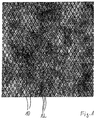
- the drawing shows a top view of loop material, that happened from an originally unconsolidated pile stored staple fibers.
- the staple fibers have about a length of 40 mm. This pile then became one Calendering process, with continuous connecting lines 10 the fibers with each other and with a carrier layer connected, i.e. were thermobonded.
- Fig. 2 shows an enlarged cross section through the loop material 1.
- a fabric or a fleece can be a pile carded, crimped staple fibers 16 by thermal bonding attached. Because of this geometric structure of the fibers 16 these puff up and form a compared to the Material use of their fibers much larger volume. Despite the thermal bonding, in which the fibers melt together and also merge with the carrier layer, that remains Volume between the bonding areas 10 largely preserved. There, the fibers 16 are further puffed up and form Loops that can hook into a hook layer.
Landscapes
- Engineering & Computer Science (AREA)
- Textile Engineering (AREA)
- Nonwoven Fabrics (AREA)
- Slide Fasteners, Snap Fasteners, And Hook Fasteners (AREA)
- Laminated Bodies (AREA)
- Glass Compositions (AREA)
- Saccharide Compounds (AREA)
Description
- Fig. 1
- eine Draufsicht auf Schlaufenmaterial nach der Erfindung,
- Fig. 2
- einen vergrößerten Querschnitt durch das Schlaufenmaterial nach Fig. 1.
Claims (11)
- Schlaufenmaterial einer Haken-Schlaufen-Verbindung, bestehend aus einer Trägerschicht aus einer Folie, einem Gewebe oder einem Vlies, auf dem eine Faser- oder Filamentschicht durch schmale linienartige, parallel verlaufende Bondingbereiche direkt befestigt ist und zwischen diesen Bondingbereichen verhakungsfähige Eingriffsbereiche der Haken-Schlaufen-Verbindung für Haken unmittelbar mit den Fasern oder Filamenten der Faser- oder Filamentschicht gebildet sind, wobei zwei Gruppen schmaler linienartiger, parallel verlaufender Bondingbereiche vorhanden sind, die sich gegenseitig kreuzen und so rautenförmig begrenzte Schlaufenkissen bildend, dadurch gekennzeichnet, daß die Faser- oder Filamentschicht als kardiertes voluminöses Gelege oder Flor aus geknickten oder gekräuselten Fasern oder Filamenten gebildet ist, dessen voluminöse Eigenschaft ohne zusätzliche Bearbeitung der Faser- oder Filament- schicht ausschließlich auf der geometrischen Struktur der Fasern oder Filamente basiert und so beim Thermobonden die Schlaufenkissen bilden.
- Schlaufenmaterial nach Anspruch 1, dadurch gekennzeichnet, daß die schmalen linienartigen, parallel verlaufenden Bondingbereiche durchgehend oder unterbrochen sind.
- Schlaufenmaterial nach Anspruch 1 oder 2, dadurch gekennzeichnet, daß die Faserschicht durch ein kardiertes Gelege oder Flor gebildet ist, bei dem die Fasern während des Herstellungsprozesses eine Vorzugsrichtung in Maschinenrichtung erhalten haben und daß die schmalen linienartigen, parallel verlaufenden Bondingbereiche jeweils im spitzen Winkel zur Vorzugsrichtung der Fasern angeordnet sind.
- Schlaufenmaterial nach einem der Ansprüche 1 bis 3, dadurch gekennzeichnet, daß die Dicke des Geleges oder Flors größer als 0,15 mm ist.
- Schlaufenmaterial nach einem der Ansprüche 1 bis 4, dadurch gekennzeichnet, daß das Flächengewicht des Geleges oder Flors größer 8 g pro Quadratmeter ist.
- Schlaufenmaterial nach einem der Ansprüche 1 bis 5, dadurch gekennzeichnet, daß die Feinheit der Fasern oder Filamente größer 1,7 dtex beträgt.
- Schlaufenmaterial nach einem der Ansprüche 1 bis 6, dadurch gekennzeichnet, daß die Länge der Fasern wenigstens das zweifache des größten Abstandes benachbarter Bondinglinien beträgt.
- Schlaufenmaterial nach einem der Ansprüche 1 bis 7, dadurch gekennzeichnet, daß das Material ein thermoplastisches Material, insbesondere Polypropylen oder Polyethylen ist.
- Schlaufenmaterial nach einem der Ansprüche 1 bis 8, dadurch gekennzeichnet, daß die Schlaufenlänge innerhalb einer zwischen umgrenzenden Verbindungslinien liegenden Eingriffsfläche größer als 0,5 mm ist.
- Schlaufenmaterial nach einem der Ansprüche 1 bis 9, dadurch gekennzeichnet, daß die Trägerschicht ihrerseits mit einem zu befestigenden Material verbunden ist.
- Schlaufenmaterial nach einem der Ansprüche 1 bis 10, dadurch gekennzeichnet, daß die Trägerschicht bedruckbar und/oder beleimbar ist.
Applications Claiming Priority (2)
| Application Number | Priority Date | Filing Date | Title |
|---|---|---|---|
| DE19722748 | 1997-05-30 | ||
| DE19722748A DE19722748C2 (de) | 1997-05-30 | 1997-05-30 | Schlaufenmaterial |
Publications (2)
| Publication Number | Publication Date |
|---|---|
| EP0882828A1 EP0882828A1 (de) | 1998-12-09 |
| EP0882828B1 true EP0882828B1 (de) | 2003-03-26 |
Family
ID=7830971
Family Applications (1)
| Application Number | Title | Priority Date | Filing Date |
|---|---|---|---|
| EP98109919A Expired - Lifetime EP0882828B1 (de) | 1997-05-30 | 1998-05-29 | Schlaufenmaterial |
Country Status (4)
| Country | Link |
|---|---|
| EP (1) | EP0882828B1 (de) |
| AT (1) | ATE235590T1 (de) |
| DE (2) | DE19722748C2 (de) |
| ES (1) | ES2196426T3 (de) |
Cited By (5)
| Publication number | Priority date | Publication date | Assignee | Title |
|---|---|---|---|---|
| US7805818B2 (en) | 2001-09-05 | 2010-10-05 | The Procter & Gamble Company | Nonwoven loop member for a mechanical fastener |
| US8673097B2 (en) | 2007-06-07 | 2014-03-18 | Velcro Industries B.V. | Anchoring loops of fibers needled into a carrier sheet |
| US8753459B2 (en) | 2002-12-03 | 2014-06-17 | Velcro Industries B.V. | Needling loops into carrier sheets |
| US9078793B2 (en) | 2011-08-25 | 2015-07-14 | Velcro Industries B.V. | Hook-engageable loop fasteners and related systems and methods |
| US9119443B2 (en) | 2011-08-25 | 2015-09-01 | Velcro Industries B.V. | Loop-engageable fasteners and related systems and methods |
Families Citing this family (24)
| Publication number | Priority date | Publication date | Assignee | Title |
|---|---|---|---|---|
| CA2410484A1 (en) * | 2000-05-26 | 2001-12-06 | William H. Shepard | Loops material for a hook and loop fastener |
| US7395583B2 (en) | 2000-05-26 | 2008-07-08 | Valero Industries B.V. | Hook engageable loops |
| JP3820081B2 (ja) * | 2000-05-29 | 2006-09-13 | ユニ・チャーム株式会社 | 使い捨て着用物品 |
| DE10103627B4 (de) * | 2001-01-27 | 2007-11-15 | Sandler Ag | Vliesstoff mit Struktur |
| US20020137418A1 (en) * | 2001-03-23 | 2002-09-26 | 3M Innovative Properties Company | Fluid management composite |
| US20020168497A1 (en) * | 2001-05-11 | 2002-11-14 | Lester Donald H. | Non woven loop forming material |
| ES2291509T3 (es) * | 2001-06-12 | 2008-03-01 | Velcro Industries B.V. | Materiales de bucle para cierre por contacto. |
| DE10139842B4 (de) * | 2001-08-14 | 2005-06-09 | Techtex Gmbh Vliesstoffe | Schlingenteil für Klettverbindungen |
| DE60131163T3 (de) * | 2001-09-05 | 2012-03-29 | The Procter & Gamble Company | Vliesstoff für die Schlaufenstruktur eines Haftverschlusses |
| DE10151045C2 (de) * | 2001-10-16 | 2003-09-25 | Freudenberg Carl Kg | Vliesverbundstoff für mechanische Verschlusssysteme, Verfahren zu dessen Herstellung und dessen Verwendung |
| US20040063369A1 (en) * | 2002-09-30 | 2004-04-01 | Jung Yeul Ahn | Nonwoven loop material and process and products relating thereto |
| US7465366B2 (en) | 2002-12-03 | 2008-12-16 | Velero Industries B.V. | Needling loops into carrier sheets |
| US20050196583A1 (en) * | 2002-12-03 | 2005-09-08 | Provost George A. | Embossing loop materials |
| US7547469B2 (en) | 2002-12-03 | 2009-06-16 | Velcro Industries B.V. | Forming loop materials |
| EP2063844B1 (de) * | 2006-08-03 | 2010-07-21 | Velcro Industries B.V. | Verbesserung der einsatzfähigkeit fibröser oberflächen zur verwendung auf berührungsbefestigungen |
| PL1915977T3 (pl) | 2006-10-27 | 2015-09-30 | Hartmann Paul Ag | Chłonny artykuł na nietrzymanie moczu z ulepszonym systemem zapinania |
| DE202006021198U1 (de) | 2006-10-27 | 2013-08-08 | Paul Hartmann Ag | Absorbierender Inkontinenzartikel mit verbessertem Verschlusssystem |
| EP2386279A3 (de) | 2007-08-02 | 2015-01-21 | Paul Hartmann AG | Absorbierende Inkontinenzwegwerfwindel |
| DE502008001216D1 (de) * | 2008-07-17 | 2010-10-07 | Nordenia Technologies Gmbh | Verbundstoffelement für einen Klettverschluss, insbesondere für einen Windelverschluss |
| DE102008059512A1 (de) * | 2008-11-28 | 2010-06-10 | Nordenia Deutschland Gronau Gmbh | Verbundstoffelement für einen Klettverschluss |
| JP6622025B2 (ja) * | 2014-08-26 | 2019-12-18 | 日東電工株式会社 | 面ファスナー雌部材 |
| CN112638341A (zh) * | 2018-09-27 | 2021-04-09 | 宝洁公司 | 衣服样的吸收制品 |
| WO2020190554A1 (en) * | 2019-03-21 | 2020-09-24 | The Procter & Gamble Company | Absorbent articles having discontinuous bond patterns |
| US12043019B2 (en) | 2019-05-03 | 2024-07-23 | The Procter & Gamble Company | Nonwoven webs with one or more repeat units |
Family Cites Families (6)
| Publication number | Priority date | Publication date | Assignee | Title |
|---|---|---|---|---|
| AU622171B2 (en) * | 1988-05-13 | 1992-04-02 | Minnesota Mining And Manufacturing Company | Sheet material for forming the loop portion for hook and loop fasteners |
| WO1992020252A1 (en) * | 1991-05-13 | 1992-11-26 | Mobil Oil Corporation | Leakproof zipper with slider |
| PL171000B1 (en) * | 1991-05-20 | 1997-02-28 | Procter & Gamble | Disposable moisture absorbing article with a fastening element |
| US5547531A (en) * | 1994-06-06 | 1996-08-20 | The Proctor & Gamble Company | Nonwoven female component for refastenable fastening device and method of making the same |
| US5595567A (en) * | 1994-08-09 | 1997-01-21 | The Procter & Gamble Company | Nonwoven female component for refastenable fastening device |
| EP0765616B1 (de) * | 1995-09-28 | 2001-06-27 | Japan Vilene Company, Ltd. | Schlaufenteil für Haftverschluss und Verfahren zur Herstellung desselben |
-
1997
- 1997-05-30 DE DE19722748A patent/DE19722748C2/de not_active Expired - Lifetime
-
1998
- 1998-05-29 DE DE59807605T patent/DE59807605D1/de not_active Expired - Lifetime
- 1998-05-29 AT AT98109919T patent/ATE235590T1/de not_active IP Right Cessation
- 1998-05-29 ES ES98109919T patent/ES2196426T3/es not_active Expired - Lifetime
- 1998-05-29 EP EP98109919A patent/EP0882828B1/de not_active Expired - Lifetime
Cited By (8)
| Publication number | Priority date | Publication date | Assignee | Title |
|---|---|---|---|---|
| US7805818B2 (en) | 2001-09-05 | 2010-10-05 | The Procter & Gamble Company | Nonwoven loop member for a mechanical fastener |
| USD640064S1 (en) | 2002-09-05 | 2011-06-21 | The Procter & Gamble Company | Nonwoven material with pattern element |
| USD642809S1 (en) | 2002-09-05 | 2011-08-09 | The Procter & Gamble Company | Nonwoven material with pattern element |
| US9259059B2 (en) | 2002-09-05 | 2016-02-16 | The Procter & Gamble Company | Nonwoven loop member for a mechanical fastener |
| US8753459B2 (en) | 2002-12-03 | 2014-06-17 | Velcro Industries B.V. | Needling loops into carrier sheets |
| US8673097B2 (en) | 2007-06-07 | 2014-03-18 | Velcro Industries B.V. | Anchoring loops of fibers needled into a carrier sheet |
| US9078793B2 (en) | 2011-08-25 | 2015-07-14 | Velcro Industries B.V. | Hook-engageable loop fasteners and related systems and methods |
| US9119443B2 (en) | 2011-08-25 | 2015-09-01 | Velcro Industries B.V. | Loop-engageable fasteners and related systems and methods |
Also Published As
| Publication number | Publication date |
|---|---|
| DE19722748A1 (de) | 1998-12-03 |
| EP0882828A1 (de) | 1998-12-09 |
| ATE235590T1 (de) | 2003-04-15 |
| ES2196426T3 (es) | 2003-12-16 |
| DE19722748C2 (de) | 2002-04-18 |
| DE59807605D1 (de) | 2003-04-30 |
Similar Documents
| Publication | Publication Date | Title |
|---|---|---|
| EP0882828A1 (de) | Schlaufenmaterial | |
| DE68923719T2 (de) | Gebundenes, nichtgewebtes Material und Verfahren und Vorrichtung zu dessen Herstellung. | |
| DE69711616T2 (de) | Dauerhafte, wasserstrahlenverfestigte vliesstoffe | |
| DE68919492T2 (de) | Elastomerischer Vliesstoff und Verfahren zu dessen Herstellung. | |
| DE69907292T2 (de) | Weibliches Element eines Flächenreissverschlusses und Verfahren zur Herstellung desselben | |
| DE19902762C2 (de) | Klettverbindung für flächige Gebilde und Verfahren zu seiner Herstellung | |
| DE68929260T2 (de) | Verbundvliesstoffmaterial und sein Herstellverfahren | |
| DE69816250T2 (de) | Reinigungsprodukt und Verfahren zu seiner Herstellung | |
| DE69002088T2 (de) | Textil-Schichtstoff aus Faserbahnen mit verschiedenen Eigenschaften und dessen Verfahren zur Herstellung. | |
| DE3688644T2 (de) | Zusammengesetztes Bahnmaterial für Kunstleder und Verfahren zur Herstellung desselben. | |
| DE1761119A1 (de) | Papiermaschinenfilz und Verfahren zu seiner Herstellung | |
| EP0290653B1 (de) | Materialbahn | |
| DE69513013T2 (de) | Reinigungsartikel, Substrat dafür und sein Herstellungsverfahren | |
| DE69603128T2 (de) | Verfahren zur Herstellung einer textilen Verstärkungseinlage für die Herstellung von Kompositmaterialien | |
| EP1172473A1 (de) | Voluminöser Vliesstoff | |
| DE1940465A1 (de) | Ungewobene Ware und Verfahren zu ihrer Herstellung | |
| DE112014003037T5 (de) | Vliesbahn mit verbesserter Schnittkantenqualitat und Verfahren zum Verleihen derselben | |
| DE68906632T2 (de) | Einbügelbarer Einlagestoff auf der Basis von Mikrofäden. | |
| EP1748101A2 (de) | Voluminöse Faserlaminate und ihre Herstellung | |
| DE2731269C2 (de) | Faservlies sowie Verfahren und Vorrichtung zur Herstellung des Vlieses | |
| DE2746146C2 (de) | Mehrlagige, textile Polstermaterialbahn | |
| EP0896080B1 (de) | Verfahren zur Herstellung eines voluminösen Verbundvlieses, Vorrichtung zur Durchführung des Verfahrens und Verbundvlies nach diesem Verfahren | |
| DE60013805T2 (de) | Vliesstoff mit streck- und rückfähigkeiten und verfahren zu dessen herstellung | |
| DE2365243A1 (de) | Verfahren zur verbesserung der formstabilitaet und mechanischer eigenschaften von nadel-vliesstoffen | |
| DE202021104492U1 (de) | Textilbahn sowie Verwendung einer solchen |
Legal Events
| Date | Code | Title | Description |
|---|---|---|---|
| PUAI | Public reference made under article 153(3) epc to a published international application that has entered the european phase |
Free format text: ORIGINAL CODE: 0009012 |
|
| AK | Designated contracting states |
Kind code of ref document: A1 Designated state(s): AT BE CH DE DK ES FR GB GR IT LI NL SE |
|
| AX | Request for extension of the european patent |
Free format text: AL;LT;LV;MK;RO;SI |
|
| 17P | Request for examination filed |
Effective date: 19990602 |
|
| AKX | Designation fees paid |
Free format text: AT BE CH DE DK ES FR GB GR IT LI NL SE |
|
| 17Q | First examination report despatched |
Effective date: 20010503 |
|
| GRAG | Despatch of communication of intention to grant |
Free format text: ORIGINAL CODE: EPIDOS AGRA |
|
| GRAG | Despatch of communication of intention to grant |
Free format text: ORIGINAL CODE: EPIDOS AGRA |
|
| GRAH | Despatch of communication of intention to grant a patent |
Free format text: ORIGINAL CODE: EPIDOS IGRA |
|
| GRAH | Despatch of communication of intention to grant a patent |
Free format text: ORIGINAL CODE: EPIDOS IGRA |
|
| GRAA | (expected) grant |
Free format text: ORIGINAL CODE: 0009210 |
|
| AK | Designated contracting states |
Designated state(s): AT BE CH DE DK ES FR GB GR IT LI NL SE |
|
| PG25 | Lapsed in a contracting state [announced via postgrant information from national office to epo] |
Ref country code: NL Free format text: LAPSE BECAUSE OF FAILURE TO SUBMIT A TRANSLATION OF THE DESCRIPTION OR TO PAY THE FEE WITHIN THE PRESCRIBED TIME-LIMIT Effective date: 20030326 Ref country code: GR Free format text: LAPSE BECAUSE OF FAILURE TO SUBMIT A TRANSLATION OF THE DESCRIPTION OR TO PAY THE FEE WITHIN THE PRESCRIBED TIME-LIMIT Effective date: 20030326 Ref country code: GB Free format text: LAPSE BECAUSE OF FAILURE TO SUBMIT A TRANSLATION OF THE DESCRIPTION OR TO PAY THE FEE WITHIN THE PRESCRIBED TIME-LIMIT Effective date: 20030326 |
|
| REG | Reference to a national code |
Ref country code: GB Ref legal event code: FG4D Free format text: NOT ENGLISH |
|
| REG | Reference to a national code |
Ref country code: CH Ref legal event code: EP |
|
| REF | Corresponds to: |
Ref document number: 59807605 Country of ref document: DE Date of ref document: 20030430 Kind code of ref document: P |
|
| PG25 | Lapsed in a contracting state [announced via postgrant information from national office to epo] |
Ref country code: AT Free format text: LAPSE BECAUSE OF NON-PAYMENT OF DUE FEES Effective date: 20030529 |
|
| PG25 | Lapsed in a contracting state [announced via postgrant information from national office to epo] |
Ref country code: LI Free format text: LAPSE BECAUSE OF NON-PAYMENT OF DUE FEES Effective date: 20030531 Ref country code: CH Free format text: LAPSE BECAUSE OF NON-PAYMENT OF DUE FEES Effective date: 20030531 Ref country code: BE Free format text: LAPSE BECAUSE OF NON-PAYMENT OF DUE FEES Effective date: 20030531 |
|
| PG25 | Lapsed in a contracting state [announced via postgrant information from national office to epo] |
Ref country code: SE Free format text: LAPSE BECAUSE OF FAILURE TO SUBMIT A TRANSLATION OF THE DESCRIPTION OR TO PAY THE FEE WITHIN THE PRESCRIBED TIME-LIMIT Effective date: 20030626 Ref country code: DK Free format text: LAPSE BECAUSE OF FAILURE TO SUBMIT A TRANSLATION OF THE DESCRIPTION OR TO PAY THE FEE WITHIN THE PRESCRIBED TIME-LIMIT Effective date: 20030626 |
|
| ET | Fr: translation filed | ||
| NLV1 | Nl: lapsed or annulled due to failure to fulfill the requirements of art. 29p and 29m of the patents act | ||
| GBV | Gb: ep patent (uk) treated as always having been void in accordance with gb section 77(7)/1977 [no translation filed] |
Effective date: 20030326 |
|
| BERE | Be: lapsed |
Owner name: *COROVIN G.M.B.H. Effective date: 20030531 |
|
| REG | Reference to a national code |
Ref country code: ES Ref legal event code: FG2A Ref document number: 2196426 Country of ref document: ES Kind code of ref document: T3 |
|
| REG | Reference to a national code |
Ref country code: CH Ref legal event code: PL |
|
| PLBE | No opposition filed within time limit |
Free format text: ORIGINAL CODE: 0009261 |
|
| STAA | Information on the status of an ep patent application or granted ep patent |
Free format text: STATUS: NO OPPOSITION FILED WITHIN TIME LIMIT |
|
| 26N | No opposition filed |
Effective date: 20031230 |
|
| PGFP | Annual fee paid to national office [announced via postgrant information from national office to epo] |
Ref country code: FR Payment date: 20120608 Year of fee payment: 15 |
|
| PGFP | Annual fee paid to national office [announced via postgrant information from national office to epo] |
Ref country code: ES Payment date: 20120607 Year of fee payment: 15 |
|
| REG | Reference to a national code |
Ref country code: DE Ref legal event code: R081 Ref document number: 59807605 Country of ref document: DE Owner name: FITESA GERMANY GMBH, DE Free format text: FORMER OWNER: FIBERWEB COROVIN GMBH, 31224 PEINE, DE Effective date: 20121218 |
|
| REG | Reference to a national code |
Ref country code: FR Ref legal event code: ST Effective date: 20140131 |
|
| PG25 | Lapsed in a contracting state [announced via postgrant information from national office to epo] |
Ref country code: FR Free format text: LAPSE BECAUSE OF NON-PAYMENT OF DUE FEES Effective date: 20130531 |
|
| REG | Reference to a national code |
Ref country code: ES Ref legal event code: FD2A Effective date: 20140606 |
|
| PG25 | Lapsed in a contracting state [announced via postgrant information from national office to epo] |
Ref country code: ES Free format text: LAPSE BECAUSE OF NON-PAYMENT OF DUE FEES Effective date: 20130530 |
|
| PGFP | Annual fee paid to national office [announced via postgrant information from national office to epo] |
Ref country code: DE Payment date: 20160531 Year of fee payment: 19 |
|
| PGFP | Annual fee paid to national office [announced via postgrant information from national office to epo] |
Ref country code: IT Payment date: 20160524 Year of fee payment: 19 |
|
| REG | Reference to a national code |
Ref country code: DE Ref legal event code: R119 Ref document number: 59807605 Country of ref document: DE |
|
| PG25 | Lapsed in a contracting state [announced via postgrant information from national office to epo] |
Ref country code: DE Free format text: LAPSE BECAUSE OF NON-PAYMENT OF DUE FEES Effective date: 20171201 |
|
| PG25 | Lapsed in a contracting state [announced via postgrant information from national office to epo] |
Ref country code: IT Free format text: LAPSE BECAUSE OF NON-PAYMENT OF DUE FEES Effective date: 20170529 |