EP0877047A1 - Composition de caoutchouc à base de noir de carbone ayant de la silice fixée à sa surface et de polymère diénique fonctionnalisé ou modifié par des fonctions silanols - Google Patents
Composition de caoutchouc à base de noir de carbone ayant de la silice fixée à sa surface et de polymère diénique fonctionnalisé ou modifié par des fonctions silanols Download PDFInfo
- Publication number
- EP0877047A1 EP0877047A1 EP98107525A EP98107525A EP0877047A1 EP 0877047 A1 EP0877047 A1 EP 0877047A1 EP 98107525 A EP98107525 A EP 98107525A EP 98107525 A EP98107525 A EP 98107525A EP 0877047 A1 EP0877047 A1 EP 0877047A1
- Authority
- EP
- European Patent Office
- Prior art keywords
- silanol
- diene polymer
- silica
- carbon black
- functionalized
- Prior art date
- Legal status (The legal status is an assumption and is not a legal conclusion. Google has not performed a legal analysis and makes no representation as to the accuracy of the status listed.)
- Granted
Links
- VYPSYNLAJGMNEJ-UHFFFAOYSA-N Silicium dioxide Chemical compound O=[Si]=O VYPSYNLAJGMNEJ-UHFFFAOYSA-N 0.000 title claims abstract description 109
- 239000000203 mixture Substances 0.000 title claims abstract description 109
- 229920000642 polymer Polymers 0.000 title claims abstract description 83
- 239000000377 silicon dioxide Substances 0.000 title claims abstract description 53
- 239000006229 carbon black Substances 0.000 title claims abstract description 39
- 229920001971 elastomer Polymers 0.000 title claims abstract description 29
- 125000005372 silanol group Chemical group 0.000 title claims abstract description 24
- 239000005060 rubber Substances 0.000 title claims abstract description 19
- 150000001993 dienes Chemical class 0.000 title claims description 42
- -1 polysiloxane Polymers 0.000 claims abstract description 32
- SCPYDCQAZCOKTP-UHFFFAOYSA-N silanol Chemical compound [SiH3]O SCPYDCQAZCOKTP-UHFFFAOYSA-N 0.000 claims abstract description 27
- 229920001296 polysiloxane Polymers 0.000 claims abstract description 24
- 239000000945 filler Substances 0.000 claims abstract description 9
- 229920001577 copolymer Polymers 0.000 claims description 20
- 239000012763 reinforcing filler Substances 0.000 claims description 14
- 125000004432 carbon atom Chemical group C* 0.000 claims description 7
- 125000000217 alkyl group Chemical group 0.000 claims description 5
- 230000003014 reinforcing effect Effects 0.000 claims description 4
- 244000043261 Hevea brasiliensis Species 0.000 claims description 3
- 238000002156 mixing Methods 0.000 claims description 3
- 229920003052 natural elastomer Polymers 0.000 claims description 3
- 229920001194 natural rubber Polymers 0.000 claims description 3
- 229910052799 carbon Inorganic materials 0.000 claims description 2
- 125000002897 diene group Chemical group 0.000 claims description 2
- 229920002857 polybutadiene Polymers 0.000 claims description 2
- 150000004819 silanols Chemical class 0.000 claims description 2
- OKTJSMMVPCPJKN-UHFFFAOYSA-N Carbon Chemical compound [C] OKTJSMMVPCPJKN-UHFFFAOYSA-N 0.000 claims 1
- 239000005062 Polybutadiene Substances 0.000 claims 1
- MTAZNLWOLGHBHU-UHFFFAOYSA-N butadiene-styrene rubber Chemical compound C=CC=C.C=CC1=CC=CC=C1 MTAZNLWOLGHBHU-UHFFFAOYSA-N 0.000 claims 1
- 125000002496 methyl group Chemical group [H]C([H])([H])* 0.000 claims 1
- 239000004636 vulcanized rubber Substances 0.000 claims 1
- 241000872198 Serjania polyphylla Species 0.000 abstract 1
- OKKJLVBELUTLKV-UHFFFAOYSA-N Methanol Chemical compound OC OKKJLVBELUTLKV-UHFFFAOYSA-N 0.000 description 36
- 235000019241 carbon black Nutrition 0.000 description 32
- MZRVEZGGRBJDDB-UHFFFAOYSA-N N-Butyllithium Chemical compound [Li]CCCC MZRVEZGGRBJDDB-UHFFFAOYSA-N 0.000 description 20
- PPBRXRYQALVLMV-UHFFFAOYSA-N Styrene Chemical compound C=CC1=CC=CC=C1 PPBRXRYQALVLMV-UHFFFAOYSA-N 0.000 description 18
- 239000003795 chemical substances by application Substances 0.000 description 18
- 238000006116 polymerization reaction Methods 0.000 description 15
- KAKZBPTYRLMSJV-UHFFFAOYSA-N Butadiene Chemical compound C=CC=C KAKZBPTYRLMSJV-UHFFFAOYSA-N 0.000 description 14
- VZEZONWRBFJJMZ-UHFFFAOYSA-N 3-allyl-2-[2-(diethylamino)ethoxy]benzaldehyde Chemical compound CCN(CC)CCOC1=C(CC=C)C=CC=C1C=O VZEZONWRBFJJMZ-UHFFFAOYSA-N 0.000 description 10
- 239000000806 elastomer Substances 0.000 description 10
- YXFVVABEGXRONW-UHFFFAOYSA-N Toluene Chemical compound CC1=CC=CC=C1 YXFVVABEGXRONW-UHFFFAOYSA-N 0.000 description 9
- XLOMVQKBTHCTTD-UHFFFAOYSA-N Zinc monoxide Chemical compound [Zn]=O XLOMVQKBTHCTTD-UHFFFAOYSA-N 0.000 description 8
- 238000007306 functionalization reaction Methods 0.000 description 8
- 238000000034 method Methods 0.000 description 8
- 239000003963 antioxidant agent Substances 0.000 description 7
- 229920001400 block copolymer Polymers 0.000 description 7
- 150000001875 compounds Chemical class 0.000 description 7
- 238000004519 manufacturing process Methods 0.000 description 7
- 239000002904 solvent Substances 0.000 description 7
- 229920003048 styrene butadiene rubber Polymers 0.000 description 7
- RRHGJUQNOFWUDK-UHFFFAOYSA-N Isoprene Chemical compound CC(=C)C=C RRHGJUQNOFWUDK-UHFFFAOYSA-N 0.000 description 6
- NINIDFKCEFEMDL-UHFFFAOYSA-N Sulfur Chemical compound [S] NINIDFKCEFEMDL-UHFFFAOYSA-N 0.000 description 6
- 238000009472 formulation Methods 0.000 description 6
- 239000003999 initiator Substances 0.000 description 6
- 238000005259 measurement Methods 0.000 description 6
- 229910052717 sulfur Inorganic materials 0.000 description 6
- 239000011593 sulfur Substances 0.000 description 6
- XDTMQSROBMDMFD-UHFFFAOYSA-N Cyclohexane Chemical compound C1CCCCC1 XDTMQSROBMDMFD-UHFFFAOYSA-N 0.000 description 5
- 238000006243 chemical reaction Methods 0.000 description 5
- 238000012360 testing method Methods 0.000 description 5
- 235000021355 Stearic acid Nutrition 0.000 description 4
- 230000003078 antioxidant effect Effects 0.000 description 4
- 239000010692 aromatic oil Substances 0.000 description 4
- 239000002585 base Substances 0.000 description 4
- 125000004122 cyclic group Chemical group 0.000 description 4
- HTDJPCNNEPUOOQ-UHFFFAOYSA-N hexamethylcyclotrisiloxane Chemical compound C[Si]1(C)O[Si](C)(C)O[Si](C)(C)O1 HTDJPCNNEPUOOQ-UHFFFAOYSA-N 0.000 description 4
- QIQXTHQIDYTFRH-UHFFFAOYSA-N octadecanoic acid Chemical compound CCCCCCCCCCCCCCCCCC(O)=O QIQXTHQIDYTFRH-UHFFFAOYSA-N 0.000 description 4
- OQCDKBAXFALNLD-UHFFFAOYSA-N octadecanoic acid Natural products CCCCCCCC(C)CCCCCCCCC(O)=O OQCDKBAXFALNLD-UHFFFAOYSA-N 0.000 description 4
- 239000012188 paraffin wax Substances 0.000 description 4
- 238000005096 rolling process Methods 0.000 description 4
- 239000008117 stearic acid Substances 0.000 description 4
- QAZLUNIWYYOJPC-UHFFFAOYSA-M sulfenamide Chemical compound [Cl-].COC1=C(C)C=[N+]2C3=NC4=CC=C(OC)C=C4N3SCC2=C1C QAZLUNIWYYOJPC-UHFFFAOYSA-M 0.000 description 4
- 229920002554 vinyl polymer Polymers 0.000 description 4
- 238000004073 vulcanization Methods 0.000 description 4
- 239000011787 zinc oxide Substances 0.000 description 4
- OWRCNXZUPFZXOS-UHFFFAOYSA-N 1,3-diphenylguanidine Chemical compound C=1C=CC=CC=1NC(=N)NC1=CC=CC=C1 OWRCNXZUPFZXOS-UHFFFAOYSA-N 0.000 description 3
- UHOVQNZJYSORNB-UHFFFAOYSA-N Benzene Chemical compound C1=CC=CC=C1 UHOVQNZJYSORNB-UHFFFAOYSA-N 0.000 description 3
- 238000005481 NMR spectroscopy Methods 0.000 description 3
- RWRDLPDLKQPQOW-UHFFFAOYSA-N Pyrrolidine Chemical compound C1CCNC1 RWRDLPDLKQPQOW-UHFFFAOYSA-N 0.000 description 3
- BLRPTPMANUNPDV-UHFFFAOYSA-N Silane Chemical compound [SiH4] BLRPTPMANUNPDV-UHFFFAOYSA-N 0.000 description 3
- WYURNTSHIVDZCO-UHFFFAOYSA-N Tetrahydrofuran Chemical compound C1CCOC1 WYURNTSHIVDZCO-UHFFFAOYSA-N 0.000 description 3
- 125000004429 atom Chemical group 0.000 description 3
- 239000011230 binding agent Substances 0.000 description 3
- 230000015556 catabolic process Effects 0.000 description 3
- 239000003054 catalyst Substances 0.000 description 3
- 238000005859 coupling reaction Methods 0.000 description 3
- 238000006731 degradation reaction Methods 0.000 description 3
- BYLOHCRAPOSXLY-UHFFFAOYSA-N dichloro(diethyl)silane Chemical compound CC[Si](Cl)(Cl)CC BYLOHCRAPOSXLY-UHFFFAOYSA-N 0.000 description 3
- VLKZOEOYAKHREP-UHFFFAOYSA-N n-Hexane Chemical compound CCCCCC VLKZOEOYAKHREP-UHFFFAOYSA-N 0.000 description 3
- 229910000077 silane Inorganic materials 0.000 description 3
- 229920003051 synthetic elastomer Polymers 0.000 description 3
- MYRTYDVEIRVNKP-UHFFFAOYSA-N 1,2-Divinylbenzene Chemical compound C=CC1=CC=CC=C1C=C MYRTYDVEIRVNKP-UHFFFAOYSA-N 0.000 description 2
- SDJHPPZKZZWAKF-UHFFFAOYSA-N 2,3-dimethylbuta-1,3-diene Chemical compound CC(=C)C(C)=C SDJHPPZKZZWAKF-UHFFFAOYSA-N 0.000 description 2
- UMROOINDDALMLN-UHFFFAOYSA-N 3,3-dichloroprop-2-enylsilane Chemical compound ClC(=CC[SiH3])Cl UMROOINDDALMLN-UHFFFAOYSA-N 0.000 description 2
- ZZMVLMVFYMGSMY-UHFFFAOYSA-N 4-n-(4-methylpentan-2-yl)-1-n-phenylbenzene-1,4-diamine Chemical compound C1=CC(NC(C)CC(C)C)=CC=C1NC1=CC=CC=C1 ZZMVLMVFYMGSMY-UHFFFAOYSA-N 0.000 description 2
- WKBOTKDWSSQWDR-UHFFFAOYSA-N Bromine atom Chemical compound [Br] WKBOTKDWSSQWDR-UHFFFAOYSA-N 0.000 description 2
- 239000004215 Carbon black (E152) Substances 0.000 description 2
- ZAMOUSCENKQFHK-UHFFFAOYSA-N Chlorine atom Chemical compound [Cl] ZAMOUSCENKQFHK-UHFFFAOYSA-N 0.000 description 2
- 241001441571 Hiodontidae Species 0.000 description 2
- IMNFDUFMRHMDMM-UHFFFAOYSA-N N-Heptane Chemical compound CCCCCCC IMNFDUFMRHMDMM-UHFFFAOYSA-N 0.000 description 2
- OFBQJSOFQDEBGM-UHFFFAOYSA-N Pentane Chemical compound CCCCC OFBQJSOFQDEBGM-UHFFFAOYSA-N 0.000 description 2
- GAZZTULIUXRAAI-UHFFFAOYSA-N [2,3-bis(diethylamino)phenyl]-phenylmethanone Chemical compound CCN(CC)C1=CC=CC(C(=O)C=2C=CC=CC=2)=C1N(CC)CC GAZZTULIUXRAAI-UHFFFAOYSA-N 0.000 description 2
- 125000001931 aliphatic group Chemical group 0.000 description 2
- 150000001412 amines Chemical group 0.000 description 2
- 229910052788 barium Inorganic materials 0.000 description 2
- DSAJWYNOEDNPEQ-UHFFFAOYSA-N barium atom Chemical compound [Ba] DSAJWYNOEDNPEQ-UHFFFAOYSA-N 0.000 description 2
- XRBZWUQAUXLFDY-UHFFFAOYSA-N benzyl(dichloro)silane Chemical compound Cl[SiH](Cl)CC1=CC=CC=C1 XRBZWUQAUXLFDY-UHFFFAOYSA-N 0.000 description 2
- 230000015572 biosynthetic process Effects 0.000 description 2
- 239000000470 constituent Substances 0.000 description 2
- 230000008878 coupling Effects 0.000 description 2
- 239000007822 coupling agent Substances 0.000 description 2
- 238000010168 coupling process Methods 0.000 description 2
- OSXYHAQZDCICNX-UHFFFAOYSA-N dichloro(diphenyl)silane Chemical compound C=1C=CC=CC=1[Si](Cl)(Cl)C1=CC=CC=C1 OSXYHAQZDCICNX-UHFFFAOYSA-N 0.000 description 2
- LIKFHECYJZWXFJ-UHFFFAOYSA-N dimethyldichlorosilane Chemical compound C[Si](C)(Cl)Cl LIKFHECYJZWXFJ-UHFFFAOYSA-N 0.000 description 2
- 230000009477 glass transition Effects 0.000 description 2
- 125000005843 halogen group Chemical group 0.000 description 2
- 229930195733 hydrocarbon Natural products 0.000 description 2
- 230000006872 improvement Effects 0.000 description 2
- 230000003993 interaction Effects 0.000 description 2
- AFRJJFRNGGLMDW-UHFFFAOYSA-N lithium amide Chemical class [Li+].[NH2-] AFRJJFRNGGLMDW-UHFFFAOYSA-N 0.000 description 2
- 239000000178 monomer Substances 0.000 description 2
- 150000001282 organosilanes Chemical class 0.000 description 2
- 238000002103 osmometry Methods 0.000 description 2
- 239000002245 particle Substances 0.000 description 2
- 238000002360 preparation method Methods 0.000 description 2
- 230000008569 process Effects 0.000 description 2
- 238000011084 recovery Methods 0.000 description 2
- 230000002787 reinforcement Effects 0.000 description 2
- MFRIHAYPQRLWNB-UHFFFAOYSA-N sodium tert-butoxide Chemical compound [Na+].CC(C)(C)[O-] MFRIHAYPQRLWNB-UHFFFAOYSA-N 0.000 description 2
- 230000003068 static effect Effects 0.000 description 2
- 238000003786 synthesis reaction Methods 0.000 description 2
- 239000005061 synthetic rubber Substances 0.000 description 2
- 230000000930 thermomechanical effect Effects 0.000 description 2
- APPOKADJQUIAHP-GGWOSOGESA-N (2e,4e)-hexa-2,4-diene Chemical compound C\C=C\C=C\C APPOKADJQUIAHP-GGWOSOGESA-N 0.000 description 1
- PMJHHCWVYXUKFD-SNAWJCMRSA-N (E)-1,3-pentadiene Chemical compound C\C=C\C=C PMJHHCWVYXUKFD-SNAWJCMRSA-N 0.000 description 1
- AVFZOVWCLRSYKC-UHFFFAOYSA-N 1-methylpyrrolidine Chemical compound CN1CCCC1 AVFZOVWCLRSYKC-UHFFFAOYSA-N 0.000 description 1
- IGGDKDTUCAWDAN-UHFFFAOYSA-N 1-vinylnaphthalene Chemical compound C1=CC=C2C(C=C)=CC=CC2=C1 IGGDKDTUCAWDAN-UHFFFAOYSA-N 0.000 description 1
- DGLJYEKNUTVPAE-UHFFFAOYSA-N 2,4,6-triethyl-2,4,6-trimethyl-1,3,5,2,4,6-trioxatrisilinane Chemical compound CC[Si]1(C)O[Si](C)(CC)O[Si](C)(CC)O1 DGLJYEKNUTVPAE-UHFFFAOYSA-N 0.000 description 1
- HMWCQCYUKQZPRA-UHFFFAOYSA-N 2,4-dimethyl-3-methylidenepent-1-ene Chemical compound CC(C)C(=C)C(C)=C HMWCQCYUKQZPRA-UHFFFAOYSA-N 0.000 description 1
- HIXDQWDOVZUNNA-UHFFFAOYSA-N 2-(3,4-dimethoxyphenyl)-5-hydroxy-7-methoxychromen-4-one Chemical compound C=1C(OC)=CC(O)=C(C(C=2)=O)C=1OC=2C1=CC=C(OC)C(OC)=C1 HIXDQWDOVZUNNA-UHFFFAOYSA-N 0.000 description 1
- PDELBHCVXBSVPJ-UHFFFAOYSA-N 2-ethenyl-1,3,5-trimethylbenzene Chemical group CC1=CC(C)=C(C=C)C(C)=C1 PDELBHCVXBSVPJ-UHFFFAOYSA-N 0.000 description 1
- CTHJQRHPNQEPAB-UHFFFAOYSA-N 2-methoxyethenylbenzene Chemical class COC=CC1=CC=CC=C1 CTHJQRHPNQEPAB-UHFFFAOYSA-N 0.000 description 1
- PJXJBPMWCKMWLS-UHFFFAOYSA-N 2-methyl-3-methylidenepent-1-ene Chemical compound CCC(=C)C(C)=C PJXJBPMWCKMWLS-UHFFFAOYSA-N 0.000 description 1
- OAOZZYBUAWEDRA-UHFFFAOYSA-N 3,4-dimethylidenehexane Chemical compound CCC(=C)C(=C)CC OAOZZYBUAWEDRA-UHFFFAOYSA-N 0.000 description 1
- JLBJTVDPSNHSKJ-UHFFFAOYSA-N 4-Methylstyrene Chemical compound CC1=CC=C(C=C)C=C1 JLBJTVDPSNHSKJ-UHFFFAOYSA-N 0.000 description 1
- XMSXQFUHVRWGNA-UHFFFAOYSA-N Decamethylcyclopentasiloxane Chemical compound C[Si]1(C)O[Si](C)(C)O[Si](C)(C)O[Si](C)(C)O[Si](C)(C)O1 XMSXQFUHVRWGNA-UHFFFAOYSA-N 0.000 description 1
- 241000283070 Equus zebra Species 0.000 description 1
- NHTMVDHEPJAVLT-UHFFFAOYSA-N Isooctane Chemical compound CC(C)CC(C)(C)C NHTMVDHEPJAVLT-UHFFFAOYSA-N 0.000 description 1
- WHXSMMKQMYFTQS-UHFFFAOYSA-N Lithium Chemical compound [Li] WHXSMMKQMYFTQS-UHFFFAOYSA-N 0.000 description 1
- AHVYPIQETPWLSZ-UHFFFAOYSA-N N-methyl-pyrrolidine Natural products CN1CC=CC1 AHVYPIQETPWLSZ-UHFFFAOYSA-N 0.000 description 1
- CTQNGGLPUBDAKN-UHFFFAOYSA-N O-Xylene Chemical compound CC1=CC=CC=C1C CTQNGGLPUBDAKN-UHFFFAOYSA-N 0.000 description 1
- 229910020175 SiOH Inorganic materials 0.000 description 1
- BZEZSORUWZUMNU-UHFFFAOYSA-N [Li]CCCC[Li] Chemical compound [Li]CCCC[Li] BZEZSORUWZUMNU-UHFFFAOYSA-N 0.000 description 1
- 238000005299 abrasion Methods 0.000 description 1
- 230000009471 action Effects 0.000 description 1
- 125000002015 acyclic group Chemical group 0.000 description 1
- 239000000654 additive Substances 0.000 description 1
- 238000013019 agitation Methods 0.000 description 1
- 229910052783 alkali metal Inorganic materials 0.000 description 1
- 150000001340 alkali metals Chemical class 0.000 description 1
- 150000001408 amides Chemical class 0.000 description 1
- 238000010539 anionic addition polymerization reaction Methods 0.000 description 1
- 125000000129 anionic group Chemical group 0.000 description 1
- 150000004945 aromatic hydrocarbons Chemical class 0.000 description 1
- ZSIQJIWKELUFRJ-UHFFFAOYSA-N azepane Chemical compound C1CCCNCC1 ZSIQJIWKELUFRJ-UHFFFAOYSA-N 0.000 description 1
- 150000008366 benzophenones Chemical class 0.000 description 1
- FQUNFJULCYSSOP-UHFFFAOYSA-N bisoctrizole Chemical compound N1=C2C=CC=CC2=NN1C1=CC(C(C)(C)CC(C)(C)C)=CC(CC=2C(=C(C=C(C=2)C(C)(C)CC(C)(C)C)N2N=C3C=CC=CC3=N2)O)=C1O FQUNFJULCYSSOP-UHFFFAOYSA-N 0.000 description 1
- 239000003738 black carbon Substances 0.000 description 1
- 239000007767 bonding agent Substances 0.000 description 1
- GDTBXPJZTBHREO-UHFFFAOYSA-N bromine Substances BrBr GDTBXPJZTBHREO-UHFFFAOYSA-N 0.000 description 1
- 229910052794 bromium Inorganic materials 0.000 description 1
- XZKRXPZXQLARHH-UHFFFAOYSA-N buta-1,3-dienylbenzene Chemical compound C=CC=CC1=CC=CC=C1 XZKRXPZXQLARHH-UHFFFAOYSA-N 0.000 description 1
- 229910052801 chlorine Inorganic materials 0.000 description 1
- 239000000460 chlorine Substances 0.000 description 1
- 230000015271 coagulation Effects 0.000 description 1
- 238000005345 coagulation Methods 0.000 description 1
- 239000011248 coating agent Substances 0.000 description 1
- 238000000576 coating method Methods 0.000 description 1
- 229920001940 conductive polymer Polymers 0.000 description 1
- 238000010276 construction Methods 0.000 description 1
- 230000008094 contradictory effect Effects 0.000 description 1
- 238000007796 conventional method Methods 0.000 description 1
- 238000007334 copolymerization reaction Methods 0.000 description 1
- 230000000593 degrading effect Effects 0.000 description 1
- 230000006866 deterioration Effects 0.000 description 1
- 238000011161 development Methods 0.000 description 1
- JVSWJIKNEAIKJW-UHFFFAOYSA-N dimethyl-hexane Natural products CCCCCC(C)C JVSWJIKNEAIKJW-UHFFFAOYSA-N 0.000 description 1
- KPUWHANPEXNPJT-UHFFFAOYSA-N disiloxane Chemical class [SiH3]O[SiH3] KPUWHANPEXNPJT-UHFFFAOYSA-N 0.000 description 1
- 239000006185 dispersion Substances 0.000 description 1
- 238000001035 drying Methods 0.000 description 1
- 230000005611 electricity Effects 0.000 description 1
- 238000001493 electron microscopy Methods 0.000 description 1
- 230000008030 elimination Effects 0.000 description 1
- 238000003379 elimination reaction Methods 0.000 description 1
- 238000005516 engineering process Methods 0.000 description 1
- RTZKZFJDLAIYFH-UHFFFAOYSA-N ether Substances CCOCC RTZKZFJDLAIYFH-UHFFFAOYSA-N 0.000 description 1
- BLHLJVCOVBYQQS-UHFFFAOYSA-N ethyllithium Chemical compound [Li]CC BLHLJVCOVBYQQS-UHFFFAOYSA-N 0.000 description 1
- 238000001704 evaporation Methods 0.000 description 1
- 230000008020 evaporation Effects 0.000 description 1
- 239000000446 fuel Substances 0.000 description 1
- 229920001519 homopolymer Polymers 0.000 description 1
- 150000002430 hydrocarbons Chemical class 0.000 description 1
- 239000012535 impurity Substances 0.000 description 1
- 229910052744 lithium Inorganic materials 0.000 description 1
- CCZVEWRRAVASGL-UHFFFAOYSA-N lithium;2-methanidylpropane Chemical compound [Li+].CC(C)[CH2-] CCZVEWRRAVASGL-UHFFFAOYSA-N 0.000 description 1
- 239000000463 material Substances 0.000 description 1
- 239000011159 matrix material Substances 0.000 description 1
- 238000006263 metalation reaction Methods 0.000 description 1
- CLNYHERYALISIR-UHFFFAOYSA-N nona-1,3-diene Chemical compound CCCCCC=CC=C CLNYHERYALISIR-UHFFFAOYSA-N 0.000 description 1
- HMMGMWAXVFQUOA-UHFFFAOYSA-N octamethylcyclotetrasiloxane Chemical compound C[Si]1(C)O[Si](C)(C)O[Si](C)(C)O[Si](C)(C)O1 HMMGMWAXVFQUOA-UHFFFAOYSA-N 0.000 description 1
- 239000003921 oil Substances 0.000 description 1
- 238000000399 optical microscopy Methods 0.000 description 1
- 150000002978 peroxides Chemical class 0.000 description 1
- 230000000704 physical effect Effects 0.000 description 1
- 239000000049 pigment Substances 0.000 description 1
- PMJHHCWVYXUKFD-UHFFFAOYSA-N piperylene Natural products CC=CC=C PMJHHCWVYXUKFD-UHFFFAOYSA-N 0.000 description 1
- 239000004014 plasticizer Substances 0.000 description 1
- 229920003192 poly(bis maleimide) Polymers 0.000 description 1
- 229920001195 polyisoprene Polymers 0.000 description 1
- 239000003505 polymerization initiator Substances 0.000 description 1
- 229920005862 polyol Polymers 0.000 description 1
- 150000003077 polyols Chemical class 0.000 description 1
- 229920001451 polypropylene glycol Polymers 0.000 description 1
- 239000000047 product Substances 0.000 description 1
- 230000001698 pyrogenic effect Effects 0.000 description 1
- 239000011541 reaction mixture Substances 0.000 description 1
- 230000009257 reactivity Effects 0.000 description 1
- 230000009467 reduction Effects 0.000 description 1
- 239000011265 semifinished product Substances 0.000 description 1
- 238000010971 suitability test Methods 0.000 description 1
- 239000004753 textile Substances 0.000 description 1
- 238000006478 transmetalation reaction Methods 0.000 description 1
- 230000017105 transposition Effects 0.000 description 1
- 238000002604 ultrasonography Methods 0.000 description 1
- 238000007738 vacuum evaporation Methods 0.000 description 1
- 125000000391 vinyl group Chemical group [H]C([*])=C([H])[H] 0.000 description 1
- 239000001993 wax Substances 0.000 description 1
- 239000008096 xylene Substances 0.000 description 1
Classifications
-
- C—CHEMISTRY; METALLURGY
- C08—ORGANIC MACROMOLECULAR COMPOUNDS; THEIR PREPARATION OR CHEMICAL WORKING-UP; COMPOSITIONS BASED THEREON
- C08C—TREATMENT OR CHEMICAL MODIFICATION OF RUBBERS
- C08C19/00—Chemical modification of rubber
- C08C19/30—Addition of a reagent which reacts with a hetero atom or a group containing hetero atoms of the macromolecule
- C08C19/42—Addition of a reagent which reacts with a hetero atom or a group containing hetero atoms of the macromolecule reacting with metals or metal-containing groups
- C08C19/44—Addition of a reagent which reacts with a hetero atom or a group containing hetero atoms of the macromolecule reacting with metals or metal-containing groups of polymers containing metal atoms exclusively at one or both ends of the skeleton
-
- B—PERFORMING OPERATIONS; TRANSPORTING
- B60—VEHICLES IN GENERAL
- B60C—VEHICLE TYRES; TYRE INFLATION; TYRE CHANGING; CONNECTING VALVES TO INFLATABLE ELASTIC BODIES IN GENERAL; DEVICES OR ARRANGEMENTS RELATED TO TYRES
- B60C1/00—Tyres characterised by the chemical composition or the physical arrangement or mixture of the composition
- B60C1/0016—Compositions of the tread
-
- C—CHEMISTRY; METALLURGY
- C08—ORGANIC MACROMOLECULAR COMPOUNDS; THEIR PREPARATION OR CHEMICAL WORKING-UP; COMPOSITIONS BASED THEREON
- C08K—Use of inorganic or non-macromolecular organic substances as compounding ingredients
- C08K9/00—Use of pretreated ingredients
- C08K9/02—Ingredients treated with inorganic substances
-
- Y—GENERAL TAGGING OF NEW TECHNOLOGICAL DEVELOPMENTS; GENERAL TAGGING OF CROSS-SECTIONAL TECHNOLOGIES SPANNING OVER SEVERAL SECTIONS OF THE IPC; TECHNICAL SUBJECTS COVERED BY FORMER USPC CROSS-REFERENCE ART COLLECTIONS [XRACs] AND DIGESTS
- Y02—TECHNOLOGIES OR APPLICATIONS FOR MITIGATION OR ADAPTATION AGAINST CLIMATE CHANGE
- Y02T—CLIMATE CHANGE MITIGATION TECHNOLOGIES RELATED TO TRANSPORTATION
- Y02T10/00—Road transport of goods or passengers
- Y02T10/80—Technologies aiming to reduce greenhouse gasses emissions common to all road transportation technologies
- Y02T10/86—Optimisation of rolling resistance, e.g. weight reduction
Definitions
- the present invention relates to a rubber composition which can be used in particular for the manufacture of tire covers, having hysteretic properties and improved in the vulcanized state, comprising a functionalized diene polymer or modified by silanol functions and as reinforcing filler, carbon black having silica attached to its surface.
- Patent applications EP-A-0 299 074 and EP-A-0 447 066 thus describe functionalized polymers comprising alkoxysilane functions.
- These functionalized polymers have been described in the prior art as effective for reducing hysteresis and improving the abrasion resistance, however their properties remain insufficient to allow the use of these polymers in compositions intended to constitute strips of tire rolling.
- the formulation of these polymers poses problems of evolution of the macrostrutures during the elimination of the polymerization solvent, which leads to severe degradation of the potentially advantageous properties.
- this development is very difficult to control.
- coupling reactions are often observed during such functionalization reactions and, in order to minimize them, an excess of alkoxysilane and / or intense mixing are generally used.
- compositions containing silica were noted with the publication of the Patent application EP-A-0 501 227 which discloses a vulcanizable rubber composition sulfur obtained by thermomechanical work of a conjugated diene copolymer and a vinyl aromatic compound and the use of a particular precipitated silica obtained according to the process detailed in patent application EP-A-0 157 703.
- This composition which has a excellent compromise between several contradictory properties, allows the manufacture of tires with a special silica-loaded tread.
- silica-based compositions relatively large amounts of binding agents high must be used so that these compositions retain good properties of mechanical resistance.
- These materials have very low electrical conductivities which, in certain particular circumstances, do not always allow to evacuate by the ground effectively accumulated static electricity, and makes it desirable to carry out more complex tires using old solutions, used in particular in publications US-B-5,518,055, EP-A-0 705 722 or EP-A-0 718 126 in the form of a zebra conductive rubber passing through the tread, or in the patent application EP-A-0-556 890 in the form of an addition of specific conductive polymers to the rubber composition constituting the tire tread.
- compositions vulcanized comprising carbon black having silica attached to its surface as a filler reinforcing, rubber properties, and in particular, hysteretic properties and physical, improved compared to compositions based on non-diene polymers functional or functional adapted to carbon black and at the same level as compositions based on diene polymers, functionalized or not, comprising an agent for bond and silica as reinforcing filler with, in addition, with respect to the latter compositions a marked increase in electrical conductivity.
- the invention relates to a vulcanizable rubber composition
- a vulcanizable rubber composition comprising at least one functionalized or modified diene polymer, carbon black having silica attached to it surface as reinforcing filler and the other usual constituents of such compositions, characterized in that the diene polymer is a functionalized diene polymer bearing in end of chain a silanol function or a polysiloxane block having a silanol end or a diene polymer modified along its chain by silanol functions.
- die polymers capable of being used in the composition in accordance with the invention means any homopolymer obtained by polymerization of a conjugated diene monomer having from 4 to 12 carbon atoms, any copolymer obtained by copolymerization of one or several dienes conjugated together or with one or more vinyl aromatic compounds having from 8 to 20 carbon atoms.
- conjugated dienes 1,3-butadiene, 2-methyl-1,3-butadiene, 2,3-di (C 1 -C 5 alkyl) -1,3-butadiene such as, for example, are suitable.
- vinyl aromatic compounds are suitable in particular styrene, ortho-, meta, para-methylstyrene, the commercial mixture "vinyltoluene", para-tertiobutylstyrene, methoxystyrenes, vinyl mesitylene, divinylbenzene, vinylnaphthalene, etc.
- the copolymers can contain between 99% and 20% by weight of diene units and from 1% to 80% by weight of vinyl aromatic units.
- Functionalized diene polymers carrying a silanol function at the end of the chain or a polysiloxane block having a silanol end, or modified along the chain by silanol functions can have any microstructure which is a function of the conditions of polymerization used.
- the polymers can be block, statistical, sequenced, microsequences, etc ... and be prepared in dispersion or in solution.
- the microstructure of these polymers can be determined by the presence or absence of a modifying and / or randomizing agent and the quantities of modifying agent and / or randomizing employees.
- polybutadienes and in particular those having a content of 1,2 units between 4% and 80%, polyisoprenes, butadiene-styrene copolymers and in particular those having a styrene content of between 4 and 50% by weight and more particularly between 20% and 40% by weight, a content of -1.2 bonds of the part butadiene between 4% and 65%, a content of trans-1,4 bonds between 30% and 80%, butadiene-isoprene copolymers and in particular those having a content of isoprene between 5 and 90% by weight and a glass transition temperature (Tg) of - 40 ° C to -80 ° C, isoprene-styrene copolymers and in particular those having a content of styrene between 5 and 50% by weight and a Tg between -25 ° C and - 50 ° C.
- Tg glass transition temperature
- butadiene-styrene-isoprene copolymers are suitable for those having a styrene content between 5 and 50% by weight and more particularly between 10% and 40%, in isoprene between 15% and 60% by weight and more particularly between 20% and 50% by weight, a butadiene content of between 5 and 50% and more particularly between 20% and 40% by weight, a content of 1,2 units of the butadiene part between 4% and 85%, a content of trans-1,4 units of the butadiene part included between 6% and 80%, a content of 1,2 units plus 3,4 of the isoprenic part of between 5% and 70% and a content in trans-1,4 units of the isoprenic part of between 10% and 50% and more generally any butadiene-styrene-isoprene copolymer having a Tg of between - 20 ° C and -70 ° C.
- any anionic initiator or not a mono-or known multifunctional any anionic initiator or not a mono-or known multifunctional.
- an initiator containing an alkali metal such as lithium or alkaline earth such as barium is used preferentially.
- organolithians are particularly suitable for those comprising one or more carbonelithium bonds. Representative compounds are aliphatic organoliths such as ethyllithium, n-butyllithium (n-BuLi), isobutyllithium, polymethylene dilithium such as 1,4-dilithiobutane, etc ...
- Lithium amides are also preferred initiators because they lead to polymers having a polar group at the end of the chain not carrying the silanol function or the polysiloxane block having a silanol end.
- Lithium amide is obtained from an acyclic or cyclic secondary amine, in the latter case pyrrolidine and hexamethyleneimine are highly preferred; said amide being capable of being made soluble in a hydrocarbon solvent through the joint use of a solvating agent, an ether for example, as described in patent FR 2 250 774.
- Representative compounds containing of barium are those described for example in patent applications FR-A- 2,302,311 and FR-A- 2,273,822 and the certificates of addition FR-A-2,338,953 and FR-A-2,340,958, the content is incorporated here.
- the polymerization is, as known per se, preferably carried out in the presence of a solvent inert which can for example be an aliphatic or alicyclic hydrocarbon such as pentane, hexane, heptane, iso-octane, cyclohexane or an aromatic hydrocarbon such as benzene, toluene, xylene.
- a solvent inert which can for example be an aliphatic or alicyclic hydrocarbon such as pentane, hexane, heptane, iso-octane, cyclohexane or an aromatic hydrocarbon such as benzene, toluene, xylene.
- the polymerization can be carried out continuously or batchwise. We usually do the polymerization at a temperature between 20 ° C and 120 ° C and preferably close to 30 ° C to 90 ° C. It is of course also possible to add, at the end of the polymerization, a transmetallation to modify the reactivity of the end of the living chain.
- a third way consists in preparing block copolymers comprising a polysiloxane block having a silanol end by block polymerization.
- These block copolymers are obtained by the preparation, as described for example in patents US-B-3,483,270, US-B-3,051,684 and J. Appl. Poly. Sci. Flight. 8, p.
- a fourth way consists in preparing block copolymers comprising a block polysiloxane having a silanol end by grafting 2 polymers, for example, by grafting of a polysiloxane dilithiated or disoded to a diene polymer having an end (Si X), X representing a halogen atom, the grafting product then being reacted with a proton donor to lead to the block copolymer comprising a polysiloxane block having a silanol end as described for example by Messrs. Greber and Balciunas in Makromol Chem. 79, p. 149-160 (1964) or cited by MM. Plumb and Atherton in the manual ⁇ Block Copolymers ⁇ , Applied Science, England (1973) p. 339.
- Diene polymers modified along their chain by silanol functions can also be obtained by various processes including, for example, the first and third routes presented above by performing a prior metallation step of the polymer chain.
- one or more antioxidant agents can be added to the reaction mixture before recovery of the functionalized polymer by conventional techniques, that is to say either by coagulation, either by evaporation by any means such as for example vacuum evaporation then drying if necessary and even steam stripping of the solvent, which is quite surprising for those skilled in the art who expected an evolution macrostructural as is usually the case with polymers functionalized by alkoxysilanes.
- Functionalized diene polymers carrying a silanol function at the end of the chain or a polysiloxane block having a silanol end, or modified along the chain by silanol functions have a particular aptitude to be used to constitute rubber compositions as reinforcing filler of carbon black having silica attached to its surface.
- the level of carbon black having silica attached to its surface is at least equal to 30 parts in weight of polymer.
- This carbon black having silica attached to its surface can be used in blending with other reinforcing fillers such as carbon black or white fillers, in particular silica.
- the relative percentage of these charges can be adjusted according to the compromise of properties of the composition desired by those skilled in the art.
- the level of silica present on the surface of the carbon black represents from 0.1 to 50% by weight, preferably from 0.3 to 30%.
- This carbon black having silica attached to its surface can be obtained by different manufacturing methods. By way of example, mention may be made of the manufacturing methods described in patent application EP-A-0 711 805, Japanese patent application No. 63-63755 or the method of manufacturing the ECOBLACK CRX2000 marketed by the CABOT company and described in patent application WO96 / 37547.
- silica capable of being used in the invention, all precipitated or pyrogenic silicas known to those skilled in the art are suitable, and in particular highly dispersible silicas.
- highly dispersible silica is meant any silica having an ability to disaggregate and to disperse in a very large polymer matrix observable by electron or optical microscopy, on fine sections.
- the dispersibility of silica is also assessed by means of an ultrasound deagglomeration suitability test followed by a measurement, by diffraction on a particle size analyzer, of the size of the silica particles to determine the median diameter (D50) of the particles and the disagglomeration factor (F D ) after disagglomeration as described in patent application EP-A-0.520.860, the content of which is incorporated here or in the article published in the journal Rubber World, June 1994, pages 20- 24, entitled ⁇ Dispersibility measurements of prec. silicas ⁇ .
- silica As nonlimiting examples of such silica, mention may be made of Perkasil KS 430 silica from the AKZO company, Zeosil 1165 MP and 85 MP silica from Rhône-Poulenc company, HI-Sil silica 2000 from PPG, Zeopol 8741 or 8745 from Huber.
- carbon blacks all commercially available carbon blacks are suitable or conventionally used in tires and particularly in treads tires. By way of nonlimiting examples of such blacks, mention may be made of blacks N 234, N 339, N 326, N 375, etc ...
- the functionalized or modified diene polymer silanol can be used alone in the composition according to the invention or be used in combination with any other elastomer conventionally used in tires such as natural rubber or a base cut natural rubber and a synthetic elastomer or another diene polymer possibly coupled and / or starred or even partially or fully functionalized with a function other than a silanol function. It is obvious that the higher the proportion of elastomer is present in the composition according to the invention is important, less will be improving properties. This is why the conventional elastomer can be present between 1 and 50 parts by weight per 100 parts by weight of functionalized or modified silanol polymer.
- compositions according to the invention contain, in addition to one or more polymers diene and carbon black having silica attached to its surface, all or part of the others constituents and additives commonly used in rubber compounds such as plasticizers, pigments, antioxidants, anti-ozone waxes, a vulcanization system based either sulfur and / or peroxide and / or bismaleimides, vulcanization accelerators, extension oils, one or more agents for bonding with the elastomer and / or for covering the silica such as alkoxysilanes, polyols, amines, etc.
- plasticizers plasticizers, pigments, antioxidants, anti-ozone waxes
- a vulcanization system based either sulfur and / or peroxide and / or bismaleimides
- vulcanization accelerators vulcanization accelerators
- extension oils one or more agents for bonding with the elastomer and / or for covering the silica such as alkoxysilanes, polyol
- the invention also relates to tire treads and tires with reduced rolling resistance.
- the purpose of this example is to compare the properties of a composition based on a polymer functionalized carrying a silanol function at the end of the chain with two other compositions with based on the same polymers but one of which is not functionalized and the other is functionalized with a functionalizing agent known in the state of the art, these three compositions having as reinforcing filler carbon black having silica attached to its surface.
- the diene polymer is a butadiene-styrene copolymer having a 1.2 butadienic rate of 40%, a styrene rate of 25%, a temperature of glass transition Tg of -38 ° C and a Mooney viscosity of 60.
- the copolymer is prepared in a 32-liter working capacity reactor with turbine-type agitator, in which continuously introduced toluene, butadiene, styrene and THF in a mass ratio 100: 10: 4.3: 0.3 and a solution of 500 micromoles of active n-BuLi per hundred grams of monomers.
- the flow rates of the different solutions are calculated to have an average time of 45 minutes stay with strong agitation.
- the temperature is kept constant at 60 ° C. In reactor output the measured conversion is 88% and the SBR contains 25% styrene incorporated (by mass) and a content of 40% in 1,2-bonds for the butadiene part.
- the functionalization rates (Fn) are calculated by 1 H NMR and following the determination of the molecular mass obtained by osmometry.
- the molecular mass in the three cases is 175,000 g.mol -1 .
- the number of milliequivalents per kilogram corresponding to the motif [Si (CH 3 ) 2 OH] for the functionalized polymer SBR-A is 4.6, ie a functionalization rate of 80%; the number of milliequivalents per kilogram corresponding to the motif [(C 2 H 5 ) 2 NC 6 H 4 ] 2 COH for the functionalized polymer SBR-B being 4.7, ie a functionalization rate of 82%.
- 3 rubber compositions A1, B1 and C1 are respectively prepared as known per se, reinforced with a carbon black having silica fixed to its surface, according to the formulation next where all parts are expressed by weight: Elastomer 100 Black treated silica 60 Aromatic oil 25 Liaison agent 1.8 Zinc oxide 2.5 Stearic acid 1.5 Antioxidant 1.9 Paraffin 1.5 Sulfur 1.1 Sulfenamide 2 Diphenylguanidine 0.42
- thermomechanical work is carried out in two stages which last 5 and 4 minutes respectively, for an average speed of the pallets of 45 revolutions / minute up to reach an identical maximum drop temperature of 160 ° C while the introduction of vulcanization system is carried out at 30 ° C on a cylinder tool.
- Vulcanization is carried out at 150 ° C for 50 minutes. We compare the properties of these 3 compositions both in the unvulcanized state and in the vulcanized state.
- composition A1 based on SBR-A functionalized silanol
- composition C1 comprising the SBR-C (stopped methanol) at low (G '' max 23 ° ; tg ⁇ max 23 ° ) and with strong (PH 60 ° C) deformation without degrading the other properties compared to the mixture with SBR-C.
- the properties of composition A1 are also better than those obtained with composition B1 (DEAB functionalized SBR-B).
- the purpose of this example is to compare the rubber composition A1 according to the invention (containing a functionalized silanol polymer and carbon black having silica attached to it surface) with a composition B2 containing respectively the SBR-B functionalized thanks to the DEAB and a filler consisting of carbon black, and a composition C2 comprising the SBR-C, a filler consisting of silica and a covering and coupling agent silane.
- a composition B2 and C2 being recognized to give respectively for carbon black and silica, good hysteretic properties.
- the same manufacturing method is followed as that described in Example 1 for the composition C1.
- compositions have the following formulations: Composition B2 Composition C2 Elastomer 100 Elastomer 100 Carbon black N234 60 Silica 60 Aromatic oil 25 Aromatic oil 25 Liaison agent 4.8 Zinc oxide 3 Zinc oxide 2.5 Stearic acid 2 Stearic acid 1.5 Antioxidant 1.9 Antioxidant 1.9 Paraffin 1.5 Paraffin 1.5 Sulfur 1.2 Sulfur: 1.1 Sulfenamide 1.2 Sulfenamide 2 Diphenylguanidine 1.5
- composition A1 (with SBR-A functionalized with silanol) comprising the black ECOBLACK CRX2000 exhibits a very large reduction in hysteresis (at low and high deformation) of the order of 30% compared to that obtained from the composition B2 based on carbon black without damaging the other properties.
- composition A1 has improved hysteretic properties even compared to composition C2 based on silica with a greatly reduced level of conductivity.
- compositions A3, C3 and B3 respectively based on SBR-A (functionalized with D3), SBR-C (stopped with MeOH) and SBR-B (functionalized DEAB) containing no bonding agent but carbon black having silica attached to its surface at title of reinforcing filler.
- compositions A3, C3 and B3 are produced according to the method presented in Example 1, and have the following formulation: Elastomer 100 Black treated silica 60 Aromatic oil 25 Liaison agent 0 Zinc oxide 2.5 Stearic acid 1.5 Antioxidant 1.9 Paraffin 1.5 Sulfur 1.1 Sulfenamide 2 Diphenylguanidine 0.42
- composition A3 using SBR-A (functionalized silanol) has a low hysteresis level (G '' max 23 ; tg ⁇ max 23 ° ) and high (PH 60 ° C) very low deformation compared to the two other compositions which also include carbon black having silica fixed to its surface as reinforcing filler, without there being any degradation of the other properties.
- compositions B3 a slight deterioration in the hysteretic properties of the compositions B3 is observed. and C3 based respectively on SBR-B and SBR-C relative to compositions B2 and C2 of Example 2 based on the same polymers but containing a covering agent and bond, whereas on the contrary the hysteretic properties of composition A3 are almost as good as those of composition A1 containing a covering and binding agent.
- composition A3 the other properties of mechanical cohesion (MA300, force and elongation at break) of composition A3 are also not degraded compared to the composition A1, no more than the conductivity level.
- the purpose of this example is to compare the compositions A1 and C1 of Example 1 based on respectively of SBR stopped with methanol and functionalized silanol, with a composition of same F1 formulation but using a different SBR.
- This SBR-F is continuously synthesized as in Example 1, with the solvent of cyclohexane polymerization and as initiator hexamethyleneiminelithium (HMINLi). he is functionalized using hexamethylcyclotrisiloxane (D3), the method for preparing the composition F1 being identical to that used for compositions A1 and C1.
- HMINLi hexamethyleneiminelithium
- composition F1 using the SBR-A polymer functionalized silanol but with a catalyst different from that of composition A1, has hysteresis properties with low and strong deformation strongly improved compared to composition C1 based on SBR-C stopped with methanol and also good, if not better, than those obtained with composition A1.
- the improvement of hysteretic properties, without degradation of other properties, obtained by the use of a functionalized silanol polymer in the presence a reinforcing filler constituted by carbon black having silica fixed to its surface is independent of the choice of catalyst.
- the purpose of this example is to compare a G5 composition in accordance with the invention with two other H5 and I5 compositions based on commercial SBR.
- the SBR-G is synthesized discontinuously as follows:
- 0.0011 mole of hexamethylcylcotrisiloxane is injected into the reactor (D3).
- the polymer solution is stirred for 15 minutes at 55 ° C.
- the polymer is antioxidized by adding 0.80 phr of 2,2-methylene bis (4-methyl-6-tertiobutylmethylphenol) and 0.20 pce of N- (1,3-dimethylbutyl) -N'-phenyl-p-phenylene diamine, then recovered by stripping with steam and dried on a cylinder tool at 100 ° C.
- the Mooney viscosity (ML (1 + 4) 100 °) is 46, the mass percentage of incorporated styrene (% sty), determined by 1 H NMR is 33% and the rate of vinyl sequences of the butadiene part (% 1.2) is 41%.
- compositions G5, H5 and I5 have the same formulation as that specified in Example 1 based on carbon black having silica attached to its surface (ECOBLACK CRX2000), the method of preparation of these compositions is also identical to that used for composition A1 of Example 1.
- composition G5 based on a SBR-G according to the invention makes it possible to obtain very weak hysteresis properties and very high reinforcement properties.
- any functionalized polymer suitable for black carbon does not allow an improvement in hysteretic and physical properties during of its use in a composition based on black treated silica (here the ECOBLACK CRX2000), no more than the transposition of any functionalized polymer specifically for silica in a composition comprising black treated silica as filler reinforcing.
Landscapes
- Chemical & Material Sciences (AREA)
- Health & Medical Sciences (AREA)
- Chemical Kinetics & Catalysis (AREA)
- Medicinal Chemistry (AREA)
- Polymers & Plastics (AREA)
- Organic Chemistry (AREA)
- Engineering & Computer Science (AREA)
- Mechanical Engineering (AREA)
- General Chemical & Material Sciences (AREA)
- Compositions Of Macromolecular Compounds (AREA)
- Pigments, Carbon Blacks, Or Wood Stains (AREA)
- Tires In General (AREA)
- Addition Polymer Or Copolymer, Post-Treatments, Or Chemical Modifications (AREA)
Abstract
Description
De plus, des réactions de couplage sont souvent observées lors de telles réactions de fonctionnalisation et, afin de les minimiser, un excès d'alcoxysilane et/ou un mélangeage intense sont généralement utilisés.

- R1 et R2, identiques ou différents, représentent un groupe alcoyle ayant de 1 à 8 atomes de carbone,
- x est un nombre entier allant de 1 à 1500 et préférentiellement de 1 à 50.
- R1 et R2 identiques ou différents, représentent un groupe alcoyle ayant de 1 à 8 atomes de carbone,
- X représente un atome d'halogène et de préférence le chlore ou le brome.

- R1 et R2 identiques ou différents, représentent un groupe alcoyle ayant de 1 à 8 atomes de carbone,
- m représente un nombre entier de valeur 3 à 8.
Ce noir de carbone ayant de la silice fixée à sa surface peut être obtenu par différents modes de fabrication. On citera, à titre d'exemple, les modes de fabrication décrits dans la demande de brevet EP-A-0 711 805, la demande de brevet japonais N°63-63755 ou le procédé de fabrication de l'ECOBLACK CRX2000 commercialisé par la société CABOT et décrit dans la demande de brevet WO96/37547.
- Viscosité Mooney ML (1+4) à 100°C, mesurée selon la norme ASTM:D-1646, intitulée Mooney dans les tableaux.
- Modules d'allongement à 300 % (MA 300), 100 % (MA100) et 10 % (MA 10) : mesures effectuées selon la norme ISO 37.
- Indices de cassage Scott : mesurés à 20°C (Force à la rupture en MPa, Fr, Allongement à la rupture en %, Ar)
- Pertes hystérétiques mesurées à 60°C en %. La déformation pour les pertes mesurées est de 35%
- Dureté Shore A : mesures effectuées selon la norme DIN 53505
- Propriétés dynamiques en cisaillement :
Mesures effectuées en fonction de la déformation à 10 à 23°C.
La non linéarité Δ G exprimée en MPa est la différence de module de cisaillement entre 0.15 % et 50 % de déformation crête-crête.
L'hystérèse est exprimée par la mesure du maximum de G'' et du maximum de tgδ à 23°C et à environ 7 % de déformation, respectivement notés G'' max 23° et tgδ max 23°, selon la norme ASTM D2231-71 (réapprouvée en 1977). - La résistivité volumique (ρv) est mesurée, en ohm.cm, selon la norme ASTM D257, sa valeur est comprise entre 105 et 1010Ωcm. Son expression sera donnée sous la forme de son logarithme en base 10, noté Log résistivité.
- pour l'essai A, un copolymère portant une fonction silanol terminale, fonctionnalisé (SBR-A) à cet effet à l'aide d'un agent de fonctionnalisation siloxane cyclique constitué par de l'hexaméthylcyclotrisiloxane, D3,
- pour l'essai B, un copolymère fonctionnalisé (SBR-B) avec la bis-diéthylaminobenzophénone, DEAB, reconnue pour permettre l'obtention de compositions ayant de bonnes propriétés hystérétiques avec le noir de carbone,
- pour l'essai C, un copolymère non fonctionnalisé (SBR-C) stoppé au méthanol.
| Elastomère | 100 |
| Noir traité silice | 60 |
| Huile aromatique | 25 |
| Agent de liaison | 1,8 |
| Oxyde de zinc | 2,5 |
| Acide stéarique | 1,5 |
| Antioxydant | 1,9 |
| Paraffine | 1,5 |
| Soufre | 1,1 |
| Sulfénamide | 2 |
| Diphénylguanidine | 0,42 |
| Compositions | A1 | B1 | C1 | |
| Stoppeur | D3 | DEAB | MeOH | |
| Propriétés à l'état non vulcanisé | ||||
| ML(1+4)100° | 86 | 87,5 | 75,5 | |
| Propriétés à l'état vulcanisé | ||||
| Log résistivité | 9,38 | 8,14 | 7,98 | |
| Shore | 55,9 | 58,8 | 59,7 | |
| MA10 | 3,33 | 4,15 | 4,14 | |
| MA100 | 1,50 | 1,56 | 1,56 | |
| MA300 | 2,43 | 2,32 | 2,32 | |
| MA300/MA100 | 1,62 | 1,49 | 1,49 | |
| Scott | 20°C Fr | 19,4 | 23,7 | 21,2 |
| 20°C Ar % | 420 | 585 | 530 | |
| PH 60°C | 19,7 | 24,4 | 26,1 | |
| Propriétés dynamiques en fonction de la déformation | ||||
| Δ G à 23°C | 0,95 | 2,29 | 2,60 | |
| G'' max 23° | 0,40 | 0,70 | 0,83 | |
| tgδ max 23° | 0,23 | 0,29 | 0,33 |
Les propriétés de la composition A1 sont également meilleures que celles obtenues avec la composition B1 (SBR-B fonctionnalisé DEAB).
| Composition B2 | Composition C2 | ||
| Elastomère | 100 | Elastomère | 100 |
| Noir de carbone N234 | 60 | Silice | 60 |
| Huile aromatique | 25 | Huile aromatique | 25 |
| Agent de liaison | 4,8 | ||
| Oxyde de zinc | 3 | Oxyde de zinc | 2,5 |
| Acide stéarique | 2 | Acide stéarique | 1,5 |
| Antioxydant | 1,9 | Antioxydant | 1,9 |
| Paraffine | 1,5 | Paraffine | 1,5 |
| Soufre | 1,2 | Soufre : | 1,1 |
| Sulfénamide | 1,2 | Sulfénamide | 2 |
| Diphénylguanidine | 1,5 |
| Compositions | A1 | B2 | C2 | |
| Stoppeur | D3 | DEAB | MeOH | |
| Charge | Noir traité silice | Noir | Silice | |
| Propriétés à l'état non vulcanisé | ||||
| ML(1+4)100° | 86 | 90 | 68,5 | |
| Propriétés à l'état vulcanisé | ||||
| Log résistivité | 9,38 | 5,3 | >10 | |
| Shore | 55,9 | 60 | 58,4 | |
| MA10 | 3,33 | 4,44 | 4,16 | |
| MA100 | 1,50 | 1,51 | 1,37 | |
| MA300 | 2,43 | 2,02 | 1,53 | |
| MA300/MA100 | 1,62 | 1,34 | 1,12 | |
| Scott | 20°C Fr | 19,4 | 22,7 | 23,0 |
| 20°C Ar % | 420 | 650 | 705 | |
| PH 60°C | 19,7 | 30 | 26,1 | |
| Propriétés dynamiques en fonction de la déformation | ||||
| Δ G à 23°C | 0,95 | 4,84 | 1,88 | |
| G'' max 23° | 0,40 | 1,25 | 0,58 | |
| tgδ max 23° | 0,23 | 0,36 | 0,25 |
De plus, on note que la composition A1 présente des propriétés hystérétiques améliorées même par rapport à la composition C2 à base de silice avec un niveau de conductivité fortement réduit.
| Elastomère | 100 |
| Noir traité silice | 60 |
| Huile aromatique | 25 |
| Agent de liaison | 0 |
| Oxyde de zinc | 2,5 |
| Acide stéarique | 1,5 |
| Antioxydant | 1,9 |
| Paraffine | 1,5 |
| Soufre | 1,1 |
| Sulfénamide | 2 |
| Diphénylguanidine | 0,42 |
| Compositions | A3 | B3 | C3 | |
| Stoppeur | D3 | DEAB | MeOH | |
| Propriétés à l'état non vulcanisé | ||||
| ML(1+4)100° | 88,2 | 91,5 | 76,5 | |
| Propriétés à l'état vulcanisé | ||||
| Log résistivité | 8,52 | 7,09 | 6,79 | |
| Shore | 53,3 | 57,3 | 58,1 | |
| MA10 | 3,10 | 4,13 | 4,35 | |
| MA100 | 1,23 | 1,32 | 1,30 | |
| MA300 | 1,80 | 1,65 | 1,61 | |
| MA300/MA100 | 1,46 | 1,25 | 1,24 | |
| Scott | 20°C Fr | 21,5 | 21,9 | 20,8 |
| 20°C Ar % | 575 | 670 | 685 | |
| PH 60°C | 22,9 | 28,8 | 33,4 | |
| Propriétés dynamiques en fonction de la déformation | ||||
| Δ G à 23°C | 1,10 | 3,03 | 3,83 | |
| G'' max 23° | 0,45 | 0,78 | 0,97 | |
| tgδ max 23° | 0,25 | 0,38 | 0,38 |
| Compositions | A1 | C1 | F1 | |
| Catalyseur | BuLi | BuLi | HMIMLi | |
| Stoppeur | D3 | MeOH | D3 | |
| Propriétés à l'état non vulcanisé | ||||
| ML(1+4)100° | 86 | 75,5 | 120 | |
| Propriétés à l'état vulcanisé | ||||
| Log résistivité | 9,38 | 7,98 | 10 | |
| Shore | 55,9 | 59,7 | 58,1 | |
| MA10 | 3,33 | 4,14 | 3,71 | |
| MA100 | 1,50 | 1,56 | 1,72 | |
| MA300 | 2,43 | 2,32 | 2,70 | |
| MA300/MA100 | 1,62 | 1,49 | 1,57 | |
| Scott | 20°C Fr | 19,4 | 21,2 | 19,6 |
| 20°C Ar % | 420 | 530 | 415 | |
| PH 60°C | 19,7 | 26,1 | 18,0 | |
| Propriétés dynamiques en fonction de la déformation | ||||
| Δ G à 23°C | 0,95 | 2,60 | 0,93 | |
| G'' max 23° | 0,40 | 0,83 | 0,39 | |
| tgδ max 23° | 0,23 | 0,33 | 0,21 |
- le SBR-G est synthétisé en discontinu dans le cyclohexane et fonctionnalisé à l'aide de D3 selon la méthode précisée dans ce qui suit,
- le T0589 fabriqué par la société JAPAN SYNTHETIC RUBBER, est un polymère modifié spécifiquement pour réagir avec la silice, ayant les caractéristiques suivantes Tg = -32°C, %1,2 = 41%, %sty = 33%, ML(1+4)100° = 45.,
- le NS116 fabriqué par la société NIPPON ZEON, est un polymère modifié spécifiquement pour réagir avec le noir de carbone, ayant les caractéristiques suivantes Tg = -25°C, %1,2 = 60%, %sty = 21%, ML(1+4)100° = 50.
| Compositions | G5 | H5 | 15 | |
| SBR | SBR-G | T0589 | NS116 | |
| Propriétés à l'état non vulcanisé | ||||
| ML(1+4)100° | 109 | 56 | 48 | |
| Propriétés à l'état vulcanisé | ||||
| Log résistivité | 10 | 7,84 | 7,48 | |
| Shore | 56,8 | 58,6 | 59,8 | |
| MA10 | 3,58 | 4,39 | 4,47 | |
| MA100 | 1,71 | 1,72 | 1,70 | |
| MA300 | 2,98 | 2,60 | 2,49 | |
| MA300/MA100 | 1,74 | 1,51 | 1,46 | |
| Scott | 20°C Fr | 22,6 | 23,3 | 20,8 |
| 20°C Ar % | 445 | 535 | 515 | |
| PH 60°C | 17,5 | 29,0 | 29,1 | |
| Propriétés dynamiques en fonction de la déformation | ||||
| Δ G à 23°C | 1,03 | 2,47 | 2,60 | |
| G'' max 23° | 0,526 | 0,0951 | 0,977 | |
| tgδ max 23° | 0,266 | 0,341 | 0,364 |
Claims (11)
- Composition de caoutchouc vulcanisable comprenant au moins un polymère diénique, du noir de carbone ayant de la silice fixée à sa surface à titre de charge renforçante, caractérisée en ce que le polymère diénique est un polymère diénique fonctionnalisé portant en extrémité de chaíne une fonction silanol ou un bloc polysiloxane ayant une extrémité silanol ou un polymère diénique modifié le long de sa chaíne par des fonctions silanols.
- Composition selon la revendication 1, caractérisée en ce que le bloc polysiloxane ayant une extrémité silanol répond à la formule:dans laquelle:
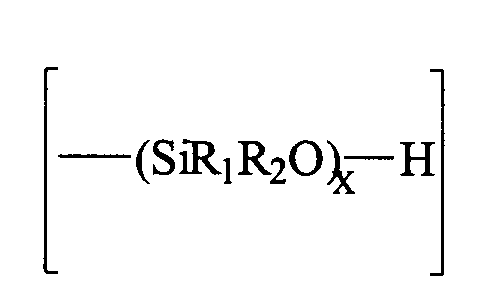 R1 et R2 identiques ou différents représentent un groupe alcoyle ayant de 1 à 8 atomes de carbone,x est un nombre entier allant de 1 à 1500.
 - Composition selon la revendication 2, caractérisée en ce que R1, R2 représentent un groupe alcoyle ayant de 1 à 5 atomes de carbone et préférentiellement le groupe méthyl.
- Composition selon l'une quelconque des revendications 1 à 3, caractérisée en ce que le polymère diénique est un copolymère de butadiène-styrène ou de butadiène-styrène-isoprène.
- Composition selon la revendication 4, caractérisée en ce qu'elle comprend en outre du polybutadiène et/ou un copolymère de butadiène-isoprène et/ou du caoutchouc naturel.
- Composition selon l'une quelconque des revendications 1 à 5, caractérisée en ce que le taux de silice présent à la surface du noir de carbone représente de 0,1 à 50% en poids.
- Composition selon la revendication 6, caractérisée en ce que le taux de silice présent à la surface du noir de carbone représente de 0,3 à 30% en poids.
- Composition selon l'une quelconque des revendications 1 à 7, caractérisée en ce que le noir de carbone ayant de la silice fixée à sa surface est utilisé en coupage avec d'autres charges renforçantes.
- Pneumatique comprenant une composition de caoutchouc vulcanisée comprenant au moins un polymère diénique, du noir de carbone ayant de la silice fixée à sa surface à titre de charge renforçante, caractérisé en ce que le polymère diénique est un polymère diénique fonctionnalisé portant en extrémité de chaíne une fonction silanol ou un bloc polysiloxane ayant une extrémité silanol ou un polymère diénique modifié le long de sa chaíne par des fonctions silanols.
- Pneumatique selon la revendication 9, caractérisé en ce que la composition entre dans la constitution de la bande de roulement.
- Bande de roulement de pneumatique constituée par une composition de caoutchouc vulcanisée comprenant au moins un polymère diénique, du noir de carbone ayant de la silice fixée à sa surface, caractérisée en ce que le polymère diénique est un polymère diénique fonctionnalisé portant en extrémité de chaíne une fonction silanol ou un bloc polysiloxane ayant une extrémité silanol ou un polymère diénique modifié le long de sa chaíne par des fonctions silanols.
Applications Claiming Priority (2)
| Application Number | Priority Date | Filing Date | Title |
|---|---|---|---|
| FR9705887A FR2763074B1 (fr) | 1997-05-07 | 1997-05-07 | Composition de caoutchouc a base de noir de carbone ayant de la silice fixee a sa surface et de polymere dyenique fonctionalise ou modifie par des fonctions silanols |
| FR9705887 | 1997-05-07 |
Publications (2)
| Publication Number | Publication Date |
|---|---|
| EP0877047A1 true EP0877047A1 (fr) | 1998-11-11 |
| EP0877047B1 EP0877047B1 (fr) | 2002-10-02 |
Family
ID=9506858
Family Applications (1)
| Application Number | Title | Priority Date | Filing Date |
|---|---|---|---|
| EP98107525A Expired - Lifetime EP0877047B1 (fr) | 1997-05-07 | 1998-04-24 | Composition de caoutchouc à base de noir de carbone ayant de la silice fixée à sa surface et de polymère diénique fonctionnalisé ou modifié par des fonctions silanols |
Country Status (12)
| Country | Link |
|---|---|
| US (1) | US6071995A (fr) |
| EP (1) | EP0877047B1 (fr) |
| JP (1) | JP4394181B2 (fr) |
| CN (1) | CN1202164C (fr) |
| AT (1) | ATE225380T1 (fr) |
| AU (1) | AU733790B2 (fr) |
| BR (1) | BR9801587A (fr) |
| CA (1) | CA2235095A1 (fr) |
| DE (1) | DE69808367T2 (fr) |
| ES (1) | ES2184166T3 (fr) |
| FR (1) | FR2763074B1 (fr) |
| WO (1) | WO1998050462A1 (fr) |
Cited By (12)
| Publication number | Priority date | Publication date | Assignee | Title |
|---|---|---|---|---|
| FR2802542A1 (fr) * | 1999-12-20 | 2001-06-22 | Michelin Soc Tech | Composition de caoutchouc vulcanisable pour la fabrication d'un pneumatique et pneumatique dont la bande de roulement comprend une telle composition |
| US6503973B2 (en) | 2000-02-24 | 2003-01-07 | Michelin Recherche Et Technique S.A. | Vulcanizable rubber composition usable for the manufacture of a tire, and a tire comprising this composition |
| WO2003046066A1 (fr) | 2001-11-26 | 2003-06-05 | Societe De Technologie Michelin | Composition de caoutchouc pour bande de roulement de pneu et son procede d'obtention |
| US6815487B2 (en) | 2000-05-22 | 2004-11-09 | Michelin Recherche Et Technique S.A. | Composition for a tire tread and process for its preparation |
| US6815473B2 (en) | 2000-05-26 | 2004-11-09 | Michelin Recherche Et Technique S.A. | Rubber composition usable as a tire tread |
| WO2015065884A1 (fr) | 2013-10-31 | 2015-05-07 | Compagnie Generale Des Etablissements Michelin | Mélanges de polymères fonctionnalisés pour une usure améliorée |
| WO2016180693A1 (fr) * | 2015-05-11 | 2016-11-17 | Compagnie Generale Des Etablissements Michelin | Composition de caoutchouc |
| WO2018115761A1 (fr) | 2016-12-22 | 2018-06-28 | Compagnie Generale Des Etablissements Michelin | Composition de caoutchouc avec une bonne dispersion de quantites elevees de charge inorganique renforçante |
| US10160847B2 (en) | 2010-11-26 | 2018-12-25 | Compagnie Generale Des Etablissments Michelin | Tyre tread |
| WO2019220029A1 (fr) | 2018-05-17 | 2019-11-21 | Compagnie Generale Des Etablissements Michelin | Bande de roulement de pneumatique dont le systeme de reticulation est a base de peroxyde organique |
| WO2019220028A1 (fr) | 2018-05-17 | 2019-11-21 | Compagnie Generale Des Etablissements Michelin | Bande de roulement de pneumatique dont le systeme de reticulation est a base de peroxyde organique |
| EP3647351A4 (fr) * | 2017-07-19 | 2021-03-24 | Sumitomo Rubber Industries, Ltd. | Composition de caoutchouc destinée à une bande de roulement, et pneumatique |
Families Citing this family (45)
| Publication number | Priority date | Publication date | Assignee | Title |
|---|---|---|---|---|
| JP4105328B2 (ja) * | 1999-04-09 | 2008-06-25 | 住友ゴム工業株式会社 | 空気入りタイヤ |
| US6255404B1 (en) * | 1999-07-26 | 2001-07-03 | Bridgestone Corporation | Method to control increase in viscosity during aging of siloxane modified polymers |
| FR2804688B1 (fr) * | 2000-02-07 | 2006-08-11 | Michelin Soc Tech | Utilisation d'une composition de caoutchouc pour retarder lors du roulage l'apparition de l'usure irreguliere sur une bande de roulement de pneumatique destinee a porter de lourdes charges |
| KR100403089B1 (ko) * | 2001-01-03 | 2003-10-30 | 금호석유화학 주식회사 | 말단변성 디엔계 공중합체의 제조방법 |
| US6569942B2 (en) * | 2001-03-14 | 2003-05-27 | The Goodyear Tire & Rubber Company | Rubber compositions containing silicon coupled oligomers |
| US20040095244A1 (en) * | 2002-05-10 | 2004-05-20 | Kevin Conwell | Tire identification label and tire label film with integrated barrier |
| US7241842B2 (en) | 2002-05-31 | 2007-07-10 | Zeon Corporation | Conjugated diene rubber, process for producing the same, and rubber composition |
| KR100466200B1 (ko) * | 2002-09-02 | 2005-01-13 | 금호석유화학 주식회사 | 다가성 커플링제로 처리된 말단변성 스티렌-디엔블록공중합체 |
| US6998448B2 (en) * | 2002-09-16 | 2006-02-14 | The Goodyear Tire & Rubber Company | Tire with tread of CIS 1,4-polybutadiene rich rubber composition which contains a functional styrene/butadiene elastomer, silica and coupling agent |
| US7163975B2 (en) * | 2002-09-17 | 2007-01-16 | The Goodyear Tire & Rubber Company | Tire with compound of rubber composition comprised of silanol and/or siloxy functionalized elastomer and silica |
| US7071251B2 (en) * | 2002-09-17 | 2006-07-04 | The Goodyear Tire & Rubber Company | Tire with component comprised of rubber composite of styrene/butadiene elastomer containing pendent silanol and/or siloxy groups |
| US7137423B2 (en) * | 2003-06-06 | 2006-11-21 | The Goodyear Tire & Rubber Company | Tire with component comprised of amine functionalized styrene/diene copolymer elastomer, silanol functionalized carbon black and coupling agent |
| EP1661946B1 (fr) | 2003-09-01 | 2012-12-26 | Zeon Corporation | Caoutchouc de dienes conjuguees, son procede de production, et ses produits de reticulation |
| US20050171267A1 (en) * | 2004-01-29 | 2005-08-04 | Zanzig David J. | Tire with component of rubber composition comprised of functionalized styrene/butadiene elastomer, silica and styrene/alpha methylstyrene resin |
| US7338914B2 (en) | 2004-03-31 | 2008-03-04 | Intermec Ip Corp. | RFID tire label |
| CN101090914B (zh) * | 2004-10-26 | 2011-02-09 | 株式会社普利司通 | 具有连接基团的官能化聚合物 |
| BRPI0705025A2 (pt) * | 2007-12-14 | 2009-08-11 | Petroflex Ind E Com S A | produto de copolìmero de 1,3-butadieno e estireno, funcionalizado nas extremidades das suas cadeias poliméricas e seu processo de preparação |
| JP5473360B2 (ja) * | 2008-03-10 | 2014-04-16 | 株式会社ブリヂストン | ゴム組成物及びそれを用いたタイヤ |
| JP5547058B2 (ja) * | 2008-03-10 | 2014-07-09 | 株式会社ブリヂストン | 変性共役ジエン(共)重合体の製造方法、変性共役ジエン(共)重合体、並びにそれを用いたゴム組成物及びタイヤ |
| DE102009023915A1 (de) * | 2009-05-27 | 2010-12-02 | Rhein-Chemie Rheinau Gmbh | Mischungen aus funktionalisierten Dienkautschuken mit Trimethylolpropan und Fettsäure, ein Verfahren zu deren Herstellung und deren Verwendung |
| JP5663146B2 (ja) * | 2009-05-29 | 2015-02-04 | 株式会社ブリヂストン | 変性共役ジエン系重合体の製造方法、変性共役ジエン系重合体、ゴム組成物、空気入りタイヤ |
| MY170989A (en) * | 2009-08-27 | 2019-09-23 | Columbian Chem | Use of surface-treated carbon blacks in an elastomer to reduce compound hysteresis and tire rolling resistance and improve wet traction |
| FR2951178B1 (fr) | 2009-10-08 | 2012-08-17 | Michelin Soc Tech | Elastomere dienique fonctionnalise et composition de caoutchouc le contenant. |
| FR2968005B1 (fr) | 2010-11-26 | 2012-12-21 | Michelin Soc Tech | Bande de roulement de pneumatique neige |
| FR2968600A1 (fr) | 2010-12-08 | 2012-06-15 | Michelin Soc Tech | Bande de roulement pour pneumatique neige |
| CN103370377B (zh) * | 2010-12-14 | 2019-01-15 | 卡博特公司 | 控制填料-聚合物组合物中的电阻率的方法以及与其相关的产品 |
| US9221923B2 (en) | 2010-12-31 | 2015-12-29 | Bridgestone Corporation | Coupled polymers and methods for making same |
| US8680210B2 (en) | 2011-05-02 | 2014-03-25 | Bridgestone Corporation | Method for making functionalized polymer |
| US8580886B2 (en) | 2011-09-20 | 2013-11-12 | Dow Corning Corporation | Method for the preparation and use of bis (alkoxysilylorgano)-dicarboxylates |
| CN104024265B (zh) | 2011-12-02 | 2017-03-01 | 道康宁公司 | 酯官能化硅烷及其制备和用途;以及亚胺化合物作为相转移催化剂的用途 |
| JP5996961B2 (ja) * | 2012-08-03 | 2016-09-21 | 住友ゴム工業株式会社 | タイヤ用ゴム組成物及び空気入りタイヤ |
| JP6018207B2 (ja) * | 2012-08-03 | 2016-11-02 | 住友ゴム工業株式会社 | トレッド用ゴム組成物及び空気入りタイヤ |
| WO2014165151A1 (fr) | 2013-03-13 | 2014-10-09 | Cabot Corporation | Revêtements à base de compositions charge-polymère alliant basse constante diélectrique, résistivité et propriétés de densité optique élevées et résistivité électrique contrôlée, dispositifs obtenus à partir de ceux-ci, et leurs procédés de production |
| EP2796471A1 (fr) * | 2013-04-24 | 2014-10-29 | LANXESS Deutschland GmbH | Polymère carboxyterminé contenant du silane |
| FR3021971B1 (fr) | 2014-06-05 | 2016-06-03 | Michelin & Cie | Pneumatique a faible resistance au roulement |
| FR3021972B1 (fr) | 2014-06-05 | 2016-06-03 | Michelin & Cie | Pneumatique a faible resistance au roulement |
| FR3023293B1 (fr) * | 2014-07-03 | 2016-07-01 | Michelin & Cie | Elastomere dienique a ip reduit possedant une fonction silanol en extremite de chaine et composition le contenant |
| WO2016109476A1 (fr) | 2014-12-30 | 2016-07-07 | Compagnie Generale Des Etablissements Michelin | Composition de caoutchouc ayant des résines |
| JP2018522996A (ja) | 2015-04-30 | 2018-08-16 | キャボット コーポレイションCabot Corporation | 炭素コーティング粒子 |
| CN108250327B (zh) * | 2016-12-28 | 2020-04-14 | 北京化工大学 | 一种链端含硅和羟基的官能化聚合物及其制备方法和支化聚合物 |
| WO2019122602A1 (fr) | 2017-12-19 | 2019-06-27 | Compagnie Generale Des Etablissements Michelin | Bande de roulement de pneumatique dont le systeme de reticulation est a base de peroxyde organique |
| US20210087370A1 (en) | 2017-12-19 | 2021-03-25 | Compagnie Generale Des Etablissements Michelin | Tire tread, the crosslinking system of which is based on organic peroxide |
| WO2019122604A1 (fr) | 2017-12-19 | 2019-06-27 | Compagnie Generale Des Etablissements Michelin | Bande de roulement de pneumatique dont le systeme de reticulation est a base de peroxyde organique |
| EP3728451B1 (fr) | 2017-12-19 | 2022-02-02 | Compagnie Generale Des Etablissements Michelin | Bande de roulement de pneumatique dont le système de réticulation est à base de peroxyde organique |
| CN112094434B (zh) * | 2020-08-24 | 2022-05-27 | 杭州师范大学 | 一种含硅烷氧基硼硅氧烷改性白炭黑的制备方法及其应用 |
Citations (2)
| Publication number | Priority date | Publication date | Assignee | Title |
|---|---|---|---|---|
| EP0299074A1 (fr) * | 1987-01-14 | 1989-01-18 | Bridgestone Corporation | Pneu |
| EP0711805A1 (fr) * | 1994-11-11 | 1996-05-15 | The Yokohama Rubber Co., Ltd. | Noir de carbone modifié en surface et composition de caoutchouc contenant celui-ci |
Family Cites Families (1)
| Publication number | Priority date | Publication date | Assignee | Title |
|---|---|---|---|---|
| DE69119125T3 (de) * | 1990-03-02 | 2001-01-11 | Bridgestone Corp., Tokio/Tokyo | Luftreifen |
-
1997
- 1997-05-07 FR FR9705887A patent/FR2763074B1/fr not_active Expired - Fee Related
-
1998
- 1998-04-24 DE DE69808367T patent/DE69808367T2/de not_active Expired - Lifetime
- 1998-04-24 ES ES98107525T patent/ES2184166T3/es not_active Expired - Lifetime
- 1998-04-24 AT AT98107525T patent/ATE225380T1/de not_active IP Right Cessation
- 1998-04-24 EP EP98107525A patent/EP0877047B1/fr not_active Expired - Lifetime
- 1998-05-05 WO PCT/EP1998/002652 patent/WO1998050462A1/fr not_active Ceased
- 1998-05-05 CN CNB988006103A patent/CN1202164C/zh not_active Expired - Fee Related
- 1998-05-06 CA CA002235095A patent/CA2235095A1/fr not_active Abandoned
- 1998-05-06 US US09/073,551 patent/US6071995A/en not_active Expired - Lifetime
- 1998-05-06 BR BR9801587A patent/BR9801587A/pt not_active IP Right Cessation
- 1998-05-06 AU AU64770/98A patent/AU733790B2/en not_active Ceased
- 1998-05-07 JP JP12450998A patent/JP4394181B2/ja not_active Expired - Fee Related
Patent Citations (2)
| Publication number | Priority date | Publication date | Assignee | Title |
|---|---|---|---|---|
| EP0299074A1 (fr) * | 1987-01-14 | 1989-01-18 | Bridgestone Corporation | Pneu |
| EP0711805A1 (fr) * | 1994-11-11 | 1996-05-15 | The Yokohama Rubber Co., Ltd. | Noir de carbone modifié en surface et composition de caoutchouc contenant celui-ci |
Cited By (17)
| Publication number | Priority date | Publication date | Assignee | Title |
|---|---|---|---|---|
| FR2802542A1 (fr) * | 1999-12-20 | 2001-06-22 | Michelin Soc Tech | Composition de caoutchouc vulcanisable pour la fabrication d'un pneumatique et pneumatique dont la bande de roulement comprend une telle composition |
| EP1110998A1 (fr) * | 1999-12-20 | 2001-06-27 | Société de Technologie Michelin | Composition de caoutchouc vulcanisable pour la fabrication d'un pneumatique et pneumatique dont la bande de roulement comprend une telle composition |
| US6667362B2 (en) | 1999-12-20 | 2003-12-23 | Michelin Recherche Et Technique S.A. | Vulcanizable rubber composition for the manufacture of a tire, and a tire, the tread of which comprises such a composition |
| US7026387B2 (en) | 1999-12-20 | 2006-04-11 | Michelin Recherche Et Technique S.A. | Vulcanizable rubber composition for the manufacture of a tire, and a tire, the tread of which comprises such a composition |
| US6503973B2 (en) | 2000-02-24 | 2003-01-07 | Michelin Recherche Et Technique S.A. | Vulcanizable rubber composition usable for the manufacture of a tire, and a tire comprising this composition |
| US6815487B2 (en) | 2000-05-22 | 2004-11-09 | Michelin Recherche Et Technique S.A. | Composition for a tire tread and process for its preparation |
| US6815473B2 (en) | 2000-05-26 | 2004-11-09 | Michelin Recherche Et Technique S.A. | Rubber composition usable as a tire tread |
| WO2003046066A1 (fr) | 2001-11-26 | 2003-06-05 | Societe De Technologie Michelin | Composition de caoutchouc pour bande de roulement de pneu et son procede d'obtention |
| US10160847B2 (en) | 2010-11-26 | 2018-12-25 | Compagnie Generale Des Etablissments Michelin | Tyre tread |
| WO2015065884A1 (fr) | 2013-10-31 | 2015-05-07 | Compagnie Generale Des Etablissements Michelin | Mélanges de polymères fonctionnalisés pour une usure améliorée |
| WO2016180693A1 (fr) * | 2015-05-11 | 2016-11-17 | Compagnie Generale Des Etablissements Michelin | Composition de caoutchouc |
| FR3036115A1 (fr) * | 2015-05-11 | 2016-11-18 | Michelin & Cie | Composition de caoutchouc |
| WO2018115761A1 (fr) | 2016-12-22 | 2018-06-28 | Compagnie Generale Des Etablissements Michelin | Composition de caoutchouc avec une bonne dispersion de quantites elevees de charge inorganique renforçante |
| EP3647351A4 (fr) * | 2017-07-19 | 2021-03-24 | Sumitomo Rubber Industries, Ltd. | Composition de caoutchouc destinée à une bande de roulement, et pneumatique |
| US11458768B2 (en) | 2017-07-19 | 2022-10-04 | Sumitomo Rubber Industries, Ltd. | Rubber composition for tread, and pneumatic tire |
| WO2019220029A1 (fr) | 2018-05-17 | 2019-11-21 | Compagnie Generale Des Etablissements Michelin | Bande de roulement de pneumatique dont le systeme de reticulation est a base de peroxyde organique |
| WO2019220028A1 (fr) | 2018-05-17 | 2019-11-21 | Compagnie Generale Des Etablissements Michelin | Bande de roulement de pneumatique dont le systeme de reticulation est a base de peroxyde organique |
Also Published As
| Publication number | Publication date |
|---|---|
| FR2763074B1 (fr) | 1999-06-25 |
| US6071995A (en) | 2000-06-06 |
| CN1202164C (zh) | 2005-05-18 |
| BR9801587A (pt) | 1999-07-06 |
| AU6477098A (en) | 1998-11-12 |
| ATE225380T1 (de) | 2002-10-15 |
| AU733790B2 (en) | 2001-05-24 |
| DE69808367T2 (de) | 2003-06-12 |
| JP4394181B2 (ja) | 2010-01-06 |
| CA2235095A1 (fr) | 1998-11-07 |
| ES2184166T3 (es) | 2003-04-01 |
| FR2763074A1 (fr) | 1998-11-13 |
| EP0877047B1 (fr) | 2002-10-02 |
| WO1998050462A1 (fr) | 1998-11-12 |
| DE69808367D1 (de) | 2002-11-07 |
| JPH10316800A (ja) | 1998-12-02 |
| CN1226908A (zh) | 1999-08-25 |
Similar Documents
| Publication | Publication Date | Title |
|---|---|---|
| EP0877047B1 (fr) | Composition de caoutchouc à base de noir de carbone ayant de la silice fixée à sa surface et de polymère diénique fonctionnalisé ou modifié par des fonctions silanols | |
| EP0778311B1 (fr) | Composition de caoutchouc à base de silice et de polymère diénique fonctionnalisé ayant une fonction silanol terminale | |
| EP0890607B1 (fr) | Composition de caoutchouc à base de noir de carbone ayant de la silice fixée à sa surface et de polymère diénique fonctionnalisé alcoxysilane | |
| CA2195990C (fr) | Composition de caoutchouc a base d'un polymere dienique ayant une fonction silanol et comprenant un derive organosilane | |
| EP1110998B1 (fr) | Composition de caoutchouc vulcanisable pour la fabrication d'un pneumatique et pneumatique dont la bande de roulement comprend une telle composition | |
| EP0692492B1 (fr) | Compositions élastomères chargées à la silice utilisables pour des enveloppes de pneumatiques | |
| EP0767206B1 (fr) | Composition de caoutchouc à base d'un polymère diénique comprenant un dérivé organosilane, utilisable pour la fabrication de bandes de roulement de pneumatiques | |
| EP1127909B1 (fr) | Composition de caoutchouc vulcanisable, utilisable pour fabriquer un pneumatique, et pneumatique comprenant cette composition | |
| EP1204702B1 (fr) | Composition de caoutchouc utilisable comme bande de roulement de pneumatique | |
| CA2144561C (fr) | Polymeres dieniques fonctionnels, leur procede de preparation et leur utilisation dans des compositions elastomeres chargees a la silice utilisables pour des enveloppes de pneumatiques | |
| EP2139703B1 (fr) | Elastomere dienique couple monomodal possedant une fonction silanol en milieu de chaine, son procede d'obtention et composition de caoutchouc le contenant | |
| EP2173789B1 (fr) | Procédé de préparation d'un copolymère diénique à bloc polyéther, copolymère diénique à bloc polyéther, composition de caoutchouc renforcée et pneumatique | |
| FR2821848A1 (fr) | Composition de caoutchouc pour bande de roulement de pneumatique et enveloppe de pneumatique l'incorporant | |
| FR2821849A1 (fr) | Composition de caoutchouc pour bande de roulement de pneumatique et enveloppe de pneumatique l'incorporant | |
| FR2918065A1 (fr) | Procede de preparation d'un copolymere dienique a bloc polyether, composition de caoutchouc renforcee et enveloppe de pneumatique. | |
| WO2001090237A1 (fr) | Composition pour bande de roulement de pneumatique et son procede de preparation | |
| EP1122281B1 (fr) | Pneumatiques pour lourdes charges, et utilisation d'une composition de caoutchouc pour retarder l'usure irrégulière sur ces pneumatiques. | |
| CA2368003A1 (fr) | Bande de roulement de pneumatique comprenant un copolymere styrene/butadiene prepare en emulsion |
Legal Events
| Date | Code | Title | Description |
|---|---|---|---|
| PUAI | Public reference made under article 153(3) epc to a published international application that has entered the european phase |
Free format text: ORIGINAL CODE: 0009012 |
|
| AK | Designated contracting states |
Kind code of ref document: A1 Designated state(s): AT DE ES FR GB IT LU |
|
| AX | Request for extension of the european patent |
Free format text: AL;LT;LV;MK;RO;SI |
|
| 17P | Request for examination filed |
Effective date: 19990511 |
|
| AKX | Designation fees paid |
Free format text: AT DE ES FR GB IT LU |
|
| GRAG | Despatch of communication of intention to grant |
Free format text: ORIGINAL CODE: EPIDOS AGRA |
|
| 17Q | First examination report despatched |
Effective date: 20020225 |
|
| GRAG | Despatch of communication of intention to grant |
Free format text: ORIGINAL CODE: EPIDOS AGRA |
|
| GRAH | Despatch of communication of intention to grant a patent |
Free format text: ORIGINAL CODE: EPIDOS IGRA |
|
| GRAH | Despatch of communication of intention to grant a patent |
Free format text: ORIGINAL CODE: EPIDOS IGRA |
|
| GRAA | (expected) grant |
Free format text: ORIGINAL CODE: 0009210 |
|
| AK | Designated contracting states |
Kind code of ref document: B1 Designated state(s): AT DE ES FR GB IT LU |
|
| REF | Corresponds to: |
Ref document number: 225380 Country of ref document: AT Date of ref document: 20021015 Kind code of ref document: T |
|
| REG | Reference to a national code |
Ref country code: GB Ref legal event code: FG4D Free format text: NOT ENGLISH |
|
| REF | Corresponds to: |
Ref document number: 69808367 Country of ref document: DE Date of ref document: 20021107 |
|
| GBT | Gb: translation of ep patent filed (gb section 77(6)(a)/1977) |
Effective date: 20030127 |
|
| REG | Reference to a national code |
Ref country code: ES Ref legal event code: FG2A Ref document number: 2184166 Country of ref document: ES Kind code of ref document: T3 |
|
| PLBE | No opposition filed within time limit |
Free format text: ORIGINAL CODE: 0009261 |
|
| STAA | Information on the status of an ep patent application or granted ep patent |
Free format text: STATUS: NO OPPOSITION FILED WITHIN TIME LIMIT |
|
| 26N | No opposition filed |
Effective date: 20030703 |
|
| PGFP | Annual fee paid to national office [announced via postgrant information from national office to epo] |
Ref country code: LU Payment date: 20060414 Year of fee payment: 9 |
|
| PGFP | Annual fee paid to national office [announced via postgrant information from national office to epo] |
Ref country code: AT Payment date: 20060418 Year of fee payment: 9 |
|
| PGFP | Annual fee paid to national office [announced via postgrant information from national office to epo] |
Ref country code: ES Payment date: 20060427 Year of fee payment: 9 |
|
| PGFP | Annual fee paid to national office [announced via postgrant information from national office to epo] |
Ref country code: IT Payment date: 20060430 Year of fee payment: 9 |
|
| PG25 | Lapsed in a contracting state [announced via postgrant information from national office to epo] |
Ref country code: AT Free format text: LAPSE BECAUSE OF NON-PAYMENT OF DUE FEES Effective date: 20070424 |
|
| REG | Reference to a national code |
Ref country code: ES Ref legal event code: FD2A Effective date: 20070425 |
|
| PG25 | Lapsed in a contracting state [announced via postgrant information from national office to epo] |
Ref country code: ES Free format text: LAPSE BECAUSE OF NON-PAYMENT OF DUE FEES Effective date: 20070425 |
|
| PG25 | Lapsed in a contracting state [announced via postgrant information from national office to epo] |
Ref country code: LU Free format text: LAPSE BECAUSE OF NON-PAYMENT OF DUE FEES Effective date: 20070424 |
|
| PG25 | Lapsed in a contracting state [announced via postgrant information from national office to epo] |
Ref country code: IT Free format text: LAPSE BECAUSE OF NON-PAYMENT OF DUE FEES Effective date: 20070424 |
|
| PGFP | Annual fee paid to national office [announced via postgrant information from national office to epo] |
Ref country code: GB Payment date: 20100420 Year of fee payment: 13 |
|
| GBPC | Gb: european patent ceased through non-payment of renewal fee |
Effective date: 20110424 |
|
| PG25 | Lapsed in a contracting state [announced via postgrant information from national office to epo] |
Ref country code: GB Free format text: LAPSE BECAUSE OF NON-PAYMENT OF DUE FEES Effective date: 20110424 |
|
| PGFP | Annual fee paid to national office [announced via postgrant information from national office to epo] |
Ref country code: DE Payment date: 20130419 Year of fee payment: 16 |
|
| PGFP | Annual fee paid to national office [announced via postgrant information from national office to epo] |
Ref country code: FR Payment date: 20130515 Year of fee payment: 16 |
|
| REG | Reference to a national code |
Ref country code: DE Ref legal event code: R119 Ref document number: 69808367 Country of ref document: DE |
|
| REG | Reference to a national code |
Ref country code: DE Ref legal event code: R119 Ref document number: 69808367 Country of ref document: DE Effective date: 20141101 |
|
| REG | Reference to a national code |
Ref country code: FR Ref legal event code: ST Effective date: 20141231 |
|
| PG25 | Lapsed in a contracting state [announced via postgrant information from national office to epo] |
Ref country code: DE Free format text: LAPSE BECAUSE OF NON-PAYMENT OF DUE FEES Effective date: 20141101 |
|
| PG25 | Lapsed in a contracting state [announced via postgrant information from national office to epo] |
Ref country code: FR Free format text: LAPSE BECAUSE OF NON-PAYMENT OF DUE FEES Effective date: 20140430 |