EP0873009B1 - Multimediasystem zum Übertragen und Empfangen einer Programmnummer und Verfahren dafür - Google Patents
Multimediasystem zum Übertragen und Empfangen einer Programmnummer und Verfahren dafür Download PDFInfo
- Publication number
- EP0873009B1 EP0873009B1 EP19970307437 EP97307437A EP0873009B1 EP 0873009 B1 EP0873009 B1 EP 0873009B1 EP 19970307437 EP19970307437 EP 19970307437 EP 97307437 A EP97307437 A EP 97307437A EP 0873009 B1 EP0873009 B1 EP 0873009B1
- Authority
- EP
- European Patent Office
- Prior art keywords
- program
- recording
- digital interface
- program number
- transport stream
- Prior art date
- Legal status (The legal status is an assumption and is not a legal conclusion. Google has not performed a legal analysis and makes no representation as to the accuracy of the status listed.)
- Expired - Lifetime
Links
Images



Classifications
-
- H—ELECTRICITY
- H04—ELECTRIC COMMUNICATION TECHNIQUE
- H04L—TRANSMISSION OF DIGITAL INFORMATION, e.g. TELEGRAPHIC COMMUNICATION
- H04L12/00—Data switching networks
- H04L12/28—Data switching networks characterised by path configuration, e.g. LAN [Local Area Networks] or WAN [Wide Area Networks]
- H04L12/40—Bus networks
- H04L12/40052—High-speed IEEE 1394 serial bus
- H04L12/40058—Isochronous transmission
-
- H—ELECTRICITY
- H04—ELECTRIC COMMUNICATION TECHNIQUE
- H04N—PICTORIAL COMMUNICATION, e.g. TELEVISION
- H04N21/00—Selective content distribution, e.g. interactive television or video on demand [VOD]
- H04N21/40—Client devices specifically adapted for the reception of or interaction with content, e.g. set-top-box [STB]; Operations thereof
- H04N21/43—Processing of content or additional data, e.g. demultiplexing additional data from a digital video stream; Elementary client operations, e.g. monitoring of home network or synchronising decoder's clock; Client middleware
- H04N21/433—Content storage operation, e.g. storage operation in response to a pause request, caching operations
-
- H—ELECTRICITY
- H04—ELECTRIC COMMUNICATION TECHNIQUE
- H04L—TRANSMISSION OF DIGITAL INFORMATION, e.g. TELEGRAPHIC COMMUNICATION
- H04L12/00—Data switching networks
- H04L12/28—Data switching networks characterised by path configuration, e.g. LAN [Local Area Networks] or WAN [Wide Area Networks]
- H04L12/40—Bus networks
- H04L12/40052—High-speed IEEE 1394 serial bus
- H04L12/40071—Packet processing; Packet format
-
- H—ELECTRICITY
- H04—ELECTRIC COMMUNICATION TECHNIQUE
- H04L—TRANSMISSION OF DIGITAL INFORMATION, e.g. TELEGRAPHIC COMMUNICATION
- H04L12/00—Data switching networks
- H04L12/28—Data switching networks characterised by path configuration, e.g. LAN [Local Area Networks] or WAN [Wide Area Networks]
- H04L12/40—Bus networks
- H04L12/40052—High-speed IEEE 1394 serial bus
- H04L12/40117—Interconnection of audio or video/imaging devices
-
- H—ELECTRICITY
- H04—ELECTRIC COMMUNICATION TECHNIQUE
- H04N—PICTORIAL COMMUNICATION, e.g. TELEVISION
- H04N21/00—Selective content distribution, e.g. interactive television or video on demand [VOD]
- H04N21/40—Client devices specifically adapted for the reception of or interaction with content, e.g. set-top-box [STB]; Operations thereof
- H04N21/41—Structure of client; Structure of client peripherals
- H04N21/4104—Peripherals receiving signals from specially adapted client devices
- H04N21/4135—Peripherals receiving signals from specially adapted client devices external recorder
-
- H—ELECTRICITY
- H04—ELECTRIC COMMUNICATION TECHNIQUE
- H04N—PICTORIAL COMMUNICATION, e.g. TELEVISION
- H04N21/00—Selective content distribution, e.g. interactive television or video on demand [VOD]
- H04N21/40—Client devices specifically adapted for the reception of or interaction with content, e.g. set-top-box [STB]; Operations thereof
- H04N21/43—Processing of content or additional data, e.g. demultiplexing additional data from a digital video stream; Elementary client operations, e.g. monitoring of home network or synchronising decoder's clock; Client middleware
- H04N21/432—Content retrieval operation from a local storage medium, e.g. hard-disk
- H04N21/4325—Content retrieval operation from a local storage medium, e.g. hard-disk by playing back content from the storage medium
-
- H—ELECTRICITY
- H04—ELECTRIC COMMUNICATION TECHNIQUE
- H04N—PICTORIAL COMMUNICATION, e.g. TELEVISION
- H04N21/00—Selective content distribution, e.g. interactive television or video on demand [VOD]
- H04N21/40—Client devices specifically adapted for the reception of or interaction with content, e.g. set-top-box [STB]; Operations thereof
- H04N21/43—Processing of content or additional data, e.g. demultiplexing additional data from a digital video stream; Elementary client operations, e.g. monitoring of home network or synchronising decoder's clock; Client middleware
- H04N21/433—Content storage operation, e.g. storage operation in response to a pause request, caching operations
- H04N21/4334—Recording operations
-
- H—ELECTRICITY
- H04—ELECTRIC COMMUNICATION TECHNIQUE
- H04N—PICTORIAL COMMUNICATION, e.g. TELEVISION
- H04N21/00—Selective content distribution, e.g. interactive television or video on demand [VOD]
- H04N21/40—Client devices specifically adapted for the reception of or interaction with content, e.g. set-top-box [STB]; Operations thereof
- H04N21/43—Processing of content or additional data, e.g. demultiplexing additional data from a digital video stream; Elementary client operations, e.g. monitoring of home network or synchronising decoder's clock; Client middleware
- H04N21/434—Disassembling of a multiplex stream, e.g. demultiplexing audio and video streams, extraction of additional data from a video stream; Remultiplexing of multiplex streams; Extraction or processing of SI; Disassembling of packetised elementary stream
-
- H—ELECTRICITY
- H04—ELECTRIC COMMUNICATION TECHNIQUE
- H04N—PICTORIAL COMMUNICATION, e.g. TELEVISION
- H04N21/00—Selective content distribution, e.g. interactive television or video on demand [VOD]
- H04N21/40—Client devices specifically adapted for the reception of or interaction with content, e.g. set-top-box [STB]; Operations thereof
- H04N21/43—Processing of content or additional data, e.g. demultiplexing additional data from a digital video stream; Elementary client operations, e.g. monitoring of home network or synchronising decoder's clock; Client middleware
- H04N21/436—Interfacing a local distribution network, e.g. communicating with another STB or one or more peripheral devices inside the home
- H04N21/4363—Adapting the video stream to a specific local network, e.g. a Bluetooth® network
- H04N21/43632—Adapting the video stream to a specific local network, e.g. a Bluetooth® network involving a wired protocol, e.g. IEEE 1394
-
- H—ELECTRICITY
- H04—ELECTRIC COMMUNICATION TECHNIQUE
- H04N—PICTORIAL COMMUNICATION, e.g. TELEVISION
- H04N21/00—Selective content distribution, e.g. interactive television or video on demand [VOD]
- H04N21/40—Client devices specifically adapted for the reception of or interaction with content, e.g. set-top-box [STB]; Operations thereof
- H04N21/47—End-user applications
- H04N21/482—End-user interface for programme selection
-
- H—ELECTRICITY
- H04—ELECTRIC COMMUNICATION TECHNIQUE
- H04N—PICTORIAL COMMUNICATION, e.g. TELEVISION
- H04N5/00—Details of television systems
- H04N5/76—Television signal recording
- H04N5/765—Interface circuits between an apparatus for recording and another apparatus
- H04N5/775—Interface circuits between an apparatus for recording and another apparatus between a recording apparatus and a television receiver
-
- H—ELECTRICITY
- H04—ELECTRIC COMMUNICATION TECHNIQUE
- H04N—PICTORIAL COMMUNICATION, e.g. TELEVISION
- H04N21/00—Selective content distribution, e.g. interactive television or video on demand [VOD]
- H04N21/40—Client devices specifically adapted for the reception of or interaction with content, e.g. set-top-box [STB]; Operations thereof
- H04N21/41—Structure of client; Structure of client peripherals
- H04N21/426—Internal components of the client ; Characteristics thereof
-
- H—ELECTRICITY
- H04—ELECTRIC COMMUNICATION TECHNIQUE
- H04N—PICTORIAL COMMUNICATION, e.g. TELEVISION
- H04N9/00—Details of colour television systems
- H04N9/79—Processing of colour television signals in connection with recording
- H04N9/80—Transformation of the television signal for recording, e.g. modulation, frequency changing; Inverse transformation for playback
- H04N9/804—Transformation of the television signal for recording, e.g. modulation, frequency changing; Inverse transformation for playback involving pulse code modulation of the colour picture signal components
- H04N9/8042—Transformation of the television signal for recording, e.g. modulation, frequency changing; Inverse transformation for playback involving pulse code modulation of the colour picture signal components involving data reduction
Definitions
- the present invention relates to a digital audio/video (A/V) apparatus, and more particularly, to a multi-media system in which a plurality of digital A/V apparatuses are connected with each other via a digital interface.
- A/V digital audio/video
- a device can be controlled by other devices, which could not be achieved in a conventional analog A/V apparatus.
- the High-Definition-Digital Video Cassette Recorder (HD-DVCR) Conference defines a command set which is called AV/C CTS (Audio/Video Control Command and Transaction Set) so that an operation command from a remote controller is transferred to a target control device (called "local device") via the IEEE 1394 serial bus.
- AV/C CTS Audio/Video Control Command and Transaction Set
- local device target control device
- IEEE 1394 serial bus is a standard related to the high-speed data transfer, which is defined by the Institute of Electrical & Electronics Engineers (IEEE).
- the IEEE 1394 serial bus is used as an interface for connecting each device of a digital multi-media system, having an isochronous transfer mode and an asynchronous transfer mode.
- A/V data is transferred in real time using the isochronous transfer mode, and transactions required for communication, including read, write and lock, are transferred in an asynchronous pattern using the asynchronous transfer mode.
- control commands such as AV/C CTS are transferred in an asynchronous pattern using the asynchronous transfer mode.
- AV/C CTS includes commands relating to a direct/indirect user's input button, but commands relating to all operations are not completed yet, and are still being updated. Also, commands related to the transfer of information which is not noticed by a user, or the notice of which is not necessary, are not yet provided. Thus, it is difficult to achieve a single common remote control for all devices.
- the MPEG2-TS is prescribed to transfer the MPEG2-TS using the isochronous transfer mode of the IEEE 1394 while having a common format, i.e., common isochronous packet (CIP) header structure as in the case of a digital video cassette (DVC) called a camcoder.
- CIP common isochronous packet
- DVC digital video cassette
- the MPEG2 is roughly classified into one of three: MPEG2-system, MPEG2-video and MPEG2-audio.
- a transport stream (TS) and a program stream (PS) are defined as a transfer standard in the MPEG2-system.
- Figure 1 shows a typical example of data transfer between the ATV and HD-VCR.
- Bluetooth Book published by the HD-DVCR Conference, including articles entitled “ Specification of Consumer-Use Digital VCRs using 6.3mm magnetic tapes ", " Specificatio n of Digital Interface for Consumer Electronic Audio / Video Equipment “, and " Specifications of AV / C Command and Transaction Set for Digital Interface "
- A/V data transferred from an ATV 10 to HD-VCR 20 which are connected by an IEEE 1394 cable 30 during a recording mode is a multi-program MPEG2-TS
- data transferred from the HD-VCR 20 to the ATV 10 during a playback mode is a single program MPEG2-TS.
- ATV refers to the American high definition television (HDTV) suggested by the Advanced Television Systems Committee (ATSC).
- ATSC Advanced Television Systems Committee
- AV/C CTS suggested in the Blue Book defines control commands with respect to VCR sub-devices, most of which relate to mechanical operation.
- commands from a remote controller 11 for the ATV 10 can be transferred to the HD-VCR 20 via the IEEE 1394 serial bus.
- control commands to the VCR sub-devices do not include commands for transferring information related to an MPEG2 system layer, e.g., program number.
- the MPEG2-TS is transferred from the ATV 10 to the HD-VCR 20 during the recording mode.
- the HD-VCR 20 should receive information required for parsing the MPEG2-TS being transferred from the ATV 10, from a user using a remote controller 21 for HD-VCR 20.
- the recorded single program MPEG2-TS is transferred from the HD-VCR 20 to the ATV 10 during the playback mode.
- a program number recorded in a video auxiliary (VAUX) region should be transferred from the HD-VCR 20 to the ATV. Additionally, it is prescribed in the Blue Book to record the program number in the VAUX region of a tape.
- the multi-media system of Figure 1 requires a separate remote controller for each device connected to the ATV. That is, when a plurality of devices, being capable of recording/reproducing a received signal, are connected to the ATV, there is an inconvenience in that an operational command should be input to each recording/reproducing device by the user, using a different remote controller for each device.
- the HD-VCR 20 should first parse the program guide information in the multi-program MPEG2-TS transferred from the ATV.
- the OSG of the program guide information is transferred to the ATV 10 by being MPEG2-TS encoded since there is no OSG transfer standard in the IEEE 1394. Then, a user can input a program number corresponding to an intended program, using an up/down key of the remote controller 21 for the HD-VCR while viewing the OSG displayed on the ATV 10.
- this multi-media system requires an extra encoding circuit in the HD-VCR 20, for the MPEG2-TS encoding of the OSG, and the ability to parse the program guide information from MPEG2-TS in order to constitute the OSG. Also, the generation of the OSG is dependent on the VCR manufacturer, so it is difficult to provide the same OSG consistently.
- the ATV parses the program guide information in transferred MPEG2-TS and displays the parsed program guide information on an OSG display, and a user inputs a program number using the remote controller 11 for the ATV, the program number can not be transferred to the HD-VCR 20, since no command is defined for transferring the program number to the HD-VCR 20.
- EP 0 749 244 discloses a method for receiving a broadcast, the method including steps of: receiving a digital signal obtained by multiplexing at least one program; selecting data corresponding to one program among the at least one program multiplexed in the digital signal; decoding the selected data; and selecting data corresponding to at least one program among the at least one program multiplexed in the digital signal and transmitting the selected data to an external device.
- preferred embodiments of the present invention provide a multi-media system for receiving a program number between a plurality of digital A/V apparatuses having a digital interface, in an asynchronous transfer mode.
- embodiments of the present invention provide a multi-media system in which a receiver, for receiving an MPEG2-TS, parses program guide information of the MPEG2-TS and displays the parsed information on an on-screen graphic (OSG) display, and then transfers a command with respect to the input program number to a recording/reproducing device.
- OSG on-screen graphic
- embodiments of the present invention provide a method for transferring a program number during a recording mode, using an asynchronous transfer mode, in the MPEG2-TS transfer between a plurality of digital A/V apparatuses having a digital interface.
- a multi-media system having at least a receiver for receiving a transport stream and a recording/reproducing device for recording/reproducing selected programs in the transport stream, wherein the receiver comprises:
- the input device is preferably a remote controller.
- the receiver may be connected to one to more recording/reproducing devices using the digital interface and the recording/reproducing devices may be controlled by the input device.
- the first digital interface may generate a command based on the parsed PSI.
- the first and second digital Interfaces are preferably an IEEE 1394 interface, respectively.
- the first digital interface preferably transfers the transport stream as isochronous packets during an isochronous transfer mode, and transfers the program number as asynchronous packets during an asynchronous transfer mode using a control command set.
- the control command set is preferably an audio/video control command and transaction set (AV/C CTS)
- the first digital interface may transfer a multi-program transport stream as isochronous packets in an isochronous transfer mode
- the second digital interface may transfer either a single program or multi-program transport stream as isochronous packets in the isochronous transfer mode during a playback mode.
- the first digital interface may transfer a single program transport stream as isochronous packets in an isochronous transfer mode
- the second digital interface transfer a single program transport stream as isochronous packets in the isochronous transfer mode during a playback mode.
- the first digital interface preferably comprises: a first microcomputer including a transaction layer and a serial bus management layer as software, for generating a program number command based on a program number received from the input device, using a write transaction and a read transaction; a first link layer for adding an asynchronous header to the program number command received from the first microcomputer to convert the program number command into serial data; and a first physical layer for converting the serial data into an electrical signal.
- the receiver may further comprise a first extra header inserter/remover for inserting an extra header into a transport stream being received, to form a data block packet provided by the first digital interface for the IEEE 1394 transfer, and for removing the extra header inserted into a reproduced data block packet for the IEEE 1394 transfer.
- a first extra header inserter/remover for inserting an extra header into a transport stream being received, to form a data block packet provided by the first digital interface for the IEEE 1394 transfer, and for removing the extra header inserted into a reproduced data block packet for the IEEE 1394 transfer.
- the second digital interface may comprise: a second physical layer for converting the program number command electrical signal, transferred from the first physical layer, into digital data; a second link layer for converting the program number command digital data into parallel data, and for removing an asynchronous header; and a second microcomputer including a transaction layer and a serial bus management layer as software, for recording the program number on a predetermined region of a recording medium by recognizing the program number command during a recording mode, and for reading out the program number recorded in the predetermined region during a playback mode.
- the recording/reproducing device preferably further comprises a second extra header inserter/remover for removing an extra header inserted into a data block packet provided by the second digital interface for a IEEE 1394 transfer, and for inserting an extra header into the transport stream reproduced from the second signal processor, to form the data block packet for the IEEE 1394 transfer.
- the first signal processor preferably further comprises an on-screen graphic (OSG) generator for displaying program guide information of a transport stream being received on an OSG display.
- OSG on-screen graphic
- the OSG generator may mix the program guide information with a graphic signal of a background screen or with the decoded video signal to be provided to the OSG display.
- the first signal processor may further comprise an on-screen display (OSD) generator for displaying the program guide information of a transport stream being received on an OSD display.
- OSD on-screen display
- the second signal processor preferably does not, parse program guide information from a transport stream being received via the second digital interface.
- a method for transferring a program number between a receiver for receiving a transport stream and a recording/reproducing device, wherein each of the receiver and recording/reproducing device has a digital interface comprising the steps of:
- the step (a) comprises preferably the steps of: (a1) parsing program guide information from the transport stream; (a2) displaying the parsed program guide information; and (a3) providing the program number of the intended program according to the displayed program guide information.
- Step (a2) preferably comprises displaying, the parsed program guide information on an OSG display.
- the step (a2) may comprise displaying the parsed program guide information on an OSD display.
- an advanced television will be described as an example of an MPEG2-TS broadcasting signal receiver
- a high definition videocassette recorder HD-VCR
- any apparatus having a digital interface capable of transferring/receiving an MPEG2-TS can replace the ATV
- any MPEG-2-TS recording/reproducing device can replace the HD-VCR, for the purposes described below.
- an HD-VCR 200 and an ATV 100 are connected by an IEEE 1394 cable 300.
- other digital audio/video apparatuses may be connected to the ATV 100 and/or the HD-VCR 200 by the IEEE 1394 cable 300.
- one remote controller 120 for the ATV ATV-remote controller
- a multi-program MPEG2-TS is transferred from the ATV 100 to the HD-VCR 200.
- a single program MPEG2-TS is transferred from the HD-VCR 200 to the ATV 100.
- a single program MPEG2-TS may be transferred from the ATV 100 to the HD-VCR 200 during the recording mode, and from the HD-VCR 200 to the ATV 100 during the playback mode.
- a multi-program MPEG2-TS may be transferred from the ATV 100 to the HD-VCR 200 during the recording mode, and from the HD-VCR 200 to the ATV 100 during the playback mode.
- one or a plurality of program numbers input by the ATV-remote controller 120 is transferred as a command during the IEEE 1394 asynchronous transfer mode, and the program number recorded on a tape is transferred from the HD-VCR 200 to the ATV 100 during the playback of the MPEG2-TS, such that the HD-VCR 200 is controlled by the ATV 100.
- a new command for transferring a program number should be added to the AV/C CTS, and the new command is transferred from the ATV 100 and the HD-VCR 200 using the asynchronous transfer mode of the IEEE 1394.
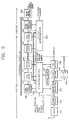
- FIG. 3 is a block diagram of a multi-media system for transferring a program number between the ATV 100 and the HD-VCR 200.
- a tuner 101 selects the frequency band of an intended program from the multi-program MPEG2-TS received via an antenna.
- a channel decoder 102 extracts the intended multi-program MPEG2-TS after removing an error correction code from the received signal.
- the multi-program MPEG2-TS extracted from the channel decoder 102 is output to a transport stream demultiplexer 103 during a display mode, and to an extra header inserter/remover 109 during a transfer mode.
- the MPEG2-TS corresponds to an MPEG2-system layer.
- One program is constituted of video information, audio information and user data information.
- video data information, audio data information and user data information corresponding to a plurality of programs are time-division multiplexed into one stream.
- the MPEG2-TS includes program specific information (PSI) such that a receiver can properly parse the audio data information, video data information and user data information corresponding to an intended program during demultiplexing.
- PSI program specific information
- PAT program association table
- PMT program map table
- CAT conditional access table
- PAT and PMT are important.
- PIDs packet identification numbers (PIDs) with respect to transport stream packets including a video stream and an audio stream of the corresponding program, are summarized by item.
- the lengths of the transport stream packets are fixed at 188 bytes.
- a transport stream demultiplexer 103 parses the PAT and PMT of the multi-program MPEG2-TS of a channel selected by the channel decoder 102.
- the transport stream demultiplexer 103 then extracts a video PID (V_PID) and an audio PID (A_PID) from the parsed PMT, to separate a video stream and an audio stream according to the video PID and the audio PID.
- the video and audio streams are output to a video decoder 104 and an audio decoder 105, respectively.
- the transport stream demultiplexer 103 parses program guide information of the multi-program MPEG2-TS of the channel selected by the channel decoder 102, and outputs the parsed information to an ATV microcomputer 106.
- the video decoder 104 decodes the separated video stream and displays the decoded image signal on a display (not shown).
- the audio decoder 105 decodes the audio stream and outputs the decoded sound signal to a sound output device (not shown) such as a speaker.
- An on-screen graphic (OSG) generator 108 mixes the program guide information with a graphic signal used as a background screen, generated by a graphic source 107, or with the image signal decoded by the video decoder 104, under the control of the ATV microcomputer 106, to display the result on a display (not shown).
- OSG on-screen graphic
- a user inputs one or a plurality of program numbers of intended programs using the ATV-remote controller 120.
- the OSG is reproduced by the ATV 100, and the same OSG is provided, regardless of the manufacturers of the connected apparatus. Also, it is unnecessary for an HD-VCR signal processor 205 of the HD-VCR 200 to parse the program guide information existing in MPEG2-TS.
- the transport stream demultiplexer 103, the video decoder 104, the audio decoder 105, the graphic source 107 and the OSG generator 108 may be called an "ATC signal processor.”
- an on-screen display (OSD) generator for generating the program guide information for an OSD may be included instead of the OSG generator 108.
- a transaction layer, an IEEE 1394 serial bus management layer, a link layer 110 and a physical layer 111 which are various layer of the IEEE 1394 protocol, may be called as a digital interface for the ATV.
- the transaction layer and the IEEE 1394 serial bus management layer are installed in the ATV microcomputer 106 as software.
- the HD-VCR 200 is roughly constituted of a digital interface including a physical layer 201, a link layer 202, a transaction layer and an IEEE 1394 serial bus management layer, an HD-VCR microcomputer 203, an extra header inserter/remover 204 and an HD-VCR signal processor 205.
- the transaction layer and the IEEE 1394 serial bus management layer are installed in the HD-VCR microcomputer 103 as software.
- the transfer of the MPEG2-TS from the ATV 100 to the HD-VCR 200 during the recording mode will be described as an example.
- the transfer of the MPEG2 is performed reversed.
- the extra header inserter/remover 109 inserts a time stamp, divides each TS packet having the time stamp into block units of a predetermined size (24 bytes), and adds a CIP header to each block, thereby constituting a data block packet for the IEEE 1394 transfer.
- the link layer 110 adds an isochronous header to the data block packet including the CIP header for the IEEE 1394 transfer, output from the extra header inserter/remover 109 to make the data block packet into an isochronous packet.
- the link layer 110 then converts the isochronous packet into a serial signal.
- the physical layer 111 converts the serial signal into an electrical signal.
- the electrical signal is input to the physical layer 201 of the digital interface of the HD-VCR, via the IEEE 1394 cable 300.
- the physical layer 201 converts the electrical signal into digital data.
- the link layer 202 converts the digital data into parallel data of a 1-byte unit and then removes the isochronous header.
- the extra header inserter/remover 204 removes the extra header (CIP header), and makes the data into a TS packet to output to the HD-VCR signal processor 205.
- the HD-VCR signal processor 205 parses the PAT from the multi-program MPEG2-TS processed into transport packets, and parses the PMT PID based on the parsed PAT using the asynchronously transferred program number.
- the PAT PID since the PAT PID is set to "0", the PAT is extracted by checking whether the PAT PID is equal to "0" or not. Also, all packets of an intended program are extracted by extracting the A_PID and the V_PID from the PMT PID to be recorded on a tape.
- the HD-VCR signal processor 205 performs signal processing for reproduction as well.
- the program information (program number) selected by a user must be transferred from the ATV-remote controller 120 to the ATV-microprocessor 106, and then to the HD-VCR 200. Since the program number is transferred once after the recording mode is set, the program number is transferred as an asynchronous packet together with a recording start command. According to the current specification proposed by the HD-VCR Conference, a command capable of transferring a program number is not defined. Thus, the present invention is intended to transfer the program number by adding a command for transferring the program number thereto.
- the program specific information excluding the program number, e.g., PMT PID, V_PID, A_PID and other information, can be transferred. This command is required for controlling the A/V apparatus as well as the AV/C CTS.
- the addition of the program number transferring command is meaningful more than decreasing the number of remote controllers for each apparatus in the multi-media system. That is, even though it is not shown in the embodiment of the present invention, it means that the HD-VCR 200 can connect to various types of external apparatuses or a network. That is, the HD-VCR 200 can accept a program number input from an external network such as the Internet, as it does a program number transferred from the ATV 100, so that the control by the network is possible. For example, suppose that the Internet includes a home page providing program guide information managed by a broadcasting station, and an ATV capable of web browsing exists at home. If a user selects a program by connecting to the home page, the corresponding program number would be transferred to the ATV of the user and then to the HD-VCR.
- an external network such as the Internet
- the Internet includes a home page providing program guide information managed by a broadcasting station, and an ATV capable of web browsing exists at home. If a user selects a program by connecting to the home page,
- a command for transferring a program number is transferred as an asynchronous packet using the asynchronous transfer mode.
- the flow of the asynchronous transfer relates to a microcomputer.
- the command for transferring a program number is implemented using the IEEE 1394 read and write transactions, wherein the write and read transactions are performed in a transaction layer which is implemented by software in the ATV microcomputer 106.
- the ATV microcomputer 106 also implements the contents related to the management of a serial bus and an application program, as well as the transaction layer, by software.
- the link layer 110 adds an asynchronous header to a program number command in order to transfer the program number command as an asynchronous packet from the ATV microcomputer 106 according to the AV/C CTS specification, and converts the command having the asynchronous header into serial data.
- the physical layer 111 converts the serial data into an electrical signal to output via the IEEE 1394 cable 300.
- the physical layer 201 as an HD-VCR digital interface converts the electrical signal into digital data.
- the link layer 202 converts the digital data into parallel data of a 1-byte unit, removes the asynchronous header, and then outputs the result to the HD-VCR microcomputer 203.
- the HD-VCR microcomputer 203 recognizes the program number command and writes the program number in a VAUX region of the tape during a recording mode, and it reads out the program number recorded in the VAUX region during a playback mode to transfer the program number to the ATV 100 via the digital interface of the HD-VCR.
- a node on the IEEE 1394 serial bus in the AV/C CTS is called a "device".
- the device is divided into sub-devices.
- a VCR device may be constituted of a VCR sub-device and a tuner sub-device.
- devices for transferring and receiving a command are called “controller” and "target”, respectively.
- the controller can transfer a command to the target.
- the commands are classified as device commands or sub-device commands, according to whether the target of the command is a device unit or a sub-device unit.
- the target receiving the command is set to respond within a predetermined time (100msec) after receiving a command.
- a command register and a response register are required.
- the command register and the response register exist in the microcomputers 106 and 203 of Figure 3 or an external memory (not shown), which are mapped at a predetermined location on the IEEE 1394 bus.
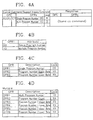
- Figure 4A shows the format of an MPEG2 information notify command for use with a system or method according to the present invention, defining a command for notifying a target (HD-VCR) of information related to the MPEG2-TS.
- a command for inquiring of whether to supply an information transfer function or not is also defined.
- a VCR device performs a single program recording, however, the command format of Figure 4A includes the commands for both single program recording and multi-program recording.
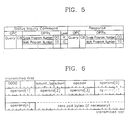
- FIG 5 shows the format of an MPEG2 information inquiry command for use with a system or method according to an embodiment of the present invention, in which a command capable of taking MPEG2-TS information from a target (HD-VCR) is defined.
- a command capable of taking MPEG2-TS information from a target HD-VCR
- each OPR is the same as those of the MPEG2 information notify command of Figures 4B to 4D.
- Figure 6 shows the format of an AV/C command frame and of an AV/C response frame proposed by the cited reference [2]
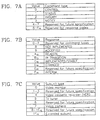
- Figures 7A to 7C are tables defining a command type, a response code and a subunit address, respectively, proposed by the cited reference [2].
- Figure 8 shows an example in which the program number of a single program is transferred from the ATV 100 to the HD-VCR 200 during a recording mode using the commands defined in Figures 4A through 4D, 5, 6 and 7A through 7C, which is performed by software in the ATV microcomputer 106 of Figure 3.
- a controller transfers a first command frame to a target (HD-VCR) to inquire (OPC:C7 16 ) whether to support (CT/RC:0010 2 ) the recording of the program number of a single program (OPR1:00 16 ) by a first VCR device (Header Address (HA) 00100 2 /000 2 ).
- the target (HD-VCR) transfers a first response frame to the controller (ATV) as a response (OPC:C7 16 ) for permitting (CT/RC:1100 2 ) the recording of the program number of the single program (OPR1:00 16 ) by the first VCR device (HA:00100 2 /000 2 ).
- the controller (ATV) receives the first response frame, and transfers a second command frame to the target (HD-VCR) to notify (OPC:C7 16 ) a command (CT/RC:0000 2 ) for recording the program number (OPR1:00 ABCD 16 ) of the program selected by a user by using the first VCR device (HA:00100 2 /000 2 ). Then, the target (HD-VCR) transfers a second response frame to the controller (ATV) to notify (OPC:C7 16 ) the permission (CT/RC:1001 2 ) of the recording of the program number (ABCD 16 ) by the first VCR device (HA: 00100 2 /000 2 ).
- Figure 9 shows an example in which the program number of a single program is received by the ATV 100 from the HD-VCR 200 during the playback mode, which is performed by the ATV microcomputer 106.
- a controller (ATV) transfers a first command frame to a target (HD-VCR) to inquire (CT/RC:0010 2 ) as to whether to notify (OPC:C8 16 ) the target (HD-VCR) of the program number of a single program (OPR1:00 16 ) recorded by a first VCR device (HA:00100 2 /000 2 ).
- the target (HD-VCR) transfers a first response frame to the controller (ATV) to notify (OPC:C8 16 ) the controller (ATV) of the permission (CT/RC:1100 2 ) of the reproduction of the single program (OPR1:00 16 ) by the first VCR device (HA:00100 2 /000 2 ).
- the controller (ATV) transfers a second command frame to the target (HD-VCR) to inquire (CT/RC:1000 2 ) as to whether to notify (OPC:C8 16 ) the target (HD-VCR) of the program number of the single program (OPR1:00 16 ) recorded by the first VCR device (HA:00100 2 /000 2 ).
- the target (HD-VCR) transfers a second response frame to the controller (ATV) to notify (CT/RC:1001 2 ) the controller (ATV) of the program number (ABCD 16 ) of the single program (OPR1:00 16 ) recorded by the first VCR device (HA:00100 2 /00 2 ).
- the remote controller of the above embodiment may include all input devices.
- the program number is transferred and received during the asynchronous transfer mode of the IEEE 1394 digital interface, so that various digital A/V apparatuses can all be controlled by one apparatus, implementing a home network.
- an OSG generator is provided in the ATV, providing a consistent OSG.
Landscapes
- Engineering & Computer Science (AREA)
- Signal Processing (AREA)
- Multimedia (AREA)
- Computer Networks & Wireless Communication (AREA)
- Databases & Information Systems (AREA)
- Human Computer Interaction (AREA)
- Signal Processing For Digital Recording And Reproducing (AREA)
- Television Signal Processing For Recording (AREA)
- Two-Way Televisions, Distribution Of Moving Picture Or The Like (AREA)
- Details Of Television Systems (AREA)
- Compression Or Coding Systems Of Tv Signals (AREA)
Claims (22)
- Multimedia-System, das wenigstens einen Empfänger (100) zum Empfangen eines Transportstroms und eine Aufzeichnungs-/Wiedergabevorrichtung (200) zum Aufzeichnen/Wiedergeben ausgewählter Programme in dem Transportstrom aufweist, wobei der Empfänger (100) umfasst:wobei die Aufzeichnungs-/Wiedergabevorrichtung (200) umfasst:einen ersten Signalprozessor (103-105), der Parsing programmspezifischer Informationen (PSI) des empfangenen Transportstroms durchführt und ein Videosignal sowie ein Audiosignal eines zum Anzeigen bestimmten Programms auf Basis der Parsing unterzogenen PSI dekodiert;eine Eingabevorrichtung (120) zum Eingeben einer oder mehrerer Programmnummern von Programmen, die zum Anzeigen oder Aufzeichnen/Wiedergeben bestimmt sind; undeine erste digitale Schnittstelle (106, 110, 111), die einen Programmnummernbefehl auf Basis einer von der Eingabevorrichtung empfangenen Programmnummer erzeugt, die die Nummer eines zum Aufzeichnen/Wiedergeben bestimmten Programms ist, den Programmnummernbefehl überträgt und den Transportstrom überträgt, undeine zweite digitale Schnittstelle (201-203), die den über die erste digitale Schnittstelle übertragenen Programmnummernbefehl dekodiert und den über die erste digitale Schnittstelle übertragenen Transportstrom empfängt; undeinen zweiten Signalprozessor (205), der aus dem durch die zweite digitale Schnittstelle (201-203) empfangenen Transportstrom auf Basis des Programmnummernbefehls ein zum Aufzeichnen bestimmtes Programm extrahiert und das extrahierte Ergebnis während eines Aufzeichnungs-Modus auf Aufzeichnungsmedien aufzeichnet und der zweiten digitalen Schnittstelle (201-203) während des Wiedergabemodus auf Basis eines von der ersten digitalen Schnittstelle empfangenen Programmnummernbefehls ein von den Aufzeichnungsmedien wiedergegebenes Programm zuführt.
- Multimedia-System nach Anspruch 1, wobei die Eingabevorrichtung (120) eine Fernbedienung ist.
- Multimedia-System nach Anspruch 1 oder 2, wobei der Empfänger (100) unter Verwendung der digitalen Schnittstelle mit einer oder mehreren Aufzeichnungs-/Wiedergabevorrichtungen (200) verbunden ist und die Aufzeichungs-/Wiedergabevorrichtungen mit der Eingabevorrichtung (120) gesteuert werden.
- Multimedia-System nach Anspruch 1, 2 oder 3, wobei die erste digitale Schnittstelle (106, 110, 111) einen Befehl auf Basis der Parsing unterzogenen PSI erzeugt.
- Multimedia-System nach Anspruch 1, 2, 3 oder 4, wobei die erste und die zweite digitale Schnittstelle (106, 110, 111; 201-203) jeweils eine Schnittstelle vom Typ IEEE 1394 sind.
- Multimedia-System nach einem der Ansprüche 1 bis 5, wobei die erste digitale Schnittstelle (106, 110, 111) den Transportstrom während eines isochronen Übertragungsmodus als isochrone Pakete überträgt und die Programmnummer während eines asynchronen Übertragungsmodus unter Verwendung eines Steuerbefehlssatzes als asynchrone Pakete überträgt.
- Multimedia-System nach Anspruch 6, wobei der Steuerbefehlsatz ein Audio-Nideo-Steuerbefehl-und-Transaktions-Satz (AV/C CTS) ist.
- Multimedia-System nach einem der Ansprüche 1 bis 7, wobei die erste digitale Schnittstelle (106, 110, 111) einen Mehrfachprogramm-Transportstrom in einem isochronen Übertragungsmodus als isochrone Pakete überträgt und die zweite digitale Schnittstelle (201-203) während eines Abspiel-Modus einen Einzelprogramm-Transportstrom in dem isochronen Übertragungsmodus als isochrone Pakete überträgt.
- Multimedia-System nach einem der Ansprüche 1 bis 7, wobei die erste digitale Schnittstelle (106, 110, 111) einen Mehrfachprogramm-Transportstrom in einem isochronen Übertragungsmodus als isochrone Pakete überträgt und die zweite digitale Schnittstelle (201-203) während eines Abspiel-Modus einen Mehrfachprogramm-Transportstrom in dem isochronen Übertragungsmodus als isochrone Pakete überträgt.
- Multimedia-System nach einem der Ansprüche 1 bis 7, wobei die erste digitale Schnittstelle (106, 110, 111) einen Einzelprogramm-Transportstrom in einem isochronen Übertragungsmodus als isochrone Pakete überträgt, und die zweite digitale Schnittstelle (201-203) während eines Abspiel-Modus einen Einzelprogramm-Transportstrom in dem isochronen Übertragungsmodus als isochrone Pakete überträgt.
- Multimedia-System nach Anspruch 5 oder einem der Ansprüche 6 bis 10, wenn davon abhängig, wobei die erste digitale Schnittstelle umfasst:einen ersten Mikrocomputer (106), der eine Transaktions-Schicht und eine Schicht zum Verwalten eines seriellen Busses als Software enthält, um einen Programmnummernbefehl auf Basis einer von der Eingabevorrichtung (120) empfangenen Programmnummer unter Verwendung einer Schreib-Transaktion und einer Lese-Transaktion zu erzeugen;eine erste Verbindungsschicht (110) zum Hinzufügen eines asynchronen Headers zu dem von dem ersten Mikrocomputer (106) empfangenen Programmnummernbefehl, um den Programmnummernbefehl in serielle Daten umzuwandeln; undeine erste physikalische Schicht (111) zum Umwandeln der seriellen Daten in ein elektrisches Signal.
- Multimedia-System nach Anspruch 11, wobei der Empfänger des Weiteren eine Einrichtung (109) zum Einfügen/Entfernen eines ersten zusätzlichen Headers umfasst, die einen zusätzlichen Header in einen empfangenen Transportstrom einfügt, um ein Datenblockpaket auszubilden, das von der ersten digitalen Schnittstelle (106, 110, 111) für die IEEE 1394-Übertragung bereitgestellt wird, und den in ein wiedergegebenes Datenblockpaket eingefügten zusätzlichen Header für die IEEE 1394-Übertragung entfernt.
- Multimedia-System nach Anspruch 5, wobei die zweite digitale Schnittstelle (201-203) umfasst:eine zweite physikalische Schicht (201) zum Umwandeln des elektrischen Signals des Programmnummembefehls, das von der ersten physikalischen Schicht übertragen wird, in digitale Daten;eine zweite Verbindungsschicht (202) zum Umwandeln der digitalen Daten des Programmnummernbefehls in parallele Daten und zum Entfernen eines asynchronen Headers; undeinen zweiten Mikrocomputer (203), der eine Transaktions-Schicht und eine Schicht zum Verwalten eines seriellen Busses als Software enthält, um die Programmnummer in einem vorgegebenen Bereich eines Aufzeichnungsmediums aufzuzeichnen, indem der Programmnummernbefehls während eines Aufzeichnungsmediums erkannt wird, und die in dem vorgegebenen Bereich aufgezeichnete Programmnummer während eines Abspiel-Modus auszulesen.
- Multimedia-System nach Anspruch 13, wobei die Aufzeichnungs-/Wiedergabevorrichtung (200) des Weiteren eine zweite Einrichtung (204) zum Einfügen/Entfernen eines zusätzlichen Headers umfasst, die einen in ein Datenblockpaket, das von der zweiten digitalen Schnittstelle (201-203) bereitgestellt wird, eingefügten zusätzlichen Header für eine IEEE 1394-Übertragung entfernt und einen zusätzlichen Header in den von dem zweiten Signalprozessor (205) wiedergegebenen Transportstrom einfügt, um das Datenblockpaket für die IEEE 1394-Übertragung auszubilden.
- Multimedia-System nach Anspruch 1, wobei der erste Signalprozessor des Weiteren einen On-Screen-Grafik (OSG)-Generator (108) umfasst, der Programmleitinformationen eines empfangenen Transportstroms auf einer OSG-Anzeige anzeigt.
- Multimedia-System nach Anspruch 15, wobei der OSG-Generator (108) die Programmleitinformationen mit einem grafischen Signal eines Hintergrundbildschirms mischt, das für die OSG-Anzeige bereitzustellen ist.
- Multimedia-System nach Anspruch 15, wobei der OSG-Generator (108) die Programmleitinformationen mit dem dekodierten Videosignal mischt, das für die OSG-Anzeige bereitzustellen ist.
- Multimedia-System nach Anspruch 1, wobei der erste Signalprozessor des Weiteren einen On-Screen-Display (OSD)-Generator umfasst, der die Programmleitinformationen eines empfangenen Transportstroms auf einer OSD-Anzeige anzeigt.
- Multimedia-System nach Anspruch 15, wobei der zweite Signalprozessor (205) Programmleitinformationen aus einem Transportstrom, der über die zweite digitale Schnittstelle (201-203) empfangen wird, nicht Parsing unterzieht.
- Verfahren zum Übertragen einer Programmnummer zwischen einem Empfänger zum Empfangen eines Transportstroms und einer Aufzeichnungs-/Wiedergabevorrichtung, wobei der Empfänger und die Aufzeichnungs-/Wiedergabevorrichtung jeweils eine digitale Schnittstelle haben und das Verfahren die folgenden Schritte umfasst:(a) Eingeben der Programmnummer eines zum Aufzeichnen oder Wiedergeben bestimmten Programms in den Empfänger; und(b) Erzeugen eines Programmnummernbefehls auf Basis der eingegebenen Programmnummer in der digitalen Schnittstelle des Empfängers und Übertragen des Programmnummernbefehls von der digitalen Schnittstelle des Empfängers zu der digitalen Schnittstelle der Aufzeichnungs-/Wiedergabevorrichtung, wobei im Aufzeichnungs-Modus der von der digitalen Schnittstelle des Empfängers empfangene Programmnummernbefehl durch die Aufzeichnungs-/Wiedergabevorrichtung genutzt wird, um aus dem Transportstrom das der eingegebenen Programmnummer entsprechende Programm zu extrahieren, und die Aufzeichnungs-/Wiedergabevorrichtung das Programm auf einem Aufzeichnungsmedium aufzeichnet, und in dem Wiedergabemodus der von der digitalen Schnittstelle des Empfängers empfangene Programmnummernbefehl durch die Aufzeichnungs-/Wiedergabevorrichtung genutzt wird, um das der in den Empfänger eingegebenen Programmnummer entsprechende Programm von dem Aufzeichnungsmedium wiederzugeben, wobei das Programm über die digitalen Schnittstellen zu dem Empfänger übertragen wird.
- Verfahren nach Anspruch 20, wobei der Schritt (a) die folgenden Schritte umfasst:(a1) Ausführen von Parsing von Programmleitinformationen aus dem Transportstrom;(a2) Anzeigen der Parsing unterzogenen Programmleitinformationen; und(a3) Eingeben der Programmnummer des gewünschten Programms entsprechend den angezeigten Programmleitinformationen.
- Verfahren nach Anspruch 21, wobei in dem Schritt (a2) die Parsing unterzogenen Programmleitinformationen auf einer OSG-Anzeige angezeigt werden.
Priority Applications (1)
| Application Number | Priority Date | Filing Date | Title |
|---|---|---|---|
| EP20040000208 EP1420581A1 (de) | 1997-04-14 | 1997-09-24 | Multimediasystem zum Übertragen und Empfangen einer Programmnummer und Verfahren dafür |
Applications Claiming Priority (2)
| Application Number | Priority Date | Filing Date | Title |
|---|---|---|---|
| KR1019970013586A KR100230281B1 (ko) | 1997-04-14 | 1997-04-14 | 프로그램 번호를 전송 및 수신하는 멀티미디어 시스템과 프로그램 번호 전송 및 수신방법 |
| KR9713586 | 1997-04-14 |
Related Child Applications (1)
| Application Number | Title | Priority Date | Filing Date |
|---|---|---|---|
| EP20040000208 Division EP1420581A1 (de) | 1997-04-14 | 1997-09-24 | Multimediasystem zum Übertragen und Empfangen einer Programmnummer und Verfahren dafür |
Publications (3)
| Publication Number | Publication Date |
|---|---|
| EP0873009A2 EP0873009A2 (de) | 1998-10-21 |
| EP0873009A3 EP0873009A3 (de) | 1998-12-16 |
| EP0873009B1 true EP0873009B1 (de) | 2005-11-02 |
Family
ID=19502676
Family Applications (2)
| Application Number | Title | Priority Date | Filing Date |
|---|---|---|---|
| EP20040000208 Withdrawn EP1420581A1 (de) | 1997-04-14 | 1997-09-24 | Multimediasystem zum Übertragen und Empfangen einer Programmnummer und Verfahren dafür |
| EP19970307437 Expired - Lifetime EP0873009B1 (de) | 1997-04-14 | 1997-09-24 | Multimediasystem zum Übertragen und Empfangen einer Programmnummer und Verfahren dafür |
Family Applications Before (1)
| Application Number | Title | Priority Date | Filing Date |
|---|---|---|---|
| EP20040000208 Withdrawn EP1420581A1 (de) | 1997-04-14 | 1997-09-24 | Multimediasystem zum Übertragen und Empfangen einer Programmnummer und Verfahren dafür |
Country Status (6)
| Country | Link |
|---|---|
| US (2) | US7162145B2 (de) |
| EP (2) | EP1420581A1 (de) |
| JP (1) | JP2912899B2 (de) |
| KR (1) | KR100230281B1 (de) |
| CN (2) | CN100375514C (de) |
| DE (1) | DE69734502T2 (de) |
Cited By (3)
| Publication number | Priority date | Publication date | Assignee | Title |
|---|---|---|---|---|
| US8302100B2 (en) | 2000-01-18 | 2012-10-30 | Galactic Computing Corporation Bvi/Bc | System for balance distribution of requests across multiple servers using dynamic metrics |
| US8316131B2 (en) | 2000-11-10 | 2012-11-20 | Galactic Computing Corporation Bvi/Bc | Method and system for providing dynamic hosted service management across disparate accounts/sites |
| US8429049B2 (en) | 2000-07-17 | 2013-04-23 | Galactic Computing Corporation Bvi/Ibc | Method and system for allocating computing resources |
Families Citing this family (37)
| Publication number | Priority date | Publication date | Assignee | Title |
|---|---|---|---|---|
| KR100230281B1 (ko) * | 1997-04-14 | 1999-11-15 | 윤종용 | 프로그램 번호를 전송 및 수신하는 멀티미디어 시스템과 프로그램 번호 전송 및 수신방법 |
| CN1182710C (zh) | 1997-09-18 | 2004-12-29 | 汤姆森消费电子有限公司 | 外围电子设备和经数字总线控制这种设备的系统 |
| EP1034654B1 (de) * | 1997-11-25 | 2003-07-09 | Thomson Licensing S.A. | Zusammenarbeitsfähigkeit von geräten unter verwendung von bitorganisierten bildschirmanzeigemenüs |
| US7068920B1 (en) | 1998-02-04 | 2006-06-27 | Thomson Licensing | Digital baseband interface for a DVD player |
| AU766795B2 (en) * | 1998-02-04 | 2003-10-23 | Thomson Licensing S.A. | Digital baseband interface for a DVD player |
| US6816491B1 (en) * | 1998-11-04 | 2004-11-09 | Hitachi, Ltd. | Multiplexed audio data decoding apparatus and receiver apparatus |
| US6671290B1 (en) * | 1998-11-10 | 2003-12-30 | Sony Corporation | Receiving apparatus and recording/reproducing system for digital broadcasts |
| US7362381B1 (en) | 1998-11-20 | 2008-04-22 | Thomson Licensing | Device interoperability utilizing bit-mapped on-screen display menus |
| EP1021048A3 (de) * | 1999-01-14 | 2002-10-02 | Kabushiki Kaisha Toshiba | System zur Aufnahme von digitalem Video und Aufnahmemedium |
| US6490002B1 (en) * | 1999-02-03 | 2002-12-03 | Sony Corporation | Supplemental data path for supporting on-screen displays from external sources in a monitor/TV receiver using a secondary analog signal path |
| EP1039750A3 (de) * | 1999-03-26 | 2005-05-25 | Matsushita Electric Industrial Co., Ltd. | Videodatenaufzeichnungs- und wiedergabevorrichtung |
| CN100383890C (zh) * | 1999-03-30 | 2008-04-23 | 提维股份有限公司 | 多媒体节目书签系统和方法 |
| CN1190014C (zh) * | 1999-07-09 | 2005-02-16 | 索尼公司 | 接收设备和方法 |
| KR100331825B1 (ko) * | 1999-07-27 | 2002-04-09 | 구자홍 | 디지털 인터페이스의 전송 스트림 전달장치 및 방법 |
| KR100357095B1 (ko) * | 1999-07-27 | 2002-10-18 | 엘지전자 주식회사 | 디지털 인터페이스의 프로그램 정보 전송방법 및 장치 |
| US7032024B1 (en) * | 1999-07-29 | 2006-04-18 | Samsung Electronics Co., Ltd. | Connection management method for devices connected digital interface and command structure therefor |
| KR100620186B1 (ko) * | 1999-09-21 | 2006-09-01 | 엘지전자 주식회사 | 디지털 인터페이스에서의 명령 및 응답 프레임 생성장치 및 방법 |
| JP4501187B2 (ja) * | 1999-10-22 | 2010-07-14 | ソニー株式会社 | 情報処理装置、情報処理システム及び情報処理方法 |
| JP4660877B2 (ja) | 2000-01-11 | 2011-03-30 | ソニー株式会社 | 電子機器システム |
| JP2001237860A (ja) * | 2000-02-21 | 2001-08-31 | Sony Corp | 通信制御方法及び通信制御装置 |
| CN1285055C (zh) * | 2000-07-17 | 2006-11-15 | 蚬壳星盈科技有限公司 | 用于动态配置服务器场的方法和系统 |
| JP2002051307A (ja) * | 2000-08-02 | 2002-02-15 | Sony Corp | 画像処理装置および画像処理方法、並びに記録媒体 |
| JP2002108326A (ja) * | 2000-09-29 | 2002-04-10 | Toshiba Corp | 映像処理装置 |
| US6970481B2 (en) * | 2001-04-17 | 2005-11-29 | Microsoft Corporation | Methods and systems for distributing multimedia data over heterogeneous networks |
| US7349395B2 (en) * | 2003-06-23 | 2008-03-25 | Microsoft Corporation | System, method, and computer program product for parsing packetized, multi-program transport stream |
| JP2005017817A (ja) * | 2003-06-27 | 2005-01-20 | Pioneer Electronic Corp | 映像信号供給装置と映像表示端末装置及び当該装置における信号入力端子選択方法 |
| US7808895B2 (en) | 2003-10-30 | 2010-10-05 | Intel Corporation | Isochronous device communication management |
| KR20050077182A (ko) * | 2004-01-27 | 2005-08-01 | 엘지전자 주식회사 | Ieee1394 인터페이스를 사용하는 기기의 제어방법 |
| DE102004045118A1 (de) * | 2004-09-17 | 2006-03-23 | Robert Bosch Gmbh | Verfahren und Vorrichtung zur Datenübertragung |
| CN100403295C (zh) * | 2004-10-22 | 2008-07-16 | 宏普科技股份有限公司 | 多媒体服务系统 |
| TWI266534B (en) * | 2005-07-29 | 2006-11-11 | Optoma Corp | Control system for synchronously controlling displaying apparatus and playing apparatus |
| KR20080078415A (ko) * | 2007-02-23 | 2008-08-27 | 삼성전자주식회사 | 디지털 방송 녹화 장치 및 방법, 그리고 상기 방법에 의해프로그램 부가정보를 저장하는 저장 매체 |
| CN101202884B (zh) * | 2007-06-06 | 2010-09-15 | 深圳市同洲电子股份有限公司 | 一种多节目输出控制方法、装置及设备 |
| US7817586B2 (en) * | 2007-08-16 | 2010-10-19 | Mediatek Inc. | High-speed digital interface transceiver and method of supplying bi-directional communication process on high-speed digital interface device |
| US20110183654A1 (en) * | 2010-01-25 | 2011-07-28 | Brian Lanier | Concurrent Use of Multiple User Interface Devices |
| US20110181780A1 (en) * | 2010-01-25 | 2011-07-28 | Barton James M | Displaying Content on Detected Devices |
| CN103596043B (zh) * | 2013-11-14 | 2017-05-10 | 上海电力学院 | 一种数字电视中ts流转化为ps流的方法 |
Family Cites Families (28)
| Publication number | Priority date | Publication date | Assignee | Title |
|---|---|---|---|---|
| US6430359B1 (en) * | 1988-12-23 | 2002-08-06 | Gemstar Development Corporation | Apparatus and method using compressed codes for television program record scheduling |
| JPH02264586A (ja) * | 1989-04-04 | 1990-10-29 | Pioneer Electron Corp | Catvシステム及びcatv端末装置 |
| US5488409A (en) * | 1991-08-19 | 1996-01-30 | Yuen; Henry C. | Apparatus and method for tracking the playing of VCR programs |
| GB9216681D0 (en) * | 1992-08-06 | 1992-09-23 | D2B Systems Co Ltd | Apparatuses interconnected for the communication of control messages |
| US5657414A (en) * | 1992-12-01 | 1997-08-12 | Scientific-Atlanta, Inc. | Auxiliary device control for a subscriber terminal |
| CA2156871C (en) * | 1994-09-09 | 2005-04-05 | Thomas Patrick Newberry | Unified program guide interface |
| US5681284A (en) | 1994-10-31 | 1997-10-28 | Glenn Herskowitz | Infusion pump with tube spike holder |
| US6002832A (en) * | 1995-02-09 | 1999-12-14 | Matsushita Electric Industrial Co., Ltd. | Apparatus and method for recording and reproducing data |
| US5742730A (en) * | 1995-03-09 | 1998-04-21 | Couts; David A. | Tape control system |
| US5898695A (en) * | 1995-03-29 | 1999-04-27 | Hitachi, Ltd. | Decoder for compressed and multiplexed video and audio data |
| JP3372004B2 (ja) * | 1995-03-31 | 2003-01-27 | ソニー株式会社 | 電子番組ガイド装置、電子番組ガイドシステム、および電子番組ガイド方法 |
| US6069902A (en) * | 1995-06-14 | 2000-05-30 | Matsushita Electric Industrial Co., Ltd. | Broadcast receiver, transmission control unit and recording/reproducing apparatus |
| US5933430A (en) * | 1995-08-12 | 1999-08-03 | Sony Corporation | Data communication method |
| US6727799B1 (en) * | 1995-10-31 | 2004-04-27 | Sony Corporation | Communication control method and electronic equipments |
| TW319942B (de) * | 1995-11-14 | 1997-11-11 | Nippon Bickter Kk | |
| US5899578A (en) * | 1995-12-25 | 1999-05-04 | Sony Corporation | Digital signal processor, processing method, digital signal recording/playback device and digital signal playback method |
| JP3305183B2 (ja) * | 1996-01-12 | 2002-07-22 | 株式会社東芝 | ディジタル放送受信端末装置 |
| KR100319953B1 (ko) * | 1996-02-02 | 2002-02-19 | 크리트먼 어윈 엠 | 다수의전자장치를인터페이스하기위한시스템및그방법 |
| US6038368A (en) * | 1996-02-05 | 2000-03-14 | Sony Corporation | System for acquiring, reviewing, and editing sports video segments |
| US5909257A (en) * | 1996-02-27 | 1999-06-01 | Victor Company Of Japan, Ltd. | Apparatus and method of receiving broadcasted digital signal |
| US5787259A (en) * | 1996-03-29 | 1998-07-28 | Microsoft Corporation | Digital interconnects of a PC with consumer electronics devices |
| US5940600A (en) * | 1996-04-01 | 1999-08-17 | Apple Computer, Inc. | Isochronous channel having a linked list of buffers |
| TW364083B (en) * | 1996-06-21 | 1999-07-11 | Sony Corp | A method and a system for providing devices monitoring and control with a topology map in a network |
| WO1998002881A1 (en) * | 1996-07-15 | 1998-01-22 | Kabushiki Kaisha Toshiba | Apparatus having digital interface, network system employing the apparatus and copy protection method |
| US5838876A (en) * | 1996-09-24 | 1998-11-17 | Sony Corporation | Frame-accurate edit and playback in digital stream recording |
| CA2216573C (en) * | 1996-10-01 | 2006-03-14 | Sony Corporation | Digital tuner having ieee 1394 serial bus interface for providing a plurality of selected programs as a functional unit |
| US6097878A (en) * | 1997-02-25 | 2000-08-01 | Sony Corporation | Automatic timer event entry |
| KR100230281B1 (ko) * | 1997-04-14 | 1999-11-15 | 윤종용 | 프로그램 번호를 전송 및 수신하는 멀티미디어 시스템과 프로그램 번호 전송 및 수신방법 |
-
1997
- 1997-04-14 KR KR1019970013586A patent/KR100230281B1/ko not_active Expired - Fee Related
- 1997-09-22 CN CNB2004100067614A patent/CN100375514C/zh not_active Expired - Fee Related
- 1997-09-22 CN CNB971186383A patent/CN1257461C/zh not_active Expired - Fee Related
- 1997-09-24 EP EP20040000208 patent/EP1420581A1/de not_active Withdrawn
- 1997-09-24 DE DE1997634502 patent/DE69734502T2/de not_active Expired - Fee Related
- 1997-09-24 EP EP19970307437 patent/EP0873009B1/de not_active Expired - Lifetime
- 1997-09-29 US US08/939,442 patent/US7162145B2/en not_active Expired - Fee Related
-
1998
- 1998-02-26 JP JP4586498A patent/JP2912899B2/ja not_active Expired - Fee Related
-
2005
- 2005-10-03 US US11/240,363 patent/US20060056799A1/en not_active Abandoned
Cited By (4)
| Publication number | Priority date | Publication date | Assignee | Title |
|---|---|---|---|---|
| US8302100B2 (en) | 2000-01-18 | 2012-10-30 | Galactic Computing Corporation Bvi/Bc | System for balance distribution of requests across multiple servers using dynamic metrics |
| US8429049B2 (en) | 2000-07-17 | 2013-04-23 | Galactic Computing Corporation Bvi/Ibc | Method and system for allocating computing resources |
| US8538843B2 (en) | 2000-07-17 | 2013-09-17 | Galactic Computing Corporation Bvi/Bc | Method and system for operating an E-commerce service provider |
| US8316131B2 (en) | 2000-11-10 | 2012-11-20 | Galactic Computing Corporation Bvi/Bc | Method and system for providing dynamic hosted service management across disparate accounts/sites |
Also Published As
| Publication number | Publication date |
|---|---|
| KR100230281B1 (ko) | 1999-11-15 |
| EP0873009A2 (de) | 1998-10-21 |
| CN100375514C (zh) | 2008-03-12 |
| DE69734502D1 (de) | 2005-12-08 |
| JPH1116272A (ja) | 1999-01-22 |
| US20060056799A1 (en) | 2006-03-16 |
| US20010028780A1 (en) | 2001-10-11 |
| EP1420581A1 (de) | 2004-05-19 |
| CN1625244A (zh) | 2005-06-08 |
| EP0873009A3 (de) | 1998-12-16 |
| JP2912899B2 (ja) | 1999-06-28 |
| CN1196527A (zh) | 1998-10-21 |
| KR19980076740A (ko) | 1998-11-16 |
| US7162145B2 (en) | 2007-01-09 |
| DE69734502T2 (de) | 2006-06-01 |
| CN1257461C (zh) | 2006-05-24 |
Similar Documents
| Publication | Publication Date | Title |
|---|---|---|
| EP0873009B1 (de) | Multimediasystem zum Übertragen und Empfangen einer Programmnummer und Verfahren dafür | |
| US6366731B1 (en) | Digital broadcast receiving/recording apparatus and method | |
| US5973748A (en) | Receiving device and receiving method thereof | |
| USRE42369E1 (en) | Feature-dependent operating method between two connected equipments and an apparatus for controlling the operating method | |
| US6839071B1 (en) | Data communication apparatus and method for receiving and displaying information from first and second devices | |
| JP3249334B2 (ja) | ディジタルインターフェース装置及びディジタルインターフェース方法 | |
| JP2004336576A (ja) | コンテンツ配信システム、コンテンツ配信装置、コンテンツ記録再生装置並びにコンテンツ記録再生方法、並びにコンピュータ・プログラム | |
| JPH11177957A (ja) | 入出力装置および入出力方法、並びに受信装置 | |
| US7610609B2 (en) | Network system and electronic device | |
| EP1053634B1 (de) | Digitale basisbandschnittstelle für ein dvd wiedergabegerät | |
| KR100331825B1 (ko) | 디지털 인터페이스의 전송 스트림 전달장치 및 방법 | |
| JPH09200693A (ja) | ディジタル放送記録再生装置 | |
| US7907834B2 (en) | Image processing apparatus and image processing method | |
| US6842579B1 (en) | Apparatus and method of transferring transmission stream in digital interface | |
| US7068920B1 (en) | Digital baseband interface for a DVD player | |
| KR100357095B1 (ko) | 디지털 인터페이스의 프로그램 정보 전송방법 및 장치 | |
| KR100628175B1 (ko) | 디지털 인터페이스의 전송 스트림 전달방법 | |
| JP2002544721A (ja) | オン・スクリーン・ディスプレイ情報をデジタル情報モードのアナログコネクション手段へ供給する再生装置 |
Legal Events
| Date | Code | Title | Description |
|---|---|---|---|
| PUAI | Public reference made under article 153(3) epc to a published international application that has entered the european phase |
Free format text: ORIGINAL CODE: 0009012 |
|
| 17P | Request for examination filed |
Effective date: 19971009 |
|
| AK | Designated contracting states |
Kind code of ref document: A2 Designated state(s): DE GB NL |
|
| PUAL | Search report despatched |
Free format text: ORIGINAL CODE: 0009013 |
|
| AK | Designated contracting states |
Kind code of ref document: A3 Designated state(s): AT BE CH DE DK ES FI FR GB GR IE IT LI LU MC NL PT SE |
|
| AKX | Designation fees paid |
Free format text: DE GB NL |
|
| 17Q | First examination report despatched |
Effective date: 20021211 |
|
| GRAP | Despatch of communication of intention to grant a patent |
Free format text: ORIGINAL CODE: EPIDOSNIGR1 |
|
| GRAS | Grant fee paid |
Free format text: ORIGINAL CODE: EPIDOSNIGR3 |
|
| GRAA | (expected) grant |
Free format text: ORIGINAL CODE: 0009210 |
|
| AK | Designated contracting states |
Kind code of ref document: B1 Designated state(s): DE GB NL |
|
| REG | Reference to a national code |
Ref country code: GB Ref legal event code: FG4D |
|
| REF | Corresponds to: |
Ref document number: 69734502 Country of ref document: DE Date of ref document: 20051208 Kind code of ref document: P |
|
| PLBE | No opposition filed within time limit |
Free format text: ORIGINAL CODE: 0009261 |
|
| STAA | Information on the status of an ep patent application or granted ep patent |
Free format text: STATUS: NO OPPOSITION FILED WITHIN TIME LIMIT |
|
| 26N | No opposition filed |
Effective date: 20060803 |
|
| PGFP | Annual fee paid to national office [announced via postgrant information from national office to epo] |
Ref country code: NL Payment date: 20080903 Year of fee payment: 12 |
|
| PGFP | Annual fee paid to national office [announced via postgrant information from national office to epo] |
Ref country code: GB Payment date: 20080924 Year of fee payment: 12 |
|
| PGFP | Annual fee paid to national office [announced via postgrant information from national office to epo] |
Ref country code: DE Payment date: 20081002 Year of fee payment: 12 |
|
| REG | Reference to a national code |
Ref country code: NL Ref legal event code: V1 Effective date: 20100401 |
|
| GBPC | Gb: european patent ceased through non-payment of renewal fee |
Effective date: 20090924 |
|
| PG25 | Lapsed in a contracting state [announced via postgrant information from national office to epo] |
Ref country code: NL Free format text: LAPSE BECAUSE OF NON-PAYMENT OF DUE FEES Effective date: 20100401 Ref country code: DE Free format text: LAPSE BECAUSE OF NON-PAYMENT OF DUE FEES Effective date: 20100401 |
|
| PG25 | Lapsed in a contracting state [announced via postgrant information from national office to epo] |
Ref country code: GB Free format text: LAPSE BECAUSE OF NON-PAYMENT OF DUE FEES Effective date: 20090924 |