EP0872508A1 - Verfahren zur Herstellung eines Lagerstabilen Flüssigsystems zur Durchführung der anionischen Lactam-Polymerisation - Google Patents
Verfahren zur Herstellung eines Lagerstabilen Flüssigsystems zur Durchführung der anionischen Lactam-Polymerisation Download PDFInfo
- Publication number
- EP0872508A1 EP0872508A1 EP98105939A EP98105939A EP0872508A1 EP 0872508 A1 EP0872508 A1 EP 0872508A1 EP 98105939 A EP98105939 A EP 98105939A EP 98105939 A EP98105939 A EP 98105939A EP 0872508 A1 EP0872508 A1 EP 0872508A1
- Authority
- EP
- European Patent Office
- Prior art keywords
- liquid system
- lactam
- producing
- activator
- base
- Prior art date
- Legal status (The legal status is an assumption and is not a legal conclusion. Google has not performed a legal analysis and makes no representation as to the accuracy of the status listed.)
- Granted
Links
- 239000007788 liquid Substances 0.000 title claims abstract description 106
- 238000004519 manufacturing process Methods 0.000 title claims abstract description 45
- -1 anionic lactam Chemical class 0.000 title claims description 20
- 238000003860 storage Methods 0.000 title abstract description 7
- 150000003951 lactams Chemical class 0.000 claims abstract description 75
- 239000012190 activator Substances 0.000 claims abstract description 35
- 238000006243 chemical reaction Methods 0.000 claims abstract description 12
- 239000002904 solvent Substances 0.000 claims abstract description 9
- 238000001816 cooling Methods 0.000 claims abstract description 5
- 230000007717 exclusion Effects 0.000 claims abstract 2
- 239000011261 inert gas Substances 0.000 claims abstract 2
- 239000003795 chemical substances by application Substances 0.000 claims description 46
- 238000006116 polymerization reaction Methods 0.000 claims description 45
- 239000002585 base Substances 0.000 claims description 29
- 238000000034 method Methods 0.000 claims description 29
- QOSSAOTZNIDXMA-UHFFFAOYSA-N Dicylcohexylcarbodiimide Chemical compound C1CCCCC1N=C=NC1CCCCC1 QOSSAOTZNIDXMA-UHFFFAOYSA-N 0.000 claims description 27
- 238000007614 solvation Methods 0.000 claims description 23
- 239000003054 catalyst Substances 0.000 claims description 21
- JBKVHLHDHHXQEQ-UHFFFAOYSA-N epsilon-caprolactam Chemical compound O=C1CCCCCN1 JBKVHLHDHHXQEQ-UHFFFAOYSA-N 0.000 claims description 19
- 238000009835 boiling Methods 0.000 claims description 18
- 238000012693 lactam polymerization Methods 0.000 claims description 18
- 239000000243 solution Substances 0.000 claims description 16
- 239000012948 isocyanate Substances 0.000 claims description 12
- 150000002513 isocyanates Chemical class 0.000 claims description 12
- 239000007787 solid Substances 0.000 claims description 11
- 239000007795 chemical reaction product Substances 0.000 claims description 9
- 150000001718 carbodiimides Chemical class 0.000 claims description 8
- 150000001875 compounds Chemical class 0.000 claims description 8
- 239000000155 melt Substances 0.000 claims description 8
- 239000000203 mixture Chemical class 0.000 claims description 8
- 239000000047 product Substances 0.000 claims description 8
- 238000006386 neutralization reaction Methods 0.000 claims description 7
- YXFVVABEGXRONW-UHFFFAOYSA-N Toluene Chemical compound CC1=CC=CC=C1 YXFVVABEGXRONW-UHFFFAOYSA-N 0.000 claims description 6
- VLKZOEOYAKHREP-UHFFFAOYSA-N n-Hexane Chemical compound CCCCCC VLKZOEOYAKHREP-UHFFFAOYSA-N 0.000 claims description 6
- 239000000654 additive Substances 0.000 claims description 5
- 239000003513 alkali Substances 0.000 claims description 5
- 150000001408 amides Chemical class 0.000 claims description 5
- 125000005442 diisocyanate group Chemical group 0.000 claims description 5
- 238000010924 continuous production Methods 0.000 claims description 4
- 238000001125 extrusion Methods 0.000 claims description 4
- HJOVHMDZYOCNQW-UHFFFAOYSA-N isophorone Chemical compound CC1=CC(=O)CC(C)(C)C1 HJOVHMDZYOCNQW-UHFFFAOYSA-N 0.000 claims description 4
- 125000001931 aliphatic group Chemical group 0.000 claims description 3
- 125000003118 aryl group Chemical group 0.000 claims description 3
- 150000003857 carboxamides Chemical class 0.000 claims description 3
- 238000005266 casting Methods 0.000 claims description 3
- 238000001746 injection moulding Methods 0.000 claims description 3
- 239000000178 monomer Substances 0.000 claims description 3
- SNDGLCYYBKJSOT-UHFFFAOYSA-N 1,1,3,3-tetrabutylurea Chemical compound CCCCN(CCCC)C(=O)N(CCCC)CCCC SNDGLCYYBKJSOT-UHFFFAOYSA-N 0.000 claims description 2
- UWHSPZZUAYSGTB-UHFFFAOYSA-N 1,1,3,3-tetraethylurea Chemical compound CCN(CC)C(=O)N(CC)CC UWHSPZZUAYSGTB-UHFFFAOYSA-N 0.000 claims description 2
- AVQQQNCBBIEMEU-UHFFFAOYSA-N 1,1,3,3-tetramethylurea Chemical compound CN(C)C(=O)N(C)C AVQQQNCBBIEMEU-UHFFFAOYSA-N 0.000 claims description 2
- BDNKZNFMNDZQMI-UHFFFAOYSA-N 1,3-diisopropylcarbodiimide Chemical compound CC(C)N=C=NC(C)C BDNKZNFMNDZQMI-UHFFFAOYSA-N 0.000 claims description 2
- XDTMQSROBMDMFD-UHFFFAOYSA-N Cyclohexane Chemical compound C1CCCCC1 XDTMQSROBMDMFD-UHFFFAOYSA-N 0.000 claims description 2
- 239000004609 Impact Modifier Substances 0.000 claims description 2
- CTQNGGLPUBDAKN-UHFFFAOYSA-N O-Xylene Chemical compound CC1=CC=CC=C1C CTQNGGLPUBDAKN-UHFFFAOYSA-N 0.000 claims description 2
- 238000010923 batch production Methods 0.000 claims description 2
- 239000004202 carbamide Substances 0.000 claims description 2
- 125000004122 cyclic group Chemical group 0.000 claims description 2
- CZZYITDELCSZES-UHFFFAOYSA-N diphenylmethane Chemical compound C=1C=CC=CC=1CC1=CC=CC=C1 CZZYITDELCSZES-UHFFFAOYSA-N 0.000 claims description 2
- 125000000524 functional group Chemical group 0.000 claims description 2
- 150000004678 hydrides Chemical class 0.000 claims description 2
- WCYWZMWISLQXQU-UHFFFAOYSA-N methyl Chemical compound [CH3] WCYWZMWISLQXQU-UHFFFAOYSA-N 0.000 claims description 2
- 239000006082 mold release agent Substances 0.000 claims description 2
- JCNCSCMYYGONLU-UHFFFAOYSA-N n,n'-bis(2-methylphenyl)methanediimine Chemical compound CC1=CC=CC=C1N=C=NC1=CC=CC=C1C JCNCSCMYYGONLU-UHFFFAOYSA-N 0.000 claims description 2
- 239000002667 nucleating agent Substances 0.000 claims description 2
- 230000003287 optical effect Effects 0.000 claims description 2
- 239000004014 plasticizer Substances 0.000 claims description 2
- 229920000151 polyglycol Polymers 0.000 claims description 2
- 239000010695 polyglycol Substances 0.000 claims description 2
- 229920005862 polyol Polymers 0.000 claims description 2
- 150000003077 polyols Chemical class 0.000 claims description 2
- 239000011347 resin Substances 0.000 claims description 2
- 229920005989 resin Polymers 0.000 claims description 2
- 239000003381 stabilizer Substances 0.000 claims description 2
- 239000000375 suspending agent Substances 0.000 claims description 2
- 239000000725 suspension Substances 0.000 claims description 2
- 238000001721 transfer moulding Methods 0.000 claims description 2
- 150000003672 ureas Chemical class 0.000 claims description 2
- 239000008096 xylene Substances 0.000 claims description 2
- 150000001768 cations Chemical class 0.000 claims 1
- 239000000975 dye Substances 0.000 claims 1
- 150000002148 esters Chemical class 0.000 claims 1
- 238000000465 moulding Methods 0.000 claims 1
- 238000004090 dissolution Methods 0.000 abstract description 2
- 239000003880 polar aprotic solvent Substances 0.000 abstract 1
- OKKJLVBELUTLKV-UHFFFAOYSA-N Methanol Chemical compound OC OKKJLVBELUTLKV-UHFFFAOYSA-N 0.000 description 21
- GUVUOGQBMYCBQP-UHFFFAOYSA-N dmpu Chemical compound CN1CCCN(C)C1=O GUVUOGQBMYCBQP-UHFFFAOYSA-N 0.000 description 21
- WQDUMFSSJAZKTM-UHFFFAOYSA-N Sodium methoxide Chemical compound [Na+].[O-]C WQDUMFSSJAZKTM-UHFFFAOYSA-N 0.000 description 16
- 238000007792 addition Methods 0.000 description 14
- IJGRMHOSHXDMSA-UHFFFAOYSA-N Atomic nitrogen Chemical compound N#N IJGRMHOSHXDMSA-UHFFFAOYSA-N 0.000 description 10
- 230000015572 biosynthetic process Effects 0.000 description 10
- 238000003756 stirring Methods 0.000 description 9
- 108090001005 Interleukin-6 Proteins 0.000 description 7
- SECXISVLQFMRJM-UHFFFAOYSA-N N-Methylpyrrolidone Chemical compound CN1CCCC1=O SECXISVLQFMRJM-UHFFFAOYSA-N 0.000 description 7
- 238000002474 experimental method Methods 0.000 description 7
- 238000012360 testing method Methods 0.000 description 7
- LFQSCWFLJHTTHZ-UHFFFAOYSA-N Ethanol Chemical compound CCO LFQSCWFLJHTTHZ-UHFFFAOYSA-N 0.000 description 6
- WYURNTSHIVDZCO-UHFFFAOYSA-N Tetrahydrofuran Chemical compound C1CCOC1 WYURNTSHIVDZCO-UHFFFAOYSA-N 0.000 description 6
- 125000000129 anionic group Chemical group 0.000 description 6
- 238000002844 melting Methods 0.000 description 6
- 230000008018 melting Effects 0.000 description 6
- 229910052757 nitrogen Inorganic materials 0.000 description 5
- MZRVEZGGRBJDDB-UHFFFAOYSA-N N-Butyllithium Chemical compound [Li]CCCC MZRVEZGGRBJDDB-UHFFFAOYSA-N 0.000 description 4
- 230000000694 effects Effects 0.000 description 4
- 230000001771 impaired effect Effects 0.000 description 4
- ODZPKZBBUMBTMG-UHFFFAOYSA-N sodium amide Chemical compound [NH2-].[Na+] ODZPKZBBUMBTMG-UHFFFAOYSA-N 0.000 description 4
- 239000000126 substance Substances 0.000 description 4
- OIKFIOGYFGWPAB-UHFFFAOYSA-N 1-(3-methoxypropyl)pyrrolidin-2-one Chemical compound COCCCN1CCCC1=O OIKFIOGYFGWPAB-UHFFFAOYSA-N 0.000 description 3
- RTZKZFJDLAIYFH-UHFFFAOYSA-N Diethyl ether Chemical compound CCOCC RTZKZFJDLAIYFH-UHFFFAOYSA-N 0.000 description 3
- 229910052784 alkaline earth metal Inorganic materials 0.000 description 3
- 238000004458 analytical method Methods 0.000 description 3
- 239000000543 intermediate Substances 0.000 description 3
- ZFSLODLOARCGLH-UHFFFAOYSA-N isocyanuric acid Chemical compound OC1=NC(O)=NC(O)=N1 ZFSLODLOARCGLH-UHFFFAOYSA-N 0.000 description 3
- XLDBGFGREOMWSL-UHFFFAOYSA-N n,n'-bis[2,6-di(propan-2-yl)phenyl]methanediimine Chemical compound CC(C)C1=CC=CC(C(C)C)=C1N=C=NC1=C(C(C)C)C=CC=C1C(C)C XLDBGFGREOMWSL-UHFFFAOYSA-N 0.000 description 3
- 229920000642 polymer Polymers 0.000 description 3
- 239000011541 reaction mixture Substances 0.000 description 3
- MOMGDEWWZBKDDR-UHFFFAOYSA-M sodium;3,4,5,6-tetrahydro-2h-azepin-7-olate Chemical compound [Na+].O=C1CCCCC[N-]1 MOMGDEWWZBKDDR-UHFFFAOYSA-M 0.000 description 3
- YLQBMQCUIZJEEH-UHFFFAOYSA-N tetrahydrofuran Natural products C=1C=COC=1 YLQBMQCUIZJEEH-UHFFFAOYSA-N 0.000 description 3
- FYYHWMGAXLPEAU-UHFFFAOYSA-N Magnesium Chemical compound [Mg] FYYHWMGAXLPEAU-UHFFFAOYSA-N 0.000 description 2
- ISWSIDIOOBJBQZ-UHFFFAOYSA-N Phenol Chemical compound OC1=CC=CC=C1 ISWSIDIOOBJBQZ-UHFFFAOYSA-N 0.000 description 2
- 230000000996 additive effect Effects 0.000 description 2
- 150000001342 alkaline earth metals Chemical class 0.000 description 2
- 150000001450 anions Chemical class 0.000 description 2
- 239000003963 antioxidant agent Substances 0.000 description 2
- 230000003078 antioxidant effect Effects 0.000 description 2
- CJYXCQLOZNIMFP-UHFFFAOYSA-N azocan-2-one Chemical compound O=C1CCCCCCN1 CJYXCQLOZNIMFP-UHFFFAOYSA-N 0.000 description 2
- BCSGAWBQJHXXSE-UHFFFAOYSA-N bis(11-methyldodecyl) benzene-1,2-dicarboxylate Chemical compound CC(C)CCCCCCCCCCOC(=O)C1=CC=CC=C1C(=O)OCCCCCCCCCCC(C)C BCSGAWBQJHXXSE-UHFFFAOYSA-N 0.000 description 2
- 235000013877 carbamide Nutrition 0.000 description 2
- KIQKWYUGPPFMBV-UHFFFAOYSA-N diisocyanatomethane Chemical compound O=C=NCN=C=O KIQKWYUGPPFMBV-UHFFFAOYSA-N 0.000 description 2
- 239000012760 heat stabilizer Substances 0.000 description 2
- 125000005842 heteroatom Chemical group 0.000 description 2
- 238000002347 injection Methods 0.000 description 2
- 239000007924 injection Substances 0.000 description 2
- IQPQWNKOIGAROB-UHFFFAOYSA-N isocyanate group Chemical group [N-]=C=O IQPQWNKOIGAROB-UHFFFAOYSA-N 0.000 description 2
- 239000004611 light stabiliser Substances 0.000 description 2
- 229910052749 magnesium Inorganic materials 0.000 description 2
- 239000011777 magnesium Substances 0.000 description 2
- 229910052987 metal hydride Inorganic materials 0.000 description 2
- 150000004681 metal hydrides Chemical class 0.000 description 2
- 238000002156 mixing Methods 0.000 description 2
- 230000003647 oxidation Effects 0.000 description 2
- 238000007254 oxidation reaction Methods 0.000 description 2
- DGTNSSLYPYDJGL-UHFFFAOYSA-N phenyl isocyanate Chemical compound O=C=NC1=CC=CC=C1 DGTNSSLYPYDJGL-UHFFFAOYSA-N 0.000 description 2
- XUWHAWMETYGRKB-UHFFFAOYSA-N piperidin-2-one Chemical compound O=C1CCCCN1 XUWHAWMETYGRKB-UHFFFAOYSA-N 0.000 description 2
- 238000001556 precipitation Methods 0.000 description 2
- HNJBEVLQSNELDL-UHFFFAOYSA-N pyrrolidin-2-one Chemical compound O=C1CCCN1 HNJBEVLQSNELDL-UHFFFAOYSA-N 0.000 description 2
- 229910000104 sodium hydride Inorganic materials 0.000 description 2
- 238000003786 synthesis reaction Methods 0.000 description 2
- ZUHZGEOKBKGPSW-UHFFFAOYSA-N tetraglyme Chemical compound COCCOCCOCCOCCOC ZUHZGEOKBKGPSW-UHFFFAOYSA-N 0.000 description 2
- DVKJHBMWWAPEIU-UHFFFAOYSA-N toluene 2,4-diisocyanate Chemical compound CC1=CC=C(N=C=O)C=C1N=C=O DVKJHBMWWAPEIU-UHFFFAOYSA-N 0.000 description 2
- 230000001960 triggered effect Effects 0.000 description 2
- XLYOFNOQVPJJNP-UHFFFAOYSA-N water Substances O XLYOFNOQVPJJNP-UHFFFAOYSA-N 0.000 description 2
- CYSGHNMQYZDMIA-UHFFFAOYSA-N 1,3-Dimethyl-2-imidazolidinon Chemical compound CN1CCN(C)C1=O CYSGHNMQYZDMIA-UHFFFAOYSA-N 0.000 description 1
- BNXZHVUCNYMNOS-UHFFFAOYSA-N 1-butylpyrrolidin-2-one Chemical compound CCCCN1CCCC1=O BNXZHVUCNYMNOS-UHFFFAOYSA-N 0.000 description 1
- OVOUKWFJRHALDD-UHFFFAOYSA-N 2-[2-(2-acetyloxyethoxy)ethoxy]ethyl acetate Chemical compound CC(=O)OCCOCCOCCOC(C)=O OVOUKWFJRHALDD-UHFFFAOYSA-N 0.000 description 1
- ZMGMDXCADSRNCX-UHFFFAOYSA-N 5,6-dihydroxy-1,3-diazepan-2-one Chemical class OC1CNC(=O)NCC1O ZMGMDXCADSRNCX-UHFFFAOYSA-N 0.000 description 1
- QTBSBXVTEAMEQO-UHFFFAOYSA-N Acetic acid Chemical compound CC(O)=O QTBSBXVTEAMEQO-UHFFFAOYSA-N 0.000 description 1
- 229940126062 Compound A Drugs 0.000 description 1
- 241000237858 Gastropoda Species 0.000 description 1
- NLDMNSXOCDLTTB-UHFFFAOYSA-N Heterophylliin A Natural products O1C2COC(=O)C3=CC(O)=C(O)C(O)=C3C3=C(O)C(O)=C(O)C=C3C(=O)OC2C(OC(=O)C=2C=C(O)C(O)=C(O)C=2)C(O)C1OC(=O)C1=CC(O)=C(O)C(O)=C1 NLDMNSXOCDLTTB-UHFFFAOYSA-N 0.000 description 1
- 239000005057 Hexamethylene diisocyanate Substances 0.000 description 1
- DGAQECJNVWCQMB-PUAWFVPOSA-M Ilexoside XXIX Chemical compound C[C@@H]1CC[C@@]2(CC[C@@]3(C(=CC[C@H]4[C@]3(CC[C@@H]5[C@@]4(CC[C@@H](C5(C)C)OS(=O)(=O)[O-])C)C)[C@@H]2[C@]1(C)O)C)C(=O)O[C@H]6[C@@H]([C@H]([C@@H]([C@H](O6)CO)O)O)O.[Na+] DGAQECJNVWCQMB-PUAWFVPOSA-M 0.000 description 1
- OWIKHYCFFJSOEH-UHFFFAOYSA-N Isocyanic acid Chemical compound N=C=O OWIKHYCFFJSOEH-UHFFFAOYSA-N 0.000 description 1
- JHWNWJKBPDFINM-UHFFFAOYSA-N Laurolactam Chemical compound O=C1CCCCCCCCCCCN1 JHWNWJKBPDFINM-UHFFFAOYSA-N 0.000 description 1
- WHXSMMKQMYFTQS-UHFFFAOYSA-N Lithium Chemical compound [Li] WHXSMMKQMYFTQS-UHFFFAOYSA-N 0.000 description 1
- VVQNEPGJFQJSBK-UHFFFAOYSA-N Methyl methacrylate Chemical compound COC(=O)C(C)=C VVQNEPGJFQJSBK-UHFFFAOYSA-N 0.000 description 1
- ZWXPDGCFMMFNRW-UHFFFAOYSA-N N-methylcaprolactam Chemical compound CN1CCCCCC1=O ZWXPDGCFMMFNRW-UHFFFAOYSA-N 0.000 description 1
- 229920000299 Nylon 12 Polymers 0.000 description 1
- 229920005372 Plexiglas® Polymers 0.000 description 1
- 239000004952 Polyamide Substances 0.000 description 1
- 239000004698 Polyethylene Substances 0.000 description 1
- 239000004721 Polyphenylene oxide Substances 0.000 description 1
- ZLMJMSJWJFRBEC-UHFFFAOYSA-N Potassium Chemical compound [K] ZLMJMSJWJFRBEC-UHFFFAOYSA-N 0.000 description 1
- KEAYESYHFKHZAL-UHFFFAOYSA-N Sodium Chemical compound [Na] KEAYESYHFKHZAL-UHFFFAOYSA-N 0.000 description 1
- 230000003213 activating effect Effects 0.000 description 1
- 239000013543 active substance Substances 0.000 description 1
- 230000001476 alcoholic effect Effects 0.000 description 1
- 150000007824 aliphatic compounds Chemical class 0.000 description 1
- 229910052783 alkali metal Inorganic materials 0.000 description 1
- 150000001340 alkali metals Chemical class 0.000 description 1
- 125000000217 alkyl group Chemical group 0.000 description 1
- 125000004429 atom Chemical group 0.000 description 1
- 125000004432 carbon atom Chemical group C* 0.000 description 1
- 238000012512 characterization method Methods 0.000 description 1
- 239000003086 colorant Substances 0.000 description 1
- 239000002131 composite material Substances 0.000 description 1
- 238000006482 condensation reaction Methods 0.000 description 1
- 238000011109 contamination Methods 0.000 description 1
- 230000003247 decreasing effect Effects 0.000 description 1
- 238000007872 degassing Methods 0.000 description 1
- 238000013461 design Methods 0.000 description 1
- MTHSVFCYNBDYFN-UHFFFAOYSA-N diethylene glycol Chemical compound OCCOCCO MTHSVFCYNBDYFN-UHFFFAOYSA-N 0.000 description 1
- 230000008030 elimination Effects 0.000 description 1
- 238000003379 elimination reaction Methods 0.000 description 1
- LRMHFDNWKCSEQU-UHFFFAOYSA-N ethoxyethane;phenol Chemical compound CCOCC.OC1=CC=CC=C1 LRMHFDNWKCSEQU-UHFFFAOYSA-N 0.000 description 1
- 125000001495 ethyl group Chemical group [H]C([H])([H])C([H])([H])* 0.000 description 1
- 230000003203 everyday effect Effects 0.000 description 1
- 238000000605 extraction Methods 0.000 description 1
- 239000000835 fiber Substances 0.000 description 1
- 238000001914 filtration Methods 0.000 description 1
- 239000012530 fluid Substances 0.000 description 1
- 239000007789 gas Substances 0.000 description 1
- 239000008187 granular material Substances 0.000 description 1
- 238000005469 granulation Methods 0.000 description 1
- 230000003179 granulation Effects 0.000 description 1
- 238000010438 heat treatment Methods 0.000 description 1
- RRAMGCGOFNQTLD-UHFFFAOYSA-N hexamethylene diisocyanate Chemical compound O=C=NCCCCCCN=C=O RRAMGCGOFNQTLD-UHFFFAOYSA-N 0.000 description 1
- 239000001257 hydrogen Substances 0.000 description 1
- 229910052739 hydrogen Inorganic materials 0.000 description 1
- 125000004435 hydrogen atom Chemical class [H]* 0.000 description 1
- 125000002887 hydroxy group Chemical group [H]O* 0.000 description 1
- CWYNVVGOOAEACU-UHFFFAOYSA-N iron (II) ion Substances [Fe+2] CWYNVVGOOAEACU-UHFFFAOYSA-N 0.000 description 1
- 238000009533 lab test Methods 0.000 description 1
- 229910052744 lithium Inorganic materials 0.000 description 1
- RLSSMJSEOOYNOY-UHFFFAOYSA-N m-cresol Chemical compound CC1=CC=CC(O)=C1 RLSSMJSEOOYNOY-UHFFFAOYSA-N 0.000 description 1
- QUXHCILOWRXCEO-UHFFFAOYSA-M magnesium;butane;chloride Chemical compound [Mg+2].[Cl-].CCC[CH2-] QUXHCILOWRXCEO-UHFFFAOYSA-M 0.000 description 1
- XDKQUSKHRIUJEO-UHFFFAOYSA-N magnesium;ethanolate Chemical compound [Mg+2].CC[O-].CC[O-] XDKQUSKHRIUJEO-UHFFFAOYSA-N 0.000 description 1
- 239000011159 matrix material Substances 0.000 description 1
- 229940100630 metacresol Drugs 0.000 description 1
- 229910052751 metal Inorganic materials 0.000 description 1
- 239000002184 metal Substances 0.000 description 1
- NZMAJUHVSZBJHL-UHFFFAOYSA-N n,n-dibutylformamide Chemical compound CCCCN(C=O)CCCC NZMAJUHVSZBJHL-UHFFFAOYSA-N 0.000 description 1
- XNGIFLGASWRNHJ-UHFFFAOYSA-N o-dicarboxybenzene Natural products OC(=O)C1=CC=CC=C1C(O)=O XNGIFLGASWRNHJ-UHFFFAOYSA-N 0.000 description 1
- MBAUOPQYSQVYJV-UHFFFAOYSA-N octyl 3-[4-hydroxy-3,5-di(propan-2-yl)phenyl]propanoate Chemical compound OC1=C(C=C(C=C1C(C)C)CCC(=O)OCCCCCCCC)C(C)C MBAUOPQYSQVYJV-UHFFFAOYSA-N 0.000 description 1
- 150000002894 organic compounds Chemical class 0.000 description 1
- 150000003022 phthalic acids Chemical class 0.000 description 1
- 229920002647 polyamide Polymers 0.000 description 1
- 229920000570 polyether Polymers 0.000 description 1
- 229920000573 polyethylene Polymers 0.000 description 1
- 229910052700 potassium Inorganic materials 0.000 description 1
- 239000011591 potassium Substances 0.000 description 1
- BDAWXSQJJCIFIK-UHFFFAOYSA-N potassium methoxide Chemical compound [K+].[O-]C BDAWXSQJJCIFIK-UHFFFAOYSA-N 0.000 description 1
- 239000002244 precipitate Substances 0.000 description 1
- 238000002360 preparation method Methods 0.000 description 1
- 230000001681 protective effect Effects 0.000 description 1
- 150000003254 radicals Chemical group 0.000 description 1
- 238000010107 reaction injection moulding Methods 0.000 description 1
- 239000012429 reaction media Substances 0.000 description 1
- 230000009257 reactivity Effects 0.000 description 1
- 238000007086 side reaction Methods 0.000 description 1
- 229910052708 sodium Inorganic materials 0.000 description 1
- 239000011734 sodium Substances 0.000 description 1
- 239000012312 sodium hydride Substances 0.000 description 1
- 239000011949 solid catalyst Substances 0.000 description 1
- 239000007858 starting material Substances 0.000 description 1
Classifications
-
- C—CHEMISTRY; METALLURGY
- C08—ORGANIC MACROMOLECULAR COMPOUNDS; THEIR PREPARATION OR CHEMICAL WORKING-UP; COMPOSITIONS BASED THEREON
- C08G—MACROMOLECULAR COMPOUNDS OBTAINED OTHERWISE THAN BY REACTIONS ONLY INVOLVING UNSATURATED CARBON-TO-CARBON BONDS
- C08G69/00—Macromolecular compounds obtained by reactions forming a carboxylic amide link in the main chain of the macromolecule
- C08G69/02—Polyamides derived from amino-carboxylic acids or from polyamines and polycarboxylic acids
- C08G69/08—Polyamides derived from amino-carboxylic acids or from polyamines and polycarboxylic acids derived from amino-carboxylic acids
- C08G69/14—Lactams
- C08G69/16—Preparatory processes
-
- C—CHEMISTRY; METALLURGY
- C08—ORGANIC MACROMOLECULAR COMPOUNDS; THEIR PREPARATION OR CHEMICAL WORKING-UP; COMPOSITIONS BASED THEREON
- C08G—MACROMOLECULAR COMPOUNDS OBTAINED OTHERWISE THAN BY REACTIONS ONLY INVOLVING UNSATURATED CARBON-TO-CARBON BONDS
- C08G69/00—Macromolecular compounds obtained by reactions forming a carboxylic amide link in the main chain of the macromolecule
- C08G69/02—Polyamides derived from amino-carboxylic acids or from polyamines and polycarboxylic acids
- C08G69/08—Polyamides derived from amino-carboxylic acids or from polyamines and polycarboxylic acids derived from amino-carboxylic acids
- C08G69/14—Lactams
- C08G69/16—Preparatory processes
- C08G69/18—Anionic polymerisation
-
- C—CHEMISTRY; METALLURGY
- C08—ORGANIC MACROMOLECULAR COMPOUNDS; THEIR PREPARATION OR CHEMICAL WORKING-UP; COMPOSITIONS BASED THEREON
- C08G—MACROMOLECULAR COMPOUNDS OBTAINED OTHERWISE THAN BY REACTIONS ONLY INVOLVING UNSATURATED CARBON-TO-CARBON BONDS
- C08G69/00—Macromolecular compounds obtained by reactions forming a carboxylic amide link in the main chain of the macromolecule
- C08G69/02—Polyamides derived from amino-carboxylic acids or from polyamines and polycarboxylic acids
- C08G69/08—Polyamides derived from amino-carboxylic acids or from polyamines and polycarboxylic acids derived from amino-carboxylic acids
- C08G69/14—Lactams
- C08G69/16—Preparatory processes
- C08G69/18—Anionic polymerisation
- C08G69/20—Anionic polymerisation characterised by the catalysts used
-
- C—CHEMISTRY; METALLURGY
- C08—ORGANIC MACROMOLECULAR COMPOUNDS; THEIR PREPARATION OR CHEMICAL WORKING-UP; COMPOSITIONS BASED THEREON
- C08G—MACROMOLECULAR COMPOUNDS OBTAINED OTHERWISE THAN BY REACTIONS ONLY INVOLVING UNSATURATED CARBON-TO-CARBON BONDS
- C08G69/00—Macromolecular compounds obtained by reactions forming a carboxylic amide link in the main chain of the macromolecule
- C08G69/46—Post-polymerisation treatment
Definitions
- the invention relates to a method for producing and using a storage-stable Liquid system that triggers and runs the activated anionic lactam polymerization leaves.
- the activated, anionic lactam polymerization is generally by separate addition triggered by catalyst and activator to the lactam melt, which is suitable for many applications has enforced the so-called 2-pot process.
- the same volume Melt portions provided, the one hand, catalyst and on the other hand, activator dissolved contain. These melts are used to accelerate the polymerization merged.
- the process therefore requires two separate melting tanks for lactam, which contains active substances, such as catalyst and activator, in solution at elevated temperature. The melts are severely impaired in their shelf life.
- lactam-12 which is only liquid above 150 ° C.
- each catalyst and activator is added separately to the lactam melt Need to become.
- the catalyst is a solid and also many activators are solids, so that the polymerization is always separate or gradual Solving processes must precede during which the polymerization of the Lactams can use. This applies in particular to lactam-12 with its high melting point and the entry of catalyst into the lactam melt.
- lactam-6-containing catalyst is used for the polymerization of other lactams, this produces copolyamides, albeit to a small extent.
- the activated, anionic lactam polymerization thus corresponds to a stated need to simplify considerably, their technical feasibility to be safer design and perform with fewer procedural steps.
- a method for producing a liquid system for triggering and Implementation of lactam polymerization which is a liquid system with few process steps can be produced, especially no or only a small proportion of free lactam contains and which is characterized by high fluidity and good storage stability, the means that it remains fluid and active during storage, and that even if only one is used low volume fraction as an additive to a lactam melt, lactam polymerization triggers and expire in a few minutes with suitable temperature control and thus for continuous and discontinuous process is suitable
- the production takes place in at least one solvating aprotic compound, the solvation agent S, in which at least one lactam L is dissolved, the with a strong base B to lactamate, the catalyst K is converted.
- an activator A is added and reacted with the lactamate.
- the liquid system thus formed is then cooled. Lactam L, base B and activator A are preferably used here stoichiometric equivalent ratio used.
- the excess of lactam L in the ratio to base B should not be more than 10 mol%.
- the inventive idea of the method for producing the storage-stable liquid system is therefore the direct production of the reaction product consisting of catalyst and activator in the aprotic solvation agent, the free excess of lactam being targeted limited is avoided in particular, while according to the prior art, also at the production of liquid systems, the solid catalyst to be added in an excess of lactam, which in practice is generally 400% by weight.
- solvation agents are organic compounds with aliphatic, cycloaliphatic and aromatic structural elements, heteroatoms and hetero groups, such as: - O -, - CO -, - SO 2 -, - CONR -, - COO -, - NR ⁇ CO ⁇ O -, - NO-, -RN ⁇ CO ⁇ NR-, phenol ether, - NR -, P (OR) 3 , and PO (OR) 3 , which have a solvating effect.
- the lines on the structural elements mean a bond to a residue, the is not H and cannot undergo a condensation reaction with elimination of water.
- R is a radical other than hydrogen, especially an alkyl radical.
- the solvation agent can contain several of the listed structural elements.
- the Structural elements listed are to be considered as examples.
- the solvation agent S is preferably an aliphatic compound.
- N-alkylated urea compounds e.g. Tetralkylureas, such as Tetramethyl urea, tetraethyl urea and tetrabutyl urea.
- N-alkylated carboxamides such as. Dialkylacetamide or dibutylformamide or cyclic
- N-alkylated carboxamides such as. N-alkyl pyrrolidone and N-alkyl caprolactam with preferably one Alkyl radical with 1-8 C atoms, e.g. N-butyl-2-pyrrolidone and especially N-methylpyrrolidone and N-methylcaprolactam.
- alkyl radicals can also contain hereo atoms, e.g. N- (3-methyloxypropyl) -2-pyrrolidone.
- solvating agents S are liquid, etherified polyols, for example the basic structure H 3 CO- (CH 2 -CH 2 -O) n -CH 3 with a molecular weight of up to approx. 1500, and esterified polyglycols, for example di- and triethylene glycol diacetate or liquid phthalic acid esters.
- the solvating agent S needs the solvating structural elements to solve the Lactams and, preferably at elevated or advantageously also at room temperature, of the lactamate formed. It must be sufficiently thermostable to act as a reaction medium serve for the lactamate formation and the subsequent sales with the activator, it must be in advantageous process variants are sufficiently high-boiling to be used later no bubble formation to trigger the lactam polymerization in the lactam melt to effect. Solvation agents with boiling points between 80 are advantageous and 300 ° C, preferably at least 200 ° C, used. After all, it has to be the educated one Dissolve the reaction product from the metalactamate and activator at room temperature.
- the solvating agent S or other solvents can also serve to dissolve or suspend the base B or the activator A before they are added. Both the solvents and suspending agents and the neutralization products of base B can be removed from the process by vacuum and / or heat.
- a process alternative, especially for a continuous process, is a solvation agent with a low boiling point, which is approximately in the range between 80 and 160 ° C and which allows the solvating agent after adding the liquid system to the lactam melt to remove continuously.
- the solvation agent is a system composed of several components, for example low-boiling and high-boiling components, or those with different application-specific properties.
- a cyclic urea derivative such a system can also contain, for example, a sterically hindered phenol, a fatty alkyloxazoline and / or a phthalic acid ester.
- additional components can include stability. against the effects of heat, light and / or oxidation or the demolding of the finished part.
- Additional components that are solids can be dissolved in the main component of the solvation agent before the start of the reaction. It is essential in their selection that they do not undergo any undesirable side reactions in the formation of lactamate and in the reaction with the activator and do not or only insignificantly impair the later lactam polymerization.
- mixtures of different active satisation agents that are miscible with one another.
- the urea compound or the amide preferably brings about the solvation of the adduct of the lactamate with the compound A (carbodiimide or isocyanate) and the special polyether serves to further liquefy the system and can, for example, help to lower the modulus of the polylactam via plasticization.
- the lactams (L) used for the lactamate formation are advantageously those with 5 to 13 ring members, such as butyrolactam, valerolactam, caprolactam, oenantholactam and laurin lactam. Lactams with 5-7 ring members and especially caprolactam are preferred.
- the strong bases B used for the lactamate formation preferably have a higher basicity than the lactamate anion, the formation of which they cause.
- Bases B used with preference have an alkali metal, alkaline earth metal or tetraalkylammonium cation and an alcoholate, amide, hydride, or an alkylate as an anion or are Grignard compounds.
- alkali and alkaline earth alcoholates especially methylates and ethylates, e.g. Sodium methylate and ethylate or alcoholates of lithium, potassium or magnesium or also tetralkylammonium alcoholate, metal hydrides, e.g. Sodium hydride, metal alkyls such as e.g. Butyllithium, amides, e.g. Sodium amide, or also alkali and alkaline earth metals, the e.g. can be activated by means of iron (II) ions.
- methylates and ethylates e.g. Sodium methylate and ethylate or alcoholates of lithium, potassium or magnesium or also tetralkylammonium alcoholate
- metal hydrides e.g. Sodium hydride
- metal alkyls such as e.g. Butyllithium
- amides e.g. Sodium amide
- alkali and alkaline earth metals
- the bases B are added in special process variants as a solution or suspension, for example in the solvating agent, or as finely divided solids.
- Preferred activators are carbodiimides, polycarbodiimides or monoisocyanates and diisocyanates, which have an aliphatic, cycloaliphatic, aromatic or aliphatic-aromatic basic structure.
- Preferred structures of toluene, isophorone, xylene, diphenylmethane, hexane or cyclohexane are preferred.
- liquid isocyanates such as, for example, tolylene diisocyanate and hexamethylene diisocyanate, and in particular also monoisocyanates and diisocyanates blocked with hydroxyl fatty alkyloxazoline or lactam, or else carbodiimides and polycarbodiimides.
- Suitable carbodiimides are, for example, N, N'-dicyclohexylcarbodiimide, N, N'-diisopropylcarbodiimide, N, N'-di- (o-toluyl) carbodiimide,, 2,2 ', 6,6'-tetraisopropyldiphenylcarbodiimide and poly- (2 , 2-diisopropyl) -p-phenylene carbodiimide.
- the activators can also advantageously be dissolved in the solvation agent.
- Lactamate L and activator A are used at least in the stoichiometric ratio of their functional groups. However, 0.4-1 mol of the activator are preferably used per mol of lactamate. The excess of lactamate can serve to eliminate traces of residual moisture.
- the liquid system can also advantageously contain properties and application-related additives, which do not or only insignificantly impair the polymerization, in any Step added during manufacturing.
- properties and application-related additives which do not or only insignificantly impair the polymerization, in any Step added during manufacturing.
- These are e.g. Mold release agents, Defoamers, heat, light and / or oxidation stabilizers, nucleating agents, Tracers, optical brighteners, plasticizers, impact modifiers and colorants.
- the liquid system is produced in several stages directly in the solvation agent, without the lactamate being separated off as a solid in an intermediate stage got to.
- the process can be varied Perform wise.
- the solvating agent is placed in a stirrable and heatable reaction vessel and dissolved the lactam therein at a suitable temperature. Then with stirring the base added slowly. If sodium methylate, dissolved in methanol, is used for this, the alcohol introduced and the alcohol formed advantageously become continuous deducted under the action of heat and vacuum, with the action of vacuum and heat continuing with stirring for a suitable time after the addition has ended becomes. Residual amounts of alcohol can also be extracted using an entrainer, e.g. Tetrahydrofuran and vacuum exposure are removed.
- Particularly strong bases e.g. Metal hydrides (e.g. NaH) or butyllithium or also Grignard compounds, e.g. Ethyl or Butyl magnesium chloride or sodium amide are often used as a solution or in an antioxidant or applied in tetrahydrofuran or diethyl ether.
- reaction products are volatile at room temperature, and the strong ones used Bases react very violently with the dissolved lactam and they become the stirred one Reaction mixture advantageously added in portions. Becomes liquid antioxidant used, it is then removed under vacuum. Alternatively you can also proceed in such a way that the base e.g. dissolves in or in the solvation agent suspended and then adding the lactam with stirring and reaction products under vacuum and if necessary also pulls off with an entrainer.
- Butyro-, Valero- or Oenantholactam continuously be added while under vacuum and optionally under the action of heat the resulting alcohol is continuously removed, an entrainer such as e.g. Tetrahydrofuran can also be used.
- Towing and / or solvation agents can also be added to the lactam, advantageously having the melting point of the Lactams lowers and thus facilitates its dosing.
- Lactam-6 which adds little dimethylpropyleneurea Room temperature is liquid.
- the activator already contains lactam, such as in the case of capping of isocyanate with caprolactam, you can also the capped isocyanate directly in the solvating agent solve and then the base in stoichiometric proportion based on the capped Add isocyanate groups.
- Solvating agents whose boiling point between are preferably used, for example 80 and 300 ° C is. It is often advantageous to use a solvating agent with a boiling point of at least 200 ° C, advantageously of at least 230 C and in particular of 250 C and more to use and choose the base so that after neutralization can be easily removed from the reaction mixture.
- Selected low-boiling satisation agents have boiling points between 80 and 160 ° C, selected high-boiling boilers at at least 200 ° C.
- the catalyst does not have to be isolated as an intermediate, but the activator can be added directly to the freshly prepared catalyst solution can. He is, optionally also as a solution, advantageously directly the e.g. 70 - 120 ° C warm catalyst solution added with stirring, causing the lactamate to precipitate is avoided.
- the finished liquid system is then cooled to room temperature, making it thin and remains stable in storage and in this form for the direct triggering and execution of the Polymerization of lactam can be used.
- liquid system according to the invention both in continuous as well as in batch processes the polymerization of the lactam melt directly triggered, after which it expires in a short time and a high-quality, low-extract polylactam arises, which in particular has excellent mechanical properties.
- Lactam 6, lactam 12 or their mixtures are particularly suitable.
- liquid system according to the invention is of particular interest for the polymerization of lactam-12, which is used in a very wide temperature range 170 C to about 330 ° C can be carried out, the rate of implementation can be set specifically via the temperature control.
- liquid system according to the invention as a catalyst at the same time and activating additive to a lactam melt is especially in monomer casting, extrusion, Injection molding, pultrusion, resin transfer molding, reaction injection molding and rotomodling processes for the production of everyday objects made of polylactam and for the production of fiber composites with polylactam as a matrix is particularly advantageous.
- the Maintain vacuum for about 1 ⁇ 2 hour while maintaining the temperature depending on the one used Activator A increased to 80 - 140 ° C.
- activator A was then added dropwise under dry nitrogen.
- A is a solid, e.g. in the case of many carbodiimides, dislocations with little S lead (e.g. 25 - 30 wt .-% based on A) and slight heating for liquidation, so that continuous dropwise addition under nitrogen and stirring. During the dropping A keeps the reaction solution at 80 - 100 ° C, as well as this temperature then keep for about 10 minutes and then cool to room temperature.
- Table 2 shows polymerization attempts for lactam 12 with the addition of 3 uniformly % By weight of the respective liquid system summarized. For this purpose, 100 g of lactam-12 were melted with stirring and nitrogen and added the liquid system after reaching the predetermined temperature.
- the time t u is the time from the addition of the liquid system at which the magnetic stirrer stops. After its rapid removal, the melt is polymerized to completion during the predetermined time, the polymer is then cooled, comminuted and, if necessary, subjected to an analysis. Polymerization behavior Polymerization conditions Analytics Example No. FLS from Ex. T ° C t min.
- a comparison of example 54 with example 48 also shows that variation can also be effected by varying the ratio B: A t u .
- the proportion of the solvating agent is increased. This reduces the viscosity of the system.
- the polymerization was carried out at 220 ° C. and at 240 ° C. while maintaining a total polymerization time of 5 and 3 minutes. The measured extract values show that the polymerization was very rapid. Polymerization behavior Example No. FLS from Bs p T ° C t min.
- the 2-course twin-shaft kneader (L / D ratio 36) with a special Provided pair of snails, which dosing of solid lactam in the form of scales and rapid Melt, then continuous metering and homogeneous mixing of Liquid system and then continuous polymerization and promotion of the resulting Polymer melt allowed to the discharge nozzle.
- degassing was carried out Melt provided in several places.
- the liquid system was operated using an oscillating piston pump at a pressure of 15-20 bar continuously injected into the lactam melt.
- This example describes the manufacture and application of a liquid system that additionally Component Z in the form of heat and light stabilizer contains.
- a Liquid system with composition according to experiment 56 produced on a 100 g scale and after addition of component A (based on the mass in question) 3% by weight of Tinuvin 765 as light stabilizer and 2% by weight Irganox 1135 added as heat stabilizer, cooled, and then 4% by weight of this system to 100 g of stirred lactam-12 melt 200 ° C added. The polymerization went smoothly. The stirrer remained after 1.5 minutes stand. After a total polymerization time of 30 minutes, the ⁇ rel was 2.527 for one Extract of 3.18% and a melting point of 176.1 ° C.
- Table 7 summarizes other examples. Additional activators A were used and the proportion of solvating agent S was selected so that the addition of 0.5 to 3.0 parts by weight of the respective liquid system to 100 parts by weight of molten lactam 12 is sufficient for the polymerization of lactam 12 to ensure rapid and complete polymerization.
- Example 65 the weight fraction of S is varied, less than 50 parts by weight of solvating agent being used in Example 65. Even when 1.13 parts by weight of the liquid system from Example 66 was added to the lactam melt, excellent polymerization behavior was evident.
- Example 66 From the liquid system of Example 66 , 0.5 to 10 parts by weight of the lactam 12 melt were added. It was found that with lower additions the polymerization takes longer, but leads to very high molecular weights of the polylactam, while it proceeds rapidly with higher additions to the liquid system, resulting in lower molecular weights.
- Example 68 2 parts by weight of NaC were used per part by weight of TPC.
- the liquid systems based on isocyanate and isocyanurate are generally low-viscosity and mostly of good starting color. They are particularly suitable where forced mixing and delivery of the resulting polylactam melt take place, such as in the case of continuous lactam polymerization in a twin-screw extruder.
Landscapes
- Chemical & Material Sciences (AREA)
- Health & Medical Sciences (AREA)
- Chemical Kinetics & Catalysis (AREA)
- Medicinal Chemistry (AREA)
- Polymers & Plastics (AREA)
- Organic Chemistry (AREA)
- Polyamides (AREA)
- Polyurethanes Or Polyureas (AREA)
Abstract
Description
- O -, - CO -, - SO2 -, - CONR -, - COO -, - NR · CO · O -, - NO-,
-RN · CO · NR-, Phenoläther, - NR -, P(OR)3, und PO(OR)3,
welche solvatisierend wirken.
Sowohl die Lösungs- und Suspensionsmittel als auch die Neutralisationsprodukte der Base B können aus dem Verfahren durch Vakuum und/oder Wärmeeinwirkung wieder entfernt werden.
Im fertigen Polyamid können solche zusätzlichen Komponenten z.B. die Stabilität. gegen die Einwirkung von Hitze, Licht und/oder Oxidation oder die Entformung des Fertigteils verbessern.
Dabei können zusätzliche Komponenten, die Feststoffe sind, vor Beginn der Umsetzung in der Hauptkomponente des Solvatisierungsmittels gelöst werden.
Wesentlich bei ihrer Auswahl ist, dass sie bei der Lactamatbildung und bei der Umsetzung mit dem Aktivator keine unerwünschten Nebenreaktionen eingehen und die spätere Lactampolymerisation nicht oder nur unwesentlich beeinträchtigen.

Die für die Lactamatbildung eingesetzten Lactame (L) sind vorteilhaft solche mit 5 bis 13 Ringgliedern, wie z.B. Butyrolactam, Valerolactam, Caprolactam, Oenantholactam und Laurinlactam. Dabei sind Lactame mit 5 - 7 Ringgliedern und besonders Caprolactam bevorzugt.
Bevorzugte Aktivatoren sind Carbodiimide, Polycarbodiimide oder Monoisocyanate und Diisocyanate, welche eine aliphatische, cycloaliphatische, aromatische oder aliphatischaromatische Grundstruktur haben.Bevorzugt sind Grundstrukturen des Toluol, Isophoron, Xylol, Diphenylmethan, Hexan oder Cyclohexan.
Beispiele sind flüssige Isocyanate, wie z.B. Toluylendiisocyanat und Hexamethylendiisocyanat, und besonders auch mit Hydroxifettalkyloxazolin oder mit Lactam verkappte Monoisocyanate und Diisocyanate oder aber Carbodiimide und Polycarbodiimide.
Geeignete Carbodiimide sind z.B. N,N'-Dicyclohexylcarbodiimid, N,N'-Diisopropylcarbodiimid, N,N'-Di-(o-toluyl)-carbodiimid, , 2,2',6,6'-Tetraisopropyldiphenylcarbodiimid und Poly-(2,2-diisopropyl)-p-phenylencarbodiimid.
Bevorzugt werden aber pro Mol Lactamat 0,4-1 Mol des Aktivators eingesetzt.
Der Überschuss an Lactamat kann dazu dienen, Spuren an Restfeuchte zu eliminieren.
Zu beachten ist dabei, dass alle Komponenten weitgehend wasserfrei sein müssen. Zudem ist Arbeiten unter Schutzgas notwendig.
Ist Restfeuchte vorhanden, so führt dies oft zur Bildung eines Anteils an Niederschlag im hergestellten Flüssigsystem, der vorteilhafterweise durch Dekantieren oder Filtration abgetrennt werden sollte. Ist die Feuchtigkeitsmenge insgesamt gering, so wird die Polymerisation von Lactam nach Zusatz von Flüssigsystem nicht wesentlich beeinträchtigt. Bei Feuchtikeitsgehalten zum Beispiel des Solvatisierungsmittels von 0.1 - 1,0 % oder bei Verwendung von ungenügend reinen Solvatisierungsmitteln, die z.B. noch alkoholisches oder phenolisches - OH oder auch NH- (Zerewitinoff H) enthalten, kann die Polymerisation stark verlangsamt oder ganz verhindert sein. Dies gilt auch, wenn von der Reaktion stammender Alkohol ungenügend entfernt ist.
Solvatisierungsmittel S wurde auf ca. 80°C erwärmt und darin das Lactam L gelöst. Danach wurde die Base B (meist Natriummethylat zu 30 Gew.-% gelöst in Methanol) langsam zugetropft und unter kontinuierlicher Vakuumeinwirkung und Rühren der Alkohol, entsprechend dem Lösemittelanteil sowie dem Reaktionsprodukt aus der Neutralisationsreaktion des Lactams, fortwährend abgezogen.
Entsteht beim Abkühlen ein Niederschlag in geringem Anteil, so kann dies auf Spuren von Wasser und/oder Verunreinigungen der Komponenten zurückzuführen sein. Nach Absetzen des Niederschlages kann abdekantiert oder filtriert werden, aber auch zur Prüfung der Aktivität des Systems die Probemenge dem überstehenden, klaren Anteil entnommen werden. Versuche haben bestätigt, dass bei Zugabe von System mit einem Feststoffanteil die Polymerisation im allgemeinen in kaum festellbarem Ausmass beeinträchtigt ist. Die Versuche im 100 g-Massstab sind in Tabelle 1 zusammengefasst.
- S:
- das Löse- und Solvatisierungsmittel
- L:
- das Lactam
- B:
- die zur Neutralisation verwendete Base
- A:
- der die Lactampolymerisation beschleunigende Aktivator
- DMPU:
- Dimethylpropylenharnstoff
- DMI:
- Dimethylethylenharnstoff
- NMP:
- N-Methylpyrrolidon
- W300:
- Diisotridecylphthalat
- MPP:
- Methoxypropylpyrrolidon
- TEGDE:
- Tetraethylenglykoldimethylether
- BH:
- Tetraburylharnstoff
- LC-4,LC-5-LC-6.
- Lactame mit 5-, 6- und 7-gliedrigem Ring
- NaM:
- Natriummethylat
- KM:
- Kaliummethylat
- MgE:
- Magnesiumdiethylat
- NaN:
- Natriumamid
- DCC:
- Dicylohexylcarbodiimid
- Lox:
- mit Ricinyloxazolin verkapptes Toluydindiisocyanat
- IL-6.
- Caprolactam-verkapptes Methylendiisocyanat
- CD:
- Bis-(2.6-Diisopropylphenyl)carbodiimid

| Polymerisationsverhalten | |||||||
| Polymerisationsbedingungen | Analytik | ||||||
| Bsp. Nr. | FLS aus Bsp. | T °C | t Min. | t u Min | SMP,DSC °C | µrel 0,5 % mK | Extrakt Gew.-% |
| 20 | 1 | 200 | 20 | 3,5 | 178 | 2,60 | 2,4 |
| 21 | 2 | 200 | 20 | 1,0 | 3,31 | ||
| 22 | 3 | 200 | 20 | 0,5 | 2,71 | ||
| 23 | 4 | 200 | 20 | 3,5 | 177 | 2,50 | |
| 24 | 5 | 200 | 20 | 2,5 | 176 | 2,36 | |
| 25 | 6 | 200 | 20 | 4,0 | 176 | 2,53 | 3,33 |
| 26 | 7 | 200 | 20 | 5,0 | 172 | 2,10 | |
| 27 | 8 | 200 | 20 | 3,0 | |||
| 28 | 9 | 200 | 40 | 4,2 | 176 | 2,63 | |
| 29 | 10 | 200 | 20 | 5,0 | 176 | 2,41 | |
| 30 | 11 | 200 | 20 | 3,5 | 175 | 2,15 | 6,10 |
| 31 | 12 | 240 | 30 | 16,0 | 164 | 2,17 | |
| 32 | 13 | 200 | 20 | 8,0 | 166 | 1,96 | |
| 33 | 14 | 170 | 60 | 0,13 | nmb | ||
| 34 | 15 | 200 | 20 | 0,50 | 177 | 2,55 | 4,60 |
| 35 | 16 | 200 | 20 | 0,07 | 172 | nmb | 4,30 |
| 36 | 17 | 200 | 20 | 0,13 | nmb | ||
| 37 | 18 | 200 | 20 | 3,5 | nmb | ||
| 38 | 19 | 200 | 20 | 1,0 | 178 | 1,83 | 3,40 |
- FLS:
- Flüssigsystem
- T:
- die Massetemperatur bei der Polymerisation
- t:
- die gesamte Polymerisationszeit
- SMP, DSC:
- das mittels DSC-Methode gemessene Schmelzpunktmaximum
- µrel:
- die relative Lösungsviskosität, gemessen an einer 0,5 prozentigen Lösung in Metakresol
- nmb:
- nicht messbar nach üblicher Methode, µrel sehr hoch,
- Extrakt:
- der Gesamtextrakt nach Extraktion mit siedendem Methanol
| Bsp | S | L | B | A | Mol.vh.tot | |||||
| Nr. | Art | Gew.-% | Art | Art | Typ 1 | Typ 2 | Mol.-vh | L | B | A |
| 39 | DMPU | 66,25 | CL | NaM | CD | - | 1,005 | 1 | 0,667 | |
| 40 | DMPU | 75,61 | CL | NaM | IL-6 | DCC | 0,05:0,95 | 1,005 | 1 | 0,667 |
| 41 | DMPU | 75,52 | CL | NaM | IL-6 | DCC | 0,10:0,90 | 1,005 | 1 | 0,667 |
| 42 | DMPU | 75,26 | CL | NaM | IL-6 | DCC | 0,25:0,75 | 1,005 | 1 | 0,667 |
| 43 | DMPU | 74,78 | CL | NaM | IL-6 | DCC | 0,50:0,50 | 1,005 | 1 | 0,667 |
| 44 | DMPU | 70,89 | CL | NaM | CD | DCC | 0,50:0,50 | 1,005 | 1 | 0,667 |
| 45 | DMPU | 62 | CL | NaM | CD | - | - | 1,005 | 1 | 0,4545 |
| 46 | DMPU | 68,3 | CL | NaM | CD | - | - | 1,005 | 1 | 0,4545 |
| 47 | DMPU | 76,3 | CL | NaM | IL-6 | DCC | 0,05:0,95 | 1,005 | 1 | 0,667 |
| Polymerisationsverhalten | |||||||
| Bsp Nr. | FLS aus Bsp | T °C | t Min. | t u Min | SMP °C | µrel | Extrakt Gew.-% |
| 48 | 39 | 170 | 60 | 2,5 | 173 | 2,61 | 3,70 |
| 240 | 7 | 0,4 | 174 | 3,47 | 3,15 | ||
| 49 | 40 | 170 | 40 | 1,5 | 173 | 2,53 | |
| 50 | 41 | 170 | 40 | 0,5 | 174 | 2,37 | |
| 230 | 6 | 0,08 | 173 | 4,38 | |||
| 51 | 42 | 170 | 40 | 0,08 | |||
| 52 | 43 | 170 | 40 | 0,08 | |||
| 53 | 44 | 170 | 60 | 3,0 | 175 | 2,55 | |
| 240 | 6 | 0,66 | 176 | 3,44 | 3,38 | ||
| 54 | 45 | 170 | 60 | 1,0 | 174 | 2,68 | |
| 55 | 46 | 170 | 60 | 1,0 | 175 | 2,49 | |
| 56 | 46 | 220 | 5 | 2,88 | |||
| 240 | 3 | 2,69 |
Dadurch wurde Methanol kontinuierlich aus der Reaktionsmischung entfernt, und die Temperatur des Flüssigsystems reduzierte sich auf ca. 90°C.
- die Drehzahl von 100 - 200 UpM
- der Durchsatz von 6,5 - 12,5 kg/h
- die Massetemperatur des Flüssigsystems von 70 - 130°C
- die Konzentration von FLS* von 3 - 6 Gew.-% und
- die Temperatur der Schmelze in der Polymerisationszone von 290 - 325 °C variiert.
| Einstellung Nr. Verfahrensparameter | 1 | 2 | 3 | 4 | 5 | 6 | |
| Durchsatz | kg/h | 6,5 | 6,5 | 8,4 | 6,9 | 10,4 | 12,5 |
| Drehzahl | UPM | 100 | 100 | 100 | 100 | 150 | 100 |
| Temp. Polymerisations und Förderzone | °C | 290 | 300 | 290 | 290 | 290 | 290 |
| Drehmoment | Nm | 28 | 22,4 | 26,4 | 25,6 | 24 | 24,8 |
| Zugabemenge FLS* | G.-% | 4 | 4 | 5 | 6 | 4 | 4 |
| Temp. Einspritzg. | °C | 70 | 70 | 70 | 70 | 70 | 70 |
| Produktcharakterisierung | |||||||
| SMP(DSC | °C | 173 | 173 | 173 | 172 | 173 | 175 |
| µrel | 0,5% m-Kr. | 2,57 | 2,32 | 2,26 | 2,08 | 2,75 | 2,50 |
| Extrakt (Methanol) | Gew.-% | 3,94 | 4,18 | 4,79 | 5,09 | 3,44 | 3,24 |
| Bsp. Nr. | Gew.-% FLS | T °C | t u Min. | t Min. | SMP °C | µ-rel | Extrakt Gew.-% |
| 59 | 3 | 180 | 9,5 | 50 | 215,7 | 2,758 | 0,75 |
| 60 | 5 | 180 | 4,0 | 50 | 216,7 | 2,104 | 1,62 |
| 61 | 7 | 180 | 3,5 | 50 | 216,1 | 1,750 | 1,59 |
| 62 | 3 | 160 | 20 | 100 | 218,4 | 2,648 | 2,60 |
| 63 | 5 | 160 | 10,5 | 100 | 216,6 | 2,107 | 1,91 |
| 64 | 7 | 160 | 7,5 | 100 | 215,9 | 1,821 | 2,19 |
Dabei wurden zusätzliche Aktivatoren A verwendet und der Anteil an Solvatisierungsmittel S so gewählt, dass für die Polymerisation von Lactam 12 die Zugabe von 0,5 bis 3,0 Gewichts-Teilen des jeweiligen Flüssigsystems zu 100 Gewichts-Teilen an geschmolzenem Lactam 12 genügt, um eine rasche und vollständige Polymerisation zu gewährleisten.
- Komponenten Art:
- die für die Synthese verwendeten Verbindungen.
- Komp. Molv.:
- das Molverhältnis der eingesetzten Komponenten,
- S,Gew.%
- der Gewichtsanteil an Solvatisierungsmittel im Flüssigsystem,
- FLS, T.le
- die Gewichtsteile an Flüssigsystem, die zu 100 Gew.-Teilen, Lactam 12 -Schmelze zugefügt wurden,
- TPC:
- Tripropylisocyanurat,
- PHI:
- Phenylisocyanat,
- TMI:
- das Isocyanat der Formel

- NaC:
- Natriumcaprolactamat
Schon bei Zugabe von 1,13 Gew.-Teilen Flüssigsystem aus Beispiel 66 zur Lactamschmelze zeigt sich ein ausgezeichnetes Polymerisationsverhalten.
Dabei wird vorteilhaft so vorgegangen werden, dass man das verkappte Isocyanat im Solvatisierungsmittel löst und danach die Base, zum Beispiel Natriummethylat, NaM, insbesondere im Verhältnis von ca. 1 NaM pro verkappte Isocyanat-Gruppe, zufügt und das Neutralisationsprodukt der Base sowie das Lösemittel für die Base, z.B. Methylalkohol, vollständig entfernt.
Nach Abkühlen liegt gemäss diesem modifizierten Herstellungsverfahren bereits das Flüssigsystem vor.
Sie sind insbesondere dort geeignet, wo Zwangsmischung und -Förderung der resultierenden Polylactamschmelze erfolgt, wie z.B. bei der kontinuierlichen Lactampolymerisation in einem Doppelwellenextruder.

Claims (31)
- Verfahren zur Herstellung eines lagerstabilen Flüssigsystems zur Durchführung der Lactam-Polymerisation, in welchem
unter Temperaturführung, Inertgas und Feuchtigkeitsausschluss
in mindestens einem flüssigen,polaren, aprotischen Solvatisierungsmittel (S) die ein gleichzeitig die Wirkung von Katalysator und Aktivator ausübendes Reaktionsprodukt hergestellt wird durch die Schritte:Lösen mindestens eines Lactams (L) im Solvatisierungsmittel (S),Zugabe von mindestens einer starken Base (B) undUmsetzung des mindestens einen Lactams zum Lactamat,Zugabe von mindestens einem Aktivator (A) und dessen Umsetzung mit dem Lactamat,Abkühlung der Lösung des Reaktionsproduktes, - Verfahren nach Anspruch 1,
dadurch gekennzeichnet, dass
das Lactam (L) und die Base (B) in stöchiometrischen Anteilen oder mit einem minimalen Lactamüberschuss von maximal 10 Mol% eingesetzt werden. - Verfahren zur Herstellung eines Flüssigsystems nach Anspruch 1 oder 2,
dadurch gekennzeichnet, dass
die mindestens eine Base (B) und/oder der mindestens eine Aktivator (A) wahlweise in einem Lösungsmittel gelöst oder suspendiert eingebracht werden, - Verfahren zur Herstellung eines Flüssigsystems nach einem der Ansprüch 1 bis 3,
dadurch gekennzeichnet, dass
unter Vakuumeinwirkung und Wärmezuführung Löse- und/oder Suspensionsmittel für die Base (B), sowie die Neutralisationsprodukte der Base (B) entfernt werden. - Verfahren zur Herstellung eines Flüssigsystems nach einem der vorangehenden Ansprüche,
dadurch gekennzeichnet, dass
das Solvatisierungsmittel (S) eine polare aprotische Verbindungen ist, ausgewählt aus der Gruppe veretherte Polyole, veresterte Polyglykole, flüssige Phthalsäureester, N-alkylierte Harnstoff-Verbindungen, N-alkylierte Carbonsäureamide oder deren Gemische. - Verfahren zur Herstellung eines Flüssigsystems nach Anspruch 5,
dadurch gekennzeichnet, dass
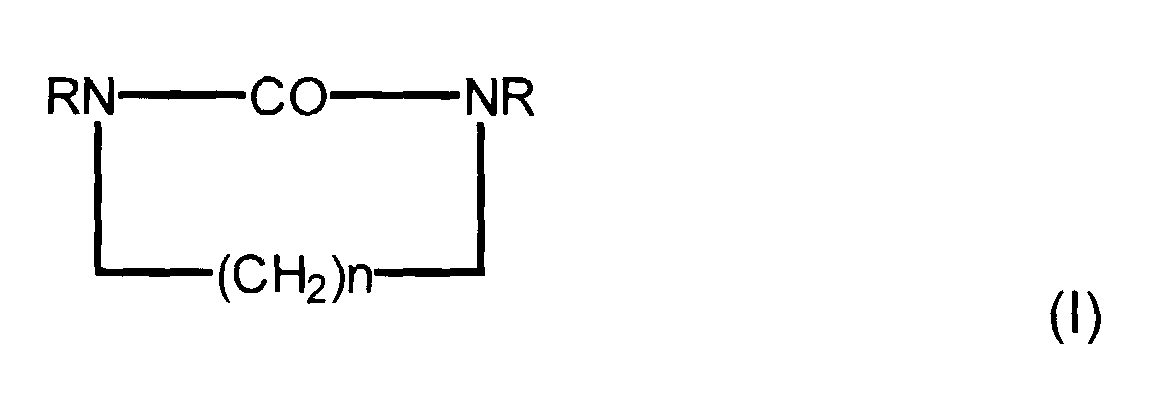
die Harnstoff-Verbindung ein Tetraalkylharnstoff ist, ausgewählt aus der Gruppe Tetramethylharnstoff, Tetraethylharnstoff, Tetrabutylharnstoff oder eine cyclische Struktur gemäss der allgemeinen Formel I hat,in welcher R ein Alkylrest, insbesondere ein Methylrest und n = 2 und 3 ist.
- Verfahren zur Herstellung eines Flüssigsystems nach einem der vorangehenden Ansprüche,
dadurch gekennzeichnet, dass
das Lactam (L) einen 5- bis 13-gliedrigen Ring aufweist. - Verfahren zur Herstellung eines Flüssigsystems nach einem der vorangehenden Ansprüche
dadurch gekennzeichnet, dass
das Lactam (L) einen 5- bis 7-gliedrigen Ring aufweist. - Verfahren zur Herstellung eines Flüssigsystems nach einem der vorangehenden Ansprüche
dadurch gekennzeichnet, dass
das Lactam (L) Caprolactam ist. - Verfahren zur Herstellung eines Flüssigsystems nach einem der vorangehenden Ansprüche
dadurch gekennzeichnet, dass
das Kation der Base (B) ein Alkali-, Erdalkali- oder Tetraalkylammonium-Kation ist. - Verfahren zur Herstellung eines Flüssigsystems nach einem der vorangehenden Ansprüche
dadurch gekennzeichnet, dass
die Base (B) ein Alkoholat, ein Amid, ein Hydrid, ein Alkylanion oder eine Grignardverbindung ist. - Verfahren zur Herstellung eines Flüssigsystems nach einem der vorangehenden Ansprüche
dadurch gekennzeichnet, dass
die Base (B) ein Alkali- oder Erdalkaliethylat oder ein Alkali- oder Erdalkalimethylat ist. - Verfahren zur Herstellung eines Flüssigsystems nach einem der vorangehenden Ansprüche
dadurch gekennzeichnet, dass
die Zugabe der Base (B) als Lösung, Suspension oder in Form eines feinteiligen Feststoffes erfolgt. - Verfahren zur Herstellung eines Flüssigsystems nach einem der vorangehenden Ansprüche
dadurch gekennzeichnet, dass
der Aktivator (A) mindestens eine Verbindung, ausgewählt aus der Gruppe Carbodiimid, Polycarbodiimid, Monoisocyanat und Diisocyanat ist. - Verfahren zur Herstellung eines Flüssigsystems nach einem der vorangehenden Ansprüche
dadurch gekennzeichnet, dass
das Mono- oder Diisocyanat eine aliphatische, cycloaliphatische, aliphatisch-aromatische oder aromatische Grundstruktur hat. - Verfahren zur Herstellung eines Flüssigsystems nach einem der vorangehenden Ansprüche
dadurch gekennzeichnet, dass
die Grundstruktur des Isocyanates die des Toluol, Isophoron, Xylol, Diphenylmethan, Hexan oder Cyclohexan ist. - Verfahren zur Herstellung eines Flüssigsystems nach einem der vorangehenden Ansprüche
dadurch gekennzeichnet, dass
die Monoisocyanate und Diisocyanate verkappt sind mit Verbindungen, ausgewählt aus der Gruppe Lactam und Hydroxyfettalkyloxazolin. - Verfahren zur Herstellung eines Flüssigsystems nach einem der vorangehenden Ansprüche
dadurch gekennzeichnet, dass
das Carbodiimid ausgewählt ist aus der Gruppe N,N'-Dicyclohexylcarbodiimid, N,N'-Diisopropylcarbodiimid, N,N'-Di-(o-toluyl)carbodiimid, 2,2',6,6'-Tertraisopropyldiphenyl-carbodiimid, und Poly-(2,2'-diisopropyl)-p-phenylencarbodiimid. - Verfahren zur Herstellung eines Flüssigsystems nach einem der vorangehenden Ansprüche
dadurch gekennzeichnet, dass
pro Mol Lactamat (L) 0,4 bis 1 Mol an Aktivator (A) zugefügt werden. - Verfahren zur Herstellung eines Flüssigsystems nach einem der vorangehenden Ansprüche,
dadurch gekennzeichnet, dass
das Lactamat (L) und der Aktivator (A) im stöchiometrischen Verhältnis ihrer funktionellen Gruppen eingesetzt werden. - Verfahren zur Herstellung eines Flüssigsystems nach einem der vorangehenden Ansprüche
dadurch gekennzeichnet, dass
in einem beliebigen Verfahrensschritt anwendungs- oder eigenschaftsbedingte Additive, ausgewählt aus der Gruppe Entformungsmittel, Entschäumer, Stabilisatoren, Nukleierungsmittel, Tracer, optische Aufheller, Weichmacher, Schlagzähmittel und Farbstoffe, zugesetzt werden. - Verfahren zur Herstellung eines Flüssigsystems nach einem der vorangehenden Ansprüche
dadurch gekennzeichnet, dass
durch die Temperaturführung die einzelnen Reaktionsschritte bei Temperaturen zwischen 70 und 130°C ablaufen. - Verfahren zur Herstellung eines Flüssigsystems nach einem der vorangehenden Ansprüche
dadurch gekennzeichnet, dass
das Solvatisierungsmittel (S) einen Siedepunkt im Bereich von 80 bis 330°C hat. - Verfahren zur Herstellung eines Flüssigsystems nach Anspruch 23
dadurch gekennzeichnet, dass
das Solvatisierungsmittel (S) einen Siedepunkt im Bereich von 80 bis 160°C hat. - Verfahren zur Herstellung eines Flüssigsystems nach Anspruch 23,
dadurch gekennzeichnet, dass
das Solvatisierungsmittel (S) einen Siedepunkt von mindestens 200°C hat. - Verfahren zur Herstellung eines Flüssigsystems nach einem der Ansprüche 1 bis 22
dadurch gekennzeichnet, dass
das Solvatisierungsmittel (S) ein Gemisch ist aus mindestens einer hochsiedenden und mindestens einer tiefsiedenden Komponente. - Verfahren zur Herstellung eines Flüssigsystems nach einem der vorangehenden Ansprüche
dadurch gekennzeichnet, dass
die Base (B) und/oder des Aktivators (A) im Solvatisierungsmittel (S) gelöst sind. - Verwendung des Flüssigsystems nach einem der Ansprüche 1 bis 27,
zur Auslösung der Polymerisation von Lactamen in einem kontinuierlichen oder diskontinuierlichen Verfahren. - Verwendung des Flüssigsystems nach Anspruch 28
dadurch gekennzeichnet, dass
der Lactamschmelze 0,5 bis 15 Gew.% des Flüssigsystems zugesetzt werden. - Verwendung des Flüssigsystems nach einem der Ansprüche 28 oder 29,
dadurch gekennzeichnet, dass
das Flüssigsystem einer Schmelze von Lactam-6, Lactam-12 oder ihrem Gemisch zugesetzt wird. - Verwendung des Flüssigsystems gemäss einem der Ansprüche 28 bis 30,
zur Herstellung von Gebrauchsgegenständen aus Polylactam in einem diskontinierlichen oder kontinuierlichen Prozess der Art Monomerguss, Extrusion, Spritzguss, Rotationsguss, Resintransfermolding, Pultrusion, wobei das Flüssigsystem jeweils der Lactamschmelze zugefügt ist.
Applications Claiming Priority (2)
| Application Number | Priority Date | Filing Date | Title |
|---|---|---|---|
| DE19715679A DE19715679C2 (de) | 1997-04-15 | 1997-04-15 | Verfahren zur Herstellung eines katalytisch wirkenden Flüssigsystems zur Auslösung der anionischen Lactam-Polymerisation |
| DE19715679 | 1997-04-15 |
Publications (2)
| Publication Number | Publication Date |
|---|---|
| EP0872508A1 true EP0872508A1 (de) | 1998-10-21 |
| EP0872508B1 EP0872508B1 (de) | 2000-08-16 |
Family
ID=7826562
Family Applications (1)
| Application Number | Title | Priority Date | Filing Date |
|---|---|---|---|
| EP98105939A Expired - Lifetime EP0872508B1 (de) | 1997-04-15 | 1998-04-01 | Verfahren zur Herstellung eines lagerstabilen Flüssigsystems zur Durchführung der anionischen Lactam-Polymerisation |
Country Status (13)
| Country | Link |
|---|---|
| US (1) | US6013758A (de) |
| EP (1) | EP0872508B1 (de) |
| JP (1) | JPH10292041A (de) |
| KR (1) | KR19980081390A (de) |
| CN (1) | CN1104455C (de) |
| AR (1) | AR012408A1 (de) |
| AU (1) | AU724986B2 (de) |
| BR (1) | BR9801063A (de) |
| CA (1) | CA2231821A1 (de) |
| DE (2) | DE19715679C2 (de) |
| ES (1) | ES2151304T3 (de) |
| PL (1) | PL325808A1 (de) |
| TW (1) | TW565581B (de) |
Cited By (7)
| Publication number | Priority date | Publication date | Assignee | Title |
|---|---|---|---|---|
| WO2000058387A1 (fr) * | 1999-03-26 | 2000-10-05 | Atofina | Procede de polymerisation anionique de lactames |
| WO2001046292A1 (de) * | 1999-12-21 | 2001-06-28 | Ems-Chemie Ag | Flüssiginitiator zur beschleunigten durchführung der anionischen lactampolymerisation, verfahren zu dessen herstellung und verwendung |
| WO2001046293A1 (de) * | 1999-12-21 | 2001-06-28 | Ems-Chemie Ag | Flüssiginitiator zur beschleunigten durchführung der anionischen lactampolymerisation, verfahren zu dessen herstellung und verwendung |
| EP1191050A1 (de) * | 2000-09-22 | 2002-03-27 | Atofina | Anionisches Polymerisationsverfahren von Lactamen |
| EP2338665A1 (de) | 2009-12-22 | 2011-06-29 | Fundacion Inasmet | Verfahren und Vorrichtung zur Polymerisation von Lactamen in Formen |
| WO2012045806A1 (de) * | 2010-10-07 | 2012-04-12 | Basf Se | Verfahren zur herstellung von monomer-zusammensetzungen und deren verwendung zur herstellung eines polyamid-formteils |
| US10538624B2 (en) | 2010-10-07 | 2020-01-21 | Basf Se | Process for producing monomer compositions and use of these for producing a polyamide molding |
Families Citing this family (19)
| Publication number | Priority date | Publication date | Assignee | Title |
|---|---|---|---|---|
| DE19715679C2 (de) * | 1997-04-15 | 1999-06-02 | Inventa Ag | Verfahren zur Herstellung eines katalytisch wirkenden Flüssigsystems zur Auslösung der anionischen Lactam-Polymerisation |
| DE10129049A1 (de) * | 2001-06-15 | 2003-06-26 | Ems Chemie Ag | Flüssigkatalysator |
| US20050214465A1 (en) * | 2001-12-20 | 2005-09-29 | Peter Maskus | Method for producing composite materials using a thermoplastic matrix |
| US20030203811A1 (en) * | 2002-04-25 | 2003-10-30 | Putzig Donald Edward | Stable aqueous solutions comprising titanium and zinc and process therewith |
| DE10341811B4 (de) | 2003-09-10 | 2006-09-28 | Ems-Chemie Ag | Katalysatorlösung zur Durchführung der anionischen Lactampolymerisation, Verfahren zu deren Herstellung und Polyamidformmasse |
| AU2006282942B2 (en) * | 2005-08-26 | 2012-07-26 | Wisconsin Alumni Research Foundation | Poly-beta-peptides from functionalized beta-lactam monomers and antibacterial compositions containing same |
| JP5065699B2 (ja) * | 2007-02-08 | 2012-11-07 | ガンツ化成株式会社 | 球状ポリアミド粒子の製造方法 |
| DE102008000259A1 (de) * | 2008-02-08 | 2009-08-13 | Rhein Chemie Rheinau Gmbh | Verfahren zur Herstellung von Lactamaten durch Dünnschichtverdampfung |
| DE102008000352A1 (de) * | 2008-02-20 | 2009-08-27 | Rhein Chemie Rheinau Gmbh | Gusspolyamid-Herstellung unter Verwendung spezieller Aktivatoren |
| JP6328553B2 (ja) * | 2011-07-05 | 2018-05-23 | ビーエーエスエフ ソシエタス・ヨーロピアBasf Se | ラクタムと活性剤と触媒とを含有する固形粒子、該固形粒子を製造する方法、及び該固形粒子の使用方法 |
| CN103827171B (zh) * | 2011-09-08 | 2016-10-19 | 莱茵化学莱瑙有限公司 | 用于生产浇注的聚酰胺的新型组合物 |
| CN103834005A (zh) * | 2012-11-27 | 2014-06-04 | 上海特种电线电缆(集团)启东有限公司 | 一种高性能塑料电缆桥架的制备方法 |
| CN105026462B (zh) | 2013-03-08 | 2018-01-02 | 长濑化成株式会社 | 聚酰胺6的制造方法 |
| CN103487423B (zh) * | 2013-10-14 | 2015-10-21 | 无锡艾科瑞思产品设计与研究有限公司 | 基于原位喷涂法的食品中塑化剂是否超标的快速检测方法 |
| DE202015106663U1 (de) | 2015-12-07 | 2017-03-08 | Heimbach Gmbh & Co. Kg | Band für den Einsatz in Maschinen |
| KR102510135B1 (ko) * | 2018-08-22 | 2023-03-14 | 국립대학법인 홋가이도 다이가쿠 | 질화 처리액, 질화 처리 금속 산화물의 제조 방법 및 질화 처리 산화인듐막 |
| CN113802217B (zh) * | 2021-09-18 | 2023-08-15 | 株洲时代华先材料科技有限公司 | 一种间位芳纶纤维废料的回收方法及回收料 |
| CN117603022A (zh) * | 2023-11-02 | 2024-02-27 | 山东默锐科技有限公司 | 芳甲醚绿色化学高收率合成方法 |
| CN117736074A (zh) * | 2023-11-22 | 2024-03-22 | 山东默锐科技有限公司 | 芳甲醚高收率合成工艺 |
Citations (11)
| Publication number | Priority date | Publication date | Assignee | Title |
|---|---|---|---|---|
| DE1495132A1 (de) * | 1963-07-17 | 1969-01-30 | Basf Ag | Alkalilactamatloesungen fuer Polymerisationszwecke |
| DE1495848A1 (de) * | 1964-12-10 | 1969-05-08 | Bayer Ag | Verfahren zur Herstellung von Polyamiden |
| DE1520605A1 (de) * | 1963-04-23 | 1970-01-22 | Polymer Corp | Verfahren zur Herstellung von Polylactamgegenstaenden |
| US3575938A (en) * | 1969-01-08 | 1971-04-20 | Monsanto Co | Anionic lactam catalyst system |
| DE2230732A1 (de) * | 1972-06-23 | 1974-01-10 | Bayer Ag | Lactampolymerisation |
| EP0438762A1 (de) * | 1990-01-26 | 1991-07-31 | BASF Aktiengesellschaft | Katalysatorlösung für die anionische Polymerisation von Lactamen und deren Verwendung für die anionische Polymerisation von Caprolactam |
| EP0786482A2 (de) * | 1996-01-25 | 1997-07-30 | Ems-Inventa Ag | Flüssigsystem zur Durchführung der anionischen Lactampolymerisation |
| EP0786486A2 (de) * | 1996-01-25 | 1997-07-30 | Ems-Inventa Ag | Flüssiges Mehrkomponentensystem zur Durchführung der anionischen Lactampolymerisation |
| EP0786485A2 (de) * | 1996-01-25 | 1997-07-30 | Ems-Inventa Ag | Kontinuierliches Verfahren zur aktivierten anionischen Lactampolymerisation |
| EP0786484A2 (de) * | 1996-01-25 | 1997-07-30 | Ems-Inventa Ag | Flüssiges System zur Durchführung der anionischen Lactampolymerisation |
| EP0786483A2 (de) * | 1996-01-25 | 1997-07-30 | Ems-Inventa Ag | Verfahren zur aktivierten anionischen Lactampolymerisation |
Family Cites Families (5)
| Publication number | Priority date | Publication date | Assignee | Title |
|---|---|---|---|---|
| US3017391A (en) * | 1956-12-13 | 1962-01-16 | Monsanto Chemicals | Preparation of polycaprolactam using n-acyl activators |
| NL8401843A (nl) * | 1984-06-09 | 1986-01-02 | Stamicarbon | Werkwijze voor het bereiden van een polyamide. |
| IT1213482B (it) * | 1986-08-14 | 1989-12-20 | Canalini Giovanni | Processo perfezionato per la polimerizzazione anionica del caprolattame e sua copolimerizzazione con altri lattami. |
| JP3347545B2 (ja) * | 1995-09-13 | 2002-11-20 | 三菱化学株式会社 | ランダム共重合ポリアミド樹脂及びその製造法 |
| DE19715679C2 (de) * | 1997-04-15 | 1999-06-02 | Inventa Ag | Verfahren zur Herstellung eines katalytisch wirkenden Flüssigsystems zur Auslösung der anionischen Lactam-Polymerisation |
-
1997
- 1997-04-15 DE DE19715679A patent/DE19715679C2/de not_active Expired - Fee Related
-
1998
- 1998-04-01 DE DE59800236T patent/DE59800236D1/de not_active Expired - Fee Related
- 1998-04-01 ES ES98105939T patent/ES2151304T3/es not_active Expired - Lifetime
- 1998-04-01 EP EP98105939A patent/EP0872508B1/de not_active Expired - Lifetime
- 1998-04-02 US US09/053,734 patent/US6013758A/en not_active Expired - Fee Related
- 1998-04-03 TW TW087105059A patent/TW565581B/zh not_active IP Right Cessation
- 1998-04-07 AU AU60680/98A patent/AU724986B2/en not_active Ceased
- 1998-04-14 CA CA002231821A patent/CA2231821A1/en not_active Abandoned
- 1998-04-14 AR ARP980101693A patent/AR012408A1/es unknown
- 1998-04-14 KR KR1019980013241A patent/KR19980081390A/ko not_active Abandoned
- 1998-04-15 BR BR9801063-8A patent/BR9801063A/pt not_active Application Discontinuation
- 1998-04-15 PL PL98325808A patent/PL325808A1/xx unknown
- 1998-04-15 CN CN98101292A patent/CN1104455C/zh not_active Expired - Fee Related
- 1998-04-15 JP JP10104409A patent/JPH10292041A/ja active Pending
Patent Citations (11)
| Publication number | Priority date | Publication date | Assignee | Title |
|---|---|---|---|---|
| DE1520605A1 (de) * | 1963-04-23 | 1970-01-22 | Polymer Corp | Verfahren zur Herstellung von Polylactamgegenstaenden |
| DE1495132A1 (de) * | 1963-07-17 | 1969-01-30 | Basf Ag | Alkalilactamatloesungen fuer Polymerisationszwecke |
| DE1495848A1 (de) * | 1964-12-10 | 1969-05-08 | Bayer Ag | Verfahren zur Herstellung von Polyamiden |
| US3575938A (en) * | 1969-01-08 | 1971-04-20 | Monsanto Co | Anionic lactam catalyst system |
| DE2230732A1 (de) * | 1972-06-23 | 1974-01-10 | Bayer Ag | Lactampolymerisation |
| EP0438762A1 (de) * | 1990-01-26 | 1991-07-31 | BASF Aktiengesellschaft | Katalysatorlösung für die anionische Polymerisation von Lactamen und deren Verwendung für die anionische Polymerisation von Caprolactam |
| EP0786482A2 (de) * | 1996-01-25 | 1997-07-30 | Ems-Inventa Ag | Flüssigsystem zur Durchführung der anionischen Lactampolymerisation |
| EP0786486A2 (de) * | 1996-01-25 | 1997-07-30 | Ems-Inventa Ag | Flüssiges Mehrkomponentensystem zur Durchführung der anionischen Lactampolymerisation |
| EP0786485A2 (de) * | 1996-01-25 | 1997-07-30 | Ems-Inventa Ag | Kontinuierliches Verfahren zur aktivierten anionischen Lactampolymerisation |
| EP0786484A2 (de) * | 1996-01-25 | 1997-07-30 | Ems-Inventa Ag | Flüssiges System zur Durchführung der anionischen Lactampolymerisation |
| EP0786483A2 (de) * | 1996-01-25 | 1997-07-30 | Ems-Inventa Ag | Verfahren zur aktivierten anionischen Lactampolymerisation |
Non-Patent Citations (1)
| Title |
|---|
| ULLMANN'S ENCYCLOPEDIA OF INDUSTRIAL CHEMISTRY, vol. A27, 1996, pages 356, XP002067281 * |
Cited By (13)
| Publication number | Priority date | Publication date | Assignee | Title |
|---|---|---|---|---|
| WO2000058387A1 (fr) * | 1999-03-26 | 2000-10-05 | Atofina | Procede de polymerisation anionique de lactames |
| US6713596B1 (en) | 1999-03-26 | 2004-03-30 | Atofina | Method for anionic polymerization of lactames |
| US6846901B1 (en) | 1999-12-21 | 2005-01-25 | Ems-Chemie Ag | Liquid initiator for accelerating the progress of the anionic lactam polymerization, method for producing the same and the use thereof |
| WO2001046292A1 (de) * | 1999-12-21 | 2001-06-28 | Ems-Chemie Ag | Flüssiginitiator zur beschleunigten durchführung der anionischen lactampolymerisation, verfahren zu dessen herstellung und verwendung |
| WO2001046293A1 (de) * | 1999-12-21 | 2001-06-28 | Ems-Chemie Ag | Flüssiginitiator zur beschleunigten durchführung der anionischen lactampolymerisation, verfahren zu dessen herstellung und verwendung |
| US6881819B2 (en) | 1999-12-21 | 2005-04-19 | Ems-Chemie Ag | Liquid initiator for carrying out anionic lactam polymerization in an accelerated manner, method for the production thereof and its use |
| EP1191050A1 (de) * | 2000-09-22 | 2002-03-27 | Atofina | Anionisches Polymerisationsverfahren von Lactamen |
| FR2814466A1 (fr) * | 2000-09-22 | 2002-03-29 | Atofina | Procede de polymerisation anionique de lactames |
| EP2338665A1 (de) | 2009-12-22 | 2011-06-29 | Fundacion Inasmet | Verfahren und Vorrichtung zur Polymerisation von Lactamen in Formen |
| US9290622B2 (en) | 2009-12-22 | 2016-03-22 | Fundacion Inasmet | Process and device for polymerizing lactams molds |
| WO2012045806A1 (de) * | 2010-10-07 | 2012-04-12 | Basf Se | Verfahren zur herstellung von monomer-zusammensetzungen und deren verwendung zur herstellung eines polyamid-formteils |
| EP2789641A1 (de) * | 2010-10-07 | 2014-10-15 | Basf Se | Verfahren zur Herstellung von Monomer-Zusammensetzungen und deren Verwendung zur Herstellung eines Polyamid-Formteils |
| US10538624B2 (en) | 2010-10-07 | 2020-01-21 | Basf Se | Process for producing monomer compositions and use of these for producing a polyamide molding |
Also Published As
| Publication number | Publication date |
|---|---|
| TW565581B (en) | 2003-12-11 |
| AU6068098A (en) | 1998-10-22 |
| KR19980081390A (ko) | 1998-11-25 |
| AR012408A1 (es) | 2000-10-18 |
| US6013758A (en) | 2000-01-11 |
| JPH10292041A (ja) | 1998-11-04 |
| AU724986B2 (en) | 2000-10-05 |
| ES2151304T3 (es) | 2000-12-16 |
| BR9801063A (pt) | 1999-12-14 |
| CN1196361A (zh) | 1998-10-21 |
| DE19715679C2 (de) | 1999-06-02 |
| EP0872508B1 (de) | 2000-08-16 |
| PL325808A1 (en) | 1998-10-26 |
| DE19715679A1 (de) | 1998-10-22 |
| DE59800236D1 (de) | 2000-09-21 |
| CN1104455C (zh) | 2003-04-02 |
| CA2231821A1 (en) | 1998-10-15 |
Similar Documents
| Publication | Publication Date | Title |
|---|---|---|
| EP0872508B1 (de) | Verfahren zur Herstellung eines lagerstabilen Flüssigsystems zur Durchführung der anionischen Lactam-Polymerisation | |
| EP0786484B1 (de) | Flüssiges System für die anionische Lactampolymerisation | |
| EP0786485B1 (de) | Kontinuierliches Verfahren für die aktivierte anionische Lactampolymerisation | |
| EP0786483B1 (de) | Verfahren zur aktivierten anionischen Lactampolymerisation | |
| DE19602683C1 (de) | Flüssigsystem zur Durchführung der anionischen Lactampolymerisation | |
| EP0288893B1 (de) | Alpha-Amino-Epsilon-Caprolactam-modifizierte Polyamide aus Dicarbonsäuren/Diaminen | |
| EP0786486B1 (de) | Flüssiges Mehrkomponentensystem für die anionische Lactampolymerisation | |
| EP1514887B1 (de) | Katalysatorlösung zur Durchführung der anionischen Lactampolymerisation, Verfahren zur deren Herstellung und Polyamidformmasse | |
| EP0288894B1 (de) | Alpha-amino-epsilon-caprolactam modifizierte Polyamide | |
| DE19961819C2 (de) | Flüssiginitiator zur beschleunigten Durchführung der anionischen Lactampolymerisation, Verfahren zu dessen Herstellung und Verwendung | |
| DE19961818C2 (de) | Flüssiginitiator zur beschleunigten Durchführung der anionischen Lactampolymerisation, Verfahren zu dessen Herstellung und Verwendung | |
| WO2018041642A1 (de) | Verfahren zur herstellung eines polyamids mit kaliumlactamat | |
| EP1266925B1 (de) | Flüssigkatalysator | |
| EP2646494B1 (de) | Verfahren zur quervernetzung von polyamiden | |
| DE1745238A1 (de) | Polyamid bildende,lagerfaehige Gemische aus Lactamen und Katalysatoren | |
| EP1687356B1 (de) | Verfahren zur kontinuierlichen herstellung von polyamiden mit verbesserten fliesseigenschaften | |
| DE19603304C2 (de) | Verwendung von Oxazolin-Verbindungen als Aktivator zur Auslösung der anionischen Lactampolymerisation | |
| DE1942046A1 (de) | Carbonsaeureamide,Verfahren zu ihrer Herstellung und ihre Verwendung zur Polymerisation von Lactamen | |
| EP3670575A1 (de) | Verfahren zur herstellung eines katalysatorsystems, katalysatorsystem, und dessen verwendung für die herstellung von gusspolyamid |
Legal Events
| Date | Code | Title | Description |
|---|---|---|---|
| PUAI | Public reference made under article 153(3) epc to a published international application that has entered the european phase |
Free format text: ORIGINAL CODE: 0009012 |
|
| AK | Designated contracting states |
Kind code of ref document: A1 Designated state(s): CH DE ES FR GB IT LI NL |
|
| AX | Request for extension of the european patent |
Free format text: AL;LT;LV;MK;RO;SI |
|
| 17P | Request for examination filed |
Effective date: 19990209 |
|
| 17Q | First examination report despatched |
Effective date: 19990415 |
|
| AKX | Designation fees paid |
Free format text: CH DE ES FR GB IT LI NL |
|
| GRAG | Despatch of communication of intention to grant |
Free format text: ORIGINAL CODE: EPIDOS AGRA |
|
| GRAG | Despatch of communication of intention to grant |
Free format text: ORIGINAL CODE: EPIDOS AGRA |
|
| GRAH | Despatch of communication of intention to grant a patent |
Free format text: ORIGINAL CODE: EPIDOS IGRA |
|
| GRAH | Despatch of communication of intention to grant a patent |
Free format text: ORIGINAL CODE: EPIDOS IGRA |
|
| GRAA | (expected) grant |
Free format text: ORIGINAL CODE: 0009210 |
|
| AK | Designated contracting states |
Kind code of ref document: B1 Designated state(s): CH DE ES FR GB IT LI NL |
|
| REG | Reference to a national code |
Ref country code: CH Ref legal event code: EP |
|
| REG | Reference to a national code |
Ref country code: CH Ref legal event code: NV Representative=s name: OK PAT AG |
|
| REF | Corresponds to: |
Ref document number: 59800236 Country of ref document: DE Date of ref document: 20000921 |
|
| ITF | It: translation for a ep patent filed | ||
| GBT | Gb: translation of ep patent filed (gb section 77(6)(a)/1977) |
Effective date: 20001030 |
|
| ET | Fr: translation filed | ||
| REG | Reference to a national code |
Ref country code: ES Ref legal event code: FG2A Ref document number: 2151304 Country of ref document: ES Kind code of ref document: T3 |
|
| PLBE | No opposition filed within time limit |
Free format text: ORIGINAL CODE: 0009261 |
|
| STAA | Information on the status of an ep patent application or granted ep patent |
Free format text: STATUS: NO OPPOSITION FILED WITHIN TIME LIMIT |
|
| 26N | No opposition filed | ||
| REG | Reference to a national code |
Ref country code: GB Ref legal event code: IF02 |
|
| PGFP | Annual fee paid to national office [announced via postgrant information from national office to epo] |
Ref country code: NL Payment date: 20060413 Year of fee payment: 9 |
|
| PGFP | Annual fee paid to national office [announced via postgrant information from national office to epo] |
Ref country code: ES Payment date: 20060427 Year of fee payment: 9 |
|
| PGFP | Annual fee paid to national office [announced via postgrant information from national office to epo] |
Ref country code: CH Payment date: 20070402 Year of fee payment: 10 |
|
| PGFP | Annual fee paid to national office [announced via postgrant information from national office to epo] |
Ref country code: DE Payment date: 20070423 Year of fee payment: 10 |
|
| REG | Reference to a national code |
Ref country code: CH Ref legal event code: PUE Owner name: EMS-PATENT AG Free format text: EMS-INVENTA AG#SELNAUSTRASSE 16#8002 ZUERICH (CH) -TRANSFER TO- EMS-PATENT AG#REICHENAUERSTRASSE#7013 DOMAT/EMS (CH) |
|
| REG | Reference to a national code |
Ref country code: GB Ref legal event code: 732E |
|
| REG | Reference to a national code |
Ref country code: FR Ref legal event code: TP Ref country code: FR Ref legal event code: CD Ref country code: FR Ref legal event code: CA |
|
| PGFP | Annual fee paid to national office [announced via postgrant information from national office to epo] |
Ref country code: GB Payment date: 20070426 Year of fee payment: 10 |
|
| NLV4 | Nl: lapsed or anulled due to non-payment of the annual fee |
Effective date: 20071101 |
|
| PGFP | Annual fee paid to national office [announced via postgrant information from national office to epo] |
Ref country code: IT Payment date: 20070614 Year of fee payment: 10 |
|
| PG25 | Lapsed in a contracting state [announced via postgrant information from national office to epo] |
Ref country code: NL Free format text: LAPSE BECAUSE OF NON-PAYMENT OF DUE FEES Effective date: 20071101 |
|
| PGFP | Annual fee paid to national office [announced via postgrant information from national office to epo] |
Ref country code: FR Payment date: 20070416 Year of fee payment: 10 |
|
| REG | Reference to a national code |
Ref country code: ES Ref legal event code: FD2A Effective date: 20070402 |
|
| PG25 | Lapsed in a contracting state [announced via postgrant information from national office to epo] |
Ref country code: ES Free format text: LAPSE BECAUSE OF NON-PAYMENT OF DUE FEES Effective date: 20070402 |
|
| REG | Reference to a national code |
Ref country code: CH Ref legal event code: PL |
|
| GBPC | Gb: european patent ceased through non-payment of renewal fee |
Effective date: 20080401 |
|
| PG25 | Lapsed in a contracting state [announced via postgrant information from national office to epo] |
Ref country code: LI Free format text: LAPSE BECAUSE OF NON-PAYMENT OF DUE FEES Effective date: 20080430 Ref country code: DE Free format text: LAPSE BECAUSE OF NON-PAYMENT OF DUE FEES Effective date: 20081101 Ref country code: CH Free format text: LAPSE BECAUSE OF NON-PAYMENT OF DUE FEES Effective date: 20080430 |
|
| REG | Reference to a national code |
Ref country code: FR Ref legal event code: ST Effective date: 20081231 |
|
| PG25 | Lapsed in a contracting state [announced via postgrant information from national office to epo] |
Ref country code: FR Free format text: LAPSE BECAUSE OF NON-PAYMENT OF DUE FEES Effective date: 20080430 |
|
| PG25 | Lapsed in a contracting state [announced via postgrant information from national office to epo] |
Ref country code: GB Free format text: LAPSE BECAUSE OF NON-PAYMENT OF DUE FEES Effective date: 20080401 |
|
| PG25 | Lapsed in a contracting state [announced via postgrant information from national office to epo] |
Ref country code: IT Free format text: LAPSE BECAUSE OF NON-PAYMENT OF DUE FEES Effective date: 20080401 |