EP0858071A2 - Dynamische Spurfolgeregelung in einem optischen Auzeichnungssystem durch beugungsbasierte Detektion der Markenerzeugung - Google Patents
Dynamische Spurfolgeregelung in einem optischen Auzeichnungssystem durch beugungsbasierte Detektion der Markenerzeugung Download PDFInfo
- Publication number
- EP0858071A2 EP0858071A2 EP98200004A EP98200004A EP0858071A2 EP 0858071 A2 EP0858071 A2 EP 0858071A2 EP 98200004 A EP98200004 A EP 98200004A EP 98200004 A EP98200004 A EP 98200004A EP 0858071 A2 EP0858071 A2 EP 0858071A2
- Authority
- EP
- European Patent Office
- Prior art keywords
- signal
- diffraction
- tracking
- mfe
- medium
- Prior art date
- Legal status (The legal status is an assumption and is not a legal conclusion. Google has not performed a legal analysis and makes no representation as to the accuracy of the status listed.)
- Withdrawn
Links
Images



Classifications
-
- G—PHYSICS
- G11—INFORMATION STORAGE
- G11B—INFORMATION STORAGE BASED ON RELATIVE MOVEMENT BETWEEN RECORD CARRIER AND TRANSDUCER
- G11B7/00—Recording or reproducing by optical means, e.g. recording using a thermal beam of optical radiation by modifying optical properties or the physical structure, reproducing using an optical beam at lower power by sensing optical properties; Record carriers therefor
- G11B7/08—Disposition or mounting of heads or light sources relatively to record carriers
- G11B7/09—Disposition or mounting of heads or light sources relatively to record carriers with provision for moving the light beam or focus plane for the purpose of maintaining alignment of the light beam relative to the record carrier during transducing operation, e.g. to compensate for surface irregularities of the latter or for track following
- G11B7/0901—Disposition or mounting of heads or light sources relatively to record carriers with provision for moving the light beam or focus plane for the purpose of maintaining alignment of the light beam relative to the record carrier during transducing operation, e.g. to compensate for surface irregularities of the latter or for track following for track following only
- G11B7/0904—Dithered tracking systems
Definitions
- the present invention relates to optical data recording. More particularly, the present invention relates to utilizing a signal generated during recording and indicative of mark formation effectiveness to control the position of a recording spot relative to a tracking structure on a recording medium.
- an optical source typically a laser or laser diode
- the beam is applied to an optical medium to record data thereon as optically-detectable marks.
- certain types of media such as compact disk recordable (CD-R) media, include a preformed spiral tracking structure typically referred to as a groove or pregroove.
- the spiral groove may be "wobbled" in a radial direction of the disk about an average groove centerline in order to provide rotational velocity and beam position information in a well-known manner.
- the dimensions and shape of the groove can vary depending upon the medium, but an exemplary groove width is on the order of 0.4 micron in the radial direction, with adjacent grooves in the spiral separated by about 1.6 microns in the radial direction.
- the groove corresponds to a data track on which marks are recorded.
- the quality of recorded data in many optical recording systems is generally very sensitive to the cross-track position of the recording spot on the medium.
- data quality rapidly deteriorates when the recording spot deviates from the centerline of the disk groove.
- a commonly-used technique for maintaining a recording spot on-track is referred to as push-pull tracking. This technique involves measuring an interference pattern caused by the interaction of the recording spot with the groove or other suitable tracking structure on the recording medium to generate a push-pull tracking signal.
- a tracking servo adjusts the position of the recording spot to keep the push-pull signal at a predetermined optimum value generally referred to as a "tracking offset" or an on-track value.
- the tracking offset is intended to compensate for static errors such as detector misalignment and optical axis tilt.
- Prior art techniques typically determine the tracking offset during a calibration period before data recording. One common approach is to make a series of trial recordings.
- MFE mark formation effectiveness
- This technique recognizes and makes use of the fact that certain characteristics of the reflected write signal vary with cross-track position of the recording spot, thereby providing a number of advantages over other techniques.
- the tracking offset can be determined in a single recording pass, as compared to separate record and read passes required by two-pass techniques.
- the resulting tracking offset is optimized for recording rather than for reading.
- "on-track” is defined as the cross-track position with the highest MFE signal.
- the mark formation effectiveness signals described in US-A-5,440,534 are hereafter termed "density-based” methods. These methods are based on a single reflected write signal which is generated from light received in substantially all of the return aperture.
- the above-referenced commonly-assigned U.S. patents describe techniques for measuring mark formation effectiveness that are fundamentally different from prior art “density-based” methods. These new techniques, hereafter referred to as “diffraction-based” methods, are based on reflected write signals generated from light received in different zones of the return aperture. A mark formation effectiveness signal is derived by comparing these reflected write signals. Diffraction-based methods can also be combined with the prior art density-based techniques for improved measurement signal-to-noise and more accurate prediction of the resulting written mark quality.
- the push-pull tracking method described above is referred to as a "single spot" technique in that the spot that records and reads data also generates the tracking signal. This reduces system cost and complexity when compared with multi-spot tracking techniques.
- push-pull tracking also suffers from a number of problems.
- the tracking offset can vary with conditions such as media tilt, lens decenter, optical spot aberrations, and groove asymmetry. These conditions can change from disk to disk and from point to point on a given disk. The tracking offset determined during a calibration period may therefore be unable to keep the recording beam sufficiently on-track in the presence of the changing conditions that can arise during actual data recording.
- the push-pull technique is used as an example, it should be understood that other tracking methods, both “single spot” and “multiple spot” are vulnerable to tracking errors from these effects as well.
- US-A-4,118,735 (Wilkinson) and US-A-4,322,837 (Mickelson et. al.) describe a dynamic tracking technique in which a read-back beam is continuously moved back and forth or "dithered" in a cross-track direction.
- This repetitive cross-track motion is correlated with any resulting variation in the intensity of the light reflected by the medium.
- the read-back beam is considered to be "on-track”.
- This cross-track position corresponds to a minimum of the reflected light intensity for a "burn dark" medium (burn dark being defined as a medium where written marks are less reflective than unwritten lands).
- the relative phase (positive or negative) of the two signals is an indication of which side of "on-track" the read-back beam is located.
- US-A-Patent 5,434,834 (Shinoda et. al.) describes a similar method to keep a light beam on-track. It differs from US-A-4,118,735 and US-A-4,322,837 in that repetitive cross track motion is no longer achieved by dithering the illuminating beam. Rather, it is produced by the periodic side-to-side wobble of a pre-groove, such as found in recordable compact disk (CD-R) media. This relative cross-track motion between illuminating beam and recording medium is detected using well known methods such as push-pull techniques described above.
- a tracking signal is derived by correlating this cross-track motion with variations in the reflected light intensity. Also, as with US-A-4,118,735 and US-A-4,322,837, "on-track" is defined as a minimum in reflected light intensity.
- Mark formation effectiveness measurement is preferable to detecting reflected light intensity for a number of reasons.
- the reflected light intensity depends directly on the specific write pulse pattern being recorded.
- Such data dependent fluctuations reduce measurement signal-to-noise as compared with an MFE signal, which is a specific measured characteristic of reflected write pulses and is much less dependent on data pattern.
- the maximum MFE signal may not occur at the same cross-track position as the minimum reflected light intensity.
- the present invention generates a tracking error signal (TES) during actual data recording by correlating a diffraction-based mark formation effectiveness (MFE) signal with a position signal indicative of relative cross-track movement between a recording spot and a tracking structure on a recording medium.
- the TES is used by a tracking servo in an optical recording system to keep the recording spot on-track.
- the tracking servo may use the TES of the present invention either alone or in conjunction with a conventional tracking signal such as a push-pull signal.
- the diffraction-based MFE signal corresponds to a monitored characteristic of a reflected optical recording beam, and provides an indication of whether marks have been properly formed on the medium. Diffraction-based MFE techniques compare reflected write signals received in different zones of the return aperture.
- diffraction-based methods include techniques that are combinations of density-based and diffraction-based methods.
- the present invention is applicable to any optical recording medium in which a diffraction-based MFE signal generated during recording varies with the cross-track position of the recording spot.
- an apparatus for use in an optical recording system in which an incident beam records data on a medium in the form of marks.
- a diffraction-based MFE signal is generated by monitoring reflected write signals received in different zones of the return aperture and is indicative of a characteristic of the marks formed on the medium.
- a position signal is generated to provide an indication of a cross-track movement of the incident beam relative to a tracking structure such as a wobbled groove on an optical disk recording medium.
- Variations in the diffraction-based MFE and position signals are then correlated to provide a dynamic TES.
- the diffraction-based MFE and position signals are first band pass filtered and then correlated by, for example, using a multiplier circuit to multiply the two signals together.
- Another approach is to use the position signal to control application of the band-pass filtered diffraction-based MFE signal to particular inputs of a signal difference circuit.
- the position signal in accordance with the present invention can be generated using a number of different techniques.
- the position signal is generally indicative of relative cross-track motion between the incident beam recording spot and a desired on-track position which may correspond to, for example, a centerline of a tracking structure on the medium.
- the relative cross-track motion can be provided by, for example, moving the recording spot in a predetermined cross-track pattern using a drive signal applied to a tracking actuator.
- the position signal may correspond to the drive signal applied to move the actuator or to a detected push-pull signal indicative of the motion of the recording spot.
- relative cross-track motion of the tracking structure beneath the recording spot can be detected to provide a position signal.
- This type of relative cross-track motion may be provided, for example, by the wobbled groove tracking structure of a recordable compact disk (CD-R) medium.
- the present invention provides a dynamic TES using a diffraction-based MFE signal measured during actual data recording and a position signal corresponding to, for example, the time-varying AC component of a detected push-pull position signal. Offset errors of the prior art associated with the DC component of the push-pull signal are thereby avoided. This provides improved correction for static errors such as detector misalignment or optical axis tilt.
- the TES of the present invention adapts more accurately than prior art push-pull signals to changing conditions such as media tilt, lens decenter, optical spot aberrations, and groove asymmetry.
- the dynamic tracking of the present invention does not require generation of an offset value or set of offset values during a calibration period.
- the present invention is superior to prior art techniques which correlate changes in a cross-track position signal with changes in the intensity of light reflected by the recording medium.
- the present invention provides higher measurement signal-to-noise and a more accurate indication of optimum cross-track position.
- the diffraction-based MFE techniques of the current invention allow the dynamic tracking method to be applied to recording systems which have inadequate density-based MFE signals.
- FIG. 1 shows an optical recording system 10 in accordance with the invention.
- the recording system 10 includes an optical source 11 for generating an incident optical write signal.
- the optical source 11 may be, for example, a laser, laser diode or LED.
- the optical source 11 is intensity-modulated by a stream of recording data, such as digital audio, video or other information, suitably encoded to facilitate recording on the optical medium.
- a data source (not shown) supplies the encoded recording data, generally in the form of a stream of pulses, to optical source 11.
- An exemplary data encoding technique well-known in the art is the eight-to-fourteen bit modulation (EFM) code typically used in CD-R recording.
- the incident optical signal typically includes a series of incident write pulses, each corresponding to a portion of the recording data.
- the incident optical signal passes through beam shaping optics 12 and is reflected by a beam-directing surface of beam splitter 13 toward an optical recording medium 14.
- the invention is more broadly applicable to any recordable medium which includes an optically-detectable tracking structure.
- the term "wobbled groove” as used herein should therefore be understood to include any optically-detectable structures arranged on a surface of a medium and suitable for generating relative cross-track motion in accordance with the invention.
- the incident beam is applied to medium 14 via an objective lens 15 mounted on a focus actuator FA.
- Focus actuator FA is designed to move objective lens 15 in a direction perpendicular to the surface of medium 14 in order to change the focus of the recording spot on the medium.
- a tracking actuator TA is operative to move those parts of the system which are within or part of a housing 16, such as the objective lens 15, beam splitters 13, 18, and photodetector assemblies 19, 20, in response to a control signal from a servo control system 17.
- Tracking actuator TA thereby moves the incident recording beam laterally across medium 14 in order to maintain the beam in an on-track position with respect to the tracking structure of medium 14.
- the tracking function may be accomplished by moving only objective lens 15 in a lateral direction.
- Tracking and focus actuators TA and FA may include, for example, various well-known arrangements of coils and electro-magnets (not shown) controlled by servo control system 17 in a conventional manner.
- the servo control system 17 operates the tracking actuator in response to the dynamic tracking error signal (TES) of the present invention generated in a manner to be described in greater detail below.
- the servo control system 17 may also receive a conventional push-pull tracking signal directly from a position signal generator 25 as shown in FIG. 1. In such an embodiment, the tracking servo utilizes both the dynamic TES of the present invention and a conventional push-pull tracking signal.
- a return beam reflected and diffracted from the recording medium 14 is used for various functions such as tracking and focus detection and mark formation effectiveness (MFE) measurement.
- MFE tracking and focus detection and mark formation effectiveness
- the exemplary return beam path of Figure 1 shows one of many possible ways to accomplish these functions.
- the return beam passes through the lens 15 and the first beam splitter 13 and is applied to a second beam splitter 18.
- the return beam is separated by beam splitter 18 into two components.
- a first component is applied to a detector array 19 which includes, in this example four elements: D1, D2, D3, and D4.
- the detector elements D1, D2, D3, and D4 generate detected signals d1, d2, d3, and d4, respectively.
- Detector array 19 provides signals for tracking detection and MFE measurements.
- a second component of the return beam is directed to a focus photodetector assembly 20 via a collimating lens 22 and a limiting aperture 21.
- the focus photodetector assembly 20 is used to generate a focus error signal for controlling the
- the four detected signals d1, d2, d3, and d4 are applied to position signal generator 25 and mark formation effectiveness (MFE) signal generator 23.
- the position signal generator 25 receives the four detected signals d1, d2, d3, and d4 from detector array 19 and generates a conventional push-pull signal therefrom.
- Signal generator 25 will typically add detected signals d1 and d3 to form a signal representing light received in one side of the return aperture.
- detected signals d2 and d4 will be added to form a sum signal representing light received in the other side of the return aperture.
- the return aperture is thus effectively divided into two halves in the cross-track direction. The sum signals from each half of the aperture are then used to form a conventional push-pull signal by, for example, taking their difference.
- the position signal generator output may also be sent to an absolute-time-in-pregroove (ATIP) detection circuit (not shown).
- ADP absolute-time-in-pregroove
- Other alternative embodiments of the invention may utilize a position signal generator that does not receive detected signals dl and d2 and instead generates a signal suitable for driving a tracking actuator to thereby provide relative cross-track motion.
- the return aperture is effectively divided into two halves in the in-track direction.
- the MFE signal generator 23 in this embodiment will typically add detected signals d1 and d2 to form a signal representing light received in one half of the return aperture.
- detected signals d3 and d4 will be added to form a sum signal representing light received in the other half of the return aperture.
- the sum signals from the front and rear of the aperture are then used to form a diffraction-based MFE signal by, for example, taking their ratio. It should be noted that this is only one exemplary way of generating a diffraction-based MFE signal.
- the present invention utilizes a relative cross-track position signal and a diffraction-based MFE signal to provide dynamic tracking error detection and tracking position control in the optical recording system of FIG. 1.
- the cross-track position signal is generated by providing relative cross-track motion between the recording spot and the tracking structure of the recording medium.
- a tracking error signal is then generated by detecting the resulting variations in the diffraction-based MFE signal, and correlating the diffraction-based MFE signal variations to variations in the position signal.
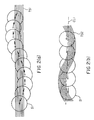
- FIGS. 2a and 2b illustrate two exemplary techniques for generating the cross-track position signal of the present invention.
- the views shown are looking down on an optical disk in a direction normal to its laser-incident surface.
- a recording spot S1 is focused on a non-wobbled tracking structure TS1.
- the spot S1 typically has a width of greater than 0.5 microns and less than 2.0 microns, but can of course vary depending upon the application.
- the tracking structure shown may correspond to a pre-formed groove in which marks are recorded during the recording process.
- a disk which includes the data track corresponding to tracking structure TS1 is rotated past the stationary recording beam at a desired velocity, such that S1 moves relative to the disk.
- Movement of spot S1 back and forth across the tracking structure TS2 is shown in FIG. 2a as a series of subsequent overlapping spots.
- An arrow in the center of each spot indicates the direction of movement of the recording beam relative to the recording medium.
- This relative cross-track motion could be provided by, for example, supplying an appropriate drive signal to the tracking actuator in the system of FIG. 1.
- the position signal can therefore be obtained from tracking actuator drive circuitry acting as a position signal generator.
- the cross-track motion of the recording spot shown in FIG. 2a is substantially sinusoidal, it should be noted that the present invention may utilize any of a number of other repetitive patterns to provide suitable cross-track motion.
- FIG. 2b illustrates generation of relative cross-track motion by variation in the tracking structure relative to a focused recording spot.
- the recording spot S1 is focused on tracking structure TS2 which in this example corresponds to a wobbled groove.
- tracking structure TS2 which in this example corresponds to a wobbled groove.
- the movement of spot S1 relative to TS2 is indicated by a series of subsequent overlapping spots, and each overlapping spot has an arrow in its center indicating the direction of movement of the recording beam relative to the medium.
- the groove wobble provides relative cross-track movement between the spot and the tracking structure.
- a wobbled groove tracking structure is usually substantially sinusoidal as shown in FIG. 2b, other repetitive variations in the tracking structure could be used to provide the desired relative cross-track motion.
- CD-R media typically include a wobbled groove such as that shown in FIG. 2b.
- the wobbled groove corresponds to a data track on which marks are intended to be recorded.
- the dimensions and shape of the groove can vary depending upon the medium, but a typical groove width is on the order of 0.4 micron in the radial direction of the disk, with adjacent grooves in the spiral separated by about 1.6 microns in the radial direction. It should be noted that the amount of groove wobble is exaggerated in FIG. 2b for illustrative purposes.
- the deviation of the wobbled groove from a groove centerline CL1 is referred to as the wobble amplitude.
- the wobble amplitude for CD-R media is typically on the order of 60 nm peak-to-peak, and the average spatial wavelength of the groove is on the order of 60 microns.
- the groove wobble is generally used to provide rotational velocity and beam position information.
- a wobbled-groove disk When a wobbled-groove disk is rotated at, for example, a constant linear velocity of 1.4 meters/second, the wobble amplitude variation will modulate a push-pull tracking signal at a predetermined frequency.
- the wobble frequency For CD-R media in systems operating at a write speed of 1X or 4.32 Mbits/sec, the wobble frequency is 22.05 kHz.
- the wobble frequency is scaled upward for systems operating at higher speeds such that, for example, a system operating at a 6X write speed will have a wobble frequency six times higher than that of a 1X system, or 132.30 kHz.
- a servo loop can then provide the desired disk rotational velocity by controlling the disk motor to maintain the tracking signal modulation at the wobble frequency.
- the beam position on the surface of a wobbled-groove disk is provided by frequency-modulating the wobble.
- the modulation of the push-pull signal will then vary about the wobble frequency in accordance with the frequency modulation applied thereto.
- the frequency modulation of the groove wobble may be, for example, on the order of plus and minus five percent.
- the information frequency-modulated onto the groove wobble is often referred to as absolute-time-in-pregroove (ATIP) information.
- the ATIP information typically includes binary data indicating the amount of time the beam would have spent in the spiral groove to reach a given position on the disk surface by following the groove from its beginning at the inner disk diameter.
- the time may be represented in minutes, seconds and frames, with a frame corresponding to, for example, 1/75 of a second at a write speed of 1X.
- the ATIP modulation may also include other information such as a disk identifier, synchronization marks and the expected optimum recording power. ATIP is described in greater detail in U.S. Patent No. 5,363,360, which is assigned to the present assignee and incorporated herein by reference.
- the relative cross-track motion is detected to provide a position signal.
- CD-R systems typically detect the groove wobble and any modulation thereon using a technique similar to that used to provide a conventional push-pull tracking signal.
- the resulting detected signal may be an ATIP wobble signal used to provide rotational velocity control and beam position information as described above.
- both ATIP detection and the dynamic tracking of the present invention generally utilize the time-varying component of the detected groove wobble, hereinafter referred to as the AC component.
- Information on the absolute position of the tracking structure relative to the recording spot is usually not needed and, in view of the tracking offset problems described previously, may be unreliable under certain system operating conditions.
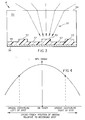
- FIG. 3 illustrates a partial side sectional view of an exemplary CD-R medium 14.
- the medium 14 includes a transparent polycarbonate substrate 50 having an upper surface 54.
- a recording beam 52 is incident on the surface 54 of the substrate 50 and is focused onto a groove 53.
- Substrate 50 overlies an absorptive dye recording layer 55 and a gold reflective layer 56.
- data is recorded in the dye layer 55 by beam 52 in the form of optically-detectable marks within groove 53.
- the gold reflective layer 56 provides the high reflectivity required for reading back the recorded data.
- the dye layer 55 is thicker in the grooves 53 than it is in the areas 57 between the grooves. This is one factor which can produce detectable variations in a diffraction-based MFE signal at a constant write power level as the recording beam moves from an on-track to an off-track position.
- FIG. 4 is a plot of diffraction-based MFE signal variation during recording as a function of the cross-track position of the groove relative to the recording spot. It can be seen that the diffraction-based MFE signal during recording is at a maximum when the recording beam spot is on-track, that is, centered on the wobbled groove. As the beam moves off-track to either side of the groove centerline, the diffraction-based MFE signal decreases in magnitude as shown.
- the present invention utilizes these diffraction-based MFE signal variations to provide a dynamic tracking error signal in a manner to be described below.
- FIG. 5 illustrates the generation of an exemplary diffraction-based MFE signal suitable for use with the present invention.
- a diffraction-based MFE measurement involves detecting reflected write signals in different zones of the return aperture.
- reflected write signals will be generated using the detector configuration shown in Figure 1.
- the two sum signals J and K represent reflected write signals from light received in the front and rear of the return aperture. These two signals are sampled at a time ⁇ T after the start of the write pulse.
- the ratio of these sampled signals, J ⁇ T /K ⁇ T is one exemplary way to generate a diffraction-based MFE signal. It should be understood that this exemplary diffraction-based MFE signal is only one of many possible ways to measure mark formation effectiveness using the present invention.
- Other examples of diffraction-based MFE signal generation include:
- FIGS. 6, 7, 8a and 8b illustrate the operation of an exemplary embodiment of the present invention in which relative cross-track motion is provided by a wobbled groove of a CD-R medium.
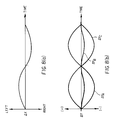
- FIG. 6 shows a portion of the wobbled groove tracking structure TS2 with recording spot S1 in three different positions A, B and C relative to groove centerline CL1.
- position A the groove centerline CL1 is to the left of the recording spot S1.
- position B the spot is centered on the groove centerline CL1 and will generally track along CL1 since the wobble frequency is too high for the recording spot to follow instantaneously.
- position C CL1 is to the right of the spot.
- FIG. 7 is a plot of the resulting diffraction-based MFE signal variations for each of the recording spot positions A, B and C of FIG. 6.
- the relative cross-track motion for each of the spot positions is provided by the wobbled groove and is shown as DX on the horizontal axis.
- the position signal corresponds to the detected groove motion at the wobble frequency and is generally the same for each of the three spot positions A, B and C.
- the corresponding diffraction-based MFE signal variations are different for each spot position and are shown as DYA, DYB and DYC for the spot positions A, B and C, respectively.
- the present invention utilizes these differences in diffraction-based MFE signal variation to provide a dynamic tracking error signal (TES).
- TES dynamic tracking error signal
- FIGS. 8a and 8b show in greater detail the position signal variation DX and diffraction-based MFE signal variation DY, respectively, for each of the spot positions A, B and C of FIG. 6 over one cycle of the groove wobble.
- the diffraction-based MFE signals variations DYA and DYC are measured relative to diffraction-based MFE signal values YA1 and YC1, respectively, as shown in FIG. 7, which are the diffraction-based MFE values for positions A and C, respectively, when the position signal DX is at its average value corresponding to the groove centerline.
- the diffraction-based MFE signal variation DYB is the same when the groove moves to the left relative to the spot as it is when the groove moves to the right relative to the spot.
- the diffraction-based MFE signal variation DYA is negative when the groove moves to the left (farther from the spot) and positive when the groove moves to the right (closer to the spot).
- the diffraction-based MFE signal variation DYC is positive when the groove moves to the left and negative when the groove moves to the right.
- the present invention correlates the position signal variations DX, in this embodiment representing the movement of the groove relative to the recording spot, with the diffraction-based MFE signal variations DY.
- the correlation of DX and DY provides a dynamic TES which can be used to maintain the recording spot on-track relative to the groove centerline.
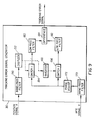
- FIG. 9 is an exemplary embodiment of a TES generator 30 which implements the correlation of position signal variations DX and diffraction-based MFE signal variations DY.
- the position signal X is supplied from position signal generator 25 of FIG. 1 and may be, for example, a conventional push-pull signal. Alternatively, the position signal X may correspond to an actuator drive signal generated by a tracking servo for application to a tracking actuator.
- the position signal X is filtered in band pass filter (BPF) 150 and then digitized in digitizer 152.
- BPF 150 band pass filter
- the BPF 150 may be centered at the fundamental groove wobble frequency and may have a passband suitable for passing any FM modulation of the wobble frequency.
- the position signal after digitization may be, for example, a binary signal having a logic level "1" when the wobbled groove has moved to the left of the centerline and a logic level "0" when the wobbled groove has moved to the right of the centerline.
- the digitized position signal operates switch 154 and an inverted version of the digitized position signal from inverter 160 operates switch 156.
- the diffraction-based MFE signal Y is supplied to a second BPF 170 and thereafter to a phase adjust element 172.
- the BPFs 150 and 170 serve to AC couple the position and diffraction-based MFE signals, respectively, to the TES generator 30 such that only the AC components thereof, representing instantaneous deviations of these signals from their average values, are processed.
- BPFs 150, 170 also eliminate unwanted noise outside the bandwidth of interest.
- BPF 170 may therefore also be centered at the groove wobble frequency and have a passband suitable for passing any modulation thereon.
- Phase adjust element 172 is used to compensate for any remaining phase difference between the filtered position and diffraction-based MFE signals.
- the digitized position signal controls switches 154 and 156 to gate the diffraction-based MFE signal.
- Switch 154 is closed and switch 156 is open when the digitized position signal is at a logic "1" level.
- Switch 154 is open and switch 156 is closed when the digitized position signal is at a logic "0" level.
- Low pass filters 180, 182 connected in the signal path after switches 154, 156 serve to average out the diffraction-based MFE signal Y over several gating cycles. Suitable cut-off frequencies for low pass filters 180, 182 depend, for example, on the recording speed and the highest frequency at which the tracking actuator (TA in FIG. 1) can be driven.
- Typical cut-off frequencies at 1X would be in the range of about 40 Hz to 4kHz, but it should be understood that cut-off frequencies need not be limited to this range.
- the resulting filtered diffraction-based MFE signals are subtracted in a difference circuit 184 which may be a differential amplifier. If the resulting difference is zero, the recording beam is on-track relative to the groove centerline. If the difference is non-zero, its sign indicates whether the recording beam is off-track to the right or to the left. The magnitude of the difference increases as the recording beam moves farther off-track in either direction.
- the output of difference circuit 184 thus represents a dynamic TES which can be utilized in a conventional tracking servo control system to adjust a tracking actuator to keep the recording beam on-track.
- the dynamic TES of the present invention may be utilized in conjunction with a conventional push-pull tracking signal.
- both the dynamic TES from TES generator 30 and a push-pull signal from position signal generator 25 could be applied to a servo control system as shown in FIG. 1. This would allow the servo to utilize desired properties of both signals.
- the push-pull signal generally has an unreliable DC content, its AC content is more reliable and extends to relatively high frequencies.
- the dynamic TES of the present invention exhibits reliable DC and AC content, but the upper end of its AC frequency range may be limited by filters such as low pass filters 180, 182 in the TES generator 30 of FIG. 9.
- One possible technique for combining the dynamic TES of the present invention with a conventional push-pull signal is to use the dynamic TES to update the tracking offset value of the push-pull signal. This could be accomplished by, for example, integrating the dynamic TES, multiplying the integral by a predetermined scaling factor, and then adding the result to the previously-determined push-pull offset value. Numerous alternative approaches may be used to combine the dynamic TES of the present invention with push-pull or other conventional tracking signals.
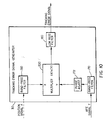
- FIG. 10 shows an alternative TES generator in accordance with the present invention.
- the position signal X is bandpass filtered in BPF 150.
- the diffraction-based MFE signal Y is bandpass filtered in BPF 170 and phase adjusted in phase adjust element 172.
- the signals X and Y are then multiplied together in a multiplier 200 and the result is filtered in low-pass filter 180 to provide a dynamic TES.
- the TES When the signals X and Y are in phase, corresponding to a groove centerline to the right of the recording spot, the TES will be positive in sign.
- the signals X and Y are out of phase, corresponding to a groove centerline to the left of the recording spot, the TES will be negative in sign.
- the magnitude of the TES will increase as the recording beam moves farther off-track in either direction.
- the TES will be substantially zero.
- the dynamic TES can be utilized in a conventional tracking servo control system to keep the recording beam on-track.
- the dynamic TES may be used alone or in conjunction with a push-pull signal or other conventional tracking signal.
- the recording system 10 could include a computer, microprocessor, application-specific integrated circuit (ASIC) or other digital data processor suitable for directing the signal processing operations described above.
- the system 10 may also include a system memory capable of storing, for example, various measured signal values.
- the signal processing operations may be completely or partially implemented in software or firmware.
Landscapes
- Optical Recording Or Reproduction (AREA)
- Optical Head (AREA)
Applications Claiming Priority (4)
| Application Number | Priority Date | Filing Date | Title |
|---|---|---|---|
| US3466497P | 1997-01-09 | 1997-01-09 | |
| US34664P | 1997-01-09 | ||
| US925826 | 1997-09-05 | ||
| US08/925,826 US5859830A (en) | 1997-09-05 | 1997-09-05 | Dynamic tracking control in an optical recording system by diffraction-based mark formation detection |
Publications (2)
| Publication Number | Publication Date |
|---|---|
| EP0858071A2 true EP0858071A2 (de) | 1998-08-12 |
| EP0858071A3 EP0858071A3 (de) | 1998-08-19 |
Family
ID=26711231
Family Applications (1)
| Application Number | Title | Priority Date | Filing Date |
|---|---|---|---|
| EP98200004A Withdrawn EP0858071A3 (de) | 1997-01-09 | 1998-01-02 | Dynamische Spurfolgeregelung in einem optischen Auzeichnungssystem durch beugungsbasierte Detektion der Markenerzeugung |
Country Status (2)
| Country | Link |
|---|---|
| EP (1) | EP0858071A3 (de) |
| JP (1) | JPH10255288A (de) |
Family Cites Families (4)
| Publication number | Priority date | Publication date | Assignee | Title |
|---|---|---|---|---|
| KR950010418B1 (ko) * | 1991-08-28 | 1995-09-16 | 미쯔비시덴끼 가부시끼가이샤 | 광기록재생장치 |
| US5363360A (en) * | 1993-09-27 | 1994-11-08 | Eastman Kodak Company | Method and apparatus for detecting and processing synchronization marks extracted from a prerecorded wobbled groove on a compact disk |
| US5440534A (en) * | 1994-01-10 | 1995-08-08 | Eastman Kodak Company | Method and apparatus for maintaining a recording light beam in an on-track position on a recording medium |
| US5495466A (en) * | 1994-01-10 | 1996-02-27 | Eastman Kodak Company | Write verification in an optical recording system by sensing mark formation while writing |
-
1998
- 1998-01-02 EP EP98200004A patent/EP0858071A3/de not_active Withdrawn
- 1998-01-08 JP JP255498A patent/JPH10255288A/ja active Pending
Also Published As
| Publication number | Publication date |
|---|---|
| EP0858071A3 (de) | 1998-08-19 |
| JPH10255288A (ja) | 1998-09-25 |
Similar Documents
| Publication | Publication Date | Title |
|---|---|---|
| US4751695A (en) | Method and apparatus for tracking servo system | |
| JP2681933B2 (ja) | 記録再生装置 | |
| US4803677A (en) | Rotary recording medium having a guide track and recording and reproducing apparatus therefor | |
| KR100952793B1 (ko) | 트랙킹 제어 장치 및 광 디스크 장치 | |
| US5646919A (en) | Dynamic tracking control in an optical recording system by sensing mark formation | |
| EP1526371A1 (de) | Analysevorrichtung und in dieser verwendete analysierte scheibe | |
| US5859830A (en) | Dynamic tracking control in an optical recording system by diffraction-based mark formation detection | |
| JP2775956B2 (ja) | 記録媒体 | |
| JPH08194969A (ja) | 光ディスク装置 | |
| US5508996A (en) | Optical disc having an offset tracking groove for representing multi-value digital information signals and reproducing apparatus therefor | |
| KR100507560B1 (ko) | 광 디스크장치 | |
| US20030067852A1 (en) | Optical disk recording apparatus and control method thereof | |
| US7113460B2 (en) | Optical disk having pits of different depths formed therein, optical disk reproducing apparatus for reproducing the optical disk, and method of tracking the optical disk | |
| EP0523334B1 (de) | Optisches Informationsaufzeichnungsmedium und Gerät zur Wiedergabe von Information aus dem Medium | |
| KR101053375B1 (ko) | 스큐 검출 방법 및 광 픽업과 광 디스크 장치 | |
| EP0858071A2 (de) | Dynamische Spurfolgeregelung in einem optischen Auzeichnungssystem durch beugungsbasierte Detektion der Markenerzeugung | |
| US7126893B2 (en) | Information recording apparatus and control method thereof | |
| JP3216418B2 (ja) | 円盤状記録媒体用の記録再生装置 | |
| KR100628171B1 (ko) | 광 기록 매체의 기록재생방법 및 그 장치 | |
| US7539088B2 (en) | Optical disc recording and reproducing method adaptive to wobble pregroove | |
| JP2892325B2 (ja) | 光ディスク装置 | |
| JP3086465B2 (ja) | 信号再生方法 | |
| JP3231506B2 (ja) | 情報記録方法及び情報再生方法 | |
| KR100565716B1 (ko) | 광 기록 매체의 기록재생방법 및 그 장치 | |
| JPH04318329A (ja) | 光ディスク及び光ディスク装置 |
Legal Events
| Date | Code | Title | Description |
|---|---|---|---|
| PUAI | Public reference made under article 153(3) epc to a published international application that has entered the european phase |
Free format text: ORIGINAL CODE: 0009012 |
|
| PUAL | Search report despatched |
Free format text: ORIGINAL CODE: 0009013 |
|
| AX | Request for extension of the european patent |
Free format text: AL;LT;LV;MK;RO;SI |
|
| AK | Designated contracting states |
Kind code of ref document: A3 Designated state(s): AT BE CH DE DK ES FI FR GB GR IE IT LI LU MC NL PT SE |
|
| AX | Request for extension of the european patent |
Free format text: AL;LT;LV;MK;RO;SI |
|
| AKX | Designation fees paid | ||
| RBV | Designated contracting states (corrected) | ||
| 17P | Request for examination filed |
Effective date: 19990327 |
|
| RBV | Designated contracting states (corrected) |
Designated state(s): DE FR GB |
|
| 17Q | First examination report despatched |
Effective date: 20000926 |
|
| STAA | Information on the status of an ep patent application or granted ep patent |
Free format text: STATUS: THE APPLICATION IS DEEMED TO BE WITHDRAWN |
|
| 18D | Application deemed to be withdrawn |
Effective date: 20010207 |