EP0846543A1 - Weatherstrip product formed by sequential extrusion of cellular and non-cellular plastic resins - Google Patents
Weatherstrip product formed by sequential extrusion of cellular and non-cellular plastic resins Download PDFInfo
- Publication number
- EP0846543A1 EP0846543A1 EP97309426A EP97309426A EP0846543A1 EP 0846543 A1 EP0846543 A1 EP 0846543A1 EP 97309426 A EP97309426 A EP 97309426A EP 97309426 A EP97309426 A EP 97309426A EP 0846543 A1 EP0846543 A1 EP 0846543A1
- Authority
- EP
- European Patent Office
- Prior art keywords
- cellular
- strip
- cellular material
- base portion
- die
- Prior art date
- Legal status (The legal status is an assumption and is not a legal conclusion. Google has not performed a legal analysis and makes no representation as to the accuracy of the status listed.)
- Withdrawn
Links
- 230000001413 cellular effect Effects 0.000 title claims abstract description 163
- 239000011347 resin Substances 0.000 title claims description 32
- 229920005989 resin Polymers 0.000 title claims description 32
- 238000001125 extrusion Methods 0.000 title abstract description 33
- 239000004033 plastic Substances 0.000 title description 8
- 229920003023 plastic Polymers 0.000 title description 8
- 239000000463 material Substances 0.000 claims abstract description 34
- 238000000034 method Methods 0.000 claims abstract description 34
- 238000004513 sizing Methods 0.000 claims description 12
- 238000001816 cooling Methods 0.000 claims description 8
- 238000005520 cutting process Methods 0.000 claims description 6
- 238000010438 heat treatment Methods 0.000 claims description 4
- 239000002131 composite material Substances 0.000 claims description 2
- 239000000047 product Substances 0.000 abstract description 41
- 150000001875 compounds Chemical class 0.000 abstract description 12
- 239000012467 final product Substances 0.000 abstract description 2
- XLYOFNOQVPJJNP-UHFFFAOYSA-N water Substances O XLYOFNOQVPJJNP-UHFFFAOYSA-N 0.000 description 8
- 230000009977 dual effect Effects 0.000 description 4
- 230000013011 mating Effects 0.000 description 4
- 230000015572 biosynthetic process Effects 0.000 description 3
- 239000004604 Blowing Agent Substances 0.000 description 2
- 238000004049 embossing Methods 0.000 description 2
- 238000005538 encapsulation Methods 0.000 description 2
- 230000004927 fusion Effects 0.000 description 2
- 238000012986 modification Methods 0.000 description 2
- 230000004048 modification Effects 0.000 description 2
- 238000000465 moulding Methods 0.000 description 2
- 230000000717 retained effect Effects 0.000 description 2
- 239000007787 solid Substances 0.000 description 2
- 239000004793 Polystyrene Substances 0.000 description 1
- 239000004676 acrylonitrile butadiene styrene Substances 0.000 description 1
- 239000000945 filler Substances 0.000 description 1
- 239000006260 foam Substances 0.000 description 1
- 238000005187 foaming Methods 0.000 description 1
- 238000009472 formulation Methods 0.000 description 1
- 238000003780 insertion Methods 0.000 description 1
- 230000037431 insertion Effects 0.000 description 1
- 239000007788 liquid Substances 0.000 description 1
- 238000004519 manufacturing process Methods 0.000 description 1
- 230000007246 mechanism Effects 0.000 description 1
- 239000000203 mixture Substances 0.000 description 1
- 239000000049 pigment Substances 0.000 description 1
- 239000004014 plasticizer Substances 0.000 description 1
- 229920002223 polystyrene Polymers 0.000 description 1
- 239000004800 polyvinyl chloride Substances 0.000 description 1
- 229920000915 polyvinyl chloride Polymers 0.000 description 1
- 239000000126 substance Substances 0.000 description 1
- 239000002344 surface layer Substances 0.000 description 1
- 229920001169 thermoplastic Polymers 0.000 description 1
- 239000004416 thermosoftening plastic Substances 0.000 description 1
- 239000002023 wood Substances 0.000 description 1
Images
Classifications
-
- B—PERFORMING OPERATIONS; TRANSPORTING
- B29—WORKING OF PLASTICS; WORKING OF SUBSTANCES IN A PLASTIC STATE IN GENERAL
- B29C—SHAPING OR JOINING OF PLASTICS; SHAPING OF MATERIAL IN A PLASTIC STATE, NOT OTHERWISE PROVIDED FOR; AFTER-TREATMENT OF THE SHAPED PRODUCTS, e.g. REPAIRING
- B29C44/00—Shaping by internal pressure generated in the material, e.g. swelling or foaming ; Producing porous or cellular expanded plastics articles
- B29C44/20—Shaping by internal pressure generated in the material, e.g. swelling or foaming ; Producing porous or cellular expanded plastics articles for articles of indefinite length
- B29C44/22—Shaping by internal pressure generated in the material, e.g. swelling or foaming ; Producing porous or cellular expanded plastics articles for articles of indefinite length consisting of at least two parts of chemically or physically different materials, e.g. having different densities
-
- B—PERFORMING OPERATIONS; TRANSPORTING
- B29—WORKING OF PLASTICS; WORKING OF SUBSTANCES IN A PLASTIC STATE IN GENERAL
- B29C—SHAPING OR JOINING OF PLASTICS; SHAPING OF MATERIAL IN A PLASTIC STATE, NOT OTHERWISE PROVIDED FOR; AFTER-TREATMENT OF THE SHAPED PRODUCTS, e.g. REPAIRING
- B29C44/00—Shaping by internal pressure generated in the material, e.g. swelling or foaming ; Producing porous or cellular expanded plastics articles
- B29C44/34—Auxiliary operations
- B29C44/56—After-treatment of articles, e.g. for altering the shape
- B29C44/5627—After-treatment of articles, e.g. for altering the shape by mechanical deformation, e.g. crushing, embossing, stretching
- B29C44/5654—Subdividing foamed articles to obtain particular surface properties, e.g. on multiple modules
-
- B—PERFORMING OPERATIONS; TRANSPORTING
- B29—WORKING OF PLASTICS; WORKING OF SUBSTANCES IN A PLASTIC STATE IN GENERAL
- B29C—SHAPING OR JOINING OF PLASTICS; SHAPING OF MATERIAL IN A PLASTIC STATE, NOT OTHERWISE PROVIDED FOR; AFTER-TREATMENT OF THE SHAPED PRODUCTS, e.g. REPAIRING
- B29C48/00—Extrusion moulding, i.e. expressing the moulding material through a die or nozzle which imparts the desired form; Apparatus therefor
- B29C48/03—Extrusion moulding, i.e. expressing the moulding material through a die or nozzle which imparts the desired form; Apparatus therefor characterised by the shape of the extruded material at extrusion
- B29C48/07—Flat, e.g. panels
- B29C48/08—Flat, e.g. panels flexible, e.g. films
-
- B—PERFORMING OPERATIONS; TRANSPORTING
- B29—WORKING OF PLASTICS; WORKING OF SUBSTANCES IN A PLASTIC STATE IN GENERAL
- B29C—SHAPING OR JOINING OF PLASTICS; SHAPING OF MATERIAL IN A PLASTIC STATE, NOT OTHERWISE PROVIDED FOR; AFTER-TREATMENT OF THE SHAPED PRODUCTS, e.g. REPAIRING
- B29C48/00—Extrusion moulding, i.e. expressing the moulding material through a die or nozzle which imparts the desired form; Apparatus therefor
- B29C48/03—Extrusion moulding, i.e. expressing the moulding material through a die or nozzle which imparts the desired form; Apparatus therefor characterised by the shape of the extruded material at extrusion
- B29C48/12—Articles with an irregular circumference when viewed in cross-section, e.g. window profiles
-
- B—PERFORMING OPERATIONS; TRANSPORTING
- B29—WORKING OF PLASTICS; WORKING OF SUBSTANCES IN A PLASTIC STATE IN GENERAL
- B29C—SHAPING OR JOINING OF PLASTICS; SHAPING OF MATERIAL IN A PLASTIC STATE, NOT OTHERWISE PROVIDED FOR; AFTER-TREATMENT OF THE SHAPED PRODUCTS, e.g. REPAIRING
- B29C48/00—Extrusion moulding, i.e. expressing the moulding material through a die or nozzle which imparts the desired form; Apparatus therefor
- B29C48/15—Extrusion moulding, i.e. expressing the moulding material through a die or nozzle which imparts the desired form; Apparatus therefor incorporating preformed parts or layers, e.g. extrusion moulding around inserts
- B29C48/154—Coating solid articles, i.e. non-hollow articles
- B29C48/155—Partial coating thereof
-
- B—PERFORMING OPERATIONS; TRANSPORTING
- B29—WORKING OF PLASTICS; WORKING OF SUBSTANCES IN A PLASTIC STATE IN GENERAL
- B29C—SHAPING OR JOINING OF PLASTICS; SHAPING OF MATERIAL IN A PLASTIC STATE, NOT OTHERWISE PROVIDED FOR; AFTER-TREATMENT OF THE SHAPED PRODUCTS, e.g. REPAIRING
- B29C48/00—Extrusion moulding, i.e. expressing the moulding material through a die or nozzle which imparts the desired form; Apparatus therefor
- B29C48/16—Articles comprising two or more components, e.g. co-extruded layers
- B29C48/18—Articles comprising two or more components, e.g. co-extruded layers the components being layers
- B29C48/22—Articles comprising two or more components, e.g. co-extruded layers the components being layers with means connecting the layers, e.g. tie layers or undercuts
-
- B—PERFORMING OPERATIONS; TRANSPORTING
- B29—WORKING OF PLASTICS; WORKING OF SUBSTANCES IN A PLASTIC STATE IN GENERAL
- B29C—SHAPING OR JOINING OF PLASTICS; SHAPING OF MATERIAL IN A PLASTIC STATE, NOT OTHERWISE PROVIDED FOR; AFTER-TREATMENT OF THE SHAPED PRODUCTS, e.g. REPAIRING
- B29C48/00—Extrusion moulding, i.e. expressing the moulding material through a die or nozzle which imparts the desired form; Apparatus therefor
- B29C48/25—Component parts, details or accessories; Auxiliary operations
- B29C48/30—Extrusion nozzles or dies
- B29C48/304—Extrusion nozzles or dies specially adapted for bringing together components, e.g. melts within the die
-
- E—FIXED CONSTRUCTIONS
- E06—DOORS, WINDOWS, SHUTTERS, OR ROLLER BLINDS IN GENERAL; LADDERS
- E06B—FIXED OR MOVABLE CLOSURES FOR OPENINGS IN BUILDINGS, VEHICLES, FENCES OR LIKE ENCLOSURES IN GENERAL, e.g. DOORS, WINDOWS, BLINDS, GATES
- E06B7/00—Special arrangements or measures in connection with doors or windows
- E06B7/16—Sealing arrangements on wings or parts co-operating with the wings
- E06B7/22—Sealing arrangements on wings or parts co-operating with the wings by means of elastic edgings, e.g. elastic rubber tubes; by means of resilient edgings, e.g. felt or plush strips, resilient metal strips
- E06B7/23—Plastic, sponge rubber, or like strips or tubes
- E06B7/2314—Plastic, sponge rubber, or like strips or tubes characterised by the material
-
- B—PERFORMING OPERATIONS; TRANSPORTING
- B29—WORKING OF PLASTICS; WORKING OF SUBSTANCES IN A PLASTIC STATE IN GENERAL
- B29L—INDEXING SCHEME ASSOCIATED WITH SUBCLASS B29C, RELATING TO PARTICULAR ARTICLES
- B29L2031/00—Other particular articles
- B29L2031/26—Sealing devices, e.g. packaging for pistons or pipe joints
Definitions
- the invention relates to extruded composite profiles and to methods of making such profiles.
- Weatherstrip products made by dual extrusion or coextrusion of cellular and non-cellular plastic resins are well-known in the art. Examples of such products are shown in U.S. Patent No. 3,535,824 and U.S. Patent No. 3,685,206 to Kessler.
- the Kessler patents disclose a dual extruded weatherstrip product having a rigid base with a flexible strip that is mechanically interlocked and thermally fused to the base.
- Kessler patents teach that the products are made by "well-known dual extrusion processes," which would include the standard processing techniques shown in, for example, Boutillier U.S. Patent No. 3,879,505 or in Hoffman U.S. Patent No. 4,690,862.
- standard processing techniques are described in both Boutillier and Hoffman, as well as in numerous other references, and have been used to produce products that have been available commercially since at least the early 1980's (e.g., the Contemporary Molding product made by Gossen Corporation).
- These processes involve the extrusion of cellular and non-cellular resins through separate extruders into a common die. The resins meet either inside or immediately upon exiting the die and then travel through a sizing box and cooling tank, which are typically under vacuum pressure conditions in order to maintain the size of the cellular plastic portion as the profile is cooled.
- Kessler and Hoffman teach the use of a bulbous tongue to form a mechanical interlock between the two plastics, which is in addition to the thermal or chemical fusion that occurs between the plastics during the extrusion process.
- Hoffman in particular, teaches that the bulbous tongue is important to maintain the tongue portion within the corresponding groove portion of the mating profile during the extrusion process and during use of the product.
- Gossen Corporation has commercially sold weatherstrip product both with and without the bulbous tongue shown in the Hoffman patent.
- the present invention provides a weatherstrip product preferably for use in garage doors and similar applications in which the flexible portion is subjected to back and forth movements by the opening and closing of the garage door and therefore needs to be securely held by the mating portion.
- the present invention provides such a weatherstrip product, but avoids the use of the bulbous tongue configuration that is taught to be so important in the Hoffman patent.
- While other prior art weatherstrip products have utilized a non-cellular piece fixedly abutted against a cellular piece, or a non-cellular flap extruded along the surface of a cellular piece, one embodiment of the present invention provides an extended surface area of contact that allows use of the weatherstrip as a garage door weatherstrip product in which the flexible portion is repeatedly contacted or moved by the garage door or other external forces.
- An example of a prior art weather seal for a garage door with a solid base and a pivoting seal member is shown in U.S. Patent No. 5,092,079.
- An example of a prior art weatherstrip with a cellular (foamed) portion and a solid, or non-cellular portion is shown in UK Patent Application GB 2,183,707.
- the invention provides an extrusion product or profile formed by extrusion of a cellular compound to form a base and then subsequent extrusion of a non-cellular compound to form an attached flexible strip.
- the final product or profile may be used as a garage door weatherstrip in which the cellular base is mounted against the door jamb and the strip of flexible non-cellular material extends out from the cellular base to prevent the flow of air through openings between doors and adjacent jambs or frames.
- the present invention also includes the process for forming such a product.
- the process involves sequential extrusion of the two portions of the product.
- a cellular base is first extruded through a die and vacuum sizer and allowed to cool.
- a saddle die is used to apply the flexible non-cellular strip to a portion of the cellular base.
- the saddle die heats a portion of the cellular base to improve the bond between the cellular and non-cellular portions.
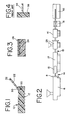
- Fig. 1 is a cross-sectional view of one embodiment of the weatherstrip product of the present invention.
- Fig. 2 is a schematic drawing of one embodiment of the process of the present invention.
- Fig. 3 is a schematic view of one embodiment of the product of the present invention, illustrating the non-cellular extrudate in the open cells of the cellular base.
- Fig. 4 is a schematic view of a prior art weatherstrip having non-cellular and cellular portions.
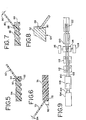
- Fig. 5 is a cross-sectional view of a second embodiment of the weatherstrip product of the present invention.
- Fig. 6 is a cross-sectional view of a third embodiment of the weatherstrip product of the present invention.
- Fig. 7 is a cross-sectional view of a fourth embodiment of the weatherstrip product of the present invention.
- Fig. 8 is an illustration of the die cross-sectional configuration for one embodiment of the present invention, illustrating the area of contact of the cellular and non-cellular resins.
- Fig. 9 is a schematic drawing of another embodiment of the process of the present invention.
- the product has a base that is formed by a conventional cellular extrusion process.
- the process is shown schematically in Figs. 2 and 9, which are not to scale.
- a cellular resin is heated to a molten state and pushed by an extrusion screw through a conventional extruder 6 and then exits a die 8.
- the die is shaped to form a profile of the desired cross-sectional configuration (before expansion) of the cellular plastic portion or base 10.
- the cellular extrudate will have a rectangular configuration with ridges 12 along one side of the product, but ridges are not required.
- the cellular extrudate After the compound exits the die 8, the cellular extrudate reaches open air and begins to expand or foam during travel through the distance 14 of approximately six to eight inches between the die and a sizing box.
- the extrudate then enters the sizing box 16, which is under vacuum draw to maintain the shape of the cellular material as it passes through the sizing box.
- the configuration of the entry to the sizing box has the same shape but is slightly larger than the exit of the die 8 in order to accommodate the expansion of the cellular extrudate in the space 14 between the die 8 and the sizing box 16.
- the sizing box is submerged in a cold water tank 17. As the extrudate exits the sizing box, which is typically about 14 inches long, it continues through the remainder of the water tank 17, which is typically about 20 feet in length.
- the water tank is cooled in order to cool the cellular extrudate.
- the extrusion profile has substantially hardened and reached its full size, but may still have some retained heat within the profile.
- the expansion of the cellular product is accomplished by the formation of gas bubbles or cells within the extrusion product.
- the extrusion product is typically pulled from the point of its exit from the die and through the sizing box 16 and tank 17.
- a puller 18 which is conventionally utilized downstream from the die and tank, acts to maintain a tension on the length of extrusion product from the die until the final cutting and finishing operation.
- An embossing wheel (not shown) may be used after the cellular product leaves the water tank to provide a simulated wood grain finish on the outside of the profile.
- a carbide blade (not shown) is used to cut a groove 20 along the length of the cellular piece.
- a circular saw with carbide blade continuously cuts a groove or trough along the length of the product.
- the groove is positioned at a point along the width of the cellular piece to permit appropriate placement of the flexible non-cellular extrudate 22, as subsequently explained.
- Other types of saws or cutting mechanisms may also be used. For example, a cutting tool may be held and dragged along the profile to form the groove as the profile is pulled forward.
- adhesion of the non-cellular product is promoted by cutting the groove sufficiently deep so that it cuts through any skin or hardened surface layer that might form on the outside of the cellular product as it cools as well as through the cell structure that is formed by the expansion of the cellular compound.
- the contact is shown schematically and substantially enlarged in Fig. 3, with the non-cellular resin 26 above and within the open cells of the cellular resin 24.
- the opening of the cells 24 by the cutting or formation of the groove will permit the flexible non-cellular extrudate 26 to flow into the cells and create a stronger bond.
- no groove is cut or otherwise formed in the cellular plastic portion.
- the adhesion between the non-cellular and cellular portions is accomplished by providing sufficient surface area of contact between the two portions.
- a groove may be integrally formed in the cellular base as it passes through the die and vacuum sizer.
- the profile After the cellular profile emerges from the cooling tank and passes under the embossing wheel, the profile passes beneath a second die 28 or saddle die from which the non-cellular extrudate is placed onto the cellular profile.
- the saddle die may also be below or alongside the cellular profile, as desired.
- the cellular profile is generally cooled, but will most likely have some retained or residual heat.
- the flexible, non-cellular compound or resin is fed from a second extruder through the saddle die 28 and along the length of the cellular profile.
- the flexible resin is applied so that one end 30 of the width of flexible strip is placed along the cellular piece.
- the other end 32 of the width of the flexible piece extends upward and away from the cellular portion 10 in order to form the strip portion 22 of the weatherstrip.
- the saddle die is formed in two connected portions.
- the first portion is approximately one inch thick and the second portion is approximately one-quarter inch thick. These die dimensions will vary based on the formulations and sizes of the profiles formed.
- the saddle die is positioned so that one side 50 and one corner 52 of the cellular piece 54 pass in contact with the first portion of the saddle die.
- the flexible, non-cellular resin also passes through this first portion of the saddle die, but is kept separate from the cellular resin in this die portion.
- Both the cellular and non-cellular resins are heated in the first die portion.
- the non-cellular resin is heated to maintain its flowability as it will be added to the cellular portion.
- the cellular portion is also heated along the side on which the non-cellular portion will be attached. Heating of both the cellular and non-cellular is believed to be important in order for the proper adhesion of the non-cellular flexible piece to the cellular base in some embodiments and applications.
- Both the cellular and non-cellular resins then pass into the second portion of the saddle die.
- the opening next to the cellular resin is shaped so that the non-cellular resin flows into the proper configuration against the side of the cellular resin.
- the two resins contact and are joined.
- both resins pass through a cooling fixture.
- cold water flows along both the non-cellular and cellular portions to cool the profile.
- cold water and cold air both contact the profile to cool the product.
- the cooling fixture is approximately 15 inches long. No sizing box is necessary in this portion of the process.
- the product After leaving the cooling fixture, the product is cut to the appropriate length. Embossment of the cellular portion was previously completed, so no further embossment is necessary or performed.
- the flexible compound is in a hot molten state (approximately 183°C (330°F)) as it leaves the saddle die 28 and contacts the cellular portion.
- the heat from the flexible compound should cause at least some portion of the cells in the cellular profile to heat and partially liquefy.
- Such heating preferably provides the cellular resin with a somewhat soft, tacky surface, but not pure liquid or molten resin. Such a surface improves the bonding between the flexible and cellular without affecting the integrity of the cellular profile.
- saddle dies have previously been utilized to place a flexible non-cellular compound along a portion of a cellular profile.
- extrusions are typically utilized in window frames in which the flexible extrusion extends outward from the cellular base to hold a window pane in position.
- the flexible portion is moved only during the insertion of the window into the frame.
- the flexible portion is not repeatedly moved in a hinge-like manner. Since the flexible portion 36 in these applications is not repeatedly moved, it may be attached or bonded to the outer, uncut surface 38 of the cellular profile, as shown in Fig. 4.
- the flexible portion is also not placed along a substantial portion of the top of the base or along the side of the base.
- extrudable material may be used with the present process.
- the preferred materials include polyvinyl chloride and polystyrene.
- Other extrudable materials such as acrylonitrile-butadiene-styrene (ABS), may also be used.
- the cellular compound may be made of the same or a different material than the non-cellular compound. However, the cellular material includes a conventional blowing agent to cause foaming or expansion of the cellular material. Blowing agents are well-known in the extrusion art.
- the extrusion materials may contain other plasticizers, fillers and pigments, as known and used by those skilled in the extrusion art.
- the flexible, non-cellular portion 60 has a length that extends from a first end along the entire side 50 of the cellular portion 54. The length extends upward from the top corner 62 of the cellular portion to a second end of the flexible portion. Only a portion of the entire length of the flexible strip is firmly attached to the rigid base.
- a portion of the length of the flexible portion 70 extends along only a portion of the side 72 of the cellular portion 74.
- the flexible portion 80 extends upward from the top 82 of the cellular portion.
- the flexible portion preferably extends along the surface of the cellular portion for a length that is greater than the thickness of the flexible portion.
- Satisfactory profiles for commercial use as a garage doorstop have been made of the embodiment shown in Figure 7 with the flexible portion 80 being attached to the cellular portion 84, the flexible portion 80 having a flat attachment portion 88 with a length approximately twice the width 90 of the flexible portion. Part of the flat attachment portion 88 projects from the main body of the flexible portion 80. Satisfactory profiles for commercial use as a garage doorstop have been made of the embodiment in Figure 6 in which the flexible portion 70 extends along the side 72 of the cellular portion for a distance 92 that is approximately four times the thickness 94 of the cellular portion.
- a dual strand or twin strand production line is shown schematically in Figure 9.
- two parallel extrusions 100, 102 are produced by a sequential extrusion process.
- a main extruder 104 extrudes the cellular resin through a hot die 106 into two parallel streams. Both streams enter the vacuum tank 108 in which they are cooled. After leaving the tank 108, the cellular resin is at least partially cooled and therefore proceeds through embosser 110 and puller 112.
- the second stage of the extrusion process is through saddle die 114.
- Two separate extruders 116, 118 feed the non-cellular resin to the saddle die 114.
- the streams leave the saddle die with the flexible, non-cellular strip attached to the cellular base.
- the resins are cooled in the cooling fixture 120 and then cut to size on a cut-off table.
Landscapes
- Engineering & Computer Science (AREA)
- Mechanical Engineering (AREA)
- Civil Engineering (AREA)
- Structural Engineering (AREA)
- Manufacturing & Machinery (AREA)
- Extrusion Moulding Of Plastics Or The Like (AREA)
- Specific Sealing Or Ventilating Devices For Doors And Windows (AREA)
Applications Claiming Priority (4)
| Application Number | Priority Date | Filing Date | Title |
|---|---|---|---|
| US3134296P | 1996-11-21 | 1996-11-21 | |
| US31342P | 1996-11-21 | ||
| US5236097P | 1997-07-11 | 1997-07-11 | |
| US52360P | 1997-07-11 |
Publications (1)
| Publication Number | Publication Date |
|---|---|
| EP0846543A1 true EP0846543A1 (en) | 1998-06-10 |
Family
ID=26707108
Family Applications (1)
| Application Number | Title | Priority Date | Filing Date |
|---|---|---|---|
| EP97309426A Withdrawn EP0846543A1 (en) | 1996-11-21 | 1997-11-21 | Weatherstrip product formed by sequential extrusion of cellular and non-cellular plastic resins |
Country Status (8)
| Country | Link |
|---|---|
| US (2) | US6167657B1 (enExample) |
| EP (1) | EP0846543A1 (enExample) |
| JP (1) | JPH10227185A (enExample) |
| CN (1) | CN1184730A (enExample) |
| AU (1) | AU719275B2 (enExample) |
| CA (1) | CA2219735C (enExample) |
| NZ (1) | NZ329061A (enExample) |
| TW (1) | TW381053B (enExample) |
Cited By (3)
| Publication number | Priority date | Publication date | Assignee | Title |
|---|---|---|---|---|
| DE102010001049A1 (de) * | 2010-01-20 | 2011-07-21 | Greiner Tool.Tec Gmbh | Verfahren und Vorrichtung zur Herstellung eines Verbundprofils und ein Verbundprofil |
| BE1027200B1 (de) * | 2019-04-19 | 2020-11-17 | Nmc Sa | Verbundprofilstücke mit kern aus polyesterschaum niedriger dichte |
| AT17158U1 (de) * | 2019-04-19 | 2021-07-15 | Nmc Sa | Verbundprofilstücke mit kern aus polyesterschaum niedriger dichte |
Families Citing this family (31)
| Publication number | Priority date | Publication date | Assignee | Title |
|---|---|---|---|---|
| US6784216B1 (en) | 1999-04-28 | 2004-08-31 | Crane Plastics Company Llc | ABS foam and method of making same |
| JP4161473B2 (ja) * | 1999-07-01 | 2008-10-08 | 豊田合成株式会社 | インサートをもつ押出成形品及びその製造方法 |
| US20040142160A1 (en) * | 2000-03-06 | 2004-07-22 | Mikron Industries, Inc. | Wood fiber polymer composite extrusion and method |
| US6665989B2 (en) * | 2000-09-25 | 2003-12-23 | Endura Products, Inc. | Entryway system with leak managing corner pads |
| CA2361992A1 (en) * | 2000-11-13 | 2002-05-13 | Mikronwood, Llc | Multi-component coextrusion |
| US6609349B2 (en) | 2001-09-26 | 2003-08-26 | Formtech Enterprises, Incorporated | Window framing system for embossed surfaces |
| US6772560B2 (en) | 2001-10-23 | 2004-08-10 | Greg Dischiant | Weather strip for doors |
| US6772561B1 (en) * | 2002-12-18 | 2004-08-10 | Allen Berger, Jr. | Garage door trim assembly with removable sealing element |
| US20050129911A1 (en) * | 2003-12-12 | 2005-06-16 | Schlegel Corporation | Surface treated particulated polymeric matrix for forming an exposed surface of a weatherseal |
| US20050257455A1 (en) * | 2004-03-17 | 2005-11-24 | Fagan Gary T | Wood-plastic composite door jamb and brickmold, and method of making same |
| US20050281997A1 (en) * | 2004-06-16 | 2005-12-22 | Sealed Air Corporation (Us) | Pitch modulating laminate |
| WO2006016867A1 (en) * | 2004-07-09 | 2006-02-16 | Berger Allen Jr | Garage door trim assembly with removable sealing element |
| US7877951B2 (en) * | 2004-09-10 | 2011-02-01 | Rodney Allen Jacobsen | Caulk free window trim |
| US8006445B2 (en) * | 2006-06-29 | 2011-08-30 | Pella Corporation | Self-sealing window installation and method |
| US8530037B2 (en) * | 2006-06-30 | 2013-09-10 | John Halle | Window trim apparatus and methods for making and using same |
| WO2008137393A1 (en) * | 2007-05-01 | 2008-11-13 | Arkema Inc. | Foamed polyvinylidene fluoride tubular structures |
| US20090084041A1 (en) * | 2007-10-01 | 2009-04-02 | Schlegel Systems, Inc. | Coextruded corner seal having materials of varied hardness |
| KR20100084924A (ko) * | 2009-01-19 | 2010-07-28 | 삼성광주전자 주식회사 | 냉장고 |
| USD632556S1 (en) | 2010-01-19 | 2011-02-15 | Endura Products, Inc. | Threshold sill cap carriage |
| US9745798B2 (en) * | 2011-06-01 | 2017-08-29 | Overhead Door Corporation | Movable barrier seal assembly |
| CA2775167C (en) * | 2012-04-20 | 2013-02-12 | Forimpex Inc. | Door sill assembly for exterior doors |
| US8881464B1 (en) * | 2014-01-27 | 2014-11-11 | Melken L.L.C. | Weatherguard door sealing device with replaceable seal |
| CA2985703C (en) | 2015-05-27 | 2023-10-17 | Pella Corporation | Water management systems for fenestration products |
| US10352093B2 (en) * | 2015-12-17 | 2019-07-16 | Royal Group, Inc. | Stackable weatherstrip |
| US9845638B1 (en) | 2016-12-11 | 2017-12-19 | Chris Cunningham | Garage door stop mould |
| CN106943040B (zh) * | 2017-03-29 | 2025-01-17 | 王晓东 | 负压密封结构及负压密封方法与应用 |
| US20190261620A1 (en) * | 2018-02-28 | 2019-08-29 | John Koshar | Novel Pest Barricade |
| US11725453B2 (en) * | 2018-02-28 | 2023-08-15 | John Koshar | Pest barricade |
| US12065874B1 (en) * | 2023-07-17 | 2024-08-20 | Gridz Llc | Overhead garage door trim seal apparatus and method of installation and use |
| US12116835B1 (en) * | 2023-12-26 | 2024-10-15 | Gridz Llc | Overhead garage door selectively inflatable seal apparatus and method of installation and use |
| CN121245404A (zh) * | 2025-10-23 | 2026-01-02 | 中国航发西安动力控制科技有限公司 | 一种航空用封严碗精密制造方法及封严碗 |
Citations (8)
| Publication number | Priority date | Publication date | Assignee | Title |
|---|---|---|---|---|
| US3535824A (en) * | 1967-03-02 | 1970-10-27 | Gerald Kessler | Abrasion-resistant rigid-flexible weatherstrip |
| FR2378935A1 (fr) * | 1977-01-26 | 1978-08-25 | France Menuisiers | Nouveaux joints d'etancheite a levres souples, en particulier pour portes et fenetres |
| JPS5539348A (en) * | 1978-09-12 | 1980-03-19 | Matsushita Electric Works Ltd | Forming method for building plate with bead pattern |
| US4690862A (en) * | 1984-12-28 | 1987-09-01 | Gossen Corporation | Integral composite profile of cellular and non-cellular resins and a dual extrusion method for its manufacture |
| WO1988003863A1 (fr) * | 1986-11-29 | 1988-06-02 | Peter Uhle | Procede de fabrication d'un profile pour fenetres ou analogue avec un element d'etancheite, ainsi que profile pour fenetres et dispositif pour sa fabrication |
| WO1990008639A1 (de) * | 1989-01-27 | 1990-08-09 | Schaumstoffwerk Greiner Gesellschaft M.B.H. | Verfahren und vorrichtung zum herstellen von profilen |
| US5186876A (en) * | 1989-01-27 | 1993-02-16 | Schaumstoffwerk Greiner Gesellschaft M.B.H | Process of making dimensionally stable section |
| EP0805013A1 (en) * | 1996-04-30 | 1997-11-05 | Kinugawa Rubber Industrial Co., Ltd., | Device for extruding automotive weather strip |
Family Cites Families (10)
| Publication number | Priority date | Publication date | Assignee | Title |
|---|---|---|---|---|
| FR94389E (fr) | 1966-09-07 | 1969-08-08 | Ugine Kuhlmann | Procédé et dispositif pour l'extrusion des matieres plastiques expansibles. |
| US3685206A (en) | 1970-09-28 | 1972-08-22 | Gerald Kessler | Low-friction abrasion-resistant plastic weatherstrip |
| US4322260A (en) | 1979-04-04 | 1982-03-30 | Monsanto Company | Process for the continuous extrusion forming of a plastic double-walled foam-core conduit |
| IT1126452B (it) | 1979-11-30 | 1986-05-21 | Mario Calcagni | Testa di estrusione per profilati per infissi e simili,nonche' profilato ottenuto |
| US4600461A (en) | 1983-09-12 | 1986-07-15 | Lof Plastics Inc. | Method of extruding a foamed thermoplastic core and extruding and integrally sealing a non-porous skin thereon |
| GB2183707B (en) | 1985-12-10 | 1988-11-30 | Draftex Ind Ltd | Sealing strips |
| US5092079A (en) | 1988-10-05 | 1992-03-03 | The Standard Products Company | Weather seal for a garage door |
| US5538777A (en) | 1993-09-01 | 1996-07-23 | Marley Mouldings Inc. | Triple extruded frame profiles |
| US5508103A (en) | 1995-01-30 | 1996-04-16 | Marley Mouldings Inc. | Extrusion product with decorative enhancement and process of making the same |
| US5784834A (en) * | 1997-01-03 | 1998-07-28 | Stutzman; Ellis D. | Door seal |
-
1997
- 1997-10-28 AU AU43590/97A patent/AU719275B2/en not_active Ceased
- 1997-10-29 NZ NZ329061A patent/NZ329061A/en unknown
- 1997-10-29 US US08/959,914 patent/US6167657B1/en not_active Expired - Lifetime
- 1997-10-30 CA CA002219735A patent/CA2219735C/en not_active Expired - Lifetime
- 1997-11-12 JP JP9329597A patent/JPH10227185A/ja active Pending
- 1997-11-20 TW TW086117398A patent/TW381053B/zh active
- 1997-11-20 CN CN97123140A patent/CN1184730A/zh not_active Ceased
- 1997-11-21 EP EP97309426A patent/EP0846543A1/en not_active Withdrawn
-
2000
- 2000-09-29 US US09/675,738 patent/US6360489B1/en not_active Expired - Lifetime
Patent Citations (9)
| Publication number | Priority date | Publication date | Assignee | Title |
|---|---|---|---|---|
| US3535824A (en) * | 1967-03-02 | 1970-10-27 | Gerald Kessler | Abrasion-resistant rigid-flexible weatherstrip |
| FR2378935A1 (fr) * | 1977-01-26 | 1978-08-25 | France Menuisiers | Nouveaux joints d'etancheite a levres souples, en particulier pour portes et fenetres |
| JPS5539348A (en) * | 1978-09-12 | 1980-03-19 | Matsushita Electric Works Ltd | Forming method for building plate with bead pattern |
| US4690862A (en) * | 1984-12-28 | 1987-09-01 | Gossen Corporation | Integral composite profile of cellular and non-cellular resins and a dual extrusion method for its manufacture |
| US4690862B1 (en) * | 1984-12-28 | 1998-03-17 | Gossen Corp | Integral composite profile of cellular and non-cellular resins and dual extension method for its manufacture |
| WO1988003863A1 (fr) * | 1986-11-29 | 1988-06-02 | Peter Uhle | Procede de fabrication d'un profile pour fenetres ou analogue avec un element d'etancheite, ainsi que profile pour fenetres et dispositif pour sa fabrication |
| WO1990008639A1 (de) * | 1989-01-27 | 1990-08-09 | Schaumstoffwerk Greiner Gesellschaft M.B.H. | Verfahren und vorrichtung zum herstellen von profilen |
| US5186876A (en) * | 1989-01-27 | 1993-02-16 | Schaumstoffwerk Greiner Gesellschaft M.B.H | Process of making dimensionally stable section |
| EP0805013A1 (en) * | 1996-04-30 | 1997-11-05 | Kinugawa Rubber Industrial Co., Ltd., | Device for extruding automotive weather strip |
Non-Patent Citations (2)
| Title |
|---|
| EBLI M: "HART-WEICH NACHEINANDER RIGID AND NON-RIGID IN SUCCESSION", KUNSTSTOFFE, vol. 85, no. 1, 1 January 1995 (1995-01-01), pages 97/98, XP000486615 * |
| PATENT ABSTRACTS OF JAPAN vol. 004, no. 076 (M - 014) 3 June 1980 (1980-06-03) * |
Cited By (4)
| Publication number | Priority date | Publication date | Assignee | Title |
|---|---|---|---|---|
| DE102010001049A1 (de) * | 2010-01-20 | 2011-07-21 | Greiner Tool.Tec Gmbh | Verfahren und Vorrichtung zur Herstellung eines Verbundprofils und ein Verbundprofil |
| WO2011089159A3 (de) * | 2010-01-20 | 2011-12-01 | Greiner Tool.Tec Gmbh | Verfahren und vorrichtung zur herstellung eines verbundprofils und ein verbundprofil |
| BE1027200B1 (de) * | 2019-04-19 | 2020-11-17 | Nmc Sa | Verbundprofilstücke mit kern aus polyesterschaum niedriger dichte |
| AT17158U1 (de) * | 2019-04-19 | 2021-07-15 | Nmc Sa | Verbundprofilstücke mit kern aus polyesterschaum niedriger dichte |
Also Published As
| Publication number | Publication date |
|---|---|
| CA2219735A1 (en) | 1998-05-21 |
| US6360489B1 (en) | 2002-03-26 |
| TW381053B (en) | 2000-02-01 |
| JPH10227185A (ja) | 1998-08-25 |
| AU719275B2 (en) | 2000-05-04 |
| NZ329061A (en) | 1998-08-26 |
| AU4359097A (en) | 1998-05-28 |
| CN1184730A (zh) | 1998-06-17 |
| CA2219735C (en) | 2006-01-03 |
| US6167657B1 (en) | 2001-01-02 |
| MX9708965A (es) | 1998-09-30 |
Similar Documents
| Publication | Publication Date | Title |
|---|---|---|
| US6167657B1 (en) | Weatherstrip product formed by sequential extrusion of cellular and non-cellular plastic resins | |
| CA2196635C (en) | Polymer and wood flour composite extrusion | |
| US4690862A (en) | Integral composite profile of cellular and non-cellular resins and a dual extrusion method for its manufacture | |
| US4107247A (en) | Method of co-extrusion with foam core | |
| AU689007B2 (en) | Extrusion product with decorative enhancement and process of making the same | |
| US4913976A (en) | Cohesive bonding process for forming a laminate of a wear resistant thermoplastic and a weather resistant rubber | |
| US20060026920A1 (en) | Straight face vinyl siding | |
| US5226998A (en) | Process for making a vehicle molding | |
| US5227108A (en) | Method of forming decorative trim strips | |
| GB2236978B (en) | Improvements in and relating to forming a plastics article | |
| US5723199A (en) | Method of extruding two or more materials | |
| JPH11138615A (ja) | プラスチック複合プロフィルの製造方法と、この方法を実施するための装置と、プラスチック複合プロフィル | |
| KR101241749B1 (ko) | 목분을 함유한 창호용 프로파일 제조방법 및 그 방법에 의해 제조된 창호용 프로파일 | |
| CA2612232A1 (en) | Hollow wall base | |
| US4554123A (en) | Process and apparatus for direct extrusion of thermal barrier profiles | |
| MXPA97008965A (en) | Product of formula formed by sequential extrusion of cellular plastic resins and not cellular | |
| KR19980042619A (ko) | 다공성 및 비다공성 플라스틱 수지의 순차적 압출에 의해 제조된 틈마개 제품 | |
| CA2001181C (en) | Window molding members for automobiles, and method of manufacturing the same | |
| US20030165660A1 (en) | Polymer component, apparatus and method | |
| JP3507017B2 (ja) | ベルトモールの製造方法 | |
| JP2003181902A (ja) | 長尺シール材の製造方法 | |
| JPH01204713A (ja) | モールディングの製造方法 | |
| GB2313088A (en) | Extruded plastics composite | |
| JPS59232839A (ja) | 複合断熱形材の製造方法 | |
| JPS583817B2 (ja) | ホオンカンノ セイゾウホウホウ |
Legal Events
| Date | Code | Title | Description |
|---|---|---|---|
| PUAI | Public reference made under article 153(3) epc to a published international application that has entered the european phase |
Free format text: ORIGINAL CODE: 0009012 |
|
| AK | Designated contracting states |
Kind code of ref document: A1 Designated state(s): AT BE CH DE DK ES FI FR GB GR IE IT LI LU MC NL PT SE |
|
| AX | Request for extension of the european patent |
Free format text: AL;LT;LV;MK;RO;SI |
|
| 17P | Request for examination filed |
Effective date: 19980613 |
|
| AKX | Designation fees paid |
Free format text: AT BE CH DE DK ES FI FR GB GR IE IT LI LU MC NL PT SE |
|
| RBV | Designated contracting states (corrected) |
Designated state(s): AT BE CH DE DK ES FI FR GB GR IE IT LI LU MC NL PT SE |
|
| 17Q | First examination report despatched |
Effective date: 20020201 |
|
| STAA | Information on the status of an ep patent application or granted ep patent |
Free format text: STATUS: THE APPLICATION IS DEEMED TO BE WITHDRAWN |
|
| 18D | Application deemed to be withdrawn |
Effective date: 20020612 |