EP0844544A2 - Une méthode pour générer des profils de vitesse pour portes de cabine d'ascenseur - Google Patents
Une méthode pour générer des profils de vitesse pour portes de cabine d'ascenseur Download PDFInfo
- Publication number
- EP0844544A2 EP0844544A2 EP97309427A EP97309427A EP0844544A2 EP 0844544 A2 EP0844544 A2 EP 0844544A2 EP 97309427 A EP97309427 A EP 97309427A EP 97309427 A EP97309427 A EP 97309427A EP 0844544 A2 EP0844544 A2 EP 0844544A2
- Authority
- EP
- European Patent Office
- Prior art keywords
- versus time
- time profile
- velocity
- elevator car
- low pass
- Prior art date
- Legal status (The legal status is an assumption and is not a legal conclusion. Google has not performed a legal analysis and makes no representation as to the accuracy of the status listed.)
- Granted
Links
Images

Classifications
-
- G—PHYSICS
- G05—CONTROLLING; REGULATING
- G05B—CONTROL OR REGULATING SYSTEMS IN GENERAL; FUNCTIONAL ELEMENTS OF SUCH SYSTEMS; MONITORING OR TESTING ARRANGEMENTS FOR SUCH SYSTEMS OR ELEMENTS
- G05B19/00—Program-control systems
- G05B19/02—Program-control systems electric
- G05B19/18—Numerical control [NC], i.e. automatically operating machines, in particular machine tools, e.g. in a manufacturing environment, so as to execute positioning, movement or co-ordinated operations by means of program data in numerical form
- G05B19/416—Numerical control [NC], i.e. automatically operating machines, in particular machine tools, e.g. in a manufacturing environment, so as to execute positioning, movement or co-ordinated operations by means of program data in numerical form characterised by control of velocity, acceleration or deceleration
Definitions
- the present invention relates to elevator car door systems and, more particularly, to the generation of velocity profiles therefor.
- elevator car doors are driven into opened and closed positions by an electric motor.
- the elevator car doors usually couple to hoistway doors to drive hoistway doors into open and closed positions.
- the elevator car doors typically have to maintain a certain velocity at the beginning of an operation, in the middle of the operation, and at the end of the operation. For example, as the doors are opening, the initial velocity is relatively low to allow time for the elevator car doors to couple to the hoistway doors. After the two sets of doors are coupled, the doors accelerate to a higher velocity. The doors then decelerate toward the end of the opening operation to avoid slamming against a fixed stop.
- a number of methods are used to achieve the change in velocity of the elevator car doors during various operations.
- a conventional approach to changing the velocity of elevator car doors is to use resistors.
- the resistors are placed in series with a voltage source and a DC motor and adjusted to provide smaller or greater values of resistance.
- the greater resistance value corresponds to slower DC motor operation and to smaller generated velocity output.
- the converse is true for the smaller resistance values.
- this approach has a number of limitations.
- resistors cannot compensate for changes in friction or other loading on the doors.
- Third, resistors are adjusted by a trial and error method, which is time consuming and frequently lacks the necessary precision.
- Another approach to varying the velocity of elevator car doors in modern closed loop systems includes software generated velocity profiles.
- the software dictates what the door velocity should be at a given time or distance.
- the velocity profiles are generated for each operation of the elevator car doors. This approach either results in a time lag for the doors to respond to a command or requires a powerful processor to generate profiles in real time.
- the transition from one velocity level to another is currently achieved by building in constant jerk (rate of change in acceleration) segments and constant acceleration segments of the profile.
- the constant jerk segments used to smooth the corners of the transition from constant velocity phase to constant acceleration phase of the doors, must match values of velocity and acceleration where the constant jerk segments join the constant acceleration phase and the constant velocity phase. Matching the constant jerk segment with the constant acceleration phase and the constant velocity phase at numerous transition points takes a great deal of processor time.
- a door control system cannot cause the doors to follow the high frequency components of the profile if these frequency components are higher than the bandwidth of the control system. This can cause misoperation of the elevator car doors, such as the doors overshooting the final position and hitting the stops or exciting a resonant vibration frequency of the doors.
- the velocity profiles can be broken down to show the frequency content through a Fourier transform method.
- the profiles include low and high frequency components of velocity.
- the current method of providing constant jerk segments lowers the frequency content of the velocity profile by minimizing sharp corners, it is not known how much of the higher frequency content is attenuated and what the frequency content of the profile is. Besides causing misoperation, the constant jerk method of generating a profile could result in very low frequency content and an associated increase in door operation time as compared to the optimum operation time.
- a velocity signal versus time profile for moving elevator car doors is passed through a filter, integrated into a position versus time profile, and then stored as part of an initialization procedure of the elevator car doors so that for every subsequent operation of the elevator car doors, the doors follow the stored position versus time profile.
- the initial velocity versus time profile is a (multi) straight-line profile and is preferably passed through a low pass finite impulse response (FIR) filter that limits the frequency content of the profile to the bandwidth of the control system and ensures smooth transitions between different velocity levels of the elevator car doors during each operation. Limiting the frequency content of the profile ensures that the profile matches the bandwidth of the control system and, therefore, the actual door motion can follow the filtered velocity profile. Since the position versus time profile is stored, a new profile does not need to be generated for each door operation, thereby saving real time and processor time.
- FIR finite impulse response
- One advantage of the present invention is that the door operation time can be tailored for the bandwidth of the control system.
- Another advantage of the present invention is that misoperation of the elevator car doors, such as the doors overshooting the final door position, is prevented.
- An additional advantage of the present invention is that resonant vibration modes of the door system are not excited.
- a straight-line velocity versus time profile is generated in the software of an elevator car door operating system as the elevator car door system is powered.
- the straight-line velocity versus time profile represents the desired velocity values at certain times of the door operating function. For example, at the beginning of an opening door function, velocity values are relatively low to allow the hoistway doors to couple to the elevator car doors. Once the coupling is completed, the doors accelerate to a higher velocity value, shown in FIG. 1 as a velocity peak. The higher velocity value is maintained until the doors decelerate to a stop velocity. The lower velocity value is frequently necessary toward the end of a door operation to either decelerate the elevator car doors, or in the case of a closing operation to allow the hoistway doors to decouple from the elevator car doors.
- the straight-line profiles are typically generated for each door function, such as opening, closing, reversing, or for different speeds required at various floors.
- the parameters determining the shape of the straight-line velocity versus time profile can change. Such changes in parameters require recalculation of a new straight-line velocity versus time profile.
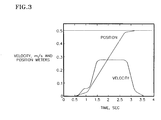
- the straight-line velocity versus time profile is passed through a low pass finite impulse response (FIR) filter.
- the low pass filter attenuates high frequencies and ensures that the frequency content of the profile matches the bandwidth of a position feedback control system.
- the control system has a 1 to 2 Hertz (Hz) position control bandwidth.
- the finite impulse response filter calculates the moving weighted average rounding the corners of the straight-line velocity versus time profile to ensure smooth transitions between different velocity values.
- a low pass finite impulse response filter a low pass infinite impulse response (IIR) filter could be used also.
- IIR infinite impulse response
- the filtered velocity versus time profile is integrated to obtain a position versus time profile.
- another point is calculated and plotted as a point on the position versus time profile.
- the position versus time profile is generated in the preferred embodiment because the closed loop control system of the door operator used in this application is a position control system.
- the filtered velocity versus time profile can be stored and used as an input into the velocity control system.
- the position versus time profile for each elevator car door operation is then stored in the RAM of the control system.
- a straight-line velocity versus time profile is generated as part of the initialization procedure.
- the straight-line velocity versus time profile is then passed through the low pass FIR filter.
- the filtered velocity versus time profile is then integrated into the position versus time profile, depending on the input required for the control system.
- the profile is then stored for future use.
- the door controller receives a command to move the elevator car doors, the controller retrieves the stored position versus time profile for the appropriate operation.
- the door controller does not need to generate a profile for every command and take up valuable processor time.
- Another major benefit of the present invention is that the frequency content of the filtered profile matches the bandwidth of the closed loop control system. This prevents misoperation of the elevator car doors, such as overshooting of the final position. Also, as high frequency content is attenuated, resonant vibration modes of the door system are not excited.
Landscapes
- Engineering & Computer Science (AREA)
- Human Computer Interaction (AREA)
- Manufacturing & Machinery (AREA)
- Physics & Mathematics (AREA)
- General Physics & Mathematics (AREA)
- Automation & Control Theory (AREA)
- Elevator Door Apparatuses (AREA)
- Elevator Control (AREA)
Applications Claiming Priority (2)
| Application Number | Priority Date | Filing Date | Title |
|---|---|---|---|
| US08/754,456 US5859395A (en) | 1996-11-21 | 1996-11-21 | Method for generating velocity profiles for elevator car doors |
| US754456 | 1996-11-21 |
Publications (3)
| Publication Number | Publication Date |
|---|---|
| EP0844544A2 true EP0844544A2 (fr) | 1998-05-27 |
| EP0844544A3 EP0844544A3 (fr) | 1999-05-19 |
| EP0844544B1 EP0844544B1 (fr) | 2008-07-16 |
Family
ID=25034870
Family Applications (1)
| Application Number | Title | Priority Date | Filing Date |
|---|---|---|---|
| EP97309427A Expired - Lifetime EP0844544B1 (fr) | 1996-11-21 | 1997-11-21 | Une méthode pour générer des profils de vitesse pour portes de cabine d'ascenseur |
Country Status (7)
| Country | Link |
|---|---|
| US (1) | US5859395A (fr) |
| EP (1) | EP0844544B1 (fr) |
| JP (1) | JPH10157956A (fr) |
| CN (1) | CN1095802C (fr) |
| BR (1) | BR9705754A (fr) |
| DE (1) | DE69738834D1 (fr) |
| ID (1) | ID18901A (fr) |
Cited By (3)
| Publication number | Priority date | Publication date | Assignee | Title |
|---|---|---|---|---|
| WO1999066413A1 (fr) * | 1998-06-18 | 1999-12-23 | Aristocrat Technologies Australia Pty Ltd | Procede pour relier des appareils a des machines de jeu |
| ES2156076A1 (es) * | 1999-05-28 | 2001-06-01 | Wavecrest Servicios Sociedade | Operador de puertas de cabina de ascensor. |
| EP1528446A1 (fr) * | 2003-10-29 | 2005-05-04 | Siemens Aktiengesellschaft | Méthode et contrôleur pour le positionnement d'un actionneur et utilisation du contrôleur |
Families Citing this family (14)
| Publication number | Priority date | Publication date | Assignee | Title |
|---|---|---|---|---|
| AU6963496A (en) * | 1995-09-01 | 1997-03-27 | Irwin Research And Development | Method and apparatus for control of drive systems for cycle based processes |
| US6445152B1 (en) * | 1999-11-24 | 2002-09-03 | Westinghouse Air Brake Co. | Door control system |
| JP2001320891A (ja) * | 2000-05-09 | 2001-11-16 | Mitsubishi Electric Corp | ドア制御装置およびドア制御装置の調整方法 |
| US7040457B1 (en) * | 2001-11-08 | 2006-05-09 | Bene Wayne J | Motor speed controller system for freight elevator doors |
| ATE549479T1 (de) * | 2006-09-12 | 2012-03-15 | Otis Elevator Co | Türanordnung, die einen sensor zur steuerung einer automatisierten türbewegung enthält |
| WO2010016826A1 (fr) * | 2008-08-04 | 2010-02-11 | Otis Elevator Company | Commande de profil de mouvement d'ascenseur |
| EP2298683A1 (fr) * | 2009-09-18 | 2011-03-23 | Inventio AG | Opérateur pour porte |
| US8761947B2 (en) * | 2010-06-30 | 2014-06-24 | Mitsubishi Electric Research Laboratories, Inc. | System and method for reducing lateral vibration in elevator systems |
| KR101368847B1 (ko) * | 2012-01-31 | 2014-03-03 | 주식회사 아진엑스텍 | 모션 프로파일 생성방법 |
| CN103264948B (zh) * | 2013-04-24 | 2015-03-25 | 深圳市海浦蒙特科技有限公司 | 电梯门机控制系统和方法 |
| FI124545B (fi) * | 2013-09-26 | 2014-10-15 | Kone Corp | Menetelmä hissikomponentin liikkeen valvomiseksi sekä hissin turvajärjestely |
| GB2566497B (en) | 2017-09-15 | 2020-07-29 | Illinois Tool Works | Braking system for electromagnetic motors |
| JP7002072B2 (ja) * | 2017-10-30 | 2022-01-20 | ブラザー工業株式会社 | 数値制御装置と制御方法 |
| CN112723069B (zh) * | 2020-12-16 | 2023-06-09 | 长沙慧联智能科技有限公司 | 基于tof视觉检测的电梯门运行状态监测方法及系统 |
Family Cites Families (9)
| Publication number | Priority date | Publication date | Assignee | Title |
|---|---|---|---|---|
| EP0419705A1 (fr) * | 1989-09-27 | 1991-04-03 | Siemens Aktiengesellschaft | Procédé pour limiter les à-coups de systèmes d'entraînement numériques |
| DE59006423D1 (de) * | 1989-11-27 | 1994-08-18 | Inventio Ag | Verfahren und Vorrichtung zur Herabsetzung der Einklemmgefahr bei automatischen Türen. |
| JP3135570B2 (ja) * | 1991-04-25 | 2001-02-19 | ユニシス・コーポレイション | グレースケール画像データの適応的しきい値処理を行なうための方法および装置 |
| US5159281A (en) * | 1991-11-20 | 1992-10-27 | Nsi Partners | Digital demodulator using numerical processor to evaluate period measurements |
| AU5550694A (en) * | 1992-11-06 | 1994-06-08 | Pericle Communications Company | Adaptive data rate modem |
| US5339016A (en) * | 1993-01-14 | 1994-08-16 | Mts Systems Corporation | Crossover and spectral preemphasis networks for adaptive inverse control |
| US5384439A (en) * | 1993-02-16 | 1995-01-24 | Otis Elevator Company | Adaptive digital velocity control loop for a high performance elevator door system with low cost |
| JPH06250723A (ja) * | 1993-02-25 | 1994-09-09 | Komatsu Ltd | ロボットの振動低減装置 |
| US5495918A (en) * | 1994-04-06 | 1996-03-05 | Otis Elevator Company | Smooth and quiet linear induction motor elevator door operation |
-
1996
- 1996-11-21 US US08/754,456 patent/US5859395A/en not_active Expired - Lifetime
-
1997
- 1997-11-17 ID IDP973686A patent/ID18901A/id unknown
- 1997-11-19 JP JP9317907A patent/JPH10157956A/ja active Pending
- 1997-11-19 BR BR9705754A patent/BR9705754A/pt not_active Application Discontinuation
- 1997-11-20 CN CN97109397A patent/CN1095802C/zh not_active Expired - Fee Related
- 1997-11-21 DE DE69738834T patent/DE69738834D1/de not_active Expired - Lifetime
- 1997-11-21 EP EP97309427A patent/EP0844544B1/fr not_active Expired - Lifetime
Cited By (5)
| Publication number | Priority date | Publication date | Assignee | Title |
|---|---|---|---|---|
| WO1999066413A1 (fr) * | 1998-06-18 | 1999-12-23 | Aristocrat Technologies Australia Pty Ltd | Procede pour relier des appareils a des machines de jeu |
| AU756227B2 (en) * | 1998-06-18 | 2003-01-09 | Aristocrat Technologies Australia Pty Limited | Method of linking devices to gaming machines |
| ES2156076A1 (es) * | 1999-05-28 | 2001-06-01 | Wavecrest Servicios Sociedade | Operador de puertas de cabina de ascensor. |
| EP1528446A1 (fr) * | 2003-10-29 | 2005-05-04 | Siemens Aktiengesellschaft | Méthode et contrôleur pour le positionnement d'un actionneur et utilisation du contrôleur |
| US7295899B2 (en) | 2003-10-29 | 2007-11-13 | Siemens Aktiengesellschaft | Method and controller for setting a control element and a use of said controller |
Also Published As
| Publication number | Publication date |
|---|---|
| HK1013198A1 (en) | 1999-08-20 |
| EP0844544A3 (fr) | 1999-05-19 |
| CN1095802C (zh) | 2002-12-11 |
| DE69738834D1 (de) | 2008-08-28 |
| JPH10157956A (ja) | 1998-06-16 |
| EP0844544B1 (fr) | 2008-07-16 |
| BR9705754A (pt) | 1999-03-09 |
| ID18901A (id) | 1998-05-20 |
| CN1187454A (zh) | 1998-07-15 |
| US5859395A (en) | 1999-01-12 |
Similar Documents
| Publication | Publication Date | Title |
|---|---|---|
| EP0844544B1 (fr) | Une méthode pour générer des profils de vitesse pour portes de cabine d'ascenseur | |
| EP0844545B1 (fr) | Une méthode pour générer et changer l'échelle des profils de vitesse pour portes de cabines d'ascenseur | |
| JPH08259154A (ja) | エレベータドアの制御装置 | |
| CN87106487A (zh) | 电动机的预置控制器 | |
| JP2001320891A (ja) | ドア制御装置およびドア制御装置の調整方法 | |
| US12187576B2 (en) | Drive system and method for controlling a drive system | |
| JP3875674B2 (ja) | 比例積分制御器の制御方法 | |
| JP2684808B2 (ja) | モータ駆動式つまみのモータ制御装置 | |
| HK1013198B (en) | A method for generating velocity profiles for elevator car doors | |
| JP2023110430A (ja) | エレベーターのドア制御装置及びドア制御方法 | |
| EP0491201B1 (fr) | Procédé de production d'une référence de vitesse pour un moteur de grue | |
| JP2592554B2 (ja) | 電動巻上機 | |
| JPH06323651A (ja) | 空気調和装置 | |
| JPH09309682A (ja) | エレベータかご扉装置 | |
| HK1010527B (en) | A method for generating and scaling velocity profiles for elevator car doors | |
| JP2000293234A (ja) | モータ制御ゲイン切替方法 | |
| US20040195990A1 (en) | Robust current loop controller for servo system | |
| JP3213121B2 (ja) | ステップモータ制御装置 | |
| SU907178A1 (ru) | Устройство дл управлени электроприводом поворота одноковшового экскаватора | |
| JPH11113277A (ja) | モータ制御装置 | |
| JPS61237860A (ja) | エンジンのアイドル速度制御方法 | |
| JPH07319550A (ja) | 機械系制御装置 | |
| JPH03237506A (ja) | 電子制御膨張弁の制御方法 | |
| JPH03288072A (ja) | 電動弁の位置決め制御方法 | |
| JPH0522988A (ja) | エレベータ用リニアモータの制御装置および制御方法 |
Legal Events
| Date | Code | Title | Description |
|---|---|---|---|
| PUAI | Public reference made under article 153(3) epc to a published international application that has entered the european phase |
Free format text: ORIGINAL CODE: 0009012 |
|
| AK | Designated contracting states |
Kind code of ref document: A2 Designated state(s): DE FR GB |
|
| AX | Request for extension of the european patent |
Free format text: AL;LT;LV;MK;RO;SI |
|
| PUAL | Search report despatched |
Free format text: ORIGINAL CODE: 0009013 |
|
| AK | Designated contracting states |
Kind code of ref document: A3 Designated state(s): AT BE CH DE DK ES FI FR GB GR IE IT LI LU MC NL PT SE |
|
| AX | Request for extension of the european patent |
Free format text: AL;LT;LV;MK;RO;SI |
|
| 17P | Request for examination filed |
Effective date: 19990622 |
|
| AKX | Designation fees paid |
Free format text: DE FR GB |
|
| 17Q | First examination report despatched |
Effective date: 20020131 |
|
| GRAP | Despatch of communication of intention to grant a patent |
Free format text: ORIGINAL CODE: EPIDOSNIGR1 |
|
| GRAS | Grant fee paid |
Free format text: ORIGINAL CODE: EPIDOSNIGR3 |
|
| GRAA | (expected) grant |
Free format text: ORIGINAL CODE: 0009210 |
|
| AK | Designated contracting states |
Kind code of ref document: B1 Designated state(s): DE FR GB |
|
| REG | Reference to a national code |
Ref country code: GB Ref legal event code: FG4D |
|
| REF | Corresponds to: |
Ref document number: 69738834 Country of ref document: DE Date of ref document: 20080828 Kind code of ref document: P |
|
| PLBE | No opposition filed within time limit |
Free format text: ORIGINAL CODE: 0009261 |
|
| STAA | Information on the status of an ep patent application or granted ep patent |
Free format text: STATUS: NO OPPOSITION FILED WITHIN TIME LIMIT |
|
| 26N | No opposition filed |
Effective date: 20090417 |
|
| PGFP | Annual fee paid to national office [announced via postgrant information from national office to epo] |
Ref country code: GB Payment date: 20131120 Year of fee payment: 17 Ref country code: DE Payment date: 20131113 Year of fee payment: 17 Ref country code: FR Payment date: 20131108 Year of fee payment: 17 |
|
| REG | Reference to a national code |
Ref country code: DE Ref legal event code: R119 Ref document number: 69738834 Country of ref document: DE |
|
| GBPC | Gb: european patent ceased through non-payment of renewal fee |
Effective date: 20141121 |
|
| REG | Reference to a national code |
Ref country code: FR Ref legal event code: ST Effective date: 20150731 |
|
| PG25 | Lapsed in a contracting state [announced via postgrant information from national office to epo] |
Ref country code: DE Free format text: LAPSE BECAUSE OF NON-PAYMENT OF DUE FEES Effective date: 20150602 Ref country code: GB Free format text: LAPSE BECAUSE OF NON-PAYMENT OF DUE FEES Effective date: 20141121 |
|
| PG25 | Lapsed in a contracting state [announced via postgrant information from national office to epo] |
Ref country code: FR Free format text: LAPSE BECAUSE OF NON-PAYMENT OF DUE FEES Effective date: 20141201 |