EP0832101B1 - Uber urethangruppen gebundene, gst-spezifische freisetzungssysteme für moleküle - Google Patents
Uber urethangruppen gebundene, gst-spezifische freisetzungssysteme für moleküle Download PDFInfo
- Publication number
- EP0832101B1 EP0832101B1 EP96918420A EP96918420A EP0832101B1 EP 0832101 B1 EP0832101 B1 EP 0832101B1 EP 96918420 A EP96918420 A EP 96918420A EP 96918420 A EP96918420 A EP 96918420A EP 0832101 B1 EP0832101 B1 EP 0832101B1
- Authority
- EP
- European Patent Office
- Prior art keywords
- compound
- alkyl
- gly
- glu
- asp
- Prior art date
- Legal status (The legal status is an assumption and is not a legal conclusion. Google has not performed a legal analysis and makes no representation as to the accuracy of the status listed.)
- Expired - Lifetime
Links
Classifications
-
- C—CHEMISTRY; METALLURGY
- C07—ORGANIC CHEMISTRY
- C07K—PEPTIDES
- C07K5/00—Peptides containing up to four amino acids in a fully defined sequence; Derivatives thereof
- C07K5/02—Peptides containing up to four amino acids in a fully defined sequence; Derivatives thereof containing at least one abnormal peptide link
- C07K5/0215—Peptides containing up to four amino acids in a fully defined sequence; Derivatives thereof containing at least one abnormal peptide link containing natural amino acids, forming a peptide bond via their side chain functional group, e.g. epsilon-Lys, gamma-Glu
-
- A—HUMAN NECESSITIES
- A61—MEDICAL OR VETERINARY SCIENCE; HYGIENE
- A61P—SPECIFIC THERAPEUTIC ACTIVITY OF CHEMICAL COMPOUNDS OR MEDICINAL PREPARATIONS
- A61P35/00—Antineoplastic agents
-
- A—HUMAN NECESSITIES
- A61—MEDICAL OR VETERINARY SCIENCE; HYGIENE
- A61K—PREPARATIONS FOR MEDICAL, DENTAL OR TOILETRY PURPOSES
- A61K38/00—Medicinal preparations containing peptides
Definitions
- the invention relates to compounds capable of releasing useful entities wherein the release is catalyzed by glutathione S-transferase (GST). More specifically, the invention concerns such compounds wherein the release is mediated by electron donation to the leaving group through a urethane linkage.
- GST glutathione S-transferase
- Electron transit through a urethane linkage has been utilized to construct prodrugs by Senter, P.D. et al., J Org Chem (1990), 55 :2975.
- the reduction of a disulfide bridging two phenyl moieties was used to mediate the release of either nitroaniline or mitomycin C, wherein the amino group of the substance released was part of a urethane linkage para to the disulfide on one of the phenyl moieties.
- the reduction released electrons through the phenyl moiety to decompose the urethane This provided the released nitroaniline or mitomycin C, and CU 2 as a by-product.
- PCT/US1994/11109 was published 13 April 1995 as WO95/09866.
- This published application describes a set of ghlathione S-transferase activated compounds wherein the release of a desired leaving group is actuated by abstraction of a hydrogen ion ⁇ to the cysteinyl sulfur atom in a glutathione analog. The nature of the glutathione analog will determine which isoenzyme of GST will be the most effective in activating the release of the leaving group.
- Also disclosed in WO95/09866 is the inclusion of a urethane linkage within the leaving group, so that CO 2 is released when the leaving group is released as well.
- the enzyme specificity conferred by the nature of glutathione analogs can be coupled with the electron release mechanisms associated with the urethane linkage to provide a new class of effective prodrugs for a variety of nitrogen-containing pharmaceuticals as well as more generally a release mechanism for any moiety containing reduced nitrogen.
- the urethane-mediated linkage can be employed to release moieties which do not contain reduced nitrogen as part of the urethane linkage per se.
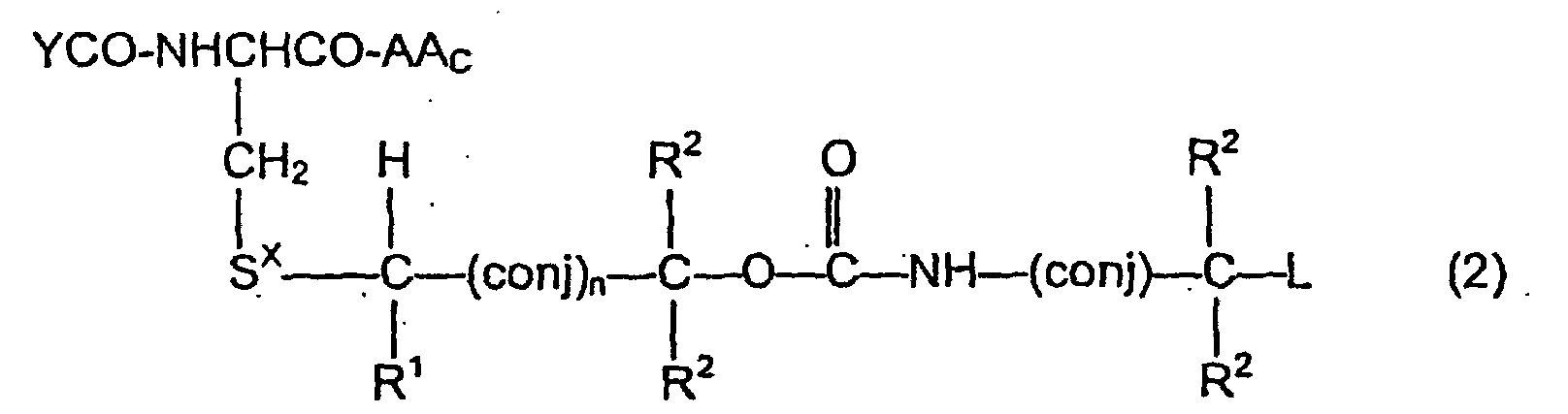
- the invention relates to a new class of GST-activated compounds capable of releasing desired moieties by electron transfer through a urethane linkage, with concomitant release of CO 2 , through coupling to a conjugated system.
- These compounds have the advantage of GST-regulated specificity, the equilibrium-driving properties associated with CO 2 release, and general applicability to release of electron withdrawing leaving groups.
- the compounds of the invention are therefore useful as prodrugs as well as laboratory reagents.
- n O or 1;
- YCO is selected from the group consisting of ⁇ -Glu, ⁇ -Glu-Gly, Glu, Glu-Gly, ⁇ -Asp, ⁇ -Asp-Gly, Asp and Asp-Gly;
- AA c is an amino acid linked through a peptide bond to the remainder of said compound of Formula 2; and
- L is a phosphoroamide mustard, a phosphorodiamidate mustard, adriamycin, daunorubicin, a toxin such as ricin toxin or diphtheria toxin, anti-inflamrnatory or steroid-based drugs or pother metabolic modulators such as 2,3-di-t-butyl-4-hydroxyanisole.
- CR CR-, wherein R is H or alkyl (1-4C), or paraphenylene.
- the invention is directed to methods of synthesizing the compounds of Formula 2, to pharmaceutical. compositions containing these compounds, and to methods to impair or otherwise affect tumor cells or other targets by administering the compounds of Formula 2 in contexts where the prodrugs are selectively cleaved by the targets to release L, which is typically a cytotoxic agent.
- the invention is directed to methods selectively to treat tumor cells or other target cells with characterized GST contents by selectively administering the prodrugs of the invention that are sensitive to cleavage with a GST that shows an elevated level in the target cells.
- the compounds of the invention are prodrugs which can be used selectively to target tissues having GST complements which are elevated or which contain isoenzymes peculiar in specificity to the prodrug provided. Depending on the nature of YCO and AA c , these compounds are differentially activated by GST enzymes of the T, X and I classes. These prodrugs, in addition to being selective for cells with elevated GST complements per se, can be used in a finely tuned protocol to target cells which have elevated levels of a particular isoenzyme of the GST group.
- the compounds of Formula 2 can be used as analytical reagents for GST activity by employing as "L" an indicator group which is detectable when liberated from the compounds of Formula 2.
- Such a reagent is suitable for determining the concentration of GST of known substrate specificity, or analyzing the specificity of particular GSTs by varying the glutathione analog component of the compounds of Formula 2.
- the compounds of the invention are comprised of a tripeptide which is glutathione or an analog thereof coupled to a leaving group through a molecular system which permits release of the leaving group L when the compounds of Formula 2 are treated with the appropriate GST. CO 2 will also be released.
- the release of the leaving group occurs through a " ⁇ -elimination" -- i.e., the removal of the proton on the carbon ⁇ to the electron-poor oxidized carbon, sulfur or selenium releases electrons which are ultimately absorbed by the leaving group and result in its release. This can be shown schematically as follows:
- the electron pair can be released to the leaving group through liberation of CO 2 through ⁇ -elimination directly or through a system of conjugation represented by (conj), when n is 1 in Formula 2.
- the substituents R 1 and R 2 play no direct part in the release of substituent L.
- the rate of ⁇ -elimination can be controlled by the nature of these R groups; by choosing electron withdrawing or electron donating substituents the rate of elimination can be accelerated or decreased.
- Suitable substituents for R 1 and R 2 are H, substituted or unsubstituted alkyl (1-6C) substituted or unsubstituted aryl (6-12C), substituted or unsubstituted aryl alkyl (7-12C), cyano, halo, substituted or unsubstituted alkoxy (1-6C), substituted or unsubstituted aryloxy (6-12C) or substituted.or unsubstituted arylalkyloxy (7-12C).
- Alkyl, aryl, and arylalkyl have their conventional meanings; alkyl groups are straight, branched chain or cyclic saturated hydrocarbon moieties such as methyl, tert-butyl, cyclohexyl, and the like.
- Aryl groups include aromatic systems such as phenyl, naphthyl, pyridyl and the like.
- Arylalkyl substituents contain an aryl moiety coupled to the remainder of the molecule through an alkylene moiety. Such groups include, most commonly benzyl, phenylethyl, 2-pyridylethyl, and the like.
- Suitable substituents in the substituted forms are halo, SR, OR, and NR 2 wherein R is H or alkyl (1-4C).
- R 1 and R 2 independently are H, alkyl (1-4C) and phenyl.
- YCO and -AA c determine the nature of the glutathione. like tripeptide.
- a preferred embodiment is that wherein YCO is ⁇ -glutamic and AA c is glycine, phenylglycine, ⁇ -alanine, alanine or phenylalanine, resulting in the tripeptide glutathione or a close analog.
- alternative embodiments of YCO include ⁇ -Asp, Glu, Asp, ⁇ -Glu-Gly, ⁇ -Asp-Gly, Glu-Gly and Asp-Gly.
- Alternative embodiments of AA c include, along with the preferred glycine, phenylglycine, ⁇ -alanine, alanine, and unsubstituted phenylalanine: substituted phenylglycine and substituted phenylalanine.
- Suitable phenylalanine and phenylglycine substituents are as described above for the substituted forms of R 1 and R 2 .
- Suitable embodiments for L include those which generate drugs which may be cytotoxic to unwanted cells.
- drugs include the phosphoramide mustards, the phosphorodiamidate mustards, the chemotherapeutic agents adriamycin and daunorubicin, toxins such as ricin toxin or diphtheria toxin, anti-inflammatory or steroid-based drugs and the like, and other metabolic modulators such as 2,3-di-t-butyl-4-hydroxyanisole.
- Preferred forms of the phosphorodiamidate mustards are - OP(O)(N(CH 2 CH 2 Cl) 2 ) 2 , -OP(O)(N(CH 2 CH 2 Br) 2 ) 2 , -OP(O)(NHCH 2 CH 2 Cl) 2 and -OP(O)(NHCH 2 CH 2 Br) 2 .
- Any biologically active moiety, provided with an electron adsorbing linkage to the remainder of the compound so that "L" released by ⁇ -elimination may be used.
- conjugated systems either to avoid the necessity for the inclusion of reduced nitrogen in the released moiety or simply to provide for electron flow or both.
- conjugated systems contain a p-phenylene moiety.
- advantage may be taken of conjugated systems to liberate any moiety which can absorb electrons.
- a phosphoramidate mustard was described.
- the phosphoramidate is coupled through a methylene linkage to a para-nitrobenzene moiety and the conjugate is reduced under hypoxic conditions present in some cells to liberate the phosphoramidate mustard OP(O)(N(CH 2 CH 2 Cl) 2 ) 2 leaving behind a para-phenylene monoamine.
- Preferred compounds of the invention are:
- indicator molecules such as p-nitrophenol can be used as leaving groups when the compound of Formula 2 is intended as a reagent.
- the compounds of the invention may also be prepared in the forms of their esters or amides, or as their salts.
- the esters, amides or salts are formed with any or all carboxyl groups present in the molecule; hence, included in this group are monoesters, diesters, and, if applicable, triesters. Similarly, monoamides, diamides, or, if applicable, triamides are included.
- the esters or amides may be alkyl (1-6C), alkenyl (1-6C) or arylalkyl (7-12C).
- Alkyl esters of the free carboxyls are esters of the straight- and branched-chain alkyl alcohols (1-6C) such as methanol, ethanol, isopropanol, t-butanol, n-hexanol and the like.
- Suitable alkyl (1-6C) amides are those of primary straight- or branched-chain alkyl amines, such as methylamine, ethylamine, n-propylamine, isopentylaminc, and isohexylamine.
- Alkenyl esters are similar, but contain at least one double bond.
- Arylalkyl is as defined above.
- the alcohols or amines may also carry noninterfering substituents such as halo, alkoxy, or alkyl amines.
- the esters and amides are prepared using conventional techniques, with suitable protection of any alcohol or amino functional groups.
- the salts of the compounds of the invention may be formed of inorganic or organic bases to form the basic salts of the free carboxyl groups or may be formed from organic or inorganic acids to obtain the acid addition salts of free amino groups.
- the salts may be of inorganic bases such as sodium hydroxide, potassium hydroxide, calcium hydroxide, ammonium hydroxide, magnesium hydroxide, and the like, or of organic bases such as trimethylamine, pyridine, pyrimidine, piperidine, lysine, caffeine, and the like.
- the acid addition salts may be formed from inorganic acids such as hydrochloric acid, hydrobromic acid, sulfuric acid, phosphoric acid, and the like, or from organic acids such as acetic acid, propionic acid, glycolic acid, pyruvic acid, oxalic acid, malic acid, tartaric acid, citric acid, benzoic acid, cinnamic acid, mandelic acid, salicylic acid, and the like. Salts of citric acid are preferred.
- the salts of the compounds are formed in standard protocols by treating with the appropriate base or acid at a temperature of from about 0°C to about 100°C preferably at room temperature either in water alone or in combination with an inert water-miscible organic solvent such as methanol, ethanol or dioxane.
- the invention provides a general vehicle for delivering drugs to tissues specifically based on their GST content.
- the leaving group when released in the target tissue, will exert its desired effects selectively in that target tissue.
- the released moiety may have other regulatory features.
- "L" is 2,3-di-t-buty!-4-hydroxyanisole
- this compound is known to induce the synthesis ofGSTs in mice.
- Administration of the compound of Formula 2 wherein "L” is 2,3-di-t-butyl-4-hydroxyanisole, will release this moiety may result in concomitant increase in GSTs.
- the target cells where release will occur can be regulated by manipulating the nature of the glutathione analog portion of the molecule. It may be desirable to enhance the GST component of the tumor cells concomitantly with supplying a compound of Formula 2 containing a cytotoxin.
- the various prodrugs of the invention are selective for the various isozymes of GST whose levels may be elevated in tumor cells.
- maximum effectiveness against the tumor cell will be obtained and maximum selectivity for the tumor cell as opposed to normal tissue can be achieved.
- the compounds of Formula 2 are administered as pharmaceutical compositions in usual formulations such as those outlined in Remington's Pharmaceutical Sciences , Mack Publishing Company, Easton, PA, latest edition. Typical formulations will include those for injection, for transdermal and transmucosal administration, and for oral administration.
- the formulations depending on the intended mode, may be liquids, syrups, powders, capsules, suppositories, and the like.
- the compounds of the invention may be included in liposomes, or in other emulsified forms. Protocols for administration and suitable formulations are subject to optimization using standard procedures known to those in the art.
- the antitumor activity of the invention compounds coupled with phosphorodiamidate mustard or other toxins can be assessed using a number of human tumor xenographs to determine tumor growth inhibition or a B16 mouse melanoma and measuring the prolongation of survival to determine the efficacy of particular compounds.
- a compound of Formula 2, or a pharmaceutical composition containing it can be used in the manufacture of a medicament for use in a method to deliver a biologically active moiety to a target, which method comprises administering to a subject containing said target, said compound or pharmaceutical composition.
- an alternative use for the compounds of Formula 2 is as reagents in assays where the moiety "L", when released from the compound can be readily detected.
- the compounds can thus conveniently be used to monitor the extent of the GST cleavage reaction, e.g., colorimetrically.
- an indicator moiety such as p-nitrophenol, which is colorless when coupled to GSH or a GSH analog but develops a color on release from the compound by GST, offers an improved method of assaying GST activity.
- GST isoenzyme-specific assays using compounds comprising certain GSH analogs that are substrates only for selected GST isoenzymes can be used to determine substrate specificity.
- the compounds comprising glutathione or its analogs described above coupled to a desirable leaving group can be synthesized using means generally known in the art.
- S x is an oxidized form of S or Se
- the methods illustrated below can be used, incorporating modifications which render them applicable to desired compounds of the invention.
- the method of Whitehead, J.K. et al., J Chem Soc (1952) 1572-1574 may be used.
- Precursor compounds lacking Y-CO or AA c can be converted to the compounds of Formula 2 by coupling the Y-CO moiety through a peptide linkage or the AA c amino acid using standard peptide coupling techniques.
- S* is S or Se in reduced form in these precursors
- these compounds may, similarly, be converted to compounds containing S or Se in oxidized form.
- Compounds of Formula 2 wherein S x is a sulfonium ion, i.e., is S + may be synthesized by treating compounds with reduced -S- with alkyl halides under suitable conditions to alkylate the sulfide.
- R 3 is alkyl (1-6C) as defined above.
- Preferred alkyl halides for reaction to form, ultimately, compounds of Formula 2 in this embodiment are the iodides.
- Reaction Scheme 2 shows the synthesis of an illustrative compound of Formula 2.
- 2-bromoethyl chloroformate is reacted with p-hydroxymethylvaniline in triethanolamine and methylene chloride to provide the urethane bromide.
- the urethane bromide is then treated with POCl 3 and bis(2-chloroethyl)amine to give the tetrachloroethylphosphorodiamidate which is then treated first with glutathione or the relevant glutathione analog and then oxidized with peracetic acid to give the compound of Formula 2 as shown.
Landscapes
- Chemical & Material Sciences (AREA)
- Organic Chemistry (AREA)
- Health & Medical Sciences (AREA)
- General Health & Medical Sciences (AREA)
- Medicinal Chemistry (AREA)
- Life Sciences & Earth Sciences (AREA)
- Biophysics (AREA)
- Biochemistry (AREA)
- Genetics & Genomics (AREA)
- Molecular Biology (AREA)
- Proteomics, Peptides & Aminoacids (AREA)
- General Chemical & Material Sciences (AREA)
- Chemical Kinetics & Catalysis (AREA)
- Nuclear Medicine, Radiotherapy & Molecular Imaging (AREA)
- Pharmacology & Pharmacy (AREA)
- Animal Behavior & Ethology (AREA)
- Public Health (AREA)
- Veterinary Medicine (AREA)
- Medicines That Contain Protein Lipid Enzymes And Other Medicines (AREA)
- Peptides Or Proteins (AREA)
- Organic Low-Molecular-Weight Compounds And Preparation Thereof (AREA)
- Pharmaceuticals Containing Other Organic And Inorganic Compounds (AREA)
- Materials For Medical Uses (AREA)
Claims (11)
- Verbindung, welche die Formelaufweist, oder ein Amid, Ester oder Salz davon, worin:
Sx S=O, O=S=O, S=NH, HN=S=O, Se=O, O=Se=O, Se=NH, HN=Se=O, S+R3, worin R3 Alkyl (1-6 C) oder O-C=O oder HN-C=O ist, ist;
R1 oder R2 jeweils unabhängig H, Alkyl (1-6 C), Aryl (6-12C), Arylalkyl (7-12 C), Cyano, Halogen, Alkoxy (1-6 C), Aryloxy (6-12 C) oder Arylalkyloxy (7-12 C) sind;
worin (conj) eine geradkettige Gruppe auf Alkylenbasis, wie -CR=CR-; - CR=CR-CR=CR-; -CR=CR-CR=CR-CR=CR- und dgl., worin R H oder Alkyl (1-4 C) ist, oder ein aliphatisches oder aromatisches Ringsystem, wie 1,3-Cyclohexadien, worin das Ringsystem in der Verbindung über Bindungen an den 1- und 4-Positionen eingeschlossen ist, oder Benzol oder andere aromatische Systeme, die Ober Bindungen an gerade Zahlen von Kohlenstoffen eingeschlossen sind, ist;
n 0 oder 1 ist;
YCO ausgewählt ist aus der Gruppe bestehend aus γ-Glu, γ-Glu-Gly, Glu, Glu-Gly, β-Asp, β-Asp-Gly, Asp und Asp-Gly;
AAc eine Aminosäure ist, die über eine Peptidbindung mit dem Rest der Verbindung der Formel 2 verknüpft ist; und
L ein Phosphoroamid-Senfgas, ein Phosphorodiamidat-Senfgas, Adriamycin, Daunorubicin, ein Toxin, wie Ricintoxin oder Diphtherietoxin, entzündungshemmende Arzneimittel oder Arzneimittel auf Steroidbasis oder andere metabolische Modulatoren wie 2,3-Di-tert.-butyl-4-hydroxyanisol ist. - Verbindung nach Anspruch 1, worin (conj) -CR=CR-, -CR=CR-CR=CR-, - CR=CR-CR=CR-CR=CR-, worin R H oder Alkyl (1-4 C) ist, oder para-Phenylen ist.
- Verbindung nach Anspruch 1 oder 2, worin L 2,3-Di-tert.-butyl-4-hydroxyanisol, Ricintoxin, Diphtherietoxin, Adriamycin oder Daunorubicin ist.
- Verbindung nach irgendeinem der vorhergehenden Ansprüche, worin n 0 ist und/oder worin YCO γ-Glu ist und/oder worin AAc ausgewählt ist aus der Gruppe bestehend aus Glycin, Phenylglycin. β-Alanin,' Alanin und Phenylalanin.
- Verbindung nach irgendeinem der vorhergehenden Ansprüche, worin R1 und R2 jeweils H sind.
- Verbindung nach irgendeinem der Ansprüche 1 bis 4, worin R1 oder R2 jeweils unabhängig Alkyl (1-6 C), Aryl (6-12 C), Arylalkyl (7-12 C), Alkoxy (1-6 C), Aryloxy (6-12 C) oder Arylalkyloxy (7-12 C) sind und R1 oder R2 jeweils gegebenenfalls mit Halogen, SR, OR oder NR2, worin R H oder Alkyl (1-4 C) ist, substituiert sind.
- Verbindung nach irgendeinem der vorhergehenden Ansprüche, worin Sx O=S=O ist.
- Verbindung nach Anspruch 1, worin L ein Phosphodiamidat-Senfgas ausgewählt aus -OP(O)(N(CH2CH2Cl)2)2, -OP(O)(N(CH2CH2Br)2)2, OP(O)(NHCH2CH2Cl)2 und -OP(O)(NHCH2CH2Br)2 ist.
- Pharmazeutische Zusammensetzung zur Arzneimittelabgabe, welche Zusammensetzung umfasst eine Verbindung nach irgendeinem der vorhergehenden Ansprüche als Wirkstoff in Mischung mit einem pharmazeutisch verträglichen Exzipienten.
- Verbindung wie in irgendeinem der Ansprüche 1 bis 8 beansprucht zur Verwendung in einem Verfahren zur medizinischen Behandlung.
- Verwendung einer Verbindung wie in irgendeinem der Ansprüche 1 bis 8 beansprucht oder einer Zusammensetzung wie in Anspruch 9 beansprucht bei der Herstellung eines Arzneimittels zur Verwendung in einem Verfahren zur Abgabe einer biologisch wirksamen Gruppe an ein Target, wobei das Verfahren die Verabreichung der Verbindung oder der pharmazeutischen Zusammensetzung an einen Patienten, der das Target enthält, umfasst.
Applications Claiming Priority (3)
| Application Number | Priority Date | Filing Date | Title |
|---|---|---|---|
| US476119 | 1995-06-07 | ||
| US08/476,119 US5908919A (en) | 1993-10-01 | 1995-06-07 | Urethane mediated, GST specific molecular release systems |
| PCT/US1996/009831 WO1996040739A2 (en) | 1995-06-07 | 1996-06-07 | Urethane mediated, gst specific molecular release systems |
Publications (2)
| Publication Number | Publication Date |
|---|---|
| EP0832101A2 EP0832101A2 (de) | 1998-04-01 |
| EP0832101B1 true EP0832101B1 (de) | 2004-08-11 |
Family
ID=23890586
Family Applications (1)
| Application Number | Title | Priority Date | Filing Date |
|---|---|---|---|
| EP96918420A Expired - Lifetime EP0832101B1 (de) | 1995-06-07 | 1996-06-07 | Uber urethangruppen gebundene, gst-spezifische freisetzungssysteme für moleküle |
Country Status (10)
| Country | Link |
|---|---|
| US (1) | US5908919A (de) |
| EP (1) | EP0832101B1 (de) |
| JP (1) | JPH11507370A (de) |
| AT (1) | ATE273318T1 (de) |
| AU (1) | AU722595B2 (de) |
| CA (1) | CA2224191A1 (de) |
| DE (1) | DE69633126T2 (de) |
| DK (1) | DK0832101T3 (de) |
| ES (1) | ES2227592T3 (de) |
| WO (1) | WO1996040739A2 (de) |
Families Citing this family (9)
| Publication number | Priority date | Publication date | Assignee | Title |
|---|---|---|---|---|
| US5880097A (en) * | 1996-01-04 | 1999-03-09 | Terrapin Techologies, Inc. | Tethered prodrugs |
| US7462605B2 (en) | 1998-01-23 | 2008-12-09 | Celmed Oncology (Usa), Inc. | Phosphoramidate compounds and methods of use |
| AU753155B2 (en) | 1998-01-23 | 2002-10-10 | Kiadis Pharma Intellectual Property B.V. | Enzyme catalyzed therapeutic agents |
| US6683061B1 (en) | 1999-07-22 | 2004-01-27 | Newbiotics, Inc. | Enzyme catalyzed therapeutic activation |
| BR0012676A (pt) | 1999-07-22 | 2003-07-01 | Newbiotics Inc | Métodos para tratamento de tumores resistentes a terapia |
| US7172905B2 (en) * | 2001-08-07 | 2007-02-06 | The University Of Chicago | Polypeptide immobilization |
| AU2003247907A1 (en) * | 2002-07-05 | 2004-01-23 | University Of Chicago | Characterization of biochips containing self-assembled monolayers with maldi-tof-ms |
| DE602006003064D1 (en) * | 2005-01-06 | 2008-11-20 | Telik Inc | Tripeptid- und tetrapeptid-thioether |
| ES2584381T3 (es) * | 2010-05-05 | 2016-09-27 | Prolynx Llc | Liberación controlada de compuestos activos desde conjugados macromoleculares |
Family Cites Families (16)
| Publication number | Priority date | Publication date | Assignee | Title |
|---|---|---|---|---|
| JPS60255789A (ja) * | 1984-06-01 | 1985-12-17 | Kyowa Hakko Kogyo Co Ltd | マイトマイシン誘導体,その製造法および抗腫瘍剤 |
| DE3586772T2 (de) * | 1984-07-24 | 1993-03-04 | Coselco Mimotopes Pty Ltd | Verfahren zur bestimmung von mimotopen. |
| WO1986006487A1 (en) * | 1985-04-22 | 1986-11-06 | Commonwealth Serum Laboratories Commission | Method for determining mimotopes |
| WO1987004440A1 (en) * | 1986-01-23 | 1987-07-30 | Pfizer Inc. | Heptanoyl-glu-asp-ala-amino acid immunostimulants |
| US4963263A (en) * | 1988-03-24 | 1990-10-16 | Terrapin Technologies, Inc. | Method of identity analyte-binding peptides |
| US5133866A (en) * | 1988-03-24 | 1992-07-28 | Terrapin Technologies, Inc. | Method to identify analyte-bending ligands |
| WO1990012088A1 (en) * | 1989-04-13 | 1990-10-18 | The United States Of America, As Represented By The Secretary, U.S. Department Of Commerce | MONOCLONAL ANTIBODIES TO HUMAN GLUTATHIONE S TRANSFERASE Pi |
| JP2919867B2 (ja) * | 1989-09-27 | 1999-07-19 | 千寿製薬株式会社 | 抗腫瘍剤 |
| ES2058050T3 (es) * | 1990-05-07 | 1996-02-16 | Dade Int Inc | Metodo y aparato para la realizacion de ensayos de citotoxicidad sobre celulas tumorales humanas. |
| US5204241A (en) * | 1990-10-22 | 1993-04-20 | Oxi-Gene Inc. | Glutathione-S-transferase mu as a measure of drug resistance |
| WO1992019767A1 (en) * | 1991-04-29 | 1992-11-12 | Terrapin Technologies, Inc. | Methods to profile and treat abnormal cells |
| US5786336A (en) * | 1991-04-29 | 1998-07-28 | Terrapin Technologies, Inc. | Target-selective protocols based on mimics |
| US5545621A (en) * | 1991-04-29 | 1996-08-13 | Terrapin Technologies, Inc. | Glutathione S-transferase-activated compounds |
| US5556942A (en) * | 1991-04-29 | 1996-09-17 | Terrapin Technologies, Inc. | Glutathione S-transferase-activated compounds |
| US5430045A (en) * | 1992-04-23 | 1995-07-04 | Free Radical Sciences, Inc. | Method of reducing or preventing bone marrow hypoplasia |
| AU4406793A (en) * | 1992-06-04 | 1993-12-30 | Clover Consolidated, Limited | Water-soluble polymeric carriers for drug delivery |
-
1995
- 1995-06-07 US US08/476,119 patent/US5908919A/en not_active Expired - Fee Related
-
1996
- 1996-06-07 EP EP96918420A patent/EP0832101B1/de not_active Expired - Lifetime
- 1996-06-07 CA CA002224191A patent/CA2224191A1/en not_active Withdrawn
- 1996-06-07 ES ES96918420T patent/ES2227592T3/es not_active Expired - Lifetime
- 1996-06-07 DK DK96918420T patent/DK0832101T3/da active
- 1996-06-07 JP JP9502035A patent/JPH11507370A/ja active Pending
- 1996-06-07 DE DE69633126T patent/DE69633126T2/de not_active Expired - Fee Related
- 1996-06-07 WO PCT/US1996/009831 patent/WO1996040739A2/en not_active Ceased
- 1996-06-07 AU AU61088/96A patent/AU722595B2/en not_active Ceased
- 1996-06-07 AT AT96918420T patent/ATE273318T1/de not_active IP Right Cessation
Also Published As
| Publication number | Publication date |
|---|---|
| DE69633126T2 (de) | 2005-08-11 |
| JPH11507370A (ja) | 1999-06-29 |
| US5908919A (en) | 1999-06-01 |
| EP0832101A2 (de) | 1998-04-01 |
| CA2224191A1 (en) | 1996-12-19 |
| DK0832101T3 (da) | 2004-11-29 |
| WO1996040739A2 (en) | 1996-12-19 |
| WO1996040739A3 (en) | 1997-01-30 |
| ES2227592T3 (es) | 2005-04-01 |
| AU722595B2 (en) | 2000-08-10 |
| DE69633126D1 (de) | 2004-09-16 |
| AU6108896A (en) | 1996-12-30 |
| ATE273318T1 (de) | 2004-08-15 |
Similar Documents
| Publication | Publication Date | Title |
|---|---|---|
| EP0721465B1 (de) | Durch glutathion-s-transferase aktivierte verbindungen | |
| US5880097A (en) | Tethered prodrugs | |
| US6180824B1 (en) | Manipulating nitrosative stress to kill pathologic microbes, pathologic helminths and pathologically, proliferating cells or to upregulate nitrosative stress defenses | |
| US5908919A (en) | Urethane mediated, GST specific molecular release systems | |
| MC1465A1 (fr) | Procede et dispositif integres de mise en place,de blocage et de traitement des cartes magnetiques et/ou a memoire | |
| EP0426467B1 (de) | Pro-drugs von 6-Mercaptopurin und 6-Thioguanin | |
| US5545621A (en) | Glutathione S-transferase-activated compounds | |
| Niemeyer et al. | Mafosfamide—a derivative of 4-hydroxycyclophosphamide | |
| US6747009B2 (en) | Peptidomimetic glutathione analogs | |
| US6576436B1 (en) | Anticancer agents based on prevention of protein prenylation | |
| US8044101B2 (en) | Nitrosation-inducible inhibitors biological macromolecules | |
| Jiang | Novel cyclophosphamide prodrugs for site-specific activation in tumor cells | |
| Younis | In vitro elucidation of the metabolic fate of the anticancer drug busulfan | |
| Down et al. | Induction and Inhibition of Organic Nitrate Metabolism | |
| Pickering | Active Site Studies on Microsomal Aminopeptidase |
Legal Events
| Date | Code | Title | Description |
|---|---|---|---|
| PUAI | Public reference made under article 153(3) epc to a published international application that has entered the european phase |
Free format text: ORIGINAL CODE: 0009012 |
|
| 17P | Request for examination filed |
Effective date: 19971222 |
|
| AK | Designated contracting states |
Kind code of ref document: A2 Designated state(s): AT BE CH DE DK ES FI FR GB GR IE IT LI LU MC NL PT SE |
|
| RAP1 | Party data changed (applicant data changed or rights of an application transferred) |
Owner name: TELIK, INC. |
|
| 17Q | First examination report despatched |
Effective date: 20000918 |
|
| GRAP | Despatch of communication of intention to grant a patent |
Free format text: ORIGINAL CODE: EPIDOSNIGR1 |
|
| RAP1 | Party data changed (applicant data changed or rights of an application transferred) |
Owner name: TELIK, INC. |
|
| GRAS | Grant fee paid |
Free format text: ORIGINAL CODE: EPIDOSNIGR3 |
|
| GRAA | (expected) grant |
Free format text: ORIGINAL CODE: 0009210 |
|
| AK | Designated contracting states |
Kind code of ref document: B1 Designated state(s): AT BE CH DE DK ES FI FR GB GR IE IT LI LU MC NL PT SE |
|
| PG25 | Lapsed in a contracting state [announced via postgrant information from national office to epo] |
Ref country code: FI Free format text: LAPSE BECAUSE OF FAILURE TO SUBMIT A TRANSLATION OF THE DESCRIPTION OR TO PAY THE FEE WITHIN THE PRESCRIBED TIME-LIMIT Effective date: 20040811 Ref country code: AT Free format text: LAPSE BECAUSE OF FAILURE TO SUBMIT A TRANSLATION OF THE DESCRIPTION OR TO PAY THE FEE WITHIN THE PRESCRIBED TIME-LIMIT Effective date: 20040811 |
|
| REG | Reference to a national code |
Ref country code: GB Ref legal event code: FG4D |
|
| REG | Reference to a national code |
Ref country code: CH Ref legal event code: EP |
|
| REG | Reference to a national code |
Ref country code: IE Ref legal event code: FG4D |
|
| REF | Corresponds to: |
Ref document number: 69633126 Country of ref document: DE Date of ref document: 20040916 Kind code of ref document: P |
|
| PG25 | Lapsed in a contracting state [announced via postgrant information from national office to epo] |
Ref country code: GR Free format text: LAPSE BECAUSE OF FAILURE TO SUBMIT A TRANSLATION OF THE DESCRIPTION OR TO PAY THE FEE WITHIN THE PRESCRIBED TIME-LIMIT Effective date: 20041111 |
|
| REG | Reference to a national code |
Ref country code: DK Ref legal event code: T3 |
|
| REG | Reference to a national code |
Ref country code: SE Ref legal event code: TRGR Ref country code: CH Ref legal event code: NV Representative=s name: A. BRAUN, BRAUN, HERITIER, ESCHMANN AG PATENTANWAE |
|
| ET | Fr: translation filed | ||
| REG | Reference to a national code |
Ref country code: ES Ref legal event code: FG2A Ref document number: 2227592 Country of ref document: ES Kind code of ref document: T3 |
|
| PG25 | Lapsed in a contracting state [announced via postgrant information from national office to epo] |
Ref country code: LU Free format text: LAPSE BECAUSE OF NON-PAYMENT OF DUE FEES Effective date: 20050607 |
|
| PLBE | No opposition filed within time limit |
Free format text: ORIGINAL CODE: 0009261 |
|
| STAA | Information on the status of an ep patent application or granted ep patent |
Free format text: STATUS: NO OPPOSITION FILED WITHIN TIME LIMIT |
|
| PG25 | Lapsed in a contracting state [announced via postgrant information from national office to epo] |
Ref country code: MC Free format text: LAPSE BECAUSE OF NON-PAYMENT OF DUE FEES Effective date: 20050630 |
|
| 26N | No opposition filed |
Effective date: 20050512 |
|
| PGFP | Annual fee paid to national office [announced via postgrant information from national office to epo] |
Ref country code: SE Payment date: 20070614 Year of fee payment: 12 Ref country code: DK Payment date: 20070614 Year of fee payment: 12 |
|
| PGFP | Annual fee paid to national office [announced via postgrant information from national office to epo] |
Ref country code: NL Payment date: 20070615 Year of fee payment: 12 Ref country code: CH Payment date: 20070615 Year of fee payment: 12 |
|
| PGFP | Annual fee paid to national office [announced via postgrant information from national office to epo] |
Ref country code: DE Payment date: 20070622 Year of fee payment: 12 |
|
| PGFP | Annual fee paid to national office [announced via postgrant information from national office to epo] |
Ref country code: IE Payment date: 20070628 Year of fee payment: 12 Ref country code: ES Payment date: 20070628 Year of fee payment: 12 |
|
| PGFP | Annual fee paid to national office [announced via postgrant information from national office to epo] |
Ref country code: GB Payment date: 20070621 Year of fee payment: 12 |
|
| PG25 | Lapsed in a contracting state [announced via postgrant information from national office to epo] |
Ref country code: PT Free format text: LAPSE BECAUSE OF NON-PAYMENT OF DUE FEES Effective date: 20050111 |
|
| PGFP | Annual fee paid to national office [announced via postgrant information from national office to epo] |
Ref country code: IT Payment date: 20070627 Year of fee payment: 12 |
|
| PGFP | Annual fee paid to national office [announced via postgrant information from national office to epo] |
Ref country code: BE Payment date: 20070711 Year of fee payment: 12 |
|
| PGFP | Annual fee paid to national office [announced via postgrant information from national office to epo] |
Ref country code: FR Payment date: 20070615 Year of fee payment: 12 |
|
| REG | Reference to a national code |
Ref country code: CH Ref legal event code: PFA Owner name: TELIK, INC. Free format text: TELIK, INC.#3165 PORTER DR.#PALO ALTO, CA 94304 (US) -TRANSFER TO- TELIK, INC.#3165 PORTER DR.#PALO ALTO, CA 94304 (US) |
|
| BERE | Be: lapsed |
Owner name: *TELIK INC. Effective date: 20080630 |
|
| REG | Reference to a national code |
Ref country code: CH Ref legal event code: PL |
|
| REG | Reference to a national code |
Ref country code: DK Ref legal event code: EBP |
|
| EUG | Se: european patent has lapsed | ||
| GBPC | Gb: european patent ceased through non-payment of renewal fee |
Effective date: 20080607 |
|
| NLV4 | Nl: lapsed or anulled due to non-payment of the annual fee |
Effective date: 20090101 |
|
| PG25 | Lapsed in a contracting state [announced via postgrant information from national office to epo] |
Ref country code: BE Free format text: LAPSE BECAUSE OF NON-PAYMENT OF DUE FEES Effective date: 20080630 |
|
| REG | Reference to a national code |
Ref country code: IE Ref legal event code: MM4A |
|
| REG | Reference to a national code |
Ref country code: FR Ref legal event code: ST Effective date: 20090228 |
|
| PG25 | Lapsed in a contracting state [announced via postgrant information from national office to epo] |
Ref country code: IE Free format text: LAPSE BECAUSE OF NON-PAYMENT OF DUE FEES Effective date: 20080609 Ref country code: DE Free format text: LAPSE BECAUSE OF NON-PAYMENT OF DUE FEES Effective date: 20090101 |
|
| PG25 | Lapsed in a contracting state [announced via postgrant information from national office to epo] |
Ref country code: NL Free format text: LAPSE BECAUSE OF NON-PAYMENT OF DUE FEES Effective date: 20090101 |
|
| PG25 | Lapsed in a contracting state [announced via postgrant information from national office to epo] |
Ref country code: LI Free format text: LAPSE BECAUSE OF NON-PAYMENT OF DUE FEES Effective date: 20080630 Ref country code: GB Free format text: LAPSE BECAUSE OF NON-PAYMENT OF DUE FEES Effective date: 20080607 Ref country code: CH Free format text: LAPSE BECAUSE OF NON-PAYMENT OF DUE FEES Effective date: 20080630 |
|
| REG | Reference to a national code |
Ref country code: ES Ref legal event code: FD2A Effective date: 20080609 |
|
| PG25 | Lapsed in a contracting state [announced via postgrant information from national office to epo] |
Ref country code: IT Free format text: LAPSE BECAUSE OF NON-PAYMENT OF DUE FEES Effective date: 20080607 Ref country code: FR Free format text: LAPSE BECAUSE OF NON-PAYMENT OF DUE FEES Effective date: 20080630 |
|
| PG25 | Lapsed in a contracting state [announced via postgrant information from national office to epo] |
Ref country code: ES Free format text: LAPSE BECAUSE OF NON-PAYMENT OF DUE FEES Effective date: 20080609 |
|
| PG25 | Lapsed in a contracting state [announced via postgrant information from national office to epo] |
Ref country code: DK Free format text: LAPSE BECAUSE OF NON-PAYMENT OF DUE FEES Effective date: 20090106 |
|
| PG25 | Lapsed in a contracting state [announced via postgrant information from national office to epo] |
Ref country code: DK Free format text: LAPSE BECAUSE OF NON-PAYMENT OF DUE FEES Effective date: 20080630 |
|
| PG25 | Lapsed in a contracting state [announced via postgrant information from national office to epo] |
Ref country code: SE Free format text: LAPSE BECAUSE OF NON-PAYMENT OF DUE FEES Effective date: 20080608 |