EP0824904A2 - Anordnung zum Einsetzen einer femoralen Knie-Gleitflächen-Endoprothese - Google Patents
Anordnung zum Einsetzen einer femoralen Knie-Gleitflächen-Endoprothese Download PDFInfo
- Publication number
- EP0824904A2 EP0824904A2 EP97112565A EP97112565A EP0824904A2 EP 0824904 A2 EP0824904 A2 EP 0824904A2 EP 97112565 A EP97112565 A EP 97112565A EP 97112565 A EP97112565 A EP 97112565A EP 0824904 A2 EP0824904 A2 EP 0824904A2
- Authority
- EP
- European Patent Office
- Prior art keywords
- prosthesis
- receptacles
- parts
- prosthesis parts
- condyle
- Prior art date
- Legal status (The legal status is an assumption and is not a legal conclusion. Google has not performed a legal analysis and makes no representation as to the accuracy of the status listed.)
- Withdrawn
Links
Images
Classifications
-
- A—HUMAN NECESSITIES
- A61—MEDICAL OR VETERINARY SCIENCE; HYGIENE
- A61F—FILTERS IMPLANTABLE INTO BLOOD VESSELS; PROSTHESES; DEVICES PROVIDING PATENCY TO, OR PREVENTING COLLAPSING OF, TUBULAR STRUCTURES OF THE BODY, e.g. STENTS; ORTHOPAEDIC, NURSING OR CONTRACEPTIVE DEVICES; FOMENTATION; TREATMENT OR PROTECTION OF EYES OR EARS; BANDAGES, DRESSINGS OR ABSORBENT PADS; FIRST-AID KITS
- A61F2/00—Filters implantable into blood vessels; Prostheses, i.e. artificial substitutes or replacements for parts of the body; Appliances for connecting them with the body; Devices providing patency to, or preventing collapsing of, tubular structures of the body, e.g. stents
- A61F2/02—Prostheses implantable into the body
- A61F2/30—Joints
- A61F2/46—Special tools for implanting artificial joints
- A61F2/4603—Special tools for implanting artificial joints for insertion or extraction of endoprosthetic joints or of accessories thereof
- A61F2/461—Special tools for implanting artificial joints for insertion or extraction of endoprosthetic joints or of accessories thereof of knees
-
- A—HUMAN NECESSITIES
- A61—MEDICAL OR VETERINARY SCIENCE; HYGIENE
- A61F—FILTERS IMPLANTABLE INTO BLOOD VESSELS; PROSTHESES; DEVICES PROVIDING PATENCY TO, OR PREVENTING COLLAPSING OF, TUBULAR STRUCTURES OF THE BODY, e.g. STENTS; ORTHOPAEDIC, NURSING OR CONTRACEPTIVE DEVICES; FOMENTATION; TREATMENT OR PROTECTION OF EYES OR EARS; BANDAGES, DRESSINGS OR ABSORBENT PADS; FIRST-AID KITS
- A61F2/00—Filters implantable into blood vessels; Prostheses, i.e. artificial substitutes or replacements for parts of the body; Appliances for connecting them with the body; Devices providing patency to, or preventing collapsing of, tubular structures of the body, e.g. stents
- A61F2/02—Prostheses implantable into the body
- A61F2/30—Joints
- A61F2/38—Joints for elbows or knees
- A61F2/3859—Femoral components
-
- A—HUMAN NECESSITIES
- A61—MEDICAL OR VETERINARY SCIENCE; HYGIENE
- A61F—FILTERS IMPLANTABLE INTO BLOOD VESSELS; PROSTHESES; DEVICES PROVIDING PATENCY TO, OR PREVENTING COLLAPSING OF, TUBULAR STRUCTURES OF THE BODY, e.g. STENTS; ORTHOPAEDIC, NURSING OR CONTRACEPTIVE DEVICES; FOMENTATION; TREATMENT OR PROTECTION OF EYES OR EARS; BANDAGES, DRESSINGS OR ABSORBENT PADS; FIRST-AID KITS
- A61F2/00—Filters implantable into blood vessels; Prostheses, i.e. artificial substitutes or replacements for parts of the body; Appliances for connecting them with the body; Devices providing patency to, or preventing collapsing of, tubular structures of the body, e.g. stents
- A61F2/02—Prostheses implantable into the body
- A61F2/30—Joints
- A61F2/30767—Special external or bone-contacting surface, e.g. coating for improving bone ingrowth
- A61F2/30771—Special external or bone-contacting surface, e.g. coating for improving bone ingrowth applied in original prostheses, e.g. holes or grooves
- A61F2002/3082—Grooves
-
- A—HUMAN NECESSITIES
- A61—MEDICAL OR VETERINARY SCIENCE; HYGIENE
- A61F—FILTERS IMPLANTABLE INTO BLOOD VESSELS; PROSTHESES; DEVICES PROVIDING PATENCY TO, OR PREVENTING COLLAPSING OF, TUBULAR STRUCTURES OF THE BODY, e.g. STENTS; ORTHOPAEDIC, NURSING OR CONTRACEPTIVE DEVICES; FOMENTATION; TREATMENT OR PROTECTION OF EYES OR EARS; BANDAGES, DRESSINGS OR ABSORBENT PADS; FIRST-AID KITS
- A61F2/00—Filters implantable into blood vessels; Prostheses, i.e. artificial substitutes or replacements for parts of the body; Appliances for connecting them with the body; Devices providing patency to, or preventing collapsing of, tubular structures of the body, e.g. stents
- A61F2/02—Prostheses implantable into the body
- A61F2/30—Joints
- A61F2/46—Special tools for implanting artificial joints
- A61F2/4603—Special tools for implanting artificial joints for insertion or extraction of endoprosthetic joints or of accessories thereof
- A61F2002/4625—Special tools for implanting artificial joints for insertion or extraction of endoprosthetic joints or of accessories thereof with relative movement between parts of the instrument during use
- A61F2002/4628—Special tools for implanting artificial joints for insertion or extraction of endoprosthetic joints or of accessories thereof with relative movement between parts of the instrument during use with linear motion along or rotating motion about an axis transverse to the instrument axis or to the implantation direction, e.g. clamping
-
- A—HUMAN NECESSITIES
- A61—MEDICAL OR VETERINARY SCIENCE; HYGIENE
- A61F—FILTERS IMPLANTABLE INTO BLOOD VESSELS; PROSTHESES; DEVICES PROVIDING PATENCY TO, OR PREVENTING COLLAPSING OF, TUBULAR STRUCTURES OF THE BODY, e.g. STENTS; ORTHOPAEDIC, NURSING OR CONTRACEPTIVE DEVICES; FOMENTATION; TREATMENT OR PROTECTION OF EYES OR EARS; BANDAGES, DRESSINGS OR ABSORBENT PADS; FIRST-AID KITS
- A61F2/00—Filters implantable into blood vessels; Prostheses, i.e. artificial substitutes or replacements for parts of the body; Appliances for connecting them with the body; Devices providing patency to, or preventing collapsing of, tubular structures of the body, e.g. stents
- A61F2/02—Prostheses implantable into the body
- A61F2/30—Joints
- A61F2/46—Special tools for implanting artificial joints
- A61F2002/4631—Special tools for implanting artificial joints the prosthesis being specially adapted for being cemented
Definitions
- sliding surface prostheses are made relatively thin and therefore only slight resection of cartilage and bone material, and in some Cases the partial or complete preservation of the hard Allow bark.
- Condyle-associated prosthesis sliding surfaces by a shield-like Part connected, which protrudes on the front and forms a sliding surface for the patella.
- Such a connection of the condylar sliding surfaces secures one another correctly coordinated position.
- the replacement is the Patella sliding surface not required. You could be then with a simpler connection of the two condylar sliding surfaces content.
- experience has shown that a often easier connection to the stresses of use has not grown and breaks. One can be too disconnected instead Condylar sliding surfaces grip, but the disadvantage have their correct mutual positioning hands-free is hardly possible.
- the invention is therefore based on the object of an arrangement to create the insertion of a femoral knee sliding surface endoprosthesis with correctly coordinated condylar sliding surface parts enables.
- the invention requires that unconnected sliding surface prosthesis parts be used. Their correct mutual positioning is carried out by appropriately aligned mounting devices guaranteed in an insertion tool that forms two receptacles for the prosthesis parts. These are with too the bracket parts of the insertion device matching bracket elements equipped. These consist of a pair of rails, preferably in the AP direction (anterior-posterior direction) is arranged. That is the direction when stretched Knee runs from front to back, i.e. in one Sagittal plane perpendicular to the direction of the femur. This feature allows the tool to be U-shaped Images taken after the prosthesis parts are inserted to the front move away.
- the pairs of rails are expediently on both sides of the receptacles and the prosthesis parts provided. Static uniqueness is already given, if only on one A pair of rails is arranged on the side of the receptacles and the prosthesis parts is, while on the other hand a punctiform or other type of holder is provided. For example there may be a hole or a depression in the edge of the prosthesis part be provided in the tip of one at the receptacle engages provided screw, which for releasing the device from the prosthesis parts is released.
- a locking device be provided, which ensures that the prosthesis parts their correct starting position until the end of the insertion process maintained.
- This locking device can for example from one provided on the recordings Clamping screw must be formed.
- the rail on the receptacle is formed by a continuous bar can, you can with two at the edge of the prosthesis part Pairs of pins or two spaced apart on one of the bars arranged pins and one about the center of it on the other Satisfy the pin located on the side of the bar.
- the each other rails do not need to be carried out continuously be; rather, it can be interrupted at those points be in cooperation with corresponding elements the other part is not required.
- the hint of a of the two rails by isolated projections also has the Advantage that the desired alignment of the prosthesis parts opposite the insertion device is only present when the Prosthesis parts correctly fixed in the insertion position in the device are. It ends immediately after starting the device from remove the implants used, reducing the risk is reduced by clumsy movement when removing the implants from their intended position getting crazy.
- the arrangement according to the invention is primarily for such Prostheses are provided, which are anchored using bone cement.
- the prosthesis parts are retained until the cement has hardened through the insertion device of the correctly aligned Position held.
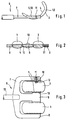
- the knee prosthesis to be used consists of the prosthesis parts 1, 2, the side view of which can be seen from FIG. 1 and the one Sliding surface 3 and a surface 4 to be connected to the bone exhibit. You can also not shown cones or have other surface structures that anchor the in Improve bone and cement adhesion. The example assumes that they agree in the side view and are used exactly parallel to each other. This does not have to be the case be.
- the prosthesis parts 1, 2 are provided with grooves 5 on both edges, that run parallel to each other in the AP direction.
- the Insertion instrument 6 has a double fork 7 with two outer fingers 8 and a middle finger 9, in the spaces between them the prosthesis parts 1, 2 fit. In the front section of the fingers 8, 9 are projecting on their mutually facing side surfaces Last 10 provided the dimensions of the grooves 5 of the prosthesis parts are matched and also parallel to each other.
- the prosthesis parts 1, 2 can therefore each between a pair of fingers 8, 9 with their grooves 5 the strips 10 are pushed on. These form the aforementioned interacting guide rails.
- the two outer fingers 8 each contain a grub screw 11, whose tip, as shown above in Fig. 3, in a corresponding Taper bore 12 of the associated prosthetic part engages and this in the correct insertion position on the insertion device 6 saves.
- the insertion device 6 has a handle 13 on which a not shown handle is provided.
- the longitudinal direction of the stem 13 and the insertion device as a whole agrees with the direction of the Last 10 essentially match.
- the device allows the two prosthesis parts to be put together and in exact mutual alignment and to use them in the hold the intended position until the bone cement attaching it is hardened. Then the grub screws 11 solved and the device can be directed in an anterior direction Movement be taken away. It can be seen from the drawing that it can be made very flat and therefore in the operating field takes up little space.
Landscapes
- Health & Medical Sciences (AREA)
- Transplantation (AREA)
- Orthopedic Medicine & Surgery (AREA)
- Heart & Thoracic Surgery (AREA)
- Life Sciences & Earth Sciences (AREA)
- Oral & Maxillofacial Surgery (AREA)
- Engineering & Computer Science (AREA)
- Biomedical Technology (AREA)
- Physical Education & Sports Medicine (AREA)
- Vascular Medicine (AREA)
- Cardiology (AREA)
- Animal Behavior & Ethology (AREA)
- General Health & Medical Sciences (AREA)
- Public Health (AREA)
- Veterinary Medicine (AREA)
- Prostheses (AREA)
- Surgical Instruments (AREA)
Abstract
Description
- Fig. 1
- eine Lateralansicht des Geräts mit darin fixierten Prothesenteilen,
- Fig. 2
- einen Frontalschnitt und
- Fig. 3
- eine Draufsicht.
Claims (4)
- Anordnung zum Einsetzen einer femoralen Knie-Gleitflächen-Endoprothese bestehend aus einem Einsetzgerät (6) sowie zusammenwirkenden Halteeinrichtungen an diesem und der Prothese, dadurch gekennzeichnet, daß das Einsetzgerät (6) zwei Aufnahmen (8,9) für unverbundene Condylenprothesenteile (1,2) bildet und jede Aufnahme (8.9) und jeder Condylenprothesenteil über mindestens ein Paar von Führungsschienen zusammenwirken, von denen die eine am Seitenrand des Condylenprothesenteils angeordnet ist.
- Anordnung nach Anspruch 1, dadurch gekennzeichnet, daß die Führungsschienen (5,10) etwa in AP-Richtung verlaufen.
- Anordnung nach Anspruch 1 oder 2, dadurch gekennzeichnet, daß die Schienenpaare (5,10) beidseitig an den Aufnahmen und den Prothesenteilen vorgesehen sind.
- Anordnung nach einem der Ansprüche 1 bis 3, dadurch gekennzeichnet, daß eine Arretierungseinrichtung (11) zum Arretieren der Prothesenteile (1,2) in den Aufnahmen (8,9) vorgesehen ist.
Applications Claiming Priority (2)
| Application Number | Priority Date | Filing Date | Title |
|---|---|---|---|
| DE29614349U DE29614349U1 (de) | 1996-08-19 | 1996-08-19 | Anordnung zum Einsetzen einer femoralen Knie-Gleitflächen-Endoprothese |
| DE29614349U | 1996-08-19 |
Publications (2)
| Publication Number | Publication Date |
|---|---|
| EP0824904A2 true EP0824904A2 (de) | 1998-02-25 |
| EP0824904A3 EP0824904A3 (de) | 1998-11-18 |
Family
ID=8028024
Family Applications (1)
| Application Number | Title | Priority Date | Filing Date |
|---|---|---|---|
| EP97112565A Withdrawn EP0824904A3 (de) | 1996-08-19 | 1997-07-22 | Anordnung zum Einsetzen einer femoralen Knie-Gleitflächen-Endoprothese |
Country Status (4)
| Country | Link |
|---|---|
| US (1) | US5902339A (de) |
| EP (1) | EP0824904A3 (de) |
| JP (1) | JP3662721B2 (de) |
| DE (1) | DE29614349U1 (de) |
Cited By (6)
| Publication number | Priority date | Publication date | Assignee | Title |
|---|---|---|---|---|
| EP1099430A1 (de) | 1999-11-09 | 2001-05-16 | Waldemar Link (GmbH & Co.) | Knieprothesensystem |
| US6482209B1 (en) | 2001-06-14 | 2002-11-19 | Gerard A. Engh | Apparatus and method for sculpting the surface of a joint |
| US6723102B2 (en) | 2001-06-14 | 2004-04-20 | Alexandria Research Technologies, Llc | Apparatus and method for minimally invasive total joint replacement |
| US7258701B2 (en) | 2004-01-12 | 2007-08-21 | Depuy Products, Inc. | Systems and methods for compartmental replacement in a knee |
| US8002840B2 (en) | 2004-01-12 | 2011-08-23 | Depuy Products, Inc. | Systems and methods for compartmental replacement in a knee |
| US8535383B2 (en) | 2004-01-12 | 2013-09-17 | DePuy Synthes Products, LLC | Systems and methods for compartmental replacement in a knee |
Families Citing this family (15)
| Publication number | Priority date | Publication date | Assignee | Title |
|---|---|---|---|---|
| US6478799B1 (en) * | 2000-06-29 | 2002-11-12 | Richard V. Williamson | Instruments and methods for use in performing knee surgery |
| US20070173858A1 (en) * | 2001-06-14 | 2007-07-26 | Alexandria Research Technologies, Llc | Apparatus and Method for Sculpting the Surface of a Joint |
| US7153310B2 (en) * | 2001-07-16 | 2006-12-26 | Spinecore, Inc. | Vertebral bone distraction instruments |
| ATE272374T1 (de) * | 2001-12-10 | 2004-08-15 | Link Waldemar Gmbh Co | Einsetzinstrument für schlittenprothesen |
| CA2646389A1 (en) * | 2002-02-20 | 2003-08-28 | Donald M. Smucker | Knee arthroplasty prosthesis and method |
| US7235106B2 (en) * | 2002-12-20 | 2007-06-26 | Depuy Products, Inc. | Modular hip stems and associated method of trialing |
| US7854737B2 (en) * | 2002-12-20 | 2010-12-21 | Depuy Products, Inc. | Instrument and associated method of trailing for modular hip stems |
| US7022141B2 (en) * | 2002-12-20 | 2006-04-04 | Depuy Products, Inc. | Alignment device for modular implants and method |
| ES2252598T3 (es) * | 2003-08-07 | 2006-05-16 | WALDEMAR LINK GMBH & CO. KG | Instrumento de insercion para un par de protesis de deslizamiento. |
| US7632284B2 (en) * | 2004-07-06 | 2009-12-15 | Tyco Healthcare Group Lp | Instrument kit and method for performing meniscal repair |
| JP5252968B2 (ja) * | 2007-07-30 | 2013-07-31 | 京セラメディカル株式会社 | 大腿骨コンポーネント用保持器具 |
| GB0911643D0 (en) * | 2009-07-04 | 2009-08-12 | Depuy Ireland | Surgical instrument |
| US10092421B2 (en) | 2012-09-28 | 2018-10-09 | Depuy Ireland Unlimited Company | Surgical instrument and method of use |
| US12324749B2 (en) | 2022-07-25 | 2025-06-10 | DePuy Synthes Products, Inc. | Impaction handle for implanting a tibial tray of an orthopaedic knee prosthesis and associated method of making the same |
| US12357470B2 (en) | 2022-12-16 | 2025-07-15 | Depuy Ireland Unlimited Company | Impaction instrument for implanting an orthopaedic knee prosthesis and associated method of using the same |
Family Cites Families (10)
| Publication number | Priority date | Publication date | Assignee | Title |
|---|---|---|---|---|
| US3715763A (en) * | 1971-04-21 | 1973-02-13 | W Link | Artificial limb for the knee joint |
| GB1485771A (en) * | 1973-09-07 | 1977-09-14 | Nat Res Dev | Prosthetic bone joint devices |
| FR2266492A1 (en) * | 1974-04-08 | 1975-10-31 | Garonne Ets Auriol & Cie | Artificial knee joint - has plates removable from tibia base sections and supporting femoral assembly |
| CA1045752A (en) * | 1975-05-26 | 1979-01-09 | Robert W. Jackson | Prosthetic implant |
| US4211228A (en) * | 1979-01-24 | 1980-07-08 | Cloutier Jean Marie | Multipurpose tibial template |
| US5059196A (en) * | 1991-03-07 | 1991-10-22 | Dow Corning Wright Corporation | Femoral prosthesis holder/driver tool and method of implantation using same |
| US5520695A (en) * | 1992-02-14 | 1996-05-28 | Johnson & Johnson Professional, Inc. | Instruments for use in knee replacement surgery |
| FR2691355A1 (fr) * | 1992-05-19 | 1993-11-26 | Deux C T | Prothèse de resurfaçage de plateau tibial. |
| SE9201671D0 (sv) * | 1992-05-27 | 1992-05-27 | Astra Ab | Knee joint prosthesis iii f |
| EP0645992B1 (de) * | 1992-06-17 | 1998-03-04 | Minnesota Mining And Manufacturing Company | Instrumentarium zum vorbereiten des femurs für ein künstliches knieimplantat und zum positionieren des femorales implantat |
-
1996
- 1996-08-19 DE DE29614349U patent/DE29614349U1/de not_active Expired - Lifetime
-
1997
- 1997-07-22 EP EP97112565A patent/EP0824904A3/de not_active Withdrawn
- 1997-08-19 JP JP22249597A patent/JP3662721B2/ja not_active Expired - Fee Related
- 1997-08-19 US US08/914,710 patent/US5902339A/en not_active Expired - Lifetime
Cited By (12)
| Publication number | Priority date | Publication date | Assignee | Title |
|---|---|---|---|---|
| EP1099430A1 (de) | 1999-11-09 | 2001-05-16 | Waldemar Link (GmbH & Co.) | Knieprothesensystem |
| WO2001034069A1 (de) * | 1999-11-09 | 2001-05-17 | Waldemar Link (Gmbh & Co.) | Knieprothesensystem |
| US6743258B1 (en) | 1999-11-09 | 2004-06-01 | Waldemar Link (Gmbh & Co.) | Knee prosthesis system |
| US6482209B1 (en) | 2001-06-14 | 2002-11-19 | Gerard A. Engh | Apparatus and method for sculpting the surface of a joint |
| US6723102B2 (en) | 2001-06-14 | 2004-04-20 | Alexandria Research Technologies, Llc | Apparatus and method for minimally invasive total joint replacement |
| US7115131B2 (en) | 2001-06-14 | 2006-10-03 | Alexandria Research Technologies, Llc | Apparatus and method for sculpting the surface of a joint |
| US7520901B2 (en) | 2001-06-14 | 2009-04-21 | Alexandria Research Technologies, Inc. | Bicompartmental implants and method of use |
| US7604637B2 (en) | 2001-06-14 | 2009-10-20 | Alexandria Research Technologies, Llc | Apparatus and method for minimally invasive total joint replacement |
| US7896922B2 (en) | 2001-06-14 | 2011-03-01 | Alexandria Research Technologies, Llc | Implants for partial knee arthroplasty |
| US7258701B2 (en) | 2004-01-12 | 2007-08-21 | Depuy Products, Inc. | Systems and methods for compartmental replacement in a knee |
| US8002840B2 (en) | 2004-01-12 | 2011-08-23 | Depuy Products, Inc. | Systems and methods for compartmental replacement in a knee |
| US8535383B2 (en) | 2004-01-12 | 2013-09-17 | DePuy Synthes Products, LLC | Systems and methods for compartmental replacement in a knee |
Also Published As
| Publication number | Publication date |
|---|---|
| EP0824904A3 (de) | 1998-11-18 |
| JP3662721B2 (ja) | 2005-06-22 |
| JPH1075972A (ja) | 1998-03-24 |
| DE29614349U1 (de) | 1997-12-18 |
| US5902339A (en) | 1999-05-11 |
Similar Documents
| Publication | Publication Date | Title |
|---|---|---|
| EP0855173B1 (de) | Fixation eines keramischen Bauteils als Gleitkomponente in einem Femurteil | |
| EP1099430B1 (de) | Knieprothesensystem | |
| DE29614349U1 (de) | Anordnung zum Einsetzen einer femoralen Knie-Gleitflächen-Endoprothese | |
| EP1504733B1 (de) | Zervikalprothese mit Einsetzinstrument | |
| DE69022973T2 (de) | Fräser und Führung für die Bahn der Kniescheibe. | |
| DE69205709T2 (de) | Modullehre zum Umformen des Oberschenkels. | |
| EP1482874B1 (de) | Sprunggelenk-endoprothese | |
| DE69218897T2 (de) | Knieprothese | |
| EP0145641B1 (de) | Bausatz für eine Resektionsprothese | |
| EP0928172B1 (de) | Stiellose kniegelenkendoprothese | |
| DE60104428T2 (de) | Gelenkprothese | |
| DE3205577C2 (de) | Endoprothese für femorale oder tibiale Gelenkknochenteile und angrenzende femorale oder tibiale Knochenabschnitte | |
| DE2442927A1 (de) | Kniegelenk-endoprothese | |
| EP1304964A1 (de) | Vorrichtung zur ausrichtung einer führungsschablone | |
| EP1729673A2 (de) | Zervikale zwischenwirbelprothese | |
| DE3013155A1 (de) | Tibia-prothese | |
| DE2320683A1 (de) | Endoprothese fuer den proximalen hueftteil | |
| DE69123966T2 (de) | Chirurgische Prothese für das Kniegelenk | |
| DE3010421A1 (de) | Instrument zum halten und einsetzen der tibiaplateaus fuer eine kniegelenk-gleitflaechenprothese | |
| WO1995014444A1 (de) | System für die ausbildung einer kniegelenk-endoprothese | |
| DE29906909U1 (de) | Femurschlitten | |
| DE2901009A1 (de) | Kniegelenk-endoprothese | |
| DE202004015198U1 (de) | Implantatsystem | |
| EP0177755B1 (de) | Tibiaprothesenteil einer Kniegelenk-Endoprothese | |
| DE2114287B2 (de) | Gelenkprothese fuer den ersatz von knochengewebe im bereich des kniegelenkes eines menschen |
Legal Events
| Date | Code | Title | Description |
|---|---|---|---|
| PUAI | Public reference made under article 153(3) epc to a published international application that has entered the european phase |
Free format text: ORIGINAL CODE: 0009012 |
|
| AK | Designated contracting states |
Kind code of ref document: A2 Designated state(s): DE ES FR GB IT |
|
| PUAL | Search report despatched |
Free format text: ORIGINAL CODE: 0009013 |
|
| AK | Designated contracting states |
Kind code of ref document: A3 Designated state(s): AT BE CH DE DK ES FI FR GB GR IE IT LI LU MC NL PT SE |
|
| 17P | Request for examination filed |
Effective date: 19981222 |
|
| AKX | Designation fees paid |
Free format text: DE ES FR GB IT |
|
| 17Q | First examination report despatched |
Effective date: 20010525 |
|
| STAA | Information on the status of an ep patent application or granted ep patent |
Free format text: STATUS: THE APPLICATION IS DEEMED TO BE WITHDRAWN |
|
| 18D | Application deemed to be withdrawn |
Effective date: 20011005 |