EP0809927B1 - Separable articulated claw coupling - Google Patents
Separable articulated claw coupling Download PDFInfo
- Publication number
- EP0809927B1 EP0809927B1 EP97106978A EP97106978A EP0809927B1 EP 0809927 B1 EP0809927 B1 EP 0809927B1 EP 97106978 A EP97106978 A EP 97106978A EP 97106978 A EP97106978 A EP 97106978A EP 0809927 B1 EP0809927 B1 EP 0809927B1
- Authority
- EP
- European Patent Office
- Prior art keywords
- parts
- clutch
- frame parts
- separable
- claw coupling
- Prior art date
- Legal status (The legal status is an assumption and is not a legal conclusion. Google has not performed a legal analysis and makes no representation as to the accuracy of the status listed.)
- Expired - Lifetime
Links
- 210000000078 claw Anatomy 0.000 title claims abstract description 27
- 230000008878 coupling Effects 0.000 title abstract description 30
- 238000010168 coupling process Methods 0.000 title abstract description 30
- 238000005859 coupling reaction Methods 0.000 title abstract description 30
- 238000010276 construction Methods 0.000 claims 1
- 230000000903 blocking effect Effects 0.000 description 4
- 238000000034 method Methods 0.000 description 2
- 230000006978 adaptation Effects 0.000 description 1
- 238000005452 bending Methods 0.000 description 1
- 210000000056 organ Anatomy 0.000 description 1
- 238000009987 spinning Methods 0.000 description 1
- 230000001360 synchronised effect Effects 0.000 description 1
Images


Classifications
-
- F—MECHANICAL ENGINEERING; LIGHTING; HEATING; WEAPONS; BLASTING
- F16—ENGINEERING ELEMENTS AND UNITS; GENERAL MEASURES FOR PRODUCING AND MAINTAINING EFFECTIVE FUNCTIONING OF MACHINES OR INSTALLATIONS; THERMAL INSULATION IN GENERAL
- F16D—COUPLINGS FOR TRANSMITTING ROTATION; CLUTCHES; BRAKES
- F16D3/00—Yielding couplings, i.e. with means permitting movement between the connected parts during the drive
- F16D3/16—Universal joints in which flexibility is produced by means of pivots or sliding or rolling connecting parts
- F16D3/18—Universal joints in which flexibility is produced by means of pivots or sliding or rolling connecting parts the coupling parts (1) having slidably-interengaging teeth
-
- F—MECHANICAL ENGINEERING; LIGHTING; HEATING; WEAPONS; BLASTING
- F16—ENGINEERING ELEMENTS AND UNITS; GENERAL MEASURES FOR PRODUCING AND MAINTAINING EFFECTIVE FUNCTIONING OF MACHINES OR INSTALLATIONS; THERMAL INSULATION IN GENERAL
- F16H—GEARING
- F16H1/00—Toothed gearings for conveying rotary motion
- F16H1/006—Toothed gearings for conveying rotary motion the driving and driven axes being designed to assume variable positions relative to one another during operation
Definitions
- the invention relates to a separable claw coupling, in particular for Drive of hay machines with articulated frame parts, the pivot axis of the frame joint at a distance from the axis of rotation the clutch is arranged.
- the invention is therefore based on the object of a separable articulated claw coupling of the type mentioned in such a way that when swiveling the clutch in the working position the meshing of the claw coupling parts regardless of the position of these parts relative to each other is possible.
- the claw coupling parts are first engaged, which also automatically rotates the gyro units into one position be in which the tines of the one spinning top in gaps between tines of the intervene in another gyro so that when swiveling further the mentioned one Blocking can never take place.
- the driver bodies are like this designed to be able to bend the frame parts during operation are always fully engaged against each other and thus a rotary movement as possible can transmit without play.
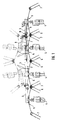
- the rotary tedder shown schematically in Fig. 1 comprises a Frame 1 with two inner frame parts 2 and two articulated, can be swiveled upwards into the dashed driving or non-use position outer frame parts 3, an impeller 4 on each of the frame parts 2 and 3 and a gyro unit 5 with one another meshing in the operating position according to FIG. 1 engaging tine groups 6, 7 is arranged.
- an impeller 4 on each of the frame parts 2 and 3 and a gyro unit 5 with one another meshing in the operating position according to FIG. 1 engaging tine groups 6, 7 is arranged.
- From a common Not shown drive in the drawbar to the towing vehicle are the individual Gyro 5 driven by drive shafts 8, 9 which are in the area of the joints 10 between the inner and outer frame parts 2, 3 via separable articulated Claw couplings are interconnected.
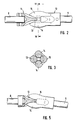
- the substantially identical claw coupling parts 11 and 12 include in the illustrated embodiment, two for each drive shaft 8, 9 parallel spaced spindle-shaped driver bodies 13 and 14, according to a preferred embodiment shown in FIG. 7, one of the Driver body 13 'is shorter than the other driver body 13, so that when engaging, as shown in Fig. 6, not in one position can hit both tips of the driver body and each other therefore the coupling halves do not mutually screw into the coupling position can hinder.
- Fig. 5 it is indicated that the shape of the spindle-shaped driver body 13, 14 is chosen so that taking into account the possible bends in operation the frame parts 2, 3 against each other, resulting in a corresponding Bending the drive shafts 8, 9 leads, the driver body always fully in Stand in engagement and can thus transmit a rotational movement with as little play as possible.
- Fig. 4 it can also be seen that the training is made such that the pivot angle a of the outer frame part 3 with respect to the inner frame part 2, in which the engagement or disengagement of the driver bodies 13, 14 takes place, is smaller than the swivel angle from which the tines 6, 7 to the Frame parts 2 and 3 attached gyro units 5 interlock. Thereby it is ensured that the driver bodies 13, 13 '; 14 of the claw coupling parts 11, 12 when moving together rotated by 180 ° against each other Have brought position according to FIG.
Landscapes
- Engineering & Computer Science (AREA)
- General Engineering & Computer Science (AREA)
- Mechanical Engineering (AREA)
- Soil Working Implements (AREA)
- Seal Device For Vehicle (AREA)
- Flanged Joints, Insulating Joints, And Other Joints (AREA)
- Clamps And Clips (AREA)
- Replacement Of Web Rolls (AREA)
- Agricultural Machines (AREA)
Abstract
Description
Die Erfindung bezieht sich auf eine trennbare Klauenkupplung, insbesondere zum Antrieb von Heumaschinen mit gelenkig aneinander angelenkten Rahmenteilen, wobei die Schwenkachse des Rahmengelenks in Abstand von der Rotationsachse der Kupplung angeordnet ist.The invention relates to a separable claw coupling, in particular for Drive of hay machines with articulated frame parts, the pivot axis of the frame joint at a distance from the axis of rotation the clutch is arranged.
Damit sich die einzelnen Arbeitselemente von Heumaschinen mit großer Arbeitsbreite den Bodenunebenheiten anpassen können, sind diese an gelenkig miteinander verbundenen Rahmenteilen angeordnet. Die in den Rahmenteilen laufenden Antriebswellen sind an den Gelenkstellen durch Kupplungen verbunden, welche in Betriebsstellung die zur Bodenanpassung erforderliche Winkelabweichung (Abknickung) des Antriebsstranges zulassen, siehe EP-A-370933. Zur Verringerung der Transportbreite werden die äußeren Rahmenteile nach oben oder nach hinten verschwenkt. Dabei ist es vorteilhaft, wenn die Wellenkupplungen getrennt werden, so daß sich die einzelnen Arbeitsorgane (z.B. Rechkreisel) unabhängig voneinander bewegen können. Beim Zurückschwenken in die Arbeitsstellung müssen die Kupplungen wieder in einer bestimmten Lage zueinander eingreifen, damit der Synchronlauf der ineinandergreifenden Zettkreisel gewährleistet ist.So that the individual working elements of hay machines with a large working width can adapt to the unevenness of the floor, these are articulated with each other connected frame parts arranged. The ones running in the frame parts Drive shafts are connected at the articulation points by couplings, which in the operating position the angular deviation required for ground adaptation Allow (kinking) of the drive train, see EP-A-370933. To reduce the transport width the outer frame parts are pivoted upwards or backwards. It is advantageous if the shaft couplings are separated so that move the individual work organs (e.g. rake gyroscope) independently of one another can. When swiveling back into the working position, the couplings must intervene again in a certain position so that the synchronous operation the interlocking tedder is guaranteed.
Bei den bisher bekannten Ausführungen wie DP 1 266 556 oder DBGM 9306787 werden Klauenkupplungen verwendet, welche beim Verschwenken der Rahmenteile in die Transportstellung außer Eingriff gelangen. Beim Umstellen in die Arbeitsstellung müssen die beiden Kupplungsteile so zueinander positioniert werden, daß die Kupplungsklauen ineinandergreifen können. Dieses ist problemlos möglich, wenn wie bisher üblich der Umstellvorgang von Hand durchgeführt wird, und dabei die Kreisel zueinander in die geeignete Stellung gedreht werden.In the previously known versions such as DP 1 266 556 or DBGM 9306787 claw couplings are used, which when pivoting the frame parts disengaged in the transport position. When switching to the working position the two coupling parts must be positioned in relation to each other that the clutch claws can interlock. This is no problem possible if the changeover process is carried out by hand as usual, and the rotors are rotated to each other in the appropriate position.
Zur Erhöhung des Bedienungskomforts wird auch für derartige Maschinen verlangt, daß der Umstellvorgang ohne Kraftanstrengung vom Schleppersitz aus mit hydraulischen Stellgliedern durchgeführt werden kann. Solche hydraulische Umstellvorrichtungen sollten auch als Sonderausrüstungen an handbetätigte Maschinen nachrüstbar sein. Bei Maschinen, welche mit bisher bekannten Klauenkupplungen ausgerüstet sind, ist jedoch eine derartige hydraulische Betätigung nicht möglich, da die Klauenkupplungen nicht in jeder Position ineinandergreifen können und bei ungünstiger Stellung durch die Kraft der Hydrozylinder zerstört werden.To increase the ease of use, it is also required for such machines that that the changeover process without effort from the tractor seat with hydraulic actuators can be performed. Such hydraulic changeover devices should also be used as special equipment on hand-operated machines can be retrofitted. For machines that have previously known dog clutches are equipped, however, such a hydraulic actuation is not possible because the dog clutches cannot interlock in every position and in an unfavorable position can be destroyed by the force of the hydraulic cylinders.
Der Erfindung liegt daher die Aufgabe zugrunde, eine trennbare gelenkige Klauenkupplung der eingangs genannten Art so auszugestalten, daß beim Einschwenken der Kupplung in die Arbeitsstellung das Ineinandergreifen der Klauenkupplungsteile unabhängig von der jeweiligen Stellung dieser Teile relativ zueinander möglich ist.The invention is therefore based on the object of a separable articulated claw coupling of the type mentioned in such a way that when swiveling the clutch in the working position the meshing of the claw coupling parts regardless of the position of these parts relative to each other is possible.
Zur Lösung dieser Aufgabe sind erfindungsgemäß die Merkmale des Anspruchs 1 vorgesehen.To achieve this object, the features of claim 1 are provided according to the invention.
Durch die erfindungsgemäße Ausgestaltung, bei der die einzelnen Mitnehmerkörper nach vorne zum freien Ende hin spitz auslaufen, kann ein blockierendes Aufeinandertreffen der Mitnehmerkörper praktisch nicht vorkommen, da selbst bei einem Aufeinandertreffen der Spitzen zweier Mitnehmerkörper der Klauenkupplungsteile diese aneinander abgleiten können, wobei sie sich dann jeweils in um 90° verdrehte Stellungen verdrehen, die der Kupplungsbetriebsstellung entsprechen. Noch sicherer läßt sich die Gefahr einer Blockierung beim Zusammenfahren der Klauenkupplungsteile infolge des Schwenkens der aneinander angelenkten Rahmenteile in die gestreckte Arbeitsposition in Ausgestaltung der Erfindung dadurch vermeiden, daß an einer Klauenkupplungshälfte wenigstens ein Mitnehmerkörper kürzer ausgebildet ist als der (die) andere(n).Due to the configuration according to the invention, in which the individual driver bodies tapering towards the free end can result in a blocking encounter the driver body practically does not occur because even at a meeting of the tips of two driver bodies of the claw coupling parts these can slide against each other, whereby they then each in um Turn the 90 ° rotated positions that correspond to the clutch operating position. The danger of a blockage when moving together can be even more secure the claw coupling parts as a result of the pivoting of the articulated Frame parts in the extended working position in an embodiment of the invention Avoid having at least one driver body on one claw coupling half is shorter than the other (s).
Um bei der Verwendung einer erfindungsgemäßen trennbaren gelenkigen Klauenkupplung für den Antrieb von Heumaschinen zu vermeiden, daß beim Schwenken der Rahmenteile in die Betriebsstellung die Kreiseleinheiten mit ihren Zinken blockierend aufeinanderfahren können, kann in Weiterbildung der Erfindung vorgesehen sein, daß der Schwenkwinkel a der Rahmenteile, ab dem die Klauenkupplungsteile in Eingriff stehen, kleiner ist als der Schwenkwinkel, ab dem sich die zugeordneten Kreiseleinheiten überdecken.To when using a separable articulated claw coupling according to the invention for driving hay machines to avoid that when swiveling the frame parts in the operating position the rotor units with their tines can move towards each other blocking, can be provided in a development of the invention be that the pivot angle a of the frame parts, from which the claw coupling parts engage, is smaller than the swivel angle from which cover the assigned gyro units.
Durch diese Ausgestaltung erfolgt zunächst das Einkuppeln der Klauenkupplungsteile, wodurch automatisch die Kreiseleinheiten ebenfalls in eine Position verdreht werden, bei denen die Zinken des einen Kreisels in Lücken zwischen Zinken des anderen Kreisels eingreifen, so daß beim Weiterverschwenken die angesprochene Blockierung niemals stattfinden kann.With this configuration, the claw coupling parts are first engaged, which also automatically rotates the gyro units into one position be in which the tines of the one spinning top in gaps between tines of the intervene in another gyro so that when swiveling further the mentioned one Blocking can never take place.
Die Mitnehmerkörper sind so gestaltet, daß sie bei den im Betrieb möglichen Abwinklungen der Rahmenteile gegeneinander stets voll in Eingriff stehen und so eine Drehbewegung möglichst spielfrei übertragen können.The driver bodies are like this designed to be able to bend the frame parts during operation are always fully engaged against each other and thus a rotary movement as possible can transmit without play.
Weitere Vorteile, Merkmale und Einzelheiten der Erfindung ergeben sich aus der nachfolgenden Beschreibung eines Ausführungsbeispiels sowie anhand der Zeichnung. Dabei zeigen:
- Fig. 1
- die Rückansicht eines Kreiselzettwenders mit erfindungsgemäßen trennbaren Klauenkupplungen, wobei gestrichelt die hochgeschwenkte Nichtarbeitsstellung der äußeren Rahmenteile mit den daran befestigten Kreiseleinheiten mit eingezeichnet ist,
- Fig. 2
- eine vergrößerte Ansicht der in Eingriffstellung befindlichen Klauenkupplungsteile,
- Fig. 3
- einen Schnitt längs der Linie III-III in Fig. 2,
- Fig. 4
- eine vergrößerte Ansicht des Gelenkbereichs zwischen zwei Rahmenteilen in der Stellung, in der die Kupplungsteile gerade außer Eingriff gelangt sind,
- Fig. 5
- eine der Fig. 2 entsprechende vergrößerte Ansicht der Klauenkupplung, bei der das mögliche Winkelspiel der Rahmenteile gegeneinander eingezeichnet ist,
- Fig. 6
- eine vergrößerte Ansicht der Kupplung beim Aufeinanderfahren "Spitze auf Spitze" der Mitnehmerkörper der Klauenkupplungsteile, und
- Fig. 7
- eine Draufsicht auf die Klauenkupplung entsprechend Fig. 6 von oben, wobei abweichend von der Anordnung nach Fig. 6 einer der Mitnehmerkörper des linken Klauenkupplungsteils kürzer ausgebildet ist als der andere.
- Fig. 1
- the rear view of a rotary tedder with separable claw clutches according to the invention, the broken-up non-working position of the outer frame parts with the attached rotary units is also shown,
- Fig. 2
- 3 shows an enlarged view of the claw coupling parts in the engaged position,
- Fig. 3
- 2 shows a section along the line III-III in FIG. 2,
- Fig. 4
- 2 shows an enlarged view of the joint area between two frame parts in the position in which the coupling parts have just come out of engagement,
- Fig. 5
- 2 shows an enlarged view of the claw coupling corresponding to FIG. 2, in which the possible angular play of the frame parts relative to one another is shown,
- Fig. 6
- an enlarged view of the coupling when moving together "tip to tip" the driver body of the claw coupling parts, and
- Fig. 7
- a top view of the claw coupling according to FIG. 6 from above, wherein, deviating from the arrangement according to FIG. 6, one of the driver bodies of the left claw coupling part is shorter than the other.
Der in Fig. 1 schematisch von hinten gezeigte Kreiselzettwender umfaßt einen
Rahmen 1 mit zwei inneren Rahmenteilen 2 und zwei gelenkig daran angelenkten,
nach oben in die gestrichelte Fahr- oder Nichtgebrauchstellung schwenkbaren
äußeren Rahmenteilen 3, wobei an jedem der Rahmenteile 2 und 3 ein Laufrad 4
und eine Kreiseleinheit 5 mit in der Betriebsstellung nach Fig. 1 kämmend ineinander
eingreifenden Zinkengruppen 6, 7 angeordnet ist. Von einem gemeinsamen
nicht gezeichneten Antrieb in der Deichsel zum Zugfahrzeug werden die einzelnen
Kreisel 5 durch Antriebswellen 8, 9 angetrieben, die im Bereich der Gelenke 10
zwischen den inneren und äußeren Rahmenteilen 2, 3 über trennbare gelenkige
Klauenkupplungen miteinander verbunden sind.The rotary tedder shown schematically in Fig. 1 comprises a
Frame 1 with two
Die im wesentlichen gleich ausgebildeten Klauenkupplungsteile 11 und 12 umfassen
dabei im dargestellten Ausführungsbeispiel jeweils zwei zur jeweiligen Antriebswelle
8, 9 parallele beabstandete spindelfömige Mitnehmerkörper 13 und 14,
wobei gemäß einer bevorzugten in Fig. 7 dargestellten Ausführungsform einer der
Mitnehmerkörper 13' kürzer ausgebildet ist als der andere Mintnehmerkörper 13,
so daß beim Einkuppelvorgang, wie er in Fig. 6 gezeigt ist, bei einer Stellung nicht
jeweils beide Spitzen der Mitnehmerkörper aneinanderstoßen können und sich
dadurch die Kupplungshälften nicht gegenseitig am Eindrehen in die Kuppelposition
behindern können. The substantially identical
In Fig. 5 ist angedeutet, daß die Form der spindelförmigen Mitnehmerkörper 13,
14 so gewählt ist, daß auch unter Berücksichtigung der im Betrieb möglichen Abwinklungen
der Rahmenteile 2, 3 gegeneinander, was zu einer entsprechenden
Abwinklung auch der Antriebswellen 8, 9 führt, die Mitnehmerkörper stets voll in
Eingriff stehen und so eine Drehbewegung möglichst spielfrei übertragen können.In Fig. 5 it is indicated that the shape of the spindle-
Aus Fig. 4 erkennt man darüber hinaus, daß die Ausbildung so getroffen ist, daß
der Schwenkwinkel a des äußeren Rahmenteils 3 gegenüber dem inneren Rahmenteil
2, bei welchem das Ein- bzw. Auskuppeln der Mitnehmerkörper 13, 14
stattfindet, kleiner ist als der Schwenkwinkel, ab dem die Zinken 6, 7 der an den
Rahmenteilen 2 und 3 befestigten Kreiseleinheiten 5 ineinandergreifen. Dadurch
ist sichergestellt, daß zunächst die Mitnehmerkörper 13, 13'; 14 der Klauenkupplungsteile
11, 12 sich beim Zusammenfahren in die um 180° gegeneinander verdrehte
Position gemäß Fig. 3 gebracht haben und damit auch die zugehörigen
Kreiseleinheiten 5 derart verdreht haben, daß ihre Zinken zum gegenseitigen Eingriff
gegeneinander versetzt sind, so daß beim weiteren Herunterklappen des äußeren
Rahmenteils 3 gegenüber dem inneren Rahmenteil 2 eine Blockierung der
Kreiseleinheiten durch Aufeinanderfahren der Zinkenteile 6, 7 sicher verhindert ist.From Fig. 4 it can also be seen that the training is made such that
the pivot angle a of the
Claims (3)
- Separable claw clutch, in particular for driving hay machines having frame parts coupled together pivotably, wherein the pivotal axis of the frame hinge is disposed at a distance from the axis of rotation of the clutch, characterised in that each of the two claw clutch parts (11, 12) of identical construction has only two spaced, spindle-shaped driver bodies (13, 13'; 14), which are substantially parallel to the respective drive shaft (8, 9) and in that the driver bodies (13, 13'; 14) are so formed that they are fully in mesh with one another at the angles of the frame parts (2, 3) possible in operation.
- Separable claw clutch according to claim 1, characterised in that the pivotal angle a of the frame parts (2, 3) starting from which the claw clutch parts (11, 12) mesh, is smaller than the pivotal angle starting from which the associated gyratory units (5) overlap.
- Separable claw clutch according to one of claims 1 to 2, characterised in that on one clutch half, at least one driver body (13') is formed shorter than the other clutch body (13).
Applications Claiming Priority (2)
| Application Number | Priority Date | Filing Date | Title |
|---|---|---|---|
| DE29609520U | 1996-05-29 | ||
| DE29609520U DE29609520U1 (en) | 1996-05-29 | 1996-05-29 | Separable articulated claw coupling |
Publications (2)
| Publication Number | Publication Date |
|---|---|
| EP0809927A1 EP0809927A1 (en) | 1997-12-03 |
| EP0809927B1 true EP0809927B1 (en) | 2001-02-14 |
Family
ID=8024517
Family Applications (1)
| Application Number | Title | Priority Date | Filing Date |
|---|---|---|---|
| EP97106978A Expired - Lifetime EP0809927B1 (en) | 1996-05-29 | 1997-04-26 | Separable articulated claw coupling |
Country Status (3)
| Country | Link |
|---|---|
| EP (1) | EP0809927B1 (en) |
| AT (1) | ATE199114T1 (en) |
| DE (2) | DE29609520U1 (en) |
Cited By (1)
| Publication number | Priority date | Publication date | Assignee | Title |
|---|---|---|---|---|
| US12181004B2 (en) | 2021-06-22 | 2024-12-31 | JSI Equipment Solutions LLC | Flexible coupling for a drive train |
Families Citing this family (1)
| Publication number | Priority date | Publication date | Assignee | Title |
|---|---|---|---|---|
| DE202009015958U1 (en) | 2009-11-23 | 2011-04-07 | Kverneland Asa | Rotary coupling and agricultural machine |
Family Cites Families (5)
| Publication number | Priority date | Publication date | Assignee | Title |
|---|---|---|---|---|
| DE1507338C3 (en) * | 1966-11-19 | 1978-07-13 | Massey-Ferguson Industries Ltd., Toronto, Ontario (Kanada) | Coupling for connecting the world end of the transverse drive shaft of a combine harvester cutting table with the shaft end of the parallel drive shaft of the elevator part |
| DE2740911A1 (en) * | 1977-09-10 | 1979-03-22 | Kloeckner Humboldt Deutz Ag | CLAW CLUTCH |
| NL8800065A (en) * | 1987-06-23 | 1989-01-16 | Lely Nv C Van Der | HAY CONSTRUCTION MACHINE. |
| FR2641936B2 (en) * | 1988-11-21 | 1992-01-03 | Kuhn Sa | |
| FR2740653B1 (en) * | 1995-11-07 | 1998-01-30 | Kuhn Sa | HAYMAKING MACHINE, ESPECIALLY A TEDDER, COMPRISING A FRAMEWORK WITH FOLDABLE SIDE PARTS |
-
1996
- 1996-05-29 DE DE29609520U patent/DE29609520U1/en not_active Expired - Lifetime
-
1997
- 1997-04-26 DE DE59702994T patent/DE59702994D1/en not_active Expired - Fee Related
- 1997-04-26 EP EP97106978A patent/EP0809927B1/en not_active Expired - Lifetime
- 1997-04-26 AT AT97106978T patent/ATE199114T1/en not_active IP Right Cessation
Cited By (1)
| Publication number | Priority date | Publication date | Assignee | Title |
|---|---|---|---|---|
| US12181004B2 (en) | 2021-06-22 | 2024-12-31 | JSI Equipment Solutions LLC | Flexible coupling for a drive train |
Also Published As
| Publication number | Publication date |
|---|---|
| DE29609520U1 (en) | 1996-08-29 |
| EP0809927A1 (en) | 1997-12-03 |
| DE59702994D1 (en) | 2001-03-22 |
| ATE199114T1 (en) | 2001-02-15 |
Similar Documents
| Publication | Publication Date | Title |
|---|---|---|
| AT389974B (en) | CYLINDER HAY ADVERTISING MACHINE | |
| EP0277343B1 (en) | Mowing machine | |
| EP0131853A1 (en) | Maize harvester | |
| DE60320097T2 (en) | Hay-making machine | |
| DE69628598T2 (en) | Hay-making machine | |
| DE60003614T2 (en) | TOWING MACHINE WITH AT LEAST ONE ROTOR FOR SWATHING WITH POSITION ADJUSTABLE PLATE | |
| DE2111227A1 (en) | Harvester | |
| DE102019002828B3 (en) | mower | |
| DE68916191T2 (en) | Agricultural machine, in particular for hay advertising with a multi-part swiveling frame. | |
| DE9312222U1 (en) | Haymaking machine | |
| EP0291812B1 (en) | Agricultural machine, especially a rotary tedder | |
| EP1769668B1 (en) | Harvester head with pivoting frame for agricultural machines | |
| EP2923541B1 (en) | Agricultural cultivation device | |
| DE19620063A1 (en) | Suspension and drive arrangement for work units attached to one or both sides of a carrier vehicle | |
| DE69705337T2 (en) | Hay-making machine | |
| DE2844235A1 (en) | HAY ADVERTISING MACHINE | |
| EP0809927A1 (en) | Separable articulated claw coupling | |
| DE3029502C2 (en) | ||
| DE10021660C2 (en) | Harvester, especially self-propelled forage harvesters | |
| DE602005005143T2 (en) | Hay-making machine | |
| DE910028C (en) | Device for coupling the semitrailer of articulated lorries | |
| DE69604317T2 (en) | Haymaking machine | |
| EP4344528B1 (en) | Header for frontal attachment to a harvester with a mulching unit | |
| DE2617970A1 (en) | HAYMAKING MACHINE | |
| EP3823430B1 (en) | Agricultural device having an articulated shaft drive |
Legal Events
| Date | Code | Title | Description |
|---|---|---|---|
| PUAI | Public reference made under article 153(3) epc to a published international application that has entered the european phase |
Free format text: ORIGINAL CODE: 0009012 |
|
| AK | Designated contracting states |
Kind code of ref document: A1 Designated state(s): AT DE FR |
|
| 17P | Request for examination filed |
Effective date: 19980516 |
|
| 17Q | First examination report despatched |
Effective date: 19981014 |
|
| GRAG | Despatch of communication of intention to grant |
Free format text: ORIGINAL CODE: EPIDOS AGRA |
|
| GRAG | Despatch of communication of intention to grant |
Free format text: ORIGINAL CODE: EPIDOS AGRA |
|
| GRAH | Despatch of communication of intention to grant a patent |
Free format text: ORIGINAL CODE: EPIDOS IGRA |
|
| GRAH | Despatch of communication of intention to grant a patent |
Free format text: ORIGINAL CODE: EPIDOS IGRA |
|
| GRAA | (expected) grant |
Free format text: ORIGINAL CODE: 0009210 |
|
| AK | Designated contracting states |
Kind code of ref document: B1 Designated state(s): AT DE FR |
|
| REF | Corresponds to: |
Ref document number: 199114 Country of ref document: AT Date of ref document: 20010215 Kind code of ref document: T |
|
| ET | Fr: translation filed | ||
| REF | Corresponds to: |
Ref document number: 59702994 Country of ref document: DE Date of ref document: 20010322 |
|
| PLBE | No opposition filed within time limit |
Free format text: ORIGINAL CODE: 0009261 |
|
| STAA | Information on the status of an ep patent application or granted ep patent |
Free format text: STATUS: NO OPPOSITION FILED WITHIN TIME LIMIT |
|
| 26N | No opposition filed | ||
| PGFP | Annual fee paid to national office [announced via postgrant information from national office to epo] |
Ref country code: FR Payment date: 20030401 Year of fee payment: 7 |
|
| PGFP | Annual fee paid to national office [announced via postgrant information from national office to epo] |
Ref country code: AT Payment date: 20030424 Year of fee payment: 7 |
|
| PGFP | Annual fee paid to national office [announced via postgrant information from national office to epo] |
Ref country code: DE Payment date: 20030428 Year of fee payment: 7 |
|
| PG25 | Lapsed in a contracting state [announced via postgrant information from national office to epo] |
Ref country code: AT Free format text: LAPSE BECAUSE OF NON-PAYMENT OF DUE FEES Effective date: 20040426 |
|
| PG25 | Lapsed in a contracting state [announced via postgrant information from national office to epo] |
Ref country code: DE Free format text: LAPSE BECAUSE OF NON-PAYMENT OF DUE FEES Effective date: 20041103 |
|
| PG25 | Lapsed in a contracting state [announced via postgrant information from national office to epo] |
Ref country code: FR Free format text: LAPSE BECAUSE OF NON-PAYMENT OF DUE FEES Effective date: 20041231 |
|
| REG | Reference to a national code |
Ref country code: FR Ref legal event code: ST |