EP0808712A2 - Elément de construction, notamment matériau de revêtement de construction ou partie de bâtiment - Google Patents
Elément de construction, notamment matériau de revêtement de construction ou partie de bâtiment Download PDFInfo
- Publication number
- EP0808712A2 EP0808712A2 EP97108080A EP97108080A EP0808712A2 EP 0808712 A2 EP0808712 A2 EP 0808712A2 EP 97108080 A EP97108080 A EP 97108080A EP 97108080 A EP97108080 A EP 97108080A EP 0808712 A2 EP0808712 A2 EP 0808712A2
- Authority
- EP
- European Patent Office
- Prior art keywords
- water
- layer
- absorbent
- mat
- building
- Prior art date
- Legal status (The legal status is an assumption and is not a legal conclusion. Google has not performed a legal analysis and makes no representation as to the accuracy of the status listed.)
- Withdrawn
Links
- 239000000463 material Substances 0.000 title claims abstract description 26
- 238000010276 construction Methods 0.000 title description 5
- XLYOFNOQVPJJNP-UHFFFAOYSA-N water Substances O XLYOFNOQVPJJNP-UHFFFAOYSA-N 0.000 claims abstract description 107
- 239000002250 absorbent Substances 0.000 claims abstract description 89
- 230000002745 absorbent Effects 0.000 claims abstract description 86
- 239000004566 building material Substances 0.000 claims abstract description 69
- 239000004568 cement Substances 0.000 claims abstract description 56
- 239000000203 mixture Substances 0.000 claims abstract description 36
- 239000004567 concrete Substances 0.000 claims abstract description 34
- 230000009969 flowable effect Effects 0.000 claims abstract description 7
- 239000011505 plaster Substances 0.000 claims abstract description 6
- 238000000034 method Methods 0.000 claims description 15
- 239000000758 substrate Substances 0.000 claims description 11
- 238000010521 absorption reaction Methods 0.000 claims description 9
- 239000004033 plastic Substances 0.000 claims description 9
- 229920003023 plastic Polymers 0.000 claims description 9
- 239000004745 nonwoven fabric Substances 0.000 claims description 8
- 239000001913 cellulose Substances 0.000 claims description 7
- 238000009415 formwork Methods 0.000 claims description 6
- 229920001495 poly(sodium acrylate) polymer Polymers 0.000 claims description 6
- NNMHYFLPFNGQFZ-UHFFFAOYSA-M sodium polyacrylate Chemical compound [Na+].[O-]C(=O)C=C NNMHYFLPFNGQFZ-UHFFFAOYSA-M 0.000 claims description 6
- 239000011358 absorbing material Substances 0.000 claims description 5
- 229920002678 cellulose Polymers 0.000 claims description 5
- 238000004519 manufacturing process Methods 0.000 claims description 5
- 239000006185 dispersion Substances 0.000 claims description 3
- 239000000835 fiber Substances 0.000 claims description 3
- 239000006260 foam Substances 0.000 claims description 3
- 239000004816 latex Substances 0.000 claims description 3
- 229920000126 latex Polymers 0.000 claims description 3
- 239000004570 mortar (masonry) Substances 0.000 claims description 3
- 229920003043 Cellulose fiber Polymers 0.000 claims description 2
- 229920000742 Cotton Polymers 0.000 claims description 2
- 229920001821 foam rubber Polymers 0.000 claims description 2
- 238000007711 solidification Methods 0.000 claims 1
- 230000008023 solidification Effects 0.000 claims 1
- 230000002349 favourable effect Effects 0.000 abstract description 8
- 238000005336 cracking Methods 0.000 abstract description 7
- 238000001035 drying Methods 0.000 abstract description 7
- 235000011837 pasties Nutrition 0.000 abstract description 3
- 230000015572 biosynthetic process Effects 0.000 description 11
- 239000007788 liquid Substances 0.000 description 5
- 230000008901 benefit Effects 0.000 description 4
- 230000008094 contradictory effect Effects 0.000 description 4
- 238000012545 processing Methods 0.000 description 4
- 238000007792 addition Methods 0.000 description 3
- -1 gravel Substances 0.000 description 3
- 238000009413 insulation Methods 0.000 description 3
- 238000002156 mixing Methods 0.000 description 3
- 238000005507 spraying Methods 0.000 description 3
- 239000004698 Polyethylene Substances 0.000 description 2
- 239000000654 additive Substances 0.000 description 2
- 239000011230 binding agent Substances 0.000 description 2
- 230000003111 delayed effect Effects 0.000 description 2
- 238000009826 distribution Methods 0.000 description 2
- 238000001704 evaporation Methods 0.000 description 2
- 230000008020 evaporation Effects 0.000 description 2
- 238000007373 indentation Methods 0.000 description 2
- 229920000573 polyethylene Polymers 0.000 description 2
- 239000004576 sand Substances 0.000 description 2
- 238000012360 testing method Methods 0.000 description 2
- 230000002730 additional effect Effects 0.000 description 1
- 238000009435 building construction Methods 0.000 description 1
- 230000000052 comparative effect Effects 0.000 description 1
- 239000008032 concrete plasticizer Substances 0.000 description 1
- 239000000470 constituent Substances 0.000 description 1
- 230000007423 decrease Effects 0.000 description 1
- 238000013461 design Methods 0.000 description 1
- 230000000694 effects Effects 0.000 description 1
- 238000004049 embossing Methods 0.000 description 1
- 238000005516 engineering process Methods 0.000 description 1
- 239000012530 fluid Substances 0.000 description 1
- 238000009499 grossing Methods 0.000 description 1
- 230000036571 hydration Effects 0.000 description 1
- 238000006703 hydration reaction Methods 0.000 description 1
- 229920002521 macromolecule Polymers 0.000 description 1
- 238000005259 measurement Methods 0.000 description 1
- 239000004014 plasticizer Substances 0.000 description 1
- 238000009417 prefabrication Methods 0.000 description 1
- 230000002441 reversible effect Effects 0.000 description 1
- 238000000926 separation method Methods 0.000 description 1
- 239000007787 solid Substances 0.000 description 1
- 230000006641 stabilisation Effects 0.000 description 1
- 238000011105 stabilization Methods 0.000 description 1
- 238000003860 storage Methods 0.000 description 1
- 238000004154 testing of material Methods 0.000 description 1
Images

Classifications
-
- E—FIXED CONSTRUCTIONS
- E04—BUILDING
- E04F—FINISHING WORK ON BUILDINGS, e.g. STAIRS, FLOORS
- E04F15/00—Flooring
- E04F15/18—Separately-laid insulating layers; Other additional insulating measures; Floating floors
- E04F15/20—Separately-laid insulating layers; Other additional insulating measures; Floating floors for sound insulation
- E04F15/206—Layered panels for sound insulation
-
- B—PERFORMING OPERATIONS; TRANSPORTING
- B32—LAYERED PRODUCTS
- B32B—LAYERED PRODUCTS, i.e. PRODUCTS BUILT-UP OF STRATA OF FLAT OR NON-FLAT, e.g. CELLULAR OR HONEYCOMB, FORM
- B32B13/00—Layered products comprising a a layer of water-setting substance, e.g. concrete, plaster, asbestos cement, or like builders' material
- B32B13/04—Layered products comprising a a layer of water-setting substance, e.g. concrete, plaster, asbestos cement, or like builders' material comprising such water setting substance as the main or only constituent of a layer, which is next to another layer of the same or of a different material
- B32B13/045—Layered products comprising a a layer of water-setting substance, e.g. concrete, plaster, asbestos cement, or like builders' material comprising such water setting substance as the main or only constituent of a layer, which is next to another layer of the same or of a different material of foam
-
- B—PERFORMING OPERATIONS; TRANSPORTING
- B32—LAYERED PRODUCTS
- B32B—LAYERED PRODUCTS, i.e. PRODUCTS BUILT-UP OF STRATA OF FLAT OR NON-FLAT, e.g. CELLULAR OR HONEYCOMB, FORM
- B32B13/00—Layered products comprising a a layer of water-setting substance, e.g. concrete, plaster, asbestos cement, or like builders' material
-
- B—PERFORMING OPERATIONS; TRANSPORTING
- B32—LAYERED PRODUCTS
- B32B—LAYERED PRODUCTS, i.e. PRODUCTS BUILT-UP OF STRATA OF FLAT OR NON-FLAT, e.g. CELLULAR OR HONEYCOMB, FORM
- B32B13/00—Layered products comprising a a layer of water-setting substance, e.g. concrete, plaster, asbestos cement, or like builders' material
- B32B13/14—Layered products comprising a a layer of water-setting substance, e.g. concrete, plaster, asbestos cement, or like builders' material next to a fibrous or filamentary layer
-
- B—PERFORMING OPERATIONS; TRANSPORTING
- B32—LAYERED PRODUCTS
- B32B—LAYERED PRODUCTS, i.e. PRODUCTS BUILT-UP OF STRATA OF FLAT OR NON-FLAT, e.g. CELLULAR OR HONEYCOMB, FORM
- B32B3/00—Layered products comprising a layer with external or internal discontinuities or unevennesses, or a layer of non-planar shape; Layered products comprising a layer having particular features of form
- B32B3/26—Layered products comprising a layer with external or internal discontinuities or unevennesses, or a layer of non-planar shape; Layered products comprising a layer having particular features of form characterised by a particular shape of the outline of the cross-section of a continuous layer; characterised by a layer with cavities or internal voids ; characterised by an apertured layer
- B32B3/30—Layered products comprising a layer with external or internal discontinuities or unevennesses, or a layer of non-planar shape; Layered products comprising a layer having particular features of form characterised by a particular shape of the outline of the cross-section of a continuous layer; characterised by a layer with cavities or internal voids ; characterised by an apertured layer characterised by a layer formed with recesses or projections, e.g. hollows, grooves, protuberances, ribs
-
- B—PERFORMING OPERATIONS; TRANSPORTING
- B32—LAYERED PRODUCTS
- B32B—LAYERED PRODUCTS, i.e. PRODUCTS BUILT-UP OF STRATA OF FLAT OR NON-FLAT, e.g. CELLULAR OR HONEYCOMB, FORM
- B32B5/00—Layered products characterised by the non- homogeneity or physical structure, i.e. comprising a fibrous, filamentary, particulate or foam layer; Layered products characterised by having a layer differing constitutionally or physically in different parts
- B32B5/02—Layered products characterised by the non- homogeneity or physical structure, i.e. comprising a fibrous, filamentary, particulate or foam layer; Layered products characterised by having a layer differing constitutionally or physically in different parts characterised by structural features of a fibrous or filamentary layer
- B32B5/022—Non-woven fabric
-
- B—PERFORMING OPERATIONS; TRANSPORTING
- B32—LAYERED PRODUCTS
- B32B—LAYERED PRODUCTS, i.e. PRODUCTS BUILT-UP OF STRATA OF FLAT OR NON-FLAT, e.g. CELLULAR OR HONEYCOMB, FORM
- B32B5/00—Layered products characterised by the non- homogeneity or physical structure, i.e. comprising a fibrous, filamentary, particulate or foam layer; Layered products characterised by having a layer differing constitutionally or physically in different parts
- B32B5/18—Layered products characterised by the non- homogeneity or physical structure, i.e. comprising a fibrous, filamentary, particulate or foam layer; Layered products characterised by having a layer differing constitutionally or physically in different parts characterised by features of a layer of foamed material
-
- C—CHEMISTRY; METALLURGY
- C04—CEMENTS; CONCRETE; ARTIFICIAL STONE; CERAMICS; REFRACTORIES
- C04B—LIME, MAGNESIA; SLAG; CEMENTS; COMPOSITIONS THEREOF, e.g. MORTARS, CONCRETE OR LIKE BUILDING MATERIALS; ARTIFICIAL STONE; CERAMICS; REFRACTORIES; TREATMENT OF NATURAL STONE
- C04B40/00—Processes, in general, for influencing or modifying the properties of mortars, concrete or artificial stone compositions, e.g. their setting or hardening ability
- C04B40/0028—Aspects relating to the mixing step of the mortar preparation
- C04B40/006—Aspects relating to the mixing step of the mortar preparation involving the elimination of excess water from the mixture
-
- E—FIXED CONSTRUCTIONS
- E01—CONSTRUCTION OF ROADS, RAILWAYS, OR BRIDGES
- E01C—CONSTRUCTION OF, OR SURFACES FOR, ROADS, SPORTS GROUNDS, OR THE LIKE; MACHINES OR AUXILIARY TOOLS FOR CONSTRUCTION OR REPAIR
- E01C7/00—Coherent pavings made in situ
- E01C7/08—Coherent pavings made in situ made of road-metal and binders
- E01C7/10—Coherent pavings made in situ made of road-metal and binders of road-metal and cement or like binders
- E01C7/14—Concrete paving
- E01C7/145—Sliding coverings, underlayers or intermediate layers ; Isolating or separating intermediate layers; Transmission of shearing force in horizontal intermediate planes, e.g. by protrusions, by inlays
-
- E—FIXED CONSTRUCTIONS
- E04—BUILDING
- E04F—FINISHING WORK ON BUILDINGS, e.g. STAIRS, FLOORS
- E04F13/00—Coverings or linings, e.g. for walls or ceilings
- E04F13/02—Coverings or linings, e.g. for walls or ceilings of plastic materials hardening after applying, e.g. plaster
- E04F13/04—Bases for plaster
-
- E—FIXED CONSTRUCTIONS
- E04—BUILDING
- E04F—FINISHING WORK ON BUILDINGS, e.g. STAIRS, FLOORS
- E04F15/00—Flooring
- E04F15/18—Separately-laid insulating layers; Other additional insulating measures; Floating floors
-
- E—FIXED CONSTRUCTIONS
- E04—BUILDING
- E04F—FINISHING WORK ON BUILDINGS, e.g. STAIRS, FLOORS
- E04F15/00—Flooring
- E04F15/18—Separately-laid insulating layers; Other additional insulating measures; Floating floors
- E04F15/182—Underlayers coated with adhesive or mortar to receive the flooring
-
- E—FIXED CONSTRUCTIONS
- E04—BUILDING
- E04F—FINISHING WORK ON BUILDINGS, e.g. STAIRS, FLOORS
- E04F15/00—Flooring
- E04F15/18—Separately-laid insulating layers; Other additional insulating measures; Floating floors
- E04F15/185—Underlayers in the form of studded or ribbed plates
-
- B—PERFORMING OPERATIONS; TRANSPORTING
- B32—LAYERED PRODUCTS
- B32B—LAYERED PRODUCTS, i.e. PRODUCTS BUILT-UP OF STRATA OF FLAT OR NON-FLAT, e.g. CELLULAR OR HONEYCOMB, FORM
- B32B2307/00—Properties of the layers or laminate
- B32B2307/70—Other properties
- B32B2307/726—Permeability to liquids, absorption
-
- B—PERFORMING OPERATIONS; TRANSPORTING
- B32—LAYERED PRODUCTS
- B32B—LAYERED PRODUCTS, i.e. PRODUCTS BUILT-UP OF STRATA OF FLAT OR NON-FLAT, e.g. CELLULAR OR HONEYCOMB, FORM
- B32B2419/00—Buildings or parts thereof
-
- C—CHEMISTRY; METALLURGY
- C04—CEMENTS; CONCRETE; ARTIFICIAL STONE; CERAMICS; REFRACTORIES
- C04B—LIME, MAGNESIA; SLAG; CEMENTS; COMPOSITIONS THEREOF, e.g. MORTARS, CONCRETE OR LIKE BUILDING MATERIALS; ARTIFICIAL STONE; CERAMICS; REFRACTORIES; TREATMENT OF NATURAL STONE
- C04B2111/00—Mortars, concrete or artificial stone or mixtures to prepare them, characterised by specific function, property or use
- C04B2111/00474—Uses not provided for elsewhere in C04B2111/00
- C04B2111/00586—Roofing materials
-
- C—CHEMISTRY; METALLURGY
- C04—CEMENTS; CONCRETE; ARTIFICIAL STONE; CERAMICS; REFRACTORIES
- C04B—LIME, MAGNESIA; SLAG; CEMENTS; COMPOSITIONS THEREOF, e.g. MORTARS, CONCRETE OR LIKE BUILDING MATERIALS; ARTIFICIAL STONE; CERAMICS; REFRACTORIES; TREATMENT OF NATURAL STONE
- C04B2111/00—Mortars, concrete or artificial stone or mixtures to prepare them, characterised by specific function, property or use
- C04B2111/00474—Uses not provided for elsewhere in C04B2111/00
- C04B2111/00612—Uses not provided for elsewhere in C04B2111/00 as one or more layers of a layered structure
-
- C—CHEMISTRY; METALLURGY
- C04—CEMENTS; CONCRETE; ARTIFICIAL STONE; CERAMICS; REFRACTORIES
- C04B—LIME, MAGNESIA; SLAG; CEMENTS; COMPOSITIONS THEREOF, e.g. MORTARS, CONCRETE OR LIKE BUILDING MATERIALS; ARTIFICIAL STONE; CERAMICS; REFRACTORIES; TREATMENT OF NATURAL STONE
- C04B2111/00—Mortars, concrete or artificial stone or mixtures to prepare them, characterised by specific function, property or use
- C04B2111/60—Flooring materials
Definitions
- the invention relates to a structural part, in particular a building material covering, for example, for walkable surfaces, namely floors, paths, streets, squares or for ceilings, roofs, walls or the like, or a part of a building, for example ceiling, floor or wall, which structural part consists of a Water-binding, binding, in particular cement and aggregate-containing building material mixture, for example self-leveling screed, and a layer covered by it is built up, which covered layer consists at least in regions of absorbent or water-absorbing material.
- a building material covering for example, for walkable surfaces, namely floors, paths, streets, squares or for ceilings, roofs, walls or the like
- a part of a building for example ceiling, floor or wall
- which structural part consists of a Water-binding, binding, in particular cement and aggregate-containing building material mixture, for example self-leveling screed, and a layer covered by it is built up, which covered layer consists at least in regions of absorbent or water-absorbing material.
- the part of the building structure mentioned at the outset should therefore be able to be used both for civil engineering and building construction and is primarily characterized by its disk or layer shape, which can only refer to one covering or else to the entire building part, for example as part of a building.
- the concrete - or a comparable building material mixture - is to be set to a pumpable consistency, approximately 200 l of water per 1 ton of concrete are required with the same cement content. With a total of 150 kg of cement and 850 kg of gravel, sand and similar aggregates and 200 l of water, this means a water-cement value of around 1.33. Such concrete tends to shrink and crack.
- the invention has for its object to provide a structural part of the type mentioned, in which the building material mixture, for example concrete or liquid screed, can be mixed with excess water and processed, the shrinkage should be reduced so that cracking is reduced despite the lack of post-treatment or is avoided.
- the building material mixture for example concrete or liquid screed
- the absorbent or water-absorbing layer is arranged on a water-impermeable layer or film and consists of a water-releasing material.
- the water-cement value can advantageously be reduced by the excess water, which counteracts the shrinkage of the component in a manner known per se.
- the water initially absorbed by the water-absorbing layer is released by the latter again to the structural part or building material covering.
- the return of this water, which was initially absorbed by the water-absorbing layer, to the part of the structure surprisingly has an additional effect in terms of reducing the shrinkage, as has been the case up to now could only be achieved by a time-consuming aftertreatment by repeatedly spraying with water over a longer period of time.
- a ton of concrete or screed or the like consists of 150 kg of cement and 850 kg of other components, approx. 105 l of water are provided for mixing at a water-cement value of 0.7.
- 45 l of water must be absorbed by the absorbent or water-absorbing layer per ton of concrete or similar building material mixture.
- the mixing water is reduced to 60 l per ton in a certain time, bringing it to a practical ideal value for the water-cement value.
- the ratio of 60 kg water to 150 kg cement is the desired water-cement value of 0.4.
- the first withdrawn 45 l of water are then available again for "internal post-treatment".
- the shrinkage of the concrete due to setting from drying out is less than 0.3 mm per meter, which is less than the shrinkage of a conventional cement screed, in which this value is approximately 0.6 mm per meter.
- a ton of concrete consists of 250 kg of cement and 750 kg of aggregates, as well as a plasticizer and 140 l of water. This means a water-cement value of 0.56. If 40 l of water is removed from this concrete again before the stiffening (which can be shortened by accelerating or lengthened by decelerating) through the absorbent layer or mat, this results in a ratio of 100 l of water to 250 kg of cement, i.e. a water-cement Value of 0.4, which is particularly favorable in practice.
- the absorbent layer or mat according to the invention thus determines the achievable water-cement value and the duration or intensity of the aftertreatment by its material properties, its volume or porosity, that is to say by its reversible fluid absorption capacity. Under certain circumstances, this can even be brought below the value of 0.4, but can also be higher if desired or required.
- the building material quality can thus be determined or at least significantly influenced by the absorbent layer.
- the absorbent layer is sprayed on, poured on or cast on or formed as a mat on the substructure or sub-floor or formwork that receives the building material covering or part of the building - during its manufacture - or has the water-impermeable layer. If it is a floor, the absorbent layer can therefore be placed on the substrate before the actual floor or covering is made from the building material mixture containing the cement dressed form is applied over it. If it is a part of a building, such as a ceiling, the absorbent layer can be applied to the formwork before the concrete that forms the ceiling is poured over it.
- an embodiment of the invention of very considerable and advantageous importance can consist in that the surface of the absorbent layer or mat facing the mixed building material mixture is increased by elevations in the form of bulges and / or to increase the water absorption capacity. or indentations is enlarged, the elevations and / or indentations having, for example, the shape of spherical, hemispherical, undulating, conical, paraboloidal or similar curvatures or can be designed as cuboids, flat cylinders or the like.
- the invention makes use of the above-mentioned features and measures, in particular the knowledge that when a building material mixture is made up with excess water and then the excess water is temporarily drawn off with the aid of the absorbent layer of cement or similar binders, approximately the amount of water that it holds required for setting, so that a favorable water-cement value arises despite the original excess of water and the building material part is kept moist for as long as possible, which further reduces the shrinkage.
- the absorbent layer or mat can release the excess water at first, it is advantageous if it consists of one the water is physically binding material. Thus, an excess is initially absorbed, however, the water can then be returned to the building material body when it sets and dries and this then creates a moisture gradient from the absorbent layer to the building material.
- the absolute water absorption capacity depends on the volume of the absorbent layer or mat. It is therefore expedient if the thickness or average thickness of the absorbent layer or mat is proportional to the thickness of the layer of screed, plaster, mortar, concrete or the like setting material to be applied. In the case of a thicker layer of setting material, the absorbent layer or mat is also thicker in order to be able to absorb more excess mixing water.
- the absorbent layer or mat can have a full cross-section and fill the space it forms between the setting layer and the water-impermeable layer. Thus, it also contributes to the stabilization of the entire structural part to which it belongs.
- the absorbent layer or mat is arranged on a water-impermeable layer or film, in particular on a heat and / or sound-insulating layer made of natural or plastic. This can also prevent the liquid or moisture absorbed by the absorbent layer or mat from reaching an area below it, for example an underlying ceiling of a next lower floor.
- the material of the water-absorbing layer can also contribute to a favorable overall result.
- the absorbent layer or mat can contain or consist of sodium polyacrylate and the sodium polyacrylate can in particular be microencapsulated.
- This material is known to have a high absorption capacity for water and is successfully used in children's diapers, for example.
- the microencapsulation which may be provided can be carried out in the manner described in the book by Hans-Georg Elias "Macromolecules" Volume 2 Technology, Hythig + Wepf Verlag, Basel, Heidelberg, New York, 5th ed. (1992), pp. 700 to 702.
- the absorbent layer or mat can also consist of foam or foam rubber, for example moltoprene.
- foam or foam rubber for example moltoprene.
- This is an inexpensive, yet robust and highly absorbent material, but it can also give off the absorbed water again when the layer of water-bound building material sets and dries, so that it is then kept moist for a long time in the desired manner.
- the absorbent layer or mat may be or to consist of a nonwoven fabric which in particular has one or more layers of cellulose and / or cotton fibers.
- a nonwoven fabric which in particular has one or more layers of cellulose and / or cotton fibers.
- Such nonwovens or cellulose are also used, for example, as medical records and have also proven themselves in the absorption of liquids. They are particularly suitable for the temporary storage of water according to the invention because of their simple and inexpensive production and the large variation possibilities.
- the nonwoven fabric can be strengthened or reinforced by needles, in particular admixed plastic fibers, which are optionally melted, or by latex dispersions or the like. This benefits the strength of the corresponding building material body.
- An absorbent layer or mat formed in this way can of course additionally contain sodium polyacrylate.
- the water-removing can also Effect of this absorbent layer or mat can be delayed. As a result, a certain amount of time can be gained for any necessary processing of such a concrete or screed layer. In this way, large-area surfaces can be produced without the connection points that arise during the gradual application of the mixed building material mixture being partially tied.
- This delayed effect of water removal can also be achieved in that sodium polyacrylate is present in microencapsulated form in the manner already mentioned.
- a further embodiment of the invention and in this connection the absorbent layer on the one hand and the water-impermeable layer on the other hand can consist in that the absorbent layer or mat, in particular the cellulose or nonwoven fabric, on its side facing away from the building material mixture in the use position - in the case of a floor or screed on the underside - is impermeable to water and thus also forms the impermeable layer, or is connected, in particular glued, to a impermeable layer or film.
- the water-absorbing or absorbent layer and the water-impermeable layer or film can be connected to one another in a prefabricated manner.
- the water-impermeable layer or film can also be connected to it, so that the processor saves one work step at the construction site, namely the separate laying of the water-impermeable layer or film under the absorbent layer.
- the absorbent layer or mat can be shaped differently. It is possible for the absorbent layer or mat to have an essentially constant thickness or thickness even when the surface is enlarged by elevations, bulges or projections and / or depressions. It could therefore be formed, for example, by an embossing process or the like, and nevertheless due to the fact that it remains largely the same Thickness or thickness practically everywhere have a constant water absorption capacity per unit area.
- a method according to the invention for producing a structural part with a layer containing cement or the like setting material and a layer covered by it, which can be a sub-surface or formwork - in the case of a ceiling construction as a structural part - provides that the covered layer consists of water-absorbing material the substrate is applied and the building material mixture containing the setting material is poured over, this building material mixture being prepared beforehand with an excess of water.
- this method provides that the layer of water-absorbing or water-absorbing material is applied to a water-impermeable layer or film.
- the water absorbed by the absorbent layer is gradually released back to the setting and / or set layer at least partially in order to keep it moist over a longer period of time, which counteracts further shrinkage and crack formation.
- the absorbent layer can be made from an initially flowable and then hardening plastic and on the water-impermeable layer, in particular a water-impermeable surface distributed, for example poured or sprayed on. But it is also possible that it is simply placed on the surface as a prefabricated mat or consisting of loose bodies.
- projections and depressions can be formed on the surface after it has been distributed on the substrate and before it solidifies. This not only increases the surface area, but also ensures that vault-like structures are created on the underside of the building material layer, which increase strength and counteract crack formation.
- a flowing cement screed is poured in a layer thickness of 40 mm into a mold that is 1000 mm long and 80 mm wide and which allows the measurement of the change in length of the molded part.
- the water-cement value in the comparison test on polyethylene film was 0.77.
- a cellulose mat is placed on the water-impermeable film and the liquid screed is poured onto it. After 45 minutes, so much water has been removed from the building material mixture that the water-cement value is 0.63, after 6 hours it has dropped to 0.55. About 65% of the water that is initially extracted is returned to the building material within 28 days.
- the drying shrinkage in the comparative test is 0.54 mm / m, in the construction according to the invention 0.24 mm / m. Even after 10 months, the improvement in shrinkage in the structure according to the invention is clearly pronounced at 0.25 mm / m. Those skilled in the art will appreciate this improvement, which is decisive for crack formation or the absence of cracks.
- the evaporation on the surface of the molded part was approximately the same in both cases. This makes it clear that the structure according to the invention creates the water that escapes through evaporation by returning the water initially absorbed by the absorbent layer, quasi conditions that are similar to hardening and setting under water, which is known to reduce shrinkage.
- the structure according to the invention has the additional advantage, initially to reduce the water-cement value, which of course is not possible when building materials harden under water, quite apart from the fact that it would hardly be applicable in practice.
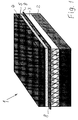
- a structural part designated as a whole with 1 is composed of several layers of different materials and could belong to an accessible area, namely the floor of a building or a factory building, a path, a street, a square or the like.
- it is a building ceiling that has a raw concrete ceiling 2 as the bottom layer, on which an insulation board 3 lies in this exemplary embodiment.
- the uppermost layer of this structural part 1 is a screed 4, however, depending on the application, this uppermost layer could also be a concrete and - in the case of a structural part 1 designed as a wall - a plaster.
- this uppermost or outermost layer 4 in FIG. 1 is formed from a building material mixture which is made up with excess water and which in particular contains cement and additives.
- a layer or mat 5 covered by the binding building material which consists of a reversibly absorbent or water-absorbing material, for example cellulose or nonwoven. This lies on a water-impermeable layer 8, for example a polyethylene film.
- the building material layer 4 is then applied with excess water, it can be distributed and processed quickly and well due to the excess water, but the excess water is then absorbed by this layer or mat 5, while only about the amount of water is held in the building material mixture, the cement or similar binders, required for the setting process, so that practically no shrinkage and no cracking occurs during setting and drying, which is promoted considerably by keeping this layer of building material 4 moist over a longer period of time because the absorbent layer 5 has at least part releases the absorbed water back to the building material layer 4.
- the absorbent layer 5 can be sprayed or poured onto the substrate 2 or sub-floor receiving the building material covering 4 or possibly a formwork and possibly provided with elevations and depressions on its surface to enlarge it, the absorbent layer 5 is expediently designed as a mat, designed in the desired size can be. In the following, the absorbent layer is therefore also referred to as mat 5.
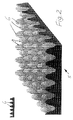
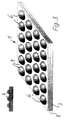
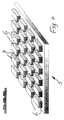
- FIGs 2 to 5 different embodiments of this mat 5 made of absorbent material are shown, all of which have in common that to increase the water absorption capacity the surface facing the mixed building material and layer 4 by elevations 6 in the form of different curvatures or projections (Fig. 1 to 4) or recesses 7 (Fig.5) is enlarged.
- the elevations have the shape of hemispherical (Fig. 3) or undulating (Fig. 1 and 2) curvatures, whereby the elevations 6 of Figs. 1 and 2 can also be viewed as a paraboloid, because the waveform is also provided spatially.
- the elevations 6 can also be cuboid.
- other shapes are conceivable, such as cones, pyramids, half cylinders, flat solid cylinders and the like.
- approximately cylindrical depressions are provided.
- the thickness or average thickness of the absorbent layer or mat 5 is, according to FIG. 1, proportional to the thickness of the layer 4 of screed, plaster, mortar, concrete or the like which sets the building material mixture so that a corresponding amount of excess water can be absorbed.
- This amount of water to be absorbed also depends on the proportion of the water-binding component, in particular the cement within the building material mixture of the layer or of the covering 4. It is advantageous that the cement or the like holds or binds about as much water as it needs for setting and drying out, despite the suction through absorbent mat 5.
- elevations 6 or depressions 7 form vault-like structures on the underside of the layer 4, which increase the strength physically and when they dry out and setting also counteract the formation of cracks physically, so that such cracks are avoided in two ways, namely by the vault-like structures mentioned on the one hand and, above all, by the fact that, during the setting, only that layer remains within the building material layer 4 which has been made with water, despite the original water excess Amount of water is included, which is necessary for an optimal or almost optimal water-cement value and the described "internal aftertreatment" takes place.
- the absorbent mat 5 has a full cross-section and fills the space it forms between the setting layer 4 and the substrate 3, 2.
- the absorbent layer or mat 5 is arranged on a water-impermeable layer or film 8 to cause a separation from an underlying heat and / or sound-insulating layer 3 and the extracted water in the to hold absorbent mat 5, so that it then gradually released again at least partially to the layer 4 and this can thereby be kept moist longer.
- a structural part 1 is formed from several layers, which can represent a building ceiling or a building material covering for walkable areas or the like and in which a building material mixture to be prepared can be made up in an apparently contradictory manner with an excess of water and crack formation can be counteracted because during the The setting process only has about the amount of water in the setting building material that is actually necessary for the setting process itself, because the excess water is temporarily sucked off by the absorbent layer or mat 5 in contact with this setting building material and is later partially returned.
- the absorbent layer or mat 5 thus consists of a material that physically binds the water, so that it can also release it again. In the exemplary embodiments, it has a full cross section and fills the space it forms between the setting layer 4 and the water-impermeable layer 5, the aforementioned configuration with elevations and depressions not being absolutely necessary, but also, according to FIG. 1, a non-structured, essentially flat or absorbent layer 5 or mat 5 of approximately the same thickness can be provided.
- water-impermeable film 8 can be prefabricated with the absorbent layer or mat 5, so that both can be laid in a single operation at the construction site.
- the layer 5 made of water-absorbent material is therefore applied to a water-impermeable layer or film 8, be it during the prefabrication or only later during the laying.
- the water absorbed by the absorbent layer 5 can gradually be at least partially released again to the setting or setting layer 4, so that it is kept moist longer in the desired manner.
- the absorbent layer 5 can be produced from an initially flowable and then hardening plastic and distributed, for example poured or sprayed, onto the water-impermeable layer 8, in particular a water-impermeable substrate. This allows the elevations or projections 5 and / or depressions to be formed on the surface in order to enlarge the surface of the absorbent layer 5 after it has been distributed on the substrate and before it solidifies.
- the structural part or building material covering in particular a floor covering or a building ceiling, is made up of several layers, the uppermost or outermost layer being a concrete or screed or plaster, ie consisting of a building material mixture to be mixed with water. So that this building material mixture can be made flowable or pasty with a surplus of water, so that it can be processed quickly and easily, but when setting and drying out there is then a favorable water-cement value in this layer or not for the actual setting excess water required cannot lead to shrinkage and cracking, this absorbent layer or mat 5 is arranged directly adjacent to this layer 4 made of setting material and temporarily absorbs the excess water that is initially present.
- This absorbent mat 5 can also be used to mold the strength of the physically increasing arch structures on the underside of the setting layer of concrete or screed.
- the water absorbed by the absorbent layer or mat 5 is held in place by a water-impermeable layer or film 8, so that it can then at least partially be released again to the setting layer 4 and this can thereby be kept moist for longer.
Landscapes
- Engineering & Computer Science (AREA)
- Architecture (AREA)
- Structural Engineering (AREA)
- Civil Engineering (AREA)
- Chemical & Material Sciences (AREA)
- Ceramic Engineering (AREA)
- Textile Engineering (AREA)
- Materials Engineering (AREA)
- Organic Chemistry (AREA)
- On-Site Construction Work That Accompanies The Preparation And Application Of Concrete (AREA)
- Building Environments (AREA)
- Working Measures On Existing Buildindgs (AREA)
Applications Claiming Priority (2)
| Application Number | Priority Date | Filing Date | Title |
|---|---|---|---|
| DE19620345 | 1996-05-21 | ||
| DE19620345 | 1996-05-21 |
Publications (2)
| Publication Number | Publication Date |
|---|---|
| EP0808712A2 true EP0808712A2 (fr) | 1997-11-26 |
| EP0808712A3 EP0808712A3 (fr) | 1998-05-20 |
Family
ID=7794844
Family Applications (1)
| Application Number | Title | Priority Date | Filing Date |
|---|---|---|---|
| EP97108080A Withdrawn EP0808712A3 (fr) | 1996-05-21 | 1997-05-17 | Elément de construction, notamment matériau de revêtement de construction ou partie de bâtiment |
Country Status (1)
| Country | Link |
|---|---|
| EP (1) | EP0808712A3 (fr) |
Cited By (8)
| Publication number | Priority date | Publication date | Assignee | Title |
|---|---|---|---|---|
| EP0999193A1 (fr) * | 1998-11-03 | 2000-05-10 | Horst Wustinger | Masse à base de ciment et élément de construction en béton à partir de cette masse |
| EP1420128A1 (fr) * | 2002-10-22 | 2004-05-19 | FTI Faserbetontechnik GmbH | Surface en béton et son procédé de fabrication |
| EP1582654A1 (fr) * | 2004-03-24 | 2005-10-05 | BAUMBACH Metall GmbH | Surface en béton et son procédé de fabrication |
| CN100338310C (zh) * | 2004-08-30 | 2007-09-19 | 邢台路桥建设总公司 | 路面结构层 |
| WO2007115902A1 (fr) * | 2006-04-07 | 2007-10-18 | Schlüter-Systems Kg | PLAQUE DE construction SERVANT DE SUPPORT POUR UN REVETEMENT DE SURFACE EN FEUTRE DE CERAMIQUE, EN ENDUIT OU EN MORTIER D'ENDUIT EN COUCHE MINCE SUR OU DANS DES BATIMENTS |
| EP2642042A1 (fr) * | 2012-03-23 | 2013-09-25 | Cemex Research Group AG | Élément mural préfabriqué isolé thermiquement pour application aux murs verticaux en béton et procédé de fabrication |
| CN113719070A (zh) * | 2021-09-07 | 2021-11-30 | 深圳市名雕装饰股份有限公司 | 一种地面防开裂施工方法 |
| US11865820B2 (en) | 2017-12-19 | 2024-01-09 | Saint-Gobain Adfors Canada, Ltd. | Reinforcing layer, a cementitious board, and method of forming the cementitious board |
Family Cites Families (5)
| Publication number | Priority date | Publication date | Assignee | Title |
|---|---|---|---|---|
| DE2319069B2 (de) * | 1973-04-16 | 1976-09-09 | mitteln im Fließverfahren Bayer AG, 5090 Leverkusen | Verfahren zur herstellung von estrichen aus anorganischen bindemitteln im fliessverfahren |
| DE2442183A1 (de) * | 1974-09-03 | 1976-03-11 | Bayer Ag | Verfahren zur herstellung von estrichen aus anorganischen bindemitteln im fliessverfahren |
| JPS5248230A (en) * | 1975-10-15 | 1977-04-16 | Ube Industries | Mortar foundation sheet |
| GB9300654D0 (en) * | 1993-01-14 | 1993-03-03 | Davies Derek | Thin cementitious surface coatings |
| DE69509376T2 (de) * | 1994-12-28 | 1999-08-26 | Fukuvi Chemical Industry Co. | Mörtelunterschicht |
-
1997
- 1997-05-17 EP EP97108080A patent/EP0808712A3/fr not_active Withdrawn
Cited By (9)
| Publication number | Priority date | Publication date | Assignee | Title |
|---|---|---|---|---|
| EP0999193A1 (fr) * | 1998-11-03 | 2000-05-10 | Horst Wustinger | Masse à base de ciment et élément de construction en béton à partir de cette masse |
| EP1420128A1 (fr) * | 2002-10-22 | 2004-05-19 | FTI Faserbetontechnik GmbH | Surface en béton et son procédé de fabrication |
| EP1582654A1 (fr) * | 2004-03-24 | 2005-10-05 | BAUMBACH Metall GmbH | Surface en béton et son procédé de fabrication |
| CN100338310C (zh) * | 2004-08-30 | 2007-09-19 | 邢台路桥建设总公司 | 路面结构层 |
| WO2007115902A1 (fr) * | 2006-04-07 | 2007-10-18 | Schlüter-Systems Kg | PLAQUE DE construction SERVANT DE SUPPORT POUR UN REVETEMENT DE SURFACE EN FEUTRE DE CERAMIQUE, EN ENDUIT OU EN MORTIER D'ENDUIT EN COUCHE MINCE SUR OU DANS DES BATIMENTS |
| US8703632B2 (en) | 2006-04-07 | 2014-04-22 | Schlueter-Systems Kg | Building board for use as a carrier for a surface cladding of ceramic tiles, a stucco, or a trowel mortar, on or in buildings |
| EP2642042A1 (fr) * | 2012-03-23 | 2013-09-25 | Cemex Research Group AG | Élément mural préfabriqué isolé thermiquement pour application aux murs verticaux en béton et procédé de fabrication |
| US11865820B2 (en) | 2017-12-19 | 2024-01-09 | Saint-Gobain Adfors Canada, Ltd. | Reinforcing layer, a cementitious board, and method of forming the cementitious board |
| CN113719070A (zh) * | 2021-09-07 | 2021-11-30 | 深圳市名雕装饰股份有限公司 | 一种地面防开裂施工方法 |
Also Published As
| Publication number | Publication date |
|---|---|
| EP0808712A3 (fr) | 1998-05-20 |
Similar Documents
| Publication | Publication Date | Title |
|---|---|---|
| DE2002621A1 (de) | Verfahren zum Herstellen von Beton | |
| DE3629223A1 (de) | Bauplatte im schichtenaufbau und verfahren zu ihrer herstellung | |
| CH714239A2 (de) | Verbundplatte mit Leichtbeton. | |
| DE19526396A1 (de) | Baugrubenverbau, Verfahren zu seiner Herstellung sowie Baustoffgemenge dafür | |
| DE202008010803U1 (de) | Wärmedämmender Mauerstein | |
| WO2023180023A1 (fr) | Bloc de béton multicouche pour un pavage, ainsi que pavage et procédé permettant de produire un bloc de béton | |
| DE19944341C2 (de) | Bauplatte | |
| DE202021103443U1 (de) | Vorgefertigter Block zur Verwendung im Bauwesen | |
| DE29622325U1 (de) | Balkonkonstruktion | |
| EP3404001B1 (fr) | Béton frais à consistance de terre humide et éléments en béton frais à consistance de terre humide durci | |
| EP4428318A1 (fr) | Pierre de plan, procédé de construction d'un ouvrage de maçonnerie et de soutènement à l'aide de telles pierres de plan, ainsi que ouvrage de maçonnerie et bâtiment correspondants | |
| EP0510486B1 (fr) | Pierre composée resp. plaque composée | |
| DE102023005019A1 (de) | Lehmbaustoff | |
| DE3417024A1 (de) | Verfahren zum herstellen eines wasserdurchlaessigen zementbetonbauwerks | |
| EP1725717B1 (fr) | Procede de realisation d'un mur porteur et blocs pour la mise en oeuvre de ce procede | |
| DE3504093A1 (de) | Lehmbaustoff | |
| DE19942965A1 (de) | Wärmedämmendes, tragendes Bauelement | |
| WO1985000395A1 (fr) | Procede d'isolation ou d'isolation ulterieure en particulier dem urs de batiments et element d'insertion pour executer ce procede | |
| DE3926123A1 (de) | Grossformatiger mauerstein aus konstruktivem beton mit waermedaemmender gewichtsverminderung | |
| DE10230963A1 (de) | Verfahren zur Herstellung einer tragenden Wand und ein entsprechendes Bauelement zur Durchführung des Verfahrens | |
| AT407526B (de) | Wärmedämmstoff | |
| DE3545707A1 (de) | Leichtlehmbauelement | |
| DE60101114T2 (de) | Leichte Füllung für die Aufbau erhöhte Deckoberfläche in Schiffe, und Bauverfahren | |
| DE2545925A1 (de) | Saeurefester fussbodenbelag und verfahren zu dessen herstellung | |
| DE2265308C2 (de) | Verfahren zum Herstellen eines Baustoffes für Tragschichten für den Straßenoberbau |
Legal Events
| Date | Code | Title | Description |
|---|---|---|---|
| PUAI | Public reference made under article 153(3) epc to a published international application that has entered the european phase |
Free format text: ORIGINAL CODE: 0009012 |
|
| AK | Designated contracting states |
Kind code of ref document: A2 Designated state(s): AT CH DE ES FR LI |
|
| PUAL | Search report despatched |
Free format text: ORIGINAL CODE: 0009013 |
|
| AK | Designated contracting states |
Kind code of ref document: A3 Designated state(s): AT CH DE ES FR LI |
|
| 17P | Request for examination filed |
Effective date: 19980613 |
|
| STAA | Information on the status of an ep patent application or granted ep patent |
Free format text: STATUS: THE APPLICATION HAS BEEN WITHDRAWN |
|
| 17Q | First examination report despatched |
Effective date: 20030130 |
|
| 18W | Application withdrawn |
Effective date: 20030312 |