EP0807433A1 - Zubereitung mit verzögerter freisetzung - Google Patents
Zubereitung mit verzögerter freisetzung Download PDFInfo
- Publication number
- EP0807433A1 EP0807433A1 EP95941893A EP95941893A EP0807433A1 EP 0807433 A1 EP0807433 A1 EP 0807433A1 EP 95941893 A EP95941893 A EP 95941893A EP 95941893 A EP95941893 A EP 95941893A EP 0807433 A1 EP0807433 A1 EP 0807433A1
- Authority
- EP
- European Patent Office
- Prior art keywords
- water
- tablets
- tablet
- mixture
- controlled release
- Prior art date
- Legal status (The legal status is an assumption and is not a legal conclusion. Google has not performed a legal analysis and makes no representation as to the accuracy of the status listed.)
- Withdrawn
Links
Images




Classifications
-
- A—HUMAN NECESSITIES
- A61—MEDICAL OR VETERINARY SCIENCE; HYGIENE
- A61K—PREPARATIONS FOR MEDICAL, DENTAL OR TOILETRY PURPOSES
- A61K9/00—Medicinal preparations characterised by special physical form
- A61K9/20—Pills, tablets, discs, rods
- A61K9/2004—Excipients; Inactive ingredients
- A61K9/2013—Organic compounds, e.g. phospholipids, fats
-
- A—HUMAN NECESSITIES
- A61—MEDICAL OR VETERINARY SCIENCE; HYGIENE
- A61K—PREPARATIONS FOR MEDICAL, DENTAL OR TOILETRY PURPOSES
- A61K9/00—Medicinal preparations characterised by special physical form
- A61K9/20—Pills, tablets, discs, rods
- A61K9/2004—Excipients; Inactive ingredients
- A61K9/2009—Inorganic compounds
-
- A—HUMAN NECESSITIES
- A61—MEDICAL OR VETERINARY SCIENCE; HYGIENE
- A61K—PREPARATIONS FOR MEDICAL, DENTAL OR TOILETRY PURPOSES
- A61K9/00—Medicinal preparations characterised by special physical form
- A61K9/20—Pills, tablets, discs, rods
- A61K9/2004—Excipients; Inactive ingredients
- A61K9/2022—Organic macromolecular compounds
- A61K9/2027—Organic macromolecular compounds obtained by reactions only involving carbon-to-carbon unsaturated bonds, e.g. polyvinyl pyrrolidone, poly(meth)acrylates
-
- A—HUMAN NECESSITIES
- A61—MEDICAL OR VETERINARY SCIENCE; HYGIENE
- A61K—PREPARATIONS FOR MEDICAL, DENTAL OR TOILETRY PURPOSES
- A61K9/00—Medicinal preparations characterised by special physical form
- A61K9/20—Pills, tablets, discs, rods
- A61K9/2072—Pills, tablets, discs, rods characterised by shape, structure or size; Tablets with holes, special break lines or identification marks; Partially coated tablets; Disintegrating flat shaped forms
- A61K9/2086—Layered tablets, e.g. bilayer tablets; Tablets of the type inert core-active coat
- A61K9/209—Layered tablets, e.g. bilayer tablets; Tablets of the type inert core-active coat containing drug in at least two layers or in the core and in at least one outer layer
-
- A—HUMAN NECESSITIES
- A61—MEDICAL OR VETERINARY SCIENCE; HYGIENE
- A61K—PREPARATIONS FOR MEDICAL, DENTAL OR TOILETRY PURPOSES
- A61K9/00—Medicinal preparations characterised by special physical form
- A61K9/20—Pills, tablets, discs, rods
- A61K9/28—Dragees; Coated pills or tablets, e.g. with film or compression coating
- A61K9/2806—Coating materials
- A61K9/2833—Organic macromolecular compounds
- A61K9/284—Organic macromolecular compounds obtained by reactions only involving carbon-to-carbon unsaturated bonds, e.g. polyvinyl pyrrolidone
- A61K9/2846—Poly(meth)acrylates
-
- A—HUMAN NECESSITIES
- A61—MEDICAL OR VETERINARY SCIENCE; HYGIENE
- A61K—PREPARATIONS FOR MEDICAL, DENTAL OR TOILETRY PURPOSES
- A61K9/00—Medicinal preparations characterised by special physical form
- A61K9/20—Pills, tablets, discs, rods
- A61K9/28—Dragees; Coated pills or tablets, e.g. with film or compression coating
- A61K9/2806—Coating materials
- A61K9/2833—Organic macromolecular compounds
- A61K9/286—Polysaccharides, e.g. gums; Cyclodextrin
- A61K9/2866—Cellulose; Cellulose derivatives, e.g. hydroxypropyl methylcellulose
Definitions
- the present invention relates to a novel controlled release preparation. More in detail it relates to a controlled release preparation consisting of a tablet containing (a) a mixture of a drug and a water-soluble polymer or a solid dispersion thereof, (b) polyvinylalcohol and (c) one or more salts selected from a group consisting of trisodium citrate, sodium sulfate and sodium chloride, and the tablet being coated by (d) a coating material consisting of a water-insoluble polymer and a water-soluble polymer and/or an enteric polymer.
- membrane-coating granules and membrane-coating tablets which are prepared by coating the core portion or an uncoated core-tablet containing a drug with a water-insoluble polymer and a water-soluble polymer, and matrix tablets which are prepared by compressing a drug with a water-insoluble polymer or wax, etc. and so on are evaluated.
- the drug release rate is reduced with the lapse of time on administration in vivo, the plasma level of the drug is reductive from time to time. There is such a problem that it is difficult to keep the plasma level of the drug for long hours.
- the object of the present invention is to provide such the controlled release preparation as a drug in the preparation is continuously released for long hours and the prophylaxis and treatment of diseases are expected on administration of the preparation once or twice a day.
- a controlled release preparation prepared by coating an uncoated core-tablet that contains (a) a mixture of a drug and a water-soluble polymer, or a solid dispersion thereof, (b) polyvinylalcohol, and (c) one or more salts selected from a group consisting of trisodium citrate, sodium sulfate and sodium chloride, with (d) a coating material which consists of a water-insoluble polymer and a water-soluble polymer and/or an enteric polymer, is suitable for the object of the present invention.
- a water-soluble polymer and/or an enteric polymer in a membrane consisting of a water-insoluble polymer and a water-soluble polymer(referred to a water-soluble pore-forming membrane) a membrane consisting of a water-insoluble polymer and an enteric polymer(referred to enteric pore-forming membrane) or a membrane consisting of a water-insoluble polymer, a water-soluble polymer and an enteric polymer (referred to water-soluble enteric pore-forming membrane) are dissolved in gastrointestinal fluid, pores are formed in the membrane and then via the pores the drug on the surface of the uncoated core-tablet and around there is gradually released.
- the above controlled release preparation may be coated with a coating material consisting of an enteric polymer (referred to enteric membrane).
- enteric membrane a coating material consisting of an enteric polymer (referred to enteric membrane).
- Fig.1 to 8 show cross sections of the controlled release preparation.
- Fig.1 and 5 show examples coated on an uncoated core-tablet (1) with a membrane (2) consisting of a water-insoluble polymer and a water-soluble and/or an enteric polymer.
- Fig.2 and 6 show examples further coated on the above membrane (2) with a membrane consisting of an enteric polymer (3).
- Fig.3 and 7 show examples coated on the above membrane (2) with a mixture of a drug and a water-soluble polymer, or a solid dispersion thereof (4), and
- Fig.4 and 8 show examples coated on the above membrane (2) or the above membrane (3) with a membrane (4).
- Fig.1 to 4 show examples in which a drug (shown by black discontinuous phase) and other components (shown by white continuous phase) in an uncoated core-tablet are contained as a mixture
- Fig.5 to 8 show examples in which a drug and a water-soluble polymer in an uncoated core-tablets are contained as a solid dispersion (a solid dispersion is shown by black continuous phase, other components are shown by white discontinuous phase).
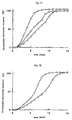
- Fig.9 shows the result of the dissolution test of emedastine difumarate from a tablet prepared by Example 1, and in Fig.9, ⁇ mark means a case in which as a dissolution medium were used 1st fluid (pH1.2) in the disintegration test described in Japanese Pharmacopeia 12th edition (published by Dai-ichi Hoki, 1991: abbreviated to JP), ⁇ mark is in case of using acetic acid-sodium acetate buffer solution (pH4.0) in JP as a dissolution medium, and ⁇ mark is in case of using 2nd fluid (pH6.8) in the disintegration test in JP.
- 1st fluid pH1.2
- JP 1st fluid
- ⁇ mark is in case of using acetic acid-sodium acetate buffer solution (pH4.0) in JP as a dissolution medium
- ⁇ mark is in case of using 2nd fluid (pH6.8) in the disintegration test in JP.
- Fig.10 shows the result of the dissolution test of emedastine difumarate from tablets prepared by Examples 1 to 3 (dissolution medium: 1st fluid (pH1.2) in the disintegration test in JP), ⁇ mark is on a tablet of Example 1, ⁇ mark is on a tablet of Example 2, and ⁇ mark is on a tablet of Example 3.
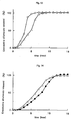
- Fig.11 shows the result of the dissolution test of emedastine difumarate from tablets prepared by Examples 3 to 5 (dissolution medium: 1st fluid (pH1.2) in the disintegration test in JP), ⁇ mark is on a tablet of Example 3, ⁇ mark is on a tablet of Example 4 and mark ⁇ is on a tablet of Example 5.
- Fig.12 shows the result of the dissolution test of emedastine difumarate from tablets prepared by Examples 6 and 7 (dissolution medium: 1st fluid (pH1.2) in the disintegration test in JP), ⁇ mark is on a tablet of Example 6, and ⁇ mark is on a tablet of Example 7.
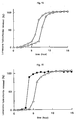
- Fig.13 shows the result of the dissolution test of emedastine difumarate from tablets prepared by Examples 8 and 9 (dissolution medium: 1st fluid (pH1.2) in the disintegration test in JP), ⁇ mark is on a tablet of Example 8 and ⁇ mark is on a tablet of Example 9.
- Fig.14 shows the result of the dissolution test of emedastine difumarate from tablets prepared by Example 10 to 11 (dissolution medium: 1st fluid (pH1.2) in the disintegration test in JP), ⁇ mark is on a tablet of Example 10, and ⁇ mark is on a tablet of Example 11.
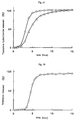
- Fig.15 shows the result of the dissolution test of lomerizine hydrochloride from tablets prepared by Example 12 to 13 (dissolution medium: 1st fluid (pH1.2) in the disintegration test in JP), ⁇ mark is on a tablet of Example 12 and ⁇ mark is on a tablet of Example 13.
- Fig 16 shows the result of the dissolution test of lomerizine hydrochloride from tablets prepared by Example 14 to 15 (dissolution medium: 1st fluid (pH1.2) in the disintegration test in JP), ⁇ mark is on a tablet of Example 14, ⁇ mark is a tablet of Example 15.
- Fig.17 shows the result of the dissolution of trazodone hydrochloride from tablets prepared by Example 16 and 17 (dissolution medium: 1st fluid (pH1.2) in the disintegration test in JP), ⁇ mark is on a tablet of Example 16 and ⁇ mark is on a tablet of Example 17.
- Fig.18 shows the result of the dissolution of nifedipine from a tablet prepared by Example 18 (dissolution medium:2nd fluid (pH6.8) in disintegration test in JP.
- Fig.19 shows the result of the dissolution of nifedipine from tablets prepared by Examples 20, 22 and 24 (dissolution medium:2nd fluid (pH6.8) in the disintegration test in JP), ⁇ mark is on a tablet of Example 20, ⁇ mark is on a tablet of Example 22 and ⁇ mark is on a tablet of Example 24.
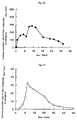
- Fig. 20 shows a graph on a change of the urinary excretion rate of the main metabolite of nifedipine with the lapse of time after oral administration of a capsule of Example 19 and a tablet of Comparative example 1 to normal adult volunteers.
- ⁇ mark is on a capsule of Example 19 and ⁇ mark is on a tablet of Comparative example 1.
- Fig.21 shows a change of the urinary excretion rate of the main metabolite of nifedipine with the lapse of time after oral administration of a capsule of Example 21 to normal adult volunteers.
- Fig.22 shows a change of the urinary excretion rate of the main metabolite of nifedipine with the lapse of time after oral administration of a capsule of Example 23 to normal adult volunteers.
- Fig.23 shows a change of the urinary excretion rate of the main metabolite nifedipine with the lapse of time after oral administration of a capsule of Example 25 to normal adult volunteers.
- Fig.24 shows a change of the plasma level of nifedipine with the lapse of time after oral administration of a capsule of Example 19 to normal adult volunteers.
- Examples of a water-soluble polymer used in the present invention are illustrated as water-soluble cellulose ethers, polyvinylpyrrolidone, etc.
- water-soluble cellulose ethers are ones which by partial substitution of alcohol group which are glucose group in the cellulose, form methyl ether, hydroxypropyl ether and/or hydroxyethyl ether and that are soluble in water.
- water-soluble cellulose ethers examples are methylcellulose, hydroxypropylcellulose, hydroxypropylmethylcellulose, etc.
- Methoxyl group in the methylcellulose is preferably 26.0 to 33.0 %, and the methylcellulose described in JP, at page 1070 is preferably used.
- This compound is sold as a trade name, Metolose SM (produced by Shin-Etsu Chemical Co., Ltd.).
- hydroxypropylcellulose (abbreviated to HPC)
- hydroxypropoxyl group is preferably 53.4 to 77.5 %.
- HPMC hydroxypropylmethylcellulose
- methoxyl and hydroxypropoxyl groups are preferably 19.0 to 30.0% and 4.0 to 12.0% respectively.
- This compound is sold in such as trade names,Metolose 90SH and Metolose 65SH, TC-5 (produced by Shin-Etsu Chemical Co., Ltd.).
- the above mentioned polyvinylpyrrolidone is one having molecular weight about 25,000 to about 1,200,000, and preferably about 40,000.
- the above water-soluble polymer can be used either in the uncoated core-tablet or in the membrane, and also the above water-soluble polymer can be optionally used in the mixture thereof.
- a water-soluble cellulose ether can be used alone or in the mixture of two or more kinds of water-soluble cellulose ethers, or in the mixture of one or more of water-soluble cellulose ethers and polyvinylpyrrolidone, and in the membrane only a kind of water-soluble cellulose ethers and one or more of them are preferably used.
- a mixture of above water-soluble polymer and an enteric polymer mentioned later may be optionally used.
- hydroxypropylmethylcellulose in which methoxyl and hydroxypropoxyl groups are 28.0 to 30.0% and 7.0 to 12.0% respectively, is preferably used, and especially hydroxypropylmethylcellulose 2910 described in JP, at page 1027 is preferably used.
- a water-soluble polymer used in an uncoated core-tablet is mixed for controlling the absorption of a drug and therefore, according to the degree of absorption of a drug the mixing form may be changed.
- a simple mixture of a drug and a water-soluble polymer may be used, or when a mixture of a drug and other ingredients (b) and (c) is granulated, an aqueous solution of a water-soluble polymer may be used as a binder.
- a mixture of a drug and a water-soluble polymer may be used in stead of a drug alone.
- a solid dispersion consisting of a drug and a water-soluble polymer which is prepared by removal of the solvent in an organic solution of a drug and a water-soluble polymer can be used, or a part of said solid dispersion can be used together with the mixture of said water-soluble polymer which can be used as a binder in the granulation in the same manner as above.
- Polyvinylalcohol used in this invention may be used in the fully hydrolyzed or partially hydrolyzed one, and one having the high swelling ability in contacting with water is preferably used.
- polyvinylalcohol of which 93.5 to 97.5% is hydrolyzed is illustrated.
- This compound is available ,for example, in trade names, Kuraray Poval PVA-613, Kuraray Poval PVA-CST, Kuraray Poval PVA-CSTS, and Kuraray Poval PVA-CS(produced by Kuraray Co., Ltd.).
- Trisodium citrate, sodium sulfate and sodium chloride used in this invention can be used in form of anhydride or hydrate thereof respectively. These compounds can be also used in the mixture thereof.
- Examples of a water-insoluble polymer used in this invention are ethylcellulose, ethylacrylate methylmethacrylate methacrylic acid trimethylammonium chloride ethyl co-polymer, etc.
- the above ethylcellulose in which ethoxly group is 46.5 to 51.0% is preferably used.
- This ethylcellulose is available, for example, in a trade name, Ethocel (produced by Dow Chemical Co., Ltd.).
- Aminoalkylmethacrylate co-polymer RS as ethylacrylate methylmethacrylate methacrylic acid trimethylammonium chloride ethyl co-polymer is preferably used.
- This polymer is available, for example, in a trade name, Eudragit RS (produced by Röhm Pharm Co., Ltd.).
- Eudragit RS produced by Röhm Pharm Co., Ltd.
- ethylcellulose in which ethoxyl group is 46.5 to 51.0% is especially preferable.
- Examples of an enteric polymer used in this invention are hydroxypropylmethylcellulose phthalate (abbreviated to HPMCP), hydroxypropylmethylcellulose acetate succinate, carboxymethylethylcellulose, etc.
- HPMCP hydroxypropylmethylcellulose phthalate
- hydroxypropylmethylcellulose acetate succinate carboxymethylethylcellulose
- carboxymethylethylcellulose etc.
- Hydroxypropylmethylcellulose phthalate in which methoxyl, hydroxypropoxyl and carboxybenzoyl groups are 18.0 to 24.0%, 5.0 to 10.0% and 21.0 to 35.0% respectively is preferably used.
- This phthalate is available, for example, in trade names, HPMCP HP-55 and HPMCP HP-50 (produced by Shin-Etsu Chemical Co., Ltd.).
- Hydroxypropylmethylcellulose acetate succinate is a mixed ester of hydroxypropylmethylcellulose with acetic acid and mono succinic acid.
- the mixed ester in which methoxyl, hydroxypropoxyl, acetyl and succinoyl groups are 12.0 to 28.0%, 4.0 to 23.0%, 2.0 to 16.0% and 4.0 to 28.0% respectively is preferably used.
- This ester is available, for example, in a trade name, Shin-Etsu AQOAT(produced by Shin-Etsu Chemical Co., Ltd.).
- Carboxymethylethylcellulose is a mixed ether of cellulose with carboxymethyl and ethyl.
- the mixed ether in which carboxymethyl and ethoxyl groups are 8.9 to 14.9% and 32.5 to 43.0% respectively is preferably used.
- This cellulose is available, for example, in a trade name, CMEC(produced by Freund Ind. Co., Ltd.).
- a mixture of above illustrated enteric polymers may be optionally used.
- HPMCP in which methoxyl, hydroxypropoxyl and carboxybenzoyl groups are 18.0 to 22.0%, 5.0 to 9.0% and 27.0 to 35.0% respectively is preferably used.
- the controlled release preparation of this invention is prepared as follows.
- a drug, or a drug and a water-soluble polymer of component (a), polyvinylalcohol of component (b) and one or more salts selected from a group consisting of trisodium citrate, sodium sulfate and sodium chloride of component (c) are mixed, and then a mixture of components (a), (b) and (c) are granulated by using an aqueous solution of a water-soluble polymer as a binder to prepare granules containing a drug, or a solution prepared by dissolving a drug and a water-soluble polymer in organic solvent (hereinafter referred to a solid dispersion solution) is sprayed on a mixture of components (b) and (c) and the mixture is dried, or a solid dispersion solution is added to a mixture of components (b) and (c), the resulting mixture is kneaded and the solvent is removed and the residue is crushed to prepare granules containing a drug.
- a solid dispersion solution
- a water-insoluble polymer and a water-soluble polymer are dispersed or dissolved in water and/or organic solvent (hereinafter referred to water-soluble pore-forming membrane solution) and the resulting solution is sprayed on the surface of the uncoated core-tablets prepared above and the tablets are dried to prepare a tablet coated with pore-forming membrane (hereinafter referred to water-soluble pore-forming membrane coated tablet) or a water-insoluble polymer and an enteric polymer are dispersed or dissolved in water and/or organic solvent (hereinafter referred to enteric pore-forming membrane solution) and the resulting solution is sprayed on the surface of the uncoated core-tablet prepared above and the tablets are dried to prepare a tablet coated with enteric pore-forming membrane (hereinafter referred to enteric pore-forming membrane coated tablet) or a water-insoluble polymer, a water-soluble polymer and an enteric polymer are dispersed or dissolved in water and/or organic solvent (hereinafter referred to
- an enteric polymer is dissolved or dispersed in water and/or organic solvent (hereinafter referred to enteric coating solution) is sprayed on the surface of the controlled release preparation prepared above and the preparation is dried by using the same method as mentioned above to make a coated tablet (hereinafter referred to enteric coated tablet) and by making such the preparation, it is possible to keep the plasma level of a drug for longer hours.
- enteric coating solution water and/or organic solvent
- one or more carriers used conventionally in a pharmaceutical preparation such as starch, sucrose, lactose, mannitol, crystalline cellulose, etc., may be admixed, if necessary.
- one or more lubricants such as magnesium stearate, talk, etc. and one or more flowing agents such as light anhydrous silicic acid, hydrated silicon dioxide and synthetic aluminum silicate are mixed optionally.
- one or more flowing agents such as light anhydrous silicic acid, hydrated silicon dioxide and synthetic aluminum silicate are mixed optionally.
- Diameter of an uncoated core-tablet is normally 2 to 10 mm, preferably 2 to 6mm and more preferably 5mm.
- the amount of a water-soluble polymer which is added to an uncoated core-tablet in case of using a water-soluble polymer as a binder is normally 0.01 to 20 weight parts per 1 weight part of a drug, preferably 0.05 to 5 weight parts.
- a water-soluble polymer is admixed to the mixture of polyvinylalcohol and one or more salts selected from a group consisting of trisodium citrate, sodium sulfate and sodium chloride
- the amount of a water-soluble polymer is normally 0.01 to 150 weight parts per 1 weight part of a drug, preferably 0.1 to 30 weight parts.
- the amount of a water-soluble polymer is normally 1 to 7 weight parts per 1 weight part of a drug, preferably 1.5 to 3 weight parts when it is used for preparing a solid dispersion.
- the organic solvent used for a solid dispersion solution is not limited if the solvent can dissolve both a drug and a water-soluble polymer, and such the solvent as methanol, ethanol, isopropanol, acetone, chloroform, dichloromethane or a mixture thereof can be illustrated.
- the appropriate amount of the organic solvent is 1.2 to 3 times as much as the amount of a drug and a water-soluble polymer which are soluble in the organic solvent at room temperature.
- the amount of polyvinylalcohol in an uncoated core-tablet is normally 0.1 to 400 weight parts per 1 weight part of a drug, preferably 1 to 50 weight parts.
- the amount of one or more salts selected from a group consisting of trisodium citrate, sodium sulfate and sodium chloride is normally 0.01 to 300 weight parts per 1 weight part of a drug, preferably 0.1 to 50 weight parts.
- the amount of a water-insoluble polymer and a water-soluble polymer and/or an enteric polymer used for forming the membrane is normally 5 to 20 weight percent per uncoated core-tablet.
- a water-insoluble polymer and a water-soluble polymer and/or an enteric polymer In respect of ratio of a water-insoluble polymer and a water-soluble polymer and/or an enteric polymer, whether a water-soluble polymer and an enteric polymer are used alone or in combination, its suitable total amount in any way is normally 0.4 to 0.8 weight parts per 1 weight part of a water-insoluble polymer.
- one or more additives such as plasticizers (e.g.
- triacetin, triethyl citrate , MACROGOL 6,000, etc. are admixed optionally to the water-soluble pore-forming membrane solution, the enteric pore-forming membrane solution, the water-soluble enteric pore-forming membrane solution and the enteric membrane solution. Its amount is 5 to 40 weight percent per total amount of a water-insoluble polymer and a water-soluble polymer and/or an enteric polymer.
- organic solvent used for a water-soluble pore-forming membrane solution, an enteric pore-forming membrane solution or a water-soluble enteric pore-forming membrane solution are not limited, and are methanol, ethanol, isopropanol, acetone, chloroform and dichloromethane, and a mixture thereof, and in case that a mixture of water and organic solvent is used, it is necessary to choose organic solvent well miscible each other.
- the amount of an enteric polymer is 4 to 12 weight percent per weight of a water-soluble pore-forming membrane-coated tablet, an enteric pore-forming membrane-coated tablet or a water-soluble enteric pore-forming membrane-coated tablet.
- the amount of a drug in said coating region is 1 to 30 weight percent, preferably 5 to 25 weight percent per total amount of a drug in the controlled release preparation of this invention.
- hydroxypropylmethylcellulose, and titanium oxide, red ferric oxide, yellow ferric oxide, food yellow No. 4 or No. 5, etc. are dissolved or dispersed in water and/or in organic solvent, and the resulting solution may be sprayed on the controlled release preparation of this invention and the preparation may be dried to prepare the tablet coated with the membrane for protecting from light on the tablet.
- tablets which are prepared by using an uncoated core-tablet (2 to 6 mm in diameter) may be filled into a capsule with a conventional method to form capsules.
- a drug contained in the controlled release preparation of this invention is not limited as long as the therapeutic efficacy of the drug is increased by keeping the plasma level of the drug for long hours.
- the examples are drugs for cardiovascular system (nifedipine, lomerizine hydrochloride, nicardipine hydrochloride, nitroglycerine, isosorbide dinitrate, captopril, delapril hydrochloride, ifenprodil tartrate), drugs for digestive system gastro-intestinal (domperidone, metoclopramide), anti-allergic agents (e.g. emedastine difumarate), antidepressants (e.g. trazodone hydrochloride), analgesics (indomethacin, ibuprofen), antitumors (e.g.
- the amount of a drug in a tablet is an unit dose as known as effective amount in the drug, and for example when it is administered once a day, one day dose is compounded in the preparation of this invention.
- the preparation of this invention containing nifedipine which is especially hardly soluble in water, is excellent in gastro-intestinal absorption after oral administration and the continuation of the plasma level of the drug and therefore is useful as a preparation for once a day-administration dosage form.
- the preparation of the present invention is orally administered, usually once or twice a day for prophylaxis or treatment of various kinds of diseases.
- a drug in the controlled release preparation of this invention is released at least via two steps mentioned below.
- a water-soluble polymer and/or an enteric polymer in the water pore-forming membrane dissolve in gastro-intestinal fluid and thereby pores in the coating layer are formed.
- the gastro-intestinal fluid penetrates into an uncoated core-tablet and a drug in the tablet dissolves and is gradually released. On this occasion it is possible to control the drug release by adding a water-soluble polymer to an uncoated core-tablet.
- a component (b), that is polyvinylalcohol swells to accelerate the drug release by the gastro-intestinal fluid which penetrates in the tablet, but in this case components (c), trisodium citrate, sodium sulfate and sodium chloride contained in the uncoated core-tablet control the swelling of polyvinylalcohol, and these salts dissolve in gastro-intestinal fluid, and the solution gradually diffuses outside of the coated layer of the tablet, and then the salt concentration results in decrease. Thereafter polyvinylalcohol begins to swell by the gastro-intestinal fluid.
- the coated layer of the tablet bursts and a drug in the tablet is released freely.
- polyvinylalcohol in the tablet forms matrix and the drug is trapped in the matrix and the matrix forms gel and gradually erode from its surface and accompanied with it the drug is gradually released.
- total release patterns of releasing a drug in the controlled release preparation of this invention show two phases pattern consisting of slow release rate in the initial phase and fast release rate in the last phase, sigmoide pattern consisting of slow release rate in the initial phase and the last phase and fast release rate in the middle phase, or zero-order pattern with constant release rate.
- the controlled release preparation of this invention by controlling the amount of polyvinylalcohol in an uncoated core-tablet, the amount (ratio) of a water-soluble polymer, the amount of one or more salts selected from a group consisting of trisodium citrate, sodium sulfate and sodium chloride which control the swelling of polyvinylalcohol, or the amount of a water-insoluble polymer and a water-soluble polymer and/or an enteric polymer and the amount of the membrane coated on, the release rate in the first step that the drug is released via pores, the burst time of the membrane and the release rate in the second step that the drug is released after the burst of the membrane and so on, are intentionally controllable and thereby preparations having many kinds of the release patterns as mentioned above can be prepared.
- the release pattern can be optionally chosen according to the drug. Therefore, the controlled release preparation of this invention can become a controlled release preparation suitable for oral administration once or twice a day.
- enteric coating on the above mentioned controlled release preparation or by coating a mixture of a drug and a water-soluble polymer or a solid dispersion thereof on the above mentioned controlled release preparation or enteric coated tablet, to extend further the plasma level of the drug and keep plasma level on the initial stage of administration is obtainable.
- one embodiment of the preparation of this invention is a small sized tablet form, not only the adjustment of dose accorded with disease syndrome or age is easy but also it can be possible to take once them by filling them into a capsule (see the test examples 1 to 3 described later).
- This method was conducted according to the dissolution method No.2 (paddle method) in JP.
- a dissolution medium 1st fluid or 2nd fluid of JP, or acetic acid-sodium acetate buffer solution (pH4.0) was used.
- the temperature of the dissolution medium was kept at 37°C and the revolution was set at 50rpm.
- the release rate of emedastine difumarate, trazodone hydrochloride or nifedipine was determined by measurement of absorbance at 280nm, 312nm, and 325nm.
- the release rate of lomerizine hydrochloride was determined by liquid chromatography (abbreviated to HPLC) on the following conditions.
- Fig.9 shows the result on the effect of dissolution medium (pH) tested by using emedastine difumarate as a drug.
- dissolution medium pH
- Fig.10 shows the effect of the amount of polyvinylalcohol in the uncoated core-tablet containing emedastine difumarate on the release rate. As is clear from Fig.10, in proportion with increase of the amount of polyvinylalcohol, burst of the membrane began faster and the release rate was accelerated.
- Fig.11 shows the effect of the amount of a salt, trisodium citrate in the uncoated core-tablet containing emedastine difumarate on the release rate.
- Fig.12 and 13 show the result on the effect of the amount of the coated membrane of a water-soluble pore-forming membrane on the tablet containing emedastine difumarate on the release rate.
- Fig.12 and 13 show the result on the effect of the amount of the coated membrane of a water-soluble pore-forming membrane on the tablet containing emedastine difumarate on the release rate.
- Fig.14 shows the effect on the release rate when a water-soluble polymer was added or not added in the uncoated core-tablet containg emedastine difumarate as a drug. As is clear from Fig.14, with addition of a water-soluble polymer, the release rate became slow.
- Fig.15 and 16 show the effect of the amount of the water-soluble pore-forming membrane on the tablet containing lomerizine hydrochloride on the release rate. As is clear from Fig.15 and 16, in proportion with increase of the amount of the water-soluble pore-forming membrane on the tablet, burst time of the membrane was prolonged and the release rate became slow.
- Fig.17 shows the effect of the amount of the water-soluble pore-forming membrane on the tablet (8mm in diameter) containing trazodone hydrochloride on the release rate.
- Fig.18 shows the result of the effect of the tablet coated with the water-soluble pore-forming membrane(Example 18) containing nifedipine on the release rate.
- release of nifedipine from the controlled release tablet (Example 18) began from three hours, and at three and a half hours the membrane burst, followed by rapid release of nifedipine.
- Fig.19 shows the result of the effect of the tablet coated with the water-soluble pore-forming membrane and further coated with the enteric membrane (Example 20) containing nifedipine, the tablet coated with the water-soluble pore-forming membrane, with the enteric membrane and further coated with a solid dispersion membrane (Example 22), and the tablet coated with the enteric pore-forming membrane and further coated with a solid dispersion membrane (Example 24) (each tablet containing nifedipine) [dissolution medium: 2nd fluid (pH6.8) of disintegration test described in JP].
- nifedipine from the controlled release tablet of Example 20 in 2nd fluid began from one hour and the membrane burst at two hours, followed by rapid release of nifedipine.
- 1st fluid pH1.2
- release of nifedipine was not detected until 10 hours.
- Release of nifedipine from the controlled release tablet of Example 22 began immediately, and the membrane burst at two hours, followed by rapid release of nifedipine.
- Example 24 Either on the controlled release tablet of Example 22 or Example 24, in 1st fluid (pH1.2), only nifedipine in a solid dispersion membrane-coated as the most outlayer was gradually released and burst of the membrane could not be found until 10 hours.
- 1st fluid pH1.2
- Absorption test of the preparation of this invention was evaluated by using urinary excretion rate of the main metabolite of nifedipine, 2,6-dimethyl-4-(2-nitrophenyl)-3,5-pyridine carboxylic acid monomethylester (hereinafter abbreviated as the main metabolite) as indicator.
- the concentration in urea of the main metabolite of nifedipine was determined by HPLC on the following conditions.
- Each sample (containing 20mg of nifedipine) was orally administered to 3 to 4 normal adult volunteers after 30 minutes of breakfast and urea between 0 to 1 hr, 1 to 2hr, 2 to 4hr, 4 to 6hr, 6 to 8hr, 8 to 10hr, 10 to 12hr, 12 to 15hr, 15 to 22hr and 22 to 24hr respectively were collected.
- urea between 24 to 27hr, 27 to 30hr and 30 to 33hr respectively were collected and the concentration in urea of the main metabolite of nifedipine was measured by HPLC and the urinary excretion rate at each time was calculated.
- Example 19 When a capsule of Example 19 in which four tablets coated with the water-soluble pore-forming membrane (Example 18) were filled and a tablet of Comparative example 1, each containing nifedipine, were administered, comparative data of the urinary excretion rate of the main metabolite was shown in Fig.20. As is clear from Fig.20, the urinary excretion rate in case of administration of the controlled release preparation of this invention (capsules) was longer sustained in comparison with that in case of administration of a tablet of Comparative example 1 (controlled release preparation).
- Example 21 a capsule of Example 21 in which four tablets coated with the water-soluble pore-forming membrane and further coated with the enteric membrane (Example 20) were filled, a capsule of Example 23 in which four tablets coated with the water-soluble pore-forming membrane and further coated with the solid dispersion membrane (Example 22) were filled and a capsule of Example 25 in which four tablets coated with the enteric pore-forming membrane and further coated with the solid dispersion membrane (Example 24) were filled, were administered to normal adult volunteers and in that case the urinary excretion rate into urea of the main metabolite was measured and the results are shown in Fig.21 to 23. As is clear from Fig.21 to 23, the urinary excretion rate was longer sustained when the controlled release preparation of this invention which was coated with enteric membrane on the surface of the water-soluble pore-forming membrane coated tablet was administered in the form of capsule.
- the plasma level of nifedipine was determined by gas chromatography (abbreviated to GC) on following conditions.
- a mixture of emedastine difumarate (98g) (see Japanese Patent Publication No. 24821/1990), polyvinylalcohol (trade name: Kuraray Poval PVA-CSTS; Kuraray Co., Ltd.) (734.7g), trisodium citrate dihydrate (244.9g) (sieved with Sieve No.
- magnesium stearate (11.3g) and light silicic acid anhydride (11.3g) were admixed, and the mixture was compressed into tablets each weighing 50mg by using a rotary tableting machine with a punch 5mm in diameter to produce uncoated core-tablets 753g (about 15,100 tablets).
- ethyl cellulose (1 weight part) (trade name: Ethocel standard-10; Dow Chemical Co., Ltd.), hydroxypropylmethylcellulose (0.43 weight part) (trade name: TC-5E; Shin-Etsu Chemical Co., Ltd.), and triethyl citrate (0.29 weight part) (trade name: Citroflex 2; Pfizer Co., Ltd.) were dissolved in a mixture of water and ethanol [1:4 (weight ratio) so that the concentration of ethylcellulose and hydroxypropylmethylcellulose amounted to 5 weight percent. The resulting solution was used as a water-soluble pore-forming membrane solution.
- the above uncoated core-tablets (350g) (about 7,000 tablets) was put in the tablet coating machine (trade name: Hi-Coater. HCT-MINI; Freund Ind. Co., Ltd.) and then said membrane solution was sprayed on the tablets in the coating machine and the tablets were dried to produce the coated tablets each weighing 56mg.
- the controlled release preparation of this invention thus obtained contains emedastine difumarate 4mg/tablet.
- a mixture of emedastine difumarate (72g), polyvinylalcohol (495g) (trade name: Kuraray Poval PVA-CSTS; Kuraray Co., Ltd.), trisodium citrate dihydrate (180g) (sieved with Sieve No. 100) and lactose (117g) was admixed in the fluidized bed granulator, and to the mixture a solution of hydroxypropylcellulose (trade name: Nisso HPC; Nippon Soda Co., Ltd.) (18g) in water (342g) was sprayed as a binder and then the mixture was dried and sieved with Sieve No. 18 to make granules containing the drug.
- hydroxypropylcellulose trade name: Nisso HPC; Nippon Soda Co., Ltd.
- magnesium stearate (10.5g) and light anhydrous silicic acid (7g) were admixed and the mixture was compressed by using a rotary tableting machine with a punch 5mm in diameter to produce uncoated core-tablets (737g) (about 14,700 tablets).
- Example 2 On the uncoated core-tablets (350g) (about 7,000 tablets), a water-soluble pore-forming membrane solution was sprayed and the tablets were dried to produce coated tablets each weighing 56mg.
- the controlled release preparation of this invention thus obtained contains emedastine difumarate 4mg per tablet.
- a mixture of emedastine difumarate (152g), polyvinylalcohol (950g) (trade name: Kuraray Poval PVA-CSTS, Kuraray Co., Ltd.), trisodium citrate dihydrate (380g) (sieved with Sieve No. 100) and lactose (342g) was admixed in the fluidized bed granulator, and to the mixture a solution of hydroxypropyl-cellulose (38g) (trade name: Nisso HPC; Nippon Soda Co., Ltd.) in water (722g) was sprayed as a binder, and the mixture was dried and sieved with Sieve No.18 to produce granules containing the drug.
- magnesium stearate (18.4g) and light anhydrous silicic acid (18.4g) were admixed and the mixture was compressed by using a rotary tableting machine with a punch 5mm in diameter to produce uncoated core-tablets (1,680g) each weighing 50mg (about 33,600 tablets).
- Example 2 a water-soluble pore-forming membrane solution was sprayed on the uncoated core-tablets (350g) (about 7,000 tablets) and the tablets were dried to produce coated tablets each weighing 56mg.
- the controlled release preparation of this invention thus prepared contains emedastine difumarate 4mg per tablet.
- a mixture of emedastine difumarate (72g), polyvinylalcohol (450g) (trade name: Kuraray Poval PVA-CSTS; Kuraray Co., Ltd.), trisodium citrate dihydrate (36g) (sieved with Sieve No. 100) and lactose (306g) was admixed in the frieldized bed granulator, and to the mixture a solution of hydroxypropylcellulose (18g) (trade name: Nisso HPC; Nippon Soda Co., Ltd.) in water (342g) was sprayed as a binder and the mixture was dried and sieved with Sieve No. 18 to give granules.
- magnesium stearate (10.5g) and light anhydrous silicic acid (7g) were admixed and the mixture was compressed by using a rotary tableting machine with a punch 5mm in diameter to produce uncoated core-tablets (720g) (about 14,400 tablets) each weighing 50mg.
- Example 2 a water-soluble pore-forming membrane solution was sprayed on the uncoated core-tablets (350g) (about 7,000 tablets) and the tablets were dried to produce coated tablets each weighing 56mg.
- the controlled release preparation of this invention thus prepared contains emedastine difumarate 4mg per tablet.
- a mixture of emedastine difumarate (72g), polyvinylalcohol (450g) (trade name: Kuraray Poval PVA-CSTS; Kuraray Co., Ltd.), trisodium citrate dihydrate (54g) (sieved with Sieve No. 100) and lactose (288g) was admixed in the fluidized bed granulator and to the mixture a solution of hydroxypropylcellulose (18g) (trade name: Nisso HPC; Nippon Soda Co., Ltd.) in water (342g) was sprayed as a binder, and the mixture was dried and sieved with Sieve No. 18 to give granules.
- magnesium stearate (10.5g) and light anhydrous silicic acid (7g) were admixed and the mixture was compressed by using a rotary tableting machine with a punch 5mm in diameter to produce uncoated core-tablets (740g) (about 14,800 tablets) each weighing 50mg.
- Example 2 a water-soluble pore-forming membrane solution was sprayed on the uncoated core-tablets (350g) (about 7,000 tablets) and the tablets were dried to produce coated tablets each weighing 56mg.
- the controlled release preparation of this invention thus obtained contains emedastine difumarate 4mg per tablet.
- a mixture of emedastine difumarate (72g), polyvinylalcohol (540g) (trade name: Kuraray Poval PVA-CSTS; Kuraray Co., Ltd.), trisodium citrate dihydrate (180g) (sieved by Sieve No. 100) and lactose (72g) was admixed in the fluidized bed granulator, and to the mixture a solution of hydroxypropylcellulose (18g) (trade name: Nisso HPC;Nippon Soda Co., Ltd.) in water (342g) was sprayed as a binder, and the mixture was dried and sieved with Sieve No. 18 to produce granules.
- magnesium stearate (10.5g) and light anhydrous silicic acid (7g) were admixed and the mixture was compressed by using a rotary tableting machine with a punch 5mm in diameter to produce uncoated core-tablets 708g (14,200 tablets) each weighing 50mg per tablet.
- ethylcellulose (1 weight part) (trade name: Ethocel standard -10, Dow Chemical Co., Ltd.), hydroxypropylcellulose (0.43 weight part) (trade name: Nisso HPC; Nippon Soda Co., Ltd.) and triethyl citrate (0.29 weight part) (trade name: Citroflex 2; Pfizer Co., Ltd.) were dissolved in ethanol so that the concentration of ethylcellulose and hydroxypropylcellulose amounted to 5 weight percent. This solution was used as a water-soluble pore-forming membrane solution.
- the above uncoated core-tablets (350g) (about 7,000 tablets) were put in the tablet coating machine (trade name: Hi-coater. HCT-MINI; Freund Ind. Co., Ltd.) and on the tablets the water-soluble pore-forming membrane solution was sprayed and the tablets were dried to produce the coated tablets each weighing 56mg.
- the controlled release preparation of this invention thus prepared contains emedastine difumarate 4mg per tablet.
- the controlled release preparation of the present invention thus prepared contains emedastine difumarate 4mg per tablet.
- a mixture of emedastine difumarate (72g), polyvinylalcohol (540g) (trade name: Kuraray Poval PVA-CS; Kuraray, sieved by Sieve No. 100), sodium chloride (180g) (sieved by Sieve No. 100), and lactose (72g) was admixed in the fluidized bed granulator, and to the mixture a solution of hydroxypropylcellulose (18g) (trade name: Nisso HPC, Nippon Soda Co., Ltd.) in water (342g) was sprayed as a binder, and the mixture was dried and sieved by Sieve No. 18 to produce granules.
- magnesium stearate (10.4g) and light anhydrous silicic acid (7g) were admixed, and the mixture was compressed by using a rotary tableting machine with a punch 5mm in diameter to produce uncoated core-tablets (755g) (about 15,100 tablets) each weighing 50mg.
- Example 2 a water-soluble pore-forming membrane solution was sprayed on the uncoated core-tablets (350g) (about 7,000 tablets) and the tablets were dried to produce each weighing 56mg.
- the controlled release preparation of this invention thus prepared contains emedastine difumarate 4mg per tablet.
- Example 2 In the same manner as in Example 1 except for increasing the coating amount 1mg per tablets, a water-soluble pore-forming membrane solution was sprayed on the tablets 350g (about 7,000 tablets), and the tablets were dried to produce weighing 57mg per tablet.
- the controlled release preparation of this invention thus prepared contains emedastine difumarate 4mg per tablet.
- a mixture of emedastine difumarate (72g), polyvinylalcohol (540g) (trade name: Kuraray Poval PVA-CSTS; Kuraray Co., Ltd.), anhydrous sodium sulfate (180g) (sieved with Sieve No. 100) and lactose (72g) was admixed in the fluidized bed granulator, and to the mixture a solution hydroxypropylcellulose (18g) (trade name: Nisso HPC; Nippon Soda Co., Ltd.) in ethanol (342g) was sprayed as a binder, and the mixture was dried and sieved with Sieve No. 18 to produce granules.
- magnesium stearate (10.4g) and light anhydrous silicic acid (7g) were admixed and the mixture was compressed by using a rotary tableting machine with a punch 5mm in diameter to produce uncoated core-tablets (770g) (15,400 tablets) each weighing 50mg.
- a mixture of emedastine difumarate (72g), polyvinylalcohol (540g) (trade name: Kuraray Poval PVA-CSTS; Kuraray Co., Ltd.), anhydrous sodium sulfate (180g) (sieved with Sieve No. 100) and hydroxypropylcellulose (72g) (Nisso HPC; Nippon Soda Co., Ltd.) was admixed in the fluidized bed granulator, and to the mixture a solution of hydroxypropylcellulose (18g) in ethanol (342g) was sprayed as a binder, and the mixture was dried and sieved with Sieve No. 18 to give granules.
- magnesium stearate (10.4g) and light anhydrous silicic acid (7g) were admixed and the mixture was compressed by using a rotary tableting machine with a punch 5mm in diameter to produce uncoated core-tablets (760g) (about 15,200 tablets) each weighing 50mg.
- Example 2 a water-soluble pore-forming membrane solution was sprayed on these tablets (350g) (about 7,000 tablets), and the tablets were dried to give tablets each weighing 56mg.
- the controlled release preparation of this invention thus prepared contains emedastine difumarate 4mg per tablet.
- a mixture of lomerizine hydrochloride (90g) (see Japanese Patent Publication No. 13232/1991), polyvinylalcohol (360g) (Kuraray Poval PVA-CSTS; Kuraray Co., Ltd.), anhydrous sodium sulfate (360g) (sieved with Sieve No. 100) and lactose (54g) was admixed in the fluidized bed granulator, and to the mixture a solution of hydroxypropylcellulose (18g) in ethanol (342g) was sprayed as a binder, and the mixture was dried and sieved with Sieve No. 18 to give granules.
- magnesium stearate (12.1g) and light anhydrous silicic acid (5.2g) were admixed and the mixture was compressed by using a rotary tableting machine with a punch 5mm in diameter to produce uncoated core-tablets 750g (about 15,000 tablets) each weighing 50mg.
- ethylcellulose (1 weight part) (trade name: Ethocel standard-10; Dow Chemical Co., Ltd.), hydroxypropylmethylcellulose (0.49 weight part) (trade name: TC-5E; Shin-Etsu Chemical Co., Ltd.) and triethyl citrate (0.30 weight part) (trade name: Citroflex 2; Pfizer Co., Ltd.) were dissolved in a mixture of water and ethanol (1:4 weight ratio) so that the concentration of ethylcellulose and hydroxypropylmethylcellulose amounted to 5 weight percentage. This solution was used as a water-soluble pore-forming membrane solution.
- the above uncoated core-tablets (350g) (about 7,000 tablets) were put in the tablet coating machine (trade name: Hi-Coater. HCT-MINI; Freund Ind. Co., Ltd.) and on the tablets this water-soluble pore-forming membrane was sprayed and the tablets were dried to produce the coated tablets each weighing 56mg.
- the controlled release preparation of this invention thus prepared contains lomerizine hydrochloride 5mg per tablet.
- Example 12 In the same manner as in Example 12, a mixture containing lomerizine hydrochloride was compressed by using a rotary tableting machine with a punch 5mm in diameter to produce uncoated core-tablets (750g) (about 15,000 tablets) each weighing 50mg.
- the controlled release preparation of this invention thus prepared contains lomerizine hydrochloride 5mg per tablet.
- a mixture of lomerizine hydrochloride (90g), polyvinylalcohol (450g) (Kuraray Poval PVA-CSTS; Kuraray Co., Ltd.), trisodium citrate dihydrate (270g) (sieved with Sieve No. 100) and lactose (57.6g) was admixed in the fluidized bed granulator, and to the mixture a solution of hydroxypropylcellulose (18g) (trade name: Nisso HPC; Nippon Soda Co., Ltd.) in water (342g) was sprayed as a binder, and the mixture was dried and sieved with Sieve No. 18 to produce granules.
- magnesium stearate (7g) and light anhydrous silicic acid (7g) were admixed and the mixture was compressed by using a rotary tableting machine with a punch 5mm in diameter to produce uncoated core-tablets (735g) (about 14,700 tablets) each weighing 50mg.
- ethylcellulose (1 weight part) (trade name: Ethocel standard-10; Dow Chemical Co., Ltd.), hydroxypropylmethylcellulose (0.47 weight part) (trade name: TC-5E; Shin-Etsu Chemical Co., Ltd.) and triethyl citrate (0.29 weight part) (trade name: Citroflex 2; Pfizer Co., Ltd.) were dissolved in a mixture of water and ethanol (1:4 weight ratio) so that the concentration of ethylcellulose and hydroxypropylmethylcellulose amounted to 5 weight percent. This solution was used as a water-soluble pore-forming membrane solution.
- the above uncoated core-tablets 350g (about 7,000 tablets) were put in the tablet coating machine (trade name: Hi-Coater. HCT-MINI; Freund Ind. Co., Ltd.) and on the tablets the water-soluble pore-forming membrane was sprayed and the tablets were dried to produce coated tablets each weighing 56mg.
- the controlled release preparation of this invention thus prepared contains lomerizine hydrochloride 5mg per tablet.
- Example 14 In the same manner as in Example 14, a mixture containing lomerizine hydrochloride was compressed by using a rotary tableting machine with a punch 5mm in diameter to produce uncoated core-tablets 750g (about 15,000 tablets) each weighing 50mg.
- Example 16 contains lomerizine hydrochloride 5mg per tablet.
- a mixture of trazodone hydrochloride (337.5g) (Japanese Patent Publication 7341/1969), polyvinylalcohol (360g) (trade name: Kuraray Poval PVA-CSTS; Kuraray Co., Ltd.) and trisodium citrate dihydrate (180g) (sieved with Sieve No. 100) was admixed in the fluidized bed granulator, and to the mixture a solution of hydroxypropylcellulose (18g) (trade name: Nisso HPC; Nippon Soda Co., Ltd.) in water (342g) was sprayed as a binder, and the mixture was dried and sieved with Sieve No. 18 to produce granules.
- magnesium stearate (8.7g) and light anhydrous silicic acid (4.4g) were admixed and the mixture was compressed by using a rotary tableting machine to produce uncoated core-tablets (750g) (about 3,700 tablets) each weighing 202mg.
- ethylcellulose (1 weight part) (trade name: Ethocel standard-10; Dow Chemical Co., Ltd.), hydroxypropylmethylcellulose (0.47 weight part) (trade name: TC-5E; Shin-Etsu Chemical Co., Ltd.) and triethyl citrate (0.29 weight part) (trade name: Citroflex 2; Pfizer Co., Ltd.) were dissolved in a mixture of water and ethanol (1:4 weight ratio) so that the concentration of ethylcellulose and hydroxymethylcellulose amounted to 5 weight percent. This solution was used as a water-soluble pore-forming membrane solution.
- the above uncoated core-tablets (350g) (about 1,700 tablets) were put in the tablet coating machine(trade name: Hi-Coater. HCT-MINI; Freund Ind. Co., Ltd.) and on the tablets this water-soluble pore-forming membrane solution was sprayed, and the tablets were dried to produce coated tablets each weighing 213mg.
- the controlled release preparation of this invention thus prepared contains trazodone hydrochloride 75mg per tablet.
- Example 16 a water-soluble pore-forming membrane solution was sprayed on the uncoated core-tablets (350g) (about 1,700 tablets) and the tablets were dried to produce tablets each weighing 220mg.
- the controlled release preparation of this invention thus prepared contains trazodone hydrochloride 75mg per tablet.
- Nifedipine (101.4g) and hydroxymethylcellulose (152g) (trade name: TC-5E; Shin-Etsu Chemical Co., Ltd.) were dissolved in the mixture of dichloromethane (821g) and ethanol (547g) to produce a solid dispersion solution.
- a mixture of polyvinylalcohol (810.8g) (trade name: Kuraray Poval PVA-CSTS; Kuraray Co., Ltd.) and trisodium citrate dihydrate (135.8g) (sieved with Sieve No. 100) was admixed in the fluidized bed granulator, and to the mixture the above solid dispersion was sprayed, and the mixture was dried and sieved with Sieve No. 30 to give granules.
- magnesium stearate (3g) and light anhydrous silicic acid (5g) were admixed and the mixture was compressed by using a rotary tableting machine with a punch 5mm in diameter to produce uncoated core-tablets (460g) (about 7,600 tablets) each weighing 60mg.
- ethylcellulose (1 weight part) (trade name: Ethocel standard-10; Dow Chemical Co., Ltd.), and hydroxypropylmethylcellulose (0.6 weight part) (trade name: TC-5E; Shin-Etsu Chemical Co., Ltd.) were dissolved in the mixture of dichloromethane and ethanol (1:1 weight ratio) so that the total concentration of ethylcellulose and hydroxypropymethylcellulose amounted to 5 weight percent.
- This solution was used as a water-soluble pore-forming membrane solution.
- On the above uncoated core-tablets (350g) (about 5,800 tablets) this water-soluble pore-forming membrane solution was sprayed and the tablets were dried to produce coated tablets each weighing 65mg.
- the controlled release preparation of this invention thus prepared contains nifedipine 5mg per tablet.
- Example 18 Four controlled release tablets prepared by Example 18 were filled in a hard capsule #2 to produce capsules.
- Nifedipine (338g) and hydroxypropylmethylcellulose (507g) (trade name: TC-5E; Shin-Etsu Chemical Co., Ltd.) were dissolved in a mixture of dichloromethane (2,740g) and ethanol (1,824g) to produce a solid dispersion solution.
- a mixture of polyvinylalcohol (2,703g) (trade name: Kuraray Poval PVA-CSTS; Kuraray Co., Ltd.) and trisodium citrate dihydrate (453g) (sieved with Sieve No.
- ethylcellulose (1 weight part) (trade name: Ethocel standard-10; Dow Chemical Co., Ltd.) and hydroxypropylmethylcellulose (0.7 weight part) (trade name: TC-5E; Shin-Etsu Chemical Co., Ltd.) were dissolved in a mixture of dichloromethane and water (1:1 weight ratio) so that the total concentration of ethylcellulose and hydroxypropylmethylcellulose amounted to 5 weight percent to produce a water-soluble pore-forming membrane solution.
- the water-soluble pore-forming membrane solution was sprayed, and the tablets were dried to produce coated tablets each weighing 65mg.
- Hydroxypropylmethylcellulose phthalate [trade name: HPMCP(HP-50); Shin-Etsu Chemical Co., Ltd.] was dissolved in a mixture of dichloroethane and ethanol (1:1 weight ratio) so that the concentration of hydroxypropylmethycellulose phthalate amounted to 5 weight percent, and then the resulting enteric coating solution was sprayed on the coated tablets, and the tablets were dried to produce coated tablets each weighing 68mg.
- the controlled release preparation of this invention thus prepared contains nifedipine 5mg per tablet.
- Nifedipine (300g) and hydroxypropylmethylcellulose (450g) (trade name: TC-5E; Shin-Etsu Chemical Co., Ltd.) were dissolved in the mixture of dichloromethane (2,432g) and ethanol (1,624g) to produce a solid dispersion solution.
- a mixture of polyvinylalcohol (3,200g) (trade name: Kuraray Poval PVA-CSTS; Kuraray Co., Ltd.) and trisodium citrate anhydride (536g) (sieved with Sieve No. 100) was admixed in the fluidized bed granulator, and to the mixture the solid dispersion solution was sprayed and the mixture was dried and sieved with Sieve No.
- ethylcellulose (1 weight part) (trade name: Ethocel standard-10; Dow Chemical Co., Ltd.) and hydroxypropylmethylcellulose (0.7 weight part) (trade name: TC-5E; Shin-Etsu Chemical Co., Ltd.) were dissolved in a mixture of dichloromethane and ethanol (1:1 weight ratio) so that the total concentration of ethylcellulose and hydroxypropylmethylcellulose amounted to 5 weight percent to produce a water-soluble pore-forming membrane solution.
- the above uncoated core-tablets (350g) (about 6,200 tablets) were put in a coating tablet machine and on them the water-soluble pore-forming membrane solution was sprayed, and the tablets were dried to produce coated tablets each weighing 61.38mg.
- Hydroxypropylmethylcellulose phthalate (trade name: HPMCP (HP-50); Shin-Etsu Chemical Co., Ltd.) was dissolved in the mixture of dichloromethane and ethanol (1:1 weight ratio) so that the concentration of the hydroxypropylmethylcellulose phthalate amounted to 5% weight percent, and then the resulting enteric coating solution was sprayed on the above tablets, and the tablets were dried to produce enteric coated tablets each weighing 64.38mg.
- nifedipine (1 weight part) and hydroxypropylmethylcellulose (1.5 weight part) (trade name: TC-5RW; Shin-Etsu Chemical Co., Ltd.) were dissolved in a mixture of dichloromethane and ethanol (6:4 weight ratio) so that the concentration of hydroxypropylmethylcellulose amounted to 5 weight percent to produce a solid dispersion solution.
- this solid dispersion solution was sprayed and the tablets were dried to produce the controlled release tablets of this invention coated with the solid dispersion membrane (corresponding to nifedipine 1.25mg per tablet) each weighing 67.5mg.
- the controlled release preparation of this invention thus prepared contains nifedipine 5mg per tablet.
- Example 22 Four controlled release tablets prepared by Example 22 were filled in a hard capsule #2 to produce capsules.
- Nifedipine (90g) and hydroxypropylmethylcellulose (135.6g) were dissolved in a mixture of dichloromethane (732g) and ethanol (488g) to produce a solid dispersion solution.
- a mixture of polyvinylalcohol (600g) (trade name: Kuraray Poval PVA-CSTS; Kuraray Co., Ltd.), trisodium citrate anhydride (160.8g) and crystalline cellulose (trade name: Avicel PH301; Asahi Chemical Ind.
- ethycellulose (1 weight part) (trade name: Ethocel standard-10; Dow Chemical Co., Ltd.), hydroxypropylmethylcellulose phthalate (0.67 weight part) (trade name: HPMCP (HP-55); Shin-Etsu Chemical Co., Ltd.), and triethyl citrate (0.33 weight part) (trade name: Citroflex 2; Pfizer Co., Ltd.) were dissolved in a mixture of water and ethanol (1:4 weight ratio) so that the total concentration of ethylcellulose and hydroxypropylmethylcellulose phthalate amounted to 5 weight percent to produce a enteric pore-forming membrane solution.
- nifedipine (1 weight part) and hydroxypropylmethylcellulose (1.5 weight part) (trade name: TC-5RW; Shin-Etsu Chemical Co., Ltd.) were dissolved in a mixture of dichloromethane and ethanol (6:4 weight ratio) so that the concentration of hydroxypropylmethylcellulose amounted to 5 weight percent to produce a solid dispersion solution.
- the solid dispersion solution was sprayed, and the tablets were dried to produce the controlled release preparation of the invention which was coated with the solid dispersion membrane (containing to nifedipine 1.25mg per tablet) each weighing 59.85mg.
- the controlled release preparation of this invention thus prepared contains 5mg of nifedipine per tablet.
- Example 24 Four controlled release tablets prepared by Example 24 were filled in a hard capsule #2 to produce capsules.
- ethycellulose (1 weight part) (trade name: Ethocel standard-10; Dow Chemical Co., Ltd.), hydroxypropylmethylcellulose (1 weight part) (trade name: TC-5E; Shin-Etsu Chemical Co., Ltd.), hydroxypropylmethylcellulose phthalate (0.21 weight part) (trade name: HPMCP(HP-55); Shin-Etsu Chemical Co., Ltd.), and triethyl citrate (0.29 weight part) (trade name: Citroflex2; Pfizer Co., Ltd.) were dissolved in a mixture of water and ethanol (1:4 weight ratio) so that the concentration of ethylcellulose, hydroxypropylmethylcellulose and hydroxypropylmethylcellulose phthalate amounted to 5 weight percent to produce a water-soluble enteric pore-forming membrane.
- the above uncoated core-tablets (350g) (about 7,000 tablets) were put in the coating tableting machine (trade name: Hi-Coater. HCT-MINI; Freund Ind. Co., Ltd.), and on the tablets this water-soluble pore-forming solution was sprayed and the tablets were dried to produce tablets coated with the water-soluble pore-forming membrane each weighing 56mg.
- the controlled release tablet of this invention thus prepared contains emedastine difumarate 4mg per tablet.
- a mixture containing emedastine difumarate was compressed, in the same manner as in Example 1, to produce uncoated core-tablets and on the surface of the tablets a water-soluble pore-forming solution was sprayed, and the tablets were dried to produce coated tablets with the water-soluble pore-forming membrane (200g) (about 3,560 tablets) each weighing 56mg.
- Hydroxypropylmethylcellulose phthalate (trade name: HPMCP(HP-50); Shin-Etsu Chemical Co., Ltd.) was dissolved in a mixture of ethanol and water (4:1 weight ratio) so that the concentration of hydroxypropylmethylcellulose phthalate amounted to 5 weight percent and the resulting enteric coating solution was sprayed on the tablets, and the tablets were dried to produce tablets coated with the enteric coating membrane each weighing 59mg.
- the controlled release tablet thus prepared contains emedastine difumarate 4mg per tablet.
- Example 2 In the same manner as in Example 1, a mixture containing emedastine difumarate was compressed to prepare uncoated core-tablets and on the surface of the tablets a water-soluble pore-forming solution was sprayed and the tablets were dried to produce coated tablets with the water-soluble pore-forming membrane (100g) (about 1,780 tablets).
- Emedastine difumarate (1 weight part), and hydroxypropylmethylcellulose (2 weight parts) (trade name: TC-5MW; Shin-Etsu Chemical Co., Ltd.) were dissolved in a mixture of ethanol and water (1:1 weight ratio) so that We concentration of the hydroxypropylmethylcellulose amounted to 5 weight percent, and the resulting solution was further sprayed on the surface of the coated tablets to produce the controlled release tablets of the invention coated with the solid dispersion membrane (containing emedastine difumarate 1mg per tablet) each weighing 56mg.
- the controlled release preparation thus prepared contains emedastine difumarate 5mg per tablet.
- Example 27 In the same manner as in Example 27, a mixture containing emedastine difumarate was compressed to prepare uncoated core-tablets and on the surface of the tablets a water-soluble pore-forming solution and a enteric coating solution were sprayed and the tablets were dried to produce enteric coated tablets (100g) (about 1,690 tablets) each weighing 59mg.
- Emedastine difumarate (1 weight part) and hydroxypropylmethylcellulose (2 weight part)(trade name: TC-5MW; Shin-Etsu Chemical Co., Ltd.) were dissolved in a mixture of ethanol and water (1:1 weight ratio) so that the concentration of hydroxypropylmethylcellulose amounted to 5 weight percent and the resulting solid dispersion membrane solution was further sprayed on the surface of the coated tablets, and the tablets were dried to produce tablets which were coated with the solid dispersion membrane (the coated portion corresponding to emedastine difumarate 1mg per tablet) each weighing 62mg.
- the controlled release preparation of this invention thus prepared contains emedastine difumarate 5mg per tablet.
- Crystalline nifedipine [average particle seize 3.3 ⁇ m (measured by the air permeability method)] (16.5g) was mixed with lactose (194.0g) and corn starch (75.0g), and the mixture was granulated in the paste of corn starch (5.0g) and hot water (70.0g), and the resulting granules were dried and sieved and to the granules microcrystalline cellulose (25.0g) and magnesium stearate (1.0g) were admixed. The mixture was compressed to produce tablets each weighing 63.3mg with 6mm in diameter. By coating the tablets with an organic solution of a hydroxypropylmethylcellulose phthalate, there were obtained gastric fluid tolerable coated tablets. The weight of the tablet was 70.3mg.
- Nifedipine (8.4g) was admixed with lactose (20.2g), colloidal silica (0.8g), hydroxypropylcellulose (35.0g) (trade name: Nisso HPC(HPC-M); Nippon Soda Co., Ltd.), hydroxypropylcellulose (trade name: Nisso HPC(HPC-L); Nippon Soda Co., Ltd.) (87.4g) and citric acid (16.0g) and this mixture was granulated with a solution of hydroxypropylcellulose (1.0g) in the fluidized bed granulator, dried and sieved. The resulting granules were admixed with magnesium stearate (1.4g).
Landscapes
- Health & Medical Sciences (AREA)
- Chemical & Material Sciences (AREA)
- Life Sciences & Earth Sciences (AREA)
- Animal Behavior & Ethology (AREA)
- Medicinal Chemistry (AREA)
- Pharmacology & Pharmacy (AREA)
- Epidemiology (AREA)
- General Health & Medical Sciences (AREA)
- Public Health (AREA)
- Veterinary Medicine (AREA)
- Bioinformatics & Cheminformatics (AREA)
- Engineering & Computer Science (AREA)
- Biophysics (AREA)
- Molecular Biology (AREA)
- Inorganic Chemistry (AREA)
- Medicinal Preparation (AREA)
Applications Claiming Priority (11)
| Application Number | Priority Date | Filing Date | Title |
|---|---|---|---|
| JP34004594 | 1994-12-27 | ||
| JP340045/94 | 1994-12-27 | ||
| JP340407/94 | 1994-12-28 | ||
| JP34040794 | 1994-12-28 | ||
| JP36156/95 | 1995-01-31 | ||
| JP3615695 | 1995-01-31 | ||
| JP5353495 | 1995-02-17 | ||
| JP53534/95 | 1995-02-17 | ||
| JP222566/95 | 1995-08-07 | ||
| JP22256695 | 1995-08-07 | ||
| PCT/JP1995/002689 WO1996019974A1 (en) | 1994-12-27 | 1995-12-26 | Sustained-release preparation |
Publications (2)
| Publication Number | Publication Date |
|---|---|
| EP0807433A1 true EP0807433A1 (de) | 1997-11-19 |
| EP0807433A4 EP0807433A4 (de) | 2005-12-28 |
Family
ID=27521767
Family Applications (1)
| Application Number | Title | Priority Date | Filing Date |
|---|---|---|---|
| EP95941893A Withdrawn EP0807433A4 (de) | 1994-12-27 | 1995-12-26 | Zubereitung mit verzögerter freisetzung |
Country Status (3)
| Country | Link |
|---|---|
| US (1) | US6156343A (de) |
| EP (1) | EP0807433A4 (de) |
| WO (1) | WO1996019974A1 (de) |
Cited By (6)
| Publication number | Priority date | Publication date | Assignee | Title |
|---|---|---|---|---|
| EP0793959A1 (de) * | 1996-03-07 | 1997-09-10 | Takeda Chemical Industries, Ltd. | Zusammensetzung mit kontrollierter Wirkstofffreisetzung |
| WO2000020033A1 (en) * | 1998-10-05 | 2000-04-13 | Eisai Co., Ltd. | Tablets immediately disintegrating in the oral cavity |
| WO2001037813A3 (de) * | 1999-11-24 | 2001-12-27 | Lohmann Therapie Syst Lts | Mehrschichtige zubereitung zur gesteuerten, pulsartigen abgabe von wirkstoffen |
| US7189415B2 (en) | 1996-12-25 | 2007-03-13 | Astellas Pharma Inc. | Rapidly disintegrable pharmaceutical composition |
| WO2013130785A3 (en) * | 2012-03-01 | 2013-10-24 | Bristol-Myers Squibb Company | Extended release pharmaceutical formulations of water-soluble active pharmaceutical ingredients and methods for making the same |
| WO2013124832A3 (en) * | 2012-02-24 | 2013-11-07 | Ranbaxy Laboratories Limited | Stabilized controlled-release pharmaceutical composition comprising gliclazide |
Families Citing this family (37)
| Publication number | Priority date | Publication date | Assignee | Title |
|---|---|---|---|---|
| JP4711520B2 (ja) * | 2000-03-21 | 2011-06-29 | 日本ケミカルリサーチ株式会社 | 生理活性ペプチド含有粉末 |
| GB0025208D0 (en) * | 2000-10-13 | 2000-11-29 | Euro Celtique Sa | Delayed release pharmaceutical formulations |
| US20030070584A1 (en) | 2001-05-15 | 2003-04-17 | Cynthia Gulian | Dip coating compositions containing cellulose ethers |
| US8309118B2 (en) | 2001-09-28 | 2012-11-13 | Mcneil-Ppc, Inc. | Film forming compositions containing sucralose |
| US20050163846A1 (en) * | 2001-11-21 | 2005-07-28 | Eisai Co., Ltd. | Preparation composition containing acid-unstable physiologically active compound, and process for producing same |
| KR100540035B1 (ko) * | 2002-02-01 | 2005-12-29 | 주식회사 태평양 | 다단계 경구 약물 방출 제어 시스템 |
| US7125563B2 (en) * | 2002-04-12 | 2006-10-24 | Dava Pharmaceuticals, Inc. | Sustained release pharmaceutical preparations and methods for producing the same |
| US7429619B2 (en) | 2002-08-02 | 2008-09-30 | Mcneil Consumer Healthcare | Polyacrylic film forming compositions |
| SI1551372T1 (en) * | 2002-09-20 | 2018-08-31 | Alpharma Pharmaceuticals Llc | SUBVENCATION DATA AND RELATED CONSTRUCTIONS AND PROCEDURES |
| US8487002B2 (en) | 2002-10-25 | 2013-07-16 | Paladin Labs Inc. | Controlled-release compositions |
| TWI319713B (en) | 2002-10-25 | 2010-01-21 | Sustained-release tramadol formulations with 24-hour efficacy | |
| BR0315731A (pt) * | 2002-10-30 | 2005-09-06 | Pharmacia Corp | Comprimidos orais de liberação prolongada e métodos para fabricar e usar os mesmos |
| US20040086566A1 (en) * | 2002-11-04 | 2004-05-06 | Alpharma, Inc. | Waxy matrix dosage forms |
| BRPI0509135A (pt) * | 2004-03-26 | 2007-08-28 | Eisai R&D Man Co Ltd | composição farmacêutica de liberação controlada e método para produzir a mesma |
| US20050226927A1 (en) * | 2004-04-02 | 2005-10-13 | Impax Laboratories, Inc. | Pharmaceutical dosage forms having immediate release and/or controlled release properties that contain a GABAB receptor agonist |
| US8007827B2 (en) * | 2004-04-02 | 2011-08-30 | Impax Laboratories, Inc. | Pharmaceutical dosage forms having immediate release and/or controlled release properties |
| US20050220873A1 (en) * | 2004-04-02 | 2005-10-06 | Chien-Hsuan Han | Pharmaceutical dosage forms having immediate and controlled release properties that contain a GABAB receptor agonist |
| US20070212415A1 (en) * | 2004-09-15 | 2007-09-13 | Gl Pharmtech Corp. | Sustained-release tablet containing doxazosin mesylate |
| US20060165745A1 (en) * | 2005-01-21 | 2006-07-27 | Yiwen Chew | Sustained release tablets for treatment of aqueous environment and methods for making the same |
| SI1931346T1 (sl) * | 2005-09-09 | 2012-10-30 | Angelini Labopharm Llc | Trazodonski sestavek za dajanje enkrat dnevno |
| ES2620293T3 (es) * | 2005-09-09 | 2017-06-28 | Paladin Labs Inc. | Composición de liberación sostenida de fármacos |
| US20090148519A1 (en) * | 2005-09-29 | 2009-06-11 | Yasuhiro Zaima | Pulsed-release preparation having improved disintegration properties in vivo |
| SI2484346T1 (sl) | 2006-06-19 | 2017-05-31 | Alpharma Pharmaceuticals Llc | Farmacevtski sestavki |
| WO2008062320A2 (en) * | 2006-10-06 | 2008-05-29 | Eisai R&D Management Co., Ltd | Extended release formulations of a proton pump inhibitor |
| CA2665726C (en) * | 2006-10-11 | 2016-04-19 | Alpharma, Inc. | Pharmaceutical compositions |
| KR101381999B1 (ko) * | 2007-07-06 | 2014-04-14 | 동아에스티 주식회사 | 위염 치료제의 효력을 극대화시키기 위한 가용화 위체류시스템 매트릭스 제제 |
| US8623418B2 (en) | 2007-12-17 | 2014-01-07 | Alpharma Pharmaceuticals Llc | Pharmaceutical composition |
| US20090196890A1 (en) * | 2007-12-17 | 2009-08-06 | Alpharma Pharmaceuticals, Llc | Pharmaceutical compositions |
| US8540633B2 (en) * | 2008-08-13 | 2013-09-24 | Proteus Digital Health, Inc. | Identifier circuits for generating unique identifiable indicators and techniques for producing same |
| WO2010086989A1 (ja) | 2009-01-29 | 2010-08-05 | 日東電工株式会社 | 口腔内フィルム状基剤及び製剤 |
| WO2011102505A1 (ja) * | 2010-02-22 | 2011-08-25 | 第一三共株式会社 | 経口用徐放性固形製剤 |
| JP2011207847A (ja) * | 2010-03-30 | 2011-10-20 | Nitto Denko Corp | フィルム状製剤及びその製造方法 |
| JP5751868B2 (ja) | 2010-03-30 | 2015-07-22 | 日東電工株式会社 | フィルム状製剤及びその製造方法 |
| JP5841433B2 (ja) | 2012-01-11 | 2016-01-13 | 日東電工株式会社 | 口腔内フィルム状基剤及び製剤 |
| PL3616696T3 (pl) | 2017-04-28 | 2025-05-05 | Astellas Pharma Inc. | Kompozycja farmaceytczna do podawania doustnego zawierająca enzalutamid |
| BR112021004213A2 (pt) * | 2018-09-06 | 2021-05-25 | Fachhochschule Nordwestschweiz | forma de dosagem de formulação farmacêutica e método para preparar uma forma de dosagem de formulação farmacêutica |
| CN117100711B (zh) * | 2022-05-16 | 2026-05-19 | 江苏济茗医药有限公司 | 一种含有盐酸曲唑酮的缓释片剂及其制备方法 |
Family Cites Families (12)
| Publication number | Priority date | Publication date | Assignee | Title |
|---|---|---|---|---|
| US2887440A (en) * | 1957-08-12 | 1959-05-19 | Dow Chemical Co | Enteric coating |
| US3538214A (en) * | 1969-04-22 | 1970-11-03 | Merck & Co Inc | Controlled release medicinal tablets |
| DE3769707D1 (de) * | 1986-06-17 | 1991-06-06 | Recordati Chem Pharm | Therapeutisches system mit geregelter wirkstoffabgabe. |
| DE3720757A1 (de) * | 1987-06-24 | 1989-01-05 | Bayer Ag | Dhp-manteltablette |
| US5340590A (en) * | 1987-06-25 | 1994-08-23 | Alza Corporation | Delivery system with bilayer osmotic engine |
| EP0325086A3 (de) * | 1987-11-23 | 1990-10-31 | Jago Research Ag | Verfahren zur Herstellung von therapeutischen Systemen mit gesteuerter Freigabe des Wirkstoffes |
| US5612059A (en) * | 1988-08-30 | 1997-03-18 | Pfizer Inc. | Use of asymmetric membranes in delivery devices |
| FI900470A7 (fi) * | 1989-01-31 | 1990-08-01 | Ipa Int Pharma Agentur Gmbh | Aktiiviaineita säädetysti vapauttava systeemi ja menetelmä sen valmistamiseksi |
| EP0408496A3 (en) * | 1989-07-12 | 1992-07-01 | Ciba-Geigy Ag | Solid dosage form for pharmaceutical substances |
| US5120548A (en) * | 1989-11-07 | 1992-06-09 | Merck & Co., Inc. | Swelling modulated polymeric drug delivery device |
| WO1992020326A1 (en) * | 1991-05-20 | 1992-11-26 | Marion Laboratories, Inc. | Multi-layered controlled release formulation |
| JP3171939B2 (ja) * | 1992-06-24 | 2001-06-04 | 株式会社リコー | 液晶表示素子 |
-
1995
- 1995-12-26 WO PCT/JP1995/002689 patent/WO1996019974A1/ja not_active Ceased
- 1995-12-26 US US08/860,121 patent/US6156343A/en not_active Expired - Fee Related
- 1995-12-26 EP EP95941893A patent/EP0807433A4/de not_active Withdrawn
Cited By (9)
| Publication number | Priority date | Publication date | Assignee | Title |
|---|---|---|---|---|
| EP0793959A1 (de) * | 1996-03-07 | 1997-09-10 | Takeda Chemical Industries, Ltd. | Zusammensetzung mit kontrollierter Wirkstofffreisetzung |
| US6245351B1 (en) | 1996-03-07 | 2001-06-12 | Takeda Chemical Industries, Ltd. | Controlled-release composition |
| US7189415B2 (en) | 1996-12-25 | 2007-03-13 | Astellas Pharma Inc. | Rapidly disintegrable pharmaceutical composition |
| WO2000020033A1 (en) * | 1998-10-05 | 2000-04-13 | Eisai Co., Ltd. | Tablets immediately disintegrating in the oral cavity |
| US6743443B1 (en) | 1998-10-05 | 2004-06-01 | Eisai Co., Ltd. | Tablets immediately disintegrating in the oral cavity |
| WO2001037813A3 (de) * | 1999-11-24 | 2001-12-27 | Lohmann Therapie Syst Lts | Mehrschichtige zubereitung zur gesteuerten, pulsartigen abgabe von wirkstoffen |
| WO2013124832A3 (en) * | 2012-02-24 | 2013-11-07 | Ranbaxy Laboratories Limited | Stabilized controlled-release pharmaceutical composition comprising gliclazide |
| WO2013130785A3 (en) * | 2012-03-01 | 2013-10-24 | Bristol-Myers Squibb Company | Extended release pharmaceutical formulations of water-soluble active pharmaceutical ingredients and methods for making the same |
| US10973768B2 (en) | 2012-03-01 | 2021-04-13 | Bristol-Myers Squibb Company | Extended release pharmaceutical formulations of water-soluble active pharmaceutical ingredients and methods for making the same |
Also Published As
| Publication number | Publication date |
|---|---|
| US6156343A (en) | 2000-12-05 |
| WO1996019974A1 (en) | 1996-07-04 |
| EP0807433A4 (de) | 2005-12-28 |
Similar Documents
| Publication | Publication Date | Title |
|---|---|---|
| US6156343A (en) | Controlled release preparation | |
| JP4072597B2 (ja) | 持続性製剤 | |
| US7928092B2 (en) | Formulations and methods of treating inflammatory bowel disease | |
| EP1993517B1 (de) | Modifizierte freigabeformulierungen und verfahren zur behandlung von entzündlichen darmerkrankungen | |
| AU2009308958B2 (en) | Pharmaceutical compositions containing diacerein | |
| JPH061716A (ja) | 活性成分の長期放出性を有する投薬形 | |
| JP2015098477A (ja) | 弱塩基性薬物を含む組成物及び徐放性剤形 | |
| JP2009532331A (ja) | 鎮静剤および睡眠剤の経口放出制御製剤 | |
| US20060222709A1 (en) | Metformin methods and formulations for treating chronic constipation | |
| CZ293062B6 (cs) | Léčivo s regulovaným uvolněním aktivní sloučeniny | |
| KR20080037732A (ko) | pH-의존성 약물, pH 개질제 및 지연제를 포함하는제약학적 조성물 | |
| KR100591142B1 (ko) | 파록세틴을 활성물질로 함유하는 장용성 서방형 정제 | |
| AU2006257281A1 (en) | Acarbose methods and formulations for treating chronic constipation | |
| KR102850275B1 (ko) | 탐수로신 또는 이의 염산염 함유 제약 조성물 및 이의 제조방법 | |
| EP3796908B1 (de) | Propiverin-formulierungen mit kontrollierter freisetzung | |
| RU2727721C2 (ru) | Фармацевтическая композиция с замедленным высвобождением, содержащая ривастигмин | |
| JPH08208476A (ja) | ニフェジピン含有持続性製剤 | |
| EP3251661B1 (de) | Partikuläre raloxifenzusammensetzung | |
| US20060280788A1 (en) | Delivery and formulations of mast cell stabilizers | |
| WO2010123440A1 (en) | Pharmaceutical composition comprising 4-amino-8-(2-fluoro-6-methoxy-phenyl)-n- propylcinnoline-3-carboxamide hydrogen sulphate and rate-controlling polymer |
Legal Events
| Date | Code | Title | Description |
|---|---|---|---|
| PUAI | Public reference made under article 153(3) epc to a published international application that has entered the european phase |
Free format text: ORIGINAL CODE: 0009012 |
|
| 17P | Request for examination filed |
Effective date: 19970715 |
|
| AK | Designated contracting states |
Kind code of ref document: A1 Designated state(s): AT BE CH DE DK ES FR GB GR IE IT LI LU NL PT SE |
|
| RAP1 | Party data changed (applicant data changed or rights of an application transferred) |
Owner name: AKZO NOBEL N.V. |
|
| A4 | Supplementary search report drawn up and despatched |
Effective date: 20051110 |
|
| RAP1 | Party data changed (applicant data changed or rights of an application transferred) |
Owner name: N.V. ORGANON |
|
| 17Q | First examination report despatched |
Effective date: 20070906 |
|
| STAA | Information on the status of an ep patent application or granted ep patent |
Free format text: STATUS: THE APPLICATION HAS BEEN WITHDRAWN |
|
| 18W | Application withdrawn |
Effective date: 20090827 |