EP0806541A2 - Rolladenlamelle, Verfahren zur Herstellung einer Rolladenlamelle und Rolladenbeschichtungsanlage - Google Patents
Rolladenlamelle, Verfahren zur Herstellung einer Rolladenlamelle und Rolladenbeschichtungsanlage Download PDFInfo
- Publication number
- EP0806541A2 EP0806541A2 EP97102110A EP97102110A EP0806541A2 EP 0806541 A2 EP0806541 A2 EP 0806541A2 EP 97102110 A EP97102110 A EP 97102110A EP 97102110 A EP97102110 A EP 97102110A EP 0806541 A2 EP0806541 A2 EP 0806541A2
- Authority
- EP
- European Patent Office
- Prior art keywords
- roller shutter
- shutter slat
- roll
- metal part
- strip
- Prior art date
- Legal status (The legal status is an assumption and is not a legal conclusion. Google has not performed a legal analysis and makes no representation as to the accuracy of the status listed.)
- Granted
Links
- 238000004519 manufacturing process Methods 0.000 title claims abstract description 17
- 241000446313 Lamella Species 0.000 title 2
- 229910052751 metal Inorganic materials 0.000 claims abstract description 42
- 239000002184 metal Substances 0.000 claims abstract description 42
- 239000004744 fabric Substances 0.000 claims abstract description 4
- 239000004753 textile Substances 0.000 claims abstract description 3
- 239000011248 coating agent Substances 0.000 claims description 28
- 238000000576 coating method Methods 0.000 claims description 28
- 229910052782 aluminium Inorganic materials 0.000 claims description 22
- XAGFODPZIPBFFR-UHFFFAOYSA-N aluminium Chemical compound [Al] XAGFODPZIPBFFR-UHFFFAOYSA-N 0.000 claims description 22
- 239000004831 Hot glue Substances 0.000 claims description 15
- 229920000049 Carbon (fiber) Polymers 0.000 claims description 3
- 239000004917 carbon fiber Substances 0.000 claims description 3
- 238000009500 colour coating Methods 0.000 claims description 3
- 239000003365 glass fiber Substances 0.000 claims description 3
- VNWKTOKETHGBQD-UHFFFAOYSA-N methane Chemical compound C VNWKTOKETHGBQD-UHFFFAOYSA-N 0.000 claims description 3
- 150000008280 chlorinated hydrocarbons Chemical class 0.000 claims description 2
- 238000005520 cutting process Methods 0.000 claims description 2
- 238000006068 polycondensation reaction Methods 0.000 claims description 2
- 238000004080 punching Methods 0.000 claims description 2
- 239000011347 resin Substances 0.000 claims description 2
- 229920005989 resin Polymers 0.000 claims description 2
- 239000002904 solvent Substances 0.000 claims description 2
- 238000010438 heat treatment Methods 0.000 claims 4
- 239000003795 chemical substances by application Substances 0.000 claims 1
- 238000007761 roller coating Methods 0.000 claims 1
- 238000000034 method Methods 0.000 abstract description 5
- 239000000853 adhesive Substances 0.000 abstract 1
- 230000002787 reinforcement Effects 0.000 abstract 1
- 238000003860 storage Methods 0.000 description 2
- 230000032683 aging Effects 0.000 description 1
- 238000010276 construction Methods 0.000 description 1
- 238000001816 cooling Methods 0.000 description 1
- 230000000694 effects Effects 0.000 description 1
- 239000004519 grease Substances 0.000 description 1
- 239000004922 lacquer Substances 0.000 description 1
- 239000000463 material Substances 0.000 description 1
- 239000003973 paint Substances 0.000 description 1
Images

Classifications
-
- B—PERFORMING OPERATIONS; TRANSPORTING
- B32—LAYERED PRODUCTS
- B32B—LAYERED PRODUCTS, i.e. PRODUCTS BUILT-UP OF STRATA OF FLAT OR NON-FLAT, e.g. CELLULAR OR HONEYCOMB, FORM
- B32B15/00—Layered products comprising a layer of metal
- B32B15/04—Layered products comprising a layer of metal comprising metal as the main or only constituent of a layer, which is next to another layer of the same or of a different material
- B32B15/08—Layered products comprising a layer of metal comprising metal as the main or only constituent of a layer, which is next to another layer of the same or of a different material of synthetic resin
-
- B—PERFORMING OPERATIONS; TRANSPORTING
- B32—LAYERED PRODUCTS
- B32B—LAYERED PRODUCTS, i.e. PRODUCTS BUILT-UP OF STRATA OF FLAT OR NON-FLAT, e.g. CELLULAR OR HONEYCOMB, FORM
- B32B15/00—Layered products comprising a layer of metal
- B32B15/04—Layered products comprising a layer of metal comprising metal as the main or only constituent of a layer, which is next to another layer of the same or of a different material
- B32B15/08—Layered products comprising a layer of metal comprising metal as the main or only constituent of a layer, which is next to another layer of the same or of a different material of synthetic resin
- B32B15/082—Layered products comprising a layer of metal comprising metal as the main or only constituent of a layer, which is next to another layer of the same or of a different material of synthetic resin comprising vinyl resins; comprising acrylic resins
-
- B—PERFORMING OPERATIONS; TRANSPORTING
- B32—LAYERED PRODUCTS
- B32B—LAYERED PRODUCTS, i.e. PRODUCTS BUILT-UP OF STRATA OF FLAT OR NON-FLAT, e.g. CELLULAR OR HONEYCOMB, FORM
- B32B15/00—Layered products comprising a layer of metal
- B32B15/20—Layered products comprising a layer of metal comprising aluminium or copper
-
- B—PERFORMING OPERATIONS; TRANSPORTING
- B32—LAYERED PRODUCTS
- B32B—LAYERED PRODUCTS, i.e. PRODUCTS BUILT-UP OF STRATA OF FLAT OR NON-FLAT, e.g. CELLULAR OR HONEYCOMB, FORM
- B32B3/00—Layered products comprising a layer with external or internal discontinuities or unevennesses, or a layer of non-planar shape; Layered products comprising a layer having particular features of form
- B32B3/02—Layered products comprising a layer with external or internal discontinuities or unevennesses, or a layer of non-planar shape; Layered products comprising a layer having particular features of form characterised by features of form at particular places, e.g. in edge regions
- B32B3/06—Layered products comprising a layer with external or internal discontinuities or unevennesses, or a layer of non-planar shape; Layered products comprising a layer having particular features of form characterised by features of form at particular places, e.g. in edge regions for securing layers together; for attaching the product to another member, e.g. to a support, or to another product, e.g. groove/tongue, interlocking
-
- B—PERFORMING OPERATIONS; TRANSPORTING
- B32—LAYERED PRODUCTS
- B32B—LAYERED PRODUCTS, i.e. PRODUCTS BUILT-UP OF STRATA OF FLAT OR NON-FLAT, e.g. CELLULAR OR HONEYCOMB, FORM
- B32B7/00—Layered products characterised by the relation between layers; Layered products characterised by the relative orientation of features between layers, or by the relative values of a measurable parameter between layers, i.e. products comprising layers having different physical, chemical or physicochemical properties; Layered products characterised by the interconnection of layers
- B32B7/04—Interconnection of layers
- B32B7/12—Interconnection of layers using interposed adhesives or interposed materials with bonding properties
-
- E—FIXED CONSTRUCTIONS
- E06—DOORS, WINDOWS, SHUTTERS, OR ROLLER BLINDS IN GENERAL; LADDERS
- E06B—FIXED OR MOVABLE CLOSURES FOR OPENINGS IN BUILDINGS, VEHICLES, FENCES OR LIKE ENCLOSURES IN GENERAL, e.g. DOORS, WINDOWS, BLINDS, GATES
- E06B9/00—Screening or protective devices for wall or similar openings, with or without operating or securing mechanisms; Closures of similar construction
- E06B9/02—Shutters, movable grilles, or other safety closing devices, e.g. against burglary
- E06B9/08—Roll-type closures
- E06B9/11—Roller shutters
- E06B9/15—Roller shutters with closing members formed of slats or the like
-
- B—PERFORMING OPERATIONS; TRANSPORTING
- B32—LAYERED PRODUCTS
- B32B—LAYERED PRODUCTS, i.e. PRODUCTS BUILT-UP OF STRATA OF FLAT OR NON-FLAT, e.g. CELLULAR OR HONEYCOMB, FORM
- B32B2255/00—Coating on the layer surface
- B32B2255/06—Coating on the layer surface on metal layer
-
- B—PERFORMING OPERATIONS; TRANSPORTING
- B32—LAYERED PRODUCTS
- B32B—LAYERED PRODUCTS, i.e. PRODUCTS BUILT-UP OF STRATA OF FLAT OR NON-FLAT, e.g. CELLULAR OR HONEYCOMB, FORM
- B32B2255/00—Coating on the layer surface
- B32B2255/10—Coating on the layer surface on synthetic resin layer or on natural or synthetic rubber layer
-
- B—PERFORMING OPERATIONS; TRANSPORTING
- B32—LAYERED PRODUCTS
- B32B—LAYERED PRODUCTS, i.e. PRODUCTS BUILT-UP OF STRATA OF FLAT OR NON-FLAT, e.g. CELLULAR OR HONEYCOMB, FORM
- B32B2262/00—Composition or structural features of fibres which form a fibrous or filamentary layer or are present as additives
- B32B2262/10—Inorganic fibres
- B32B2262/101—Glass fibres
-
- B—PERFORMING OPERATIONS; TRANSPORTING
- B32—LAYERED PRODUCTS
- B32B—LAYERED PRODUCTS, i.e. PRODUCTS BUILT-UP OF STRATA OF FLAT OR NON-FLAT, e.g. CELLULAR OR HONEYCOMB, FORM
- B32B2262/00—Composition or structural features of fibres which form a fibrous or filamentary layer or are present as additives
- B32B2262/10—Inorganic fibres
- B32B2262/106—Carbon fibres, e.g. graphite fibres
-
- B—PERFORMING OPERATIONS; TRANSPORTING
- B32—LAYERED PRODUCTS
- B32B—LAYERED PRODUCTS, i.e. PRODUCTS BUILT-UP OF STRATA OF FLAT OR NON-FLAT, e.g. CELLULAR OR HONEYCOMB, FORM
- B32B2309/00—Parameters for the laminating or treatment process; Apparatus details
- B32B2309/02—Temperature
-
- B—PERFORMING OPERATIONS; TRANSPORTING
- B32—LAYERED PRODUCTS
- B32B—LAYERED PRODUCTS, i.e. PRODUCTS BUILT-UP OF STRATA OF FLAT OR NON-FLAT, e.g. CELLULAR OR HONEYCOMB, FORM
- B32B2310/00—Treatment by energy or chemical effects
- B32B2310/04—Treatment by energy or chemical effects using liquids, gas or steam
- B32B2310/0445—Treatment by energy or chemical effects using liquids, gas or steam using gas or flames
- B32B2310/0454—Hot air
-
- B—PERFORMING OPERATIONS; TRANSPORTING
- B32—LAYERED PRODUCTS
- B32B—LAYERED PRODUCTS, i.e. PRODUCTS BUILT-UP OF STRATA OF FLAT OR NON-FLAT, e.g. CELLULAR OR HONEYCOMB, FORM
- B32B2311/00—Metals, their alloys or their compounds
- B32B2311/24—Aluminium
-
- B—PERFORMING OPERATIONS; TRANSPORTING
- B32—LAYERED PRODUCTS
- B32B—LAYERED PRODUCTS, i.e. PRODUCTS BUILT-UP OF STRATA OF FLAT OR NON-FLAT, e.g. CELLULAR OR HONEYCOMB, FORM
- B32B2419/00—Buildings or parts thereof
-
- E—FIXED CONSTRUCTIONS
- E06—DOORS, WINDOWS, SHUTTERS, OR ROLLER BLINDS IN GENERAL; LADDERS
- E06B—FIXED OR MOVABLE CLOSURES FOR OPENINGS IN BUILDINGS, VEHICLES, FENCES OR LIKE ENCLOSURES IN GENERAL, e.g. DOORS, WINDOWS, BLINDS, GATES
- E06B9/00—Screening or protective devices for wall or similar openings, with or without operating or securing mechanisms; Closures of similar construction
- E06B9/02—Shutters, movable grilles, or other safety closing devices, e.g. against burglary
- E06B9/08—Roll-type closures
- E06B9/11—Roller shutters
- E06B9/15—Roller shutters with closing members formed of slats or the like
- E06B2009/1505—Slat details
- E06B2009/1511—Coatings
-
- E—FIXED CONSTRUCTIONS
- E06—DOORS, WINDOWS, SHUTTERS, OR ROLLER BLINDS IN GENERAL; LADDERS
- E06B—FIXED OR MOVABLE CLOSURES FOR OPENINGS IN BUILDINGS, VEHICLES, FENCES OR LIKE ENCLOSURES IN GENERAL, e.g. DOORS, WINDOWS, BLINDS, GATES
- E06B9/00—Screening or protective devices for wall or similar openings, with or without operating or securing mechanisms; Closures of similar construction
- E06B9/02—Shutters, movable grilles, or other safety closing devices, e.g. against burglary
- E06B9/08—Roll-type closures
- E06B9/11—Roller shutters
- E06B9/15—Roller shutters with closing members formed of slats or the like
- E06B2009/1533—Slat connections
- E06B2009/1538—Slats directly connected
- E06B2009/1544—Engaging section has curved articulation surfaces
-
- E—FIXED CONSTRUCTIONS
- E06—DOORS, WINDOWS, SHUTTERS, OR ROLLER BLINDS IN GENERAL; LADDERS
- E06B—FIXED OR MOVABLE CLOSURES FOR OPENINGS IN BUILDINGS, VEHICLES, FENCES OR LIKE ENCLOSURES IN GENERAL, e.g. DOORS, WINDOWS, BLINDS, GATES
- E06B9/00—Screening or protective devices for wall or similar openings, with or without operating or securing mechanisms; Closures of similar construction
- E06B9/02—Shutters, movable grilles, or other safety closing devices, e.g. against burglary
- E06B9/08—Roll-type closures
- E06B9/11—Roller shutters
- E06B9/17—Parts or details of roller shutters, e.g. suspension devices, shutter boxes, wicket doors, ventilation openings
- E06B2009/17092—Manufacturing
Definitions
- the invention relates to a roller shutter slat according to the preamble of claim 1, a method for producing such a roller shutter slat and a corresponding roller shutter coating system.
- roller shutter slats are known.
- DE 26 22 905 A1 discloses a roller shutter slat with a hook-shaped fastening section.
- a metal part and a plastic element are firmly connected to one another.
- the metal part is usually aluminum, which is roll-formed from an aluminum strip using roll forming.
- a plastic, for example PVC, is extruded or foamed into this fully formed metal part.
- the present invention is therefore based on the object of eliminating these disadvantages and of providing a simple, weather-resistant roller shutter slat and a method for producing the same in addition to a system suitable for this purpose.
- a roller shutter slat can be produced in a particularly simple manner, in which a PVC band is connected to a metal part.
- the aging resistance of the PVC tape is among other things increased by using a PVC tape with a glass fiber, carbon fiber or textile fabric. Through this fabric insert, the coefficient of thermal expansion of the PVC tape in the area of the connection between the PVC tape and the metal part is adapted approximately to the coefficient of thermal expansion of the metal part. Temperature-related tensions in the connection area hardly occur.
- a hot melt adhesive which is preferably a reactive hot melt adhesive based on PUR, which is applied to the plastic element in a thickness of approximately 30-50 g per m 2 .
- the hot melt adhesive is preferably applied at a temperature of between 110 and 120 ° C.
- the hot melt adhesive itself is heat-resistant up to 150 ° C and cold-resistant down to -40 ° C. Its peel strength is approximately 3.5 N per mm 2 .
- aluminum is particularly light and can be easily machined using roll forming.
- An embodiment according to which the PVC tape reaches close to the hook-shaped areas of the metal part has the effect that the PVC tape is relatively protected and is not used or is used only to a limited extent as a result of relative movements with respect to adjacent roller shutter slats.
- the width of the unrolled metal part is preferably approximately 51 mm, the width of the PVC band approximately 33 mm. This ensures that the edge areas of the metal part remain free.
- the weather resistance of the PVC tape and the metal part can be increased by coating them, for example by coating them with paint. Furthermore, the surface is improved by this coating, in particular the sliding properties are optimized.
- a roller shutter slat has optimal properties, in which the metal part has a thickness of approx. 0.42 mm and the PVC band has a thickness of approx. 0.6 mm.
- a method for producing a corresponding roller shutter slat in which a metal strip is first roll-formed in a roll-forming machine, then heated and brought into contact with a plastic strip coated on one side with a hot-melt adhesive, these two strips are pressed against one another and cut to length directly after curing complete automation of the manufacturing process.
- the entire roll coating system is run continuously.
- the warehousing that would also be required at intermediate stations can be completely eliminated and the space required for the roll coating system is limited to a narrow path along which the individual machines are arranged in a row.
- a roll coating system with which this method can be used has corresponding advantages. Particularly advantageous embodiments can be found in the corresponding subclaims.
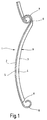
- Fig. 1 shows a roller shutter slat 1 with a metal part 2 and a plastic element 3.
- the plastic element 3 is a PVC tape 4, which with a carbon fiber network is connected.
- the PVC tape 4 is provided on one side with a color coating 9.
- the thickness of the PVC tape 4 is approximately 0.6 mm, the width in the stretched state is approximately 33 mm.
- the metal part 2 is a roll-formed aluminum band 5.
- This aluminum strip 5 has a thickness of 0.38 mm and a width of approximately 51 mm in the bent state. Before it was processed into roller shutter slats 1, the aluminum strip 5 was provided on both sides with a 0.02 mm thick colored lacquer layer.
- the PVC band 4 protrudes with its two edges 6 up to regions 7 and 8 of the metal part 2 which are hook-shaped in cross section.
- the PVC band 4 is located in the concave region of the metal part 2, as a result of which the roller shutter slats 1 are suitable for so-called right-handers.
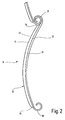
- FIG. 2 shows a further roller shutter slat 11 with a metal part 12, which essentially corresponds to the metal part 2.
- a plastic element 13 is provided, which is a PVC tape 14 reinforced with a glass fiber network.
- the dimensions correspond to those of the first embodiment.
- this PVC tape 14 is attached to the convex side of the metal part 12.
- the metal part 12 is a bent aluminum strip 15.
- the edges 16 of the PVC strip 14 protrude close to hook-shaped areas 17 and 18 of the metal part 12.
- the PVC tape 14 is provided on its outside 18 with a color coating 19.
- the roller shutter slats 11 are particularly suitable for so-called left-hand rollers.
- a roll coating system 21 is shown schematically.
- the first station 22 there is a coil 23 with an aluminum strip 24.
- This aluminum strip 24 is unwound from the coil 23 and introduced directly to the second station 25, namely directly into the roll forming machine 26.
- the aluminum strip 24 is bent by roll deformation in such a way that a profile is created which corresponds to that of the aluminum strip 5 in the first exemplary embodiment.
- the formed aluminum band 24 passes directly to the second station 25 to the third station 27, which already belongs to the actual profile coating machine 28.
- the aluminum strip 24 is coated with a primer, as a result of which grease or dirt residues are neutralized.
- the primer is based on a polycondensation resin and contains chlorinated hydrocarbon as a solvent. After this coating, the aluminum strip 24 is guided past two hot-air blowers 30 in the fourth station 29, as a result of which the primer is dried and at the same time the aluminum strip 24 is preheated to approximately 30 ° C.
- Hot melt adhesive 33 is a reactive hot melt adhesive based on PUR.
- approx. 30 - 50 g of hot melt adhesive 33 per m 2 are applied to the PVC tape 4. This takes place at a temperature of approx. 115 ° C.
- the two belts 24 and 4 come into contact in the fifth station 34 and are pressed firmly against one another by means of pressure and fixing rollers 35, so that a reliable connection exists after cooling.
- the almost finished roller shutter slat 1 leaves the profile coating machine 28 and arrives at the sixth station 36, namely a cutting and locking punching tool 37, where the individual roller slats 1 are automatically punched and pre-locked in the desired lengths.
- the roller shutter slats 1 are placed on a storage table 38 and possibly transported to the warehouse or further processed.
- the same roll coating system 21 can also be used to produce roller shutter slats without PVC tape if the stations of the profile coating machine 28 are run through without the corresponding processing steps are carried out. Furthermore, by exchanging the rollers, both roller shutter slats 1, 11 according to the first and the second exemplary embodiment can be produced on the same roll coating system 21. Depending on the construction, this can even be done by interchanging the roller sets within the roll coating system 21, as a result of which no additional storage space is required.
Landscapes
- Engineering & Computer Science (AREA)
- Structural Engineering (AREA)
- Architecture (AREA)
- Civil Engineering (AREA)
- Application Of Or Painting With Fluid Materials (AREA)
- Laminated Bodies (AREA)
- Extrusion Moulding Of Plastics Or The Like (AREA)
- Rolls And Other Rotary Bodies (AREA)
- Coating Apparatus (AREA)
- Lining Or Joining Of Plastics Or The Like (AREA)
Abstract
Description
- Die Erfindung betrifft einen Rolladenlamelle gemäß dem Oberbegriff des Anspruchs 1, ein Verfahren zur Herstellung einer derartigen Rolladenlamelle sowie eine entsprechende Rolladenbeschichtungsanlage.
- Derartige Rolladenlamellen sind bekannt. So offenbart die DE 26 22 905 A1 eine Rolladenlamelle mit einem hakenförmigen Befestigungsabschnitt. Bei einer derartigen Rolladenlamelle sind ein Metallteil und ein Kunststoffelement miteinander fest verbunden sind. Beim Metallteil handelt es sich in der Regel um Aluminium, das durch Rollverformung aus einem Aluminiumband rollgeformt wird. In dieses fertig geformte Metallteil wird ein Kunststoff, beispielsweise PVC extrudiert oder geschäumt.
- Nachteil derartiger Lamellen ist, daß die Haftung des Kunststoffelements am Metallteil nicht dauerhaft ist. So sind zusätzlich mechanische Verbindungen, insbesondere in der Form von Hinterschneidungen erforderlich. Dadurch steigt der Materialbedarf und das Herstellungsverfahren wird komplizierter und teurer.
- Der vorliegenden Erfindung liegt daher die Aufgabe zugrunde, diese Nachteile zu beseitigen und eine einfache, witterungsbeständige Rolladenlamelle sowie ein Verfahren zur Herstellung derselben neben einer hierfür geeigneten Anlage zur Verfügung zu stellen.
- Diese Aufgabe wird durch eine Rolladenlamelle mit den Merkmalen des Anspruchs 1 sowie durch ein Verfahren gemäß Anspruch 10 und die Anlage gemäß Anspruch 17 gelöst.
- Auf besonders einfache Weise läßt sich eine Rolladenlamelle herstellen, bei der ein PVC-Band mit einem Metallteil verbunden ist. Dabei wird die Alterungsbeständigkeit des PVC-Bandes u.a. dadurch erhöht, daß ein PVC-Band mit einem Glasfaser-, Kohlefasernetz- oder einem Textilgewebe verwendet wird. Durch diese Gewebeeinlage wird der Wärmeausdehnungskoeffizient des PVC-Bandes im Bereich der Verbindung zwischen dem PVC-Band und dem Metallteil etwa dem Wärmeausdehnungskoeffizienten des Metallteils angepaßt. Temperaturbedingte Spannungen im Verbindungsbereich treten kaum noch auf.
- Besonders vorteilhaft ist die Verwendung eines Schmelzklebers, wobei es sich vorzugsweise um einen reaktiven Schmelzkleber auf PUR-Basis handelt, der in einer Dicke von ca. 30 - 50 g je m2 auf das Kunststoffelement aufgetragen wird. Das Auftragen des Schmelzklebers erfolgt dabei vorzugsweise bei einer Temperatur von zwischen 110 und 120°C. Der Schmelzkleber selbst ist bis 150°C hitzebeständig und bis -40°C kältebeständig. Seine Schälfestigkeit beträgt ca. 3,5 N je mm2.
- Die Verwendung eines Aluminiumbandes als Metallteil der Rolladenlamelle ist aufgrund der Witterungsbeständigkeit des Aluminiums besonders vorteilhaft.
- Ferner ist Aluminium besonders leicht und läßt sich gut mittels Rollumformung bearbeiten.
- Eine Ausgestaltung gemäß der das PVC-Band bis dicht an die hakenförmigen Bereiche des Metallteils heranreichen, bewirkt, daß das PVC-Band relativ geschützt ist und nicht oder nur bedingt infolge von Relativbewegungen bezüglich angrenzender Rolladenlamellen benutzt wird. Vorzugsweise beträgt die Breite des ungerollten Metallteils etwa 51 mm, die Breite des PVC-Bandes etwa 33 mm. Dadurch ist ein Freibleiben der Randbereiche des Metallteils gewährleistet.
- Die Witterungsbeständigkeit des PVC-Bandes sowie des Metallteils kann durch deren Beschichtung, beispielsweise durch eine Farbbeschichtung erhöht werden. Ferner wird die Oberfläche durch diese Beschichtung verbessert, insbesondere werden die Gleiteigenschaften optimiert.
- Optimale Eigenschaften weist eine Rolladenlamelle auf, bei der das Metallteil eine Dicke von ca. 0,42 mm und das PVC-Band eine Dicke von etwa 0,6 mm aufweist.
- Ein Verfahren zur Herstellung einer entsprechenden Rolladenlamelle, bei dem zuerst ein Metallband in einer Rollformmaschine rollgeformt wird, dann dieses erwärmt und mit einem einseitig mit einem Schmelzkleber beschichteten Kunststoffband in Anlage gelangt, diese beiden Bänder aneinander gepreßt werden und nach dem Aushärten direkt abgelängt werden, ermöglicht eine vollständige Automatisierung des Herstellungsverfahrens. Dabei wird die gesamte Rollbeschichtungsanlage kontinuierlich durchlaufen. Die Lagerhaltung, die bei Zwischenstationen zusätzlich erforderlich wäre, kann vollständig entfallen und der Raumbedarf für die Rollbeschichtungsanlage beschränkt sich auf eine schmale Bahn, entlang der die einzelnen Maschinen in einer Reihe angeordnet sind.
- Weitere Vorteile dieses Verfahrens sind den entsprechenden Unteransprüchen zu entnehmen.
- Eine Rollbeschichtungsanlage, mit der nach diesem Verfahren gearbeitet werden kann, weist entsprechende Vorteile auf. Besonders vorteilhafte Ausgestaltungsformen sind den entsprechenden Unteransprüchen zu entnehmen.
- Im folgenden wird die vorliegende Erfindung anhand zweier Ausführungsbeispiele unter Bezugnahme auf die beiliegenden Zeichnungen näher erläutert. Ferner wird ein erfindungsgemäßes Herstellungsverfahren anhand einer Rollbeschichtungsanlage beschrieben. Es zeigen:
- Fig. 1
- einen Querschnitt durch eine erste Ausführungsform einer Rolladenlamelle,
- Fig. 2
- einen Querschnitt durch eine zweite Ausführungsform einer Rolladenlamelle und
- Fig. 3
- ein Ablaufschema zur Herstellung von Rolladenlamellen.
- Fig. 1 zeigt eine Rolladenlamelle 1 mit einem Metallteil 2 und einem Kunststoffelement 3. In ihrer Gesamtheit bilden das Metallteil 2 und das Kunststoffelement 3 ein allgemein übliches Profil von Rolladenlamellen 1. Beim Kunststoffelement 3 handelt es sich um ein PVC-Band 4, das mit einem Kohlefasernetz verbunden ist. Das PVC-Band 4 ist einseitig mit einer Farbbeschichtung 9 versehen. Die Dicke des PVC-Bandes 4 beträgt ca. 0,6 mm, die Breite in gestrecktem Zustand ca. 33 mm. Das Metallteil 2 ist ein rollgeformtes Aluminiumband 5. Dieses Aluminiumband 5 hat eine Dicke von 0,38 mm und im umgebogenen Zustand eine Breite von ca. 51 mm. Vor seiner Verarbeitung zu Rolladenlamellen 1 wurde das Aluminiumband 5 beidseitig mit einer jeweils 0,02 mm dicken farbigen Lackschicht versehen.
- Das PVC-Band 4 ragt mit seinen beiden Rändern 6 bis an im Querschnitt hakenförmige Bereiche 7 und 8 des Metallteils 2 heran. Beim ersten Ausführungsbeispiel befindet sich das PVC-Band 4 im konkaven Bereich des Metallteils 2, wodurch die Rolladenlamellen 1 für sogenannte Rechtsroller geeignet sind.
- Fig. 2 zeigt eine weitere Rolladenlamelle 11 mit einem Metallteil 12, das im wesentlichen dem Metallteil 2 entspricht. Ferner ist ein Kunststoffelement 13 vorgesehen, bei dem es sich um ein mit einem Glasfasernetz verstärktes PVC-Band 14 handelt. Die Abmessungen entsprechen denen des ersten Ausführungsbeispiels. Dieses PVC-Band 14 ist im Gegensatz zum PVC-Band 4 des ersten Ausführungsbeispiels auf der konvexen Seite des Metallteils 12 angebracht. Beim Metallteil 12 handelt es sich um ein gebogenes Aluminiumband 15. Die Ränder 16 des PVC-Bandes 14 ragen bis dicht an hakenförmige Bereiche 17 und 18 des Metallteils 12 heran. Ferner ist das PVC-Band 14 auf seiner Außenseite 18 mit einer Farbbeschichtung 19 versehen. Die Rolladenlamellen 11 sind insbesondere für sogenannte Linksroller geeignet.
- In Fig. 3 ist eine Rollbeschichtungsanlage 21 schematisch dargestellt. An der ersten Station 22 befindet sich ein Coil 23 mit einem Aluminiumband 24. Dieses Aluminiumband 24 wird vom Coil 23 abgerollt und direkt zur zweiten Station 25, nämlich direkt in die Rollformmaschine 26 eingeführt. In dieser Rollformmaschine 26 wird das Aluminiumband 24 durch Rollverformung derart gebogen, daß ein Profil entsteht, welches dem des Aluminiumbandes 5 des ersten Ausführungsbeispiels entspricht. Das umgeformte Aluminiumband 24 gelangt direkt im Anschluß an die zweite Station 25 zur dritten Station 27, die bereits zur eigentlichen Profilbeschichtungsmaschine 28 gehört. An dieser dritten Station 27 wird das Aluminiumband 24 mit einem Primer beschichtet, wodurch Fett- oder Schmutzrückstände neutralisiert werden. Der Primer basiert auf einem Polykondensationsharz und enthält als Lösungsmittel chlorierten Kohlenwasserstoff. Nach dieser Beschichtung wird das Aluminiumband 24 in der vierten Station 29 an zwei Heißluftgebläsen 30 vorbeigeführt, wodurch der Primer getrocknet und gleichzeitig das Aluminiumband 24 auf ca. 30°C vorgewärmt wird.
- Von außen wird dem kontinuierlich vorwärtsbewegten Aluminiumband 24 ein PVC-Band 4 zugeführt, das in gleicher Geschwindigkeit direkt von einer Rolle 31 abgewickelt und in einem Rakel 32 mit Schmelzkleber 33 einseitig beschichtet wird. Beim Schmelzkleber 33 handelt es sich um einen reaktiven Schmelzkleber auf PUR-Basis. Beim Auftragvorgang werden ca. 30 - 50 g Schmelzkleber 33 je m2 auf das PVC-Band 4 aufgetragen. Dies erfolgt bei einer Temperatur von ca. 115°C. Die beiden Bänder 24 und 4 gelangen in der fünften Station 34 in Anlage und werden mittels Andruck- und Fixierrollen 35 fest aneinander gepreßt, wodurch nach dem Auskühlen eine sichere Verbindung besteht. Nach der fünften Station 34 verläßt die fast fertige Rolladenlamelle 1 die Profilbeschichtungsmaschine 28 und gelangt zur sechsten Station 36, nämlich einem Abläng- und Arretierstanzwerkzeug 37, wo die einzelnen Roll adenlamellen 1 automatisch in den gewünschten Längen abgestanzt und vorarretiert werden. Nach Abschluß der Vorarretierung werden die Rolladenlamellen 1 auf einem Ablagetisch 38 abgelegt und gegebenenfalls ins Lager transportiert oder weiterbearbeitet.
- Wie ohne weiteres erkennbar ist, können mit derselben Rollbeschichtungsanlage 21 auch Rolladenlamellen ohne PVC-Band hergestellt werden, wenn die Stationen der Profilbeschichtungsmaschine 28 durchlaufen werden, ohne daß die entsprechenden Bearbeitungsgänge durchgeführt werden. Ferner können durch Austauschen der Rollen beide Rolladenlamellen 1, 11 gemäß dem ersten und dem zweiten Ausführungsbeispiel auf derselben Rollbeschichtungsanlage 21 hergestellt werden. Je nach Konstruktion kann dies sogar durch Vertauschen der Rollensätze innerhalb der Rollbeschichtungsanlage 21 erfolgen, wodurch kein zusätzlicher Lagerraum erforderlich ist.
Claims (21)
- Rolladenlamelle (1, 11) mit einem Metallteil (2, 12), mit welchem zumindest teilweise ein Kunststoffelement (3, 13) fest verbunden ist, dadurch gekennzeichnet, daß das Kunststoffelement (3, 13) ein PVC-Band (4, 14) ist, das mit einem Glasfaser-, Kohlenfaser- oder Textilgewebe verbunden ist.
- Rolladenlamelle nach Anspruch 1, dadurch gekennzeichnet, daß zwischen dem Metallteil (2, 12) und dem Kunststoffelement (3, 13) ein Schmelzkleber (33) vorgesehen ist.
- Rolladenlamelle nach einem der vorhergehenden Ansprüche, dadurch gekennzeichnet, daß das Metallteil (2) ein Stück eines rollgeformten Aluminiumbandes (5) ist.
- Rolladenlamelle nach einem der vorhergehenden Ansprüche, dadurch gekennzeichnet, daß die Ränder (6, 16) des PVC-Bandes (4) bis dicht an hakenförmige Bereiche (7, 8; 17, 18) des Metallteils (2) heranreichen.
- Rolladenlamelle nach einem der vorhergehenden Ansprüche, dadurch gekennzeichnet, daß die Außenseite (18) des PVC-Bandes (4, 14) mit einer Beschichtung versehen ist.
- Rolladenlamelle nach einem der vorhergehenden Ansprüche, dadurch gekennzeichnet, daß das Metallteil (2, 12) beidseitig mit einer Beschichtung versehen ist.
- Rolladenlamelle nach Anspruch 5 oder 6, dadurch gekennzeichnet, daß die Beschichtung eine Farbbeschichtung (19) ist.
- Rolladenlamelle nach einem der vorhergehenden Ansprüche, dadurch gekennzeichnet, daß das Metallteil (2, 12) 0,42 ± 0,04 mm dick ist.
- Rolladenlamelle nach einem der vorhergehenden Ansprüche, dadurch gekennzeichnet, daß das PVC-Band (4, 14) 0,60 ± 0,02 mm dick ist.
- Verfahren zur Herstellung einer Rolladenlamelle (1, 11) mit einem Metallteil (2, 12), das zumindest teilweise mit einem Kunststoffelement (3, 13) verbunden wird, dadurch gekennzeichnet, daß das Metallteil (2, 12) ein Metallband und das Kunststoffelement (3, 13) ein PVC-Band (4, 14) ist, wobei das Metallband in einer Rollformmaschine (26) rollgeformt wird, ohne Unterbrechung der Längsbewegung nach dem Durchlaufen eines Heißluftgebläses (30) oder einer Heizvorrichtung mit dem einseitig mit einem Schmelzkleber (33) beschichteten PVC-Band (4, 14) in Anlage gelangt, die beiden Bänder mittels Andruck- und Fixierrollen (35) fest miteinander verbunden werden und danach die fertigen Rolladenlamellen (1) ohne Unterbrechung der Längsbewegung abgelängt werden.
- Verfahren zur Herstellung einer Rolladenlamelle nach Anspruch 10, dadurch gekennzeichnet, daß das Metallband ein Aluminiumband (24) ist, daß dieses Aluminiumband (24) im Heißluftgebläse (30) oder der Heizvorrichtung auf eine Temperatur von 30°C vorgewärmt wird und daß das Auftragen des Schmelzklebers (33) auf das PVC-Band (4, 14) bei einer Temperatur von 110 bis 120°C erfolgt.
- Verfahren zur Herstellung einer Rolladenlamelle nach einem der Ansprüche 10 oder 11, dadurch gekennzeichnet, daß 30 - 50 g Schmelzkleber (33) je m2 PVC-Band (4, 14) aufgetragen werden.
- Verfahren zur Herstellung einer Rolladenlamelle nach einem der Ansprüche 10 bis 12, dadurch gekennzeichnet, daß der Schmelzkleber (33) ein reaktiver Schmelzkleber auf PUR-Basis ist.
- Verfahren zur Herstellung einer Rolladenlamelle nach einem der Ansprüche 10 bis 13, dadurch gekennzeichnet, daß nach der Rollumformung ein Primer auf das Aluminiumband (24) aufgebracht wird, der während des Durchlaufens durch das Heißluftgebläse (30) oder der Heizvorrichtung getrocknet wird.
- Verfahren zur Herstellung einer Rolladenlamelle nach einem der Ansprüche 10 bis 14, dadurch gekennzeichnet, daß der Primer ein Mittel auf Polykondensationsharzbasis ist, welches mit chloriertem Kohlenwasserstoff als Lösungsmittel versehen ist.
- Verfahren zur Herstellung einer Rolladenlamelle nach einem der Ansprüche 10 bis 15, dadurch gekennzeichnet, daß das PVC-Band (4, 14) nach dem Fixieren mit einer Beschichtung (19) versehen wird.
- Rollbeschichtungsanlage (21) für Rolladenlamellen (1, 11) mit einer ersten Station (22), die der Lagerung eines Coils (23) mit einem Metallband dient, einer zweiten Station (25), die im wesentlichen aus einer Rollformmaschine (26) besteht, einer Profilbeschichtungsmaschine (28), in der das Metallband mit einem Kunststoffband beschichtet wird, wobei die beiden Bänder mittels Andruck- und Fixierrollen (35) fest aneinandergepreßt werden und einer dritten Station (36), nämlich einem kontinuierlich arbeitenden Abläng- und Arretierstanzwerkzeug (37), wobei alle drei Stationen (22, 25, 36) in einer Reihe angeordnet sind.
- Rollbeschichtungsanlage nach Anspruch 17, dadurch gekennzeichnet, daß nach der Rollformmaschine (26) eine Station (27) angeordnet ist, die dazu dient, einen Primer auf das Metallband aufzutragen.
- Rollbeschichtungsanlage nach einem der Ansprüche 17 oder 18, dadurch gekennzeichnet, daß der Station (27) ein Heißluftgebläse (30) oder eine Heizvorrichtung nachgeordnet ist.
- Rollbeschichtungsanlage nach einem der Ansprüche 17 bis 19, dadurch gekennzeichnet, daß sämtliche Werkzeuge und Rollen derart ausgebildet sind, daß die Rollbeschichtungsanlage (21) durch entsprechendes Vertauschen der Werkzeuge und Rollen sowohl zur Herstellung von Rollladenlamellen (1), bei denen das Kunststoffband im konkaven Bereich des Metallbandes angeordnet ist, als auch zur Herstellung von Rolladenlamellen (11), bei denen das Kunststoffband im konvexen Bereich des Metallbandes angeordnet ist, geeignet sind.
- Rollbeschichtungsanlage nach einem der Ansprüche 17 bis 20, dadurch gekennzeichnet, daß in der oder im Anschluß an die Profilbeschichtungsmaschine (28) eine der eigentlichen Profilbeschichtung nachgeordnete Vorrichtung zum Beschichten einer Seite der Rolladenlamellen (1, 11) vorgesehen ist.
Applications Claiming Priority (2)
| Application Number | Priority Date | Filing Date | Title |
|---|---|---|---|
| DE19618418 | 1996-05-08 | ||
| DE19618418 | 1996-05-08 |
Publications (3)
| Publication Number | Publication Date |
|---|---|
| EP0806541A2 true EP0806541A2 (de) | 1997-11-12 |
| EP0806541A3 EP0806541A3 (de) | 1999-02-03 |
| EP0806541B1 EP0806541B1 (de) | 2003-05-07 |
Family
ID=7793660
Family Applications (1)
| Application Number | Title | Priority Date | Filing Date |
|---|---|---|---|
| EP97102110A Expired - Lifetime EP0806541B1 (de) | 1996-05-08 | 1997-02-11 | Rolladenlamelle, Verfahren zur Herstellung einer Rolladenlamelle und Rolladenbeschichtungsanlage |
Country Status (3)
| Country | Link |
|---|---|
| EP (1) | EP0806541B1 (de) |
| AT (1) | ATE239855T1 (de) |
| DE (1) | DE59710015D1 (de) |
Cited By (4)
| Publication number | Priority date | Publication date | Assignee | Title |
|---|---|---|---|---|
| ES2165248A1 (es) * | 1998-08-03 | 2002-03-01 | Sanchez Antonio Canovas | Lama maciza reforzada ultraligera para persianas. |
| EP1087092A3 (de) * | 1999-09-04 | 2003-06-25 | REHAU AG + Co | Profilelement |
| EP2843177A1 (de) * | 2013-08-30 | 2015-03-04 | Regazzi SA | Rollladenleiste, Verfahren zur Herstellung einer Rollladenleiste und Vorrichtung zur Herstellung eines Rollladenstreifens |
| EP3385490A1 (de) * | 2017-04-03 | 2018-10-10 | VKR Holding A/S | Abschirmkörper mit verbesserter witterungsbeständigkeit, verbessertem uv-widerstand sowie verbesserten laminierungseigenschaften |
Citations (1)
| Publication number | Priority date | Publication date | Assignee | Title |
|---|---|---|---|---|
| DE2622905A1 (de) | 1976-05-21 | 1977-11-24 | Grashei F Alukon Kg | Rolladenstab und verfahren zu seiner herstellung |
Family Cites Families (5)
| Publication number | Priority date | Publication date | Assignee | Title |
|---|---|---|---|---|
| US3231419A (en) * | 1962-07-02 | 1966-01-25 | Johnson & Johnson | Method of making a cured tacky and pressure-sensitive adhesive tape |
| DE2912774A1 (de) * | 1979-03-30 | 1980-10-02 | Braselmann Klaus | Rolladen mit einer daemmschicht zur minderung von schall- und/oder waermeuebertragungen |
| DE8102096U1 (de) * | 1981-01-28 | 1981-07-09 | Nbb - Baubedarf Gmbh, 8395 Hauzenberg | Profillamelle fuer rolltore |
| GB9111887D0 (en) * | 1991-06-03 | 1991-07-24 | Klein Andre | Improvements in composite structures |
| DE4211125C2 (de) * | 1992-04-03 | 1994-12-08 | Henkel Kgaa | Schmelzklebstoffe, Verfahren zu deren Herstellung und deren Verwendung |
-
1997
- 1997-02-11 DE DE59710015T patent/DE59710015D1/de not_active Expired - Lifetime
- 1997-02-11 AT AT97102110T patent/ATE239855T1/de not_active IP Right Cessation
- 1997-02-11 EP EP97102110A patent/EP0806541B1/de not_active Expired - Lifetime
Patent Citations (1)
| Publication number | Priority date | Publication date | Assignee | Title |
|---|---|---|---|---|
| DE2622905A1 (de) | 1976-05-21 | 1977-11-24 | Grashei F Alukon Kg | Rolladenstab und verfahren zu seiner herstellung |
Cited By (4)
| Publication number | Priority date | Publication date | Assignee | Title |
|---|---|---|---|---|
| ES2165248A1 (es) * | 1998-08-03 | 2002-03-01 | Sanchez Antonio Canovas | Lama maciza reforzada ultraligera para persianas. |
| EP1087092A3 (de) * | 1999-09-04 | 2003-06-25 | REHAU AG + Co | Profilelement |
| EP2843177A1 (de) * | 2013-08-30 | 2015-03-04 | Regazzi SA | Rollladenleiste, Verfahren zur Herstellung einer Rollladenleiste und Vorrichtung zur Herstellung eines Rollladenstreifens |
| EP3385490A1 (de) * | 2017-04-03 | 2018-10-10 | VKR Holding A/S | Abschirmkörper mit verbesserter witterungsbeständigkeit, verbessertem uv-widerstand sowie verbesserten laminierungseigenschaften |
Also Published As
| Publication number | Publication date |
|---|---|
| DE59710015D1 (de) | 2003-06-12 |
| ATE239855T1 (de) | 2003-05-15 |
| EP0806541A3 (de) | 1999-02-03 |
| EP0806541B1 (de) | 2003-05-07 |
Similar Documents
| Publication | Publication Date | Title |
|---|---|---|
| DE3888910T2 (de) | Fensterdichtungsprofil und Herstellungsverfahren. | |
| DE2937454C2 (de) | Verbundprofil, insbesondere für Fenster, Türen und Fassaden sowie Verfahren zum Herstellen des Verbundprofils | |
| DE3855847T2 (de) | Profilelement und Verfahren zu dessen Herstellung | |
| EP0069401B1 (de) | Verfahren zur Herstellung eines flächigen Verbundmaterials | |
| DE60205958T2 (de) | Herstellungsverfahren und Vorrichtung eines lamellierten Sprossenprofiles | |
| EP0446778B1 (de) | Formstabilisierter Rolladenstab und Verfahren zu seiner Herstellung | |
| DE2941176A1 (de) | Versteifungselement fuer profilleisten | |
| DE3912687C2 (de) | ||
| DE2302877C3 (de) | Verfahren zum Herstellen von Metalleinlagen für profilierte und flexible Bänder mit einer Umhüllung | |
| DE2654879C2 (de) | Verfahren zum kontinuierlichen herstellen eines mit einer Isolierhülle aus Schaumkunststoff versehenen Rohres | |
| EP0806541B1 (de) | Rolladenlamelle, Verfahren zur Herstellung einer Rolladenlamelle und Rolladenbeschichtungsanlage | |
| EP0441287B1 (de) | Metallband als Einlage für Zier- und Dichtstreife | |
| EP0579007A2 (de) | Bewehrungsmatte für Verputzschichten von Gebäuden | |
| DE2554663C2 (de) | Verfahren zum Herstellen eines Profils für Fenster, Türen und andere Rahmenkonstruktionen und Vorrichtung zur Durchführung des Verfahrens | |
| EP0010579A1 (de) | Verfahren zur Herstellung von Hochdruckschläuchen und Vorrichtung zur Durchführung des Verfahrens | |
| DE60103149T2 (de) | Vorrichtung zum verbinden von profilen | |
| DE10140450B4 (de) | Verfahren und Vorrichtung zum Beschichten einer Profilschiene | |
| DE2622905A1 (de) | Rolladenstab und verfahren zu seiner herstellung | |
| DE3843574C2 (de) | ||
| DE68911306T2 (de) | Fensterprofilstücke für Kraftfahrzeuge und Herstellungsverfahren dafür. | |
| EP1048817A1 (de) | Verfahren zur Herstellung eines Metallfolien-/Gewebebundes insbesondere für Rolladenpanzer | |
| DE19632149C1 (de) | Formstempel zum Nachformen eines an einen Gegenstand anextrudierten Profilstrangs | |
| DE69807153T2 (de) | Verfahren zum Beflocken von profilierten Streifen und beflockte Streifen | |
| AT500966B1 (de) | Profil aus formstabilem extrudat sowie verfahren und anlage zum herstellen solcher profile | |
| EP3504053B1 (de) | Verfahren zur mehrstufigen herstellung eines zug- oder tragmittels |
Legal Events
| Date | Code | Title | Description |
|---|---|---|---|
| PUAI | Public reference made under article 153(3) epc to a published international application that has entered the european phase |
Free format text: ORIGINAL CODE: 0009012 |
|
| AK | Designated contracting states |
Kind code of ref document: A2 Designated state(s): AT BE CH DE DK FR LI LU NL |
|
| PUAL | Search report despatched |
Free format text: ORIGINAL CODE: 0009013 |
|
| AK | Designated contracting states |
Kind code of ref document: A3 Designated state(s): AT BE CH DE DK FR LI LU NL |
|
| RTI1 | Title (correction) | ||
| 17P | Request for examination filed |
Effective date: 19990127 |
|
| 17Q | First examination report despatched |
Effective date: 19990326 |
|
| GRAH | Despatch of communication of intention to grant a patent |
Free format text: ORIGINAL CODE: EPIDOS IGRA |
|
| GRAH | Despatch of communication of intention to grant a patent |
Free format text: ORIGINAL CODE: EPIDOS IGRA |
|
| GRAA | (expected) grant |
Free format text: ORIGINAL CODE: 0009210 |
|
| AK | Designated contracting states |
Designated state(s): AT BE CH DE DK FR LI LU NL |
|
| PG25 | Lapsed in a contracting state [announced via postgrant information from national office to epo] |
Ref country code: NL Free format text: LAPSE BECAUSE OF FAILURE TO SUBMIT A TRANSLATION OF THE DESCRIPTION OR TO PAY THE FEE WITHIN THE PRESCRIBED TIME-LIMIT Effective date: 20030507 Ref country code: FR Free format text: LAPSE BECAUSE OF FAILURE TO SUBMIT A TRANSLATION OF THE DESCRIPTION OR TO PAY THE FEE WITHIN THE PRESCRIBED TIME-LIMIT Effective date: 20030507 |
|
| REG | Reference to a national code |
Ref country code: CH Ref legal event code: NV Representative=s name: ISLER & PEDRAZZINI AG Ref country code: CH Ref legal event code: EP |
|
| REF | Corresponds to: |
Ref document number: 59710015 Country of ref document: DE Date of ref document: 20030612 Kind code of ref document: P |
|
| PG25 | Lapsed in a contracting state [announced via postgrant information from national office to epo] |
Ref country code: DK Free format text: LAPSE BECAUSE OF FAILURE TO SUBMIT A TRANSLATION OF THE DESCRIPTION OR TO PAY THE FEE WITHIN THE PRESCRIBED TIME-LIMIT Effective date: 20030807 |
|
| NLV1 | Nl: lapsed or annulled due to failure to fulfill the requirements of art. 29p and 29m of the patents act | ||
| PG25 | Lapsed in a contracting state [announced via postgrant information from national office to epo] |
Ref country code: LU Free format text: LAPSE BECAUSE OF NON-PAYMENT OF DUE FEES Effective date: 20040211 Ref country code: AT Free format text: LAPSE BECAUSE OF NON-PAYMENT OF DUE FEES Effective date: 20040211 |
|
| PG25 | Lapsed in a contracting state [announced via postgrant information from national office to epo] |
Ref country code: BE Free format text: LAPSE BECAUSE OF NON-PAYMENT OF DUE FEES Effective date: 20040228 |
|
| PG25 | Lapsed in a contracting state [announced via postgrant information from national office to epo] |
Ref country code: LI Free format text: LAPSE BECAUSE OF NON-PAYMENT OF DUE FEES Effective date: 20040229 Ref country code: CH Free format text: LAPSE BECAUSE OF NON-PAYMENT OF DUE FEES Effective date: 20040229 |
|
| PLBE | No opposition filed within time limit |
Free format text: ORIGINAL CODE: 0009261 |
|
| STAA | Information on the status of an ep patent application or granted ep patent |
Free format text: STATUS: NO OPPOSITION FILED WITHIN TIME LIMIT |
|
| 26N | No opposition filed |
Effective date: 20040210 |
|
| EN | Fr: translation not filed | ||
| BERE | Be: lapsed |
Owner name: *BAIER PAUL Effective date: 20040228 |
|
| REG | Reference to a national code |
Ref country code: CH Ref legal event code: PL |
|
| PGFP | Annual fee paid to national office [announced via postgrant information from national office to epo] |
Ref country code: DE Payment date: 20160208 Year of fee payment: 20 |
|
| REG | Reference to a national code |
Ref country code: DE Ref legal event code: R071 Ref document number: 59710015 Country of ref document: DE |