EP0804651B1 - Materiau et procede de formation d'une couche de barrage subaquatique - Google Patents
Materiau et procede de formation d'une couche de barrage subaquatique Download PDFInfo
- Publication number
- EP0804651B1 EP0804651B1 EP95919850A EP95919850A EP0804651B1 EP 0804651 B1 EP0804651 B1 EP 0804651B1 EP 95919850 A EP95919850 A EP 95919850A EP 95919850 A EP95919850 A EP 95919850A EP 0804651 B1 EP0804651 B1 EP 0804651B1
- Authority
- EP
- European Patent Office
- Prior art keywords
- bead
- beads
- sealant layer
- clay
- core
- Prior art date
- Legal status (The legal status is an assumption and is not a legal conclusion. Google has not performed a legal analysis and makes no representation as to the accuracy of the status listed.)
- Expired - Lifetime
Links
- 239000000463 material Substances 0.000 title claims description 34
- 230000004888 barrier function Effects 0.000 title claims description 33
- 238000000034 method Methods 0.000 title claims description 16
- 239000011324 bead Substances 0.000 claims description 82
- 239000000565 sealant Substances 0.000 claims description 45
- 239000004927 clay Substances 0.000 claims description 28
- XLYOFNOQVPJJNP-UHFFFAOYSA-N water Substances O XLYOFNOQVPJJNP-UHFFFAOYSA-N 0.000 claims description 25
- 239000011230 binding agent Substances 0.000 claims description 20
- 206010063659 Aversion Diseases 0.000 claims description 6
- 239000003795 chemical substances by application Substances 0.000 claims description 6
- 229910000278 bentonite Inorganic materials 0.000 claims description 5
- 229940092782 bentonite Drugs 0.000 claims description 5
- 239000000440 bentonite Substances 0.000 claims description 5
- SVPXDRXYRYOSEX-UHFFFAOYSA-N bentoquatam Chemical compound O.O=[Si]=O.O=[Al]O[Al]=O SVPXDRXYRYOSEX-UHFFFAOYSA-N 0.000 claims description 5
- 239000010440 gypsum Substances 0.000 claims description 5
- 229910052602 gypsum Inorganic materials 0.000 claims description 5
- RWZYAGGXGHYGMB-UHFFFAOYSA-N anthranilic acid Chemical compound NC1=CC=CC=C1C(O)=O RWZYAGGXGHYGMB-UHFFFAOYSA-N 0.000 claims description 4
- OSGAYBCDTDRGGQ-UHFFFAOYSA-L calcium sulfate Inorganic materials [Ca+2].[O-]S([O-])(=O)=O OSGAYBCDTDRGGQ-UHFFFAOYSA-L 0.000 claims description 4
- ZOMBKNNSYQHRCA-UHFFFAOYSA-J calcium sulfate hemihydrate Chemical compound O.[Ca+2].[Ca+2].[O-]S([O-])(=O)=O.[O-]S([O-])(=O)=O ZOMBKNNSYQHRCA-UHFFFAOYSA-J 0.000 claims description 4
- 150000002148 esters Chemical class 0.000 claims description 4
- 239000011507 gypsum plaster Substances 0.000 claims description 4
- 125000000962 organic group Chemical group 0.000 claims description 4
- 239000007788 liquid Substances 0.000 claims description 3
- 239000011253 protective coating Substances 0.000 claims description 3
- 239000004575 stone Substances 0.000 claims description 3
- FLUWAIIVLCVEKF-UHFFFAOYSA-N 2-Methyl-1-phenyl-2-propanyl acetate Chemical compound CC(=O)OC(C)(C)CC1=CC=CC=C1 FLUWAIIVLCVEKF-UHFFFAOYSA-N 0.000 claims description 2
- WLJVXDMOQOGPHL-PPJXEINESA-N 2-phenylacetic acid Chemical compound O[14C](=O)CC1=CC=CC=C1 WLJVXDMOQOGPHL-PPJXEINESA-N 0.000 claims description 2
- 241000196324 Embryophyta Species 0.000 claims description 2
- 229920002907 Guar gum Polymers 0.000 claims description 2
- 229910000281 calcium bentonite Inorganic materials 0.000 claims description 2
- ONCZQWJXONKSMM-UHFFFAOYSA-N dialuminum;disodium;oxygen(2-);silicon(4+);hydrate Chemical compound O.[O-2].[O-2].[O-2].[O-2].[O-2].[O-2].[O-2].[O-2].[O-2].[O-2].[O-2].[O-2].[Na+].[Na+].[Al+3].[Al+3].[Si+4].[Si+4].[Si+4].[Si+4] ONCZQWJXONKSMM-UHFFFAOYSA-N 0.000 claims description 2
- 229940095104 dimethyl benzyl carbinyl acetate Drugs 0.000 claims description 2
- 229960002154 guar gum Drugs 0.000 claims description 2
- 235000010417 guar gum Nutrition 0.000 claims description 2
- 239000000665 guar gum Substances 0.000 claims description 2
- 229920000642 polymer Polymers 0.000 claims description 2
- 229910000280 sodium bentonite Inorganic materials 0.000 claims description 2
- 229940080314 sodium bentonite Drugs 0.000 claims description 2
- 239000011162 core material Substances 0.000 claims 8
- NIXOWILDQLNWCW-UHFFFAOYSA-N acrylic acid group Chemical group C(C=C)(=O)O NIXOWILDQLNWCW-UHFFFAOYSA-N 0.000 claims 1
- 230000000717 retained effect Effects 0.000 claims 1
- 239000013049 sediment Substances 0.000 description 19
- 239000004033 plastic Substances 0.000 description 10
- 239000011248 coating agent Substances 0.000 description 9
- 238000000576 coating method Methods 0.000 description 9
- 239000000203 mixture Substances 0.000 description 6
- 239000012528 membrane Substances 0.000 description 5
- 241000272517 Anseriformes Species 0.000 description 3
- 230000008021 deposition Effects 0.000 description 3
- 230000002431 foraging effect Effects 0.000 description 3
- 238000013022 venting Methods 0.000 description 3
- 235000008733 Citrus aurantifolia Nutrition 0.000 description 2
- XEEYBQQBJWHFJM-UHFFFAOYSA-N Iron Chemical compound [Fe] XEEYBQQBJWHFJM-UHFFFAOYSA-N 0.000 description 2
- 229910000831 Steel Inorganic materials 0.000 description 2
- 235000011941 Tilia x europaea Nutrition 0.000 description 2
- 239000004568 cement Substances 0.000 description 2
- 238000005336 cracking Methods 0.000 description 2
- 239000000428 dust Substances 0.000 description 2
- 239000004571 lime Substances 0.000 description 2
- 229910052751 metal Inorganic materials 0.000 description 2
- 239000002184 metal Substances 0.000 description 2
- 150000002739 metals Chemical class 0.000 description 2
- VAMXMNNIEUEQDV-UHFFFAOYSA-N methyl anthranilate Chemical compound COC(=O)C1=CC=CC=C1N VAMXMNNIEUEQDV-UHFFFAOYSA-N 0.000 description 2
- 230000005012 migration Effects 0.000 description 2
- 238000013508 migration Methods 0.000 description 2
- 150000003071 polychlorinated biphenyls Chemical class 0.000 description 2
- 239000004576 sand Substances 0.000 description 2
- 238000007789 sealing Methods 0.000 description 2
- 239000010959 steel Substances 0.000 description 2
- AROCNZZBLCAOPH-UHFFFAOYSA-N 1-methyl-4-prop-2-enoxybenzene Chemical compound CC1=CC=C(OCC=C)C=C1 AROCNZZBLCAOPH-UHFFFAOYSA-N 0.000 description 1
- 239000004925 Acrylic resin Substances 0.000 description 1
- 229920000178 Acrylic resin Polymers 0.000 description 1
- 241000251468 Actinopterygii Species 0.000 description 1
- 241000894006 Bacteria Species 0.000 description 1
- 241001465754 Metazoa Species 0.000 description 1
- OAICVXFJPJFONN-UHFFFAOYSA-N Phosphorus Chemical compound [P] OAICVXFJPJFONN-UHFFFAOYSA-N 0.000 description 1
- 240000008042 Zea mays Species 0.000 description 1
- 235000005824 Zea mays ssp. parviglumis Nutrition 0.000 description 1
- 235000002017 Zea mays subsp mays Nutrition 0.000 description 1
- 238000010521 absorption reaction Methods 0.000 description 1
- 239000007864 aqueous solution Substances 0.000 description 1
- 239000000356 contaminant Substances 0.000 description 1
- 235000005822 corn Nutrition 0.000 description 1
- 230000001419 dependent effect Effects 0.000 description 1
- 230000001627 detrimental effect Effects 0.000 description 1
- 239000003344 environmental pollutant Substances 0.000 description 1
- 239000003337 fertilizer Substances 0.000 description 1
- 239000000835 fiber Substances 0.000 description 1
- 239000010881 fly ash Substances 0.000 description 1
- 239000007789 gas Substances 0.000 description 1
- 230000012010 growth Effects 0.000 description 1
- 239000000383 hazardous chemical Substances 0.000 description 1
- 230000036571 hydration Effects 0.000 description 1
- 238000006703 hydration reaction Methods 0.000 description 1
- 238000011065 in-situ storage Methods 0.000 description 1
- 229910052742 iron Inorganic materials 0.000 description 1
- 239000004816 latex Substances 0.000 description 1
- 229920000126 latex Polymers 0.000 description 1
- 239000000155 melt Substances 0.000 description 1
- 230000008384 membrane barrier Effects 0.000 description 1
- 229940102398 methyl anthranilate Drugs 0.000 description 1
- 230000008635 plant growth Effects 0.000 description 1
- 231100000719 pollutant Toxicity 0.000 description 1
- 229910052573 porcelain Inorganic materials 0.000 description 1
- 238000002360 preparation method Methods 0.000 description 1
- 150000003839 salts Chemical class 0.000 description 1
- 230000007226 seed germination Effects 0.000 description 1
- 239000010865 sewage Substances 0.000 description 1
- 239000002893 slag Substances 0.000 description 1
- 239000010802 sludge Substances 0.000 description 1
- 239000002002 slurry Substances 0.000 description 1
- 238000005507 spraying Methods 0.000 description 1
- 230000008961 swelling Effects 0.000 description 1
Images
Classifications
-
- E—FIXED CONSTRUCTIONS
- E02—HYDRAULIC ENGINEERING; FOUNDATIONS; SOIL SHIFTING
- E02B—HYDRAULIC ENGINEERING
- E02B3/00—Engineering works in connection with control or use of streams, rivers, coasts, or other marine sites; Sealings or joints for engineering works in general
- E02B3/16—Sealings or joints
-
- E—FIXED CONSTRUCTIONS
- E02—HYDRAULIC ENGINEERING; FOUNDATIONS; SOIL SHIFTING
- E02B—HYDRAULIC ENGINEERING
- E02B3/00—Engineering works in connection with control or use of streams, rivers, coasts, or other marine sites; Sealings or joints for engineering works in general
- E02B3/04—Structures or apparatus for, or methods of, protecting banks, coasts, or harbours
- E02B3/12—Revetment of banks, dams, watercourses, or the like, e.g. the sea-floor
-
- E—FIXED CONSTRUCTIONS
- E02—HYDRAULIC ENGINEERING; FOUNDATIONS; SOIL SHIFTING
- E02D—FOUNDATIONS; EXCAVATIONS; EMBANKMENTS; UNDERGROUND OR UNDERWATER STRUCTURES
- E02D31/00—Protective arrangements for foundations or foundation structures; Ground foundation measures for protecting the soil or the subsoil water, e.g. preventing or counteracting oil pollution
-
- E—FIXED CONSTRUCTIONS
- E02—HYDRAULIC ENGINEERING; FOUNDATIONS; SOIL SHIFTING
- E02D—FOUNDATIONS; EXCAVATIONS; EMBANKMENTS; UNDERGROUND OR UNDERWATER STRUCTURES
- E02D2300/00—Materials
- E02D2300/0037—Clays
- E02D2300/004—Bentonite or bentonite-like
- E02D2300/0042—Bentonite or bentonite-like being modified by adding substances
-
- E—FIXED CONSTRUCTIONS
- E02—HYDRAULIC ENGINEERING; FOUNDATIONS; SOIL SHIFTING
- E02D—FOUNDATIONS; EXCAVATIONS; EMBANKMENTS; UNDERGROUND OR UNDERWATER STRUCTURES
- E02D2300/00—Materials
- E02D2300/0051—Including fibers
- E02D2300/0053—Including fibers made from glass
-
- E—FIXED CONSTRUCTIONS
- E02—HYDRAULIC ENGINEERING; FOUNDATIONS; SOIL SHIFTING
- E02D—FOUNDATIONS; EXCAVATIONS; EMBANKMENTS; UNDERGROUND OR UNDERWATER STRUCTURES
- E02D2300/00—Materials
- E02D2300/0051—Including fibers
- E02D2300/0054—Including fibers made from plastic
-
- E—FIXED CONSTRUCTIONS
- E02—HYDRAULIC ENGINEERING; FOUNDATIONS; SOIL SHIFTING
- E02D—FOUNDATIONS; EXCAVATIONS; EMBANKMENTS; UNDERGROUND OR UNDERWATER STRUCTURES
- E02D2300/00—Materials
- E02D2300/0051—Including fibers
- E02D2300/0064—Including fibers made from metal
-
- E—FIXED CONSTRUCTIONS
- E02—HYDRAULIC ENGINEERING; FOUNDATIONS; SOIL SHIFTING
- E02D—FOUNDATIONS; EXCAVATIONS; EMBANKMENTS; UNDERGROUND OR UNDERWATER STRUCTURES
- E02D2300/00—Materials
- E02D2300/0051—Including fibers
- E02D2300/0068—Including fibers made from carbon
-
- Y—GENERAL TAGGING OF NEW TECHNOLOGICAL DEVELOPMENTS; GENERAL TAGGING OF CROSS-SECTIONAL TECHNOLOGIES SPANNING OVER SEVERAL SECTIONS OF THE IPC; TECHNICAL SUBJECTS COVERED BY FORMER USPC CROSS-REFERENCE ART COLLECTIONS [XRACs] AND DIGESTS
- Y10—TECHNICAL SUBJECTS COVERED BY FORMER USPC
- Y10T—TECHNICAL SUBJECTS COVERED BY FORMER US CLASSIFICATION
- Y10T428/00—Stock material or miscellaneous articles
- Y10T428/25—Web or sheet containing structurally defined element or component and including a second component containing structurally defined particles
-
- Y—GENERAL TAGGING OF NEW TECHNOLOGICAL DEVELOPMENTS; GENERAL TAGGING OF CROSS-SECTIONAL TECHNOLOGIES SPANNING OVER SEVERAL SECTIONS OF THE IPC; TECHNICAL SUBJECTS COVERED BY FORMER USPC CROSS-REFERENCE ART COLLECTIONS [XRACs] AND DIGESTS
- Y10—TECHNICAL SUBJECTS COVERED BY FORMER USPC
- Y10T—TECHNICAL SUBJECTS COVERED BY FORMER US CLASSIFICATION
- Y10T428/00—Stock material or miscellaneous articles
- Y10T428/29—Coated or structually defined flake, particle, cell, strand, strand portion, rod, filament, macroscopic fiber or mass thereof
- Y10T428/2982—Particulate matter [e.g., sphere, flake, etc.]
- Y10T428/2991—Coated
-
- Y—GENERAL TAGGING OF NEW TECHNOLOGICAL DEVELOPMENTS; GENERAL TAGGING OF CROSS-SECTIONAL TECHNOLOGIES SPANNING OVER SEVERAL SECTIONS OF THE IPC; TECHNICAL SUBJECTS COVERED BY FORMER USPC CROSS-REFERENCE ART COLLECTIONS [XRACs] AND DIGESTS
- Y10—TECHNICAL SUBJECTS COVERED BY FORMER USPC
- Y10T—TECHNICAL SUBJECTS COVERED BY FORMER US CLASSIFICATION
- Y10T428/00—Stock material or miscellaneous articles
- Y10T428/29—Coated or structually defined flake, particle, cell, strand, strand portion, rod, filament, macroscopic fiber or mass thereof
- Y10T428/2982—Particulate matter [e.g., sphere, flake, etc.]
- Y10T428/2991—Coated
- Y10T428/2993—Silicic or refractory material containing [e.g., tungsten oxide, glass, cement, etc.]
-
- Y—GENERAL TAGGING OF NEW TECHNOLOGICAL DEVELOPMENTS; GENERAL TAGGING OF CROSS-SECTIONAL TECHNOLOGIES SPANNING OVER SEVERAL SECTIONS OF THE IPC; TECHNICAL SUBJECTS COVERED BY FORMER USPC CROSS-REFERENCE ART COLLECTIONS [XRACs] AND DIGESTS
- Y10—TECHNICAL SUBJECTS COVERED BY FORMER USPC
- Y10T—TECHNICAL SUBJECTS COVERED BY FORMER US CLASSIFICATION
- Y10T428/00—Stock material or miscellaneous articles
- Y10T428/29—Coated or structually defined flake, particle, cell, strand, strand portion, rod, filament, macroscopic fiber or mass thereof
- Y10T428/2982—Particulate matter [e.g., sphere, flake, etc.]
- Y10T428/2991—Coated
- Y10T428/2998—Coated including synthetic resin or polymer
Definitions
- the invention relates generally to materials and methods for forming barrier layers and, more particularly, to a material and method for forming a barrier layer over a contaminated, underwater surface.
- a significant number of lakes, ponds, marshes, river beds and the like are contaminated with environmentally hazardous materials.
- examples of such materials include polychlorinated biphenyls or PCBs, white phosphorus, and metals. Many of these materials, once introduced by one means or another, settle on the bottoms of such bodies of water. This contaminated sediment is detrimental to the wildlife which utilizes the body of water, especially to the fish and foraging waterfowl.
- plastic membrane barrier systems have been used previously. Such systems typically include a plastic membrane which is positioned on the bottom of the body of water with a layer of sand or similar material over the top of the plastic membrane to hold it in position. A number of venting pipes are usually required to permit the venting of gases which build up beneath the plastic membrane. These plastic membrane systems are relatively difficult and expensive to install. In addition, the plastic membranes are relatively easily punctured and are susceptible to cracking in response to the large temperature changes experienced in many underwater environments.
- EP-A-0 567 692 discloses a method for making a sealant and elements used to this end.
- the method for making a sealant particularly concerns the use of a material on the basis of a clay or a bentonite which is provided with a temporarily liquid-resistant coating.
- the temporarily liquid-resistant coating serves to prevent an immediate hydratization of the clay or the bentonite when the sealing is made in a wet environment so that sufficient time is left to compress the material before the coating disintegrates and/or dissolves.
- the invention relates to a bead (10) for forming a barrier layer (20) over an underwater surface (21).
- a plurality of such beads are generally required to form an effective underwater barrier layer.
- Each of the beads comprises a core (11), provided that plant seeds are excluded, and which is preferably formed of a piece of gravel.
- a sealant layer (12) is provided which at least partially encapsulates the core of the bead.
- the sealant layer includes a clay and a binder. The binder helps to adhere the sealant layer to the core of the bead.
- a plurality of the beads are deposited on top of the contaminated sediments. Once the beads are submerged, the sealant layer about each of the beads begins to absorb water and swell. A continuous layer of the clay and binder is thus formed, with the cores of the beads dispersed randomly throughout this layer.
- the beads of the invention may also be used to form barrier layers in the presence of water in a variety of other applications.
- a plurality of the beads may be introduced into an annular well space formed between the ground and the well casing, typically formed of steel or plastic.
- the entire annular space is filled with beads. If the annular space is dry, water is added. Once the beads are submerged, the sealant layer about each of the beads begins to absorb water and swell, and a continuous annular layer of the clay and binder is formed.
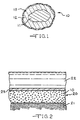
- Fig. 1 illustrates a bead, indicated generally at 10, of the material for forming a barrier layer in accordance with this invention.
- the bead 10 is formed of a core 11 which is at least partially encapsulated by a sealant layer 12.
- the core 11 is preferably completely encapsulated by the sealing layer 12.
- a protective coating 13 is provided over the sealant layer 12.
- the core 11 of the bead 10 is formed of a piece of a material which is relatively hard and dense when compared to the sealant layer 12. Examples of suitable materials for forming the core 11 include pieces of stone, iron ore, slag or crushed porcelain. Preferably, the core 11 of each bead 10 is formed of a piece of gravel. Gravel of a variety of sizes will pack together very well in the barrier layer.
- the sealant layer 12 includes a clay material, or a mixture of clay materials, which exhibits a high absorption and swelling capacity.
- the clay is a bentonite clay which is readily hydratable, such as calcium bentonite or sodium bentonite.
- the preferred clay is attipulgite clay.
- the sealant layer 12 may also include one or more organically modified clays, which also are referred to as organo clays. Such organo clays may be effective in binding with some contaminants, such as most metals, which come into contact with them. The organo clays can be innoculated with bacteria that comsume pollutants.
- the sealant layer 12 also includes a binder to promote the adhesion of the clay to the core 11 of the bead 10.
- a binder to promote the adhesion of the clay to the core 11 of the bead 10.
- An amount of the binder sufficient to bind the clay to the core 11 is mixed with the clay.
- a layer of the binder may be interposed between the clay and the core 11.
- the binder is preferably a polymeric material, such as a cellulosic polymer.
- a preferred binder is guar gum.
- Plastic fiber can also be mixed with the clay as a binder. Lime dust or cement can also be used as a binder.
- the sealant layer 12 may also include a setting material, such as gypsum or plaster of paris, which sets with water. This material is preferably mixed with the clay or mixture of clays forming the sealant layer, and may comprise up to 90% of the sealant layer 12 by weight.
- a setting material such as gypsum or plaster of paris
- a bird aversion agent may also be added to the beads 10.
- Suitable bird aversion agents include esters of anthranilic acid, esters of phenylacetic acid, or dimethyl benzyl carbinyl acetate, as examples.
- Preferred bird aversion agents are dimethyl anthranilate and methyl anthranilate. These bird aversion agents are preferably mixed in with the binder in amounts sufficient to repel foraging waterfowl which would come into contact therewith.
- the bead 10 may be provided with an outer coating 13 which aids in keeping the sealant layer 12 intact prior to the deposition of the bead 10 on an underwater surface.
- the bead is provided with a thin polymeric coating 13 about the sealant layer 12.
- a preferred material for the outer coating 13 is an acrylic resin.
- a latex, or a gypsum in water slurry, are additional examples of suitable materials for the outer coating 13.
- the outer coating 13 should not be of a thickness, dependent upon the particular material, which would prevent the eventual hydration of the sealant layer 12 of the bead 10 after the bead 10 is placed underwater.
- the beads 10 in accordance with the invention may be formed in any suitable manner.
- the binder is placed into an aqueous solution and mixed with the clay.
- a number of the cores 11 are added to this sealant mixture and stirred so that the sealant mixture adheres to the each of the cores 11.
- the sealant mixture may be allowed to dry about the cores 11, and then stirred with additional sealant mixture to form a multi-layered sealant layer 12 about each of the cores 11.
- the outer coating 13 may then be applied by any suitable means, such as by spraying.
- FIG. 2 An underwater barrier layer 20 formed from the beads 10 of this invention is illustrated in Fig. 2.
- the underwater barrier layer 20 covers a layer of contaminated sediments 21 which lies beneath a body of water 22.
- a plurality of the beads 10 are deposited on top of the contaminated sediments 21. If the contaminated sediments 21 are underwater at the time of the deposition, the beads 10 may be dropped directly into the water 22. The beads 10 will sink, settling on top of the contaminated sediments 21. Since the beads 10 are relatively hard and impact resistant, they may be dropped into the water from the air, such as from a helicopter drop bucket. The beads 10 may also be pumped out over the contaminated sediments 21 using a conventional pump.
- the beads 10 may be deposited when the water above the contaminated sediments 21 is frozen.
- the beads 10 may then be effectively deposited by means of a truck, road grader, low ground pressure bulldozer, or other suitable means. When the ice melts, the beads 10 will sink to the bottom, settling on top of the contaminated sediments 21.
- the sealant layer 12 about each of the beads 10 begins to absorb the water and to swell. A continuous layer of the clay and binder is thus formed, with the cores 11 dispersed randomly throughout. It is believed that the cores 11 aid in keeping the barrier layer 20 intact on top of the contaminated sediments 21. If a setting material such as gypsum or plaster of paris is included in the sealant layer 12 of the beads 10, this material will set when hydrated.
- a setting material such as gypsum or plaster of paris
- a sufficient number of the beads 10 are deposited over the area to form a physical barrier layer 20 of a thickness sufficient to prevent the migration of the contaminated sediments 21 into the water 22.
- a barrier layer 20 of a thickness of between about 4 to 8 cm is adequate to prevent the migration of contaminated sediments therethrough, as well as to prevent the animals and other organisms using that body of water from coming into contact with the sediments 21.
- a bird aversion agent has been added to the beads 10, it will be dispersed throughout the barrier layer 20, further discouraging foraging waterfowl from coming into contact with the contaminated sediments 21 beneath the barrier layer 20.
- additional pelletized material may also be mixed with the beads 10 prior to their deposition on the contaminated sediments 21.
- additional pelletized material include pelletized fertilizer, sewage, sludge, cement kiln dust, lime, recycled plastic, corn cobs, flyash, sawdust and recycled paper. These additional pelletized materials help to provide a medium for seed germination and plant growth within the barrier layer 20.
- a cover layer 23 may also be provided over the barrier layer 20 to minimize the dissipation of the clay into the water 22, thereby effectively increasing the useful life of the barrier layer 20.
- a cover layer 23 may be formed of a layer of aggregate, such as gravel or sand, which also promotes the growth of vegetation.
- the cover layer 23 is formed of an additional layer of the beads 10 which include a setting material such as gypsum or plaster of paris in the sealant layers 12 thereof. The setting material will quickly set when hydrated to form a hard layer over the barrier layer 20, thereby preventing any dissipation thereof into the water 22.
- the beads 10 of the invention may also be used to form barrier layers in the presence of water in a variety of other applications.
- a plurality of the beads 10 may be introduced into an annular well space formed between the ground and a well casing, typically formed of steel or plastic.
- the entire annular space is filled with beads. If the annular space is dry, water is added thereto.
- the sealant layer about each of the beads 10 begins to absorb water and swell, and a continuous annular layer of the clay and binder is formed.
Landscapes
- Engineering & Computer Science (AREA)
- General Engineering & Computer Science (AREA)
- Structural Engineering (AREA)
- Environmental & Geological Engineering (AREA)
- Civil Engineering (AREA)
- Ocean & Marine Engineering (AREA)
- Mechanical Engineering (AREA)
- Life Sciences & Earth Sciences (AREA)
- Hydrology & Water Resources (AREA)
- General Life Sciences & Earth Sciences (AREA)
- Mining & Mineral Resources (AREA)
- Paleontology (AREA)
- Revetment (AREA)
- Laminated Bodies (AREA)
- Soil Conditioners And Soil-Stabilizing Materials (AREA)
- Processing Of Solid Wastes (AREA)
Claims (27)
- Perle (10) pour la formation d'une couche barrière (20) sur une surface subaquatique (21), comprenant :un matériau de noyau (11) à la condition que les semences végétales soient exclues, etune couche d'un matériau d'étanchéité (12) comprenant une argile qui enrobe au moins partiellement le matériau de noyau (11).
- Perle selon la revendication 1, dans laquelle ledit noyau est essentiellement enrobé dans son intégralité de ladite couche de matériau d'étanchéité.
- Perle selon la revendication 1, dans laquelle ledit noyau est formé de pierre.
- Perle selon la revendication 1, dans laquelle ledit noyau est formé d'un fragment de gravier.
- Perle selon la revendication 1, dans laquelle ladite couche de matériau d'étanchéité comprend une argile bentonite.
- Perle selon la revendication 5, dans laquelle ladite couche de matériau d'étanchéité comprend un composé de bentonite de calcium.
- Perle selon la revendication 5, dans laquelle ladite couche de matériau d'étanchéité comprend un composé de bentonite de sodium.
- Perle selon la revendication 1, dans laquelle ladite couche de matériau d'étanchéité comprend une argile attipulgite.
- Perle selon la revendication 1, dans laquelle ladite couche de matériau d'étanchéité comprend un organoargile.
- Perle selon la revendication 1, dans laquelle ladite couche de matériau d'étanchéité comprend un liant.
- Perle selon la revendication 10, dans laquelle ledit liant est un matériau polymère.
- Perle selon la revendication 11, dans laquelle ledit liant comprend un polymère cellulosique.
- Perle selon la revendication 10, dans laquelle ledit liant comprend une gomme de guar.
- Perle selon la revendication 1, dans laquelle ladite couche de matériau d'étanchéité comprend un matériau durcissant.
- Perle selon la revendication 14, dans laquelle ledit matériau durcissant est choisi dans le groupe constitué du gypse et du plâtre de Paris.
- Perle selon la revendication 1, dans laquelle ladite couche de matériau d'étanchéité comprend un agent de répulsion des oiseaux choisi dans le groupe constitué des esters d'acide anthranilique, des esters d'acide phénylacétique et de l'acétate de diméthylbenzylcarbinyle.
- Perle selon la revendication 1, comprenant en outre un revêtement protecteur formé autour d'au moins une partie de ladite couche de matériau d'étanchéité.
- Perle selon la revendication 17, dans laquelle ledit revêtement protecteur est formé d'un acrylique.
- Procédé de formation d'une couche barrière sur la surface qui se trouve en dessous d'une masse d'eaux, comprenant l' étape consistant à appliquer une pluralité de perles à ladite surface, lesdites perles étant formées d'un noyau qui est au moins partiellement enrobé d'une couche de matériau d'étanchéité incluant une argile.
- Procédé selon la revendication 19, dans lequel un nombre suffisant desdites perles sont appliquées à ladite surface pour former une couche continue desdites perles sur ladite surface.
- Procédé selon la revendication 20, dans lequel un nombre suffisant desdites perles sont appliquées à ladite surface pour former une couche continue desdites perles sur ladite surface d'une épaisseur d'au moins environ 4 cm.
- Procédé selon la revendication 20, incluant, en outre, l'étape consistant à former une couche de recouvrement sur ladite couche desdites perles.
- Procédé selon la revendication 22, dans lequel ladite couche de recouvrement est formée d'un agrégat.
- Procédé selon la revendication 19, dans lequel ladite pluralité des perles sont maintenues dans un conteneur, puis libérées dudit conteneur au-dessus de ladite masse d'eau, lesdites perles se déposant sur ladite surface pour former une couche barrière sur celle-ci.
- Procédé selon la revendication 19, dans lequel ledit noyau de chacune desdites perles est formé de pierre.
- Procédé selon la revendication 19, dans lequel ladite couche de matériau d'étanchéité de chacune desdites perles comprend un argile de bentonite et un liant.
- Procédé de formation d'une couche barrière sur une surface, comprenant les étapes consistant à :appliquer une pluralité de perles à ladite surface, lesdites perles étant formées d'un noyau qui est au moins partiellement enrobé d'une couche de matériau d'étanchéité incluant une argile ; etexposer lesdites perles à des quantités suffisantes d'une liquide pour faire gonfler la couche de matériau d'étanchéité autour de chacune desdites perles.
Applications Claiming Priority (5)
| Application Number | Priority Date | Filing Date | Title |
|---|---|---|---|
| US24368794A | 1994-05-16 | 1994-05-16 | |
| US243687 | 1994-05-16 | ||
| US268633 | 1994-06-30 | ||
| US08/268,633 US5538787A (en) | 1994-05-16 | 1994-06-30 | Material and method for forming an underwater barrier layer |
| PCT/US1995/006124 WO1995031609A1 (fr) | 1994-05-16 | 1995-05-16 | Materiau et procede de formation d'une couche de barrage subaquatique |
Publications (2)
| Publication Number | Publication Date |
|---|---|
| EP0804651A1 EP0804651A1 (fr) | 1997-11-05 |
| EP0804651B1 true EP0804651B1 (fr) | 2001-11-07 |
Family
ID=26936006
Family Applications (1)
| Application Number | Title | Priority Date | Filing Date |
|---|---|---|---|
| EP95919850A Expired - Lifetime EP0804651B1 (fr) | 1994-05-16 | 1995-05-16 | Materiau et procede de formation d'une couche de barrage subaquatique |
Country Status (9)
| Country | Link |
|---|---|
| US (1) | US5538787A (fr) |
| EP (1) | EP0804651B1 (fr) |
| JP (1) | JP3393385B2 (fr) |
| KR (1) | KR100411687B1 (fr) |
| AU (1) | AU683160B2 (fr) |
| CA (1) | CA2190491C (fr) |
| DE (1) | DE69523782T2 (fr) |
| DK (1) | DK0804651T3 (fr) |
| WO (1) | WO1995031609A1 (fr) |
Families Citing this family (25)
| Publication number | Priority date | Publication date | Assignee | Title |
|---|---|---|---|---|
| US5897946A (en) * | 1994-05-16 | 1999-04-27 | New Waste Concepts, Inc. | Flowable material to isolate or treat a surface |
| US6386796B1 (en) * | 2000-03-06 | 2002-05-14 | John H. Hull | Composite particles and methods for their application and implementation |
| US7011766B1 (en) * | 2003-03-25 | 2006-03-14 | Aquablok, Ltd. | Capping and treating a metal-contaminated sediment |
| US8263203B2 (en) * | 2003-04-24 | 2012-09-11 | Usgreentech, L.L.C. | Filler for artificial turf system |
| US7858148B2 (en) * | 2003-04-24 | 2010-12-28 | Usgreentech, L.L.C. | Filler for artificial turf system |
| US6884509B2 (en) * | 2003-04-24 | 2005-04-26 | U.S. Greentech, Llc | Special turf filler comprising silica particles |
| US7472661B2 (en) * | 2004-06-23 | 2009-01-06 | Aquablok, Ltd | Method of delivering plant seed material |
| US20080032901A1 (en) * | 2006-08-07 | 2008-02-07 | Hull John H | Subsurface reactive sealant product |
| US7824129B2 (en) * | 2006-10-18 | 2010-11-02 | Menzie-Cura & Associates, Inc. | Low-impact delivery system for in situ treatment of contaminated sediment |
| KR101015426B1 (ko) | 2009-04-13 | 2011-02-17 | 한국과학기술연구원 | 생분해성 필름을 이용한 수중 퇴적오염물 현장정화방법 |
| US8287210B2 (en) * | 2010-11-17 | 2012-10-16 | Amcol International Corporation | Sub-aqueous placement of water-based suspensions and method of manufacture and use |
| DE102011012291A1 (de) * | 2011-02-24 | 2012-08-30 | Matthäi Bauunternehmen GmbH & Co. KG | Nachhaltig selbstdichtendes schüttbares Abdichtungsmaterial zur Abdichtung von Bodenflächen in situ unter Wasser, insbesondere von geneigten Flächen, beispielsweise Böschungen, von Kanälen oder dergleichen |
| ITTO20110551A1 (it) * | 2011-06-23 | 2012-12-24 | Trevi Spa | Procedimento per impermeabilizzare casse di colmata |
| JP5994383B2 (ja) * | 2011-08-15 | 2016-09-21 | Jfeスチール株式会社 | 底質の改質および臭気低減方法 |
| JP5912590B2 (ja) * | 2012-02-01 | 2016-04-27 | 五洋建設株式会社 | 底泥安定化工法 |
| FR3000496B1 (fr) * | 2012-12-28 | 2015-12-04 | Pintat Benoit Marcel | Composition pour surface exterieure |
| US11554969B2 (en) | 2013-08-09 | 2023-01-17 | Aquablok Ltd. | Reactive treatment cell and systems for environmental remediation |
| JP6384718B2 (ja) * | 2013-11-08 | 2018-09-05 | 清水建設株式会社 | 水中空間の遮水方法および水中空間への遮蔽材または遮水材の設置方法 |
| EP3169459B1 (fr) * | 2014-07-15 | 2023-08-30 | Aquablok, Ltd. | Procédé et composition destinés à inhiber la méthanogenèse pendant le traitement in situ de sédiments |
| WO2016014199A1 (fr) * | 2014-07-22 | 2016-01-28 | Aquablok, Ltd. | Traitements et procédés de remédiation à auto-régénération |
| US10934211B2 (en) | 2015-10-16 | 2021-03-02 | Halliburton Energy Services, Inc. | Modified sodium bentonite clays for barrier layer applications |
| AU2016202228B2 (en) | 2016-04-04 | 2022-05-19 | Aquablok, Ltd. | Soil-like material and method of making a barrier for containing waste |
| WO2018232082A1 (fr) * | 2017-06-16 | 2018-12-20 | Aquablok, Ltd. | Particules composites d'écaillage et leurs procédés d'utilisation |
| CN109914486B (zh) * | 2019-04-03 | 2023-12-26 | 天津市水利科学研究院 | 一种带锁紧固定结构的透气防渗毯及其制备方法与施工方法 |
| CN110616672A (zh) * | 2019-09-24 | 2019-12-27 | 中国五冶集团有限公司 | 景观湖湖底防渗结构施工方法 |
Citations (1)
| Publication number | Priority date | Publication date | Assignee | Title |
|---|---|---|---|---|
| GB1053036A (fr) * | 1900-01-01 |
Family Cites Families (9)
| Publication number | Priority date | Publication date | Assignee | Title |
|---|---|---|---|---|
| US2277286A (en) * | 1936-11-05 | 1942-03-24 | American Colloid Co | Method and means for impeding the seepage or flow of water |
| US2728733A (en) * | 1950-09-26 | 1955-12-27 | Res Counsel Inc | Light-weight aggregates of perlite fines and clay |
| US4011175A (en) * | 1973-09-28 | 1977-03-08 | Paul Preus | Composition for separating hydrocarbons from water |
| DE3264828D1 (en) * | 1981-02-27 | 1985-08-29 | Clem Environmental Corp | Waterproofing soil |
| DE3908628A1 (de) | 1989-03-16 | 1990-09-20 | Manfred Dr Ing Braun | Brikettierung von tonmehlgemengen mit zusaetzen auf walzenpressen mit formmulden und verarbeitung dieser briketts zur errichtung von wasserdichten sperrschichten |
| US5091234A (en) * | 1989-06-30 | 1992-02-25 | Mcgroarty Bryan M | Composite water barrier sheet |
| US5035804A (en) * | 1990-09-17 | 1991-07-30 | Clnzall Corporation | Oil spill water treatment |
| IE921292A1 (en) * | 1992-04-22 | 1993-11-03 | Pharo Ltd | Method for making a sealing and elements used to this end |
| JP5570808B2 (ja) * | 2006-08-18 | 2014-08-13 | アルゴス・セラピューティクス・インコーポレーテッド | 併用療法におけるcd83の使用 |
-
1994
- 1994-06-30 US US08/268,633 patent/US5538787A/en not_active Expired - Lifetime
-
1995
- 1995-05-16 WO PCT/US1995/006124 patent/WO1995031609A1/fr not_active Ceased
- 1995-05-16 JP JP52986295A patent/JP3393385B2/ja not_active Expired - Fee Related
- 1995-05-16 KR KR1019960706473A patent/KR100411687B1/ko not_active Expired - Lifetime
- 1995-05-16 DE DE69523782T patent/DE69523782T2/de not_active Expired - Lifetime
- 1995-05-16 DK DK95919850T patent/DK0804651T3/da active
- 1995-05-16 EP EP95919850A patent/EP0804651B1/fr not_active Expired - Lifetime
- 1995-05-16 AU AU25520/95A patent/AU683160B2/en not_active Ceased
- 1995-05-16 CA CA002190491A patent/CA2190491C/fr not_active Expired - Lifetime
Patent Citations (1)
| Publication number | Priority date | Publication date | Assignee | Title |
|---|---|---|---|---|
| GB1053036A (fr) * | 1900-01-01 |
Also Published As
| Publication number | Publication date |
|---|---|
| AU2552095A (en) | 1995-12-05 |
| DK0804651T3 (da) | 2001-12-27 |
| KR970703472A (ko) | 1997-07-03 |
| JP3393385B2 (ja) | 2003-04-07 |
| DE69523782T2 (de) | 2002-06-13 |
| KR100411687B1 (ko) | 2004-03-30 |
| AU683160B2 (en) | 1997-10-30 |
| DE69523782D1 (de) | 2001-12-13 |
| US5538787A (en) | 1996-07-23 |
| CA2190491A1 (fr) | 1995-11-23 |
| EP0804651A1 (fr) | 1997-11-05 |
| JPH10500464A (ja) | 1998-01-13 |
| CA2190491C (fr) | 2005-03-01 |
| WO1995031609A1 (fr) | 1995-11-23 |
Similar Documents
| Publication | Publication Date | Title |
|---|---|---|
| EP0804651B1 (fr) | Materiau et procede de formation d'une couche de barrage subaquatique | |
| US5897946A (en) | Flowable material to isolate or treat a surface | |
| CA1143957A (fr) | Produit impermeabilisant | |
| EP1289684B1 (fr) | Procede de traitement d'un materiau contamine | |
| CA2136628C (fr) | Methode favorisant la decomposition microbienne des hydrocarbures deverses accidentellement | |
| AU2001243492A1 (en) | Composite particles and methods of their use | |
| US5259695A (en) | Artificial reef module and method | |
| AU2007311193B2 (en) | Cuttings impoundment | |
| WO2007062003A2 (fr) | Geomembrane resistante a l’erosion a permeabilite variable | |
| US5176831A (en) | Method for herding and/or recovering spilled oil | |
| JPH03183813A (ja) | 干潟造成方法 | |
| Cooke | COVERING BOTTOM SEDIMENTS AS A LAKE RESTORATION TECHNIQUE 1 | |
| JP2003181485A (ja) | 浄化用接触材およびその製造方法ならびに浄化用接触材を利用した港湾、湖沼などの浄化方法 | |
| JP2584012Y2 (ja) | 産業廃棄物を利用した人工魚礁 | |
| JPH1067581A (ja) | 水中の環境共生型ブロックの形成方法 | |
| US20070090054A1 (en) | Mitigation of environmental pollution | |
| KR100234567B1 (ko) | 고무 콘크리트를 이용한 환경인공어초 | |
| JP2002250022A (ja) | コンクリート成形体およびブロック | |
| CA2169207A1 (fr) | Recif artificiel modulaire et methode connexe | |
| KR101666671B1 (ko) | 도로변 방초 구조 및 시공방법 | |
| JP2007136395A (ja) | 珪藻類着生材料及びこれを用いた水質改善方法 | |
| JPH11336043A (ja) | 人工干潟形成方法及び形成用袋体 | |
| KR970062206A (ko) | 수질 개선 기능을 갖는 누수 방지용 기저층의 형성 방법 | |
| JPH09271288A (ja) | 植毛小石接着体 | |
| JP2005256309A (ja) | 鋼製護岸構造物、鋼製護岸構造物の修復方法 |
Legal Events
| Date | Code | Title | Description |
|---|---|---|---|
| PUAI | Public reference made under article 153(3) epc to a published international application that has entered the european phase |
Free format text: ORIGINAL CODE: 0009012 |
|
| 17P | Request for examination filed |
Effective date: 19961213 |
|
| AK | Designated contracting states |
Kind code of ref document: A1 Designated state(s): BE DE DK FR GB IT NL |
|
| 17Q | First examination report despatched |
Effective date: 19991217 |
|
| GRAG | Despatch of communication of intention to grant |
Free format text: ORIGINAL CODE: EPIDOS AGRA |
|
| GRAG | Despatch of communication of intention to grant |
Free format text: ORIGINAL CODE: EPIDOS AGRA |
|
| GRAH | Despatch of communication of intention to grant a patent |
Free format text: ORIGINAL CODE: EPIDOS IGRA |
|
| GRAH | Despatch of communication of intention to grant a patent |
Free format text: ORIGINAL CODE: EPIDOS IGRA |
|
| GRAA | (expected) grant |
Free format text: ORIGINAL CODE: 0009210 |
|
| RAP1 | Party data changed (applicant data changed or rights of an application transferred) |
Owner name: AQUABLOK, LTD. |
|
| AK | Designated contracting states |
Kind code of ref document: B1 Designated state(s): BE DE DK FR GB IT NL |
|
| REF | Corresponds to: |
Ref document number: 69523782 Country of ref document: DE Date of ref document: 20011213 |
|
| REG | Reference to a national code |
Ref country code: GB Ref legal event code: IF02 |
|
| PLBE | No opposition filed within time limit |
Free format text: ORIGINAL CODE: 0009261 |
|
| STAA | Information on the status of an ep patent application or granted ep patent |
Free format text: STATUS: NO OPPOSITION FILED WITHIN TIME LIMIT |
|
| 26N | No opposition filed | ||
| PGFP | Annual fee paid to national office [announced via postgrant information from national office to epo] |
Ref country code: BE Payment date: 20090624 Year of fee payment: 15 |
|
| BERE | Be: lapsed |
Owner name: *AQUABLOK LTD Effective date: 20100531 |
|
| PG25 | Lapsed in a contracting state [announced via postgrant information from national office to epo] |
Ref country code: BE Free format text: LAPSE BECAUSE OF NON-PAYMENT OF DUE FEES Effective date: 20100531 |
|
| PGFP | Annual fee paid to national office [announced via postgrant information from national office to epo] |
Ref country code: GB Payment date: 20140527 Year of fee payment: 20 |
|
| PGFP | Annual fee paid to national office [announced via postgrant information from national office to epo] |
Ref country code: IT Payment date: 20140526 Year of fee payment: 20 Ref country code: FR Payment date: 20140519 Year of fee payment: 20 Ref country code: DE Payment date: 20140529 Year of fee payment: 20 Ref country code: NL Payment date: 20140526 Year of fee payment: 20 |
|
| PGFP | Annual fee paid to national office [announced via postgrant information from national office to epo] |
Ref country code: DK Payment date: 20140602 Year of fee payment: 20 |
|
| REG | Reference to a national code |
Ref country code: DE Ref legal event code: R071 Ref document number: 69523782 Country of ref document: DE |
|
| REG | Reference to a national code |
Ref country code: DK Ref legal event code: EUP Effective date: 20150516 |
|
| REG | Reference to a national code |
Ref country code: NL Ref legal event code: V4 Effective date: 20150516 |
|
| REG | Reference to a national code |
Ref country code: GB Ref legal event code: PE20 Expiry date: 20150515 |
|
| PG25 | Lapsed in a contracting state [announced via postgrant information from national office to epo] |
Ref country code: GB Free format text: LAPSE BECAUSE OF EXPIRATION OF PROTECTION Effective date: 20150515 |