EP0803781A1 - Bildaufzeichnungsverfahren und -gerät - Google Patents
Bildaufzeichnungsverfahren und -gerät Download PDFInfo
- Publication number
- EP0803781A1 EP0803781A1 EP97106653A EP97106653A EP0803781A1 EP 0803781 A1 EP0803781 A1 EP 0803781A1 EP 97106653 A EP97106653 A EP 97106653A EP 97106653 A EP97106653 A EP 97106653A EP 0803781 A1 EP0803781 A1 EP 0803781A1
- Authority
- EP
- European Patent Office
- Prior art keywords
- heat development
- photosensitive material
- temperature
- development photosensitive
- cooling
- Prior art date
- Legal status (The legal status is an assumption and is not a legal conclusion. Google has not performed a legal analysis and makes no representation as to the accuracy of the status listed.)
- Granted
Links
Images


Classifications
-
- G—PHYSICS
- G03—PHOTOGRAPHY; CINEMATOGRAPHY; ANALOGOUS TECHNIQUES USING WAVES OTHER THAN OPTICAL WAVES; ELECTROGRAPHY; HOLOGRAPHY
- G03D—APPARATUS FOR PROCESSING EXPOSED PHOTOGRAPHIC MATERIALS; ACCESSORIES THEREFOR
- G03D13/00—Processing apparatus or accessories therefor, not covered by groups G11B3/00 - G11B11/00
- G03D13/002—Heat development apparatus, e.g. Kalvar
-
- G—PHYSICS
- G03—PHOTOGRAPHY; CINEMATOGRAPHY; ANALOGOUS TECHNIQUES USING WAVES OTHER THAN OPTICAL WAVES; ELECTROGRAPHY; HOLOGRAPHY
- G03C—PHOTOSENSITIVE MATERIALS FOR PHOTOGRAPHIC PURPOSES; PHOTOGRAPHIC PROCESSES, e.g. CINE, X-RAY, COLOUR, STEREO-PHOTOGRAPHIC PROCESSES; AUXILIARY PROCESSES IN PHOTOGRAPHY
- G03C1/00—Photosensitive materials
- G03C1/494—Silver salt compositions other than silver halide emulsions; Photothermographic systems ; Thermographic systems using noble metal compounds
- G03C1/498—Photothermographic systems, e.g. dry silver
- G03C1/49881—Photothermographic systems, e.g. dry silver characterised by the process or the apparatus
-
- G—PHYSICS
- G03—PHOTOGRAPHY; CINEMATOGRAPHY; ANALOGOUS TECHNIQUES USING WAVES OTHER THAN OPTICAL WAVES; ELECTROGRAPHY; HOLOGRAPHY
- G03C—PHOTOSENSITIVE MATERIALS FOR PHOTOGRAPHIC PURPOSES; PHOTOGRAPHIC PROCESSES, e.g. CINE, X-RAY, COLOUR, STEREO-PHOTOGRAPHIC PROCESSES; AUXILIARY PROCESSES IN PHOTOGRAPHY
- G03C1/00—Photosensitive materials
- G03C1/494—Silver salt compositions other than silver halide emulsions; Photothermographic systems ; Thermographic systems using noble metal compounds
- G03C1/498—Photothermographic systems, e.g. dry silver
- G03C1/49836—Additives
- G03C1/49863—Inert additives, e.g. surfactants, binders
-
- G—PHYSICS
- G03—PHOTOGRAPHY; CINEMATOGRAPHY; ANALOGOUS TECHNIQUES USING WAVES OTHER THAN OPTICAL WAVES; ELECTROGRAPHY; HOLOGRAPHY
- G03C—PHOTOSENSITIVE MATERIALS FOR PHOTOGRAPHIC PURPOSES; PHOTOGRAPHIC PROCESSES, e.g. CINE, X-RAY, COLOUR, STEREO-PHOTOGRAPHIC PROCESSES; AUXILIARY PROCESSES IN PHOTOGRAPHY
- G03C1/00—Photosensitive materials
- G03C1/494—Silver salt compositions other than silver halide emulsions; Photothermographic systems ; Thermographic systems using noble metal compounds
- G03C1/498—Photothermographic systems, e.g. dry silver
- G03C1/49872—Aspects relating to non-photosensitive layers, e.g. intermediate protective layers
Definitions
- This invention relates to an image recording method and apparatus for recording an image on a heat development photosensitive material.
- This invention particularly relates to a dry type of image recording method and apparatus for recording a medical image, which has multiple gradation levels, (i.e. a continuous tone medical image) on a heat development photosensitive material.
- this invention relates to an image recording method and apparatus for developing a latent image, which has been formed on a heat development photosensitive material by a laser beam scanning operation, and thereby obtaining a medical image having multiple gradation levels.
- the processing temperature may be set to be high.
- the processing temperature is set to be high, much noise occurs in the image. Therefore, an image, which has good image quality and can serve as an effective tool in, particularly, the efficient and accurate diagnosis of an illness, cannot be obtained.
- the processing temperature is set to be low such that noise may be reduced and the image quality may be enhanced, a long processing time is required, and the processing efficiency cannot be kept high.
- the medical image it is desired that the medical image has good image quality and can serve as an effective tool in the efficient and accurate diagnosis of an illness.
- various conditions must be taken into consideration.
- the primary object of the present invention is to provide an image recording method, wherein a heat development technique is employed such that the processing time may be set to be a practically acceptable short time, noise may be reduced, and a medical image having good image quality may be obtained.
- Another object of the present invention is to provide an image recording method, wherein a practically suitable medical image, which has good image quality and can serve as an effective tool in the efficient and accurate diagnosis of an illness, is obtained with a heat development technique.
- a further object of the present invention is to provide a dry type of image recording method, wherein a medical image is recorded on a photosensitive material with a heat development technique such that the photosensitive material, on which the medical image has been recorded, may have good straightness and may thus be suitable for viewing on a viewing screen, the image recording method enabling the practical use of the heat development technique for the recording of a medical image having good image quality and multiple gradation levels.
- a still further object of the present invention is to provide an apparatus for carrying out the image recording method.
- the present invention provides a first image recording method, comprising the steps of recording a latent image of a medical image on a heat development photosensitive material, carrying out development on the heat development photosensitive material, on which the latent image of the medical image has been recorded, and thereby obtaining the medical image having multiple gradation levels, wherein the development is carried out at a heating temperature falling within the range of 120 ⁇ 10°C, at a width-direction temperature accuracy falling within the range of ⁇ 3°C, and for a development time falling within the range of 5 seconds to 30 seconds.
- the present invention also provides a first image recording apparatus, wherein a latent image of a medical image is recorded on a heat development photosensitive material, development is carried out on the heat development photosensitive material, on which the latent image of the medical image has been recorded, and the medical image having multiple gradation levels is thereby obtained, the apparatus comprising:
- the width-direction temperature accuracy should preferably fall within the range of ⁇ 1°C.
- the heating temperature should preferably be controlled at a temperature accuracy falling within the range of ⁇ 0.1°C.
- control of heating temperature means the control of the heating temperature such that the heating temperature may be stabilized with respect to time. Therefore, by the control of the heating temperature, the image quality of the medical image can be stabilized with respect to the direction, along which the heat development photosensitive material is conveyed, i.e. the length direction of the heat development photosensitive material.
- the development time should preferably fall within the range of approximately 10 seconds to approximately 20 seconds.
- multiple gradation levels means at least 64 gradation levels.
- the multiple gradation levels may be constituted of 8-bit or 10-bit gray levels.
- the present invention further provides a second image recording method, wherein a latent image is recorded on a heat development photosensitive material, which comprises a substrate and an emulsion layer overlaid upon the substrate, the emulsion layer containing a binder and a photosensitive silver halide dispersed in the binder, the heat development photosensitive material, on which the latent image has been recorded, is then conveyed along a curved conveyance path and subjected to heat development, and an image is thereby obtained, the method comprising the steps of:
- the present invention still further provides a second image recording apparatus, wherein a latent image is recorded on a heat development photosensitive material, which comprises a substrate and an emulsion layer overlaid upon the substrate, the emulsion layer containing a binder and a photosensitive silver halide dispersed in the binder, the heat development photosensitive material, on which the latent image has been recorded, is then subjected to heat development, and an image is thereby obtained, the apparatus comprising:
- the temperature, at which the heat development photosensitive material is heated for the development should preferably fall within the range of 120 ⁇ 20°C.
- the material for the substrate of the heat development photosensitive material polyethylene terephthalate (PET) may be employed.
- PET polyethylene terephthalate
- the cooling temperature should preferably be at most 85°C.
- the curl eliminating means means for setting the heat development photosensitive material to straight form while the temperature of the heat development photosensitive material is being kept to be at least 85°C should preferably be employed. Particularly large effects can be obtained when a cylindrical heating drum is employed as the curved-path conveyance and heating means.
- the curved-path conveyance and heating means, the curl eliminating means, and the cooling means may constitute portions of the conveyance means and may respectively carry out the heating, the curl elimination, and the cooling while the heat development photosensitive material is being conveyed.
- cooling means may comprise:
- the processing time can be set to be a practically acceptable short time, noise can be reduced, and an image having good image quality can be obtained. Also, since the width-direction temperature accuracy falls within the range of ⁇ 3°C, uniform finish quality, i.e. uniform image quality, can be obtained with respect to the width direction of the image.
- the heating temperature is controlled at a temperature accuracy falling within the range of ⁇ 0.1°C, uniform image quality can be obtained with respect to the length direction of the image.
- the heat development is carried out on the heat development photosensitive material at a development temperature, which is set to be equal to at least the glass transition temperature Tgb of the substrate of the heat development photosensitive material.
- the photosensitive material will be caused to be curled.
- the problems do not occur in that the photosensitive material is fixed in the curled form. Thereafter, the photosensitive material is cooled while it is being kept in the straight form. The cooling is carried out at a cooling temperature lower than the glass transition temperature TgL, that is equal to the glass transition temperature Tgb of the substrate of the photosensitive material or the glass transition temperature Tge of the binder contained in the emulsion layer, whichever takes a smaller value. Accordingly, the photosensitive material can be fixed in the straight form.
- the obtained photosensitive material, on which the image has been recorded has good straightness and can thus be suitable for viewing on a viewing screen.
- such types of photosensitive materials contain a binder matrix (an organic binder matrix) and constituents dispersed in the binder matrix.
- the constituents include a reducible silver source (e.g., an organic silver salt), a catalytic amount of a photocatalyst (e.g., a silver halide), a toning agent for controlling the tone of silver, and a reducing agent.
- the photosensitive materials are stable at normal temperatures. When the photosensitive materials are heated at a high temperature (e.g., at least 80°C) after being exposed, they form silver through the oxidation-reduction reaction of the reducible silver source (serving as an oxidizing agent) and the reducing agent.
- the oxidation-reduction reaction is promoted by the catalytic action of the latent image, which has been formed during the exposure.
- Silver which has been formed by the reaction of the organic silver salt in the exposed region, provides a black image and forms a contrast to the un-exposed region. An image is thereby formed.
- a photosensitive layer alone may be overlaid upon a substrate.
- at least a single non-photosensitive layer should preferably be overlaid upon the photosensitive layer.
- a filter layer or an anti-halation layer may be formed on the same side as the photosensitive layer or on the side opposite to the photosensitive layer, or a dye or a pigment may be contained in the photosensitive layer.
- the photosensitive layer may be composed of a plurality of layers. Also, in order for the gradation to be adjusted, the photosensitive layer may be constituted of a combination of high-sensitivity layer/low-sensitivity layer or a combination of low-sensitivity layer/high-sensitivity layer.
- additives may be added to the photosensitive layer, the non-photosensitive layer, or the other layers.
- the substrate may be constituted of a material, such as paper, polyethylene-coated paper, polypropylene-coated paper, animal parchment, or cloth; a sheet or a thin film of a metal, such as aluminum, copper, magnesium, or zinc; glass; glass coated with a metal, such as a chromium alloy, steel, silver, gold, or platinum; or a synthetic polymer material, such as a polyalkyl methacrylate (e.g., a polymethyl methacrylate), a polyester (e.g., a polyethylene terephthalate), a polyvinyl acetal, a polyamide (e.g., nylon), a cellulose ester (e.g., cellulose nitrate, cellulose acetate, cellulose acetate propionate, or cellulose acetate butyrate).
- a material such as paper, polyethylene-coated paper, polypropylene-coated paper, animal parchment, or cloth
- a sheet or a thin film of a metal such
- the photosensitive material employed in the image recording method and apparatus in accordance with the present invention may contain surface-active agents, anti-oxidants, stabilizers, plasticizers, ultraviolet absorbents, coating auxiliaries, and the like.
- Each binder layer (e.g., a synthetic polymer layer) may form a self-supporting film together with the chemical agents contained in the photosensitive material.
- the substrate may be covered with known auxiliary materials, for example, vinylidene chloride, acrylic monomer (such as acrylonitrile or methyl acrylate), and an unsaturated dicarboxylic acid (such as itaconic acid or acrylic acid), carboxymethyl cellulose, a copolymer or a terpolymer of a polyacrylamide, and a similar polymer material.
- vinylidene chloride acrylic monomer (such as acrylonitrile or methyl acrylate)
- an unsaturated dicarboxylic acid such as itaconic acid or acrylic acid
- carboxymethyl cellulose such as acrylonitrile or methyl acrylate
- copolymer or a terpolymer of a polyacrylamide such as itaconic acid or acrylic acid
- binders those which are transparent or translucent are preferable. In general, they are colorless.
- natural polymers, synthetic resins, synthetic polymers, synthetic copolymers, and other media capable of forming films may be employed.
- the binders include gelatin, gum arabic, polyvinyl alcohols, hydroxyethyl cellulose, cellulose acetate, cellulose acetate butyrate, polyvinyl pyrrolidones, casein, starch, polyacrylic acids, polymethyl methacrylates, polyvinyl chlorides, polymethacrylic acids, styrene-maleic anhydride copolymers, styrene-acrylonitrile copolymers, styrene-butadiene copolymers, polyvinyl acetals (such as polyvinyl formal and polyvinyl butyral), polyesters, polyurethanes, phenoxy resins, polyvinylidene chlorides, polyepoxides, poly
- polymers When necessary, two or more of the polymers may be used in combination. Such polymers are used in an amount sufficient to retain the constituents therein. Specifically, the polymers are used in proportions efficient for functioning as binders. Efficient proportions of the polymers can be determined easily and appropriately by experts in the art.
- the polymers listed below may be utilized.
- the temperatures shown at the right end below represent the glass transition temperatures Tg.
- Polyvinyl butyral BUTVAR #B-76 62 to 72°C BUTVAR #B-79 72 to 78°C supplied by Monsanto Co.
- Denka Butyral #3000-K 67°C Denka Butyral #5000-A 93°C supplied by Denki Kagaku Kogyo K.K.
- crosslinking agents for the binders various kinds of hardening agents may be employed.
- the hardening agents include epoxy crosslinking agents, such as glycerol polyglycidyl ethers, ethylene-polyethylene glycol-diglycidyl ethers, lauryl alcohol-polyethylene oxide-glycidyl ethers, and glycidyl phthalimide; and isocyanate crosslinking agents, such as xylylene diisocyanate, hexamethylene diisocyanate, isocyanate-methylcyclohexane, isophorone diisocyanate, and diphenylmethane diisocyanate.
- epoxy crosslinking agents such as glycerol polyglycidyl ethers, ethylene-polyethylene glycol-diglycidyl ethers, lauryl alcohol-polyethylene oxide-glycidyl ethers, and glycidyl phthalimide
- isocyanate crosslinking agents such
- the hardening agent may also be selected from ordinary crosslinking agents, such as aldehydes, chlorinated triazines, and polyvinylsulfonic acids.
- ordinary crosslinking agents such as aldehydes, chlorinated triazines, and polyvinylsulfonic acids.
- glycerol polyglycidyl ethers ethylene-polyethylene glycol-diglycidyl ethers, hexamethylene diisocyanate, and isophorone diisocyanate are preferable.
- the hardening agents When necessary, two or more of the hardening agents may be used in combination.
- the hardening agents are used in proportions sufficient to crosslink the polymer. Efficient proportions of the hardening agents can be determined easily and appropriately by experts in the art.
- toning agents examples include imides, such as phthalimide; cyclic imides, pyrazolin-5-ones, and quinazolinones (e.g., succinimide, 3-phenyl-2-pyrazolin-5-one, 1-phenylurazole, quinazoline, and 2,4-thiazolidinedione); naphthalimides, such as N-hydroxy-1,8-naphthalimide; cobalt complexes, such as hexamine trifluoro acetate of cobalt; mercaptans, such as 3-mercapto-1,2,4-triazole; N-(aminomethyl)aryldicarboxyimides, such as N-(dimethylaminomethyl)phthalimide; combinations of blocked pyrazoles, isothiuronium derivatives, and certain kinds of photo bleaching agents, such as a combination of N,N'-he
- imides such as phthalimide
- cyclic imides e.g., succ
- phthalic acid 4-methylphthalic acid, 4-nitrophthalic acid, and a tetrachlorophthalic acid anhydride
- quinazolinediones benzoxazine; naphthoxazine derivatives; benzoxazine-2,4-diones, such as 1,3-benzoxazine-2,4-dione; pyrimidines and asymmetric triazines, such as 2,4-dihydroxypyrimidine; and tetraazapentalene derivatives, such as 3,6-dimercapto-1,4-diphenyl-1H,4H-2,3a,5,6a-tetraazapentalene.
- phthalazine is preferable.
- photographic developing agents such as Phenidone, hydroquinones, or catechols
- hindered phenols are preferable.
- Color photosensitive materials disclosed in U.S. Patent No. 4,460,681 may also be utilized in the image recording method and apparatus in accordance with the present invention.
- preferable reducing agents examples include aminohydroxycycloalkenone compounds, such as 2-hydroxy-piperidino-2-cyclohexenone; esters of aminoreductones, serving as a precursor of a developing agent, such as piperidinohexose reductone monoacetates; N-hydroxyurea derivatives, such as N-p-methylphenyl-N-hydroxyurea; hydrazones formed from aldehydes or ketones, such as anthracene aldehyde phenylhydrazones; phosphamidophenols; phosphamidoanilines; polyhydroxy benzenes, such as hydroquinone, t-butyl-hydroquinone, isopropylhydroquinone, and (2,5-dihydroxy-phenyl
- hindered phenols represented by the general formula shown below are particularly preferable.
- R ordinarily represents hydrogen or an alkyl group having at most 10 carbon atoms (e.g., -C 4 H 9 or 2,4,4-trimethylpentyl), and each of R 5 and R 6 represents an alkyl group having at most 5 carbon atoms (e.g., methyl, ethyl, or t-butyl).
- any of photosensitive silverhalides e.g., silverbromide, silveriodide, silver chloride, silver chlorobromide, silver iodobromide, and silver chloroiodobromide
- the silver halide should preferably contain iodine iron. No limitation is imposed on how the silver halide is added to the image forming layer. However, the silver halide is located such that it may be close to the reducible silver source. Ordinarily, the proportion of the silver halide should preferably fall within the range of 0.75% by weight to 30% by weight with respect to the reducible silver source.
- the silver halide may be prepared with conversion of the silver soap portion through the reaction with the halogen ion.
- the silver halide may be formed preliminarily and may be added at the time of occurrence of the soap.
- the two techniques may be combined with each other. The latter technique is preferable.
- the reducible silver source may be constituted of any of materials containing a silver ion source which can be reduced.
- Silver salts of organic acids or hetero organic acids are preferable, and silver salts of aliphatic carboxylic acids having a long chain (with 10 to 30 carbon atoms, preferably with 15 to 25 carbon atoms) are more preferable.
- Organic or inorganic silver salt complexes, in which the ligand has an overall stability constant with respect to the silver ion, that falls within the range of 4.0 to 10.0, are also useful. Examples of preferable silver salts are described in, for example, Research Disclosure 17,029 and Research Disclosure 29,963.
- Examples of the preferable silver salts include silver salts of organic acids, such as gallic acid, oxalic acid, behenic acid, stearic acid, palmitic acid, and lauric acid; silver salts of carboxyalkylthioureas, such as 1-(3-carboxypropyl)thiourea and 1-(3-carboxypropyl)-3,3-dimethylthiourea; silver complexes of polymer reaction products obtained from aldehydes (such as formaldehyde, acetaldehyde, and butylaldehyde) and hydroxy-substituted aromatic carboxylic acids (such as salicylic acid, benzoic acid, 3,5-dihydroxybenzoic acid, and 5,5-thiodisalicylic acid); silver salts or complexes of thioenes, such as 3-(2-carboxyethyl)-4-hydroxymethyl-4-thiazoline-2-thioene and 3-carboxymethyl-4-thiazoline
- the behenic acid silver salt is preferable.
- the proportion of the reducible silver source, expressed in terms of the amount of silver, should preferably be at most 3g/m 2 , and should more preferably be at most 2g/m 2 .
- the photosensitive material may also contain anti-fogging agents.
- the most efficient anti-fogging agent has heretofore been a mercury ion.
- the technique for using a mercury compound as the anti-fogging agent in a photosensitive material is disclosed in, for example, U.S. Patent No. 3,589,903. However, from the view point of environmental protection, the use of the mercury compound is not desirable.
- non-mercury anti-fogging agents those disclosed in, for example, U.S. Patent Nos. 4,546,075 and 4,452,885, and Japanese Unexamined Patent Publication No. 59(1984)-57234 are preferable.
- Particularly preferable non-mercury anti-fogging agents are heterocyclic compounds having at least a single substituent group, which is represented by the formula -CX 1 X 2 X 3 , wherein each of X 1 and X 2 represents a halogen, such as F, Cl, Br, or I, and X 3 represents hydrogen or a halogen.
- the heterocyclic compounds are disclosed in U.S. Patent Nos. 3,874,946 and 4,756,999.
- Examples of preferable anti-fogging agents include the compounds represented by the formulas shown below.
- the heat development photosensitive material constituted of the materials described above is exposed, and thereafter development is carried out on the photosensitive material. How the process for the exposure and the development is carried out will be described hereinbelow with reference to the accompanying drawings.
- Figure 1 is a schematic side view showing a first embodiment of the image recording apparatus in accordance with the present invention.
- Figure 2 is a schematic side view showing a second embodiment of the image recording apparatus in accordance with the present invention.
- a laser beam 1a is produced by a laser beam source 1.
- the laser beam 1a is modulated with an image signal representing multiple gradation levels.
- the laser beam 1a is caused by a laser beam scanning system, which comprises a rotating polygon mirror 3, a scanning lens 7, and a mirror 9, to scan on a heat development photosensitive material sheet 8.
- a latent image which is represented by the image signal representing multiple gradation levels, is recorded on the heat development photosensitive material sheet 8.
- the heat development photosensitive material sheet 8, on which the latent image has been recorded, is conveyed to a drum type of heat development apparatus.
- the drum type of heat development apparatus comprises a cylindrical heating drum 4, a halogen lamp 2 located within the heating drum 4, and an endless belt 6 for conveyance, which is threaded over feed rollers 5, 5, ... such that it may be brought into close contact with the circumferential surface of the heating drum 4.
- the heat development photosensitive material sheet 8 is conveyed into the region between the endless bent 6 and the heating drum 4, is sandwiched between the endless bent 6 and the heating drum 4, and is thereby conveyed along the circumferential surface of the heating drum 4.
- the width-direction temperature accuracy can be enhanced to approximately ⁇ 1°C by optimizing the distribution of light intensity of the halogen lamp 2. Therefore, the drum type of heat development apparatus is suitable for achieving heat development at a high accuracy.
- a cylindrical heating drum 12 is provided therein with a heat source, which comprises an oil 10 and a heater 11 immersed in the oil 10.
- An endless belt 15 for conveyance is threaded over feed rollers 13 and 14 such that it may be brought into close contact with a portion (a heating side portion) of the circumferential surface of the heating drum 12.
- a heat development photosensitive material sheet 16 is sandwiched and conveyed between the endless belt 15 and the heating drum 12.
- the heat development temperature should be approximately 120°C. In cases where the heat development temperature falls within the range of 110°C to 130°C, image development can be achieved appropriately.
- the development should preferably be carried out at a temperature falling within the range of 115°C to 125°C. In cases where the development temperature is set to be 120°C, the image can be obtained accurately with a development time of approximately 10 seconds.
- the heat development photosensitive material If the temperature is high, fogging will occur with the heat development photosensitive material. However, in cases where the heat development is carried out with the image recording method and apparatus in accordance with the present invention, the occurrence of fogging can be restricted. By way of example, at a temperature of 125°C, the degree of fogging is approximately 0.2. The degree of fogging should preferably be restricted to at most approximately 0.15. For such purposes, the heat development should preferably be carried out at a heating temperature of approximately 120°C. With the image recording method and apparatus in accordance with the present invention, the maximum density falls within the range of approximately 3 to approximately 3.5.
- the materials and the apparatus can be modified in various ways such that the effects of the image recording method in accordance with the present invention may not be lost.
- Figure 3 is a schematic side view showing a third embodiment of the image recording apparatus in accordance with the present invention.
- similar elements are numbered with the same reference numerals with respect to Figure 1.
- the heat development photosensitive material sheet (hereinbelow referred to simply as the photosensitive sheet) 8 on which the latent image has been recorded is sandwiched and conveyed between the endless belt 6 and the heating drum 4. While the photosensitive sheet 8 is thus conveyed, it is heated to a development temperature falling within the range of approximately 120 ⁇ 20°C, and the latent image is developed. In this manner, the heat development is carried out.
- the photosensitive sheet 8, which is conveyed between the endless belt 6 and the heating drum 4, is fed out from an outlet 110.
- a curl eliminating guide plate 112 is located in the vicinity of the outlet 110.
- the curl eliminating guide plate 112 corrects the form of the photosensitive sheet 8, which has been released from the curved circumferential surface of the heating drum 4, into a straight form.
- the ambient temperature is adjusted such that the temperature of the photosensitive sheet 8 may not become lower than 90°C, which is the upper limit of the glass transition temperature Tgb (85 ⁇ 5°C) of polyethylene terephthalate (PET) constituting the substrate. Therefore, curl of the photosensitive sheet 8 is not fixed before the form of the photosensitive sheet 8 is corrected into the straight form.
- the curl eliminating guide plate 112 guides the photosensitive sheet 8 along the path curved reversely to the curve of the heating drum 4. Curl of the photosensitive sheet 8 is thus eliminated slightly forcibly.
- a pair of feed rollers 114, 114 for feeding the photosensitive sheet 8 are located at positions adjacent to the outlet 110.
- a pair of flat guides 115, 115 are located at positions adjacent to the feed rollers 114, 114.
- the flat guides 115, 115 keep the photosensitive sheet 8 in the straight form and guide it.
- a pair of feed rollers 116, 116 are located at positions adjacent to the flat guides 115, 115.
- the flat guides 115, 115 have lengths such that the photosensitive sheet 8 may be cooled while it is being guided and conveyed between the flat guides 115, 115.
- the photosensitive sheet 8 is cooled to a temperature lower than 80°C, which is the lower limit of the glass transition temperature Tgb (85 ⁇ 5°C) of PET constituting the substrate.
- a cooling fan (not shown in Figure 3 and is shown in Figures 5 and 8) may be utilized.
- the cooling may be effected by natural cooling with the environmental temperature.
- the cooling may be carried out in various ways such that the photosensitive sheet 8 may be cooled to a temperature lower than 80°C while the photosensitive sheet 8 is being kept in the straight form and guided.
- the temperature of 80°C is the lower limit of the glass transition temperature Tgb (85 ⁇ 5°C) of PET constituting the substrate of the photosensitive sheet 8.
- Tgb 85 ⁇ 5°C
- the photosensitive sheet 8 should be cooled to a temperature lower than the glass transition temperature Tge of the binder contained in the emulsion layer.
- the cooling temperature should be lower than the glass transition temperature Tg of every constituent of the photosensitive sheet 8, and the cooling should be completed while the photosensitive sheet 8 is being kept in the straight form.
- the development temperature is set to fall within the range of 120 ⁇ 20°C
- the temperature during the curl elimination is set to be at least 90°C
- the cooling temperature is set to be lower than 80°C.
- the temperature during the elimination of curl should be set at a temperature equal to at least the glass transition temperature TgH, that is equal to the glass transition temperature Tgb of the substrate of the photosensitive sheet 8 or the glass transition temperature Tge of the binder contained in the emulsion layer, whichever takes a larger value. In this manner, curl should be eliminated under the conditions such that curl of the substrate and curl of the emulsion layer may not be fixed.
- the cooling temperature is lower than the glass transition temperature TgL, that is equal to the glass transition temperature Tgb of the substrate or the glass transition temperature Tge of the binder contained in the emulsion layer, whichever takes a smaller value. No other limitation is imposed on the cooling temperature.
- the photosensitive sheet 8 After the heat development has been carried out on the photosensitive sheet 8 by the heating drum 4 at the development temperature, the photosensitive sheet 8 is discharged through the outlet 110 and released by the curl eliminating guide plate 112 from the curve along the circumferential surface of the heating drum 4. Also, the form of the photosensitive sheet 8 is corrected from the curved form to the straight form (in the curl eliminating step). Thereafter, the photosensitive sheet 8 is cooled at the cooling temperature while it is being kept in the straight form.
- the distance between the flat guides 115, 115 may be at most 8mm, should preferably be at most 5mm, and should more preferably be at most 3mm.
- the flat guides 115, 115 should preferably be constituted of a material, such as aluminum, which has good heat conduction properties.
- the flat guides 115, 115 may be constituted of a resin.
- the cooling path may be set to be long by successively locating a plurality of combinations of the flat guides 115, 115 for the cooling and the feed rollers 114, 114.
- the cooling path may be divided into a plurality of sections along the length direction, and gaps for introducing external air may be formed between the sections.
- Figure 4 shows an example of a cooling means in a fourth embodiment of the image recording apparatus in accordance with the present invention, wherein pairs of feed rollers are located among a plurality of pairs of flat guides.
- three pairs of flat guides 125, 126, and 127 are located among four pairs of rollers 121, 122, 123, and 124.
- FIG. 5 shows an example of a cooling means in a fifth embodiment of the image recording apparatus in accordance with the present invention.
- cooling fins 131, 131 are formed on the outer surfaces of two flat guides 130, 130 facing each other.
- cooling fans 132, 132 are located at the positions facing the flat guides 130, 130. In this manner, the cooling effects can be enhanced.
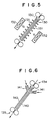
- FIG. 6 shows an example of a cooling means in a sixth embodiment of the image recording apparatus in accordance with the present invention.
- two flat guides 140, 140 are located between two feed roller pairs 134 and 135.
- Air inlets 141, 141 for introducing cooling air are respectively combined integrally with the flat guides 140, 140.
- the air inlets 141, 141 are formed at positions close to the ends of the flat guides 140, 140 on the upstream side with respect to the direction of conveyance. In this manner, the cooling effects are enhanced by utilizing cooling air.
- the cooling path can be set to be short.
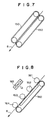
- FIG. 7 shows an example of a cooling means in a seventh embodiment of the image recording apparatus in accordance with the present invention.
- the photosensitive sheet 8 is sandwiched and conveyed between a pair of endless belts 150, 150, which are located such that their straight portions may stand facing each other.
- the endless belts 150, 150 are constituted of a material having good heat conduction properties and good cooling effects. A reliable cooling means can thereby be obtained.
- FIG. 8 shows an example of a cooling means in an eighth embodiment of the image recording apparatus in accordance with the present invention.
- endless belt 160 is located only on one side of the conveyance path for the photosensitive sheet 8.
- Four feed rollers 161, 162, 163, and 164 stand facing the straight portion of the endless belt 160, which straight portion is in contact with the conveyance path.
- a cooling fan 165 is located on the side outward from the feed rollers 161, 162, 163, and 164.
- the ambient temperature it is necessary for the ambient temperature to be adjusted such that, in the vicinity of the curl eliminating guide plate 112 located at the outlet 110, through which the photosensitive sheet 8 is fed out from between the heating drum 4 and the endless belt 6, the temperature of the photosensitive sheet 8 may not become lower than the upper limit (in the cases of PET, 90°C) of the glass transition temperature Tgb of the substrate. Therefore, though not shown, a heating fan for blowing hot air may be utilized. As the heat source for the heating fan, a new heater may be employed. Alternatively, heat of the heating drum 4 may be utilized as the heat source for the heating fan.
Landscapes
- Physics & Mathematics (AREA)
- General Physics & Mathematics (AREA)
- Chemical & Material Sciences (AREA)
- Engineering & Computer Science (AREA)
- Materials Engineering (AREA)
- Non-Silver Salt Photosensitive Materials And Non-Silver Salt Photography (AREA)
- Photographic Developing Apparatuses (AREA)
Applications Claiming Priority (6)
| Application Number | Priority Date | Filing Date | Title |
|---|---|---|---|
| JP10244296A JPH09292695A (ja) | 1996-04-24 | 1996-04-24 | 画像記録方法および装置 |
| JP10244296 | 1996-04-24 | ||
| JP102442/96 | 1996-04-24 | ||
| JP21144896A JPH1055044A (ja) | 1996-08-09 | 1996-08-09 | 画像記録方法および装置 |
| JP21144896 | 1996-08-09 | ||
| JP211448/96 | 1996-08-09 |
Publications (2)
| Publication Number | Publication Date |
|---|---|
| EP0803781A1 true EP0803781A1 (de) | 1997-10-29 |
| EP0803781B1 EP0803781B1 (de) | 2001-07-04 |
Family
ID=26443164
Family Applications (1)
| Application Number | Title | Priority Date | Filing Date |
|---|---|---|---|
| EP97106653A Expired - Lifetime EP0803781B1 (de) | 1996-04-24 | 1997-04-22 | Bildaufzeichnungsverfahren und -gerät |
Country Status (3)
| Country | Link |
|---|---|
| US (1) | US6124871A (de) |
| EP (1) | EP0803781B1 (de) |
| DE (1) | DE69705460T2 (de) |
Cited By (1)
| Publication number | Priority date | Publication date | Assignee | Title |
|---|---|---|---|---|
| EP1094361A1 (de) * | 1999-10-21 | 2001-04-25 | Konica Corporation | Verarbeitungsverfahren für photothermographisches Material |
Citations (6)
| Publication number | Priority date | Publication date | Assignee | Title |
|---|---|---|---|---|
| US3826896A (en) * | 1973-07-09 | 1974-07-30 | Xerox Corp | Dry film developing apparatus |
| US4325629A (en) * | 1979-12-07 | 1982-04-20 | Asahi Kasei Kogyo Kabushiki Kaisha | Image forming method and apparatus therefor |
| EP0355876A1 (de) * | 1988-07-05 | 1990-02-28 | Agfa-Gevaert N.V. | Verfahren zum Regeln des Aufrollens von photographischem Material |
| US5167987A (en) * | 1991-11-04 | 1992-12-01 | Xerox Corporation | Process for fabricating electrostatographic imaging members |
| US5258282A (en) * | 1990-11-19 | 1993-11-02 | Canon Kabushiki Kaisha | Dry process, silver salt photosensitive member and method for forming image with the dry process, silver salt photosensitive member |
| US5382504A (en) * | 1994-02-22 | 1995-01-17 | Minnesota Mining And Manufacturing Company | Photothermographic element with core-shell-type silver halide grains |
Family Cites Families (3)
| Publication number | Priority date | Publication date | Assignee | Title |
|---|---|---|---|---|
| US5580588A (en) * | 1994-04-14 | 1996-12-03 | Eastman Kodak Company | Apparatus for decurling a strip of photosensitive material |
| US5502532A (en) * | 1994-05-23 | 1996-03-26 | Biesinger; Mark G. | Method and system for processing film by speed and activating agent concentration temperature control |
| JPH09269578A (ja) * | 1996-03-29 | 1997-10-14 | Konica Corp | 画像形成方法 |
-
1997
- 1997-04-22 EP EP97106653A patent/EP0803781B1/de not_active Expired - Lifetime
- 1997-04-22 DE DE69705460T patent/DE69705460T2/de not_active Expired - Lifetime
- 1997-04-23 US US08/847,757 patent/US6124871A/en not_active Expired - Lifetime
Patent Citations (6)
| Publication number | Priority date | Publication date | Assignee | Title |
|---|---|---|---|---|
| US3826896A (en) * | 1973-07-09 | 1974-07-30 | Xerox Corp | Dry film developing apparatus |
| US4325629A (en) * | 1979-12-07 | 1982-04-20 | Asahi Kasei Kogyo Kabushiki Kaisha | Image forming method and apparatus therefor |
| EP0355876A1 (de) * | 1988-07-05 | 1990-02-28 | Agfa-Gevaert N.V. | Verfahren zum Regeln des Aufrollens von photographischem Material |
| US5258282A (en) * | 1990-11-19 | 1993-11-02 | Canon Kabushiki Kaisha | Dry process, silver salt photosensitive member and method for forming image with the dry process, silver salt photosensitive member |
| US5167987A (en) * | 1991-11-04 | 1992-12-01 | Xerox Corporation | Process for fabricating electrostatographic imaging members |
| US5382504A (en) * | 1994-02-22 | 1995-01-17 | Minnesota Mining And Manufacturing Company | Photothermographic element with core-shell-type silver halide grains |
Cited By (1)
| Publication number | Priority date | Publication date | Assignee | Title |
|---|---|---|---|---|
| EP1094361A1 (de) * | 1999-10-21 | 2001-04-25 | Konica Corporation | Verarbeitungsverfahren für photothermographisches Material |
Also Published As
| Publication number | Publication date |
|---|---|
| DE69705460T2 (de) | 2001-10-31 |
| EP0803781B1 (de) | 2001-07-04 |
| DE69705460D1 (de) | 2001-08-09 |
| US6124871A (en) | 2000-09-26 |
Similar Documents
| Publication | Publication Date | Title |
|---|---|---|
| JP3638023B2 (ja) | フォトサーモグラフィック・エレメントを処理するための装置及びシステム及び方法 | |
| US5952167A (en) | Photothermographic materials | |
| JPH11295847A (ja) | 熱現像画像記録材料 | |
| JP2001318449A (ja) | 熱現像システム | |
| US6198799B1 (en) | X-ray image forming method and x-ray image forming system | |
| US6197379B1 (en) | Multilayer coating method and production method of thermally developable photosensitive material using the same | |
| EP0663612B1 (de) | Polymere Filmbasis mit polymer Überzugsschicht auf organischer Lösungsmittelbasis mit einem fluorierten Antistatikmittel | |
| EP0911693B1 (de) | Bildaufzeichnungsverfahren vermittels thermischer Entfärbung, Verfahren zum Entfärben eines Cyaninfarbstoffs und Verwendung eines Cyaninfarbstoffs als Medium der thermischen Bildaufzeichnung oder als Filter- oder Antihalofarbstoff | |
| EP0803781B1 (de) | Bildaufzeichnungsverfahren und -gerät | |
| US6190854B1 (en) | Thermally developable material | |
| US6268118B1 (en) | Photosensitive emulsion, thermally developable photosensitive material containing the same, image recording method and image forming method employing the same | |
| EP1037102A1 (de) | Bilderzeugungsverfahren durch photothermographisches Material | |
| US6355407B1 (en) | Thermally developable photosensitive material | |
| US6287755B1 (en) | Thermally developable photosensitive material | |
| EP1249732A2 (de) | Flachdruckplattenmaterial und Verfahren zur Herstellung einer Flachdruckplatte | |
| JP4202625B2 (ja) | 熱現像感光材料を用いた画像形成方法 | |
| US6403297B1 (en) | Thermally developable material and packing method of the same | |
| JP3786008B2 (ja) | 画像形成装置 | |
| JP3996234B2 (ja) | ナフトオキサジニンスクアリリウム化合物とそれを含む記録材料 | |
| JP2000292897A (ja) | 熱現像装置及び熱現像方法 | |
| JPH09292695A (ja) | 画像記録方法および装置 | |
| JP3773101B2 (ja) | 画像形成装置及び画像形成方法 | |
| JP3992036B2 (ja) | 熱現像装置 | |
| EP1134612A2 (de) | Photothermographisches Material | |
| JPH1055044A (ja) | 画像記録方法および装置 |
Legal Events
| Date | Code | Title | Description |
|---|---|---|---|
| PUAI | Public reference made under article 153(3) epc to a published international application that has entered the european phase |
Free format text: ORIGINAL CODE: 0009012 |
|
| AK | Designated contracting states |
Kind code of ref document: A1 Designated state(s): DE FR IT |
|
| 17P | Request for examination filed |
Effective date: 19980427 |
|
| 17Q | First examination report despatched |
Effective date: 19980619 |
|
| GRAG | Despatch of communication of intention to grant |
Free format text: ORIGINAL CODE: EPIDOS AGRA |
|
| GRAG | Despatch of communication of intention to grant |
Free format text: ORIGINAL CODE: EPIDOS AGRA |
|
| GRAH | Despatch of communication of intention to grant a patent |
Free format text: ORIGINAL CODE: EPIDOS IGRA |
|
| GRAH | Despatch of communication of intention to grant a patent |
Free format text: ORIGINAL CODE: EPIDOS IGRA |
|
| GRAA | (expected) grant |
Free format text: ORIGINAL CODE: 0009210 |
|
| AK | Designated contracting states |
Kind code of ref document: B1 Designated state(s): DE FR IT |
|
| REF | Corresponds to: |
Ref document number: 69705460 Country of ref document: DE Date of ref document: 20010809 |
|
| ITF | It: translation for a ep patent filed | ||
| ET | Fr: translation filed | ||
| PLBE | No opposition filed within time limit |
Free format text: ORIGINAL CODE: 0009261 |
|
| STAA | Information on the status of an ep patent application or granted ep patent |
Free format text: STATUS: NO OPPOSITION FILED WITHIN TIME LIMIT |
|
| 26N | No opposition filed | ||
| REG | Reference to a national code |
Ref country code: FR Ref legal event code: TP Ref country code: FR Ref legal event code: CD |
|
| PGFP | Annual fee paid to national office [announced via postgrant information from national office to epo] |
Ref country code: DE Payment date: 20120425 Year of fee payment: 16 |
|
| PGFP | Annual fee paid to national office [announced via postgrant information from national office to epo] |
Ref country code: FR Payment date: 20120504 Year of fee payment: 16 |
|
| PGFP | Annual fee paid to national office [announced via postgrant information from national office to epo] |
Ref country code: IT Payment date: 20120420 Year of fee payment: 16 |
|
| PG25 | Lapsed in a contracting state [announced via postgrant information from national office to epo] |
Ref country code: DE Free format text: LAPSE BECAUSE OF NON-PAYMENT OF DUE FEES Effective date: 20131101 |
|
| REG | Reference to a national code |
Ref country code: FR Ref legal event code: ST Effective date: 20131231 |
|
| REG | Reference to a national code |
Ref country code: DE Ref legal event code: R119 Ref document number: 69705460 Country of ref document: DE Effective date: 20131101 |
|
| PG25 | Lapsed in a contracting state [announced via postgrant information from national office to epo] |
Ref country code: FR Free format text: LAPSE BECAUSE OF NON-PAYMENT OF DUE FEES Effective date: 20130430 Ref country code: IT Free format text: LAPSE BECAUSE OF NON-PAYMENT OF DUE FEES Effective date: 20130422 |