EP0803658B1 - Verfahren zur Herstellung einer Reibbelagmischung für Brems-und Kupplungsbeläge - Google Patents
Verfahren zur Herstellung einer Reibbelagmischung für Brems-und Kupplungsbeläge Download PDFInfo
- Publication number
- EP0803658B1 EP0803658B1 EP19970105339 EP97105339A EP0803658B1 EP 0803658 B1 EP0803658 B1 EP 0803658B1 EP 19970105339 EP19970105339 EP 19970105339 EP 97105339 A EP97105339 A EP 97105339A EP 0803658 B1 EP0803658 B1 EP 0803658B1
- Authority
- EP
- European Patent Office
- Prior art keywords
- softening agent
- mixing
- approximately
- friction material
- sprayed
- Prior art date
- Legal status (The legal status is an assumption and is not a legal conclusion. Google has not performed a legal analysis and makes no representation as to the accuracy of the status listed.)
- Expired - Lifetime
Links
- 238000000034 method Methods 0.000 title claims description 30
- 239000000203 mixture Substances 0.000 title claims description 30
- 238000004519 manufacturing process Methods 0.000 title claims description 8
- 238000002156 mixing Methods 0.000 claims description 47
- 239000002783 friction material Substances 0.000 claims description 22
- XZZNDPSIHUTMOC-UHFFFAOYSA-N triphenyl phosphate Chemical compound C=1C=CC=CC=1OP(OC=1C=CC=CC=1)(=O)OC1=CC=CC=C1 XZZNDPSIHUTMOC-UHFFFAOYSA-N 0.000 claims description 9
- 239000000463 material Substances 0.000 claims description 8
- 239000000314 lubricant Substances 0.000 claims description 4
- 238000011049 filling Methods 0.000 claims description 2
- 239000002184 metal Substances 0.000 claims description 2
- 229910052751 metal Inorganic materials 0.000 claims description 2
- 150000002739 metals Chemical class 0.000 claims description 2
- 239000004902 Softening Agent Substances 0.000 claims 9
- 150000002736 metal compounds Chemical class 0.000 claims 1
- 239000004014 plasticizer Substances 0.000 description 25
- 239000000428 dust Substances 0.000 description 20
- 238000002347 injection Methods 0.000 description 12
- 239000007924 injection Substances 0.000 description 12
- KFZMGEQAYNKOFK-UHFFFAOYSA-N Isopropanol Chemical compound CC(C)O KFZMGEQAYNKOFK-UHFFFAOYSA-N 0.000 description 4
- 238000009826 distribution Methods 0.000 description 3
- 238000003825 pressing Methods 0.000 description 3
- 239000007921 spray Substances 0.000 description 3
- 230000001174 ascending effect Effects 0.000 description 2
- 238000000889 atomisation Methods 0.000 description 2
- 238000000605 extraction Methods 0.000 description 2
- 239000000835 fiber Substances 0.000 description 2
- 239000000945 filler Substances 0.000 description 2
- 238000009472 formulation Methods 0.000 description 2
- 239000002245 particle Substances 0.000 description 2
- 239000000843 powder Substances 0.000 description 2
- 239000002994 raw material Substances 0.000 description 2
- 239000007787 solid Substances 0.000 description 2
- 239000002904 solvent Substances 0.000 description 2
- 238000009825 accumulation Methods 0.000 description 1
- 230000009286 beneficial effect Effects 0.000 description 1
- 230000015572 biosynthetic process Effects 0.000 description 1
- 238000007664 blowing Methods 0.000 description 1
- 238000001035 drying Methods 0.000 description 1
- 229920001971 elastomer Polymers 0.000 description 1
- 230000007613 environmental effect Effects 0.000 description 1
- 239000002360 explosive Substances 0.000 description 1
- 238000010438 heat treatment Methods 0.000 description 1
- 239000012784 inorganic fiber Substances 0.000 description 1
- 239000007788 liquid Substances 0.000 description 1
- 231100000053 low toxicity Toxicity 0.000 description 1
- 239000000155 melt Substances 0.000 description 1
- 238000002844 melting Methods 0.000 description 1
- 230000008018 melting Effects 0.000 description 1
- 239000012766 organic filler Substances 0.000 description 1
- 239000008031 plastic plasticizer Substances 0.000 description 1
- 238000004080 punching Methods 0.000 description 1
- 229920005989 resin Polymers 0.000 description 1
- 239000011347 resin Substances 0.000 description 1
- 230000000630 rising effect Effects 0.000 description 1
- 239000005060 rubber Substances 0.000 description 1
- 238000000926 separation method Methods 0.000 description 1
- 231100000419 toxicity Toxicity 0.000 description 1
- 230000001988 toxicity Effects 0.000 description 1
Images
Classifications
-
- F—MECHANICAL ENGINEERING; LIGHTING; HEATING; WEAPONS; BLASTING
- F16—ENGINEERING ELEMENTS AND UNITS; GENERAL MEASURES FOR PRODUCING AND MAINTAINING EFFECTIVE FUNCTIONING OF MACHINES OR INSTALLATIONS; THERMAL INSULATION IN GENERAL
- F16D—COUPLINGS FOR TRANSMITTING ROTATION; CLUTCHES; BRAKES
- F16D69/00—Friction linings; Attachment thereof; Selection of coacting friction substances or surfaces
- F16D69/02—Composition of linings ; Methods of manufacturing
- F16D69/025—Compositions based on an organic binder
- F16D69/026—Compositions based on an organic binder containing fibres
Definitions
- the invention relates to a method for producing a Friction lining mixture for brake and clutch linings after Preamble of claim 1.
- the extraction of the dust by an extraction system leads to a non-constant fine dust loss that can be up to 2% can be, which also the reproducibility of the The friction material mixture is subject to greater fluctuations.
- a known method for dust avoidance is to Solvents, e.g. Isopropanol in the friction material mixture enter, the solvent with negative pressure is withdrawn again.
- the disadvantage of this dust avoidance method is the toxicity of isopropanol and the need for explosion-proof systems.
- the invention has for its object a manufacturing process to specify for a friction material mixture with which the dust losses in the production of the friction material mixture can be reduced and with which the reproducibility the friction material mixture can be increased.
- the invention advantageously provides that during of the mixing process a liquefied plasticizer for Plastics is sprayed into the mixing container.
- the liquefied plasticizers can be used in the manufacture of the Friction material mixture significantly increases dust formation reduce and the material loss of fine dust reduce to the extent that a significantly improved reproducibility the friction material mixture can be achieved. At the same time, the significantly reduced dust emission improves air quality in the workplace and reduces pollution of the environment.
- the liquefied Plasticizer binds the ascending spray Dust and brings this in a high proportion in the Mix one.
- the liquefied plasticizer acts on it out in the friction material mixture as a lubricant what itself when pressing the friction material mixture on the walls the mold has a beneficial effect.
- the liquefied plasticizer is finely dispersed through a nozzle.
- the finely dispersed Distribution of the plasticizer in the liquid state allows the complete capture of the during Mixing process of rising dust. Because of the finely dispersed There is a reduction in distribution Droplet size of the liquefied plasticizer and thus an increase in the separation rate of the dust particles.
- It will preferably triphenyl phosphate used as a plasticizer. This liquefied plasticizer isn't volatile, either explosive and has low toxicity.
- the plasticizer is placed in a preheating container Temperature heated from approx. 80 ° C to 220 ° C. It points the plasticizer has a melting point of approx. 50 ° C and exhibits sufficient at the specified temperature Viscosity to be dispersed finely dispersed.
- the plasticizer can be wrapped in a hot air jacket Mixing containers are injected.
- the hot air jacket causes the plasticizer to not cool down quickly, so that its capacity for dust particles up to Maintain impact on the friction material mixture remains.
- the Plasticizers with a dosage of approx. 50 to 200 g / s, preferably about 140 to 180 g / s, is sprayed.
- a such a high dosage is appropriate to a short one To achieve mixing time.
- Dosing time of about 120 to 300 s, preferably about 150 to 200 s.
- the proportion of plasticizer in the friction material mixture is between about 0.1 to 5% by weight.
- the plasticizer is preferably placed centrally in the mix sprayed, causing the plasticizer to adhere to the Mixer inner walls and / or avoided on the mixing tools can be.
- Injection of the plasticizer can also be intermittent respectively.
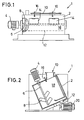
- the mixing device 1 shown in FIG. 1 is a Lödige mixer known and consists essentially of a Mixing drum 2, in the coaxial to the longitudinal axis of the mixing drum 2 a shaft 6 driven by a motor 4 is stored.
- the shaft carries radially evenly distributed Mixing blades 8, which are introduced into the mixing drum 2 Mix the friction material vigorously.
- the friction material mixture is fed through a filling opening 10 introduced into the mixing drum 2 and laterally on the Mixing drum 2 via a removal opening 12 after the Mixing process removed again.
- windows 14 can be arranged, which are the observation allow the mixing process.
- two injection nozzles 16 are schematic shown, via which the liquefied plasticizer, preferably Triphenyl phosphate at a temperature of approx. 80 to 220 ° C, e.g. 170 ° C, in the mixing room of the mixing drum 2 is injected to during the mixing process to bind released dust.
- Fig. 2 shows a mixing device, which is called Eirich mixer is known.
- This mixing device is the friction material mixture through a filler opening 10 introduced into a mixing chamber 18 which in a rotating mixing drum 2 is arranged.
- the rotating one Mixing drum 2 has an axis of rotation that is inclined to the vertical.
- the rotating one Mixing drum 2 has its own drive 20.
- eccentric to the axis of rotation of the mixing drum 2 is a Agitator stored in the mixing drum 2, with a parallel extending to the axis of rotation of the mixing drum 2 Shaft 6, on which in turn mixing blades 8 are attached.
- the agitator is driven by a motor 4.
- On the ground the mixing drum 2 is a removal opening 12 for the Friction material mixture provided.
- an injection nozzle is arranged centrally, via the liquefied plasticizer into the mixing chamber 18 can be injected. It is understood that instead a single injector 16 also a plurality of injectors be provided at the upper end of the mixing drum 2 can.
- triphenyl phosphate is only present in solid form in a preheating container, not shown in the drawings melted.
- the melt is brought to a temperature heated from about 80 to 220 ° C and then while maintaining the temperature for example by heated Pipes in a heatable nozzle head or in a or more heated injection nozzles 16 are introduced under pressure.
- the plasticizer then becomes finely dispersed during the Mixing process sprayed, with the help of the injection nozzles 16 atomization of the plasticizer in a grain size range between 0.5 and 100 ⁇ m droplet size achievable is. This prevents triphenyl phosphate on the walls of the mixer, thereby advantageously on heating the Mixer can be dispensed with.
- the finely dispersed spray from triphenyl phosphate droplets binds the while of the ascending dust quickly and almost completely, thereby avoiding material losses, without the mixing times having to be extended.
- the injection and atomization process can be done with the help of Hot air are supported, e.g. by sheathing the Spray jet with hot air.
- a dosing time of approx. 120 to 150 s are provided, for example approx. 140 up to 180 g / s triphenyl phosphate introduced into the mixture becomes.
- the metering takes place with regard to temperature and injection speed and injection quantity so that the Plasticizer can only cool down after the dust has been bound.
- the high dosing accuracy results in Connection with the significantly reduced material losses a powdery, highly reproducible mixture of friction materials.
- the injection pressure is preferably 1 to 3 bar, wherein if necessary, the plasticizer in a period of 2 to 5 min can be injected intermittently.
- the fed Amount of plasticizer is adjusted according to that Completion of the mixing process about 0.1 to 5 wt.% Triphenylphosphat are contained in the friction material mixture.
Landscapes
- Engineering & Computer Science (AREA)
- General Engineering & Computer Science (AREA)
- Mechanical Engineering (AREA)
- Processing And Handling Of Plastics And Other Materials For Molding In General (AREA)
Description
- Metalle (als Fasern oder Pulver)
- Füllstoffe (evt. anorganische Fasern)
- Gleitmittel (Festschmierstoffe) und
- organische Bestandteile (Harze, Kautschucke, organische Fasern, organische Füllstoffe).
- Fig. 1
- einen Lödige-Mischer mit Einspritzeinrichtung zur Anwendung des erfindungsgemäßen Verfahrens, und
- Fig. 2
- einen Eirich-Mischer mit Einspritzeinrichtung zur Anwendung des erfindungsgemäßen Verfahrens.
Claims (10)
- Verfahren zur Herstellung einer Reibmaterialmischung für Brems- und Kupplungsbeläge, bestehend ausdurch Mischen in einem MischraumFasern,organischen und/oder anorganischen Füllstoffen,Schmierstoffen und/oderMetallen oder Metallverbindungen, sowieorganischen Bindemitteln,
dadurch gekennzeichnet, daß während des Mischvorganges ein verflüssigter Weichmacher für Kunststoffe in den Mischraum eingesprüht wird. - Verfahren nach Anspruch 1, dadurch gekennzeichnet, daß der verflüssigte Weichmacher über eine Düse feindispers verteilt wird.
- Verfahren nach Anspruch 1 oder 2, dadurch gekennzeichnet, daß als Weichmacher Triphenylphosphat verwendet wird.
- Verfahren nach einem der Ansprüche 1 bis 3, dadurch gekennzeichnet, daß der Weichmacher in einem Vorwärmbehälter auf eine Temperatur von ca. 80 bis 220 °C erhitzt wird.
- Verfahren nach einem der Ansprüche 1 bis 4, dadurch gekennzeichnet, daß der Weichmacher mit Heißluftummantelung in den Mischbehälter eingespritzt wird.
- Verfahren nach einem der Ansprüche 1 bis 5, dadurch gekennzeichnet, daß der Weichmacher mit einer Dosierung von ca. 50 bis 200 g/s, vorzugsweise ca. 140 bis 180 g/s eingesprüht wird.
- Verfahren nach einem der Ansprüche 1 bis 6, dadurch gekennzeichnet, daß zur Erzielung kurzer Mischzeiten eine Dosierzeit von ca. 120 bis 360 s, vorzugsweise ca. 150 bis 200 s, vorgesehen wird.
- Verfahren nach einem der Ansprüche 1 bis 7, dadurch gekennzeichnet, daß der Weichmacher zentral in das Mischgut eingesprüht wird.
- Verfahren nach einem der Ansprüche 1 bis 8, dadurch gekennzeichnet, daß der verflüssigte Weichmacher einen Gewichtsanteil an der Reibmaterialmischung von ca. 0,1 bis 5 Gew%, vorzugsweise 1 bis 3 Gew%, aufweist.
- Verfahren nach einem der Ansprüche 1 bis 9, dadurch gekennzeichnet, daß der verflüssigte Weichmacher intermittierend eingesprüht wird.
Applications Claiming Priority (4)
| Application Number | Priority Date | Filing Date | Title |
|---|---|---|---|
| DE19616619 | 1996-04-25 | ||
| DE19616619 | 1996-04-25 | ||
| DE19623938A DE19623938A1 (de) | 1996-04-25 | 1996-06-15 | Verfahren zur Herstellung einer Reibbelagmischung für Brems- und Kupplungsbeläge |
| DE19623938 | 1996-06-15 |
Publications (2)
| Publication Number | Publication Date |
|---|---|
| EP0803658A1 EP0803658A1 (de) | 1997-10-29 |
| EP0803658B1 true EP0803658B1 (de) | 2002-01-23 |
Family
ID=26025137
Family Applications (1)
| Application Number | Title | Priority Date | Filing Date |
|---|---|---|---|
| EP19970105339 Expired - Lifetime EP0803658B1 (de) | 1996-04-25 | 1997-03-29 | Verfahren zur Herstellung einer Reibbelagmischung für Brems-und Kupplungsbeläge |
Country Status (2)
| Country | Link |
|---|---|
| EP (1) | EP0803658B1 (de) |
| DK (1) | DK0803658T3 (de) |
Families Citing this family (1)
| Publication number | Priority date | Publication date | Assignee | Title |
|---|---|---|---|---|
| DE19828301A1 (de) * | 1998-06-25 | 2000-02-03 | Bba Friction Gmbh | Reibbelag, insbesondere für Bremsen und Kupplungen, und Verfahren zur Herstellung eines Reibbelages |
Family Cites Families (5)
| Publication number | Priority date | Publication date | Assignee | Title |
|---|---|---|---|---|
| DE2828918C2 (de) * | 1977-07-16 | 1982-07-15 | Aisin Chemical Co. Ltd., Kariya, Aichi | Verfahren zur Herstellung eines Reibungsmaterials auf Papierbasis |
| JPS5544101A (en) * | 1978-09-19 | 1980-03-28 | Teijin Ltd | Gear made of thermoplastic resin |
| EP0050377B1 (de) * | 1980-10-16 | 1985-10-02 | Rütgerswerke Aktiengesellschaft | Asbestfreies Reibmaterial |
| JPH0439376A (ja) * | 1990-06-06 | 1992-02-10 | Sumitomo Electric Ind Ltd | 摩擦材組成物 |
| DE4205645B4 (de) * | 1992-02-25 | 2004-12-23 | RÜFAS Pagid AG | Reibbelag und Verfahren zu seiner Herstellung |
-
1997
- 1997-03-29 EP EP19970105339 patent/EP0803658B1/de not_active Expired - Lifetime
- 1997-03-29 DK DK97105339T patent/DK0803658T3/da active
Also Published As
| Publication number | Publication date |
|---|---|
| EP0803658A1 (de) | 1997-10-29 |
| DK0803658T3 (da) | 2002-05-06 |
Similar Documents
| Publication | Publication Date | Title |
|---|---|---|
| EP0024330B1 (de) | Verfahren zum Herstellen von Formteilen aus einem Mehrkomponentenreaktionsgemisch | |
| DE69219838T2 (de) | Verfahren zur Einführung von Zusätzen in faserartige Produkte | |
| DE2844661C2 (de) | Verfahren zum Beschichten eines Substrates mit filmbildenden Feststoffen, verschäumbare wärmehärtbare Zusammensetzung und Vorrichtung zum Beschichten | |
| EP2680959B1 (de) | Dynamischer mischer und dessen verwendung | |
| EP4069494B1 (de) | Druckeinrichtung für einen 3d-drucker | |
| DE1569234B2 (de) | ||
| DE202007016136U1 (de) | Gerät zur Herstellung einer gebrauchsfertigen Spachtelmasse durch Vermischen einer Binder- und einer Härter-Komponente | |
| WO1994019174A1 (de) | Verfahren zum herstellen eines dreidimensionalen objekts | |
| DE2809228A1 (de) | Vorrichtung zum dosieren und vermischen von mehrkomponentenmitteln | |
| DE69010790T2 (de) | Verfahren zur Herstellung von Explosivstoffen. | |
| WO2003008175A1 (de) | Verfahren und vorrichtung zur kontinuierlichen herstellung von kautschukmischungen | |
| DE4314941C2 (de) | Spritzeinheit an Spritzgießmaschinen zur Herstellung thermoplastischer Kunststoffteile | |
| DE19623938A1 (de) | Verfahren zur Herstellung einer Reibbelagmischung für Brems- und Kupplungsbeläge | |
| EP0803658A1 (de) | Verfahren zur Herstellung einer Reibbelagmischung für Brems-und Kupplungsbeläge | |
| EP0620778B1 (de) | Vorrichtung zur herstellung eines vernetzten extrudierten produktes | |
| DE3208047C2 (de) | Vorrichtung zur Herstellung von Gelteilchen | |
| DE8717963U1 (de) | Einrichtung zur Herstellung von Spritzgußkörpern | |
| DE1667060A1 (de) | Duennschichtvorrichtung zur Durchfuehrung von chemischen und physikalischchemischen Prozessen | |
| EP1825924B1 (de) | Vorrichtung und Verfahren zum Vermischen einer Binder- und einer Härter-Komponente zur Herstellung einer gebrauchsfertigen Spachtelmasse | |
| DE2617612A1 (de) | Verfahren und vorrichtung zum mischen verschiedener materialien | |
| DE3117682C2 (de) | Verfahren und Vorrichtung zum kontinuierlichen Beleimen von Holzspänen und anderen lignozellulosehaltigen Partikeln | |
| DE1958279C (de) | ||
| DE4036557C2 (de) | Verfahren zur Herstellung von Schleifkörpern | |
| DE2241616C3 (de) | Verfahren und Vorrichtung zur Aufbereitung von Polyadditionsharzzwischenprodukten | |
| DE69116801T2 (de) | Mischer |
Legal Events
| Date | Code | Title | Description |
|---|---|---|---|
| PUAI | Public reference made under article 153(3) epc to a published international application that has entered the european phase |
Free format text: ORIGINAL CODE: 0009012 |
|
| AK | Designated contracting states |
Kind code of ref document: A1 Designated state(s): DE DK ES FR GB IT SE |
|
| 17P | Request for examination filed |
Effective date: 19980306 |
|
| RAP1 | Party data changed (applicant data changed or rights of an application transferred) |
Owner name: BBA FRICTION GMBH |
|
| RAP1 | Party data changed (applicant data changed or rights of an application transferred) |
Owner name: TMD FRICTION GMBH |
|
| GRAG | Despatch of communication of intention to grant |
Free format text: ORIGINAL CODE: EPIDOS AGRA |
|
| GRAG | Despatch of communication of intention to grant |
Free format text: ORIGINAL CODE: EPIDOS AGRA |
|
| GRAH | Despatch of communication of intention to grant a patent |
Free format text: ORIGINAL CODE: EPIDOS IGRA |
|
| 17Q | First examination report despatched |
Effective date: 20010628 |
|
| GRAH | Despatch of communication of intention to grant a patent |
Free format text: ORIGINAL CODE: EPIDOS IGRA |
|
| RIN1 | Information on inventor provided before grant (corrected) |
Inventor name: WAPPLER, DIETER Inventor name: HUENER, ROLAND DR. |
|
| GRAA | (expected) grant |
Free format text: ORIGINAL CODE: 0009210 |
|
| REG | Reference to a national code |
Ref country code: GB Ref legal event code: IF02 |
|
| AK | Designated contracting states |
Kind code of ref document: B1 Designated state(s): DE DK ES FR GB IT SE |
|
| PG25 | Lapsed in a contracting state [announced via postgrant information from national office to epo] |
Ref country code: IT Free format text: LAPSE BECAUSE OF FAILURE TO SUBMIT A TRANSLATION OF THE DESCRIPTION OR TO PAY THE FEE WITHIN THE PRE;WARNING: LAPSES OF ITALIAN PATENTS WITH EFFECTIVE DATE BEFORE 2007 MAY HAVE OCCURRED AT ANY TIME BEFORE 2007. THE CORRECT EFFECTIVE DATE MAY BE DIFFERENT FROM THE ONE RECORDED.SCRIBED TIME-LIMIT Effective date: 20020123 |
|
| REF | Corresponds to: |
Ref document number: 59706154 Country of ref document: DE Date of ref document: 20020314 |
|
| PG25 | Lapsed in a contracting state [announced via postgrant information from national office to epo] |
Ref country code: SE Free format text: LAPSE BECAUSE OF FAILURE TO SUBMIT A TRANSLATION OF THE DESCRIPTION OR TO PAY THE FEE WITHIN THE PRESCRIBED TIME-LIMIT Effective date: 20020423 |
|
| REG | Reference to a national code |
Ref country code: DK Ref legal event code: T3 |
|
| GBT | Gb: translation of ep patent filed (gb section 77(6)(a)/1977) |
Effective date: 20020419 |
|
| ET | Fr: translation filed | ||
| PG25 | Lapsed in a contracting state [announced via postgrant information from national office to epo] |
Ref country code: ES Free format text: LAPSE BECAUSE OF FAILURE TO SUBMIT A TRANSLATION OF THE DESCRIPTION OR TO PAY THE FEE WITHIN THE PRESCRIBED TIME-LIMIT Effective date: 20020730 |
|
| PLBE | No opposition filed within time limit |
Free format text: ORIGINAL CODE: 0009261 |
|
| STAA | Information on the status of an ep patent application or granted ep patent |
Free format text: STATUS: NO OPPOSITION FILED WITHIN TIME LIMIT |
|
| 26N | No opposition filed | ||
| PGFP | Annual fee paid to national office [announced via postgrant information from national office to epo] |
Ref country code: DK Payment date: 20060328 Year of fee payment: 10 |
|
| REG | Reference to a national code |
Ref country code: DK Ref legal event code: EBP |
|
| PG25 | Lapsed in a contracting state [announced via postgrant information from national office to epo] |
Ref country code: DK Free format text: LAPSE BECAUSE OF NON-PAYMENT OF DUE FEES Effective date: 20070402 |
|
| PGFP | Annual fee paid to national office [announced via postgrant information from national office to epo] |
Ref country code: GB Payment date: 20080320 Year of fee payment: 12 |
|
| PGFP | Annual fee paid to national office [announced via postgrant information from national office to epo] |
Ref country code: FR Payment date: 20080314 Year of fee payment: 12 Ref country code: DE Payment date: 20080331 Year of fee payment: 12 |
|
| GBPC | Gb: european patent ceased through non-payment of renewal fee |
Effective date: 20090329 |
|
| REG | Reference to a national code |
Ref country code: FR Ref legal event code: ST Effective date: 20091130 |
|
| PG25 | Lapsed in a contracting state [announced via postgrant information from national office to epo] |
Ref country code: DE Free format text: LAPSE BECAUSE OF NON-PAYMENT OF DUE FEES Effective date: 20091001 |
|
| PG25 | Lapsed in a contracting state [announced via postgrant information from national office to epo] |
Ref country code: GB Free format text: LAPSE BECAUSE OF NON-PAYMENT OF DUE FEES Effective date: 20090329 Ref country code: FR Free format text: LAPSE BECAUSE OF NON-PAYMENT OF DUE FEES Effective date: 20091123 |