EP0803603B1 - Procédé et installation de fabrication par enduction d'une bande en matière plastique - Google Patents
Procédé et installation de fabrication par enduction d'une bande en matière plastique Download PDFInfo
- Publication number
- EP0803603B1 EP0803603B1 EP97420066A EP97420066A EP0803603B1 EP 0803603 B1 EP0803603 B1 EP 0803603B1 EP 97420066 A EP97420066 A EP 97420066A EP 97420066 A EP97420066 A EP 97420066A EP 0803603 B1 EP0803603 B1 EP 0803603B1
- Authority
- EP
- European Patent Office
- Prior art keywords
- coating layer
- plastisol
- particles
- plastic
- coating
- Prior art date
- Legal status (The legal status is an assumption and is not a legal conclusion. Google has not performed a legal analysis and makes no representation as to the accuracy of the status listed.)
- Expired - Lifetime
Links
Images
Classifications
-
- D—TEXTILES; PAPER
- D06—TREATMENT OF TEXTILES OR THE LIKE; LAUNDERING; FLEXIBLE MATERIALS NOT OTHERWISE PROVIDED FOR
- D06N—WALL, FLOOR, OR LIKE COVERING MATERIALS, e.g. LINOLEUM, OILCLOTH, ARTIFICIAL LEATHER, ROOFING FELT, CONSISTING OF A FIBROUS WEB COATED WITH A LAYER OF MACROMOLECULAR MATERIAL; FLEXIBLE SHEET MATERIAL NOT OTHERWISE PROVIDED FOR
- D06N3/00—Artificial leather, oilcloth or other material obtained by covering fibrous webs with macromolecular material, e.g. resins, rubber or derivatives thereof
- D06N3/0086—Artificial leather, oilcloth or other material obtained by covering fibrous webs with macromolecular material, e.g. resins, rubber or derivatives thereof characterised by the application technique
- D06N3/0088—Artificial leather, oilcloth or other material obtained by covering fibrous webs with macromolecular material, e.g. resins, rubber or derivatives thereof characterised by the application technique by directly applying the resin
- D06N3/0093—Artificial leather, oilcloth or other material obtained by covering fibrous webs with macromolecular material, e.g. resins, rubber or derivatives thereof characterised by the application technique by directly applying the resin by applying resin powders; by sintering
-
- C—CHEMISTRY; METALLURGY
- C08—ORGANIC MACROMOLECULAR COMPOUNDS; THEIR PREPARATION OR CHEMICAL WORKING-UP; COMPOSITIONS BASED THEREON
- C08J—WORKING-UP; GENERAL PROCESSES OF COMPOUNDING; AFTER-TREATMENT NOT COVERED BY SUBCLASSES C08B, C08C, C08F, C08G or C08H
- C08J3/00—Processes of treating or compounding macromolecular substances
- C08J3/02—Making solutions, dispersions, lattices or gels by other methods than by solution, emulsion or suspension polymerisation techniques
- C08J3/03—Making solutions, dispersions, lattices or gels by other methods than by solution, emulsion or suspension polymerisation techniques in aqueous media
- C08J3/075—Macromolecular gels
-
- C—CHEMISTRY; METALLURGY
- C09—DYES; PAINTS; POLISHES; NATURAL RESINS; ADHESIVES; COMPOSITIONS NOT OTHERWISE PROVIDED FOR; APPLICATIONS OF MATERIALS NOT OTHERWISE PROVIDED FOR
- C09D—COATING COMPOSITIONS, e.g. PAINTS, VARNISHES OR LACQUERS; FILLING PASTES; CHEMICAL PAINT OR INK REMOVERS; INKS; CORRECTING FLUIDS; WOODSTAINS; PASTES OR SOLIDS FOR COLOURING OR PRINTING; USE OF MATERIALS THEREFOR
- C09D127/00—Coating compositions based on homopolymers or copolymers of compounds having one or more unsaturated aliphatic radicals, each having only one carbon-to-carbon double bond, and at least one being terminated by a halogen; Coating compositions based on derivatives of such polymers
- C09D127/02—Coating compositions based on homopolymers or copolymers of compounds having one or more unsaturated aliphatic radicals, each having only one carbon-to-carbon double bond, and at least one being terminated by a halogen; Coating compositions based on derivatives of such polymers not modified by chemical after-treatment
- C09D127/04—Coating compositions based on homopolymers or copolymers of compounds having one or more unsaturated aliphatic radicals, each having only one carbon-to-carbon double bond, and at least one being terminated by a halogen; Coating compositions based on derivatives of such polymers not modified by chemical after-treatment containing chlorine atoms
- C09D127/06—Homopolymers or copolymers of vinyl chloride
-
- D—TEXTILES; PAPER
- D06—TREATMENT OF TEXTILES OR THE LIKE; LAUNDERING; FLEXIBLE MATERIALS NOT OTHERWISE PROVIDED FOR
- D06N—WALL, FLOOR, OR LIKE COVERING MATERIALS, e.g. LINOLEUM, OILCLOTH, ARTIFICIAL LEATHER, ROOFING FELT, CONSISTING OF A FIBROUS WEB COATED WITH A LAYER OF MACROMOLECULAR MATERIAL; FLEXIBLE SHEET MATERIAL NOT OTHERWISE PROVIDED FOR
- D06N3/00—Artificial leather, oilcloth or other material obtained by covering fibrous webs with macromolecular material, e.g. resins, rubber or derivatives thereof
- D06N3/04—Artificial leather, oilcloth or other material obtained by covering fibrous webs with macromolecular material, e.g. resins, rubber or derivatives thereof with macromolecular compounds obtained by reactions only involving carbon-to-carbon unsaturated bonds
- D06N3/06—Artificial leather, oilcloth or other material obtained by covering fibrous webs with macromolecular material, e.g. resins, rubber or derivatives thereof with macromolecular compounds obtained by reactions only involving carbon-to-carbon unsaturated bonds with polyvinylchloride or its copolymerisation products
-
- C—CHEMISTRY; METALLURGY
- C08—ORGANIC MACROMOLECULAR COMPOUNDS; THEIR PREPARATION OR CHEMICAL WORKING-UP; COMPOSITIONS BASED THEREON
- C08J—WORKING-UP; GENERAL PROCESSES OF COMPOUNDING; AFTER-TREATMENT NOT COVERED BY SUBCLASSES C08B, C08C, C08F, C08G or C08H
- C08J2300/00—Characterised by the use of unspecified polymers
- C08J2300/22—Thermoplastic resins
-
- C—CHEMISTRY; METALLURGY
- C08—ORGANIC MACROMOLECULAR COMPOUNDS; THEIR PREPARATION OR CHEMICAL WORKING-UP; COMPOSITIONS BASED THEREON
- C08J—WORKING-UP; GENERAL PROCESSES OF COMPOUNDING; AFTER-TREATMENT NOT COVERED BY SUBCLASSES C08B, C08C, C08F, C08G or C08H
- C08J2325/00—Characterised by the use of homopolymers or copolymers of compounds having one or more unsaturated aliphatic radicals, each having only one carbon-to-carbon double bond, and at least one being terminated by an aromatic carbocyclic ring; Derivatives of such polymers
- C08J2325/02—Homopolymers or copolymers of hydrocarbons
- C08J2325/04—Homopolymers or copolymers of styrene
- C08J2325/06—Polystyrene
-
- C—CHEMISTRY; METALLURGY
- C08—ORGANIC MACROMOLECULAR COMPOUNDS; THEIR PREPARATION OR CHEMICAL WORKING-UP; COMPOSITIONS BASED THEREON
- C08L—COMPOSITIONS OF MACROMOLECULAR COMPOUNDS
- C08L25/00—Compositions of, homopolymers or copolymers of compounds having one or more unsaturated aliphatic radicals, each having only one carbon-to-carbon double bond, and at least one being terminated by an aromatic carbocyclic ring; Compositions of derivatives of such polymers
- C08L25/02—Homopolymers or copolymers of hydrocarbons
- C08L25/04—Homopolymers or copolymers of styrene
- C08L25/06—Polystyrene
Definitions
- the present invention relates to manufacturing by coating a plastic strip, relatively thin, and including general at least one coating layer, comprising itself a substrate composed of at least one material basic thermoplastic, in particular a polymer or chlorinated copolymer, for example polyvinyl chloride.
- the coating layer may or may not be the only layer of the plastic band; it can be associated or linked to any suitable support, for example a nonwoven mineral fibers, for example glass.
- Such plastic bands can be used as floor or wall coverings, such as tarpaulins, or as furniture or automotive coatings.
- such coatings include one or more layers, obtained by calendering or coating, and themselves comprising multiple or varied decors, on which we can possibly apply a protective layer called wear layer, which provides resistance mechanical and physico-chemical coatings. And these same coatings can also have a relief, in correspondence or not with the decoration, and obtained mechanically, or chemically, for example by inhibition of foaming of the substrate of one or more coating layers.
- plasticizers for example example, a plasticizer level between 55 to 65 percent by weight of the amount of plastic from base, to obtain an acceptable viscosity for coating tools, such as doctor blades, and for allow good deaeration of the layer (s) of coating formed.
- the most used plasticizers commonly are organic derivatives of acids such as phthalic acid, phosphoric acid, acid benzoic, adipic acid, citric acid, acid glutaric, lauric acid, sebacic acid, acid azelaic, capric acid, and trimellitic acid.
- this significant amount of plasticizers does not not provide a coating with acceptable surface properties after layers gelled, and the coating has in particular a stain resistance and fouling when walking unacceptable, a greasy and sticky touch, a smell unpleasant, excessive flexibility, and a tendency exaggerated and permanent with exudation.
- coating manufacturers often add fluidizers to replace part of the plasticizers, which also allows lower viscosities to be obtained with plasticizers alone, low viscosities being desired to allow coating at speed high, and therefore save interesting.
- These are in general of low viscosity organic liquids, for example of oil cuts whose interval of distillation is between 130 ° C and 320 ° C, or products such as dodecylbenzene, and isobutyrate Texanol.
- the formulations of the coating layers by PVC-based example, may contain plasticizers at a rate of 5 to 20 percent by weight of the amount of basic plastic, which lowers the level of plasticizer in the formulation up to approximately 40 to 50 percent by weight of the amount of material basic plastic. Thus, touch and resistance to staining become acceptable.
- VOC volatile organic
- the use of fluidizers does not respond to news air quality requirements.
- the volatilization of these components on industrial sites, for example during the gelling of the plastic layers, is inevitable, and requires expensive installation for condensation and capture of effluents.
- the coating containing fluidizers continues to release VOCs by evaporation during its entire use, which results in odor and headache issues in the places where these products are installed.
- the new European legislation will fix a quantity maximum for the release of these VOCs, and commonly used thinners are particularly targeted.
- the solution to this double problem is to over laminate the plastisol to form the coating layer, and then reduce the proportion of plasticizer to a normal rate, even lower than normal by adding and integrating homogeneous PVC, in the coated layer, before finishing of the product, that is to say before gelation, and this in practically avoiding any use of plasticizer.
- the object of the present invention is therefore. main a manufacturing process of a strip in plastic material, and in particular a floor covering, allowing to remove practically any thinner and to limit the level of plasticizer, and this without modifying coating techniques and tools.
- the subject of the invention relates to a process according to the general scheme given above, more particularly characterized in that the plastic powder comprises particles of at least one thermoplastic incorporation material capable of integrating or dissolve at least partially, in the plastisol substrate, in particular a thermoplastic material of a chemical nature identical or similar to that of the basic thermoplastic material; the acceleration is voluntary, and the voluntary acceleration and the distribution are carried out so that the particles are incorporated in a homogeneous manner at least in a surface layer, above and / or back, of the coating layer.
- the plastic powder comprising particles of at least one thermoplastic of incorporation integrate completely and in a way homogeneous in the macromolecular matrix of the substrate of the coating layer.
- voluntary acceleration means particle acceleration greater than the acceleration due to the effect of gravity.
- the particles must form a homogeneous and integrated matrix with the material basic thermoplastic, if possible as soon as incorporation in plastisol, and at least in one surface layer of the coating layer, and any case after gelation. It follows that there is no of sedimentation of the particles, nor encapsulation of these last in the matrix of the coating layer like this is the case with prior art documents previously discussed.
- the weight percentage and total of the plasticizer is at least 20 PCR, i.e. 20 parts per 100 of the material base thermoplastic of the layer substrate coating.
- a powder plastic comprising particles of at least one thermoplastic material, capable of integrating or dissolve at least partially, if not completely and homogeneously in the macromolecular matrix of the plastisol substrate, somehow thinned the coating layer, without otherwise modifying important its other physico-mechanical properties.
- This surprising discovery enabled the depositor to reduce the overall amount of plasticizers in the coating layer below about 30 parts for hundred of the base thermoplastic of the layer coating.
- plastic bands comprising this coating layer essentially without thinner, when used as, or to form, floor or wall coverings, perform better than coatings floors made by calendering.
- the method according to the present invention avoids the use of plasticizers, it becomes possible to meet the requirements of air quality, and at the same time to keep, even improve the behavior of coatings or strips manufactured according to the process, and in particular to improve their touch, their resistance to staining, fouling, and to wear, and their flexibility or rigidity.
- the depositor also discovered that according to the method of the invention it is possible to have a weight proportion of incorporation particles integrated in the plastisol between approximately 20% to about 60% by weight relative to the weight of the material basic thermoplastic contained in the plastisol of departure. This is approximately equivalent to a weight proportion of integrated particles included between about 20% to about 50% by weight relative to the total weight of the coating layer.
- the plastic powder to be incorporated has a particle size between 2 ⁇ m and 500 ⁇ m, and preferably between 20 ⁇ m and 100 ⁇ m.
- the accelerated particles are distributed according to a surface density of between 30 g / m 2 and 500 g / m 2 , and preferably between 50 g / m 2 and 300 g / m 2 .
- the viscosity of the coating layer in the state pasty is set to a value less than 5 Pa.s, and preferably at a value of the order of 1 Pa.s.
- the coating layer is seeded.
- the means acceleration and distribution of plastic powder of incorporation include any of the materials following, namely projection equipment per channel electrostatic or triboelectric, material with trade dispersant, material with spray turbine.
- the means acceleration and distribution of plastic powder of incorporation include projection material by electrostatic path, with means for interposing the coating layer in the pasty state between at least one plastic powder ejection nozzle, and the support metallic nature forming a target, itself connected to the Earth.
- electrostatic projection this allows on the one hand surprisingly increase the amount of powder that can be absorbed by plastisol, and other hand, to improve the penetration of the powder into the plastisol.
- the installation is set to charge 5 negatively the plastic powder of incorporation between 5 kV and 70 kV, and preferably between 30 kV and 50 kV.
- the percentage weight of the plasticizer is at most equal to 100 PCR, and preferably between 70 PCR and 40 PCR, more preferably between around 30 and about 40 PCR.
- the plastic of incorporation includes particles of a polymer or chlorinated copolymer, for example polyvinyl chloride, advantageously recovered and previously ground.
- the plastic incorporation is a chlorinated polymer or copolymer, chosen in particular from PVC homopolymers, copolymers of vinyl chloride and acetyl chloride vinyl, and graft copolymers.
- the strip includes a flat support for the coating layer, for example a nonwoven of mineral fibers.
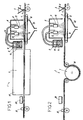
- FIG. 1 shows a schematic view in cut along an installation 1 or line of manufacture of a floor covering in accordance with the invention.
- This installation includes a source 2 a plastisol 3 in the pasty state comprising a substrate in divided form and a plasticizer.
- the substrate is composed of at least one thermoplastic material of based, for example, on PVC.
- Vinyl plastisols such that used in the present invention are generally dispersions of fine polymer particles vinyl in one or more liquid plasticizers.
- the plastisol 3 coated may also contain adjuvants and various additives, for example capable of migrate, in an added powder, which will be explained below.
- the previously mentioned plasticizing agent can be a plasticizer or a mixture of known plasticizers in general, and preferably is chosen from the group consisting of organic derivatives of acids such as phthalic acid, phosphoric acid, acid benzoic, adipic acid, citric acid, acid glutaric, lauric acid, sebacic acid, acid azelaic, capric acid, trimellitic acid, or a mixture of one or more of these compounds.
- the plasticizer is chosen in the group consisting of diethylhexylphthalate, butylbenzylphthalate, alkylbenzylphthalate, diisoheptylphthalate, diisooctyl phthalate, diisononyl phthalate, diphenyloctylphosphate, isodecyldiphenylphosphate, alkylbenzylphosphate, tri-2-ethylhexylphosphate, tricresyl phosphate, diethylene glycol dibenzoate, dipropylene glycol dibenzoate, polyethylene glycol dibenzoate, isodecyl benzoate, glyceryl-tribenzoate, diethylhexyladipate, diisononyladipate, tridecyladipate, didecyladipate, triethyl citrate, tributylcitrate, acetyltributylcitrate, trimellitates, chlor
- the fluidizers are essentially replaced by plasticizers, this which means that the starting plastisol is therefore over-laminated, and has virtually no thinning agent, and preferably is completely free of thinner.
- the excess plasticizer is completely absorbed by an incorporating plastic powder which is sprinkled on the pasty coated plastisol.
- the rate of final plasticizer is determined by the weight of powder incorporated incorporation plastic.
- the source 2 of plastisol 3 can be a hopper the container, associated with a drop-off station 4, by example a doctor blade, plastisol 3 layered on a flat support 5, to obtain a coating layer 6 to the pasty state.
- the flat support 5 makes it possible to support the coating layer in a pasty state, and may be by example a release paper of known type, a nonwoven of mineral fibers, or an endless non-stick strip metallic or non-metallic.
- a gelling station 7 Further downstream from source 2 and the substation deposit 4 there is a gelling station 7, the details will be given later, but that serves basically to get said coating layer 6 to solid but plastic state.
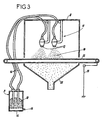
- This powder coating station which is shown schematically on the scale enlarged by Figure 3, includes a source 9 of a plastic powder 10, comprising particles of at least one material incorporation thermoplastic, and means acceleration 11 of the particles of the powder 10 towards the outer surface of the coating layer 6 in the state pasty, and particle distribution as well accelerated according to the outer surface of said layer coating.
- Means of acceleration and distribution 11 are designed and controlled to incorporate homogeneous the particles distributed and accelerated at less in a surface layer of the layer coating.
- the means of acceleration 11 and distribution of the incorporating plastic powder 10 include one any of the following materials, namely projection by electrostatic or triboelectric means, material with dispersing loom, material with turbine projection. Suitable trades can be obtained for example with the companies SALADIN, CARATSCH, KNOBEL, SCHILLING, a projection turbine with the PILLON company, an electrostatic projector near SAMES, and a triboelectric projector near from RANSBURG-GEMA.
- the acceleration means 11 and distribution of plastic powder 10 of incorporation include projection material by electrostatic path, with means for interposing the coating layer (not shown) in the pasty state between at least one powder ejection nozzle 12 plastic 10, and the support 13 of metallic nature forming target.
- This support 13 is for example a carpet metallic conveyor, which is connected to earth 19.
- the source 9 of plastic powder 10 of incorporation can consist of storage tank 14, connected to the nozzles ejection 12, by supply conduits 16 in incorporating plastic powder 10, and an entry feed 15 for recovery particles, as described below.
- Installation 1 is controlled at a central control (not shown), or for each station so that the powder coating station 8 loads negatively the plastic powder 10 of incorporation between 5 kV and 70 kV, and preferably between 30 kV and 50 kV.
- the base thermoplastic material of the layer substrate coating and the integrated particles are of a nature identical or almost identical, it is impossible or practically impossible to distinguish particles from the basic thermoplastic material, unless the percentage of plasticizers in the composition of the coating layer, for example through TEST FLEC, which will be described later, and which demonstrates that the layer coating according to the invention practically does not include no, if at all, thinners.
- the particles of incorporation powder 10 which are in excess and do not reach the coating layer are collected in a collector 22 and taken back to entry 15 feed to storage bin 14.
- powder particles 10 of incorporation these preferably have a average particle size between 20 to 50 microns.
- the powder particles 10 plastic used are PVC particles.
- PVC polymers including K WERTS are preferably between 45 and 110, by example of K WERT homopolymers between 55 and 110, copolymers of vinyl chloride and vinyl acetochloride, or graft copolymers of K WERT between 45 and 100.
- K WERT is well known to those skilled in the art in this field and does not require no more details.
- PVC can also apply to PVC waste or PVC-based compositions to PVC copolymers.
- PVC homopolymers or copolymers "extender”, also called cutting resins
- PVC homopolymers or copolymers of suspension type, or mass are used in the case of depositing a high surface density (of the order of 300 g / m 2 ).
- PVC emulsion and microsuspension can also be used with or without anti-caking treatment, to obtain silky effects.
- PVC homopolymers or copolymers can also be used in mixture with dusting single or with two successive dustings, in order to obtain different effects, for example of surface, or decorative.
- powder additives are in particular waxes, mattifying agents, slipping agents, different fillers, such as calcium carbonate, talc, dolomite, silica, and various oxides.
- An important advantage of the process and the installation according to the invention is that the dusting provides very loaded formulations. This is not possible in conventional coating, except at use large amounts of plasticizer and fluidifying, giving too flexible products containing a lot of residual "VOCs".
- the layer coating 6 and plastic powder particles 10 incorporated and integrated, as well as support 5, are routed to a gel station 7.
- This gel station gelling 7 comprises for example an air oven 17 direct or indirect heat or infrared lamps (not shown). At this stage, the coating layer is not more in the pasty state, but is still plastic.
- the layer coating incorporating the plastic powder so homogeneous in the macromolecular matrix, and possibly other additives or fillers in the form of powder switches to optional baking stations 20, per example of infrared lamps, and of graining 21 if that is desired.
- Another advantage of the present invention is the possibility of recycling PVC waste and its copolymers, which is generally very easy in calendering.
- PVC waste and its copolymers which is generally very easy in calendering.
- coating to reuse shredded PVC waste, it is necessary to dispose of it mix with another powdered polymer, compatible with PVC, such as ethylene vinyl acetate.
- the action combination of heating and pressure e.g. infrared more compacting
- the overplastic pasty plastisol can absorb very large quantities of PVC waste and by the same opportunity to provide additional laminating to PVC waste.
- This plastisol contains 10 PCR (percent of PVC resin) of plasticizer to lower the viscosity.
- the final plasticization is thus reduced to 34.7 PCR.
- the sprinkled PVC extender absorbed excess plasticization and stabilization, and the layer of surface does not contain plasticizer.
- the NORD TEST-FLEC method uses FLEC as the sampling chamber.
- This chamber is a circular electropolished steel sampling cell, with a volume of 35 ml and can analyze an area of 0.0177 m 2 .
- the method quantifies the emissions of volatile organic compounds from the surface of floor coverings.
- the samples are subjected to a quality and flow controlled air sweep (temperature of 23 ° C +/- 2 ° C, relative humidity of 45%, +/- 5%, at 100 ml / minute).
- the air is distributed around the perimeter of the cell, and exits through its center, the air outlet being divided into three to take two samples and a normal outlet to the open air.
- the floor covering sample is taken immediately during its manufacture, rolled up on itself with the surface of use towards the outside, packed in aluminum, and the whole put in a polyethylene bag closed by heat sealing. After 4 weeks, the sample is opened, and 2 squares of 20 cm side are cut out there. The squares are then stored at 23 ° C for 4 weeks and the first analysis is carried out at the end of this period.
- the analysis devices include a gas chromatography device with a mass detector coupled to a thermal desorber. The total concentration of volatile organic components expressed in ⁇ g / m 3 which is then transformed into ⁇ g * m- 2 * h -1 is obtained by using the parameters of the sampling chamber.
- This example concerns the possibility of recovering by coating PVC or PVA waste beforehand micronized.
Landscapes
- Chemical & Material Sciences (AREA)
- Engineering & Computer Science (AREA)
- Textile Engineering (AREA)
- Chemical Kinetics & Catalysis (AREA)
- Organic Chemistry (AREA)
- Dispersion Chemistry (AREA)
- Life Sciences & Earth Sciences (AREA)
- Wood Science & Technology (AREA)
- Materials Engineering (AREA)
- Health & Medical Sciences (AREA)
- Medicinal Chemistry (AREA)
- Polymers & Plastics (AREA)
- Laminated Bodies (AREA)
- Application Of Or Painting With Fluid Materials (AREA)
- Paints Or Removers (AREA)
- Electrostatic Spraying Apparatus (AREA)
- Moulding By Coating Moulds (AREA)
- Treatments For Attaching Organic Compounds To Fibrous Goods (AREA)
- Compositions Of Macromolecular Compounds (AREA)
Description
- "couche d'enduction" est une couche obtenue en appliquant sur un support une mince couche de matière sous forme fluide, appelée plastisol, le plastisol étant une dispersion de fines particules de polymère dans un mélange liquide de un ou plusieurs plastifiants; une simple élévation de température fait passer la couche d'enduction de l'état fluide à l'état solide, c'est la gélification ;
- "couche calandrée" est une couche obtenue à partir d'un mélange solide déjà gélifié de matière plastique chauffée par passage en force entre deux ou plusieurs cylindres chauds.
l'accélération est volontaire, et l'accélération volontaire et la distribution sont effectuées de sorte que les particules soient incorporées de manière homogène au moins dans une couche superficielle, de dessus et/ou d'envers, de la couche d'enduction.
- une source d'une poudre plastique, comprenant des particules d'au moins une matière thermoplastique d'incorporation ;
- des moyens d'accélération des particules de la poudre vers la surface extérieure de la couche d'enduction à l'état pâteux, et de distribution des particules ainsi accélérées selon la surface extérieure de ladite couche d'enduction, agencés et contrôlés pour incorporer de manière homogène les particules distribuées et accélérées au moins dans une couche superficielle de la couche d'enduction.
- la Figure 1 représente une vue schématique d'une installation ou ligne de fabrication d'un revêtement de sol selon un mode d'exécution préféré de l'invention ;
- la Figure 2 représente une vue schématique d'une installation ou ligne de fabrication d'un revêtement de sol selon un autre mode d'exécution préféré de l'invention ;
- la Figure 3 représente une vue schématique à l'échelle agrandie d'un poste de poudrage par accélération de particules, représenté sur les Figures 1 et 2 et selon une variante préférée de l'invention.
- PVC émulsion (KW 80) 35
- PVC micro suspension (KW 70) 35
- PVC extender (KW 65) 30
- BUTYL BENZYLE PHTHALATE 30
- DI-OCTYLE-PHTHALATE 10
- Stabilisant BARYUM ZINC 4
- Stabilisant EPOXY 4
- Anti UV 0,2
- Fluidifiant 10
- PVC émulsion (KW 80) 45
- PVC micro suspension 45
- PVC extender (KW 65) 10
- BUTYL BENZYLE PHTHALATE 40
- DI-OCTYLE PHTHALATE 10
- Stabilisant BARYUM ZINC 5,7
- Stabilisant EPOXY 5,7
- Anti UV 0,3
- Fluidifiant zéro
| TAUX DE VOLATILS COMPARES: | Exemple comparatif n°1 | Exemple n°1 | Exemple n°1 bis |
| Dans le plastisol de départ | 10 pcr | 0 | 0 |
| Pendant la gélification (perte au four) | 7 à 8 pcr (70 à 80 %) | 0 | 0 |
| Dans le produit final METHODE NORD TEST FLEC | 300 à 500 µg/m2/h | <50 µg/m2/h | <50 µg/m2/h |
| CARACTERISTIQUES : | |||
| Résistance au tachage | Médiocre | Bonne | Très bonne |
| Souplesse | Souple | Ferme | Ferme |
| Toucher à la main | Plastique | Carrelage | Carrelage |
| Encrassement | Médiocre | Très bon | Très bon |
| Odeur (selon fluidifiant) | Forte à très forte | Très faible | Très faible |
- PVC émulsion (KW 80) 30
- PVC émulsion (KW 70) 70
- DI-OCTYLE PHTHALATE 70
- Stabilisant BARYUM-ZINC 2
- Dioxyde de Titane 2
- Carbonate de calcium 100
- Fluidifiant 4
- PVC émulsion (KW 80) 80
- PVC émulsion (KW 70) 20
- DI-OCTYLE PHTHALATE 70
- Stabilisant BARYUM-ZINC 2
- Dioxyde de Titane 1
- Carbonate de calcium 60
- Fluidifiant zéro
Claims (11)
- Procédé de fabrication par enduction d'une bande en matière plastique, comprenant au moins une couche d'enduction (6) comportant un substrat composé par au moins une matière thermoplastique de base, notamment un polymère ou copolymère chloré, par exemple du chlorure de polyvinyle, ledit procédé comprenant au moins les étapes suivantes:entre l'étape (b) de formation de la couche d'enduction (6) et l'étape (c) de gélification du plastisol (3), on effectue au moins une étape de poudrage selon laquelle on accélère des particules de poudre plastique (10) vers la surface extérieure de la couche d'enduction (6) à l'état pâteux, et on distribue les particules ainsi accélérées selon la surface extérieure de ladite couche d'enduction (6),(a) on dispose d'un plastisol (3) à l'état pâteux comprenant le substrat sous forme divisée et un agent plastifiant ;(b) on dépose le plastisol (3) en couche sur un support plat (5), pour obtenir la couche d'enduction (6) à l'état pâteux ;(c) on gélifie le plastisol (3), pour obtenir ladite couche d'enduction (6) à l'état solide mais plastique ; et
caractérisé en ce que :la poudre plastique (10) comprend des particules d'au moins une matière thermoplastique d'incorporation, susceptible de s'intégrer ou se dissoudre au moins partiellement dans le substrat du plastisol (3) lors de l'étape (c) de gélification, notamment une matière thermoplastique de nature chimique identique ou similaire à celle de la matière thermoplastique de base ;l'accélération est volontaire, l'accélération volontaire et la distribution étant effectuées de sorte que les particules soient incorporées de manière homogène au moins dans une couche superficielle, de dessus et/ou d'envers, de la couche d'enduction (6). - Procédé selon la revendication 1, caractérisé en ce que la poudre plastique s'intègre complètement et de manière homogène dans la matrice macromoléculaire du substrat de la couche d'enduction.
- Procédé selon la revendication 1, caractérisé en ce que la poudre plastique (10) à incorporer a une granulométrie comprise entre 2 µm et 500 µm, et préférentiellement entre 20 µm et 100 µm.
- Procédé selon la revendication 1, caractérisé en ce que pendant l'étape de poudrage, les particules accélérées sont distribuées selon une densité surfacique comprise entre 30 g/m2 et 500 g/m2, et préférentiellement entre 50 g/m2 et 300 g/m2.
- Procédé selon la revendication 1, caractérisé en ce que pendant l'étape de poudrage, la viscosité de la couche d'enduction (6) à l'état pâteux est réglée à une valeur inférieure à 5 Pa.s, et de préférence à une valeur de l'ordre de 1 Pa.s.
- Procédé selon la revendication 1, caractérisé en ce qu'on répète au moins une fois l'étape de poudrage.
- Procédé selon la revendication 1, caractérisé en ce qu'après l'étape (c) de gélification, on graine la couche d'enduction (6).
- Installation (1) de fabrication par enduction d'une bande en matière plastique, comprenant au moins une couche d'enduction (6) comportant un substrat composé par au moins une matière thermoplastique de base, ladite installation (1) comprenant :et entre le poste (B) de dépose (4) de la couche d'enduction (6) et le poste (C) de gélification (7) du plastisol (3), est disposé un poste de poudrage (8), caractérisée en ce que le poste de poudrage comprend :(A) une source (2) d'un plastisol (3) à l'état pâteux comprenant le substrat sous forme divisée et un agent plastifiant ;(B) un poste de dépose (4) du plastisol en couche sur un support plat (5), pour obtenir la couche d'enduction (6) à l'état pâteux ;(C) un poste de gélification (7) du plastisol, pour obtenir ladite couche d'enduction (6) à l'état solide mais plastique ;une source (9) d'une poudre plastique (10), comprenant des particules d'au moins une matière thermoplastique d'incorporation ;des moyens d'accélération (11) des particules de la poudre (10) vers la surface extérieure de la couche d'enduction (6) à l'état pâteux, et de distribution des particules ainsi accélérées selon la surface extérieure de ladite couche d'enduction (6), agencés et contrôlés pour incorporer de manière homogène les particules distribuées et accélérées au moins dans une couche superficielle de la couche d'enduction (6).
- Installation (1) selon la revendication 8, caractérisée en ce que les moyens d'accélération (11) et distribution de la poudre plastique (10) d'incorporation comprennent l'un quelconque des matériels suivants, à savoir matériel de projection par voie électrostatique ou triboélectrique, matériel avec métier dispersant, matériel avec turbine de projection.
- Installation (1) selon la revendication 8, caractérisée en ce que les moyens d'accélération (11) et distribution de la poudre plastique (10) d'incorporation comprennent un matériel de projection par voie électrostatique, avec des moyens d'interposition de la couche d'enduction (6) à l'état pâteux entre au moins une buse d'éjection (12) de la poudre plastique, et le support (13) de nature métallique formant cible, lui-même relié à la terre (19).
- Installation (1) selon la revendication 10, caractérisée en ce qu'elle est réglée pour charger négativement la poudre plastique (10) d'incorporation entre 5 kV et 70 kV, et de préférence entre 30 kV et 50 kV.
Applications Claiming Priority (2)
| Application Number | Priority Date | Filing Date | Title |
|---|---|---|---|
| FR9605522 | 1996-04-26 | ||
| FR9605522A FR2747943B1 (fr) | 1996-04-26 | 1996-04-26 | Procede et installation de fabrication par enduction d'une bande en matiere plastique |
Publications (2)
| Publication Number | Publication Date |
|---|---|
| EP0803603A1 EP0803603A1 (fr) | 1997-10-29 |
| EP0803603B1 true EP0803603B1 (fr) | 2002-11-06 |
Family
ID=9491785
Family Applications (1)
| Application Number | Title | Priority Date | Filing Date |
|---|---|---|---|
| EP97420066A Expired - Lifetime EP0803603B1 (fr) | 1996-04-26 | 1997-04-18 | Procédé et installation de fabrication par enduction d'une bande en matière plastique |
Country Status (10)
| Country | Link |
|---|---|
| US (1) | US5965198A (fr) |
| EP (1) | EP0803603B1 (fr) |
| JP (1) | JPH10100172A (fr) |
| KR (1) | KR970070062A (fr) |
| AT (1) | ATE227367T1 (fr) |
| AU (1) | AU721019B2 (fr) |
| CA (1) | CA2203752A1 (fr) |
| DE (1) | DE69716805T2 (fr) |
| FR (1) | FR2747943B1 (fr) |
| TW (1) | TW462899B (fr) |
Families Citing this family (11)
| Publication number | Priority date | Publication date | Assignee | Title |
|---|---|---|---|---|
| GB9900577D0 (en) * | 1999-01-13 | 1999-03-03 | Altro Ltd | Non stain flooring |
| US6399670B1 (en) | 2000-01-21 | 2002-06-04 | Congoleum Corporation | Coating having macroscopic texture and process for making same |
| GB0118567D0 (en) * | 2001-07-31 | 2001-09-19 | Autoglym | Improvements in or relating to organic material |
| US6759096B2 (en) | 2001-09-24 | 2004-07-06 | Congoleum Corporation | Method for making differential gloss coverings |
| BRPI0409695B1 (pt) * | 2003-04-25 | 2015-08-04 | 3M Innovative Properties Co | Método para fabricar um artigo abrasivo |
| ITMO20040223A1 (it) | 2004-09-06 | 2004-12-06 | Gambro Lundia Ab | Tubo per una pompa peristaltica. |
| US7807008B2 (en) * | 2007-05-29 | 2010-10-05 | Laminating Services, Inc. | Coated fabric containing recycled material and method for manufacturing same |
| PL2157122T3 (pl) | 2008-08-19 | 2011-11-30 | Graboplast Padlogyarto Zrt | Kompozycja stanowiąca warstwę nawierzchniową elementu typu arkusza z tworzywa sztucznego do celów pokryciowych i sposób wytwarzania zawierających ją elementów typu arkusza z tworzywa sztucznego |
| JP6040722B2 (ja) * | 2012-11-16 | 2016-12-07 | ウシオ電機株式会社 | 防汚層除去方法及び防汚層形成方法 |
| CN105457832A (zh) * | 2015-12-30 | 2016-04-06 | 浙江西雅普康大制革有限公司 | 一种基于合成革加工的双面涂布机 |
| CN114713436B (zh) * | 2022-03-17 | 2023-09-15 | 江苏盛维新材有限公司 | 一种离型纸生产用涂布复合设备 |
Family Cites Families (5)
| Publication number | Priority date | Publication date | Assignee | Title |
|---|---|---|---|---|
| GB1033923A (en) * | 1962-06-02 | 1966-06-22 | Belgrave Plastic Developments | Polyvinyl chloride-coated articles |
| US3682741A (en) * | 1969-05-23 | 1972-08-08 | Armstrong Cork Co | Method of preparing decorative surface coverings |
| CA1083896A (fr) * | 1976-03-03 | 1980-08-19 | George R. Ferment | Panneaux decoratifs en plastique et methode de fabrication |
| US4794020A (en) * | 1985-10-07 | 1988-12-27 | Tarkett Inc. | Process for manufacturing inlaid types of sheet materials |
| LU86504A1 (fr) * | 1986-07-08 | 1988-02-02 | Eurofloor Sa | Procede de fabrication de revetements de sol ou de mur comportant des cailloux,produit obtenu et installation destinee a cet effet |
-
1996
- 1996-04-26 FR FR9605522A patent/FR2747943B1/fr not_active Expired - Fee Related
-
1997
- 1997-04-18 EP EP97420066A patent/EP0803603B1/fr not_active Expired - Lifetime
- 1997-04-18 DE DE69716805T patent/DE69716805T2/de not_active Expired - Fee Related
- 1997-04-18 AT AT97420066T patent/ATE227367T1/de not_active IP Right Cessation
- 1997-04-21 US US08/845,197 patent/US5965198A/en not_active Expired - Fee Related
- 1997-04-23 AU AU19044/97A patent/AU721019B2/en not_active Ceased
- 1997-04-25 JP JP9109873A patent/JPH10100172A/ja not_active Withdrawn
- 1997-04-25 CA CA002203752A patent/CA2203752A1/fr not_active Abandoned
- 1997-04-26 KR KR1019970015772A patent/KR970070062A/ko not_active Withdrawn
- 1997-06-16 TW TW086105412A patent/TW462899B/zh not_active IP Right Cessation
Also Published As
| Publication number | Publication date |
|---|---|
| FR2747943B1 (fr) | 1998-12-11 |
| FR2747943A1 (fr) | 1997-10-31 |
| TW462899B (en) | 2001-11-11 |
| ATE227367T1 (de) | 2002-11-15 |
| DE69716805D1 (de) | 2002-12-12 |
| US5965198A (en) | 1999-10-12 |
| EP0803603A1 (fr) | 1997-10-29 |
| CA2203752A1 (fr) | 1997-10-26 |
| AU1904497A (en) | 1997-10-30 |
| DE69716805T2 (de) | 2003-07-10 |
| KR970070062A (ko) | 1997-11-07 |
| AU721019B2 (en) | 2000-06-22 |
| JPH10100172A (ja) | 1998-04-21 |
Similar Documents
| Publication | Publication Date | Title |
|---|---|---|
| EP1250225B1 (fr) | Film multicouche microporeux et son procede de production | |
| CA2203752A1 (fr) | Procede et installation de fabrication par enduction d'une bande en matiere plastique | |
| CA2800740A1 (fr) | Composition adhesive thermofusible destinee a former un film apte a envelopper un produit adhesif thermofusible, et son utilisation | |
| EP0737123A1 (fr) | Procede de traitement d'une poudre de talc en vue de l'incorporer dans une matiere thermoplastique | |
| EP2844691B1 (fr) | Compositions plastifiantes comprenant des accelerateurs de gelification a base d'ester de 1,4 : 3,6-dianhydrohexitol de faible poids molaire | |
| CH657272A5 (fr) | Compositions de parfum a liberation lente et procede pour leur preparation. | |
| FR2754825A1 (fr) | Composition de resine a base de chlorure de vinyle et son procede de preparation | |
| CN114258413B (zh) | 在造粒机中制造粒料的方法、粒料及其用途 | |
| JP2024510891A (ja) | ポリマー安定剤混合物のペレット化 | |
| EP3383616B1 (fr) | Agent d'extrusion pour polyolefines | |
| BE1008979A3 (fr) | Compositions a base de polymere du propylene et de copolymere ethylene-acetate de vinyle, procede pour leur mise en oeuvre, feuilles obtenues a partir de ces compositions. | |
| EP0678398B1 (fr) | Articles à base de polyoléfines imprimés au moyen d'encres pour PVC et procédés pour leur fabrication | |
| CH627400A5 (fr) | Procede de revetement d'un support par une couche de polymere et application dudit procede. | |
| US7662470B2 (en) | Method and derived product, for the preparation of chips, flakes, pastes, and similar items, containing particles, to be added to moulding polymers and paints | |
| JP2023545640A (ja) | コア-シェル構造を有するpvdc(polyvinylidene chloride)系複合体およびその製造方法 | |
| WO2009040332A1 (fr) | Procédé de fabrication de revêtements de sol | |
| HK1002770A (en) | Process and installation for coating a web of plastic material | |
| FR2631345A1 (fr) | Composition de resine thermoplastique a teneur en halogene | |
| FR2479843A1 (fr) | Emulsion contenant des antioxydants phenoliques empeches ou a base de diarylamine et son procede de preparation | |
| EP0118351B1 (fr) | Compositions polymères pour plastisols et organosols conduisant, par enduction, à des revêtements présentant un aspect de surface mat et procédé de préparation | |
| FR3140630A1 (fr) | Elément de toiture comprenant au moins une composition comprenant au moins un polymère thermoplastique halogéné et au moins une poudrette de caoutchouc | |
| WO1999031174A1 (fr) | Procede de preparation d'une composition thermoplastique a base de polyolefines, composition obtenue et application a la fabrication d'objets a trois dimensions | |
| FR2727123A1 (fr) | Reduction du depot chimique dans les melanges de poly(ethyleneterephtalate) cristallisable | |
| FR2460311A1 (fr) | Concentre colorant solide destine a la coloration des matieres plastiques | |
| FR2984341A1 (fr) | Procede pour la fabrication d'articles par moulage par rotation d'une composition a base de polymere du chlorure de vinyle |
Legal Events
| Date | Code | Title | Description |
|---|---|---|---|
| PUAI | Public reference made under article 153(3) epc to a published international application that has entered the european phase |
Free format text: ORIGINAL CODE: 0009012 |
|
| 17P | Request for examination filed |
Effective date: 19970430 |
|
| AK | Designated contracting states |
Kind code of ref document: A1 Designated state(s): AT BE CH DE DK ES FI FR GB GR IE IT LI LU MC NL PT SE |
|
| 17Q | First examination report despatched |
Effective date: 20010411 |
|
| GRAG | Despatch of communication of intention to grant |
Free format text: ORIGINAL CODE: EPIDOS AGRA |
|
| GRAG | Despatch of communication of intention to grant |
Free format text: ORIGINAL CODE: EPIDOS AGRA |
|
| GRAH | Despatch of communication of intention to grant a patent |
Free format text: ORIGINAL CODE: EPIDOS IGRA |
|
| GRAH | Despatch of communication of intention to grant a patent |
Free format text: ORIGINAL CODE: EPIDOS IGRA |
|
| GRAA | (expected) grant |
Free format text: ORIGINAL CODE: 0009210 |
|
| AK | Designated contracting states |
Kind code of ref document: B1 Designated state(s): AT BE CH DE DK ES FI FR GB GR IE IT LI LU MC NL PT SE |
|
| PG25 | Lapsed in a contracting state [announced via postgrant information from national office to epo] |
Ref country code: NL Free format text: LAPSE BECAUSE OF FAILURE TO SUBMIT A TRANSLATION OF THE DESCRIPTION OR TO PAY THE FEE WITHIN THE PRESCRIBED TIME-LIMIT Effective date: 20021106 Ref country code: IT Free format text: LAPSE BECAUSE OF FAILURE TO SUBMIT A TRANSLATION OF THE DESCRIPTION OR TO PAY THE FEE WITHIN THE PRESCRIBED TIME-LIMIT;WARNING: LAPSES OF ITALIAN PATENTS WITH EFFECTIVE DATE BEFORE 2007 MAY HAVE OCCURRED AT ANY TIME BEFORE 2007. THE CORRECT EFFECTIVE DATE MAY BE DIFFERENT FROM THE ONE RECORDED. Effective date: 20021106 Ref country code: IE Free format text: LAPSE BECAUSE OF FAILURE TO SUBMIT A TRANSLATION OF THE DESCRIPTION OR TO PAY THE FEE WITHIN THE PRESCRIBED TIME-LIMIT Effective date: 20021106 Ref country code: GR Free format text: LAPSE BECAUSE OF FAILURE TO SUBMIT A TRANSLATION OF THE DESCRIPTION OR TO PAY THE FEE WITHIN THE PRESCRIBED TIME-LIMIT Effective date: 20021106 Ref country code: FI Free format text: LAPSE BECAUSE OF FAILURE TO SUBMIT A TRANSLATION OF THE DESCRIPTION OR TO PAY THE FEE WITHIN THE PRESCRIBED TIME-LIMIT Effective date: 20021106 Ref country code: AT Free format text: LAPSE BECAUSE OF FAILURE TO SUBMIT A TRANSLATION OF THE DESCRIPTION OR TO PAY THE FEE WITHIN THE PRESCRIBED TIME-LIMIT Effective date: 20021106 |
|
| REF | Corresponds to: |
Ref document number: 227367 Country of ref document: AT Date of ref document: 20021115 Kind code of ref document: T |
|
| REG | Reference to a national code |
Ref country code: GB Ref legal event code: FG4D Free format text: NOT ENGLISH |
|
| REG | Reference to a national code |
Ref country code: CH Ref legal event code: EP |
|
| REG | Reference to a national code |
Ref country code: IE Ref legal event code: FG4D Free format text: FRENCH |
|
| REF | Corresponds to: |
Ref document number: 69716805 Country of ref document: DE Date of ref document: 20021212 |
|
| PG25 | Lapsed in a contracting state [announced via postgrant information from national office to epo] |
Ref country code: SE Free format text: LAPSE BECAUSE OF FAILURE TO SUBMIT A TRANSLATION OF THE DESCRIPTION OR TO PAY THE FEE WITHIN THE PRESCRIBED TIME-LIMIT Effective date: 20030206 Ref country code: PT Free format text: LAPSE BECAUSE OF FAILURE TO SUBMIT A TRANSLATION OF THE DESCRIPTION OR TO PAY THE FEE WITHIN THE PRESCRIBED TIME-LIMIT Effective date: 20030206 Ref country code: DK Free format text: LAPSE BECAUSE OF FAILURE TO SUBMIT A TRANSLATION OF THE DESCRIPTION OR TO PAY THE FEE WITHIN THE PRESCRIBED TIME-LIMIT Effective date: 20030206 |
|
| GBT | Gb: translation of ep patent filed (gb section 77(6)(a)/1977) |
Effective date: 20030204 |
|
| REG | Reference to a national code |
Ref country code: CH Ref legal event code: NV Representative=s name: KIRKER & CIE SA |
|
| PLBQ | Unpublished change to opponent data |
Free format text: ORIGINAL CODE: EPIDOS OPPO |
|
| NLV1 | Nl: lapsed or annulled due to failure to fulfill the requirements of art. 29p and 29m of the patents act | ||
| PG25 | Lapsed in a contracting state [announced via postgrant information from national office to epo] |
Ref country code: MC Free format text: LAPSE BECAUSE OF NON-PAYMENT OF DUE FEES Effective date: 20030430 |
|
| PG25 | Lapsed in a contracting state [announced via postgrant information from national office to epo] |
Ref country code: ES Free format text: LAPSE BECAUSE OF FAILURE TO SUBMIT A TRANSLATION OF THE DESCRIPTION OR TO PAY THE FEE WITHIN THE PRESCRIBED TIME-LIMIT Effective date: 20030529 |
|
| REG | Reference to a national code |
Ref country code: IE Ref legal event code: FD4D Ref document number: 0803603E Country of ref document: IE |
|
| PLBE | No opposition filed within time limit |
Free format text: ORIGINAL CODE: 0009261 |
|
| STAA | Information on the status of an ep patent application or granted ep patent |
Free format text: STATUS: NO OPPOSITION FILED WITHIN TIME LIMIT |
|
| 26N | No opposition filed |
Effective date: 20030807 |
|
| REG | Reference to a national code |
Ref country code: HK Ref legal event code: WD Ref document number: 1002770 Country of ref document: HK |
|
| REG | Reference to a national code |
Ref country code: FR Ref legal event code: TP |
|
| REG | Reference to a national code |
Ref country code: CH Ref legal event code: PUE Owner name: TARAFLEX SA Free format text: GERFLOR SA#50 COURS DE LA REPUBLIQUE#69100 VILLEURBANNE (FR) -TRANSFER TO- TARAFLEX SA#BOULEVARD GARIBALDI#69170 TARTARE (FR) Ref country code: CH Ref legal event code: PFA Owner name: GERFLOR Free format text: TARAFLEX SA#BOULEVARD GARIBALDI#69170 TARTARE (FR) -TRANSFER TO- GERFLOR#50 COURS DE LA REPUBLIQUE#69100 VILLEURBANNE (FR) |
|
| BECA | Be: change of holder's address |
Owner name: *GERFLOR50 COURS DE LA R?PUBLIQUE, F-69100 VILLEUR Effective date: 20070214 |
|
| BECH | Be: change of holder |
Owner name: *GERFLOR Effective date: 20070214 |
|
| BECN | Be: change of holder's name |
Owner name: *GERFLOR Effective date: 20070214 |
|
| PGFP | Annual fee paid to national office [announced via postgrant information from national office to epo] |
Ref country code: DE Payment date: 20080613 Year of fee payment: 12 |
|
| PGFP | Annual fee paid to national office [announced via postgrant information from national office to epo] |
Ref country code: LU Payment date: 20090430 Year of fee payment: 13 |
|
| PGFP | Annual fee paid to national office [announced via postgrant information from national office to epo] |
Ref country code: BE Payment date: 20090609 Year of fee payment: 13 |
|
| PGFP | Annual fee paid to national office [announced via postgrant information from national office to epo] |
Ref country code: CH Payment date: 20090430 Year of fee payment: 13 |
|
| PGFP | Annual fee paid to national office [announced via postgrant information from national office to epo] |
Ref country code: GB Payment date: 20090519 Year of fee payment: 13 |
|
| PG25 | Lapsed in a contracting state [announced via postgrant information from national office to epo] |
Ref country code: DE Free format text: LAPSE BECAUSE OF NON-PAYMENT OF DUE FEES Effective date: 20091103 |
|
| BERE | Be: lapsed |
Owner name: *GERFLOR Effective date: 20100430 |
|
| REG | Reference to a national code |
Ref country code: CH Ref legal event code: PL |
|
| GBPC | Gb: european patent ceased through non-payment of renewal fee |
Effective date: 20100418 |
|
| PG25 | Lapsed in a contracting state [announced via postgrant information from national office to epo] |
Ref country code: LI Free format text: LAPSE BECAUSE OF NON-PAYMENT OF DUE FEES Effective date: 20100430 Ref country code: CH Free format text: LAPSE BECAUSE OF NON-PAYMENT OF DUE FEES Effective date: 20100430 |
|
| PG25 | Lapsed in a contracting state [announced via postgrant information from national office to epo] |
Ref country code: BE Free format text: LAPSE BECAUSE OF NON-PAYMENT OF DUE FEES Effective date: 20100430 Ref country code: GB Free format text: LAPSE BECAUSE OF NON-PAYMENT OF DUE FEES Effective date: 20100418 |
|
| PGFP | Annual fee paid to national office [announced via postgrant information from national office to epo] |
Ref country code: FR Payment date: 20111014 Year of fee payment: 15 |
|
| PG25 | Lapsed in a contracting state [announced via postgrant information from national office to epo] |
Ref country code: LU Free format text: LAPSE BECAUSE OF NON-PAYMENT OF DUE FEES Effective date: 20100418 |
|
| REG | Reference to a national code |
Ref country code: FR Ref legal event code: ST Effective date: 20121228 |
|
| PG25 | Lapsed in a contracting state [announced via postgrant information from national office to epo] |
Ref country code: FR Free format text: LAPSE BECAUSE OF NON-PAYMENT OF DUE FEES Effective date: 20120430 |