EP0803210B1 - Poche de conditionnement d'un produit de consistance crémeuse à pâteuse, procédé de fabrication et boítier pour le maquillage contenant une telle poche - Google Patents
Poche de conditionnement d'un produit de consistance crémeuse à pâteuse, procédé de fabrication et boítier pour le maquillage contenant une telle poche Download PDFInfo
- Publication number
- EP0803210B1 EP0803210B1 EP97400923A EP97400923A EP0803210B1 EP 0803210 B1 EP0803210 B1 EP 0803210B1 EP 97400923 A EP97400923 A EP 97400923A EP 97400923 A EP97400923 A EP 97400923A EP 0803210 B1 EP0803210 B1 EP 0803210B1
- Authority
- EP
- European Patent Office
- Prior art keywords
- product
- pouch
- sheet
- sheets
- packaging
- Prior art date
- Legal status (The legal status is an assumption and is not a legal conclusion. Google has not performed a legal analysis and makes no representation as to the accuracy of the status listed.)
- Expired - Lifetime
Links
Images


Classifications
-
- A—HUMAN NECESSITIES
- A45—HAND OR TRAVELLING ARTICLES
- A45D—HAIRDRESSING OR SHAVING EQUIPMENT; EQUIPMENT FOR COSMETICS OR COSMETIC TREATMENTS, e.g. FOR MANICURING OR PEDICURING
- A45D40/00—Casings or accessories specially adapted for storing or handling solid or pasty toiletry or cosmetic substances, e.g. shaving soaps or lipsticks
-
- B—PERFORMING OPERATIONS; TRANSPORTING
- B65—CONVEYING; PACKING; STORING; HANDLING THIN OR FILAMENTARY MATERIAL
- B65D—CONTAINERS FOR STORAGE OR TRANSPORT OF ARTICLES OR MATERIALS, e.g. BAGS, BARRELS, BOTTLES, BOXES, CANS, CARTONS, CRATES, DRUMS, JARS, TANKS, HOPPERS, FORWARDING CONTAINERS; ACCESSORIES, CLOSURES, OR FITTINGS THEREFOR; PACKAGING ELEMENTS; PACKAGES
- B65D75/00—Packages comprising articles or materials partially or wholly enclosed in strips, sheets, blanks, tubes or webs of flexible sheet material, e.g. in folded wrappers
- B65D75/52—Details
- B65D75/58—Opening or contents-removing devices added or incorporated during package manufacture
- B65D75/5894—Preformed openings provided in a wall portion and covered by a separate removable flexible element
Definitions
- the present invention relates to the packaging of a consistency product creamy to pasty, especially a cosmetic product such as a foundation.
- the envelope is made of a material chosen so that the product does not the cross member only if the contents of the envelope are pressurized at the time of the application.
- the waterproof sheet aims to avoid contact of the user's fingers with the product.
- Such an applicator is suitable for applying a sunscreen or a ointment on the body but is not suitable for taking a pasty product such than a foundation, using a finger or an applicator.
- the bag is filled with a certain amount of product and then the top of the pocket is sealed above the level of the product.
- the subject of the invention is a pouch for packaging a product of creamy to pasty consistency that has the characteristics set out in the claim 1.
- the permeability to the product of the front sheet, through which takes place product distribution, can be achieved through multiple perforations of the sheet or by making this sheet of porous woven or non-woven material or spongy or sintered.
- the user can take the product from the pocket by running his finger over the front sheet, or by means of a applicator.
- the front sheet being made of a flexible material, it gives the user an impression of softness to the touch.
- the user can by pressing the sheet before against the backsheet, which is rigid, semi-rigid or flexible but then rests on a rigid surface, just take the amount of product required, which is not always the case when packaging of the product in a jar and that the product is either very adherent or weakly adherent.
- the product tends to adhere in block to the finger of the user who wants to take it so that it it is difficult to extract a small amount of product from the jar only.
- the product When, on the contrary, the product is weakly adherent and has tendency to form agglomerates without sticking to the finger it is difficult for the user to collect the product properly.
- the invention offers the possibility of conditioning a very wide range of products.
- the sheets front and rear are substantially flat and assembled one on the other so that after the complete emptying of the bag, this last is flat and said sheets are in contact with one the other over most of their surface.
- the sheet permeable to the product is covered removable peel-off film to prevent product from coming out and guarantee the conservation of the latter sheltered from air until the first use.
- the sheet front, permeable to the product is covered with an openwork cover in center.
- this cover is constituted by a rigid frame.
- the pouch can advantageously be used as a refill in a case for makeup.
- the invention therefore also relates to a housing for the makeup, comprising a receptacle having a bottom, and accommodating a pocket as mentioned above, the back sheet resting on said background.
- the bottom of said receptacle is rigid and the back sheet of the pocket is flexible and rests on said bottom.
- said receptacle is constituted by a drawer allowing, when it is extract from the case, introduction or replacement of the pocket.
- the invention also relates to a method according to claim 18.
- the mass of product is spread by pressing the leaves against each other.
- the pocket comprises a sheet which is perforated at least in its central region and covered on its perforated region with a removable film.
- the mass of product can be deposited on one of the sheets then covered with the other sheet.
- the two sheets are pre-assembled for form a sheath, allowing the introduction of a filling spout in large diameter product.
- the sheets are pre-assembled so to form a funnel outside of said sheath, facilitating the introduction of said filling spout.
- the insertion side of the filling spout is closed and the funnel is cut out to form said pocket.
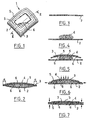
- FIG. 1 a packaging bag 1 in accordance with a first embodiment of the invention.
- This pocket 1 present in the example describes a contour rectangular and upper and lower faces generally convex outwards.
- the pocket 1 is formed in the example described by the assembly of two independent sheets 2,3, flexible, according to a line of S seal extending along the edge of all four sides of the pocket over a width e.
- the top sheet 3 which is intended to face the user while using the pocket, is called the front sheet below, and the lower sheet 2, which rests on a surface flat or slightly curved when in use, is called sheet back.
- the pocket can be formed from a strip flexible folded on itself, in which case the two sheets are linked between them by one side before being assembled along the three remaining sides.
- the pocket can be formed by assembling a flexible sheet on a relatively sheet rigid, such as a sheet of laminated cardboard or a thin plate made of rigid plastic.
- Bag 1 contains a mass of a consistency product creamy to pasty 4 and the front leaf 3 has a region central permeable to this product.
- the front sheet 3 at least is transparent to allow the user to see the product contained at inside the pocket.
- the front sheet 3 is perforated in its central region like a sieve to allow distribution of the product through multiple perforations 6 of small diameter. Until the first use, this region perforated is covered externally with a sealing film removable 5, constituted for example by an adhesive film.
- the front sheet 3 can be perforated over all of its surface or only in its central region.
- Such a cover can be made in the form of a frame relatively rigid as will be described below.
- the flexibility of the front sheet 3 ensures emptying complete of the packaging pouch through the perforations of the front sheet 3 when the sheets 2,3 are pressed one against the other, the back sheet 2 resting if it is flexible on a rigid surface such as the bottom of a receptacle, as will be specified below.
- the sheet 3 can advantageously be shaped so as to at rest take a slightly domed outward shape and detach from the mass of product contained inside the bag.
- the product is in the form of a thin layer between the leaves 2,3.
- the thickness of the product is substantially constant or slightly higher than the center of the pocket, being comprised of preferably between 1 and 6 mm, and more preferably between 2 and 4 mm.
- the product thickness is for example 0.5 mm at near the periphery and it is between 2 and 4 mm at the near the center of the pocket.
- the thickness of the sheet 3, permeable to the product is between 5 ⁇ m and 1 mm, preferably between 40 ⁇ m and 500 ⁇ m, and more preferably between 100 ⁇ m and 300 ⁇ m.
- the sheets 2,3 can be made of the same material or in different materials.
- the packaging bag 1 in polyethylene (PE), polyvinyl chloride, polyethylene terephthalate (PET), or a PE / PET copolymer, not restrictively.
- the packaging bag 1 in using sheets each consisting for example of a polyethylene terephthalate and aluminum laminate or a polyethylene terephthalate and polyethylene laminate.
- the use of multilayer films to make the pocket can be useful in preventing the escape of certain constituents of the product packaged outside, through pocket walls, when not in use.
- the region permeable to the product can be produced as in the example shown in Figures 1 and 2 by simple perforations of the top sheet 3, the diameter and the number of these perforations being chosen according to the nature of the product to condition and distribute and conditions of use of the poached.
- the sheet superior 3 a material intrinsically permeable to the product to package and distribute, such as woven or non-woven material or spongy.
- FIG. 18 we can use to constitute the region permeable to the product a superimposition of a perforated film 3 capable of allowing the passage of the produced through perforations and a 3 "porous film in woven or non-woven or spongy material extending opposite said perforations and intended for example to ensure a more homogeneous distribution of the product or to modify the sensation to touch.
- This porous 3 "film can extend over the entire surface of the perforated film or only on the perforated region thereof.
- the front sheet 3 provided with its removable film 5 is then reported on the mass of product 4 as shown on the Figure 5, being chosen large enough to cover it.
- the front sheet 3 is pressed against the back sheet 2 resting on a surface rigid plane to spread the mass of product 4 and form a sandwich a thin layer of dough spread between sheets 2 and 3.
- Sheets 2 and 3 are then pressed around their edges one against the other from their free edge over a width e and the regions of the leaves so close together are sealed on four sides through a residual thickness of product, by all techniques known per se, to form the bag 1.
- sealing means which can be used, mention may, for example, be made ultrasonic or high frequency welding.
- the protective film 5 allows to close so airtight pocket 1 when not in use.
- This sheath 12 is made of a flexible plastic material, such as that used to make sheets 2 and 3 of the previous embodiment example.
- the sleeve 12 is obtained by bringing face to face two sheets 14 and 15 of the same shape and welding them to their periphery on three sides only.
- the sheath 12 can be formed by folding over itself a single flexible strip, in which case it suffices to weld two sides only.
- the sheath 12 has on a main face of the perforations and a removable film, which we have not shown for the sake of clarity of the drawing.
- the sheath 12 is rectangular at its lower part and widens at its open upper end to form a funnel 16 intended to facilitate the introduction inside the sheath of a product filling spout.
- the assembly lines S have been indicated by dotted lines. sheets 14 and 15.
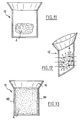
- the sleeve 12 is shown in elevation in FIG. 9 before filling, which is done by means of a spout 17 wide diameter, introduced by the upper end 13, to deliver towards the bottom through an opening 19 inside the sheath the mass of product 4.
- the orifice 19 is located, during the distribution, at about halfway up the parallel sides 20 of the bottom of the scabbard 12.
- the mass of product 4 is then spread by pressing one against the other the two main faces of the sheath 12, as illustrated in figure 12.
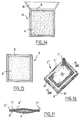
- the sheath 12 is then sealed after bringing the sheets 14 and 15 along a closing line connecting the ends upper sides 20, through a residual thickness of product, as shown in Figure 14.
- the sheath 12 is then cut along a cutting line parallel to the last sealed side, to separate the funnel 16 from the lower part of the sheath which then forms a pocket of identical packaging to bag 1 previously described, although completed differently.
- FIGS. 16 and 17 show a pocket 1 ' comprising a rear sheet 3 ', a perforated front sheet 8', a cover 9 'and a removable protective film 5' provided with a grip tab 7 '.
- the 3 'and 8' sheets are assembled to contain the product 4.
- the cover 9 ' is perforated in its center to allow the user to withdraw the product by passing his finger or a applicator on the sheet before 8 'after removal of the film removable 5 '.
- the latter is fixed to its periphery on the face external cover 9 '.
- the front sheet 8 ' is crossed by perforations regularly distributed over its entire surface.
- the cover 9 ' can be welded to the front sheet 8' during the assembly of the latter with the back sheet 3 ', and it can be made of a relatively rigid plastic and opaque, so as to facilitate the handling of the pocket and give the latter a pleasant aesthetic aspect.
- the cover 9 ' can be used to hold and hide leaves flexible around their periphery two elements forming a frame relatively rigid plastic, stacked and assembled as for retain the stretch of film on a slide. Before their assembly, the two elements can be independent or linked by a film hinge and only one of the elements can be perforated to allow the user to collect the product.
- the pocket 1 or 1 'can advantageously be used in a makeup accessory 25 as shown diagrammatically in perspective in figure 19.
- the accessory 25 comprises a box 26 provided with a cover swivel 27 which can house a mirror 28 at its bottom.
- the body of the housing 26 houses a sliding drawer 29, the bottom 33 is rigid and can be pulled out to receive pocket 1 or 1 'whose size is suitable.
- the pocket 1 or 1 ' is retained in the body of the housing 26 a times the drawer 29 in place by a frame 30 defining an access 31 to the upper side of the pocket.
- the product is removed using the finger or an applicator 32, brought into contact with the permeable region of the front sheet 3 after removal of the protective film 5.
- the applicator 32 is housed in the accessory 25 in the absence of use between the frame 30 and the cover 27 folded down on the body of the housing.
- the flexibility of the permeable front sheet allows ensure the complete emptying of the bag by applying it against the back sheet; the two sheets are then one in contact with the other on most of their surface.
- the invention thus allows the packaging of a product expensive without loss of product for the user.
- the pocket can be received not in a drawer sliding but in a simple slot of the case of an accessory of makeup similar to that described above.
- the pocket can also be used as a sample to insert into magazines or send by mail, to test the product contained inside.
Landscapes
- Engineering & Computer Science (AREA)
- Mechanical Engineering (AREA)
- Packages (AREA)
- Basic Packing Technique (AREA)
Description
- la figure 1 est une vue schématique en perspective avec arrachement partiel d'une poche de conditionnement conforme à un exemple de réalisation de l'invention,
- la figure 2 est une vue schématique selon le trait de coupe II-II de la figure 1,
- les figures 3 à 7 illustrent différentes étapes d'un premier procédé pour réaliser une poche de conditionnement selon l'invention,
- la figure 8 est une vue schématique en perspective d'un fourreau utilisé dans un deuxième exemple de procédé, pour réaliser une poche de conditionnement selon l'invention,
- la figure 9 est une vue en élévation frontale selon la flèche IX de la figure 8,
- les figures 10 et 11 sont des vues en élévation frontale respectivement pendant et après le remplissage du fourreau,
- la figure 12 est une vue schématique en perspective illustrant l'étalement de la masse de produit à l'intérieur du fourreau,
- les figures 13, 14 et 15 sont des vues en élévation frontale illustrant respectivement le fourreau à la fin de l'étalement de la masse de produit, après fermeture et après découpe de la partie supérieure formant entonnoir,
- la figure 16 est une vue schématique en perspective d'une poche de conditionnement selon une variante de réalisation,
- la figure 17 est une coupe schématique selon le trait de coupe XVII-XVII de la figure 16,
- la figure 18 est une coupe schématique d'une poche de conditionnement selon une variante de réalisation de l'invention,
- la figure 19 est une vue schématique en perspective d'un boítier pour le maquillage, contenant une poche de conditionnement conforme à un exemple de réalisation de l'invention, et
- la figure 20 est une coupe dans un plan médian du boítier représenté sur la figure 19, refermé.
Claims (26)
- Poche de conditionnement d'un produit pâteux, notamment un produit cosmétique, comprenant au moins une feuille avant (3 ; 8' ; 15) et une feuille arrière (2 ; 3' ; 14), la feuille avant au moins étant souple et présentant en outre une zone perméable audit produit, caractérisée par le fait que lesdites feuilles sont assemblées de manière à contenir ledit produit sous la forme d'une couche mince étalée entre lesdites feuilles, la souplesse de la feuille avant (3) étant choisie de manière à ce qu'elle puisse être pressée contre la feuille arrière (2) au moyen d'un doigt ou d'un applicateur pour d'une part permettre à l'utilisateur de prélever le produit et d'autre part assurer le vidage complet de la poche, les feuilles avant et arrière pouvant venir en contact mutuel sur la majeure partie de leur surface lorsque la poche a été vidée du produit contenu à l'intérieur.
- Poche selon la revendication 1, caractérisée par le fait que lesdites feuilles avant et arrière sont sensiblement planes et assemblées l'une sur l'autre de manière à ce qu'après le vidage complet de la poche, cette dernière soit plane et lesdites feuilles soient au contact l'une avec l'autre sur une majeure partie de leur surface.
- Poche de conditionnement selon la revendication 1 ou 2, caractérisée par le fait que la feuille arrière est constituée par une feuille de carton plastifiée ou une plaque mince en matière plastique rigide.
- Poche de conditionnement selon l'une quelconque des revendications 1 à 3, caractérisée par le fait que la feuille avant est réalisée dans une matière plastique transparente.
- Poche de conditionnement selon l'une quelconque des revendications 1 à 4, caractérisée par le fait que la feuille avant est constituée par la superposition d'un film poreux et d'un film perforé.
- Poche de conditionnement selon l'une quelconque des revendications 1 à 5, caractérisée par le fait que la feuille avant est recouverte d'un cache (9') ajouré en son centre.
- Poche de conditionnement selon la revendication 6, caractérisée par le fait que ledit cache (9') est constitué par un cadre rigide.
- Poche de conditionnement selon la revendication 7, caractérisée par le fait que la zone perméable au produit est recouverte avant l'utilisation de la poche par une pellicule de protection amovible (5') fixée sur ledit cache (9').
- Poche de conditionnement selon l'une quelconque des revendications 1 à 8, caractérisée par le fait qu'elle comporte dans ladite zone perméable au produit des perforations multiples de petit diamètre (6).
- Poche de conditionnement selon l'une quelconque des revendications 1 à 9, caractérisée par le fait qu'elle comporte dans ladite zone perméable au produit une matière tissée ou non tissée ou spongieuse ou frittée.
- Poche de conditionnement selon l'une quelconque des revendications 1 à 10, caractérisée par le fait que la feuille présentant ladite zone perméable au produit est conformée pour prendre au repos une forme bombée vers l'extérieur.
- Poche selon la revendication 1, caractérisée par le fait que la feuille avant comporte une pluralité de trous débouchant à l'extérieur de la poche, le prélèvement du produit s'effectuant par contact du doigt ou de l'applicateur avec la feuille avant.
- Poche selon la revendication précédente, caractérisée par le fait que la feuille avant comporte des trous sur la totalité de sa surface.
- Poche selon l'une quelconque des revendications précédentes, caractérisée par le fait que la région centrale de la feuille avant forme un tamis.
- Poche selon l'une quelconque des revendications précédentes, caractérisée par le fait que l'épaisseur de produit, au centre de la poche, est comprise entre 2 et 4 mm.
- Poche selon l'une quelconque des revendications précédentes, caractérisée par le fait que l'épaisseur de la feuille avant est comprise entre 100 et 300 µm.
- Poche selon l'une quelconque des revendications précédentes, caractérisée par le fait qu'elle est constituée par une feuille avant assemblée avec une feuille arrière.
- Procédé de fabrication d'une poche destinée à contenir un produit de consistance crémeuse à pâteuse, notamment un produit cosmétique, caractérisé par le fait qu'il comprend les étapes consistant à :former un sandwich d'une masse de produit étalée (4) entre deux feuilles (2, 3 ; 14, 15) dont l'une au moins est souple et perméable audit produit ou susceptible de l'être,comprimer selon au moins une ligne de fermeture (S) ledit sandwich pour rapprocher lesdites feuilles, etsceller ces dernières selon la ou lesdites lignes de fermeture,lesdites feuilles étant assemblées de manière à contenir ledit produit sous la forme d'une couche mince étalée entre lesdites feuilles, la souplesse de la feuille souple et présentant au moins une zone perméable au produit (3) étant choisie de manière à ce qu'elle puisse être pressée contre l'autre feuille (2) au moyen d'un doigt ou d'un applicateur, pour d'une part permettre à l'utilisateur de prélever le produit et d'autre part d'assurer le vidage complet de la poche, les feuilles pouvant venir en contact mutuel sur la majeure partie de leur surface lorsque la poche a été vidée du produit contenu à l'intérieur.
- Procédé selon la revendication 18, caractérisé par le fait que ladite masse de produit (4) est étalée en pressant les feuilles (2, 3 ; 14, 15) l'une contre l'autre.
- Procédé selon la revendication 18 ou 19, caractérisé par le fait que ladite masse de produit (4) est déposée sur l'une des feuilles (2) servant de support puis recouverte par l'autre feuille.
- Procédé selon l'une des revendications 18 et 19, caractérisé par le fait que les deux feuilles sont préassemblées pour former un fourreau (12) permettant l'introduction d'un bec de remplissage en produit (17).
- Procédé selon la revendication 21, caractérisé par le fait que les feuilles sont préassemblées de manière à former un entonnoir (16) facilitant l'introduction dudit bec de remplissage, puis le fourreau (12) est scellé au niveau du côté d'introduction du bec de remplissage et l'entonnoir est détaché par découpe pour former la poche (1).
- Procédé selon l'une quelconque des revendications 18 à 22, caractérisé par le fait que les deux feuilles sont obtenues par pliage d'une bande de matière sur elle-même.
- Boítier pour le maquillage (25), comportant un réceptacle présentant un fond, caractérisé par le fait que ledit réceptacle loge une poche de conditionnement telle que définie dans l'une quelconque des revendications 1 à 17, la feuille arrière reposant sur ledit fond.
- Boítier pour le maquillage (25), comportant un réceptacle à fond rigide, caractérisé par le fait que ledit réceptacle loge une poche de conditionnement telle que définie dans la revendication 1, la feuille arrière étant souple et reposant sur ledit fond rigide.
- Boítier selon la revendication 24 ou 25, caractérisé par le fait que ledit réceptacle est formé par un tiroir (29) permettant, lorsqu'il est extrait du boítier, l'introduction ou le remplacement de la poche.
Applications Claiming Priority (2)
| Application Number | Priority Date | Filing Date | Title |
|---|---|---|---|
| FR9605154A FR2748002B1 (fr) | 1996-04-24 | 1996-04-24 | Poche de conditionnement d'un produit pateux ou pulverulent, procede de fabrication et accessoire utilisant une telle poche |
| FR9605154 | 1996-04-24 |
Publications (2)
| Publication Number | Publication Date |
|---|---|
| EP0803210A1 EP0803210A1 (fr) | 1997-10-29 |
| EP0803210B1 true EP0803210B1 (fr) | 2002-08-21 |
Family
ID=9491534
Family Applications (1)
| Application Number | Title | Priority Date | Filing Date |
|---|---|---|---|
| EP97400923A Expired - Lifetime EP0803210B1 (fr) | 1996-04-24 | 1997-04-23 | Poche de conditionnement d'un produit de consistance crémeuse à pâteuse, procédé de fabrication et boítier pour le maquillage contenant une telle poche |
Country Status (7)
| Country | Link |
|---|---|
| US (1) | US6167890B1 (fr) |
| EP (1) | EP0803210B1 (fr) |
| JP (1) | JPH1042948A (fr) |
| CA (1) | CA2203564A1 (fr) |
| DE (1) | DE69714808T2 (fr) |
| ES (1) | ES2182002T3 (fr) |
| FR (1) | FR2748002B1 (fr) |
Families Citing this family (24)
| Publication number | Priority date | Publication date | Assignee | Title |
|---|---|---|---|---|
| GB2326158A (en) * | 1997-06-10 | 1998-12-16 | Multicore Solders Ltd | Cartridge for viscous and/or pasty products |
| US6315482B1 (en) | 1998-11-04 | 2001-11-13 | The Procter & Gamble Company | Applicator for applying and distributing substances to target surfaces |
| WO2000000059A2 (fr) * | 1998-06-30 | 2000-01-06 | The Procter & Gamble Company | Applicateur pour l'application et la distribution de substances sur des surfaces cibles |
| US6325565B1 (en) | 1998-06-30 | 2001-12-04 | The Procter & Gamble Company | Anti-perspirant/deodorant applicator |
| US6322271B1 (en) | 1998-11-04 | 2001-11-27 | The Procter & Gamble Company | Applicator for applying and distributing substances to target surfaces |
| AU2001288264A1 (en) * | 2000-08-14 | 2002-02-25 | Lendell Manufacturing Inc. | Finger wedge foam |
| GB2389033B (en) * | 2002-05-27 | 2005-11-16 | Caressa Kahn Ltd | A cosmetic applicator |
| US7419321B2 (en) * | 2005-01-05 | 2008-09-02 | Misha Tereschouk | Hand applicator of encapsulated liquids |
| JP2006298836A (ja) * | 2005-04-21 | 2006-11-02 | Meiko Shoji Kk | クリーム塗布シート |
| US20070053737A1 (en) * | 2005-09-02 | 2007-03-08 | Bryan Morris | Dispenser for a fluent product |
| US7614812B2 (en) * | 2005-09-29 | 2009-11-10 | Kimberly-Clark Worldwide, Inc. | Wiper with encapsulated agent |
| WO2007134333A2 (fr) * | 2006-05-15 | 2007-11-22 | Rebecca Delegge | Emballage de distribution destiné à être utilisé dans le traitement d'objets allongés |
| FR2934573B1 (fr) * | 2008-07-30 | 2014-12-12 | Socoplan | Support de conditionnement et de distribution d'un contenu sous forme de poudre, de liquide ou de pate, tel qu'un produit cosmetique. |
| USD624704S1 (en) * | 2009-02-06 | 2010-09-28 | Astral Brands, LLC | Combined cosmetic medium and container |
| US9066572B2 (en) * | 2010-02-19 | 2015-06-30 | Majic Beauty Pty Ltd. | Cosmetic applicator |
| BR112014003460B1 (pt) * | 2011-08-15 | 2019-05-21 | The Procter & Gamble Company | Artigos conformáveis para cuidados pessoais |
| US9010342B2 (en) * | 2011-08-17 | 2015-04-21 | Nailah Orr | Synthetic microfiber wiping cloths |
| US8864398B2 (en) * | 2011-11-07 | 2014-10-21 | Avon Products Inc. | Press-on cosmetic applicator system |
| GB2506446A (en) * | 2012-10-01 | 2014-04-02 | Anthony William Cooper | Sachet and applicators for controlled delivery of cream or similar |
| DE102012219047A1 (de) * | 2012-10-18 | 2014-04-24 | Inficon Gmbh | Prüfleckvorrichtung zum Anbringen an einer flexiblen Wandung des Prüflings |
| US20140336029A1 (en) * | 2013-05-07 | 2014-11-13 | The Procter & Gamble Company | Process for laser puncturing holes into water-soluble films |
| USD903226S1 (en) * | 2018-05-23 | 2020-12-01 | The Paget Group, Inc. | Frozen raw meat product |
| USD943236S1 (en) * | 2018-05-23 | 2022-02-15 | Swift Beef Company | Frozen raw meat product |
| USD942736S1 (en) * | 2018-05-23 | 2022-02-08 | Swift Beef Company | Frozen raw meat product |
Family Cites Families (30)
| Publication number | Priority date | Publication date | Assignee | Title |
|---|---|---|---|---|
| US1149946A (en) * | 1915-05-11 | 1915-08-10 | Mildred K Potter | Handkerchief. |
| US2209914A (en) * | 1937-02-25 | 1940-07-30 | Erwin G Gerber | Self-impregnating pad |
| US2576550A (en) * | 1948-01-10 | 1951-11-27 | James F Waters | Dentifrice-containing device and dentifrice applicator therefor |
| US2576551A (en) * | 1948-07-24 | 1951-11-27 | Waters James Francis | Toothbrush and dentifrice pack |
| US2695704A (en) * | 1950-02-10 | 1954-11-30 | Robert M Mcgredy | Cleaning device and package containing same |
| US2889922A (en) * | 1954-10-13 | 1959-06-09 | Johns Manville | Adhesive applicator |
| US3246444A (en) * | 1962-08-09 | 1966-04-19 | T J Paisley Company | Method of forming a container having a shaker outlet |
| FR1414936A (fr) * | 1964-09-11 | 1965-10-22 | Brook Chemicals Ltd | Tampon applicateur de poudre |
| US3334804A (en) * | 1965-12-20 | 1967-08-08 | American Packaging Corp | Dispenser package |
| US3362776A (en) * | 1966-01-03 | 1968-01-09 | Louis W. Knorr | Disposable finger wash device |
| FR2062956A1 (en) * | 1969-09-23 | 1971-07-02 | Richardsons Manufacturin | Cosmetic powder puff |
| US3635567A (en) * | 1969-12-31 | 1972-01-18 | Thomas F Richardson Jr | Package and applicator unit |
| GB1458262A (en) * | 1974-01-03 | 1976-12-15 | Ibc Transport Containers Ltd | Containers |
| JPS5645538Y2 (fr) * | 1976-06-16 | 1981-10-24 | ||
| US4127339A (en) * | 1976-10-19 | 1978-11-28 | Malacheski Joseph J | Dispenser package for fluent material |
| US4269527A (en) * | 1979-10-17 | 1981-05-26 | American Cyanamid Company | Applicator for pulverized substances |
| JPS5738096Y2 (fr) * | 1979-12-24 | 1982-08-23 | ||
| JPS5982419U (ja) * | 1982-11-24 | 1984-06-04 | ポ−ラ化成工業株式会社 | 化粧用具 |
| JPS60116912U (ja) * | 1984-01-14 | 1985-08-07 | 株式会社 カナエ | フアンデ−シヨン入りパフ |
| JPS60126108U (ja) * | 1984-02-02 | 1985-08-24 | 株式会社 小林コ−セ− | ペ−スト状化粧料用コンパクト |
| JPS60204426A (ja) * | 1984-03-22 | 1985-10-16 | 凸版印刷株式会社 | 両面成形小袋包装体の製造方法 |
| ATE81035T1 (de) * | 1987-05-15 | 1992-10-15 | Nancy Ann Willcox | Zufuhr-auftragsgeraet. |
| US4840270A (en) * | 1987-12-21 | 1989-06-20 | Nice-Pak Products, Inc. | Re-sealable label flap |
| JPH0543702Y2 (fr) * | 1987-12-25 | 1993-11-04 | ||
| GB2217299B (en) * | 1988-04-12 | 1992-10-14 | Derek Alfred Wheeler | Packaging |
| JPH0245944U (fr) * | 1988-09-26 | 1990-03-29 | ||
| JPH0729927Y2 (ja) * | 1989-05-31 | 1995-07-12 | 株式会社吉野工業所 | コンパクト容器 |
| WO1991018804A1 (fr) * | 1990-06-01 | 1991-12-12 | O'reilly, Daniel, Joseph | Sachets distributeurs a usage unique et procede et moyens de fabrication de ces sachets |
| US5380110A (en) * | 1993-01-21 | 1995-01-10 | Festa; Joseph F. | Packet containing treatment liquid with applicator and method |
| DE29502988U1 (de) * | 1995-02-22 | 1995-04-06 | Innovent Investment Inc., Tortola | Trägerfolie |
-
1996
- 1996-04-24 FR FR9605154A patent/FR2748002B1/fr not_active Expired - Fee Related
-
1997
- 1997-04-17 US US08/839,251 patent/US6167890B1/en not_active Expired - Fee Related
- 1997-04-23 EP EP97400923A patent/EP0803210B1/fr not_active Expired - Lifetime
- 1997-04-23 ES ES97400923T patent/ES2182002T3/es not_active Expired - Lifetime
- 1997-04-23 DE DE69714808T patent/DE69714808T2/de not_active Expired - Fee Related
- 1997-04-23 JP JP9105896A patent/JPH1042948A/ja active Pending
- 1997-04-23 CA CA002203564A patent/CA2203564A1/fr not_active Abandoned
Also Published As
| Publication number | Publication date |
|---|---|
| US6167890B1 (en) | 2001-01-02 |
| JPH1042948A (ja) | 1998-02-17 |
| CA2203564A1 (fr) | 1997-10-24 |
| ES2182002T3 (es) | 2003-03-01 |
| FR2748002A1 (fr) | 1997-10-31 |
| DE69714808D1 (de) | 2002-09-26 |
| FR2748002B1 (fr) | 1998-06-12 |
| DE69714808T2 (de) | 2003-04-24 |
| EP0803210A1 (fr) | 1997-10-29 |
Similar Documents
| Publication | Publication Date | Title |
|---|---|---|
| CA2203564A1 (fr) | Poche de conditionnement d'un produit de consistance cremeuse a pateuse,procede de fabrication et boitier pour le maquillage contenant une telle poche | |
| EP1228716B1 (fr) | Dispositif de conditionnement et d'application d'un produit | |
| CA2313530A1 (fr) | Etui pour produits tels que des lingettes humides | |
| CA2267792C (fr) | Enveloppe d'emballage fermee par des papillotes et procede d'emballage | |
| FR2942214A1 (fr) | Recipient notamment pour produits solides ou pateux, son procede de fabrication et conditionnement comportant ce recipient et un container le recevant | |
| CA2780296C (fr) | Emballage d'un produit alimentaire portionnable | |
| FR2761962A1 (fr) | Barquette thermoplastique pour le melange extemporane d'au moins deux produits | |
| WO2018234716A1 (fr) | Capsule deformable a usage unique comprenant une quantite predeterminee d'une phase d'un produit cosmetique | |
| FR2858300A1 (fr) | Emballage de recipient de produit cosmetique, therapeutique humain ou d'hygiene humaine a configuration a soufflets amelioree | |
| WO2009115667A1 (fr) | Emballage pour le conditionnement de deux composants séparés | |
| EP0633201B1 (fr) | Emballage pour cigarettes comportant plus d'un moyen d'ouverture | |
| WO1992018044A1 (fr) | Dispositif permettant l'association d'ingredients a un produit panifie pour confectionner un sandwich | |
| EP1363518B1 (fr) | Procede de conditionnement d'un produit | |
| EP3708510B1 (fr) | Sac d'emballage et procede de fabrication en continu d'une pluralite de sacs de ce type | |
| FR3093705A1 (fr) | Sac d’emballage à recyclage facilité, et procédé de fabrication en continu d’une pluralité de sacs de ce type | |
| FR2682864A1 (fr) | Plateau-repas. | |
| EP1415569B1 (fr) | Dispositif de conditionnement d'un produit et procédé de conditionnement | |
| EP0465329A2 (fr) | Bande composite en installation pour la fabrication d'emballages stériles thermoformés | |
| CA2157523A1 (fr) | Suremballage de produits | |
| EP2723652A1 (fr) | Sachet d'echantillon de produit fluide | |
| FR2823719A1 (fr) | Emballage d'un echantillon de produit cosmetique | |
| FR2846530A1 (fr) | Dispositif de conditionnement d'un produit et procede de conditionnement | |
| FR2724629A1 (fr) | Sachet d'emballage avec receptacle integre externe, et son procede de fabrication | |
| FR2846527A1 (fr) | Dispositif de conditionnement d'un produit et procede de conditionnement | |
| WO2022269197A2 (fr) | Dispositif de conditionnement d'une dose d'un produit solide ou pateux place dans un reservoir |
Legal Events
| Date | Code | Title | Description |
|---|---|---|---|
| PUAI | Public reference made under article 153(3) epc to a published international application that has entered the european phase |
Free format text: ORIGINAL CODE: 0009012 |
|
| AK | Designated contracting states |
Kind code of ref document: A1 Designated state(s): DE ES FR GB IT |
|
| 17P | Request for examination filed |
Effective date: 19980211 |
|
| 17Q | First examination report despatched |
Effective date: 19991025 |
|
| GRAG | Despatch of communication of intention to grant |
Free format text: ORIGINAL CODE: EPIDOS AGRA |
|
| GRAG | Despatch of communication of intention to grant |
Free format text: ORIGINAL CODE: EPIDOS AGRA |
|
| GRAH | Despatch of communication of intention to grant a patent |
Free format text: ORIGINAL CODE: EPIDOS IGRA |
|
| GRAH | Despatch of communication of intention to grant a patent |
Free format text: ORIGINAL CODE: EPIDOS IGRA |
|
| GRAA | (expected) grant |
Free format text: ORIGINAL CODE: 0009210 |
|
| AK | Designated contracting states |
Kind code of ref document: B1 Designated state(s): DE ES FR GB IT |
|
| REG | Reference to a national code |
Ref country code: GB Ref legal event code: FG4D Free format text: NOT ENGLISH |
|
| REF | Corresponds to: |
Ref document number: 69714808 Country of ref document: DE Date of ref document: 20020926 |
|
| GBT | Gb: translation of ep patent filed (gb section 77(6)(a)/1977) |
Effective date: 20021130 |
|
| REG | Reference to a national code |
Ref country code: ES Ref legal event code: FG2A Ref document number: 2182002 Country of ref document: ES Kind code of ref document: T3 |
|
| PG25 | Lapsed in a contracting state [announced via postgrant information from national office to epo] |
Ref country code: GB Free format text: LAPSE BECAUSE OF NON-PAYMENT OF DUE FEES Effective date: 20030423 |
|
| PG25 | Lapsed in a contracting state [announced via postgrant information from national office to epo] |
Ref country code: ES Free format text: LAPSE BECAUSE OF NON-PAYMENT OF DUE FEES Effective date: 20030424 |
|
| PLBE | No opposition filed within time limit |
Free format text: ORIGINAL CODE: 0009261 |
|
| STAA | Information on the status of an ep patent application or granted ep patent |
Free format text: STATUS: NO OPPOSITION FILED WITHIN TIME LIMIT |
|
| 26N | No opposition filed |
Effective date: 20030522 |
|
| PG25 | Lapsed in a contracting state [announced via postgrant information from national office to epo] |
Ref country code: DE Free format text: LAPSE BECAUSE OF NON-PAYMENT OF DUE FEES Effective date: 20031101 |
|
| GBPC | Gb: european patent ceased through non-payment of renewal fee |
Effective date: 20030423 |
|
| PG25 | Lapsed in a contracting state [announced via postgrant information from national office to epo] |
Ref country code: FR Free format text: LAPSE BECAUSE OF NON-PAYMENT OF DUE FEES Effective date: 20031231 |
|
| REG | Reference to a national code |
Ref country code: FR Ref legal event code: ST |
|
| REG | Reference to a national code |
Ref country code: ES Ref legal event code: FD2A Effective date: 20030424 |
|
| PG25 | Lapsed in a contracting state [announced via postgrant information from national office to epo] |
Ref country code: IT Free format text: LAPSE BECAUSE OF NON-PAYMENT OF DUE FEES;WARNING: LAPSES OF ITALIAN PATENTS WITH EFFECTIVE DATE BEFORE 2007 MAY HAVE OCCURRED AT ANY TIME BEFORE 2007. THE CORRECT EFFECTIVE DATE MAY BE DIFFERENT FROM THE ONE RECORDED. Effective date: 20050423 |