EP0797649B1 - Method of preparing small particle size phosphors - Google Patents
Method of preparing small particle size phosphors Download PDFInfo
- Publication number
- EP0797649B1 EP0797649B1 EP95927117A EP95927117A EP0797649B1 EP 0797649 B1 EP0797649 B1 EP 0797649B1 EP 95927117 A EP95927117 A EP 95927117A EP 95927117 A EP95927117 A EP 95927117A EP 0797649 B1 EP0797649 B1 EP 0797649B1
- Authority
- EP
- European Patent Office
- Prior art keywords
- particles
- phosphor
- rare earth
- particle size
- phosphors
- Prior art date
- Legal status (The legal status is an assumption and is not a legal conclusion. Google has not performed a legal analysis and makes no representation as to the accuracy of the status listed.)
- Expired - Lifetime
Links
- 239000002245 particle Substances 0.000 title claims description 98
- 238000000034 method Methods 0.000 title claims description 30
- OAICVXFJPJFONN-UHFFFAOYSA-N Phosphorus Chemical compound [P] OAICVXFJPJFONN-UHFFFAOYSA-N 0.000 claims description 44
- -1 hydroxyl ions Chemical class 0.000 claims description 24
- 230000008569 process Effects 0.000 claims description 22
- 229910052761 rare earth metal Inorganic materials 0.000 claims description 20
- 239000000243 solution Substances 0.000 claims description 17
- NKCVNYJQLIWBHK-UHFFFAOYSA-N carbonodiperoxoic acid Chemical compound OOC(=O)OO NKCVNYJQLIWBHK-UHFFFAOYSA-N 0.000 claims description 15
- 230000004907 flux Effects 0.000 claims description 14
- 229910052769 Ytterbium Inorganic materials 0.000 claims description 12
- 239000012190 activator Substances 0.000 claims description 12
- 150000002910 rare earth metals Chemical class 0.000 claims description 12
- NAWDYIZEMPQZHO-UHFFFAOYSA-N ytterbium Chemical group [Yb] NAWDYIZEMPQZHO-UHFFFAOYSA-N 0.000 claims description 11
- 229910052691 Erbium Inorganic materials 0.000 claims description 10
- 150000003839 salts Chemical class 0.000 claims description 10
- 239000000203 mixture Substances 0.000 claims description 9
- QVGXLLKOCUKJST-UHFFFAOYSA-N atomic oxygen Chemical compound [O] QVGXLLKOCUKJST-UHFFFAOYSA-N 0.000 claims description 8
- UYAHIZSMUZPPFV-UHFFFAOYSA-N erbium Chemical compound [Er] UYAHIZSMUZPPFV-UHFFFAOYSA-N 0.000 claims description 8
- 229910052760 oxygen Inorganic materials 0.000 claims description 8
- 239000001301 oxygen Substances 0.000 claims description 8
- 229910052775 Thulium Inorganic materials 0.000 claims description 7
- 229910001404 rare earth metal oxide Inorganic materials 0.000 claims description 7
- 229910052727 yttrium Inorganic materials 0.000 claims description 7
- VWQVUPCCIRVNHF-UHFFFAOYSA-N yttrium atom Chemical compound [Y] VWQVUPCCIRVNHF-UHFFFAOYSA-N 0.000 claims description 7
- 229910052689 Holmium Inorganic materials 0.000 claims description 6
- NINIDFKCEFEMDL-UHFFFAOYSA-N Sulfur Chemical group [S] NINIDFKCEFEMDL-UHFFFAOYSA-N 0.000 claims description 6
- 239000007864 aqueous solution Substances 0.000 claims description 6
- 238000010438 heat treatment Methods 0.000 claims description 6
- 239000012298 atmosphere Substances 0.000 claims description 5
- KJZYNXUDTRRSPN-UHFFFAOYSA-N holmium atom Chemical compound [Ho] KJZYNXUDTRRSPN-UHFFFAOYSA-N 0.000 claims description 5
- 239000002243 precursor Substances 0.000 claims description 5
- 238000002360 preparation method Methods 0.000 claims description 5
- 239000005864 Sulphur Substances 0.000 claims description 4
- 229910000288 alkali metal carbonate Inorganic materials 0.000 claims description 4
- BWHMMNNQKKPAPP-UHFFFAOYSA-L potassium carbonate Chemical compound [K+].[K+].[O-]C([O-])=O BWHMMNNQKKPAPP-UHFFFAOYSA-L 0.000 claims description 4
- 239000000725 suspension Substances 0.000 claims description 4
- 229910052688 Gadolinium Inorganic materials 0.000 claims description 3
- 229910052771 Terbium Inorganic materials 0.000 claims description 3
- UAHZTKVCYHJBJQ-UHFFFAOYSA-N [P].S=O Chemical compound [P].S=O UAHZTKVCYHJBJQ-UHFFFAOYSA-N 0.000 claims description 3
- 229910000318 alkali metal phosphate Inorganic materials 0.000 claims description 3
- 229910052936 alkali metal sulfate Inorganic materials 0.000 claims description 3
- 150000004649 carbonic acid derivatives Chemical class 0.000 claims description 3
- 239000013043 chemical agent Substances 0.000 claims description 3
- UIWYJDYFSGRHKR-UHFFFAOYSA-N gadolinium atom Chemical compound [Gd] UIWYJDYFSGRHKR-UHFFFAOYSA-N 0.000 claims description 3
- 230000007062 hydrolysis Effects 0.000 claims description 3
- 238000006460 hydrolysis reaction Methods 0.000 claims description 3
- INHCSSUBVCNVSK-UHFFFAOYSA-L lithium sulfate Chemical compound [Li+].[Li+].[O-]S([O-])(=O)=O INHCSSUBVCNVSK-UHFFFAOYSA-L 0.000 claims description 3
- 235000021317 phosphate Nutrition 0.000 claims description 3
- 150000003013 phosphoric acid derivatives Chemical class 0.000 claims description 3
- GZCRRIHWUXGPOV-UHFFFAOYSA-N terbium atom Chemical compound [Tb] GZCRRIHWUXGPOV-UHFFFAOYSA-N 0.000 claims description 3
- 238000005406 washing Methods 0.000 claims description 3
- 239000007900 aqueous suspension Substances 0.000 claims description 2
- 150000001875 compounds Chemical class 0.000 claims description 2
- 229910052751 metal Inorganic materials 0.000 claims description 2
- 239000002184 metal Substances 0.000 claims description 2
- 150000002739 metals Chemical class 0.000 claims description 2
- 239000006174 pH buffer Substances 0.000 claims description 2
- 229910000027 potassium carbonate Inorganic materials 0.000 claims description 2
- OTYBMLCTZGSZBG-UHFFFAOYSA-L potassium sulfate Chemical compound [K+].[K+].[O-]S([O-])(=O)=O OTYBMLCTZGSZBG-UHFFFAOYSA-L 0.000 claims description 2
- 229910052939 potassium sulfate Inorganic materials 0.000 claims description 2
- 235000011151 potassium sulphates Nutrition 0.000 claims description 2
- 230000001376 precipitating effect Effects 0.000 claims description 2
- 239000000126 substance Substances 0.000 claims description 2
- 239000004094 surface-active agent Substances 0.000 claims description 2
- 239000001120 potassium sulphate Substances 0.000 claims 1
- XTQHKBHJIVJGKJ-UHFFFAOYSA-N sulfur monoxide Chemical compound S=O XTQHKBHJIVJGKJ-UHFFFAOYSA-N 0.000 description 19
- 238000010304 firing Methods 0.000 description 15
- 239000012798 spherical particle Substances 0.000 description 12
- XLYOFNOQVPJJNP-UHFFFAOYSA-N water Substances O XLYOFNOQVPJJNP-UHFFFAOYSA-N 0.000 description 9
- 238000003018 immunoassay Methods 0.000 description 8
- 238000006243 chemical reaction Methods 0.000 description 7
- 239000007850 fluorescent dye Substances 0.000 description 7
- 238000003801 milling Methods 0.000 description 7
- 230000005855 radiation Effects 0.000 description 7
- 239000006096 absorbing agent Substances 0.000 description 6
- 230000005284 excitation Effects 0.000 description 6
- 239000000463 material Substances 0.000 description 6
- 229920001021 polysulfide Polymers 0.000 description 6
- 239000002253 acid Substances 0.000 description 4
- 239000000427 antigen Substances 0.000 description 4
- 108091007433 antigens Proteins 0.000 description 4
- 102000036639 antigens Human genes 0.000 description 4
- 230000015572 biosynthetic process Effects 0.000 description 4
- DQZARQCHJNPXQP-UHFFFAOYSA-N gadolinium;sulfur monoxide Chemical class [Gd].S=O DQZARQCHJNPXQP-UHFFFAOYSA-N 0.000 description 4
- 239000005077 polysulfide Substances 0.000 description 4
- 150000008117 polysulfides Polymers 0.000 description 4
- IAZDPXIOMUYVGZ-UHFFFAOYSA-N Dimethylsulphoxide Chemical compound CS(C)=O IAZDPXIOMUYVGZ-UHFFFAOYSA-N 0.000 description 3
- XSQUKJJJFZCRTK-UHFFFAOYSA-N Urea Chemical compound NC(N)=O XSQUKJJJFZCRTK-UHFFFAOYSA-N 0.000 description 3
- PNEYBMLMFCGWSK-UHFFFAOYSA-N aluminium oxide Inorganic materials [O-2].[O-2].[O-2].[Al+3].[Al+3] PNEYBMLMFCGWSK-UHFFFAOYSA-N 0.000 description 3
- 238000003556 assay Methods 0.000 description 3
- 239000004202 carbamide Substances 0.000 description 3
- 238000001514 detection method Methods 0.000 description 3
- 239000000975 dye Substances 0.000 description 3
- 239000002244 precipitate Substances 0.000 description 3
- 239000000523 sample Substances 0.000 description 3
- 238000004062 sedimentation Methods 0.000 description 3
- CSCPPACGZOOCGX-UHFFFAOYSA-N Acetone Chemical compound CC(C)=O CSCPPACGZOOCGX-UHFFFAOYSA-N 0.000 description 2
- 229910052693 Europium Inorganic materials 0.000 description 2
- FFJZODLGGHJTTI-UHFFFAOYSA-N O=S.[Y].[P] Chemical compound O=S.[Y].[P] FFJZODLGGHJTTI-UHFFFAOYSA-N 0.000 description 2
- MCMNRKCIXSYSNV-UHFFFAOYSA-N Zirconium dioxide Chemical compound O=[Zr]=O MCMNRKCIXSYSNV-UHFFFAOYSA-N 0.000 description 2
- MCVAAHQLXUXWLC-UHFFFAOYSA-N [O-2].[O-2].[S-2].[Gd+3].[Gd+3] Chemical compound [O-2].[O-2].[S-2].[Gd+3].[Gd+3] MCVAAHQLXUXWLC-UHFFFAOYSA-N 0.000 description 2
- FOUHTHSUSZNYNK-UHFFFAOYSA-M [O-2].[OH-].O.P.[Y+3] Chemical compound [O-2].[OH-].O.P.[Y+3] FOUHTHSUSZNYNK-UHFFFAOYSA-M 0.000 description 2
- SKQWEERDYRHPFP-UHFFFAOYSA-N [Y].S=O Chemical class [Y].S=O SKQWEERDYRHPFP-UHFFFAOYSA-N 0.000 description 2
- 238000010521 absorption reaction Methods 0.000 description 2
- 239000003513 alkali Substances 0.000 description 2
- 150000008041 alkali metal carbonates Chemical class 0.000 description 2
- 239000008280 blood Substances 0.000 description 2
- 210000004369 blood Anatomy 0.000 description 2
- 230000008859 change Effects 0.000 description 2
- 239000003610 charcoal Substances 0.000 description 2
- 239000003153 chemical reaction reagent Substances 0.000 description 2
- 230000000052 comparative effect Effects 0.000 description 2
- 239000013078 crystal Substances 0.000 description 2
- 239000003814 drug Substances 0.000 description 2
- 229940079593 drug Drugs 0.000 description 2
- OGPBJKLSAFTDLK-UHFFFAOYSA-N europium atom Chemical compound [Eu] OGPBJKLSAFTDLK-UHFFFAOYSA-N 0.000 description 2
- 150000002500 ions Chemical class 0.000 description 2
- 230000003287 optical effect Effects 0.000 description 2
- 230000001590 oxidative effect Effects 0.000 description 2
- 239000002157 polynucleotide Substances 0.000 description 2
- 102000040430 polynucleotide Human genes 0.000 description 2
- 108091033319 polynucleotide Proteins 0.000 description 2
- 108090000623 proteins and genes Proteins 0.000 description 2
- 102000004169 proteins and genes Human genes 0.000 description 2
- 238000000926 separation method Methods 0.000 description 2
- 239000007787 solid Substances 0.000 description 2
- 238000000527 sonication Methods 0.000 description 2
- 238000001228 spectrum Methods 0.000 description 2
- 229910052717 sulfur Inorganic materials 0.000 description 2
- 239000011593 sulfur Substances 0.000 description 2
- 229910002226 La2O2 Inorganic materials 0.000 description 1
- 229910052765 Lutetium Inorganic materials 0.000 description 1
- 229910002651 NO3 Inorganic materials 0.000 description 1
- NHNBFGGVMKEFGY-UHFFFAOYSA-N Nitrate Chemical compound [O-][N+]([O-])=O NHNBFGGVMKEFGY-UHFFFAOYSA-N 0.000 description 1
- GRYLNZFGIOXLOG-UHFFFAOYSA-N Nitric acid Chemical compound O[N+]([O-])=O GRYLNZFGIOXLOG-UHFFFAOYSA-N 0.000 description 1
- 102000019040 Nuclear Antigens Human genes 0.000 description 1
- 108010051791 Nuclear Antigens Proteins 0.000 description 1
- 150000007513 acids Chemical class 0.000 description 1
- 238000000137 annealing Methods 0.000 description 1
- 238000003149 assay kit Methods 0.000 description 1
- 238000004166 bioassay Methods 0.000 description 1
- 239000007844 bleaching agent Substances 0.000 description 1
- 238000009835 boiling Methods 0.000 description 1
- 239000000872 buffer Substances 0.000 description 1
- 239000007975 buffered saline Substances 0.000 description 1
- 210000004027 cell Anatomy 0.000 description 1
- 230000001413 cellular effect Effects 0.000 description 1
- 238000005119 centrifugation Methods 0.000 description 1
- 239000003795 chemical substances by application Substances 0.000 description 1
- 239000011248 coating agent Substances 0.000 description 1
- 238000000576 coating method Methods 0.000 description 1
- 238000004163 cytometry Methods 0.000 description 1
- 238000000354 decomposition reaction Methods 0.000 description 1
- 239000012153 distilled water Substances 0.000 description 1
- 239000000839 emulsion Substances 0.000 description 1
- 238000005516 engineering process Methods 0.000 description 1
- 239000000834 fixative Substances 0.000 description 1
- 238000000684 flow cytometry Methods 0.000 description 1
- RQXZRSYWGRRGCD-UHFFFAOYSA-H gadolinium(3+);tricarbonate Chemical class [Gd+3].[Gd+3].[O-]C([O-])=O.[O-]C([O-])=O.[O-]C([O-])=O RQXZRSYWGRRGCD-UHFFFAOYSA-H 0.000 description 1
- 239000000383 hazardous chemical Substances 0.000 description 1
- 231100000206 health hazard Toxicity 0.000 description 1
- UPIZSELIQBYSMU-UHFFFAOYSA-N lanthanum;sulfur monoxide Chemical compound [La].S=O UPIZSELIQBYSMU-UHFFFAOYSA-N 0.000 description 1
- 239000003446 ligand Substances 0.000 description 1
- OHSVLFRHMCKCQY-UHFFFAOYSA-N lutetium atom Chemical compound [Lu] OHSVLFRHMCKCQY-UHFFFAOYSA-N 0.000 description 1
- BAZGIOYKWQZSCP-UHFFFAOYSA-N lutetium sulfur monoxide Chemical class [Lu].O=S BAZGIOYKWQZSCP-UHFFFAOYSA-N 0.000 description 1
- 229920002521 macromolecule Polymers 0.000 description 1
- 238000004519 manufacturing process Methods 0.000 description 1
- 239000003550 marker Substances 0.000 description 1
- 238000000386 microscopy Methods 0.000 description 1
- 150000002823 nitrates Chemical class 0.000 description 1
- 229910017604 nitric acid Inorganic materials 0.000 description 1
- SIWVEOZUMHYXCS-UHFFFAOYSA-N oxo(oxoyttriooxy)yttrium Chemical compound O=[Y]O[Y]=O SIWVEOZUMHYXCS-UHFFFAOYSA-N 0.000 description 1
- GFKJCVBFQRKZCJ-UHFFFAOYSA-N oxygen(2-);yttrium(3+);trisulfide Chemical compound [O-2].[O-2].[O-2].[S-2].[S-2].[S-2].[Y+3].[Y+3].[Y+3].[Y+3] GFKJCVBFQRKZCJ-UHFFFAOYSA-N 0.000 description 1
- 239000002798 polar solvent Substances 0.000 description 1
- 229920001184 polypeptide Polymers 0.000 description 1
- 238000001556 precipitation Methods 0.000 description 1
- 102000004196 processed proteins & peptides Human genes 0.000 description 1
- 108090000765 processed proteins & peptides Proteins 0.000 description 1
- 239000012857 radioactive material Substances 0.000 description 1
- 238000003127 radioimmunoassay Methods 0.000 description 1
- 239000004065 semiconductor Substances 0.000 description 1
- 230000035945 sensitivity Effects 0.000 description 1
- 210000002966 serum Anatomy 0.000 description 1
- 238000004611 spectroscopical analysis Methods 0.000 description 1
- 239000007858 starting material Substances 0.000 description 1
- 239000011550 stock solution Substances 0.000 description 1
- 210000004895 subcellular structure Anatomy 0.000 description 1
- 150000003467 sulfuric acid derivatives Chemical class 0.000 description 1
- RBTVSNLYYIMMKS-UHFFFAOYSA-N tert-butyl 3-aminoazetidine-1-carboxylate;hydrochloride Chemical compound Cl.CC(C)(C)OC(=O)N1CC(N)C1 RBTVSNLYYIMMKS-UHFFFAOYSA-N 0.000 description 1
- 239000003053 toxin Substances 0.000 description 1
- 231100000765 toxin Toxicity 0.000 description 1
- 108700012359 toxins Proteins 0.000 description 1
Images


Classifications
-
- C—CHEMISTRY; METALLURGY
- C09—DYES; PAINTS; POLISHES; NATURAL RESINS; ADHESIVES; COMPOSITIONS NOT OTHERWISE PROVIDED FOR; APPLICATIONS OF MATERIALS NOT OTHERWISE PROVIDED FOR
- C09K—MATERIALS FOR MISCELLANEOUS APPLICATIONS, NOT PROVIDED FOR ELSEWHERE
- C09K11/00—Luminescent, e.g. electroluminescent, chemiluminescent materials
- C09K11/08—Luminescent, e.g. electroluminescent, chemiluminescent materials containing inorganic luminescent materials
- C09K11/77—Luminescent, e.g. electroluminescent, chemiluminescent materials containing inorganic luminescent materials containing rare earth metals
- C09K11/7766—Luminescent, e.g. electroluminescent, chemiluminescent materials containing inorganic luminescent materials containing rare earth metals containing two or more rare earth metals
- C09K11/7767—Chalcogenides
- C09K11/7769—Oxides
- C09K11/7771—Oxysulfides
-
- C—CHEMISTRY; METALLURGY
- C01—INORGANIC CHEMISTRY
- C01F—COMPOUNDS OF THE METALS BERYLLIUM, MAGNESIUM, ALUMINIUM, CALCIUM, STRONTIUM, BARIUM, RADIUM, THORIUM, OR OF THE RARE-EARTH METALS
- C01F17/00—Compounds of rare earth metals
- C01F17/20—Compounds containing only rare earth metals as the metal element
- C01F17/288—Sulfides
- C01F17/294—Oxysulfides
-
- C—CHEMISTRY; METALLURGY
- C01—INORGANIC CHEMISTRY
- C01P—INDEXING SCHEME RELATING TO STRUCTURAL AND PHYSICAL ASPECTS OF SOLID INORGANIC COMPOUNDS
- C01P2004/00—Particle morphology
- C01P2004/01—Particle morphology depicted by an image
- C01P2004/03—Particle morphology depicted by an image obtained by SEM
-
- C—CHEMISTRY; METALLURGY
- C01—INORGANIC CHEMISTRY
- C01P—INDEXING SCHEME RELATING TO STRUCTURAL AND PHYSICAL ASPECTS OF SOLID INORGANIC COMPOUNDS
- C01P2004/00—Particle morphology
- C01P2004/30—Particle morphology extending in three dimensions
- C01P2004/32—Spheres
-
- C—CHEMISTRY; METALLURGY
- C01—INORGANIC CHEMISTRY
- C01P—INDEXING SCHEME RELATING TO STRUCTURAL AND PHYSICAL ASPECTS OF SOLID INORGANIC COMPOUNDS
- C01P2004/00—Particle morphology
- C01P2004/60—Particles characterised by their size
- C01P2004/61—Micrometer sized, i.e. from 1-100 micrometer
-
- C—CHEMISTRY; METALLURGY
- C01—INORGANIC CHEMISTRY
- C01P—INDEXING SCHEME RELATING TO STRUCTURAL AND PHYSICAL ASPECTS OF SOLID INORGANIC COMPOUNDS
- C01P2004/00—Particle morphology
- C01P2004/60—Particles characterised by their size
- C01P2004/62—Submicrometer sized, i.e. from 0.1-1 micrometer
Definitions
- This invention relates to a method of preparing phosphors having small spherical particle size.
- Phosphors typically comprise one or more rare earth metals in a host material.
- Up-converter phosphors emit light in the visible wavelength radiation range (550-800 nanometers) when excited by long wavelength radiation, e.g., light in the infrared wavelength spectrum. This is accomplished by multiple absorption of infrared photons and energy transfer between the absorbing and emitting ions.
- long wavelength radiation e.g., light in the infrared wavelength spectrum.
- yttrium oxysulfide, Y 2 O 2 S, gadolinium oxysulfide, Gd 2 O 2 S, and lanthanum oxysulfide La 2 O 2 S doped with certain activator couples, will be excited by 0.96 micron wavelength radiation.
- Such radiation can be provided by semiconductor lasers.
- Detection methods for macromolecules such as proteins, drugs, polynucleotides and the like include an analytical reagent that binds to a specific target macromolecular species and produces a detectable signal, provided by a label, such as a radioisotope or covalently-linked fluorescent dye or phosphor.
- a label such as a radioisotope or covalently-linked fluorescent dye or phosphor.
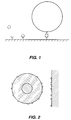
- Fig. 1 shows attachment of a specific antigen to a microtiter plate surface, capture of an antibody by the antigen, and attachment of a phosphor label by the antigen/antibody. This attachment and the relative sizes of known phosphors and antibodies are further illustrated in Fig. 2.
- Up-converting phosphors have several advantages over other known materials, such as radioisotopes and covalently-linked fluorescent dyes, for such label applications.
- Radioimmunoassays while they are sensitive, use radioactive materials which are potential health hazards for the operators of the tests, and which in turn also require special handling and expensive disposal problems.
- Radioisotopes are unstable and they do not produce strong signals in the ultraviolet, infrared or visible portions of the electromagnetic spectrum, and thus cannot be used for methods including microscopy, image spectroscopy and flow cytometry that employ optical methods for detection of the label.
- Fluorescent labels thus have come into widespread use for such methods, including small organic dye molecules which can be illuminated with light of a particular excitation frequency so that they give off emissions that can be detected by electro-optical sensors.
- these fluorescent dye labels have limited sensitivity because the specific fluorescent signal of the label is difficult to detect from nonspecific background fluorescent signals given off by other reagents required for the test, such as serum, fixatives and the sample itself, as well as autofluorescence in the visible wavelength range of optical lenses and excitation light reflected from the equipment used to carry out the test.
- whole blood samples strongly scatter light at short wavelengths of about 600 nm, which is also the emission range of fluorescent dye reporters.
- fluorescent dyes are not well suited for immunoassays of whole blood. Since fluorescent dyes have a short lifetime, about 1-100 nanoseconds, it is often difficult to measure the label light.
- Another disadvantage in the use of fluorescent dyes is that these dyes bleach out due to photolytic decomposition of the dye molecules during exposure to light.
- up-converting phosphors for immunoassays.
- Such phosphors can be excited by photons of a frequency which can be provided by inexpensive near-infrared laser diodes or light-emitting diodes for example, and they emit light of a lower frequency band, in the visible range.
- the photons of the emitted radiation are of higher energy than the excitation energy, and the emitted radiation is "up-shifted" from the excitation radiation. Since background fluorescence in the visible range is negligible if near infrared excitation wavelength light is used, the use of up-converter labels provides an essentially background-free visible emission signal.
- Solid state diode lasers can be tailored to operate at any desired wavelength in the near infrared range, and since they are inexpensive they are compatible with a low cost assay kit.
- the phosphors of the invention can be used as immunoassay labels by attaching them to one or more probes, such as antibodies, protein A, polypeptide ligands of cellular receptors, polynucleotides, drugs, antigens, toxins. When they serve as a reporter, or a light detectable marker, attachment of the label can be accomplished in various known ways, for example by coating phosphor particles with a polycarboxylic acid whereby various probes will be physically adsorbed to the surface of the phosphor particles. Other attaching agents such as siloxanes are also well known.
- Such phosphor particles are typically smaller than about 3 microns in diameter, but it is preferred that the phosphor particles be as small as possible while still generating a detectable signal. For particular tests, such as detection of an abundant nuclear antigen in a permeabilized cell, a small phosphor particle is required that can readily diffuse and penetrate subcellular structures. Further, since during the course of the assay bound and unbound phosphor particles must be separated and differentiated, it would be highly desirable that the phosphor particles be uniform in size. The size of the particles, their weight and their morphology are all important criteria because they affect the strength of particle binding and the specificity of the separation process. Further, since in an assay application each of the particles should have a like number of active binding sites, it is also desirable that the particles be of similar size.
- the as-formed phosphors are generally milled to reduce their particle size.
- Prior art milling methods employ milling in a conventional barrel mill with zirconia and/or alumina balls for up to 48 hours or longer. This produces phosphor particles of from 0.01 to 3 microns in size. If a particular particle size is desired, fractions of the desired particle size can be prepared by sedimentation which generally takes a day or more, and removal of the undesired (larger) particle sizes.
- the milling process produces non-spherical particles and a quite large range of particle sizes, even after sedimentation.
- Submicron particles of yttrium oxide have been made, doped with ytterbium and erbium [(Y 0.86 Yb 0.08 Er 0.06 ) 2 O 3 ].
- This is a relatively efficient red up-converter phosphor, but it is slightly water sensitive, especially as small particles.
- it is annealed in air at 1500°C.
- this annealing process forms aggregates of the phosphor, in which some of the particles grow together, and which are very difficult to break apart, even by sonication techniques.
- the oxide is converted to the corresponding oxysulfide for use as a phosphor label, the phosphor particles aggregate further and produce non-spherical particles of 1-3 microns or more in size.
- J. Electrochemical society; Solid State Science and Technology, August 1985, O. Kanehisa et al., pages 2023-27 discloses the heating of rare earth oxide particles in a flux composition comprising sulphur and a salt of an alkali metal carbonate in the absence of oxygen at a temperature of no more than 900°C to convert the oxide to the corresponding oxysulfide compound without changing the shape or size of the particles.
- the resulting particles have a size over 1 micron and are not spherical.
- US-A-5,015,452 discloses the preparation of spherical particles of gadolinium carbonates. Other rare earth hydroxy carbonates are disclosed, but the shapes of the particles of such carbonates are not disclosed.
- Suspensions of phosphor particles having an average size of 0.1 to 0.3 ⁇ m which are stabilised by polycarboxylic acids are disclosed at page 785, right-hand column of Cytometry 11: 784-792 (1990). Washing with a pH buffer (pH 6.0) is also disclosed. The size of the particles is reduced using a ball mill. The ball milled particles vary in shape and size.
- rare-earth e.g. yttrium or gadolinium, oxysulphide phosphors having small uniform particle size wherein the particles are spherical.
- a process for making phosphors including upconverter phosphors, having spherical particles less than 1 micron in size.
- a small, spherical particle size host hydroxycarbonate is first made by precipitation from dilute solution.
- the hydroxycarbonates are heated in air to form the corresponding oxides, under conditions that retain the shape and particle size of the hydroxycarbonate precursor.
- the oxides are then heated at a maximum temperature of about 900° in a non-oxidizing atmosphere in an alkali polysulphide flux to form the corresponding oxysulphide phosphors.
- the oxide particles do not appreciably aggregate or change their surface morphology during conversion to the oxysulphides, which are highly efficient up-converter phosphors.
- the oxysulphide phosphors of the embodiment can also be made directly from the precursor hydroxycarbonates without increasing the particle size or changing the surface morphology of the hydroxycarbonate particles. Thus small, uniform particle size, spherical particles are obtained.
- the present low temperature process heats the starting host material for the phosphor and the activator/emitter pair in a low temperature flux to a maximum temperature of about 900°C, which avoids the formation of aggregates, or produces aggregates that can be separated by sonication, to produce a highly efficient phosphor having uniform particles of small particle size.
- Fig. 1 is an illustration of the process of attaching phosphor labels to a reporter antibody during an immunoassay.
- Fig. 2 is an illustration of the relative size of the phosphor label and an antibody.
- Fig. 3 is a photomicrograph of yttrium hydroxycarbonate particles as precipitated from solution.
- Fig. 4 is a photomicrograph of yttrium oxide phosphor particles after firing at 700°C.
- Fig. 5 is a photomicrograph of yttrium oxysulphide phosphor particles after firing at 900°C in a polysulphide flux.
- Fig. 6 is a photomicrograph of yttrium oxide phosphor particles heated at 1350°C for two hours.
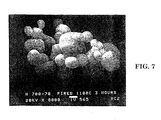
- Fig. 7 is a photomicrograph of yttrium oxysulfide phosphor particles after firing at 1100°C for three hours.
- the preferred phosphors of the invention include upconverter oxysulfides such as yttrium oxysulfides and gadolinium oxysulfides, containing various known activator/ emitter couples. Other oxysulfides can also be used, such as lutetium oxysulfides. Suitable activator couples include ytterbium/erbium, ytterbium/thulium and ytterbium/holmium. By combination of the oxysulfides and the activator couples, red, blue or green phosphors can be made.
- the absorber is ytterbium and the emitter is erbium, holmium, terbium or thulium, although the invention is not limited to these materials.
- the molar ratio of absorber: emitting center is generally at least about 1:1, but can be higher, up to about 2500:1; however, the ratio used is generally about 25:1 to about 50:1.
- the ratio will be selected on the basis of various properties of the resultant phosphor, including chemical properties, manufacturing efficiency, absorption cross-section, excitation and emission wavelengths, quantum efficiency and the like. The ratio chosen will also generally depend upon the particular absorber-emitter couple employed.
- the absorber: emitter ratio for Yb:Er couples is generally about 20:1 to about 100:1, whereas the absorber: emitter ratio for Yb:Tm and Yb:Ho couples is typically in the range of about 500:1 to about 2000:1.
- Up-converting phosphors may conveniently comprise about 10-30% of Yb and either 1-2% Er, about 0.1-0.05% Ho, or about 0.1-0.05% Tm, although the present invention is not so limited.
- Suitable phosphors for use as immunoassay labels include phosphors having the formula Y x Yb y Er z wherein x is 0.7-0.9 and each of y and z is 0.05-0.12. This is a green-emitting phosphor.
- Gadolinium oxysulfides containing ytterbium and holmium as the absorber/emitter couple is also a green phosphor.
- Gadolinium oxysulfide doped with ytterbium/thulium as the absorber/emitter couple is a blue-emitting phosphor.
- an increase in the doping levels of activator/emitter couples may be desirable to increase the quantum conversion efficiency of the phosphor.
- a mixture of a rare earth water-soluble salt, such as the nitrate, together with the water-soluble salts of an activator/emitter couple, in the molar proportion of the phosphor to be made, is dissolved in water so as to make a dilute solution.
- a concentrated aqueous solution can be prepared first, which can be further diluted.
- the rare earths used are gadolinium or yttrium which can contain activator/emitter couples of ytterbium together with erbium, thulium, lutetium or holmium and the like as discussed above.
- the hydroxycarbonate particles are collected, as by centrifugation, and then fired in an oxygen-containing atmosphere to convert the hydroxycarbonate to the corresponding oxide.
- the firing temperature is very important. In order to maintain the small particle size of the hydroxycarbonate precipitates, the firing temperature must be maintained in the range of about 700 to about 1000°C. A preferred temperature is about 700°C. At higher temperatures, aggregates and irregularly shaped particles form due to grain growth, and the desired spherical morphology will not be maintained.
- the rare earth oxides are not highly efficient phosphors, the oxides are then converted to the oxysulfides which are more efficient phosphors.
- the conversion of phosphors from their oxides to their oxysulfides is known and described in US Patent 3,502,590 to Royce et al.
- the rare earth oxides are heated in a suitable alkali polysulfide flux composition in the absence of oxygen to form the corresponding oxysulfide.
- Suitable fluxes include sulfur and a mixture of alkali metal carbonates, phosphates or sulfates.
- the rare earth oxide particles and flux are packed into a closed alumina crucible and heated to firing temperature.
- the crucible can be contained within another crucible, packed in charcoal, etc. to keep oxygen out of the system during firing.
- the firing temperature is very important in order to maintain the particle size and morphology of the oxide during conversion to the oxysulfide compound. Too high a firing temperature results in a change in both the size and shape of the oxysulfide particles, leading to an increase in size and formation of non-spherical particles, and to the formation of aggregates. Too low a firing temperature however, will not form the oxysulfide. Generally a minimum temperature of about 600°C is required for reaction to occur rapidly and completely.
- a maximum temperature of about 900°C is necessary to give high luminescent efficiency in the phosphor, yet maintain the size and morphology of the original oxide particles.
- the firing time is also important. Firing is continued until substantially all of the rare earth oxide has been converted to the oxysulfide phosphor compound. During this firing step the activator couple ions are incorporated into the oxysulfide crystal which is generally complete after about 30 minutes.
- the phosphor particles can be coated or treated with a surface active agent, as with a polycarboxylic acid. This produces a stable aqueous suspension of the phosphor particles, typically at a pH of 6-8. Since phosphors are sensitive to acid solutions, a buffer can also be added to ensure that proper pH is maintained.
- the phosphor particles also can be dispersed in a polar solvent, such as acetone or DMSO and the like, to generate a monodisperse emulsion for a stock solution, which can be further diluted into an aqueous solution such as buffered saline.
- a polar solvent such as acetone or DMSO and the like
- the precipitate was collected and centrifuged, washed, dried and fired in air at 700°C to convert the hydroxycarbonate to the corresponding oxide.
- FIG. 3 is a photomicrograph of the hydroxycarbonate as precipitated at 8000x magnification. It is apparent that the precipitated particles are small, almost perfectly spherical particles.
- Fig. 4 is a photomicrograph of the corresponding oxide formed after heating at 700°C for 2 hours, taken at 9000x magnification. It is apparent that the particles are still small, spherical particles.
- the oxides were then converted to the highly efficient oxysulfide phosphor using a polysulfide flux in a non-oxidizing atmosphere and firing at a temperature of no more than 900°C.
- the polysulfide flux was removed by washing with water, and a final rinse with dilute nitric acid solution to ensure complete removal of the polysulfide and other salts.
- the phosphor was sonified to break up any particulate aggregates, centrifuged and dried.
- Fig. 5 is a photomicrograph of the oxysulfide having a particle size of 0.4 micron. It can be seen that the particles are little changed in morphology from the corresponding oxide.
- Example 1 Part A The procedure of Example 1 Part A was repeated, except that the hydroxycarbonate particles were heated at 1350°C for three hours.
- Fig. 6 is a photomicrograph of the corresponding oxide at 9000x magnification. It is apparent that the particles have coalesced into large aggregates and the individual particles are no longer spherical, but crystal faceting has occurred.
- Example 1 Part B The procedure of Example 1 Part B was repeated, except that the oxide was heated at 1100°C for three hours.
- Fig. 7 is a photomicrograph of the corresponding oxide at 8000x magnification. This produces a highly efficient luminescent phosphor but it is apparent that the individual particles are much bigger than the oxide starting material, and they are no longer spherical.
- the invention also includes singly activated up-converter phosphors such as erbium activated oxysulphides such as yttrium oxysulphide.
- the invention also includes the process of making downconverter phosphors, for example, ultraviolet stimulated phosphors such as europium or erbium doped oxysulphides such as yttrium or gadolinium oxysulphide manufactured.
- the invention also includes the process of making cathodo-luminescent phosphors, for example, europium or terbium doped oxysulphides such as yttrium or gadolinium oxysulphide.
Landscapes
- Chemical & Material Sciences (AREA)
- Organic Chemistry (AREA)
- Inorganic Chemistry (AREA)
- Engineering & Computer Science (AREA)
- Materials Engineering (AREA)
- Life Sciences & Earth Sciences (AREA)
- Geology (AREA)
- Luminescent Compositions (AREA)
- Compounds Of Alkaline-Earth Elements, Aluminum Or Rare-Earth Metals (AREA)
Applications Claiming Priority (3)
| Application Number | Priority Date | Filing Date | Title |
|---|---|---|---|
| US278089 | 1994-07-01 | ||
| US27808994A | 1994-07-20 | 1994-07-20 | |
| PCT/US1995/007869 WO1996001297A1 (en) | 1994-07-01 | 1995-07-03 | Method of preparing small particle size phosphors |
Publications (3)
| Publication Number | Publication Date |
|---|---|
| EP0797649A1 EP0797649A1 (en) | 1997-10-01 |
| EP0797649A4 EP0797649A4 (cg-RX-API-DMAC7.html) | 1997-10-01 |
| EP0797649B1 true EP0797649B1 (en) | 2000-09-06 |
Family
ID=23063637
Family Applications (1)
| Application Number | Title | Priority Date | Filing Date |
|---|---|---|---|
| EP95927117A Expired - Lifetime EP0797649B1 (en) | 1994-07-01 | 1995-07-03 | Method of preparing small particle size phosphors |
Country Status (5)
| Country | Link |
|---|---|
| EP (1) | EP0797649B1 (cg-RX-API-DMAC7.html) |
| JP (1) | JP3734502B2 (cg-RX-API-DMAC7.html) |
| CA (1) | CA2193856A1 (cg-RX-API-DMAC7.html) |
| DE (1) | DE69518769T2 (cg-RX-API-DMAC7.html) |
| WO (1) | WO1996001297A1 (cg-RX-API-DMAC7.html) |
Cited By (1)
| Publication number | Priority date | Publication date | Assignee | Title |
|---|---|---|---|---|
| DE10208397A1 (de) * | 2002-02-27 | 2003-09-11 | Honeywell Specialty Chemicals | Anti-Stokes-Leuchtstoff-Zusammensetzung |
Families Citing this family (16)
| Publication number | Priority date | Publication date | Assignee | Title |
|---|---|---|---|---|
| WO1997046488A1 (en) * | 1996-06-05 | 1997-12-11 | Sarnoff Corporation | Method for preparing small particle size fluoride up-converting phosphors |
| KR100232402B1 (ko) * | 1996-12-31 | 1999-12-01 | 손욱 | 고밀도 Ni-M 하이드로옥시카보네이트의 제조 방법 |
| JP2001513828A (ja) * | 1997-02-24 | 2001-09-04 | スーペリア マイクロパウダーズ リミテッド ライアビリティ カンパニー | 酸素含有蛍光粉体、該蛍光粉体の製造方法、該蛍光粉体を利用してなる装置 |
| US6210604B1 (en) | 1997-02-24 | 2001-04-03 | Superior Micropowders Llc | X-ray phosphor powders, methods for making phosphor powders and devices incorporating same |
| US6039894A (en) * | 1997-12-05 | 2000-03-21 | Sri International | Production of substantially monodisperse phosphor particles |
| WO2000036051A1 (en) * | 1998-12-17 | 2000-06-22 | Isis Innovation Limited | Ternary oxide particles |
| EP1141170A1 (en) * | 1998-12-17 | 2001-10-10 | Isis Innovation Limited | Rare earth-activated phosphors |
| GB9911781D0 (en) * | 1999-05-20 | 1999-07-21 | Isis Innovations Ltd | Process for preparing phosphor particles |
| JP4344502B2 (ja) * | 2002-02-26 | 2009-10-14 | 独立行政法人産業技術総合研究所 | 金属化合物粒子の製造方法 |
| JP4526004B2 (ja) * | 2002-03-05 | 2010-08-18 | 大日本印刷株式会社 | 希土類元素含有微粒子およびそれを用いた蛍光プローブ |
| FI20030460A0 (fi) | 2003-03-28 | 2003-03-28 | Tero Soukka | Homogeeninen määritysmenetelmä, joka perustuu luminesenssienergiasiirtoon |
| EP1608980B1 (en) * | 2003-03-28 | 2007-08-15 | SOUKKA, Tero | A homogeneous luminescence energy transfer bioassay |
| KR102006599B1 (ko) * | 2011-12-21 | 2019-08-01 | 아이소테라퓨틱스 그룹 엘엘씨 | 방사성 조성물 및 그의 치료적 사용 방법 |
| CN114380319B (zh) * | 2020-10-19 | 2024-02-13 | 厦门稀土材料研究所 | 一种新型片堆积球形结构稀土硫氧化物及其制备方法和应用 |
| CN115322785A (zh) * | 2022-08-18 | 2022-11-11 | 北京科技大学 | 一种球形硫氧化物荧光粉的制备方法 |
| CN118198845B (zh) * | 2024-03-28 | 2024-11-15 | 哈尔滨工业大学 | 一种等离子激元共振增强的稀土掺杂微纳激光器及其构筑方法 |
Family Cites Families (3)
| Publication number | Priority date | Publication date | Assignee | Title |
|---|---|---|---|---|
| US3418246A (en) * | 1965-03-24 | 1968-12-24 | Rca Corp | Rare earth activated yttrium and gadolinium oxy-chalcogenide phosphors |
| US3541022A (en) * | 1968-03-28 | 1970-11-17 | Gen Electric | Infrared excitable ytterbium sensitized erbium activated rare earth oxysulfide luminescent material |
| US5015452A (en) * | 1986-11-17 | 1991-05-14 | Clarkson University | Process for synthesis of uniform colloidal particles of rare earth oxides |
-
1995
- 1995-07-03 DE DE69518769T patent/DE69518769T2/de not_active Expired - Lifetime
- 1995-07-03 CA CA002193856A patent/CA2193856A1/en not_active Abandoned
- 1995-07-03 JP JP50388996A patent/JP3734502B2/ja not_active Expired - Lifetime
- 1995-07-03 EP EP95927117A patent/EP0797649B1/en not_active Expired - Lifetime
- 1995-07-03 WO PCT/US1995/007869 patent/WO1996001297A1/en not_active Ceased
Cited By (1)
| Publication number | Priority date | Publication date | Assignee | Title |
|---|---|---|---|---|
| DE10208397A1 (de) * | 2002-02-27 | 2003-09-11 | Honeywell Specialty Chemicals | Anti-Stokes-Leuchtstoff-Zusammensetzung |
Also Published As
| Publication number | Publication date |
|---|---|
| DE69518769D1 (de) | 2000-10-12 |
| DE69518769T2 (de) | 2001-01-04 |
| EP0797649A1 (en) | 1997-10-01 |
| EP0797649A4 (cg-RX-API-DMAC7.html) | 1997-10-01 |
| JP3734502B2 (ja) | 2006-01-11 |
| CA2193856A1 (en) | 1996-01-18 |
| JPH10502408A (ja) | 1998-03-03 |
| WO1996001297A1 (en) | 1996-01-18 |
Similar Documents
| Publication | Publication Date | Title |
|---|---|---|
| US6132642A (en) | Method of preparing small particle size phosphors | |
| EP0797649B1 (en) | Method of preparing small particle size phosphors | |
| CN100357391C (zh) | 含有稀土类元素的微粒和使用其的荧光探针 | |
| CN1312479C (zh) | 一种纳米荧光磁粒及其制备方法 | |
| EP1282824B1 (de) | Dotierte nanoteilchen als biolabel | |
| CA2523027C (en) | Core/shell nanoparticles suitable for (f)ret-assays | |
| US5891361A (en) | Method for preparing small particle size fluoride up-converting phosphors | |
| AU1003602A (en) | Synthesis of nanoparticles | |
| WO1987000926A1 (en) | Labelled macromolecules; a process for their preparation and their use for immunological or immunocytochemical assays | |
| EP2093194B1 (en) | Fluorescent labeling agent and fluorescent labeling method | |
| US20060269483A1 (en) | SEM cathodoluminescent imaging using up-converting nanophosphors | |
| EP1893720A1 (de) | Hydrophile nanoteilchen mit funktionellen oberflächengruppen, deren herstellung und verwendung | |
| WO2012034696A1 (de) | Photostimulierbare partikelsysteme, verfahren zu deren herstellung sowie verwendungszwecke | |
| CN101104805A (zh) | 稀土掺杂磷酸镧纳米发光颗粒的制备方法 | |
| CN108410465B (zh) | 荧光增强型石墨烯量子点-下转换稀土氟化物复合材料 | |
| CN1775900A (zh) | 光应用的纳米结晶的基于氧化物的发光材料粉末的生产方法 | |
| CN111909695B (zh) | 一种稀土上转换和钙钛矿量子点复合纳米材料及其制备方法和应用 | |
| Ansari | Impact of surface coating on morphological, optical and photoluminescence properties of YF3: Tb3+ nanoparticles | |
| JP2006023140A (ja) | 複合化粒子 | |
| WO1997046488A1 (en) | Method for preparing small particle size fluoride up-converting phosphors | |
| WO1997046488A9 (en) | Method for preparing small particle size fluoride up-converting phosphors | |
| DE10106643A1 (de) | Dotierte Nanoteilchen als Biolabel | |
| US20250051642A1 (en) | Microjet reactor based synthesis of nanophosphors | |
| Pandey et al. | Chloroform-and water-soluble sol-gel derived Eu+++/Y2O3 (red) and Tb+++/Y2O3 (green) nanophosphors: Synthesis, characterization, and surface modification | |
| EP4435075A1 (en) | Method for treating luminescent nanoparticles |
Legal Events
| Date | Code | Title | Description |
|---|---|---|---|
| PUAI | Public reference made under article 153(3) epc to a published international application that has entered the european phase |
Free format text: ORIGINAL CODE: 0009012 |
|
| 17P | Request for examination filed |
Effective date: 19961120 |
|
| A4 | Supplementary search report drawn up and despatched | ||
| AK | Designated contracting states |
Kind code of ref document: A4 Designated state(s): DE FR GB IT NL Kind code of ref document: A1 Designated state(s): DE FR GB IT NL |
|
| 17Q | First examination report despatched |
Effective date: 19980805 |
|
| GRAG | Despatch of communication of intention to grant |
Free format text: ORIGINAL CODE: EPIDOS AGRA |
|
| GRAG | Despatch of communication of intention to grant |
Free format text: ORIGINAL CODE: EPIDOS AGRA |
|
| GRAH | Despatch of communication of intention to grant a patent |
Free format text: ORIGINAL CODE: EPIDOS IGRA |
|
| GRAH | Despatch of communication of intention to grant a patent |
Free format text: ORIGINAL CODE: EPIDOS IGRA |
|
| GRAA | (expected) grant |
Free format text: ORIGINAL CODE: 0009210 |
|
| AK | Designated contracting states |
Kind code of ref document: B1 Designated state(s): DE FR GB IT NL |
|
| ET | Fr: translation filed | ||
| ITF | It: translation for a ep patent filed | ||
| REF | Corresponds to: |
Ref document number: 69518769 Country of ref document: DE Date of ref document: 20001012 |
|
| PLBE | No opposition filed within time limit |
Free format text: ORIGINAL CODE: 0009261 |
|
| STAA | Information on the status of an ep patent application or granted ep patent |
Free format text: STATUS: NO OPPOSITION FILED WITHIN TIME LIMIT |
|
| 26N | No opposition filed | ||
| REG | Reference to a national code |
Ref country code: GB Ref legal event code: IF02 |
|
| PGFP | Annual fee paid to national office [announced via postgrant information from national office to epo] |
Ref country code: NL Payment date: 20040616 Year of fee payment: 10 |
|
| PG25 | Lapsed in a contracting state [announced via postgrant information from national office to epo] |
Ref country code: NL Free format text: LAPSE BECAUSE OF NON-PAYMENT OF DUE FEES Effective date: 20060201 |
|
| NLV4 | Nl: lapsed or anulled due to non-payment of the annual fee |
Effective date: 20060201 |
|
| PGFP | Annual fee paid to national office [announced via postgrant information from national office to epo] |
Ref country code: IT Payment date: 20130724 Year of fee payment: 19 |
|
| PGFP | Annual fee paid to national office [announced via postgrant information from national office to epo] |
Ref country code: DE Payment date: 20140729 Year of fee payment: 20 |
|
| PGFP | Annual fee paid to national office [announced via postgrant information from national office to epo] |
Ref country code: GB Payment date: 20140729 Year of fee payment: 20 Ref country code: FR Payment date: 20140717 Year of fee payment: 20 |
|
| PG25 | Lapsed in a contracting state [announced via postgrant information from national office to epo] |
Ref country code: IT Free format text: LAPSE BECAUSE OF NON-PAYMENT OF DUE FEES Effective date: 20140703 |
|
| REG | Reference to a national code |
Ref country code: DE Ref legal event code: R071 Ref document number: 69518769 Country of ref document: DE |
|
| REG | Reference to a national code |
Ref country code: GB Ref legal event code: PE20 Expiry date: 20150702 |
|
| PG25 | Lapsed in a contracting state [announced via postgrant information from national office to epo] |
Ref country code: GB Free format text: LAPSE BECAUSE OF EXPIRATION OF PROTECTION Effective date: 20150702 |