EP0797050B1 - Sicherheitsvorrichtung für Brenner - Google Patents
Sicherheitsvorrichtung für Brenner Download PDFInfo
- Publication number
- EP0797050B1 EP0797050B1 EP97301837A EP97301837A EP0797050B1 EP 0797050 B1 EP0797050 B1 EP 0797050B1 EP 97301837 A EP97301837 A EP 97301837A EP 97301837 A EP97301837 A EP 97301837A EP 0797050 B1 EP0797050 B1 EP 0797050B1
- Authority
- EP
- European Patent Office
- Prior art keywords
- burner
- air
- safety device
- combustion
- air supply
- Prior art date
- Legal status (The legal status is an assumption and is not a legal conclusion. Google has not performed a legal analysis and makes no representation as to the accuracy of the status listed.)
- Expired - Lifetime
Links
Images



Classifications
-
- F—MECHANICAL ENGINEERING; LIGHTING; HEATING; WEAPONS; BLASTING
- F23—COMBUSTION APPARATUS; COMBUSTION PROCESSES
- F23C—METHODS OR APPARATUS FOR COMBUSTION USING FLUID FUEL OR SOLID FUEL SUSPENDED IN A CARRIER GAS OR AIR
- F23C1/00—Combustion apparatus specially adapted for combustion of two or more kinds of fuel simultaneously or alternately, at least one kind of fuel being either a fluid fuel or a solid fuel suspended in a carrier gas or air
- F23C1/08—Combustion apparatus specially adapted for combustion of two or more kinds of fuel simultaneously or alternately, at least one kind of fuel being either a fluid fuel or a solid fuel suspended in a carrier gas or air liquid and gaseous fuel
-
- F—MECHANICAL ENGINEERING; LIGHTING; HEATING; WEAPONS; BLASTING
- F23—COMBUSTION APPARATUS; COMBUSTION PROCESSES
- F23D—BURNERS
- F23D14/00—Burners for combustion of a gas, e.g. of a gas stored under pressure as a liquid
- F23D14/02—Premix gas burners, i.e. in which gaseous fuel is mixed with combustion air upstream of the combustion zone
- F23D14/04—Premix gas burners, i.e. in which gaseous fuel is mixed with combustion air upstream of the combustion zone induction type, e.g. Bunsen burner
- F23D14/045—Premix gas burners, i.e. in which gaseous fuel is mixed with combustion air upstream of the combustion zone induction type, e.g. Bunsen burner with a plurality of burner bars assembled together, e.g. in a grid-like arrangement
-
- F—MECHANICAL ENGINEERING; LIGHTING; HEATING; WEAPONS; BLASTING
- F23—COMBUSTION APPARATUS; COMBUSTION PROCESSES
- F23D—BURNERS
- F23D14/00—Burners for combustion of a gas, e.g. of a gas stored under pressure as a liquid
- F23D14/46—Details
- F23D14/70—Baffles or like flow-disturbing devices
-
- F—MECHANICAL ENGINEERING; LIGHTING; HEATING; WEAPONS; BLASTING
- F23—COMBUSTION APPARATUS; COMBUSTION PROCESSES
- F23D—BURNERS
- F23D14/00—Burners for combustion of a gas, e.g. of a gas stored under pressure as a liquid
- F23D14/46—Details
- F23D14/72—Safety devices, e.g. operative in case of failure of gas supply
-
- F—MECHANICAL ENGINEERING; LIGHTING; HEATING; WEAPONS; BLASTING
- F23—COMBUSTION APPARATUS; COMBUSTION PROCESSES
- F23N—REGULATING OR CONTROLLING COMBUSTION
- F23N5/00—Systems for controlling combustion
- F23N5/02—Systems for controlling combustion using devices responsive to thermal changes or to thermal expansion of a medium
-
- F—MECHANICAL ENGINEERING; LIGHTING; HEATING; WEAPONS; BLASTING
- F23—COMBUSTION APPARATUS; COMBUSTION PROCESSES
- F23N—REGULATING OR CONTROLLING COMBUSTION
- F23N2223/00—Signal processing; Details thereof
-
- F—MECHANICAL ENGINEERING; LIGHTING; HEATING; WEAPONS; BLASTING
- F23—COMBUSTION APPARATUS; COMBUSTION PROCESSES
- F23N—REGULATING OR CONTROLLING COMBUSTION
- F23N2225/00—Measuring
- F23N2225/08—Measuring temperature
- F23N2225/16—Measuring temperature burner temperature
-
- F—MECHANICAL ENGINEERING; LIGHTING; HEATING; WEAPONS; BLASTING
- F23—COMBUSTION APPARATUS; COMBUSTION PROCESSES
- F23N—REGULATING OR CONTROLLING COMBUSTION
- F23N2227/00—Ignition or checking
- F23N2227/20—Calibrating devices
-
- F—MECHANICAL ENGINEERING; LIGHTING; HEATING; WEAPONS; BLASTING
- F23—COMBUSTION APPARATUS; COMBUSTION PROCESSES
- F23N—REGULATING OR CONTROLLING COMBUSTION
- F23N2233/00—Ventilators
- F23N2233/06—Ventilators at the air intake
-
- F—MECHANICAL ENGINEERING; LIGHTING; HEATING; WEAPONS; BLASTING
- F23—COMBUSTION APPARATUS; COMBUSTION PROCESSES
- F23N—REGULATING OR CONTROLLING COMBUSTION
- F23N5/00—Systems for controlling combustion
- F23N5/24—Preventing development of abnormal or undesired conditions, i.e. safety arrangements
Definitions
- the invention relates to a burner apparatus equipped with a safety device to detect using a temperature sensor whether or not the burning condition has deteriorated.
- a safety device is provided to detect when the burning condition deteriorates in order to regulate emission of noxious substances such as carbon monoxide and the like to below a predetermined level.
- a flame rod is used as a temperature sensor to detect the presence of flames so as to determine the burning condition of the burner.
- FR-A-2,418,907 discloses a burner in accordance with the preamble of claim 1.
- a burner apparatus comprising:
- the invention can quickly activate the safety device when the amount of air supplied is reduced before the burning condition of all the flame holes would deteriorate.
- the air-reduction member is a secondary air reduction member which regulates an amount of secondary air supplied to the specified flame holes of the burner.
- the burner comprises a support frame and a plurality of flat burner units on which the flame holes are provided, and the flat burner units are interfit into the support frame to be longitudinally or laterally arranged with their neighbouring spaces as secondary air passages.
- the secondary air reduction member is a secondary air shield plate provided downstream of the flames on the specified flame holes.
- the secondary air reduction member is a secondary air passage shield plate to block the space between the burner units or between the support frame and the burner units.
- the secondary air shield plate comprises a horizontal portion directed along the flames on the specified flame holes, and a vertical portion directed to intersect the flames on the specified flame holes.
- the temperature sensor is a flame rod or a thermocoupler.
- the safety member has a plurality of reference values whether to activate or not in order to response to different outputs generated from the temperature sensor.
- a flame rod and thermocoupler have been used as a temperature sensor which are usually provided with a certain space interposed against the flames. It does not matter with a single reference value which determines whether to activate the safety device if the burner always maintains a constant burning condition. When lengths of the flames change depending on type of the combustion fuel and combustion quantity, the outputs from the temperature sensor are generated differently even under the constant air ratio.
- the safety device may be activated to inadvertently cease the combustion of the burner when the temperature sensor generates the output corresponding to the reference value.
- the safety member Since the safety member has the plurality of the reference values to determine whether to be activated or not, the safety member is activated by the different reference values.
- the plurality of the reference values correspond to a plurality of combustion quantity values which change depending on burning condition of the burner, and the safety member determines whether to activate or not by selecting one mode among the reference value versus the combustion quantity value.
- the burning condition changes depending on the combustion quantity.
- an optimal reference value can be determined in a wide range from smaller to greater combustion quantity by considering the different flame lengths in correspondence to the combustion quantities. This makes it possible to ensure safety at various burning conditions to prevent the safety device from being activated inadvertently.
- the plurality of the reference values correspond to a plurality of combustion fuel types which change depending on burning condition of the burner, and the safety member determines whether to activate or not by selecting one mode among the reference value versus the combustion fuel type.
- a plurality of combinations among the reference value versus the combustion quantity value are determined, and the safety member selects one mode among the combinations among the reference value versus the combustion quantity value depending on the burning condition of the burner.
- a mode selection member is provided through which the safety member selects the one mode among the combinations of the reference value versus the combustion quantity value, and the mode selection member is a manual switch to set a desired mode depending on the combustion fuel type to be used.
- the burner In the case in which the burner is operated under a constant combustion quantity, it is possible to cope with it by changing the reference value itself depending on the different fuel types.
- the burner When the burner is operated under the various combustion quantities, it is possible to determine the reference value in correspondence to the combustion quantity under the particular fuel type by selecting one mode among the combinations of the reference values and the combustion quantities depending on the fuel type to be used.
- the manual switch provided to change the reference values of the safety device depending the fuel types to be used, it enables an operator to handle the switch to set an appropriate reference value in correspondence to the fuel type.
- the plurality of the reference values correspond to a plurality of air supply and exhaust lengths of the burner and the safety member determines whether to activate or not by selecting one mode among the reference value versus the air supply and exhaust length.
- a plurality of combinations among the reference value versus the air supply and exhaust length are determined, and the safety member selects one mode among the combinations among the reference value versus the the air supply and exhaust length depending on the burning condition of the burner.
- a mode selection member is provided through which the safety member selects the one mode among the combinations of the reference value versus the combustion quantity value, and the mode selection member is a connection determining switch mounted on an air supply and exhaust passage connection to automatically set a desired combustion quantity depending on whether or not an air supply and exhaust passage extension member is connected to the air supply and exhaust passage connection to which the air supply and exhaust passage extension is detachably connected.
- a mode selection member is provided through which the safety member selects the one mode among the combinations of the reference value versus the combustion quantity value, and the mode selection member is a connection switch mounted on an air supply and exhaust passage connection to manually set a desired combustion quantity depending on whether or not an air supply and exhaust passage extension member is connected to the air supply and exhaust passage connection to which the air supply and exhaust passage extension is detachably connected as required.
- the burner In the case in which the burner is operated under a constant combustion quantity, it is possible to cope with it by changing the reference value itself depending on the passage length.
- the burner When the burner is operated under the various combustion quantities, it is possible to determine the reference value in correspondence to the combustion quantity under the particular passage length by selecting one mode among the combinations of the reference values and the combustion quantities depending on the passage length to be used.
- the manual switch provided to change the reference values of the safety device depending the fuel type to be used, it enables an operator to handle the switch to set an appropriate reference value in correspondence to the fuel type to be used.
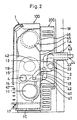
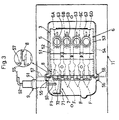
- the gas burner apparatus 100 has a flat-shaped metal casing 1 in which a centrifugal type blower 2 is installed as shown at the right hand side in Fig 1.
- a combustion cylinder 11 is laterally placed.
- a burner 3 is provided to which combustion air and gaseous fuel are supplied respectively through an outlet of the blower 2 and a fuel supply mechanism 12 so as to carry out combustion by forcibly supplying an outer air.
- a back plate 1A of the metal casing 1 has a metal farame 200 to arrange an intake pipe (air duct) to communicate the blower 2 with the outer air, and rooting an exhaust pipe (exhaust duct) to expel an combustion gas out of a room.
- the blower may be placed in the exhaust duct to introduce the outer air into the air duct (so-called intake system).
- the blower 2 has an intake cylinder whose inner space serves as an inlet 21.
- the inlet 21 pierces the back plate 1A to be in the metal frame 200 so as to be connected to an intake duct 22 which is connected to an outer air intake duct 23 which passes through an opening H provided on a partition wall W.
- a cylindrical heat exchanger 13 laterally within the metal casing 1.
- a left open end of the heat exchanger 13 is connected to that of the combustion cylinder 11 by means of an intermediary cylinder 14 which is rectangular in cross section.
- an exhaust cylinder 4 is provided in parallel therewith.
- a right open end of the heat exchanger 13 is connected to that of the exhaust cylinder 4 by means of an intermediary cylinder 15 which is rectangular in cross section.
- an intermediary cylinder 15 which is rectangular in cross section.
- a leading end 41 of the exhaust cylinder 4 is angularly bent, and pierced the back plate 1A to form a exhaust opening 40.
- an exhaust duct 44 is connected which has a lateral arm 43 and a vertical arm 42.
- a centrifugal fan 45 Concentrically passes through the outer air intake duct 23 within the opening H is the lateral arm 43 of the exhaust duct 44 whose outer end extends beyond that of the air intake duct 23.
- a centrifugal fan 45 is laterally provided to supply a warm air current. When the fan 45 is activated, it draws an indoor air from an inlet opening 46 provided on an upper portion of the back plate 1A, and sending forth through an outlet opening 47 provided on a lower portion of the back plate 1A.
- Numeral 18 designates a circulation pipe which sends a part of the combustion gas to the blower 2 to operate the burner at rlatively low temperature so as to reduce the emission of NOx-related gas.
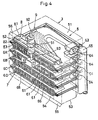
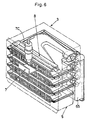
- the burner 3, which is placed at the right hand side in the combustion cylinder 11, has flat-shaped burner units 6 (6A, 6B, 6C, 6D) which are parallel stacked with a certain space 61 interposed therebetween.
- the space 61 acts as a secondary air passage.
- the burner units 6A, 6B, 6C, 6D are is interfit into a rectangular support frame 5. Between a side wall of the upper burner unit 6A and an upper wall 51 of the support frame 5, there is provided a space 52. Between a lower side wall of the lower burner unit 6D and an lower wall 53 of the support frame 5, there is provided a space 54. These spaces serve as the a secondary air passage.
- strip plates 55, 56 extend respectively from the upper wall 51 and lower wall 53 to be attached in turn to support plates 57, 58 which are each provided at the right hand side of the combustion cylinder 11 in order to support the burner 3 within the combustion cylinder 11.
- an open-ended duct 63 is provided at the upstream of the secondary air passage to introduce gaseous fuel and primary air current.
- a fuel gas supply tube 65 is provided which has four nozzles 4, 4, 4, 4, each facing the open-ended duct 63.
- a multitude of flame slits (flame holes) 66 are provided in four rows with a predetermined clearance interposed therebetween.
- a secondary air shield plate 7 is provided at a bottom of the upper burner unit 6A to regulate the secondary air current supplied to the central flame slits 66 of the upper burner unit 6A.
- a secondary air passage shield plate 8 is provided within the upper wall 51 of the support frame 5, to partially clog the space 52.
- the secondary air shield plate 7 is generally formed into L-shaped configuration.
- the shield plate 7 has a lateral arm 71 directed along flames F built up on the flame slits 66, and having a vertical arm 72 bent in a direction to intersect the flames F.
- the secondary air passage shield plate 8 has a strip plate 81 welded to the upper wall 51 of the support frame 5, an occulusive plate 82 to clog the space 52 and an engagement plate 83 which is brought in contact with an upper side wall of the upper burner unit 6A.
- the secondary air passage shield plate 8 occulates an entire breadth of the space 52. Instead of occulating the entire breadth of the space 52, the secondary air passage shield plate 8 may be adapted to be the same breadth of the secondary air shield plate 7, and located vertically in correspondence to the secondary air shield plate 7.
- a flame rod 9 is pierced therethrough as a temperature sensor to detect the burning condition of the burner 3.
- the flame rod 9 has an electrode 92 pierced through an insulator 91.
- a front end 93 of the electrode 92 faces the lateral arm 71 of the secondary air shield plate 7 so as to be in contact with the flames F.
- An output generated from the flame rod 9 is to be fed to safety valve to close the safety valve provided in the gaseous fuel supply mechanism 12 when the burning condition deteriorates to lift the flames F.
- the burning condition of the flames F occulated by the shield plates 7, 8 deteriorates earlier than that of the other flame slits 66 since the supply of the secondary air current is restricted. For this reason, it is possible to detect abnormal burning with a slight reduction of air ratio ( ⁇ ) in the entire burner 3 when air ratio in the burner unit 6A reduces due to a lenthwise alteration of the exhaust pipe 4 or the outer air intake duct 23. This holds true when the blower 2 loses its sufficient capacity, otherwise the exhaust pipe 4 and the outer air intake duct 23 is clogged by the foreign matters.
- the inventors have striven to conform to the requirement that "a furnace shall not produce a concentration of carbon monoxide in excess of 0.04 percent in an air-free sample of the flue gases when tested in an atmosphere having normal oxygen supply.”
- COAF CO Air-Free concept
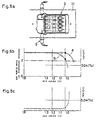
- Fig. 5a shows a flame rod 9 provided on the burner 3 in vertical relationship with the flame rod 9 to carry out a comparative experimental test by changing the air ratio ( ⁇ ) of the burner 3 as a whole.
- Fig. 5b shows an experimental test result from which it is found that the output (B) of the flame rod 9 is more sensitive against the reduction of the air ratio ( ⁇ ) than the output (A) of the flame rod 9.
- the structure is such that a current intensity (I) of the flame rod 9 drops to activate the safety valve early before the emission of carbon monoxide increases when an amount of the air supply reduces due to the lengthened exhaust pipe 4, otherwise due to the exhaust pipe 4 clogged by a piece of snow, bird's nest or spider's cobweb. This is true when the blower 2 loses its sufficient capacity, otherwise when an intake air is short of oxygen by getting the combustion gas back to the inlet opening.
- I current intensity
- Fig. 5c shows how COAF (CO Air Free Value) changes depending on the air ratio ( ⁇ ).
- COAF CO Air Free Value
- the output (A) from the prior flame rod 9a drops rapidly when the air ratio ( ⁇ ) is under 1.0 as shown in Fig. 5b. This is the case that is likely to increase COAF so as to result in an increased emission of carbon monoxide.
- the output (B) from the flame rod 9 drops rapidly when the air ratio ( ⁇ ) is around 1.1, which makes it possible to activate the safety valve before the entire burning condition would have deteriorated.
- COAF in Fig. 5c increases as approching upward along the axis of ordinates while COAF in Fig. 5b decreases as approaching upward along the axis of ordinates.
- a specified one of the burner units 6 may be occulated to block an entry of the primary air current as an air reduction means to restrict the air supply toward the specifed flame slits more than that of the other ones of the flame slits 66.
- the spaces may be partly occulated between the burner units 6 as a secondary air reduction member.
- one of the secondary air shield plate 7 and the secondary air shield passage plate 8 may be omitted.
- These plates 7, 8 may be formed in the manner to surround the specified flame slits.
- these plates 7, 8 may be formed into porous configuration.
- thermocoupler TC may be provided as the temperature sensor instead of the flame rod 9 according to a second embodiment of the invention.
- Fig. 7a shows a characteristic curve representative of an electromotive force generated from the thermocoupler TC.
- Fig. 7b shows how COAF varys depending on the air ratio ( ⁇ ).
- COAF in Fig. 7b increases as approching upward along the axis of ordinates while COAF in Fig. 7a decreases as approaching upward along the axis of ordinates.
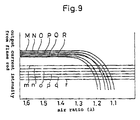
- Figs. 8 and 9 show a third embodiment of the invention in which a plurality of reference values are provided as opposed to the first and second embodiment of the invention in which the abnormal combustion is detected on the basis of a single reference value such as the output from the flame rod 9 or the thermocoupler TC.
- the plurality of reference values are represented by the gaseous fuel types to be used, an exhaust mode which changes depending on the air passage length of the intake duct 22 and exhaust duct 44, and the combustion quantity which the burner 3 produces depending on the temperature adjustment.
- the gaseous fuel types are represented by natural gas and liquefied petroleum gas.
- four types of resultant modes are predetermined in order to cope with the air passage of different lengths.
- One is a direct exhaust mode in which an extension pipe is not connected to the intake duct 22 and exhaust duct 44.
- the other is an extension mode in which the extension pipe is connected to the intake duct 22 and exhaust duct 44.
- the combustion quantity is divided into three sections, i.e., strong, weak and temperature adjustment area in correspondence to each of the modes to designate twelve reference values in total.
- a group of the reference values are determined in correspondence to each of the gaseous fuel types depending on the combustion quantity. Another group of the reference values are determined in correspondence to each of the gaseous fuel types depending on the intake and exhaust air passage of different lengths.
- These groups of the reference values are stored by a storage memory 111 of a microcomputer in a safety device 110 as criterion reference value data.
- one of the reference values is selected among the criterion reference value data to cope with the operating condition by means of a criterion reference value selection member 112 which is incorporated into the microcomputer.
- the criterion reference value selection member 112 searches the modes at Table 1 based on a setting signal generated by a dip switch 120 for a manufacturer to predetermine the gaseous fuel type to be used, and at the same time, relying on a changing signal generated by an extension pipe determining swich 130 to detect whether or not the extension pipe is connected to an connection end of the intake duct 22 and the exhaust duct 44. Then, the criterion reference value selection member 112 selects a single one reference value among the searched modes in correspondence to the combustion quantity on the basis of a control signal generated by a combustion control member 113 of the microcomputer which adjusts the combustion quantity of the burner 3.
- the safety device 110 recognizes an output singnal (M ⁇ R in Fig. 9) from the flame rod 9 on the basis of the reference value (m ⁇ r in Fig. 9) selected by the criterion reference value selection member 112.
- the safety device 110 closes the valve to cease the combustion of the burner 3 so as to prevent the abnormal combustion from inadvertently continuing.
- the output signal of the flame rod 6 is represented by six types of modes in Fig. 9 for the purpose of convenience.
- the output signal of the flame rod 6 and the reference values at Table 1 are not specified in a tangible number.
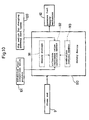
- Fig. 10 shows a fourth embodiment of the invention in which an extension pipe connection switch portion 131 is provided instead of the extension pipe determining switch 130.
- the switch portion 131 on-off actuates a switch member on a control circuit base plate by an operator when the extension pipe is connected to the connection end of the intake duct 22 and the exhaust duct 44.
- Examples of the switch portion 131 are as follows:
- the switch portion 131 categorically belongs to those which are difficult to handle upon altering the circuit wiring once programming is set at the time of installing the gas heating apparatus.
- the temperature adjustment area may be further divided minutely to increase accessible reference values to be selected if the storage memory 111 and the criterion reference value selection member 112 have more capacity while giving no significant influence on the programming procedures.
- the present invention is not only applied to the gas heater apparatus but also applied to a hot water server, water boiler and heater apparatus with a hot water server.
Landscapes
- Engineering & Computer Science (AREA)
- Chemical & Material Sciences (AREA)
- Combustion & Propulsion (AREA)
- Mechanical Engineering (AREA)
- General Engineering & Computer Science (AREA)
- Control Of Combustion (AREA)
- Regulation And Control Of Combustion (AREA)
Claims (16)
- Brennergerät, das aufweist:einen Brenner (3), in dem im Gebrauch gasförmiger Brennstoff und Luft mittels eines Gebläses (2) zugeführt werden; einen Temperatursensor (9), der zur Erfassung des Brennzustands der Flammen, die sich an wenigstens einer spezifizierten Flammenbohrung aufbauen; undeine Sicherheitsvorrichtung, die abhängig von einem vom Temperatursensor erzeugen Ausgangssignal aktiviert wird; gekennzeichnet durch:ein Luftdrosselglied (7, 8), das zur Drosselung einer der spezifizierten Flammenbohrung oder den spezifizierten Flammenbohrungen des Brenners zugeführten Menge Zusatzluft auf eine geringere Menge als die Luftmenge, die den anderen Flammenbohrungen zugeführt wird.
- Gerät nach Anspruch 1, bei dem das Luftdrosselglied (7, 8) ein Sekundärluftdrosselglied ist, das die Menge der des spezifizierten Flammenbohrung des Brenners zugeführten Sekundärluft reguliert.
- Gerät nach Anspruch 2, bei dem der Brenner (3) einen Stützrahmen (5) und mehrere flache Brennereinheiten (6A-6D) aufweist, auf denen die Flammenbohrungen (66) angebracht sind, und bei dem die flachen Brennereinheiten (6A-6D) in den Stützrahmen (5) so eingepasst sind, dass sie in Längsrichtung oder seitlich mit ihren benachbarten Zwischenräumen (61) als Sekundärluftkanäle angeordnet sind.
- Gerät nach Anspruch 2 oder 3, bei dem das Sekundärluftdrosselglied eine Sekundärluftschirmplatte (7) ist, die stromabwärts von den an der spezifizierten Flammenbohrung aufgebauten Flammen vorgesehen ist.
- Gerät nach Anspruch 4, bei dem die Sekundärluftschirmplatte einen horizontalen Abschnitt (71), der längs den an der spezifizierten Flammenbohrung aufgebauten Flammen gerichtet ist und einen vertikalen Abschnitt (72) aufweist, der so gerichtet ist, dass er die an der spezifizierten Flammenbohrung aufgebauten Flammen schneidet.
- Gerät nach Anspruch 2 oder 3, bei dem das Sekundärluftdrosselglied eine Sekundärluftkanalschirmplatte (8) zur Blockierung des Zwischenraums zwischen den Brennereinheiten (6A-6D) oder zwischen dem Stützrahmen und den Brennereinheiten (6A-6D) ist.
- Gerät nach den Ansprüchen 1 bis 6, bei dem der Temperatursensor ein Flammenstab (9) oder ein Thermokoppler ist.
- Gerät nach einem der Ansprüche 1 bis 7, bei dem die Sicherheitsvorrichtung (111) mehrere Referenzwerte hat, um in Reaktion auf verschiedene vom Temperatursensor erzeugte Ausgangssignale zu ermitteln, ob die Sicherheitsvorrichtung zu aktivieren ist oder nicht.
- Gerät nach Anspruch 8, bei dem die mehreren Referenzwerte mit mehreren sich abhängig vom Brennzustand des Brenners verändernden Verbrennungsmengenwerten korrespondieren, und die Sicherheitsvorrichtung durch Wahl eines der Referenzwerte im Vergleich mit dem Verbrennungsmengenwert ermittelt, ob sie zu aktivieren ist oder nicht.
- Gerät nach Anspruch 9, bei dem mehrere Kombinationen unter den Referenzwerten gegenüber dem Verbrennungsmengenwert bestimmt werden und die Sicherheitsvorrichtung (111) eine der Kombinationen der Referenzwerte gegenüber dem Verbrennungsmengenwert abhängig vom Brennzustand des Brenners wählt.
- Gerät nach Anspruch 8, bei dem die mehreren Referenzwerte mit mehreren Brennstoffarten korrespondieren und die Sicherheitsvorrichtung (111) durch Wahl eines der Referenzwerte zum Vergleich mit der Brennstoffart feststellt, ob sie zu aktivieren ist oder nicht.
- Gerät nach Anspruch 8, 9 oder 10, das weiterhin eine Betriebsartwählglied (120) zu Wahl des Referenzwertes als Kombination des Referenzwerts gegenüber dem Verbrennungsmengenwert aufweist und das Betriebsartwählglied ein manueller Schalter ist, mit dem eine gewünschte Betriebsart abhängig von der zu verwendenden Brennstoffart einstellbar ist.
- Gerät nach Anspruch 8, bei dem die mehreren Referenzwerte mit mehreren Luftzufuhr- und Abgaslängen des Brenners korrespondieren und die Sicherheitsvorrichtung unter Bezug auf einen gewählten Referenzwert bestimmt, ob sie zu aktivieren ist oder nicht.
- Gerät nach Anspruch 9, bei dem mehrere Kombinationen des Referenzwertes gegen die Luftzufuhr- und Abgaslänge ermittelt werden und die Sicherheitsvorrichtung eine Betriebsart unter den Kombinationen des Referenzwertes gegenüber der Luftzufuhr- und Abgaslänge abhängig von dem Verbrennungszustand des Brenners wählt.
- Gerät nach Anspruch 13 oder 14, bei dem ein Betriebartwählglied vorgesehen ist, durch welches die Sicherheitsvorrichtung eine der Kombinationen des Referenzwertes gegenüber dem Verbrennungsmengenwert wählt, und das Betriebsartwählglied ein an einem Verbindungskanal zwischen der Luftzufuhr- und dem Abgaskanal angebrachter Verbindungswegeinstellschalter (131) ist, der automatisch eine gewünschte Verbrennungsmenge abhängig davon einstellt, ob ein Luftzufuhr- und Abgaskanalverlängerungsglied, mit dem die Luftzufuhr- und den Abgaskanal verbindenden Glied verbunden ist oder nicht, mit dem die Luftzufuhr- und Abgaskanalverlängerung abnehmbar verbunden ist.
- Gerät nach Anspruch 13 oder 14, bei dem ein Betriebsartwählglied vorgesehen ist, durch welches die Sicherheitsvorrichtung (111) eine der Kombinationen des Referenzwertes gegenüber dem Verbrennungsmengenwert wählt und das Betriebsartwählglied ein an einer Verbindung zwischen Luftzufuhr- und Abgaskanal angebrachter Verbindungsschalter ist, mit dem manuell eine gewünschte Verbrennungsmenge abhängig davon eingestellt wird, ob ein Luftzufuhr- und Abgaskanalverlängerungsglied mit der Verbindung zwischen Luftzufuhr und Abgaskanal verbunden ist oder nicht, an der die Luftzufuhr- und Abgaskanalverlängerung, wenn benötigt, abnehmbar verbunden ist.
Applications Claiming Priority (6)
| Application Number | Priority Date | Filing Date | Title |
|---|---|---|---|
| JP6252096 | 1996-03-19 | ||
| JP62520/96 | 1996-03-19 | ||
| JP6252096 | 1996-03-19 | ||
| JP03092097A JP3193316B2 (ja) | 1996-03-19 | 1997-02-14 | 強制給排気式燃焼装置 |
| JP3092097 | 1997-02-14 | ||
| JP30920/97 | 1997-02-14 |
Publications (3)
| Publication Number | Publication Date |
|---|---|
| EP0797050A2 EP0797050A2 (de) | 1997-09-24 |
| EP0797050A3 EP0797050A3 (de) | 1998-10-07 |
| EP0797050B1 true EP0797050B1 (de) | 2002-02-13 |
Family
ID=26369365
Family Applications (1)
| Application Number | Title | Priority Date | Filing Date |
|---|---|---|---|
| EP97301837A Expired - Lifetime EP0797050B1 (de) | 1996-03-19 | 1997-03-19 | Sicherheitsvorrichtung für Brenner |
Country Status (4)
| Country | Link |
|---|---|
| US (1) | US5919035A (de) |
| EP (1) | EP0797050B1 (de) |
| JP (1) | JP3193316B2 (de) |
| KR (1) | KR100247514B1 (de) |
Families Citing this family (23)
| Publication number | Priority date | Publication date | Assignee | Title |
|---|---|---|---|---|
| DE10113468A1 (de) * | 2000-09-05 | 2002-03-14 | Siemens Building Tech Ag | Regeleinrichtung für einen Luftzahlgeregelten Brenner |
| US20080028754A1 (en) * | 2003-12-23 | 2008-02-07 | Prasad Tumati | Methods and apparatus for operating an emission abatement assembly |
| US7118613B2 (en) * | 2004-01-13 | 2006-10-10 | Arvin Technologies, Inc. | Method and apparatus for cooling the components of a control unit of an emission abatement assembly |
| US20050150215A1 (en) * | 2004-01-13 | 2005-07-14 | Taylor William Iii | Method and apparatus for operating an airless fuel-fired burner of an emission abatement assembly |
| US7908847B2 (en) * | 2004-01-13 | 2011-03-22 | Emcon Technologies Llc | Method and apparatus for starting up a fuel-fired burner of an emission abatement assembly |
| US7025810B2 (en) * | 2004-01-13 | 2006-04-11 | Arvin Technologies, Inc. | Method and apparatus for shutting down a fuel-fired burner of an emission abatement assembly |
| US7581389B2 (en) * | 2004-01-13 | 2009-09-01 | Emcon Technologies Llc | Method and apparatus for monitoring ash accumulation in a particulate filter of an emission abatement assembly |
| US20050150376A1 (en) * | 2004-01-13 | 2005-07-14 | Crawley Wilbur H. | Method and apparatus for monitoring the components of a control unit of an emission abatement assembly |
| US7685811B2 (en) * | 2004-01-13 | 2010-03-30 | Emcon Technologies Llc | Method and apparatus for controlling a fuel-fired burner of an emission abatement assembly |
| US7243489B2 (en) * | 2004-01-13 | 2007-07-17 | Arvin Technologies, Inc. | Method and apparatus for monitoring engine performance as a function of soot accumulation in a filter |
| US8641411B2 (en) * | 2004-01-13 | 2014-02-04 | Faureua Emissions Control Technologies, USA, LLC | Method and apparatus for directing exhaust gas through a fuel-fired burner of an emission abatement assembly |
| US20050150219A1 (en) * | 2004-01-13 | 2005-07-14 | Crawley Wilbur H. | Method and apparatus for controlling the temperature of a fuel-fired burner of an emission abatement assembly |
| US20050150216A1 (en) * | 2004-01-13 | 2005-07-14 | Crawley Wilbur H. | Method and apparatus for cleaning the electrodes of a fuel-fired burner of an emission abatement assembly |
| US7628011B2 (en) * | 2004-01-13 | 2009-12-08 | Emcon Technologies Llc | Emission abatement assembly and method of operating the same |
| US8789363B2 (en) | 2007-06-13 | 2014-07-29 | Faurecia Emissions Control Technologies, Usa, Llc | Emission abatement assembly having a mixing baffle and associated method |
| WO2009062281A1 (en) | 2007-11-16 | 2009-05-22 | Wolfedale Engineering Limited | Temperature control apparatus for a barbeque grill |
| US20090180937A1 (en) * | 2008-01-15 | 2009-07-16 | Nohl John P | Apparatus for Directing Exhaust Flow through a Fuel-Fired Burner of an Emission Abatement Assembly |
| US20090178395A1 (en) * | 2008-01-15 | 2009-07-16 | Huffmeyer Christopher R | Method and Apparatus for Regenerating a Particulate Filter of an Emission Abatement Assembly |
| US20090178391A1 (en) * | 2008-01-15 | 2009-07-16 | Parrish Tony R | Method and apparatus for operating an emission abatement assembly |
| US20090178389A1 (en) * | 2008-01-15 | 2009-07-16 | Crane Jr Samuel N | Method and Apparatus for Controlling a Fuel-Fired Burner of an Emission Abatement Assembly |
| JP2011252671A (ja) * | 2010-06-03 | 2011-12-15 | Rinnai Corp | 燃焼装置 |
| JP6057780B2 (ja) * | 2013-03-01 | 2017-01-11 | サンポット株式会社 | 燃焼装置 |
| JP2020051637A (ja) * | 2018-09-25 | 2020-04-02 | 株式会社ノーリツ | 燃焼装置及び温水装置 |
Family Cites Families (8)
| Publication number | Priority date | Publication date | Assignee | Title |
|---|---|---|---|---|
| US3295585A (en) * | 1965-07-12 | 1967-01-03 | American Gas Ass | Apparatus for sensing the composition of gases, and gas burner system employing same |
| FR1563239A (de) * | 1968-02-26 | 1969-04-11 | ||
| FR2226059A6 (de) * | 1973-04-16 | 1974-11-08 | Applic Catalytiq Lyonnaise | |
| US4315729A (en) * | 1978-03-02 | 1982-02-16 | Matsushita Electric Industrial Co., Ltd. | Gas burner |
| US4221557A (en) * | 1978-06-12 | 1980-09-09 | Gas Research Institute | Apparatus for detecting the occurrence of inadequate levels of combustion air at a flame |
| US4358265A (en) * | 1979-06-15 | 1982-11-09 | Matsushita Electric Industrial Co., Ltd. | Combustion appliance with a safety device |
| DE2950689A1 (de) * | 1979-12-17 | 1981-06-25 | Servo-Instrument, in Deutschland Alleinvertrieb der BEAB-Regulatoren GmbH u. Co KG, 4050 Mönchengladbach | Regelvorrichtung fuer die verbrennungsluftmenge einer feuerstaette |
| DE69320514T2 (de) * | 1992-03-26 | 1999-04-29 | Matsushita Electric Industrial Co., Ltd., Kadoma, Osaka | Gasgerät |
-
1997
- 1997-02-14 JP JP03092097A patent/JP3193316B2/ja not_active Expired - Lifetime
- 1997-03-18 KR KR1019970009066A patent/KR100247514B1/ko not_active Expired - Fee Related
- 1997-03-19 EP EP97301837A patent/EP0797050B1/de not_active Expired - Lifetime
- 1997-03-19 US US08/825,698 patent/US5919035A/en not_active Expired - Lifetime
Also Published As
| Publication number | Publication date |
|---|---|
| KR19980069717A (ko) | 1998-10-26 |
| US5919035A (en) | 1999-07-06 |
| KR100247514B1 (ko) | 2000-04-01 |
| JPH09310850A (ja) | 1997-12-02 |
| EP0797050A3 (de) | 1998-10-07 |
| JP3193316B2 (ja) | 2001-07-30 |
| EP0797050A2 (de) | 1997-09-24 |
Similar Documents
| Publication | Publication Date | Title |
|---|---|---|
| US5919035A (en) | Cross flow type burner apparatus | |
| US6595199B1 (en) | Stove for solid fuel | |
| US4766883A (en) | Forced draft controlled mixture heating system using a closed combustion chamber | |
| US4221557A (en) | Apparatus for detecting the occurrence of inadequate levels of combustion air at a flame | |
| US20020160326A1 (en) | Gas pilot system and method having improved oxygen level detection capability and gas fueled device including the same | |
| NZ247183A (en) | Forced draught, fuel fired water heater; downwardly directed top mounted burner with turnbowl and vent tubes at bottom | |
| US20070287111A1 (en) | Variable input radiant heater | |
| US20080118877A1 (en) | System and Control Method of Oil Burner's Suitable Burning Ratio Using Air Pressure Sensor | |
| CA2166743C (en) | Wall heater with improved heat exchanger | |
| CA2099227C (en) | Standing pilot furnace with vented vestibule | |
| US5338184A (en) | Gas burner system, gas burner and a method for combustion control | |
| JP2003042444A (ja) | 給湯器 | |
| JP3373936B2 (ja) | 燃焼装置 | |
| JPH09217929A (ja) | 燃焼機器 | |
| JPS5852913A (ja) | 燃焼安全装置 | |
| US12098867B1 (en) | Water heating system and method of operating the same | |
| JP3498544B2 (ja) | 遠赤外線放射温風暖房機 | |
| JP3468940B2 (ja) | ガス燃焼装置 | |
| JP3708145B2 (ja) | バーナー装置 | |
| JP6675920B2 (ja) | ハイブリッド式ガスファンヒーター | |
| JP2537782B2 (ja) | 燃焼装置 | |
| JP3087200B2 (ja) | 燃焼安全装置 | |
| JP3639337B2 (ja) | 燃焼装置及びその制御装置 | |
| JPS58224248A (ja) | 燃焼器具 | |
| EP0291584A1 (de) | Heizgerät, welches einen Brenner enthält, der mit einem hauptsächlich stöchiometrischen Brennstoff/Luft-Gemisch versorgt wird |
Legal Events
| Date | Code | Title | Description |
|---|---|---|---|
| PUAI | Public reference made under article 153(3) epc to a published international application that has entered the european phase |
Free format text: ORIGINAL CODE: 0009012 |
|
| AK | Designated contracting states |
Kind code of ref document: A2 Designated state(s): BE FR GB IT NL |
|
| PUAL | Search report despatched |
Free format text: ORIGINAL CODE: 0009013 |
|
| AK | Designated contracting states |
Kind code of ref document: A3 Designated state(s): BE FR GB IT NL |
|
| 17P | Request for examination filed |
Effective date: 19981202 |
|
| 17Q | First examination report despatched |
Effective date: 20000724 |
|
| GRAG | Despatch of communication of intention to grant |
Free format text: ORIGINAL CODE: EPIDOS AGRA |
|
| RTI1 | Title (correction) |
Free format text: SAFETY DEVICE BURNER |
|
| GRAG | Despatch of communication of intention to grant |
Free format text: ORIGINAL CODE: EPIDOS AGRA |
|
| GRAH | Despatch of communication of intention to grant a patent |
Free format text: ORIGINAL CODE: EPIDOS IGRA |
|
| GRAH | Despatch of communication of intention to grant a patent |
Free format text: ORIGINAL CODE: EPIDOS IGRA |
|
| GRAA | (expected) grant |
Free format text: ORIGINAL CODE: 0009210 |
|
| REG | Reference to a national code |
Ref country code: GB Ref legal event code: IF02 |
|
| AK | Designated contracting states |
Kind code of ref document: B1 Designated state(s): BE FR GB IT NL |
|
| ET | Fr: translation filed | ||
| PLBE | No opposition filed within time limit |
Free format text: ORIGINAL CODE: 0009261 |
|
| STAA | Information on the status of an ep patent application or granted ep patent |
Free format text: STATUS: NO OPPOSITION FILED WITHIN TIME LIMIT |
|
| 26N | No opposition filed |
Effective date: 20021114 |
|
| PGFP | Annual fee paid to national office [announced via postgrant information from national office to epo] |
Ref country code: FR Payment date: 20100324 Year of fee payment: 14 |
|
| PGFP | Annual fee paid to national office [announced via postgrant information from national office to epo] |
Ref country code: NL Payment date: 20100304 Year of fee payment: 14 |
|
| REG | Reference to a national code |
Ref country code: NL Ref legal event code: V1 Effective date: 20111001 |
|
| REG | Reference to a national code |
Ref country code: FR Ref legal event code: ST Effective date: 20111130 |
|
| PG25 | Lapsed in a contracting state [announced via postgrant information from national office to epo] |
Ref country code: NL Free format text: LAPSE BECAUSE OF NON-PAYMENT OF DUE FEES Effective date: 20111001 Ref country code: FR Free format text: LAPSE BECAUSE OF NON-PAYMENT OF DUE FEES Effective date: 20110331 |
|
| PGFP | Annual fee paid to national office [announced via postgrant information from national office to epo] |
Ref country code: IT Payment date: 20140319 Year of fee payment: 18 |
|
| PGFP | Annual fee paid to national office [announced via postgrant information from national office to epo] |
Ref country code: GB Payment date: 20140319 Year of fee payment: 18 |
|
| PGFP | Annual fee paid to national office [announced via postgrant information from national office to epo] |
Ref country code: BE Payment date: 20140312 Year of fee payment: 18 |
|
| GBPC | Gb: european patent ceased through non-payment of renewal fee |
Effective date: 20150319 |
|
| PG25 | Lapsed in a contracting state [announced via postgrant information from national office to epo] |
Ref country code: IT Free format text: LAPSE BECAUSE OF NON-PAYMENT OF DUE FEES Effective date: 20150319 |
|
| PG25 | Lapsed in a contracting state [announced via postgrant information from national office to epo] |
Ref country code: GB Free format text: LAPSE BECAUSE OF NON-PAYMENT OF DUE FEES Effective date: 20150319 |
|
| PG25 | Lapsed in a contracting state [announced via postgrant information from national office to epo] |
Ref country code: BE Free format text: LAPSE BECAUSE OF NON-PAYMENT OF DUE FEES Effective date: 20150331 |