EP0795752B1 - Optochemisches Verfahren und Messanordnung zur Messung der Konzentration eines Analyten - Google Patents
Optochemisches Verfahren und Messanordnung zur Messung der Konzentration eines Analyten Download PDFInfo
- Publication number
- EP0795752B1 EP0795752B1 EP96890047A EP96890047A EP0795752B1 EP 0795752 B1 EP0795752 B1 EP 0795752B1 EP 96890047 A EP96890047 A EP 96890047A EP 96890047 A EP96890047 A EP 96890047A EP 0795752 B1 EP0795752 B1 EP 0795752B1
- Authority
- EP
- European Patent Office
- Prior art keywords
- luminescent
- analyte
- luminescence
- layer
- luminescent system
- Prior art date
- Legal status (The legal status is an assumption and is not a legal conclusion. Google has not performed a legal analysis and makes no representation as to the accuracy of the status listed.)
- Expired - Lifetime
Links
Images



Classifications
-
- G—PHYSICS
- G01—MEASURING; TESTING
- G01N—INVESTIGATING OR ANALYSING MATERIALS BY DETERMINING THEIR CHEMICAL OR PHYSICAL PROPERTIES
- G01N21/00—Investigating or analysing materials by the use of optical means, i.e. using sub-millimetre waves, infrared, visible or ultraviolet light
- G01N21/62—Systems in which the material investigated is excited whereby it emits light or causes a change in wavelength of the incident light
- G01N21/63—Systems in which the material investigated is excited whereby it emits light or causes a change in wavelength of the incident light optically excited
- G01N21/64—Fluorescence; Phosphorescence
- G01N21/6428—Measuring fluorescence of fluorescent products of reactions or of fluorochrome labelled reactive substances, e.g. measuring quenching effects, using measuring "optrodes"
-
- G—PHYSICS
- G01—MEASURING; TESTING
- G01N—INVESTIGATING OR ANALYSING MATERIALS BY DETERMINING THEIR CHEMICAL OR PHYSICAL PROPERTIES
- G01N21/00—Investigating or analysing materials by the use of optical means, i.e. using sub-millimetre waves, infrared, visible or ultraviolet light
- G01N21/62—Systems in which the material investigated is excited whereby it emits light or causes a change in wavelength of the incident light
- G01N21/63—Systems in which the material investigated is excited whereby it emits light or causes a change in wavelength of the incident light optically excited
- G01N21/64—Fluorescence; Phosphorescence
- G01N21/645—Specially adapted constructive features of fluorimeters
- G01N21/648—Specially adapted constructive features of fluorimeters using evanescent coupling or surface plasmon coupling for the excitation of fluorescence
-
- G—PHYSICS
- G01—MEASURING; TESTING
- G01N—INVESTIGATING OR ANALYSING MATERIALS BY DETERMINING THEIR CHEMICAL OR PHYSICAL PROPERTIES
- G01N33/00—Investigating or analysing materials by specific methods not covered by groups G01N1/00 - G01N31/00
- G01N33/48—Biological material, e.g. blood, urine; Haemocytometers
- G01N33/50—Chemical analysis of biological material, e.g. blood, urine; Testing involving biospecific ligand binding methods; Immunological testing
- G01N33/53—Immunoassay; Biospecific binding assay; Materials therefor
- G01N33/543—Immunoassay; Biospecific binding assay; Materials therefor with an insoluble carrier for immobilising immunochemicals
- G01N33/54366—Apparatus specially adapted for solid-phase testing
- G01N33/54373—Apparatus specially adapted for solid-phase testing involving physiochemical end-point determination, e.g. wave-guides, FETS, gratings
Definitions
- the invention relates to an optochemical measuring arrangement with a luminescence sensor a biorecognitive layer for measuring the concentration of at least one analyte in a sample, the sensor having at least one island layer, the islands of which are electrical consist of conductive material and the biorecognitive layer on or by means of an intermediate layer is arranged on the island layer, wherein further a first luminescent System is provided which selectively binds the analyte to be measured.
- the invention further relates to a method for measuring the concentration of at least one analyte in a sample.
- Optochemical sensors or optochemical measuring methods are based on the fact that a chemical Response between the optical indicator and the analyte to a change of the optical properties of the sensor.
- a change in the optical properties can, for example, in a change in the absorption or luminescence properties so that the analyte concentration can be detected by spectroscopic methods.
- Optical sensors for measuring chemical substance concentrations are becoming increasingly popular Interest because they have significantly shorter response times compared to conventional greater mechanical robustness and insensitivity to electromagnetic Show interference fields.
- an optochemical sensor has become known from GB-A 2 243 683, which at the end of a fiber optic has a biorecognitive layer that is coated with an analyte a sample can come into contact.
- the biorecognitive layer shows antibodies bound fluorescence-labeled antigens, which on sample contact by the analyte be replaced. The decreasing fluorescence is used as a measure of the analyte concentration detected.
- US Pat. No. 5,449,918 describes an optochemical sensor for continuous determination chemical species described.
- the sensor is based on the use of surface plasmon resonance to amplify the fluorescence radiation chemically selective Membranes, which are applied as a Lang-muir-Blodgett film on island films.
- the island layer is in turn applied to a solid substrate, for example glass.
- WO-A 93 02362 discloses a surface which is used in analytical processes can be.
- the surface contains a metallic island layer as well as a Intermediate layer from a coupling reagent, which covers the island layer and the Molecules such as proteins, nucleic acids, lipids etc. can be bound.
- the islands for example made of silver, have a thickness of 2 to 20 nm and a diameter of up to to 14 nm.
- An assay according to WO-A 93 02362 consists of a partner A, which is linked to a Surface bound, a partner B, which binds to A and a partner C, which for example, is fluorescence-labeled and binds to B. The fluorescence of one at the Island bound molecule increases significantly compared to unbound Molecules.
- WO-A 95 18376 describes a method for determining the concentration of an analyte become known, whereby the analyte is bound to a receptor. After that, two differently labeled ligands added, with one of the ligands specifically on the bound analyte that binds others to unoccupied receptors. From the received relative signals is based on the occupation of the receptors and thus on the concentration of the analyte inferred. Fluorescent markers, e.g. Fluorescein or coumarin can be used.
- the object of the invention is to provide optical measuring arrangements or measuring methods at the outset further described type in such a way that even low substance concentrations of, for example Antibodies or enzymes in a particularly simple and reproducible way can be recorded. Furthermore, the advantageous in optical measuring arrangements, short response time also for the new measuring arrangements or measuring methods to be described to be valid.
- the measuring arrangement according to the invention is characterized above all by the use of two luminescent systems, with at least one of the two systems significantly change optical properties in the vicinity of the island layer.
- the luminophore is not in a chemical bound selective membrane, but a luminescent system selectively binds to measuring analyte, which docks to the biorecognitive layer and thus the luminescent System brings near the island layer, whereby its emission spectrum measurably changes.
- luminophores In conventional luminescence sensors, luminophores have to have a high quantum yield can be used to ensure the necessary sensitivity of the sensor. Do it however, dissolved fluorescent molecules around the sensor have a strong signal background. Therefore, many of these systems need to get a usable signal the excess of dissolved luminophores before the measurement from the actual sensor be removed.
- Two signals can thus be determined from the two luminescent systems, one of which is the contact points of the biorecognitive layer occupied by the analyte and Measured value, which is largely independent of the optical excitation and detection conditions indicates the analyte concentration
- spectral analysis of the emitted luminescent radiation is also possible perform at least one luminescent system and from the spectral changes to conclude on the analyte concentration.
- point d) provides that at least one of the two luminescent systems has a luminophore, the molecules of which have a high spatial density, which leads to strong self-quenching, whereby self-quenching in the vicinity of the island layer is abolished and the emission spectrum at least one of the two luminescent systems changes significantly, or that at least one of the two luminescent systems two spatially closely adjacent molecules which have common excitation and emission spectra, making the spectral distribution of the emission radiation near the island layer significant will be changed
- the island layer can be applied to a transparent surface, which is used for coupling of the excitation beam (e.g. laser or LED) is used.
- the excitation beam e.g. laser or LED
- the evanescent portion of the excitation light be used.
- the configuration can preferably be made such that the islands have a diameter of less than 100 nm, preferably less than 60 nm when using visible Show light.
- the radiation occurs in a preferred measurement geometry of the optochemical measurement arrangement the excitation light from the sample-facing, transparent side of the sensor and the detection of the measurement radiation on the same side.
- the biorecognitive layer on or above the island layer consists of proteins, lipids, lectins, nucleic acids or artificial ligands Proteins such as antibodies, antigens and lectins as well as hormones are preferred. DNA and RNA used. Such biorecognitive layers are characterized by a selective binding of the analyte.
- the two luminescent systems can also preferably proteins, such as antibodies, Antigens and lectins as well as hormones, lipids, DNA and RNA, which with a Luminophore are marked.
- proteins such as antibodies, Antigens and lectins as well as hormones, lipids, DNA and RNA, which with a Luminophore are marked.
- the invention provides that the luminescent systems have at least one luminescence-labeled antibody which is able to bind a detection antibody which binds the actual analyte.
- the table below shows some examples of luminescent systems that interact with certain antibodies in the biorecognitive layer: biorecognit.
- CK creatine kinase
- M muscle and B for brain.
- the design is advantageously made such that the thickness of the immobilized, biorecognitive layer is chosen to be less than 20 nm, in particular less than 15 nm. To increase the luminescence yield, however, the thickness should not be less than 3 to 5 nm, in principle layer thicknesses of 5 to 15 nm can be optimally realized.
- Transition metal complexes are preferably the central atoms ruthenium, platinum and palladium used.
- the island layer used advantageously has a mass thickness of less than 20 nm, preferably less than 15 nm, with a particularly high sensitivity of the island layer an absorption between 40 and 60% for the wavelength of the excitation light used in each case is sought.
- the two luminescent systems can be luminescence-labeled in a variety of ways his.
- at least one of the two luminescent systems can have two have coupled molecules, at least one of which is a luminophore and that other quenches the luminescence of the luminophore, the quenching in the Is removed near the island layer.
- at least one of the two luminescent ones Systems have a luminophore, the molecules of which have a high spatial density which leads to strong self-quenching, with the self-quenching nearby the island layer is removed.
- a particularly advantageous embodiment of the invention provides that at least one of the two luminescent systems has two spatially closely adjacent molecules, which have common excitation and emission spectra, the spectral Significantly change the distribution of the emission radiation near the island layer.
- Spatially closely adjacent molecules that have common excitation and emission spectra are called Exciplex.
- the emission spectrum is a spectral analysis subjected, conclusions being drawn about the analyte concentration via spectral changes can.
- the optochemical measuring arrangement has a sensor 1, which on one for the excitation and measurement radiation Transparent substrate carries an island layer 2, which consists of a variety of electrically conductive Islands 3, preferably made of gold or silver, are islands 3 Diameters smaller than 300 nm and can for example be evaporated onto the substrate 1, sputtered or produced by electron beam lithographic processes.
- a Biorecognitive layer 4 is directly - or as shown in FIG. 1 - bound via a Spacer or intermediate layer 5 connected to the island layer 2 or in its immediate Environment arranged The biorecognitive layer 4 stands directly or via an analyte-permeable Membrane with sample 7 in connection.
- a first luminescent system 9 is provided in the measuring arrangement Is able to bind analytes 8 selectively, as well as a second, non-analyte-specific, luminescent System 9 *.
- the biorecognitive layer 4 of the sensor can contain both the analyte 8 and also bind the second luminescent system 9 *.
- the two are luminescent Systems 9 and 9 * excited and emit luminescent radiation.
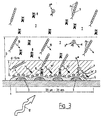
- the quantum yield at least one of the two luminescent systems 9 and 9 * is outside a distance d 15 nm (area of the luminophore / island coupling) low (represented by the Arrows 10 and 11) and increases sharply within the distance d (see arrows 10 'and 11'). It However, it is also possible for at least one of the two luminescent systems 9, 9 * forms an exciplex, d. H. has two spatially closely adjacent molecules, which over have common excitation and emission spectra. The electron spectrum of the Exciplex changes in the vicinity of the island layer, which also changes the emission spectrum changes significantly.
- the intensity of the luminescent radiation of both luminescent Systems 9 and 9 * are detected by a detection device 13, in one device 14 performed a spectral analysis of the emission spectrum or the ratio of the both intensities is determined.
- the ratio obtained or spectral changes are a measure of the concentration of analyte 8 in sample 7.
- the first luminescent system 9 has a biorecognitive molecule, which is labeled with a luminophore, preferably fluorophore F 1 , and which is able to couple to the analyte 8.
- the second luminescent system 9 * has two coupled luminophores or fluorophores A and B, which likewise mark a biorecognitive molecule, which, however, couples directly to the biorecognitive layer 4.
- the second luminescent system 9 * could also have a simple luminescent marking; it would only have to be ensured that the two luminophores are distinguishable for the detection and evaluation device 13, 14 and at least one of the two luminescent systems 9, 9 * undergoes a measurable change in the vicinity of the island layer.
- the coupling between the two luminophores A and B in the vicinity of the island layer could be canceled, as a result of which the luminescence quenching ceases to increase the intensity of the luminescence radiation (see arrow 11).
- luminescence amplification can also occur in the vicinity of the island layer 4, but a luminophore F 1 could also be used, the intensity of which does not change in the vicinity of the island layer, in which case the luminescent system 9 is used only as a reference variable would.
- the first luminescent system 9 consists of two coupled luminophores F 2 and F 3 , and the second luminescent system 9 * with a luminophore C. is marked
- the luminescent system 9 consists of a plurality of luminophores F 4 , which have a spatial density which leads to strong self-quenching. The self-quenching is canceled within the distance d (area of the luminophore, island coupling), so that the intensity of the luminescent radiation increases.
- d area of the luminophore, island coupling
- the first luminescent system 9 consists of a labeled antibody 15, which is attached to the analyte 8 via a detection antibody 16 docks.
- a similar construction is also possible for the second luminescent system 9 *, wherein the detection antibody or reference antibody via at least one luminescence-labeled Antibody has and docked directly to the biorecognitive layer 4.
Landscapes
- Health & Medical Sciences (AREA)
- Immunology (AREA)
- Life Sciences & Earth Sciences (AREA)
- Chemical & Material Sciences (AREA)
- Physics & Mathematics (AREA)
- Analytical Chemistry (AREA)
- Biochemistry (AREA)
- General Health & Medical Sciences (AREA)
- General Physics & Mathematics (AREA)
- Pathology (AREA)
- Engineering & Computer Science (AREA)
- Hematology (AREA)
- Urology & Nephrology (AREA)
- Nuclear Medicine, Radiotherapy & Molecular Imaging (AREA)
- Biomedical Technology (AREA)
- Molecular Biology (AREA)
- Optics & Photonics (AREA)
- Cell Biology (AREA)
- Microbiology (AREA)
- Biotechnology (AREA)
- Chemical Kinetics & Catalysis (AREA)
- Food Science & Technology (AREA)
- Medicinal Chemistry (AREA)
- Investigating, Analyzing Materials By Fluorescence Or Luminescence (AREA)
Description
- dass entweder zumindest eines der beiden lumineszierenden Systeme zwei gekoppelte Moleküle aufweist, von welchen zumindest eines ein Luminophor ist und das andere die Lumineszenz des Luminophors löscht, wobei die Lumineszenzlöschung in der Nähe der Inselschicht aufgehoben ist;
- oder dass zumindest eines der beiden lumineszierenden Systeme einen Luminophor aufweist, dessen Moleküle eine hohe räumliche Dichte aufweisen, welche zu starker Eigenquenchung führt, wobei die Eigenquenchung in der Nähe der Inselschicht aufgehoben ist;
- oder dass zumindest eines der beiden lumineszierenden Systeme zwei räumlich eng benachbarte Moleküle aufweist, welche über gemeinsame Anregungs- und Emissionsspektren verfügen, wobei sich die spektrale Verteilung der Emissionsstrahlung in der Nähe der Inselschicht signifikant ändern; sowie dass eine Einrichtung zur Erfassung der Intensität der Lumineszenzstrahlung beider lumineszierender Systeme vorgesehen ist.
| biorekognit. Schicht | Lumineszierendes System | |
| Coating Antikörper | Detektionsantikörper | Markierter Antikörper (bzw. Protein G) |
| Anti-CK-MB (monoklonal) | Anti-CK-B (monoklonal) | Protein G-Peroxidase |
| Anti-CK-BB (polyklonales Serum, rabbit) | Anti-CK-MM (polyklonales Serum, goat) | Anti-goat-Peroxidase |
| Anti-CK-MM (polyklonales Serum, goat) | Anti-CK-BB (polyklonales Serum rabbit) | Anti-rabbit-Peroxidase |
| Anti-CK-MB (monoklonal) | Anti-CK-BB (polyklonales Serum, rabbit) | Anti-rabbit-Peroxidase |
Um eine hinreichend rasche Ansprechzeit und gleichzeitig auch eine ausgeprägte Erhöhung der Lumineszenzintensität zu gewährleisten, wird mit Vorteil die Ausbildung so getroffen, dass die Dicke der immobilisierten, biorekognitiven Schicht kleiner als 20 nm, insbesondere kleiner als 15 nm gewählt wird. Zur Erhöhung der Lumineszenzausbeute soll die Dicke jedoch nicht unter 3 bis 5 nm betragen wobei prinzipiell Schichtdicken von 5 bis 15 nm optimal realisierbar sind.
- Amino-Triphenylmethanfarbstoffe: Malachitgrün, Fuchsin, Kristallviolett;
- Phthaleine: Fluorescein, Eosin
- homozyklische, aromatische Kohlenwasserstoffe: Pyrene, Perylene, Benzo(ghi)perylene, Coronene, Anthracene, Phenanthrene;
- heterozyklische, aromatische Kohlenwasserstoffe: Coumarine, Acridine, Carbazole, Qinoline, Triphenylamine, Imidazole, Porphyrine und -ketone, Übergangsmetallkomplexe mit Diimine-Liganden.
Claims (11)
- Optochemische Messanordnung mit einem Lumineszenzsensor (1) mit einer biorekognitiven Schicht (4) zur Messung der Konzentration zumindest eines Analyten (8) in einer Probe (7), wobei der Sensor (1) zumindest eine Inselschicht (2) aufweist, deren Inseln (3) aus elektrisch leitendem Material bestehen und die biorekognitive Schicht (4) auf oder mittels einer Zwischenschicht (5) an der Inselschicht (2) angeordnet ist, wobei weiters ein erstes lumineszierendes System (9) vorgesehen ist, welches den zu messenden Analyten (8) selektiv bindet, dadurch gekennzeichnet, dass die biorekognitive Schicht (4) sowohl den zu messenden Analyten (8) sowie ein zweites der Probe zusetzbares oder im Sensor (1) vorliegendes lumineszierendes System (9*) zumindest indirekt zu binden vermag, wobei sich das Emissionsspektrum zumindest eines der beiden lumineszierenden Systeme (9, 9*) in der Nähe der Inselschicht (2) signifikant ändert, derart,sowie dass eine Einrichtung (13, 14) zur Erfassung der Intensität der Lumineszenzstrahlung beider lumineszierender Systeme (9, 9*) vorgesehen ist.dass entweder zumindest eines der beiden lumineszierenden Systeme (9, 9*) zwei gekoppelte Moleküle aufweist, von welchen zumindest eines ein Luminophor ist und das andere die Lumineszenz des Luminophors löscht, wobei die Lumineszenzlöschung in der Nähe der Inselschicht (2) aufgehoben ist;oder dass zumindest eines der beiden lumineszierenden Systeme (9, 9*) einen Luminophor aufweist, dessen Moleküle eine hohe räumliche Dichte aufweisen, welche zu starker Eigenquenchung führt, wobei die Eigenquenchung in der Nähe der Inselschicht (2) aufgehoben ist;oder dass zumindest eines der beiden lumineszierenden Systeme (9, 9*) zwei räumlich eng benachbarte Moleküle aufweist, welche über gemeinsame Anregungs- und Emissionsspektren verfügen, wobei sich die spektrale Verteilung der Emissionsstrahlung in der Nähe der Inselschicht (2) signifikant ändern;
- Messanordnung nach Anspruch 1, dadurch gekennzeichnet, dass die biorekognitive Schicht (4) an oder über der Inselschicht (2) aus Proteinen, Lipiden, Lektinen, Nukleinsäuren oder artifiziellen Liganden besteht.
- Messanordnung nach Anspruch 1 oder 2, dadurch gekennzeichnet, dass die lumineszierenden Systeme (9, 9*) über zumindest einen lumineszenzmarkierten Antikörper verfügen, welcher einen den eigentlichen Analyten (8) bindenden Detektionsantikörper zu binden vermag.
- Messanordnung nach einem der Ansprüche 1 bis 3, dadurch gekennzeichnet, dass die beiden lumineszierenden Systeme (9, 9*) zumindest einen Fluorophor aus der Gruppe der Triphenylmethanfarbstoffe sowie der homo- und heterozyklischen, aromatischen Kohlenwasserstoffe aufweisen, vorzugsweiseAmino-Triphenylmethanfarbstoffe: Malachitgnin, Fuchsin, Kristallviolett;Phthaleine: Fluorescein, Eosin;homozyklische, aromatische Kohlenwasserstoffe: Pyrene, Perylene, Benzo(ghi)perylene, Coronene, Anthracene, Phenanthrene;heterozyklische, aromatische Kohlenwasserstoffe: Coumarine, Acridine, Carbazole, Qinoline, Triphenylamine, Imidazole, Porphyrine und -ketone, Übergangsmetallkomplexe mit Diimine-Liganden.
- Messanordnung nach einem der Ansprüche 1 bis 4, dadurch gekennzeichnet, dass die Inseln (3) der Inselschicht (2) aus Gold oder Silber besteht, und einen Durchmesser kleiner 100 nm, vorzugsweise kleiner 60 nm aufweisen.
- Verfahren zur Messung der Konzentration zumindest eines Analyten in einer Probe,
dadurch gekennzeichnet:a) dass die Probe mit einer biorekognitiven Schicht eines Sensors in Kontakt gebracht wird, welche auf oder in unmittelbarer Umgebung zumindest einer Inselschicht mit Inseln aus elektrisch leitendem Material angeordnet ist,b) dass die Probe mit einem ersten und einem zweiten lumineszierenden System in Kontakt gebracht wird,c) dass eine Bindung des ersten lumineszierenden Systems an den Analyten sowie die Bindung des Analyten an die biorekognitive Schicht ermöglicht wird,d) dass eine Bindung des zweiten lumineszierenden Systems an die biorekognitive Schicht ermöglicht wird, wobei zumindest eines der beiden lumineszierenden Systeme zwei gekoppelte Moleküle aufweist, von welchen zumindest eines ein Luminophor ist und das andere die Lumineszenz des Luminophors löscht, wobei die Lumineszenzlöschung in der Nähe der Inselschicht aufgehoben wird und sich das Emissionsspektrum zumindest eines der beiden lumineszierenden Systeme signifikant ändert,e) dass eine zur Anregung des ersten und zweiten lumineszierenden Systems geeignete Anregungsstrahlung in die zumindest eine Inselschicht eingestrahlt wird,f) dass die vom ersten und zweiten lumineszierenden System emittierte Lumineszenzstrahlung erfasst und aus den gewonnenen Messwerten auf die Analytkonzentration geschlossen wird. - Verfahren zur Messung der Konzentration zumindest eines Analyten in einer Probe,
dadurch gekennzeichnet:a) dass die Probe mit einer biorekognitiven Schicht eines Sensors in Kontakt gebracht wird, welche auf oder in unmittelbarer Umgebung zumindest einer Inselschicht mit Inseln aus elektrisch leitendem Material angeordnet ist,b) dass die Probe mit einem ersten und einem zweiten lumineszierenden System in Kontakt gebracht wird,c) dass eine Bindung des ersten lumineszierenden Systems an den Analyten sowie die Bindung des Analyten an die biorekognitive Schicht ermöglicht wird,d) dass eine Bindung des zweiten lumineszierenden Systems an die biorekognitive Schicht ermöglicht wird, wobei zumindest eines der beiden lumineszierenden Systeme einen Luminophor aufweist, dessen Moleküle eine hohe räumliche Dichte aufweisen, welche zu starker Eigenquenchung führt, wobei die Eigenquenchung in der Nähe der Inselschicht aufgehoben wird und sich das Emissionsspektrum zumindest eines der beiden lumineszierenden Systeme signifikant ändert,e) dass eine zur Anregung des ersten und zweiten lumineszierenden Systems geeignete Anregungsstrahlung in die zumindest eine Inselschicht eingestrahlt wird,f) dass die vom ersten und zweiten lumineszierenden System emittierte Lumineszenzstrahlung erfasst und aus den gewonnenen Messwerten auf die Analytkonzentration geschlossen wird. - Verfahren zur Messung der Konzentration zumindest eines Analyten in einer Probe,
dadurch gekennzeichnet:a) dass die Probe mit einer biorekognitiven Schicht eines Sensors in Kontakt gebracht wird, welche auf oder in unmittelbarer Umgebung zumindest einer Inselschicht mit Inseln aus elektrisch leitendem Material angeordnet ist,b) dass die Probe mit einem ersten und einem zweiten lumineszierenden System in Kontakt gebracht wird,c) dass eine Bindung des ersten lumineszierenden Systems an den Analyten sowie die Bindung des Analyten an die biorekognitive Schicht ermöglicht wird,d) dass eine Bindung des zweiten lumineszierenden Systems an die biorekognitive Schicht ermöglicht wird, wobei zumindest eines der beiden lumineszierenden Systeme zwei räumlich eng benachbarte Moleküle aufweist, welche über gemeinsame Anregungs- und Emissionsspektren verfügen, wodurch die spektrale Verteilung der Emissionsstrahlung in der Nähe der Inselschicht signifikant geändert wird,e) dass eine zur Anregung des ersten und zweiten lumineszierenden Systems geeignete Anlegungsstrahlung in die zumindest eine Inselschicht eingestrahlt wird,f) dass die vom ersten und zweiten lumineszierenden System emittierte Lumineszenzstrahlung erfasst und aus den gewonnenen Messwerten auf die Analytkonzentration geschlossen wird. - Verfahren nach einem der Ansprüche 6 bis 8, dadurch gekennzeichnet, dass in Punkt e) die Anregung des ersten und zweiten lumineszierenden Systems mit dem evaneszenten Anteil der Anregungsstrahlung erfolgt.
- Verfahren nach einem der Ansprüche 6 bis 9, dadurch gekennzeichnet, dass in Punkt f) die Lumineszenzintensität beider lumineszierender Systeme erfasst und aus dem Verhältnis beider Lumineszenzintensitäten die Analytkonzentration bestimmt wird.
- Verfahren nach einem der Ansprüche 6 bis 9, dadurch gekennzeichnet, dass in Punkt f) eine Spektralanalyse der emittierten Lumineszenzstrahlung zumindest eines lumineszierenden Systems durchgeführt und aus den spektralen Änderungen auf die Analytkonzentration geschlossen wird.
Priority Applications (3)
| Application Number | Priority Date | Filing Date | Title |
|---|---|---|---|
| DE59607877T DE59607877D1 (de) | 1996-03-13 | 1996-03-13 | Optochemisches Verfahren und Messanordnung zur Messung der Konzentration eines Analyten |
| EP96890047A EP0795752B1 (de) | 1996-03-13 | 1996-03-13 | Optochemisches Verfahren und Messanordnung zur Messung der Konzentration eines Analyten |
| JP9058211A JP2826725B2 (ja) | 1996-03-13 | 1997-03-13 | 光化学測定装置および測定方法 |
Applications Claiming Priority (1)
| Application Number | Priority Date | Filing Date | Title |
|---|---|---|---|
| EP96890047A EP0795752B1 (de) | 1996-03-13 | 1996-03-13 | Optochemisches Verfahren und Messanordnung zur Messung der Konzentration eines Analyten |
Publications (2)
| Publication Number | Publication Date |
|---|---|
| EP0795752A1 EP0795752A1 (de) | 1997-09-17 |
| EP0795752B1 true EP0795752B1 (de) | 2001-10-10 |
Family
ID=8226195
Family Applications (1)
| Application Number | Title | Priority Date | Filing Date |
|---|---|---|---|
| EP96890047A Expired - Lifetime EP0795752B1 (de) | 1996-03-13 | 1996-03-13 | Optochemisches Verfahren und Messanordnung zur Messung der Konzentration eines Analyten |
Country Status (3)
| Country | Link |
|---|---|
| EP (1) | EP0795752B1 (de) |
| JP (1) | JP2826725B2 (de) |
| DE (1) | DE59607877D1 (de) |
Families Citing this family (1)
| Publication number | Priority date | Publication date | Assignee | Title |
|---|---|---|---|---|
| DE102004027957A1 (de) * | 2004-06-08 | 2005-12-29 | Carl Zeiss Jena Gmbh | Verfahren und Anordnung zur Untersuchung der Wechselwirkung von Biomolekülen |
Family Cites Families (9)
| Publication number | Priority date | Publication date | Assignee | Title |
|---|---|---|---|---|
| US4174384A (en) * | 1975-06-30 | 1979-11-13 | Syva Company | Fluorescence quenching with immunological pairs in immunoassays |
| GB2057685B (en) * | 1979-03-19 | 1983-12-21 | Int Diagnostic Tech | Double tagged immunoassay |
| GB8423204D0 (en) * | 1984-09-14 | 1984-10-17 | Comtech Res Unit | Assay technique and equipment |
| WO1988001058A1 (en) * | 1986-08-06 | 1988-02-11 | Roger Philip Ekins | Determination of analyte concentration using two labelling markers |
| GB8827853D0 (en) * | 1988-11-29 | 1988-12-29 | Ares Serono Res & Dev Ltd | Sensor for optical assay |
| DE69228421D1 (de) * | 1991-07-22 | 1999-03-25 | Kloehn Instr Ltd | Substrat für oberflächenverstärkte verfahren und für spezifische verfahren hergestellte substrate |
| AU662169B2 (en) * | 1991-10-31 | 1995-08-24 | Minnesota Mining And Manufacturing Company | Exciplex-based sensors and methods for sensing |
| GB9326451D0 (en) * | 1993-12-24 | 1994-02-23 | Multilyte Ltd | Binding assay |
| AT403746B (de) * | 1994-04-12 | 1998-05-25 | Avl Verbrennungskraft Messtech | Optochemischer sensor sowie verfahren zu seiner herstellung |
-
1996
- 1996-03-13 EP EP96890047A patent/EP0795752B1/de not_active Expired - Lifetime
- 1996-03-13 DE DE59607877T patent/DE59607877D1/de not_active Expired - Fee Related
-
1997
- 1997-03-13 JP JP9058211A patent/JP2826725B2/ja not_active Expired - Lifetime
Also Published As
| Publication number | Publication date |
|---|---|
| JP2826725B2 (ja) | 1998-11-18 |
| JPH09329603A (ja) | 1997-12-22 |
| DE59607877D1 (de) | 2001-11-15 |
| EP0795752A1 (de) | 1997-09-17 |
Similar Documents
| Publication | Publication Date | Title |
|---|---|---|
| EP0732583B1 (de) | Optochemischer Fluoreszenzsensor sowie ein Verfahren zur Messung der Konzentration zumindest eines Analyten in einer Probe | |
| DE69302273T2 (de) | Verfahren zur verbesserung der messgenauigkeit in messverfahren, die evanescent-wave-biosensoren verwenden | |
| EP1000345B1 (de) | Verfahren und vorrichtung zur referenzierung von fluoreszenzintensitätssignalen | |
| EP1451586B1 (de) | Verfahren und vorrichtung zur bestimmung der konzentration von in einer zu untersuchenden probe enthaltenen liganden | |
| DE60034315T2 (de) | Chemisches und biochemisches nachweisverfahren und vorrichtung | |
| EP1966594B1 (de) | Vorrichtung und verfahren zum nachweis von mykotoxinen | |
| DE4210970C2 (de) | Verfahren zur simultanen optischen qualitativen und quantitativen Erfassung von verschiedenen mit Fluorochromen oder Fluorogenen markierten Molekülen eines Gemisches mittels Laserspektroskopie | |
| DE102019120455B4 (de) | Verfahren zur simultanen Bestimmung verschiedener Analyte in einer Umweltprobe, gestützt auf Kern/Schale-Mikropartikel | |
| DE69411189T2 (de) | Rücktitrations-messverfahren unter verwendung von zweiverschiedenen markern | |
| EP1485717B1 (de) | Verfahren zur quantitativen bestimmung mehrerer analyten | |
| EP0397641B1 (de) | Verfahren zur quantitativen Bestimmung zumindest eines chemischen Parameters eines Probenmediums | |
| WO1993021530A1 (de) | Verfahren und vorrichtung zur empfindlichkeits- und selektivitätssteigerung bei immuno-assays, molekül-rezeptor-, dna-komplementär-dna- und gast-wirtsmolekül-wechselwirkungs-assays | |
| DE19903576C2 (de) | Quantitative Bestimmung von Analyten in einem heterogenen System | |
| DE69129035T2 (de) | Testverfahren | |
| DE3784465T2 (de) | Bestimmung von analyt-konzentration mit zwei etiketten. | |
| DE19829657A1 (de) | Verfahren und Vorrichtung zur Referenzierung von Fluoreszenzintensitätssignalen | |
| DE102020134517A1 (de) | Optisches Sensorelement, optischer pH-Sensor sowie Verfahren zur Funktionsüberwachung eines optischen pH-Sensors | |
| DE4301005A1 (de) | Verfahren und Vorrichtung zur Bewertung der Fitness von Biopolymeren | |
| DE19822452C2 (de) | Verfahren zur Bestimmung der Dichte lumineszierender Moleküle an einer Oberfläche, Verwendung des Verfahrens zur Bestimmung von Adsorptions- und Bindungskinetiken und Gleichgewichts- und Bindungskonstanten von Molekülen an einer Oberfläche durch Lumineszenz-Messungen und Vorrichtung zur Durchführung des Verfahrens | |
| DE19943704C1 (de) | Affinitätssensor zum Nachweis biologischer und/oder chemischer Spezies und dessen Verwendung | |
| EP0795752A1 (de) | Optochemisches Verfahren und Messanordnung zur Messung der Konzentration eines Analyten | |
| EP1511992A1 (de) | Verfahren und vorrichtung zum detektieren mindestens eines lumineszenz-stoffs | |
| DE102004051830B4 (de) | Multifunktionales Referenzsystem bei Analytbestimmungen durch Fluoreszenz | |
| DE102005018337A1 (de) | Mikrooptisches Detektionssystem und Verfahren zur Bestimmung temperaturabhängiger Parameter von Analyten | |
| DE102019130890B3 (de) | Verfahren zum Bestimmen des physiologischen Belastungszustandes in einem Individuum und Vorrichtung hierfür |
Legal Events
| Date | Code | Title | Description |
|---|---|---|---|
| PUAI | Public reference made under article 153(3) epc to a published international application that has entered the european phase |
Free format text: ORIGINAL CODE: 0009012 |
|
| AK | Designated contracting states |
Kind code of ref document: A1 Designated state(s): DE FR GB |
|
| 17P | Request for examination filed |
Effective date: 19971029 |
|
| 17Q | First examination report despatched |
Effective date: 20000509 |
|
| GRAG | Despatch of communication of intention to grant |
Free format text: ORIGINAL CODE: EPIDOS AGRA |
|
| GRAG | Despatch of communication of intention to grant |
Free format text: ORIGINAL CODE: EPIDOS AGRA |
|
| GRAH | Despatch of communication of intention to grant a patent |
Free format text: ORIGINAL CODE: EPIDOS IGRA |
|
| GRAH | Despatch of communication of intention to grant a patent |
Free format text: ORIGINAL CODE: EPIDOS IGRA |
|
| RAP1 | Party data changed (applicant data changed or rights of an application transferred) |
Owner name: F. HOFFMANN-LA ROCHE AG |
|
| GRAA | (expected) grant |
Free format text: ORIGINAL CODE: 0009210 |
|
| RAP1 | Party data changed (applicant data changed or rights of an application transferred) |
Owner name: F.HOFFMANN-LA ROCHE AG |
|
| AK | Designated contracting states |
Kind code of ref document: B1 Designated state(s): DE FR GB |
|
| GBT | Gb: translation of ep patent filed (gb section 77(6)(a)/1977) |
Effective date: 20011015 |
|
| REF | Corresponds to: |
Ref document number: 59607877 Country of ref document: DE Date of ref document: 20011115 |
|
| ET | Fr: translation filed | ||
| REG | Reference to a national code |
Ref country code: GB Ref legal event code: IF02 |
|
| PGFP | Annual fee paid to national office [announced via postgrant information from national office to epo] |
Ref country code: FR Payment date: 20020312 Year of fee payment: 7 |
|
| PGFP | Annual fee paid to national office [announced via postgrant information from national office to epo] |
Ref country code: GB Payment date: 20020313 Year of fee payment: 7 |
|
| PGFP | Annual fee paid to national office [announced via postgrant information from national office to epo] |
Ref country code: DE Payment date: 20020327 Year of fee payment: 7 |
|
| PLBE | No opposition filed within time limit |
Free format text: ORIGINAL CODE: 0009261 |
|
| STAA | Information on the status of an ep patent application or granted ep patent |
Free format text: STATUS: NO OPPOSITION FILED WITHIN TIME LIMIT |
|
| 26N | No opposition filed | ||
| PG25 | Lapsed in a contracting state [announced via postgrant information from national office to epo] |
Ref country code: GB Free format text: LAPSE BECAUSE OF NON-PAYMENT OF DUE FEES Effective date: 20030313 |
|
| PG25 | Lapsed in a contracting state [announced via postgrant information from national office to epo] |
Ref country code: DE Free format text: LAPSE BECAUSE OF NON-PAYMENT OF DUE FEES Effective date: 20031001 |
|
| GBPC | Gb: european patent ceased through non-payment of renewal fee |
Effective date: 20030313 |
|
| PG25 | Lapsed in a contracting state [announced via postgrant information from national office to epo] |
Ref country code: FR Free format text: LAPSE BECAUSE OF NON-PAYMENT OF DUE FEES Effective date: 20031127 |
|
| REG | Reference to a national code |
Ref country code: FR Ref legal event code: ST |