EP0793392B1 - Method and apparatus for the transmission and the reception of three-dimensional television signals of stereoscopic images - Google Patents
Method and apparatus for the transmission and the reception of three-dimensional television signals of stereoscopic images Download PDFInfo
- Publication number
- EP0793392B1 EP0793392B1 EP97103112A EP97103112A EP0793392B1 EP 0793392 B1 EP0793392 B1 EP 0793392B1 EP 97103112 A EP97103112 A EP 97103112A EP 97103112 A EP97103112 A EP 97103112A EP 0793392 B1 EP0793392 B1 EP 0793392B1
- Authority
- EP
- European Patent Office
- Prior art keywords
- information
- dimensional
- dimensional information
- stereoscopic image
- stereoscopic
- Prior art date
- Legal status (The legal status is an assumption and is not a legal conclusion. Google has not performed a legal analysis and makes no representation as to the accuracy of the status listed.)
- Expired - Lifetime
Links
Images



Classifications
-
- H—ELECTRICITY
- H04—ELECTRIC COMMUNICATION TECHNIQUE
- H04N—PICTORIAL COMMUNICATION, e.g. TELEVISION
- H04N5/00—Details of television systems
- H04N5/44—Receiver circuitry for the reception of television signals according to analogue transmission standards
- H04N5/445—Receiver circuitry for the reception of television signals according to analogue transmission standards for displaying additional information
-
- H—ELECTRICITY
- H04—ELECTRIC COMMUNICATION TECHNIQUE
- H04N—PICTORIAL COMMUNICATION, e.g. TELEVISION
- H04N13/00—Stereoscopic video systems; Multi-view video systems; Details thereof
-
- H—ELECTRICITY
- H04—ELECTRIC COMMUNICATION TECHNIQUE
- H04N—PICTORIAL COMMUNICATION, e.g. TELEVISION
- H04N13/00—Stereoscopic video systems; Multi-view video systems; Details thereof
- H04N13/10—Processing, recording or transmission of stereoscopic or multi-view image signals
- H04N13/106—Processing image signals
- H04N13/111—Transformation of image signals corresponding to virtual viewpoints, e.g. spatial image interpolation
- H04N13/117—Transformation of image signals corresponding to virtual viewpoints, e.g. spatial image interpolation the virtual viewpoint locations being selected by the viewers or determined by viewer tracking
-
- H—ELECTRICITY
- H04—ELECTRIC COMMUNICATION TECHNIQUE
- H04N—PICTORIAL COMMUNICATION, e.g. TELEVISION
- H04N13/00—Stereoscopic video systems; Multi-view video systems; Details thereof
- H04N13/10—Processing, recording or transmission of stereoscopic or multi-view image signals
- H04N13/194—Transmission of image signals
-
- H—ELECTRICITY
- H04—ELECTRIC COMMUNICATION TECHNIQUE
- H04N—PICTORIAL COMMUNICATION, e.g. TELEVISION
- H04N13/00—Stereoscopic video systems; Multi-view video systems; Details thereof
- H04N13/20—Image signal generators
- H04N13/204—Image signal generators using stereoscopic image cameras
- H04N13/239—Image signal generators using stereoscopic image cameras using two two-dimensional [2D] image sensors having a relative position equal to or related to the interocular distance
-
- H—ELECTRICITY
- H04—ELECTRIC COMMUNICATION TECHNIQUE
- H04N—PICTORIAL COMMUNICATION, e.g. TELEVISION
- H04N13/00—Stereoscopic video systems; Multi-view video systems; Details thereof
- H04N13/20—Image signal generators
- H04N13/204—Image signal generators using stereoscopic image cameras
- H04N13/243—Image signal generators using stereoscopic image cameras using three or more two-dimensional [2D] image sensors
-
- H—ELECTRICITY
- H04—ELECTRIC COMMUNICATION TECHNIQUE
- H04N—PICTORIAL COMMUNICATION, e.g. TELEVISION
- H04N13/00—Stereoscopic video systems; Multi-view video systems; Details thereof
- H04N13/20—Image signal generators
- H04N13/275—Image signal generators from three-dimensional [3D] object models, e.g. computer-generated stereoscopic image signals
- H04N13/279—Image signal generators from three-dimensional [3D] object models, e.g. computer-generated stereoscopic image signals the virtual viewpoint locations being selected by the viewers or determined by tracking
-
- H—ELECTRICITY
- H04—ELECTRIC COMMUNICATION TECHNIQUE
- H04N—PICTORIAL COMMUNICATION, e.g. TELEVISION
- H04N13/00—Stereoscopic video systems; Multi-view video systems; Details thereof
- H04N13/10—Processing, recording or transmission of stereoscopic or multi-view image signals
- H04N13/106—Processing image signals
- H04N13/122—Improving the three-dimensional [3D] impression of stereoscopic images by modifying image signal contents, e.g. by filtering or adding monoscopic depth cues
-
- H—ELECTRICITY
- H04—ELECTRIC COMMUNICATION TECHNIQUE
- H04N—PICTORIAL COMMUNICATION, e.g. TELEVISION
- H04N13/00—Stereoscopic video systems; Multi-view video systems; Details thereof
- H04N13/10—Processing, recording or transmission of stereoscopic or multi-view image signals
- H04N13/106—Processing image signals
- H04N13/161—Encoding, multiplexing or demultiplexing different image signal components
-
- H—ELECTRICITY
- H04—ELECTRIC COMMUNICATION TECHNIQUE
- H04N—PICTORIAL COMMUNICATION, e.g. TELEVISION
- H04N13/00—Stereoscopic video systems; Multi-view video systems; Details thereof
- H04N13/10—Processing, recording or transmission of stereoscopic or multi-view image signals
- H04N13/189—Recording image signals; Reproducing recorded image signals
-
- H—ELECTRICITY
- H04—ELECTRIC COMMUNICATION TECHNIQUE
- H04N—PICTORIAL COMMUNICATION, e.g. TELEVISION
- H04N13/00—Stereoscopic video systems; Multi-view video systems; Details thereof
- H04N13/20—Image signal generators
- H04N13/204—Image signal generators using stereoscopic image cameras
- H04N13/207—Image signal generators using stereoscopic image cameras using a single two-dimensional [2D] image sensor
- H04N13/221—Image signal generators using stereoscopic image cameras using a single two-dimensional [2D] image sensor using the relative movement between cameras and objects
-
- H—ELECTRICITY
- H04—ELECTRIC COMMUNICATION TECHNIQUE
- H04N—PICTORIAL COMMUNICATION, e.g. TELEVISION
- H04N13/00—Stereoscopic video systems; Multi-view video systems; Details thereof
- H04N13/20—Image signal generators
- H04N13/257—Colour aspects
-
- H—ELECTRICITY
- H04—ELECTRIC COMMUNICATION TECHNIQUE
- H04N—PICTORIAL COMMUNICATION, e.g. TELEVISION
- H04N13/00—Stereoscopic video systems; Multi-view video systems; Details thereof
- H04N13/20—Image signal generators
- H04N13/261—Image signal generators with monoscopic-to-stereoscopic image conversion
-
- H—ELECTRICITY
- H04—ELECTRIC COMMUNICATION TECHNIQUE
- H04N—PICTORIAL COMMUNICATION, e.g. TELEVISION
- H04N13/00—Stereoscopic video systems; Multi-view video systems; Details thereof
- H04N13/20—Image signal generators
- H04N13/286—Image signal generators having separate monoscopic and stereoscopic modes
- H04N13/289—Switching between monoscopic and stereoscopic modes
-
- H—ELECTRICITY
- H04—ELECTRIC COMMUNICATION TECHNIQUE
- H04N—PICTORIAL COMMUNICATION, e.g. TELEVISION
- H04N13/00—Stereoscopic video systems; Multi-view video systems; Details thereof
- H04N13/20—Image signal generators
- H04N13/296—Synchronisation thereof; Control thereof
-
- H—ELECTRICITY
- H04—ELECTRIC COMMUNICATION TECHNIQUE
- H04N—PICTORIAL COMMUNICATION, e.g. TELEVISION
- H04N13/00—Stereoscopic video systems; Multi-view video systems; Details thereof
- H04N13/30—Image reproducers
-
- H—ELECTRICITY
- H04—ELECTRIC COMMUNICATION TECHNIQUE
- H04N—PICTORIAL COMMUNICATION, e.g. TELEVISION
- H04N19/00—Methods or arrangements for coding, decoding, compressing or decompressing digital video signals
- H04N19/50—Methods or arrangements for coding, decoding, compressing or decompressing digital video signals using predictive coding
- H04N19/597—Methods or arrangements for coding, decoding, compressing or decompressing digital video signals using predictive coding specially adapted for multi-view video sequence encoding
-
- H—ELECTRICITY
- H04—ELECTRIC COMMUNICATION TECHNIQUE
- H04N—PICTORIAL COMMUNICATION, e.g. TELEVISION
- H04N5/00—Details of television systems
- H04N5/44—Receiver circuitry for the reception of television signals according to analogue transmission standards
Definitions
- the present invention relates to a TV broadcasting system and, more particularly to a system which can display a desired object on the screen from various view points, that is, from arbitrary view points which a viewer demands.
- the video image of the stereoscopic object is taken by a video camera rotating the stereoscopic object with the video camera's view point fixed to display the video image on the TV screen.
- the video image of the stereoscopic object is taken by the video camera from various angles with the stereoscopic object fixed to display the video image sequentially or dividedly on the screen.
- the video images from view points which are predetermined by the broadcasting station are transmitted sequentially in a time sequence which is predetermined by the broadcasting station.
- Some cable TVs provide a service to viewers as follows. For example, in a sport program, video images taken from various angles are broadcasted through different channels respectively, among which, the viewer can choose one with the video image taken from the angle which the viewer demands, thereby the viewer can choose the angle and the view point in watching the video image of one program.
- the viewer can only choose one among video images taken from a plurality of predetermined angles and view points.
- the viewer can neither see the stereoscopic object from an angle or a view point which the viewer demands nor see the same from various angles and view points in a desired sequence continuously through the same channel.
- a method of transmitting TV signals comprises transmitting as TV signals through one channel: three-dimensional information representing a three-dimensional configuration of a stereoscopic image of the object to be transmitted; image information of the stereoscopic object obtained when the stereoscopic image of the object to be transmitted is viewed from a plurality of directions; and two-dimensional information indicating a correspondence between points in a surface of the object represented by the three-dimensional information and the stereoscopic image information of the object.
- an apparatus for transmitting TV signals through one channel comprises: a three-dimensional information extracting means for extracting three-dimensional configuration information representing a three-dimensional configuration of the stereoscopic image of the object from stereoscopic information of the object viewed from respective direction among a plurality of directions; an image information extracting means for extracting stereoscopic image information of the object viewed from respective directions among the plurality of directions; and a two-dimensional information extracting means for extracting two-dimensional information indicating a correspondence between points in a surface of the stereoscopic image of the object represented by the three-dimensional information and the stereoscopic image information of the object.
- data of the stereoscopic image of the object is produced by a computer, and the three-dimensional information extracting means, the image information extracting means, and the two-dimensional information extracting means produce the three-dimensional information, the stereoscopic image information and the two-dimensional information of the object with the use of the data of the stereoscopic image of the object produced by the computer.
- a method of receiving TV signals through one channel comprises: storing three-dimensional information representing a three-dimensional configuration of the stereoscopic image of the object, stereoscopic image information of the object obtained when the stereoscopic image of the object to be transmitted is viewed from a plurality of directions and two-dimensional information indicating a correspondence between points in a surface of the stereoscopic object represented by the three-dimensional information and the stereoscopic image information of the object, which have been transmitted as TV signals; and upon receipt of an external instruction signal, selecting required data among the stored data, followed by operation and display of a stereoscopic video image of the object from an angle determined by the instruction signal.
- an apparatus for receiving TV signals through one channel comprises a data storage means for storing three-dimensional information representing a three-dimensional configuration of a stereoscopic image of the object, image information of the stereoscopic object obtained when the stereoscopic image of the object to be transmitted is viewed from a plurality of directions and two-dimensional information indicating a correspondence between points in a surface of the stereoscopic object represented by the three-dimensional information and the stereoscopic image information of the object, which have been transmitted as TV signals; and a data operation and display means for selecting required data among the stored data, followed by operation and display, upon receipt of an external instruction signal, to display a stereoscopic video image of the object from an angle determined by the instruction signal.
- a method of transmitting and receiving TV signals through one channel comprises: transmitting three-dimensional information representing a three-dimensional configuration of a stereoscopic image of object to be transmitted, image information of the stereoscopic image of the object obtained when the stereoscopic object to be transmitted is viewed from a plurality of directions and two-dimensional information indicating a correspondence between points in a surface of the stereoscopic image of the object represented by the three-dimensional information and the stereoscopic image information of the object, as TV signals through one channel; upon receipt of the transmitted TV signals, storing the three-dimensional information, the image information and the two-dimensional information of the object; and upon receipt of an external instruction signal, selecting required data among the stored data, followed by operation and display, to display a stereoscopic video image of the object from an angle determined by the instruction signal.
- an apparatus for transmitting and receiving TV signals through one channel comprises a three-dimensional information extracting means for extracting a three-dimensional configuration information representing a three-dimensional configuration of a stereoscopic image of an object from stereoscopic information of the object viewed from a plurality of directions ; an image information extracting means for extracting respective stereoscopic image information of the object viewed from a respective direction among a plurality of directions; and two-dimensional information extracting means for extracting two-dimensional information indicating a correspondence between points in a surface of the stereoscopic image of the object represented by the three-dimensional information and the stereoscopic image information of the object, in a transmission section, and further comprises, in a receiving means a data storage means for storing the three-dimensional information, the stereoscopic image information and the two-dimensional information; and a data operation and display means for selecting required data among the stored data, followed by operation and display, upon receipt of an external instruction signal, to display a stereoscopic video image of
- Figure 1 is a block diagram illustrating a construction of an apparatus for transmitting/receiving TV signals according to an embodiment 1 of the present invention.
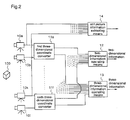
- Figure 2 illustrates a detailed construction of a video signal producing means in the apparatus for transmitting/receiving TV signals.
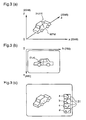
- Figure 3 illustrates an operation of a video signal receiving means in the apparatus for transmitting/receiving TV signals.
- Figure 4 is a flow chart illustrating a flow of image processing in an image processing means 50 in the video signal receiving means in the apparatus for transmitting/receiving TV signals.
- FIG. 5 illustrates a detailed construction of the video signal producing means in the apparatus for transmitting/receiving TV signals according to an embodiment 2 of the present invention.
- Figure 1 is a block diagram illustrating a construction of an apparatus for transmitting/receiving TV signals according to an embodiment 1.
- reference numeral 1 designates a video signal producing means provided in a broadcasting station of TV broadcast.
- Numeral 2 designates a video signal receiving section provided in a receiving station of the TV broadcast (a TV receiver).
- Figure 2 illustrates a detailed construction of the video signal producing means 1 provided in the broadcasting station.
- reference characters 10a, 10b-10k and 101 designate video cameras for taking video images of a stereoscopic object 100 from six directions, that is, front, rear, top, bottom, left-side and right-side views, at the same time.
- Reference characters 11a-11f designate first to sixth three-dimensional coordinate converters for obtaining each stereoscopic information of the object 100 as three-dimensional coordinates from each video image taken by each pair of adjacent video cameras among video cameras 10a, 10b-10k and 10l.
- Reference numeral 12 designates a two-dimensional information operating means for operating the two-dimensional information of the object 100 from outputs of the first to sixth three-dimensional coordinate converters 11a-11f.
- Reference numeral 13 designates a three-dimensional information operating means for operating three-dimensional information of the object 100 from outputs of the first to sixth three-dimensional coordinate converters 11a-11f.
- Reference numeral 14 designates a still picture information extracting means for extracting still picture information of the stereoscopic object 100 from an output of each one video camera 10a-10k among the adjacent pair of video cameras among the video cameras 10a, 10b-10k and 10l.
- the video signal receiving section 2 provided in the TV receiver comprises a receiving antenna 20 for receiving a transmitted video signal; a decoding section 21 for decoding the video signal and a character broadcasting signal from the transmitted signal; a data storage means 22 for storing the two-dimensional information, the three-dimensional information, and texture image data of the stereoscopic object 100; an image processing section 50 including a geometry processing means 23, a shading processing means 24, a texture mapping processing means 25 and a rendering processing means 26 for producing a three-dimensional video image; a frame memory 27 and a display means 28.
- reference characters 10a-10l designate video cameras, in which adjacent ones are disposed in pairs such as 10a-10b, 10c-10d, 10e-10f, 10g -10h, 10i-10j, and 10k-10l.
- a pair of cameras take one view of the video image of the object 100, among six views, that is, front, rear, top, bottom, left-side and right-side views. From the image output of each pair of video cameras, the three-dimensional information in one view of the object, that is, concave-convex information is extracted using a technique such as a stereo technique.
- the pair of video cameras 10a and 10b are disposed to view the object 100 from different angles, respectively.
- Two video signals from these different angles are input to the first three-dimensional coordinate converter 11a, in which the two video signals are processed using the stereo technique to produce the concave-convex information in one view of the stereoscopic object 100.
- the three-dimensional information of the object 100 is obtained from the plurality of concave-convex information of the object 100 obtained using the plurality of video cameras.
- stereoscopic image information in one view of the object 100 (still picture information) is extracted from the video images taken by the pair of video cameras 10a, 10b.
- the two-dimensional information indicating a correspondence between the three-dimensional information and the above-described image information of the object 100 is obtained by the operation of the two-dimensional coordinate information operating means 12.
- the three-dimensional information, the stereoscopic image information, and the two-dimensional information of the object 100 are obtained from the outputs of video images in six views of the object using the six pairs of video cameras.
- the three-dimensional information of the object 100 obtained as described above is transmitted in radio waves from the video signal producing means 1.
- the three-dimensional information of the object is managed as a set of information including id (identification number), an x-axis coordinate, a y-axis coordinate and a z-axis coordinate, i.e., as the three-dimensional information (id, x, y, z).
- the x-axis, y-axis and z-axis coordinates respectively are transmitted as data within 2048 pixels
- the two-dimensional information is managed as a set of information including id, x-axis and y-axis coordinates (h, v), i.e., the two dimensional information (id, h, v).
- the still picture information in six views of the stereoscopic object is obtained by extraction from the image output of one video camera among the pair of video cameras in the still picture extracting means 14, and this still picture information is transmitted as normal TV video signals.
- TV signals including the still picture information, the two-dimensional information, and the three-dimensional information are received by the antenna 20 in the video signal receiving means 2, and are decoded in the decoding section 21.
- the video signal input to the decoding section 21 is decoded into a normal video signal and character information by the character broadcasting decoding means 21a.
- the character information is transmitted to a three-dimensional data analyzing means 21b.
- the three-dimensional information (id, x, y, z) and the two-dimensional information (id, h, v) of the object 100 produced in the video signal producing means 1 are reproduced and output to the data storage means 22 comprising an HDD or the like, to be stored therein.
- the still picture information included in TV signals is reproduced in a still picture capturing means 21c and stored in the data storage means 22 as texture image data.
- the image processing means 50 performs following image processing using the image data stored in the data storage means 22.
- the geometry processing means 23 computes a view from a point corresponding to the id, upon receipt of an user input and based on an initial value of display angle in reproducing the image in the receiver corresponding to one coordinate data id of the transmitted three-dimensional information (id, x, y, z). Further, the geometry processing means 23 computes luminance of each 1024 point determined by a distance between a light source and each of the 1024 points, thereby a so-called Wire Frame Model (WFM) is produced as illustrated in figure 3(a).
- WFM Wire Frame Model
- step S2 illustrated in figure 4 in the shading processing means 24, luminance of each polygon plane is obtained from polygon (plane) normal vector obtained referring to the three-dimensional information (id, x, y, z) (figure 3(a)) and the angle of the light source.
- step S3 illustrated in figure 4 in the texture mapping processing means 25, a texture mapping is performed in such a manner that the texture image data is read from the data storage means 22 and a pattern (video, texture) is mapped to a surface of what is obtained by the luminance information which is obtained in the shading processing means 24 being added to the Wire Frame Model which is obtained in the geometry processing means 23.
- a pixel conversion is executed to the image data output from the texture mapping means 25 in accordance with resolution and gradation of a display device (CRT, printer or the like) and the image data by rendering is written into the frame memory 27.
- the image data written into the frame memory 27 is subjected to D/A conversion in the display means 28, and is displayed on the display device such as CRT.
- the geometry processing means 23 has capability of producing and displaying the video image viewed from the angle and the view point according to the display initial value which is set in the receiver with respect to the image information of the object 100 stored in the data storage means 22 as well as capability of converting the video image into a video image from an angle and a view point which the viewer arbitrarily demands to display the same. Therefore, upon receipt of an external user input, the geometry processing means 23 can perform processing of steps S1 to S4 illustrated in figure 4 from an angle indicated by the user input to produce the video image of the configuration of the object 100 viewed from the angle and the view point indicated by the user input to display the same on the screen.
- icons 31 each for indicating a rotation direction are displayed at a corner of the screen.
- the video stereoscopic image of the object may be displayed continuously changing the view point of the object. Further, when a higher-speed operation is possible, the video image of a moving object may be displayed changing view points.
- the method of transmitting/receiving TV signals comprises extracting three-dimensional information obtained from the stereoscopic information of the six-view images of the object 100, the two-dimensional information indicating a correspondence between the three-dimensional information and the image information, and the video information (still picture information), transmitting these information as video signals and character multiplex broadcasting data, and synthesizing and displaying the video image viewed from the angle which the viewer demands based on these information in the receiving section. Therefore, in case of displaying a car, video images of the car in six views obtained by taking images from respective six views are transmitted through the same channel and thus the viewer can obtain a desired video image of the car viewed from an arbitrary angle which the user demands. Accordingly, the TV viewer can observe various kinds of articles and products to a greater detail, resulting in a system which is quite appropriate for home shopping.
- transmitting and receiving of the three-dimensional information and the two-dimensional information are realized in the current character broadcasting system. Therefore a transmission apparatus and a receiving apparatus for existing character broadcasting can be employed.
- an existing TV receiver having no function to receive the character broadcasting receives radio waves transmitted according to the embodiment 1, it receives only image information, which is displayed as a normal video image. Therefore, the present invention provides compatibility with the existing TV receiver.
- the video stereoscopic image of the object 100 is taken directly by the video cameras 10a, 10b-10k and 101.
- data produced by CAD Computer Aided Design
- CAD Computer Aided Design
- Wire Frame Data (WFD) of the stereoscopic object produced by CAD or the like and Color Data (CD) are input to a two-dimensional information operating means 12.
- Wire Frame Data (WFD) of the object produced by the CAD or the like is input to a three-dimensional information operating means 13.
- Color Data (CD) of the object produced by the CAD or the like is input to a still picture information extracting means 14.
- the two-dimensional information operating means 12, the three-dimensional information operating means 13 and the still picture information extract means 14 inputting of the video output from the video cameras described in the embodiment 1 and inputting of the above-described data to the means 12, 13, 14 are switched to output desired data.
- data in a desired format produced by the CAD or the like can be employed as input video information, and a video image viewed from an arbitrary view according to the present invention can be displayed together with the data in a desired format.
- completed prediction image data of a building is transmitted from the transmitter's side, and the completed prediction image of the building from the arbitrary angle which the viewer demands is displayed at the receiver's side.
- the video images of the object 100 to be represented as TV video images are taken from six directions, so that viewing from all directions is possible.
- the present invention is applicable to a program, for example, an "igo" program or a sport program, in which the object is to be viewed only from 2 to 4 directions, where only required number of pairs of video cameras are provided.
Landscapes
- Engineering & Computer Science (AREA)
- Multimedia (AREA)
- Signal Processing (AREA)
- Testing, Inspecting, Measuring Of Stereoscopic Televisions And Televisions (AREA)
- Processing Or Creating Images (AREA)
- Two-Way Televisions, Distribution Of Moving Picture Or The Like (AREA)
Applications Claiming Priority (3)
| Application Number | Priority Date | Filing Date | Title |
|---|---|---|---|
| JP8043506A JPH09238367A (ja) | 1996-02-29 | 1996-02-29 | テレビジョン信号送信方法,テレビジョン信号送信装置,テレビジョン信号受信方法,テレビジョン信号受信装置,テレビジョン信号送信受信方法,テレビジョン信号送信受信装置 |
| JP43506/96 | 1996-02-29 | ||
| JP4350696 | 1996-02-29 |
Publications (2)
| Publication Number | Publication Date |
|---|---|
| EP0793392A1 EP0793392A1 (en) | 1997-09-03 |
| EP0793392B1 true EP0793392B1 (en) | 2001-05-02 |
Family
ID=12665625
Family Applications (1)
| Application Number | Title | Priority Date | Filing Date |
|---|---|---|---|
| EP97103112A Expired - Lifetime EP0793392B1 (en) | 1996-02-29 | 1997-02-26 | Method and apparatus for the transmission and the reception of three-dimensional television signals of stereoscopic images |
Country Status (7)
| Country | Link |
|---|---|
| US (1) | US6104425A (enExample) |
| EP (1) | EP0793392B1 (enExample) |
| JP (1) | JPH09238367A (enExample) |
| KR (1) | KR100313178B1 (enExample) |
| CN (1) | CN1079182C (enExample) |
| DE (1) | DE69704685T2 (enExample) |
| TW (1) | TW365668B (enExample) |
Families Citing this family (55)
| Publication number | Priority date | Publication date | Assignee | Title |
|---|---|---|---|---|
| US6849471B2 (en) * | 2003-03-28 | 2005-02-01 | Reflectivity, Inc. | Barrier layers for microelectromechanical systems |
| JP4332231B2 (ja) * | 1997-04-21 | 2009-09-16 | ソニー株式会社 | 撮像装置コントローラおよび撮像システム |
| JP3931392B2 (ja) | 1997-08-25 | 2007-06-13 | ソニー株式会社 | 立体画像用ビデオ信号生成装置、立体画像用ビデオ信号送出装置および立体画像用ビデオ信号受信装置 |
| US6993245B1 (en) | 1999-11-18 | 2006-01-31 | Vulcan Patents Llc | Iterative, maximally probable, batch-mode commercial detection for audiovisual content |
| US7661116B2 (en) * | 2000-02-25 | 2010-02-09 | Vulcan Patents Llc | Auction for targeted content |
| US8910199B2 (en) | 2000-02-25 | 2014-12-09 | Interval Licensing Llc | Targeted television content display |
| AU2001249994A1 (en) | 2000-02-25 | 2001-09-03 | Interval Research Corporation | Method and system for selecting advertisements |
| KR20000049589A (ko) * | 2000-04-14 | 2000-08-05 | 주진용 | 화면선택이 가능한 텔레비젼 방송시스템 |
| US6965468B2 (en) | 2003-07-03 | 2005-11-15 | Reflectivity, Inc | Micromirror array having reduced gap between adjacent micromirrors of the micromirror array |
| US7474454B2 (en) * | 2004-06-18 | 2009-01-06 | Angstrom, Inc. | Programmable micromirror motion control system |
| US8537204B2 (en) * | 2004-07-08 | 2013-09-17 | Gyoung Il Cho | 3D television broadcasting system |
| US7580178B2 (en) * | 2004-02-13 | 2009-08-25 | Angstrom, Inc. | Image-guided microsurgery system and method |
| US7350922B2 (en) * | 2004-02-13 | 2008-04-01 | Angstrom, Inc. | Three-dimensional display using variable focal length micromirror array lens |
| US7330297B2 (en) * | 2005-03-04 | 2008-02-12 | Angstrom, Inc | Fine control of rotation and translation of discretely controlled micromirror |
| US7751694B2 (en) * | 2004-02-13 | 2010-07-06 | Angstrom, Inc. | Three-dimensional endoscope imaging and display system |
| US7898144B2 (en) * | 2006-02-04 | 2011-03-01 | Angstrom, Inc. | Multi-step microactuator providing multi-step displacement to a controlled object |
| US7382516B2 (en) * | 2004-06-18 | 2008-06-03 | Angstrom, Inc. | Discretely controlled micromirror with multi-level positions |
| US20050185711A1 (en) * | 2004-02-20 | 2005-08-25 | Hanspeter Pfister | 3D television system and method |
| US7768571B2 (en) * | 2004-03-22 | 2010-08-03 | Angstrom, Inc. | Optical tracking system using variable focal length lens |
| US7339746B2 (en) * | 2004-03-22 | 2008-03-04 | Angstrom, Inc. | Small and fast zoom system using micromirror array lens |
| US7410266B2 (en) * | 2004-03-22 | 2008-08-12 | Angstrom, Inc. | Three-dimensional imaging system for robot vision |
| US20070115261A1 (en) * | 2005-11-23 | 2007-05-24 | Stereo Display, Inc. | Virtual Keyboard input system using three-dimensional motion detection by variable focal length lens |
| US20070040924A1 (en) * | 2005-08-19 | 2007-02-22 | Stereo Display, Inc. | Cellular phone camera with three-dimensional imaging function |
| US8049776B2 (en) * | 2004-04-12 | 2011-11-01 | Angstrom, Inc. | Three-dimensional camcorder |
| US7619614B2 (en) * | 2004-04-12 | 2009-11-17 | Angstrom, Inc. | Three-dimensional optical mouse system |
| US7742232B2 (en) * | 2004-04-12 | 2010-06-22 | Angstrom, Inc. | Three-dimensional imaging system |
| US7354167B2 (en) | 2004-05-27 | 2008-04-08 | Angstrom, Inc. | Beam focusing and scanning system using micromirror array lens |
| US7777959B2 (en) * | 2004-05-27 | 2010-08-17 | Angstrom, Inc. | Micromirror array lens with fixed focal length |
| US7667896B2 (en) | 2004-05-27 | 2010-02-23 | Angstrom, Inc. | DVD recording and reproducing system |
| DE102004032586B4 (de) * | 2004-07-06 | 2009-09-24 | Daimler Ag | Verfahren zur Erzeugung einer dreidimensionalen Darstellung |
| KR101046587B1 (ko) * | 2004-07-16 | 2011-07-06 | 삼성전자주식회사 | 디스플레이장치 및 그 제어방법 |
| US7489434B2 (en) | 2007-05-02 | 2009-02-10 | Angstrom, Inc. | Hybrid micromirror array lens for reducing chromatic aberration |
| US7619807B2 (en) * | 2004-11-08 | 2009-11-17 | Angstrom, Inc. | Micromirror array lens with optical surface profiles |
| US20060198011A1 (en) * | 2005-03-04 | 2006-09-07 | Stereo Display, Inc. | Volumetric three-dimensional device using two-dimensional scanning device |
| US20060203117A1 (en) * | 2005-03-10 | 2006-09-14 | Stereo Display, Inc. | Video monitoring system using variable focal length lens |
| US20070041077A1 (en) * | 2005-08-19 | 2007-02-22 | Stereo Display, Inc. | Pocket-sized two-dimensional image projection system |
| US7609906B2 (en) * | 2006-04-04 | 2009-10-27 | Mitsubishi Electric Research Laboratories, Inc. | Method and system for acquiring and displaying 3D light fields |
| US9736346B2 (en) | 2006-05-09 | 2017-08-15 | Stereo Display, Inc | Imaging system improving image resolution of the system with low resolution image sensor |
| US7365899B2 (en) * | 2006-08-10 | 2008-04-29 | Angstrom, Inc. | Micromirror with multi-axis rotation and translation |
| US7589884B2 (en) * | 2006-09-22 | 2009-09-15 | Angstrom, Inc. | Micromirror array lens with encapsulation of reflective metal layer and method of making the same |
| US7589885B2 (en) * | 2006-09-22 | 2009-09-15 | Angstrom, Inc. | Micromirror array device comprising encapsulated reflective metal layer and method of making the same |
| KR100864826B1 (ko) | 2006-09-29 | 2008-10-23 | 한국전자통신연구원 | 디지털 방송기반의 3차원 정지영상 서비스 방법 및 장치 |
| KR100905723B1 (ko) * | 2006-12-08 | 2009-07-01 | 한국전자통신연구원 | 비실시간 기반의 디지털 실감방송 송수신 시스템 및 그방법 |
| US7488082B2 (en) | 2006-12-12 | 2009-02-10 | Angstrom, Inc. | Discretely controlled micromirror array device with segmented electrodes |
| US7535618B2 (en) * | 2007-03-12 | 2009-05-19 | Angstrom, Inc. | Discretely controlled micromirror device having multiple motions |
| US9505606B2 (en) * | 2007-06-13 | 2016-11-29 | Angstrom, Inc. | MEMS actuator with discretely controlled multiple motions |
| US7605988B2 (en) * | 2007-07-23 | 2009-10-20 | Angstrom, Inc. | Compact image taking lens system with a lens-surfaced prism |
| US7589916B2 (en) * | 2007-08-10 | 2009-09-15 | Angstrom, Inc. | Micromirror array with iris function |
| US20090185067A1 (en) * | 2007-12-21 | 2009-07-23 | Stereo Display, Inc. | Compact automatic focusing camera |
| US8810908B2 (en) * | 2008-03-18 | 2014-08-19 | Stereo Display, Inc. | Binoculars with micromirror array lenses |
| US20090303569A1 (en) * | 2008-05-20 | 2009-12-10 | Stereo Didplay, Inc. | Self-tilted micromirror device |
| US8622557B2 (en) * | 2008-05-20 | 2014-01-07 | Stereo Display, Inc. | Micromirror array lens with self-tilted micromirrors |
| CN103339946B (zh) * | 2010-12-03 | 2015-10-07 | Lg电子株式会社 | 用于接收多视图三维广播信号的接收设备和方法 |
| WO2013183947A1 (ko) * | 2012-06-05 | 2013-12-12 | 엘지전자 주식회사 | 3d 방송 서비스를 위한 방송 신호 처리 방법 및 장치 |
| CN104602129B (zh) * | 2015-01-27 | 2018-03-06 | 三星电子(中国)研发中心 | 互动式多视角视频的播放方法及系统 |
Family Cites Families (8)
| Publication number | Priority date | Publication date | Assignee | Title |
|---|---|---|---|---|
| JPS51142212A (en) * | 1975-06-02 | 1976-12-07 | Hokkaido Daigaku | Tridimensional television system |
| JPS6025384B2 (ja) * | 1978-04-28 | 1985-06-18 | 新日本化学工業株式会社 | 高密度マグネシア焼結体の製造法 |
| GB8626527D0 (en) * | 1986-11-06 | 1986-12-10 | British Broadcasting Corp | 3d video transmission |
| US5495576A (en) * | 1993-01-11 | 1996-02-27 | Ritchey; Kurtis J. | Panoramic image based virtual reality/telepresence audio-visual system and method |
| EP0631250B1 (en) * | 1993-06-21 | 2002-03-20 | Nippon Telegraph And Telephone Corporation | Method and apparatus for reconstructing three-dimensional objects |
| WO1995019093A1 (en) * | 1994-01-10 | 1995-07-13 | Fuisz Richard C | Viewing imaged objects from selected points of view |
| DE4400540C2 (de) * | 1994-01-11 | 1995-10-12 | Forschungszentrum Juelich Gmbh | Perowskitische Elektroden insbesondere für Hochtemperatur-Brennstoffzellen |
| US5714997A (en) * | 1995-01-06 | 1998-02-03 | Anderson; David P. | Virtual reality television system |
-
1996
- 1996-02-29 JP JP8043506A patent/JPH09238367A/ja active Pending
-
1997
- 1997-02-25 US US08/805,580 patent/US6104425A/en not_active Expired - Lifetime
- 1997-02-26 EP EP97103112A patent/EP0793392B1/en not_active Expired - Lifetime
- 1997-02-26 DE DE69704685T patent/DE69704685T2/de not_active Expired - Fee Related
- 1997-02-26 TW TW086102348A patent/TW365668B/zh active
- 1997-02-28 CN CN97110058A patent/CN1079182C/zh not_active Expired - Fee Related
- 1997-02-28 KR KR1019970006779A patent/KR100313178B1/ko not_active Expired - Fee Related
Also Published As
| Publication number | Publication date |
|---|---|
| EP0793392A1 (en) | 1997-09-03 |
| CN1079182C (zh) | 2002-02-13 |
| KR100313178B1 (ko) | 2001-12-12 |
| TW365668B (en) | 1999-08-01 |
| CN1167400A (zh) | 1997-12-10 |
| US6104425A (en) | 2000-08-15 |
| JPH09238367A (ja) | 1997-09-09 |
| DE69704685T2 (de) | 2001-08-16 |
| DE69704685D1 (de) | 2001-06-07 |
| KR970064284A (ko) | 1997-09-12 |
Similar Documents
| Publication | Publication Date | Title |
|---|---|---|
| US6104425A (en) | Method and apparatus for transmitting television signals, method and apparatus for receiving television signals, and method and apparatus for transmitting/receiving television signals | |
| US6496598B1 (en) | Image processing method and apparatus | |
| KR101340911B1 (ko) | 다중 뷰들의 효율적인 인코딩 방법 | |
| EP1141893B1 (en) | System and method for creating 3d models from 2d sequential image data | |
| US6747610B1 (en) | Stereoscopic image display apparatus capable of selectively displaying desired stereoscopic image | |
| US6502107B1 (en) | Visual database system | |
| US20120224025A1 (en) | Transport stream structure including image data and apparatus and method for transmitting and receiving image data | |
| EP2214137B1 (en) | A method and apparatus for frame interpolation | |
| US20050128286A1 (en) | VTV system | |
| JP2005500721A (ja) | Vtvシステム | |
| JPH09307827A (ja) | 選局装置 | |
| KR100190250B1 (ko) | 디지탈 텔레비전 수신기 | |
| JP2010093816A (ja) | 視覚的関心に基づいた2次元映像の3次元映像変換器および変換方法 | |
| WO2011030234A1 (en) | Recommended depth value for overlaying a graphics object on three-dimensional video | |
| CA3043247A1 (en) | Methods, devices and stream to provide indication of mapping of omnidirectional images | |
| US9338429B2 (en) | Video processing apparatus capable of reproducing video content including a plurality of videos and control method therefor | |
| JPH09275577A (ja) | 立体視化装置及び立体視化方法 | |
| JP2000057350A (ja) | 画像処理装置と方法及び画像送信装置と方法 | |
| CN114500970B (zh) | 一种全景视频图像处理、显示方法及设备 | |
| US5742353A (en) | Image processing apparatus | |
| EP1219115A2 (en) | Narrow bandwidth broadcasting system | |
| US7439976B2 (en) | Visual communication signal | |
| CN102238421A (zh) | 多路视频同步传输方法、装置及系统 | |
| US3626404A (en) | Three-dimensional display system | |
| JPH10257525A (ja) | ディジタル放送受信機 |
Legal Events
| Date | Code | Title | Description |
|---|---|---|---|
| PUAI | Public reference made under article 153(3) epc to a published international application that has entered the european phase |
Free format text: ORIGINAL CODE: 0009012 |
|
| AK | Designated contracting states |
Kind code of ref document: A1 Designated state(s): DE FR GB |
|
| 17P | Request for examination filed |
Effective date: 19971010 |
|
| 17Q | First examination report despatched |
Effective date: 19990615 |
|
| GRAG | Despatch of communication of intention to grant |
Free format text: ORIGINAL CODE: EPIDOS AGRA |
|
| GRAG | Despatch of communication of intention to grant |
Free format text: ORIGINAL CODE: EPIDOS AGRA |
|
| GRAH | Despatch of communication of intention to grant a patent |
Free format text: ORIGINAL CODE: EPIDOS IGRA |
|
| GRAH | Despatch of communication of intention to grant a patent |
Free format text: ORIGINAL CODE: EPIDOS IGRA |
|
| GRAA | (expected) grant |
Free format text: ORIGINAL CODE: 0009210 |
|
| AK | Designated contracting states |
Kind code of ref document: B1 Designated state(s): DE FR GB |
|
| REF | Corresponds to: |
Ref document number: 69704685 Country of ref document: DE Date of ref document: 20010607 |
|
| ET | Fr: translation filed | ||
| REG | Reference to a national code |
Ref country code: GB Ref legal event code: IF02 |
|
| PLBE | No opposition filed within time limit |
Free format text: ORIGINAL CODE: 0009261 |
|
| STAA | Information on the status of an ep patent application or granted ep patent |
Free format text: STATUS: NO OPPOSITION FILED WITHIN TIME LIMIT |
|
| 26N | No opposition filed | ||
| PGFP | Annual fee paid to national office [announced via postgrant information from national office to epo] |
Ref country code: FR Payment date: 20060220 Year of fee payment: 10 |
|
| PGFP | Annual fee paid to national office [announced via postgrant information from national office to epo] |
Ref country code: DE Payment date: 20060223 Year of fee payment: 10 |
|
| GBPC | Gb: european patent ceased through non-payment of renewal fee |
Effective date: 20070226 |
|
| REG | Reference to a national code |
Ref country code: FR Ref legal event code: ST Effective date: 20071030 |
|
| PG25 | Lapsed in a contracting state [announced via postgrant information from national office to epo] |
Ref country code: DE Free format text: LAPSE BECAUSE OF NON-PAYMENT OF DUE FEES Effective date: 20070901 |
|
| PG25 | Lapsed in a contracting state [announced via postgrant information from national office to epo] |
Ref country code: GB Free format text: LAPSE BECAUSE OF NON-PAYMENT OF DUE FEES Effective date: 20070226 Ref country code: FR Free format text: LAPSE BECAUSE OF NON-PAYMENT OF DUE FEES Effective date: 20070228 |
|
| PGFP | Annual fee paid to national office [announced via postgrant information from national office to epo] |
Ref country code: GB Payment date: 20060222 Year of fee payment: 10 |