EP0791034B1 - Methin- und azamethinfarbstoffe auf basis von trifluormethylpyridonen - Google Patents
Methin- und azamethinfarbstoffe auf basis von trifluormethylpyridonen Download PDFInfo
- Publication number
- EP0791034B1 EP0791034B1 EP95938380A EP95938380A EP0791034B1 EP 0791034 B1 EP0791034 B1 EP 0791034B1 EP 95938380 A EP95938380 A EP 95938380A EP 95938380 A EP95938380 A EP 95938380A EP 0791034 B1 EP0791034 B1 EP 0791034B1
- Authority
- EP
- European Patent Office
- Prior art keywords
- alkyl
- unsubstituted
- substituted
- radical
- interrupted
- Prior art date
- Legal status (The legal status is an assumption and is not a legal conclusion. Google has not performed a legal analysis and makes no representation as to the accuracy of the status listed.)
- Expired - Lifetime
Links
- 0 CC(C)Cc1c(C)cc(C)c(*)c1 Chemical compound CC(C)Cc1c(C)cc(C)c(*)c1 0.000 description 2
- AYKJNUUBLLVUGE-UHFFFAOYSA-N CC1N(C)c2cc(C)c(C)cc2C1(C)C Chemical compound CC1N(C)c2cc(C)c(C)cc2C1(C)C AYKJNUUBLLVUGE-UHFFFAOYSA-N 0.000 description 1
Classifications
-
- B—PERFORMING OPERATIONS; TRANSPORTING
- B41—PRINTING; LINING MACHINES; TYPEWRITERS; STAMPS
- B41M—PRINTING, DUPLICATING, MARKING, OR COPYING PROCESSES; COLOUR PRINTING
- B41M5/00—Duplicating or marking methods; Sheet materials for use therein
- B41M5/26—Thermography ; Marking by high energetic means, e.g. laser otherwise than by burning, and characterised by the material used
- B41M5/382—Contact thermal transfer or sublimation processes
- B41M5/385—Contact thermal transfer or sublimation processes characterised by the transferable dyes or pigments
-
- C—CHEMISTRY; METALLURGY
- C09—DYES; PAINTS; POLISHES; NATURAL RESINS; ADHESIVES; COMPOSITIONS NOT OTHERWISE PROVIDED FOR; APPLICATIONS OF MATERIALS NOT OTHERWISE PROVIDED FOR
- C09B—ORGANIC DYES OR CLOSELY-RELATED COMPOUNDS FOR PRODUCING DYES, e.g. PIGMENTS; MORDANTS; LAKES
- C09B23/00—Methine or polymethine dyes, e.g. cyanine dyes
- C09B23/02—Methine or polymethine dyes, e.g. cyanine dyes the polymethine chain containing an odd number of >CH- or >C[alkyl]- groups
- C09B23/04—Methine or polymethine dyes, e.g. cyanine dyes the polymethine chain containing an odd number of >CH- or >C[alkyl]- groups one >CH- group, e.g. cyanines, isocyanines, pseudocyanines
-
- C—CHEMISTRY; METALLURGY
- C09—DYES; PAINTS; POLISHES; NATURAL RESINS; ADHESIVES; COMPOSITIONS NOT OTHERWISE PROVIDED FOR; APPLICATIONS OF MATERIALS NOT OTHERWISE PROVIDED FOR
- C09B—ORGANIC DYES OR CLOSELY-RELATED COMPOUNDS FOR PRODUCING DYES, e.g. PIGMENTS; MORDANTS; LAKES
- C09B55/00—Azomethine dyes
- C09B55/009—Azomethine dyes, the C-atom of the group -C=N- being part of a ring (Image)
-
- G—PHYSICS
- G03—PHOTOGRAPHY; CINEMATOGRAPHY; ANALOGOUS TECHNIQUES USING WAVES OTHER THAN OPTICAL WAVES; ELECTROGRAPHY; HOLOGRAPHY
- G03G—ELECTROGRAPHY; ELECTROPHOTOGRAPHY; MAGNETOGRAPHY
- G03G9/00—Developers
- G03G9/08—Developers with toner particles
- G03G9/09—Colouring agents for toner particles
- G03G9/0906—Organic dyes
-
- B—PERFORMING OPERATIONS; TRANSPORTING
- B41—PRINTING; LINING MACHINES; TYPEWRITERS; STAMPS
- B41M—PRINTING, DUPLICATING, MARKING, OR COPYING PROCESSES; COLOUR PRINTING
- B41M5/00—Duplicating or marking methods; Sheet materials for use therein
- B41M5/26—Thermography ; Marking by high energetic means, e.g. laser otherwise than by burning, and characterised by the material used
- B41M5/382—Contact thermal transfer or sublimation processes
- B41M5/385—Contact thermal transfer or sublimation processes characterised by the transferable dyes or pigments
- B41M5/3854—Dyes containing one or more acyclic carbon-to-carbon double bonds, e.g., di- or tri-cyanovinyl, methine
-
- B—PERFORMING OPERATIONS; TRANSPORTING
- B41—PRINTING; LINING MACHINES; TYPEWRITERS; STAMPS
- B41M—PRINTING, DUPLICATING, MARKING, OR COPYING PROCESSES; COLOUR PRINTING
- B41M5/00—Duplicating or marking methods; Sheet materials for use therein
- B41M5/26—Thermography ; Marking by high energetic means, e.g. laser otherwise than by burning, and characterised by the material used
- B41M5/382—Contact thermal transfer or sublimation processes
- B41M5/385—Contact thermal transfer or sublimation processes characterised by the transferable dyes or pigments
- B41M5/39—Dyes containing one or more carbon-to-nitrogen double bonds, e.g. azomethine
-
- Y—GENERAL TAGGING OF NEW TECHNOLOGICAL DEVELOPMENTS; GENERAL TAGGING OF CROSS-SECTIONAL TECHNOLOGIES SPANNING OVER SEVERAL SECTIONS OF THE IPC; TECHNICAL SUBJECTS COVERED BY FORMER USPC CROSS-REFERENCE ART COLLECTIONS [XRACs] AND DIGESTS
- Y10—TECHNICAL SUBJECTS COVERED BY FORMER USPC
- Y10S—TECHNICAL SUBJECTS COVERED BY FORMER USPC CROSS-REFERENCE ART COLLECTIONS [XRACs] AND DIGESTS
- Y10S428/00—Stock material or miscellaneous articles
- Y10S428/913—Material designed to be responsive to temperature, light, moisture
-
- Y—GENERAL TAGGING OF NEW TECHNOLOGICAL DEVELOPMENTS; GENERAL TAGGING OF CROSS-SECTIONAL TECHNOLOGIES SPANNING OVER SEVERAL SECTIONS OF THE IPC; TECHNICAL SUBJECTS COVERED BY FORMER USPC CROSS-REFERENCE ART COLLECTIONS [XRACs] AND DIGESTS
- Y10—TECHNICAL SUBJECTS COVERED BY FORMER USPC
- Y10S—TECHNICAL SUBJECTS COVERED BY FORMER USPC CROSS-REFERENCE ART COLLECTIONS [XRACs] AND DIGESTS
- Y10S428/00—Stock material or miscellaneous articles
- Y10S428/914—Transfer or decalcomania
Definitions
- JP-A-339 237/1993 describes the preparation of 1-alkyl-3-cyano-4-trifluoromethyl-6-hydroxypyrid-2-ones described. Farther are from JP-A-331 382/1993 and from Bull. Chem. Soc. Japan, volume 66, pages 1790 to 1794, 1993, azo dyes known, which the above connection as a coupling component exhibit.
- JP-A-68 743/1989 describes methine dyes based on Trifluormethylpyridon.
- EP-A-416 434 and EP-A-591 736 are methine and azamethine dyes known based on methylpyridone.
- the object of the present invention was to develop new methine and azamethine dyes to provide the beneficial have application properties.
- R 1 represents a 5- or 6-membered carbocyclic or heterocyclic, preferably aromatic, radical which is optionally substituted and can be benzo-fused.
- R 1 radicals can be derived, for example, from components from the benzene, indole, quinoline, naphthalene, pyrrole, thiazole, benzimidazole, benzothiazole, thiophene or pyridine series.
- Alkenyl groups can be straight-chain or branched.
- alkyl radicals occur in the abovementioned formulas, unless otherwise stated, substituents such as cyclohexyl, optionally substituted phenyl, C 1 -C 8 alkanoyloxy, C 1 -C 8 alkylaminocarbonyloxy, C 1 -C 8 alkoxycarbonyl, C 1 -C 8 alkoxycarbonyloxy, where the alkyl chain of the last three radicals is optionally interrupted by 1 to 3 oxygen atoms in ether function and can be substituted by phenyl or phenoxy, cyclohexyloxy, phenoxy, halogen, hydroxy or cyano are suitable.
- the alkyl radicals generally have 1 or 2 substituents.
- alkyl radicals occur in the above formulas, which are caused by Oxygen atoms are interrupted in ether function, so are those alkyl radicals preferred, which have 1 or 2 oxygen atoms are interrupted in ether function.
- substituted phenyl or pyridyl radicals occur in the abovementioned formulas, substituents, for example C 1 -C 8 alkyl, C 1 -C 8 alkoxy, halogen, in particular chlorine or bromine, nitro or carboxyl, can be used.
- the phenyl or pyridyl radicals generally have 1 to 3 substituents.
- Suitable radicals R 3 , E 1 , E 2 , Z 1 , Z 2 , Z 3 , Z 4 , Z 5 , Z 6 and Z 7 are, for example, methyl, ethyl, propyl, isopropyl, butyl, isobutyl, sec-butyl or tert butyl.
- R 3 , E 1 , E 2 , Z 1 , Z 3 , Z 4 , Z 6 and Z 7 are furthermore, for example, pentyl, isopentyl, neopentyl, tert-pentyl, hexyl, 2-methylpentyl, heptyl, octyl, 2-ethylhexyl , Isooctyl, nonyl, isononyl, decyl, isodecyl, undecyl, dodecyl, tridecyl or isotridecyl.
- R 3 , E 1 , E 2 , Z 1 , Z 3 , Z 4 and Z 7 are furthermore, for example, 2-methoxyethyl, 2-ethoxyethyl, 2-propoxyethyl, 2-butoxyethyl, 2- or 3-methoxypropyl, 2- or 3-ethoxypropyl, 2- or 3-propoxypropyl, 2- or 3-butoxypropyl, 2- or 4-methoxybutyl, 2- or 4-ethoxybutyl, 2- or 4-butoxybutyl, 3,6-dioxaheptyl, 3,6- Dioxaoctyl, 4,8-dioxanonyl, 3,7-dioxaoctyl, 3,7-dioxanonyl, 4,7-dioxaoctyl, 4,7-dioxanonyl, 4,8-dioxadecyl, 3,6,9-trioxadecyl or 3,6, 9-tri
- Residues Z 1 , Z 2 and Z 6 are furthermore, for example, methoxy, ethoxy, propoxy, isopropoxy, butoxy, isobutoxy or sec-butoxy.
- R 3 , E 1 , E 2 and Z 6 are furthermore, for example, phenyl, 2-, 3- or 4-methylphenyl, 2-, 3- or 4-ethylphenyl, 2-, 3- or 4-propylphenyl, 2-, 3- or 4-isopropylphenyl, 2-, 3- or 4-butylphenyl, 2,4-dimethylphenyl, 2-, 3- or 4-methoxyphenyl, 2-, 3- or 4-ethoxyphenyl, 2-, 3- or 4 -Isobutoxyphenyl, 2,4-dimethoxyphenyl, 2-, 3- or 4-chlorophenyl, 2,6-dichlorophenyl, 2-, 3- or 4-nitrophenyl or 2-, 3- or 4-carboxylphenyl.
- Residues Z 3 , Z 4 , Z 6 , E 1 and E 2 are furthermore, for example, cyclopentyl, cyclohexyl or cycloheptyl.
- R 3 , Z 3 , Z 4 , E 1 and E 2 are furthermore, for example, benzyl, 2-methylbenzyl, 1- or 2-phenylethyl, 2-hydroxyethyl, 2- or 3-hydroxypropyl, 2-cyanoethyl, 2- or 3 -Cyanopropyl, 2-acetyloxyethyl, 2- or 3-acetyloxypropyl, 2-isobutyryloxyethyl, 2- or 3-isobutyryloxypropyl, 2-methoxycarbonylethyl, 2- or 3-methoxycarbonylpropyl, 2-ethoxycarbonylethyl, 2- or 3-ethoxycarbonylpropyl, 2-methoxycarbonyloxyethyl , 2- or 3-methoxycarbonyloxypropyl, 2-ethoxycarbonyloxyethyl, 2- or 3-methoxycarbonyloxypropyl, 2-ethoxycarbonyloxyethyl, 2- or 3-methoxycarbonyl
- Residues E 1 and E 2 are furthermore, for example, pyridyl, 2-, 3- or 4-methylpyridyl, 2-, 3- or 4-methoxypyridyl, formyl, acetyl, propionyl, butyryl, isobutyryl, pentanoyl, hexanoyl, heptanoyl, octanoyl, 2 -Ethylhexanoyl, methoxycarbonyl, ethoxycarbonyl, propoxycarbonyl, isopropoxycarbonyl, butoxycarbonyl, isobutoxycarbonyl, sec-butoxycarbonyl, methylsulfonyl, ethylsulfonyl, propylsulfonyl, phenylsulfonyl, phenylsulfonyl, cyclohexylsulfonyl, cyclohexylsulfonyl -
- Residues Z 1 are furthermore, for example, methylsulfonylamino, ethylsulfonylamino, propylsulfonylamino, isopropylsulfonylamino, butylsulfonylamino, mono- or dimethylaminosulfonylamino, mono- or diethylaminosulfonylamino, mono- or dipropylaminosulfonylamino or monosulfonylamino, monoulfonylamino, mono or monosulfonylamino, mono or monosulfonylamino, mono or monosulfonylamino, mono or monosulfonylamino, mono or monosulfonylamino, mono or monosulfonylamino
- Z 6 radicals are furthermore, for example fluorine, chlorine, bromine, benzyl, 2-methylbenzyl, 2,4-dimethylbenzyl, 2-methoxybenzyl, 2,4-dimethoxybenzyl, methylamino, ethylamino, propylamino, isopropylamino, butylamino, pentylamino, hexylamino, heptylamino , Octylamino, 2-ethylhexylamino, methylthio, ethylthio, propylthio, isopropylthio or butylthio.
- Z 3 and Z 4 are, for example, allyl or methallyl.
- R 2 radicals are, for example, methoxycarbonyl, ethoxycarbonyl, propoxycarbonyl, isopropoxycarbonyl, butoxycarbonyl, pentyloxycarbonyl, hexyloxycarbonyl, formyl, acetyl, propionyl, butyryl or isobutyryl.
- E 1 and E 2 or Z 3 and Z 4 each together with the nitrogen atom connecting them represent a 5- or 6-membered saturated heterocyclic radical which optionally contains further heteroatoms, for example pyrrolidinyl, piperidinyl, morpholinyl, piperazinyl or N- (C 1 -C 4 alkyl) piperazinyl come into consideration.
- Pyridone dyes of the formula I in which X is CH are preferred.
- pyridone dyes of the formula I in which R 2 is cyano are also preferred.
- pyridone dyes of the formula I in which R 3 is C 1 -C 13 -alkyl, which is optionally interrupted by 1 to 3 oxygen atoms in ether function.
- Pyridone dyes of the formula I in which R 3 is C 1 -C 6 -alkyl, which is optionally interrupted by 1 or 2 oxygen atoms in ether function, are particularly preferred.
- pyridone dyes of the formula I in which R 1 denotes a radical which is derived from a component from the benzene or thiazole series, in particular a radical of the formula IIa or IIi.
- pyridone dyes of the formula Ia in which Z 6 is branched C 3 -C 6 -alkyl, in particular branched C 5 -alkyl, where neopentyl is to be mentioned in particular.
- pyridone dyes of the formula Ia in which, when the Z 3 and Z 4 radicals are each C 1 -C 8 alkyl, the sum of the carbon atoms present in the two Z 3 and Z 4 radicals is at least 7, in particular at least 8.
- the pyridone dyes of the formula I according to the invention can according to known methods can be produced.
- those pyridone dyes of the formula I in which X is CH can be obtained by condensation of aldehydes of the formula III R 1 -CHO in which R 1 has the meaning given above, with trifluoromethylpyridones of the formula IV in which R 2 and R 3 each have the meaning given above, are obtained.
- pyridone dyes of the formula I in which X is nitrogen can, for example, by condensation of nitroso compounds of the formula V. R 1 -NO in which R 1 has the meaning given above, or by oxidative coupling of amino compounds of the formula VI R 1 -NH 2 in which R 1 has the meaning given above, with which trifluoromethylpyridones IV are obtained.
- Another object of the present invention is a method for transferring dyes from a support to a paper coated with plastic by diffusion or sublimation with the help of an energy source, which is characterized is that one uses a carrier on which one or there are several pyridone dyes of the formula I.
- Dye carriers are the dyes of the formula I in a suitable organic solvents or in mixtures of solvents with one or more binders, if appropriate processed with the addition of auxiliaries to a printing ink.
- the printing ink can by means of a Spread the squeegee on the inert carrier and stain e.g. on be dried in the air or with a hair dryer.
- Suitable organic Solvents for the dyes of formula I are e.g. those in which the solubility of the dyes of the formula I a temperature of 20 ° C greater than 1 wt .-%, preferably greater than 5% by weight.
- Examples include ethanol, propanol, isobutanol, tetrahydrofuran, Methylene chloride, methyl ethyl ketone, cyclopentanone, cyclohexanone, Called toluene, chlorobenzene or mixtures thereof.
- binders are those containing the dyes after air drying in the form of a record clear, transparent film without making a visible one Crystallization of the dyes occurs.
- Preferred binders are ethyl cellulose, ethyl hydroxyethyl cellulose, Polyvinyl butyral, polyvinyl acetate, cellulose propionate or saturated linear polyesters.
- the weight ratio of binder: dye is generally 1: 1 to 10: 1.
- Suitable inert carriers are e.g. in US-A-5 132 438 or in the corresponding patent applications cited there.
- the thickness of the dye carrier is generally 3 to 30 ⁇ m.
- the transmission takes place by means of an energy source, e.g. by means of a laser or a thermal head, the latter on a Temperature of ⁇ 300 ° C must be heatable so that the dye transfer in the time range t: 0 ⁇ t ⁇ 15 ms. there the dye migrates from the transfer sheet and diffuses into the surface coating of the recording medium.
- an energy source e.g. by means of a laser or a thermal head
- the dyes of the formula I according to the invention are notable for Dye transfer through advantageous application properties out. They have a high solubility in the ribbon (good Compatibility with the binder), high stability in the Printing ink, good transferability, high image stability (i.e. good light fastness and good stability against environmental influences, e.g. Humidity, temperature or chemicals) and allow flexible coloristic adjustment to already predetermined subtractive basic colors in the sense of an optimal one Trichromatic (maximum possible brilliance of basic or mixed colors and deep neutral black).
- synthetic materials can dye or print advantageously if you use them with a or more of the dyes of the invention treated.
- synthetic Materials are e.g. Polyesters, polyamides or polycarbonates.
- Materials in textile are particularly worth mentioning Form, such as fibers, yarns, threads, knitwear, woven goods or non-wovens made of polyester, modified polyester, e.g. anionically modified Polyester, blended fabric of polyester with cellulose, Cotton, viscose or wool, or polyamide.
- the dyeing and Printing conditions are known per se. Colorings are obtained or prints with high lightfastness, high brilliance and very good Wet fastness, e.g. very good fastness to washing or sweating.
- the dyes of the invention can also be used to dye keratin Fibers, e.g. when dyeing hair or coloring Furs.
- the new dyes of the formula I are also advantageous for the production of color filters, e.g. in the EP-A-399 473.
- Polyester fabric is placed in a dye bath at 55 ° C, the X% dye (based on the weight of the fabric), 1 g / l of the sodium salt of a condensation product Naphthalene-2-sulfonic acid and formaldehyde and 0.5 ml / l buffer solution (pH 4.5) contains.
- the bathroom will then be within Heated to 130 ° C for 30 minutes and at this for another 60 minutes Temperature maintained.
- the tissue After cooling and rinsing, the tissue is in a bath, the 4 g / l 32 wt .-% sodium hydroxide solution, 2 g / l sodium dithionite and 1 g / l of an adduct of 12 moles of ethylene oxide contains 1 mol of oleylamine, reductive at 70 ° C for 30 minutes cleaned and then rinsed and dried.
Landscapes
- Physics & Mathematics (AREA)
- Chemical & Material Sciences (AREA)
- Organic Chemistry (AREA)
- Optics & Photonics (AREA)
- General Physics & Mathematics (AREA)
- Plural Heterocyclic Compounds (AREA)
- Pyridine Compounds (AREA)
- Coloring (AREA)
- Thermal Transfer Or Thermal Recording In General (AREA)
- Inks, Pencil-Leads, Or Crayons (AREA)
Description

- X
- Stickstoff oder CH,
- R1
- einen 5- oder 6-gliedrigen carbocyclischen oder heterocyclischen Rest,
- R2
- Cyano, Carbamoyl, C1-C6-Alkoxycarbonyl oder C1-C4-Alkanoyl und
- R3
- C1-C13-Alkyl, das gegebenenfalls substituiert ist und durch 1
bis 3 Sauerstoffatome in Etherfunktion unterbrochen sein
kann, gegebenenfalls substituiertes Phenyl oder einen Rest
der Formel NE1E2, wobei E1 und E2 gleich oder verschieden sind
und unabhängig voneinander jeweils für Wasserstoff,
C1-C13-Alkyl, das gegebenenfalls substituiert ist und durch 1
bis 3 Sauerstoffatome in Etherfunktion unterbrochen sein
kann, C5-C7-Cycloalkyl, gegebenenfalls substituiertes Phenyl,
gegebenenfalls substituiertes Pyridyl, gegebenenfalls substituiertes
C1-C13-Alkanoyl, C1-C13-Alkoxycarbonyl, gegebenenfalls
substituiertes C1-C13-Alkylsulfonyl, C5-C7-Cycloalkylsulfonyl,
gegebenenfalls substituiertes Phenylsulfonyl, gegebenenfalls
substituiertes Pyridylsulfonyl, gegebenenfalls substituiertes
Benzoyl, Pyridylcarbonyl oder Thienylcarbonyl oder E1 und E2
zusammen mit dem sie verbindenden Stickstoffatom gegebenenfalls
durch C1-C4-Alkyl substituiertes Succinimido, gegebenenfalls
durch C1-C4-Alkyl substituiertes Phthalimido oder einen
5- oder 6-gliedrigen gesättigten heterocyclischen Rest, der
gegebenenfalls weitere Heteroatome enthält, stehen, bedeuten,
wobei neben der Verbindung der Formel
auch solche Verbindungen ausgenommen sind, in denen R1 einen Rest bedeutet, der sich von 4-Trifluormethylpyridin als Grundkörper ableitet, ein Verfahren zu ihrer thermischen Übertragung sowie ein Verfahren zum Färben oder Bedrucken von synthetischen Materialien mittels der neuen Farbstoffe.


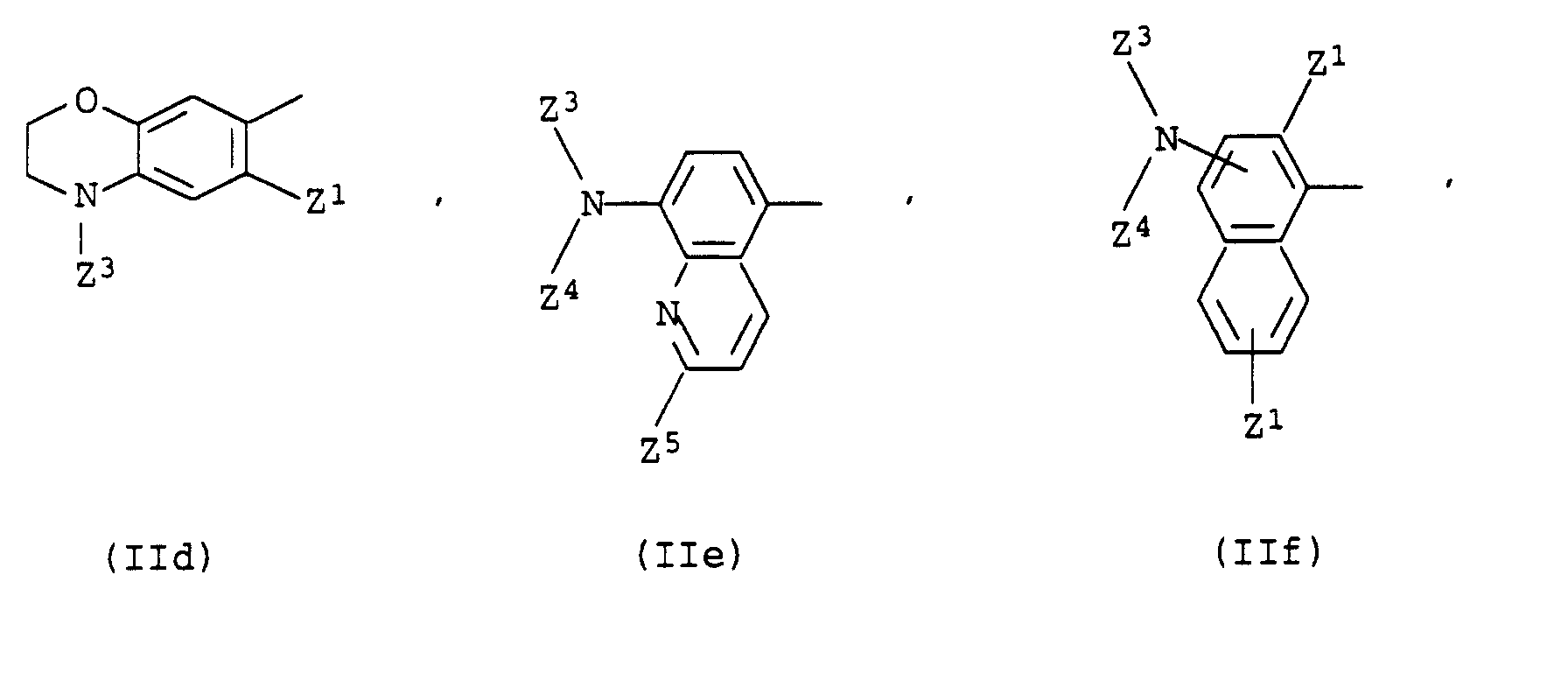


- n
- für 0 oder 1,
- Z1
- für Wasserstoff, C1-C13-Alkyl, das gegebenenfalls durch 1 bis 3 Sauerstoffatome in Etherfunktion unterbrochen ist, Hydroxy, C1-C4-Alkoxy, C1-C4-Alkylsulfonylamino, C1-C4-Mono- oder Dialkylaminosulfonylamino oder den Rest -NHCOZ7 oder -NHCO2Z7, wobei Z7 die Bedeutung von Phenyl, Benzyl, Tolyl oder C1-C13-Alkyl, das gegebenenfalls durch 1 bis 3 Sauerstoffatome in Etherfunktion unterbrochen ist, besitzt,
- Z2
- für Wasserstoff, C1-C4-Alkyl oder C1-C4-Alkoxy,
- Z3
- und Z4 gleich oder verschieden sind und unabhängig voneinander jeweils für Wasserstoff, C1-C13-Alkyl, das gegebenenfalls substituiert ist und durch 1 bis 3 Sauerstoffatome in Etherfunktion unterbrochen sein kann, C3-C4-Alkenyl, C5-C7-Cycloalkyl, Phenyl oder Tolyl oder zusammen mit dem sie verbindenden Stickstoffatom für einen 5- oder 6-gliedrigen gesättigten heterocyclischen Rest, der gegebenenfalls weitere Heteroatome enthält,
- Z5
- für Wasserstoff oder C1-C4-Alkyl und
- Z6
- für Wasserstoff, Halogen, C1-C13-Alkyl, gegebenenfalls substituiertes Phenyl, gegebenenfalls substituiertes Benzyl, C5-C7-Cycloalkyl, Thienyl, Hydroxy, C1-C4-Alkoxy, C1-C4-Alkylthio oder C1-C13-Monoalkylamino stehen.
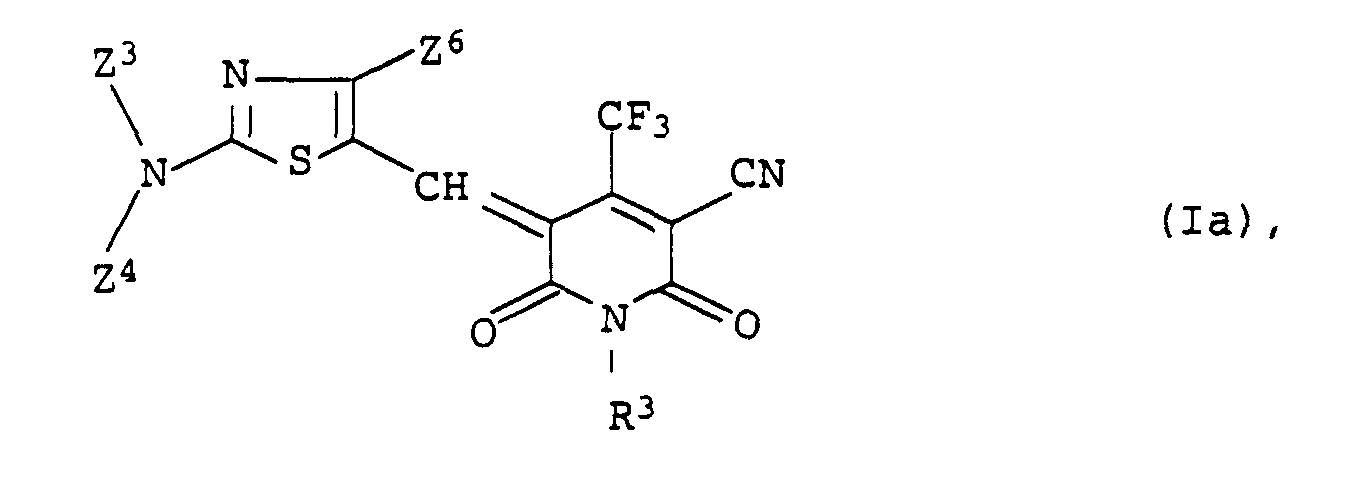
- R3
- C1-C8-Alkyl,
- Z3 und Z4
- unabhängig voneinander jeweils C1-C8-Alkyl, das gegebenenfalls durch C1-C4-Alkoxy, C1-C4-Alkoxycarbonyl oder Phenyl substituiert ist, Cyclopentyl, Cyclohexyl oder Prop-1-en-3-yl und
- Z6
- verzweigtes C3-C10-Alkyl oder Phenyl, insbesondere verzweigtes C3-C8-Alkyl, bedeuten.


1H-NMR (CDCl3, 250 MHz):δ = 8,02 (s; 1H), 3,80 (t, J = 8 Hz; 2H), 3,58 (t, J = 8 Hz; 2H), 3,38 (s; 3H), 2,80 (s; 2H), 1,70 (m; 4H), 1,38 (m; 4H), 1,00 (s; 9H), 0,95 (m; 6H).
| C | H | N | O | F | S | |
| ber. | 58,75 | 6,52 | 10,98 | 6,27 | 11,17 | 6,27 |
| gef. | 58,80 | 6,40 | 10,90 | 6,30 | 11,20 | 6,30 |

1H-NMR (CDCl3, 200 MHz): δ = 8,00 (d, J = 7 Hz; 2H), 7,62 (dd, J = 7 Hz, J = 7 Hz; 1 H), 7,52 (d, J = 7 Hz; 2H), 4,02 (t, J = 7 Hz; 2H), 3,65 (t, J = 8 Hz; 2H), 3,38 (s; 3 H), 1,80 (m; 4 H), 1,42 (m; 4H), 1,00 (m; 6H).


| Farbstoff Nr. | Q* [mJ/Dot] |
| 1 | 0,76 |
| 0,76 | |
| 2 | 1,01 |
| 1,12 | |
| 3 | 1,02 |
| 1,16 | |
| 4 | 1,01 |
| 1,10 | |
| 5 | 1,58 |
| 1,34 | |
| 6 | 0,80 |
| 0,82 | |
| 7 | 1,01 |
| 1,12 | |
| 8 | 0,80 |
| 0,81 | |
| 9 | 0,83 |
| 0,81 | |
| 10 | 0,84 |
| 0,88 | |
| 11 | 0,84 |
| 0,89 | |
| 12 | 0,77 |
| 0,87 | |
| 13 | 0,86 |
| 0,88 | |
| 14 | 0,81 |
| 0,87 | |
| 15 | 0,85 |
| 0,87 | |
| 16 | 0,83 |
| 0,86 | |
| 17 | 0,84 |
| 0,86 | |
| 18 | 0,84 |
| 0,79 | |
| 19 | 0,78 |
| 0,83 | |
| 20 | 0,80 |
| 0,77 | |
| 21 | 0,75 |
| 0,78 | |
| 22 | |
| 1,08 | |
| 23 | 1,04 |
| 1,01 | |
| 24 | |
| 0,95 | |
| 25 | 1,18 |
| 26 | 0,97 |
| 0,94 |
Claims (8)
- Pyridonfarbstoffe der Formel Iin der

- X
- Stickstoff oder CH,
- R1
- einen 5- oder 6-gliedrigen carbocyclischen oder heterocyclischen Rest,
- R2
- Cyano, Carbamoyl, C1-C6-Alkoxycarbonyl oder C1-C4-Alkanoyl und
- R3
- C1-C13-Alkyl, das gegebenenfalls substituiert ist und durch 1 bis 3 Sauerstoffatome in Etherfunktion unterbrochen sein kann, gegebenenfalls substituiertes Phenyl oder einen Rest der Formel NE1E2, wobei E1 und E2 gleich oder verschieden sind und unabhängig voneinander jeweils für Wasserstoff, C1-C13-Alkyl, das gegebenenfalls substituiert ist und durch 1 bis 3 Sauerstoffatome in Etherfunktion unterbrochen sein kann, C5-C7-Cycloalkyl, gegebenenfalls substituiertes Phenyl, gegebenenfalls substituiertes Pyridyl, gegebenenfalls substituiertes C1-C13-Alkanoyl, C1-C13-Alkoxycarbonyl, gegebenenfalls substituiertes C1-C13-Alkylsulfonyl, C5-C7-Cycloalkylsulfonyl, gegebenenfalls substituiertes Phenylsulfonyl, gegebenenfalls substituiertes Pyridylsulfonyl, gegebenenfalls substituiertes Benzoyl, Pyridylcarbonyl oder Thienylcarbonyl oder E1 und E2 zusammen mit dem sie verbindenden Stickstoffatom gegebenenfalls durch C1-C4-Alkyl substituiertes Succinimido, gegebenenfalls durch C1-C4-Alkyl substituiertes Phthalimido oder einen 5- oder 6-gliedrigen gesättigten heterocyclischen Rest, der gegebenenfalls weitere Heteroatome enthält, stehen, bedeuten,
auch solche Verbindungen ausgenommen sind, in denen R1 einen Rest bedeutet, der sich von 4-Trifluormethylpyridin als Grundkörper ableitet.
- Pyridonfarbstoffe nach Anspruch 1, dadurch gekennzeichnet, daß X CH bedeutet.
- Pyridonfarbstoffe nach Anspruch 1, dadurch gekennzeichnet, daß R2 Cyano bedeutet.
- Pyridonfarbstoffe nach Anspruch 1, dadurch gekennzeichnet, daß R3 C1-C13-Alkyl, das gegebenenfalls durch 1 bis 3 Sauerstoffatome in Etherfunktion unterbrochen ist, bedeutet.
- Pyridonfarbstoffe nach Anspruch 1, dadurch gekennzeichnet, daß R1 einen Rest bedeutet, der sich von einer Komponente aus der Benzol-, Indol-, Chinolin-, Naphthalin-, Pyrrol-, Thiazol-, Benzimidazol-, Benzthiazol-, Thiophen- oder Pyridinreihe ableitet.
- Pyridonfarbstoffe nach Anspruch 1, dadurch gekennzeichnet, daß R1 einen Rest der Formel
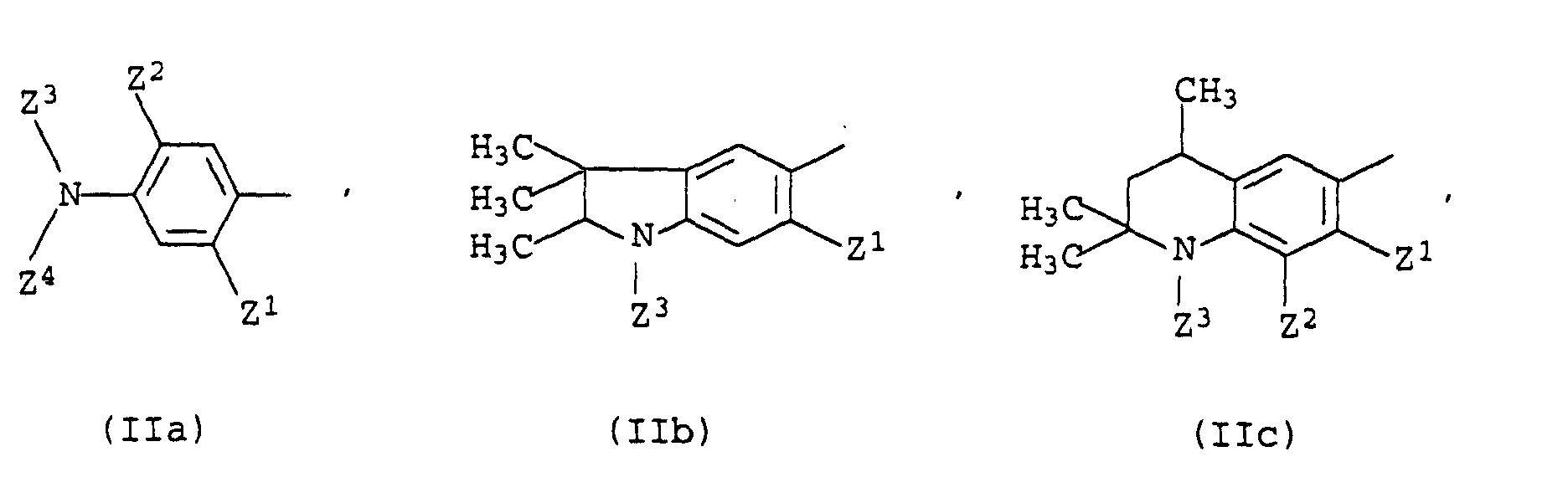

 bedeutet, worin
- n
- für 0 oder 1,
- Z1
- für Wasserstoff, C1-C13-Alkyl, das gegebenenfalls durch 1 bis 3 Sauerstoffatome in Etherfunktion unterbrochen ist, Hydroxy, C1-C4-Alkoxy, C1-C4-Alkylsulfonylamino, C1-C4-Mono- oder Dialkylaminosulfonylamino oder den Rest -NHCOZ7 oder -NHCO2Z7, wobei Z7 die Bedeutung von Phenyl, Benzyl, Tolyl oder C1-C13-Alkyl, das gegebenenfalls durch 1 bis 3 Sauerstoffatome in Etherfunktion unterbrochen ist, besitzt,
- Z2
- für Wasserstoff, C1-C4-Alkyl oder C1-C4-Alkoxy,
- Z3
- und Z4 gleich oder verschieden sind und unabhängig voneinander jeweils für Wasserstoff, C1-C13-Alkyl, das gegebenenfalls substituiert ist und durch 1 bis 3 Sauerstoffatome in Etherfunktion unterbrochen sein kann, C3-C4-Alkenyl, C5-C7-Cycloalkyl, Phenyl oder Tolyl oder zusammen mit dem sie verbindenden Stickstoffatom für einen 5- oder 6-gliedrigen gesättigten heterocyclischen Rest, der gegebenenfalls weitere Heteroatome enthält,
- Z5
- für Wasserstoff oder C1-C4-Alkyl und
- Z6
- für Wasserstoff, Halogen, C1-C13-Alkyl, gegebenenfalls substituiertes Phenyl, gegebenenfalls substituiertes Benzyl, C5-C7-Cycloalkyl, Thienyl, Hydroxy, C1-C4-Alkoxy, C1-C4-Alkylthio oder C1-C13-Monoalkylamino stehen.
- Verfahren zur Übertragung von Farbstoffen von einem Träger auf ein mit Kunststoff beschichtetes Papier durch Diffusion oder Sublimation mit Hilfe einer Energiequelle, dadurch gekennzeichnet, daß man einen Träger verwendet, auf dem sich ein oder mehrere Pyridonfarbstoffe gemäß Anspruch 1 befinden.
- Verfahren zum Färben oder Bedrucken von synthetischen Materialien, dadurch gekennzeichnet, daß man die synthetischen Materialien mit einem oder mehreren Pyridonfarbstoffen gemäß Anspruch 1 behandelt.
Applications Claiming Priority (3)
| Application Number | Priority Date | Filing Date | Title |
|---|---|---|---|
| DE4440066 | 1994-11-10 | ||
| DE4440066A DE4440066A1 (de) | 1994-11-10 | 1994-11-10 | Methin- und Azamethinfarbstoffe auf Basis von Trifluormethylpyridonen |
| PCT/EP1995/004267 WO1996015195A1 (de) | 1994-11-10 | 1995-10-31 | Methin- und azamethinfarbstoffe auf basis von trifluormethylpyridonen |
Publications (2)
| Publication Number | Publication Date |
|---|---|
| EP0791034A1 EP0791034A1 (de) | 1997-08-27 |
| EP0791034B1 true EP0791034B1 (de) | 2002-01-09 |
Family
ID=6532907
Family Applications (1)
| Application Number | Title | Priority Date | Filing Date |
|---|---|---|---|
| EP95938380A Expired - Lifetime EP0791034B1 (de) | 1994-11-10 | 1995-10-31 | Methin- und azamethinfarbstoffe auf basis von trifluormethylpyridonen |
Country Status (12)
| Country | Link |
|---|---|
| US (1) | US5962691A (de) |
| EP (1) | EP0791034B1 (de) |
| JP (1) | JPH10508641A (de) |
| KR (1) | KR970707240A (de) |
| AR (1) | AR000444A1 (de) |
| AU (1) | AU3979695A (de) |
| BR (1) | BR9509725A (de) |
| DE (2) | DE4440066A1 (de) |
| ES (1) | ES2171202T3 (de) |
| MX (1) | MX9703118A (de) |
| TW (1) | TW448159B (de) |
| WO (1) | WO1996015195A1 (de) |
Families Citing this family (14)
| Publication number | Priority date | Publication date | Assignee | Title |
|---|---|---|---|---|
| DE19618528A1 (de) * | 1996-05-08 | 1997-11-13 | Basf Ag | Methin- und Azamethinfarbstoffe auf Basis von Trifluormethylpyridonen |
| DE19623411A1 (de) * | 1996-06-12 | 1997-12-18 | Basf Ag | Farbstoffmischungen |
| US6086637A (en) * | 1996-11-23 | 2000-07-11 | Basf Aktiengesellschaft | Trifluormethylpyridone based indolenine methine dyes |
| US6432994B1 (en) | 1997-04-28 | 2002-08-13 | Texas Biotechnology Corporation | Sulfonamides for treatment of endothelin-mediated disorders |
| DE19920808A1 (de) * | 1998-05-16 | 1999-11-18 | Basf Ag | Methin- und Azamethinfarbstoffe auf Basis von 5-gliedrigen Heterocyclen, die eine Trifluormethylgruppe aufweisen |
| US6124237A (en) * | 1999-10-14 | 2000-09-26 | Eastman Kodak Company | Orange dye mixture for thermal color proofing |
| US6127316A (en) * | 1999-10-14 | 2000-10-03 | Eastman Kodak Company | Orange dye mixture for thermal color proofing |
| US6124238A (en) * | 1999-10-14 | 2000-09-26 | Eastman Kodak Company | Pink dye for thermal color proofing |
| US6121192A (en) * | 1999-10-14 | 2000-09-19 | Eastman Kodak Company | Orange dye mixture for thermal color proofing |
| US6124239A (en) * | 1999-10-14 | 2000-09-26 | Eastman Kodak Company | Orange dye mixture for thermal color proofing |
| US20030113665A1 (en) * | 2001-03-28 | 2003-06-19 | Horst Berneth | Optical data medium containing, in the information layer, a dye as a light-absorbing compound |
| US20100140559A1 (en) * | 2007-07-10 | 2010-06-10 | Basf Se | Mixtures for producing photoactive layers for organic solar cells and organic photodetectors |
| EP2891923A4 (de) * | 2012-08-29 | 2016-04-20 | Canon Kk | Toner |
| WO2014034096A1 (ja) * | 2012-08-29 | 2014-03-06 | キヤノン株式会社 | トナー |
Citations (1)
| Publication number | Priority date | Publication date | Assignee | Title |
|---|---|---|---|---|
| JPS63247092A (ja) * | 1987-04-03 | 1988-10-13 | Fuji Photo Film Co Ltd | 光学的情報記録媒体 |
Family Cites Families (7)
| Publication number | Priority date | Publication date | Assignee | Title |
|---|---|---|---|---|
| JPS6468743A (en) * | 1987-09-09 | 1989-03-14 | Fuji Photo Film Co Ltd | Silver halide color photographic sensitive material |
| US4975410A (en) * | 1989-05-26 | 1990-12-04 | Eastman Kodak Company | Thermally-transferred color filter array element and process for preparing |
| DE3929698A1 (de) * | 1989-09-07 | 1991-03-14 | Basf Ag | Triazolopyridinfarbstoffe sowie ein verfahren zum thermischen transfer von methinfarbstoffen |
| JP3009158B2 (ja) * | 1989-09-14 | 2000-02-14 | 三井化学株式会社 | シアン色系感熱昇華転写型色素及び転写シート |
| DE4004612A1 (de) * | 1990-02-15 | 1991-08-22 | Basf Ag | Neue bichromophore methin- und azamethinfarbstoffe und ein verfahren zu ihrer uebertragung |
| DE59208556D1 (en) * | 1991-05-03 | 1997-07-03 | Basf Ag | N-aminopyridonfarbstoffe |
| DE4232557A1 (de) * | 1992-09-29 | 1994-03-31 | Basf Ag | Verwendung von Pyridinfarbstoffen im textilen Bereich, Farbstoffmischungen, enthaltend Pyridinfarbstoffe, sowie Triazolopyridinfarbstoffe mit einem Thienylrest |
-
1994
- 1994-11-10 DE DE4440066A patent/DE4440066A1/de not_active Withdrawn
-
1995
- 1995-10-31 AU AU39796/95A patent/AU3979695A/en not_active Abandoned
- 1995-10-31 JP JP8515677A patent/JPH10508641A/ja active Pending
- 1995-10-31 US US08/817,929 patent/US5962691A/en not_active Expired - Fee Related
- 1995-10-31 ES ES95938380T patent/ES2171202T3/es not_active Expired - Lifetime
- 1995-10-31 KR KR1019970703064A patent/KR970707240A/ko not_active Ceased
- 1995-10-31 WO PCT/EP1995/004267 patent/WO1996015195A1/de not_active Ceased
- 1995-10-31 DE DE59509992T patent/DE59509992D1/de not_active Expired - Lifetime
- 1995-10-31 MX MX9703118A patent/MX9703118A/es unknown
- 1995-10-31 BR BR9509725A patent/BR9509725A/pt not_active Application Discontinuation
- 1995-10-31 EP EP95938380A patent/EP0791034B1/de not_active Expired - Lifetime
- 1995-11-09 TW TW084111861A patent/TW448159B/zh not_active IP Right Cessation
- 1995-11-09 AR ARP950100103A patent/AR000444A1/es unknown
Patent Citations (1)
| Publication number | Priority date | Publication date | Assignee | Title |
|---|---|---|---|---|
| JPS63247092A (ja) * | 1987-04-03 | 1988-10-13 | Fuji Photo Film Co Ltd | 光学的情報記録媒体 |
Non-Patent Citations (1)
| Title |
|---|
| DATABASE WPI Week 8847, Derwent World Patents Index; Class A89, AN 88-334167 * |
Also Published As
| Publication number | Publication date |
|---|---|
| AR000444A1 (es) | 1997-06-25 |
| BR9509725A (pt) | 1997-10-21 |
| KR970707240A (ko) | 1997-12-01 |
| US5962691A (en) | 1999-10-05 |
| TW448159B (en) | 2001-08-01 |
| DE4440066A1 (de) | 1996-05-15 |
| WO1996015195A1 (de) | 1996-05-23 |
| EP0791034A1 (de) | 1997-08-27 |
| AU3979695A (en) | 1996-06-06 |
| ES2171202T3 (es) | 2002-09-01 |
| DE59509992D1 (de) | 2002-02-14 |
| MX9703118A (es) | 1997-06-28 |
| JPH10508641A (ja) | 1998-08-25 |
Similar Documents
| Publication | Publication Date | Title |
|---|---|---|
| EP0582579B1 (de) | N-aminopyridonfarbstoffe | |
| WO1996015195A1 (de) | Methin- und azamethinfarbstoffe auf basis von trifluormethylpyridonen | |
| EP0569785B1 (de) | Farbstoffmischungen für den Farbstofftransfer | |
| EP0773976B1 (de) | Azofarbstoffe mit einer kupplungskomponente aus der aminothiazolreihe | |
| EP0906370B1 (de) | Pyridonfarbstoffe | |
| EP0944673B1 (de) | Indoleninmethinfarbstoffe auf basis von trifluormethylpyridonen | |
| EP0806455B1 (de) | Methin- und Azamethinfarbstoffe auf Basis von Trifluormethylpyridonen | |
| DE19920808A1 (de) | Methin- und Azamethinfarbstoffe auf Basis von 5-gliedrigen Heterocyclen, die eine Trifluormethylgruppe aufweisen | |
| WO1997047690A1 (de) | Farbstoffmischungen | |
| EP0727463B1 (de) | Triazolopyridinfarbstoffe und deren Zwischenprodukte | |
| DE19611351A1 (de) | Farbstoffmischungen, enthaltend Thienyl- und/oder Thiazolazofarbstoffe | |
| EP0763571B1 (de) | Farbmischungen, enhaltend Methin- und Anthrachinonfarbstoffe | |
| DE19650958A1 (de) | Indoleninmethinfarbstoffe auf Basis von Trifluormethylpyridonen | |
| EP0745107B1 (de) | Triazolopyridinfarbstoffe | |
| EP0736575B1 (de) | Azamethinfarbstoffe mit heterocyclischen Seitengruppen | |
| EP0761464B1 (de) | Thermischer Transfer von Farbstoffmischungen, enthaltend Azamethinfarbstoffe | |
| EP0791035B1 (de) | Azamethinfarbstoffe | |
| EP0796297B1 (de) | Methinfarbstoffe auf basis von formylaminopyridonen | |
| DE4114456A1 (de) | N-aminopyridonfarbstoffe |
Legal Events
| Date | Code | Title | Description |
|---|---|---|---|
| PUAI | Public reference made under article 153(3) epc to a published international application that has entered the european phase |
Free format text: ORIGINAL CODE: 0009012 |
|
| 17P | Request for examination filed |
Effective date: 19970424 |
|
| AK | Designated contracting states |
Kind code of ref document: A1 Designated state(s): BE CH DE ES FR GB IT LI NL |
|
| 17Q | First examination report despatched |
Effective date: 19990520 |
|
| RBV | Designated contracting states (corrected) |
Designated state(s): BE CH DE ES FR GB IT LI NL |
|
| GRAG | Despatch of communication of intention to grant |
Free format text: ORIGINAL CODE: EPIDOS AGRA |
|
| RAP1 | Party data changed (applicant data changed or rights of an application transferred) |
Owner name: DYSTAR TEXTILFARBEN GMBH & CO. DEUTSCHLAND KG |
|
| RAP1 | Party data changed (applicant data changed or rights of an application transferred) |
Owner name: BASF AKTIENGESELLSCHAFT |
|
| GRAG | Despatch of communication of intention to grant |
Free format text: ORIGINAL CODE: EPIDOS AGRA |
|
| GRAH | Despatch of communication of intention to grant a patent |
Free format text: ORIGINAL CODE: EPIDOS IGRA |
|
| GRAH | Despatch of communication of intention to grant a patent |
Free format text: ORIGINAL CODE: EPIDOS IGRA |
|
| GRAA | (expected) grant |
Free format text: ORIGINAL CODE: 0009210 |
|
| REG | Reference to a national code |
Ref country code: GB Ref legal event code: IF02 |
|
| RIN1 | Information on inventor provided before grant (corrected) |
Inventor name: ETZBACH, KARL-HEINZ Inventor name: SENS, RUEDIGER Inventor name: SCHMIDT, ANDREAS JOHANN |
|
| AK | Designated contracting states |
Kind code of ref document: B1 Designated state(s): BE CH DE ES FR GB IT LI NL |
|
| REG | Reference to a national code |
Ref country code: CH Ref legal event code: EP |
|
| REG | Reference to a national code |
Ref country code: CH Ref legal event code: NV Representative=s name: SCHMAUDER & PARTNER AG PATENTANWALTSBUERO |
|
| REF | Corresponds to: |
Ref document number: 59509992 Country of ref document: DE Date of ref document: 20020214 |
|
| GBT | Gb: translation of ep patent filed (gb section 77(6)(a)/1977) |
Effective date: 20020404 |
|
| ET | Fr: translation filed | ||
| REG | Reference to a national code |
Ref country code: ES Ref legal event code: FG2A Ref document number: 2171202 Country of ref document: ES Kind code of ref document: T3 |
|
| PG25 | Lapsed in a contracting state [announced via postgrant information from national office to epo] |
Ref country code: LI Free format text: LAPSE BECAUSE OF NON-PAYMENT OF DUE FEES Effective date: 20021031 Ref country code: GB Free format text: LAPSE BECAUSE OF NON-PAYMENT OF DUE FEES Effective date: 20021031 Ref country code: CH Free format text: LAPSE BECAUSE OF NON-PAYMENT OF DUE FEES Effective date: 20021031 Ref country code: BE Free format text: LAPSE BECAUSE OF NON-PAYMENT OF DUE FEES Effective date: 20021031 |
|
| PG25 | Lapsed in a contracting state [announced via postgrant information from national office to epo] |
Ref country code: ES Free format text: LAPSE BECAUSE OF NON-PAYMENT OF DUE FEES Effective date: 20021101 |
|
| PLBE | No opposition filed within time limit |
Free format text: ORIGINAL CODE: 0009261 |
|
| STAA | Information on the status of an ep patent application or granted ep patent |
Free format text: STATUS: NO OPPOSITION FILED WITHIN TIME LIMIT |
|
| PG25 | Lapsed in a contracting state [announced via postgrant information from national office to epo] |
Ref country code: DE Free format text: LAPSE BECAUSE OF THE APPLICANT RENOUNCES Effective date: 20021116 |
|
| 26N | No opposition filed | ||
| BERE | Be: lapsed |
Owner name: *BASF A.G. Effective date: 20021031 |
|
| PG25 | Lapsed in a contracting state [announced via postgrant information from national office to epo] |
Ref country code: NL Free format text: LAPSE BECAUSE OF NON-PAYMENT OF DUE FEES Effective date: 20030501 |
|
| REG | Reference to a national code |
Ref country code: CH Ref legal event code: PL |
|
| GBPC | Gb: european patent ceased through non-payment of renewal fee | ||
| PG25 | Lapsed in a contracting state [announced via postgrant information from national office to epo] |
Ref country code: FR Free format text: LAPSE BECAUSE OF NON-PAYMENT OF DUE FEES Effective date: 20030630 |
|
| NLV4 | Nl: lapsed or anulled due to non-payment of the annual fee |
Effective date: 20030501 |
|
| REG | Reference to a national code |
Ref country code: FR Ref legal event code: ST |
|
| REG | Reference to a national code |
Ref country code: ES Ref legal event code: FD2A Effective date: 20031112 |
|
| PG25 | Lapsed in a contracting state [announced via postgrant information from national office to epo] |
Ref country code: IT Free format text: LAPSE BECAUSE OF NON-PAYMENT OF DUE FEES;WARNING: LAPSES OF ITALIAN PATENTS WITH EFFECTIVE DATE BEFORE 2007 MAY HAVE OCCURRED AT ANY TIME BEFORE 2007. THE CORRECT EFFECTIVE DATE MAY BE DIFFERENT FROM THE ONE RECORDED. Effective date: 20051031 |