EP0785686A2 - Methode und Gerät zum Übertragen und Empfangen eines Fernsehsignals - Google Patents
Methode und Gerät zum Übertragen und Empfangen eines Fernsehsignals Download PDFInfo
- Publication number
- EP0785686A2 EP0785686A2 EP19970100847 EP97100847A EP0785686A2 EP 0785686 A2 EP0785686 A2 EP 0785686A2 EP 19970100847 EP19970100847 EP 19970100847 EP 97100847 A EP97100847 A EP 97100847A EP 0785686 A2 EP0785686 A2 EP 0785686A2
- Authority
- EP
- European Patent Office
- Prior art keywords
- signal
- television signal
- transmitting
- video
- coded
- Prior art date
- Legal status (The legal status is an assumption and is not a legal conclusion. Google has not performed a legal analysis and makes no representation as to the accuracy of the status listed.)
- Granted
Links
Images

Classifications
-
- H—ELECTRICITY
- H04—ELECTRIC COMMUNICATION TECHNIQUE
- H04N—PICTORIAL COMMUNICATION, e.g. TELEVISION
- H04N21/00—Selective content distribution, e.g. interactive television or video on demand [VOD]
- H04N21/20—Servers specifically adapted for the distribution of content, e.g. VOD servers; Operations thereof
- H04N21/25—Management operations performed by the server for facilitating the content distribution or administrating data related to end-users or client devices, e.g. end-user or client device authentication, learning user preferences for recommending movies
- H04N21/266—Channel or content management, e.g. generation and management of keys and entitlement messages in a conditional access system, merging a VOD unicast channel into a multicast channel
- H04N21/2662—Controlling the complexity of the video stream, e.g. by scaling the resolution or bitrate of the video stream based on the client capabilities
-
- H—ELECTRICITY
- H04—ELECTRIC COMMUNICATION TECHNIQUE
- H04N—PICTORIAL COMMUNICATION, e.g. TELEVISION
- H04N7/00—Television systems
- H04N7/16—Analogue secrecy systems; Analogue subscription systems
- H04N7/162—Authorising the user terminal, e.g. by paying; Registering the use of a subscription channel, e.g. billing
- H04N7/163—Authorising the user terminal, e.g. by paying; Registering the use of a subscription channel, e.g. billing by receiver means only
-
- H—ELECTRICITY
- H04—ELECTRIC COMMUNICATION TECHNIQUE
- H04N—PICTORIAL COMMUNICATION, e.g. TELEVISION
- H04N19/00—Methods or arrangements for coding, decoding, compressing or decompressing digital video signals
- H04N19/30—Methods or arrangements for coding, decoding, compressing or decompressing digital video signals using hierarchical techniques, e.g. scalability
-
- H—ELECTRICITY
- H04—ELECTRIC COMMUNICATION TECHNIQUE
- H04N—PICTORIAL COMMUNICATION, e.g. TELEVISION
- H04N19/00—Methods or arrangements for coding, decoding, compressing or decompressing digital video signals
- H04N19/60—Methods or arrangements for coding, decoding, compressing or decompressing digital video signals using transform coding
-
- H—ELECTRICITY
- H04—ELECTRIC COMMUNICATION TECHNIQUE
- H04N—PICTORIAL COMMUNICATION, e.g. TELEVISION
- H04N21/00—Selective content distribution, e.g. interactive television or video on demand [VOD]
- H04N21/20—Servers specifically adapted for the distribution of content, e.g. VOD servers; Operations thereof
- H04N21/25—Management operations performed by the server for facilitating the content distribution or administrating data related to end-users or client devices, e.g. end-user or client device authentication, learning user preferences for recommending movies
- H04N21/254—Management at additional data server, e.g. shopping server, rights management server
- H04N21/2543—Billing, e.g. for subscription services
-
- H—ELECTRICITY
- H04—ELECTRIC COMMUNICATION TECHNIQUE
- H04N—PICTORIAL COMMUNICATION, e.g. TELEVISION
- H04N21/00—Selective content distribution, e.g. interactive television or video on demand [VOD]
- H04N21/40—Client devices specifically adapted for the reception of or interaction with content, e.g. set-top-box [STB]; Operations thereof
- H04N21/45—Management operations performed by the client for facilitating the reception of or the interaction with the content or administrating data related to the end-user or to the client device itself, e.g. learning user preferences for recommending movies, resolving scheduling conflicts
- H04N21/462—Content or additional data management e.g. creating a master electronic programme guide from data received from the Internet and a Head-end or controlling the complexity of a video stream by scaling the resolution or bit-rate based on the client capabilities
-
- H—ELECTRICITY
- H04—ELECTRIC COMMUNICATION TECHNIQUE
- H04N—PICTORIAL COMMUNICATION, e.g. TELEVISION
- H04N19/00—Methods or arrangements for coding, decoding, compressing or decompressing digital video signals
- H04N19/30—Methods or arrangements for coding, decoding, compressing or decompressing digital video signals using hierarchical techniques, e.g. scalability
- H04N19/39—Methods or arrangements for coding, decoding, compressing or decompressing digital video signals using hierarchical techniques, e.g. scalability involving multiple description coding [MDC], i.e. with separate layers being structured as independently decodable descriptions of input picture data
Definitions
- the present invention relates to a method and an apparatus for transmitting and receiving television signals and, more particularly, to those capable of selecting the grade of received image quality according to the accounting system in chargeable broadcasting employing digital signals.
- NTSC National Television System Committee
- a transmission speed of 100 Mbps is required, and only one channel can be broadcasted using a transmission band of 27 MHz.
- a high resolution television such as a high-grade television, requires a transmission speed of 1.2 Gbps, that is, more than ten times as high as the transmission speed of the NTSC system.
- digital television broadcasting has attracted attention in recent years.
- required transmission speed is only 4 Mbps, and broadcasts for six channels are possible per the present one channel.
- broadcasting is possible at a transmission speed of about 30 Mbps.
- the digital television broadcasting has various advantages over the analog television broadcasting, for example, effective use of electric wave resource, and transmission of high-quality image with less defect.
- chargeable television broadcasting such as BS, CS, or CATV
- BS chargeable television broadcasting
- CS chargeable television broadcasting
- CATV CATV
- An object of the present invention is to provide a method and an apparatus for transmitting and receiving television signals, which can provide a service at a resolution or a tone quality according to an accounting system, in digital television broadcasting.
- a television signal transmitting method for transmitting a digitally coded television signal includes the step of transmitting, as the digitally coded television signal, one of a video signal having a resolution and an audio signal having a tone quality, which resolution and tone quality correspond to a decoding coefficient that is input to a receiver by a user.
- a television signal transmitting apparatus for transmitting a digitally coded television signal comprises an encoding means for transmitting, as the digitally coded television signal, one of a video signal having a resolution and an audio signal having a tone quality, which resolution and tone quality correspond to a decoding coefficient that is input to a receiver by a user.
- a television signal receiving method for receiving a digitally coded television signal comprises the steps of variably controlling a decoding coefficient value in response to an external input; and converting the digitally coded television signal into one of a video signal having a resolution according to the controlled decoding coefficient and an audio signal having a quality according to the controlled decoding coefficient.
- the above-mentioned television signal receiving method comprises the steps of storing the variation in the decoding coefficient value, as information, with the lapse of time; and posting the information, for a prescribed period of time, to a base station that sends the television signal.
- a television signal receiving apparatus for receiving a digitally coded television signal, comprises a decoding coefficient control means for variably controlling a decoding coefficient value in response to a user input; and a signal reproducing means for converting the digitally coded television signal into one of a video signal having a resolution according to the controlled-decoding coefficient and an audio signal having a quality according to the controlled decoding coefficient.
- the above-mentioned television signal receiving apparatus comprises means for storing the variation in the decoding coefficient value, as information, with the lapse of time, and posting the information, for a prescribed period of time, to a base station that sends the television signal.
- a television signal transmitting method for transmitting a digitally coded television signal comprises the steps of separating a video signal having a resolution twice as high as an ordinary resolution into two video signals each having the ordinary resolution; and coding the two video signals individually, and transmitting the coded video signals through different channels.
- a television signal receiving method for receiving a digitally coded television signal it is possible to select one of a case where both of two coded video signals, each having an ordinary resolution, are reproduced and a case where one of the coded video signals is reproduced, in accordance with an external input.
- a television signal transmitting apparatus for transmitting a digitally coded television signal, comprises a video signal separating means for separating a video signal having a resolution twice as high as an ordinary resolution into two video signals each having the ordinary resolution; and a video signal encoding means for coding the two video signals individually, and transmitting the coded video signals through different channels.
- a television signal receiving apparatus for receiving a digitally coded television signal, comprises a video signal decoding means capable of selecting one of a case where both of two coded video signals, each having an ordinary resolution, are reproduced and a case where one of the coded video signals is reproduced, in accordance with an external input.
- a television signal transmitting method for transmitting a digitally coded television signal comprises the steps of separating a video signal having a resolution twice as high as an ordinary resolution into a first video signal comprising high-frequency components and a second video signal comprising components other than the high-frequency components; and coding the first video signal and the second video signal individually, and transmitting the coded first and second video signals through different channels.
- a sixteenth aspect of the present invention in a television signal receiving method for receiving a digitally coded television signal, it is possible to select one of a case where both of a first video signal comprising high-frequency components and a second video signal comprising components other than the high-frequency components, which video signals are obtained by separating a video signal having a resolution twice as high as an ordinary resolution, and a case where one of the first and second video signals is reproduced, in accordance with an external input.
- a television signal transmitting apparatus for transmitting a digitally coded television signal, comprises a video signal separating means for separating a video signal having a resolution twice as high as an ordinary resolution into a first video signal comprising high-frequency components and a second video signal comprising components other than the high-frequency components; and a video signal encoding means for encoding the first video signal and the second video signal individually, and transmitting the coded first and second video signals through different channels.
- a television signal receiving apparatus for receiving a digitally coded television signal, comprises a video signal decoding means capable of selecting one of a case where both of a first video signal comprising high-frequency components and a second video signal comprising components other than the high-frequency components, which video signals are obtained by separating a video signal having a resolution twice as high as an ordinary resolution, and a case where one of the first and second video signals is reproduced, in accordance with an external input.
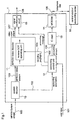
- Figure 1 is a block diagram illustrating a television signal transmitting and receiving apparatus according to a first embodiment of the present invention.
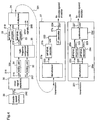
- Figure 2 is a block diagram illustrating a television signal transmitting and receiving apparatus according to a second embodiment of the present invention.
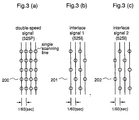
- Figures 3(a)-3(d) are diagrams for explaining the video signal processing by the transmitter in the apparatus according to the second embodiment.
- Figure 4 is a block diagram illustrating a television signal transmitting and receiving apparatus according to a third embodiment of the present invention.
- FIG. 1 is a block diagram illustrating a structure of a receiver (decoder) in a television signal transmitting and receiving apparatus according to a first embodiment of the present invention.
- the decoding coefficient is varied according to the accounting level, whereby the resolution of the decoded image is varied.
- reference numeral 1 designates a video decoder to which a stream 100 specified in MPEG2-System (hereinafter referred to as an MPEG2-System stream) is input.
- Reference numeral 10 designates a system decoder for analyzing the MPEG2-System stream 100 and extracting accounting information 102 and a stream 103 specified in MPEG2-Video (hereinafter referred to as MPEG2-Video stream) from the MPEG2-System stream 100.
- Reference numeral 11 designates an MPEG2-Video decoder including a reverse DCT (Discrete Cosine Transform) operation unit.
- Reference numeral 12 designates an accounting control unit for controlling the accounting level according to an input 101 from the user.
- Reference numeral 13 designates an IC card for totalizing the accounting amounts.
- Reference numeral 14 designates a MODEM (modulator-demodulator) for transmitting accounting amount information 109 output from the IC card 13 through a telephone line to a central station/accounting center 16.
- Reference numeral 15 designates a signal synthesizer circuit for synthesizing a decoded video signal output from the video decoder 11 and an accounting message 105 output from the accounting control unit 12, and outputting a monitor output 108.
- the accounting information 102 and the MPEG2-Video stream 103 which are described in the stream 100, are extracted.
- the MPEG2-System has wide application, including application of MPEG1 system that can multiplexes a plurality of video or audio streams coded individually to produce a single stream (data sequence) as a set of programs, and it is also able to unify a plurality of programs to make a single stream. Therefore, the MPEG2-System is a suitable standard for television broadcasting.
- the accounting information 102 extracted in the system decoder 10 is input to the accounting control unit 12.
- the accounting control unit 12 confirms the accounting level requested by the user (user input 101) and outputs a decoding coefficient control signal 104 according to the accounting level to the reverse DCT operation unit in the MPEG2-Video decoder 11.
- Receiving the decoding coefficient control signal 104, the MPEG2-Video decoder 11 performs decoding (orthogonal transform) of the stream 103 at a level corresponding to the decoding coefficient control signal 104, and outputs a video signal 107.
- the stream 103 is fully decoded when the accounting level is high whereas only a low-frequency component of the stream 103 is decoded when the accounting level is low.
- the accounting control unit 12 always monitors the accounting condition according to the selected accounting level from the accounting information 102 and the user input 101, and outputs the accounting condition, as an accounting message 105, toward the video signal synthesizer 15.
- the video signal synthesizer 15 synthesizes the video signal 107 and the accounting message 105 as occasion demands, and outputs a monitor signal 108.
- the IC card 13 always receives accounting amount signals 106 output from the accounting control unit 12, totalizes the accounting amount signals, and sends accounting amount information 109, which is obtained by totalizing the accounting amount signals for a prescribed period of time, through the MODEM 14 to the central station/accounting center 16.
- the transmission of the accounting amount information 109 would be automatically carried out during a period of time when the telephone line is not crowded, for example, from midnight to early morning.
- a digitally coded television signal such as the MPEG2-Video stream 103
- an accounting level requested by the user is input to the receiver as the user input 101, whereby the decoding coefficient (DCT coefficient) at the decoding in the MPEG2-Video decoder 11 is varied to obtain an image having a resolution according to the accounting level. Therefore, an apparatus and a method for transmitting and receiving television signals that can offer a service with a resolution according to the accounting level are realized.
- decoding of the stream 103 is performed by an operation according to the decoding coefficient which can be set ungradedly, it is possible to set the accounting level ungradedly.
- FIG. 2 is a block diagram illustrating a transmitter (encoder) and a receiver (decoder) in a television signal transmitting and receiving apparatus according to a second embodiment of the present invention.
- reference numeral 20 designates a double-speed camera (525P), called a progressive camera, that can scan a target at a speed twice as high as that of an ordinary camera.
- Reference numeral 21 designates a video signal separator for separating a video signal 202 shot by the double-speed camera 20 into two interlace signals 201 and 202.
- Reference numerals 22 and 23 designate MP@ML encoders for coding the interlace signals 201 and 202 within the standard of MP@ML (Main Profile at Main Level), respectively.
- Reference numeral 24 designates a multiplexer for multiplexing coded signals 203 and 204, and other coded signals 205.
- Reference numeral 25 designates a receiver's side first decoder for low resolution.
- the first decoder 25 comprises a demultiplexer 25a, an MP@ML decoder 25b, and an I-P converter 25c.
- the demultiplexer 25a receives a stream 206 sent from the transmitter, converts the signal included in the stream 206 into signals in the states before the multiplexing, and outputs a coded signal 207 that corresponds to one of the coded signals 203 and 204 which are obtained in the transmitter by encoding the interlace signals 201 and 202 within the MP@ML standard.
- the MP@ML decoder 25b decodes the coded signal 207 output from the demultiplexer 25a and outputs a decoded interlace signal 208.
- the I-P converter 25c converts the decoded interlace signal 208 into a signal 209 for high-resolution and double-speed monitoring.
- Reference numeral 26 designates a receiver's second decoder for high resolution.
- the second decoder 26 comprises a demultiplexer 26a, MP@ML decoders 26b and 26c, and a synthesizer 26d.
- the demultiplexer 26a receives the stream 206 sent from the transmitter, converts the signal included in the stream 206 into signals in the states before the multiplexing, and outputs a coded signal 207 which corresponds to one of the coded signals 203 and 204, and a coded signal 211 which corresponds to the other.
- the MP@ML decoders 26b and 26c decode the coded signals 207 and 211 and outputs decoded interlace signals 212 and 213, respectively.
- the synthesizer 26d synthesizes the decoded interlace signals 212 and 213 and outputs a signal 214 for high-resolution and double-speed monitoring.
- one of the first decoder 25 and the second decoder 26 is selected to decode the stream 206 from the transmitter, in response to an external input signal (not shown) corresponding to the user input 110 described in the first embodiment.
- interlace signals 201 and 202 are coded by the MP@ML encoders 22 and 23, producing coded interlace signals 203 and 204, respectively.
- the multiplexer 24 receives the coded interlace signals 203 and 204 through different channels and also receives other coded signals 205, such as accounting information, and multiplexes these signals to produce a transmission signal 206.
- the transmission signal (video stream) 206 is decoded by one of the first decoder 25 for low resolution and the second decoder 26 for high resolution. More specifically, when the accounting level is low, the transmitted stream 206 is input to the first decoder 25.
- the demultiplexer 25a converts the signal included in the stream 206 into signals in the states before the multiplexing, and outputs a coded signal 207 that corresponds to one of the coded signals 203 and 204 which are respectively produced in the transmitter by coding the interlace signals 201 and 202 within the MP@ML standard.
- the coded signal 207 is input to the MP@ML decoder 25b and decoded to an interlace signal 208.
- the other coded signal i.e., one of the coded signals 203 and 204
- the decoded interlace signal 208 cannot be displayed as it is by the double-speed monitor, it is subjected to, for example, interpolation, by the I-P converter 25c and then it is output as a non-interlace monitor signal 209.
- the transmitted stream 206 is input to the second decoder 26.
- the demultiplexer 26a converts the signal included in the stream 206 into signals in the states before the multiplexing, and outputs coded signals 207 and 211 that respectively correspond to the coded signals 203 and 204 which are produced in the transmitter by coding the interlace signals 201 and 202 within the MP@ML standard.
- coded signals 207 and 211 are input to the MP@ML decoders 26b and 26c and decoded to interlace signals 212 and 213, respectively.
- interlace signals 212 and 213 are input to the synthesizer 26d and synthesized to be a signal equal to the video signal 200 shot by the double-speed camera 20 before separation by the video signal separator 21.
- This video signal is output from the synthesizer 26d as a monitor signal 214.
- the video signal 200 shot by the double-speed camera 20 is converted into two interlace signals 201 and 202, and these interlace signals are coded by the MP@ML encoders 22 and 23, received by the multiplexer 24 through different channels and multiplexed, and transmitted to the decoder (receiver).
- the decoder it is decided according to the accounting level whether both the interlace signals 201 and 202 are decoded or one of the interlace signals is decoded. Therefore, an apparatus and a method for transmitting and receiving television signals, which can offer a service with a resolution according to the accounting level (two grades), are realized.
- EDTV-II has been disclosed in the following publications: Japanese Patent Unexamined Publications Nos. Hei.1-258581, Hei.1-317079, Hei.3-237894, Hei.4-240982, and Hei.7-79420, and Japanese Patent Examined Publications Nos. Hei.1-7555 and Hei.3-52278.
- FIG. 4 is a block diagram illustrating a transmitter (encoder) and a receiver (decoder) in a television signal transmitting and receiving apparatus according to a third embodiment of the invention.
- This third embodiment provides another method for preparing an image of a resolution according to the accounting level when a stream specified in MPEG2-System is coded.
- reference numeral 30 designates a video signal separator for separating a video signal shot by a double-speed camera 20 into an interlace signal 215 of a main picture (Letter Box) in a frequency band that is transmittable by the NTSC system (hereinafter referred to as a main picture signal), and a vertical high-frequency (VH) component 216 and a horizontal high-frequency (HH) component 217 which are not transmittable by the NTSC system.
- Reference numerals 31 and 32 designate high-frequency component folding units for converting the VH and HH components 216 and 217 into low-frequency components, for example, DC level components, using folding method.
- Reference numeral 33 designates a high-frequency component synthesizer for synthesizing the VH and HH components and outputting the synthesized signal as an interlace signal 218 within a frequency band transmittable by the NTSC system.
- Reference numeral 22 designates an MP@ML encoder for coding the main picture signal 215 and outputting a coded signal 219
- reference numeral 23 designates an MP@ML encoder 23 for coding the VH/HH component (interlace) signal 218 and outputting a coded signal 220.
- Reference numeral 24 designates a multiplexer for multiplexing the coded signals 219 and 220 and outputting a stream 221.
- Reference numeral 27 designates a receiver's first decoder for low resolution.
- the first decoder 27 comprises a demultiplexer 27a, an MP@ML decoder 27b, and an I-P converter 27c.
- the demultiplexer 27a receives the stream 221 from the transmitter, converts the signal included in the stream 221 into signals in the states before the multiplexing, and outputs a signal 222 which corresponds to the coded signal 219 obtained in the transmitter by coding the main picture signal 215 within the MP@ML standard.
- the MP@ML decoder 27b decodes the main picture coded signal 222 output from the demultiplexer 27a and outputs a main picture interlace signal 223.
- the I-P converter 27c converts the main picture interlace signal 222 into a signal 224 for high-resolution and double-speed monitoring.
- Reference numeral 28 designates a receiver's second decoder for high resolution.
- the second decoder 28 comprises a demultiplexer 28a, MP@ML decoders 28b and 28c, and a synthesizer 28d.
- the demultiplexer 28a receives the stream 221 sent from the transmitter, converts the signal included in the stream 221 into signals in the states before the multiplexing, and outputs a signal 222 which corresponds to the coded signal 219 obtained in the transmitter by coding the main picture signal 215 within the MP@ML standard, and a signal 225 which corresponds to the coded signal 220 obtained in the transmitter by coding the synthesized VH and HH components, i.e., the interlace signal 218, within the MP@ML standard.
- the MP@ML decoder 28b decodes the main picture coded signal 222 output from the demultiplexer 28a and outputs a main picture interlace signal 223.
- the MP@ML decoder 28c decodes the VH/HH component coded signal 225 output from the demultiplexer 28a and outputs a VH/HH component interlace signal 226.
- the synthesizer 28d synthesises the decoded main picture interlace signals 223 and the decoded VH/HH component interlace signal 226, and outputs a signal 227 for high-resolution and double-speed monitoring.
- one of the first decoder 27 and the second decoder 28 is selected as a decoder to decode the transmitted stream 221, in response to an external input signal (not shown) corresponding to the user input 110 described for the first embodiment.
- the video signal 200 shot by the double-speed camera 20 is input to the video signal separator 30.
- the video signal separator 30 separates the video signal 200 into an interlace signal 215 of a main picture (Letter Box) in a frequency band that is transmittable by the NTSC system, and a vertical high-frequency (VH) component 216 and a horizontal high-frequency (HH) component 217 which are not transmittable by the NTSC system.
- the VH and HH components 216 and 217 are input to the folding units 31 and 32, respectively, wherein these high-frequency components are converted to, for example, DC level components. Thereafter, these VH and HH components are input to the synthesizer 33.
- the synthesizer 33 synthesizes the VH component and the HH component and outputs a high-frequency component (interlace) signal 218.
- the interlace signal 218 and the main picture interlace signal 215 are coded by the MP@ML encoders 23 and 22, respectively, and input to the multiplexer 24.
- the VH/HH component signal 220 which is obtained by folding and encoding the VH and HH components, occupies a frequency band narrower than the frequency band of the interlace signal 219, which is obtained by encoding the main picture signal 215, because the narrow band of the VH/HH component signal 220 does not adversely affect the practical use of the apparatus.
- the multiplexer 24 receives the two coded interlace signals 219 and 220 through different channels and also receives other coded video signals 205 through different channels, and multiplexes these signals to produce a transmission signal 221.
- the transmission signal (stream) 221 is decoded by one of the first decoder 27 for low resolution and the second decoder 28 for high resolution. More specifically, when the accounting level is low, the transmitted stream 221 is input to the first decoder 27.
- the demultiplexer 25a converts the stream 221 into signals in the states before the multiplexing, and outputs a coded signal 222 that corresponds to the coded signal 219 which is produced in the transmitter by coding the main picture signal 215 in the MP@ML standard.
- the coded signal 222 is input to the MP@ML decoder 27b and decoded to an interlace signal 223.
- the interlace signal 223 output from the MP@ML decoder 27b cannot be displayed as it is by the double-speed monitor, it is subjected to, for example, interpolation, by the I-P converter 27c and then it is output as a non-interlace monitor signal 224.
- the transmitted stream 221 is input to the second decoder 28.
- the demultiplexer 28a converts the stream 221 into signals in the states before the multiplexing, and outputs a coded signal 222 that corresponds to the coded signal 219 which is produced in the transmitter by coding the main picture signal 215 in the MP@ML standard, and a coded signal 225 that corresponds to the coded signal 220 which is produced in the transmitter by coding the VH/HH component signal 218 in the MP@ML standard.
- coded signals 222 and 225 are input to the MP@ML decoder 28b and the MP@ML decoder 28c and decoded to interlace signals 223 and 226, respectively.
- the two coded signals 219 and 220 before the multiplexing are decoded to signals of two channels, i.e., the main picture interlace signal 223 and the VH/HH component interlace signal 226, respectively.
- These decoded two-channel interlace signals 223 and 226 are input to the synthesizer 28d and synthesized to be a signal equal to the video signal 200 shot by the double-speed camera 20 before separation by the video signal separator 30.
- This video signal is output from the synthesizer 28d as a monitor signal 227.
- the video signal 200 shot by the double-speed camera 20 is separated into the main picture signal 215 that is transmittable by NTSC and the VH/HH component signals 216 and 217 that are not transmittable by NTSC, and these signals are encoded, multiplexed, and transmitted, through different channels.
- the accounting level On the decoder's side, it is decided according to the accounting level whether both the two channel coded signals are decoded or only the main picture coded signal is decoded. Therefore, an apparatus and a method for transmitting and receiving television signals, which can offer a service with a resolution according to the accounting level (two grades), are realized.
- the apparatus and the method according to this third embodiment are applicable to Wide Clear Vision (EDTV-II) and the like. Further, since an image quality as high as that of an HD television is obtained with two MP@ML decoders utilizing MPEG2, the production cost is reduced as compared with a case where a decoder is fabricated using a memory, such as a DRAM. Further, since the encoded VH/HH component signal 220 occupies less frequency band, judging from the total bit rate, the frequency band used in the apparatus according to this third embodiment is reduced as compared with the second embodiment. Hence, the apparatus according to this third embodiment is superior in multiple channelizing to the apparatus according to the second embodiment.
- EDTV-II Wide Clear Vision
- MP@HL or HP@HL standard which is superior in quality or resolution to the MP@ML standard, may be employed with the same effects as described above.
- An interactive communication system can be constituted using the stream or the channel including the hierarchized additional information.
- Japanese Patent Unexamined Publication No. Hei.7-123375 discloses an interactive communication system.
Landscapes
- Engineering & Computer Science (AREA)
- Multimedia (AREA)
- Signal Processing (AREA)
- Databases & Information Systems (AREA)
- Computer Security & Cryptography (AREA)
- Television Systems (AREA)
- Compression Or Coding Systems Of Tv Signals (AREA)
- Two-Way Televisions, Distribution Of Moving Picture Or The Like (AREA)
- Compression, Expansion, Code Conversion, And Decoders (AREA)
Applications Claiming Priority (3)
| Application Number | Priority Date | Filing Date | Title |
|---|---|---|---|
| JP1156196 | 1996-01-26 | ||
| JP11561/96 | 1996-01-26 | ||
| JP1156196A JPH09205630A (ja) | 1996-01-26 | 1996-01-26 | テレビジョン信号送信・受信方法、及びテレビジョン信号送信・受信装置 |
Publications (3)
| Publication Number | Publication Date |
|---|---|
| EP0785686A2 true EP0785686A2 (de) | 1997-07-23 |
| EP0785686A3 EP0785686A3 (de) | 1998-04-01 |
| EP0785686B1 EP0785686B1 (de) | 2004-06-16 |
Family
ID=11781358
Family Applications (1)
| Application Number | Title | Priority Date | Filing Date |
|---|---|---|---|
| EP19970100847 Expired - Lifetime EP0785686B1 (de) | 1996-01-26 | 1997-01-21 | Methode und Gerät zum Übertragen und Empfangen eines Fernsehsignals |
Country Status (7)
| Country | Link |
|---|---|
| US (1) | US6345388B1 (de) |
| EP (1) | EP0785686B1 (de) |
| JP (1) | JPH09205630A (de) |
| KR (1) | KR100260287B1 (de) |
| CN (2) | CN1251501C (de) |
| DE (1) | DE69729493T2 (de) |
| TW (1) | TW330365B (de) |
Cited By (6)
| Publication number | Priority date | Publication date | Assignee | Title |
|---|---|---|---|---|
| WO2001041444A1 (en) * | 1999-12-03 | 2001-06-07 | Thomson Licensing S.A. | An adaptive video image information processing system |
| WO2001078395A1 (en) * | 2000-04-06 | 2001-10-18 | Koninklijke Philips Electronics N.V. | Object-conditional access system |
| WO2001067743A3 (en) * | 2000-03-08 | 2002-01-03 | Koninkl Philips Electronics Nv | Business model for leasing storage space on a digital recorder |
| EP1170882A3 (de) * | 2000-07-07 | 2004-08-04 | Hitachi, Ltd. | Basisstationsgerät, mobile Station, und Inhaltversorger |
| US7071995B1 (en) | 1999-05-28 | 2006-07-04 | Thomson Licensing | Adaptive video image information processing system |
| EP1661401A4 (de) * | 2003-07-15 | 2006-08-02 | Citipati Partners Llc | Verfahren und system zum abliefern von media-daten |
Families Citing this family (14)
| Publication number | Priority date | Publication date | Assignee | Title |
|---|---|---|---|---|
| EP1032200B1 (de) | 1999-02-26 | 2005-11-16 | Canon Kabushiki Kaisha | System zur Kontrolle eines Bildwiedergabegerätes und Verfahren zur Kontrolle eines Bildwiedergabesystems |
| JP3647305B2 (ja) | 1999-02-26 | 2005-05-11 | キヤノン株式会社 | 画像表示装置制御システム及び画像表示システム制御方法 |
| US7057667B1 (en) * | 1999-02-26 | 2006-06-06 | Canon Kabushiki Kaisha | Image display control system and method allowing connection of various kinds of image displays to one supply source |
| US6788311B1 (en) * | 1999-04-28 | 2004-09-07 | Intel Corporation | Displaying data on lower resolution displays |
| KR100335441B1 (ko) * | 1999-05-01 | 2002-05-04 | 윤종용 | 다중 비디오 디코딩 장치 및 그 방법 |
| US6756921B2 (en) | 2000-12-27 | 2004-06-29 | Mitsubishi Denki Kabushiki Kaisha | Multiple quality data creation encoder, multiple quality data creation decoder, multiple quantity data encoding decoding system, multiple quality data creation encoding method, multiple quality data creation decoding method, and multiple quality data creation encoding/decoding method |
| US7099951B2 (en) * | 2001-05-24 | 2006-08-29 | Vixs, Inc. | Method and apparatus for multimedia system |
| FR2838589B1 (fr) * | 2002-04-10 | 2005-03-04 | Thomson Licensing Sa | Dispositif de transmission de donnees et dispositif de reception de donnees |
| JP2004112261A (ja) * | 2002-09-18 | 2004-04-08 | Fujitsu Ltd | 受信機のプロファイルに応じたディジタル放送プログラムの受信機およびその課金方法 |
| FR2850826B1 (fr) * | 2003-02-04 | 2005-04-01 | Medialive | Procede et dispositif de protection pour la diffusion securisee d'oeuvres audiovisuelles |
| CN1333596C (zh) * | 2004-06-30 | 2007-08-22 | 大唐电信科技股份有限公司光通信分公司 | 点播请求信息分级装置及方法和点播信息分级系统及方法 |
| JP2007053554A (ja) | 2005-08-17 | 2007-03-01 | Sony Corp | 符号化装置、符号化方法、復号装置、復号方法およびプログラム |
| US20160057492A1 (en) | 2014-08-22 | 2016-02-25 | Netflix, Inc. | Dynamically adjusting video merchandising to reflect user preferences |
| WO2018101514A1 (ko) * | 2016-12-01 | 2018-06-07 | 엘지전자 주식회사 | 영상표시장치, 및 이를 구비하는 영상표시 시스템 |
Citations (8)
| Publication number | Priority date | Publication date | Assignee | Title |
|---|---|---|---|---|
| JPS647555B2 (de) | 1986-11-25 | 1989-02-09 | Hitachi Ltd | |
| JPH01258581A (ja) | 1988-04-08 | 1989-10-16 | Hitachi Ltd | テレビジョン信号の伝送方法及び再生方法 |
| JPH01317079A (ja) | 1988-06-17 | 1989-12-21 | Hitachi Ltd | テレビジョン信号伝送方式,及び復調方式 |
| JPH0352278A (ja) | 1989-07-20 | 1991-03-06 | Fanuc Ltd | Ncレーザ装置 |
| JPH03237894A (ja) | 1990-02-14 | 1991-10-23 | Sharp Corp | テレビジョン信号伝送方式 |
| JPH04240982A (ja) | 1991-01-25 | 1992-08-28 | Hitachi Ltd | テレビジョン信号送受信装置 |
| JPH0779420A (ja) | 1993-09-08 | 1995-03-20 | Hitachi Ltd | テレビジョン補強信号方式 |
| JPH07123375A (ja) | 1993-10-22 | 1995-05-12 | Matsushita Electric Ind Co Ltd | 文字図形伝送システム |
Family Cites Families (10)
| Publication number | Priority date | Publication date | Assignee | Title |
|---|---|---|---|---|
| JPS647555A (en) | 1987-06-30 | 1989-01-11 | Oki Electric Ind Co Ltd | Semiconductor device and manufacture thereof |
| JPH01258851A (ja) | 1988-04-08 | 1989-10-16 | Kawasaki Steel Corp | 双方向引抜型水平連鋳機の耐火物予熱方法 |
| FR2660139B1 (fr) * | 1990-03-23 | 1995-08-25 | France Etat | Procede de codage et de transmission a au moins deux niveaux de qualite d'images numeriques appartenant a une sequence d'images, et dispositifs correspondants. |
| US5235420A (en) * | 1991-03-22 | 1993-08-10 | Bell Communications Research, Inc. | Multilayer universal video coder |
| JP3237894B2 (ja) | 1992-03-19 | 2001-12-10 | チノン株式会社 | 一眼レフカメラ |
| US5253058A (en) * | 1992-04-01 | 1993-10-12 | Bell Communications Research, Inc. | Efficient coding scheme for multilevel video transmission |
| JPH0622215A (ja) * | 1992-07-06 | 1994-01-28 | Toshiba Corp | 映像送信方法、該方法に用いる映像送信装置および映像受信装置 |
| US5355162A (en) * | 1993-07-13 | 1994-10-11 | Pacific Ray Video Limited | Multi-standard cable television system |
| CA2179973C (en) * | 1995-06-30 | 2002-03-05 | Takayuki Nagashima | Image transmission apparatus, image transmission system, and communication apparatus |
| US5748903A (en) * | 1995-07-21 | 1998-05-05 | Intel Corporation | Encoding images using decode rate control |
-
1996
- 1996-01-26 JP JP1156196A patent/JPH09205630A/ja active Pending
-
1997
- 1997-01-21 DE DE1997629493 patent/DE69729493T2/de not_active Expired - Fee Related
- 1997-01-21 EP EP19970100847 patent/EP0785686B1/de not_active Expired - Lifetime
- 1997-01-23 CN CNB971029199A patent/CN1251501C/zh not_active Expired - Fee Related
- 1997-01-23 CN CNA2005100927723A patent/CN1728820A/zh active Pending
- 1997-01-24 TW TW086100770A patent/TW330365B/zh not_active IP Right Cessation
- 1997-01-24 US US08/787,746 patent/US6345388B1/en not_active Expired - Fee Related
- 1997-01-25 KR KR1019970002180A patent/KR100260287B1/ko not_active Expired - Fee Related
Patent Citations (8)
| Publication number | Priority date | Publication date | Assignee | Title |
|---|---|---|---|---|
| JPS647555B2 (de) | 1986-11-25 | 1989-02-09 | Hitachi Ltd | |
| JPH01258581A (ja) | 1988-04-08 | 1989-10-16 | Hitachi Ltd | テレビジョン信号の伝送方法及び再生方法 |
| JPH01317079A (ja) | 1988-06-17 | 1989-12-21 | Hitachi Ltd | テレビジョン信号伝送方式,及び復調方式 |
| JPH0352278A (ja) | 1989-07-20 | 1991-03-06 | Fanuc Ltd | Ncレーザ装置 |
| JPH03237894A (ja) | 1990-02-14 | 1991-10-23 | Sharp Corp | テレビジョン信号伝送方式 |
| JPH04240982A (ja) | 1991-01-25 | 1992-08-28 | Hitachi Ltd | テレビジョン信号送受信装置 |
| JPH0779420A (ja) | 1993-09-08 | 1995-03-20 | Hitachi Ltd | テレビジョン補強信号方式 |
| JPH07123375A (ja) | 1993-10-22 | 1995-05-12 | Matsushita Electric Ind Co Ltd | 文字図形伝送システム |
Cited By (12)
| Publication number | Priority date | Publication date | Assignee | Title |
|---|---|---|---|---|
| US7071995B1 (en) | 1999-05-28 | 2006-07-04 | Thomson Licensing | Adaptive video image information processing system |
| WO2001041444A1 (en) * | 1999-12-03 | 2001-06-07 | Thomson Licensing S.A. | An adaptive video image information processing system |
| US7116375B2 (en) | 1999-12-03 | 2006-10-03 | Thomson Licensing | Adaptive video image information processing system |
| US7538819B2 (en) | 1999-12-03 | 2009-05-26 | Thomson Licensing | Adaptive video image information processing system |
| WO2001067743A3 (en) * | 2000-03-08 | 2002-01-03 | Koninkl Philips Electronics Nv | Business model for leasing storage space on a digital recorder |
| US6658663B1 (en) | 2000-03-08 | 2003-12-02 | Koninklijke Philips Electronics N.V. | Business model for leasing storage on a digital recorder |
| WO2001078395A1 (en) * | 2000-04-06 | 2001-10-18 | Koninklijke Philips Electronics N.V. | Object-conditional access system |
| EP1170882A3 (de) * | 2000-07-07 | 2004-08-04 | Hitachi, Ltd. | Basisstationsgerät, mobile Station, und Inhaltversorger |
| US7006484B2 (en) | 2000-07-07 | 2006-02-28 | Hitachi, Ltd. | Base station apparatus, mobile station, and contents provider |
| EP1686705A3 (de) * | 2000-07-07 | 2006-09-13 | Hitachi, Ltd. | Basisstationsgerät, mobile Station, und Inhaltversorger |
| US7561557B2 (en) | 2000-07-07 | 2009-07-14 | Hitachi, Ltd. | Base station apparatus, mobile station, and contents provider |
| EP1661401A4 (de) * | 2003-07-15 | 2006-08-02 | Citipati Partners Llc | Verfahren und system zum abliefern von media-daten |
Also Published As
| Publication number | Publication date |
|---|---|
| EP0785686A3 (de) | 1998-04-01 |
| TW330365B (en) | 1998-04-21 |
| DE69729493D1 (de) | 2004-07-22 |
| EP0785686B1 (de) | 2004-06-16 |
| US6345388B1 (en) | 2002-02-05 |
| CN1168601A (zh) | 1997-12-24 |
| JPH09205630A (ja) | 1997-08-05 |
| CN1251501C (zh) | 2006-04-12 |
| KR970060952A (ko) | 1997-08-12 |
| KR100260287B1 (ko) | 2000-07-01 |
| CN1728820A (zh) | 2006-02-01 |
| DE69729493T2 (de) | 2005-06-30 |
Similar Documents
| Publication | Publication Date | Title |
|---|---|---|
| US6345388B1 (en) | Method and apparatus for transmitting and receiving television signal | |
| US5493339A (en) | System and method for transmitting a plurality of digital services including compressed imaging services and associated ancillary data services | |
| EP0536628B1 (de) | Auswahl komprimierter Fernsehsignale aus einer Einzelkanalzuteilung auf der Basis von Zuschauercharakteristiken | |
| CN1306796C (zh) | 解码器装置和利用它的接收机 | |
| EP0928116A2 (de) | Fehlerkorrekturkodierungsverfahren und -vorrichtung, Datenübertragungsverfahren, Empfangsverfahren und Empfänger | |
| KR100326641B1 (ko) | 영상신호의전송,부호화,복호화방법및장치와광디스크의기록및재생방법 | |
| JPH10224751A (ja) | デジタルテレビデータストリームでのvbiデータの通信 | |
| HK1005634B (en) | Selection of compressed television signals from single channel allocation based on viewer characteristics | |
| US5459514A (en) | Video-signal transmitting and receiving apparatus and method for transmitting and receiving high-resolution and low-resolution television signals | |
| JP2001501400A (ja) | 受信機とデコーダが統合されたテレビジョン受像機 | |
| US5861905A (en) | Digital television system with artificial intelligence | |
| JP2001527351A (ja) | 低ノイズ符号化/復号化の装置および方法 | |
| EP0352963A2 (de) | Verfahren und Vorrichtung zum Empfang von Fernsehsignalen mit hoher Auflösung | |
| EP1434437A2 (de) | Multimedia Aufzeichnungsgerät mit variabler Kompression | |
| JP2001044866A (ja) | 信号受信方法およびその装置 | |
| JP3033702B2 (ja) | 送信装置 | |
| EP0938233A2 (de) | Verfahren und Vorrichtung zur Übertragung digitaler Bildsignale | |
| JP2000299854A (ja) | 多チャンネル映像音声信号サーバおよびプログラム記録媒体 | |
| JPH10112857A (ja) | 画像信号の符号化・復号化方法および装置 | |
| JPH11289520A (ja) | デコーダ装置及びこれを用いた受信機 | |
| Hoffman | Communications—Broadcasting Applications | |
| Netravali et al. | High Definition Television | |
| JPH0722385B2 (ja) | 狭帯域多重サブサンプル伝送装置と送・受信装置 |
Legal Events
| Date | Code | Title | Description |
|---|---|---|---|
| PUAI | Public reference made under article 153(3) epc to a published international application that has entered the european phase |
Free format text: ORIGINAL CODE: 0009012 |
|
| AK | Designated contracting states |
Kind code of ref document: A2 Designated state(s): DE FR GB |
|
| PUAL | Search report despatched |
Free format text: ORIGINAL CODE: 0009013 |
|
| AK | Designated contracting states |
Kind code of ref document: A3 Designated state(s): DE FR GB |
|
| 17P | Request for examination filed |
Effective date: 19980518 |
|
| 17Q | First examination report despatched |
Effective date: 20000912 |
|
| GRAP | Despatch of communication of intention to grant a patent |
Free format text: ORIGINAL CODE: EPIDOSNIGR1 |
|
| RAP1 | Party data changed (applicant data changed or rights of an application transferred) |
Owner name: MATSUSHITA ELECTRIC INDUSTRIAL CO., LTD. |
|
| GRAS | Grant fee paid |
Free format text: ORIGINAL CODE: EPIDOSNIGR3 |
|
| GRAA | (expected) grant |
Free format text: ORIGINAL CODE: 0009210 |
|
| AK | Designated contracting states |
Kind code of ref document: B1 Designated state(s): DE FR GB |
|
| REG | Reference to a national code |
Ref country code: GB Ref legal event code: FG4D |
|
| REF | Corresponds to: |
Ref document number: 69729493 Country of ref document: DE Date of ref document: 20040722 Kind code of ref document: P |
|
| ET | Fr: translation filed | ||
| PLBE | No opposition filed within time limit |
Free format text: ORIGINAL CODE: 0009261 |
|
| STAA | Information on the status of an ep patent application or granted ep patent |
Free format text: STATUS: NO OPPOSITION FILED WITHIN TIME LIMIT |
|
| 26N | No opposition filed |
Effective date: 20050317 |
|
| PGFP | Annual fee paid to national office [announced via postgrant information from national office to epo] |
Ref country code: FR Payment date: 20060110 Year of fee payment: 10 |
|
| PGFP | Annual fee paid to national office [announced via postgrant information from national office to epo] |
Ref country code: DE Payment date: 20060119 Year of fee payment: 10 |
|
| PG25 | Lapsed in a contracting state [announced via postgrant information from national office to epo] |
Ref country code: DE Free format text: LAPSE BECAUSE OF NON-PAYMENT OF DUE FEES Effective date: 20070801 |
|
| GBPC | Gb: european patent ceased through non-payment of renewal fee |
Effective date: 20070121 |
|
| REG | Reference to a national code |
Ref country code: FR Ref legal event code: ST Effective date: 20070930 |
|
| PG25 | Lapsed in a contracting state [announced via postgrant information from national office to epo] |
Ref country code: GB Free format text: LAPSE BECAUSE OF NON-PAYMENT OF DUE FEES Effective date: 20070121 |
|
| PG25 | Lapsed in a contracting state [announced via postgrant information from national office to epo] |
Ref country code: FR Free format text: LAPSE BECAUSE OF NON-PAYMENT OF DUE FEES Effective date: 20070131 |
|
| PGFP | Annual fee paid to national office [announced via postgrant information from national office to epo] |
Ref country code: GB Payment date: 20060118 Year of fee payment: 10 |