EP0776331B1 - Structure d'ordre superieur et liaison d'acides nucleiques peptidiques - Google Patents
Structure d'ordre superieur et liaison d'acides nucleiques peptidiques Download PDFInfo
- Publication number
- EP0776331B1 EP0776331B1 EP94921413A EP94921413A EP0776331B1 EP 0776331 B1 EP0776331 B1 EP 0776331B1 EP 94921413 A EP94921413 A EP 94921413A EP 94921413 A EP94921413 A EP 94921413A EP 0776331 B1 EP0776331 B1 EP 0776331B1
- Authority
- EP
- European Patent Office
- Prior art keywords
- group
- hydrogen
- hydroxy
- alkyl
- alkylthio
- Prior art date
- Legal status (The legal status is an assumption and is not a legal conclusion. Google has not performed a legal analysis and makes no representation as to the accuracy of the status listed.)
- Expired - Lifetime
Links
- 230000027455 binding Effects 0.000 title claims description 151
- 108091093037 Peptide nucleic acid Proteins 0.000 title abstract description 493
- 230000035897 transcription Effects 0.000 claims abstract description 84
- 238000013518 transcription Methods 0.000 claims abstract description 84
- 102000039446 nucleic acids Human genes 0.000 claims abstract description 50
- 108020004707 nucleic acids Proteins 0.000 claims abstract description 50
- 150000007523 nucleic acids Chemical class 0.000 claims abstract description 50
- 238000003776 cleavage reaction Methods 0.000 claims abstract description 22
- 230000007017 scission Effects 0.000 claims abstract description 21
- 108020004414 DNA Proteins 0.000 claims description 358
- 229910052739 hydrogen Inorganic materials 0.000 claims description 165
- 239000001257 hydrogen Substances 0.000 claims description 164
- 102000053602 DNA Human genes 0.000 claims description 119
- -1 hydroxy- Chemical group 0.000 claims description 94
- 108090000623 proteins and genes Proteins 0.000 claims description 93
- 150000001875 compounds Chemical class 0.000 claims description 90
- 239000003446 ligand Substances 0.000 claims description 82
- 125000002887 hydroxy group Chemical group [H]O* 0.000 claims description 81
- 108091034117 Oligonucleotide Proteins 0.000 claims description 76
- 239000002773 nucleotide Substances 0.000 claims description 73
- UFHFLCQGNIYNRP-UHFFFAOYSA-N Hydrogen Chemical compound [H][H] UFHFLCQGNIYNRP-UHFFFAOYSA-N 0.000 claims description 66
- 125000002924 primary amino group Chemical group [H]N([H])* 0.000 claims description 64
- 125000004178 (C1-C4) alkyl group Chemical group 0.000 claims description 60
- 125000003545 alkoxy group Chemical group 0.000 claims description 60
- 102000004163 DNA-directed RNA polymerases Human genes 0.000 claims description 52
- 108090000626 DNA-directed RNA polymerases Proteins 0.000 claims description 52
- JLCPHMBAVCMARE-UHFFFAOYSA-N [3-[[3-[[3-[[3-[[3-[[3-[[3-[[3-[[3-[[3-[[3-[[5-(2-amino-6-oxo-1H-purin-9-yl)-3-[[3-[[3-[[3-[[3-[[3-[[5-(2-amino-6-oxo-1H-purin-9-yl)-3-[[5-(2-amino-6-oxo-1H-purin-9-yl)-3-hydroxyoxolan-2-yl]methoxy-hydroxyphosphoryl]oxyoxolan-2-yl]methoxy-hydroxyphosphoryl]oxy-5-(5-methyl-2,4-dioxopyrimidin-1-yl)oxolan-2-yl]methoxy-hydroxyphosphoryl]oxy-5-(6-aminopurin-9-yl)oxolan-2-yl]methoxy-hydroxyphosphoryl]oxy-5-(6-aminopurin-9-yl)oxolan-2-yl]methoxy-hydroxyphosphoryl]oxy-5-(6-aminopurin-9-yl)oxolan-2-yl]methoxy-hydroxyphosphoryl]oxy-5-(6-aminopurin-9-yl)oxolan-2-yl]methoxy-hydroxyphosphoryl]oxyoxolan-2-yl]methoxy-hydroxyphosphoryl]oxy-5-(5-methyl-2,4-dioxopyrimidin-1-yl)oxolan-2-yl]methoxy-hydroxyphosphoryl]oxy-5-(4-amino-2-oxopyrimidin-1-yl)oxolan-2-yl]methoxy-hydroxyphosphoryl]oxy-5-(5-methyl-2,4-dioxopyrimidin-1-yl)oxolan-2-yl]methoxy-hydroxyphosphoryl]oxy-5-(5-methyl-2,4-dioxopyrimidin-1-yl)oxolan-2-yl]methoxy-hydroxyphosphoryl]oxy-5-(6-aminopurin-9-yl)oxolan-2-yl]methoxy-hydroxyphosphoryl]oxy-5-(6-aminopurin-9-yl)oxolan-2-yl]methoxy-hydroxyphosphoryl]oxy-5-(4-amino-2-oxopyrimidin-1-yl)oxolan-2-yl]methoxy-hydroxyphosphoryl]oxy-5-(4-amino-2-oxopyrimidin-1-yl)oxolan-2-yl]methoxy-hydroxyphosphoryl]oxy-5-(4-amino-2-oxopyrimidin-1-yl)oxolan-2-yl]methoxy-hydroxyphosphoryl]oxy-5-(6-aminopurin-9-yl)oxolan-2-yl]methoxy-hydroxyphosphoryl]oxy-5-(4-amino-2-oxopyrimidin-1-yl)oxolan-2-yl]methyl [5-(6-aminopurin-9-yl)-2-(hydroxymethyl)oxolan-3-yl] hydrogen phosphate Polymers Cc1cn(C2CC(OP(O)(=O)OCC3OC(CC3OP(O)(=O)OCC3OC(CC3O)n3cnc4c3nc(N)[nH]c4=O)n3cnc4c3nc(N)[nH]c4=O)C(COP(O)(=O)OC3CC(OC3COP(O)(=O)OC3CC(OC3COP(O)(=O)OC3CC(OC3COP(O)(=O)OC3CC(OC3COP(O)(=O)OC3CC(OC3COP(O)(=O)OC3CC(OC3COP(O)(=O)OC3CC(OC3COP(O)(=O)OC3CC(OC3COP(O)(=O)OC3CC(OC3COP(O)(=O)OC3CC(OC3COP(O)(=O)OC3CC(OC3COP(O)(=O)OC3CC(OC3COP(O)(=O)OC3CC(OC3COP(O)(=O)OC3CC(OC3COP(O)(=O)OC3CC(OC3COP(O)(=O)OC3CC(OC3COP(O)(=O)OC3CC(OC3CO)n3cnc4c(N)ncnc34)n3ccc(N)nc3=O)n3cnc4c(N)ncnc34)n3ccc(N)nc3=O)n3ccc(N)nc3=O)n3ccc(N)nc3=O)n3cnc4c(N)ncnc34)n3cnc4c(N)ncnc34)n3cc(C)c(=O)[nH]c3=O)n3cc(C)c(=O)[nH]c3=O)n3ccc(N)nc3=O)n3cc(C)c(=O)[nH]c3=O)n3cnc4c3nc(N)[nH]c4=O)n3cnc4c(N)ncnc34)n3cnc4c(N)ncnc34)n3cnc4c(N)ncnc34)n3cnc4c(N)ncnc34)O2)c(=O)[nH]c1=O JLCPHMBAVCMARE-UHFFFAOYSA-N 0.000 claims description 49
- 125000000623 heterocyclic group Chemical group 0.000 claims description 48
- 238000000034 method Methods 0.000 claims description 45
- 125000003178 carboxy group Chemical group [H]OC(*)=O 0.000 claims description 44
- 230000000694 effects Effects 0.000 claims description 44
- 125000004435 hydrogen atom Chemical group [H]* 0.000 claims description 43
- 125000003118 aryl group Chemical group 0.000 claims description 41
- 125000004169 (C1-C6) alkyl group Chemical group 0.000 claims description 40
- 125000004414 alkyl thio group Chemical group 0.000 claims description 40
- 229910052760 oxygen Inorganic materials 0.000 claims description 40
- 235000018102 proteins Nutrition 0.000 claims description 40
- 102000004169 proteins and genes Human genes 0.000 claims description 40
- 229910052717 sulfur Inorganic materials 0.000 claims description 40
- 230000000295 complement effect Effects 0.000 claims description 39
- 229910006069 SO3H Inorganic materials 0.000 claims description 38
- 108091008146 restriction endonucleases Proteins 0.000 claims description 34
- 125000003729 nucleotide group Chemical group 0.000 claims description 33
- 108090000765 processed proteins & peptides Proteins 0.000 claims description 29
- 239000002777 nucleoside Substances 0.000 claims description 26
- 239000000203 mixture Substances 0.000 claims description 25
- 150000001371 alpha-amino acids Chemical class 0.000 claims description 23
- 235000008206 alpha-amino acids Nutrition 0.000 claims description 23
- 125000003835 nucleoside group Chemical group 0.000 claims description 23
- 239000012625 DNA intercalator Substances 0.000 claims description 22
- 230000005764 inhibitory process Effects 0.000 claims description 22
- 102000004196 processed proteins & peptides Human genes 0.000 claims description 22
- 125000006239 protecting group Chemical group 0.000 claims description 22
- 125000002861 (C1-C4) alkanoyl group Chemical group 0.000 claims description 21
- 125000002723 alicyclic group Chemical group 0.000 claims description 21
- 150000001720 carbohydrates Chemical class 0.000 claims description 21
- 235000014633 carbohydrates Nutrition 0.000 claims description 21
- 125000001072 heteroaryl group Chemical group 0.000 claims description 21
- 239000001226 triphosphate Substances 0.000 claims description 21
- 235000011178 triphosphate Nutrition 0.000 claims description 21
- 125000006528 (C2-C6) alkyl group Chemical group 0.000 claims description 20
- 125000000217 alkyl group Chemical group 0.000 claims description 20
- 125000003710 aryl alkyl group Chemical group 0.000 claims description 20
- 239000002738 chelating agent Substances 0.000 claims description 20
- IPZJQDSFZGZEOY-UHFFFAOYSA-N dimethylmethylene Chemical compound C[C]C IPZJQDSFZGZEOY-UHFFFAOYSA-N 0.000 claims description 20
- 239000001177 diphosphate Substances 0.000 claims description 20
- 235000011180 diphosphates Nutrition 0.000 claims description 20
- 229910052736 halogen Inorganic materials 0.000 claims description 20
- 150000002367 halogens Chemical class 0.000 claims description 20
- 150000002632 lipids Chemical class 0.000 claims description 20
- 229920000642 polymer Polymers 0.000 claims description 20
- 230000008569 process Effects 0.000 claims description 20
- 150000003431 steroids Chemical class 0.000 claims description 20
- 230000029087 digestion Effects 0.000 claims description 19
- 125000004191 (C1-C6) alkoxy group Chemical group 0.000 claims description 17
- 125000006700 (C1-C6) alkylthio group Chemical group 0.000 claims description 17
- 108091023040 Transcription factor Proteins 0.000 claims description 15
- 102000040945 Transcription factor Human genes 0.000 claims description 15
- 230000003993 interaction Effects 0.000 claims description 14
- 230000014509 gene expression Effects 0.000 claims description 12
- 102000004190 Enzymes Human genes 0.000 claims description 10
- 108090000790 Enzymes Proteins 0.000 claims description 10
- 238000012163 sequencing technique Methods 0.000 claims description 10
- 239000012190 activator Substances 0.000 claims description 8
- 230000002401 inhibitory effect Effects 0.000 claims description 8
- 239000002299 complementary DNA Substances 0.000 claims description 6
- 230000000977 initiatory effect Effects 0.000 claims description 6
- PIINGYXNCHTJTF-UHFFFAOYSA-N 2-(2-azaniumylethylamino)acetate Chemical group NCCNCC(O)=O PIINGYXNCHTJTF-UHFFFAOYSA-N 0.000 claims description 4
- 108020004635 Complementary DNA Proteins 0.000 claims description 4
- 238000010804 cDNA synthesis Methods 0.000 claims description 4
- 125000001997 phenyl group Chemical group [H]C1=C([H])C([H])=C(*)C([H])=C1[H] 0.000 claims description 3
- 230000004570 RNA-binding Effects 0.000 claims description 2
- 230000001413 cellular effect Effects 0.000 claims description 2
- 150000002431 hydrogen Chemical class 0.000 claims 40
- 230000007023 DNA restriction-modification system Effects 0.000 claims 2
- 108091033380 Coding strand Proteins 0.000 claims 1
- 230000008263 repair mechanism Effects 0.000 claims 1
- 230000005026 transcription initiation Effects 0.000 abstract description 11
- 230000004952 protein activity Effects 0.000 abstract 1
- 239000013612 plasmid Substances 0.000 description 82
- 108091032973 (ribonucleotides)n+m Proteins 0.000 description 80
- 239000002585 base Substances 0.000 description 59
- YMWUJEATGCHHMB-UHFFFAOYSA-N Dichloromethane Chemical compound ClCCl YMWUJEATGCHHMB-UHFFFAOYSA-N 0.000 description 51
- RTZKZFJDLAIYFH-UHFFFAOYSA-N Diethyl ether Chemical compound CCOCC RTZKZFJDLAIYFH-UHFFFAOYSA-N 0.000 description 48
- XEKOWRVHYACXOJ-UHFFFAOYSA-N Ethyl acetate Chemical compound CCOC(C)=O XEKOWRVHYACXOJ-UHFFFAOYSA-N 0.000 description 48
- FAPWRFPIFSIZLT-UHFFFAOYSA-M Sodium chloride Chemical compound [Na+].[Cl-] FAPWRFPIFSIZLT-UHFFFAOYSA-M 0.000 description 42
- 239000012634 fragment Substances 0.000 description 38
- 239000000047 product Substances 0.000 description 37
- 101710163270 Nuclease Proteins 0.000 description 35
- 210000004027 cell Anatomy 0.000 description 34
- 238000002474 experimental method Methods 0.000 description 34
- 101001007348 Arachis hypogaea Galactose-binding lectin Proteins 0.000 description 31
- 230000015572 biosynthetic process Effects 0.000 description 31
- HEDRZPFGACZZDS-UHFFFAOYSA-N Chloroform Chemical compound ClC(Cl)Cl HEDRZPFGACZZDS-UHFFFAOYSA-N 0.000 description 30
- OKKJLVBELUTLKV-UHFFFAOYSA-N Methanol Chemical compound OC OKKJLVBELUTLKV-UHFFFAOYSA-N 0.000 description 30
- 239000000872 buffer Substances 0.000 description 30
- 239000000499 gel Substances 0.000 description 30
- XLYOFNOQVPJJNP-UHFFFAOYSA-N water Substances O XLYOFNOQVPJJNP-UHFFFAOYSA-N 0.000 description 29
- 238000006073 displacement reaction Methods 0.000 description 25
- 239000011541 reaction mixture Substances 0.000 description 25
- 108020004682 Single-Stranded DNA Proteins 0.000 description 24
- 239000003153 chemical reaction reagent Substances 0.000 description 22
- OPTASPLRGRRNAP-UHFFFAOYSA-N cytosine Chemical compound NC=1C=CNC(=O)N=1 OPTASPLRGRRNAP-UHFFFAOYSA-N 0.000 description 22
- HEMHJVSKTPXQMS-UHFFFAOYSA-M Sodium hydroxide Chemical compound [OH-].[Na+] HEMHJVSKTPXQMS-UHFFFAOYSA-M 0.000 description 21
- 238000007792 addition Methods 0.000 description 21
- 239000011780 sodium chloride Substances 0.000 description 21
- 239000012074 organic phase Substances 0.000 description 20
- 230000002829 reductive effect Effects 0.000 description 20
- LFQSCWFLJHTTHZ-UHFFFAOYSA-N Ethanol Chemical compound CCO LFQSCWFLJHTTHZ-UHFFFAOYSA-N 0.000 description 19
- 238000011534 incubation Methods 0.000 description 19
- 238000005160 1H NMR spectroscopy Methods 0.000 description 18
- IAZDPXIOMUYVGZ-UHFFFAOYSA-N Dimethylsulphoxide Chemical compound CS(C)=O IAZDPXIOMUYVGZ-UHFFFAOYSA-N 0.000 description 18
- 238000009396 hybridization Methods 0.000 description 18
- UIIMBOGNXHQVGW-UHFFFAOYSA-M Sodium bicarbonate Chemical compound [Na+].OC([O-])=O UIIMBOGNXHQVGW-UHFFFAOYSA-M 0.000 description 16
- HEDRZPFGACZZDS-MICDWDOJSA-N Trichloro(2H)methane Chemical compound [2H]C(Cl)(Cl)Cl HEDRZPFGACZZDS-MICDWDOJSA-N 0.000 description 16
- VAYGXNSJCAHWJZ-UHFFFAOYSA-N dimethyl sulfate Chemical compound COS(=O)(=O)OC VAYGXNSJCAHWJZ-UHFFFAOYSA-N 0.000 description 16
- 229940093499 ethyl acetate Drugs 0.000 description 16
- 235000019439 ethyl acetate Nutrition 0.000 description 16
- 238000010265 fast atom bombardment Methods 0.000 description 16
- 239000000243 solution Substances 0.000 description 16
- 238000000338 in vitro Methods 0.000 description 15
- 108020004999 messenger RNA Proteins 0.000 description 15
- QKNYBSVHEMOAJP-UHFFFAOYSA-N 2-amino-2-(hydroxymethyl)propane-1,3-diol;hydron;chloride Chemical compound Cl.OCC(N)(CO)CO QKNYBSVHEMOAJP-UHFFFAOYSA-N 0.000 description 14
- 230000001965 increasing effect Effects 0.000 description 14
- 239000012286 potassium permanganate Substances 0.000 description 14
- 230000005029 transcription elongation Effects 0.000 description 14
- 238000000376 autoradiography Methods 0.000 description 13
- 238000001962 electrophoresis Methods 0.000 description 13
- 239000003921 oil Substances 0.000 description 13
- 150000003839 salts Chemical class 0.000 description 13
- RWQNBRDOKXIBIV-UHFFFAOYSA-N thymine Chemical compound CC1=CNC(=O)NC1=O RWQNBRDOKXIBIV-UHFFFAOYSA-N 0.000 description 13
- KCXVZYZYPLLWCC-UHFFFAOYSA-N EDTA Chemical compound OC(=O)CN(CC(O)=O)CCN(CC(O)=O)CC(O)=O KCXVZYZYPLLWCC-UHFFFAOYSA-N 0.000 description 12
- TWRXJAOTZQYOKJ-UHFFFAOYSA-L Magnesium chloride Chemical compound [Mg+2].[Cl-].[Cl-] TWRXJAOTZQYOKJ-UHFFFAOYSA-L 0.000 description 12
- 230000007423 decrease Effects 0.000 description 12
- 239000003814 drug Substances 0.000 description 12
- 239000002904 solvent Substances 0.000 description 12
- 238000006243 chemical reaction Methods 0.000 description 11
- 239000000284 extract Substances 0.000 description 11
- KDCGOANMDULRCW-UHFFFAOYSA-N 7H-purine Chemical compound N1=CNC2=NC=NC2=C1 KDCGOANMDULRCW-UHFFFAOYSA-N 0.000 description 10
- VEXZGXHMUGYJMC-UHFFFAOYSA-N Hydrochloric acid Chemical compound Cl VEXZGXHMUGYJMC-UHFFFAOYSA-N 0.000 description 10
- 238000003556 assay Methods 0.000 description 10
- 229940104302 cytosine Drugs 0.000 description 10
- 230000001419 dependent effect Effects 0.000 description 10
- 229940079593 drug Drugs 0.000 description 10
- 229920002401 polyacrylamide Polymers 0.000 description 10
- 239000007787 solid Substances 0.000 description 10
- PEDCQBHIVMGVHV-UHFFFAOYSA-N Glycerine Chemical compound OCC(O)CO PEDCQBHIVMGVHV-UHFFFAOYSA-N 0.000 description 9
- 239000007832 Na2SO4 Substances 0.000 description 9
- PMZURENOXWZQFD-UHFFFAOYSA-L Sodium Sulfate Chemical compound [Na+].[Na+].[O-]S([O-])(=O)=O PMZURENOXWZQFD-UHFFFAOYSA-L 0.000 description 9
- 238000000211 autoradiogram Methods 0.000 description 9
- 238000001816 cooling Methods 0.000 description 9
- UYTPUPDQBNUYGX-UHFFFAOYSA-N guanine Chemical compound O=C1NC(N)=NC2=C1N=CN2 UYTPUPDQBNUYGX-UHFFFAOYSA-N 0.000 description 9
- 239000000178 monomer Substances 0.000 description 9
- 239000012071 phase Substances 0.000 description 9
- 229910052938 sodium sulfate Inorganic materials 0.000 description 9
- TZDMCKHDYUDRMB-UHFFFAOYSA-N 2-(5-methyl-2,4-dioxopyrimidin-1-yl)acetic acid Chemical compound CC1=CN(CC(O)=O)C(=O)NC1=O TZDMCKHDYUDRMB-UHFFFAOYSA-N 0.000 description 8
- IJGRMHOSHXDMSA-UHFFFAOYSA-N Atomic nitrogen Chemical compound N#N IJGRMHOSHXDMSA-UHFFFAOYSA-N 0.000 description 8
- QOSSAOTZNIDXMA-UHFFFAOYSA-N Dicylcohexylcarbodiimide Chemical compound C1CCCCC1N=C=NC1CCCCC1 QOSSAOTZNIDXMA-UHFFFAOYSA-N 0.000 description 8
- 241000588724 Escherichia coli Species 0.000 description 8
- 108091028043 Nucleic acid sequence Proteins 0.000 description 8
- 239000007984 Tris EDTA buffer Substances 0.000 description 8
- 238000005859 coupling reaction Methods 0.000 description 8
- 238000001502 gel electrophoresis Methods 0.000 description 8
- 229910000030 sodium bicarbonate Inorganic materials 0.000 description 8
- 0 C*CC(*(*)C(*)C(C)(*)*)NC(C)=O Chemical compound C*CC(*(*)C(*)C(C)(*)*)NC(C)=O 0.000 description 7
- KDLHZDBZIXYQEI-UHFFFAOYSA-N Palladium Chemical compound [Pd] KDLHZDBZIXYQEI-UHFFFAOYSA-N 0.000 description 7
- VYPSYNLAJGMNEJ-UHFFFAOYSA-N Silicium dioxide Chemical compound O=[Si]=O VYPSYNLAJGMNEJ-UHFFFAOYSA-N 0.000 description 7
- YGYLYUIRSJSFJS-QMMMGPOBSA-N benzyl (2s)-2-aminopropanoate Chemical compound C[C@H](N)C(=O)OCC1=CC=CC=C1 YGYLYUIRSJSFJS-QMMMGPOBSA-N 0.000 description 7
- 238000001142 circular dichroism spectrum Methods 0.000 description 7
- 230000008878 coupling Effects 0.000 description 7
- 238000010168 coupling process Methods 0.000 description 7
- 230000003247 decreasing effect Effects 0.000 description 7
- 230000037230 mobility Effects 0.000 description 7
- CHKVPAROMQMJNQ-UHFFFAOYSA-M potassium bisulfate Chemical compound [K+].OS([O-])(=O)=O CHKVPAROMQMJNQ-UHFFFAOYSA-M 0.000 description 7
- 229910000343 potassium bisulfate Inorganic materials 0.000 description 7
- 238000011533 pre-incubation Methods 0.000 description 7
- 239000000126 substance Substances 0.000 description 7
- JUENYVLSZPILMW-UHFFFAOYSA-N tert-butyl N,N-bis(2-aminoethyl)carbamate dihydrochloride Chemical compound Cl.Cl.CC(C)(C)OC(=O)N(CCN)CCN JUENYVLSZPILMW-UHFFFAOYSA-N 0.000 description 7
- NWONKYPBYAMBJT-UHFFFAOYSA-L zinc sulfate Chemical compound [Zn+2].[O-]S([O-])(=O)=O NWONKYPBYAMBJT-UHFFFAOYSA-L 0.000 description 7
- 229910000368 zinc sulfate Inorganic materials 0.000 description 7
- 239000011686 zinc sulphate Substances 0.000 description 7
- CZPWVGJYEJSRLH-UHFFFAOYSA-N Pyrimidine Chemical compound C1=CN=CN=C1 CZPWVGJYEJSRLH-UHFFFAOYSA-N 0.000 description 6
- ZMANZCXQSJIPKH-UHFFFAOYSA-N Triethylamine Chemical compound CCN(CC)CC ZMANZCXQSJIPKH-UHFFFAOYSA-N 0.000 description 6
- 241000700605 Viruses Species 0.000 description 6
- 239000008346 aqueous phase Substances 0.000 description 6
- 238000010367 cloning Methods 0.000 description 6
- 238000001704 evaporation Methods 0.000 description 6
- 230000008020 evaporation Effects 0.000 description 6
- 238000001914 filtration Methods 0.000 description 6
- 229910001629 magnesium chloride Inorganic materials 0.000 description 6
- 230000001404 mediated effect Effects 0.000 description 6
- 239000003208 petroleum Substances 0.000 description 6
- 239000002244 precipitate Substances 0.000 description 6
- 239000000523 sample Substances 0.000 description 6
- 239000011734 sodium Substances 0.000 description 6
- 238000003786 synthesis reaction Methods 0.000 description 6
- 230000008685 targeting Effects 0.000 description 6
- HRPVXLWXLXDGHG-UHFFFAOYSA-N Acrylamide Chemical compound NC(=O)C=C HRPVXLWXLXDGHG-UHFFFAOYSA-N 0.000 description 5
- 241000701806 Human papillomavirus Species 0.000 description 5
- JGFZNNIVVJXRND-UHFFFAOYSA-N N,N-Diisopropylethylamine (DIPEA) Chemical compound CCN(C(C)C)C(C)C JGFZNNIVVJXRND-UHFFFAOYSA-N 0.000 description 5
- 108091005804 Peptidases Proteins 0.000 description 5
- DTQVDTLACAAQTR-UHFFFAOYSA-N Trifluoroacetic acid Chemical compound OC(=O)C(F)(F)F DTQVDTLACAAQTR-UHFFFAOYSA-N 0.000 description 5
- 244000309466 calf Species 0.000 description 5
- 238000005520 cutting process Methods 0.000 description 5
- ZMMJGEGLRURXTF-UHFFFAOYSA-N ethidium bromide Chemical compound [Br-].C12=CC(N)=CC=C2C2=CC=C(N)C=C2[N+](CC)=C1C1=CC=CC=C1 ZMMJGEGLRURXTF-UHFFFAOYSA-N 0.000 description 5
- 229960005542 ethidium bromide Drugs 0.000 description 5
- 229910052757 nitrogen Inorganic materials 0.000 description 5
- RYYWUUFWQRZTIU-UHFFFAOYSA-K thiophosphate Chemical compound [O-]P([O-])([O-])=S RYYWUUFWQRZTIU-UHFFFAOYSA-K 0.000 description 5
- 229940113082 thymine Drugs 0.000 description 5
- 210000001541 thymus gland Anatomy 0.000 description 5
- YBJHBAHKTGYVGT-ZKWXMUAHSA-N (+)-Biotin Chemical compound N1C(=O)N[C@@H]2[C@H](CCCCC(=O)O)SC[C@@H]21 YBJHBAHKTGYVGT-ZKWXMUAHSA-N 0.000 description 4
- RYHBNJHYFVUHQT-UHFFFAOYSA-N 1,4-Dioxane Chemical compound C1COCCO1 RYHBNJHYFVUHQT-UHFFFAOYSA-N 0.000 description 4
- 238000001644 13C nuclear magnetic resonance spectroscopy Methods 0.000 description 4
- QTBSBXVTEAMEQO-UHFFFAOYSA-N Acetic acid Chemical compound CC(O)=O QTBSBXVTEAMEQO-UHFFFAOYSA-N 0.000 description 4
- 108010014303 DNA-directed DNA polymerase Proteins 0.000 description 4
- 102000016928 DNA-directed DNA polymerase Human genes 0.000 description 4
- 241000388186 Deltapapillomavirus 4 Species 0.000 description 4
- IAZDPXIOMUYVGZ-WFGJKAKNSA-N Dimethyl sulfoxide Chemical compound [2H]C([2H])([2H])S(=O)C([2H])([2H])[2H] IAZDPXIOMUYVGZ-WFGJKAKNSA-N 0.000 description 4
- 108091027305 Heteroduplex Proteins 0.000 description 4
- XSQUKJJJFZCRTK-UHFFFAOYSA-N Urea Chemical compound NC(N)=O XSQUKJJJFZCRTK-UHFFFAOYSA-N 0.000 description 4
- 229940022663 acetate Drugs 0.000 description 4
- 230000009471 action Effects 0.000 description 4
- 150000001412 amines Chemical group 0.000 description 4
- 238000004458 analytical method Methods 0.000 description 4
- 230000000692 anti-sense effect Effects 0.000 description 4
- 238000013459 approach Methods 0.000 description 4
- 230000015556 catabolic process Effects 0.000 description 4
- 238000002983 circular dichroism Methods 0.000 description 4
- 230000009918 complex formation Effects 0.000 description 4
- 238000001493 electron microscopy Methods 0.000 description 4
- 238000012869 ethanol precipitation Methods 0.000 description 4
- 230000006870 function Effects 0.000 description 4
- 238000004128 high performance liquid chromatography Methods 0.000 description 4
- 238000007327 hydrogenolysis reaction Methods 0.000 description 4
- 238000005259 measurement Methods 0.000 description 4
- 238000002844 melting Methods 0.000 description 4
- 230000008018 melting Effects 0.000 description 4
- 238000000329 molecular dynamics simulation Methods 0.000 description 4
- 150000003212 purines Chemical class 0.000 description 4
- 230000001105 regulatory effect Effects 0.000 description 4
- 238000011160 research Methods 0.000 description 4
- 229920006395 saturated elastomer Polymers 0.000 description 4
- 238000000926 separation method Methods 0.000 description 4
- ATHGHQPFGPMSJY-UHFFFAOYSA-N spermidine Chemical compound NCCCCNCCCN ATHGHQPFGPMSJY-UHFFFAOYSA-N 0.000 description 4
- 238000004448 titration Methods 0.000 description 4
- 238000013519 translation Methods 0.000 description 4
- JKMHFZQWWAIEOD-UHFFFAOYSA-N 2-[4-(2-hydroxyethyl)piperazin-1-yl]ethanesulfonic acid Chemical compound OCC[NH+]1CCN(CCS([O-])(=O)=O)CC1 JKMHFZQWWAIEOD-UHFFFAOYSA-N 0.000 description 3
- OSBLTNPMIGYQGY-UHFFFAOYSA-N 2-amino-2-(hydroxymethyl)propane-1,3-diol;2-[2-[bis(carboxymethyl)amino]ethyl-(carboxymethyl)amino]acetic acid;boric acid Chemical compound OB(O)O.OCC(N)(CO)CO.OC(=O)CN(CC(O)=O)CCN(CC(O)=O)CC(O)=O OSBLTNPMIGYQGY-UHFFFAOYSA-N 0.000 description 3
- WEVYAHXRMPXWCK-UHFFFAOYSA-N Acetonitrile Chemical compound CC#N WEVYAHXRMPXWCK-UHFFFAOYSA-N 0.000 description 3
- WVDDGKGOMKODPV-UHFFFAOYSA-N Benzyl alcohol Chemical compound OCC1=CC=CC=C1 WVDDGKGOMKODPV-UHFFFAOYSA-N 0.000 description 3
- OKTJSMMVPCPJKN-UHFFFAOYSA-N Carbon Chemical group [C] OKTJSMMVPCPJKN-UHFFFAOYSA-N 0.000 description 3
- 108020004638 Circular DNA Proteins 0.000 description 3
- 239000007995 HEPES buffer Substances 0.000 description 3
- 101000740205 Homo sapiens Sal-like protein 1 Proteins 0.000 description 3
- 102000035195 Peptidases Human genes 0.000 description 3
- 239000004952 Polyamide Substances 0.000 description 3
- 239000004365 Protease Substances 0.000 description 3
- 102100037204 Sal-like protein 1 Human genes 0.000 description 3
- 239000008051 TBE buffer Substances 0.000 description 3
- 108010006785 Taq Polymerase Proteins 0.000 description 3
- 108020005202 Viral DNA Proteins 0.000 description 3
- 150000001408 amides Chemical class 0.000 description 3
- 235000001014 amino acid Nutrition 0.000 description 3
- 150000001413 amino acids Chemical class 0.000 description 3
- 239000007864 aqueous solution Substances 0.000 description 3
- 239000012148 binding buffer Substances 0.000 description 3
- 230000000903 blocking effect Effects 0.000 description 3
- 239000003795 chemical substances by application Substances 0.000 description 3
- 229960005091 chloramphenicol Drugs 0.000 description 3
- 239000012043 crude product Substances 0.000 description 3
- 238000006731 degradation reaction Methods 0.000 description 3
- 231100000673 dose–response relationship Toxicity 0.000 description 3
- 239000006260 foam Substances 0.000 description 3
- 125000001165 hydrophobic group Chemical group 0.000 description 3
- 239000000463 material Substances 0.000 description 3
- 230000004048 modification Effects 0.000 description 3
- 238000012986 modification Methods 0.000 description 3
- 229940124276 oligodeoxyribonucleotide Drugs 0.000 description 3
- 150000004713 phosphodiesters Chemical class 0.000 description 3
- 229920002647 polyamide Polymers 0.000 description 3
- 150000003230 pyrimidines Chemical class 0.000 description 3
- 230000009467 reduction Effects 0.000 description 3
- 238000006722 reduction reaction Methods 0.000 description 3
- 210000003705 ribosome Anatomy 0.000 description 3
- 238000010186 staining Methods 0.000 description 3
- 239000000758 substrate Substances 0.000 description 3
- 238000012360 testing method Methods 0.000 description 3
- 238000001890 transfection Methods 0.000 description 3
- 238000000539 two dimensional gel electrophoresis Methods 0.000 description 3
- 239000013598 vector Substances 0.000 description 3
- TXTWXQXDMWILOF-UHFFFAOYSA-N (2-ethoxy-2-oxoethyl)azanium;chloride Chemical compound [Cl-].CCOC(=O)C[NH3+] TXTWXQXDMWILOF-UHFFFAOYSA-N 0.000 description 2
- ZAQQBWSWWGIGTM-UHFFFAOYSA-N (3-benzyl-2-nitrophenyl) hydrogen carbonate Chemical compound OC(=O)OC1=CC=CC(CC=2C=CC=CC=2)=C1[N+]([O-])=O ZAQQBWSWWGIGTM-UHFFFAOYSA-N 0.000 description 2
- WHTVZRBIWZFKQO-AWEZNQCLSA-N (S)-chloroquine Chemical compound ClC1=CC=C2C(N[C@@H](C)CCCN(CC)CC)=CC=NC2=C1 WHTVZRBIWZFKQO-AWEZNQCLSA-N 0.000 description 2
- 102000040650 (ribonucleotides)n+m Human genes 0.000 description 2
- JEPVUMTVFPQKQE-AAKCMJRZSA-N 2-[(1s,2s,3r,4s)-1,2,3,4,5-pentahydroxypentyl]-1,3-thiazolidine-4-carboxylic acid Chemical group OC[C@H](O)[C@@H](O)[C@H](O)[C@H](O)C1NC(C(O)=O)CS1 JEPVUMTVFPQKQE-AAKCMJRZSA-N 0.000 description 2
- ADGMBHUSGZGHTE-UHFFFAOYSA-N 3-bromo-2-phenylimidazo[1,2-a]pyrimidine Chemical compound N1=C2N=CC=CN2C(Br)=C1C1=CC=CC=C1 ADGMBHUSGZGHTE-UHFFFAOYSA-N 0.000 description 2
- 210000002925 A-like Anatomy 0.000 description 2
- 229920000936 Agarose Polymers 0.000 description 2
- 241001479434 Agfa Species 0.000 description 2
- 241000894006 Bacteria Species 0.000 description 2
- 101100148606 Caenorhabditis elegans pst-1 gene Proteins 0.000 description 2
- 108020004394 Complementary RNA Proteins 0.000 description 2
- 102000003844 DNA helicases Human genes 0.000 description 2
- 108090000133 DNA helicases Proteins 0.000 description 2
- 230000007018 DNA scission Effects 0.000 description 2
- 230000004568 DNA-binding Effects 0.000 description 2
- RPNUMPOLZDHAAY-UHFFFAOYSA-N Diethylenetriamine Chemical compound NCCNCCN RPNUMPOLZDHAAY-UHFFFAOYSA-N 0.000 description 2
- 239000006144 Dulbecco’s modified Eagle's medium Substances 0.000 description 2
- 108010042407 Endonucleases Proteins 0.000 description 2
- 102000004533 Endonucleases Human genes 0.000 description 2
- 241000206602 Eukaryota Species 0.000 description 2
- WQZGKKKJIJFFOK-GASJEMHNSA-N Glucose Natural products OC[C@H]1OC(O)[C@H](O)[C@@H](O)[C@@H]1O WQZGKKKJIJFFOK-GASJEMHNSA-N 0.000 description 2
- 101900065606 Human cytomegalovirus Immediate early protein IE1 Proteins 0.000 description 2
- QNAYBMKLOCPYGJ-REOHCLBHSA-N L-alanine Chemical compound C[C@H](N)C(O)=O QNAYBMKLOCPYGJ-REOHCLBHSA-N 0.000 description 2
- HKXLAGBDJVHRQG-YFKPBYRVSA-N L-lysinamide Chemical compound NCCCC[C@H](N)C(N)=O HKXLAGBDJVHRQG-YFKPBYRVSA-N 0.000 description 2
- KDXKERNSBIXSRK-YFKPBYRVSA-N L-lysine Chemical compound NCCCC[C@H](N)C(O)=O KDXKERNSBIXSRK-YFKPBYRVSA-N 0.000 description 2
- 239000004472 Lysine Substances 0.000 description 2
- KDXKERNSBIXSRK-UHFFFAOYSA-N Lysine Natural products NCCCCC(N)C(O)=O KDXKERNSBIXSRK-UHFFFAOYSA-N 0.000 description 2
- 229910019142 PO4 Inorganic materials 0.000 description 2
- NQRYJNQNLNOLGT-UHFFFAOYSA-N Piperidine Chemical compound C1CCNCC1 NQRYJNQNLNOLGT-UHFFFAOYSA-N 0.000 description 2
- JUJWROOIHBZHMG-UHFFFAOYSA-N Pyridine Chemical compound C1=CC=NC=C1 JUJWROOIHBZHMG-UHFFFAOYSA-N 0.000 description 2
- 102100037486 Reverse transcriptase/ribonuclease H Human genes 0.000 description 2
- CDBYLPFSWZWCQE-UHFFFAOYSA-L Sodium Carbonate Chemical compound [Na+].[Na+].[O-]C([O-])=O CDBYLPFSWZWCQE-UHFFFAOYSA-L 0.000 description 2
- 239000008049 TAE buffer Substances 0.000 description 2
- RYYWUUFWQRZTIU-UHFFFAOYSA-N Thiophosphoric acid Chemical class OP(O)(S)=O RYYWUUFWQRZTIU-UHFFFAOYSA-N 0.000 description 2
- IQFYYKKMVGJFEH-XLPZGREQSA-N Thymidine Chemical compound O=C1NC(=O)C(C)=CN1[C@@H]1O[C@H](CO)[C@@H](O)C1 IQFYYKKMVGJFEH-XLPZGREQSA-N 0.000 description 2
- 108020004566 Transfer RNA Proteins 0.000 description 2
- DRTQHJPVMGBUCF-XVFCMESISA-N Uridine Chemical compound O[C@@H]1[C@H](O)[C@@H](CO)O[C@H]1N1C(=O)NC(=O)C=C1 DRTQHJPVMGBUCF-XVFCMESISA-N 0.000 description 2
- HGEVZDLYZYVYHD-UHFFFAOYSA-N acetic acid;2-amino-2-(hydroxymethyl)propane-1,3-diol;2-[2-[bis(carboxymethyl)amino]ethyl-(carboxymethyl)amino]acetic acid Chemical compound CC(O)=O.OCC(N)(CO)CO.OC(=O)CN(CC(O)=O)CCN(CC(O)=O)CC(O)=O HGEVZDLYZYVYHD-UHFFFAOYSA-N 0.000 description 2
- ZSLZBFCDCINBPY-ZSJPKINUSA-N acetyl-CoA Chemical compound O[C@@H]1[C@H](OP(O)(O)=O)[C@@H](COP(O)(=O)OP(O)(=O)OCC(C)(C)[C@@H](O)C(=O)NCCC(=O)NCCSC(=O)C)O[C@H]1N1C2=NC=NC(N)=C2N=C1 ZSLZBFCDCINBPY-ZSJPKINUSA-N 0.000 description 2
- 239000002253 acid Substances 0.000 description 2
- 230000004913 activation Effects 0.000 description 2
- OIRDTQYFTABQOQ-KQYNXXCUSA-N adenosine Chemical compound C1=NC=2C(N)=NC=NC=2N1[C@@H]1O[C@H](CO)[C@@H](O)[C@H]1O OIRDTQYFTABQOQ-KQYNXXCUSA-N 0.000 description 2
- 235000004279 alanine Nutrition 0.000 description 2
- 125000002947 alkylene group Chemical group 0.000 description 2
- 230000004888 barrier function Effects 0.000 description 2
- JHVLLYQQQYIWKX-UHFFFAOYSA-N benzyl 2-bromoacetate Chemical compound BrCC(=O)OCC1=CC=CC=C1 JHVLLYQQQYIWKX-UHFFFAOYSA-N 0.000 description 2
- 229940007550 benzyl acetate Drugs 0.000 description 2
- QUKGYYKBILRGFE-UHFFFAOYSA-N benzyloxyacetoaldehyde Natural products CC(=O)OCC1=CC=CC=C1 QUKGYYKBILRGFE-UHFFFAOYSA-N 0.000 description 2
- 229960002685 biotin Drugs 0.000 description 2
- 235000020958 biotin Nutrition 0.000 description 2
- 239000011616 biotin Substances 0.000 description 2
- AIYUHDOJVYHVIT-UHFFFAOYSA-M caesium chloride Chemical compound [Cl-].[Cs+] AIYUHDOJVYHVIT-UHFFFAOYSA-M 0.000 description 2
- 239000001506 calcium phosphate Substances 0.000 description 2
- 229910000389 calcium phosphate Inorganic materials 0.000 description 2
- 235000011010 calcium phosphates Nutrition 0.000 description 2
- 239000004202 carbamide Substances 0.000 description 2
- 230000008859 change Effects 0.000 description 2
- 229960003677 chloroquine Drugs 0.000 description 2
- WHTVZRBIWZFKQO-UHFFFAOYSA-N chloroquine Natural products ClC1=CC=C2C(NC(C)CCCN(CC)CC)=CC=NC2=C1 WHTVZRBIWZFKQO-UHFFFAOYSA-N 0.000 description 2
- 239000003184 complementary RNA Substances 0.000 description 2
- 230000000536 complexating effect Effects 0.000 description 2
- 230000009260 cross reactivity Effects 0.000 description 2
- RGWHQCVHVJXOKC-SHYZEUOFSA-J dCTP(4-) Chemical compound O=C1N=C(N)C=CN1[C@@H]1O[C@H](COP([O-])(=O)OP([O-])(=O)OP([O-])([O-])=O)[C@@H](O)C1 RGWHQCVHVJXOKC-SHYZEUOFSA-J 0.000 description 2
- HAAZLUGHYHWQIW-KVQBGUIXSA-N dGTP Chemical compound C1=NC=2C(=O)NC(N)=NC=2N1[C@H]1C[C@H](O)[C@@H](COP(O)(=O)OP(O)(=O)OP(O)(O)=O)O1 HAAZLUGHYHWQIW-KVQBGUIXSA-N 0.000 description 2
- NHVNXKFIZYSCEB-XLPZGREQSA-N dTTP Chemical compound O=C1NC(=O)C(C)=CN1[C@@H]1O[C@H](COP(O)(=O)OP(O)(=O)OP(O)(O)=O)[C@@H](O)C1 NHVNXKFIZYSCEB-XLPZGREQSA-N 0.000 description 2
- 238000001514 detection method Methods 0.000 description 2
- 238000011161 development Methods 0.000 description 2
- 230000002255 enzymatic effect Effects 0.000 description 2
- 150000002148 esters Chemical class 0.000 description 2
- 238000000605 extraction Methods 0.000 description 2
- 238000004992 fast atom bombardment mass spectroscopy Methods 0.000 description 2
- 239000000706 filtrate Substances 0.000 description 2
- 239000008103 glucose Substances 0.000 description 2
- 230000007062 hydrolysis Effects 0.000 description 2
- 238000006460 hydrolysis reaction Methods 0.000 description 2
- 238000010348 incorporation Methods 0.000 description 2
- 238000002955 isolation Methods 0.000 description 2
- 238000005304 joining Methods 0.000 description 2
- 238000002372 labelling Methods 0.000 description 2
- 229920002521 macromolecule Polymers 0.000 description 2
- 239000002609 medium Substances 0.000 description 2
- 125000002496 methyl group Chemical group [H]C([H])([H])* 0.000 description 2
- 230000003278 mimic effect Effects 0.000 description 2
- 238000000655 nuclear magnetic resonance spectrum Methods 0.000 description 2
- 150000003833 nucleoside derivatives Chemical class 0.000 description 2
- 230000003287 optical effect Effects 0.000 description 2
- 150000002923 oximes Chemical class 0.000 description 2
- 238000010647 peptide synthesis reaction Methods 0.000 description 2
- 239000010452 phosphate Substances 0.000 description 2
- 150000008298 phosphoramidates Chemical class 0.000 description 2
- 229920001467 poly(styrenesulfonates) Polymers 0.000 description 2
- 102000040430 polynucleotide Human genes 0.000 description 2
- 108091033319 polynucleotide Proteins 0.000 description 2
- 239000002157 polynucleotide Substances 0.000 description 2
- SCVFZCLFOSHCOH-UHFFFAOYSA-M potassium acetate Chemical compound [K+].CC([O-])=O SCVFZCLFOSHCOH-UHFFFAOYSA-M 0.000 description 2
- 235000019833 protease Nutrition 0.000 description 2
- 235000019419 proteases Nutrition 0.000 description 2
- 230000005588 protonation Effects 0.000 description 2
- 230000002285 radioactive effect Effects 0.000 description 2
- 239000011347 resin Substances 0.000 description 2
- 229920005989 resin Polymers 0.000 description 2
- 230000002441 reversible effect Effects 0.000 description 2
- 230000035945 sensitivity Effects 0.000 description 2
- 235000017557 sodium bicarbonate Nutrition 0.000 description 2
- 230000009870 specific binding Effects 0.000 description 2
- 229940063673 spermidine Drugs 0.000 description 2
- 238000010561 standard procedure Methods 0.000 description 2
- 238000006467 substitution reaction Methods 0.000 description 2
- 230000008093 supporting effect Effects 0.000 description 2
- 230000002194 synthesizing effect Effects 0.000 description 2
- JVTSAQRBJJAPHM-NBFOIZRFSA-N tert-butyl 2-amino-3-[[(2s)-1-oxo-1-phenylmethoxypropan-2-yl]amino]propanoate Chemical compound CC(C)(C)OC(=O)C(N)CN[C@@H](C)C(=O)OCC1=CC=CC=C1 JVTSAQRBJJAPHM-NBFOIZRFSA-N 0.000 description 2
- 230000001225 therapeutic effect Effects 0.000 description 2
- FYSNRJHAOHDILO-UHFFFAOYSA-N thionyl chloride Chemical compound ClS(Cl)=O FYSNRJHAOHDILO-UHFFFAOYSA-N 0.000 description 2
- WYWHKKSPHMUBEB-UHFFFAOYSA-N tioguanine Chemical compound N1C(N)=NC(=S)C2=C1N=CN2 WYWHKKSPHMUBEB-UHFFFAOYSA-N 0.000 description 2
- QORWJWZARLRLPR-UHFFFAOYSA-H tricalcium bis(phosphate) Chemical compound [Ca+2].[Ca+2].[Ca+2].[O-]P([O-])([O-])=O.[O-]P([O-])([O-])=O QORWJWZARLRLPR-UHFFFAOYSA-H 0.000 description 2
- BRZYSWJRSDMWLG-DJWUNRQOSA-N (2r,3r,4r,5r)-2-[(1s,2s,3r,4s,6r)-4,6-diamino-3-[(2s,3r,4r,5s,6r)-3-amino-4,5-dihydroxy-6-[(1r)-1-hydroxyethyl]oxan-2-yl]oxy-2-hydroxycyclohexyl]oxy-5-methyl-4-(methylamino)oxane-3,5-diol Chemical compound O1C[C@@](O)(C)[C@H](NC)[C@@H](O)[C@H]1O[C@@H]1[C@@H](O)[C@H](O[C@@H]2[C@@H]([C@@H](O)[C@H](O)[C@@H]([C@@H](C)O)O2)N)[C@@H](N)C[C@H]1N BRZYSWJRSDMWLG-DJWUNRQOSA-N 0.000 description 1
- HWPZZUQOWRWFDB-UHFFFAOYSA-N 1-methylcytosine Chemical compound CN1C=CC(N)=NC1=O HWPZZUQOWRWFDB-UHFFFAOYSA-N 0.000 description 1
- APXRHPDHORGIEB-UHFFFAOYSA-N 1H-pyrazolo[4,3-d]pyrimidine Chemical class N1=CN=C2C=NNC2=C1 APXRHPDHORGIEB-UHFFFAOYSA-N 0.000 description 1
- ZEZJPIDPVXJEME-UHFFFAOYSA-N 2,4-Dihydroxypyridine Chemical compound OC=1C=CNC(=O)C=1 ZEZJPIDPVXJEME-UHFFFAOYSA-N 0.000 description 1
- XMNIGCXCRRNARJ-UHFFFAOYSA-N 5-methyl-5-prop-1-ynylpyrimidine-2,4-dione Chemical compound CC#CC1(C)C=NC(=O)NC1=O XMNIGCXCRRNARJ-UHFFFAOYSA-N 0.000 description 1
- CZVCGJBESNRLEQ-UHFFFAOYSA-N 7h-purine;pyrimidine Chemical compound C1=CN=CN=C1.C1=NC=C2NC=NC2=N1 CZVCGJBESNRLEQ-UHFFFAOYSA-N 0.000 description 1
- 108091092742 A-DNA Proteins 0.000 description 1
- 208000030507 AIDS Diseases 0.000 description 1
- 101150084229 ATXN1 gene Proteins 0.000 description 1
- 229930024421 Adenine Natural products 0.000 description 1
- GFFGJBXGBJISGV-UHFFFAOYSA-N Adenine Chemical compound NC1=NC=NC2=C1N=CN2 GFFGJBXGBJISGV-UHFFFAOYSA-N 0.000 description 1
- DWRXFEITVBNRMK-UHFFFAOYSA-N Beta-D-1-Arabinofuranosylthymine Natural products O=C1NC(=O)C(C)=CN1C1C(O)C(O)C(CO)O1 DWRXFEITVBNRMK-UHFFFAOYSA-N 0.000 description 1
- 108091003079 Bovine Serum Albumin Proteins 0.000 description 1
- 239000002126 C01EB10 - Adenosine Substances 0.000 description 1
- MUNDAAGMVKUCCY-UHFFFAOYSA-N CC(C)C(C=N)=O Chemical compound CC(C)C(C=N)=O MUNDAAGMVKUCCY-UHFFFAOYSA-N 0.000 description 1
- UXVMQQNJUSDDNG-UHFFFAOYSA-L Calcium chloride Chemical compound [Cl-].[Cl-].[Ca+2] UXVMQQNJUSDDNG-UHFFFAOYSA-L 0.000 description 1
- 108010035563 Chloramphenicol O-acetyltransferase Proteins 0.000 description 1
- HMFHBZSHGGEWLO-SOOFDHNKSA-N D-ribofuranose Chemical compound OC[C@H]1OC(O)[C@H](O)[C@@H]1O HMFHBZSHGGEWLO-SOOFDHNKSA-N 0.000 description 1
- 108010017826 DNA Polymerase I Proteins 0.000 description 1
- 102000004594 DNA Polymerase I Human genes 0.000 description 1
- 102000003915 DNA Topoisomerases Human genes 0.000 description 1
- 108090000323 DNA Topoisomerases Proteins 0.000 description 1
- 102000007260 Deoxyribonuclease I Human genes 0.000 description 1
- 108010008532 Deoxyribonuclease I Proteins 0.000 description 1
- WSFSSNUMVMOOMR-UHFFFAOYSA-N Formaldehyde Chemical compound O=C WSFSSNUMVMOOMR-UHFFFAOYSA-N 0.000 description 1
- 239000001828 Gelatine Substances 0.000 description 1
- 108010025076 Holoenzymes Proteins 0.000 description 1
- 241000713772 Human immunodeficiency virus 1 Species 0.000 description 1
- 208000022361 Human papillomavirus infectious disease Diseases 0.000 description 1
- 208000026350 Inborn Genetic disease Diseases 0.000 description 1
- UGQMRVRMYYASKQ-KQYNXXCUSA-N Inosine Chemical compound O[C@@H]1[C@H](O)[C@@H](CO)O[C@H]1N1C2=NC=NC(O)=C2N=C1 UGQMRVRMYYASKQ-KQYNXXCUSA-N 0.000 description 1
- 229930010555 Inosine Natural products 0.000 description 1
- UEZVMMHDMIWARA-UHFFFAOYSA-N Metaphosphoric acid Chemical compound OP(=O)=O UEZVMMHDMIWARA-UHFFFAOYSA-N 0.000 description 1
- 241001465754 Metazoa Species 0.000 description 1
- 108010086093 Mung Bean Nuclease Proteins 0.000 description 1
- 229910020889 NaBH3 Inorganic materials 0.000 description 1
- 206010028980 Neoplasm Diseases 0.000 description 1
- 241001631646 Papillomaviridae Species 0.000 description 1
- OAICVXFJPJFONN-UHFFFAOYSA-N Phosphorus Chemical compound [P] OAICVXFJPJFONN-UHFFFAOYSA-N 0.000 description 1
- 108010039918 Polylysine Proteins 0.000 description 1
- 102000017143 RNA Polymerase I Human genes 0.000 description 1
- 108010013845 RNA Polymerase I Proteins 0.000 description 1
- 102000009572 RNA Polymerase II Human genes 0.000 description 1
- 108010009460 RNA Polymerase II Proteins 0.000 description 1
- PYMYPHUHKUWMLA-LMVFSUKVSA-N Ribose Natural products OC[C@@H](O)[C@@H](O)[C@@H](O)C=O PYMYPHUHKUWMLA-LMVFSUKVSA-N 0.000 description 1
- 241000521327 Streptomyces caespitosus Species 0.000 description 1
- 102000004357 Transferases Human genes 0.000 description 1
- 108090000992 Transferases Proteins 0.000 description 1
- 108091061763 Triple-stranded DNA Proteins 0.000 description 1
- COQLPRJCUIATTQ-UHFFFAOYSA-N Uranyl acetate Chemical compound O.O.O=[U]=O.CC(O)=O.CC(O)=O COQLPRJCUIATTQ-UHFFFAOYSA-N 0.000 description 1
- GIPMJJKGMCUJKA-UHFFFAOYSA-N [C].CCCN(CCC)CCC Chemical compound [C].CCCN(CCC)CCC GIPMJJKGMCUJKA-UHFFFAOYSA-N 0.000 description 1
- 239000008351 acetate buffer Substances 0.000 description 1
- 229960000583 acetic acid Drugs 0.000 description 1
- PBCJIPOGFJYBJE-UHFFFAOYSA-N acetonitrile;hydrate Chemical compound O.CC#N PBCJIPOGFJYBJE-UHFFFAOYSA-N 0.000 description 1
- 229940100228 acetyl coenzyme a Drugs 0.000 description 1
- 150000008065 acid anhydrides Chemical class 0.000 description 1
- 238000010306 acid treatment Methods 0.000 description 1
- 229960000643 adenine Drugs 0.000 description 1
- 229960005305 adenosine Drugs 0.000 description 1
- 239000011543 agarose gel Substances 0.000 description 1
- 230000002776 aggregation Effects 0.000 description 1
- 238000004220 aggregation Methods 0.000 description 1
- 150000001299 aldehydes Chemical group 0.000 description 1
- 239000003513 alkali Substances 0.000 description 1
- 125000005600 alkyl phosphonate group Chemical group 0.000 description 1
- 230000002152 alkylating effect Effects 0.000 description 1
- HMFHBZSHGGEWLO-UHFFFAOYSA-N alpha-D-Furanose-Ribose Natural products OCC1OC(O)C(O)C1O HMFHBZSHGGEWLO-UHFFFAOYSA-N 0.000 description 1
- 125000003368 amide group Chemical group 0.000 description 1
- 125000003277 amino group Chemical group 0.000 description 1
- 238000000137 annealing Methods 0.000 description 1
- 239000000074 antisense oligonucleotide Substances 0.000 description 1
- 238000012230 antisense oligonucleotides Methods 0.000 description 1
- 239000002787 antisense oligonuctleotide Substances 0.000 description 1
- 239000012131 assay buffer Substances 0.000 description 1
- 125000004429 atom Chemical group 0.000 description 1
- RLMHWGDKMJIEHH-QRPNPIFTSA-N benzyl (2s)-2-aminopropanoate;hydrochloride Chemical compound Cl.C[C@H](N)C(=O)OCC1=CC=CC=C1 RLMHWGDKMJIEHH-QRPNPIFTSA-N 0.000 description 1
- 235000019445 benzyl alcohol Nutrition 0.000 description 1
- 125000001797 benzyl group Chemical group [H]C1=C([H])C([H])=C(C([H])=C1[H])C([H])([H])* 0.000 description 1
- IQFYYKKMVGJFEH-UHFFFAOYSA-N beta-L-thymidine Natural products O=C1NC(=O)C(C)=CN1C1OC(CO)C(O)C1 IQFYYKKMVGJFEH-UHFFFAOYSA-N 0.000 description 1
- DRTQHJPVMGBUCF-PSQAKQOGSA-N beta-L-uridine Natural products O[C@H]1[C@@H](O)[C@H](CO)O[C@@H]1N1C(=O)NC(=O)C=C1 DRTQHJPVMGBUCF-PSQAKQOGSA-N 0.000 description 1
- 230000037396 body weight Effects 0.000 description 1
- UORVGPXVDQYIDP-BJUDXGSMSA-N borane Chemical class [10BH3] UORVGPXVDQYIDP-BJUDXGSMSA-N 0.000 description 1
- 125000004063 butyryl group Chemical group O=C([*])C([H])([H])C([H])([H])C([H])([H])[H] 0.000 description 1
- 239000001110 calcium chloride Substances 0.000 description 1
- 229910001628 calcium chloride Inorganic materials 0.000 description 1
- BLORRZQTHNGFTI-ZZMNMWMASA-L calcium-L-ascorbate Chemical compound [Ca+2].OC[C@H](O)[C@H]1OC(=O)C(O)=C1[O-].OC[C@H](O)[C@H]1OC(=O)C(O)=C1[O-] BLORRZQTHNGFTI-ZZMNMWMASA-L 0.000 description 1
- 201000011510 cancer Diseases 0.000 description 1
- 125000001951 carbamoylamino group Chemical group C(N)(=O)N* 0.000 description 1
- 150000003857 carboxamides Chemical group 0.000 description 1
- 230000032823 cell division Effects 0.000 description 1
- 230000004700 cellular uptake Effects 0.000 description 1
- 238000005119 centrifugation Methods 0.000 description 1
- 125000003636 chemical group Chemical group 0.000 description 1
- WIIZWVCIJKGZOK-RKDXNWHRSA-N chloramphenicol Chemical compound ClC(Cl)C(=O)N[C@H](CO)[C@H](O)C1=CC=C([N+]([O-])=O)C=C1 WIIZWVCIJKGZOK-RKDXNWHRSA-N 0.000 description 1
- 239000012230 colorless oil Substances 0.000 description 1
- 229940125782 compound 2 Drugs 0.000 description 1
- 229940126214 compound 3 Drugs 0.000 description 1
- 229940125898 compound 5 Drugs 0.000 description 1
- 238000009833 condensation Methods 0.000 description 1
- 230000005494 condensation Effects 0.000 description 1
- 239000013078 crystal Substances 0.000 description 1
- 238000012258 culturing Methods 0.000 description 1
- SUYVUBYJARFZHO-RRKCRQDMSA-N dATP Chemical compound C1=NC=2C(N)=NC=NC=2N1[C@H]1C[C@H](O)[C@@H](COP(O)(=O)OP(O)(=O)OP(O)(O)=O)O1 SUYVUBYJARFZHO-RRKCRQDMSA-N 0.000 description 1
- SUYVUBYJARFZHO-UHFFFAOYSA-N dATP Natural products C1=NC=2C(N)=NC=NC=2N1C1CC(O)C(COP(O)(=O)OP(O)(=O)OP(O)(O)=O)O1 SUYVUBYJARFZHO-UHFFFAOYSA-N 0.000 description 1
- 238000004925 denaturation Methods 0.000 description 1
- 230000036425 denaturation Effects 0.000 description 1
- 238000010511 deprotection reaction Methods 0.000 description 1
- 238000013461 design Methods 0.000 description 1
- 239000000539 dimer Substances 0.000 description 1
- 230000003292 diminished effect Effects 0.000 description 1
- NAGJZTKCGNOGPW-UHFFFAOYSA-K dioxido-sulfanylidene-sulfido-$l^{5}-phosphane Chemical compound [O-]P([O-])([S-])=S NAGJZTKCGNOGPW-UHFFFAOYSA-K 0.000 description 1
- LOKCTEFSRHRXRJ-UHFFFAOYSA-I dipotassium trisodium dihydrogen phosphate hydrogen phosphate dichloride Chemical compound P(=O)(O)(O)[O-].[K+].P(=O)(O)([O-])[O-].[Na+].[Na+].[Cl-].[K+].[Cl-].[Na+] LOKCTEFSRHRXRJ-UHFFFAOYSA-I 0.000 description 1
- 201000010099 disease Diseases 0.000 description 1
- 208000037265 diseases, disorders, signs and symptoms Diseases 0.000 description 1
- 238000009826 distribution Methods 0.000 description 1
- 230000005782 double-strand break Effects 0.000 description 1
- 230000000464 effect on transcription Effects 0.000 description 1
- 239000012893 effector ligand Substances 0.000 description 1
- 238000000635 electron micrograph Methods 0.000 description 1
- 230000009881 electrostatic interaction Effects 0.000 description 1
- 239000003480 eluent Substances 0.000 description 1
- 239000003623 enhancer Substances 0.000 description 1
- 230000007515 enzymatic degradation Effects 0.000 description 1
- AEOCXXJPGCBFJA-UHFFFAOYSA-N ethionamide Chemical compound CCC1=CC(C(N)=S)=CC=N1 AEOCXXJPGCBFJA-UHFFFAOYSA-N 0.000 description 1
- 210000003527 eukaryotic cell Anatomy 0.000 description 1
- 239000013604 expression vector Substances 0.000 description 1
- 239000012091 fetal bovine serum Substances 0.000 description 1
- 238000007667 floating Methods 0.000 description 1
- 125000002541 furyl group Chemical group 0.000 description 1
- 229920000159 gelatin Polymers 0.000 description 1
- 235000019322 gelatine Nutrition 0.000 description 1
- 238000001415 gene therapy Methods 0.000 description 1
- 102000034356 gene-regulatory proteins Human genes 0.000 description 1
- 108091006104 gene-regulatory proteins Proteins 0.000 description 1
- 238000007429 general method Methods 0.000 description 1
- 208000016361 genetic disease Diseases 0.000 description 1
- 239000012362 glacial acetic acid Substances 0.000 description 1
- 239000001963 growth medium Substances 0.000 description 1
- 230000002209 hydrophobic effect Effects 0.000 description 1
- 230000008696 hypoxemic pulmonary vasoconstriction Effects 0.000 description 1
- 125000002883 imidazolyl group Chemical group 0.000 description 1
- 230000001976 improved effect Effects 0.000 description 1
- 230000006872 improvement Effects 0.000 description 1
- 238000001727 in vivo Methods 0.000 description 1
- 230000002779 inactivation Effects 0.000 description 1
- 125000001041 indolyl group Chemical group 0.000 description 1
- 230000001939 inductive effect Effects 0.000 description 1
- 239000003112 inhibitor Substances 0.000 description 1
- 229960003786 inosine Drugs 0.000 description 1
- 239000000138 intercalating agent Substances 0.000 description 1
- 210000004347 intestinal mucosa Anatomy 0.000 description 1
- 230000009545 invasion Effects 0.000 description 1
- 238000011835 investigation Methods 0.000 description 1
- 125000000654 isopropylidene group Chemical group C(C)(C)=* 0.000 description 1
- 230000002147 killing effect Effects 0.000 description 1
- 230000000670 limiting effect Effects 0.000 description 1
- 125000005647 linker group Chemical group 0.000 description 1
- 239000007788 liquid Substances 0.000 description 1
- 125000003588 lysine group Chemical group [H]N([H])C([H])([H])C([H])([H])C([H])([H])C([H])([H])C([H])(N([H])[H])C(*)=O 0.000 description 1
- 238000004519 manufacturing process Methods 0.000 description 1
- 230000007246 mechanism Effects 0.000 description 1
- 230000010534 mechanism of action Effects 0.000 description 1
- 239000012528 membrane Substances 0.000 description 1
- 210000004379 membrane Anatomy 0.000 description 1
- GLVAUDGFNGKCSF-UHFFFAOYSA-N mercaptopurine Chemical compound S=C1NC=NC2=C1NC=N2 GLVAUDGFNGKCSF-UHFFFAOYSA-N 0.000 description 1
- 125000006357 methylene carbonyl group Chemical group [H]C([H])([*:1])C([*:2])=O 0.000 description 1
- YACKEPLHDIMKIO-UHFFFAOYSA-N methylphosphonic acid Chemical class CP(O)(O)=O YACKEPLHDIMKIO-UHFFFAOYSA-N 0.000 description 1
- 238000002156 mixing Methods 0.000 description 1
- 239000012452 mother liquor Substances 0.000 description 1
- FEMOMIGRRWSMCU-UHFFFAOYSA-N ninhydrin Chemical compound C1=CC=C2C(=O)C(O)(O)C(=O)C2=C1 FEMOMIGRRWSMCU-UHFFFAOYSA-N 0.000 description 1
- 125000004433 nitrogen atom Chemical group N* 0.000 description 1
- 229940046166 oligodeoxynucleotide Drugs 0.000 description 1
- 238000002515 oligonucleotide synthesis Methods 0.000 description 1
- 229910052763 palladium Inorganic materials 0.000 description 1
- 239000002245 particle Substances 0.000 description 1
- 230000035515 penetration Effects 0.000 description 1
- NBIIXXVUZAFLBC-UHFFFAOYSA-K phosphate Chemical compound [O-]P([O-])([O-])=O NBIIXXVUZAFLBC-UHFFFAOYSA-K 0.000 description 1
- 239000002953 phosphate buffered saline Substances 0.000 description 1
- 150000008300 phosphoramidites Chemical class 0.000 description 1
- 150000003014 phosphoric acid esters Chemical class 0.000 description 1
- 229910052698 phosphorus Inorganic materials 0.000 description 1
- 239000011574 phosphorus Substances 0.000 description 1
- 230000004962 physiological condition Effects 0.000 description 1
- 229920003023 plastic Polymers 0.000 description 1
- 239000004033 plastic Substances 0.000 description 1
- BASFCYQUMIYNBI-UHFFFAOYSA-N platinum Chemical compound [Pt] BASFCYQUMIYNBI-UHFFFAOYSA-N 0.000 description 1
- 230000008488 polyadenylation Effects 0.000 description 1
- 229920000656 polylysine Polymers 0.000 description 1
- 230000008092 positive effect Effects 0.000 description 1
- 230000023603 positive regulation of transcription initiation, DNA-dependent Effects 0.000 description 1
- 235000011056 potassium acetate Nutrition 0.000 description 1
- XAEFZNCEHLXOMS-UHFFFAOYSA-M potassium benzoate Chemical compound [K+].[O-]C(=O)C1=CC=CC=C1 XAEFZNCEHLXOMS-UHFFFAOYSA-M 0.000 description 1
- 238000001556 precipitation Methods 0.000 description 1
- 210000001236 prokaryotic cell Anatomy 0.000 description 1
- 125000001325 propanoyl group Chemical group O=C([*])C([H])([H])C([H])([H])[H] 0.000 description 1
- 230000000069 prophylactic effect Effects 0.000 description 1
- ZCCUUQDIBDJBTK-UHFFFAOYSA-N psoralen Chemical class C1=C2OC(=O)C=CC2=CC2=C1OC=C2 ZCCUUQDIBDJBTK-UHFFFAOYSA-N 0.000 description 1
- 238000000746 purification Methods 0.000 description 1
- UMJSCPRVCHMLSP-UHFFFAOYSA-N pyridine Natural products COC1=CC=CN=C1 UMJSCPRVCHMLSP-UHFFFAOYSA-N 0.000 description 1
- 125000004076 pyridyl group Chemical group 0.000 description 1
- 125000000714 pyrimidinyl group Chemical group 0.000 description 1
- 125000000168 pyrrolyl group Chemical group 0.000 description 1
- 239000011535 reaction buffer Substances 0.000 description 1
- 238000005932 reductive alkylation reaction Methods 0.000 description 1
- 230000037425 regulation of transcription Effects 0.000 description 1
- 230000022532 regulation of transcription, DNA-dependent Effects 0.000 description 1
- 230000009712 regulation of translation Effects 0.000 description 1
- 230000010076 replication Effects 0.000 description 1
- 238000010850 salt effect Methods 0.000 description 1
- 239000012047 saturated solution Substances 0.000 description 1
- 238000007790 scraping Methods 0.000 description 1
- 210000002966 serum Anatomy 0.000 description 1
- 230000007781 signaling event Effects 0.000 description 1
- 239000000377 silicon dioxide Substances 0.000 description 1
- 229910000029 sodium carbonate Inorganic materials 0.000 description 1
- BEOOHQFXGBMRKU-UHFFFAOYSA-N sodium cyanoborohydride Chemical compound [Na+].[B-]C#N BEOOHQFXGBMRKU-UHFFFAOYSA-N 0.000 description 1
- 238000010532 solid phase synthesis reaction Methods 0.000 description 1
- 241000894007 species Species 0.000 description 1
- 238000001228 spectrum Methods 0.000 description 1
- 201000003624 spinocerebellar ataxia type 1 Diseases 0.000 description 1
- 125000001010 sulfinic acid amide group Chemical group 0.000 description 1
- 125000000020 sulfo group Chemical group O=S(=O)([*])O[H] 0.000 description 1
- 229940124530 sulfonamide Drugs 0.000 description 1
- 150000003456 sulfonamides Chemical class 0.000 description 1
- GIQVECXZIKKICM-GUDMUQDVSA-N tert-butyl 2-amino-3-[[(2s)-1-oxo-1-phenylmethoxypropan-2-yl]amino]propanoate;hydrochloride Chemical compound Cl.CC(C)(C)OC(=O)C(N)CN[C@@H](C)C(=O)OCC1=CC=CC=C1 GIQVECXZIKKICM-GUDMUQDVSA-N 0.000 description 1
- ZZKXXDPRBHMOAA-UHFFFAOYSA-N tert-butyl 2-amino-3-oxopropanoate Chemical compound CC(C)(C)OC(=O)C(N)C=O ZZKXXDPRBHMOAA-UHFFFAOYSA-N 0.000 description 1
- 238000010257 thawing Methods 0.000 description 1
- 229940124597 therapeutic agent Drugs 0.000 description 1
- 125000001544 thienyl group Chemical group 0.000 description 1
- DLFVBJFMPXGRIB-UHFFFAOYSA-N thioacetamide Natural products CC(N)=O DLFVBJFMPXGRIB-UHFFFAOYSA-N 0.000 description 1
- 150000003568 thioethers Chemical class 0.000 description 1
- 229940104230 thymidine Drugs 0.000 description 1
- 229960003087 tioguanine Drugs 0.000 description 1
- 230000002103 transcriptional effect Effects 0.000 description 1
- 238000000844 transformation Methods 0.000 description 1
- 230000009466 transformation Effects 0.000 description 1
- ITMCEJHCFYSIIV-UHFFFAOYSA-N triflic acid Chemical compound OS(=O)(=O)C(F)(F)F ITMCEJHCFYSIIV-UHFFFAOYSA-N 0.000 description 1
- 125000002264 triphosphate group Chemical group [H]OP(=O)(O[H])OP(=O)(O[H])OP(=O)(O[H])O* 0.000 description 1
- DRTQHJPVMGBUCF-UHFFFAOYSA-N uracil arabinoside Natural products OC1C(O)C(CO)OC1N1C(=O)NC(=O)C=C1 DRTQHJPVMGBUCF-UHFFFAOYSA-N 0.000 description 1
- 229940045145 uridine Drugs 0.000 description 1
- 125000003774 valeryl group Chemical group O=C([*])C([H])([H])C([H])([H])C([H])([H])C([H])([H])[H] 0.000 description 1
- 230000009385 viral infection Effects 0.000 description 1
- 238000005406 washing Methods 0.000 description 1
- 229920003176 water-insoluble polymer Polymers 0.000 description 1
- 229920003169 water-soluble polymer Polymers 0.000 description 1
- 238000004804 winding Methods 0.000 description 1
Images













Classifications
-
- C—CHEMISTRY; METALLURGY
- C12—BIOCHEMISTRY; BEER; SPIRITS; WINE; VINEGAR; MICROBIOLOGY; ENZYMOLOGY; MUTATION OR GENETIC ENGINEERING
- C12Q—MEASURING OR TESTING PROCESSES INVOLVING ENZYMES, NUCLEIC ACIDS OR MICROORGANISMS; COMPOSITIONS OR TEST PAPERS THEREFOR; PROCESSES OF PREPARING SUCH COMPOSITIONS; CONDITION-RESPONSIVE CONTROL IN MICROBIOLOGICAL OR ENZYMOLOGICAL PROCESSES
- C12Q1/00—Measuring or testing processes involving enzymes, nucleic acids or microorganisms; Compositions therefor; Processes of preparing such compositions
- C12Q1/68—Measuring or testing processes involving enzymes, nucleic acids or microorganisms; Compositions therefor; Processes of preparing such compositions involving nucleic acids
- C12Q1/6813—Hybridisation assays
-
- A—HUMAN NECESSITIES
- A61—MEDICAL OR VETERINARY SCIENCE; HYGIENE
- A61P—SPECIFIC THERAPEUTIC ACTIVITY OF CHEMICAL COMPOUNDS OR MEDICINAL PREPARATIONS
- A61P31/00—Antiinfectives, i.e. antibiotics, antiseptics, chemotherapeutics
-
- A—HUMAN NECESSITIES
- A61—MEDICAL OR VETERINARY SCIENCE; HYGIENE
- A61P—SPECIFIC THERAPEUTIC ACTIVITY OF CHEMICAL COMPOUNDS OR MEDICINAL PREPARATIONS
- A61P31/00—Antiinfectives, i.e. antibiotics, antiseptics, chemotherapeutics
- A61P31/12—Antivirals
-
- A—HUMAN NECESSITIES
- A61—MEDICAL OR VETERINARY SCIENCE; HYGIENE
- A61P—SPECIFIC THERAPEUTIC ACTIVITY OF CHEMICAL COMPOUNDS OR MEDICINAL PREPARATIONS
- A61P35/00—Antineoplastic agents
-
- A—HUMAN NECESSITIES
- A61—MEDICAL OR VETERINARY SCIENCE; HYGIENE
- A61P—SPECIFIC THERAPEUTIC ACTIVITY OF CHEMICAL COMPOUNDS OR MEDICINAL PREPARATIONS
- A61P35/00—Antineoplastic agents
- A61P35/02—Antineoplastic agents specific for leukemia
-
- A—HUMAN NECESSITIES
- A61—MEDICAL OR VETERINARY SCIENCE; HYGIENE
- A61P—SPECIFIC THERAPEUTIC ACTIVITY OF CHEMICAL COMPOUNDS OR MEDICINAL PREPARATIONS
- A61P43/00—Drugs for specific purposes, not provided for in groups A61P1/00-A61P41/00
-
- B—PERFORMING OPERATIONS; TRANSPORTING
- B82—NANOTECHNOLOGY
- B82Y—SPECIFIC USES OR APPLICATIONS OF NANOSTRUCTURES; MEASUREMENT OR ANALYSIS OF NANOSTRUCTURES; MANUFACTURE OR TREATMENT OF NANOSTRUCTURES
- B82Y5/00—Nanobiotechnology or nanomedicine, e.g. protein engineering or drug delivery
-
- C—CHEMISTRY; METALLURGY
- C07—ORGANIC CHEMISTRY
- C07H—SUGARS; DERIVATIVES THEREOF; NUCLEOSIDES; NUCLEOTIDES; NUCLEIC ACIDS
- C07H21/00—Compounds containing two or more mononucleotide units having separate phosphate or polyphosphate groups linked by saccharide radicals of nucleoside groups, e.g. nucleic acids
-
- C—CHEMISTRY; METALLURGY
- C07—ORGANIC CHEMISTRY
- C07K—PEPTIDES
- C07K14/00—Peptides having more than 20 amino acids; Gastrins; Somatostatins; Melanotropins; Derivatives thereof
- C07K14/001—Peptides having more than 20 amino acids; Gastrins; Somatostatins; Melanotropins; Derivatives thereof by chemical synthesis
- C07K14/003—Peptide-nucleic acids (PNAs)
-
- C—CHEMISTRY; METALLURGY
- C12—BIOCHEMISTRY; BEER; SPIRITS; WINE; VINEGAR; MICROBIOLOGY; ENZYMOLOGY; MUTATION OR GENETIC ENGINEERING
- C12N—MICROORGANISMS OR ENZYMES; COMPOSITIONS THEREOF; PROPAGATING, PRESERVING, OR MAINTAINING MICROORGANISMS; MUTATION OR GENETIC ENGINEERING; CULTURE MEDIA
- C12N15/00—Mutation or genetic engineering; DNA or RNA concerning genetic engineering, vectors, e.g. plasmids, or their isolation, preparation or purification; Use of hosts therefor
- C12N15/09—Recombinant DNA-technology
- C12N15/11—DNA or RNA fragments; Modified forms thereof; Non-coding nucleic acids having a biological activity
- C12N15/113—Non-coding nucleic acids modulating the expression of genes, e.g. antisense oligonucleotides; Antisense DNA or RNA; Triplex- forming oligonucleotides; Catalytic nucleic acids, e.g. ribozymes; Nucleic acids used in co-suppression or gene silencing
-
- A—HUMAN NECESSITIES
- A61—MEDICAL OR VETERINARY SCIENCE; HYGIENE
- A61K—PREPARATIONS FOR MEDICAL, DENTAL OR TOILETRY PURPOSES
- A61K38/00—Medicinal preparations containing peptides
-
- C—CHEMISTRY; METALLURGY
- C12—BIOCHEMISTRY; BEER; SPIRITS; WINE; VINEGAR; MICROBIOLOGY; ENZYMOLOGY; MUTATION OR GENETIC ENGINEERING
- C12N—MICROORGANISMS OR ENZYMES; COMPOSITIONS THEREOF; PROPAGATING, PRESERVING, OR MAINTAINING MICROORGANISMS; MUTATION OR GENETIC ENGINEERING; CULTURE MEDIA
- C12N2310/00—Structure or type of the nucleic acid
- C12N2310/10—Type of nucleic acid
- C12N2310/15—Nucleic acids forming more than 2 strands, e.g. TFOs
-
- C—CHEMISTRY; METALLURGY
- C12—BIOCHEMISTRY; BEER; SPIRITS; WINE; VINEGAR; MICROBIOLOGY; ENZYMOLOGY; MUTATION OR GENETIC ENGINEERING
- C12N—MICROORGANISMS OR ENZYMES; COMPOSITIONS THEREOF; PROPAGATING, PRESERVING, OR MAINTAINING MICROORGANISMS; MUTATION OR GENETIC ENGINEERING; CULTURE MEDIA
- C12N2310/00—Structure or type of the nucleic acid
- C12N2310/30—Chemical structure
- C12N2310/31—Chemical structure of the backbone
- C12N2310/318—Chemical structure of the backbone where the PO2 is completely replaced, e.g. MMI or formacetal
- C12N2310/3181—Peptide nucleic acid, PNA
Definitions
- This invention is directed to compounds that form triple-stranded structures with single-stranded and double-stranded nucleic acids. It is further directed to the use of such compounds to cause strand displacement in double-stranded nucleic acids.
- the invention further is directed to processes for modifying double-stranded nucleic acid utilizing such strand displacement. Such processes for modifying double-stranded nucleic acids include cleavage of the nucleic acid strand or strands. In particular, such cleavage includes sequence specific cleavage of double-stranded nucleic acids using a nuclease which normally is nonsequence specific. Such processes also include transcription inhibition or arrest as well as transcription initiation.
- the processes of the invention are effected, in particular, with compounds that include naturally-occurring nucleobases or other nucleobase-binding moieties covalently bound to a polyamide backbone.
- mRNA messenger RNA
- mRNA messenger RNA
- tRNA transfer RNAs
- RNA-synthesizing enzyme RNA polymerase
- this recognition is preceded by sequence-specific binding of a protein transcription factor to the promoter.
- Other proteins which bind to the promoter, but whose binding prohibits action of RNA polymerase are known as repressors.
- gene activation typically is regulated positively by transcription factors and negatively by repressors.
- Most conventional drugs function by interaction with and modulation of one or more targeted endogenous proteins, e.g. , enzymes.
- Typical daily doses of drugs are from 10 -5 -10 -1 millimoles per kilogram of body weight or 10 -3 -10 millimoles for a 100 kilogram person. If this modulation instead could be effected by interaction with and inactivation of mRNA, a dramatic reduction in the necessary amount of drug necessary likely could be achieved, along with a corresponding reduction in side effects. Further reductions could be effected if such interaction could be rendered site-specific. Given that a functioning gene continually produces mRNA, it would thus be even more advantageous if gene transcription could be arrested in its entirety.
- Synthetic reagents that bind sequence selectively to single-stranded and especially to double-stranded nucleic acids are of great interest in molecular biology and medicinal/chemistry, since such reagents may provide the tools for developing gene-targeted drugs and other sequence-specific gene modulators. Until now oligonucleotides and their close analogues have presented the best candidates for such reagents.
- Oligodeoxyribonucleotides as long as 100 base pairs (bp) are routinely synthesized by solid phase methods using commercially available, fully automatic synthesis machines. Oligoribonucleotides, however, are much less stable than oligodeoxyribonucleotides, a fact which has contributed to the more prevalent use of oligodeoxyribonucleotides in medical and biological research directed to, for example, gene therapy and the regulation of transcription and translation. Synthetic oligodeoxynucleotides are being investigated for used as antisense probes to block and eventually breakdown mRNA.
- oligonucleotide triple helix formation it also may be possible to modulate the genome of an animal by, for example, triple helix formation using oligonucleotides or other DNA recognizing agents.
- triple helix formation generally has only been obtained using homopurine sequences and requires unphysiologically high ionic strength and low pH.
- unmodified oligonucleotides are unpractical because they have short in vivo half-lives.
- oligonucleotide analogues have been used.
- sequence specific endonucleases were an essential step in the development of biotechnology, enabling DNA to be cut at precisely specified locations containing specific base sequences.
- restriction enzymes Although the range of restriction enzymes now known is extensive, there is still a need to obtain greater flexibility in the ability to recognize particular sequences in double-stranded nucleic acids and to cleave the nucleic acid specifically at or about the recognized sequence.
- restriction enzymes recognize quartet or sextet DNA sequences and only a very few require octets for recognition.
- restriction enzymes have been identified and isolated only for a small subset of all possible sequences within these constraints. A need exists, especially in connection with the study of large genomic DNA molecules, in general, and with the human genome project, in particular, to recognize and specifically cleave DNA molecules at more rarely occurring sites, e.g. , sites defined by about fifteen base pairs.
- nucleic acid analogue compounds that have a strong sequence specific DNA binding ability. Examples of such compounds were also disclosed by us in Science 1991 , 254 1497-1500.
- a nucleic acid analogue of this type containing 10 bases hybridized to a non-terminal region of a double-stranded DNA and rendered the strand of DNA which was non-complementary to the nucleic acid analogue susceptible to degradation by S 1 nuclease. No increased cleavage of the DNA strand complementary to the nucleic acid analogue was seen, so no cleavage of double-stranded DNA was obtained.
- 1667 - 1670 discloses a PNA ⁇ DNA ⁇ PNA triplex formed from the PNA H-T 10 -LysNH 2 and the oligonucleotide (dA) 10 .
- Nucleic Acids Research 21(2) (1993), 197 - 200 discloses PNA ⁇ dsDNA complexes formed from the PNAs T 10 -LysNH 2 , T 5 CT 4 -LysNH 2 and T 2 CT 2 CT 4 -LysNH 2 .
- DNA exists as a double stranded structure.
- portions of the double stranded DNA are transiently denatured to single strand.
- DNA can be isolated outside of a cell and can be purposefully denatured to single stranded DNA.
- RNA generally exist as a single stranded structure; however, in a local area of secondary structure a RNA, as for instance the stem of a stem loop structure, the RNA can exist as a double stranded structure.
- nucleobases attached to an aminoethylglycine backbone and other like backbones including polyamides, polythioamides, polysulfinamides and polysulfonamides, which compounds we call peptide nucleic acids or PNA, surprisingly bind strongly and sequence selectively to both RNA and DNA.
- RNA, ssDNA or dsDNA can take place in sequences at least 5 bases long.
- a more preferred recognition sequence length is 5-60 base pairs long.
- Sequences between 10 and 20 bases are of particular interest since this is the range within which unique DNA sequences of prokaryotes and eukaryotes are found.
- Sequences of 17-18 bases are of special interest since this is the length of unique sequences in the human genome.
- the PNA compounds are able to form triple helices with dsDNA.
- PNA compounds are able to form triple helices with RNA and ssDNA.
- the resulting triplexes e.g ., (PNA) 2 /DNA or (PNA) 2 /RNA, surprisingly have very high thermal stability. It has been found that the PNA binds with a DNA or RNA in either orientation, i.e ., the antiparallel orientation where the amino-terminal of the PNA faces the 3' end of the nucleic acid or the parallel orientation where the amino-terminal of the PNA faces the 5' end of the nucleic acid.
- PNAs are able to form triple helices wherein a first PNA strand binds with RNA or ssDNA and a second PNA strand binds with the resulting double helix or with the first PNA strand.
- the PNA compounds are able to form triple helices wherein a first PNA strand binds with the ssDNA or RNA or to one of the strands of dsDNA and in doing so displaces the other strand, and a second PNA strand then binds with the resulting double helix. While we do not wish to be bound by theory, it is further believed that other triple helices might be formed wherein a single PNA strand binds to two single stranded nucleic acids strands. In binding with nucleic acids both Watson-Crick and Hoogsteen bind is utilized. It is further believed that PNA might also bind via reverse Hoogsteen binding.
- the PNA compounds form double helices with RNA and ssDNA.
- double helices are hetero duplex structures between the PNA and the respective nucleic acid.
- double helices are preferably helices formed when the PNA strand includes a mixture of both pyrimidine and purines nucleobases.
- the targets of the PNA compounds would generally be double stranded DNA and RNA.
- the DNA can be denatured to single stranded DNA and use of the PNA compound would be targeted to such single stranded DNA as well as RNA.
- PNA compounds useful to effect binding to RNA, ssDNA and dsDNA and to form duplex and triplex complexes are in one sense polymeric strands formed from a polyamide, polythioamide, polysulfinamide or polysulfonamide backbone with a plurality of ligands located at spaced locations along the backbone. At least some of the ligands are capable of hydrogen bonding with other ligands either on the compounds or nucleic acid ligands.
- PNA compounds according to the invention have the formula: wherein:
- R', R", R''' and R''' are oligonucleotides or oligonucleosides
- such structures can be considered chimeric structures between PNA compounds and the oligonucleotide or oligonucleoside.
- Preferred PNA-containing compounds useful to effect binding to RNA, ssDNA and dsDNA and to form triplexing structure are compounds of the formula III, IV or V: wherein:
- the improved binding of the PNA compounds of the invention with single-stranded RNA and DNA renders them useful as antisense agents.
- the binding to double-stranded DNA renders these compounds useful for gene inhibition via various mechanisms.
- the binding to double-stranded DNA renders these compounds useful as gene activators to initiate transcription.
- the present invention provides methods for inhibiting the expression of particular genes in the cells of an organism, comprising administering to said organism a reagent as defined above which binds specifically to sequences of said genes.
- the invention provides methods for inhibiting transcription and/or replication of particular genes or for modifying double-stranded DNA as, for instance, by inducing degradation of particular regions of double-stranded DNA in cells of an organism comprising administering to said organism a reagent as defined above.
- the invention provides methods for killing cells or virus by contacting said cells or virus with a reagent as defined above which binds specifically to sequences of the genome of said cells or virus.
- a novel strategy for sequence-selective cleavage of double-stranded DNA is described. For cases were two closely positioned homo-pyrimidine stretches (of 7-10 bases and preferably on opposite strands) can be identified, this can be done by synthesizing pairs of PNAs complementary to two parts of this DNA sequence and separated by several base pairs. These PNA molecules are then reacted with the dsDNA and the resulting complex is allowed to react with an endonuclease.
- the PNA compounds are able to recognize duplex DNA by displacing one strand, thereby presumably generating a hetero duplex with the other one.
- Such recognition can take place with dsDNA sequences 5-60 base pairs long. Sequences between 10 and 20 bases are of interest since this is the range within which unique DNA sequences of prokaryotes and eukaryotes are found. Reagents which recognize 17-18 bases are of particular interest since this is the length of unique sequences in the human genome.
- the PNA compounds are able to form triple helices with dsDNA, ssDNA or RNA and double helices with RNA or ssDNA.
- the PNA compounds form triple helices wherein a first PNA strand binds with a nucleic acid strand forming a hetero duplex and a second PNA strand then binds with the resulting hetero duplex.
- a PNA compound or a PNA chimera compound forms triple helices wherein a single PNA strand or PNA chimera strand binds with two nucleic acid strands, with a nucleic acid strand and a PNA chimera strand or with two chimera PNA strands.
- the invention further provides methods for inhibiting the action of restriction enzymes at restriction sites in nucleic acids. Such methods comprise contacting a nucleic acid with a reagent as defined above under conditions effective to bind such reagent to the nucleic acid proximal to a restriction site.
- the invention further provides methods of sequencing DNA by binding the DNA with a reagent as defined above at a site proximal to a restriction site, cleaving the DNA with a restriction enzyme, and identifying the cleaved products.
- the invention further provides methods for initiating transcription in cells or organisms comprising administering to the organism a reagent as defined above which initiates transcription of a gene in such cells or organisms.
- the invention further provides methods for modulating binding of RNA polymerase to dsDNA by binding the dsDNA with a reagent as defined above that binds with the DNA and then exposing the complex formed thereby to a RNA polymerase.
- the invention further provides methods for initiating transcription of a gene by binding the gene with a reagent as defined above that interacts with the gene to melt the double-stranded DNA of the gene and to form a transcription elongation loop.
- the invention further provides methods for binding RNA polymerase to dsDNA by contacting the dsDNA with a reagent as defined above that is capable of interacting with the DNA and then exposing the complex formed thereby to a RNA polymerase. More particularly, the interaction is via binding to said dsDNA.
- the invention further provides a hybrid complex for modulating transcription wherein the complex comprises dsDNA and a reagent as defined above that binds with the dsDNA, and a RNA transferase.
- the invention further provides a synthetic transcription factor comprising a dsDNA and a reagent as defined above that is capable of interaction with the dsDNA. More particularly, the interaction is via binding to said dsDNA.
- the invention further provides specific gene activators comprising first and second strands, as defined above, that have specific sequences that bind to selected DNA regions of the gene.
- the invention further provides chimeric structures comprising PNAs and DNA or RNA. Such chimeric structures will be used in place of or in addition to a normal PNA strand to effect duplexing, triplexing, nucleic acid binding or protein binding.
- purine rich shall mean a preponderance (i.e. , greater than 50%) of purine bases, preferably greater than about 65% and most preferrably greater than about 90%.
- modify shall mean to change properties by addition to, substraction from, cleavage of or otherwise, such that which results is intrinsically different from that which is modified.
- modulate shall mean to change ( i.e. , increase or decrease) the magnitude of a property.
- the ligand L is primarily a naturally occurring nucleobase attached at the position found in nature, i.e. , position 9 for purines including adenine, guanine or inosine, and position 1 for pyrimidines including thymine, uridine, or cytosine.
- L may be a non-naturally occurring nucleobase (nucleobase analog), another base-binding moiety, an aromatic moiety, (C 1 -C 4 )alkanoyl, hydroxy or even hydrogen.
- nucleobase includes nucleobases bearing removable protecting groups.
- nucleobase ligands and illustrative synthetic ligands are shown in Figure 2 of WO 92/20702.
- Two particular nucleobase ligands, 5-propynylthymine and 3-deazauracil, have been shown to increase binding affinity of an oligonucleotide to a target nucleotide (see Froehler, B.C. et. al., Tetrahedron Letters , 1992 33 :5307-5310 and United States patent 5,134,066).
- Other like analogues are shown by Sagi, J. et. al., Tetrahedron Letters , 1993 34 :2191-2194.
- nucleobases can be effected to increase the binding affinity of the PNA product with a nucleic acid target.
- Further useful non-naturally occurring nucleobases include 6-thioguanine, i.e. , purine-6(1H)-thione, and pyrazolo[4,3-d]pyrimidines especially useful as triplexing bases (see PCT application PCT/US92/04795).
- L can be a DNA intercalator, a reporter ligand such as, for example, a fluorophor, a radio label, a spin label, hapten, or a protein-recognizing ligand such as biotin.
- a reporter ligand such as, for example, a fluorophor, a radio label, a spin label, hapten, or a protein-recognizing ligand such as biotin.
- L may be blocked with protecting groups, as illustrated in Figure 4 of WO 92/20702.
- A is methylenecarbonyl (-CH 2 CO-), amido (-CONR 3 -), or ureido (-NR 3 CONR 3 -).
- A can be a longer chain moiety such as propanoyl, butanoyl or pentanoyl, or corresponding derivative, wherein O is replaced by another value of X or the chain is substituted with R 1 R 2 or is heterogenous, containing Y.
- A can be a (C 2 -C 6 )alkylene chain, a (C 2 -C 6 )alkylene chain substituted with R 1 R 2 or can be heterogenous, containing Y. In certain cases, A can just be a single bond.
- B is a nitrogen atom, thereby presenting the possibility of an achiral backbone.
- B can also be R 3 N + , where R 3 is as defined above, or CH.
- C is -CR 6 R 7 -, but can also be a two carbon unit, i.e. , -CHR 6 CHR 7 - or -CR 6 R 7 CH 2 -, where R 6 and R 7 are as defined above.
- R 6 and R 7 also can be heteroaryl groups such as, for example, pyrrolyl, furyl, thienyl, imidazolyl, pyridyl, pyrimidinyl, indolyl, or can be taken together to complete an alicyclic system such as, for example, 1,2-cyclobutanediyl, 1,2-cyclopentanediyl or 1,2-cyclohexanediyl.
- E in the monomer synthon is COOH or an activated derivative thereof
- G in the oligomer is -CONR 3 - (amide).
- E may also be CSOH, SOOH, SO 2 OH or an activated derivative thereof, whereby G in the oligomer becomes -CSNR 3 -, -SONR 3 -and -SO 2 NR 3 -, (thioamide, sulfinamide or sulfonamide, respectively).
- the G group can be in either orientation, e.g. , for amide -CONR 3 - or -R 3 NCO-.
- the activation may, for example, be achieved using an acid anhydride or an active ester derivative, wherein hydrogen in the groups represented by E is replaced by a leaving group suited for generating the growing backbone.
- amino acids which form the backbone may be identical or different. We have found that those based on 2-aminoethyl-glycine are especially well suited to the purpose of the invention.
- ligands at either terminus (Q, I) to modulate the binding characteristics of the PNAs.
- Representative ligands include DNA intercalators, which improve dsDNA binding or basic groups, such as lysine or polylysine, which strengthen the binding of the PNA due to electrostatic interaction.
- electrostatic repulsion charged groups such as carboxyl and sulfo groups could be used.
- the design of the synthons further allows such other moieties to be located on non-terminal positions.
- Oligonucleotides and/or oligonucleoside can be covalently bound to terminal positions Q or I to form chimeras containing PNA portions and oligonucleotide and/or oligonucleoside portions.
- Nucleosides and/or nucleotides also can be attached to the terminal positions.
- the PNA oligomers are conjugated to low molecular weight effector ligands such as ligands having nuclease activity or alkylating activity or reporter ligands (fluorescent, spin labels, radioactive, protein recognition ligands, for example, biotin or haptens).
- the PNAs are conjugated to peptides or proteins, where the peptides have signaling activity and the proteins are, for example, enzymes, transcription factors or antibodies.
- the PNAs can be attached to water-soluble or water-insoluble polymers.
- the PNAs are conjugated to oligonucleotides or carbohydrates. When warranted, a PNA oligomer can be synthesized onto some moiety (e.g. , a peptide chain, reporter, intercalator or other type of ligand-containing group) attached to a solid support.
- conjugates can be used for gene modulation (e.g. , gene targeted drugs), for diagnostics, for biotechnology, and for scientific purposes.
- PNAs can be used to target RNA and ssDNA to produce both antisense-type gene regulating moieties and hybridization probes for the identification and purification of nucleic acids. Furthermore, the PNAs can be modified in such a way that they form triple helices with dsDNA. Reagents that bind sequence-specifically to dsDNA have applications as gene targeted drugs. These are foreseen as extremely useful drugs for treating diseases like cancer, AIDS and other virus infections, and may also prove effective for treatment of some genetic diseases. Furthermore, these reagents may be used for research and in diagnostics for detection and isolation of specific nucleic acids.
- Triple helix formation wherein an oligonucleotide is triplexed to a dsDNA, is believed to be the only means known in the art for sequence-specific recognition of dsDNA.
- triple helix formation is largely limited to recognition of homopurine-homopyrimidine sequences.
- Triplexing with strand displacement using PNAs of this invention is superior to oligonucleotide-dsDNA triple helix recognition in that it may allow for recognition of any sequence by use of the four natural bases.
- Gene targeted drugs are designed with a nucleobase sequence (containing 10-20 units) complementary to the regulatory region (the promoter) of the target gene. Upon administration, the drug binds to the promoter and blocks access thereto by RNA polymerase. Consequently, no mRNA, and thus no gene product (protein), is produced. If the target is within a vital gene for a virus, no viable virus particles will be produced. Alternatively, if the target is downstream from the promoter, RNA polymerase will terminate at this position, thus forming a truncated mRNA/protein which is nonfunctional.
- Sequence-specific recognition of ssDNA by base complementary hybridization can be exploited to target specific genes and viruses.
- the target sequence is contained in the mRNA such that binding of the drug to the target hinders the action of ribosomes and, consequently, translation of the mRNA into protein.
- the peptide nucleic acids of the invention are superior to prior reagents in that they have significantly higher affinity for complementary ssDNA.
- a charged species such as a lysine moiety can be added, PNAs possess no charge, they are water soluble (which should facilitate cellular uptake), and they contain amides of non-biological amino acids (which should make them biostable and resistant to enzymatic degradation by, for example, proteases). Further, they can triplex with the mRNA.
- the PNA compounds used in this invention can be synthesized by the methodologies disclosed in WO 92/20702, WO/92/20703 and the foregoing United States patent application bearing attorney docket ISIS-1017. Monomer synthons according to those disclosures are coupled using standard protocols to give the desired PNA oligomeric sequences. The synthesis of additional synthetic monomers are given by example 33 through 45 of this specification.
- Binding of PNA compounds to double-stranded DNA accompanied by strand displacement is shown in illustrative examples in this specification by both enzymatic and chemical probing. Our illustrative examples show that the PNA compounds bind via Watson-Crick binding to their complementary strand and extrudes the other strand in a virtually single-stranded conformation.
- PNA-directed and PNA-provoked double strand DNA cleavage by S 1 nuclease is especially efficient when two adjacent PNA sites are targeted, yielding quanti-tative conversion of the target site into double-strand breaks.
- the targets are cloned within a pUC 19 polylinker and the plasmids are linearized with the Cfr10I restriction enzyme.
- the resulting polylinker region is in the middle (1.33 kb from one end and 1.36 kb from the other).
- a pT10 plasmid carrying a known sequence is then inserted in the unique BamHl site in the polylinker. This is complexed with a complementary PNA compound and subjected to treatment with S 1 nuclease. Upon nuclease treatment, a significant fraction of DNA is cut, as shown by gel electrophoresis of the resulting fragments. Cross reactivity experiments show that the targeting is sequence-specific; only corresponding PNAs mediated cutting of the targets. The yield of digested molecules is high and one can reach the quantitative digestion with increasing exposure to nuclease.
- results of such treatment demonstrate a novel method for sequence-selective cleavage of double-stranded DNA. If two closely positioned homo-pyrimidine stretches can be identified (as for example 7-10 bases, preferably on opposite strands), this can be done by synthesizing pairs of PNAs complementary to two parts of this DNA sequence and separated by several base pairs. If this strand displacement binding mode is extended to include PNAs recognizing DNA sequences containing thymine and cytosine, this strategy allows targeting and specific cleavage of any desired sequence of 10-20 base pairs.
- a PNA-DNA complex was formed with a target. Full occupancy of the target resulted in a strand displacement loop of 90-100 bases, as detected by electron microscopy.
- the DNA molecules carry an open region in the form of an "eye". In all cases, one of the two strands in the open region is thicker than the other one and has the same thickness as the normal DNA duplex. The thicker strand corresponds to the strand covered by PNA while the thinner strand corresponds to the displaced strand. In control experiments carried out without added PNA, the displaced structures are not observed.
- PNA compounds truly mimic DNA in terms of base pair specific hybridization to complementary strands of oligonucleotides as measured by thermal stability of complexes.
- the formation of PNA/DNA duplexes exhibits a decrease in entropy almost identical to that for the formation of DNA/DNA duplexes and that like the formation of a DNA/DNA it is strongly enthalpy driven. From this we deduce that single stranded PNA must have the same degree of base stacking as single stranded DNA and thus appears to be highly structured.
- PNA compounds may bind to complementary DNA or RNA in one of two orientations, a parallel orientation or an anti-parallel orientation.
- the PNA compounds prefer the anti-parallel orientation (wherein the amino end of the PNA strand is complementary to the 3'-end of the nucleic acid) over the parallel orientation ((wherein the amino end of the PNA strand is complementary to the 5'-end of the nucleic acid).
- one embodiment of this invention is directed to use of PNA compounds as effective inhibitors of the elongation activity of RNA and DNA polymerases.
- this allows use of PNA compounds to target genes not only at promoter or regulatory regions of the genome but to other regions as well.
- decamer targets are required for efficient binding of the PNA to dsDNA. Consequently, it is easier to identify suitable PNA targets as compared to oligonucleotide triple helix targets.
- PNA compounds have certain effects on transcription in both prokaryotic and eukaryotic systems. Transcription by RNA polymerases T 3 or T 7 of PNA T 10 -LysNH 2 (SEQ ID NO:2) and T 2 CT 2 CT 4 -LysNH 2 (SEQ ID NO:1) bound to dsDNA targets A 10 (SEQ ID NO:3), A 5 GA 4 (SEQ ID NO:4) and A 2 GA 2 GA 4 (SEQ ID NO:5) positioned downstream from T 3 or T 7 promoters in pBluescriptKS + plasmids were studied.
- plasmids were constructed with the CMV IE 1 promoter driving the transcription of viral DNA sequences.
- the viral DNA sequences containing homopurine target sites for the PNAs were cloned downstream of the CMV IE 1 promoter.
- the plasmids were incubated with PNA oligomers under various conditions then added to eukaryotic nuclear extracts to initiate in vitro transcription. Transcripts were specifically truncated at the site of PNA binding. This effect was dependent upon hybridization of the PNA to the template strand, i.e. , the inhibition of transcription was sequence specific. Binding affinity was increased by either lowering the ionic strength or pH of the binding buffer.
- RNA polymerase can be used as sequence specific gene activators and synthetic transcription factors. Transcription initiation by RNA polymerase involves the sequence specific recognition of the double-stranded DNA promoter either by the polymerase itself or by auxiliary transcription factors. Subsequently a transcription initiation open complex is formed in which about 12 base pairs of the DNA helix are melted. This exposes the bases of the template strand for base pairing with the RNA strand being synthesized. It has been shown that an E. coli phage T 7 RNA polymerase can utilize synthetic "RNA/DNA bubble duplex" complexes containing an RNA/DNA duplex and a single-stranded DNA D-loop for transcription elongation. We have found that homopyrimidine PNAs also form D-loop structures when binding to complimentary double-stranded DNA by strand displacement. We believe that these structures behave like RNA/DNA open complex structures and are recognized by RNA polymerase.
- RNA polymerase does indeed bind to PNA/dsDNA strand displacement complexes and initiates RNA transcription therefrom.
- the results of these examples further suggest that a single-stranded DNA loop is a major structural determinant for RNA polymerase upon transcription initiation and elongation.
- the results of these examples also have implications for elucidating the mechanism of action of RNA polymerase.
- chimera strands are formed between PNAs and either RNA or DNA. Such chimeric strands can then in the same manner as the "homo" PNA strands described above. Such chimeric structures thus will be used, as described above, for binding, duplexing, triplexing and the like. In one particularly preferred use, either a PNA strand or a PNA containing chimera strand will be used to bind to or otherwise modulate proteins in cells. Such proteins will include transcription factors and other regulatory proteins.
- RNA or DNA nucleic acid portion of such chimeric structures include nucleic acid connected via phosphodiester, phosphorothioate, phosphorodithioate, alkyl phosphonate, hydrogen phosphonate, phosphotriester, phosphoramidite and other like phosphorus linkages. They further can include other substitutions such as substitution at the 2' position of a ribose sugar.
- PNA oligomeric compounds were prepared generally in accordance with the methods disclosed by WO 92/20702, WO 92/20703 and the foregoing United States patent application bearing attorney docket ISIS-1017.
- Other PNA monomers are prepared as per Examples 34-46 below. Briefly, benzyhydrylamine resin (initially loaded 0.28 mmol/gm with Boc-L-Lys(2-chlorobenzyloxycarbonyl)) was swollen in DMF and an excess of a monomer to be coupled was added, followed by dicyclohexylcarbodiimide (0.15M in 50% DMF in dichloromethane). The Boc deprotection was accomplished by trifluoroacetic acid treatment.
- the progress of the coupling reactions was monitored by qualitative or quantitative ninhydrin analysis.
- the PNA was released from the resin using anhydrous HF or trifluoromethyl sulfonic acid under standard conditions.
- the products were purified using HPLC with acetonitrile-water (0.1%TFA) gradient and structure confirmed by fast atom bombardment mass spectrometry.
- the PNA's are written from amino to the carboxyterminal.
- LysNH 2 designates a lysine amide is attached to the PNA and NH 2 indicates a free c-terminal carboxamide without lysine.
- PNA H-T 10 -LysNH 2 (SEQ ID NO:2) was synthesized as described in Example 1.
- a pTlO plasmid was prepared from the pUC19 plasmid by inserting the dA 10 /dT10 (SEQ ID NO:3) sequence into the Bam H1 site of the polylinker as per the method of Egholm, M et al., J.A.C.S. 1992 114 :1895-1897.
- the pTlO plasmid was linearized with Cfr lOI restriction enzyme in the unique site.
- targets were cloned within a pUC 19 polylinker.
- the plasmids were linearized with the Cfr 10I restriction enzyme.
- the obtained polylinker region is in the middle (1.33 kb from one end and 1.36 kb from the other).
- a pT10 plasmid carrying the sequence dA 10 dT 10 (SEQ ID NO:31) was inserted in the unique Bam Hl site in the polylinker. This was complexed with PNA H-T 10 -LysNH 2 (SEQ ID NO:2) and subjected to treatment with S 1 nuclease.
- the enzyme first digests the displaced strand, then to some extent enlarges the gap after which the opposite strand becomes a substrate for the enzyme. As a result, the double-stranded break is created.
- the yield of digested molecules is high and one can reach the quantitative digestion with increasing exposure to S 1 nuclease (data not shown).
- the PNA-mediated digestion with the S 1 nuclease leads to the clear-cut doublet. While not wishing to be bound by theory, we believe this probably reflects a widening of the gap by the S 1 nuclease as well as digestion from the ends of the cfr lOI site.
- the insert was cloned into the Sal1 site of the pUC 19 plasmid.
- This plasmid which contained two binding sites for PNA H-T 5 CT 4 -LysNH 2 (SEQ ID NO:6) separated by six base pairs, was designated pT9CT9C. Strand displacement in the two T 5 CT 4 sites led to opening of the entire region, including the sequence GTCGAC/GACGAC, providing a substrate for the S 1 nuclease in both strands.
- a pT9C-5 plasmid was used, which carried only one T 5 CT 4 insert cloned into the Sal1 site of the pUC 19 plasmid.
- This example illustrates the use of one molecule of PNA hybridized to a target DNA to define a restriction site.
- PNA 1,2 and 3 were synthesized as Example 1 and the results are shown in Figure 2.
- a pT9C plasmid carried the insert: cloned in the Sal1 site of the pUC19 polylinker.
- the pT9C-5 plasmid carried the single insert A 5 GA 4 /CT 5 cloned in the same site.
- the PNA-DNA complexes were prepared as described in Example 2 with the only difference being the duration of the incubation was 2 hours. Digestion by 30 units of the S 1 nuclease was performed in the same buffer as described in Example 2 with two exceptions, lanes 2 and 4.
- Lane 2 the reference band obtained by digestion with the Bam HI restriction enzyme of the pUC19 plasmid linearized by the Cfr lOl restriction enzyme. Lanes 2-4 site-specific digestion by the S 1 nuclease of the linearized pT9C plasmid complexed with PNA H-T 5 CT 4 -LysNH 2 (SEQ ID NO:6). Lanes 5-7: various controls. Lane 8: the same experiment as in lane 3, but using PNA T 10 (SEQ ID NO:2) instead of T 4 CT 5 (SEQ ID NO:8).
- Lane 9 the same experiment as in lane 3, but using PNA T 2 CT 2 CT 4 (SEQ ID NO:1) instead of T 4 CT 5 (SEQ ID NO:8).
- Lane 10 the same experiment as in lane 3, but using the pT9C-5 plasmid instead of the pT9C.
- PNA T 5 CT 4 SEQ ID NO:6 is labelled as 1, T 10 (SEQ ID NO:2) as 2 and T 2 CT 2 CT 4 (SEQ ID NO:1) as 3.
- This example illustrates the use of two molecules of PNA bound to opposite strands of a DNA target.
- a further plasmid pT9CA9GKS was produced by cloning the insert GTCGACA 5 GA 4 GTCGACT 4 CT 5 GTCGAC (SEQ ID NO:32) into pUC19 at the Sal I site and linearizing with Sca I restriction enzyme.
- the linearized plasmid has two hybridization sites for PNA H-T 4 CT 5 -Lys NH 2 (SEQ ID NO:8) on opposite strands spaced by six base pairs.
- the protocol of Example 3 was use except the samples were treated using 1 U/ ⁇ l of S 1 and 15 min incubation at 37 °C.
- Lanes 1-4 pT9C-5; lanes 5-8: pT9CT9C; lanes 9-12: pT9CA9GKS. Lanes 1, 5 & 9: no PNA; lanes 2, 6 & 10: 50 ⁇ M; lanes 3, 7, 11: 500 uM; lanes 4, 8, 12: 5 mM.
- the standard strain lambda cI indl ts857 Sam7 (New England Biolab) was used.
- the PNA double target was T 7 N 6 T 7 (SEQ ID NO:33) which upon cleavage should give rise to a 6.1 kb fragment.
- the PNA was a PNA (T 7 ) 2 and the conditions were as follows: 0.1 ⁇ g DNA and 1-2 OD units of PNA were incubated in 5 ⁇ l TE buffer for 10 min at 37 °C. 5 ⁇ l buffer (33 mM NaAc, 30 mM NaCl, 10 ⁇ M ZnSO 4 , pH 4.5) and 20 U mung bean nuclease were added and the mixture was incubated for 5 min at room temperature. Upon analysis by electrophoresis in 0.5% agarose in TBE buffer, fragments of sizes 6 kb and 42 kb were observed using lambda x Hind III or Sal I as size markers. Without additions of PNA no bands were seen.
- Target A 10 oligonucleotides GATCCA 10 G (SEQ ID NO:34) & GATCCT 10 G (SEQ ID NO:35) cloned into the Bam HI site (plasmid designated pT10).
- Target A 5 GA 4 oligonucleotides TCGACT 4 CT 5 G (SEQ ID NO:36) & TCGACA 5 GA 4 G (SEQ ID NO:37) cloned into the Sal I site (plasmid pT9C).
- Target A 2 GA 2 GA 4 oligonucleotides CA 2 GA 2 GA 4 CTGCA (SEQ ID NO:38) and GT 4 CT 2 CT 2 CTGCA (SEQ ID NO:39) into the Pst I site (plasmid pT8C2). The results are shown in Figure 4. The positions of the targets in the gel are indicated by bars to the left.
- A/G is an A+G sequence ladder of target P10.
- a 2 ⁇ g portion of plasmid pT10 was mixed with the indicated amount of PNA-T 10 (SEQ ID NO:2) in 20 ⁇ l TE buffer (10 mM Tris-HCl, 1 mM EDTA, pH 7.4) and incubated at 37°C for 120 min.
- 2 ⁇ l 10 ⁇ buffer (10 mM Tris-HCl, pH 7.5, 10 mM, MgCl 2 , 50 mM NaCl, 1 mM DTT).
- Pvu II (2 units) and Bam HI (2 units) were added and the incubation was continued for 60 min.
- the DNA was analyzed by gel electrophoresis in 5% polyacrylamide and the DNA was visualized by ethidium bromide staining. This gel is illustrated in Figure 5.
- the DNA was then precipitated by addition of 250 ⁇ l 2% K-acetate in ethanol and analyzed by electrophoresis in a 10% polyacrylamide sequencing gel.
- the amount of strand displacement complex was calculated from the intensity of the S 1 -cleavage at the target sequence, as measured by densitometric scanning of autoradiographs. The results are illustrated in Figure 6.
- a mixture of 200 cps 32 P-pT10 fragment, 0.5 ⁇ g calf thymus DNA and 300 ng of the desired PNA was incubated in 100 ⁇ l 200 mM NaCl, 50 mM Na-acetate, pH 4.5, 1 mM ZnSO 4 for 60 min at 37°C.
- PNA-T 5 (SEQ ID NO:41) (10 ⁇ g) and a control, "normal" peptide (10 ⁇ g) in 40 ⁇ l 50 mM Tris-HCl, pH 7.4 was treated with varying amounts of peptidase from porcine intestinal mucosa or protease from Streptomyces caespitosus for 10 min at 37°C.
- the amount of PNA and peptide was determined by HPLC analysis (reversed phase C-18 column: 0-60% acetonitrile, 0.1% trifluoroacetic acid).
- a preferred assay to test the ability of peptide nucleic acids to inhibit expression of the E2 mRNA of papillomavirus is based on the well-documented transactivation properties of E2. Spalholtz, et al., J. Virol ., 1987, 61 , 2128-2137.
- a reporter plasmid (E2RECAT) was constructed to contain the E2 responsive element, which functions as an E2 dependent enhancer.
- E2RECAT also contains the SV40 early promoter, an early polyadenylation signal, and the chloramphenicol acetyl transferase gene (CAT).
- CAT expression is dependent upon expression of E2. The dependence of CAT expression on the presence of E2 has been tested by transfection of this plasmid into C127 cells transformed by BPV-1, uninfected C127 cells and C127 cells cotransfected with E2RECAT and an E2 expression vector.
- BPV-1 transformed C127 cells are plated in 12 well plates. Twenty four hours prior to transfection with E2RE1, cells are pretreated by addition of antisense PNAs to the growth medium at final concentrations of 5, 15 and 30 mM. The next day cells are transfected with 10 ⁇ g of E2RE1CAT by calcium phosphate precipitation. Ten micrograms of E2RE1CAT and 10 ⁇ g of carrier DNA (PUC 19) are mixed with 62 ⁇ l of 2 M CaCl 2 in a final volume of 250 ⁇ l of H 2 O, followed by addition of 250 ⁇ l of 2X HBSP (1.5 mM Na 2 PO 2 .
- CAT activity For determination of CAT activity, cells are washed 2 times with phosphate buffered saline and collected by scraping. Cells are resuspended in 100 ⁇ l of 250 mM Tris-HCl, pH 8.0 and disrupted by freeze-thawing 3 times. Twenty four microliters of cell extract is used for each assay. For each assay the following are mixed together in an 1.5 ml Eppendorf tube and incubated at 37°C for one hour: 25 ⁇ l of cell extract, 5 ⁇ l of 4 mM acetyl coenzyme A, 18 ⁇ l H 2 O and 1 ⁇ l 14 C-chloramphenicol, 40-60 mCi/mM.
- chloramphenicol acetylated and nonacetylated forms
- ethyl acetate ethyl acetate
- Chromatographs are analyzed by autoradiography. Spots corresponding to acetylated and nonacetylated 14 C-chloramphenicol are excised from the TLC plate and counted by liquid scintillation for quantitation of CAT activity. Peptide nucleic acids that depress CAT activity in a dose dependent fashion are considered positives.
- HPV human papillomavirus
- peptide nucleic acids are considered to have a positive effect if they can depress CAT activity in a dose dependent fashion.
- Probing was effected in 100 ⁇ buffer (S1: 100 mM NaCl, 1 mM ZnSO 4 , 50 mM NaAc, pH 4.5; KMnO 4 /dimethyl sulphate (DMS): 10mM Na-cacodylate, 1mM EDTA, pH 7.0 or as other wise noted) containing about 200 cps 32 P-labeled DNA fragment, 0.5 ⁇ g calf thymus DNA and the desired amount of PNA. Following a preincubation for 60 min at 37°C, the probing reagent was added and the incubation was continued at room temperature. The reactions were terminated by the addition of a stop-buffer.
- S1 100 mM NaCl, 1 mM ZnSO 4 , 50 mM NaAc, pH 4.5
- the DNA was precipitated by addition of 200 ⁇ L 2% KAc in 96% EtOH and was analyzed by electrophoresis in 10% polyacrylamide sequencing gels. Radioactive DNA bands were visualized by autoradiography using amplifying screens and Agfa curix RPA X-ray films exposed at -70°C.
- Probing conditions were: S1: 0.5 U/ ⁇ l, 5 mm. stopped with 3 ⁇ l 1 M EDTA; KMnO 4 : 1mM, 15 sec. stopped with 50 ⁇ l 1M 6-mercaptoethanol, 1.5 M NaAc, pH 7.0; DMS: 1% DMS, 15 sec., stopped as for KMnO 4 probing. Samples probed with DMS or KMnO 4 were treated with piperidine (0.5 M, 90°C, 20 min.) prior to gel analysis.
- Lane 1 is a control in S1 buffer without S 1 nuclease and without PNA.
- Lanes 2-5 S1 probing
- lanes 6-9 KMnO 4 probing
- lanes 10-13 DMS probing.
- Lanes S are A+G sequence markers.
- the plasmid pT8C2A8G2 contains two targets for PNA T 2 CT 2 CT 4 (SEQ ID NO:1) in opposite orientation. Therefore both KMnO 4 (thymines of the pyrimidine strand) and DMS (guanines of the purine strand) probing was done on the same DNA fragment. Probing with single strand specific nuclease, S 1 , verified that upon binding of PNA, the pyrimidine strand but not the purine strand of the PNA targets, became susceptible to attack by S 1 ( Figure 10, lanes 2-5). Interestingly, however, in the absence of PNA S 1 attacks the purine strand (lane 2).
- H-DNA intramolecular triple helix
- S 1 sensitivity extends into the linker between the two PNA targets. This can be explained if both PNA targets are occupied, thereby forming a combined loop where the DNA region between the targets is single-stranded. This type of binding further illustrates that PNA can be used for directed double strand DNA cleavage by S 1 .
- the 248 bp EcoRI/PvuII fragment of pA8G2 was used that was 32 P-end-labeled (5'-labeling, lanes 1-5) or (3'-labeling, lanes 6-9)) at the EcoRI site. Probing was effected as per the protocols of Example 12. The results are shown in Figure 11 wherein lane 1 is a control in S1 buffer without S 1 nuclease and without PNA. Lanes 2-5: KMnO 4 probing and lanes 6-9: DMS probing.
- Lanes S are A+G sequence markers.
- a pA98 plasmid containing an A 98 /T 98 (SEQ ID NO:42) insert in the PstI site of the polylinker of a pUC19 plasmid was used.
- 0.1 ⁇ g of the pA98 plasmid linearized by the Cfr10I I restriction enzyme was incubated with 0.15 ⁇ g of PNA H-T 10 -LysNH 2 at 37 °C for 3 hours in 10 ⁇ L of the TE buffer (10 mM of Tris-HCl, 1 mM of Na 3 EDTA, pH 8.0).
- the complex was diluted with buffer containing 10 mM of Tris-HCI, 10 mM of NaCl, pH 7.5 to the final DNA concentration of 0.2 - 0.5 ⁇ g/mL and absorbed to the surface of glow discharged in tripropylamine carbon grid for 2 minutes as described in Duochet, J., Ultrastruct. Res. , 1971 35 , 147-167.
- the grid was stained in 0.1-0.5 % water solution of uranyl acetate for 10-15 sec and dried.
- the sample was shadowed with Pt/C (95/5) and studied in a Philips 400 electron microscope at accelerating voltage of 40 kV. The length of the DNA molecules were measured and a histogram was plotted as described by A.V.
- the electron microscopy of the PNA-DNA complex was carried out on the A 98 /T 98 (SEQ ID NO:42) target contained within the supercoiled plasmid, pA98, linearized with the Cfr10I restriction enzyme, and challenged with a PNA H-T 10 -LysNH 2 (SEQ ID NO:2).
- Full occupancy of the target results in a strand displacement loop of 90-100 bases was detected as is shown in Figure 13.
- This histogram plot is illustrated in Figure 14.
- the DNA molecules carry an open region in the form of "an eye". In all cases one of the two strands in the open region was thicker than the other one and has the same thickness as the normal DNA duplex.
- the thicker strand corresponds to the A-strand covered by PNA, while the thinner strand corresponds to the displaced T-strand.
- the positions of two branch points of the loops were 47.1% and 51.2%, which within the error of EM-measurements (0.5%), coincides with the ends of the A98/T98 insert (47.5% and 51.0%).
- the average size of the loop was 4.1%, i.e. , 114 bp, which also agrees well with the length of the insert( the standard error is 17bp). In control experiments carried out without added PNA, the eye-like structures were not observed.
- Relaxed circular DNA was prepared by treating ordinary supercoiled plasmid DNA with an extract containing DNA topoisomerase I, as described by V.I. Lyamichev, et. al., J. Biomolec. Struct. Dynamics, 3 , 327-338 (1985).
- DNA-PNA complexes were obtained by incubation of 1-2 ⁇ g of DNA in 5-20 ⁇ L TE with 0.4 optical units./mL of PNA for 4 hours at 20-22 °C. This corresponded to about 10 times molar excess of PNA to its potential binding sites.
- Agarose (1.5%) gel electrophoresis was performed in the TAE buffer containing 1 ⁇ g/mL of chloroquine at 10 °C for 15 hours at 1.5 V/cm.
- Two-dimensional gel electrophoresis was preformed in the first direction (from top to bottom) in the TAE buffer and in the second direction (from left to right) in the same buffer with addition of 1 ⁇ g/mL of chloroquine
- the efficiency of PNA T10 incorporating into the DNA duplex and displacing the DNA T-strand in solution was shown by unwinding of closed circular DNA by PNA.
- the pA98 plasmid (Example 16) was prepared in the form of relaxed circles (rcDNA). It was expected that complexing with PNA would unwind about 10 turns of the DNA duplex. Because of topological constraints (the two strands in rcDNA were closed and therefore topologically linked), this unwinding would make the rcDNA molecules behave as if they were positively supercoiled by 10 superturns. This would manifest itself in an increase of electrophoretic mobility of the complex as compared with control rcDNA preincubated in the same buffer without PNA.
- the complex between PNA T 10 -LysNH 2 (SEQ ID NO:2) (1 or 10 uM) and pAIOKS (pBluescriptKS + in which the d(A 10 ) target is cloned into the BamH1 site, analogous to pTlO) (100 ng) cleaved with restriction enzyme Pvu II, Xba I, or Bam H1, was formed by incubation in 14 ⁇ L 10 mM Tris-HCl, 1 mM EDTA, (pH 7.4) buffer for 60 min. at 37 °C.
- 5x concentrated polymerase buffer (0.2 M Tris-HCl, pH 8.0, 125 mM NaCl, 40 mM MgCl 2 , 10 mM spermidine) was added together with 15 U T 3 RNA polymerase and ATP (10 mM), CTP (10 mM), GTP (10 mM), UTP (1 mM) and 32 P-UTP (0.1 ⁇ Ci), and the incubation was continued for 10 min. Following ethanol precipitation, the RNA was analyzed by electrophoresis in sequencing gels and the radiolabeled bands were visualized by autoradiography using intensifying screens.
- Lane 1 pTIOKS was cut with Pvu H and no PNA was present.
- Lane 2 pTIOKS was cut with Bam Hl, and no PNA was present.
- Lane 3 pTIOKS was cut with Xba I, no PNA.
- Lane 4 as in lane 1 but in the presence of PNA (1 uM).
- Lane 5 as lane 3 + PNA (1uM).
- Lane 6 as lane 1 + PNA (10 uM).
- Lane 7 as lane 3 + PNA (10uM).
- the PNA oligomers T 10 -LysNH 2 (SEQ ID NO:2), T 5 CT 4 -LysNH 2 (SEQ ID NO:6) and T 2 CT 2 CT 4 -LysNH 2 (SEQ ID NO:1) were synthesized as described in Example 1. Plasmids containing the target sequences were obtained by cloning of the appropriate oligonucleotides into the vector pBluescripKS + .
- pT9CA9GKS was obtained by cloning 5'-TCGACT 4 CT 5 G (SEQ ID NO:36) and 5'-TCGACA 5 GA 4 G (SEQ ID NO:37) into the SalI site and pT8C2KS and pA8G2KS were obtained by cloning 5'-GT 4 CT 2 CT 2 CTGCA (SEQ ID NO:39) AND 5'-GA 2 GA 2 GA 4 CTGCA (SEQ ID NO:38) into the PstI site.
- E. coli JM103 was used as host in all cases, and transformations and isolation of clones were done by standard techniques. Plasmids were purified by buoyant density centrifugation in CsCl gradients and characterized by dideoxy sequencing.
- the complex between the desired PNA and the desired DNA (100 ng) cleaved with the desired restriction enzyme was formed by incubation in 14 ⁇ L 10 mM Tris-HCl, 1 mM EDTA, (pH 7.4) buffer for 60 min at 37 °C. Subsequently 4 ⁇ L 5x concentrated polymerase buffer (0.2 M Tris-HCl, pH 8.0, 125 mM NaCl, 40 mM MgCl 2 10 mM spermidine) was added together with 15 U of RNA polymerase and ATP (10 mM), CTP (10 mM), UTP (1 mM) and 32 P-UTP (0.1 ⁇ Ci). The incubation was continued for 10 min.
- RNA was analyzed by electrophoresis in polyacrylamide sequencing gels, and radiolabeled RNA bands were visualized by autoradiography (using Agfa Curix RPI X-ray films and intensifying screens). Quantitation was performed by densitometric scanning using a Molecular Dynamics laser scanner and the ImageQuantTM software.
- Figure 20 illustrates certain concentration dependence between complexes of pA10KS cleaved with XbaI and the following concentrations of PNA T 10 -LsyNH 2 (SEQ ID NO:2): 0, 0.2, 0.35, 0.7, 1, 1.4, 1.75, 2.1, 2.8, 3.5, 4.3 or 5 ⁇ M (lanes 1-12).
- the complexes were formed by incubation in TE buffer for 60 min. at 37°C.
- the buffer was adjusted to transcription conditions and following the addition of NTPs, 32 P-UTP and T 3 RNA polymerase, transcription was allowed to proceed for 5 min. at 37°C.
- the transcripts were analyzed by electrophoresis in 10% polyacrylamide/7M urea gels and visualized by autoradiography.
- Figure 22 illustrates a quantitative representation of the results shown in Figures 20 and 21.
- the following symbols, respectively, are utilized, squares: pA10KS x XbaI and PNA T 10 -LysNH 2 (SEQ ID NO:2); circles: pA8GKS x BamH1 and PNA T 2 CT 2 CT 4 -LysNH 2 (SEQ ID NO:1).
- closed squares relative amount of the truncated transcript; closed circles: total amount of transcript.
- phage T 3 and T 7 RNA polymerases can be used as a model system for very efficient and robust transcription.
- a template was constructed by cloning the appropriate PNA targets into the polylinker of the BluescriptKS + plasmid. The target was clone into the Bam H1 site in both orientations, thus allowing for four transcription experiments to be performed using either the constructs and either the T 3 - or the T 7 -promoter.
- Lanes 1-4 pA10KS/T 3 RNA polymerase; lanes 5-8: pT10KS/T 7 RNA polymerase; lanes 9-12: pA8G2KS/T 3 RNA polymerase; lanes 13-16: pT8C2KST 7 RNA polymerase.
- the plasmid used in the samples of lanes 1-3 was cleaved with Xbal, that in lanes 6-8 with Pst1, that in lanes 9-11 with BamH1 and that in lanes 14-16 with HindIII. Lanes 1, 8, 9 & 16 are controls without PNA.
- Lanes 4, 5, 12 & 13 are controls cleaved proximal to the PNA target site i.e. , with BamH1 (lanes 4 & 5) or Pst1 (lanes 12 & 13).
- Samples of lanes 2, 3, 6 & 7 were preincubated with PNA T 10 -LysNH 2 (SEQ ID NO:2), and those of lanes 10, 11, 14 & 15 were preincubated with PNA T 2 CT 2 CT 4 -LysNH 2 (SEQ ID NO:1).
- RNA transcripts were analyzed on high resolution sequencing gels.
- the results show that a specific RNA transcript is produced by T 3 -RNA polymerase in the presence of PNA-T 10 (SEQ ID NO:2) that is one nucleotide longer than the run-off transcript produced using a template ( Bam H1 cleaved) ending one nucleotide in front of the PNA target ( Figure 23, lanes 2-4).
- PNA-T 10 SEQ ID NO:2
- transcription proceeds to, but does not include, the first nucleotide involved in hydrogen bonding with the PNA.
- the results obtained with T 7 -RNA polymerase are similar to those with T 3 -RNA polymerase ( Figure 23, lanes 5-8).
- the transcript is less homogeneous in length than the transcript obtained with the T 3 -polymerase, and the lengths of the transcripts indicate that the polymerase is able to transcribe into the PNA target.
- transcription arrest with an A 4 GA 5 (SEQ ID NO:43) target and a T 4 CT 5 -LysNH 2 (SEQ ID NO:8) PNA occurs one to two nucleotides inside the target
- transcription arrest with an A 4 GA 2 GA 2 (SEQ ID NO:44) target and a T 4 CT 2 CT 2 -LysNH 2 (SEQ ID NO:9) PNA is much less efficient (as compared to the results of Example 22) and occurs at the end of the target ( Figure 23, lanes 10, 11, 14 & 15).
- PNA Peptide nucleic acid
- PNA PNA form 2 /DNA,DNA triplex-D-loop structure upon binding to complimentary double-stranded DNA as shown schematically in Figure 27. If two adjacent PNA sites are present in cis or in trans (wherein cis is where two PNA bind adjacent to each other on the same strand and trans is where the two PNA bind on opposite strands), structures of the type shown in Figure 27 b,c are formed. In this example, since these structures resemble transcription elongation loops we tested if E. coli RNA polymerase is able to recognize and bind to such PNA/DNA loops.
- the three plasmids pT9C, pT9CT9C (pUC19 derivatives) and pT9CA9GKS (Bluescript derivative) were used for this in vitro transcription experiments. Restriction fragments were isolated by digestion with PvuII and on polyacrylamide gels resulting in the fragments shown in Figure 28. In addition, the isolated Pvu II fragment from pKST9C was restricted with Xba I or Sac I before PNA hybridization to obtain a shorter transcript from the 'PNA-promoter'.
- PNA-DNA complexes were formed by combining 0.3, ⁇ PNA (50 OD) with DNA fragments in 10 mM Tris-HCl pH 8.0 and 0.1 mM EDTA in a total volume of 25 ⁇ L for 1 hour at 37°C.
- the transcription were initiated by addition of 50-100 mM E. coli RNA Polymerase holoenzyme, T3 and T7.
- the reaction mix contained a final concentration of: 40 mM Tris-HCl pH 8.0, 120 mM KCl SmM MgCl 2 , 0.1 mM DTT and 1mM of ATP, CTP, GTP and 0,1, mM of UTP and 32 p UTP.
- RNA transcripts were analyzed on 8% denaturing polyacrylamide gels, and visualized by autoradiography.
- the RNAse H experiment was done by hybridization of a complimentary oligonucleotide to the mRNA to synthesize a double-stranded target for RNAse H.
- a PvuII fragment including a single or a triple PNA binding site together with the lac UV5 promoter was isolated.
- the DNA was incubated with increasing amounts of PNA for 1 hour.
- the transcriptions were performed as described in Example 25. As indicated by the gel-shifts shown in Figure 29, a slower migrating complex between the target DNA and the RNA polymerase is formed only if a PNA binding to this target is formed is prebound to the DNA.
- DNA fragments of the length shown in Figure 30 are labeled in the 3' end with klenow polymerase and 32 P-dXTP.
- the PNA-DNA complexes are formed as described in Example 26 above.
- the RNA Polymerase-PNA/DNA complexes are formed in a reaction buffer as described for Example 26 with the addition of 2ug/ml calf Thymus DNA in a total volume of 100 ul. After 15 min. incubation at 37 °C the samples are digested with 0.03 ⁇ L DNAse (1mg/ml for 3 min followed by ethanol precipitation and analyzing by 8% denaturing PAGE.
- PNA-DNA complexes are formed as for the footprint experiment in Example 27. After 15 min at 37 °C incubation the samples are analyzed on 5% PAGE.
- the gel-shift and DNaseI footprinting results should demonstrate that E. coli RNA polymerase binds to a PNA/dsDNA strand displacement loop. The binding should differ distinctly from that seen for RNA polymerase in the initiation and in the elongation complex. Binding in case of the PNA/DNA complex likely will be confined to the DNA loop and will not extend much into the surrounding double-stranded DNA.
- the (PNA) 2 /DNA,DNA triplex-D-loop structurally does resemble an RNA transcription elongation loop, it differs in one important aspect; the PNA does not contain a 3'-hydroxyl group to be used as an elongation substrate for RNA polymerase. Nevertheless, PNA dependent transcription is observed from a DNA molecule containing a PNA target. Furthermore, the length of the resulting transcript should corresponds to a run-off transcript initiated at the bound PNA, as exemplified in Figure 27a. The transcription should be more efficient if a double PNA target is used giving rise to a loop of approximately 30 bases (Figure 27b) in the cis configuration, and approximately 16 bases in the trans configuration (Figure 27c). In the latter case, transcripts of two distinct sizes should be produced (Figure 27c), which in length corresponds to initiation at both PNA targets and proceeding in opposite directions (Figure 27c).
- PNA TTTTCTTTT-NH 2 (SEQ ID NO:16), TTCCCTTCC-LysNH 2 (SEQ ID NO:12), CCCCCCCTTTTTTTTT-NH 2 (SEQ ID NO:18), TTCTCTCTCT-NH 2 (SEQ ID NO:20) and CCTCCTTCCC-NH 2 (SEQ ID NO:19) were synthesized as described in Example 1.
- Phosphodiester oligonucleotides were synthesized using standard protocols as for example Vickers, T. et. al., Nucleic Acids Research, 1991 , 19 , 3359-3368. Plasmids were constructed with the CMV IE 1 promoter driving the transcription of viral DNA sequences.
- the plasmid pIE72 is a CMV IE cDNA clone which was constructed as described by Stenberg, M. et. al., J. Virol ., 1993, 64 , 1556-1565.
- pCH495 was constructed by ligating the 495 bp SalI/EcoRI fragment from the plasmid pBH10 (see Hahn, B., et. al., Nature, 1984, 312, 166-169) into the vector pUC-CMV, prepared by digestion with the same two enzymes.
- pCIN was constructed by ligating a 463 bp PvuII fragment from the plasmid pSVCC3 (see Depeto, A.S.
- the plasmid pCIN contains a 463 bp PvuII fragment subcloned from the plasmid pSVCC3, a genomic CMV clone.
- pCINr contains the same fragment in the opposite orientation.
- pIE72 is a CMV IE1 cDNA clone.
- the filled boxes represent the transcribed region of each linearized plasmid.
- the expected transcript length is shown at the 3' end of each.
- the sequence of the PNA target site is also shown along with the position relative to the end of the transcript. In vitro transcription.
- KCl 100 ng/ul of linearized plasmid was pre-incubated with PNA at various concentrations in a volume of 10 ul for 3 hours at room temperature in KCl buffered with 10 mM HEPES, pH 6.8.
- KCl was buffered with 10 mM TrisOAc, pH 5.1 or 10 mM Tris-HCl, pH 7.9.
- KCl ranged in concentration from 0.5 to 100 mM.
- 2 ul of the PNA bound plasmid was transcribed in HeLa nuclear extracts (Promega) following the manufacturer's protocol.
- RNA's were precipitated then separated by electrophoresis through 5% denaturing acrylamide gels, run 2 hours at 15W. Gels were then dried and exposed to film. Bands on the exposed film were quantitated using a Molecular Dynamics laser densitometer.
- a PNA with the sequence TTTTCTTTT-NH 2 (SEQ ID NO:16) and a non homologous PNA control were pre-incubated with the 200 ng of EcoRI linerized plasmid pCH495 at the indicated concentrations for 3 hours at 22 °C in 10 ul of 10 mM KCl, pH 6.8 (potassium salt was used in all binding buffers because it is the most compatable with the transcription extract).
- the PNA bound plasmid was transcribed in HeLa cell nuclear lystates (Promega) containing 32 P GTP.
- RNA product was then electrophoresed on a 5% acrylamide gel with 50% w/v urea, which was then dried and exposed to film.
- the expected size of the full length run off transcript and the PNA truncated transcript are shown in Figure 31.
- the concentration at which 50% of the transcript was truncated was determined to be approximately 80 uM by quantitating the bands from the exposed film using a Molecular Dynamics densitometer. Results are shown in Figure 32. Linearization of the plasmid with EcoRI and PvuII provides transcription templates with expected run-off transcripts of 495 (lane1) and 190 (lane 2) nucleotides respectively.
- the EcoRI linearized plasmid yields two distinct transcripts, one corresponding to the run-off transcript and a second truncated transcript with a molecular weight consistent with the 373 nucleotide product expected if truncation occurred at the PNA binding site.
- the relative proportion of the truncated nucleotide product increases with increasing concentration of PNA in the pre-incubation.
- a DNA oligonucleotide of the same sequence (5'-TTTTCTTTT-3') was used in place of the PNA no truncated product was observed (data not shown). The experiment was repeated for the other PNA target sites shown in Figure 31.
- the total yield of transcript is reduced approximately 63 percent in the presence of PNA TTTTCTTTT-NH 2 (SEQ ID NO:16), 84 percent in the presence of TTCTCTCTCT-NH 2 (SEQ ID NO:20) and completely in the presence of CCCCCTTTTTTTTT-NH 2 (SEQ ID NO:18) (compare the 1 mM lanes in Figure 32 and Figure 33.
- PNA TTTTCTTTT-NH 2 SEQ ID NO:16
- TTCTCTCTCT-NH 2 SEQ ID NO:20
- CCCCCCCTTTTTTTTTTTTTTTTTTT-NH 2 SEQ ID NO:18
- Plasmids pCIN and pCINr were linearized with HindIII, then pre-incubated with PNA of the sequence CCCCCCCTTTTTTTTT-NH 2 (SEQ ID NO:18) at the concentrations shown in Figure 33 under the conditions described for Example 29. Following the IVT a truncated product was clearly observed for pCIN, where the PNA is bound to the template strand. However, for pCINr, where the PNA is bound to the non-transcribed strand, only a slight amount of truncated product of the expected size is observed.
- the plasmids pCIN and PCINr contain a CMV gene fragment cloned in opposite orientations under the transcriptional control of of the CMV promoter.
- pCIN contains the binding site for the PNA CCCCCCCTTTTTTTTT-NH 2 (SEQ ID NO:18) on the template strand, while pCINr contains the same target site on the non-transcribed strand.
- the PNA was tested for the ability to effect in vitro transcription as per Example 29. The results are shown in Figure 33. Both plasmids show non-specific inhibition of in vitro transcription at the highest concentration of PNA tested (1 mM). However, when the PNA concentration is decreased to 100 uM, approximately one half of the RNA produced corresponds to the size expected for the PNA truncated product (209 nucleotides) with the pCIN template. In contrast, pCINr shows only a faint truncated product of the correct size at the same concentration.
- PNA TTTTCTTTT-NH 2 (SEQ ID NO:16) was pre-incubated three hours with pCH495 at pH 6.8 in 0.5 to 100 mM KCl buffer. Following the pre-incubation the linearized plasmid was transcribed as detailed in Example 29. The results are shown in Figure 34 with the percent PNA truncated product indicated at the bottom of each lane. The proportion of the truncated product relative to full length transcript is increased as the salt concentration is decreased.
- PNA and plasmid template were used to determine the effects of pH on the ability of PNA to effect transcription.
- PNA at a concentration of 10 or 100 uM was pre-incubated (as described in Example 29) with the template in 10 mM KCl buffer at pH 5.1, 6.8, or 7.9 then transcribed in HeLa cell extracts.
- the resultant transcription products are shown in Figure 35 with the percent truncated product shown below each lane. At the highest pH tested, 7.9, little specifically truncated product is observed even at a PNA concentration of 100 uM.
- PNA protein binds to adenosine
- dG/dC duplexes avoiding dG/dC duplexes.
- modified residues such as methyl cytosine could facilitate binding.
- inhibition of in vitro transcription was most efficient at ionic strengths less than those typically found in cells. Therefore, it is possible that PNA will strand invade under physiological conditions if given sufficient time to overcome kinetic barriers. Further to enhance the rate of strand invasion metabolically active regions of the genome would be targeted.
- the target for in vitro binding of duplex DNA was prepared by annealing two 50 base DNA oligonucleotides in which the binding site for PNA TTTTCTTTT-NH 2 (SEQ ID NO:16) is centered (5'-AAACAGGGCA GGAAACAGCA TATTTTCTTT TAAAATTAGC AGGAAGATGG-3' and 5'-CCATCTTCC TGCTAATTTT AAAAGAAAAT ATGCTGTTTC CTGCCCTGTTT-3' (SEQ ID NO:46)).
- the target was 32 P end labeled, then incubated at roughly 500 nM with various concentrations of PNA in the buffers described above for 4 hours at room temperature.
- PNA bound duplex was separated from free by electrophoresis on a 5% native acrylamide gel in TBE. The gel was then dried and exposed on a Molecular Dynamics PhosphoImager. The K d is given as the PNA concentration at which one half of the labeled target is bound.
- Gel shifts of PNA against DNA oligonucleotide complement were carried out in the same buffers using an end labeled DNA oligonucleotide with the sequence 5-AAAAGAAAA-3', which was present in each hybridization mix at 1 nM. Bound DNA oligonucleotide was separated from free by electrophoresis through a 12% native acrylamide gel in TBE.
- the in vitro binding of PNA to DNA was assessed by gel mobility shift assay.
- the 50 base pair duplex DNA target for the PNA TTTTCTTTT-NH 2 (SEQ ID NO:16) was prepared with the binding site for PNA TTTTCTTTT-NH 2 5 (SEQ ID NO:16) centered in the fragment.
- the DNA complement (5'-AAAAGAAAA-3') was synthesized and end labeled.
- PNA was incubated with the either the single strand complement or duplex DNA target in 20 mM KCl buffer at pH 5.1, 6.8, or 7.9. PNA bound DNA was then separated from free on a native 0 acrylamide gel.
- Figure 36a shows that PNA binding to both the single stranded and duplex target is effected by the pH of the binding buffer.
- Binding affinity K d , the PNA concentration at which one half of the target is shifted in mobility
- PNA affinity for the single stranded target is much greater than for the duplex target, presumably due to the stability of the DNA duplex in 20 mM KCl.
- Other experiments to determine the binding affinity of other PNA oligomers showed that the effect of pH on binding was more pronounced with cytosine rich PNA's (data not shown).
- Binding of PNA to target was also utilized to study the effects of salt concentration on PNA binding by incubating PNA TTTTCTTTT-NH 2 (SEQ ID NO:16) with it's single stranded or duplex target in buffers containing 1, 10, or 100 mM KCl at pH 6.8. The results are shown in Figure 36b. While the salt concentration does have a large effect on the ability of PNA to bind duplex DNA, there is little salt effect on the binding to single stranded complement. Similar results were obtained when PNA TTCCCTTCC-LysNH 2 (SEQ ID NO:12) was tested (data not shown).
- a pentadecamer PNA was designed to contain an almost equal number of hybridization to complementary oligonucleotides
- a pentadecamer PNA was designed to contain an almost equal number of pyrimidines and purines yet having no more than two purines or pyrimidines juxtaposed. It contains an equal number of thymines and cytosines and a single guanine.
- the sequence of the pentadecamer is non-selfcomplementary and contains a GTCA sequence at the center.
- T m The thermal stability measured as the melting temperature, T m , of complexes between the pentadecamer, H-TGTACGTCACAACTA-NH 2 (SEQ ID NO:10) and the complementary deoxyoligonucleotide 3'-ACATGCAGTGTTGAT (SEQ ID NO:47) (termed anti-parallel orientation: amino terminal of the PNA complementary to the 3'-end of the oligonucleotide) was 69.5°C (see Table II), whereas the T m of the corresponding PNA-DNA complex in parallel orientation was 56.1°C.
- the T m for the PNA-RNA complexes was 72.3 and 51.2°C, respectively (see Table II).
- the orientation preference was further settled by using two decamer PNAs, and hybridizing these to complementary oligonucleotides in both orientations.
- the anti-parallel orientation was preferred in all cases (see Table II).
- T m s were obtained regardless of which strand is the PNA and which is the DNA (see Table II, 2nd & 3rd row).
- the results also show that the presence of a terminal lysine amide (add to certain PNAs to reduce aggregation of oligo thymine PNA) does not influence the preferred orientation of the PNA relative to the DNA.
- each of the twelve oligonucleotides contains one of the twelve possible base pair mismatches relative to the PNA pentadecamer.
- the T m of these complexes are displayed as solid bars in Figure 37.
- the results of similar experiments performed with DNA/DNA duplexes are displayed (hatched bars).
- Hybridizations were performed in 10 mM Na-phosphate, pH 7.0, 150 mM NaCl, 1 mM MgCl 2 .
- titration was by gel-shift of the binding of PNA H-TGTACGTCACAACTA-NH 2 (SEQ ID NO:10) to the 5'-endlabeled oligonucleotide 3'-d(ACATGCAGTGTTGAT) (SEQ ID NO:47).
- the oligonucleotide was labeled with 32 P at the 5'-end using standard techniques 22 .
- the oligonucleotide (1nmole, 10 3 cpm) was incubated with various amounts of PNA (0-5 nmol) in 10 ⁇ 10 mM Tris-HCl, 1mM EDTA, pH 7.4 for 1 hour at 37°C.
- T m The T m ) data (Table II above) show that PNA, in contrast to DNA or RNA, may bind to complementary DNA or RNA in either orientation, although the antiparallel orientation is preferred. Since the PNA backbone is achiral, the orientation does not by itself impose any steric constraints on the winding of the helix, i.e. , left or right handed helicity, and computer modelling also indicates that both binding orientations are possible.
- Figure 40 shows the CD spectra of the PNA/DNA, PNA/RNA, DNA/DNA and DNA/RNA duplexes. Shown in Figure 40 is the circular dichroism spectra of PNA/DNA (a: antiparallel; b: parallel), PNA/RNA (c: antiparallel; d: parallel), DNA/DNA (e) and DNA/RNA (f) complexes. The complexes were formed by mixing equal molar amounts of the two complements in distilled H 2 O. Circular dichroism spectra were recorded on a Jasco 700 instrument at room temperature using an optical path of 1 mm.
- Thermodynamics parameters for hybridization can be extracted from thermal stability measurements when these are performed at varying concentrations of the complexes, or from the shape of the thermal denaturation curves. Both methods were used to determine ⁇ H°, ⁇ S° and ⁇ G° for formation of the PNA/RNA, DNA/RNA, PNA/DNA and DNA/DNA duplexes (Table III). It is remarkable that the decrease in entropy is almost identical for the formation of DNA/DNA and PNA/DNA duplexes and that both reactions are strongly enthalpy driven. Thermodynamic parameters for the formation of PNA/DNA, PNA/RNA, DNA/RNA and DNA/DNA duplexes with the sequence TGTACGTCACAACTA present in the PNA strand strand.
- the residue was dissolved in a mixture ethylacetate (50 ml)/H 2 O (50 ml) and the solution was acidified to pH 4 with HCl 4N, extracted with ethylacetate (3x50 ml).
- the aqueous solution was adjusted to pH 9 with NaOH 2N and extracted with ethylacetate (3x50 ml).
- the aqueous phase was adjusted to pH 11.5 and extracted with ethylacetate (10x50 ml).
- the combined organic phases of the last extraction were evaporated under reduced pressure and the resulting oil was dissolved in water (50 ml) and acidified to pH 5.
- the aqueous phases were collected, alkalinized (to pH 9-10) by addition of 2N NaOH (aq.) and subsequently extracted with dichloromethane (2x200 ml and 1x100 ml - alkaline extract).
- the alkaline extract was dried (Na 2 SO 4 ), filtered and evaporated under reduced pressure affording 13.39 g (67%) of the title compound as a colorless oil.
- the product was characterized as its hydrochloride: The product (0.50 g, 2.8 mmol) was dissolved in ether (5 ml) and HCl in ether (2ml) was added.
- N -(2-Boc-aminoethyl)alanine benzyl ester hydrochloride ( 11 , 3.00 g, 8.4 mmol, 1.0 eq) was dissolved in dry dichloromethane (50 ml) and stirred at 0 °C under nitrogen.
- N -(2-Boc-aminoethyl)-N-(1-thyminylacetyl)alanine benzyl ester ( 12 , 2.02 g, 4.1 mmol, 1 eq) was dissolved in MeOH (100 ml) and stirred at 0 °C under nitrogen. 10% palladium on activated carbon (1.7 g) was added and the mixture was hydrogenated at atmospheric pressure and 0 °C for 1 h at which time hydrogen uptake had ceased (91 ml, 4.1 mmol, 1 eq had been consumed). The reaction mixture was filtered through celite which was washed thoroughly with MeOH. The collected filtrates were evaporated giving 1.65 g (100%) of 13 as a white glassy foam.
- a first section of peptide nucleic acids is prepared as per PCT patent application PCT/EP/01219.
- the peptide nucleic acids are prepared from the C terminus towards the N terminus using monomers having protected amine groups. Following completion of the peptide region, the terminal amine blocking group is removed and the resulting amine reacted with a 3'-C-(formyl)-2',3'-dideoxy-5'-trityl nucleotide as prepared as per the procedure of Vasseur, et. al., J. Am. Chem . Soc. 1992, 114, 4006.
- the condensation of the amine with the aldehyde moiety of the C-formyl nucleoside is effected as per the conditions of the Vasseur, ibid ., to yield an intermediate oxime linkage.
- the oxime linkage is reduced under reductive alkylation conditions of Vasseur, ibid., with HCHO/NaBH 3 CN/AcOH to yield the nucleoside connected to the peptide nucleic acid via an methyl alkylated amine linkage.
- An internal 2'-deoxy phosphorothioate nucleotide region is then continued from this nucleoside as per standard automatated DNA synthetic protocols (see Oligonucleotide synthesis, a practic approach, M.J. Gait ed, IRL Press, 1984).
- a phosphorothioate oligonucleotide is prepare in the standard manner on a solid support as per standard protocols (see Oligonucleotides and Analogues, A Practical Approach, F. Eckstein Ed., IRL Press, 1991.
- the dimethoxytrityl blocking group on that nucleotide is removed in the standard manner.
- Peptide synthesis for the peptide region is commenced by reaction of the carboxyl end of the first peptide nucleic acid of this region with the 5' hydroxy of the last nucleotide of the DNA region. Coupling is effected via DEA in pyridine to form an ester linkage between the peptide and the nucleoside.
- Peptide synthesis is then continued in the manner of patent application PCT/EP/01219 to complete the peptide nucleic acid region.
- Duplex and triplex structures will be formed with the chimera strands of Examples 42 and 43 as per the protocols of other of the above examples.
- Duplex structures can include duplexes between a PNA-RNA or PNA-DNA strand and a RNA strand, a PNA-RNA or PNA-DNA strand and a DNA strand, a PNA-RNA or PNA-DNA strand and a PNA strand or a PNA-RNA or PNA-DNA strand and a further chimeric PNA-DNA or PNA-RNA strand.
- Triplex structures can include a PNA containing chimeric strands triplexing with dsDNA or with a double-stranded PNA construct.
- Further triplex structures can include two of the PNA containing chimera triplexing with a single DNA or RNA strand.
- Additional triplex structures can include a single PNA containing chimera plus a PNA triplexing with an additional PNA containing chimera, an additional PNA strand or a DNA or RNA strand.
- a PNA containing chimeric strand will be used to bind to or otherwise modulate single-stranded DNA, double-stranded DNA, RNA, a transcription factor or other protein.
- part of the binding between the chimera and the transcription factor or other protein will be binding between the sugar-phosphate backbone of the DNA or RNA portion of the chimera and hydrogen bonding between the ligands, e.g. , nucleobases, of the PNA portion of the chimera.
- Binding to the sugar-phosphate backbone includes binding to phosphodiester linkages, phosphorothioate linkages or other linkgages that may be used as the bacbone of the DNA or RNA.
- bonding can include hydrophobic contacts between hydrophobic groups on the ligands, including nucleobases, of the PNA or the nucleobases of the nucleic acid portion of the chimera with like hydrophobic groups on proteins that are being bound.
- hydrophobic groups on the chimeric strand include the methyl groups on thymine nucleobases.
- the precipitate that appeared was filtered and washed with CHCl 3 .
- the solvent was evaporated, first under reduced pressure with a water-aspirator, then with an oil-pump (0.05 mmHg; 50°C).
- the residue was dissolved in a mixture of ethyl acetate (50ml) and H 2 O (50ml).
- the solution was acidified to pH 4 with 4N HCl and extracted with ethyl acetate (3x50ml).
- the aqueous solution was adjusted to pH 9 with 2N NaOH and extracted with ethyl acetate (3x50ml).
- the aqueous phase was adjusted to pH 11.5 and extracted with ethyl acetate (10x50ml).
- the combined organic phases of the last extraction were evaporated under reduced pressure and the resulting oil was dissolved in water (50ml) and acidified to pH 5.
- Example 53B The product of Example 53B (4g; 10.7 mmoles), N-1-carboxymethylthymine (1.97 g; 10.7 mmoles).
- DhbtOH (1.75 g; 10.7 mmoles) and DIEA (1.9 ml; 11.2 mmoles) were dissolved in a mixture of CH 2 Cl 2 (50ml) / DMF (50ml). After cooling at 0°C, DCC (2.2 g; 10.7 mmoles) was added and the reaction mixture was stirred at 0°C for 0.5h and 2.5h at room temperature. Then, DCU was filtered and washed with CH 2 Cl 2 (2x100 ml).
- Example 53C The product of Example 53C (4 g; 7.9 mmoles) was dissolved in MeOH (150ml). At 0°C, 10% Pd/C (1.4 g) was added. The reaction mixture was hydrogenated at 0°C for 1h, filtered through Celite and the solvent removed under reduced pressure to give 4. (Yield: 3,0g; 100%) 1 H-NMR (CDCl 3 ): ⁇ (ppm): 1.4 (s,9H); 1.9 (s,3H); 3.0-3.8(m); 4.6 (d,2H); 6.9 (s,1H); 7.3 (s,5H); 9.0 (s,1H). MS FAB+: M+1: 370.2
- Example 53D The product of Example 53D (2.8g; 9.7 mmoles), N-1-carboxymethylthymine (1.79 g; 9.7 mmoles), DhbtOH (1.6g; 9.7 mmoles) and DIEA (1.7 ml; 10 mmoles) were dissolved in a mixture of CH 2 Cl 2 (30 ml) / DMF (30 ml). After cooling at O°C, DCC (2.0 g; 9.7 mmoles) was added and the reaction mixture was stirred at 0°C for 0.5h and 4h at room temperature. Then DCU was filtered and wash with CH 2 Cl 2 (120 ml).
- Example 53G The product of Example 53G (529 mg; 0.8 mmoles) was dissolved in absolute ethanol (100 ml). Then NaOH 1M (20 ml) was added. The reaction mixture was stirred for 30 min at room temperature and after cooling, neutralized with Dowex 50W (about 13g). After filtration, washing with H 2 O, ethanol and evaporation of the solvent, the residue was suspended in ether and filtered. The acid product was obtained as a white solid, pure in HPLC (Yield: 450 mg: 86%) MS FAB+: 673 (M+Na + ); 617 (M Na + -tBu); 595 (M+1-tBu); 573 (M Na + -Boc); 551 (M+1-Boc)
- the dimer prepared in Example 53 was incorporated into PNA H-TT(detT-idaT)CCTCTC-LysNH 2 (SEQ ID NO:53) generally in accordance with Example 1.
- the melting temperatures, T m of complexes between this PNA and decamers 5'd(AAAAGGAGAG) (SEQ ID NO:54) and 5'd(GAGAGGAAAA) (SEQ ID NO:55) were 55°C and 43.5°C, respectively, at pH 7.
Landscapes
- Chemical & Material Sciences (AREA)
- Health & Medical Sciences (AREA)
- Life Sciences & Earth Sciences (AREA)
- Organic Chemistry (AREA)
- Engineering & Computer Science (AREA)
- General Health & Medical Sciences (AREA)
- Genetics & Genomics (AREA)
- Molecular Biology (AREA)
- Biochemistry (AREA)
- Biotechnology (AREA)
- Medicinal Chemistry (AREA)
- Bioinformatics & Cheminformatics (AREA)
- Biophysics (AREA)
- General Engineering & Computer Science (AREA)
- Zoology (AREA)
- Wood Science & Technology (AREA)
- General Chemical & Material Sciences (AREA)
- Chemical Kinetics & Catalysis (AREA)
- Pharmacology & Pharmacy (AREA)
- Proteomics, Peptides & Aminoacids (AREA)
- Biomedical Technology (AREA)
- Veterinary Medicine (AREA)
- Animal Behavior & Ethology (AREA)
- Public Health (AREA)
- Nuclear Medicine, Radiotherapy & Molecular Imaging (AREA)
- Microbiology (AREA)
- Nanotechnology (AREA)
- Physics & Mathematics (AREA)
- Oncology (AREA)
- Communicable Diseases (AREA)
- Gastroenterology & Hepatology (AREA)
- Analytical Chemistry (AREA)
- Plant Pathology (AREA)
- Medical Informatics (AREA)
- Crystallography & Structural Chemistry (AREA)
- Immunology (AREA)
- Hematology (AREA)
- Virology (AREA)
- Saccharide Compounds (AREA)
- Pharmaceuticals Containing Other Organic And Inorganic Compounds (AREA)
Claims (42)
- Un complexe comprenant un premier brin d'acide nucléique et des deuxième et troisième brins ;
les deuxième et troisième brins comprenant indépendamment un composé de formule :dans laquelle :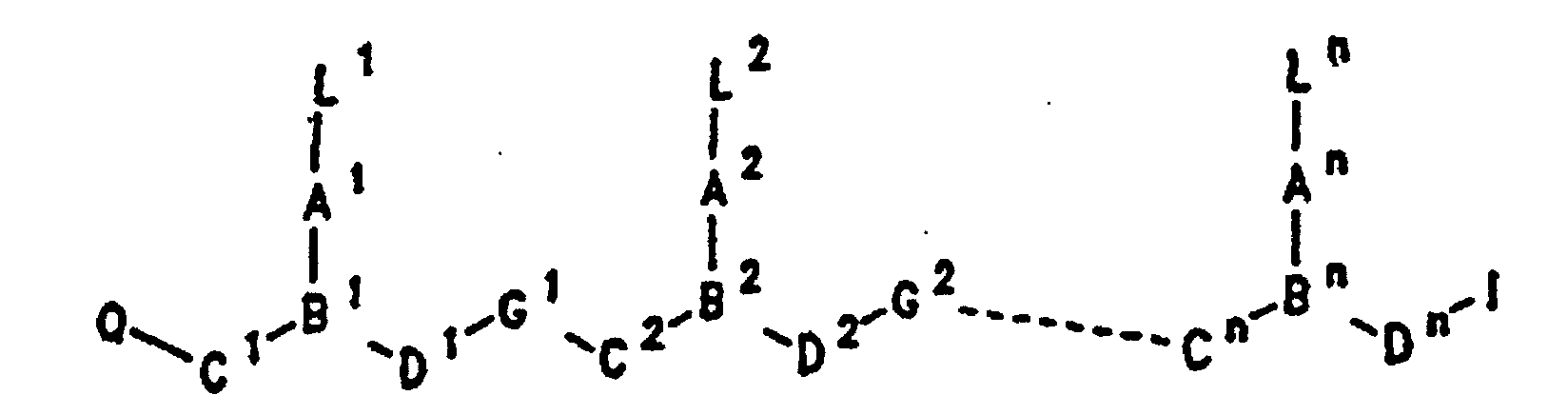 dans lesquellesn est au moins 2,chacun de L1 à Ln est indépendamment choisi dans le groupe consistant en l'hydrogène, l'hydroxy, un alcanoyle ayant de 1 à 4 atomes de carbone, des nucléobases d'origine naturelle, des nucléobases qui ne sont pas d'origine naturelle, des radicaux aromatiques, des intercalateurs d'ADN, des groupes de liaison de nucléobases, des radicaux hétérocycliques et des ligands reporters ;chacun de C1 à Cn est (CR6R7)y, dans laquelle R6 est l'hydrogène et R7 est choisi dans le groupe consistant en les chaínes latérales d'acides alpha aminés d'origine naturelle, ou R6 et R7 sont choisis indépendamment dans le groupe consistant en l'hydrogène, un alcoyle ayant de 2 à 6 atomes de carbone, un aryle, un aralcoyle, un hétéroaryle, l'hydroxy, un alcoxy ayant de 1 à 6 atomes de carbone, un alcoylthio ayant de 1 à 6 atomes de carbone, NR3R4 et SR5, dans laquelle R3 et R4 sont tels que définis ci-dessous, et R5 est l'hydrogène, un alcoyle ayant de 1 à 6 atomes de carbone, un alcoyle ayant de 1 à 6 atomes de carbone substitué par un hydroxy, par un alcoxy ou par un alcoylthio, ou R6 et R7 pris ensemble complètent un système alicyclique ou hétérocyclique ;chacun de D1 à Dn est (CR6R7)z dans laquelle R6 et R7 sont tels que définis ci-dessus ;chacun de y et z est zéro ou un nombre entier allant de 1 à 10, la somme y + z étant supérieure à 2 mais n'étant pas supérieure à 10 ;chacun de G1 à Gn-1 est -NR3CO-, -NR3CS-, -NR3SO- ou -NR3SO2-, dans les deux orientations, dans lesquelles R3 est tel que défini ci-dessous ;chacun de A1 à An et de B1 à Bn est choisi de façon à ce que :(a) A soit un groupe de formule (IIc) ou (IId), et B soit N ou R3N+ ; ou(b) A soit un groupe de formule (IId) et B soit CH ;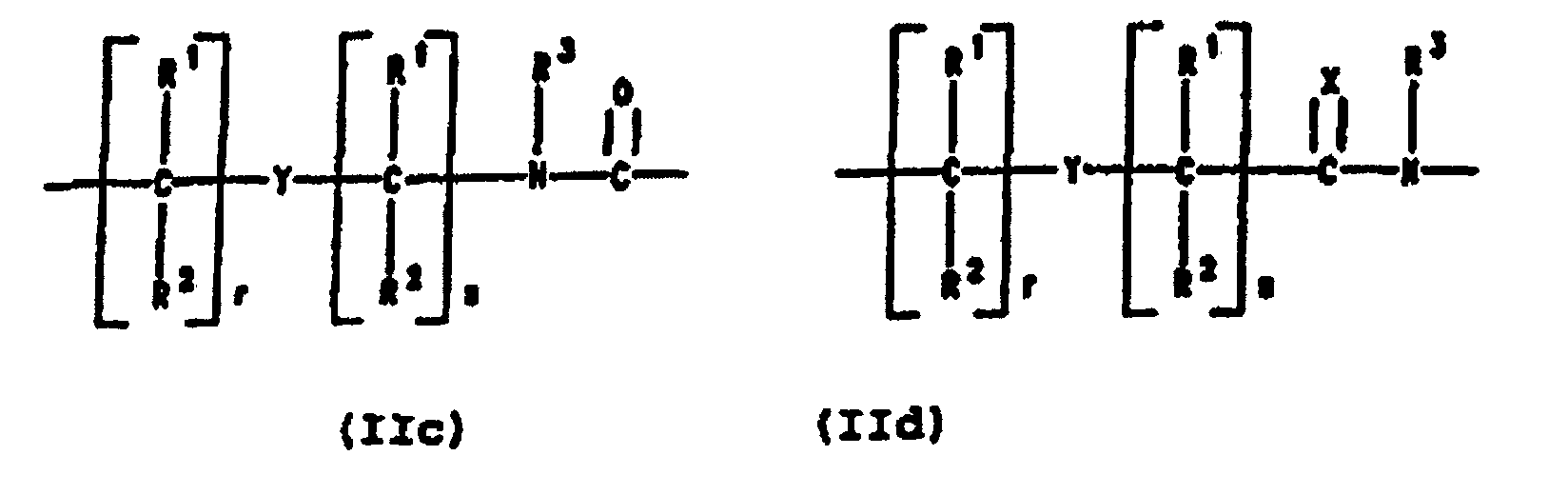
X est O, S, Se, NR3, CH2 ou C(CH3)2;
Y est une simple liaison O, S ou NR4 ;
chacun de p et q est égal à zéro ou est un nombre entier allant de 1 à 5, la somme p+q n'étant pas supérieure à 10 ;
chacun de r et s est égal à zéro ou est un nombre entier allant de 1 à 5, la somme r+s n'étant pas supérieure à 10 ;
chacun de R1 et R2 étant choisi indépendamment dans le groupe consistant en l'hydrogène, un alcoyle ayant de 1 à 4 atomes de carbone qui peut être substitué par un hydroxy ou par un alcoxy ou par un alcoylthio, l'hydroxy, un alcoxy, un alcoylthio, un amino et un halogène ; et
chacun de R3 et R4 est choisi indépendamment dans le groupe consistant en l'hydrogène, un alcoyle ayant de 1 à 4 atomes de carbone, un alcoyle ayant de 1 à 4 atomes de carbone substitué par un hydroxy ou par un alcoxy ou par un alcoylthio, l'hydroxy, un alcoxy, un alcoylthio et un amino ;
Q est -CO2H, -CONR'R", -SO3H ou -SO2NR'R" ou un dérivé activé de -CO2H ou de -SO3H ; et
I est -NHR'''R'''' ou -NR'''C(O)R'''', dans laquelle R', R", R"' et R"" sont choisis indépendamment dans le groupe consistant en l'hydrogène, un alcoyle, des groupes de protection d'un amino, des ligands reporters, des intercalateurs, des agents de chélation, des peptides, des protéines, des hydrates de carbone, des lipides, des stéroïdes, des nucléosides, des nucléotides, des nucléotides diphosphates, des nucléotides triphosphates, des oligonucléotides, des oligonucléosides et des polymères solubles et insolubles ;
et une pluralité des ligands sur le deuxième brin agissant en interaction avec le premier brin ; et
une pluralité des ligands sur le troisième brin agissant en interaction avec le premier brin ou avec les ligands du deuxième brin. - Le complexe de la revendication 1, dans lequel le premier brin est un brin d'ADN.
- Le complexe de la revendication 1, dans lequel le premier brin est un brin d'ARN.
- Le complexe de la revendication 1, dans lequel les motifs monomères comprennent des motifs d'aminoéthylglycine.
- Le complexe de la revendication 1, dans lequel le deuxième brin et le troisième brin comprennent indépendamment un composé de formule IV ou V :
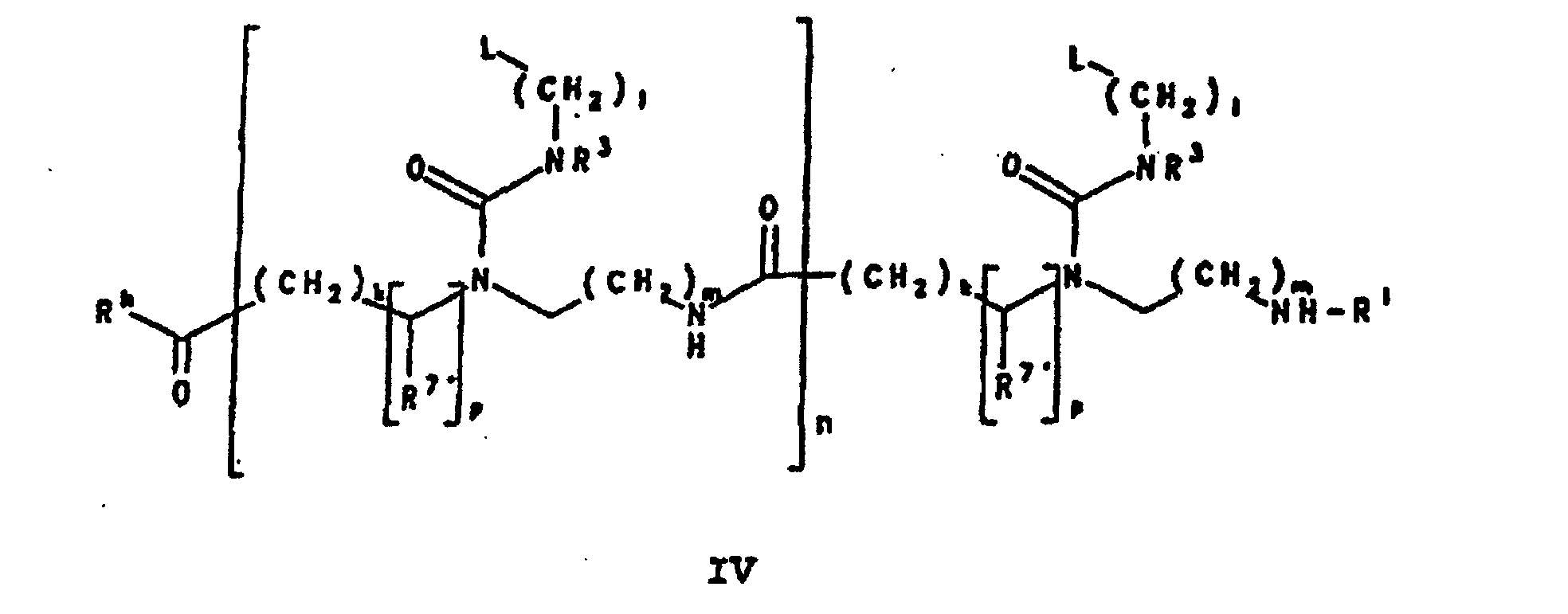 dans lesquelles :
 chaque L est choisi indépendamment dans le groupe consistant en l'hydrogène, le phényle, des radicaux hétérocycliques, des nucléobases d'origine naturelle et des nucléobases qui ne sont pas d'origine naturelle ;chaque R7' est choisi indépendamment dans le groupe consistant en l'hydrogène et les chaínes latérales d'acides aminés en alpha d'origine naturelle ;n est un nombre entier supérieur 1,chaque k, l et m est indépendamment égal à zéro ou est un nombre entier allant de 1 à 5 ;chaque p est égal à zéro ou à 1 ;Rh est OH, NH2 ou -NHLysNH2 ; etRj est H ou COCH3.
 - Le complexe de la revendication 1, dans lequel l'interaction entre le premier et le deuxième brin se produit entre des bases hétérocycliques du premier brin et des ligands du deuxième brin ;
l'interaction entre le premier et le troisième brin se produit entre des bases hétérocycliques du premier brin et des ligands du troisième brin ; et
l'interaction de ligands du deuxième brin et de bases hétérocycliques du premier brin s'effectue par l'intermédiaire d'une liaison hydrogène de Watson/Crick et l'interaction de ligands du deuxième brin et de bases hétérocycliques du premier brin s'effectue par l'intermédiaire d'une liaison hydrogène de Watson/Crick ou d'une liaison hydrogène de Hoogsteen. - Complexe comprenant un premier brin d'acide nucléique, un deuxième brin d'acide nucléique et un troisième brin ;
le troisième brin comprenant un composé de formule :dans laquelle :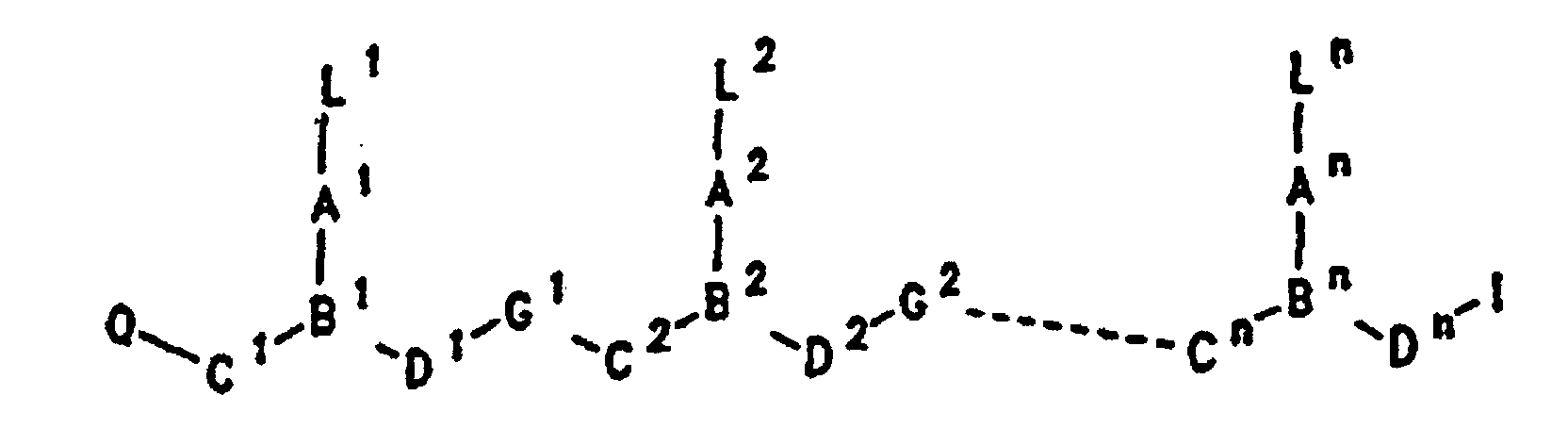 dans lesquellesn est au moins 2,chacun de L1 à Ln est indépendamment choisi dans le groupe consistant en l'hydrogène, l'hydroxy, un alcanoyle ayant de 1 à 4 atomes de carbone, des nucléobases d'origine naturelle, des nucléobases qui ne sont pas d'origine naturelle, des radicaux aromatiques, des intercalateurs d'ADN, des groupes de liaison de nucléobases, des radicaux hétérocycliques et des ligands reporters ;chacun de C1 à Cn est (CR6R7)y, dans laquelle R6 est l'hydrogène et R7 est choisi dans le groupe consistant en les chaínes latérales d'acides alpha aminés d'origine naturelle, ou R6 et R7 sont choisis indépendamment dans le groupe consistant en l'hydrogène, un alcoyle ayant de 2 à 6 atomes de carbone, un aryle, un aralcoyle, un hétéroaryle, l'hydroxy, un alcoxy ayant de 1 à 6 atomes de carbone, un alcoylthio ayant de 1 à 6 atomes de carbone, NR3R4 et SR5, dans laquelle R3 et R4 sont tels que définis ci-dessous, et R5 est l'hydrogène, un alcoyle ayant de 1 à 6 atomes de carbone, un alcoyle ayant de 1 à 6 atomes de carbone substitué par un hydroxy, par un alcoxy ou par un alcoylthio, ou R6 et R7 pris ensemble complètent un système alicyclique ou hétérocyclique ;chacun de D1 à Dn est (CR6R7)z dans laquelle R6 et R7 sont tels que définis ci-dessus ;chacun de y et z est zéro ou un nombre entier allant de 1 à 10, la somme y + z étant supérieure à 2 mais n'étant pas supérieure à 10 ;chacun de G1 à Gn-1 est -NR3CO-, -NR3CS-, -NR3SO- ou -NR3SO2-, dans les deux orientations, dans lesquelles R3 est tel que défini ci-dessous ;chacun de A1 à An et de B1 à Bn est choisi de façon à ce que :(a) A soit un groupe de formule (IIc) ou (IId), et B soit N ou R3N+ ; ou(b) A soit un groupe de formule (IId) et B soit CH ;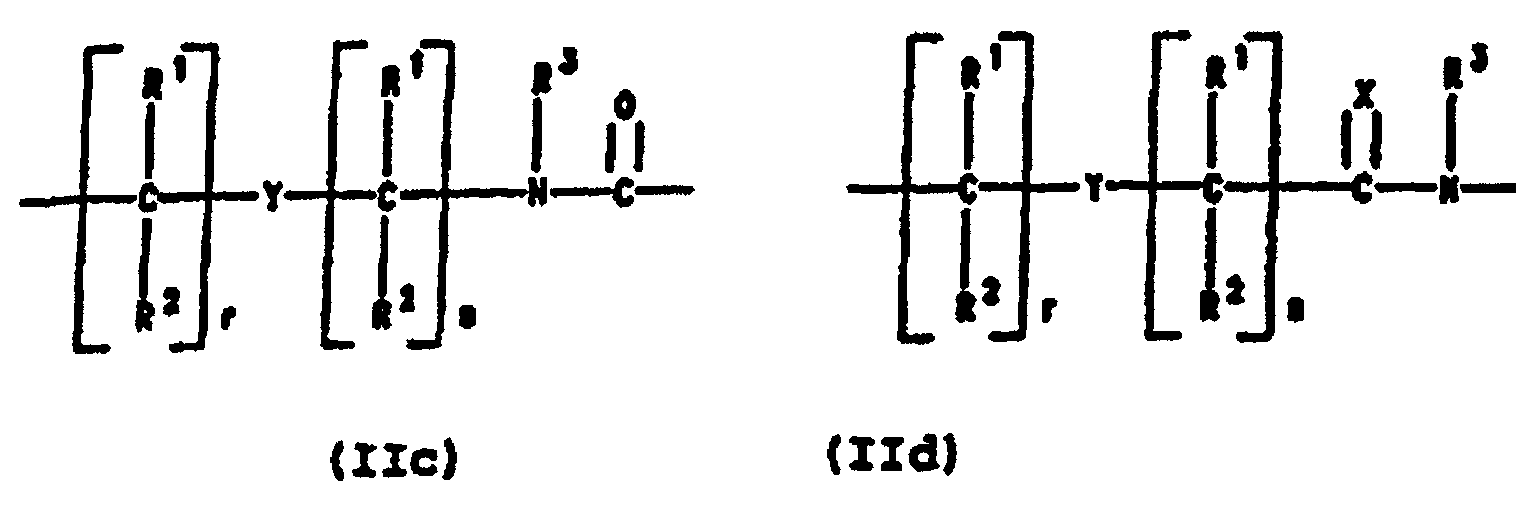
X est O, S, Se, NR3, CH2 ou C(CH3)2 ;
Y est une simple liaison O, S ou NR4 ;
chacun de p et q est égal à zéro ou est un nombre entier allant de 1 à 5, la somme p+q n'étant pas supérieure à 10 ;
chacun de r et s est égal à zéro ou est un nombre entier allant de 1 à 5, la somme r+s n'étant pas supérieure à 10 ;
chacun de R1 et R2 étant choisi indépendamment dans le groupe consistant en l'hydrogène, un alcoyle ayant de 1 à 4 atomes de carbone qui peut être substitué par un hydroxy ou par un alcoxy ou par un alcoylthio, l'hydroxy, un alcoxy, un alcoylthio, un amino et un halogène ; et
chacun de R3 et R4 est choisi indépendamment dans le groupe consistant en l'hydrogène, un alcoyle ayant de 1 à 4 atomes de carbone, un alcoyle ayant de 1 à 4 atomes de carbone substitué par un hydroxy ou par un alcoxy ou par un alcoylthio, l'hydroxy, un alcoxy, un alcoylthio et un amino ;
Q est -CO2H, -CONR'R", -SO3H ou -SO2NR'R" ou un dérivé activé de -CO2H ou de -SO3H ; et
I est -NHR"'R"" ou -NR"'C(O)R"", dans laquelle R', R", R"' et R"" sont choisis indépendamment dans le groupe consistant en l'hydrogène, un alcoyle, des groupes de protection d'un amino, des ligands reporters, des intercalateurs, des agents de chélation, des peptides, des protéines, des hydrates de carbone, des lipides, des stéroïdes, des nucléosides, des nucléotides, des nucléotides diphosphates, des nucléotides triphosphates, des oligonucléotides, des oligonucléosides et des polymères solubles et non solubles. - Le complexe de la revendication 7, dans lequel l'interaction se produit entre des bases hétérocycliques du premier brin ou du deuxième brin et des ligands du troisième brin.
- Le complexe de la revendication 7, dans lequel le premier brin et le deuxième brin sont des brins d'ADN.
- Le complexe de la revendication 9, dans lequel les brins d'ADN sont des brins d'ADN complémentaires.
- Le complexe de la revendication 1 ou de la revendication 7, dans lequel les motifs monomères comprennent des motifs d'aminoéthylglycine.
- Le complexe de la revendication 7, dans lequel le troisième brin comprend un composé de formule IV ou V :
 dans lesquelles :
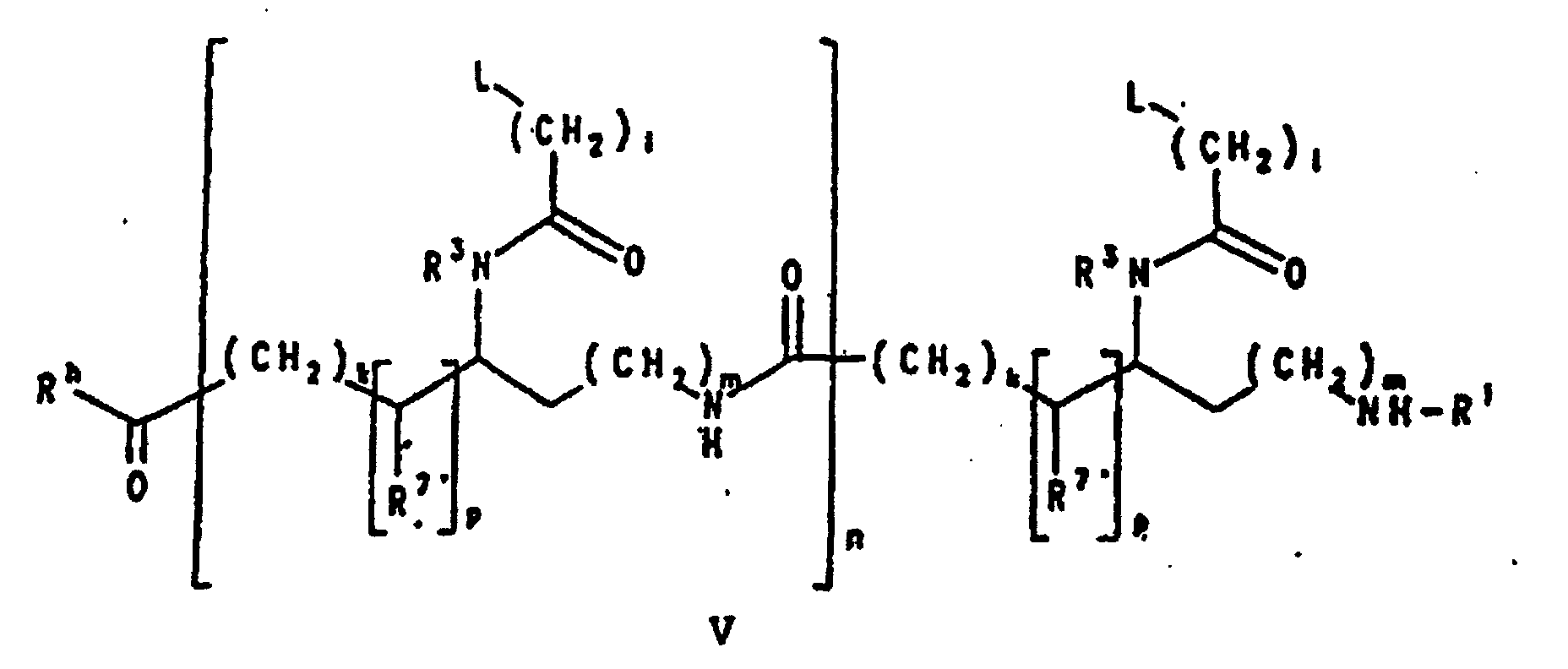 chaque L est choisi indépendamment dans le groupe consistant en l'hydrogène, le phényle, des radicaux hétérocycliques, des nucléobases d'origine naturelle et des nucléobases qui ne sont pas d'origine naturelle ;chaque R7' est choisi indépendamment dans le groupe consistant en l'hydrogène et les chaínes latérales d'acides aminés en alpha d'origine naturelle ;n est un nombre entier supérieur 1,chaque k, l et m est indépendamment égal à zéro ou est un nombre entier allant de 1 à 5 ;chaque p est égal à zéro ou à 1 ;Rh est OH, NH2 ou -NHLysNH2 ; etRj est H ou COCH3.
 - Procédé de modification d'un ADN à double brin, comprenant les stades de :dans laquelle :mise de l'ADN à double brin en contact avec un composé de formule :
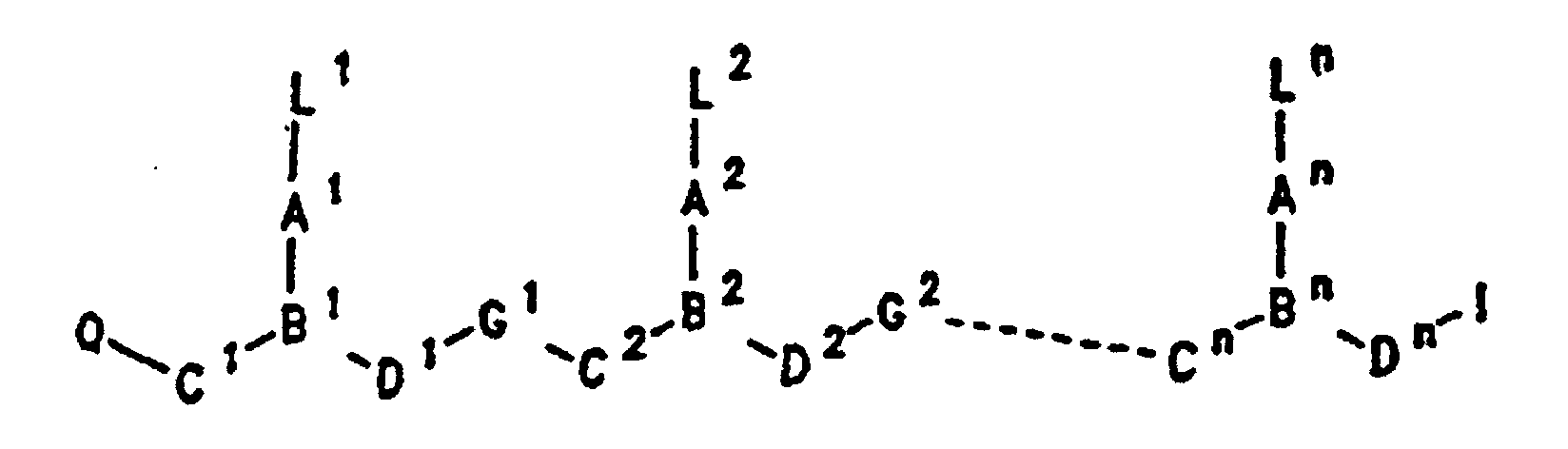 dans lesquellesn est au moins égal à 2 ;chacun de L1 à Ln est indépendamment choisi dans le groupe consistant en l'hydrogène, l'hydroxy, un alcanoyle ayant de 1 à 4 atomes de carbone, des nucléobases d'origine naturelle, des nucléobases qui ne sont pas d'origine naturelle, des radicaux aromatiques, des intercalateurs d'ADN, des groupes de liaison de nucléobases, des radicaux hétérocycliques et des ligands reporters ;chacun de C1 à Cn est (CR6R7)y, dans laquelle R6 est l'hydrogène et R7 est choisi dans le groupe consistant en les chaínes latérales d'acides alpha aminés d'origine naturelle, ou R6 et R7 sont choisis indépendamment dans le groupe consistant en l'hydrogène, un alcoyle ayant de 2 à 6 atomes de carbone, un aryle, un aralcoyle, un hétéroaryle, l'hydroxy, un alcoxy ayant de 1 à 6 atomes de carbone, un alcoylthio ayant de 1 à 6 atomes de carbone, NR3R4 et SR5, dans laquelle R3 et R4 sont tels que définis ci-dessous, et R5 est l'hydrogène, un alcoyle ayant de 1 à 6 atomes de carbone, un alcoyle ayant de 1 à 6 atomes de carbone substitué par un hydroxy, par un alcoxy ou par un alcoylthio, ou R6 et R7 pris ensemble complètent un système alicyclique ou hétérocyclique ;chacun de D1 à Dn est (CR6R7)z dans laquelle R6 et R7 sont tels que définis ci-dessus ;chacun de y et z est zéro ou un nombre entier allant de 1 à 10, la somme y + z étant supérieure à 2 mais n'étant pas supérieure à 10 ;chacun de G1 à Gn-1 est ―NR3CO-, -NR3CS-, -NR3SO- ou ―NR3SO2-, dans les deux orientations, dans lesquelles R3 est tel que défini ci-dessous ;chacun de A1 à An et de B1 à Bn est choisi de façon à ce que :(a) A soit un groupe de formule (IIc) ou (IId), et B soit N ou R3N+ ; ou(b) A soit un groupe de formule (IId) et B soit CH ;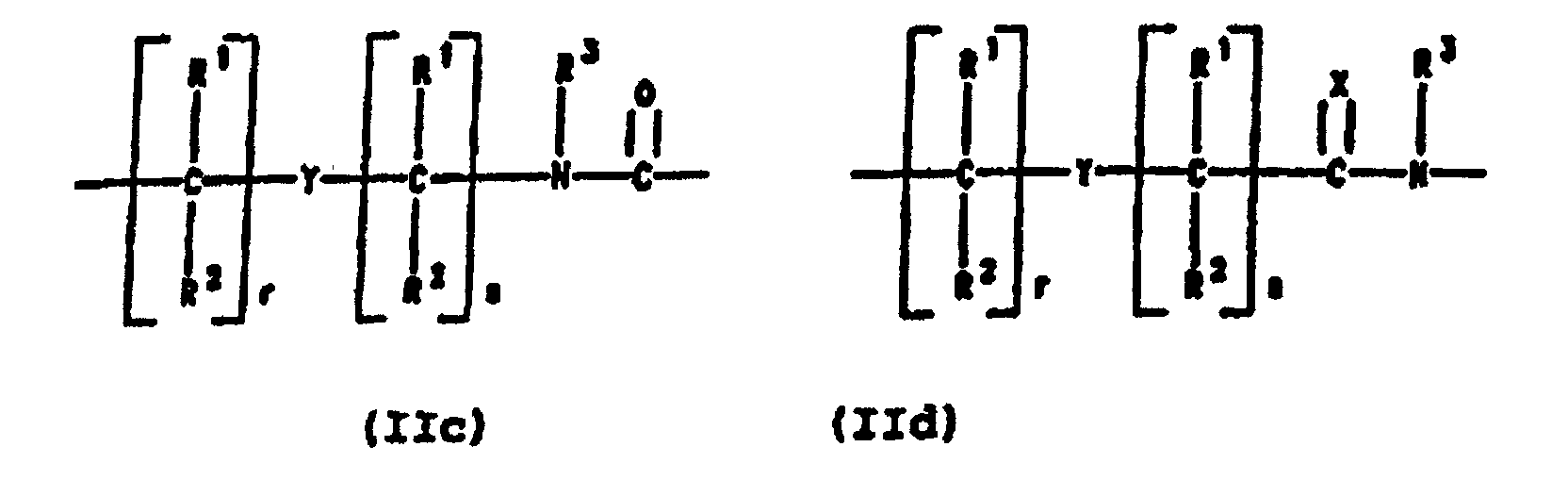
X est O, S, Se, NR3, CH2 ou C(CH3)2 ;
Y est une simple liaison O, S ou NR4 ;
chacun de p et q est égal à zéro ou est un nombre entier allant de 1 à 5, la somme p+q n'étant pas supérieure à 10 ;
chacun de r et s est égal à zéro ou est un nombre entier allant de 1 à 5, la somme r+s n'étant pas supérieure à 10 ;
chacun de R1 et R2 étant choisi indépendamment dans le groupe consistant en l'hydrogène, un alcoyle ayant de 1 à 4 atomes de carbone qui peut être substitué par un hydroxy ou par un alcoxy ou par un alcoylthio, l'hydroxy, un alcoxy, un alcoylthio, un amino et un halogène ; et
chacun de R3 et R4 est choisi indépendamment dans le groupe consistant en l'hydrogène, un alcoyle ayant de 1 à 4 atomes de carbone, un alcoyle ayant de 1 à 4 atomes de carbone substitué par un hydroxy ou par un alcoxy ou par un alcoylthio, l'hydroxy, un alcoxy, un alcoylthio et un amino ;
Q est -CO2H, -CONR'R", -SO3H ou -SO2NR'R" ou un dérivé activé de -CO2H ou de -SO3H ; et
I est -NHR"'R"" ou -NR'''C(O)R'''', dans laquelle R', R", R"' et R"" sont choisis indépendamment dans le groupe consistant en l'hydrogène, un alcoyle, des groupes de protection d'un amino, des ligands reporters, des intercalateurs, des agents de chélation, des peptides, des protéines, des hydrates de carbone, des lipides, des stéroïdes, des nucléosides, des nucléotides, des nucléotides diphosphates, des nucléotides triphosphates, des oligonucléotides, des oligonucléosides et des polymères solubles et non solubles ;
une pluralité des ligands agissant en interaction avec l'ADN à double brin et déplaçant ainsi l'un des brins d'ADN ; et de modification du brin déplacé. - Le procédé de la revendication 13, dans lequel la modification du brin déplacé comprend la coupure du brin.
- Le procédé de la revendication 14, dans lequel la coupure est effectuée par un enzyme.
- Le procédé suivant la revendication 13, dans lequel le composé forme des liaisons hydrogène de Watson-Crick avec l'un des brins de l'ADN à double brin.
- Le procédé suivant la revendication 13, dans lequel une première molécule du composé forme des liaisons hydrogène de Watson-Crick avec un premier brin de l'ADN à double brin et une deuxième molécule du composé forme des liaisons hydrogène de Hoogsteen avec le premier brin.
- Le procédé suivant la revendication 13, dans lequel le brin déplacé est modifié en liant par covalence un radical de liaison sur le brin déplacé, en initiant ainsi un mécanisme de réparation cellulaire qui effectue une digestion du brin déplacé.
- Procédé d'inhibition de l'expression d'un gène qui consiste à mettre le gène en contact avec un composé de formule :dans laquelle :
 dans lesquellesn est au moins égal à 2 ;chacun de L1 à Ln est indépendamment choisi dans le groupe consistant en l'hydrogène, l'hydroxy, un alcanoyle ayant de 1 à 4 atomes de carbone, des nucléobases d'origine naturelle, des nucléobases qui ne sont pas d'origine naturelle, des radicaux aromatiques, des intercalateurs d'ADN, des groupes de liaison de nucléobases, des radicaux hétérocycliques et des ligands reporters ;chacun de C1 à Cn est (CR6R7)y, dans laquelle R6 est l'hydrogène et R7 est choisi dans le groupe consistant en les chaínes latérales d'acides alpha aminés d'origine naturelle, ou R6 et R7 sont choisis indépendamment dans le groupe consistant en l'hydrogène, un alcoyle ayant de 2 à 6 atomes de carbone, un aryle, un aralcoyle, un hétéroaryle, l'hydroxy, un alcoxy ayant de 1 à 6 atomes de carbone, un alcoylthio ayant de 1 à 6 atomes de carbone, NR3R4 et SR5, dans laquelle R3 et R4 sont tels que définis ci-dessous, et R5 est l'hydrogène, un alcoyle ayant de 1 à 6 atomes de carbone, un alcoyle ayant de 1 à 6 atomes de carbone substitué par un hydroxy, par un alcoxy ou par un alcoylthio, ou R6 et R7 pris ensemble complètent un système alicyclique ou hétérocyclique ;chacun de D1 à Dn est (CR6R7)z dans laquelle R6 et R7 sont tels que définis ci-dessus ;chacun de y et z est zéro ou un nombre entier allant de 1 à 10, la somme y + z étant supérieure à 2 mais n'étant pas supérieure à 10 ;chacun de G1 à Gn-1 est -NR3CO-, -NR3CS-, -NR3SO- ou -NR3SO2-, dans les deux orientations, dans lesquelles R3 est tel que défini ci-dessous ;chacun de A1 à An et de B1 à Bn est choisi de façon à ce que :(a) A soit un groupe de formule (IIc) ou (IId), et B soit N ou R3N+ ; ou(b) A soit un groupe de formule (IId) et B soit CH ;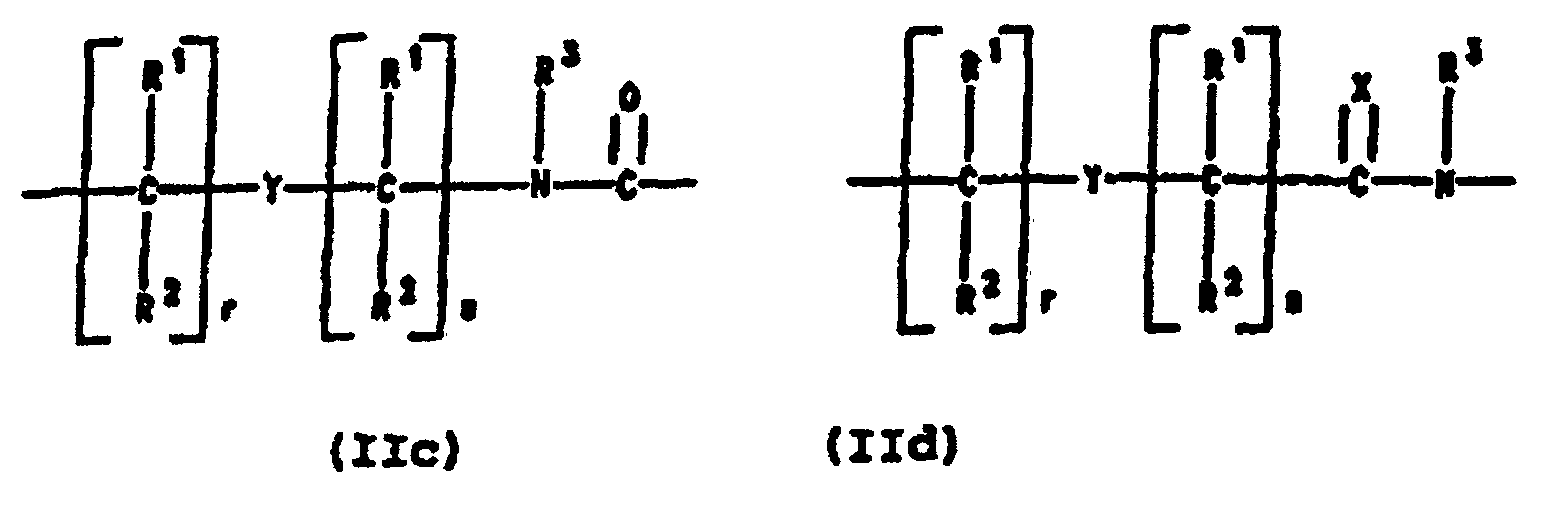
X est O, S, Se, NR3, CH2 ou C(CH3)2 ;
Y est une simple liaison O, S ou NR4 ;
chacun de p et q est égal à zéro ou est un nombre entier allant de 1 à 5, la somme p+q n'étant pas supérieure à 10 ;
chacun de r et s est égal à zéro ou est un nombre entier allant de 1 à 5, la somme r+s n'étant pas supérieure à 10 ;
chacun de R1 et R2 étant choisi indépendamment dans le groupe consistant en l'hydrogène, un alcoyle ayant de 1 à 4 atomes de carbone qui peut être substitué par un hydroxy ou par un alcoxy ou par un alcoylthio, l'hydroxy, un alcoxy, un alcoylthio, un amino et un halogène ; et
chacun de R3 et R4 est choisi indépendamment dans le groupe consistant en l'hydrogène, un alcoyle ayant de 1 à 4 atomes de carbone, un alcoyle ayant de 1 à 4 atomes de carbone substitué par un hydroxy ou par un alcoxy ou par un alcoylthio, l'hydroxy, un alcoxy, un alcoylthio et un amino ;
Q est -CO2H, -CONR'R", -SO3H ou -SO2NR'R" ou un dérivé activé de -CO2H ou de -SO3H ; et
I est -NHR"'R"" ou -NR'''C(O)R'''', dans laquelle R', R", R"' et R"" sont choisis indépendamment dans le groupe consistant en l'hydrogène, un alcoyle, des groupes de protection d'un amino, des ligands reporters, des intercalateurs, des agents de chélation, des peptides, des protéines, des hydrates de carbone, des lipides, des stéroïdes, des nucléosides, des nucléotides, des nucléotides diphosphates, des nucléotides triphosphates, des oligonucléotides, des oligonucléosides et des polymères solubles et non solubles ;
et dans lequel une pluralité des ligands agissent en interaction avec le gène. - Le procédé de la revendication 19, dans lequel l'inhibition de l'expression du gène comprend une interférence de transcription.
- Le procédé de la revendication 20, dans lequel l'interférence de transcription comporte un arrêt d'ARN polymérase.
- Procédé de modulation de l'activité d'un enzyme de restriction en un site de restriction d'ADN qui consiste à mettre l'ADN en contact avec un composé de formule :dans laquelle :
 dans lesquellesn est au moins égal à 2 ;chacun de L1 à Ln est indépendamment choisi dans le groupe consistant en l'hydrogène, l'hydroxy, un alcanoyle ayant de 1 à 4 atomes de carbone, des nucléobases d'origine naturelle, des nucléobases qui ne sont pas d'origine naturelle, des radicaux aromatiques, des intercalateurs d'ADN, des groupes de liaison de nucléobases, des radicaux hétérocycliques et des ligands reporters ;chacun de C1 à C" est (CR6R7)y, dans laquelle R6 est l'hydrogène et R7 est choisi dans le groupe consistant en les chaínes latérales d'acides alpha aminés d'origine naturelle, ou R6 et R7 sont choisis indépendamment dans le groupe consistant en l'hydrogène, un alcoyle ayant de 2 à 6 atomes de carbone, un aryle, un aralcoyle, un hétéroaryle, l'hydroxy, un alcoxy ayant de 1 à 6 atomes de carbone, un alcoylthio ayant de 1 à 6 atomes de carbone, NR3R4 et SR5, dans laquelle R3 et R4 sont tels que définis ci-dessous, et R5 est l'hydrogène, un alcoyle ayant de 1 à 6 atomes de carbone, un alcoyle ayant de 1 à 6 atomes de carbone substitué par un hydroxy, par un alcoxy ou par un alcoylthio, ou R6 et R7 pris ensemble complètent un système alicyclique ou hétérocyclique ;chacun de D1 à Dn est (CR6R7)z dans laquelle R6 et R7 sont tels que définis ci-dessus ;chacun de y et z est zéro ou un nombre entier allant de 1 à 10, la somme y + z étant supérieure à 2 mais n'étant pas supérieure à 10 ;chacun de G1 à Gn-1 est -NR3CO-, -NR3CS-, -NR3SO- ou -NR3SO2-, dans les deux orientations, dans lesquelles R3 est tel que défini ci-dessous ;chacun de A1 à An et de B1 à Bn est choisi de façon à ce que :(a) A soit un groupe de formule (IIc) ou (IId), et B soit N ou R3N+ ; ou(b) A soit un groupe de formule (IId) et B soit CH ;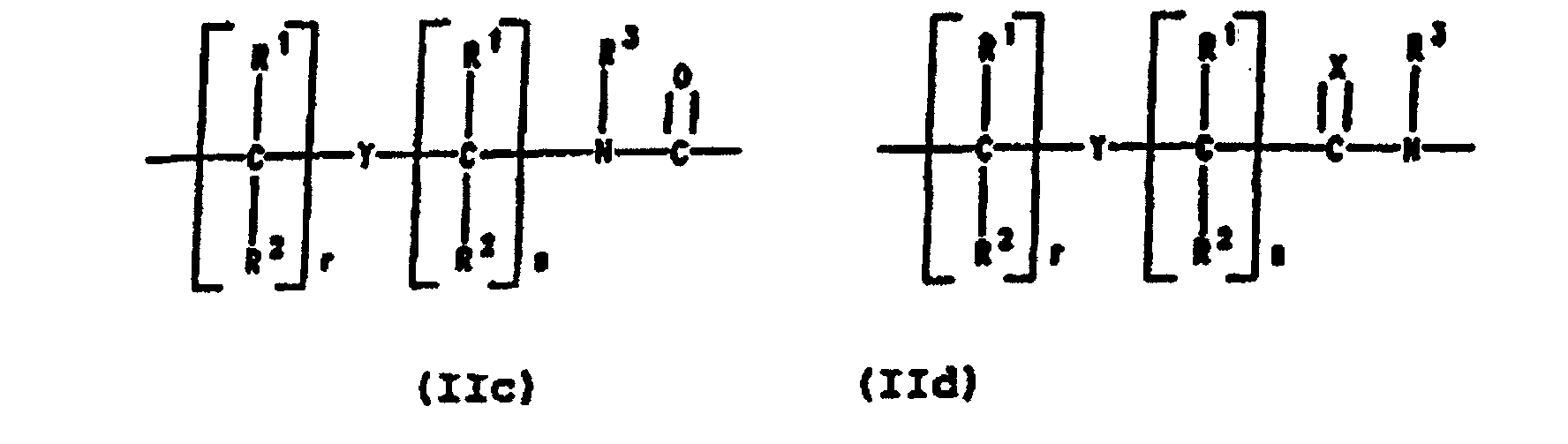
X est O, S, Se, NR3, CH2 ou C(CH3)2 ;
Y est une simple liaison O, S ou NR4 ;
chacun de p et q est égal à zéro ou est un nombre entier allant de 1 à 5, la somme p+q n'étant pas supérieure à 10 ;
chacun de r et s est égal à zéro ou est un nombre entier allant de 1 à 5, la somme r+s n'étant pas supérieure à 10 ;
chacun de R1 et R2 étant choisi indépendamment dans le groupe consistant en l'hydrogène, un alcoyle ayant de 1 à 4 atomes de carbone qui peut être substitué par un hydroxy ou par un alcoxy ou par un alcoylthio, l'hydroxy, un alcoxy, un alcoylthio, un amino et un halogène ; et
chacun de R3 et R4 est choisi indépendamment dans le groupe consistant en l'hydrogène, un alcoyle ayant de 1 à 4 atomes de carbone, un alcoyle ayant de 1 à 4 atomes de carbone substitué par un hydroxy ou par un alcoxy ou par un alcoylthio, l'hydroxy, un alcoxy, un alcoylthio et un amino ;
Q est -CO2H, -CONR'R", -SO3H ou -SO2NR'R" ou un dérivé activé de -CO2H ou de -SO3H ; et
I est -NHR'''R'''' ou -NR"'C(O)R'''', dans laquelle R', R", R"' et R"" sont choisis indépendamment dans le groupe consistant en l'hydrogène, un alcoyle, des groupes de protection d'un amino, des ligands reporters, des intercalateurs, des agents de chélation, des peptides, des protéines, des hydrates de carbone, des lipides, des stéroïdes, des nucléosides, des nucléotides, des nucléotides diphosphates, des nucléotides triphosphates, des oligonucléotides, des oligonucléosides et des polymères solubles et non solubles ;
en liant ainsi une pluralité des ligands à l'ADN proximal du site de restriction. - Procédé de séquençage d'ADN qui consiste à mettre l'ADN en contact avec un composé de formule :dans laquelle :
 dans lesquellesn est au moins égal à 2 ;chacun de L1 à Ln est indépendamment choisi dans le groupe consistant en l'hydrogène, l'hydroxy, un alcanoyle ayant de 1 à 4 atomes de carbone, des nucléobases d'origine naturelle, des nucléobases qui ne sont pas d'origine naturelle, des radicaux aromatiques, des intercalateurs d'ADN, des groupes de liaison de nucléobases, des radicaux hétérocycliques et des ligands reporters ;chacun de C1 à Cn est (CR6R7)y, dans laquelle R6 est l'hydrogène et R7 est choisi dans le groupe consistant en les chaínes latérales d'acides alpha aminés d'origine naturelle, ou R6 et R7 sont choisis indépendamment dans le groupe consistant en l'hydrogène, un alcoyle ayant de 2 à 6 atomes de carbone, un aryle, un aralcoyle, un hétéroaryle, l'hydroxy, un alcoxy ayant de 1 à 6 atomes de carbone, un alcoylthio ayant de 1 à 6 atomes de carbone, NR3R4 et SR5, dans laquelle R3 et R4 sont tels que définis ci-dessous, et R5 est l'hydrogène, un alcoyle ayant de 1 à 6 atomes de carbone, un alcoyle ayant de 1 à 6 atomes de carbone substitué par un hydroxy, par un alcoxy ou par un alcoylthio, ou R6 et R7 pris ensemble complètent un système alicyclique ou hétérocyclique ;chacun de D1 à Dn est (CR6R7)z dans laquelle R6 et R7 sont tels que définis ci-dessus ;chacun de y et z est zéro ou un nombre entier allant de 1 à 10, la somme y + z étant supérieure à 2 mais n'étant pas supérieure à 10 ;chacun de G1 à Gn-1 est ―NR3CO-, -NR3CS-, -NR3SO- ou ―NR3SO2-, dans les deux orientations, dans lesquelles R3 est tel que défini ci-dessous ;chacun de A1 à An et de B1 à Bn est choisi de façon à ce que :(a) A soit un groupe de formule (IIc) ou (IId), et B soit N ou R3N+ ; ou(b) A soit un groupe de formule (IId) et B soit CH ;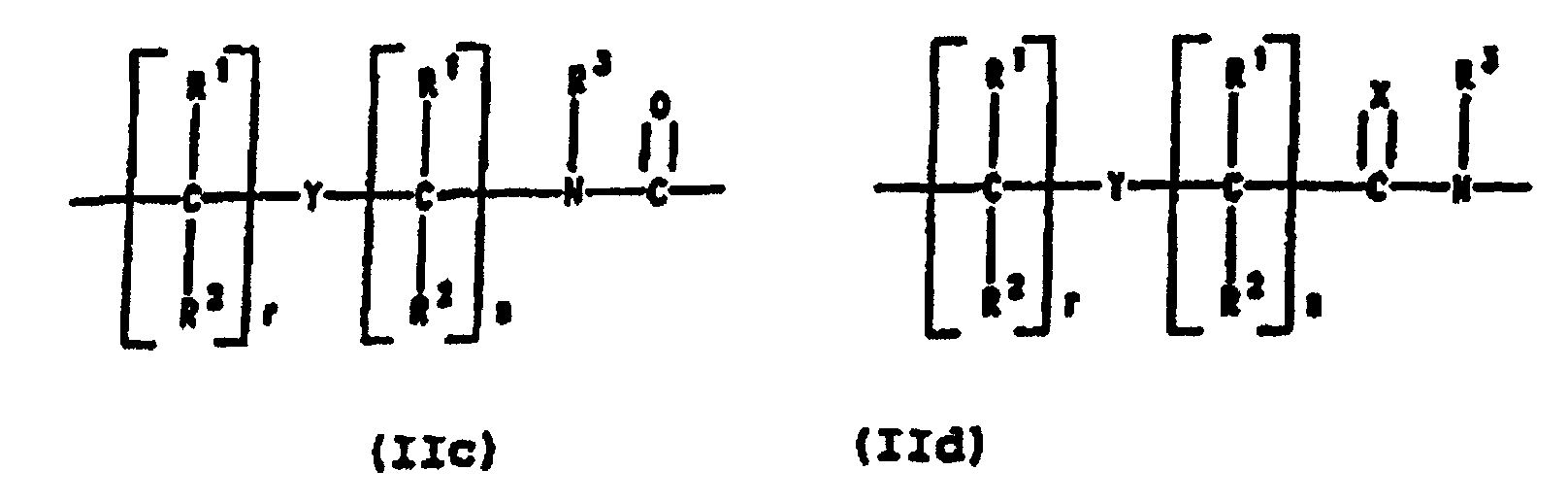
X est O, S, Se, NR3, CH2 ou C(CH3)2 ;
Y est une simple liaison O, S ou NR4 ;
chacun de p et q est égal à zéro ou est un nombre entier allant de 1 à 5, la somme p+q n'étant pas supérieure à 10 ;
chacun de r et s est égal à zéro ou est un nombre entier allant de 1 à 5, la somme r+s n'étant pas supérieure à 10 ;
chacun de R1 et R2 étant choisi indépendamment dans le groupe consistant en l'hydrogène, un alcoyle ayant de 1 à 4 atomes de carbone qui peut être substitué par un hydroxy ou par un alcoxy ou par un alcoylthio, l'hydroxy, un alcoxy, un alcoylthio, un amino et un halogène ; et
chacun de R3 et R4 est choisi indépendamment dans le groupe consistant en l'hydrogène, un alcoyle ayant de 1 à 4 atomes de carbone, un alcoyle ayant de 1 à 4 atomes de carbone substitué par un hydroxy ou par un alcoxy ou par un alcoylthio, l'hydroxy, un alcoxy, un alcoylthio et un amino ;
Q est -CO2H, -CONR'R", -SO3H ou -SO2NR'R" ou un dérivé activé de -CO2H ou de -SO3H ; et
I est -NHR'''R'''' ou -NR'''C(O)R'''', dans laquelle R', R", R''' et R"" sont choisis indépendamment dans le groupe consistant en l'hydrogène, un alcoyle, des groupes de protection d'un amino, des ligands reporters, des intercalateurs, des agents de chélation, des peptides, des protéines, des hydrates de carbone, des lipides, des stéroïdes, des nucléosides, des nucléotides, des nucléotides diphosphates, des nucléotides triphosphates, des oligonucléotides, des oligonucléosides et des polymères solubles et non solubles ;
en liant ainsi une pluralité des ligands à l'ADN proximal d'un site de restriction d'ADN; à traiter l'ADN par un enzyme de restriction qui reconnaít et coupe l'ADN au site de restriction ; et à identifier au moins un produit de cette coupure. - Procédé d'inhibition de la transcription de l'ADN qui consiste :dans laquelle :à sélectionner de l'ADN pour lequel une transcription doit être inhibée ; età ajouter à un mélange contenant cet ADN et un facteur de transcription de cet ADN un composé de formule :
 dans lesquellesn est au moins égal à 2 ;chacun de L1 à Ln est indépendamment choisi dans le groupe consistant en l'hydrogène, l'hydroxy, un alcanoyle ayant de 1 à 4 atomes de carbone, des nucléobases d'origine naturelle, des nucléobases qui ne sont pas d'origine naturelle, des radicaux aromatiques, des intercalateurs d'ADN, des groupes de liaison de nucléobases, des radicaux hétérocycliques et des ligands reporters ;chacun de C1 à Cn est (CR6R7)y, dans laquelle R6 est l'hydrogène et R7 est choisi dans le groupe consistant en les chaínes latérales d'acides alpha aminés d'origine naturelle, ou R6 et R7 sont choisis indépendamment dans le groupe consistant en l'hydrogène, un alcoyle ayant de 2 à 6 atomes de carbone, un aryle, un aralcoyle, un hétéroaryle, l'hydroxy, un alcoxy ayant de 1 à 6 atomes de carbone, un alcoylthio ayant de 1 à 6 atomes de carbone, NR3R4 et SR5, dans laquelle R3 et R4 sont tels que définis ci-dessous, et R5 est l'hydrogène, un alcoyle ayant de 1 à 6 atomes de carbone, un alcoyle ayant de 1 à 6 atomes de carbone substitué par un hydroxy, par un alcoxy ou par un alcoylthio, ou R6 et R7 pris ensemble complètent un système alicyclique ou hétérocyclique ;chacun de D1 à Dn est (CR6R7)z dans laquelle R6 et R7 sont tels que définis ci-dessus ;chacun de y et z est zéro ou un nombre entier allant de 1 à 10, la somme y + z étant supérieure à 2 mais n'étant pas supérieure à 10 ;chacun de G1 à Gn-1 est -NR3CO-, -NR3CS-, -NR3SO- ou -NR3SO2-, dans les deux orientations, dans lesquelles R3 est tel que défini ci-dessous ;chacun de A1 à An et de B1 à Bn est choisi de façon à ce que :(a) A soit un groupe de formule (IIc) ou (IId), et B soit N ou R3N+ ; ou(b) A soit un groupe de formule (IId) et B soit CH ;
X est O, S, Se, NR3, CH2 ou C(CH3)2 ;
Y est une simple liaison O, S ou NR4 ;
chacun de p et q est égal à zéro ou est un nombre entier allant de 1 à 5, la somme p+q n'étant pas supérieure à 10 ;
chacun de r et s est égal à zéro ou est un nombre entier allant de 1 à 5, la somme r+s n'étant pas supérieure à 10 ;
chacun de R1 et R2 étant choisi indépendamment dans le groupe consistant en l'hydrogène, un alcoyle ayant de 1 à 4 atomes de carbone qui peut être substitué par un hydroxy ou par un alcoxy ou par un alcoylthio, l'hydroxy, un alcoxy, un alcoylthio, un amino et un halogène ; et
chacun de R3 et R4 est choisi indépendamment dans le groupe consistant en l'hydrogène, un alcoyle ayant de 1 à 4 atomes de carbone, un alcoyle ayant de 1 à 4 atomes de carbone substitué par un hydroxy ou par un alcoxy ou par un alcoylthio, l'hydroxy, un alcoxy, un alcoylthio et un amino ;
Q est -CO2H, -CONR'R", -SO3H ou -SO2NR'R" ou un dérivé activé de -CO2H ou de -SO3H ; et
I est -NHR"'R"" ou -NR'''C(O)R"", dans laquelle R', R", R"' et R'"' sont choisis indépendamment dans le groupe consistant en l'hydrogène, un alcoyle, des groupes de protection d'un amino, des ligands reporters, des intercalateurs, des agents de chélation, des peptides, des protéines, des hydrates de carbone, des lipides, des stéroïdes, des nucléosides, des nucléotides, des nucléotides diphosphates, des nucléotides triphosphates, des oligonucléotides, des oligonucléosides et des polymères solubles et non solubles ;
en liant ainsi une pluralité des ligands au facteur de transcription. - Procédé de modulation de la liaison d'ARN polymérase à de l'ADN à double brin qui consiste :dans laquelle :à mettre l'ADN en contact avec un composé de formule :
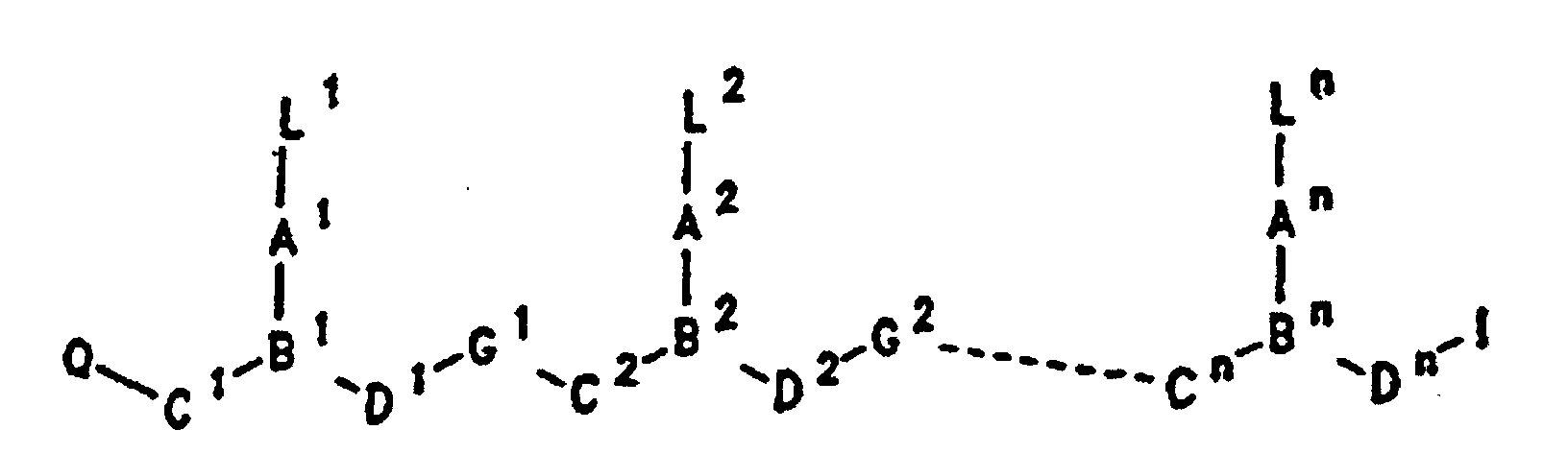 dans lesquellesn est au moins égal à 2 ;chacun de L1 à Ln est indépendamment choisi dans le groupe consistant en l'hydrogène, l'hydroxy, un alcanoyle ayant de 1 à 4 atomes de carbone, des nucléobases d'origine naturelle, des nucléobases qui ne sont pas d'origine naturelle, des radicaux aromatiques, des intercalateurs d'ADN, des groupes de liaison de nucléobases, des radicaux hétérocycliques et des ligands reporters ;chacun de C1 à Cn est (CR6R7)y, dans laquelle R6 est l'hydrogène et R7 est choisi dans le groupe consistant en les chaínes latérales d'acides alpha aminés d'origine naturelle, ou R6 et R7 sont choisis indépendamment dans le groupe consistant en l'hydrogène, un alcoyle ayant de 2 à 6 atomes de carbone, un aryle, un aralcoyle, un hétéroaryle, l'hydroxy, un alcoxy ayant de 1 à 6 atomes de carbone, un alcoylthio ayant de 1 à 6 atomes de carbone, NR3R4 et SR5, dans laquelle R3 et R4 sont tels que définis ci-dessous, et R5 est l'hydrogène, un alcoyle ayant de 1 à 6 atomes de carbone, un alcoyle ayant de 1 à 6 atomes de carbone substitué par un hydroxy, par un alcoxy ou par un alcoylthio, ou R6 et R7 pris ensemble complètent un système alicyclique ou hétérocyclique ;chacun de D1 à Dn est (CR6R7)z dans laquelle R6 et R7 sont tels que définis ci-dessus ;chacun de y et z est zéro ou un nombre entier allant de 1 à 10, la somme y + z étant supérieure à 2 mais n'étant pas supérieure à 10 ;chacun de G1 à Gn-1 est -NR3CO-, -NR3CS-, -NR3SO- ou -NR3SO2-, dans les deux orientations, dans lesquelles R3 est tel que défini ci-dessous ;chacun de A1 à An et de B1 à Bn est choisi de façon à ce que :(a) A soit un groupe de formule (IIc) ou (IId), et B soit N ou R3N+; ou(b) A soit un groupe de formule (IId) et B soit CH ;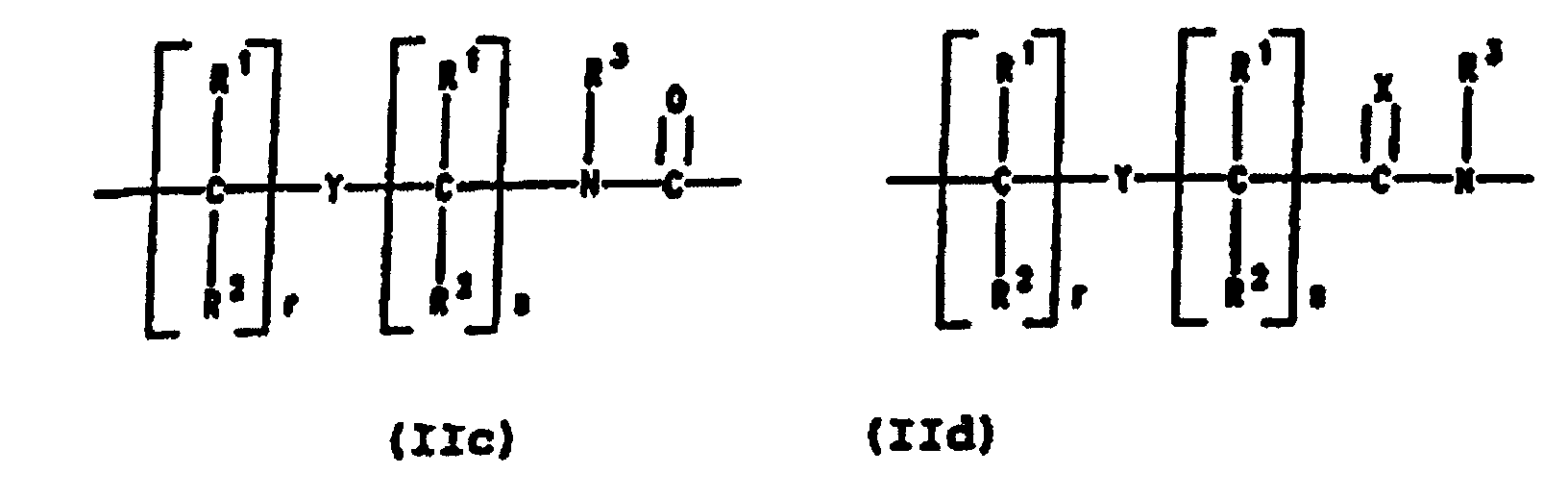
X est O, S, Se, NR3, CH2 ou C(CH3)2 ;
Y est une simple liaison O, S ou NR4 ;
chacun de p et q est égal à zéro ou est un nombre entier allant de 1 à 5, la somme p+q n'étant pas supérieure à 10 ;
chacun de r et s est égal à zéro ou est un nombre entier allant de 1 à 5, la somme r+s n'étant pas supérieure à 10 ;
chacun de R1 et R2 étant choisi indépendamment dans le groupe consistant en l'hydrogène, un alcoyle ayant de 1 à 4 atomes de carbone qui peut être substitué par un hydroxy ou par un alcoxy ou par un alcoylthio, l'hydroxy, un alcoxy, un alcoylthio, un amino et un halogène ; et
chacun de R3 et R4 est choisi indépendamment dans le groupe consistant en l'hydrogène, un alcoyle ayant de 1 à 4 atomes de carbone, un alcoyle ayant de 1 à 4 atomes de carbone substitué par un hydroxy ou par un alcoxy ou par un alcoylthio, l'hydroxy, un alcoxy, un alcoylthio et un amino ;
Q est -CO2H, -CONR'R", -SO3H ou -SO2NR'R" ou un dérivé activé de -CO2H ou de -SO3H ; et
I est -NHR'''R'''' ou -NR'''C(O)R'''', dans laquelle R', R", R"' et R"" sont choisis indépendamment dans le groupe consistant en l'hydrogène, un alcoyle, des groupes de protection d'un amino, des ligands reporters, des intercalateurs, des agents de chélation, des peptides, des protéines, des hydrates de carbone, des lipides, des stéroïdes, des nucléosides, des nucléotides, des nucléotides diphosphates, des nucléotides triphosphates, des oligonucléotides, des oligonucléosides et des polymères solubles et non solubles ;
en liant ainsi une pluralité des ligands à l'ADN ; et à exposer le complexe à une ARN polymérase. - Procédé d'initiation de la transcription d'un gène qui consiste à mettre le gène en contact avec un composé de formule:dans laquelle :
 dans lesquellesn est au moins égal à 2 ;chacun de L1 à Ln est indépendamment choisi dans le groupe consistant en l'hydrogène, l'hydroxy, un alcanoyle ayant de 1 à 4 atomes de carbone, des nucléobases d'origine naturelle, des nucléobases qui ne sont pas d'origine naturelle, des radicaux aromatiques, des intercalateurs d'ADN, des groupes de liaison de nucléobases, des radicaux hétérocycliques et des ligands reporters ;chacun de C1 à Cn est (CR6R7)y, dans laquelle R6 est l'hydrogène et R7 est choisi dans le groupe consistant en les chaínes latérales d'acides alpha aminés d'origine naturelle, ou R6 et R7 sont choisis indépendamment dans le groupe consistant en l'hydrogène, un alcoyle ayant de 2 à 6 atomes de carbone, un aryle, un aralcoyle, un hétéroaryle, l'hydroxy, un alcoxy ayant de 1 à 6 atomes de carbone, un alcoylthio ayant de 1 à 6 atomes de carbone, NR3R4 et SR5, dans laquelle R3 et R4 sont tels que définis ci-dessous, et R5 est l'hydrogène, un alcoyle ayant de 1 à 6 atomes de carbone, un alcoyle ayant de 1 à 6 atomes de carbone substitué par un hydroxy, par un alcoxy ou par un alcoylthio, ou R6 et R7 pris ensemble complètent un système alicyclique ou hétérocyclique ;chacun de D1 à Dn est (CR6R7)z dans laquelle R6 et R7 sont tels que définis ci-dessus ;chacun de y et z est zéro ou un nombre entier allant de 1 à 10, la somme y + z étant supérieure à 2 mais n'étant pas supérieure à 10 ;chacun de G1 à Gn-1 est -NR3CO-, -NR3CS-, -NR3SO- ou -NR3SO2-, dans les deux orientations, dans lesquelles R3 est tel que défini ci-dessous ;chacun de A1 à An et de B1 à Bn est choisi de façon à ce que :(a) A soit un groupe de formule (Ilc) ou (Ild), et B soit N ou R3N+ ; ou(b) A soit un groupe de formule (Ild) et B soit CH ;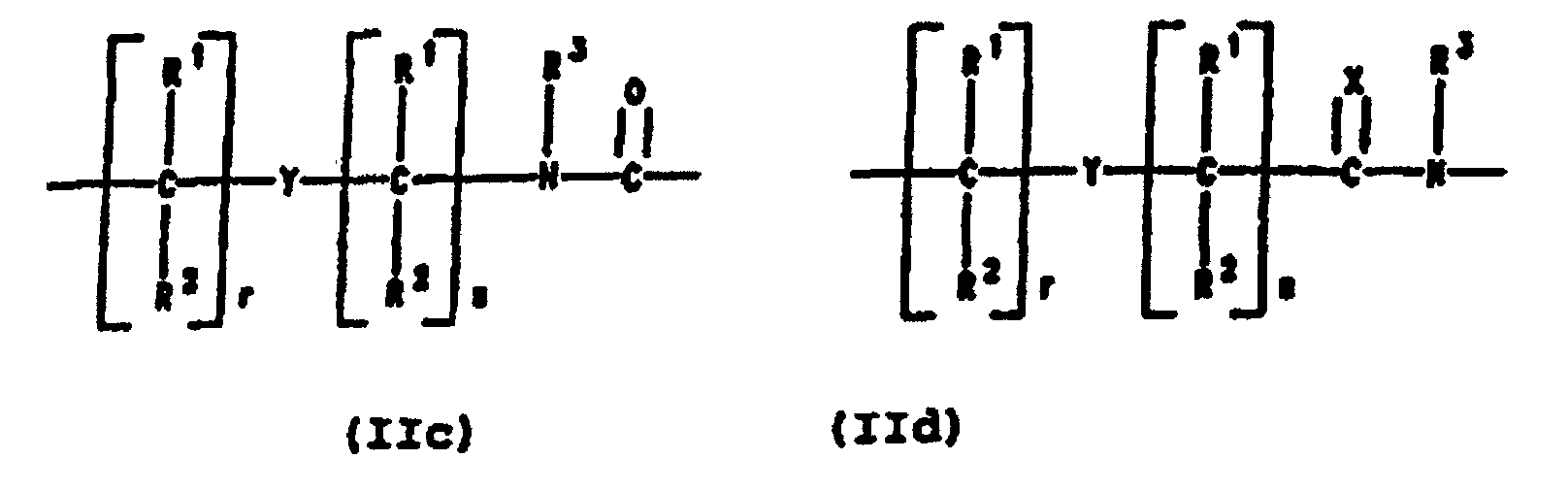
X est O, S, Se, NR3, CH2 ou C(CH3)2 ;
Y est une simple liaison O, S ou NR4 ;
chacun de p et q est égal à zéro ou est un nombre entier allant de 1 à 5, la somme p+q n'étant pas supérieure à 10 ;
chacun de r et s est égal à zéro ou est un nombre entier allant de 1 à 5, la somme r+s n'étant pas supérieure à 10 ;
chacun de R1 et R2 étant choisi indépendamment dans le groupe consistant en l'hydrogène, un alcoyle ayant de 1 à 4 atomes de carbone qui peut être substitué par un hydroxy ou par un alcoxy ou par un alcoylthio, l'hydroxy, un alcoxy, un alcoylthio, un amino et un halogène ; et
chacun de R3 et R4 est choisi indépendamment dans le groupe consistant en l'hydrogène, un alcoyle ayant de 1 à 4 atomes de carbone, un alcoyle ayant de 1 à 4 atomes de carbone substitué par un hydroxy ou par un alcoxy ou par un alcoylthio, l'hydroxy, un alcoxy, un alcoylthio et un amino ;
Q est -CO2H, -CONR'R", -SO3H ou -SO2NR'R" ou un dérivé activé de -CO2H ou de -SO3H ; et
I est -NHR'''R'''' ou -NR'''C(O)R'''', dans laquelle R', R", R"' et R"" sont choisis indépendamment dans le groupe consistant en l'hydrogène, un alcoyle, des groupes de protection d'un amino, des ligands reporters, des intercalateurs, des agents de chélation, des peptides, des protéines, des hydrates de carbone, des lipides, des stéroïdes, des nucléosides, des nucléotides, des nucléotides diphosphates, des nucléotides triphosphates, des oligonucléotides, des oligonucléosides et des polymères solubles et non solubles ;
une pluralité des ligands agissant en interaction avec le gène pour fusionner l'ADN à double brin du gène et exposer ainsi un brin matrice de l'ADN à une reconnaissance par l'ARN polymérase. - Le procédé de la revendication 26, dans lequel le gène est mis en contact avec le composé dans des conditions qui forment un brin hybride avec un brin non codant de l'ADN.
- Le procédé de la revendication 26, dans lequel le gène est mis en contact avec le composé dans des conditions qui forment à la fois un brin hybride avec l'ADN et une boucle "D" du brin matrice.
- Procédé de liaison d'ARN polymérase à de l'ADN à double brin qui consiste à mettre l'ADN en contact avec un composé de formule :dans laquelle :
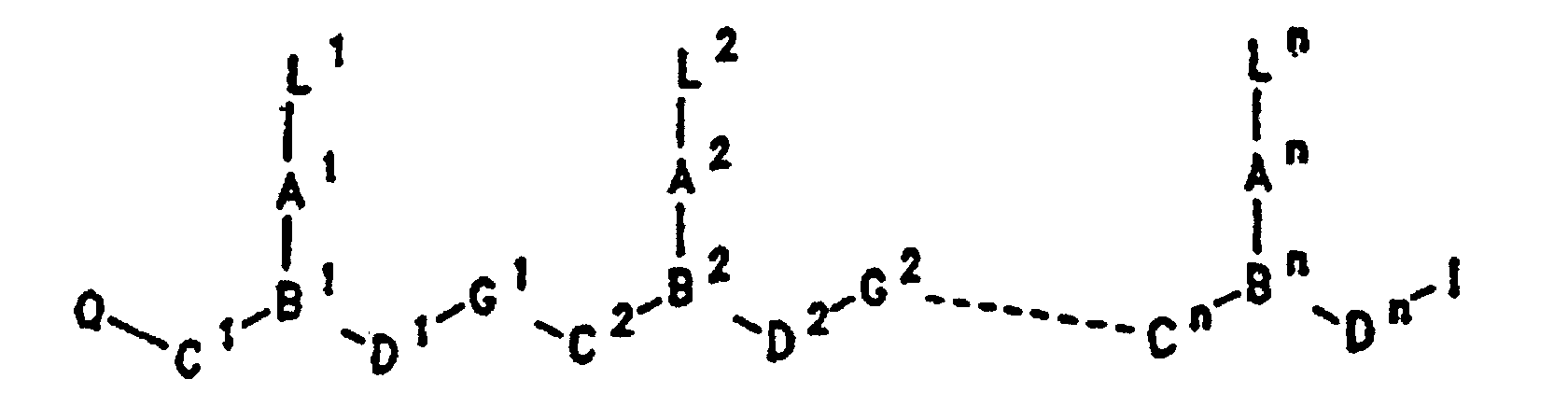 dans lesquellesn est au moins égal à 2 ;chacun de L1 à Ln est indépendamment choisi dans le groupe consistant en l'hydrogène, l'hydroxy, un alcanoyle ayant de 1 à 4 atomes de carbone, des nucléobases d'origine naturelle, des nucléobases qui ne sont pas d'origine naturelle, des radicaux aromatiques, des intercalateurs d'ADN, des groupes de liaison de nucléobases, des radicaux hétérocycliques et des ligands reporters ;chacun de C1 à Cn est (CR6R7)y, dans laquelle R6 est l'hydrogène et R7 est choisi dans le groupe consistant en les chaínes latérales d'acides alpha aminés d'origine naturelle, ou R6 et R7 sont choisis indépendamment dans le groupe consistant en l'hydrogène, un alcoyle ayant de 2 à 6 atomes de carbone, un aryle, un aralcoyle, un hétéroaryle, l'hydroxy, un alcoxy ayant de 1 à 6 atomes de carbone, un alcoylthio ayant de 1 à 6 atomes de carbone, NR3R4 et SR5, dans laquelle R3 et R4 sont tels que définis ci-dessous, et R5 est l'hydrogène, un alcoyle ayant de 1 à 6 atomes de carbone, un alcoyle ayant de 1 à 6 atomes de carbone substitué par un hydroxy, par un alcoxy ou par un alcoylthio, ou R6 et R7 pris ensemble complètent un système alicyclique ou hétérocyclique ;chacun de D1 à Dn est (CR6R7)z dans laquelle R6 et R7 sont tels que définis ci-dessus ;chacun de y et z est zéro ou un nombre entier allant de 1 à 10, la somme y + z étant supérieure à 2 mais n'étant pas supérieure à 10 ;chacun de G1 à Gn-1 est -NR3CO-, -NR3CS-, -NR3SO- ou -NR3SO2-, dans les deux orientations, dans lesquelles R3 est tel que défini ci-dessous ;chacun de A1 à An et de B1 à Bn est choisi de façon à ce que :(a) A soit un groupe de formule (IIc) ou (IId), et B soit N ou R3N+ ; ou(b) A soit un groupe de formule (IId) et B soit CH ;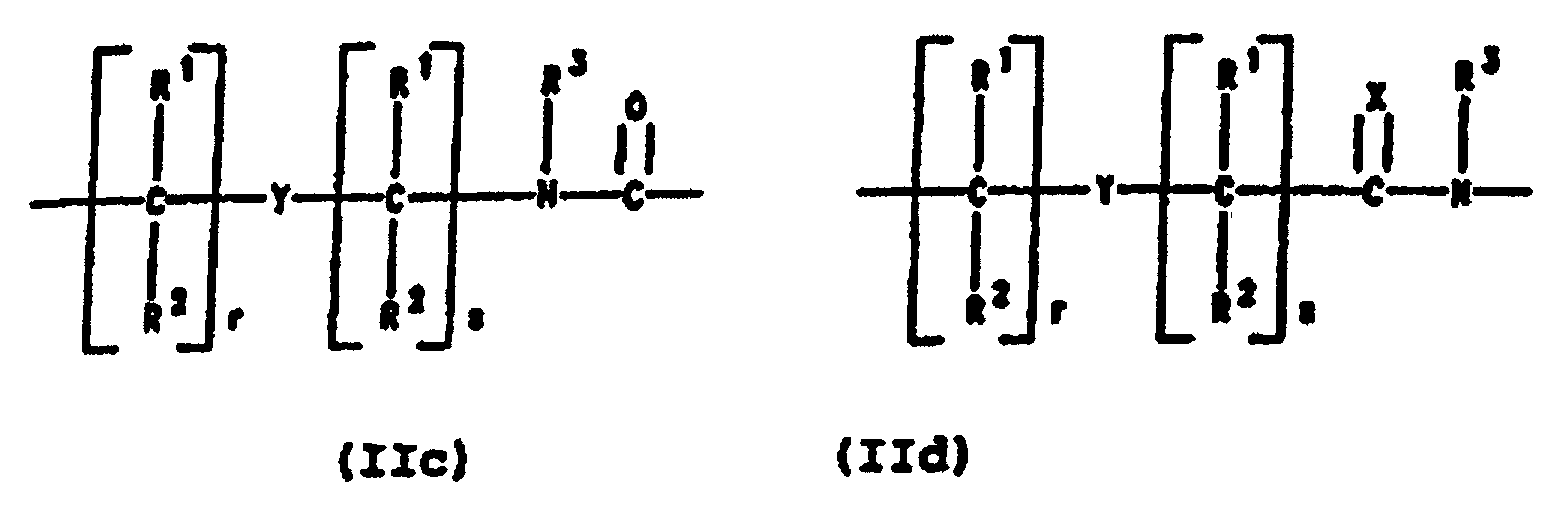
X est O, S, Se, NR3, CH2 ou C(CH3)2 ;
Y est une simple liaison O, S ou NR4 ;
chacun de p et q est égal à zéro ou est un nombre entier allant de 1 à 5, la somme p+q n'étant pas supérieure à 10 ;
chacun de r et s est égal à zéro ou est un nombre entier allant de 1 à 5, la somme r+s n'étant pas supérieure à 10 ;
chacun de R1 et R2 étant choisi indépendamment dans le groupe consistant en l'hydrogène, un alcoyle ayant de 1 à 4 atomes de carbone qui peut être substitué par un hydroxy ou par un alcoxy ou par un alcoylthio, l'hydroxy, un alcoxy, un alcoylthio, un amino et un halogène ; et
chacun de R3 et R4 est choisi indépendamment dans le groupe consistant en l'hydrogène, un alcoyle ayant de 1 à 4 atomes de carbone, un alcoyle ayant de 1 à 4 atomes de carbone substitué par un hydroxy ou par un alcoxy ou par un alcoylthio, l'hydroxy, un alcoxy, un alcoylthio et un amino ;
Q est -CO2H, -CONR'R", -SO3H ou -SO2NR'R" ou un dérivé activé de -CO2H ou de -SO3H ; et
I est -NHR'''R'''' ou -NR'''C(O)R'''', dans laquelle R', R", R''' et R"" sont choisis indépendamment dans le groupe consistant en l'hydrogène, un alcoyle, des groupes de protection d'un amino, des ligands reporters, des intercalateurs, des agents de chélation, des peptides, des protéines, des hydrates de carbone, des lipides, des stéroïdes, des nucléosides, des nucléotides, des nucléotides diphosphates, des nucléotides triphosphates, des oligonucléotides, des oligonucléosides et des polymères solubles et non solubles ;
une pluralité des ligands agissant en interaction avec l'ADN ; et
à exposer le composé et l'ADN à l'ARN polymérase. - Complexe hybride de modulation de la transcription comprenant :dans laquelle :de l'ADN à double brin ;un composé de formule :
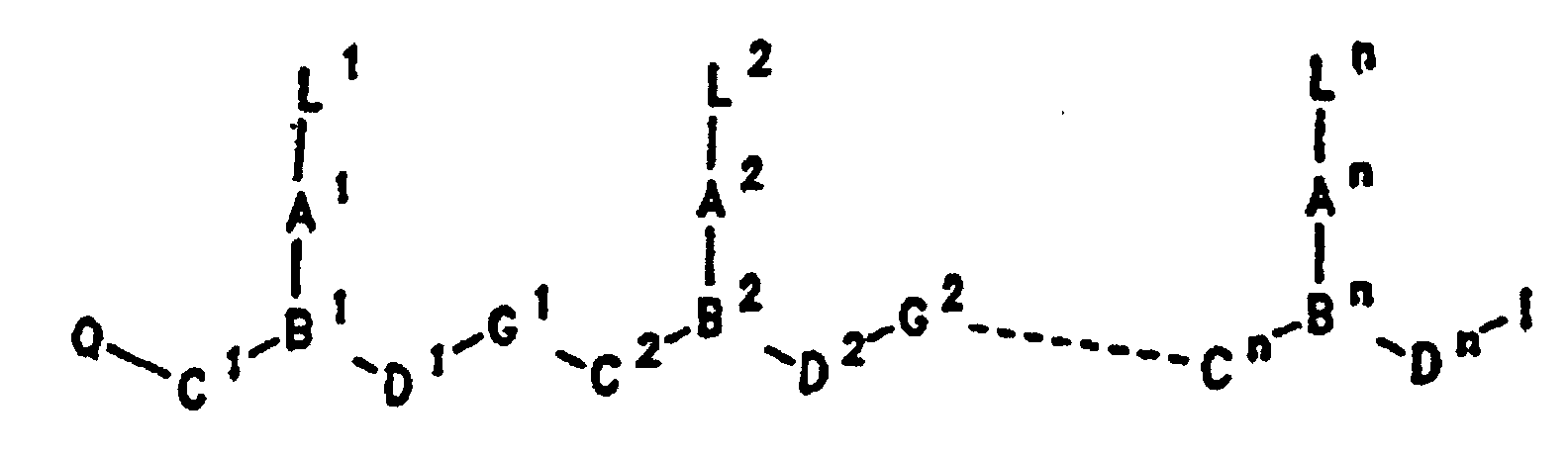 dans lesquellesn est au moins égal à 2 ;chacun de L1 à Ln est indépendamment choisi dans le groupe consistant en l'hydrogène, l'hydroxy, un alcanoyle ayant de 1 à 4 atomes de carbone, des nucléobases d'origine naturelle, des nucléobases qui ne sont pas d'origine naturelle, des radicaux aromatiques, des intercalateurs d'ADN, des groupes de liaison de nucléobases, des radicaux hétérocycliques et des ligands reporters ;chacun de C1 à Cn est (CR6R7)y, dans laquelle R6 est l'hydrogène et R7 est choisi dans le groupe consistant en les chaínes latérales d'acides alpha aminés d'origine naturelle, ou R6 et R7 sont choisis indépendamment dans le groupe consistant en l'hydrogène, un alcoyle ayant de 2 à 6 atomes de carbone, un aryle, un aralcoyle, un hétéroaryle, l'hydroxy, un alcoxy ayant de 1 à 6 atomes de carbone, un alcoylthio ayant de 1 à 6 atomes de carbone, NR3R4 et SR5, dans laquelle R3 et R4 sont tels que définis ci-dessous, et R5 est l'hydrogène, un alcoyle ayant de 1 à 6 atomes de carbone, un alcoyle ayant de 1 à 6 atomes de carbone substitué par un hydroxy, par un alcoxy ou par un alcoylthio, ou R6 et R7 pris ensemble complètent un système alicyclique ou hétérocyclique ;chacun de D1 à Dn est (CR6R7)z dans laquelle R6 et R7 sont tels que définis ci-dessus ;chacun de y et z est zéro ou un nombre entier allant de 1 à 10, la somme y + z étant supérieure à 2 mais n'étant pas supérieure à 10 ;chacun de G1 à Gn-1 est -NR3CO-, -NR3CS-, -NR3SO- ou -NR3SO2-, dans les deux orientations, dans lesquelles R3 est tel que défini ci-dessous ;chacun de A1 à An et de B1 à Bn est choisi de façon à ce que :(a) A soit un groupe de formule (IIc) ou (IId), et B soit N ou R3N+ ; ou(b) A soit un groupe de formule (IId) et B soit CH ;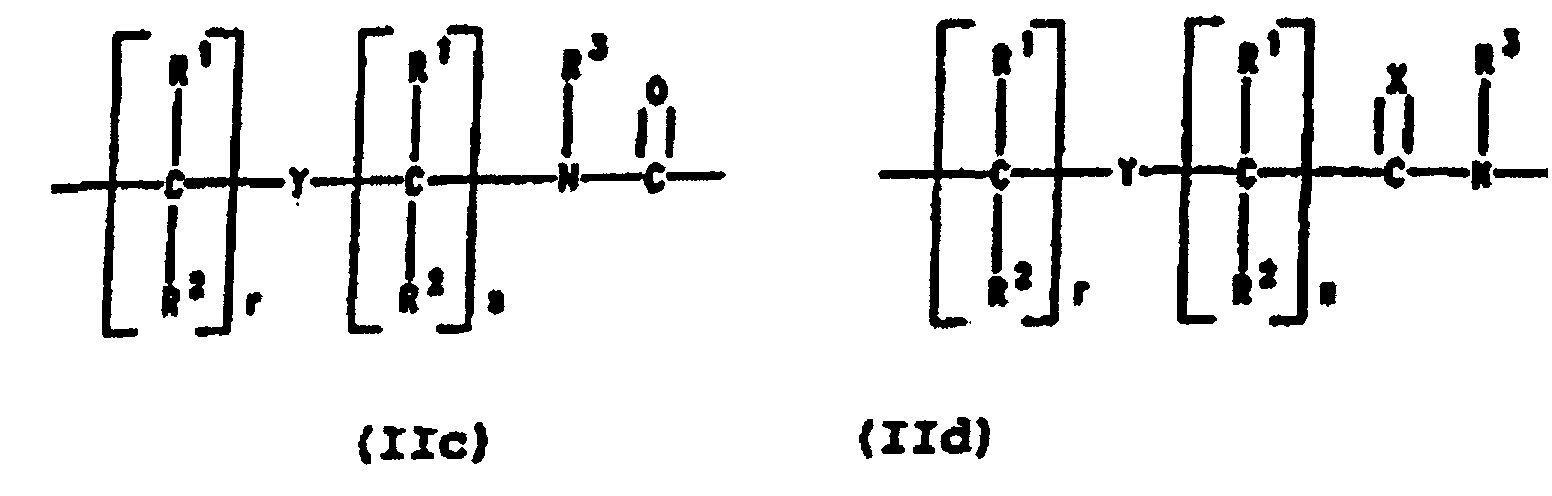
X est O, S, Se, NR3, CH2 ou C(CH3)2 ;
Y est une simple liaison O, S ou NR4 ;
chacun de p et q est égal à zéro ou est un nombre entier allant de 1 à 5, la somme p+q n'étant pas supérieure à 10 ;
chacun de r et s est égal à zéro ou est un nombre entier allant de 1 à 5, la somme r+s n'étant pas supérieure à 10 ;
chacun de R1 et R2 étant choisi indépendamment dans le groupe consistant en l'hydrogène, un alcoyle ayant de 1 à 4 atomes de carbone qui peut être substitué par un hydroxy ou par un alcoxy ou par un alcoylthio, l'hydroxy, un alcoxy, un alcoylthio, un amino et un halogène ; et
chacun de R3 et R4 est choisi indépendamment dans le groupe consistant en l'hydrogène, un alcoyle ayant de 1 à 4 atomes de carbone, un alcoyle ayant de 1 à 4 atomes de carbone substitué par un hydroxy ou par un alcoxy ou par un alcoylthio, l'hydroxy, un alcoxy, un alcoylthio et un amino ;
Q est ―CO2H, -CONR'R", -SO3H ou ―SO2NR'R" ou un dérivé activé de ―CO2H ou de ―SO3H ; et
I est ―NHR'''R'''' ou -NR'''C(O)R'''', dans laquelle R', R", R''' et R"" sont choisis indépendamment dans le groupe consistant en l'hydrogène, un alcoyle, des groupes de protection d'un amino, des ligands reporters, des intercalateurs, des agents de chélation, des peptides, des protéines, des hydrates de carbone, des lipides, des stéroïdes, des nucléosides, des nucléotides, des nucléotides diphosphates, des nucléotides triphosphates, des oligonucléotides, des oligonucléosides et des polymères solubles et non solubles ;
une pluralité des ligands agissant en interaction avec l'ADN à double brin ; et
de l'ARN polymérase en contact étant avec au moins l'un de l'ADN et du composé. - Facteur de transcription synthétique comprenant :dans laquelle :de l'ADN à double brin ; etun composé de formule :
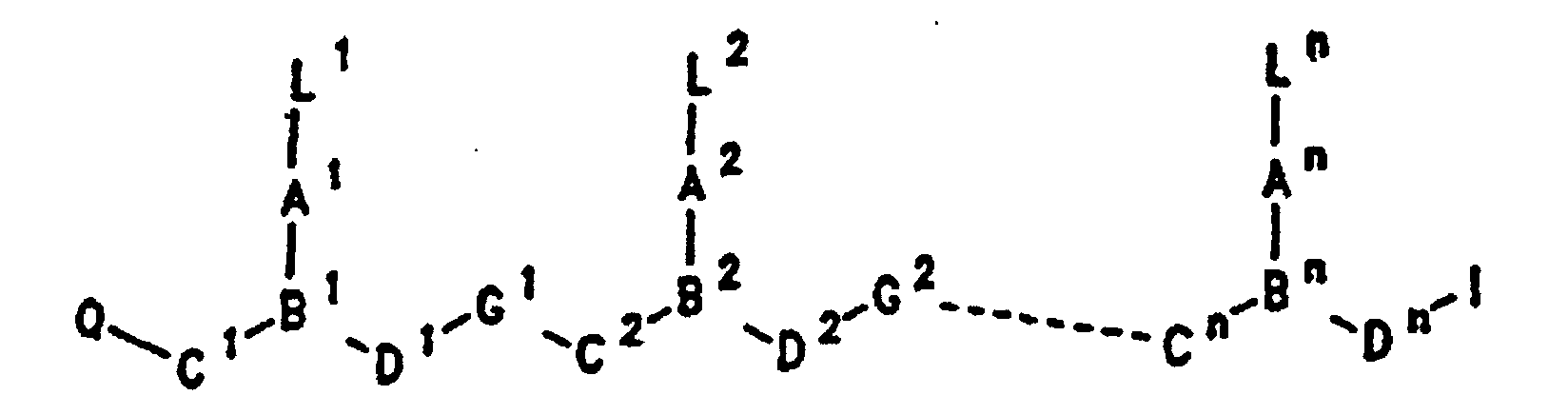 dans lesquellesn est au moins égal à 2 ;chacun de L1 à Ln est indépendamment choisi dans le groupe consistant en l'hydrogène, l'hydroxy, un alcanoyle ayant de 1 à 4 atomes de carbone, des nucléobases d'origine naturelle, des nucléobases qui ne sont pas d'origine naturelle, des radicaux aromatiques, des intercalateurs d'ADN, des groupes de liaison de nucléobases, des radicaux hétérocycliques et des ligands reporters ;chacun de C1 à Cn est (CR6R7)y, dans laquelle R6 est l'hydrogène et R7 est choisi dans le groupe consistant en les chaínes latérales d'acides alpha aminés d'origine naturelle, ou R6 et R7 sont choisis indépendamment dans le groupe consistant en l'hydrogène, un alcoyle ayant de 2 à 6 atomes de carbone, un aryle, un aralcoyle, un hétéroaryle, l'hydroxy, un alcoxy ayant de 1 à 6 atomes de carbone, un alcoylthio ayant de 1 à 6 atomes de carbone, NR3R4 et SR5, dans laquelle R3 et R4 sont tels que définis ci-dessous, et R5 est l'hydrogène, un alcoyle ayant de 1 à 6 atomes de carbone, un alcoyle ayant de 1 à 6 atomes de carbone substitué par un hydroxy, par un alcoxy ou par un alcoylthio, ou R6 et R7 pris ensemble complètent un système alicyclique ou hétérocyclique ;chacun de D1 à Dn est (CR6R7)z dans laquelle R6 et R7 sont tels que définis ci-dessus ;chacun de y et z est zéro ou un nombre entier allant de 1 à 10, la somme y + z étant supérieure à 2 mais n'étant pas supérieure à 10 ;chacun de G1 à Gn-1 est -NR3CO-, -NR3CS-, -NR3SO- ou -NR3SO2-, dans les deux orientations, dans lesquelles R3 est tel que défini ci-dessous ;chacun de A1 à An et de B1 à Bn est choisi de façon à ce que :(a) A soit un groupe de formule (Ilc) ou (Ild), et B soit N ou R3N+ ; ou(b) A soit un groupe de formule (IId) et B soit CH ;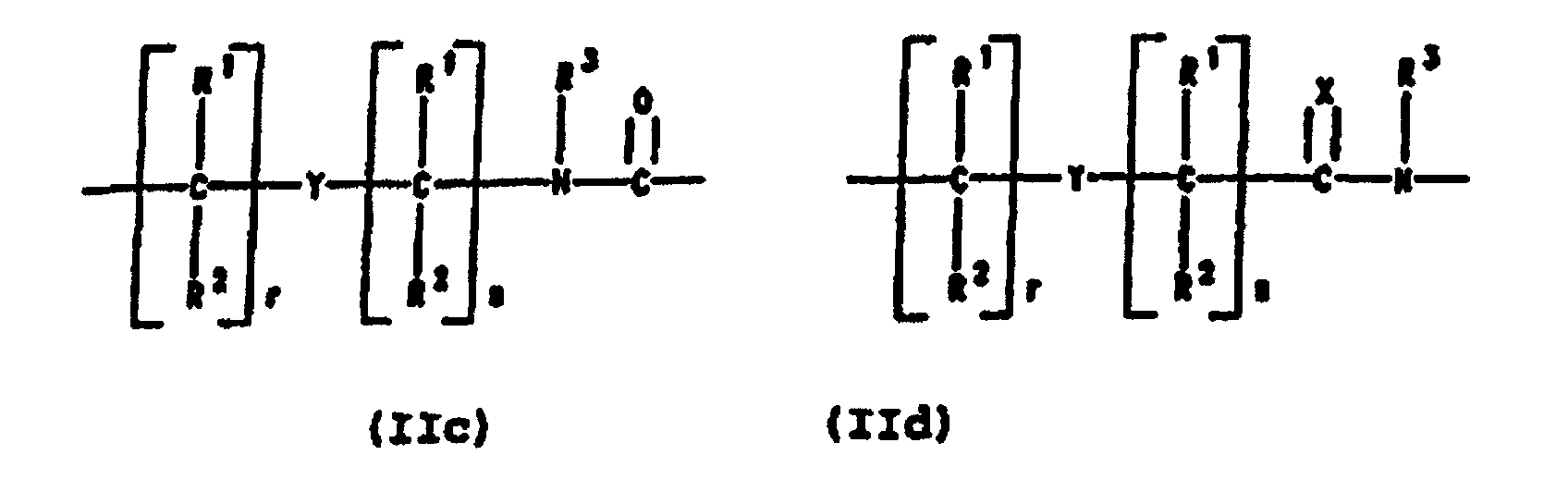
X est O, S, Se, NR3, CH2 ou C(CH3)2 ;
Y est une simple liaison O, S ou NR4 ;
chacun de p et q est égal à zéro ou est un nombre entier allant de 1 à 5, la somme p+q n'étant pas supérieure à 10 ;
chacun de r et s est égal à zéro ou est un nombre entier allant de 1 à 5, la somme r+s n'étant pas supérieure à 10 ;
chacun de R1 et R2 étant choisi indépendamment dans le groupe consistant en l'hydrogène, un alcoyle ayant de 1 à 4 atomes de carbone qui peut être substitué par un hydroxy ou par un alcoxy ou par un alcoylthio, l'hydroxy, un alcoxy, un alcoylthio, un amino et un halogène ; et
chacun de R3 et R4 est choisi indépendamment dans le groupe consistant en l'hydrogène, un alcoyle ayant de 1 à 4 atomes de carbone, un alcoyle ayant de 1 à 4 atomes de carbone substitué par un hydroxy ou par un alcoxy ou par un alcoylthio, l'hydroxy, un alcoxy, un alcoylthio et un amino ;
Q est -CO2H, -CONR'R", -SO3H ou -SO2NR'R" ou un dérivé activé de -CO2H ou de -SO3H ; et
I est -NHR'''R'''' ou -NR'''C(O)R'''', dans laquelle R', R", R"' et R"" sont choisis indépendamment dans le groupe consistant en l'hydrogène, un alcoyle, des groupes de protection d'un amino, des ligands reporters, des intercalateurs, des agents de chélation, des peptides, des protéines, des hydrates de carbone, des lipides, des stéroïdes, des nucléosides, des nucléotides, des nucléotides diphosphates, des nucléotides triphosphates, des oligonucléotides, des oligonucléosides et des polymères solubles et non solubles ;
une pluralité des ligands agissant en interaction avec l'ADN à double brin. - Activateur de gène spécifique à une séquence comprenant des premier et deuxième brins synthétiques, chaque brin comprenant un composé de formule :dans laquelle :
 dans lesquellesn va de 6 à 50 ;chacun de L1 à Ln est indépendamment choisi dans le groupe consistant en l'hydrogène, l'hydroxy, un alcanoyle ayant de 1 à 4 atomes de carbone, des nucléobases d'origine naturelle, des nucléobases qui ne sont pas d'origine naturelle, des radicaux aromatiques, des intercalateurs d'ADN, des groupes de liaison de nucléobases, des radicaux hétérocycliques et des ligands reporters ;chacun de C1 à Cn est (CR6R7)y, dans laquelle R6 est l'hydrogène et R7 est choisi dans le groupe consistant en les chaínes latérales d'acides alpha aminés d'origine naturelle, ou R6 et R7 sont choisis indépendamment dans le groupe consistant en l'hydrogène, un alcoyle ayant de 2 à 6 atomes de carbone, un aryle, un aralcoyle, un hétéroaryle, l'hydroxy, un alcoxy ayant de 1 à 6 atomes de carbone, un alcoylthio ayant de 1 à 6 atomes de carbone, NR3R4 et SR5, dans laquelle R3 et R4 sont tels que définis ci-dessous, et R5 est l'hydrogène, un alcoyle ayant de 1 à 6 atomes de carbone, un alcoyle ayant de 1 à 6 atomes de carbone substitué par un hydroxy, par un alcoxy ou par un alcoylthio, ou R6 et R7 pris ensemble complètent un système alicyclique ou hétérocyclique ;chacun de D1 à Dn est (CR6R7)z dans laquelle R6 et R7 sont tels que définis ci-dessus ;chacun de y et z est zéro ou un nombre entier allant de 1 à 10, la somme y + z étant supérieure à 2 mais n'étant pas supérieure à 10 ;chacun de G1 à Gn-1 est -NR3CO-, -NR3CS-, -NR3SO- ou -NR3SO2-, dans les deux orientations, dans lesquelles R3 est tel que défini ci-dessous ;chacun de A1 à An et de B1 à Bn est choisi de façon à ce que :(a) A soit un groupe de formule (IIc) ou (IId), et B soit N ou R3N+ ; ou(b) A soit un groupe de formule (IId) et B soit CH ;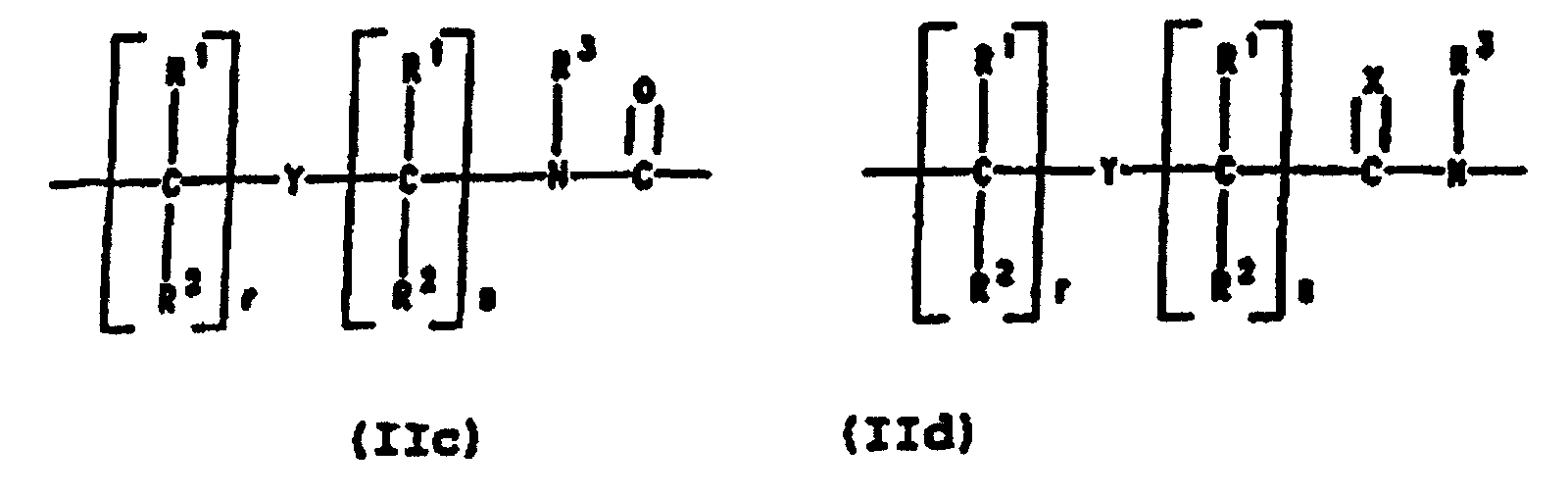
X est O, S, Se, NR3, CH2 ou C(CH3)2 ;
Y est une simple liaison O, S ou NR4 ;
chacun de p et q est égal à zéro ou est un nombre entier allant de 1 à 5, la somme p+q n'étant pas supérieure à 10 ;
chacun de r et s est égal à zéro ou est un nombre entier allant de 1 à 5, la somme r+s n'étant pas supérieure à 10 ;
chacun de R1 et R2 étant choisi indépendamment dans le groupe consistant en l'hydrogène, un alcoyle ayant de 1 à 4 atomes de carbone qui peut être substitué par un hydroxy ou par un alcoxy ou par un alcoylthio, l'hydroxy, un alcoxy, un alcoylthio, un amino et un halogène ; et
chacun de R3 et R4 est choisi indépendamment dans le groupe consistant en l'hydrogène, un alcoyle ayant de 1 à 4 atomes de carbone, un alcoyle ayant de 1 à 4 atomes de carbone substitué par un hydroxy ou par un alcoxy ou par un alcoylthio, l'hydroxy, un alcoxy, un alcoylthio et un amino ;
Q est -CO2H, -CONR'R", -SO3H ou -SO2NR'R" ou un dérivé activé de -CO2H ou de -SO3H ; et
I est -NHR'''R'''' ou -NR'''C(O)R'''', dans laquelle R', R", R"' et R"" sont choisis indépendamment dans le groupe consistant en l'hydrogène, un alcoyle, des groupes de protection d'un amino, des ligands reporters, des intercalateurs, des agents de chélation, des peptides, des protéines, des hydrates de carbone, des lipides, des stéroïdes, des nucléosides, des nucléotides, des nucléotides diphosphates, des nucléotides triphosphates, des oligonucléotides, des oligonucléosides et des polymères solubles et non solubles ;
et chacun des brins a une séquence de ligands qui reconnaít une séquence de bases au sein de régions proximales sur au moins un brin d'ADN du gène, de sorte que les brins se lient de manière proximale l'un à l'autre sur le brin d'ADN. - L'activateur de gène de la revendication 32, dans lequel la séquence de ligands des brins synthétiques est complémentaire d'un brin non-matrice de l'ADN.
- L'activateur de gène de la revendication 32, dans lequel la séquence de ligands des brins synthétiques est choisie de façon à ce que la liaison des brins synthétiques sur le gène entraíne la création d'une boucle d'ADN qui inclut les sites de liaison des brins synthétiques sur le gène.
- Activateur de gène spécifique à une séquence, comprenant des premier et deuxième brins synthétiques, dans lequel :chaque brin comprend un composé de formule :dans laquelle :
 dans lesquellesn va de 6 à 50 ;chacun de L1 à Ln est indépendamment choisi dans le groupe consistant en l'hydrogène, l'hydroxy, un alcanoyle ayant de 1 à 4 atomes de carbone, des nucléobases d'origine naturelle, des nucléobases qui ne sont pas d'origine naturelle, des radicaux aromatiques, des intercalateurs d'ADN, des groupes de liaison de nucléobases, des radicaux hétérocycliques et des ligands reporters ;chacun de C1 à Cn est (CR6R7)y, dans laquelle R6 est l'hydrogène et R7 est choisi dans le groupe consistant en les chaínes latérales d'acides alpha aminés d'origine naturelle, ou R6 et R7 sont choisis indépendamment dans le groupe consistant en l'hydrogène, un alcoyle ayant de 2 à 6 atomes de carbone, un aryle, un aralcoyle, un hétéroaryle, l'hydroxy, un alcoxy ayant de 1 à 6 atomes de carbone, un alcoylthio ayant de 1 à 6 atomes de carbone, NR3R4 et SR5, dans laquelle R3 et R4 sont tels que définis ci-dessous, et R5 est l'hydrogène, un alcoyle ayant de 1 à 6 atomes de carbone, un alcoyle ayant de 1 à 6 atomes de carbone substitué par un hydroxy, par un alcoxy ou par un alcoylthio, ou R6 et R7 pris ensemble complètent un système alicyclique ou hétérocyclique ;chacun de D1 à Dn est (CR6R7)z dans laquelle R6 et R7 sont tels que définis ci-dessus ;chacun de y et z est zéro ou un nombre entier allant de 1 à 10, la somme y + z étant supérieure à 2 mais n'étant pas supérieure à 10 ;chacun de G1 à Gn-1 est ―NR3CO-, -NR3CS-, -NR3SO- ou ―NR3SO2-, dans les deux orientations, dans lesquelles R3 est tel que défini ci-dessous ;chacun de A1 à An et de B1 à Bn est choisi de façon à ce que :(a) A soit un groupe de formule (IIc) ou (IId), et B soit N ou R3N+ ; ou(b) A soit un groupe de formule (IId) et B soit CH ;
X est O, S, Se, NR3, CH2 ou C(CH3)2 ;
Y est une simple liaison O, S ou NR4 ;
chacun de p et q est égal à zéro ou est un nombre entier allant de 1 à 5, la somme p+q n'étant pas supérieure à 10 ;
chacun de r et s est égal à zéro ou est un nombre entier allant de 1 à 5, la somme r+s n'étant pas supérieure à 10 ;
chacun de R1 et R2 étant choisi indépendamment dans le groupe consistant en l'hydrogène, un alcoyle ayant de 1 à 4 atomes de carbone qui peut être substitué par un hydroxy ou par un alcoxy ou par un alcoylthio, l'hydroxy, un alcoxy, un alcoylthio, un amino et un halogène ; et
chacun de R3 et R4 est choisi indépendamment dans le groupe consistant en l'hydrogène, un alcoyle ayant de 1 à 4 atomes de carbone, un alcoyle ayant de 1 à 4 atomes de carbone substitué par un hydroxy ou par un alcoxy ou par un alcoylthio, l'hydroxy, un alcoxy, un alcoylthio et un amino ;
Q est -CO2H, -CONR'R", -SO3H ou -SO2NR'R" ou un dérivé activé de -CO2H ou de -SO3H ; et
I est -NHR'''R'''' ou -NR'''C(O)R'''', dans laquelle R', R", R"' et R"" sont choisis indépendamment dans le groupe consistant en l'hydrogène, un alcoyle, des groupes de protection d'un amino, des ligands reporters, des intercalateurs, des agents de chélation, des peptides, des protéines, des hydrates de carbone, des lipides, des stéroïdes, des nucléosides, des nucléotides, des nucléotides diphosphates, des nucléotides triphosphates, des oligonucléotides, des oligonucléosides et des polymères solubles et non solubles ;
le premier brin ayant une séquence de ligands qui reconnaít une séquence de bases sur l'un des brins d'ADN du gène ;
le deuxième brin ayant une séquence de ligands qui reconnaít une séquence de bases sur l'autre des brins d'ADN du gène ; et
la séquence de bases reconnue sur l'un des brins d'ADN et la séquence de bases reconnue sur l'autre brin d'ADN étant en position proximale l'une par rapport à l'autre sur le gène. - L'activateur de gène suivant la revendication 35, dans lequel les séquences de ligands des brins synthétiques sont choisies de façon à ce que la liaison des brins synthétiques sur le gène entraíne la création d'une boucle d'ADN sur le gène qui inclut les sites de liaison des brins synthétiques sur le gène.
- Composé chimère comprenant une première section de brin incluant de l'ADN ou de l'ARN, et une deuxième section de brin incluant un composé de formule :dans laquelle :
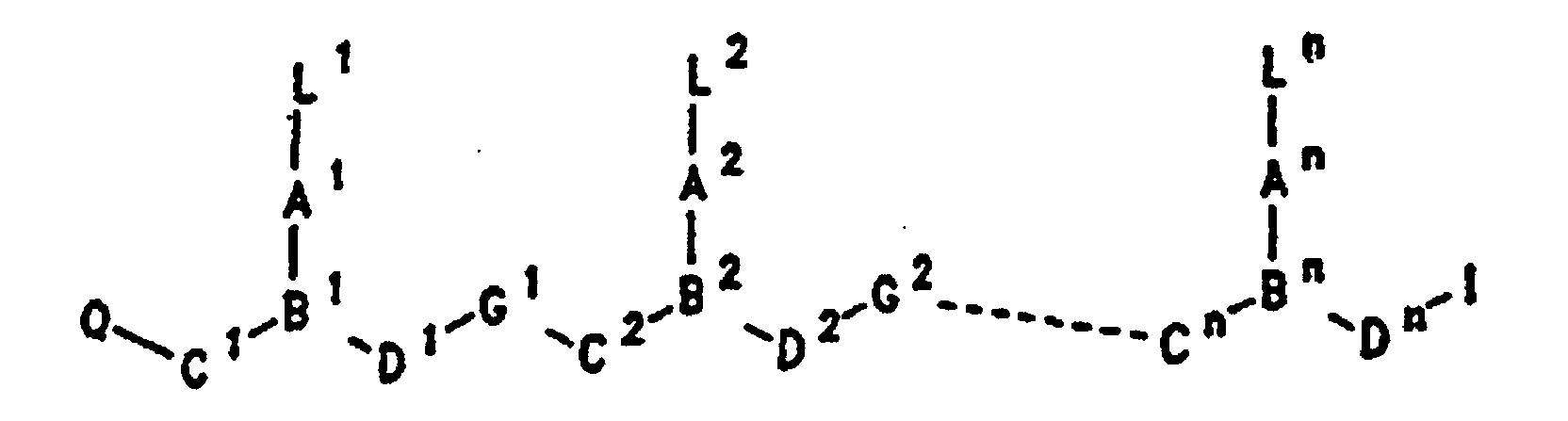 dans lesquellesn est au moins égal à 2 ;chacun de L1 à Ln est indépendamment choisi dans le groupe consistant en l'hydrogène, l'hydroxy, un alcanoyle ayant de 1 à 4 atomes de carbone, des nucléobases d'origine naturelle, des nucléobases qui ne sont pas d'origine naturelle, des radicaux aromatiques, des intercalateurs d'ADN, des groupes de liaison de nucléobases, des radicaux hétérocycliques et des ligands reporters ;chacun de C1 à Cn est (CR6R7)y, dans laquelle R6 est l'hydrogène et R7 est choisi dans le groupe consistant en les chaínes latérales d'acides alpha aminés d'origine naturelle, ou R6 et R7 sont choisis indépendamment dans le groupe consistant en l'hydrogène, un alcoyle ayant de 2 à 6 atomes de carbone, un aryle, un aralcoyle, un hétéroaryle, l'hydroxy, un alcoxy ayant de 1 à 6 atomes de carbone, un alcoylthio ayant de 1 à 6 atomes de carbone, NR3R4 et SR5, dans laquelle R3 et R4 sont tels que définis ci-dessous, et R5 est l'hydrogène, un alcoyle ayant de 1 à 6 atomes de carbone, un alcoyle ayant de 1 à 6 atomes de carbone substitué par un hydroxy, par un alcoxy ou par un alcoylthio, ou R6 et R7 pris ensemble complètent un système alicyclique ou hétérocyclique ;chacun de D1 à Dn est (CR6R7)z dans laquelle R6 et R7 sont tels que définis ci-dessus ;chacun de y et z est zéro ou un nombre entier allant de 1 à 10, la somme y + z étant supérieure à 2 mais n'étant pas supérieure à 10 ;chacun de G1 à Gn-1 est -NR3CO-, -NR3CS-, -NR3SO- ou -NR3SO2-, dans les deux orientations, dans lesquelles R3 est tel que défini ci-dessous ;chacun de A1 à An et de B1 à Bn est choisi de façon à ce que :(a) A soit un groupe de formule (IIc) ou (IId), et B soit N ou R3N+ ; ou(b) A soit un groupe de formule (IId) et B soit CH ;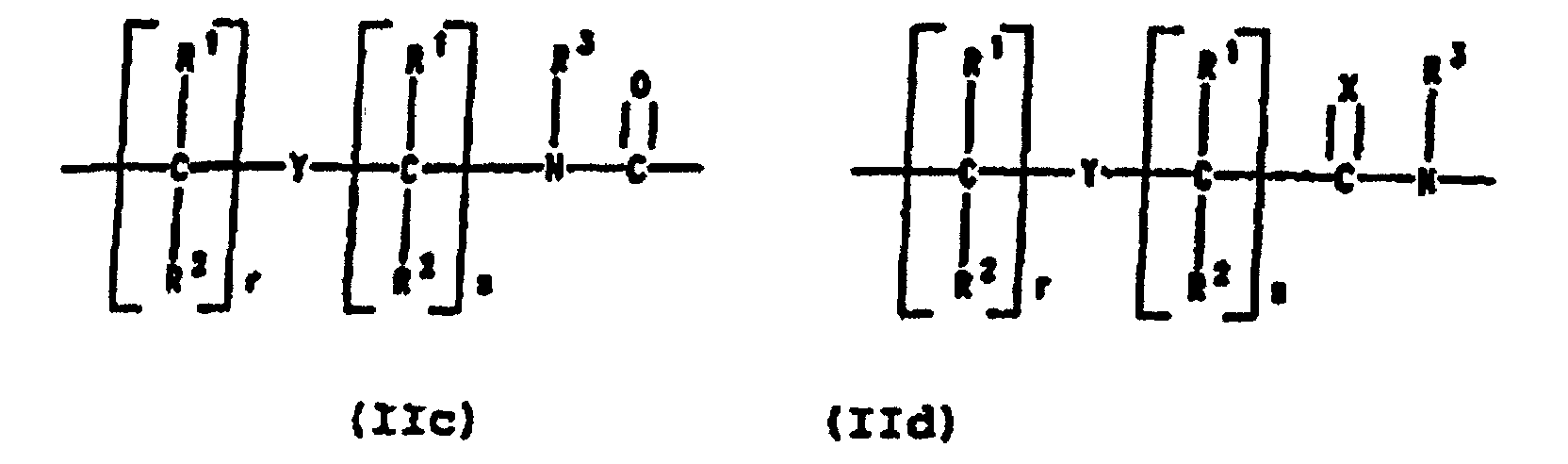
X est O, S, Se, NR3, CH2 ou C(CH3)2 ;
Y est une simple liaison O, S ou NR4 ;
chacun de p et q est égal à zéro ou est un nombre entier allant de 1 à 5, la somme p+q n'étant pas supérieure à 10 ;
chacun de r et s est égal à zéro ou est un nombre entier allant de 1 à 5, la somme r+s n'étant pas supérieure à 10 ;
chacun de R1 et R2 étant choisi indépendamment dans le groupe consistant en l'hydrogène, un alcoyle ayant de 1 à 4 atomes de carbone qui peut être substitué par un hydroxy ou par un alcoxy ou par un alcoylthio, l'hydroxy, un alcoxy, un alcoylthio, un amino et un halogène ; et
chacun de R3 et R4 est choisi indépendamment dans le groupe consistant en l'hydrogène, un alcoyle ayant de 1 à 4 atomes de carbone, un alcoyle ayant de 1 à 4 atomes de carbone substitué par un hydroxy ou par un alcoxy ou par un alcoylthio, l'hydroxy, un alcoxy, un alcoylthio et un amino ;
Q est -CO2H, -CONR'R", -SO3H ou -SO2NR'R" ou un dérivé activé de -CO2H ou de -SO3H ; et
I est -NHR'''R'''' ou -NR'''C(O)R'''', dans laquelle R', R", R"' et R"" sont choisis indépendamment dans le groupe consistant en l'hydrogène, un alcoyle, des groupes de protection d'un amino, des ligands reporters, des intercalateurs, des agents de chélation, des peptides, des protéines, des hydrates de carbone, des lipides, des stéroïdes, des nucléosides, des nucléotides, des nucléotides diphosphates, des nucléotides triphosphates, des oligonucléotides, des oligonucléosides et des polymères solubles et non solubles ;
la première section de brin et la deuxième section de brin étant liées par covalence. - La structure chimère de la revendication 37, dans laquelle la première section de brin comprend de l'ADN.
- Un complexe chimère à double brin, dans lequel :dans laquelle :un premier brin comprend une première section de brin incluant de l'ADN ou de l'ARN et une deuxième section de brin comprenant un composé de formule :
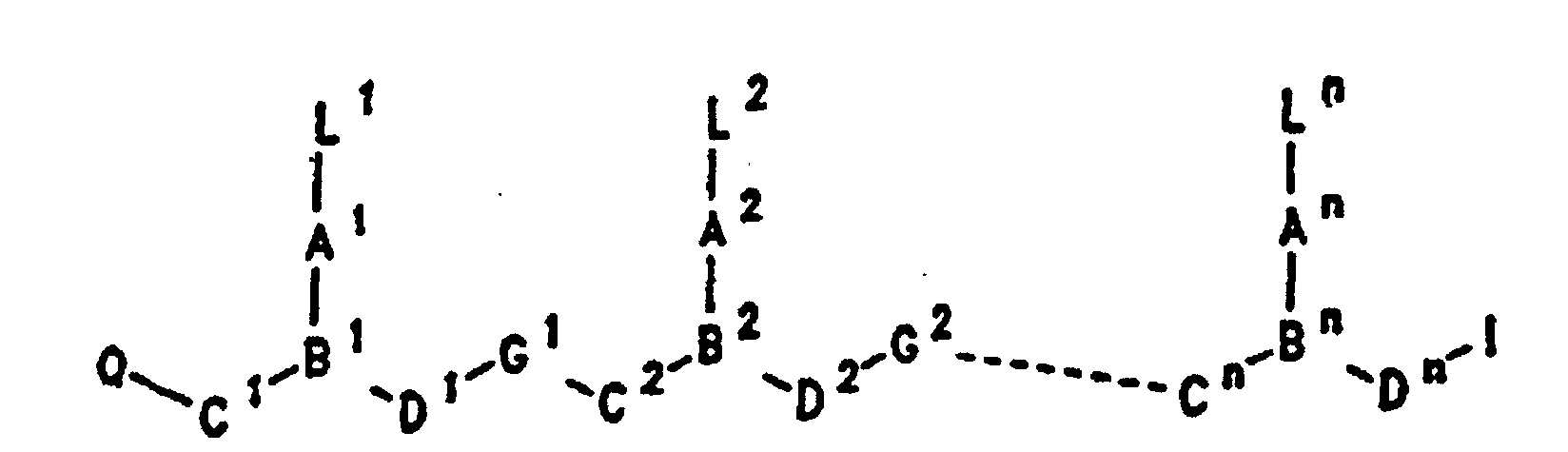 dans lesquellesn est au moins égal à 2 ;chacun de L1 à Ln est indépendamment choisi dans le groupe consistant en l'hydrogène, l'hydroxy, un alcanoyle ayant de 1 à 4 atomes de carbone, des nucléobases d'origine naturelle, des nucléobases qui ne sont pas d'origine naturelle, des radicaux aromatiques, des intercalateurs d'ADN, des groupes de liaison de nucléobases, des radicaux hétérocycliques et des ligands reporters ;chacun de C1 à Cn est (CR6R7)y, dans laquelle R6 est l'hydrogène et R7 est choisi dans le groupe consistant en les chaínes latérales d'acides alpha aminés d'origine naturelle, ou R6 et R7 sont choisis indépendamment dans le groupe consistant en l'hydrogène, un alcoyle ayant de 2 à 6 atomes de carbone, un aryle, un aralcoyle, un hétéroaryle, l'hydroxy, un alcoxy ayant de 1 à 6 atomes de carbone, un alcoylthio ayant de 1 à 6 atomes de carbone, NR3R4 et SR5, dans laquelle R3 et R4 sont tels que définis ci-dessous, et R5 est l'hydrogène, un alcoyle ayant de 1 à 6 atomes de carbone, un alcoyle ayant de 1 à 6 atomes de carbone substitué par un hydroxy, par un alcoxy ou par un alcoylthio, ou R6 et R7 pris ensemble complètent un système alicyclique ou hétérocyclique ;chacun de D1 à Dn est (CR6R7)z dans laquelle R6 et R7 sont tels que définis ci-dessus ;chacun de y et z est zéro ou un nombre entier allant de 1 à 10, la somme y + z étant supérieure à 2 mais n'étant pas supérieure à 10 ;chacun de G1 à Gn-1 est -NR3CO-, -NR3CS-, -NR3SO- ou -NR3SO2-, dans les deux orientations, dans lesquelles R3 est tel que défini ci-dessous ;chacun de A1 à An et de B1 à Bn est choisi de façon à ce que :(a) A soit un groupe de formule (IIc) ou (IId), et B soit N ou R3N+ ; ou(b) A soit un groupe de formule (IId) et B soit CH ;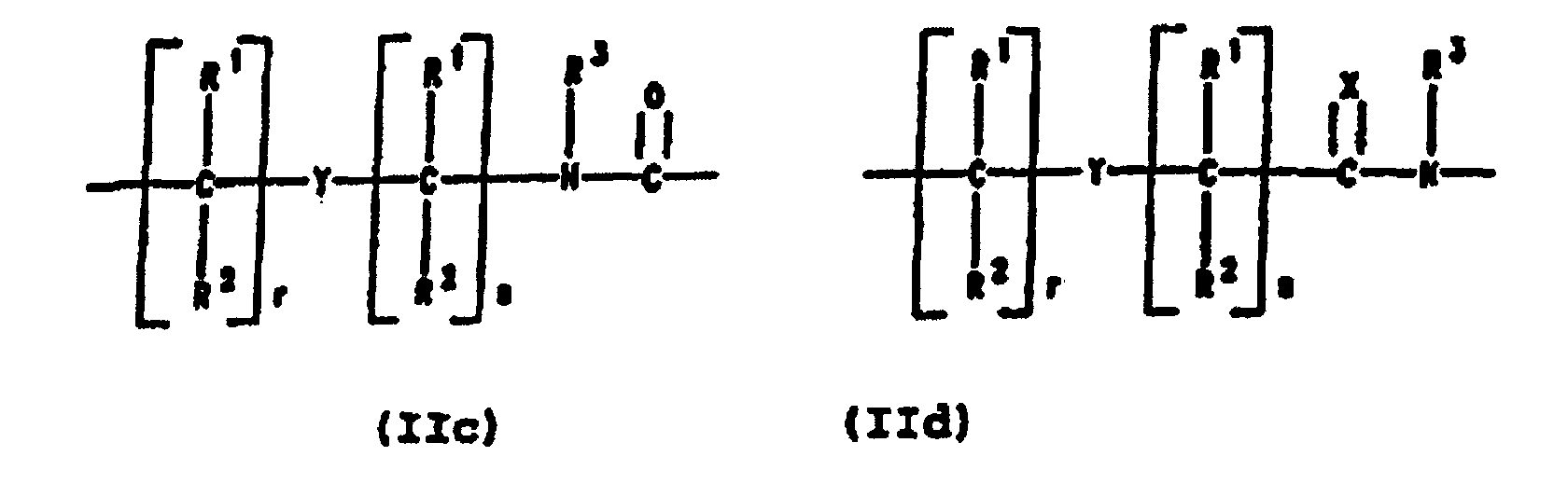
X est O, S, Se, NR3, CH2 où C(CH3)2;
Y est une simple liaison O, S ou NR4 ;
chacun de p et q est égal à zéro ou est un nombre entier allant de 1 à 5, la somme p+q n'étant pas supérieure à 10 ;
chacun de r et s est égal à zéro ou est un nombre entier allant de 1 à 5, la somme r+s n'étant pas supérieure à 10 ;
chacun de R1 et R2 étant choisi indépendamment dans le groupe consistant en l'hydrogène, un alcoyle ayant de 1 à 4 atomes de carbone qui peut être substitué par un hydroxy ou par un alcoxy ou par un alcoylthio, l'hydroxy. un alcoxy, un alcoylthio, un amino et un halogène ; et
chacun de R3 et R4 est choisi indépendamment dans le groupe consistant en l'hydrogène, un alcoyle ayant de 1 à 4 atomes de carbone, un alcoyle ayant de 1 à 4 atomes de carbone substitué par un hydroxy ou par un alcoxy ou par un alcoylthio, l'hydroxy, un alcoxy, un alcoylthio et un amino ;
Q est -CO2H, -CONR'R'', -SO3H ou -SO2NR'R" ou un dérivé activé de -CO2H ou de -SO3H ; et
I est -NHR'''R'''' ou -NR'''C(O)R'''', dans laquelle R', R", R"' et R"" sont choisis indépendamment dans le groupe consistant en l'hydrogène, un alcoyle, des groupes de protection d'un amino, des ligands reporters, des intercalateurs, des agents de chélation, des peptides, des protéines, des hydrates de carbone, des lipides, des stéroïdes, des nucléosides, des nucléotides, des nucléotides diphosphates, des nucléotides triphosphates, des oligonucléotides, des oligonucléosides et des polymères solubles et non solubles ;
la première et la deuxième sections de brin étant liées par covalence ;
un deuxième brin comprend de l'ADN, de l'ARN ou un composé de formule :dans laquelle : dans lesquellesn est au moins égal à 2 ;chacun de L1 à Ln est indépendamment choisi dans le groupe consistant en l'hydrogène, l'hydroxy, un alcanoyle ayant de 1 à 4 atomes de carbone, des nucléobases d'origine naturelle, des nucléobases qui ne sont pas d'origine naturelle, des radicaux aromatiques, des intercalateurs d'ADN, des groupes de liaison de nucléobases, des radicaux hétérocycliques et des ligands reporters ;chacun de C1 à Cn est (CR6R7)y, dans laquelle R6 est l'hydrogène et R7 est choisi dans le groupe consistant en les chaínes latérales d'acides alpha aminés d'origine naturelle, ou R6 et R7 sont choisis indépendamment dans le groupe consistant en l'hydrogène, un alcoyle ayant de 2 à 6 atomes de carbone, un aryle, un aralcoyle, un hétéroaryle, l'hydroxy, un alcoxy ayant de 1 à 6 atomes de carbone, un alcoylthio ayant de 1 à 6 atomes de carbone, NR3R4 et SR5, dans laquelle R3 et R4 sont tels que définis ci-dessous, et R5 est l'hydrogène, un alcoyle ayant de 1 à 6 atomes de carbone, un alcoyle ayant de 1 à 6 atomes de carbone substitué par un hydroxy, par un alcoxy ou par un alcoylthio, ou R6 et R7 pris ensemble complètent un système alicyclique ou hétérocyclique ;chacun de D1 à Dn est (CR6R7)z dans laquelle R6 et R7 sont tels que définis ci-dessus ;chacun de y et z est zéro ou un nombre entier allant de 1 à 10, la somme y + z étant supérieure à 2 mais n'étant pas supérieure à 10 ;chacun de G1 à Gn-1 est -NR3CO-, -NR3CS-, -NR3SO- ou -NR3SO2-, dans les deux orientations, dans lesquelles R3 est tel que défini ci-dessous ;chacun de A1 à An et de B1 à Bn est choisi de façon à ce que :(a) A soit un groupe de formule (IIc) ou (IId), et B soit N ou R3N+ ; ou(b) A soit un groupe de formule (IId) et B soit CH ;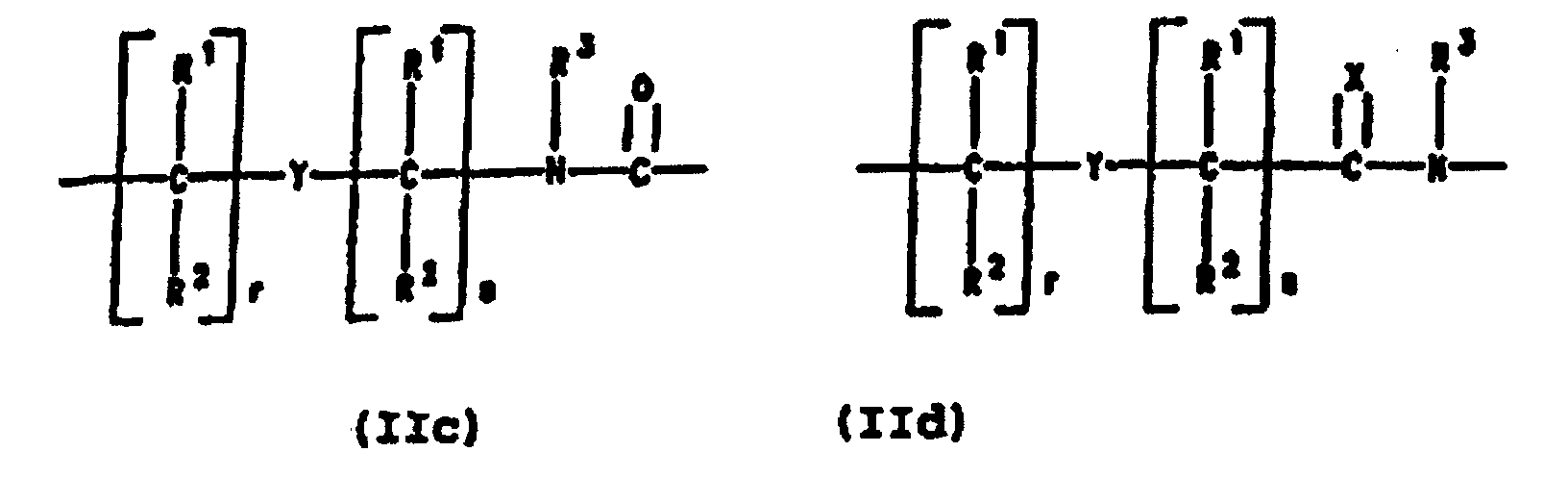
X est O, S, Se, NR3, CH2 ou C(CH3)2 ;
Y est une simple liaison O, S ou NR4 ;
chacun de p et q est égal à zéro ou est un nombre entier allant de 1 à 5, la somme p+q n'étant pas supérieure à 10 ;
chacun de r et s est égal à zéro ou est un nombre entier allant de 1 à 5, la somme r+s n'étant pas supérieure à 10 ;
chacun de R1 et R2 étant choisi indépendamment dans le groupe consistant en l'hydrogène, un alcoyle ayant de 1 à 4 atomes de carbone qui peut être substitué par un hydroxy ou par un alcoxy ou par un alcoylthio, l'hydroxy, un alcoxy, un alcoylthio, un amino et un halogène ; et
chacun de R3 et R4 est choisi indépendamment dans le groupe consistant en l'hydrogène, un alcoyle ayant de 1 à 4 atomes de carbone, un alcoyle ayant de 1 à 4 atomes de carbone substitué par un hydroxy ou par un alcoxy ou par un alcoylthio, l'hydroxy, un alcoxy, un alcoylthio et un amino ;
Q est -CO2H, -CONR'R", -SO3H ou -SO2NR'R" ou un dérivé activé de -CO2H ou de -SO3H ; et
I est -NHR'''R'''' ou -NR'''C(O)R'''', dans laquelle R', R", R"' et R"" sont choisis indépendamment dans le groupe consistant en l'hydrogène, un alcoyle, des groupes de protection d'un amino, des ligands reporters, des intercalateurs, des agents de chélation, des peptides, des protéines, des hydrates de carbone, des lipides, des stéroïdes, des nucléosides, des nucléotides, des nucléotides diphosphates, des nucléotides triphosphates, des oligonucléotides, des oligonucléosides et des polymères solubles et non solubles ; et
le premier brin et le deuxième brin agissant en interaction l'un avec l'autre pour former une structure duplex. - Structure chimère pour moduler de manière intercellulaire l'activité d'un facteur de transcription, la structure chimère comprenant une première section de brin comprenant de l'ADN ou de l'ARN et une deuxième section de brin liée par covalence à la première section de brin, la deuxième section de brin comprenant un composé de formule :dans laquelle :
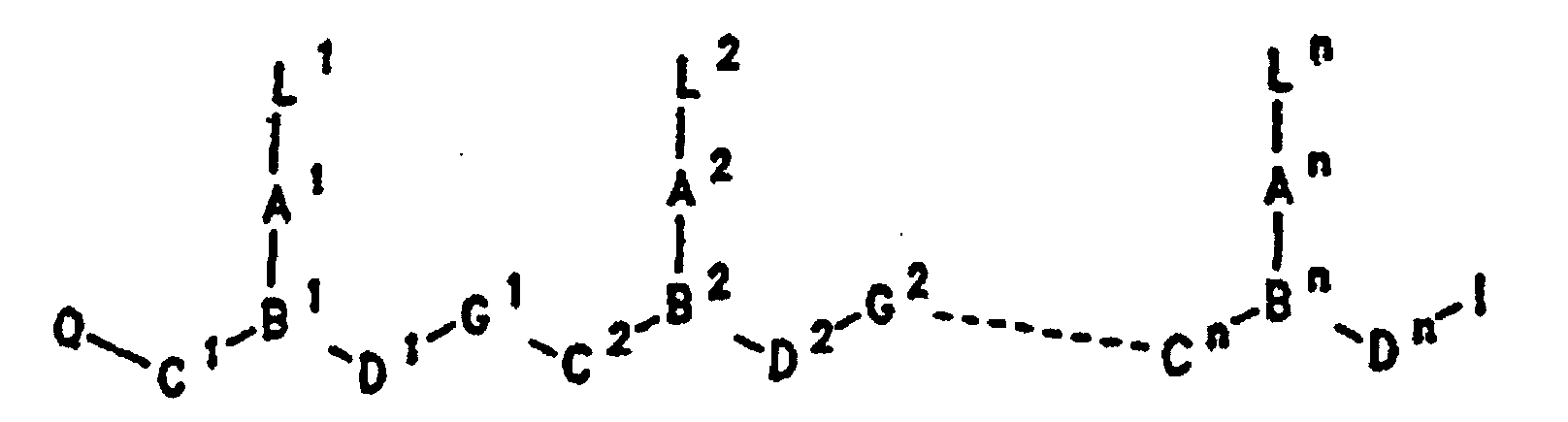 n est au moins égal à 2 ;chacun de L1 à Ln est indépendamment choisi dans le groupe consistant en l'hydrogène, l'hydroxy, un alcanoyle ayant de 1 à 4 atomes de carbone, des nucléobases d'origine naturelle, des nucléobases qui ne sont pas d'origine naturelle, des radicaux aromatiques, des intercalateurs d'ADN, des groupes de liaison de nucléobases, des radicaux hétérocycliques et des ligands reporters ;chacun de C1 à Cn est (CR6R7)y, dans laquelle R6 est l'hydrogène et R7 est choisi dans le groupe consistant en les chaínes latérales d'acides alpha aminés d'origine naturelle, ou R6 et R7 sont choisis indépendamment dans le groupe consistant en l'hydrogène, un alcoyle ayant de 2 à 6 atomes de carbone, un aryle, un aralcoyle, un hétéroaryle, l'hydroxy, un alcoxy ayant de 1 à 6 atomes de carbone, un alcoylthio ayant de 1 à 6 atomes de carbone, NR3R4 et SR5, dans laquelle R3 et R4 sont tels que définis ci-dessous, et R5 est l'hydrogène, un alcoyle ayant de 1 à 6 atomes de carbone, un alcoyle ayant de 1 à 6 atomes de carbone substitué par un hydroxy, par un alcoxy ou par un alcoylthio, ou R6 et R7 pris ensemble complètent un système alicyclique ou hétérocyclique ;chacun de D1 à Dn est (CR6R7)z dans laquelle R6 et R7 sont tels que définis ci-dessus ;chacun de y et z est zéro ou un nombre entier allant de 1 à 10, la somme y + z étant supérieure à 2 mais n'étant pas supérieure à 10 ;chacun de G1 à Gn-1 est -NR3CO-, -NR3CS-, -NR3SO- ou -NR3SO2-, dans les deux orientations, dans lesquelles R3 est tel que défini ci-dessous ;chacun de A1 à An et de B1 à Bn est choisi de façon à ce que :dans les(a) A soit un groupe de formule (IIc) ou (IId), et B soit N ou R3N+ ; ou(b) A soit un groupe de formule (IId) et B soit CH ;
X est O, S, Se, NR3, CH2 ou C(CH3)2 ;
Y est une simple liaison O, S ou NR4 ;
chacun de p et q est égal à zéro ou est un nombre entier allant de 1 à 5, la somme p+q n'étant pas supérieure à 10 ;
chacun de r et s est égal à zéro ou est un nombre entier allant de 1 à 5, la somme r+s n'étant pas supérieure à 10 ;
chacun de R1 et R2 étant choisi indépendamment dans le groupe consistant en l'hydrogène, un alcoyle ayant de 1 à 4 atomes de carbone qui peut être substitué par un hydroxy ou par un alcoxy ou par un alcoylthio, l'hydroxy, un alcoxy, un alcoylthio, un amino et un halogène ; et
chacun de R3 et R4 est choisi indépendamment dans le groupe consistant en l'hydrogène, un alcoyle ayant de 1 à 4 atomes de carbone, un alcoyle ayant de 1 à 4 atomes de carbone substitué par un hydroxy ou par un alcoxy ou par un alcoylthio, l'hydroxy, un alcoxy, un alcoylthio et un amino ;
Q est -CO2H, -CONR'R", -SO3H ou -SO2NR'R" ou un dérivé activé de -CO2H ou de -SO3H ; et
I est -NHR'''R'''' ou -NR'''C(O)R'''', dans laquelle R', R", R''' et R"" sont choisis indépendamment dans le groupe consistant en l'hydrogène, un alcoyle, des groupes de protection d'un amino, des ligands reporters, des intercalateurs, des agents de chélation, des peptides, des protéines, des hydrates de carbone, des lipides, des stéroïdes, des nucléosides, des nucléotides, des nucléotides diphosphates, des nucléotides triphosphates, des oligonucléotides, des oligonucléosides et des polymères solubles et non solubles ;
une pluralité de L'-Ln étant apte à se lier au facteur de transcription. - La structure chimère de la revendication 40, dans laquelle une pluralité des L1 à Ln se fixe au squelette sucre-phosphate de l'ARN ou de l'ADN.
- Composé d'inhibition de manière intercellulaire de la liaison d'une protéine, ce composé comprenant un deuxième composé de formule :dans laquelle :
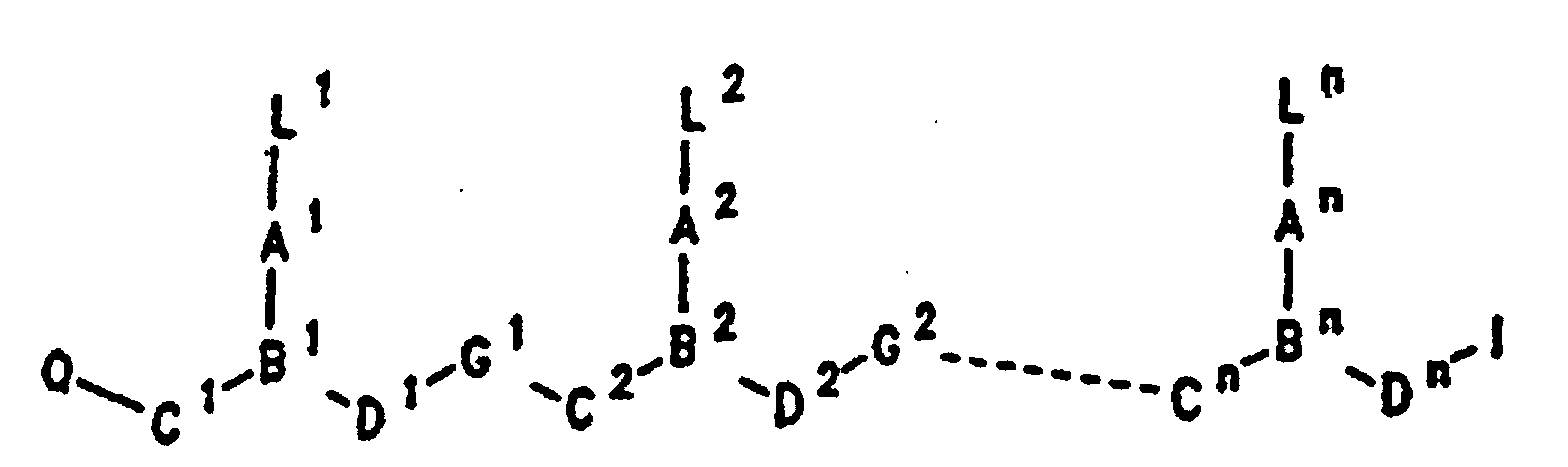 dans lesquellesn est au moins égal à 2 ;chacun de L1 à Ln est indépendamment choisi dans le groupe consistant en l'hydrogène, l'hydroxy, un alcanoyle ayant de 1 à 4 atomes de carbone, des nucléobases d'origine naturelle, des nucléobases qui ne sont pas d'origine naturelle, des radicaux aromatiques, des intercalateurs d'ADN, des groupes de liaison de nucléobases, des radicaux hétérocycliques et des ligands reporters ;chacun de C1 à Cn est (CR6R7)y, dans laquelle R6 est l'hydrogène et R7 est choisi dans le groupe consistant en les chaínes latérales d'acides alpha aminés d'origine naturelle, ou R6 et R7 sont choisis indépendamment dans le groupe consistant en l'hydrogène, un alcoyle ayant de 2 à 6 atomes de carbone, un aryle, un aralcoyle, un hétéroaryle, l'hydroxy, un alcoxy ayant de 1 à 6 atomes de carbone, un alcoylthio ayant de 1 à 6 atomes de carbone, NR3R4 et SR5, dans laquelle R3 et R4 sont tels que définis ci-dessous, et R5 est l'hydrogène, un alcoyle ayant de 1 à 6 atomes de carbone, un alcoyle ayant de 1 à 6 atomes de carbone substitué par un hydroxy, par un alcoxy ou par un alcoylthio, ou R6 et R7 pris ensemble complètent un système alicyclique ou hétérocyclique ;chacun de D1 à Dn est (CR6R7)z dans laquelle R6 et R7 sont tels que définis ci-dessus ;chacun de y et z est zéro ou un nombre entier allant de 1 à 10, la somme y + z étant supérieure à 2 mais n'étant pas supérieure à 10 ;chacun de G1 à Gn-1 est -NR3CO-, -NR3CS-, -NR3SO- ou -NR3SO2-, dans les deux orientations, dans lesquelles R3 est tel que défini ci-dessous ;chacun de A1 à An et de B1 à Bn est choisi de façon à ce que :(a) A soit un groupe de formule (IIc) ou (IId), et B soit N ou R3N+ ; ou(b) A soit un groupe de formule (IId) et B soit CH ;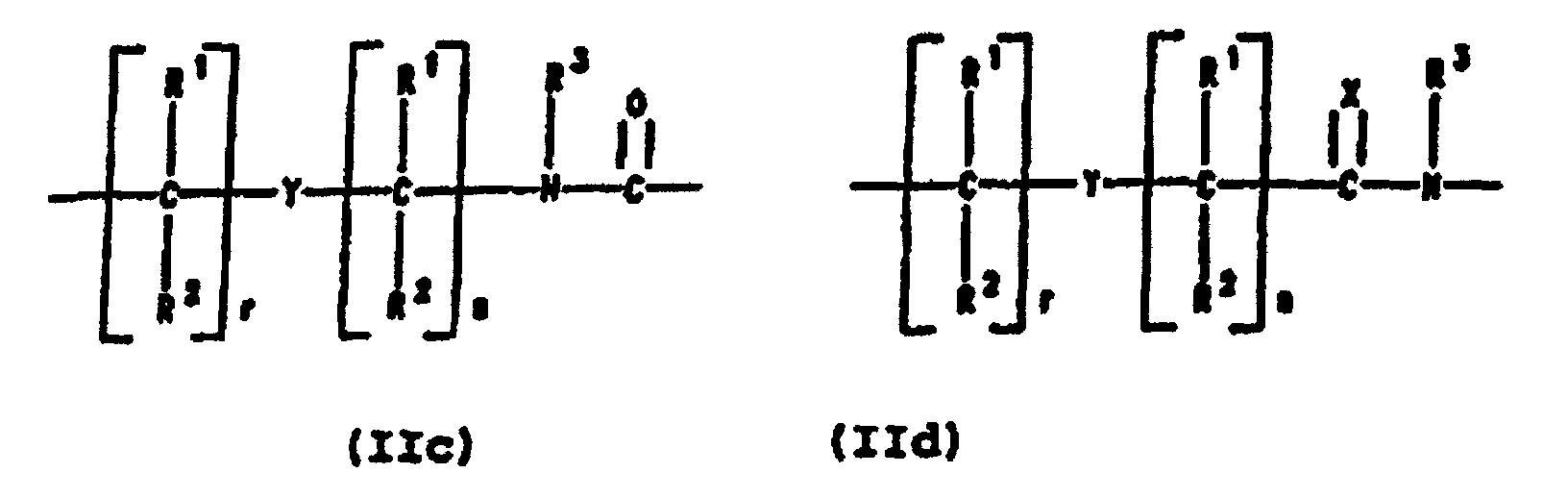
X est O, S, Se, NR3, CH2 ou C(CH3)2 ;
Y est une simple liaison O, S ou NR4 ;
chacun de p et q est égal à zéro ou est un nombre entier allant de 1 à 5, la somme p+q n'étant pas supérieure à 10 ;
chacun de r et s est égal à zéro ou est un nombre entier allant de 1 à 5, la somme r+s n'étant pas supérieure à 10 ;
chacun de R1 et R2 étant choisi indépendamment dans le groupe consistant en l'hydrogène, un alcoyle ayant de 1 à 4 atomes de carbone qui peut être substitué par un hydroxy ou par un alcoxy ou par un alcoylthio, l'hydroxy, un alcoxy, un alcoylthio, un amino et un halogène ; et
chacun de R3 et R4 est choisi indépendamment dans le groupe consistant en l'hydrogène, un alcoyle ayant de 1 à 4 atomes de carbone, un alcoyle ayant de 1 à 4 atomes de carbone substitué par un hydroxy ou par un alcoxy ou par un alcoylthio, l'hydroxy, un alcoxy, un alcoylthio et un amino ;
Q est -CO2H, -CONR'R", -SO3H ou -SO2NR'R" ou un dérivé activé de -CO2H ou de -SO3H ; et
I est -NHR'''R'''' ou -NR'''C(O)R'''', dans laquelle R', R", R"' et R'''' sont choisis indépendamment dans le groupe consistant en l'hydrogène, un alcoyle, des groupes de protection d'un amino, des ligands reporters, des intercalateurs, des agents de chélation, des peptides, des protéines, des hydrates de carbone, des lipides, des stéroides, des nucléosides, des nucléotides, des nucléotides diphosphates, des nucléotides triphosphates, des oligonucléotides, des oligonucléosides et des polymères solubles et non solubles ;
dans laquelle une pluralité des L1 à Ln est susceptible de se lier à la protéine.
Applications Claiming Priority (3)
| Application Number | Priority Date | Filing Date | Title |
|---|---|---|---|
| US88658 | 1987-08-24 | ||
| US08/088,658 US5641625A (en) | 1992-05-22 | 1993-07-02 | Cleaving double-stranded DNA with peptide nucleic acids |
| PCT/US1994/007319 WO1995001370A1 (fr) | 1993-07-02 | 1994-06-28 | Structure d'ordre superieur et liaison d'acides nucleiques peptidiques |
Publications (3)
| Publication Number | Publication Date |
|---|---|
| EP0776331A1 EP0776331A1 (fr) | 1997-06-04 |
| EP0776331A4 EP0776331A4 (fr) | 1998-11-25 |
| EP0776331B1 true EP0776331B1 (fr) | 2002-11-27 |
Family
ID=22212648
Family Applications (1)
| Application Number | Title | Priority Date | Filing Date |
|---|---|---|---|
| EP94921413A Expired - Lifetime EP0776331B1 (fr) | 1993-07-02 | 1994-06-28 | Structure d'ordre superieur et liaison d'acides nucleiques peptidiques |
Country Status (9)
| Country | Link |
|---|---|
| US (2) | US5641625A (fr) |
| EP (1) | EP0776331B1 (fr) |
| JP (2) | JPH09503198A (fr) |
| AT (1) | ATE228534T1 (fr) |
| CA (1) | CA2166461A1 (fr) |
| DE (1) | DE69431805T2 (fr) |
| DK (1) | DK0776331T3 (fr) |
| ES (1) | ES2187527T3 (fr) |
| WO (1) | WO1995001370A1 (fr) |
Families Citing this family (101)
| Publication number | Priority date | Publication date | Assignee | Title |
|---|---|---|---|---|
| US6770738B1 (en) | 1992-05-22 | 2004-08-03 | Isis Pharmaceuticals, Inc. | Higher order structure and binding of peptide nucleic acids |
| US7825215B1 (en) | 1993-04-26 | 2010-11-02 | Peter E. Nielsen | Substituted nucleic acid mimics |
| EP0813610A1 (fr) * | 1995-03-04 | 1997-12-29 | Roche Diagnostics GmbH | Detection d'acides nucleiques specifique aux sequences |
| US5770715A (en) * | 1995-03-22 | 1998-06-23 | Toagosei Co., Ltd. | Hammerhead-like nucleic acid analogues and their synthesis |
| EP0837696B1 (fr) * | 1995-06-07 | 2010-02-24 | Immunomedics, Inc. | Apport ameliore d'agents diagnostiques ou therapeutiques a un site cible |
| ATE362546T1 (de) | 1995-10-12 | 2007-06-15 | Lansdorp Peter M | Verfahren zum nachweis von mehrfachkopien einer wiederholungssequenz in einem nukleinsäuremolekül |
| WO1997014793A1 (fr) * | 1995-10-20 | 1997-04-24 | Trustees Of Boston University | Raccords d'acide nucleique |
| US7070925B1 (en) | 1996-07-16 | 2006-07-04 | Gen-Probe Incorporated | Method for determining the presence of an RNA analyte in a sample using a modified oligonucleotide probe |
| US6130038A (en) * | 1996-07-16 | 2000-10-10 | Gen-Probe Incorporated | Method for amplifying target nucleic acids using modified primers |
| US6110676A (en) * | 1996-12-04 | 2000-08-29 | Boston Probes, Inc. | Methods for suppressing the binding of detectable probes to non-target sequences in hybridization assays |
| EP0857791B1 (fr) * | 1996-12-21 | 2004-03-31 | PNA Diagnostics A/S | Méthode d'analyse utilisant l'amplification des signaux |
| US6617422B1 (en) | 1997-05-23 | 2003-09-09 | Peter Nielsen | Peptide nucleic acid monomers and oligomers |
| DK0897991T3 (da) * | 1997-08-22 | 2005-07-25 | Pna Diagnostics Aps | Små triplexdannende PNA-oligoer |
| US6300318B1 (en) | 1997-09-16 | 2001-10-09 | Peter E. Nielsen | Antibacterial and antibiotic methods using peptide nucleic acids and pharmaceutical compositions therefor |
| US6962778B1 (en) | 1997-09-25 | 2005-11-08 | Boston Probes, Inc. | Methods, kits and compositions for suppressing the binding of detectable probes to non-target sequences in hybridization assays |
| US6989270B1 (en) | 1997-10-17 | 2006-01-24 | Mayo Foundation For Medical Education And Research | Using polyamide nucleic acid oligomers to engender a biological response |
| US6723560B2 (en) | 1998-10-08 | 2004-04-20 | Mayo Foundation For Medical Education And Research | Using polyamide nucleic acid oligomers to engender a biological response |
| US6472209B1 (en) | 1997-10-17 | 2002-10-29 | Mayo Foundation For Medical Education And Research | Using polyamide nucleic acid oligomers to engender a biological response |
| US20040063618A1 (en) * | 2002-09-30 | 2004-04-01 | Muthiah Manoharan | Peptide nucleic acids having improved uptake and tissue distribution |
| US20040186071A1 (en) | 1998-04-13 | 2004-09-23 | Bennett C. Frank | Antisense modulation of CD40 expression |
| ATE343586T1 (de) | 1998-07-09 | 2006-11-15 | Biocept Inc | Verfahren zur verwendung einer universellen bibliothek von peptid-nukleinsäuren zur optimierung der dns-hybridisierung |
| GB9815933D0 (en) * | 1998-07-23 | 1998-09-23 | Secr Defence | Detection method |
| US7981599B1 (en) | 1998-07-31 | 2011-07-19 | Boston Probes, Inc. | Non-nucleic acid probes, probe sets, methods and kits pertaining to the detection of individual human chromosomes X, Y, 1, 2, 3, 4, 6, 7, 8, 9, 10, 11, 12, 16, 17, 18 and 20 as 13/21 as a pair |
| SE9803099D0 (sv) | 1998-09-13 | 1998-09-13 | Karolinska Innovations Ab | Nucleic acid transfer |
| US6492111B1 (en) | 1998-11-25 | 2002-12-10 | Isis Pharmaceuticals, Inc. | In situ binary synthesis of biologically effective molecules |
| US6441152B1 (en) * | 1998-12-08 | 2002-08-27 | Boston Probes, Inc. | Methods, kits and compositions for the identification of nucleic acids electrostatically bound to matrices |
| US6403313B1 (en) * | 1999-12-21 | 2002-06-11 | Ingeneus Corporation | Fluorescent intensity assay for duplex and triplex nucleic acid hybridization solution utilizing fluorescent intercalators |
| US6613524B1 (en) | 2000-01-24 | 2003-09-02 | Ingeneus Corporation | Amperometric affinity assay and electrically stimulated complexes of nucleic acids |
| US7220541B2 (en) | 2000-01-24 | 2007-05-22 | Ingeneus, Inc. | Homogeneous assay of biopolymer binding by means of multiple measurements under varied conditions |
| US6982147B2 (en) | 2000-01-24 | 2006-01-03 | Ingeneus Corporation | Apparatus for assaying biopolymer binding by means of multiple measurements under varied conditions |
| US6265170B1 (en) * | 2000-01-24 | 2001-07-24 | Ingeneus Corporation | Homogenous assay of duplex of triplex hybridization by means of multiple measurements under varied conditions |
| US20040014644A1 (en) * | 2000-03-14 | 2004-01-22 | Vladimir Efimov | Oligonucleotide analogues and methods of use for modulating gene expression |
| AU2001247414A1 (en) | 2000-03-14 | 2001-09-24 | Active Motif | Oligonucleotide analogues, methods of synthesis and methods of use |
| US6962906B2 (en) * | 2000-03-14 | 2005-11-08 | Active Motif | Oligonucleotide analogues, methods of synthesis and methods of use |
| AU2001245942A1 (en) * | 2000-03-24 | 2001-10-08 | The Government Of The United States Of America, As Represented By The Secretary Of The Department Of Health And Human Services | Establishment of cellular manipulations which enhance oligo-mediated gene targeting |
| DE60119173T2 (de) * | 2000-08-30 | 2007-01-18 | Avi Biopharma, Inc., Corvallis | Methode zur analyse von oligonukleotidanaloga |
| EP1349958B1 (fr) | 2000-09-26 | 2009-06-03 | Boston Probes, Inc. | Sondes, jeu de sondes, techniques et kits concernant la detection, l'identification et/ou le denombrement de bacteries |
| WO2002038738A2 (fr) * | 2000-11-09 | 2002-05-16 | Cold Spring Harbor Laboratory | Molecules chimeres servant a moduler l'expression d'un gene |
| US6905824B2 (en) * | 2000-12-15 | 2005-06-14 | Boston Probes, Inc. | Methods for determining organisms not requiring the separation of fixative or excess probe |
| JP2002186481A (ja) * | 2000-12-18 | 2002-07-02 | Eiken Chem Co Ltd | 光学的特性の測定による核酸増幅産物の検出方法 |
| DE60216468T2 (de) | 2001-03-09 | 2007-09-27 | Boston Probes, Inc., Bedford | Kombinationsoligomere betreffende verfahren, kits und zusammensetzungen |
| IL158000A0 (en) * | 2001-03-19 | 2004-03-28 | Harvard College | Evolving new molecular function |
| PT1401853E (pt) | 2001-05-25 | 2010-12-07 | Univ Duke | Modulador de oligonucleotídeos |
| WO2002097134A2 (fr) * | 2001-05-25 | 2002-12-05 | Isis Pharmaceuticals, Inc. | Acide nucleique peptide modifie |
| EP2305808B1 (fr) | 2001-06-20 | 2016-03-02 | Nuevolution A/S | Molécules à matrice et procédés pour l'utilisation de telles molécules |
| WO2003027328A2 (fr) * | 2001-09-24 | 2003-04-03 | Boston Probes, Inc. | Procedes, kits et compositions utilises dans la suppression d'une sonde detectable se liant a des sequences de repetition reparties de maniere aleatoire de l'acide nucleique genomique |
| AU2003230717A1 (en) * | 2002-03-21 | 2003-10-08 | Boston Probes, Inc. | Pna oligomers, oligomers sets, methods and kits pertaining to the detection of bacillus anthracis |
| JP2005523707A (ja) * | 2002-04-23 | 2005-08-11 | ユー.エス. ジェノミクス, インコーポレイテッド | 2アーム核酸プローブに関する組成物および方法 |
| JP2006507798A (ja) * | 2002-05-17 | 2006-03-09 | アプレラ コーポレイション | Listeriaの決定に関するPNAプローブ、プローブセット、方法およびキット |
| EP1543155A4 (fr) * | 2002-07-17 | 2006-08-16 | Us Genomics Inc | Procedes et compositions d'analyse de polymeres au moyen de marqueurs chimeres |
| WO2004016767A2 (fr) * | 2002-08-19 | 2004-02-26 | The President And Fellows Of Harvard College | Developpement d'une nouvelle fonction moleculaire |
| WO2004022578A2 (fr) * | 2002-09-08 | 2004-03-18 | Applera Corporation | Procedes, compositions et banques se rapportant a la synthese de dimere et d'oligomere d'anp |
| EP1576188B1 (fr) * | 2002-11-21 | 2008-10-15 | Epicentre Technologies | Procedes d'utilisation d'amorces contenant des ribonucleotides pour la replication par deplacement de brin de sequences cibles |
| US20040259132A1 (en) * | 2002-11-22 | 2004-12-23 | Henrik Stender | Peptide nucleic acid probes for analysis of pseudomonas (sensu stricto) |
| US8017323B2 (en) | 2003-03-26 | 2011-09-13 | President And Fellows Of Harvard College | Free reactant use in nucleic acid-templated synthesis |
| GB2422196B (en) * | 2003-05-20 | 2008-05-07 | Investigen Inc | System for detecting polynucleotides |
| EP1651778A1 (fr) * | 2003-08-01 | 2006-05-03 | U.S. Genomics, Inc. | Procedes et compositions lies a l'utilisation d'endonucleases specifiques d'une sequence pour analyser des acides nucleiques dans des conditions de non-clivage |
| EP1680439A2 (fr) * | 2003-10-14 | 2006-07-19 | Kernel Biopharma Inc. | Conjugues de pna double phase permettant de liberer des pna a travers la barriere hemato-encephalique |
| US20060142227A1 (en) * | 2003-10-14 | 2006-06-29 | Itschak Lamensdorf | Amphiphylic peptide-PNA conjugates for the delivery of PNA through the blood brain barrier |
| WO2005111235A2 (fr) * | 2004-05-04 | 2005-11-24 | Dak Denmark A/S | Procedes de detection d'aberrations chromosomiques |
| NL1027479C2 (nl) * | 2004-10-21 | 2006-05-01 | Synvolux Ip B V | Bescherming van biologisch actieve moleculen met behulp van amphifielen. |
| US7700287B2 (en) * | 2005-01-28 | 2010-04-20 | Life Technologies Corporation | Compositions and methods for terminating a sequencing reaction at a specific location in a target DNA template |
| JP5479731B2 (ja) | 2005-06-02 | 2014-04-23 | アドヴァンディーエックス,インコーポレイテッド | 微生物を解析するためのペプチド核酸プローブ |
| DE602006020577D1 (de) | 2005-07-01 | 2011-04-21 | Dako Denmark As | Monomere und polymere linker zur konjugierung von biologischen molekülen und anderen stoffen |
| WO2007011722A2 (fr) | 2005-07-15 | 2007-01-25 | President And Fellows Of Harvard College | Systeme de decouverte de reaction |
| WO2007100711A2 (fr) * | 2006-02-24 | 2007-09-07 | Investigen, Inc. | Procédés et compositions pour la détection de polynucléotides |
| US20080096193A1 (en) * | 2006-10-24 | 2008-04-24 | Charles Robert Bupp | Methods and compositions for detecting polynucleotides |
| CN101978070A (zh) * | 2006-12-29 | 2011-02-16 | 应用生物系统公司 | 检测核酸的系统和方法 |
| EP2118310B1 (fr) * | 2006-12-29 | 2013-03-06 | Applied Biosystems, LLC | Systemes et procedes pour la detection d'acide nucleique |
| WO2008103702A2 (fr) * | 2007-02-23 | 2008-08-28 | Investigen, Inc. | Procédés et compositions pour isolement activé par la lumière rapide et détection d'analytes |
| WO2009003493A2 (fr) | 2007-07-03 | 2009-01-08 | Dako Denmark A/S | Procédés compilés pour analyser et trier des échantillons |
| US8916531B2 (en) | 2007-11-20 | 2014-12-23 | Isis Pharmaceuticals, Inc. | Modulation of CD40 expression |
| EP3733871A1 (fr) | 2008-05-27 | 2020-11-04 | Dako Denmark A/S | Compositions et procédés pour la détection d'aberrations chromosomiques avec de nouveaux tampons d'hybridation |
| US7964355B2 (en) * | 2009-02-17 | 2011-06-21 | Investigen, Inc. | Assays based on detection of photobleaching reaction products from dye catalytic complex |
| EP2401396B1 (fr) | 2009-02-26 | 2016-11-23 | Dako Denmark A/S | Procédés pour effectuer une étape de lavage stringent dans des applications d'hybridation |
| CA2781907C (fr) | 2009-12-02 | 2019-07-16 | Dako Denmark A/S | Compositions et procedes pour realiser des hybridations sans denaturation |
| WO2011087789A2 (fr) | 2009-12-22 | 2011-07-21 | Becton, Dickinson And Company | Procédés de détection de microorganismes |
| WO2013046033A1 (fr) | 2011-09-30 | 2013-04-04 | Dako Denmark A/S | Compositions d'hybridation et procédés utilisant du formamide |
| EP2768974B1 (fr) | 2011-10-21 | 2017-07-19 | Dako Denmark A/S | Compositions et procédés d'hybridation |
| WO2014033314A1 (fr) | 2012-09-03 | 2014-03-06 | Uab Bioseka | Oligonucléotides antisens ciblant des glucosyltransférases bactériennes |
| US10260089B2 (en) * | 2012-10-29 | 2019-04-16 | The Research Foundation Of The State University Of New York | Compositions and methods for recognition of RNA using triple helical peptide nucleic acids |
| WO2014093291A1 (fr) | 2012-12-10 | 2014-06-19 | Advandx, Inc. | Utilisation de sondes pour l'identification par spectrométrie de masse de micro-organismes ou de cellules et de pathologies associées présentant un intérêt |
| KR102206573B1 (ko) | 2013-03-15 | 2021-01-25 | 테출론 인코포레이티드 | 스타필로코커스 아우레우스 감염의 치료를 위한 안티센스 분자 |
| US9957515B2 (en) | 2013-03-15 | 2018-05-01 | Cibus Us Llc | Methods and compositions for targeted gene modification |
| UA120033C2 (uk) | 2013-03-15 | 2019-09-25 | Сібас Юс Ллс | Спосіб підвищення ефективності спрямованої модифікації генів із застосуванням опосередкованої олігонуклеотидами репарації генів |
| US12331303B2 (en) | 2013-03-15 | 2025-06-17 | Cibus Us Llc | Methods and compositions for increasing efficiency of targeted gene modification using oligonucleotide-mediated gene repair |
| CA2906663A1 (fr) | 2013-03-15 | 2014-09-18 | Techulon Inc. | Molecules antisens pour le traitement de l'infection a staphylococcus aureus |
| LT6214B (lt) | 2013-10-07 | 2015-08-25 | Uab "Bioseka" | Priešprasminiai oligonukleotidai aterosklerozės ir kardiovaskulinių infekcijų prevencijai |
| JP6640079B2 (ja) | 2013-10-16 | 2020-02-05 | ザ・ユニバーシティ・オブ・ブリティッシュ・コロンビア | 小容積の粒子を調製するためのデバイス及び方法 |
| SG11201605539SA (en) | 2014-01-10 | 2016-08-30 | Glaxosmithkline Ip No 2 Ltd | Hydroxy formamide derivatives and their use |
| AU2015229095B2 (en) | 2014-03-14 | 2022-01-27 | Cibus Europe B.V. | Methods and compositions for increasing efficiency of targeted gene modification using oligonucleotide-mediated gene repair |
| WO2016138175A1 (fr) | 2015-02-24 | 2016-09-01 | The University Of British Columbia | Système microfluidique à flux continu |
| AU2016324165B2 (en) | 2015-09-16 | 2020-07-02 | PetaOmics, Inc. | Methods and compositions for genomic target enrichment and selective DNA sequencing |
| US12492423B2 (en) | 2015-09-16 | 2025-12-09 | PetaOmics, Inc. | Methods and compositions for genomic target enrichment and selective DNA sequencing |
| MX391259B (es) | 2015-10-14 | 2025-03-21 | X Therma Inc | Composiciones y métodos para reducir la formación de cristales de hielo. |
| CN108778477B (zh) | 2016-01-06 | 2022-02-25 | 不列颠哥伦比亚大学 | 分叉混合器及其使用和制造方法 |
| BR112018016278A2 (pt) | 2016-02-09 | 2019-01-02 | Cibus Europe Bv | métodos e composições para aumentar a eficiência da modificação do gene direcionada usando reparação de gene mediada por oligonucleotídeo |
| US20210284998A1 (en) | 2016-10-03 | 2021-09-16 | Precision Nanosystems Inc. | Compositions for Transfecting Resistant Cell Types |
| WO2019140009A1 (fr) | 2018-01-09 | 2019-07-18 | Cibus Us Llc | Gènes de résistance à l'égrenage et mutations |
| AU2019247403B2 (en) | 2018-04-04 | 2025-04-10 | Cibus Europe, B.V. | FAD2 genes and mutations |
| EP3844278A4 (fr) * | 2018-08-27 | 2022-05-25 | North Carolina State University | Ciblage de kit par des oligonucléotides de commutation d'épissage pour induire l'apoptose de mastocytes |
Family Cites Families (2)
| Publication number | Priority date | Publication date | Assignee | Title |
|---|---|---|---|---|
| US5134066A (en) * | 1989-08-29 | 1992-07-28 | Monsanto Company | Improved probes using nucleosides containing 3-dezauracil analogs |
| DK51092D0 (da) * | 1991-05-24 | 1992-04-15 | Ole Buchardt | Oligonucleotid-analoge betegnet pna, monomere synthoner og fremgangsmaade til fremstilling deraf samt anvendelser deraf |
-
1993
- 1993-07-02 US US08/088,658 patent/US5641625A/en not_active Expired - Lifetime
-
1994
- 1994-06-28 EP EP94921413A patent/EP0776331B1/fr not_active Expired - Lifetime
- 1994-06-28 DK DK94921413T patent/DK0776331T3/da active
- 1994-06-28 CA CA002166461A patent/CA2166461A1/fr not_active Abandoned
- 1994-06-28 WO PCT/US1994/007319 patent/WO1995001370A1/fr not_active Ceased
- 1994-06-28 JP JP7503609A patent/JPH09503198A/ja active Pending
- 1994-06-28 ES ES94921413T patent/ES2187527T3/es not_active Expired - Lifetime
- 1994-06-28 DE DE69431805T patent/DE69431805T2/de not_active Expired - Fee Related
- 1994-06-28 AT AT94921413T patent/ATE228534T1/de not_active IP Right Cessation
-
1995
- 1995-06-07 US US08/471,907 patent/US5986053A/en not_active Expired - Lifetime
-
1998
- 1998-10-14 JP JP10291590A patent/JPH11236396A/ja active Pending
Also Published As
| Publication number | Publication date |
|---|---|
| JPH11236396A (ja) | 1999-08-31 |
| ES2187527T3 (es) | 2003-06-16 |
| CA2166461A1 (fr) | 1995-01-12 |
| JPH09503198A (ja) | 1997-03-31 |
| EP0776331A4 (fr) | 1998-11-25 |
| DE69431805T2 (de) | 2003-07-03 |
| US5641625A (en) | 1997-06-24 |
| EP0776331A1 (fr) | 1997-06-04 |
| WO1995001370A1 (fr) | 1995-01-12 |
| DE69431805D1 (de) | 2003-01-09 |
| ATE228534T1 (de) | 2002-12-15 |
| DK0776331T3 (da) | 2003-03-03 |
| US5986053A (en) | 1999-11-16 |
Similar Documents
| Publication | Publication Date | Title |
|---|---|---|
| EP0776331B1 (fr) | Structure d'ordre superieur et liaison d'acides nucleiques peptidiques | |
| AU680253B2 (en) | Novel peptide nucleic acids | |
| Uhlmann et al. | PNA: synthetic polyamide nucleic acids with unusual binding properties | |
| EP0773950B1 (fr) | Acides nucleiques peptidiques lies | |
| EP1074559B1 (fr) | Acides nucléiques peptidiques | |
| CA2177357C (fr) | Macromolecules chimeres pna-dna-pna | |
| US7897346B2 (en) | Polyamide nucleic acid derivatives and agents, and processes for preparing them | |
| AU2001246536B2 (en) | Polyamide nucleic acid derivatives, agents and methods for producing the same | |
| US6770738B1 (en) | Higher order structure and binding of peptide nucleic acids | |
| Zhu | Synthesis of Ethyl N-[(2-Boc-Amino)-Ethyl] Glycinate and PNA Monomer Containing 5-Iodouracil | |
| Shirude | Synthesis and biophysical evaluation of modified and fluorescent PNAs: applications in antisense therapeutics and diagnostics |
Legal Events
| Date | Code | Title | Description |
|---|---|---|---|
| PUAI | Public reference made under article 153(3) epc to a published international application that has entered the european phase |
Free format text: ORIGINAL CODE: 0009012 |
|
| 17P | Request for examination filed |
Effective date: 19960202 |
|
| AK | Designated contracting states |
Kind code of ref document: A1 Designated state(s): AT BE CH DE DK ES FR GB GR IE IT LI LU MC NL PT SE |
|
| A4 | Supplementary search report drawn up and despatched |
Effective date: 19981012 |
|
| AK | Designated contracting states |
Kind code of ref document: A4 Designated state(s): AT BE CH DE DK ES FR GB GR IE IT LI LU MC NL PT SE |
|
| 17Q | First examination report despatched |
Effective date: 20000918 |
|
| GRAG | Despatch of communication of intention to grant |
Free format text: ORIGINAL CODE: EPIDOS AGRA |
|
| GRAG | Despatch of communication of intention to grant |
Free format text: ORIGINAL CODE: EPIDOS AGRA |
|
| GRAH | Despatch of communication of intention to grant a patent |
Free format text: ORIGINAL CODE: EPIDOS IGRA |
|
| GRAH | Despatch of communication of intention to grant a patent |
Free format text: ORIGINAL CODE: EPIDOS IGRA |
|
| GRAA | (expected) grant |
Free format text: ORIGINAL CODE: 0009210 |
|
| AK | Designated contracting states |
Kind code of ref document: B1 Designated state(s): AT BE CH DE DK ES FR GB GR IE IT LI LU MC NL PT SE |
|
| REF | Corresponds to: |
Ref document number: 228534 Country of ref document: AT Date of ref document: 20021215 Kind code of ref document: T |
|
| REG | Reference to a national code |
Ref country code: GB Ref legal event code: FG4D |
|
| REG | Reference to a national code |
Ref country code: CH Ref legal event code: EP |
|
| REG | Reference to a national code |
Ref country code: IE Ref legal event code: FG4D |
|
| REF | Corresponds to: |
Ref document number: 69431805 Country of ref document: DE Date of ref document: 20030109 |
|
| PG25 | Lapsed in a contracting state [announced via postgrant information from national office to epo] |
Ref country code: PT Free format text: LAPSE BECAUSE OF FAILURE TO SUBMIT A TRANSLATION OF THE DESCRIPTION OR TO PAY THE FEE WITHIN THE PRESCRIBED TIME-LIMIT Effective date: 20030227 |
|
| REG | Reference to a national code |
Ref country code: DK Ref legal event code: T3 |
|
| REG | Reference to a national code |
Ref country code: GR Ref legal event code: EP Ref document number: 20030400757 Country of ref document: GR |
|
| REG | Reference to a national code |
Ref country code: CH Ref legal event code: NV Representative=s name: PATENTANWAELTE SCHAAD, BALASS, MENZL & PARTNER AG |
|
| REG | Reference to a national code |
Ref country code: ES Ref legal event code: FG2A Ref document number: 2187527 Country of ref document: ES Kind code of ref document: T3 |
|
| PGFP | Annual fee paid to national office [announced via postgrant information from national office to epo] |
Ref country code: SE Payment date: 20030626 Year of fee payment: 10 |
|
| PG25 | Lapsed in a contracting state [announced via postgrant information from national office to epo] |
Ref country code: LU Free format text: LAPSE BECAUSE OF NON-PAYMENT OF DUE FEES Effective date: 20030628 |
|
| PG25 | Lapsed in a contracting state [announced via postgrant information from national office to epo] |
Ref country code: MC Free format text: LAPSE BECAUSE OF NON-PAYMENT OF DUE FEES Effective date: 20030630 |
|
| PGFP | Annual fee paid to national office [announced via postgrant information from national office to epo] |
Ref country code: BE Payment date: 20030701 Year of fee payment: 10 |
|
| ET | Fr: translation filed | ||
| PGFP | Annual fee paid to national office [announced via postgrant information from national office to epo] |
Ref country code: AT Payment date: 20030728 Year of fee payment: 10 |
|
| PGFP | Annual fee paid to national office [announced via postgrant information from national office to epo] |
Ref country code: DK Payment date: 20030729 Year of fee payment: 10 |
|
| PGFP | Annual fee paid to national office [announced via postgrant information from national office to epo] |
Ref country code: NL Payment date: 20030730 Year of fee payment: 10 Ref country code: GR Payment date: 20030730 Year of fee payment: 10 Ref country code: ES Payment date: 20030730 Year of fee payment: 10 |
|
| PGFP | Annual fee paid to national office [announced via postgrant information from national office to epo] |
Ref country code: IE Payment date: 20030731 Year of fee payment: 10 |
|
| PLBE | No opposition filed within time limit |
Free format text: ORIGINAL CODE: 0009261 |
|
| STAA | Information on the status of an ep patent application or granted ep patent |
Free format text: STATUS: NO OPPOSITION FILED WITHIN TIME LIMIT |
|
| 26N | No opposition filed |
Effective date: 20030828 |
|
| REG | Reference to a national code |
Ref country code: CH Ref legal event code: PL |
|
| REG | Reference to a national code |
Ref country code: CH Ref legal event code: AEN Free format text: DAS PATENT IST AUFGRUND DES WEITERBEHANDLUNGSANTRAGS VOM 28.01.2004 REAKTIVIERT WORDEN |
|
| PG25 | Lapsed in a contracting state [announced via postgrant information from national office to epo] |
Ref country code: IE Free format text: LAPSE BECAUSE OF NON-PAYMENT OF DUE FEES Effective date: 20040628 Ref country code: AT Free format text: LAPSE BECAUSE OF NON-PAYMENT OF DUE FEES Effective date: 20040628 |
|
| PG25 | Lapsed in a contracting state [announced via postgrant information from national office to epo] |
Ref country code: SE Free format text: LAPSE BECAUSE OF NON-PAYMENT OF DUE FEES Effective date: 20040629 Ref country code: ES Free format text: LAPSE BECAUSE OF NON-PAYMENT OF DUE FEES Effective date: 20040629 |
|
| PG25 | Lapsed in a contracting state [announced via postgrant information from national office to epo] |
Ref country code: DK Free format text: LAPSE BECAUSE OF NON-PAYMENT OF DUE FEES Effective date: 20040630 Ref country code: BE Free format text: LAPSE BECAUSE OF NON-PAYMENT OF DUE FEES Effective date: 20040630 |
|
| BERE | Be: lapsed |
Owner name: *BERG ROLF Effective date: 20040630 Owner name: *NIELSEN PETER EIGIL Effective date: 20040630 Owner name: *EGHOLM MICHAEL Effective date: 20040630 Owner name: *BUCHARDT OLE Effective date: 20040630 Owner name: *ISIS PHARMACEUTICALS INC. Effective date: 20040630 |
|
| PG25 | Lapsed in a contracting state [announced via postgrant information from national office to epo] |
Ref country code: NL Free format text: LAPSE BECAUSE OF NON-PAYMENT OF DUE FEES Effective date: 20050101 |
|
| PG25 | Lapsed in a contracting state [announced via postgrant information from national office to epo] |
Ref country code: GR Free format text: LAPSE BECAUSE OF NON-PAYMENT OF DUE FEES Effective date: 20050105 |
|
| REG | Reference to a national code |
Ref country code: DK Ref legal event code: EBP |
|
| EUG | Se: european patent has lapsed | ||
| EUG | Se: european patent has lapsed | ||
| NLV4 | Nl: lapsed or anulled due to non-payment of the annual fee |
Effective date: 20050101 |
|
| REG | Reference to a national code |
Ref country code: IE Ref legal event code: MM4A |
|
| PG25 | Lapsed in a contracting state [announced via postgrant information from national office to epo] |
Ref country code: IT Free format text: LAPSE BECAUSE OF NON-PAYMENT OF DUE FEES;WARNING: LAPSES OF ITALIAN PATENTS WITH EFFECTIVE DATE BEFORE 2007 MAY HAVE OCCURRED AT ANY TIME BEFORE 2007. THE CORRECT EFFECTIVE DATE MAY BE DIFFERENT FROM THE ONE RECORDED. Effective date: 20050628 |
|
| REG | Reference to a national code |
Ref country code: ES Ref legal event code: FD2A Effective date: 20040629 |
|
| PGFP | Annual fee paid to national office [announced via postgrant information from national office to epo] |
Ref country code: FR Payment date: 20090605 Year of fee payment: 16 |
|
| PGFP | Annual fee paid to national office [announced via postgrant information from national office to epo] |
Ref country code: CH Payment date: 20090430 Year of fee payment: 16 |
|
| PGFP | Annual fee paid to national office [announced via postgrant information from national office to epo] |
Ref country code: GB Payment date: 20090507 Year of fee payment: 16 Ref country code: DE Payment date: 20090630 Year of fee payment: 16 |
|
| REG | Reference to a national code |
Ref country code: CH Ref legal event code: PL |
|
| GBPC | Gb: european patent ceased through non-payment of renewal fee |
Effective date: 20100628 |
|
| REG | Reference to a national code |
Ref country code: FR Ref legal event code: ST Effective date: 20110228 |
|
| PG25 | Lapsed in a contracting state [announced via postgrant information from national office to epo] |
Ref country code: CH Free format text: LAPSE BECAUSE OF NON-PAYMENT OF DUE FEES Effective date: 20100630 Ref country code: LI Free format text: LAPSE BECAUSE OF NON-PAYMENT OF DUE FEES Effective date: 20100630 Ref country code: DE Free format text: LAPSE BECAUSE OF NON-PAYMENT OF DUE FEES Effective date: 20110101 |
|
| PG25 | Lapsed in a contracting state [announced via postgrant information from national office to epo] |
Ref country code: FR Free format text: LAPSE BECAUSE OF NON-PAYMENT OF DUE FEES Effective date: 20100630 |
|
| PG25 | Lapsed in a contracting state [announced via postgrant information from national office to epo] |
Ref country code: GB Free format text: LAPSE BECAUSE OF NON-PAYMENT OF DUE FEES Effective date: 20100628 |