EP0773015A2 - Haarpflegemittel - Google Patents
Haarpflegemittel Download PDFInfo
- Publication number
- EP0773015A2 EP0773015A2 EP96117107A EP96117107A EP0773015A2 EP 0773015 A2 EP0773015 A2 EP 0773015A2 EP 96117107 A EP96117107 A EP 96117107A EP 96117107 A EP96117107 A EP 96117107A EP 0773015 A2 EP0773015 A2 EP 0773015A2
- Authority
- EP
- European Patent Office
- Prior art keywords
- water vapor
- vapor transmission
- hair
- polymer
- treatment composition
- Prior art date
- Legal status (The legal status is an assumption and is not a legal conclusion. Google has not performed a legal analysis and makes no representation as to the accuracy of the status listed.)
- Granted
Links
Images

Classifications
-
- A—HUMAN NECESSITIES
- A61—MEDICAL OR VETERINARY SCIENCE; HYGIENE
- A61Q—SPECIFIC USE OF COSMETICS OR SIMILAR TOILETRY PREPARATIONS
- A61Q5/00—Preparations for care of the hair
- A61Q5/06—Preparations for styling the hair, e.g. by temporary shaping or colouring
-
- A—HUMAN NECESSITIES
- A61—MEDICAL OR VETERINARY SCIENCE; HYGIENE
- A61K—PREPARATIONS FOR MEDICAL, DENTAL OR TOILETRY PURPOSES
- A61K8/00—Cosmetics or similar toiletry preparations
- A61K8/02—Cosmetics or similar toiletry preparations characterised by special physical form
- A61K8/04—Dispersions; Emulsions
- A61K8/046—Aerosols; Foams
-
- A—HUMAN NECESSITIES
- A61—MEDICAL OR VETERINARY SCIENCE; HYGIENE
- A61K—PREPARATIONS FOR MEDICAL, DENTAL OR TOILETRY PURPOSES
- A61K8/00—Cosmetics or similar toiletry preparations
- A61K8/18—Cosmetics or similar toiletry preparations characterised by the composition
- A61K8/72—Cosmetics or similar toiletry preparations characterised by the composition containing organic macromolecular compounds
- A61K8/81—Cosmetics or similar toiletry preparations characterised by the composition containing organic macromolecular compounds obtained by reactions involving only carbon-to-carbon unsaturated bonds
- A61K8/8141—Compositions of homopolymers or copolymers of compounds having one or more unsaturated aliphatic radicals, each having only one carbon-to-carbon double bond, and at least one being terminated by only one carboxyl radical, or of salts, anhydrides, esters, amides, imides or nitriles thereof; Compositions of derivatives of such polymers
- A61K8/8158—Homopolymers or copolymers of amides or imides, e.g. (meth) acrylamide; Compositions of derivatives of such polymers
-
- A—HUMAN NECESSITIES
- A61—MEDICAL OR VETERINARY SCIENCE; HYGIENE
- A61K—PREPARATIONS FOR MEDICAL, DENTAL OR TOILETRY PURPOSES
- A61K8/00—Cosmetics or similar toiletry preparations
- A61K8/18—Cosmetics or similar toiletry preparations characterised by the composition
- A61K8/72—Cosmetics or similar toiletry preparations characterised by the composition containing organic macromolecular compounds
- A61K8/81—Cosmetics or similar toiletry preparations characterised by the composition containing organic macromolecular compounds obtained by reactions involving only carbon-to-carbon unsaturated bonds
- A61K8/8164—Compositions of homopolymers or copolymers of compounds having one or more unsaturated aliphatic radicals, each having only one carbon-to-carbon double bond, and at least one being terminated by a carboxyl radical, and containing at least one other carboxyl radical in the molecule, or of salts, anhydrides, esters, amides, imides or nitriles thereof; Compositions of derivatives of such polymers, e.g. poly (methyl vinyl ether-co-maleic anhydride)
Definitions
- This invention relates to a hair treatment composition which aims at retaining a hair set while maintaining the natural hair texture even under rainy weather or strong wind.
- An object of the present invention is to solve the above-mentioned problems encountering in the prior art from a viewpoint different from the modulus of film elasticity of setting polymers (i.e., without forming any highly elastic film on the hair) by providing a novel hair treatment composition which can impart an excellent set-retaining power to the hair and protects the hairstyle from rainy or windy weather, while sustaining the natural hair texture.
- the present inventors have found out that the water content of the hair varies depending on the environmental humidity but the hair-set is deformed depending not merely on the environmental humidity but largely on the transmission rate of water which is determined on the difference between the water content of the hair and the environmental humidity; and that the hair-set can be efficaciously protected from deformation by regulating the transmission rate of water into the hair, thus completing the present invention.
- the present invention provides a hair treatment composition which comprises a polymer capable of forming a polymer film having a water vapor transmission coefficient, which is determined on the basis of a water vapor transmission rate measured in accordance with "Testing Methods for Determination of the Water Vapor Transmission Rate of Moisture-proof Packaging Materials” [Japanese Industrial Standard (JIS) Z0208-1976], at a temperature of 20 °C under a relative humidity of 90 %, of 0.8 x 10 -3 g ⁇ m -1 ⁇ hr -1 or less.
- JIS Japanese Industrial Standard
- the hair treatment composition of the present invention makes it possible to considerably prevent the hair-set from deformation.
- the modulus of elasticity of the hair is not unnecessarily elevated in order to prevent the hair-set from deformation. As a result, it becomes possible to impart a natural feel to the hair-set.
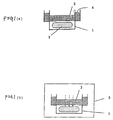
- Fig. 1 illustrates the method for evaluating the water vapor transmission of a polymer film.
- Fig. 2. illustrates the method for measuring the setting efficiency.
- the hair treatment composition of the present invention is characterized by comprising a polymer having a water vapor transmission rate represented by a water vapor transmission coefficient of the polymer film not exceeding-a definite level so as to improve the set-retaining power.
- the polymer to be contained in the hair treatment composition of the present invention for improving the set-retaining power use is made of a polymer having a regulated water vapor transmission rate of the polymer film, namely, one having a water vapor transmission coefficient of the polymer film, which is determined on the basis of a water vapor transmission rate measured in accordance with "Testing Methods for Determination of the Water Vapor Transmission Rate of Moisture-proof Packaging Materials” [JIS-Z0208-1976], at a temperature of 20 °C under a relative humidity of 90 %, of 0.8 x 10 -3 g ⁇ m -1 ⁇ hr -1 or less, still preferably 0.6 x 10 -3 g ⁇ m -1 ⁇ hr -1 or below.
- water vapor transmission rate means the amount (g ⁇ m -2 ⁇ hr -1 ) of water vapor transmission through a unit area of a polymer film within a definite time.
- a larger water vapor transmission rate means that water vapor can the more easily transmit through the film.
- the water vapor transmission rate varies between films depending on the film thickness, even though these film are made of the same material.
- water vapor transmission rate cannot be employed as an indication for the comparison between the water vapor transmission rates of films differing in thickness and material from each other.
- water vapor transmission coefficient is used as a value showing the water vapor transmission rate of a material.
- Water vapor transmission coefficient is the slope (g ⁇ m -1 ⁇ hr -1 ) of a line obtained by plotting the water vapor transmission rate against the reciprocal of the thickness. A larger water vapor transmission coefficient means that water vapor can the more easily transmit through the film.
- the water vapor transmission coefficient of a polymer film is obtained on the basis of a water vapor transmission rate measured in accordance with "Testing Methods for Determination of the Water Vapor Transmission Rate of Moisture-proof Packaging Materials" [JIS-Z0208-1976] in the following manner. Namely, as shown in Fig. 1 (a), 5 g of calcium chloride is introduced as a desiccant 2 into a cup 1 having an effective transmission sectional area of 28.27 cm 2 . Then the cup 1 is coated with a polymer film 3 and sealed by using white bees wax pellets as a sealing wax 4.
- the polymer film 3 employed in this case is one formed by casting a polymer solution onto a Petri dish made of Teflon and drying under reduced pressure (i.e., a cast method) and having a thickness of from 0.1 to 0.03 mm.
- the cup coated with the polymer film 3 is allowed to stand in a glove box 5 (temperature: 20 ⁇ 0.1 °C, humidity: 90 ⁇ 2 %).
- the humidity in this glove box 5 is controlled by using an aqueous solution of a compound which is commonly used for controlling humidity (i.e., phosphoric acid, glycerol, etc.).
- the cup 1 coated with the polymer film 3 is weighed with the passage of time. After the cup 1 is allowed to stand for 20 hours so as to attain the stationary state, it is weighed at intervals of 1.5 hours.
- the cup 1 When the cup 1 is allowed to stand in the glove box 5, namely, the weight of the cup is increased during the first several hours due to both of the water vapor transmission through the polymer film 3 and the moisture adsorbed by the polymer film 3 per se. After 20 hours, however, the weight of the cup 1 is changed exclusively by the water vapor transmission through the polymer film 3. Therefore, the cup is weighed at definite intervals (1.5 hours) after allowing to stand for 20 hours.
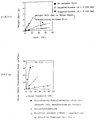
- the weight gain is plotted against time and the water vapor transmission rate J (g ⁇ m -2 ⁇ hr -1 ) of the polymer film 3 of the corresponding thickness is determined from the slope of the line thus obtained.
- polymer films differing in thickness from each other are also evaluated in the same manner and the water vapor transmission rate J of each polymer film is determined.
- the water vapor transmission rate is plotted against the reciprocal of film thickness and thus the water vapor transmission coefficient P (g ⁇ m -1 ⁇ hr -1 ) is determined from the slope of the line thus obtained.
- Fig. 1 (c) shows an example with the use of organosiloxane (organosiloxane A-2 described in EP-A-640643 corresponding to JP-A-7-133352; the term "JP-A” as used herein means an "unexamined published Japanese patent application”) films having a thickness of 0.036 mm and 0.601 mm as the polymer film.
- Fig. 1 (d) shows another example with the use of poly(dimethyldiallylammonium chloride) (Merquat 100: manufactured by Calgon), polyethyloxazoline (molecular weight: 50,000) and polyvinyl alcohol (PA24, manufactured by Shin-Etsu Chemical Co., Ltd.) as the polymer film.
- organosiloxane organosiloxane A-2 described in EP-A-640643 corresponding to JP-A-7-133352; the term "JP-A" as used herein means an "unexamined published Japanese patent application” films having
- the water vapor transmission rate of water into the hair can be sufficiently controlled in the process of the absorption of water by the hair, which makes it possible to retain the hair-set for a prolonged period of time.
- Examples of the polymer capable of forming a polymer film having such the low water vapor transmission coefficient include polyolefin polymers, chlorine-containing polymers, fluorine-containing polymers, polyvinyl alcohol polymers, polyesters and polyamides.
- Examples of the monomers constituting vinyl polymers or copolymers include olefins such as ethylene, propylene and 1-butene, cyclic olefins such as cyclobutene, cyclopentene and cyclohexene, butadiene, styrene, acrylonitrile, vinyl alcohol, vinyl acetate, alkyl vinyl ether, vinyl chloride, vinylidene chloride, and fluorine-containing olefins such as tetrafluoroethylene, hexafluoropropylene, perfluoroalkyl vinyl ether, chlorotrifluoroethylene, butene fluoride and vinylidene fluoride.
- a polymer having a polyester structure in its molecule which has been formed by polycondensation of a specific dicarboxylic acid with a diol examples include terephthalic acid, isophthalic acid, o-phthalic acid, 2,6-naphthalenedicarboxylic acid, p-phenylenedicarboxylic acid, 1,4-cyclohexanedicarboxylic acid, succinic acid, adipic acid, azelaic acid, sebacic acid and sodium sulfoisophthalate.
- diol component examples include ethylene glycol, propylene glycol, 1,4-butanediol, 1,6-hexanediol, neopentyl glycol, diethylene glycol, triethylene glycol, 1,4-cyclohexane dimethanol and bisphenol.
- a polymer having a polyamide structure in its molecule examples thereof include polymers of ⁇ -caprolactam, ⁇ -aminoenanthic acid, 11-aminoundecanoic acid, ⁇ -laurolactam, ⁇ -aminododecanoic acid, etc., hexamethylenediamine/adipic acid polycondensation product, hexamethylenediamine/sebacic acid polycondensation product, hexamethylenediamine/lauric acid polycondensation product, diaminobutane/adipic acid polycondensation product and metaxylilenediamine/adipic acid polycondensation product.
- the polymer to be used in the present invention it is also preferable to employ one modified with an ionic group.
- Use of such the ionic group-modified polymer makes it possible not only to regulate the water vapor transmission coefficient of the polymer film at a low level but also to improve the adhesion of the film to the hair. In addition, flaking can be prevented and further a soft touch can be imparted to the hair thereby. In this case, the effects of the modification can be achieved even though the polymer has been modified by the ionic group only at a low ratio. On the other hand, excessive modification is not preferable, since it would cause an increase in the water vapor transmission coefficient of the polymer film. Accordingly, it is preferable that the ratio of the monomers containing the ionic group is not more than 50 % by mol based on the total monomers.
- Such the polymer containing an ionic group and capable of forming a polymer film with a low water vapor transmission coefficient can be obtained as a copolymer of the above-mentioned monomers with a monomer containing the ionic group.
- the ionic group include carboxylic acid, sulfonic acid, phosphoric acid, amine salt, quaternary ammonium salt and thiol group.
- the monomers containing these ionic groups include acrylic acid, methacrylic acid, maleic acid, itaconic acid, styrenesulfonic acid, sodium sulfoisophthalate, methacryloylaminopropyltrimethylammonium chloride, dimethyldiallylammonium chloride, dimethylaminoethyl methacrylate diethylsulfate, imidazolinium methochloride, vinylamine and methacryloylbetaine.
- polyvinyl alcohol containing the ionic group is preferably used as the polymer.
- the polymer to be used in the present invention is one having a degree of polymerization of at least 500. It is not preferable that the degree of polymerization is excessively low, since such the polymer is liable to be plasticized under a high humidity so as to lower the set-retaining power.
- the polymer to be used in the present invention is one capable of forming a polymer film which has a modulus of elasticity (20 °C, relative humidity 65 %) ranging from 0.01 x 10 7 Pa to 7 x 10 7 Pa, still preferably from 0.01 x 10 7 Pa to 5 x 10 7 Pa. It has been a practice to use a polymer having a high modulus of film elasticity in order to strengthen the set-retaining power of a hair treatment. In the present invention, however, it is not necessary to elevate the modulus of film elasticity in order to strengthen the set-retaining power, since the set-retaining power has been improved by controlling the water vapor transmission coefficient of the film as described above.
- a high modulus of film elasticity makes the hair stiff and deteriorates the natural feel of the styled hair. Therefore, it is preferable in the present invention to use a polymer forming a film with a relatively low modulus of elasticity of not more than 7 x 10 7 , still preferably, not more than 5 x 10 7 .
- the modulus of film elasticity is excessively low, on the other hand, the polymer film is too soft for sustaining the hairstyle, even though the polymer can form a film having a very low water vapor transmission coefficient.
- the hair treatment composition of the present invention use can be made of either one of the polymers capable of forming a polymer film with a low water vapor transmission coefficient or a combination of two or more of the same.
- the content of the polymer component is at least 0.1 % by weight of the stock solution of the composition. In general, the upper limit of the content thereof is about 80 % by weight.
- the hair treatment composition of the present invention may further contain various components.
- it may contain polymers (e.g., polyethylene glycol, polymeric silicone, etc.), oils (hydrocarbon oil, ester oil, silicone oil, etc.) or fats.
- it may contain solvents, anionic, cationic or nonionic surfactants, higher alcohols, etc. in order to solubilize or emulsify the hair treatment composition.
- it may contain various additives commonly employed in cosmetics (thickener, chelating agent, pearling agent, perfume, coloring matter, UV absorber, foaming agent, propellant, etc.), if needed.
- the hair treatment composition of the present invention may be processed into various forms (hair foam, hair spray, hair set mist, hair set gel, color lotion, set lotion, blow lotion, etc.) without restriction.
- a set lotion was prepared by mixing the components as shown in Table 1 with the use of each polymer as listed in Table 2 as the polymer components.
- TABLE 1 Composition 1) Component wt. % Polymer 2 Ethanol 49 Purified water 49
- the water vapor transmission coefficient was determined by forming a film by the cast method and measuring its water vapor transmission tate in accordance with JIS-Z0208-1976 at a temperature of 20 °C under a relative humidity of 90 %.
- the modulus of film elasticity was determined by using the film formed by the cast method similar to the determination of the water vapor transmission coefficient as a sample (30 mm in length, 5 mm in width, 0.3 mm in thickness). The measurement was performed by using a universal tensile compression tester ("Model TCM-20S", manufactured by Shinko Tsushin Kogyo) at 20 °C under a relative humidity of 65 % at a crosshead speed of 20 mm/min.
- the set lotions of the above Examples and Comparative Examples were evaluated in (i) set-retaining power in moist state; (ii) flaking; and (iii) softness; each in the following manner.
- one end of hair 9 (a virgin hair bundle of a Japanese female, 10 cm in length, 1 g) was sandwiched between two acrylic plates and fixed with an adhesive, while another end was made free so as to prepare a plate tress 8.
- the plate tress 8 was immersed in deionized water for 5 minutes and then the moisture was sufficiently eliminated with towel.
- each of the set lotions of Examples and Comparative Examples was applied onto the hair 9 of the plate tress 8 at a bathing ratio (hair : set lotion) of 1 : 0.2.
- the hair 9 was wound around a glass rod 10 (4 cm in diameter) and allowed to stand at 20 °C under a relative humidity of 65 % for 24 hours.
- the set-retaining power in the moist state was evaluated in 3 grades as specified below.
- a sheet tress (a virgin hair bundle of a Japans female, 10 cm in length, 1 g) was prepared in the same manner as described above. Then each of the set lotions of Examples and Comparative Examples was applied onto the hair of the plate tress at a bathing ratio (hair : set lotion) of 1 : 0.2. After spontaneously drying, the plate tress was combed 5 times and then flaking was evaluated with the naked eye by skilled panelists in 4 grades as specified below.
- a sheet tress (a virgin hair bundle of a Japans female, 10 cm in length, 1 g) was prepared in the same manner as described above. Then each Of the set lotions of Examples and Comparative Examples was applied onto the hair of the plate tress at a bathing ratio (hair : set lotion) of 1 : 0.2. After spontaneously drying, the softness of the plate tress was evaluated by touching by skilled panelists in 4 grades as specified below.
- the set lotions of Examples each containing a polymer capable of forming a polymer film with a water vapor transmission coefficient of 0.8 x 10 -3 g ⁇ m -1 ⁇ hr -1 or less, make it possible to achieve a good set-retaining power and to impart a soft texture.
- composition 2 stock solution
- Component wt. % Anionized polyvinyl alcohol ("HL12E”, manufactured by Kuraray) 3 N-coconut oil fatty acid acyl-L-glutamic acid triethanolamine ("Amisoft CT12", manufactured by Ajinomoto) 0.3 Propylene glycol 0.1 ⁇ -Monoisostearyl glyceryl ether 0.1 8-Acetyl sucrose-modified alcohol 10.0 Perfume trace Deionized water the balance
- This hair set foam was evaluated in (i) set-retaining power in moist state; (ii) flaking; and (iii) softness; each in the same manner as described in Example 1. As a result, it showed a setting efficiency of 75 %, which indicated that it had a good set-retaining power.
- the flaking and softness were both evaluated as E (excellent).
- composition 3 stock solution
- Component wt. % Anionized polyvinyl alcohol (HL12E manufactured by Kuraray) 2 ⁇ -Monoisostearyl glyceryl ether 0.1 Squalane 0.2 Propylene glycol 0.5 Deionized water 20.0 Perfume trace 8-Acetyl sucrose modified alcohol the balance
- This hair set spray was evaluated in (i) set-retaining power in moist state; (ii) flaking; and (iii) softness; each in the same manner as described in Example 1. As a result, it showed a setting efficiency of 77 %, which indicated that it had a good set-retaining power.
- the flaking and softness were both evaluated as E (excellent).
- composition 4 as specified in Table 6 was prepared by mixing the components.
- Component wt. % Anionized polyvinyl alcohol (M115 manufactured by Kuraray) [water vapor transmission coefficient: 0.11 x 10 -3 g ⁇ m -1 ⁇ hr -1 modulus of film elasticity: 7.0 x 10 7 Pa] 0.5 Anionized polyvinyl alcohol ("HL12E", manufactured by Kuraray) 3 Carboxyvinyl polymer 1.0 Triethanolamine (89 %) 1.2 ⁇ -Monoisostearyl glyceryl ether 0.1 Propylene glycol 1.0 Methyl p-hydroxybenzoate 0.2 Perfume trace Deionized water the balance
- the stock solution and the hair gel thus obtained were evaluated in (i) set-retaining power in moist state; (ii) flaking; and (iii) softness; each in the same manner as described in Example 1. As a result, it showed a setting efficiency of 80 %, which indicated that it had a good set-retaining power.
- the flaking and softness were both evaluated as E (excellent).
- an excellent set-retaining power can be imparted to the hair while maintaining the natural texture of the hair.
Landscapes
- Health & Medical Sciences (AREA)
- Life Sciences & Earth Sciences (AREA)
- Animal Behavior & Ethology (AREA)
- General Health & Medical Sciences (AREA)
- Public Health (AREA)
- Veterinary Medicine (AREA)
- Birds (AREA)
- Epidemiology (AREA)
- Chemical & Material Sciences (AREA)
- Dispersion Chemistry (AREA)
- Cosmetics (AREA)
Applications Claiming Priority (3)
| Application Number | Priority Date | Filing Date | Title |
|---|---|---|---|
| JP30378595A JP3528373B2 (ja) | 1995-10-28 | 1995-10-28 | 毛髪処理組成物 |
| JP30378595 | 1995-10-28 | ||
| JP303785/95 | 1995-10-28 |
Publications (3)
| Publication Number | Publication Date |
|---|---|
| EP0773015A2 true EP0773015A2 (de) | 1997-05-14 |
| EP0773015A3 EP0773015A3 (de) | 1998-11-25 |
| EP0773015B1 EP0773015B1 (de) | 2004-01-07 |
Family
ID=17925268
Family Applications (1)
| Application Number | Title | Priority Date | Filing Date |
|---|---|---|---|
| EP96117107A Expired - Lifetime EP0773015B1 (de) | 1995-10-28 | 1996-10-24 | Haarpflegemittel |
Country Status (6)
| Country | Link |
|---|---|
| US (1) | US5985254A (de) |
| EP (1) | EP0773015B1 (de) |
| JP (1) | JP3528373B2 (de) |
| CN (1) | CN1117557C (de) |
| DE (1) | DE69631279T2 (de) |
| TW (1) | TW516963B (de) |
Cited By (1)
| Publication number | Priority date | Publication date | Assignee | Title |
|---|---|---|---|---|
| WO2006032321A1 (de) * | 2004-09-22 | 2006-03-30 | Henkel Kommanditgesellschaft Auf Aktien | Pflegende haarbehandlungsmittel mit polyvinylalkohol |
Families Citing this family (3)
| Publication number | Priority date | Publication date | Assignee | Title |
|---|---|---|---|---|
| US6372601B1 (en) | 1998-09-03 | 2002-04-16 | Micron Technology, Inc. | Isolation region forming methods |
| US6514918B1 (en) | 2000-08-18 | 2003-02-04 | Johnson & Johnson Consumer Companies, Inc. | Viscous, mild, and effective cleansing compositions |
| JP2012036130A (ja) * | 2010-08-06 | 2012-02-23 | Kao Corp | 整髪方法 |
Citations (1)
| Publication number | Priority date | Publication date | Assignee | Title |
|---|---|---|---|---|
| EP0640643A2 (de) | 1993-08-10 | 1995-03-01 | Kao Corporation | Organopolysiloxane und ein Verfahren zum Haarfestigen unter Verwendung derselben |
Family Cites Families (12)
| Publication number | Priority date | Publication date | Assignee | Title |
|---|---|---|---|---|
| DE2404046C3 (de) * | 1974-01-29 | 1984-07-26 | Henkel KGaA, 4000 Düsseldorf | Verwendung von Carboxyl- bzw. Carboxylat- und Hydroxylgruppen aufweisenden Polymeren als Hautfeuchthaltemittel |
| JPS57116006A (en) * | 1981-01-09 | 1982-07-19 | Kuraray Co Ltd | Additive for cosmetic |
| LU83350A1 (fr) * | 1981-05-08 | 1983-03-24 | Oreal | Composition destinee au traitement des fibres keratiniques a base de polymere cationique et de polymere anionique a groupements vinylsulfoniques et procede de traitement la mettant en oeuvre |
| US4690817A (en) * | 1983-10-07 | 1987-09-01 | Ici Americas Inc. | Quaternary nitrogen containing polyvinyl alcohol polymers for use in skin conditioning, cosmetic and pharmaceutical formulations |
| US4689217A (en) * | 1983-10-07 | 1987-08-25 | Ici Americas Inc. | Amine and ammonium nitrogen containing polyvinyl alcohol polymers having improved lipophilic properties for use in skin conditioning, cosmetic and pharmaceutical formulations |
| EP0141269B1 (de) * | 1983-10-07 | 1989-08-23 | Ici Americas Inc. | Modifizierte Polyvinylalkohol-Polymere |
| JPS60202103A (ja) * | 1984-03-27 | 1985-10-12 | Kuraray Co Ltd | 化粧料用添加剤 |
| JPS61261341A (ja) * | 1985-05-15 | 1986-11-19 | Nitto Electric Ind Co Ltd | 含水弾性体組成物 |
| JPS6335511A (ja) * | 1986-07-30 | 1988-02-16 | Shiseido Co Ltd | パツク化粧料 |
| GB8618634D0 (en) * | 1986-07-30 | 1986-09-10 | Unilever Plc | Treatment of keratinous fibres |
| US5112886A (en) * | 1986-09-26 | 1992-05-12 | Ici Americas Inc. | Allantoin salts of quaternary nitrogen containing polymers for use in skin conditioning, cosmetic and pharmaceutical formulations |
| US5338541A (en) * | 1992-10-15 | 1994-08-16 | Calgon Corporation | Dual cationic terpolymers providing superior conditioning properties in hair, skin and nail care products |
-
1995
- 1995-10-28 JP JP30378595A patent/JP3528373B2/ja not_active Expired - Lifetime
-
1996
- 1996-10-21 US US08/734,263 patent/US5985254A/en not_active Expired - Lifetime
- 1996-10-22 TW TW085112883A patent/TW516963B/zh not_active IP Right Cessation
- 1996-10-24 DE DE1996631279 patent/DE69631279T2/de not_active Expired - Lifetime
- 1996-10-24 EP EP96117107A patent/EP0773015B1/de not_active Expired - Lifetime
- 1996-10-28 CN CN96123358A patent/CN1117557C/zh not_active Expired - Fee Related
Patent Citations (1)
| Publication number | Priority date | Publication date | Assignee | Title |
|---|---|---|---|---|
| EP0640643A2 (de) | 1993-08-10 | 1995-03-01 | Kao Corporation | Organopolysiloxane und ein Verfahren zum Haarfestigen unter Verwendung derselben |
Cited By (1)
| Publication number | Priority date | Publication date | Assignee | Title |
|---|---|---|---|---|
| WO2006032321A1 (de) * | 2004-09-22 | 2006-03-30 | Henkel Kommanditgesellschaft Auf Aktien | Pflegende haarbehandlungsmittel mit polyvinylalkohol |
Also Published As
| Publication number | Publication date |
|---|---|
| JP3528373B2 (ja) | 2004-05-17 |
| CN1159911A (zh) | 1997-09-24 |
| CN1117557C (zh) | 2003-08-13 |
| DE69631279T2 (de) | 2004-11-18 |
| TW516963B (en) | 2003-01-11 |
| EP0773015B1 (de) | 2004-01-07 |
| EP0773015A3 (de) | 1998-11-25 |
| JPH09124448A (ja) | 1997-05-13 |
| US5985254A (en) | 1999-11-16 |
| DE69631279D1 (de) | 2004-02-12 |
Similar Documents
| Publication | Publication Date | Title |
|---|---|---|
| US4871529A (en) | Autophobic silicone copolyols in hairspray compositions | |
| US4223009A (en) | Hair preparation containing vinyl pyrrolidone copolymer | |
| KR100249284B1 (ko) | 샴푸 및 기타의 모발 보호 제품에 우수한 컨디셔닝 특성을 제공하는 양성전해질 삼원공중합체 | |
| CA1091160A (en) | Hair preparation containing vinyl pyrrolidone copolymer | |
| US5939058A (en) | Hair styling compositions and method of enhancing the performance of hair fixative resins | |
| US5747016A (en) | Organopolysiloxanes and a method of setting hair using the same | |
| US4165367A (en) | Hair preparations containing vinyl pyrrolidone copolymer | |
| RU2183449C2 (ru) | Композиция для укладки волос, содержащая полимер с особыми характеристиками и пленкообразующий ионный полимер | |
| US4059688A (en) | Hair fixing compositions containing fluoroterpolymers and method | |
| US3530215A (en) | Conditioning hair with quaternized homopolymers | |
| US5658558A (en) | Hair styling compositions and method of enhancing the performance of hair fixative resins | |
| MXPA97008071A (en) | Cosmetic composition to keep the hair shape fixed and give bright appearance to my | |
| RU96115458A (ru) | Косметическая композиция с фиксирующей способностью и/или кондиционером, содержащая особый акриловый сополимер и ее применение | |
| RU2000128888A (ru) | Косметическая композиция, содержащая полимер с особыми свойствами и загущающий полимер | |
| EA001049B1 (ru) | Косметическая композиция для фиксации волос и придания им блеска | |
| US20110186070A1 (en) | Method for strengthening keratinous fibers | |
| US20010022967A1 (en) | Hair styling compositions | |
| US4007005A (en) | Hair setting compositions which display high resistance to high humidity | |
| SE461436B (sv) | Foerfarande foer lockpermanentning eller rakpermanentning av haar jaemte permanentningskomposition foer anvaendning vid naemnda foerfarande | |
| DE3731477A1 (de) | Kosmetische mittel auf der basis von kationischen polymeren und alkyloxazolinpolymeren | |
| US6083494A (en) | Cosmetic composition comprising an aqueous non-ionic polymer dispersion and process of using | |
| US5985254A (en) | Hair treatment composition | |
| US4012501A (en) | Hair-care composition containing a thermoplastic polymer | |
| US5663261A (en) | Film-forming resin and hair care cosmetic containing the same | |
| US6998114B2 (en) | Hair grooming formulations and methods for the use thereof |
Legal Events
| Date | Code | Title | Description |
|---|---|---|---|
| PUAI | Public reference made under article 153(3) epc to a published international application that has entered the european phase |
Free format text: ORIGINAL CODE: 0009012 |
|
| AK | Designated contracting states |
Kind code of ref document: A2 Designated state(s): DE FR GB |
|
| RHK1 | Main classification (correction) |
Ipc: A61K 7/06 |
|
| PUAL | Search report despatched |
Free format text: ORIGINAL CODE: 0009013 |
|
| AK | Designated contracting states |
Kind code of ref document: A3 Designated state(s): DE FR GB |
|
| 17P | Request for examination filed |
Effective date: 19990315 |
|
| 17Q | First examination report despatched |
Effective date: 20020412 |
|
| GRAH | Despatch of communication of intention to grant a patent |
Free format text: ORIGINAL CODE: EPIDOS IGRA |
|
| GRAS | Grant fee paid |
Free format text: ORIGINAL CODE: EPIDOSNIGR3 |
|
| GRAA | (expected) grant |
Free format text: ORIGINAL CODE: 0009210 |
|
| AK | Designated contracting states |
Kind code of ref document: B1 Designated state(s): DE FR GB |
|
| REG | Reference to a national code |
Ref country code: GB Ref legal event code: FG4D |
|
| REF | Corresponds to: |
Ref document number: 69631279 Country of ref document: DE Date of ref document: 20040212 Kind code of ref document: P |
|
| ET | Fr: translation filed | ||
| PLBE | No opposition filed within time limit |
Free format text: ORIGINAL CODE: 0009261 |
|
| STAA | Information on the status of an ep patent application or granted ep patent |
Free format text: STATUS: NO OPPOSITION FILED WITHIN TIME LIMIT |
|
| 26N | No opposition filed |
Effective date: 20041008 |
|
| PGFP | Annual fee paid to national office [announced via postgrant information from national office to epo] |
Ref country code: DE Payment date: 20121017 Year of fee payment: 17 Ref country code: FR Payment date: 20121018 Year of fee payment: 17 |
|
| PGFP | Annual fee paid to national office [announced via postgrant information from national office to epo] |
Ref country code: GB Payment date: 20121024 Year of fee payment: 17 |
|
| REG | Reference to a national code |
Ref country code: DE Ref legal event code: R119 Ref document number: 69631279 Country of ref document: DE |
|
| GBPC | Gb: european patent ceased through non-payment of renewal fee |
Effective date: 20131024 |
|
| REG | Reference to a national code |
Ref country code: DE Ref legal event code: R079 Ref document number: 69631279 Country of ref document: DE Free format text: PREVIOUS MAIN CLASS: A61K0007060000 Ipc: A61K0008810000 |
|
| PG25 | Lapsed in a contracting state [announced via postgrant information from national office to epo] |
Ref country code: GB Free format text: LAPSE BECAUSE OF NON-PAYMENT OF DUE FEES Effective date: 20131024 |
|
| REG | Reference to a national code |
Ref country code: FR Ref legal event code: ST Effective date: 20140630 |
|
| PG25 | Lapsed in a contracting state [announced via postgrant information from national office to epo] |
Ref country code: FR Free format text: LAPSE BECAUSE OF NON-PAYMENT OF DUE FEES Effective date: 20131031 Ref country code: DE Free format text: LAPSE BECAUSE OF NON-PAYMENT OF DUE FEES Effective date: 20140501 |
|
| REG | Reference to a national code |
Ref country code: DE Ref legal event code: R119 Ref document number: 69631279 Country of ref document: DE Effective date: 20140501 Ref country code: DE Ref legal event code: R079 Ref document number: 69631279 Country of ref document: DE Free format text: PREVIOUS MAIN CLASS: A61K0007060000 Ipc: A61K0008810000 Effective date: 20140728 |