EP0764867A2 - CCD-Zeilenscanner zum optisch-elektrischen Abtasten eines Objektes - Google Patents
CCD-Zeilenscanner zum optisch-elektrischen Abtasten eines Objektes Download PDFInfo
- Publication number
- EP0764867A2 EP0764867A2 EP96115252A EP96115252A EP0764867A2 EP 0764867 A2 EP0764867 A2 EP 0764867A2 EP 96115252 A EP96115252 A EP 96115252A EP 96115252 A EP96115252 A EP 96115252A EP 0764867 A2 EP0764867 A2 EP 0764867A2
- Authority
- EP
- European Patent Office
- Prior art keywords
- mirror
- lamps
- ccd line
- line scanner
- beam path
- Prior art date
- Legal status (The legal status is an assumption and is not a legal conclusion. Google has not performed a legal analysis and makes no representation as to the accuracy of the status listed.)
- Granted
Links
Images

Classifications
-
- G—PHYSICS
- G06—COMPUTING OR CALCULATING; COUNTING
- G06K—GRAPHICAL DATA READING; PRESENTATION OF DATA; RECORD CARRIERS; HANDLING RECORD CARRIERS
- G06K7/00—Methods or arrangements for sensing record carriers, e.g. for reading patterns
- G06K7/10—Methods or arrangements for sensing record carriers, e.g. for reading patterns by electromagnetic radiation, e.g. optical sensing; by corpuscular radiation
- G06K7/10544—Methods or arrangements for sensing record carriers, e.g. for reading patterns by electromagnetic radiation, e.g. optical sensing; by corpuscular radiation by scanning of the records by radiation in the optical part of the electromagnetic spectrum
- G06K7/10821—Methods or arrangements for sensing record carriers, e.g. for reading patterns by electromagnetic radiation, e.g. optical sensing; by corpuscular radiation by scanning of the records by radiation in the optical part of the electromagnetic spectrum further details of bar or optical code scanning devices
- G06K7/1092—Methods or arrangements for sensing record carriers, e.g. for reading patterns by electromagnetic radiation, e.g. optical sensing; by corpuscular radiation by scanning of the records by radiation in the optical part of the electromagnetic spectrum further details of bar or optical code scanning devices sensing by means of TV-scanning
-
- H—ELECTRICITY
- H04—ELECTRIC COMMUNICATION TECHNIQUE
- H04N—PICTORIAL COMMUNICATION, e.g. TELEVISION
- H04N1/00—Scanning, transmission or reproduction of documents or the like, e.g. facsimile transmission; Details thereof
- H04N1/024—Details of scanning heads ; Means for illuminating the original
- H04N1/028—Details of scanning heads ; Means for illuminating the original for picture information pick-up
- H04N1/02815—Means for illuminating the original, not specific to a particular type of pick-up head
- H04N1/0282—Using a single or a few point light sources, e.g. a laser diode
- H04N1/0284—Using a single or a few point light sources, e.g. a laser diode in combination with a light integrating, concentrating or diffusing cavity
-
- H—ELECTRICITY
- H04—ELECTRIC COMMUNICATION TECHNIQUE
- H04N—PICTORIAL COMMUNICATION, e.g. TELEVISION
- H04N1/00—Scanning, transmission or reproduction of documents or the like, e.g. facsimile transmission; Details thereof
- H04N1/024—Details of scanning heads ; Means for illuminating the original
- H04N1/028—Details of scanning heads ; Means for illuminating the original for picture information pick-up
- H04N1/03—Details of scanning heads ; Means for illuminating the original for picture information pick-up with photodetectors arranged in a substantially linear array
-
- H—ELECTRICITY
- H04—ELECTRIC COMMUNICATION TECHNIQUE
- H04N—PICTORIAL COMMUNICATION, e.g. TELEVISION
- H04N1/00—Scanning, transmission or reproduction of documents or the like, e.g. facsimile transmission; Details thereof
- H04N1/024—Details of scanning heads ; Means for illuminating the original
- H04N1/028—Details of scanning heads ; Means for illuminating the original for picture information pick-up
- H04N1/03—Details of scanning heads ; Means for illuminating the original for picture information pick-up with photodetectors arranged in a substantially linear array
- H04N1/0301—Details of scanning heads ; Means for illuminating the original for picture information pick-up with photodetectors arranged in a substantially linear array using a bent optical path between the scanned line and the photodetector array, e.g. a folded optical path
-
- H—ELECTRICITY
- H04—ELECTRIC COMMUNICATION TECHNIQUE
- H04N—PICTORIAL COMMUNICATION, e.g. TELEVISION
- H04N1/00—Scanning, transmission or reproduction of documents or the like, e.g. facsimile transmission; Details thereof
- H04N1/024—Details of scanning heads ; Means for illuminating the original
- H04N1/028—Details of scanning heads ; Means for illuminating the original for picture information pick-up
- H04N1/03—Details of scanning heads ; Means for illuminating the original for picture information pick-up with photodetectors arranged in a substantially linear array
- H04N1/0301—Details of scanning heads ; Means for illuminating the original for picture information pick-up with photodetectors arranged in a substantially linear array using a bent optical path between the scanned line and the photodetector array, e.g. a folded optical path
- H04N1/0303—Details of scanning heads ; Means for illuminating the original for picture information pick-up with photodetectors arranged in a substantially linear array using a bent optical path between the scanned line and the photodetector array, e.g. a folded optical path with the scanned line and the photodetector array lying in non-parallel planes
Definitions
- the invention relates to a CCD line scanner for the optical-electrical scanning of an object, in particular for the automatic detection of receipts or check cards, consisting of an illumination device in the form of a curved mirror with a lamp, an optical lens and at least one CCD line sensor arranged thereafter according to the preamble of claim 1.
- Row-shaped lighting devices with elliptical mirrors are known, for example, in copiers.
- the mirrors used can also have other shapes, for example cylindrically curved or concavely curved.
- so-called cold light sources consisting of a remote halogen lamp with optical fibers, instead of lamps.
- lighting technology is a crucial system element if shiny surfaces are to be inspected and if high-contrast images, for example of receipts, are to be obtained that are to be automatically archived or read.
- the invention has for its object to provide a compact design of a CCD line scanner of the type mentioned, which should have a high efficiency in terms of lighting, a low power loss and low shading.
- the solution to a CCD line scanner for optical-electrical scanning of an object consisting of an illumination device in the form of a concave mirror with lamp, an optical lens and at least one CCD line sensor arranged thereafter
- the task is that the mirror is elliptically curved, in whose one focal point (F1) two lamps are arranged and in the second focal point (F2) the object to be scanned is located in the plane, and the mirror is seen in the region of its apex and in projection has a slit-shaped opening between the lamps for masking out the imaging beam path to the outside of the mirror, the lens being located in the image plane of the line sensor after the breakthrough.
- the CCD line scanner according to the invention has the advantage that it has a compact design, high lighting efficiency, low power loss and low shading.
- the CCD line scanner is advantageously optimized or the mirror surface structured so that the image recorded by the CCD line or matrix sensors is essentially formed from reflecting and not reflecting components of the incident light, ie the imaging beam path is mainly from remitted rays, originating from the object to be scanned.
- the characteristic of the incident light is chosen so that the angle of incidence is between approximately 20 and 50 degrees. This advantageously eliminates reflections such as those generated by rapidly moving ("fluttering") and shiny documents, for example checks or check cards.
- the mirror is preferably elliptically curved in one direction and the lamps lie on the focal line (F1) of the mirror, the lamps being arranged in the outer regions of the mirror.
- a deflection mirror can be arranged along it, which is inclined by 45 degrees to deflect the imaging beam path. This ensures a small construction of the CCD line scanner.
- a beam or color splitter can be arranged after the lens and in front of the line or matrix sensor, which divides the partial beam onto further CCD line or matrix sensors.
- Such a beam and / or color splitter advantageously enables image recording in two color channels.
- An aperture can be arranged in front of the lamps or each lamp in order to avoid that directly emitted light passes through the aperture.
- the mirror can be blackened in the region of the apex of the mirror and / or in the region of the lamps.
- the mirror can be blackened in the region of the apex on both sides of the opening in order to ensure that essentially only remitting components of the light form the imaging beam path.
- Figure 1 shows a longitudinal section through a body which has a concave cavity which is elliptically curved in one direction and the surface of which is mirrored to form a mirror 1;
- the left and right mirror halves of the mirror 1 are designated by the reference numerals 2 and 3.
- the object 12 to be scanned is located in the plane, which is moved in the y-direction under the mirror 1.
- the mirror 1 has a slit-shaped opening 4 between the lamps 7, 7 ′ for masking out the imaging beam path 6 originating from the object 12 to the outside of the mirror 1.
- a deflecting mirror 5 is arranged along the same, which is inclined at 45 degrees for deflecting the imaging beam path 6, a lens 8 being located in the outer, deflected imaging beam path 6 ', in the image plane of which a line sensor 11 is arranged.
- a beam or color splitter 9 can be arranged in front of the line sensor 11, which splits the imaging beam path 6 ′ and directs it to further CCD line sensors 10.
- the mirror 1 can have an elongated blackened area 14 in the region of the apex and around the opening and the lamps 7, 7 '.
- the mirror 1 below the mirror halves 2 and 3 can be elongated, parallel to the opening 4 have blackened areas 13, 13 '; or these areas 13, 13 'can be roughened or structured non-reflecting, as can be seen in FIG. 2.
- the imaging beam path 6, 6 ' essentially consists of remitting components of the incident light from the lamps 7, 7'.
- the lighting maxima are on the edge of the image fields. This produces a distribution of the illuminance that is inverse to the shading of the lens, so that the overall sensitivity remains constant over the CCD line.
- the CCD line scanner or mirror 1 can be designed in a particularly small design according to FIGS. 1, 3 and 4 in a straight direction in an axial direction and in the cross-sectional plane perpendicular thereto as a partial ellipsoid or approximately as a partial ellipsoid, in which case the second focal line F2 , on which the object 12 is located in the plane, runs outside the mirror or reflector.
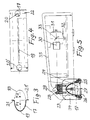
- FIG. 4 shows a technical embodiment of the lighting device according to the invention.
- a CCD line scanner consists of a reflector 17, which is elliptically curved in a cross-sectional plane and, in the vertical direction, is straight and elongated from a sheet metal or plastic part, the inner surface of which, as a mirror envelope, has half an ellipse 18 with the focal line F1 and is the outside focus line F2.
- the reflector 17 according to FIG. 4 has a longitudinal slot 19.
- the reflector 17 has longitudinally extending legs 21, 21 ′ which are bent over by approximately 90 degrees and in which bores 22 are arranged for fastening the reflector 17.
- FIG. 5 shows the arrangement of the reflector 17 within a complete lighting device, consisting of a holding element 34, which can be designed in a bow-shaped manner, also consisting of two brackets, and in which the reflector 17 is mounted.
- a holding element 34 On the inner focus line F1 of the reflector 17 and thus within it are two lamps 23, each of which is suspended from a lamp holder 28, both of which are fastened on the holding element 34 or holding elements are.
- the lamp holders 28 as well as the one or more holding elements 34 are designed such that the imaging beam path through the longitudinal slot 19 can fall onto a longitudinal mirror 29 located above the reflector 17 between the lamp holders 28, which deflects the imaging beam path onto a lens 30. From there, the redirected beam falls on a CCD line 31 or CCD matrix.
- a semi-transparent deflecting mirror 33 can be arranged within the imaging beam path after the objective 30, which deflects part of the beam path via a filter onto a further CCD line 32.
- a lamp backdrop 24 which causes shadowing of the light which projects from the lamps 23 downwards in a projection perpendicular to the object.
- This shading can be formed by a projection or a nose, which is arranged in a projecting manner on the scenes 24, the noses on the lamp scenes 24 being directed towards one another and in the vertical projection just the direct beam path of the lamps 23 downward on the Shade the object to avoid directly emitted light.
- a cover glass frame 26 is arranged below the reflector 17 and holds a cover glass 25 at the end of the reflector 17.
- an aperture 27 can be arranged on or below the cover slip 25.
- the cover slip frame 26 is screwed together with the reflector 17 by means of screws to the holding element or elements 34.
- the one or more holding elements 34 are held on a support frame 35, which also encloses the electrical and optical parts.
- the CCD line scanner according to the invention for the optical-electrical scanning of an object is particularly suitable for being used for the automatic detection of receipts or check cards, because it is used for reflections such as those from rapidly moving ( " fluttering") and shiny receipts Example checks or check cards that are generated are excluded.
Landscapes
- Engineering & Computer Science (AREA)
- Multimedia (AREA)
- Signal Processing (AREA)
- Physics & Mathematics (AREA)
- Electromagnetism (AREA)
- Health & Medical Sciences (AREA)
- General Health & Medical Sciences (AREA)
- Toxicology (AREA)
- Artificial Intelligence (AREA)
- Computer Vision & Pattern Recognition (AREA)
- General Physics & Mathematics (AREA)
- Theoretical Computer Science (AREA)
- Optics & Photonics (AREA)
- Facsimile Scanning Arrangements (AREA)
- Image Input (AREA)
- Inspection Of Paper Currency And Valuable Securities (AREA)
- Character Input (AREA)
Abstract
Description
- Die Erfindung betrifft einen CCD-Zeilenscanner zum optisch-elektrischen Abtasten eines Objektes, insbesondere zum automatischen Erfassen von Belegen oder Scheckkarten, bestehend aus einer Beleuchtungseinrichtung in Form eines gekrümmten Spiegels mit Lampe, einem optischen Objektiv und wenigstens einem danach angeordneten CCD-Zeilensensor gemäß dem Oberbegriff des Anspruchs 1.
- Zeilenförmige Beleuchtungseinrichtungen mit elliptischen Spiegeln sind zum Beispiel in Kopiergeräten bekannt. Die verwendeten Spiegel können auch andere Formen aufweisen, zum Beispiel zylindrisch gekrümmt oder konkav gekrümmt sein. Des weiteren ist es bekannt, anstelle von Lampen sogenannte Kaltlichtquellen, bestehend aus einer abgesetzten Halogenlampe mit Lichtwellenleitern, zu verwenden.
- Für eine opto-elektische Oberflächeninspektion ist die Beleuchtungstechnik ein entscheidendes Systemelement, wenn glänzende Oberflächen zu inspizieren sind und wenn kontrastreiche Bildaufnahmen beispielsweise von Belegen, erhalten werden sollen, die automatisch archiviert oder gelesen werden sollen.
- Der Erfindung liegt die Aufgabe zugrunde, eine kompakte Konstruktion eines CCD-Zeilenscanners der genannten Gattung zu schaffen, der einen hohen Wirkungsgrad hinsichtlich der Beleuchtung, eine geringe Verlustleistung und ein geringes Shading aufweisen soll.
- Bei einem CCD-Zeilenscanner zum optisch-elektrischen Abtasten eines Objektes, insbesondere zum automatischen Erfassen von Belegen oder Scheckkarten, bestehend aus einer Beleuchtungseinrichtung in Form eines konkav gekrümmten Spiegels mit Lampe, einem optischen Objektiv und wenigstens einem danach angeordneten CCD-Zeilensensor, besteht die Lösung der Aufgabe darin, daß der Spiegel elliptisch gekrümmt ist, in dessen ein Brennpunkt (F1) zwei Lampen angeordnet sind und in dessen zweiten Brennpunkt (F2) in der Ebene sich das abzutastende Objekt befindet, und der Spiegel im Bereich seines Scheitels und in Projektion gesehen zwischen den Lampen einen spaltförmigen Durchbruch zum Ausblenden des Abbildungsstrahlengangs nach außerhalb des Spiegels aufweist, wobei im äußeren Abbildungsstrahlengang nach dem Durchbruch sich das Objektiv befindet, in dessen Bildebene der Zeilensensor angeordnet ist.
- Der erfindungsgemäße CCD-Zeilenscanner besitzt den Vorteil, daß er eine kompakte Bauweise, einen hohen Wirkungsgrad hinsichtlich der Beleuchtung, eine geringe Verlustleistung und ein geringes Shading aufweist. Vorteilhaft ist der CCD-Zeilenscanner so optimiert bzw. die Spiegeloberfläche so strukturiert, daß das von dem oder den CCD-Zeilen- oder Matrixsensoren aufgenommene Bild im wesentlichen aus remittierenden und nicht aus reflektierenden Komponenten des einfallenden Lichtes gebildet wird, d.h., der Abbildungsstrahlengang wird hauptsächlich aus remittierten Strahlen, herrührend vom abzutastenden Objekt, gebildet. Die Charakteristik des einfallenden Lichtes ist so gewählt, daß der Einfallswinkel zwischen etwa 20 und 50 Grad liegt. Dadurch sind Reflexionen, wie sie beispielsweise von schnell bewegten (,,flatternden'') und glänzenden Belegen, zum Beispiel Schecks oder Scheckkarten, erzeugt werden, vorteilhafterweise ausgeschlossen.
- Vorzugsweise ist der Spiegel in einer Richtung elliptisch gekrümmt und liegen die Lampen auf der Brenn-Geraden (F1) des Spiegels, wobei die Lampen in den äußern Bereichen des Spiegels angeordnet sind. Oberhalb des Durchbruches kann längs desselben ein Ablenkspiegel angeordnet sein, der um 45 Grad geneigt ist zum Ablenken des Abbildungsstrahlengangs. Dadurch ist eine kleine Bauweise des CCD-Zeilenscanners gewährleistet.
- Nach dem Objektiv und vor dem Zeilen- oder Matrixsensor kann ein Strahl- oder Farbteiler angeordnet sein, der den Teilstrahl auf weitere CCD-Zeilen- oder Matrixsensoren leitet. Ein derartiger Strahl- und/oder Farbteiler ermöglicht vorteilhaft eine Bildaufnahme in zwei Farbkanälen.
- Eine Blende kann vor den Lampen oder jeder Lampe angeordnet sein, um zu vermeiden, daß direkt abgestrahltes Licht durch den Durchbruch gelangt. Zusätzlich kann hierzu im Bereich des Scheitels des Spiegels und/oder im Bereich der Lampen der Spiegel geschwärzt ausgeführt sein. Ebenso kann der Spiegel im Bereich des Scheitels auf beiden Seiten des Durchbruchs geschwärzt sein, um zu gewährleisten, daß im wesentlichen nur remittierende Komponenten des Lichts den Abbildungsstrahlengang bilden.
- Kurzbeschreibung der Zeichnung, in der zeigen:
- Figur 1
- einen Längsschnitt durch eine Beleuchtungsanordnung mit einem in einer Richtung elliptisch-konkav gekrümmten Spiegel,
- Figur 2
- eine Draufsicht auf die Beleuchtungsanordnung der Figur 1 längs des Schnittes A-A,
- Figur 3
- eine technische Ausführung eines Spiegels, der im Querschnitt elliptisch gekrümmt ist,
- Figur 4
- eine Draufsicht von unten auf Figur 3 und
- Figur 5
- eine Ansicht der Beleuchtungsanordnung mit Spiegel gemäß der Figur 3.
- Figur 1 zeigt einen Längsschnitt durch einen Körper, der einen konkaven Hohlraum aufweist, der in einer Richtung elliptisch gekrümmt ist und dessen Oberfläche zur Bildung eines Spiegels 1 verspiegelt ist; in der Figur 1 sind die linke und die rechte Spiegelhälfte des Spiegels 1 mit den Bezugsziffern 2 und 3 bezeichnet. Auf der Brenn-Geraden F1 bzw. in Projektion gesehen in dem einen Brennpunkt F1 des Spiegels 1 innerhalb desselben sind zwei Lampen 7, 7' angeordnet; in der zweiten Brenn-Geraden F2 bzw. in Projektion gesehen im zweiten Brennpunkt F2 befindet sich in der Ebene das abzutastende Objekt 12, welches in y-Richtung unter dem Spiegel 1 bewegt wird. Vorzugsweise sind die Lampen 7, 7' in den äußern Bereichen des Spiegels 1 angeordnet sind, was aus Figur 2 hervorgeht.
- Der Spiegel 1 weist im Bereich seines Scheitels und in Projektion gesehen zwischen den Lampen 7, 7' einen spaltförmigen Durchbruch 4 zum Ausblenden des vom Objekt 12 herrührenden Abbildungsstrahlengangs 6 nach außerhalb des Spiegels 1 auf. Oberhalb des Durchbruchs 4 ist längs desselben ein Ablenkspiegel 5 angeordnet, der um 45 Grad geneigt ist zum Ablenken des Abbildungsstrahlengangs 6, wobei sich im äußeren, umgelenkten Abbildungsstrahlengang 6' ein Objektiv 8 befindet, in dessen Bildebene ein Zeilensensor 11 angeordnet ist. Vor dem Zeilensensor 11 kann ein Strahl- oder Farbteiler 9 angeordnet sein, der den Abbildungs-strahlengang 6' aufteilt und auf weitere CCD-Zeilensensoren 10 leitet.
- Um direkt abgestrahltes Licht zu vermeiden, kann gemäß Figur 2 vor den Lampen 7, 7' je eine Blende 16, 16' angeordnet sein. Des weiteren kann der Spiegel 1 im Bereich des Scheitels und um den Durchbruch sowie die Lampen 7, 7' einen länglichen geschwärzten Bereich 14 aufweisen. Ebenso kann der Spiegel 1 unterhalb der Spiegelhälften 2 und 3 längliche, parallel zum Durchbruch 4 verlaufende geschwärzte Bereiche 13, 13' aufweisen; oder diese Bereiche 13, 13' können aufgerauht oder strukturiert nichtspiegelnd sein, wie es aus Figur 2 hervorgeht.
- Dadurch wird erreicht, daß die Bereiche 13, 13' des Spiegels 1 ausgeblendet sind und die Raumsektoren 15, 15' keine Strahlung zum Brennpunkt F2 bzw. zur Brenn-Geraden F2 liefern, so daß die Charakteristik des einfallenden Lichts dergestalt gewählt ist, daß der Einfallswinkel des einfallenden Lichtes zwischen etwa 20 und 50 Grad beträgt. Dadurch besteht der Abbildungsstrahlengang 6, 6' im wesent-lichen aus remittierenden Komponenten des einfallenden Lichtes der Lampen 7, 7'. Die Beleuchtungsmaxima liegen am Rand der Bildfelder. Damit wird eine in guter Näherung zum Shading des Objektivs inverse Verteilung der Beleuchtungsstärke erzeugt, so daß insgesamt die Empfindlichkeit über der CCD-Zeile konstant bleibt.
- Der CCD-Zeilenscanner bzw. Spiegel 1 kann in besonders kleiner Bauweise gemäß der Figuren 1, 3 und 4 in einer Achsrichtung gerade-länglich und in der dazu senkrechten Querschnittsebene als Teilellipsoid oder annähernd als Teilellipsoid ausgeführt sein, wobei dann die zweite Brenn-Gerade F2, auf der sich in der Ebene das Objekt 12 befindet, außerhalb des Spiegels bzw. Reflektors verläuft.
- Die Figuren 3 bis 5 zeigen eine technische Ausführung der erfindungsgemäßen Beleuchtungseinrichtung. Ein CCD-Zeilenscanner besteht aus einem in einer Querschnittsebene elliptisch gekrümmten, in senkrechter Richtung hierzu gerade-länglichen Reflektor 17 aus einem Blech- oder Kunststoffteil, dessen innere Fläche als Spiegel-Einhüllende die Hälfte einer Ellipse 18 mit der innen liegenden Brennpunkt-Geraden F1 und der außen liegenden Brennpunkt-Geraden F2 ist. Am Scheitel besitzt der Reflektor 17 gemäß Figur 4 einen Längsschlitz 19. Seitlich der Enden des Längsschlitzes 19 befinden sich innerhalb des Reflektors für die Lampen-halterung zwei Löcher 20, 20'. Der Reflektor 17 besitzt längs seitlich verlaufende, um cirka 90 Grad umgekantete Schenkel 21, 21', in denen Bohrungen 22 zur Befestigung des Reflektors 17 angeordnet sind.
- Figur 5 zeigt die Anordnung des Reflektors 17 innerhalb einer kompletten Beleuchtungseinrichtung, bestehend aus einem Halteelement 34, welches bügelförmig, auch aus zwei Bügeln, gestaltet sein kann und in welchem der Reflektor 17 montiert ist. Auf der inneren Brennpunktsgeraden F1 des Reflektors 17 und somit innerhalb desselben befinden sich zwei Lampen 23, welche je an einer Lampenfassung 28 aufgehängt sind, die beide auf dem Halteelement 34 oder Halteelementen befestigt sind. Die Lampenfassungen 28 wie auch das oder die Halteelemente 34 sind so gestaltet, daß der Abbildungsstrahlengang durch den Längsschlitz 19 auf einen oberhalb des Reflektors 17 zwischen den Lampenfassungen 28 befindlichen Längsspiegel 29 fallen kann, der den Abbildungsstrahlengang auf ein Objektiv 30 umlenkt. Von da fällt das umgelenkte Strahlenbündel auf eine CCD-Zeile 31 oder CCD-Matrix. Innerhalb des Abbildungsstrahlenganges nach dem Ob jektiv 30 kann ein halbdurchlässiger Umlenkspiegel 33 angeordnet sein, der einen Teil des Strahlengangs über ein Filter auf eine weitere CCD-Zeile 32 ablenkt.
- Innerhalb des Reflektors 17 unterhalb oder seitlich der Lampen 23 befindet sich je eine Lampenkulisse 24, die eine Abschattung desjenigen Lichtes bewirkt, welches in Projektion senkrecht nach unten von den Lampen 23 zum Objekt ausgeht. Diese Abschattung kann durch einen Vorsprung oder eine Nase gebildet sein, welche an den Kulissen 24 vorspringend angeordnet ist, wobei die Nasen an den Lampen-kulissen 24 aufeinander zu gerichtet sind und in der senkrechten Projektion gerade den direkten Strahlengang der Lampen 23 nach unten auf das Objekt abschatten, um dadurch direkt abgestrahltes Licht zu vermeiden. Unterhalb des Reflektors 17 ist ein Deckglasrahmen 26 angeordnet, der ein Deckglas 25 zum Abschluß des Reflektors 17 haltert. Zur Shadingkorrektur kann auf oder unterhalb des Deckglases 25 eine Blende 27 angeordnet sein. Der Deckglasrahmen 26 ist zusammen mit dem Reflektor 17 mittels Schrauben an dem oder den Halteelementen 34 angeschraubt. Das oder die Halteelemente 34 sind an einem Traggerüst 35 gehaltert, welches auch die elektrischen und optischen Teile umschließt.
- Der erfindungsgemäße CCD-Zeilenscanner zum optisch-elektrischen Abtasten eines Objektes ist insbesondere dazu geeignet, zum automatischen Erfassen von Belegen oder Scheckkarten eingesetzt zu werden, weil damit Reflexionen, wie sie beispielsweise von schnell bewegten (,,flatternden'') und glänzenden Belegen, zum Beispiel Schecks oder Scheckkarten, erzeugt werden, ausgeschlossen sind.
Claims (11)
- CCD-Zeilenscanner zum optisch-elektrischen Abtasten eines Objektes (12), insbesondere zum automatischen Erfassen von Belegen oder Scheckkarten, bestehend aus einer Beleuchtungseinrichtung (34,35) in Form eines konkav gekrümmten Spiegels oder Reflektors (1,2,3,17) mit Lampe (7,7',23), einem optischen Objektiv (8,30) und wenigstens einem danach angeordneten CCD-Zeilensensor (10,11,31,32), dadurch gekennzeichnet,
daß der Spiegel bzw. Reflektor (1,2,3,17) elliptisch gekrümmt ist, in dessen ein Brennpunkt (F1) zwei Lampen (7,7',23) angeordnet sind und in dessen zweiten Brennpunkt (F2) in der Ebene sich das abzutastende Objekt (12) befindet, und der Spiegel (1,2,3,17) im Bereich seines Scheitels und in Projektion gesehen zwischen den Lampen (7,7',23) einen spaltförmigen Durchbruch (4,19) zum Ausblenden des Abbildungsstrahlengangs (6) nach außerhalb des Spiegels (1,2,3,17) aufweist, wobei im äußeren Abbildungsstrahlengang (6') nach dem Durchbruch (4,19) sich das Objektiv (8,30) befindet, in dessen Bildebene der Zeilensensor (10,11,31,32) angeordnet ist. - CCD-Zeilenscanner nach Anspruch 1, dadurch gekennzeichnet,
daß der Spiegel (1,2,3,17) gerade-länglich und nur in einer Richtung, nämlich in einer Querschnittsebene, elliptisch gekrümmt ist und die Lampen (7,7',23) auf einer der beiden Brenn-Geraden (F1,F1-F2) des Spiegels (1,2,3,17) liegen, wobei die Lampen (7, 7',23) in den äußern Bereichen des Spiegels (1,2,3,17) angeordnet sind und das abzutastende Objekt (12) sich auf der gegenüberliegenden Brenn-Geraden (F1,F1-F2) des Spiegels (1,2,3,17) befindet. - CCD-Zeilenscanner nach Anspruch 1 oder 2, dadurch gekennzeichnet,
daß oberhalb des Durchbruchs (4,19) längs desselben ein Ablenkspiegel (5,29) angeordnet ist, der zum Ablenken des Abbildungsstrahlengangs (6) um 45 Grad geneigt ist. - CCD-Zeilenscanner nach Anspruch 1 oder 2, dadurch gekennzeichnet,
daß nach dem Objektiv (8,30) und vor dem Zeilensensor (11,31^,32) ein Strahl- oder Farbteiler (9,33) angeordnet ist, der den Teilstrahl auf weitere CCD-Zeilensensoren (10,32) leitet. - CCD-Zeilenscanner nach Anspruch 1 oder 2, dadurch gekennzeichnet,
daß vor den Lampen (7,7') eine Blende (16,16',27) angeordnet ist. - CCD-Zeilenscanner nach Anspruch 1, dadurch gekennzeichnet,
daß im Bereich des Scheitels des Spiegels (1,2,3,17) auf beiden Seiten des Durchbruchs (4,19) und/oder im Bereich der Lampen (7,7'),23 derselbe geschwärzt ist. - CCD-Zeilenscanner nach Anspruch 1, dadurch gekennzeichnet,
daß der Winkel des einfallenden Lichtes zwischen etwa 20 und 50 Grad beträgt. - CCD-Zeilenscanner zum optisch-elektrischen Abtasten eines Objektes (12), insbesondere zum automatischen Erfassen von Belegen oder Scheckkarten, bestehend aus einer Beleuchtungseinrichtung in Form eines gekrümmten Spiegels (1,2,3), der elliptisch-konkav gekrümmt ist, in dessen ein Brennpunkt (F1) zwei Lampen (7,7') angeordnet sind und in dessen zweiten Brennpunkt (F2) in der Ebene sich das abzutastende Objekt (12) befindet, der Spiegel (1,2,3) im Bereich seines Scheitels und in Projektion gesehen zwischen den Lampen (7,7') einen spalt-förmigen Durchbruch (4) zum Ausblenden des Abbildungsstrahlengangs (6) nach außerhalb des Spiegels (1) aufweist, wobei im äußeren Abbildungsstrahlengang (6') nach dem Durchbruch (4) sich ein Objektiv (8) befindet, in dessen Bildebene wenistens ein Zeilensensor (10,11), zum Beispiel CCD-Zeilensensor, angeordnet ist.
- CCD-Zeilenscanner nach Anspruch 1 oder 8, dadurch gekennzeichnet,
daß die Spiegeloberfläche des Spiegels (1,2,3) strukturiert nichtspiegelnd, beispielsweise aufgeraut oder geschwärzt, ist, so daß der Abbildungsstrahlengang (6,6,') im wesentlichen aus remittierenden Komponenten des einfallenden Lichtes der Lampen (7,7',23) besteht. - CCD-Zeilenscanner nach Anspruch 1 oder 8, dadurch gekennzeichnet,
daß der Spiegel (1,2,3,17) ein längliches Teilellipsoid oder annähernd ein Teilellipsoid ist und in einer Richtung, nämlich in einer Querschnittsebene, elliptisch gekrümmt und in der senkrechten Richtung hierzu gerade-länglich ist und die Lampen (7,7',23) auf derjenigen der beiden Brenn-Geraden (F1,F1-F2) des Spiegels (1,2,3,17) liegen, die innerhalb des Spiegels verläuft, wobei die Lampen (7, 7',23) in den äußern Bereichen des Spiegels (1,2,3,17) angeordnet sind und das abzutastende Objekt (12) sich in der Ebene auf der gegenüberliegenden Brenn-Geraden (F1,F1-F2) außerhalb des Spiegels (1,2,3,17) befindet. - CCD-Zeilenscanner nach Anspruch 1 oder 8, dadurch gekennzeichnet,
daß statt des Zeilensensors (10,11,31,32) ein Matrixsensor Verwendung findet.
Applications Claiming Priority (2)
| Application Number | Priority Date | Filing Date | Title |
|---|---|---|---|
| DE19535098 | 1995-09-21 | ||
| DE19535098A DE19535098C2 (de) | 1995-09-21 | 1995-09-21 | CCD-Zeilenscanner zum optisch-elektrischen Abtasten eines Objektes |
Publications (3)
| Publication Number | Publication Date |
|---|---|
| EP0764867A2 true EP0764867A2 (de) | 1997-03-26 |
| EP0764867A3 EP0764867A3 (de) | 1997-09-17 |
| EP0764867B1 EP0764867B1 (de) | 2000-12-13 |
Family
ID=7772781
Family Applications (1)
| Application Number | Title | Priority Date | Filing Date |
|---|---|---|---|
| EP96115252A Expired - Lifetime EP0764867B1 (de) | 1995-09-21 | 1996-09-23 | CCD-Zeilenscanner zum optisch-elektrischen Abtasten eines Objektes |
Country Status (3)
| Country | Link |
|---|---|
| EP (1) | EP0764867B1 (de) |
| DE (2) | DE19535098C2 (de) |
| ES (1) | ES2154374T3 (de) |
Families Citing this family (1)
| Publication number | Priority date | Publication date | Assignee | Title |
|---|---|---|---|---|
| DE10000030A1 (de) * | 2000-01-03 | 2001-07-05 | Giesecke & Devrient Gmbh | Kamerasystem für die Bearbeitung von Dokumenten |
Family Cites Families (3)
| Publication number | Priority date | Publication date | Assignee | Title |
|---|---|---|---|---|
| GB1586572A (en) * | 1977-05-31 | 1981-03-18 | Xerox Corp | Optical illuminating systems |
| US4220978A (en) * | 1977-07-08 | 1980-09-02 | Burroughs Corporation | Electro-optical document reader |
| US4422100A (en) * | 1982-03-08 | 1983-12-20 | The Mead Corporation | Document scanning apparatus |
-
1995
- 1995-09-21 DE DE19535098A patent/DE19535098C2/de not_active Expired - Fee Related
-
1996
- 1996-09-23 ES ES96115252T patent/ES2154374T3/es not_active Expired - Lifetime
- 1996-09-23 EP EP96115252A patent/EP0764867B1/de not_active Expired - Lifetime
- 1996-09-23 DE DE59606207T patent/DE59606207D1/de not_active Expired - Lifetime
Non-Patent Citations (1)
| Title |
|---|
| None |
Also Published As
| Publication number | Publication date |
|---|---|
| EP0764867A3 (de) | 1997-09-17 |
| ES2154374T3 (es) | 2001-04-01 |
| DE19535098A1 (de) | 1997-03-27 |
| DE19535098C2 (de) | 1999-08-26 |
| DE59606207D1 (de) | 2001-01-18 |
| EP0764867B1 (de) | 2000-12-13 |
Similar Documents
| Publication | Publication Date | Title |
|---|---|---|
| DE102014203335A1 (de) | Lichtmodul eines Kraftfahrzeugscheinwerfers und Scheinwerfer mit einem solchen Lichtmodul | |
| DE3534019A1 (de) | Optische bahnueberwachungsvorrichtung | |
| DE60032903T2 (de) | Kondensierendes und sammelndes optisches system, welches parabolreflektoren oder ein korrespondierendes elliptisch-hyperboloid-förmiges reflektorpaar verwendet | |
| DE3424211C2 (de) | ||
| DE1497507C3 (de) | Optische Vorrichtung zum Projizieren einer Abbildung eines Objektes | |
| DE1472288B2 (de) | Schreibprojektor | |
| DE3151221A1 (de) | "abtastobjektiv fuer abtastung mit gleichmaessiger geschwindigkeit mit hohem aufloesungsvermoegen" | |
| EP0764867A2 (de) | CCD-Zeilenscanner zum optisch-elektrischen Abtasten eines Objektes | |
| DE10210322A1 (de) | Auflagefläche eines Geräts zur optischen Aufnahme von Objekten | |
| DE3033758C2 (de) | ||
| EP1507228B1 (de) | Optischer Codeleser | |
| DE2623231A1 (de) | Optische einrichtung zur erfassung des von gluehlampen abgestrahlten lichtes | |
| DE3708647C2 (de) | ||
| EP0199976B1 (de) | Beleuchtungseinrichtung für automatisches Lesen | |
| EP0603703B1 (de) | Lesegerät | |
| DE9202306U1 (de) | Beleuchtungseinrichtung, insbesondere für Bildverarbeitungssysteme | |
| DE19925225A1 (de) | Vorlagenlesegerät und Lichtquellenbaugruppe hierfür | |
| DE2715963C3 (de) | Beleuchtungsanordnung für photographische Zwecke | |
| DE3928441C2 (de) | ||
| DE19813124B4 (de) | Filmabtaster mit optisch durchlässigen Führungselementen | |
| DE1772064C2 (de) | Optisches Meßgerät | |
| DE700698C (de) | Vorrichtung zur Beleuchtung der gekruemmten spiegeoptischen Abbildung | |
| DE69328094T2 (de) | Abtastgerät | |
| WO1998047038A2 (de) | Verfahren zur abbildung mit grossem effektivem gesichtsfeld mittels kleiner optik und vorrichtung zur durchführung des verfahrens | |
| DE1913068C3 (de) | Durch- und/oder Auflichtbeleuchtungseinrichtung |
Legal Events
| Date | Code | Title | Description |
|---|---|---|---|
| PUAI | Public reference made under article 153(3) epc to a published international application that has entered the european phase |
Free format text: ORIGINAL CODE: 0009012 |
|
| AK | Designated contracting states |
Kind code of ref document: A2 Designated state(s): CH DE ES FR GB IT LI |
|
| PUAL | Search report despatched |
Free format text: ORIGINAL CODE: 0009013 |
|
| AK | Designated contracting states |
Kind code of ref document: A3 Designated state(s): CH DE ES FR GB IT LI |
|
| 17P | Request for examination filed |
Effective date: 19980209 |
|
| RAP1 | Party data changed (applicant data changed or rights of an application transferred) |
Owner name: BAUMER OPTRONIC GMBH |
|
| 17Q | First examination report despatched |
Effective date: 19990405 |
|
| GRAG | Despatch of communication of intention to grant |
Free format text: ORIGINAL CODE: EPIDOS AGRA |
|
| GRAG | Despatch of communication of intention to grant |
Free format text: ORIGINAL CODE: EPIDOS AGRA |
|
| GRAH | Despatch of communication of intention to grant a patent |
Free format text: ORIGINAL CODE: EPIDOS IGRA |
|
| 17Q | First examination report despatched |
Effective date: 19990405 |
|
| GRAH | Despatch of communication of intention to grant a patent |
Free format text: ORIGINAL CODE: EPIDOS IGRA |
|
| GRAA | (expected) grant |
Free format text: ORIGINAL CODE: 0009210 |
|
| AK | Designated contracting states |
Kind code of ref document: B1 Designated state(s): CH DE ES FR GB IT LI |
|
| REG | Reference to a national code |
Ref country code: CH Ref legal event code: EP |
|
| GBT | Gb: translation of ep patent filed (gb section 77(6)(a)/1977) |
Effective date: 20001213 |
|
| REF | Corresponds to: |
Ref document number: 59606207 Country of ref document: DE Date of ref document: 20010118 |
|
| ITF | It: translation for a ep patent filed | ||
| REG | Reference to a national code |
Ref country code: CH Ref legal event code: NV Representative=s name: FREI PATENTANWALTSBUERO |
|
| REG | Reference to a national code |
Ref country code: ES Ref legal event code: FG2A Ref document number: 2154374 Country of ref document: ES Kind code of ref document: T3 |
|
| ET | Fr: translation filed | ||
| PLBE | No opposition filed within time limit |
Free format text: ORIGINAL CODE: 0009261 |
|
| STAA | Information on the status of an ep patent application or granted ep patent |
Free format text: STATUS: NO OPPOSITION FILED WITHIN TIME LIMIT |
|
| 26N | No opposition filed | ||
| REG | Reference to a national code |
Ref country code: GB Ref legal event code: IF02 |
|
| PGFP | Annual fee paid to national office [announced via postgrant information from national office to epo] |
Ref country code: ES Payment date: 20030929 Year of fee payment: 8 |
|
| PGFP | Annual fee paid to national office [announced via postgrant information from national office to epo] |
Ref country code: CH Payment date: 20030930 Year of fee payment: 8 |
|
| PG25 | Lapsed in a contracting state [announced via postgrant information from national office to epo] |
Ref country code: ES Free format text: LAPSE BECAUSE OF NON-PAYMENT OF DUE FEES Effective date: 20040924 |
|
| PG25 | Lapsed in a contracting state [announced via postgrant information from national office to epo] |
Ref country code: LI Free format text: LAPSE BECAUSE OF NON-PAYMENT OF DUE FEES Effective date: 20040930 Ref country code: CH Free format text: LAPSE BECAUSE OF NON-PAYMENT OF DUE FEES Effective date: 20040930 |
|
| REG | Reference to a national code |
Ref country code: CH Ref legal event code: PL |
|
| REG | Reference to a national code |
Ref country code: ES Ref legal event code: FD2A Effective date: 20040924 |
|
| PGFP | Annual fee paid to national office [announced via postgrant information from national office to epo] |
Ref country code: FR Payment date: 20080918 Year of fee payment: 13 |
|
| PGFP | Annual fee paid to national office [announced via postgrant information from national office to epo] |
Ref country code: GB Payment date: 20080917 Year of fee payment: 13 |
|
| PGFP | Annual fee paid to national office [announced via postgrant information from national office to epo] |
Ref country code: IT Payment date: 20080926 Year of fee payment: 13 |
|
| GBPC | Gb: european patent ceased through non-payment of renewal fee |
Effective date: 20090923 |
|
| REG | Reference to a national code |
Ref country code: FR Ref legal event code: ST Effective date: 20100531 |
|
| PG25 | Lapsed in a contracting state [announced via postgrant information from national office to epo] |
Ref country code: FR Free format text: LAPSE BECAUSE OF NON-PAYMENT OF DUE FEES Effective date: 20090930 |
|
| PG25 | Lapsed in a contracting state [announced via postgrant information from national office to epo] |
Ref country code: GB Free format text: LAPSE BECAUSE OF NON-PAYMENT OF DUE FEES Effective date: 20090923 |
|
| PGFP | Annual fee paid to national office [announced via postgrant information from national office to epo] |
Ref country code: DE Payment date: 20101126 Year of fee payment: 15 |
|
| PG25 | Lapsed in a contracting state [announced via postgrant information from national office to epo] |
Ref country code: IT Free format text: LAPSE BECAUSE OF NON-PAYMENT OF DUE FEES Effective date: 20090923 |
|
| REG | Reference to a national code |
Ref country code: DE Ref legal event code: R119 Ref document number: 59606207 Country of ref document: DE Effective date: 20120403 |
|
| PG25 | Lapsed in a contracting state [announced via postgrant information from national office to epo] |
Ref country code: DE Free format text: LAPSE BECAUSE OF NON-PAYMENT OF DUE FEES Effective date: 20120403 |