EP0761635B1 - Verfahren zur Hydroformylierung olefinisch ungesättigter Verbindungen - Google Patents
Verfahren zur Hydroformylierung olefinisch ungesättigter Verbindungen Download PDFInfo
- Publication number
- EP0761635B1 EP0761635B1 EP96113605A EP96113605A EP0761635B1 EP 0761635 B1 EP0761635 B1 EP 0761635B1 EP 96113605 A EP96113605 A EP 96113605A EP 96113605 A EP96113605 A EP 96113605A EP 0761635 B1 EP0761635 B1 EP 0761635B1
- Authority
- EP
- European Patent Office
- Prior art keywords
- process according
- water
- carbon atoms
- salt
- organic solvent
- Prior art date
- Legal status (The legal status is an assumption and is not a legal conclusion. Google has not performed a legal analysis and makes no representation as to the accuracy of the status listed.)
- Expired - Lifetime
Links
- 238000007037 hydroformylation reaction Methods 0.000 title claims abstract description 37
- 238000000034 method Methods 0.000 title claims description 50
- 150000001875 compounds Chemical class 0.000 title claims description 32
- XYFCBTPGUUZFHI-UHFFFAOYSA-N Phosphine Chemical compound P XYFCBTPGUUZFHI-UHFFFAOYSA-N 0.000 claims abstract description 48
- 239000003054 catalyst Substances 0.000 claims abstract description 46
- XLYOFNOQVPJJNP-UHFFFAOYSA-N water Substances O XLYOFNOQVPJJNP-UHFFFAOYSA-N 0.000 claims abstract description 38
- 238000006243 chemical reaction Methods 0.000 claims abstract description 30
- 229910000073 phosphorus hydride Inorganic materials 0.000 claims abstract description 24
- 239000003495 polar organic solvent Substances 0.000 claims abstract description 22
- 150000003839 salts Chemical class 0.000 claims abstract description 20
- OKKJLVBELUTLKV-UHFFFAOYSA-N Methanol Chemical compound OC OKKJLVBELUTLKV-UHFFFAOYSA-N 0.000 claims description 54
- 239000010948 rhodium Substances 0.000 claims description 47
- -1 rhodium carbonyl compound Chemical class 0.000 claims description 36
- 125000004432 carbon atom Chemical group C* 0.000 claims description 32
- 229910052703 rhodium Inorganic materials 0.000 claims description 32
- 239000000243 solution Substances 0.000 claims description 29
- MHOVAHRLVXNVSD-UHFFFAOYSA-N rhodium atom Chemical compound [Rh] MHOVAHRLVXNVSD-UHFFFAOYSA-N 0.000 claims description 22
- 229910052739 hydrogen Inorganic materials 0.000 claims description 15
- 239000001257 hydrogen Substances 0.000 claims description 15
- 239000000203 mixture Substances 0.000 claims description 13
- 125000000217 alkyl group Chemical group 0.000 claims description 12
- 150000002148 esters Chemical class 0.000 claims description 12
- UFHFLCQGNIYNRP-UHFFFAOYSA-N Hydrogen Chemical compound [H][H] UFHFLCQGNIYNRP-UHFFFAOYSA-N 0.000 claims description 11
- UGFAIRIUMAVXCW-UHFFFAOYSA-N Carbon monoxide Chemical compound [O+]#[C-] UGFAIRIUMAVXCW-UHFFFAOYSA-N 0.000 claims description 10
- 229910002091 carbon monoxide Inorganic materials 0.000 claims description 10
- 150000001336 alkenes Chemical class 0.000 claims description 9
- 238000004821 distillation Methods 0.000 claims description 9
- LFQSCWFLJHTTHZ-UHFFFAOYSA-N Ethanol Chemical compound CCO LFQSCWFLJHTTHZ-UHFFFAOYSA-N 0.000 claims description 8
- 150000001450 anions Chemical class 0.000 claims description 8
- 239000011541 reaction mixture Substances 0.000 claims description 8
- 235000021122 unsaturated fatty acids Nutrition 0.000 claims description 8
- 125000001997 phenyl group Chemical group [H]C1=C([H])C([H])=C(*)C([H])=C1[H] 0.000 claims description 7
- 125000001931 aliphatic group Chemical group 0.000 claims description 6
- 150000003254 radicals Chemical class 0.000 claims description 6
- 150000001298 alcohols Chemical class 0.000 claims description 5
- 125000003118 aryl group Chemical group 0.000 claims description 5
- 125000000753 cycloalkyl group Chemical group 0.000 claims description 5
- 229910052744 lithium Inorganic materials 0.000 claims description 5
- DNIAPMSPPWPWGF-GSVOUGTGSA-N (R)-(-)-Propylene glycol Chemical compound C[C@@H](O)CO DNIAPMSPPWPWGF-GSVOUGTGSA-N 0.000 claims description 4
- WHXSMMKQMYFTQS-UHFFFAOYSA-N Lithium Chemical compound [Li] WHXSMMKQMYFTQS-UHFFFAOYSA-N 0.000 claims description 4
- 150000001768 cations Chemical class 0.000 claims description 4
- 150000004670 unsaturated fatty acids Chemical class 0.000 claims description 4
- 125000002015 acyclic group Chemical group 0.000 claims description 3
- 150000007942 carboxylates Chemical class 0.000 claims description 3
- 125000001624 naphthyl group Chemical group 0.000 claims description 3
- YCWSUKQGVSGXJO-NTUHNPAUSA-N nifuroxazide Chemical group C1=CC(O)=CC=C1C(=O)N\N=C\C1=CC=C([N+]([O-])=O)O1 YCWSUKQGVSGXJO-NTUHNPAUSA-N 0.000 claims description 3
- QGZKDVFQNNGYKY-UHFFFAOYSA-O Ammonium Chemical compound [NH4+] QGZKDVFQNNGYKY-UHFFFAOYSA-O 0.000 claims description 2
- 150000005674 acyclic monoalkenes Chemical class 0.000 claims description 2
- 125000003545 alkoxy group Chemical group 0.000 claims description 2
- 150000005840 aryl radicals Chemical class 0.000 claims description 2
- 125000005843 halogen group Chemical group 0.000 claims description 2
- 150000002431 hydrogen Chemical class 0.000 claims description 2
- 125000004435 hydrogen atom Chemical group [H]* 0.000 claims description 2
- 150000005673 monoalkenes Chemical class 0.000 claims description 2
- 125000002950 monocyclic group Chemical group 0.000 claims description 2
- BDHFUVZGWQCTTF-UHFFFAOYSA-M sulfonate Chemical compound [O-]S(=O)=O BDHFUVZGWQCTTF-UHFFFAOYSA-M 0.000 claims description 2
- 125000003944 tolyl group Chemical group 0.000 claims description 2
- 230000009918 complex formation Effects 0.000 claims 1
- 125000002915 carbonyl group Chemical group [*:2]C([*:1])=O 0.000 abstract description 2
- 238000011084 recovery Methods 0.000 abstract description 2
- 239000003960 organic solvent Substances 0.000 abstract 1
- 239000000047 product Substances 0.000 description 24
- XKRFYHLGVUSROY-UHFFFAOYSA-N Argon Chemical compound [Ar] XKRFYHLGVUSROY-UHFFFAOYSA-N 0.000 description 18
- 239000007795 chemical reaction product Substances 0.000 description 13
- 239000007789 gas Substances 0.000 description 11
- 229910052786 argon Inorganic materials 0.000 description 9
- 239000002904 solvent Substances 0.000 description 9
- 239000012071 phase Substances 0.000 description 7
- 150000001299 aldehydes Chemical class 0.000 description 6
- XGQJZNCFDLXSIJ-UHFFFAOYSA-N pentadecanal Chemical compound CCCCCCCCCCCCCCC=O XGQJZNCFDLXSIJ-UHFFFAOYSA-N 0.000 description 6
- 229910052698 phosphorus Inorganic materials 0.000 description 6
- 239000007858 starting material Substances 0.000 description 6
- XPQPWPZFBULGKT-UHFFFAOYSA-N methyl undecanoate Chemical compound CCCCCCCCCCC(=O)OC XPQPWPZFBULGKT-UHFFFAOYSA-N 0.000 description 4
- JRZJOMJEPLMPRA-UHFFFAOYSA-N olefin Natural products CCCCCCCC=C JRZJOMJEPLMPRA-UHFFFAOYSA-N 0.000 description 4
- 150000003003 phosphines Chemical class 0.000 description 4
- 239000012429 reaction media Substances 0.000 description 4
- BGHCVCJVXZWKCC-UHFFFAOYSA-N tetradecane Chemical compound CCCCCCCCCCCCCC BGHCVCJVXZWKCC-UHFFFAOYSA-N 0.000 description 4
- FQQQBTSSQGFFCW-YSTUJMKBSA-N (9z,12z,15z)-2-methyloctadeca-9,12,15-trienoic acid Chemical compound CC\C=C/C\C=C/C\C=C/CCCCCCC(C)C(O)=O FQQQBTSSQGFFCW-YSTUJMKBSA-N 0.000 description 3
- MJHNFOWITPQFBW-UHFFFAOYSA-N 2-methyltetradecanal Chemical compound CCCCCCCCCCCCC(C)C=O MJHNFOWITPQFBW-UHFFFAOYSA-N 0.000 description 3
- 235000020661 alpha-linolenic acid Nutrition 0.000 description 3
- 230000015572 biosynthetic process Effects 0.000 description 3
- 239000007809 chemical reaction catalyst Substances 0.000 description 3
- 238000000605 extraction Methods 0.000 description 3
- 238000011010 flushing procedure Methods 0.000 description 3
- LEQAOMBKQFMDFZ-UHFFFAOYSA-N glyoxal Chemical group O=CC=O LEQAOMBKQFMDFZ-UHFFFAOYSA-N 0.000 description 3
- 229930195733 hydrocarbon Natural products 0.000 description 3
- 238000005984 hydrogenation reaction Methods 0.000 description 3
- 229960004488 linolenic acid Drugs 0.000 description 3
- KQQKGWQCNNTQJW-UHFFFAOYSA-N linolenic acid Natural products CC=CCCC=CCC=CCCCCCCCC(O)=O KQQKGWQCNNTQJW-UHFFFAOYSA-N 0.000 description 3
- DVWSXZIHSUZZKJ-YSTUJMKBSA-N methyl linolenate Chemical group CC\C=C/C\C=C/C\C=C/CCCCCCCC(=O)OC DVWSXZIHSUZZKJ-YSTUJMKBSA-N 0.000 description 3
- 239000003921 oil Substances 0.000 description 3
- 235000019198 oils Nutrition 0.000 description 3
- 125000004437 phosphorous atom Chemical group 0.000 description 3
- 239000002798 polar solvent Substances 0.000 description 3
- 230000001681 protective effect Effects 0.000 description 3
- NTUROZDXWLPVHB-UHFFFAOYSA-M sodium;3-diphenylphosphanylbenzenesulfonate Chemical compound [Na+].[O-]S(=O)(=O)C1=CC=CC(P(C=2C=CC=CC=2)C=2C=CC=CC=2)=C1 NTUROZDXWLPVHB-UHFFFAOYSA-M 0.000 description 3
- HXJUTPCZVOIRIF-UHFFFAOYSA-N sulfolane Chemical compound O=S1(=O)CCCC1 HXJUTPCZVOIRIF-UHFFFAOYSA-N 0.000 description 3
- LCLWKXQSQABKGT-NQLNTKRDSA-N (9z,12z)-2-methyloctadeca-9,12-dienoic acid Chemical compound CCCCC\C=C/C\C=C/CCCCCCC(C)C(O)=O LCLWKXQSQABKGT-NQLNTKRDSA-N 0.000 description 2
- XWJBRBSPAODJER-UHFFFAOYSA-N 1,7-octadiene Chemical compound C=CCCCCC=C XWJBRBSPAODJER-UHFFFAOYSA-N 0.000 description 2
- DVWSXZIHSUZZKJ-UHFFFAOYSA-N 18:3n-3 Natural products CCC=CCC=CCC=CCCCCCCCC(=O)OC DVWSXZIHSUZZKJ-UHFFFAOYSA-N 0.000 description 2
- IAZDPXIOMUYVGZ-UHFFFAOYSA-N Dimethylsulphoxide Chemical compound CS(C)=O IAZDPXIOMUYVGZ-UHFFFAOYSA-N 0.000 description 2
- OYHQOLUKZRVURQ-HZJYTTRNSA-N Linoleic acid Chemical compound CCCCC\C=C/C\C=C/CCCCCCCC(O)=O OYHQOLUKZRVURQ-HZJYTTRNSA-N 0.000 description 2
- 239000002253 acid Substances 0.000 description 2
- DTOSIQBPPRVQHS-PDBXOOCHSA-N alpha-linolenic acid Chemical compound CC\C=C/C\C=C/C\C=C/CCCCCCCC(O)=O DTOSIQBPPRVQHS-PDBXOOCHSA-N 0.000 description 2
- 125000004429 atom Chemical group 0.000 description 2
- WERYXYBDKMZEQL-UHFFFAOYSA-N butane-1,4-diol Chemical compound OCCCCO WERYXYBDKMZEQL-UHFFFAOYSA-N 0.000 description 2
- 125000000524 functional group Chemical group 0.000 description 2
- 229910052751 metal Inorganic materials 0.000 description 2
- 239000002184 metal Substances 0.000 description 2
- 239000011574 phosphorus Substances 0.000 description 2
- 239000010970 precious metal Substances 0.000 description 2
- 150000003242 quaternary ammonium salts Chemical class 0.000 description 2
- 238000004064 recycling Methods 0.000 description 2
- 150000003283 rhodium Chemical class 0.000 description 2
- 238000000926 separation method Methods 0.000 description 2
- 238000006277 sulfonation reaction Methods 0.000 description 2
- 238000003786 synthesis reaction Methods 0.000 description 2
- HITROERJXNWVOI-SOFGYWHQSA-N (5e)-octa-1,5-diene Chemical compound CC\C=C\CCC=C HITROERJXNWVOI-SOFGYWHQSA-N 0.000 description 1
- WTTJVINHCBCLGX-UHFFFAOYSA-N (9trans,12cis)-methyl linoleate Natural products CCCCCC=CCC=CCCCCCCCC(=O)OC WTTJVINHCBCLGX-UHFFFAOYSA-N 0.000 description 1
- OBDUMNZXAIUUTH-HWKANZROSA-N (e)-tetradec-2-ene Chemical compound CCCCCCCCCCC\C=C\C OBDUMNZXAIUUTH-HWKANZROSA-N 0.000 description 1
- JUUBMADBGZQVFT-KHPPLWFESA-N (z)-2-methyloctadec-9-enoic acid Chemical compound CCCCCCCC\C=C/CCCCCCC(C)C(O)=O JUUBMADBGZQVFT-KHPPLWFESA-N 0.000 description 1
- PRBHEGAFLDMLAL-UHFFFAOYSA-N 1,5-Hexadiene Natural products CC=CCC=C PRBHEGAFLDMLAL-UHFFFAOYSA-N 0.000 description 1
- HECLRDQVFMWTQS-RGOKHQFPSA-N 1755-01-7 Chemical compound C1[C@H]2[C@@H]3CC=C[C@@H]3[C@@H]1C=C2 HECLRDQVFMWTQS-RGOKHQFPSA-N 0.000 description 1
- BMTDZORNBFQUEA-UHFFFAOYSA-K 2-ethylhexanoate;rhodium(3+) Chemical compound [Rh+3].CCCCC(CC)C([O-])=O.CCCCC(CC)C([O-])=O.CCCCC(CC)C([O-])=O BMTDZORNBFQUEA-UHFFFAOYSA-K 0.000 description 1
- ZBMZOFSLQIPSPW-UHFFFAOYSA-N 3-bis(3-sulfophenyl)phosphanylbenzenesulfonic acid Chemical compound OS(=O)(=O)C1=CC=CC(P(C=2C=C(C=CC=2)S(O)(=O)=O)C=2C=C(C=CC=2)S(O)(=O)=O)=C1 ZBMZOFSLQIPSPW-UHFFFAOYSA-N 0.000 description 1
- ITPOKAFWZBFZCV-UHFFFAOYSA-N 3-diphenylphosphanylbenzenesulfonic acid Chemical compound OS(=O)(=O)C1=CC=CC(P(C=2C=CC=CC=2)C=2C=CC=CC=2)=C1 ITPOKAFWZBFZCV-UHFFFAOYSA-N 0.000 description 1
- UVGYYTMNCMPJQM-UHFFFAOYSA-N 4-[4,5-dimethyl-2,6-bis(4-sulfophenyl)-1-phosphabicyclo[2.2.1]hepta-2,5-dien-3-yl]benzenesulfonic acid Chemical compound CC1=C(C=2C=CC(=CC=2)S(O)(=O)=O)P2CC1(C)C(C=1C=CC(=CC=1)S(O)(=O)=O)=C2C1=CC=C(S(O)(=O)=O)C=C1 UVGYYTMNCMPJQM-UHFFFAOYSA-N 0.000 description 1
- 239000004215 Carbon black (E152) Substances 0.000 description 1
- VURFVHCLMJOLKN-UHFFFAOYSA-N Diphosphine Natural products PP VURFVHCLMJOLKN-UHFFFAOYSA-N 0.000 description 1
- VQTUBCCKSQIDNK-UHFFFAOYSA-N Isobutene Chemical class CC(C)=C VQTUBCCKSQIDNK-UHFFFAOYSA-N 0.000 description 1
- KFZMGEQAYNKOFK-UHFFFAOYSA-N Isopropanol Chemical compound CC(C)O KFZMGEQAYNKOFK-UHFFFAOYSA-N 0.000 description 1
- 235000019483 Peanut oil Nutrition 0.000 description 1
- OAICVXFJPJFONN-UHFFFAOYSA-N Phosphorus Chemical compound [P] OAICVXFJPJFONN-UHFFFAOYSA-N 0.000 description 1
- FXKVHXVGTMNLCR-UHFFFAOYSA-N S(=O)(=O)(O)CCCCP Chemical compound S(=O)(=O)(O)CCCCP FXKVHXVGTMNLCR-UHFFFAOYSA-N 0.000 description 1
- YBIGDTGUDWAYFR-UHFFFAOYSA-M S(=O)(=O)([O-])C=1C=C(C=CC1)P.C[N+](C)(C)C Chemical compound S(=O)(=O)([O-])C=1C=C(C=CC1)P.C[N+](C)(C)C YBIGDTGUDWAYFR-UHFFFAOYSA-M 0.000 description 1
- 235000019485 Safflower oil Nutrition 0.000 description 1
- 235000019486 Sunflower oil Nutrition 0.000 description 1
- CMIHWILCIPLTFO-UHFFFAOYSA-N [1-[2-(diphenylphosphanylmethyl)naphthalen-1-yl]naphthalen-2-yl]methyl-diphenylphosphane Chemical group C=1C=C2C=CC=CC2=C(C=2C3=CC=CC=C3C=CC=2CP(C=2C=CC=CC=2)C=2C=CC=CC=2)C=1CP(C=1C=CC=CC=1)C1=CC=CC=C1 CMIHWILCIPLTFO-UHFFFAOYSA-N 0.000 description 1
- SZKMTZNASRXXCE-UHFFFAOYSA-N [2-[2-(diphenylphosphanylmethyl)phenyl]phenyl]methyl-diphenylphosphane Chemical group C=1C=CC=C(C=2C(=CC=CC=2)CP(C=2C=CC=CC=2)C=2C=CC=CC=2)C=1CP(C=1C=CC=CC=1)C1=CC=CC=C1 SZKMTZNASRXXCE-UHFFFAOYSA-N 0.000 description 1
- CIUQDSCDWFSTQR-UHFFFAOYSA-N [C]1=CC=CC=C1 Chemical compound [C]1=CC=CC=C1 CIUQDSCDWFSTQR-UHFFFAOYSA-N 0.000 description 1
- 238000006359 acetalization reaction Methods 0.000 description 1
- 150000001447 alkali salts Chemical class 0.000 description 1
- 229920000180 alkyd Polymers 0.000 description 1
- 150000003863 ammonium salts Chemical class 0.000 description 1
- 239000006286 aqueous extract Substances 0.000 description 1
- 239000007864 aqueous solution Substances 0.000 description 1
- 125000001797 benzyl group Chemical group [H]C1=C([H])C([H])=C(C([H])=C1[H])C([H])([H])* 0.000 description 1
- 239000004305 biphenyl Substances 0.000 description 1
- 235000010290 biphenyl Nutrition 0.000 description 1
- 125000006267 biphenyl group Chemical group 0.000 description 1
- 230000021523 carboxylation Effects 0.000 description 1
- 238000006473 carboxylation reaction Methods 0.000 description 1
- 150000001733 carboxylic acid esters Chemical class 0.000 description 1
- 230000000536 complexating effect Effects 0.000 description 1
- 235000005687 corn oil Nutrition 0.000 description 1
- 239000002285 corn oil Substances 0.000 description 1
- 235000012343 cottonseed oil Nutrition 0.000 description 1
- 239000002385 cottonseed oil Substances 0.000 description 1
- 235000014113 dietary fatty acids Nutrition 0.000 description 1
- 230000007717 exclusion Effects 0.000 description 1
- 229930195729 fatty acid Natural products 0.000 description 1
- 239000000194 fatty acid Substances 0.000 description 1
- 125000002485 formyl group Chemical group [H]C(*)=O 0.000 description 1
- 229910052736 halogen Inorganic materials 0.000 description 1
- 150000002367 halogens Chemical class 0.000 description 1
- YCOZIPAWZNQLMR-UHFFFAOYSA-N heptane - octane Natural products CCCCCCCCCCCCCCC YCOZIPAWZNQLMR-UHFFFAOYSA-N 0.000 description 1
- 125000000623 heterocyclic group Chemical group 0.000 description 1
- PYGSKMBEVAICCR-UHFFFAOYSA-N hexa-1,5-diene Chemical compound C=CCCC=C PYGSKMBEVAICCR-UHFFFAOYSA-N 0.000 description 1
- 239000012456 homogeneous solution Substances 0.000 description 1
- 150000002430 hydrocarbons Chemical class 0.000 description 1
- 125000002887 hydroxy group Chemical group [H]O* 0.000 description 1
- 239000000543 intermediate Substances 0.000 description 1
- 238000002955 isolation Methods 0.000 description 1
- 238000006317 isomerization reaction Methods 0.000 description 1
- 150000002605 large molecules Chemical class 0.000 description 1
- 239000003446 ligand Substances 0.000 description 1
- 235000020778 linoleic acid Nutrition 0.000 description 1
- OYHQOLUKZRVURQ-IXWMQOLASA-N linoleic acid Natural products CCCCC\C=C/C\C=C\CCCCCCCC(O)=O OYHQOLUKZRVURQ-IXWMQOLASA-N 0.000 description 1
- 239000000944 linseed oil Substances 0.000 description 1
- 235000021388 linseed oil Nutrition 0.000 description 1
- 229910003002 lithium salt Inorganic materials 0.000 description 1
- 159000000002 lithium salts Chemical class 0.000 description 1
- 239000000314 lubricant Substances 0.000 description 1
- LGYFPCXSWDJCKK-UHFFFAOYSA-N methyl 10-methyl-11-oxoundecanoate Chemical compound COC(=O)CCCCCCCCC(C)C=O LGYFPCXSWDJCKK-UHFFFAOYSA-N 0.000 description 1
- KISVAASFGZJBCY-UHFFFAOYSA-N methyl undecenate Chemical compound COC(=O)CCCCCCCCC=C KISVAASFGZJBCY-UHFFFAOYSA-N 0.000 description 1
- 150000007524 organic acids Chemical class 0.000 description 1
- 235000005985 organic acids Nutrition 0.000 description 1
- 239000012074 organic phase Substances 0.000 description 1
- SJLOMQIUPFZJAN-UHFFFAOYSA-N oxorhodium Chemical class [Rh]=O SJLOMQIUPFZJAN-UHFFFAOYSA-N 0.000 description 1
- 239000000312 peanut oil Substances 0.000 description 1
- 238000005191 phase separation Methods 0.000 description 1
- ZUOUZKKEUPVFJK-UHFFFAOYSA-N phenylbenzene Natural products C1=CC=CC=C1C1=CC=CC=C1 ZUOUZKKEUPVFJK-UHFFFAOYSA-N 0.000 description 1
- 150000003018 phosphorus compounds Chemical class 0.000 description 1
- 239000004014 plasticizer Substances 0.000 description 1
- 229920001515 polyalkylene glycol Polymers 0.000 description 1
- 229920000768 polyamine Polymers 0.000 description 1
- 229920001296 polysiloxane Polymers 0.000 description 1
- 235000020777 polyunsaturated fatty acids Nutrition 0.000 description 1
- 229920002635 polyurethane Polymers 0.000 description 1
- 239000004814 polyurethane Substances 0.000 description 1
- 239000008171 pumpkin seed oil Substances 0.000 description 1
- 125000001453 quaternary ammonium group Chemical group 0.000 description 1
- 239000002994 raw material Substances 0.000 description 1
- 230000036632 reaction speed Effects 0.000 description 1
- 150000003284 rhodium compounds Chemical class 0.000 description 1
- 229910003450 rhodium oxide Inorganic materials 0.000 description 1
- SVOOVMQUISJERI-UHFFFAOYSA-K rhodium(3+);triacetate Chemical compound [Rh+3].CC([O-])=O.CC([O-])=O.CC([O-])=O SVOOVMQUISJERI-UHFFFAOYSA-K 0.000 description 1
- YWFDDXXMOPZFFM-UHFFFAOYSA-H rhodium(3+);trisulfate Chemical compound [Rh+3].[Rh+3].[O-]S([O-])(=O)=O.[O-]S([O-])(=O)=O.[O-]S([O-])(=O)=O YWFDDXXMOPZFFM-UHFFFAOYSA-H 0.000 description 1
- SONJTKJMTWTJCT-UHFFFAOYSA-K rhodium(iii) chloride Chemical compound [Cl-].[Cl-].[Cl-].[Rh+3] SONJTKJMTWTJCT-UHFFFAOYSA-K 0.000 description 1
- 235000005713 safflower oil Nutrition 0.000 description 1
- 239000003813 safflower oil Substances 0.000 description 1
- 238000009938 salting Methods 0.000 description 1
- 229920006395 saturated elastomer Polymers 0.000 description 1
- 229930195734 saturated hydrocarbon Natural products 0.000 description 1
- 239000003549 soybean oil Substances 0.000 description 1
- 235000012424 soybean oil Nutrition 0.000 description 1
- 229910001220 stainless steel Inorganic materials 0.000 description 1
- 239000010935 stainless steel Substances 0.000 description 1
- 238000010561 standard procedure Methods 0.000 description 1
- 239000000126 substance Substances 0.000 description 1
- 125000001273 sulfonato group Chemical group [O-]S(*)(=O)=O 0.000 description 1
- 239000002600 sunflower oil Substances 0.000 description 1
- MYAJTCUQMQREFZ-UHFFFAOYSA-K tppts Chemical compound [Na+].[Na+].[Na+].[O-]S(=O)(=O)C1=CC=CC(P(C=2C=C(C=CC=2)S([O-])(=O)=O)C=2C=C(C=CC=2)S([O-])(=O)=O)=C1 MYAJTCUQMQREFZ-UHFFFAOYSA-K 0.000 description 1
- 238000005809 transesterification reaction Methods 0.000 description 1
- DTOSIQBPPRVQHS-UHFFFAOYSA-N α-Linolenic acid Chemical compound CCC=CCC=CCC=CCCCCCCCC(O)=O DTOSIQBPPRVQHS-UHFFFAOYSA-N 0.000 description 1
Classifications
-
- B—PERFORMING OPERATIONS; TRANSPORTING
- B01—PHYSICAL OR CHEMICAL PROCESSES OR APPARATUS IN GENERAL
- B01J—CHEMICAL OR PHYSICAL PROCESSES, e.g. CATALYSIS OR COLLOID CHEMISTRY; THEIR RELEVANT APPARATUS
- B01J31/00—Catalysts comprising hydrides, coordination complexes or organic compounds
- B01J31/02—Catalysts comprising hydrides, coordination complexes or organic compounds containing organic compounds or metal hydrides
- B01J31/0234—Nitrogen-, phosphorus-, arsenic- or antimony-containing compounds
- B01J31/0235—Nitrogen containing compounds
- B01J31/0239—Quaternary ammonium compounds
-
- C—CHEMISTRY; METALLURGY
- C07—ORGANIC CHEMISTRY
- C07C—ACYCLIC OR CARBOCYCLIC COMPOUNDS
- C07C47/00—Compounds having —CHO groups
- C07C47/02—Saturated compounds having —CHO groups bound to acyclic carbon atoms or to hydrogen
- C07C47/04—Formaldehyde
-
- B—PERFORMING OPERATIONS; TRANSPORTING
- B01—PHYSICAL OR CHEMICAL PROCESSES OR APPARATUS IN GENERAL
- B01J—CHEMICAL OR PHYSICAL PROCESSES, e.g. CATALYSIS OR COLLOID CHEMISTRY; THEIR RELEVANT APPARATUS
- B01J31/00—Catalysts comprising hydrides, coordination complexes or organic compounds
- B01J31/16—Catalysts comprising hydrides, coordination complexes or organic compounds containing coordination complexes
- B01J31/20—Carbonyls
-
- B—PERFORMING OPERATIONS; TRANSPORTING
- B01—PHYSICAL OR CHEMICAL PROCESSES OR APPARATUS IN GENERAL
- B01J—CHEMICAL OR PHYSICAL PROCESSES, e.g. CATALYSIS OR COLLOID CHEMISTRY; THEIR RELEVANT APPARATUS
- B01J31/00—Catalysts comprising hydrides, coordination complexes or organic compounds
- B01J31/16—Catalysts comprising hydrides, coordination complexes or organic compounds containing coordination complexes
- B01J31/24—Phosphines, i.e. phosphorus bonded to only carbon atoms, or to both carbon and hydrogen atoms, including e.g. sp2-hybridised phosphorus compounds such as phosphabenzene, phosphole or anionic phospholide ligands
-
- B—PERFORMING OPERATIONS; TRANSPORTING
- B01—PHYSICAL OR CHEMICAL PROCESSES OR APPARATUS IN GENERAL
- B01J—CHEMICAL OR PHYSICAL PROCESSES, e.g. CATALYSIS OR COLLOID CHEMISTRY; THEIR RELEVANT APPARATUS
- B01J31/00—Catalysts comprising hydrides, coordination complexes or organic compounds
- B01J31/16—Catalysts comprising hydrides, coordination complexes or organic compounds containing coordination complexes
- B01J31/24—Phosphines, i.e. phosphorus bonded to only carbon atoms, or to both carbon and hydrogen atoms, including e.g. sp2-hybridised phosphorus compounds such as phosphabenzene, phosphole or anionic phospholide ligands
- B01J31/2404—Cyclic ligands, including e.g. non-condensed polycyclic ligands, the phosphine-P atom being a ring member or a substituent on the ring
-
- B—PERFORMING OPERATIONS; TRANSPORTING
- B01—PHYSICAL OR CHEMICAL PROCESSES OR APPARATUS IN GENERAL
- B01J—CHEMICAL OR PHYSICAL PROCESSES, e.g. CATALYSIS OR COLLOID CHEMISTRY; THEIR RELEVANT APPARATUS
- B01J31/00—Catalysts comprising hydrides, coordination complexes or organic compounds
- B01J31/16—Catalysts comprising hydrides, coordination complexes or organic compounds containing coordination complexes
- B01J31/24—Phosphines, i.e. phosphorus bonded to only carbon atoms, or to both carbon and hydrogen atoms, including e.g. sp2-hybridised phosphorus compounds such as phosphabenzene, phosphole or anionic phospholide ligands
- B01J31/2404—Cyclic ligands, including e.g. non-condensed polycyclic ligands, the phosphine-P atom being a ring member or a substituent on the ring
- B01J31/2409—Cyclic ligands, including e.g. non-condensed polycyclic ligands, the phosphine-P atom being a ring member or a substituent on the ring with more than one complexing phosphine-P atom
-
- B—PERFORMING OPERATIONS; TRANSPORTING
- B01—PHYSICAL OR CHEMICAL PROCESSES OR APPARATUS IN GENERAL
- B01J—CHEMICAL OR PHYSICAL PROCESSES, e.g. CATALYSIS OR COLLOID CHEMISTRY; THEIR RELEVANT APPARATUS
- B01J31/00—Catalysts comprising hydrides, coordination complexes or organic compounds
- B01J31/16—Catalysts comprising hydrides, coordination complexes or organic compounds containing coordination complexes
- B01J31/24—Phosphines, i.e. phosphorus bonded to only carbon atoms, or to both carbon and hydrogen atoms, including e.g. sp2-hybridised phosphorus compounds such as phosphabenzene, phosphole or anionic phospholide ligands
- B01J31/2404—Cyclic ligands, including e.g. non-condensed polycyclic ligands, the phosphine-P atom being a ring member or a substituent on the ring
- B01J31/2409—Cyclic ligands, including e.g. non-condensed polycyclic ligands, the phosphine-P atom being a ring member or a substituent on the ring with more than one complexing phosphine-P atom
- B01J31/2414—Cyclic ligands, including e.g. non-condensed polycyclic ligands, the phosphine-P atom being a ring member or a substituent on the ring with more than one complexing phosphine-P atom comprising aliphatic or saturated rings
-
- B—PERFORMING OPERATIONS; TRANSPORTING
- B01—PHYSICAL OR CHEMICAL PROCESSES OR APPARATUS IN GENERAL
- B01J—CHEMICAL OR PHYSICAL PROCESSES, e.g. CATALYSIS OR COLLOID CHEMISTRY; THEIR RELEVANT APPARATUS
- B01J31/00—Catalysts comprising hydrides, coordination complexes or organic compounds
- B01J31/16—Catalysts comprising hydrides, coordination complexes or organic compounds containing coordination complexes
- B01J31/24—Phosphines, i.e. phosphorus bonded to only carbon atoms, or to both carbon and hydrogen atoms, including e.g. sp2-hybridised phosphorus compounds such as phosphabenzene, phosphole or anionic phospholide ligands
- B01J31/2404—Cyclic ligands, including e.g. non-condensed polycyclic ligands, the phosphine-P atom being a ring member or a substituent on the ring
- B01J31/2442—Cyclic ligands, including e.g. non-condensed polycyclic ligands, the phosphine-P atom being a ring member or a substituent on the ring comprising condensed ring systems
-
- B—PERFORMING OPERATIONS; TRANSPORTING
- B01—PHYSICAL OR CHEMICAL PROCESSES OR APPARATUS IN GENERAL
- B01J—CHEMICAL OR PHYSICAL PROCESSES, e.g. CATALYSIS OR COLLOID CHEMISTRY; THEIR RELEVANT APPARATUS
- B01J31/00—Catalysts comprising hydrides, coordination complexes or organic compounds
- B01J31/16—Catalysts comprising hydrides, coordination complexes or organic compounds containing coordination complexes
- B01J31/24—Phosphines, i.e. phosphorus bonded to only carbon atoms, or to both carbon and hydrogen atoms, including e.g. sp2-hybridised phosphorus compounds such as phosphabenzene, phosphole or anionic phospholide ligands
- B01J31/2404—Cyclic ligands, including e.g. non-condensed polycyclic ligands, the phosphine-P atom being a ring member or a substituent on the ring
- B01J31/2442—Cyclic ligands, including e.g. non-condensed polycyclic ligands, the phosphine-P atom being a ring member or a substituent on the ring comprising condensed ring systems
- B01J31/2447—Cyclic ligands, including e.g. non-condensed polycyclic ligands, the phosphine-P atom being a ring member or a substituent on the ring comprising condensed ring systems and phosphine-P atoms as substituents on a ring of the condensed system or on a further attached ring
-
- B—PERFORMING OPERATIONS; TRANSPORTING
- B01—PHYSICAL OR CHEMICAL PROCESSES OR APPARATUS IN GENERAL
- B01J—CHEMICAL OR PHYSICAL PROCESSES, e.g. CATALYSIS OR COLLOID CHEMISTRY; THEIR RELEVANT APPARATUS
- B01J31/00—Catalysts comprising hydrides, coordination complexes or organic compounds
- B01J31/16—Catalysts comprising hydrides, coordination complexes or organic compounds containing coordination complexes
- B01J31/24—Phosphines, i.e. phosphorus bonded to only carbon atoms, or to both carbon and hydrogen atoms, including e.g. sp2-hybridised phosphorus compounds such as phosphabenzene, phosphole or anionic phospholide ligands
- B01J31/2404—Cyclic ligands, including e.g. non-condensed polycyclic ligands, the phosphine-P atom being a ring member or a substituent on the ring
- B01J31/2442—Cyclic ligands, including e.g. non-condensed polycyclic ligands, the phosphine-P atom being a ring member or a substituent on the ring comprising condensed ring systems
- B01J31/2447—Cyclic ligands, including e.g. non-condensed polycyclic ligands, the phosphine-P atom being a ring member or a substituent on the ring comprising condensed ring systems and phosphine-P atoms as substituents on a ring of the condensed system or on a further attached ring
- B01J31/2452—Cyclic ligands, including e.g. non-condensed polycyclic ligands, the phosphine-P atom being a ring member or a substituent on the ring comprising condensed ring systems and phosphine-P atoms as substituents on a ring of the condensed system or on a further attached ring with more than one complexing phosphine-P atom
-
- B—PERFORMING OPERATIONS; TRANSPORTING
- B01—PHYSICAL OR CHEMICAL PROCESSES OR APPARATUS IN GENERAL
- B01J—CHEMICAL OR PHYSICAL PROCESSES, e.g. CATALYSIS OR COLLOID CHEMISTRY; THEIR RELEVANT APPARATUS
- B01J31/00—Catalysts comprising hydrides, coordination complexes or organic compounds
- B01J31/40—Regeneration or reactivation
- B01J31/4015—Regeneration or reactivation of catalysts containing metals
- B01J31/4023—Regeneration or reactivation of catalysts containing metals containing iron group metals, noble metals or copper
- B01J31/4038—Regeneration or reactivation of catalysts containing metals containing iron group metals, noble metals or copper containing noble metals
- B01J31/4046—Regeneration or reactivation of catalysts containing metals containing iron group metals, noble metals or copper containing noble metals containing rhodium
-
- B—PERFORMING OPERATIONS; TRANSPORTING
- B01—PHYSICAL OR CHEMICAL PROCESSES OR APPARATUS IN GENERAL
- B01J—CHEMICAL OR PHYSICAL PROCESSES, e.g. CATALYSIS OR COLLOID CHEMISTRY; THEIR RELEVANT APPARATUS
- B01J31/00—Catalysts comprising hydrides, coordination complexes or organic compounds
- B01J31/40—Regeneration or reactivation
- B01J31/4015—Regeneration or reactivation of catalysts containing metals
- B01J31/4053—Regeneration or reactivation of catalysts containing metals with recovery of phosphorous catalyst system constituents
-
- C—CHEMISTRY; METALLURGY
- C07—ORGANIC CHEMISTRY
- C07C—ACYCLIC OR CARBOCYCLIC COMPOUNDS
- C07C45/00—Preparation of compounds having >C = O groups bound only to carbon or hydrogen atoms; Preparation of chelates of such compounds
- C07C45/49—Preparation of compounds having >C = O groups bound only to carbon or hydrogen atoms; Preparation of chelates of such compounds by reaction with carbon monoxide
- C07C45/50—Preparation of compounds having >C = O groups bound only to carbon or hydrogen atoms; Preparation of chelates of such compounds by reaction with carbon monoxide by oxo-reactions
-
- C—CHEMISTRY; METALLURGY
- C07—ORGANIC CHEMISTRY
- C07C—ACYCLIC OR CARBOCYCLIC COMPOUNDS
- C07C67/00—Preparation of carboxylic acid esters
- C07C67/30—Preparation of carboxylic acid esters by modifying the acid moiety of the ester, such modification not being an introduction of an ester group
- C07C67/333—Preparation of carboxylic acid esters by modifying the acid moiety of the ester, such modification not being an introduction of an ester group by isomerisation; by change of size of the carbon skeleton
- C07C67/343—Preparation of carboxylic acid esters by modifying the acid moiety of the ester, such modification not being an introduction of an ester group by isomerisation; by change of size of the carbon skeleton by increase in the number of carbon atoms
- C07C67/347—Preparation of carboxylic acid esters by modifying the acid moiety of the ester, such modification not being an introduction of an ester group by isomerisation; by change of size of the carbon skeleton by increase in the number of carbon atoms by addition to unsaturated carbon-to-carbon bonds
-
- B—PERFORMING OPERATIONS; TRANSPORTING
- B01—PHYSICAL OR CHEMICAL PROCESSES OR APPARATUS IN GENERAL
- B01J—CHEMICAL OR PHYSICAL PROCESSES, e.g. CATALYSIS OR COLLOID CHEMISTRY; THEIR RELEVANT APPARATUS
- B01J2231/00—Catalytic reactions performed with catalysts classified in B01J31/00
- B01J2231/30—Addition reactions at carbon centres, i.e. to either C-C or C-X multiple bonds
- B01J2231/32—Addition reactions to C=C or C-C triple bonds
- B01J2231/321—Hydroformylation, metalformylation, carbonylation or hydroaminomethylation
-
- B—PERFORMING OPERATIONS; TRANSPORTING
- B01—PHYSICAL OR CHEMICAL PROCESSES OR APPARATUS IN GENERAL
- B01J—CHEMICAL OR PHYSICAL PROCESSES, e.g. CATALYSIS OR COLLOID CHEMISTRY; THEIR RELEVANT APPARATUS
- B01J2531/00—Additional information regarding catalytic systems classified in B01J31/00
- B01J2531/80—Complexes comprising metals of Group VIII as the central metal
- B01J2531/82—Metals of the platinum group
- B01J2531/822—Rhodium
-
- B—PERFORMING OPERATIONS; TRANSPORTING
- B01—PHYSICAL OR CHEMICAL PROCESSES OR APPARATUS IN GENERAL
- B01J—CHEMICAL OR PHYSICAL PROCESSES, e.g. CATALYSIS OR COLLOID CHEMISTRY; THEIR RELEVANT APPARATUS
- B01J2531/00—Additional information regarding catalytic systems classified in B01J31/00
- B01J2531/90—Catalytic systems characterized by the solvent or solvent system used
-
- B—PERFORMING OPERATIONS; TRANSPORTING
- B01—PHYSICAL OR CHEMICAL PROCESSES OR APPARATUS IN GENERAL
- B01J—CHEMICAL OR PHYSICAL PROCESSES, e.g. CATALYSIS OR COLLOID CHEMISTRY; THEIR RELEVANT APPARATUS
- B01J2540/00—Compositional aspects of coordination complexes or ligands in catalyst systems
- B01J2540/10—Non-coordinating groups comprising only oxygen beside carbon or hydrogen
- B01J2540/12—Carboxylic acid groups
-
- B—PERFORMING OPERATIONS; TRANSPORTING
- B01—PHYSICAL OR CHEMICAL PROCESSES OR APPARATUS IN GENERAL
- B01J—CHEMICAL OR PHYSICAL PROCESSES, e.g. CATALYSIS OR COLLOID CHEMISTRY; THEIR RELEVANT APPARATUS
- B01J2540/00—Compositional aspects of coordination complexes or ligands in catalyst systems
- B01J2540/30—Non-coordinating groups comprising sulfur
- B01J2540/32—Sulfonic acid groups or their salts
-
- Y—GENERAL TAGGING OF NEW TECHNOLOGICAL DEVELOPMENTS; GENERAL TAGGING OF CROSS-SECTIONAL TECHNOLOGIES SPANNING OVER SEVERAL SECTIONS OF THE IPC; TECHNICAL SUBJECTS COVERED BY FORMER USPC CROSS-REFERENCE ART COLLECTIONS [XRACs] AND DIGESTS
- Y02—TECHNOLOGIES OR APPLICATIONS FOR MITIGATION OR ADAPTATION AGAINST CLIMATE CHANGE
- Y02P—CLIMATE CHANGE MITIGATION TECHNOLOGIES IN THE PRODUCTION OR PROCESSING OF GOODS
- Y02P20/00—Technologies relating to chemical industry
- Y02P20/50—Improvements relating to the production of bulk chemicals
- Y02P20/584—Recycling of catalysts
Definitions
- the invention relates to a process for hydroformylation olefinically unsaturated compounds, their hydroformylation products are not soluble in water.
- the implementation takes place in a homogeneous phase in a polar organic solvent, which is a low molecular weight aliphatic Alcohol with 1 to 4 carbon atoms in the molecule or a mixture of two or more of these alcohols acts as a reaction medium.
- the catalyst system there is from a rhodium carbonyl compound and the salt of one sulfonated or carboxylated organic mono- or polyphosphine, is both in the polar organic solvent as well as soluble in water.
- EP-A-0 268 268 discloses a homogeneous non-aqueous Hydroformylation process for the hydroformylation of olefinically unsaturated compounds containing 2 to 5 carbon atoms in the molecule or 6 to 20 carbon atoms in the Have molecule, in the presence of a polar organic solvent.
- polar organic solvent high molecular weight compounds, e.g. Polyalkylene glycols, Sulfolane or dimethyl sulfoxide, but also low molecular weight polar solvents, e.g. Methanol or ethanol, used.
- Methanol or ethanol low molecular weight polar solvents
- the other process is due to the presence of one of the reaction product separate aqueous catalyst phase, the rhodium carbonyl and a sulfonated or carboxylated organic Contains phosphine, characterized.
- This variant of the Implementation allows the isolation of the hydroformylation products without using thermal process steps, it simplified recycling the catalyst and gives one particularly high proportion of unbranched aldehydes when used terminal olefins.
- ⁇ , ⁇ -dialdehydes can be made from ⁇ , ⁇ -diolefins or ⁇ , ⁇ -alkenals by hydroformylation in one Obtained sulfolane / water mixture.
- the desired hydroformylation product is obtained by extraction with a saturated one alicyclic hydrocarbon with 5 to 10 carbon atoms in the molecule.
- Linoleic and linolenic acid methyl esters can be present heterogeneous rhodium carbonyl / phosphine complex catalysts are hydroformylated on polysiloxane basis (chemist newspaper, 115 (1991, pp. 39 ff)).
- the process delivers Use of linoleic acid methyl ester monoformylstearyl acid ester in yields up to 79%, based on the two used polyunsaturated esters.
- Linolenic acid results in the hydroformylation in the presence of the catalyst system mentioned a maximum of 50% diformyl compounds, triformyl products in contrast, at most in minor quantities (less than 10 %) receive.
- the rhodium discharge is on average around 0.5 % of the precious metal originally used. Not be ruled out is that a proportion of the catalyst metal in the Equilibrium with the fixed metal is homogeneously dissolved, so that the hydroformylation not only on the fixed bed catalyst, but also takes place in solution.
- C 6 - to C 20 -olefins are reacted with hydrogen and carbon monoxide in the presence of rhodium and the salt of a sulfonated arylphosphine, the cation of which is a quaternary ammonium ion .
- the quaternary ammonium salt of phosphine not only acts as a catalyst component, but also as a solubilizer. Both methods relate exclusively to the implementation of monounsaturated compounds that do not contain any functional groups.
- a Process for the hydroformylation of olefinically unsaturated compounds their hydroformylation products are not in water are soluble by reacting olefinically unsaturated Compounds in homogeneous phase in a polar organic Solvent, which is a low molecular weight aliphatic alcohol with 1 to 4 carbon atoms in the molecule or a mixture of two or more of these alcohols and in the presence of a catalyst system that a rhodium carbonyl compound and both in the polar organic solvents as well as water-soluble salt of a sulfonated or carboxylated organic mono- or Contains polyphosphine at 60 to 180 ° C and 1 to 35 MPa Carbon monoxide and hydrogen. It is characterized by that the polar organic from the reaction mixture Distilled off solvent and from the distillation residue separates the catalyst system with water.
- the new process combines the peculiarities of hydroformylation in a homogeneous phase with the advantages of hydroformylation in the presence of a heterogeneous, i.e. watery Catalyst phase to a new, advanced way of working, which are excellent for the implementation of higher molecular weight, mono- or poly-olefinically unsaturated Connections proven. It becomes hydroformylation with particular success unsaturated esters, preferably polyunsaturated fatty acids applied.
- the higher molecular weight olefinically unsaturated compounds suitable as starting materials for the process according to the invention must be soluble in the polar organic solvent used as the reaction medium and must give hydroformylation products which are insoluble or only slightly soluble in water. Accordingly, acyclic monoolefins having six or more carbon atoms in the molecule, in particular C 10 to C 30 monoolefins such as tri- and tetrabutenes and isobutenes, can be reacted using the new process.
- Polyunsaturated acyclic or cyclic olefins with at least six carbon atoms in the molecule can also be successfully hydroformylated by the process according to the invention.
- these classes of compounds are dicyclopentadiene, cyclooctatriene-1.5, cyclododecatriene-1.5.9, 1.5-hexadiene, 1.7-octadiene, 1.9-decadiene.
- the new procedure is particularly well suited for the hydroformylation of unsaturated fatty acid esters.
- esters are derived in particular from di- or tri-unsaturated fatty acids with 8 to 25, preferably 10 to 20 carbon atoms in the molecule and from saturated aliphatic monoalcohols with 1 to 10 carbon atoms in the molecule, preferably methanol.
- These esters are obtained from natural oils, which may have been previously refined and distilled, by transesterification.
- natural oils as the basis for the acid component of the starting esters are cottonseed oil, safflower oil, peanut oil, pumpkin seed oil, linseed oil, corn oil, soybean oil and sunflower oil.
- Systems are used as catalysts in the claimed process used in polar organic solvents and in Water soluble and as a component a rhodium carbonyl compound and as a further component a both in Water as well as soluble in the polar organic solvent Salt of a sulfonated or carboxylated organic Contain phosphine.
- Rhodium carbonyl and phosphine go together in a complex Binding in such a way that part of the carbon monoxide molecules in the rhodium carbonyl compound Phosphine molecules are replaced as ligands. Doing so the solubility of the rhodium / phosphine complex compound determined by the solubility of the phosphine. Usually if the phosphine is in excess based on rhodium, i.e. in the catalyst system is in addition to the rhodium / phosphine complex compound free phosphine is also present.
- organic phosphines are mono- or Understand polyphosphines in which the valences of trivalent phosphorus atom or the trivalent phosphorus atom Alkyl and / or aryl groups are bound, of which at least one single or multiple sulfonated or is carboxylated.
- aliphatic groups are straight-chain or branched residues of saturated hydrocarbons with 2 to 8 carbon atoms and cyclic hydrocarbons with 5 to 8 carbon atoms in the molecule.
- Typical of aromatic residues are the phenyl, the benzyl and the naphthyl residue.
- organic phosphines also includes such Trivalent phosphorus compounds in which the Phosphorus atom is part of a heterocyclic ring.
- the phosphines contained in the catalyst system need not be uniform chemical compounds, but can have different chemical compositions. For example, they can differ in the type and bond of the organic radicals adhering to the phosphorus atom, in the degree of sulfonation or carboxylation, or in the type of cations. Their solubility in water and in polar organic solvents is decisive for their suitability as a catalyst component. This criterion is met in particular by salts of sulfonated or carboxylated phosphines whose cation is lithium or an ammonium ion of the general formula N (R 1 R 2 R 3 R 4 ) + .
- R 1 , R 2 , R 3 and R 4 can be the same or different and represent hydrogen and straight-chain or branched alkyl radicals, in particular alkyl radicals having 1 to 4 carbon atoms.
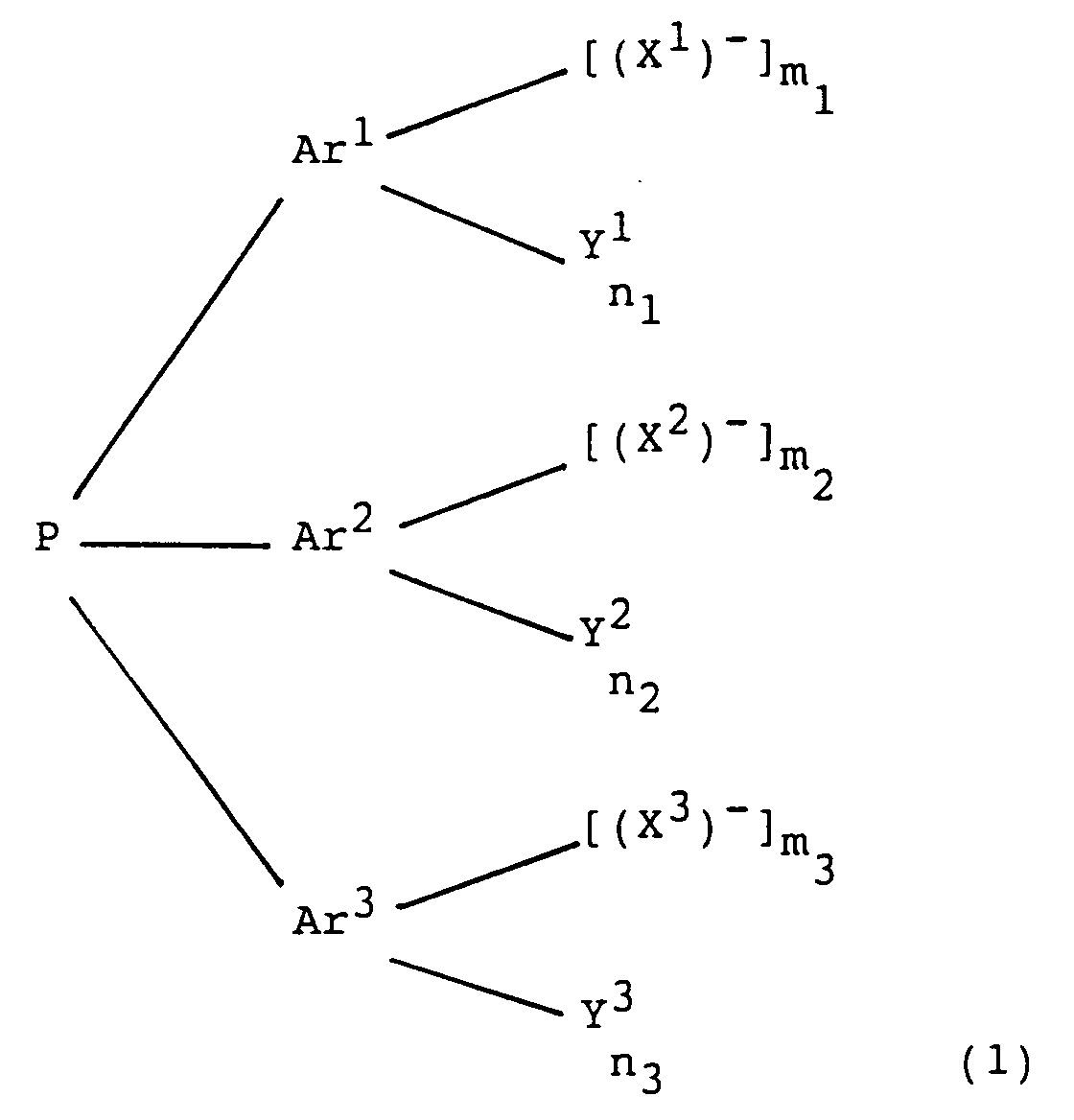
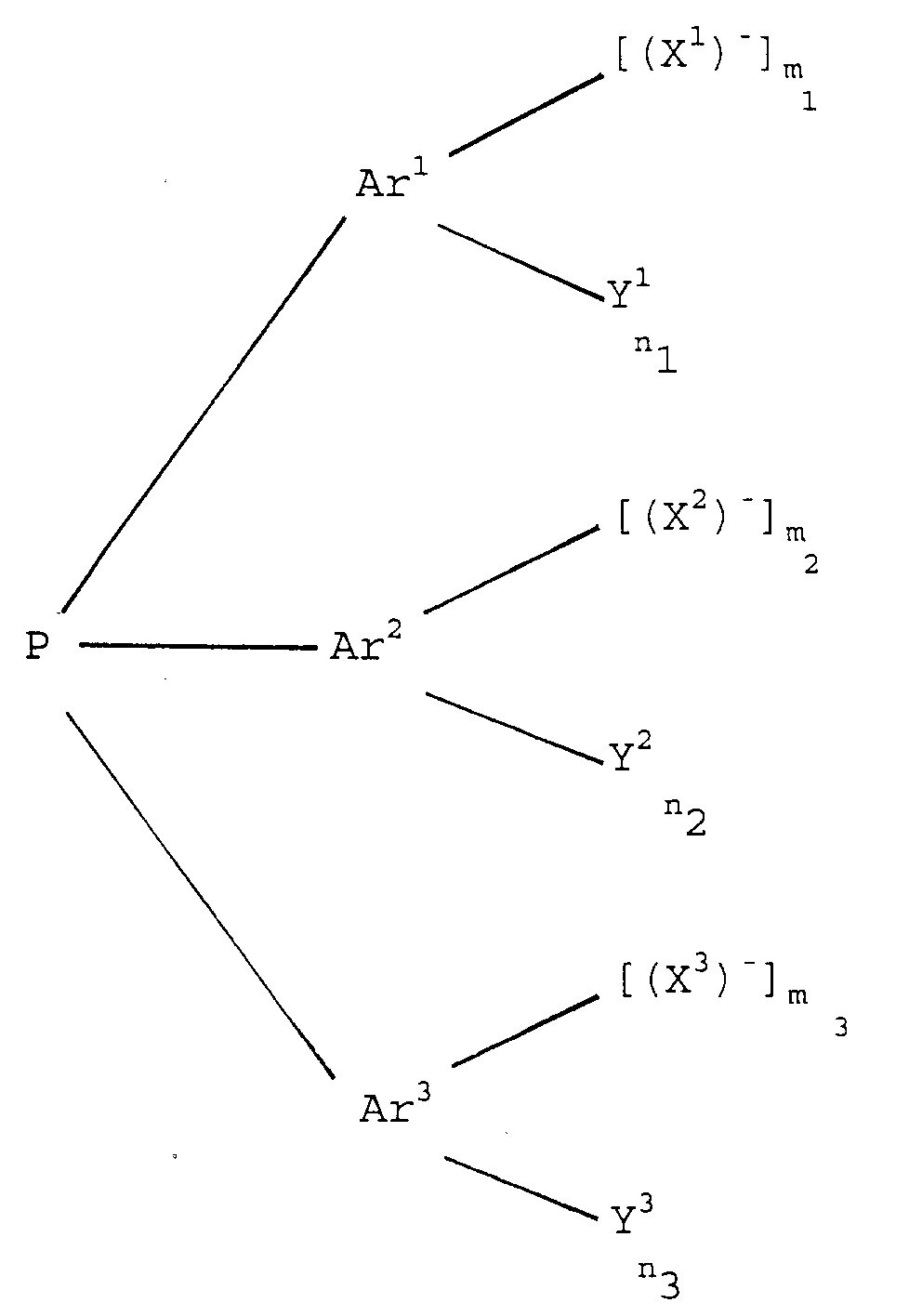
- the anions of the sulfonated or carboxylated monophosphines preferably correspond to the general formula (1) from.
- Ar 1 , Ar 2 , Ar 3 each represent a phenyl or naphthyl group
- X 1 , X 2 , X 3 each represent a sulfonate - (- SO 3 - ) and / or a carboxylate - (- COO - ) radical
- Y 1 , Y 2 , Y 3 is in each case a straight-chain or branched alkyl group having 1 to 4 carbon atoms, an alkoxy group, a halogen atom
- R 5 and R 6 each represent a straight-chain or branched alkyl group having 1 to 4 carbon atoms
- m 1 , m 2 , m 3 are identical or different integers from 0 to 5, with the proviso that at
- Particularly suitable salts are derived from the anion of the general formula (1) in which Ar 1 , Ar 2 , Ar 3 each represent a phenyl radical and X 1 , X 2 , X 3 each represent a sulfonate radical which is in the meta position to the phosphorus, ie Salting of tris (m-sulfonatophenyl) phosphine (abbreviated TPPTS). Furthermore, salts of diphenyl (m-sulfonatophenyl) phosphine (abbreviated TPPMS), among them in particular the lithium salt (Li-TPPMS), have proven to be effective as a catalyst component.
- TPPMS diphenyl (m-sulfonatophenyl) phosphine
- Li-TPPMS lithium salt
- the alkali salt can be used in a conventional manner Ammonium salt can be converted.
- the anion can also be formed from polyphosphines, in particular diphosphines, which contain at least one sulfonated or carboxylated organic radical.
- Diphosphine anions are preferably derived from diaryl compounds of the general formula (3) from which are substituted by at least one sulfonate residue (-SO 3 - ) or carboxylate residue (-COO - ).
- R 7 represents the same or different alkyl, cycloalkyl, phenyl, tolyl or naphthyl radicals
- R 8 is identical or different and means hydrogen, alkyl or alkoxy radicals having 1 to 14 carbon atoms, furthermore cycloalkyl
- m 4 is the same or different and stands for integers from 0 to 5
- n 4 is likewise the same or different and stands for integers from 0 to 4.
- the sulfonated compounds are preferred; they are accessible using standard methods.
- Proven representatives of this class of compounds are the products obtained by sulfonation of 2,2'-bis (diphenylphosphinomethyl) -1,1'-biphenyl or 2,2'-bis (diphenylphosphinomethyl) -1,1'-binaphthyl.
- An example of the anion of a heterocyclic phosphorus compound is 3,4-dimethyl-2,5,6-tris (p-sulfonatophenyl) -1-phosphanorbornadiene.
- the reaction of the olefinically unsaturated starting compounds with hydrogen and carbon monoxide takes place at temperatures from 60 to 180 ° C, especially 100 to 140 ° C and Pressures from 1 to 35 MPa.
- olefins have pressures of 2 to 35 MPa proven, esters of unsaturated fatty acids are preferred implemented at pressures of 15 to 25 MPa.
- the reaction is carried out in a polar organic solvent as a reaction medium through which both the olefinic unsaturated starting compound as well as the reaction product and catalyst system solves.
- Suitable solvents are low molecular weight aliphatic alcohols up to four carbon atoms in the molecule. Instead of pure solvents can also be mixtures of two or more these alcohols such as methanol / ethanol, methanol / i-propanol mixtures be used.
- Particularly proven as a reaction medium have methanol and ethanol up to 5 % By weight of water, but preferably be used anhydrous.
- the catalyst can be added preformed to the reaction system become. With equally good success, however, he can be also from the components rhodium or rhodium compound and the solution of the sulfonated or carboxylated phosphine in the reaction mixture, i.e. olefinically unsaturated compound and solvent, under reaction conditions.
- metallic rhodium inorganic rhodium salts such as rhodium chloride as the source of rhodium, Rhodium sulfate, rhodium salts of organic acids, such as rhodium acetate, rhodium 2-ethylhexanoate or rhodium oxides be used.
- the rhodium concentration in the reaction solution is 100 to 600 ppm by weight, preferably 300 to 400 ppm by weight to the solution. You put the phosphine in one Amount that preferably at least 20 mol per mol of rhodium 40 to 80 mol, P (III) are present.
- the pH of the reaction solution should not have a value of 3 fall below. Generally a pH of 4 is set to 11 a. When using methanol as a solvent can cause acetalization by hydroformylation formed aldehydes occur. Is it to protect the carbonyl group If desired before subsequent reactions, it is recommended at pH values of 4.5 to 6.5, in particular 5.5 to 6.0 to work.
- the ratio of carbon monoxide to hydrogen in the synthesis gas can be varied within wide limits. In general one uses synthesis gas in which the volume ratio of carbon monoxide to hydrogen is 1: 1 or deviates only slightly from this value.
- the implementation can be carried out batchwise or continuously be performed.
- the reaction product first becomes the polar organic Distilled off solvent. Then you wash the distillation residue preferably at normal temperature with water to the catalyst system from the aldehydes cut off. This treatment can possibly be repeated be repeated. To complete the rhodium recovery it has proven to be useful, the wash water a phosphine capable of complexing with rhodium, Expediently a phosphine, which is also the catalyst component is to put on.
- Example 2 to 6 are carried out with variation of the pressure, the pH of the catalyst solution and the P / Rh ratio.
- the results obtained are summarized in the following table.
- example P / Rh pH Temp. [° C] Pressure [MPa] time [H] MF DF TF Sales [%] [mol%] 2nd 40 8.4 120 20th 3rd 4th 24th 80 100 3rd 20th 5.0 120 20th 3rd 14 44 47 100 4th 10th 5.0 120 20th 3rd 16 44 45 100 5 10th 5.0 120 7 3rd 20th 50 34 100 6 20th 5.0 120 7 3rd 15 59 40 100
- Example 7 is under at a reaction pressure of 1 MPa otherwise identical conditions repeated. Already after 30 min sales are complete. In addition to only 1% undecanoic acid methyl ester 99% of one of 70 wt .-% 11 and 30 Wt .-% 10-Formylundecanklar existing mixture receive. The catalyst system is distilled off of the methanol taken up in water and from the reaction product severed.
- Example 9 The catalyst system recovered as described in Example 9 is used repeatedly for the hydroformylation of n-tetradecene-1.
- the conditions are the same as in Example 9.
- the results of the tests are summarized in Table 2.
Landscapes
- Chemical & Material Sciences (AREA)
- Organic Chemistry (AREA)
- Chemical Kinetics & Catalysis (AREA)
- Engineering & Computer Science (AREA)
- Materials Engineering (AREA)
- Inorganic Chemistry (AREA)
- Organic Low-Molecular-Weight Compounds And Preparation Thereof (AREA)
- Low-Molecular Organic Synthesis Reactions Using Catalysts (AREA)
- Catalysts (AREA)
Description

z.B. entsprechend


- 5 %
- Monoformylprodukt bezogen auf das Gesamtedukt,
- 22 %
- Diformylprodukt bezogen auf das Gesamtedukt und
- 82 %
- Triformylprodukt bezogen auf den eingesetzten Linolensäuremethylesteranteil im Edukt.
| Beispiel | P/Rh | pH | Temp. [°C] | Druck [MPa] | Zeit [h] | MF | DF | TF | Umsatz [%] |
| [ mol-% ] | |||||||||
| 2 | 40 | 8.4 | 120 | 20 | 3 | 4 | 24 | 80 | 100 |
| 3 | 20 | 5.0 | 120 | 20 | 3 | 14 | 44 | 47 | 100 |
| 4 | 10 | 5.0 | 120 | 20 | 3 | 16 | 44 | 45 | 100 |
| 5 | 10 | 5.0 | 120 | 7 | 3 | 20 | 50 | 34 | 100 |
| 6 | 20 | 5.0 | 120 | 7 | 3 | 15 | 59 | 40 | 100 |
| Beispiel | Umsatz (%) | Ausbeute (%) | n-Pentadecanal (%) | 2-Methyltetradecanal (%) | Tetradecan (%) |
| 10 | 100 | 98 | 72 | 28 | 2 |
| 11 | 100 | 96 | 70 | 30 | 4 |
| 12 | 100 | 98 | 71 | 29 | 2 |
| 13 | 100 | 99 | 70 | 30 | 1 |
| 14 | 100 | 98 | 71 | 29 | 2 |
| 15 | 100 | 97 | 70 | 30 | 3 |
Claims (25)
- Verfahren zur Hydroformylierung olefinisch ungesättigter Verbindungen, deren Hydroformylierungsprodukte in Wasser nicht löslich sind, durch Umsetzung von olefinisch ungesättigten Verbindungen in homogener Phase in einem polaren organischen Lösungsmittel, bei dem es sich um einen niedermolekularen aliphatischen Alkohol mit 1 bis 4 Kohlenstoffatomen im Molekül oder um ein Gemisch aus zwei oder mehreren dieser Alkohole handelt und in Gegenwart eines Katalysatorsystems, das eine Rhodiumcarbonylverbindung und ein sowohl in dem polaren organischen Lösungsmittel als auch in Wasser löslichens Salz eines sulfonierten oder carboxylierten organischen Mono- oder Polyphosphins enthält, bei 60 bis 180°C und 1 bis 35 MPa mit Kohlenmonoxid und Wasserstoff, dadurch gekennnzeichnet, daß aus dem Reaktionsgemisch das polare organische Lösungsmittel abdestilliert und aus dem Destillationsrückstand das Katalysatorsystem mit Wasser abgetrennt wird.
- Verfahren nach Anspruch 1, dadurch gekennzeichnet, daß die olefinisch ungesättigten Verbindungen acyclische Monoolefine mit zehn und mehr Kohlenstoffatomen im Molekül, mehrfach ungesättigte acyclische oder cyclische Olefine mit mindestens sechs Kohlenstoffatomen im Molekül oder Ester ungesättigter Fettsäuren sind.
- Verfahren nach Anspruch 1 oder 2, dadurch gekennzeichnet, daß die olefinisch ungesättigten Verbindungen acyclische C16- bis C30-Monoolefine sind.
- Verfahren nach Anspruch 1 oder 2, dadurch gekennzeichnet, daß die olefinisch ungesättigten Verbindungen mono- oder bicyclische Olefine mit mindestens sechs Kohlenstoffatomen im Molekül sind.
- Verfahren nach Anspruch 1 oder 2, dadurch gekennzeichnet, daß die olefinisch ungesättigten Verbindungen Ester von zwei- oder dreifach ungesättigten Fettsäuren mit 8 bis 25 Kohlenstoffatomen im Molekül sind.
- Verfahren nach Anspruch 5, dadurch gekennzeichnet, daß sich die Ester von zwei- oder dreifach ungesättigten Fettsäuren mit 10 bis 20 Kohlenstoffatomen im Molekül ableiten.
- Verfahren nach einem oder mehreren der Ansprüche 2, 5 und 6, dadurch gekennzeichnet, daß sich die Ester von gesättigten aliphatischen Monoalkoholen mit 1 bis 10 Kohlenstoffatomen im Molekül ableiten.
- Verfahren nach Anspruch 7, dadurch gekennzeichnet, daß der aliphatische Monoalkohol Methanol ist.
- Verfahren nach Anspruch 1, dadurch gekennzeichnet, daß das polare organische Lösungsmittel Methanol oder Ethanol ist.
- Verfahren nach einem oder mehreren der Ansprüche 1 bis 9, dadurch gekennzeichnet, daß das Kation des in einem polaren organischen Lösungsmittel und in Wasser löslichen Salzes des sulfonierten oder carboxylierten organischen Phosphins Lithium oder ein Ammonium-Ion der allgemeinen Formel N(R1R2R3R4)+ ist, in der R1, R2, R3 und R4 gleich oder verschieden sind und für Wasserstoff und geradkettige oder verzweigte Alkylreste, insbesondere Alkylresten mit 1 bis 4 Kohlenstoffatomen stehen.
- Verfahren nach einem oder mehreren der Ansprüche 1 bis 10, dadurch gekennzeichnet, daß das Anion des in Wasser und in einem polaren organischen Lösungsmittel löslichen Salzes des sulfonierten oder carboxylierten organischen Phosphins der allgemeinen Formelentspricht, in der Ar1, Ar2, Ar3 jeweils eine Phnyl- oder Naphthylgruppe bedeutet, X1, X2, X3 jeweils für einen Sulfonat-(-SO3 -) und/oder einen Carboxylat-(-COO-) Rest steht, Y1, Y2, Y3 jeweils eine geradkettige oder verzweigte Alkylgruppe mit 1 bis 4 C-Atomen, eine Alkoxygruppe, ein Halogenatom, die OH-, CN-, NO2- oder die (R5R6)-N-Gruppe, in der R5 und R6 für jeweils eine geradkettige oder verzweigte Alkylgruppe mit 1 bis 4 C-Atomen stehen, ist, m1, m2, m3 gleiche oder verschiedene ganze Zahlen von 0 bis 5 sind mit der Maßgabe, daß mindestens ein m1, m2 oder m3 größer als 0 ist und n1, n2, n3 gleiche oder verschiedene ganze Zahlen von 0 bis 5 wiedergeben.
- Verfahren nach Anspruch 11, dadurch gekennzeichnet, daß das in einem polaren organischen Lösungsmittel und in Wasser lösliche Salz des sulfonierten organischen Phosphins das Tris(m-sulfonatophenyl)phosphin-Anion enthält.
- Verfahren nach einem oder mehreren der Ansprüche 1 bis 12, dadurch gekennzeichnet, daß das Anion des in einem polaren organischen Lösungsmittel und in Wasser löslichen Salzes des sulfonierten organischen Phosphins der allgemeinen Formel
- Verfahren nach einem oder mehreren der Ansprüche 1 bis 10, dadurch gekennzeichnet, daß das Anion des in einem polaren organischen Lösungsmittel und in Wasser löslichen Salzes sich von Diarylverbindungen der allgemeinen Formelableiten, die durch mindestens einen Sulfonatrest (-SO3 -) oder einen Carboxylatrest (-COO-) substituiert sind und in der R7 für gleiche oder verschiedene Alkyl-, Cycloalkyl-, Phenyl-, Tolyl- oder Napthylreste steht, R8 gleich oder verschieden ist und Wasserstoff, Alkyl- oder Alkoxyreste mit 1 bis 14 C-Atomen, ferner Cycloalkyl-, Aryl- oder Aroxyreste mit 6 bis 14 C-Atomen oder einen annelierten Benzolring bedeutet, m4 gleich oder verschieden ist und für ganze Zahlen von 0 bis 5 steht und n4 ebenfalls gleich oder verschieden ist und für ganze Zahlen von 0 bis 4 steht.

- Verfahren nach Anspruch 14, dadurch gekennzeichnet, daß sich das Anion des in einem polaren organischen Lösungsmittel und in Wasser löslichen Salzes von Diarylverbindungen ableitet, die durch mindestens einen Sulfonatrest substituiert sind.
- Verfahren nach einem oder mehreren der Ansprüche 1 bis 15, dadurch gekennzeichnet, daß die Umsetzung der olefinisch ungesättigten Verbindungen mit Wasserstoff und Kohlenmonoxid bei 100 bis 140°C erfolgt.
- Verfahren nach einem oder mehreren der Ansprüche 1 bis 4 und 10 bis 16, dadurch gekennzeichnet, daß die Umsetzung von Olefinen mit Wasserstoff und Kohlenmonoxid bei Drücken von 2 bis 35 MPa erfolgt.
- Verfahren nach einem oder mehreren der Ansprüche 1, 2 und 5 bis 16, dadurch gekennzeichnet, daß die Umsetzung der ungesättigten Fettsäureester mit Kohlenmonoxid und Wasserstoff bei 15 bis 25 MPa erfolgt.
- Verfahren nach einem oder mehreren der Ansprüche 1 bis 18, dadurch gekennzeichnet, daß die Rhodiumkonzentration in der Katalysatorlösung 100 bis 600 Gew.-ppm, bezogen auf die Lösung, beträgt.
- Verfahren nach Anspruch 19, dadurch gekennzeichnet, daß die Rhodium-Konzentration in der Reaktionslösung 300 bis 400 Gew.-ppm, bezogen auf die Lösung, beträgt.
- Verfahren nach einem oder mehreren der Ansprüche 1 bis 20, dadurch gekennzeichnet, daß in der Reaktionslösung je mol Rhodium mindestens 20 mol, vorzugsweise 40 bis 80 mol, P(III) vorliegen.
- Verfahren nach einem oder mehreren der Ansprüche 1 bis 21, dadurch gekennzeichnet, daß der pH-Wert der Reaktionslösung mindestens 3, vorzugsweise 4 bis 11, ist.
- Verfahren nach einem oder mehreren der Ansprüche 1 bis 8 und 10 bis 21, dadurch gekennzeichnet, daß der pH-Wert der Reaktionslösung 4,5 bis 6,5, insbesondere 5,5 bis 6,0, ist.
- Verfahren nach einem oder mehreren der Ansprüche 1 bis 23, dadurch gekennzeichnet, daß die Abtrennung des Katalysatorsystems aus dem Destillationsrückstand durch mehrfache Behandlung mit Wasser erfolgt.
- Verfahren nach einem oder mehreren der Ansprüche 1 bis 24, dadurch gekennzeichnet, daß dem Wasser zur Behandlung des Destillationsrückstandes ein zur Komplexbildung mit Rhodium befähigtes Phosphin zugesetzt wird.
Applications Claiming Priority (2)
| Application Number | Priority Date | Filing Date | Title |
|---|---|---|---|
| DE19532393 | 1995-09-02 | ||
| DE19532393A DE19532393A1 (de) | 1995-09-02 | 1995-09-02 | Verfahren zur Hydroformylierung olefinisch ungesättigter Verbindungen |
Publications (2)
| Publication Number | Publication Date |
|---|---|
| EP0761635A1 EP0761635A1 (de) | 1997-03-12 |
| EP0761635B1 true EP0761635B1 (de) | 1999-08-04 |
Family
ID=7771087
Family Applications (1)
| Application Number | Title | Priority Date | Filing Date |
|---|---|---|---|
| EP96113605A Expired - Lifetime EP0761635B1 (de) | 1995-09-02 | 1996-08-24 | Verfahren zur Hydroformylierung olefinisch ungesättigter Verbindungen |
Country Status (17)
| Country | Link |
|---|---|
| US (1) | US5756854A (de) |
| EP (1) | EP0761635B1 (de) |
| JP (1) | JP3042835B2 (de) |
| KR (1) | KR970015551A (de) |
| CN (1) | CN1149043A (de) |
| AT (1) | ATE182876T1 (de) |
| AU (1) | AU6439096A (de) |
| BR (1) | BR9603617A (de) |
| CA (1) | CA2184048C (de) |
| DE (2) | DE19532393A1 (de) |
| DK (1) | DK0761635T3 (de) |
| ES (1) | ES2137604T3 (de) |
| GR (1) | GR3031630T3 (de) |
| MX (1) | MX9603656A (de) |
| PL (1) | PL183632B1 (de) |
| TW (1) | TW389751B (de) |
| ZA (1) | ZA967228B (de) |
Cited By (1)
| Publication number | Priority date | Publication date | Assignee | Title |
|---|---|---|---|---|
| US7615658B2 (en) | 2003-04-25 | 2009-11-10 | Dow Global Technologies, Inc. | Aldehyde and alcohol compositions derived from seed oils |
Families Citing this family (20)
| Publication number | Priority date | Publication date | Assignee | Title |
|---|---|---|---|---|
| ID21537A (id) * | 1997-12-22 | 1999-06-24 | Celanese Gmbh | Proses pembuatan aldehid |
| KR100308731B1 (ko) * | 1998-06-17 | 2001-11-14 | 박호군 | 로듐촉매/염조촉매시스템을사용한이산화탄소의수소화방법 |
| US6303830B1 (en) | 2000-03-15 | 2001-10-16 | Union Carbide Chemicals & Plastics Technology Corporation | Metal-ligand complex catalyzed processes |
| US6307109B1 (en) | 2000-03-15 | 2001-10-23 | Union Carbide Chemicals & Plastics Technology Corporation | Separation processes |
| US6307108B1 (en) | 2000-03-15 | 2001-10-23 | Union Carbide Chemicals & Plastics Technology Corporation | Metal-ligand complex catalyzed processes |
| US6294700B1 (en) | 2000-03-15 | 2001-09-25 | Union Carbide Chemicals & Plastics Technology Corporation | Separation processes |
| US6310260B1 (en) | 2000-03-15 | 2001-10-30 | Union Carbide Chemicals & Plastics Technology Corporation | Separation processes |
| US6307110B1 (en) | 2000-03-15 | 2001-10-23 | Union Carbide Chemicals & Plastics Technology Corporation | Separation processes |
| US6303829B1 (en) | 2000-03-15 | 2001-10-16 | Union Carbide Chemicals & Plastics Technology Corporation | Separation processes |
| KR100322616B1 (ko) * | 2000-08-29 | 2002-03-18 | 박호군 | 로듐 촉매/염 조촉매 시스템을 사용한 올레핀의하이드로포밀화 방법 |
| KR100322617B1 (ko) * | 2000-08-29 | 2002-03-18 | 박호군 | 로듐 촉매/염 조촉매 시스템을 사용한 올레핀의카보알콕시화 및 카복실화 방법 |
| US7663002B2 (en) * | 2006-05-15 | 2010-02-16 | Dow Global Technologies, Inc. | Hydroformylation process and product separation with improved recovery of rhodium |
| CN100496736C (zh) * | 2007-05-31 | 2009-06-10 | 南京大学 | 一种用于双环戊二烯氢甲酰化制醛的水溶性配体铑配合物催化剂 |
| CN101722048B (zh) * | 2008-10-31 | 2011-11-30 | 中国石油化工股份有限公司 | 一种两相催化氢甲酰化反应制备醛的催化剂及其应用 |
| CN104837800B (zh) * | 2012-12-06 | 2017-08-29 | 陶氏技术投资有限责任公司 | 氢甲酰化方法 |
| US9738853B2 (en) * | 2014-03-06 | 2017-08-22 | Elevance Renewable Sciences, Inc. | Renewably derived aldehydes and methods of making and using the same |
| CN112570032A (zh) * | 2020-11-17 | 2021-03-30 | 广东仁康达材料科技有限公司 | 一种水溶性氢甲酰化催化剂及其应用 |
| EP4008709B1 (de) * | 2020-12-04 | 2024-05-01 | OQ Chemicals GmbH | Verfahren zur herstellung polyzyklischer aliphatischer dialdehyde |
| EP4008710B1 (de) * | 2020-12-04 | 2024-05-01 | OQ Chemicals GmbH | Verfahren zur hydroformylierung von olefinen in homogener phase |
| CN118204199B (zh) * | 2024-03-06 | 2024-09-20 | 淄博坤鑫选矿药剂有限公司 | 一种可用于锂辉石浮选磺化有机羧酸类捕收剂、制备方法、及其复配应用 |
Family Cites Families (7)
| Publication number | Priority date | Publication date | Assignee | Title |
|---|---|---|---|---|
| US4248802A (en) * | 1975-06-20 | 1981-02-03 | Rhone-Poulenc Industries | Catalytic hydroformylation of olefins |
| JPS58216138A (ja) * | 1982-06-09 | 1983-12-15 | Kuraray Co Ltd | 1,8−オクタンジア−ルまたは1,10−デカンジア−ルの製造法 |
| FR2571725B1 (fr) * | 1984-10-16 | 1987-09-18 | Rhone Poulenc Chim Base | Complexes rhodies, dinucleaires et hydrosolubles et leur utilisation comme catalyseur d'hydroformylation |
| US4808756A (en) * | 1986-04-07 | 1989-02-28 | Kuraray Co., Ltd. | Method for production of α,ω-dialdehydes |
| US4731486A (en) * | 1986-11-18 | 1988-03-15 | Union Carbide Corporation | Hydroformylation using low volatile phosphine ligands |
| JP2775907B2 (ja) * | 1989-07-12 | 1998-07-16 | 三菱化学株式会社 | ヒドロホルミル化法 |
| DE3942954A1 (de) * | 1989-12-23 | 1991-06-27 | Hoechst Ag | Verfahren zur herstellung von aldehyden |
-
1995
- 1995-09-02 DE DE19532393A patent/DE19532393A1/de not_active Withdrawn
-
1996
- 1996-08-16 TW TW085109975A patent/TW389751B/zh active
- 1996-08-23 CA CA002184048A patent/CA2184048C/en not_active Expired - Fee Related
- 1996-08-24 ES ES96113605T patent/ES2137604T3/es not_active Expired - Lifetime
- 1996-08-24 DE DE59602596T patent/DE59602596D1/de not_active Expired - Fee Related
- 1996-08-24 DK DK96113605T patent/DK0761635T3/da active
- 1996-08-24 AT AT96113605T patent/ATE182876T1/de active
- 1996-08-24 EP EP96113605A patent/EP0761635B1/de not_active Expired - Lifetime
- 1996-08-26 KR KR1019960035491A patent/KR970015551A/ko not_active Withdrawn
- 1996-08-26 US US08/701,775 patent/US5756854A/en not_active Expired - Fee Related
- 1996-08-26 MX MX9603656A patent/MX9603656A/es not_active IP Right Cessation
- 1996-08-26 ZA ZA967228A patent/ZA967228B/xx unknown
- 1996-08-26 PL PL96315833A patent/PL183632B1/pl unknown
- 1996-08-30 JP JP8230636A patent/JP3042835B2/ja not_active Expired - Fee Related
- 1996-08-30 AU AU64390/96A patent/AU6439096A/en not_active Abandoned
- 1996-08-30 CN CN96111973A patent/CN1149043A/zh active Pending
- 1996-08-30 BR BR9603617A patent/BR9603617A/pt not_active Application Discontinuation
-
1999
- 1999-10-15 GR GR990402639T patent/GR3031630T3/el unknown
Cited By (1)
| Publication number | Priority date | Publication date | Assignee | Title |
|---|---|---|---|---|
| US7615658B2 (en) | 2003-04-25 | 2009-11-10 | Dow Global Technologies, Inc. | Aldehyde and alcohol compositions derived from seed oils |
Also Published As
| Publication number | Publication date |
|---|---|
| ZA967228B (en) | 1997-03-03 |
| DE19532393A1 (de) | 1997-03-06 |
| ES2137604T3 (es) | 1999-12-16 |
| JPH09124534A (ja) | 1997-05-13 |
| CA2184048C (en) | 1999-05-25 |
| US5756854A (en) | 1998-05-26 |
| DK0761635T3 (da) | 1999-12-06 |
| TW389751B (en) | 2000-05-11 |
| MX9603656A (es) | 1997-03-29 |
| CN1149043A (zh) | 1997-05-07 |
| KR970015551A (ko) | 1997-04-28 |
| BR9603617A (pt) | 1998-05-19 |
| EP0761635A1 (de) | 1997-03-12 |
| AU6439096A (en) | 1997-03-06 |
| PL183632B1 (pl) | 2002-06-28 |
| DE59602596D1 (de) | 1999-09-09 |
| PL315833A1 (en) | 1997-03-03 |
| ATE182876T1 (de) | 1999-08-15 |
| GR3031630T3 (en) | 2000-01-31 |
| JP3042835B2 (ja) | 2000-05-22 |
| CA2184048A1 (en) | 1997-03-03 |
Similar Documents
| Publication | Publication Date | Title |
|---|---|---|
| DE2627354C3 (de) | Verfahren zur Herstellung von Aldehyden | |
| EP0761635A1 (de) | Verfahren zur Hydroformylierung olefinisch ungesättigter Verbindungen | |
| EP0571819B1 (de) | Sulfonierte 2,2'-Bis(diphenylphosphinomethyl)-1,1'-binaphthaline, Verfahren zu ihrer Herstellung und ihre Verwendung in einem Verfahren zur Hydroformylierung von olefinisch ungesättigten Verbindungen | |
| EP0435084B1 (de) | Verfahren zur Herstellung von Aldehyden | |
| EP0575785B1 (de) | 3,4-Dimethyl-2,5-6-tris(p-sulfonatophenyl)-1-phosphanorbornadien, Verfahren zu seiner Herstellung und Verfahren zur Hydroformylierung von olefinisch ungesättigten Verbindungen | |
| EP0163234B1 (de) | Verfahren zur Herstellung von Aldehyden | |
| EP0158246B1 (de) | Verfahren zur Herstellung von Aldehyden | |
| EP0246475B1 (de) | Verfahren zur Herstellung von Aldehyden | |
| EP0216315A1 (de) | Verfahren zur Herstellung von Aldehyden | |
| DE2922757A1 (de) | Verfahren zur hydroformylierung von olefinischen verbindungen | |
| EP0157316A2 (de) | Verfahren zur Herstellung von Aldehyden | |
| EP0302375B1 (de) | Verfahren zur Herstellung von Aldehyden | |
| EP0711748B1 (de) | Verfahren zur Herstellung von Formylcarbonsäureestern | |
| EP0226988A2 (de) | Verfahren zur Herstellung von Aldehyden | |
| EP0269011A1 (de) | Verfahren zur Herstellung von Aldehyden | |
| EP1160234B1 (de) | Verfahren zur Herstellung von Aldehyden durch Hydroformylierung | |
| DE3534317A1 (de) | Verfahren zur herstellung von nonadecandiolen | |
| EP1017492B1 (de) | Verfahren zur herstellung von aldehyden durch hydroformulierung | |
| DE1909620C3 (de) | Verfahren zur Herstellung von Aldehyden und/oder Alkoholen durch die Oxosynthese | |
| EP0186075B1 (de) | Verfahren zur Herstellung von 8- und 9-Formyl-tricyclo-(5,2,1,0, 2,6)-decen-3 | |
| EP1017660B1 (de) | Verfahren zur herstellung von aldehyden durch hydroformylierung in gegenwart von kronenether | |
| DE2026926A1 (de) | Verfahren zur Herstellung von Aldehyden | |
| EP0489330B1 (de) | Sulfonierte Tris(p-fluorphenyl)phosphane | |
| EP0909218A1 (de) | Katalysator und ein verfahren zur herstellung von aldehyden in gegenwart dieses katalysators |
Legal Events
| Date | Code | Title | Description |
|---|---|---|---|
| PUAI | Public reference made under article 153(3) epc to a published international application that has entered the european phase |
Free format text: ORIGINAL CODE: 0009012 |
|
| AK | Designated contracting states |
Kind code of ref document: A1 Designated state(s): AT BE CH DE DK ES FI FR GB GR IE IT LI LU NL PT SE |
|
| 17P | Request for examination filed |
Effective date: 19970912 |
|
| RAP1 | Party data changed (applicant data changed or rights of an application transferred) |
Owner name: CELANESE GMBH |
|
| 17Q | First examination report despatched |
Effective date: 19980515 |
|
| GRAG | Despatch of communication of intention to grant |
Free format text: ORIGINAL CODE: EPIDOS AGRA |
|
| GRAG | Despatch of communication of intention to grant |
Free format text: ORIGINAL CODE: EPIDOS AGRA |
|
| GRAH | Despatch of communication of intention to grant a patent |
Free format text: ORIGINAL CODE: EPIDOS IGRA |
|
| GRAH | Despatch of communication of intention to grant a patent |
Free format text: ORIGINAL CODE: EPIDOS IGRA |
|
| GRAA | (expected) grant |
Free format text: ORIGINAL CODE: 0009210 |
|
| AK | Designated contracting states |
Kind code of ref document: B1 Designated state(s): AT BE CH DE DK ES FI FR GB GR IE IT LI LU NL PT SE |
|
| REF | Corresponds to: |
Ref document number: 182876 Country of ref document: AT Date of ref document: 19990815 Kind code of ref document: T |
|
| REG | Reference to a national code |
Ref country code: CH Ref legal event code: NV Representative=s name: BOVARD AG PATENTANWAELTE Ref country code: CH Ref legal event code: EP |
|
| REF | Corresponds to: |
Ref document number: 59602596 Country of ref document: DE Date of ref document: 19990909 |
|
| REG | Reference to a national code |
Ref country code: IE Ref legal event code: FG4D Free format text: GERMAN |
|
| ITF | It: translation for a ep patent filed | ||
| ET | Fr: translation filed | ||
| GBT | Gb: translation of ep patent filed (gb section 77(6)(a)/1977) |
Effective date: 19991021 |
|
| REG | Reference to a national code |
Ref country code: PT Ref legal event code: SC4A Free format text: AVAILABILITY OF NATIONAL TRANSLATION Effective date: 19990806 |
|
| REG | Reference to a national code |
Ref country code: DK Ref legal event code: T3 |
|
| REG | Reference to a national code |
Ref country code: ES Ref legal event code: FG2A Ref document number: 2137604 Country of ref document: ES Kind code of ref document: T3 |
|
| RAP2 | Party data changed (patent owner data changed or rights of a patent transferred) |
Owner name: CELANESE CHEMICALS EUROPE GMBH |
|
| NLT2 | Nl: modifications (of names), taken from the european patent patent bulletin |
Owner name: CELANESE CHEMICALS EUROPE GMBH |
|
| PLBE | No opposition filed within time limit |
Free format text: ORIGINAL CODE: 0009261 |
|
| STAA | Information on the status of an ep patent application or granted ep patent |
Free format text: STATUS: NO OPPOSITION FILED WITHIN TIME LIMIT |
|
| PGFP | Annual fee paid to national office [announced via postgrant information from national office to epo] |
Ref country code: PT Payment date: 20000704 Year of fee payment: 5 |
|
| PGFP | Annual fee paid to national office [announced via postgrant information from national office to epo] |
Ref country code: FI Payment date: 20000706 Year of fee payment: 5 Ref country code: DK Payment date: 20000706 Year of fee payment: 5 |
|
| PGFP | Annual fee paid to national office [announced via postgrant information from national office to epo] |
Ref country code: LU Payment date: 20000711 Year of fee payment: 5 |
|
| PGFP | Annual fee paid to national office [announced via postgrant information from national office to epo] |
Ref country code: FR Payment date: 20000712 Year of fee payment: 5 |
|
| 26N | No opposition filed | ||
| PGFP | Annual fee paid to national office [announced via postgrant information from national office to epo] |
Ref country code: SE Payment date: 20000719 Year of fee payment: 5 |
|
| PGFP | Annual fee paid to national office [announced via postgrant information from national office to epo] |
Ref country code: IE Payment date: 20000720 Year of fee payment: 5 |
|
| PGFP | Annual fee paid to national office [announced via postgrant information from national office to epo] |
Ref country code: GR Payment date: 20000721 Year of fee payment: 5 |
|
| PGFP | Annual fee paid to national office [announced via postgrant information from national office to epo] |
Ref country code: BE Payment date: 20000801 Year of fee payment: 5 |
|
| PGFP | Annual fee paid to national office [announced via postgrant information from national office to epo] |
Ref country code: AT Payment date: 20000803 Year of fee payment: 5 |
|
| PGFP | Annual fee paid to national office [announced via postgrant information from national office to epo] |
Ref country code: CH Payment date: 20000810 Year of fee payment: 5 |
|
| PGFP | Annual fee paid to national office [announced via postgrant information from national office to epo] |
Ref country code: GB Payment date: 20000823 Year of fee payment: 5 |
|
| PGFP | Annual fee paid to national office [announced via postgrant information from national office to epo] |
Ref country code: ES Payment date: 20000830 Year of fee payment: 5 |
|
| PGFP | Annual fee paid to national office [announced via postgrant information from national office to epo] |
Ref country code: NL Payment date: 20000831 Year of fee payment: 5 |
|
| PG25 | Lapsed in a contracting state [announced via postgrant information from national office to epo] |
Ref country code: LU Free format text: LAPSE BECAUSE OF NON-PAYMENT OF DUE FEES Effective date: 20010824 Ref country code: IE Free format text: LAPSE BECAUSE OF NON-PAYMENT OF DUE FEES Effective date: 20010824 Ref country code: GB Free format text: LAPSE BECAUSE OF NON-PAYMENT OF DUE FEES Effective date: 20010824 Ref country code: FI Free format text: LAPSE BECAUSE OF NON-PAYMENT OF DUE FEES Effective date: 20010824 Ref country code: DK Free format text: LAPSE BECAUSE OF NON-PAYMENT OF DUE FEES Effective date: 20010824 Ref country code: AT Free format text: LAPSE BECAUSE OF NON-PAYMENT OF DUE FEES Effective date: 20010824 |
|
| PG25 | Lapsed in a contracting state [announced via postgrant information from national office to epo] |
Ref country code: SE Free format text: LAPSE BECAUSE OF NON-PAYMENT OF DUE FEES Effective date: 20010825 Ref country code: ES Free format text: LAPSE BECAUSE OF NON-PAYMENT OF DUE FEES Effective date: 20010825 |
|
| PG25 | Lapsed in a contracting state [announced via postgrant information from national office to epo] |
Ref country code: LI Free format text: LAPSE BECAUSE OF NON-PAYMENT OF DUE FEES Effective date: 20010831 Ref country code: CH Free format text: LAPSE BECAUSE OF NON-PAYMENT OF DUE FEES Effective date: 20010831 Ref country code: BE Free format text: LAPSE BECAUSE OF NON-PAYMENT OF DUE FEES Effective date: 20010831 |
|
| PG25 | Lapsed in a contracting state [announced via postgrant information from national office to epo] |
Ref country code: GR Free format text: LAPSE BECAUSE OF NON-PAYMENT OF DUE FEES Effective date: 20020209 |
|
| BERE | Be: lapsed |
Owner name: CELANESE G.M.B.H. Effective date: 20010831 |
|
| PG25 | Lapsed in a contracting state [announced via postgrant information from national office to epo] |
Ref country code: PT Free format text: LAPSE BECAUSE OF NON-PAYMENT OF DUE FEES Effective date: 20020228 |
|
| PG25 | Lapsed in a contracting state [announced via postgrant information from national office to epo] |
Ref country code: NL Free format text: LAPSE BECAUSE OF NON-PAYMENT OF DUE FEES Effective date: 20020301 |
|
| EUG | Se: european patent has lapsed |
Ref document number: 96113605.8 |
|
| REG | Reference to a national code |
Ref country code: CH Ref legal event code: PL |
|
| GBPC | Gb: european patent ceased through non-payment of renewal fee |
Effective date: 20010824 |
|
| REG | Reference to a national code |
Ref country code: DK Ref legal event code: EBP |
|
| PG25 | Lapsed in a contracting state [announced via postgrant information from national office to epo] |
Ref country code: FR Free format text: LAPSE BECAUSE OF NON-PAYMENT OF DUE FEES Effective date: 20020430 |
|
| NLV4 | Nl: lapsed or anulled due to non-payment of the annual fee |
Effective date: 20020301 |
|
| REG | Reference to a national code |
Ref country code: IE Ref legal event code: MM4A |
|
| REG | Reference to a national code |
Ref country code: FR Ref legal event code: ST |
|
| REG | Reference to a national code |
Ref country code: PT Ref legal event code: MM4A Free format text: LAPSE DUE TO NON-PAYMENT OF FEES Effective date: 20020228 |
|
| REG | Reference to a national code |
Ref country code: ES Ref legal event code: FD2A Effective date: 20020911 |
|
| PG25 | Lapsed in a contracting state [announced via postgrant information from national office to epo] |
Ref country code: IT Free format text: LAPSE BECAUSE OF NON-PAYMENT OF DUE FEES;WARNING: LAPSES OF ITALIAN PATENTS WITH EFFECTIVE DATE BEFORE 2007 MAY HAVE OCCURRED AT ANY TIME BEFORE 2007. THE CORRECT EFFECTIVE DATE MAY BE DIFFERENT FROM THE ONE RECORDED. Effective date: 20050824 |
|
| PGFP | Annual fee paid to national office [announced via postgrant information from national office to epo] |
Ref country code: DE Payment date: 20070831 Year of fee payment: 12 |
|
| PG25 | Lapsed in a contracting state [announced via postgrant information from national office to epo] |
Ref country code: DE Free format text: LAPSE BECAUSE OF NON-PAYMENT OF DUE FEES Effective date: 20090303 |