EP0757720B1 - Trimerising polypeptides, their manufacture and use - Google Patents
Trimerising polypeptides, their manufacture and use Download PDFInfo
- Publication number
- EP0757720B1 EP0757720B1 EP95918689A EP95918689A EP0757720B1 EP 0757720 B1 EP0757720 B1 EP 0757720B1 EP 95918689 A EP95918689 A EP 95918689A EP 95918689 A EP95918689 A EP 95918689A EP 0757720 B1 EP0757720 B1 EP 0757720B1
- Authority
- EP
- European Patent Office
- Prior art keywords
- neck
- polypeptide
- region
- sequence
- amino acids
- Prior art date
- Legal status (The legal status is an assumption and is not a legal conclusion. Google has not performed a legal analysis and makes no representation as to the accuracy of the status listed.)
- Expired - Lifetime
Links
- 108090000765 processed proteins & peptides Proteins 0.000 title claims abstract description 266
- 102000004196 processed proteins & peptides Human genes 0.000 title claims abstract description 159
- 229920001184 polypeptide Polymers 0.000 title claims abstract description 137
- 238000004519 manufacturing process Methods 0.000 title abstract description 9
- 150000001413 amino acids Chemical class 0.000 claims abstract description 79
- 238000000034 method Methods 0.000 claims abstract description 39
- 108020004707 nucleic acids Proteins 0.000 claims abstract description 30
- 150000007523 nucleic acids Chemical class 0.000 claims abstract description 30
- 102000039446 nucleic acids Human genes 0.000 claims abstract description 30
- 108090000909 Collectins Proteins 0.000 claims abstract description 19
- 102000004405 Collectins Human genes 0.000 claims abstract description 19
- 108020001580 protein domains Proteins 0.000 claims abstract description 10
- 108060003951 Immunoglobulin Proteins 0.000 claims abstract description 4
- 102000018358 immunoglobulin Human genes 0.000 claims abstract description 4
- 125000003275 alpha amino acid group Chemical group 0.000 claims abstract 14
- 239000013638 trimer Substances 0.000 claims description 48
- 230000014509 gene expression Effects 0.000 claims description 32
- 210000004027 cell Anatomy 0.000 claims description 27
- 108010007127 Pulmonary Surfactant-Associated Protein D Proteins 0.000 claims description 26
- 210000004899 c-terminal region Anatomy 0.000 claims description 22
- 102100027845 Pulmonary surfactant-associated protein D Human genes 0.000 claims description 17
- 239000000126 substance Substances 0.000 claims description 15
- 239000013598 vector Substances 0.000 claims description 14
- 108010018927 conglutinin Proteins 0.000 claims description 5
- QCUFYOBGGZSFHY-UHFFFAOYSA-N depsidomycin Chemical compound O=C1C(C(C)C)NC(=O)C(CC(C)C)NC(=O)C(NC(=O)C(NC=O)C(C)CC)C(C)OC(=O)C2CCCNN2C(=O)C(CC(C)C)NC(=O)C2CCCNN21 QCUFYOBGGZSFHY-UHFFFAOYSA-N 0.000 claims description 5
- 101710193968 Collectin-43 Proteins 0.000 claims description 4
- 230000001105 regulatory effect Effects 0.000 claims description 4
- 238000012258 culturing Methods 0.000 claims description 2
- 239000002773 nucleotide Substances 0.000 claims description 2
- 125000003729 nucleotide group Chemical group 0.000 claims description 2
- 239000002253 acid Substances 0.000 claims 1
- 150000007513 acids Chemical class 0.000 claims 1
- 125000002924 primary amino group Chemical group [H]N([H])* 0.000 claims 1
- 102000008186 Collagen Human genes 0.000 abstract description 16
- 108010035532 Collagen Proteins 0.000 abstract description 16
- 229920001436 collagen Polymers 0.000 abstract description 16
- 230000015572 biosynthetic process Effects 0.000 abstract description 15
- 238000001816 cooling Methods 0.000 abstract description 13
- 238000010438 heat treatment Methods 0.000 abstract description 9
- 238000010899 nucleation Methods 0.000 abstract description 9
- 229920001542 oligosaccharide Polymers 0.000 abstract 1
- 150000002482 oligosaccharides Chemical class 0.000 abstract 1
- 108090000623 proteins and genes Proteins 0.000 description 48
- 239000002523 lectin Substances 0.000 description 47
- 235000001014 amino acid Nutrition 0.000 description 43
- 102000004169 proteins and genes Human genes 0.000 description 42
- 235000018102 proteins Nutrition 0.000 description 34
- 108020004414 DNA Proteins 0.000 description 33
- 102000037865 fusion proteins Human genes 0.000 description 33
- 108020001507 fusion proteins Proteins 0.000 description 33
- 101000632467 Homo sapiens Pulmonary surfactant-associated protein D Proteins 0.000 description 23
- 238000006243 chemical reaction Methods 0.000 description 22
- 239000012634 fragment Substances 0.000 description 21
- 238000004458 analytical method Methods 0.000 description 20
- 239000013612 plasmid Substances 0.000 description 20
- 102000004856 Lectins Human genes 0.000 description 19
- 108090001090 Lectins Proteins 0.000 description 19
- 238000002415 sodium dodecyl sulfate polyacrylamide gel electrophoresis Methods 0.000 description 19
- 239000000243 solution Substances 0.000 description 18
- 102000004190 Enzymes Human genes 0.000 description 17
- 108090000790 Enzymes Proteins 0.000 description 17
- 229940088598 enzyme Drugs 0.000 description 17
- 102000005720 Glutathione transferase Human genes 0.000 description 16
- 108010070675 Glutathione transferase Proteins 0.000 description 16
- 238000004132 cross linking Methods 0.000 description 14
- 238000005829 trimerization reaction Methods 0.000 description 14
- 108090000190 Thrombin Proteins 0.000 description 13
- 229960004072 thrombin Drugs 0.000 description 13
- FAPWRFPIFSIZLT-UHFFFAOYSA-M Sodium chloride Chemical compound [Na+].[Cl-] FAPWRFPIFSIZLT-UHFFFAOYSA-M 0.000 description 12
- 102000003930 C-Type Lectins Human genes 0.000 description 11
- 108090000342 C-Type Lectins Proteins 0.000 description 11
- 230000001580 bacterial effect Effects 0.000 description 11
- 230000027455 binding Effects 0.000 description 11
- 230000004927 fusion Effects 0.000 description 11
- 239000004971 Cross linker Substances 0.000 description 10
- 239000000872 buffer Substances 0.000 description 9
- 230000001965 increasing effect Effects 0.000 description 9
- 239000002953 phosphate buffered saline Substances 0.000 description 9
- 206010039509 Scab Diseases 0.000 description 8
- 239000003153 chemical reaction reagent Substances 0.000 description 8
- 238000003776 cleavage reaction Methods 0.000 description 8
- 230000029087 digestion Effects 0.000 description 8
- 239000000499 gel Substances 0.000 description 8
- BPHPUYQFMNQIOC-NXRLNHOXSA-N isopropyl beta-D-thiogalactopyranoside Chemical compound CC(C)S[C@@H]1O[C@H](CO)[C@H](O)[C@H](O)[C@H]1O BPHPUYQFMNQIOC-NXRLNHOXSA-N 0.000 description 8
- 108091008146 restriction endonucleases Proteins 0.000 description 8
- 230000007017 scission Effects 0.000 description 8
- NKLPQNGYXWVELD-UHFFFAOYSA-M coomassie brilliant blue Chemical compound [Na+].C1=CC(OCC)=CC=C1NC1=CC=C(C(=C2C=CC(C=C2)=[N+](CC)CC=2C=C(C=CC=2)S([O-])(=O)=O)C=2C=CC(=CC=2)N(CC)CC=2C=C(C=CC=2)S([O-])(=O)=O)C=C1 NKLPQNGYXWVELD-UHFFFAOYSA-M 0.000 description 7
- 238000002474 experimental method Methods 0.000 description 7
- 239000013604 expression vector Substances 0.000 description 7
- 239000000047 product Substances 0.000 description 7
- 239000011347 resin Substances 0.000 description 7
- 229920005989 resin Polymers 0.000 description 7
- DHMQDGOQFOQNFH-UHFFFAOYSA-N Glycine Chemical compound NCC(O)=O DHMQDGOQFOQNFH-UHFFFAOYSA-N 0.000 description 6
- 108010008281 Recombinant Fusion Proteins Proteins 0.000 description 6
- 102000007056 Recombinant Fusion Proteins Human genes 0.000 description 6
- VYLDEYYOISNGST-UHFFFAOYSA-N bissulfosuccinimidyl suberate Chemical compound O=C1C(S(=O)(=O)O)CC(=O)N1OC(=O)CCCCCCC(=O)ON1C(=O)C(S(O)(=O)=O)CC1=O VYLDEYYOISNGST-UHFFFAOYSA-N 0.000 description 6
- 239000003446 ligand Substances 0.000 description 6
- 230000006911 nucleation Effects 0.000 description 6
- 230000008569 process Effects 0.000 description 6
- 238000000746 purification Methods 0.000 description 6
- 239000011780 sodium chloride Substances 0.000 description 6
- HRPVXLWXLXDGHG-UHFFFAOYSA-N Acrylamide Chemical compound NC(=O)C=C HRPVXLWXLXDGHG-UHFFFAOYSA-N 0.000 description 5
- 241000588724 Escherichia coli Species 0.000 description 5
- 239000007983 Tris buffer Substances 0.000 description 5
- 238000007792 addition Methods 0.000 description 5
- 125000000539 amino acid group Chemical group 0.000 description 5
- 125000003277 amino group Chemical group 0.000 description 5
- 150000001720 carbohydrates Chemical group 0.000 description 5
- 238000005119 centrifugation Methods 0.000 description 5
- 125000000151 cysteine group Chemical group N[C@@H](CS)C(=O)* 0.000 description 5
- 238000011160 research Methods 0.000 description 5
- 238000001542 size-exclusion chromatography Methods 0.000 description 5
- LENZDBCJOHFCAS-UHFFFAOYSA-N tris Chemical compound OCC(N)(CO)CO LENZDBCJOHFCAS-UHFFFAOYSA-N 0.000 description 5
- 229920000936 Agarose Polymers 0.000 description 4
- 102000029816 Collagenase Human genes 0.000 description 4
- 108060005980 Collagenase Proteins 0.000 description 4
- 108010087870 Mannose-Binding Lectin Proteins 0.000 description 4
- 102000009112 Mannose-Binding Lectin Human genes 0.000 description 4
- 108700026244 Open Reading Frames Proteins 0.000 description 4
- 230000008901 benefit Effects 0.000 description 4
- 238000006555 catalytic reaction Methods 0.000 description 4
- 210000000349 chromosome Anatomy 0.000 description 4
- 150000001875 compounds Chemical class 0.000 description 4
- 239000000539 dimer Substances 0.000 description 4
- 125000000404 glutamine group Chemical group N[C@@H](CCC(N)=O)C(=O)* 0.000 description 4
- 125000001165 hydrophobic group Chemical group 0.000 description 4
- 230000006698 induction Effects 0.000 description 4
- 230000003993 interaction Effects 0.000 description 4
- 230000004048 modification Effects 0.000 description 4
- 238000012986 modification Methods 0.000 description 4
- 238000012163 sequencing technique Methods 0.000 description 4
- 241000894007 species Species 0.000 description 4
- 238000006467 substitution reaction Methods 0.000 description 4
- WEVYAHXRMPXWCK-UHFFFAOYSA-N Acetonitrile Chemical compound CC#N WEVYAHXRMPXWCK-UHFFFAOYSA-N 0.000 description 3
- 241000894006 Bacteria Species 0.000 description 3
- UXVMQQNJUSDDNG-UHFFFAOYSA-L Calcium chloride Chemical compound [Cl-].[Cl-].[Ca+2] UXVMQQNJUSDDNG-UHFFFAOYSA-L 0.000 description 3
- KCXVZYZYPLLWCC-UHFFFAOYSA-N EDTA Chemical compound OC(=O)CN(CC(O)=O)CCN(CC(O)=O)CC(O)=O KCXVZYZYPLLWCC-UHFFFAOYSA-N 0.000 description 3
- 239000004471 Glycine Substances 0.000 description 3
- 108091034117 Oligonucleotide Proteins 0.000 description 3
- 101150052859 Slc9a1 gene Proteins 0.000 description 3
- 239000001110 calcium chloride Substances 0.000 description 3
- 229910001628 calcium chloride Inorganic materials 0.000 description 3
- 235000014633 carbohydrates Nutrition 0.000 description 3
- 238000010367 cloning Methods 0.000 description 3
- 229960002424 collagenase Drugs 0.000 description 3
- 239000002299 complementary DNA Substances 0.000 description 3
- 239000003431 cross linking reagent Substances 0.000 description 3
- 238000010828 elution Methods 0.000 description 3
- VWWQXMAJTJZDQX-UYBVJOGSSA-N flavin adenine dinucleotide Chemical compound C1=NC2=C(N)N=CN=C2N1[C@@H]([C@H](O)[C@@H]1O)O[C@@H]1CO[P@](O)(=O)O[P@@](O)(=O)OC[C@@H](O)[C@@H](O)[C@@H](O)CN1C2=NC(=O)NC(=O)C2=NC2=C1C=C(C)C(C)=C2 VWWQXMAJTJZDQX-UYBVJOGSSA-N 0.000 description 3
- 235000019162 flavin adenine dinucleotide Nutrition 0.000 description 3
- 239000011714 flavin adenine dinucleotide Substances 0.000 description 3
- 239000011768 flavin mononucleotide Substances 0.000 description 3
- FVTCRASFADXXNN-SCRDCRAPSA-N flavin mononucleotide Chemical compound OP(=O)(O)OC[C@@H](O)[C@@H](O)[C@@H](O)CN1C=2C=C(C)C(C)=CC=2N=C2C1=NC(=O)NC2=O FVTCRASFADXXNN-SCRDCRAPSA-N 0.000 description 3
- 229940013640 flavin mononucleotide Drugs 0.000 description 3
- FVTCRASFADXXNN-UHFFFAOYSA-N flavin mononucleotide Natural products OP(=O)(O)OCC(O)C(O)C(O)CN1C=2C=C(C)C(C)=CC=2N=C2C1=NC(=O)NC2=O FVTCRASFADXXNN-UHFFFAOYSA-N 0.000 description 3
- 229940093632 flavin-adenine dinucleotide Drugs 0.000 description 3
- 230000006870 function Effects 0.000 description 3
- 125000000524 functional group Chemical group 0.000 description 3
- -1 halomethyl ketones Chemical class 0.000 description 3
- 238000003505 heat denaturation Methods 0.000 description 3
- 238000002955 isolation Methods 0.000 description 3
- 235000018977 lysine Nutrition 0.000 description 3
- 239000012139 lysis buffer Substances 0.000 description 3
- 239000011159 matrix material Substances 0.000 description 3
- 238000002156 mixing Methods 0.000 description 3
- 238000006384 oligomerization reaction Methods 0.000 description 3
- 108020003175 receptors Proteins 0.000 description 3
- 102000005962 receptors Human genes 0.000 description 3
- 230000002441 reversible effect Effects 0.000 description 3
- 235000019231 riboflavin-5'-phosphate Nutrition 0.000 description 3
- 238000001228 spectrum Methods 0.000 description 3
- 239000006228 supernatant Substances 0.000 description 3
- 238000001890 transfection Methods 0.000 description 3
- 108091032973 (ribonucleotides)n+m Proteins 0.000 description 2
- ZPEILGDXTSIWFX-UHFFFAOYSA-N 2-[[1,3-dihydroxy-2-(hydroxymethyl)propan-2-yl]amino]acetic acid propane-1,2,3-triol prop-2-enamide Chemical compound NC(=O)C=C.OCC(O)CO.OCC(CO)(CO)NCC(O)=O.OCC(CO)(CO)NCC(O)=O.OCC(CO)(CO)NCC(O)=O ZPEILGDXTSIWFX-UHFFFAOYSA-N 0.000 description 2
- 102000009842 Fibril-Associated Collagens Human genes 0.000 description 2
- 108010020305 Fibril-Associated Collagens Proteins 0.000 description 2
- KDXKERNSBIXSRK-UHFFFAOYSA-N Lysine Natural products NCCCCC(N)C(O)=O KDXKERNSBIXSRK-UHFFFAOYSA-N 0.000 description 2
- 239000004472 Lysine Substances 0.000 description 2
- 108010007100 Pulmonary Surfactant-Associated Protein A Proteins 0.000 description 2
- 102000007615 Pulmonary Surfactant-Associated Protein A Human genes 0.000 description 2
- 101100163901 Rattus norvegicus Asic2 gene Proteins 0.000 description 2
- AUNGANRZJHBGPY-SCRDCRAPSA-N Riboflavin Chemical compound OC[C@@H](O)[C@@H](O)[C@@H](O)CN1C=2C=C(C)C(C)=CC=2N=C2C1=NC(=O)NC2=O AUNGANRZJHBGPY-SCRDCRAPSA-N 0.000 description 2
- 240000004808 Saccharomyces cerevisiae Species 0.000 description 2
- 235000014680 Saccharomyces cerevisiae Nutrition 0.000 description 2
- PXIPVTKHYLBLMZ-UHFFFAOYSA-N Sodium azide Chemical compound [Na+].[N-]=[N+]=[N-] PXIPVTKHYLBLMZ-UHFFFAOYSA-N 0.000 description 2
- 241000700605 Viruses Species 0.000 description 2
- 238000005571 anion exchange chromatography Methods 0.000 description 2
- 239000000427 antigen Substances 0.000 description 2
- 102000036639 antigens Human genes 0.000 description 2
- 108091007433 antigens Proteins 0.000 description 2
- 238000013459 approach Methods 0.000 description 2
- 125000000637 arginyl group Chemical group N[C@@H](CCCNC(N)=N)C(=O)* 0.000 description 2
- RYYVLZVUVIJVGH-UHFFFAOYSA-N caffeine Chemical compound CN1C(=O)N(C)C(=O)C2=C1N=CN2C RYYVLZVUVIJVGH-UHFFFAOYSA-N 0.000 description 2
- 230000008859 change Effects 0.000 description 2
- 238000000978 circular dichroism spectroscopy Methods 0.000 description 2
- 235000018417 cysteine Nutrition 0.000 description 2
- 238000004925 denaturation Methods 0.000 description 2
- 230000036425 denaturation Effects 0.000 description 2
- 238000001514 detection method Methods 0.000 description 2
- 238000004520 electroporation Methods 0.000 description 2
- 238000001976 enzyme digestion Methods 0.000 description 2
- 239000013613 expression plasmid Substances 0.000 description 2
- RWSXRVCMGQZWBV-WDSKDSINSA-N glutathione Chemical compound OC(=O)[C@@H](N)CCC(=O)N[C@@H](CS)C(=O)NCC(O)=O RWSXRVCMGQZWBV-WDSKDSINSA-N 0.000 description 2
- 125000003630 glycyl group Chemical group [H]N([H])C([H])([H])C(*)=O 0.000 description 2
- 235000014304 histidine Nutrition 0.000 description 2
- 210000004408 hybridoma Anatomy 0.000 description 2
- 238000007901 in situ hybridization Methods 0.000 description 2
- 238000000338 in vitro Methods 0.000 description 2
- 238000003780 insertion Methods 0.000 description 2
- 230000037431 insertion Effects 0.000 description 2
- 239000002502 liposome Substances 0.000 description 2
- 239000006166 lysate Substances 0.000 description 2
- 125000003588 lysine group Chemical group [H]N([H])C([H])([H])C([H])([H])C([H])([H])C([H])([H])C([H])(N([H])[H])C(*)=O 0.000 description 2
- 210000004962 mammalian cell Anatomy 0.000 description 2
- 238000005259 measurement Methods 0.000 description 2
- 238000002844 melting Methods 0.000 description 2
- 230000008018 melting Effects 0.000 description 2
- 239000000203 mixture Substances 0.000 description 2
- BQJCRHHNABKAKU-KBQPJGBKSA-N morphine Chemical compound O([C@H]1[C@H](C=C[C@H]23)O)C4=C5[C@@]12CCN(C)[C@@H]3CC5=CC=C4O BQJCRHHNABKAKU-KBQPJGBKSA-N 0.000 description 2
- 238000010995 multi-dimensional NMR spectroscopy Methods 0.000 description 2
- 150000002894 organic compounds Chemical class 0.000 description 2
- 238000012856 packing Methods 0.000 description 2
- 230000004962 physiological condition Effects 0.000 description 2
- 238000003752 polymerase chain reaction Methods 0.000 description 2
- 239000002244 precipitate Substances 0.000 description 2
- 238000002360 preparation method Methods 0.000 description 2
- 150000003141 primary amines Chemical class 0.000 description 2
- 230000017854 proteolysis Effects 0.000 description 2
- 125000006853 reporter group Chemical group 0.000 description 2
- 239000000758 substrate Substances 0.000 description 2
- 238000003786 synthesis reaction Methods 0.000 description 2
- 238000012546 transfer Methods 0.000 description 2
- 230000007704 transition Effects 0.000 description 2
- 241000701447 unidentified baculovirus Species 0.000 description 2
- 229910052727 yttrium Inorganic materials 0.000 description 2
- OWEGMIWEEQEYGQ-UHFFFAOYSA-N 100676-05-9 Natural products OC1C(O)C(O)C(CO)OC1OCC1C(O)C(O)C(O)C(OC2C(OC(O)C(O)C2O)CO)O1 OWEGMIWEEQEYGQ-UHFFFAOYSA-N 0.000 description 1
- QEQDLKUMPUDNPG-UHFFFAOYSA-N 2-(7-amino-4-methyl-2-oxochromen-3-yl)acetic acid Chemical compound C1=C(N)C=CC2=C1OC(=O)C(CC(O)=O)=C2C QEQDLKUMPUDNPG-UHFFFAOYSA-N 0.000 description 1
- QKNYBSVHEMOAJP-UHFFFAOYSA-N 2-amino-2-(hydroxymethyl)propane-1,3-diol;hydron;chloride Chemical compound Cl.OCC(N)(CO)CO QKNYBSVHEMOAJP-UHFFFAOYSA-N 0.000 description 1
- GOLORTLGFDVFDW-UHFFFAOYSA-N 3-(1h-benzimidazol-2-yl)-7-(diethylamino)chromen-2-one Chemical compound C1=CC=C2NC(C3=CC4=CC=C(C=C4OC3=O)N(CC)CC)=NC2=C1 GOLORTLGFDVFDW-UHFFFAOYSA-N 0.000 description 1
- 239000004475 Arginine Substances 0.000 description 1
- 108010017384 Blood Proteins Proteins 0.000 description 1
- 102000004506 Blood Proteins Human genes 0.000 description 1
- 241000283690 Bos taurus Species 0.000 description 1
- 125000001433 C-terminal amino-acid group Chemical group 0.000 description 1
- OYPRJOBELJOOCE-UHFFFAOYSA-N Calcium Chemical compound [Ca] OYPRJOBELJOOCE-UHFFFAOYSA-N 0.000 description 1
- KRKNYBCHXYNGOX-UHFFFAOYSA-K Citrate Chemical compound [O-]C(=O)CC(O)(CC([O-])=O)C([O-])=O KRKNYBCHXYNGOX-UHFFFAOYSA-K 0.000 description 1
- 108020004705 Codon Proteins 0.000 description 1
- 102000001187 Collagen Type III Human genes 0.000 description 1
- 108010069502 Collagen Type III Proteins 0.000 description 1
- RYGMFSIKBFXOCR-UHFFFAOYSA-N Copper Chemical compound [Cu] RYGMFSIKBFXOCR-UHFFFAOYSA-N 0.000 description 1
- 241000699800 Cricetinae Species 0.000 description 1
- 102000018832 Cytochromes Human genes 0.000 description 1
- 108010052832 Cytochromes Proteins 0.000 description 1
- 108020003215 DNA Probes Proteins 0.000 description 1
- 239000003298 DNA probe Substances 0.000 description 1
- 238000007900 DNA-DNA hybridization Methods 0.000 description 1
- 206010012186 Delayed delivery Diseases 0.000 description 1
- 229920002307 Dextran Polymers 0.000 description 1
- 238000002965 ELISA Methods 0.000 description 1
- 108700028146 Genetic Enhancer Elements Proteins 0.000 description 1
- 108700007698 Genetic Terminator Regions Proteins 0.000 description 1
- 108010024636 Glutathione Proteins 0.000 description 1
- ABPRMMYHROQBLY-NKWVEPMBSA-N Gly-Ser-Pro Chemical compound C1C[C@@H](N(C1)C(=O)[C@H](CO)NC(=O)CN)C(=O)O ABPRMMYHROQBLY-NKWVEPMBSA-N 0.000 description 1
- 101710154606 Hemagglutinin Proteins 0.000 description 1
- 241000238631 Hexapoda Species 0.000 description 1
- 102000015696 Interleukins Human genes 0.000 description 1
- 108010063738 Interleukins Proteins 0.000 description 1
- LPHGQDQBBGAPDZ-UHFFFAOYSA-N Isocaffeine Natural products CN1C(=O)N(C)C(=O)C2=C1N(C)C=N2 LPHGQDQBBGAPDZ-UHFFFAOYSA-N 0.000 description 1
- ODKSFYDXXFIFQN-BYPYZUCNSA-P L-argininium(2+) Chemical compound NC(=[NH2+])NCCC[C@H]([NH3+])C(O)=O ODKSFYDXXFIFQN-BYPYZUCNSA-P 0.000 description 1
- WHUUTDBJXJRKMK-VKHMYHEASA-N L-glutamic acid Chemical compound OC(=O)[C@@H](N)CCC(O)=O WHUUTDBJXJRKMK-VKHMYHEASA-N 0.000 description 1
- HNDVDQJCIGZPNO-YFKPBYRVSA-N L-histidine Chemical compound OC(=O)[C@@H](N)CC1=CN=CN1 HNDVDQJCIGZPNO-YFKPBYRVSA-N 0.000 description 1
- KDXKERNSBIXSRK-YFKPBYRVSA-N L-lysine Chemical compound NCCCC[C@H](N)C(O)=O KDXKERNSBIXSRK-YFKPBYRVSA-N 0.000 description 1
- OUYCCCASQSFEME-QMMMGPOBSA-N L-tyrosine Chemical compound OC(=O)[C@@H](N)CC1=CC=C(O)C=C1 OUYCCCASQSFEME-QMMMGPOBSA-N 0.000 description 1
- GUBGYTABKSRVRQ-PICCSMPSSA-N Maltose Natural products O[C@@H]1[C@@H](O)[C@H](O)[C@@H](CO)O[C@@H]1O[C@@H]1[C@@H](CO)OC(O)[C@H](O)[C@H]1O GUBGYTABKSRVRQ-PICCSMPSSA-N 0.000 description 1
- 108010085220 Multiprotein Complexes Proteins 0.000 description 1
- 102000007474 Multiprotein Complexes Human genes 0.000 description 1
- NQTADLQHYWFPDB-UHFFFAOYSA-N N-Hydroxysuccinimide Chemical group ON1C(=O)CCC1=O NQTADLQHYWFPDB-UHFFFAOYSA-N 0.000 description 1
- 108090000189 Neuropeptides Proteins 0.000 description 1
- 108091028043 Nucleic acid sequence Proteins 0.000 description 1
- 101710093908 Outer capsid protein VP4 Proteins 0.000 description 1
- 101710135467 Outer capsid protein sigma-1 Proteins 0.000 description 1
- 108091005804 Peptidases Proteins 0.000 description 1
- 102000035195 Peptidases Human genes 0.000 description 1
- 102000004160 Phosphoric Monoester Hydrolases Human genes 0.000 description 1
- 108090000608 Phosphoric Monoester Hydrolases Proteins 0.000 description 1
- 108010004729 Phycoerythrin Proteins 0.000 description 1
- 239000004365 Protease Substances 0.000 description 1
- 101710176177 Protein A56 Proteins 0.000 description 1
- 239000012614 Q-Sepharose Substances 0.000 description 1
- 108020004511 Recombinant DNA Proteins 0.000 description 1
- MEFKEPWMEQBLKI-AIRLBKTGSA-N S-adenosyl-L-methioninate Chemical compound O[C@@H]1[C@H](O)[C@@H](C[S+](CC[C@H](N)C([O-])=O)C)O[C@H]1N1C2=NC=NC(N)=C2N=C1 MEFKEPWMEQBLKI-AIRLBKTGSA-N 0.000 description 1
- DBMJMQXJHONAFJ-UHFFFAOYSA-M Sodium laurylsulphate Chemical compound [Na+].CCCCCCCCCCCCOS([O-])(=O)=O DBMJMQXJHONAFJ-UHFFFAOYSA-M 0.000 description 1
- 102000005890 Spectrin Human genes 0.000 description 1
- 108010019965 Spectrin Proteins 0.000 description 1
- 108091081024 Start codon Proteins 0.000 description 1
- 229930006000 Sucrose Natural products 0.000 description 1
- CZMRCDWAGMRECN-UGDNZRGBSA-N Sucrose Chemical compound O[C@H]1[C@H](O)[C@@H](CO)O[C@@]1(CO)O[C@@H]1[C@H](O)[C@@H](O)[C@H](O)[C@@H](CO)O1 CZMRCDWAGMRECN-UGDNZRGBSA-N 0.000 description 1
- 108060008539 Transglutaminase Proteins 0.000 description 1
- 206010046865 Vaccinia virus infection Diseases 0.000 description 1
- HCHKCACWOHOZIP-UHFFFAOYSA-N Zinc Chemical compound [Zn] HCHKCACWOHOZIP-UHFFFAOYSA-N 0.000 description 1
- JLCPHMBAVCMARE-UHFFFAOYSA-N [3-[[3-[[3-[[3-[[3-[[3-[[3-[[3-[[3-[[3-[[3-[[5-(2-amino-6-oxo-1H-purin-9-yl)-3-[[3-[[3-[[3-[[3-[[3-[[5-(2-amino-6-oxo-1H-purin-9-yl)-3-[[5-(2-amino-6-oxo-1H-purin-9-yl)-3-hydroxyoxolan-2-yl]methoxy-hydroxyphosphoryl]oxyoxolan-2-yl]methoxy-hydroxyphosphoryl]oxy-5-(5-methyl-2,4-dioxopyrimidin-1-yl)oxolan-2-yl]methoxy-hydroxyphosphoryl]oxy-5-(6-aminopurin-9-yl)oxolan-2-yl]methoxy-hydroxyphosphoryl]oxy-5-(6-aminopurin-9-yl)oxolan-2-yl]methoxy-hydroxyphosphoryl]oxy-5-(6-aminopurin-9-yl)oxolan-2-yl]methoxy-hydroxyphosphoryl]oxy-5-(6-aminopurin-9-yl)oxolan-2-yl]methoxy-hydroxyphosphoryl]oxyoxolan-2-yl]methoxy-hydroxyphosphoryl]oxy-5-(5-methyl-2,4-dioxopyrimidin-1-yl)oxolan-2-yl]methoxy-hydroxyphosphoryl]oxy-5-(4-amino-2-oxopyrimidin-1-yl)oxolan-2-yl]methoxy-hydroxyphosphoryl]oxy-5-(5-methyl-2,4-dioxopyrimidin-1-yl)oxolan-2-yl]methoxy-hydroxyphosphoryl]oxy-5-(5-methyl-2,4-dioxopyrimidin-1-yl)oxolan-2-yl]methoxy-hydroxyphosphoryl]oxy-5-(6-aminopurin-9-yl)oxolan-2-yl]methoxy-hydroxyphosphoryl]oxy-5-(6-aminopurin-9-yl)oxolan-2-yl]methoxy-hydroxyphosphoryl]oxy-5-(4-amino-2-oxopyrimidin-1-yl)oxolan-2-yl]methoxy-hydroxyphosphoryl]oxy-5-(4-amino-2-oxopyrimidin-1-yl)oxolan-2-yl]methoxy-hydroxyphosphoryl]oxy-5-(4-amino-2-oxopyrimidin-1-yl)oxolan-2-yl]methoxy-hydroxyphosphoryl]oxy-5-(6-aminopurin-9-yl)oxolan-2-yl]methoxy-hydroxyphosphoryl]oxy-5-(4-amino-2-oxopyrimidin-1-yl)oxolan-2-yl]methyl [5-(6-aminopurin-9-yl)-2-(hydroxymethyl)oxolan-3-yl] hydrogen phosphate Polymers Cc1cn(C2CC(OP(O)(=O)OCC3OC(CC3OP(O)(=O)OCC3OC(CC3O)n3cnc4c3nc(N)[nH]c4=O)n3cnc4c3nc(N)[nH]c4=O)C(COP(O)(=O)OC3CC(OC3COP(O)(=O)OC3CC(OC3COP(O)(=O)OC3CC(OC3COP(O)(=O)OC3CC(OC3COP(O)(=O)OC3CC(OC3COP(O)(=O)OC3CC(OC3COP(O)(=O)OC3CC(OC3COP(O)(=O)OC3CC(OC3COP(O)(=O)OC3CC(OC3COP(O)(=O)OC3CC(OC3COP(O)(=O)OC3CC(OC3COP(O)(=O)OC3CC(OC3COP(O)(=O)OC3CC(OC3COP(O)(=O)OC3CC(OC3COP(O)(=O)OC3CC(OC3COP(O)(=O)OC3CC(OC3COP(O)(=O)OC3CC(OC3CO)n3cnc4c(N)ncnc34)n3ccc(N)nc3=O)n3cnc4c(N)ncnc34)n3ccc(N)nc3=O)n3ccc(N)nc3=O)n3ccc(N)nc3=O)n3cnc4c(N)ncnc34)n3cnc4c(N)ncnc34)n3cc(C)c(=O)[nH]c3=O)n3cc(C)c(=O)[nH]c3=O)n3ccc(N)nc3=O)n3cc(C)c(=O)[nH]c3=O)n3cnc4c3nc(N)[nH]c4=O)n3cnc4c(N)ncnc34)n3cnc4c(N)ncnc34)n3cnc4c(N)ncnc34)n3cnc4c(N)ncnc34)O2)c(=O)[nH]c1=O JLCPHMBAVCMARE-UHFFFAOYSA-N 0.000 description 1
- 238000002835 absorbance Methods 0.000 description 1
- 238000010521 absorption reaction Methods 0.000 description 1
- LPQOADBMXVRBNX-UHFFFAOYSA-N ac1ldcw0 Chemical compound Cl.C1CN(C)CCN1C1=C(F)C=C2C(=O)C(C(O)=O)=CN3CCSC1=C32 LPQOADBMXVRBNX-UHFFFAOYSA-N 0.000 description 1
- 230000009471 action Effects 0.000 description 1
- 230000004913 activation Effects 0.000 description 1
- 229960001570 ademetionine Drugs 0.000 description 1
- 238000000137 annealing Methods 0.000 description 1
- ODKSFYDXXFIFQN-UHFFFAOYSA-N arginine Natural products OC(=O)C(N)CCCNC(N)=N ODKSFYDXXFIFQN-UHFFFAOYSA-N 0.000 description 1
- 238000005452 bending Methods 0.000 description 1
- 230000009141 biological interaction Effects 0.000 description 1
- 108700007873 bovine collectin-43 Proteins 0.000 description 1
- 239000008366 buffered solution Substances 0.000 description 1
- 229960001948 caffeine Drugs 0.000 description 1
- VJEONQKOZGKCAK-UHFFFAOYSA-N caffeine Natural products CN1C(=O)N(C)C(=O)C2=C1C=CN2C VJEONQKOZGKCAK-UHFFFAOYSA-N 0.000 description 1
- 229910052791 calcium Inorganic materials 0.000 description 1
- 239000011575 calcium Substances 0.000 description 1
- 239000001506 calcium phosphate Substances 0.000 description 1
- 229910000389 calcium phosphate Inorganic materials 0.000 description 1
- 235000011010 calcium phosphates Nutrition 0.000 description 1
- 150000001718 carbodiimides Chemical class 0.000 description 1
- 125000003178 carboxy group Chemical group [H]OC(*)=O 0.000 description 1
- 150000007942 carboxylates Chemical group 0.000 description 1
- 230000003197 catalytic effect Effects 0.000 description 1
- 230000006037 cell lysis Effects 0.000 description 1
- 238000010382 chemical cross-linking Methods 0.000 description 1
- 238000007385 chemical modification Methods 0.000 description 1
- 210000004978 chinese hamster ovary cell Anatomy 0.000 description 1
- 238000004587 chromatography analysis Methods 0.000 description 1
- 238000002983 circular dichroism Methods 0.000 description 1
- 230000021615 conjugation Effects 0.000 description 1
- 238000010276 construction Methods 0.000 description 1
- 229910052802 copper Inorganic materials 0.000 description 1
- 239000010949 copper Substances 0.000 description 1
- 230000009089 cytolysis Effects 0.000 description 1
- 238000012217 deletion Methods 0.000 description 1
- 230000037430 deletion Effects 0.000 description 1
- 230000001419 dependent effect Effects 0.000 description 1
- 238000001212 derivatisation Methods 0.000 description 1
- 239000003599 detergent Substances 0.000 description 1
- 238000009792 diffusion process Methods 0.000 description 1
- 230000000447 dimerizing effect Effects 0.000 description 1
- LOKCTEFSRHRXRJ-UHFFFAOYSA-I dipotassium trisodium dihydrogen phosphate hydrogen phosphate dichloride Chemical compound P(=O)(O)(O)[O-].[K+].P(=O)(O)([O-])[O-].[Na+].[Na+].[Cl-].[K+].[Cl-].[Na+] LOKCTEFSRHRXRJ-UHFFFAOYSA-I 0.000 description 1
- 238000010494 dissociation reaction Methods 0.000 description 1
- 230000005593 dissociations Effects 0.000 description 1
- 229940079593 drug Drugs 0.000 description 1
- 239000003814 drug Substances 0.000 description 1
- 239000012636 effector Substances 0.000 description 1
- 230000000694 effects Effects 0.000 description 1
- 238000001493 electron microscopy Methods 0.000 description 1
- 238000005516 engineering process Methods 0.000 description 1
- 230000002708 enhancing effect Effects 0.000 description 1
- 230000002255 enzymatic effect Effects 0.000 description 1
- 150000002148 esters Chemical class 0.000 description 1
- 210000003527 eukaryotic cell Anatomy 0.000 description 1
- 230000007717 exclusion Effects 0.000 description 1
- GNBHRKFJIUUOQI-UHFFFAOYSA-N fluorescein Chemical compound O1C(=O)C2=CC=CC=C2C21C1=CC=C(O)C=C1OC1=CC(O)=CC=C21 GNBHRKFJIUUOQI-UHFFFAOYSA-N 0.000 description 1
- ZHNUHDYFZUAESO-UHFFFAOYSA-N formamide Substances NC=O ZHNUHDYFZUAESO-UHFFFAOYSA-N 0.000 description 1
- 238000002523 gelfiltration Methods 0.000 description 1
- 102000034238 globular proteins Human genes 0.000 description 1
- 108091005896 globular proteins Proteins 0.000 description 1
- 229930195712 glutamate Natural products 0.000 description 1
- 229960003180 glutathione Drugs 0.000 description 1
- 150000003278 haem Chemical class 0.000 description 1
- 239000000185 hemagglutinin Substances 0.000 description 1
- 238000005570 heteronuclear single quantum coherence Methods 0.000 description 1
- 125000004051 hexyl group Chemical group [H]C([H])([H])C([H])([H])C([H])([H])C([H])([H])C([H])([H])C([H])([H])* 0.000 description 1
- HNDVDQJCIGZPNO-UHFFFAOYSA-N histidine Natural products OC(=O)C(N)CC1=CN=CN1 HNDVDQJCIGZPNO-UHFFFAOYSA-N 0.000 description 1
- 125000000487 histidyl group Chemical class [H]N([H])C(C(=O)O*)C([H])([H])C1=C([H])N([H])C([H])=N1 0.000 description 1
- 210000003917 human chromosome Anatomy 0.000 description 1
- 238000009396 hybridization Methods 0.000 description 1
- 229910052739 hydrogen Inorganic materials 0.000 description 1
- 239000001257 hydrogen Substances 0.000 description 1
- 230000002209 hydrophobic effect Effects 0.000 description 1
- 230000033444 hydroxylation Effects 0.000 description 1
- 238000005805 hydroxylation reaction Methods 0.000 description 1
- RAXXELZNTBOGNW-UHFFFAOYSA-N imidazole Substances C1=CNC=N1 RAXXELZNTBOGNW-UHFFFAOYSA-N 0.000 description 1
- 230000028993 immune response Effects 0.000 description 1
- 230000006872 improvement Effects 0.000 description 1
- 238000000099 in vitro assay Methods 0.000 description 1
- 238000001727 in vivo Methods 0.000 description 1
- 210000003000 inclusion body Anatomy 0.000 description 1
- 238000010348 incorporation Methods 0.000 description 1
- 239000000411 inducer Substances 0.000 description 1
- 206010022000 influenza Diseases 0.000 description 1
- 239000003112 inhibitor Substances 0.000 description 1
- 230000010354 integration Effects 0.000 description 1
- 229940047122 interleukins Drugs 0.000 description 1
- 230000003834 intracellular effect Effects 0.000 description 1
- 238000005304 joining Methods 0.000 description 1
- 210000003292 kidney cell Anatomy 0.000 description 1
- 229910021644 lanthanide ion Inorganic materials 0.000 description 1
- 238000004989 laser desorption mass spectroscopy Methods 0.000 description 1
- 150000002632 lipids Chemical class 0.000 description 1
- 239000012160 loading buffer Substances 0.000 description 1
- 108091005485 macrophage scavenger receptors Proteins 0.000 description 1
- 239000003550 marker Substances 0.000 description 1
- 230000007246 mechanism Effects 0.000 description 1
- 230000001404 mediated effect Effects 0.000 description 1
- 229910021645 metal ion Inorganic materials 0.000 description 1
- 230000003278 mimic effect Effects 0.000 description 1
- 238000010369 molecular cloning Methods 0.000 description 1
- 230000009456 molecular mechanism Effects 0.000 description 1
- 229960005181 morphine Drugs 0.000 description 1
- 238000002703 mutagenesis Methods 0.000 description 1
- 231100000350 mutagenesis Toxicity 0.000 description 1
- 210000004897 n-terminal region Anatomy 0.000 description 1
- 229910052757 nitrogen Inorganic materials 0.000 description 1
- 238000000655 nuclear magnetic resonance spectrum Methods 0.000 description 1
- 230000000269 nucleophilic effect Effects 0.000 description 1
- 210000004940 nucleus Anatomy 0.000 description 1
- 230000003606 oligomerizing effect Effects 0.000 description 1
- 125000000962 organic group Chemical group 0.000 description 1
- 239000003960 organic solvent Substances 0.000 description 1
- 230000037361 pathway Effects 0.000 description 1
- 239000008363 phosphate buffer Substances 0.000 description 1
- 230000008488 polyadenylation Effects 0.000 description 1
- 125000001500 prolyl group Chemical group [H]N1C([H])(C(=O)[*])C([H])([H])C([H])([H])C1([H])[H] 0.000 description 1
- QLNJFJADRCOGBJ-UHFFFAOYSA-N propionamide Chemical compound CCC(N)=O QLNJFJADRCOGBJ-UHFFFAOYSA-N 0.000 description 1
- 229940080818 propionamide Drugs 0.000 description 1
- 230000004853 protein function Effects 0.000 description 1
- 239000012460 protein solution Substances 0.000 description 1
- 230000002797 proteolythic effect Effects 0.000 description 1
- 238000010791 quenching Methods 0.000 description 1
- 230000002285 radioactive effect Effects 0.000 description 1
- 238000005215 recombination Methods 0.000 description 1
- 230000006798 recombination Effects 0.000 description 1
- 238000006479 redox reaction Methods 0.000 description 1
- 230000009467 reduction Effects 0.000 description 1
- 230000000717 retained effect Effects 0.000 description 1
- 238000004366 reverse phase liquid chromatography Methods 0.000 description 1
- 108010038196 saccharide-binding proteins Proteins 0.000 description 1
- 239000000523 sample Substances 0.000 description 1
- 102000014452 scavenger receptors Human genes 0.000 description 1
- 238000012216 screening Methods 0.000 description 1
- 230000035945 sensitivity Effects 0.000 description 1
- 238000007086 side reaction Methods 0.000 description 1
- 239000001509 sodium citrate Substances 0.000 description 1
- NLJMYIDDQXHKNR-UHFFFAOYSA-K sodium citrate Chemical compound O.O.[Na+].[Na+].[Na+].[O-]C(=O)CC(O)(CC([O-])=O)C([O-])=O NLJMYIDDQXHKNR-UHFFFAOYSA-K 0.000 description 1
- 235000019333 sodium laurylsulphate Nutrition 0.000 description 1
- 239000007787 solid Substances 0.000 description 1
- 239000002904 solvent Substances 0.000 description 1
- 238000000527 sonication Methods 0.000 description 1
- 230000009870 specific binding Effects 0.000 description 1
- 238000010186 staining Methods 0.000 description 1
- 238000010561 standard procedure Methods 0.000 description 1
- 239000005720 sucrose Substances 0.000 description 1
- 230000008685 targeting Effects 0.000 description 1
- MPLHNVLQVRSVEE-UHFFFAOYSA-N texas red Chemical compound [O-]S(=O)(=O)C1=CC(S(Cl)(=O)=O)=CC=C1C(C1=CC=2CCCN3CCCC(C=23)=C1O1)=C2C1=C(CCC1)C3=[N+]1CCCC3=C2 MPLHNVLQVRSVEE-UHFFFAOYSA-N 0.000 description 1
- 230000001225 therapeutic effect Effects 0.000 description 1
- 230000010512 thermal transition Effects 0.000 description 1
- 125000003396 thiol group Chemical group [H]S* 0.000 description 1
- 238000010361 transduction Methods 0.000 description 1
- 230000026683 transduction Effects 0.000 description 1
- 238000006276 transfer reaction Methods 0.000 description 1
- 230000009466 transformation Effects 0.000 description 1
- 102000003601 transglutaminase Human genes 0.000 description 1
- 230000014616 translation Effects 0.000 description 1
- QORWJWZARLRLPR-UHFFFAOYSA-H tricalcium bis(phosphate) Chemical compound [Ca+2].[Ca+2].[Ca+2].[O-]P([O-])([O-])=O.[O-]P([O-])([O-])=O QORWJWZARLRLPR-UHFFFAOYSA-H 0.000 description 1
- OUYCCCASQSFEME-UHFFFAOYSA-N tyrosine Natural products OC(=O)C(N)CC1=CC=C(O)C=C1 OUYCCCASQSFEME-UHFFFAOYSA-N 0.000 description 1
- 241001515965 unidentified phage Species 0.000 description 1
- 241001430294 unidentified retrovirus Species 0.000 description 1
- 208000007089 vaccinia Diseases 0.000 description 1
- 125000002987 valine group Chemical group [H]N([H])C([H])(C(*)=O)C([H])(C([H])([H])[H])C([H])([H])[H] 0.000 description 1
- 230000003612 virological effect Effects 0.000 description 1
- 238000005406 washing Methods 0.000 description 1
- 239000003643 water by type Substances 0.000 description 1
- 229910052725 zinc Inorganic materials 0.000 description 1
- 239000011701 zinc Substances 0.000 description 1
Images

Classifications
-
- C—CHEMISTRY; METALLURGY
- C07—ORGANIC CHEMISTRY
- C07K—PEPTIDES
- C07K19/00—Hybrid peptides, i.e. peptides covalently bound to nucleic acids, or non-covalently bound protein-protein complexes
-
- C—CHEMISTRY; METALLURGY
- C07—ORGANIC CHEMISTRY
- C07K—PEPTIDES
- C07K14/00—Peptides having more than 20 amino acids; Gastrins; Somatostatins; Melanotropins; Derivatives thereof
- C07K14/435—Peptides having more than 20 amino acids; Gastrins; Somatostatins; Melanotropins; Derivatives thereof from animals; from humans
- C07K14/46—Peptides having more than 20 amino acids; Gastrins; Somatostatins; Melanotropins; Derivatives thereof from animals; from humans from vertebrates
- C07K14/47—Peptides having more than 20 amino acids; Gastrins; Somatostatins; Melanotropins; Derivatives thereof from animals; from humans from vertebrates from mammals
- C07K14/4701—Peptides having more than 20 amino acids; Gastrins; Somatostatins; Melanotropins; Derivatives thereof from animals; from humans from vertebrates from mammals not used
- C07K14/4726—Lectins
-
- C—CHEMISTRY; METALLURGY
- C07—ORGANIC CHEMISTRY
- C07K—PEPTIDES
- C07K14/00—Peptides having more than 20 amino acids; Gastrins; Somatostatins; Melanotropins; Derivatives thereof
- C07K14/435—Peptides having more than 20 amino acids; Gastrins; Somatostatins; Melanotropins; Derivatives thereof from animals; from humans
- C07K14/785—Alveolar surfactant peptides; Pulmonary surfactant peptides
Definitions
- the present invention relates to polypeptides able to form multimers, particularly trimers, and manufacture and use of such polypeptides.
- the biosynthesis of collagen molecules requires the correct alignment of three polypeptides consisting of Gly-Xaa-Yaa triplets to form the triple-helix [1].
- Each chain assumes a left-handed helical structure in the right-handed triple-helix, which is stabilized by inter-chain hydrogen bonds.
- the formation of the triple helix proceeds from a single nucleation point at the C-terminal end of the three chains and grows in a zipper-like fashion [2].
- Collectins The family of collagenous proteins known as the "collectins” is composed of the serum proteins mannan-binding protein (MBP), collectin-43 and bovine conglutinin as well as the lung surfactant proteins SP-D and SP-A [5].
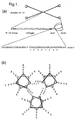
- Collectin polypeptide chains contain a short N-terminal region, a collagen-like region (of between 20 and 59 Gly-Xaa-Yaa triplets) linked, by a short stretch of 34 - 39 amino acids (which form the 'neck' region) to a C-terminal, C-type lectin domain (of 113-118 amino acids) ( Figure 1a).
- the present invention has resulted from results showing that the "neck-region" of collectin protein is able to mediate inter-chain recognition, trimerization and registered alignment of three collagenous polypeptide chains [7].
- the results make available simple means of trimerising polypeptides of choice.
- polypeptide comprising a neck-region of a collectin as set out in claim 1.
- Such polypeptide will form a trimer under appropriate conditions.
- the polypeptide is non-naturally occurring, i.e. it is one not found in nature.
- It comprises one or more heterologous amino acids joined to the neck-region or variant or derivative thereof. It may retain one or more amino acids from the molecule from which is it derived; for example the polypeptide may comprise a collectin C-type lectin domain.
- a non-naturally occurring polypeptide may consist essentially of amino acids according to the following formula: X-N-Y, wherein N is a collectin neck-region peptide or a variant or derivative thereof or a sequence of amino acids having an amino acid pattern and/or hydrophobicity profile which is the same as or similar to that of a collecting neck-region, able to form a trimer; X is absent or one or more amino acids and Y is absent or one or more amino acids. If X and Y are both absent, the polypeptide consists essentially of N. X and/or Y may comprise one or more heterologous amino acids, any of which may be derivatisable, or "chemically modifiable", for attachment of a chemical moiety.
- the chemical moiety may be introduced at a specific chemically modifiable residue or residues.
- a chemically modifiable amino acid residue is an amino acid residue susceptible to modification with a chosen chemical reagent under specified conditions.
- the amino acid may be unique in the polypeptide or it may be uniquely modifiable, or selectively or preferentially modifiable over other amino acids present.
- a cysteine residue may be introduced into the binding site and be available for chemical modification via its thiol group. It may also be possible to render an amino acid preferentially modifiable compared with other amino acids of the same type within the molecule by engineering its environment, eg by positioning it within the molecule adjacent another amino acid with particular properties. For instance, an amino group next to a carboxylate group would be rendered more nucleophilic and selectively modifiable even if not unique within the binding site.
- Covalent modification allows a wide variety of moieties to be incorporated, particularly reporter groups or cofactors for catalysis.
- one or more amino acids which are specifically modifiable are incorporated. This allows the interaction of large organic groups such as the fluorescent reporter group, 7-nitrobenz-2-oxa-1,3-diazole (NBD).
- NBD 7-nitrobenz-2-oxa-1,3-diazole
- Other large groups such as the flavin cofactors for catalysis, FMN and FAD may be incorporated.
- amino acid residues which may be specifically derivatized using molecules containing specific functional groups.
- amino groups may be modified with N-hydroxysuccinimide esters, carboxyl groups with carbodiimides, histidines and cysteines with halomethyl ketones, arginine with glyoxals (see e.g. A.R. Fersht, Enzyme Structure and Mechanism 2nd edn, 1985 pp248-251, W.H. Freeman, New York).
- N-hydroxysuccinimidyl ester of the molecule may be used to modify amino groups
- N-[6-(-amino-4-methylcoumarin-3-acetamido)hexyl]-3'-(2'-pyridyldithio)propionamide may be used to modify cysteine groups.
- transglutaminase which catalyzes an acyl-transfer reaction between the gamma-carboxyamide group of glutamine residues and primary amines
- This enzyme could therefore introduce amino acid residues from a peptide into a glutamine residue through a peptide lysine epsilon amino group or into a lysine group via a peptide glutamine group.
- the enzyme could also catalyse derivatization of glutamine residues with a primary amine.
- a further approach is to introduce chemical moieties to either the N or C terminus of a polypeptide using reverse proteolysis or chemical conjugation or a combination of the two (I. Fisch et al, Bioconj. Chem. 3 , 147-153, 1992; H. F. Gaertner et al, Bioconjug. Chem. 3 , 262-268, 1992; H. F. Gaertner et al, J. Biol. Chem. 269 , 7224-7230, 1994; J. Bongers et al, Biochim. Biophys. Acta, 50 , S57-162, 1991; R. Offord, Protein Engineering , 4 , 709-710, 1991). These methods have been used to introduce non-encoded elements to protein and peptide molecules.
- fluorophores which may be introduced are fluorescein, phycoerythrin, coumarin, NBD, Texas Red and chelated lanthanide ions.
- catalytic groups which may be introduced are flavin adenine dinucleotide (FAD), flavin mononucleotide (FMN), cytochromes and chelated metal ions such as zinc and copper.
- the neck-region is that of the collectin SP-D (or a variant or derivative thereof).
- Other possibilities include collectin-43 and conglutinin.
- Mannan-binding protein (MBP) and SP-A may also be useable in the present invention, though in that case additional amino acids from the respective lectin domains may be required. Since, however, those additional amino acids may have ⁇ -helical structure, as in the natural molecule, the sequence of amino acids required may still be considered to be the "neck region" of the collectin.
- Figure 1(a) shows the neck-region of SP-D, with V/L repeat.
- a linker may be important for spacing folded domains in a trimer. For instance, "... FP" may provide a kink in the chain.
- the neck-region in a polypeptide according to the present invention may have an amino acid pattern and/or hydrophobicity profile the same as or similar (e.g. substantially the same as) to that of the neck-region of SP-D, provided the ability to trimerise is retained.
- V at layer 'a' and L at layer 'd' was commonly believed to result preferably in dimers.
- the presence of F and Y in the above sequences is unusual and may have a direct influence on the degree of oligomerization.
- G is positioned exactly in the middle of the two 'ad' repeats. This may also be of importance for the trimerization process. Glycine residues behave slightly different than other residues in ⁇ -helices; however, no clear rules are established so far: G is often found at the end of helices, terminating them.
- the neck-region peptide has therefore a number of distinct features which may be altered perhaps to influence the properties of the peptide to form a trimeric ⁇ -helical bundle.
- the alignment shows naturally occurring neck-regions of collectins which form trimers and which also show a number of substitutions, apparently not affecting the trimerizing capability.
- Trimerising features of the neck-region peptide may be further enhanced by lengthening of the "a"-"d" repeats, particularly at the N-terminal end, for instance by addition of another copy of the first part of the neck region:
- the neck-region and/or the heterologous sequence of amino acids are human in origin, or "humanized”, in order to reduce the likelihood of there being an immune response generated upon administration of the polypeptide to an individual.
- heterologous sequence of amino acids refers to a chain of amino acids which is not found naturally joined to the collectin neck-region at the position of fusion in the polypeptide of the invention.
- Amino acids joined to the neck region may form a protein domain.
- the sequence of amino acids forms a functional domain.
- the amino acids may comprise a sequence derived from an immunoglobulin, eg variable domain, or variable domain and constant region.
- any amino acid sequence including a peptide or polypeptide, independently folding protein domain or protein domains may be joined to the neck-region peptide. This may be at the C-terminal or the N-terminal end of the polypeptide or at both ends, involving identical, similar, or different protein sequences. "Joining” may involve use of recombinant DNA technology to generate a fusion polypeptide or the use of chemical synthesis of a polypeptide including the neck-region (or a variant thereof or derivative thereof) or the chemical attachment of polypeptides to the neck-region peptide.
- Any three identical or different polypeptides containing the neck-region may form homo-trimers or hetero-trimers under appropriate conditions.
- a homotrimer consists of three polypeptides which are the same.
- a heterotrimer consists of three polypeptides, at least two of which are different. All three polypeptides may be different.
- One, two or all three polypeptides in a heterotrimer may be a polypeptide according to the invention, provided each polypeptide has a region able to trimerise.
- the neck-region ⁇ -helical bundle generally exists only as a trimeric molecule in conditions which mimic or approximate physiological conditions.
- the stability of the trimer may be enhanced by increasing the ionic strength of the solution.
- the trimeric association may be reversibly broken up by denaturation (e.g. heat denaturation) and the molecules can re-associate into trimers as soon as conditions return to physiological conditions (cooling).
- the neck-region peptide's ability to trimerize is independent of adjacent protein sequences. Using different polypeptides, each containing the neck-region, the reversible denaturation-reassociation process can be used to form heterotrimeric molecules.
- the conditions for denaturation are chosen to prevent loss of any property of the adjacent heterologous protein domain.
- One method of producing heterotrimers is specified in Example 3 and involves heating (in this case to about 50 °C) and cooling.
- the heterotrimerization using about 50°C is only an example at a certain ionic strength; other means of heterotrimerization may be preferable.
- the methods employed may vary depending on the application.
- the different neck-region peptide constructs can be chemically synthesized, modified, or generated in an expression system.
- a chemical attachment site can be as specific as a fusion-protein, since a reactive group can be placed at a specific position at the N-terminal or C-terminal (or less likely, but possible, central) part of the neck-region peptide.
- the molecules attached at these sites can be peptides or organic compounds.
- the neck-region containing peptides should preferable be purified without the use of organic solvents such as acetonitrile used in reversed-phase chromatography. If used, for example after chemical synthesis, these compounds should be thoroughly removed since they can interfere with the trimerization. In a similar way, the presence during (hetero-) trimerization of sodium dodecylsulphate or similar, strong, ionic detergents should be avoided. (However, as these compounds disrupt the hydrophobic forces that hold the helices of the neck-region together they can, in a controlled way, be also useful reagents in the heterotrimerization at low temperatures.)
- An amino acid sequence variant may comprise one or more changes, e.g. by way of addition, substitution, insertion or deletion of one or more amino acids, compared with wild type. Any such change should not abolish the ability of the polypeptide to form a trimer, though it may increase or decrease this ability depending on the nature of the change.
- a derivative has some modification compared to the naturally-occurring neck-region, which may be chemical. This may include the chemical or enzymatic attachment of carbohydrate structures, nucleic acids, or other chemical compounds, especially those used as antigen or those used in other chemical or biological interactions, such as ligand-receptor interactions.
- Changes may be made to the amino acid sequence, compared with wild-type, by providing and manipulating suitable encoding nucleic acid used for the production of the polypeptide in an expression system.
- the present invention further provides nucleic acid comprising a sequence of nucleotides encoding a polypeptide able to form a trimer and comprising a neck-region of a collectin, an amino acid sequence variant thereof or derivative thereof, or a sequence of amino acids having an amino acid pattern and/or hydrophobicity profile the same as or similar to the neck region of collectin SP-D, fused to a heterologous sequence of amino acids, as disclosed herein.
- the nucleic acid may comprise an appropriate regulatory sequence operably linked to the encoding sequence for expression of the polypeptide. Expression from the encoding sequence may be said to be under the control of the regulatory sequence.
- nucleic acid as set out above, particularly any expression vector from which the encoded polypeptide can be expressed under appropriate conditions, and a host cell containing any such vector or nucleic acid.
- a convenient way of producing a polypeptide according to the present invention is to express nucleic acid encoding it. Accordingly, the present invention also encompasses a method of making a polypeptide according to the present invention, the method comprising expression from nucleic acid encoding the polypeptide, either in vitro or in vivo.
- the nucleic acid may be part of an expression vector. Expression may conveniently be achieved by growing a host cell, containing appropriate nucleic acid, under conditions which cause or allow expression of the polypeptide.
- Suitable host cells include bacteria, mammalian cells, yeast and baculovirus systems.
- Mammalian cell lines available in the art for expression of a heterologous polypeptide include Chinese hamster ovary cells, HeLa cells, baby hamster kidney cells and many others.
- a common, preferred bacterial host is E. coli.
- Suitable vectors can be chosen or constructed, containing appropriate regulatory sequences, including promoter sequences, terminator fragments, polyadenylation sequences, enhancer sequences, marker genes and other sequences as appropriate.
- Vectors may be plasmids, viral e.g. 'phage, or phagemid, as appropriate.
- plasmids viral e.g. 'phage, or phagemid, as appropriate.
- Many known techniques and protocols for manipulation of nucleic acid for example in preparation of nucleic acid constructs, mutagenesis, sequencing, introduction of DNA into cells and gene expression, and analysis of proteins, are described in detail in Short Protocols in Molecular Biology, Second Edition, Ausubel et al. eds., John Wiley & Sons, 1992. The disclosures of Sambrook et al. and Ausubel et al. are incorporated herein by reference.
- a further aspect of the present invention provides a host cell containing nucleic acid as disclosed herein.
- a still further aspect provides a method comprising introducing such nucleic acid into a host cell.
- the introduction may employ any available technique.
- suitable techniques may include calcium phosphate transfection, DEAE-Dextran, electroporation, liposome-mediated transfection and transduction using retrovirus or other virus, e.g. vaccinia or, for insect cells, baculovirus.
- suitable techniques may include calcium chloride transformation, electroporation and transfection using bacteriophage.
- the introduction may be followed by causing or allowing expression from the nucleic acid, e.g. by culturing host cells under conditions for expression of the gene.
- the nucleic acid of the invention is integrated into the genome (e.g. chromosome) of a host cell. Integration may be promoted by inclusion of sequences which promote recombination with the genome, in accordance with standard techniques.
- polypeptides may be caused or allowed to trimerise. This may be prior to or following isolation.
- the present invention thus also provides the use of a polypeptide comprising or consisting essentially of the neck-region of a collectin, or an amino acid sequence variant thereof or derivative thereof, in a method of "seeding" of a collagenous triple-helix.
- the polypeptide consists essentially of a series of collagenous triplets (Gly-Xaa-Yaa) fused at the C-terminus (possibly via a linker) to the "neck-region" of a collectin or amino acid sequence variant thereof or derivative thereof, or a sequence of amino acids having an amino acid pattern and/or hydrophobicity profile the same as or similar to the neck-region of collectin SP-D, with no amino acids C-terminal to the neck-region or heterologous amino acids C-terminal to the neck region.
- neck-region i.e. "first sequence of amino acids” as disclosed herein
- first sequence of amino acids may be at the C-terminus of the polypeptide, or there may be additional C-terminal amino acids, the proviso being that the polypeptide as a whole is non-naturally occurring.
- a method of seeding a collagenous triple-helix involves causing or allowing trimerization of such a polypeptide. It may involve first the production of the polypeptide by expression from encoding nucleic acid therefor.
- the present invention provides such nucleic acid, a vector comprising such nucleic acid, including an expression vector from which the polypeptide may be expressed, and a host cell transfected with such a vector or nucleic acid.
- the production of the polypeptide may involve growing a host cell containing nucleic acid encoding the polypeptide under conditions in which the polypeptide is expressed. Systems for cloning and expression etc. are discussed supra.
- Trimerization may be followed by isolation of trimers, e.g. for subsequent use and/or manipulation.
- neck-region peptide may be used to generate polypeptides with one or more amino acids carrying distinct properties, at either end of the neck-region, and, using hetero-trimerization, these properties can be combined with those carried by other domains in separately generated polypeptides containing the neck region.
- a single-chain antibody may be trimerized by generating it as a fusion polypeptide with the neck-region in an expression system.
- Fusion of antibodies or fragments thereof, including scFv may be directed against cell-surface molecules, such as CD8, CD4 or TCR ⁇ , for instance.
- Trimeric molecules should have a higher avidity to their respective ligands than the monomeric forms without the neck-region.
- a mild heterotrimerization technique of heating (e.g. to about 50°C) and cooling (e.g. ambient temperature) individual trimers may be dissociated and re-associated to yield heterotrimeric complexes.
- complexes may carry a weaker affinity for each individual ligand, but a strong avidity for an entity displaying two or more of the respective ligands.
- trimerised anti-CD4, anti-CD8 and anti ⁇ TCR scFv molecules would have strong affinity for an entity which is CD4, CD8 and ⁇ TCR positive.
- heterotrimers may be created with molecules with any combination of first, second and third binding specificities.
- the other, e.g. N-terminal end, of the neck-region may be used for additional functions, e.g. in drug targeting or diagnostic detection.
- homo- or heterotrimerizations may include use of any of the following:
- Figure 1 (a) schematic drawing of the location of the neck-region peptide of human SP-D.
- Human SP-D consists of 12 identical polypeptide chains (each of 356 amino acids) which assemble into 4 rod-like structures, each composed of three chains, which form triple-helical collagenous structures over residues 26 - 202.
- the C-terminal ends of the molecule contain C-type lectin domains linked to the collagenous domains via the neck-region, whereas the N-terminus is involved in oligomerization of the trimers into a tetramer.
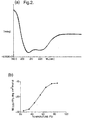
- Figure,2 shows circular dichroism spectroscopy analysis of the thermal stability of the secondary structure of the collagenase-digested neck-region peptide.
- Quarz cuvettes containing the peptide solution (adjusted to give an OD reading at 210 nm of 1.0) were allowed to equilibrate for 15 min at each temperature selected.
- Circular dichroism spectroscopy profile of the collagenase-digested (dashed line) and the intact neck-region peptide, collected at 20°C, with both peptides in 30 mM phosphate buffer pH 7.4, adjusted to give an UV absorption of 1.0 at 210 nm.
- the blank baseline was subtracted for both peptides and the resulting curves were overlaid.
- the spectra are almost identical and show a negative value of approximately -30 mdeg at the wavelength 207 nm, and of approximately -20 mdeg at the wavelength 224 nm, which is in good agreement with spectra expected from ⁇ -helical structures.
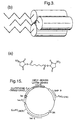
- Figure 3(a) shows the crosslinking agent, bis-(sulphosuccinimidyl) -suberate, used to react with amino-groups present within the neck-region peptide at 7 residues (Lysines), to form amide bonds, thus covalently linking polypeptide chains, spaced by 6 CH2 groups.
- Figure 3(b) shows a schematic representation of trimerised neck region peptides (tubes) with seven collagenous amino acids (zig-zags).
- Figure 4 shows SDS-PAGE analysis (Coomassie Blue R-250 stain of a 15 % (w/v) acrylamide tris-tricine-glycerol gel) of the purified collagenase-digested (lanes 5-8) and the intact neck-region peptides (lanes 1-4), reacted with increasing amounts of Bis-(sulphosuccinimidyl)-suberate.
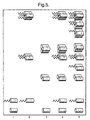
- Figure 5 shows a schematic representation of a crosslinking experiment, analysed by SDS-PAGE (see Figure 6).
- the drawing in lane 1 show the un-crosslinked single polypeptide chains of both, the collagenase-digested and the intact neck-region peptide.
- Lane 2 - 5 represent crosslinking reactions, with lane 2 showing the neck-region peptide analysed after a partial crosslinking reaction, showing monomeric, dimeric, and trimeric molecular weights.
- Lane 3 represents the same analysis for the collagenase-digested peptide, and lane 4 indicated the expected result of a crosslinking reaction of both peptides when the solution is not heated and cooled before the crosslinking step. If the heating and cooling is carried out before the crosslinking reaction, heterotrimeric complexes should be detectable, showing intermediate molecular weights, as indicated in lane 5.
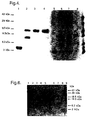
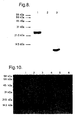
- Figure 6 shows SDS-PAGE analysis (Coomassie Blue R-250 stain of a 15 % (w/v) acrylamide tris-tricine-glycerol gel) of the purified collagenase-digested and the intact neck-region peptides, involving crosslinked of the individual peptides following heating and cooling steps in PBS, and mixing of the two peptide species in different ratios (before heating and cooling) followed by crosslinking.
- Lane 1 shows both, the collagenase-digested and the intact neck-region peptide, 1 and 5 ⁇ g respectively, without crosslinker added.
- the neck-region peptide reacted with 5 mM Bis-(sulphosuccinimidyl)-suberate is shown in lanes 2 and 3, with the peptide solution incubated at 99°C for 20 min followed by chilling on ice before addition of crosslinker shown in lane 3.
- the same reactions with the collagenase-digested peptide are shown in lanes 4 and 5, respectively.
- Peptides in lanes 3 and 5 were subjected to heating and cooling. In lanes 6 - 9 different amounts of the two peptides were mixed prior to heating and cooling, followed by crosslinking with 5mM crosslinker.
- the ratios (neck-region peptide:digested peptide) are 1:1 in lane 6, 4:1 in lane 7, 1:4 in lane 8, and 2:1 in lane 9.
- Figure 7 The pGEX-2T-N-term-neck-region plasmid allows for the induction (with IPTG) of a glutathione-S-transferase-N-terminus-neck-region fusion protein which can be cleaved with thrombin to yield the peptide sequence shown. (Lower case indicates pGEX polylinker sequence and the N-terminus sequence is underlined.)
- the DNA construct was obtained by Sma1 and Nru1 digestion of the pGEX-2T-N-term-coll-neck-region plasmid and subsequent religation of the compatible sites.
- Figure 8 shows SDS-PAGE analysis (Coomassie Blue R-250 stain of a 15 % (w/v) acrylamide gel) of the purified N-term-neck-region fusion peptide, reacted with increasing amounts of crosslinker, under reducing (lanes 4,5,6) and non-reducing (lanes 1,2,3) conditions.
- Peptides 50 ⁇ l were incubated with 0 mM (lanes 3 and 6), 2 mM (lanes 2 and 5), and 5 mM (lanes 1 and 4) Bis-(sulphosuccinimidyl)-suberate in PBS for 20 min before 10 ⁇ l 1 M Tris.Cl pH 8.0 was added to quench the reaction.
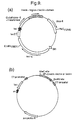
- Figure 9 illustrates transfer of the neck-region-lectin and -lectin coding DNA fragments from the fusion protein generating pGEX-2T system (a) to the pET3a vector.
- the DNA fragments were excised using BamH1 and EcoRl and subcloned into the pBluescript plasmid, which was linearized by using the same enzymes. After repurification of the resulting plasmids from transfected NM554 cells the DNA fragments were excised using Xba1 and EcoRV, thus generating compatible ends to the sites present in the pET3a plasmid cut with Nhe1 and EcoRV.
- the Nhe1 site is positioned at the start codon of the pET3a open reading frame. Therefore the proteins induced will not carry a fusion partner at the N-terminal end of their sequence, but only 7 amino acid derived from the pBluescript polylinker sequence:
- Figure 10 shows SDS-PAGE analysis (Coomassie Blue R-250 stain of a 12.5 % (w/v) acrylamide gel) of the C-type lectin domain of human SP-D and the neck-region -lectin domain as purified from lysates of bacterial cultures induced to express the recombinant proteins using the pET-3a vector.
- Lanes 1 to 3 correspond to the lectin domain
- lanes 4-6 show the neck-region-lectin domain protein.
- the proteins were crosslinked using increasing final concentrations of Bis-(sulphosuccinimidyl)-suberate.
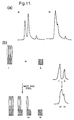
- Figure 11 illustrates (a) size-exclusion chromatography of the neck-region peptide / neck-lectin protein before (A) and after heterotrimerization (B) using a Superose 12 column.
- the column was equilibrated and run in PBS at 0.3 ml/min and the UV detector was set at 280 nm (sensitivity of 0.02).
- Samples were injected using 100 ml loops.
- the neck-lectin trimeric complex elutes first, with the neck-region peptide trimer following.
- a shift in the elution profile of the first peak can be detected corresponding to trimeric protein complexes consisting of 2 neck-region peptides and 1 neck-lectin protein.
- (b) shows a schematic representation of the heterotrimerization process.
- the different polypeptides containing the neck-region are forming heterotrimers after a re-annealing step and this is a concentration-driven process with the relative amounts of the two homotrimeric molecules used at the beginning determining the ratios of the products of the heterotrimerization reaction.
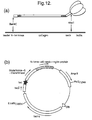
- Figure 12 The pGEX-2T-N-term-coll-neck-region plasmid (B) allows for the induction (with IPTG) of a glutathione-S-transferase-N-terminus-coll-neck-region fusion protein which can be cleaved with thrombin to yield the 25 kDa SP-D polypeptide.
- the DNA construct was obtained by PCR using a 5' oligonuclotide introducing a BamH1 site at the start of the N-terminal sequence and a 3' oligonucleotide introducing an EcoR1 site after the stop codon of the SP-D cDMA as primers, thus amplifying a DNA fragment coding for the entire protein sequence of the native SP-D protein (A).
- the PCR product was cloned into pBluescript using the engineered enzyme sites and the resulting plasmid was digested with the restriction enzymes BamH1 and Msc1 and the DNA fragment coding for the N-tem-coll-neck-region was cloned into the pGEX-2T plasmid, linearized with BamH1 and Sma1.
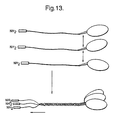
- Figure 13 shows a schematic representation of the proposed folding process involved in the formation of the triple-helical collagen-like region of human SP-D.
- the neck-region associates as a parallel homotrimeric coiled-coil and provides thus a nucleation point for the formation of the triple-helical structure in the adjacent collagenous region.
- the collagen triple-helix forms in a zipper-like fashion from this nucleation point towards the N-terminal end of the polypeptide chain.
- There are numerous potential cleavage sites for Thrombin present within the collagenous sequence however, the formation of a triple-helix would render these sites resistant to proteolytic digestion because the only known proteases to be able to digest collagenous structures are collagenases.
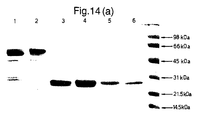
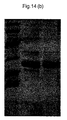
- Figure 14 shows (a) SDS-PAGE analysis (Coomassie Blue R-250 stain) of the Glutathione-S-transferase-N-term-collagen-neck-region fusion protein before and after thrombin cleavage (10 % (w/v) acrylamide). 50 ⁇ l solution of the eluted and glycine-treated fusion protein were loaded before (lanes 1,2) and after thrombin digestion (Lanes 3-6). The close-up of lanes 5&6 (b) shows the less-intensely stained 25 kDa recombinant peptide running underneath the 25 kDa glutathione-S-transferase band.
- Figure 15 The pGEX-2T-neck-region-lectin and pGEX-2T-lectin plasmids were generated using either Sma1 and EcoR1 (neck+lectin) or Mscl and EcoR1 (lectin) to clone the SP-D cDNA fragments into the pGEX-2T plasmid, linearized with Sma1 and EcoR1.
- the fusion proteins induced are 43 kDa (neck+lectin) and 37 kDa (lectin) in expected molecular weight.
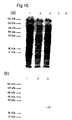
- Figure 16 shows SDS-PAGE analysis (10 % (w/v) acrylamide gel) of bacterial expression of the glutathione-S-transferase fusion proteins containing the neck-region and the lectin region (A) and the lectin domain of human SP-D alone (B).
- Non-induced (A lanes 2 and 3, and B lanes 1 and 2) and induced bacteria (A lane 1 and B lane 3) were boiled and loaded onto the gels, run under reducing conditions. Protein bound to maltose-TSK was eluted using EDTA, and peak samples (50 ⁇ l) loaded onto lanes 4 and 5, no protein eluted for the glutathione-S-transferase-Lec fusion protein.
- the fusion protein containing both the neck-region as well as the lectin domain appears to be susceptible to proteolytic degradation within the cells, for a prominent protein band in lane A 1 is not only present at the expected size of approximately 42 kDa, but also at approximately 30 kDa. However, this protein did not bind to the maltose-TSK column.
- the glutathione-S-transferase-Lec fusion protein showed a molecular weight of approximately 37 kDa.
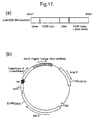
- Figure 17 shows a DNA construct encoding the immunoglobulin domains of the variable regions of the monoclonal rat anti-CD4 IgG antibody heavy and light chains (scabOX35), fused together by a flexible linker sequence (a).
- the DNA fragment was inserted into the Sma1 site of the pGEX-2T-neck-region peptide, resulting in an open reading frame for a fusion protein with the glutathione-S-transferase and the neck-region.
- the DNA was also inserted into the pGEX-2T plasmid (b), linearized with Sma1, thus producing a fusion protein of scabOX35 with glutathione-S-transferase alone.
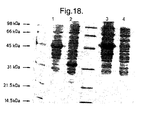
- Figure 18 shows SDS-PAGE analysis (Coomassie Blue R-250 stain) of bacterial lysates of cultures induced to express glutathione-S-transferase fusion proteins with the OX35-single-chain antibody (lane 1) the neck-region of human SP-D (lane 2), and the neck-region-OX35-single-chain antibody (lane 3), compared to non-induced bacteria (lane 4), under reducing conditions (12.5 % (w/v) acrylamide).
- Figure 1(a) shows the structure of human SP-D.
- a 168 bp DNA fragment which encoded 7 Gly-Xaa-Yaa triplets and the 35 non-collagen like residues of the neck-region leading up to the C-type lectin domain. It was cloned into the pGEX-2T bacterial expression vector [9] and the correct orientation of the insert was checked by restriction digestion. High levels of expression of the glutathione-S-transferase/neck-region peptide fusion-protein were obtained after 6 hours of induction with IPTG.
- Thrombin digestion of the affinity purified fusion-protein resulted in two polypeptides, the glutathion-S-transferase and the neck-region peptide, carrying an additional Gly-Ser-Pro triplet at the N-terminus and the residues Gly-Ile-Pro-His-Arg-Asp at the C-terminal end, representing the polylinker present in pGex-2T.
- 14 mg of the recombinant peptide were purified per litre culture in the three-step purification procedure.
- the peptide elutes in a single peak from the HighLoad-S column, at 800 mM NaCl.
- the purity of the peptide was confirmed by SDS-PAGE analysis, N-terminal sequencing of residues 1-46, and laser desorption mass spectroscopy (data not shown).
- the expression plasmid for this fusion peptide was generated by removing the DNA segment coding for the collagenous region of human SP-D from 10 ⁇ g of the original cDNA containing plasmid by restriction enzyme digestion with 4 units of Nru1 in buffer Nru1 (New England Biolabs) and subsequently with 5 units of Sma1 in buffer J (Promega) at 25°C for 4 hours, excising the 456 bp fragment.
- the remaining plasmid was purified using the magic miniprep DNA purification resin (Promega), re-ligated, and transformed into the competent cells of the BL21 bacterial strain of E.coli.
- the polymerase chain reaction was used to generate a BamH1 restriction enzyme site at the N-terminal end of the N-terminal domain of SP-D.
- the resulting PCR product was cleaved with BamH1 and Bal1 to result in an open reading frame coding for 84 amino acids (28 of the N-terminal domain and 56 of the neck-region including a 7 triplet collagenous linker between the two domains).
- the polypeptide was generated as a glutathione-S-transferase-N-term-neck-region fusion protein, illustrated in Figure 7.
- protein expression was induced using IPTG.
- the cells of 6 l bacterial culture were harvested by centrifugation at 5k rpm at 0°C and resuspended in a buffer consisting of 100 mM Tris.Cl, pH 8.0, 200 mM NaCl, 20 mM EDTA, and the cells were lysed by sonnication for 2 minutes on ice. Cell debris was spun down at 19k rpm for 30 minutes at 0°C and the supernatant was applied to a glutathione-agarose affinity column, equilibrated in the lysis buffer.
- the resin was washed using the lysis buffer containing 0.2% (w/v) Emulphogen (polyoxyethylene-10-tridecyl ether) until the absorbance at 280 nm reached the starting value again.
- Bound peptides were eluted using 20 mM glutathione (reduced form) in lysis buffer and thrombin digestion was carried out in this buffer at 37°C for 10 hours by adding 10 units of thrombin per mg of fusion peptide.
- the pH was then adjusted to 3.0 by adding a 1 M sodium citrate buffer, and subsequently 1 M HCl, to result in a 100 mM citrate buffered solution of pH 3.0.
- a white precipitate containing glutathione-S-transferase, was removed by centrifugation (19k rpm at 0°C for 30 min) and the supernatant was applied to a Pharmacia HighLoad S column for anion exchange chromatography using a Waters FPLC system.
- the N-terminus-neck-region peptide eluted at 450 mM NaCl in a single, symmetrical peak and was shown to be free of contaminating proteins as judged by SDS-PAGE analysis and Coomassie blue R-250 staining.
- the purified peptide was dialysed against PBS and concentrated using 3 kDa cut-off centricon cartridges.
- a 25 ml solution of the peptide in PBS of a final concentration of 1 mg/ml was recovered. This represents a yield of 4 mg/l bacterial culture of recombinant proteolytically processed peptide.
- the purity of the peptide as well as its size was determined by SDS-PAGE analysis to have a molecular weight of approximately 9 kDa.
- the pET series of expression vectors can be used to generate high-level intracellular production of non-fusion proteins in E.coli using IPTG as an inducer of protein expression.
- the DNA inserts coding for the SP-D derived polypeptides were excised from the pGex-2T vectors using the restriction enzymes BamH1 and EcoR1 and the resulting fragments were ligated into the chloramphenicol-resistance carrying version of the pBluescript plasmid, pBCSK, linearized with BamH1 and EcoR1, and phosphatase-treated.
- Both polypeptides were induced using IPTG and purified after lysis of the cells by conventional FPLC chromatography. Since both of the recombinant polypeptides were found to bind to FastFlow Q-Sepharose (Pharmacia) at pH 9.0 during the first step of purification, subsequent further purification was achieved on MonoQ (lectin domain) and MonoS (neck-lectin domain) columns (Pharmacia).
- the purified proteins were dialysed against PBS at 4°C and samples (50 ⁇ l) were analysed on 12.5 % SDS-PAGE gels.
- Bis-(sulfosuccinimidyl)-suberate amino-reactive crosslinker was added at 2 different concentrations and the protein bands detected in lanes corresponding to these samples revealed that the two proteins differed in respect to their oligomeric status ( Figure 10).
- the C-type lectin domain was found to behave like a monomeric protein in solution whereas the neck-lectin domain showed the expected crosslinking pattern of a trimeric molecule in solution.
- the neck-region mediates the trimerization of the C-type lectin domain of human SP-D which is shown to form a monomeric molecule without the neck-region.
- the trimerized lectin domains were also found to bind more strongly to the affinity matrix maltose-agarose, whereas the monomeric lectin domain (without the neck-region) showed a weaker affinity (data not shown).
- the two proteins expressed may provide valuable tools for the study of native carbohydrate ligands for human SP-D, since the three lectin domains in the neck-lectin molecule are expected to have the same spacing of their binding sites for carbohydrates as the lectin domains present in a single 'rod' of native human SP-D. These results indicate also that heterologous protein domains, fused to the neck-region peptide, will form trimeric complexes.
- the shifted first peak was found in crosslinking experiments (data not shown) to consist of 2 neck-region peptides and 1 neck-lectin polypeptide, held together as a heterotrimeric complex. Therefore a heterotrimerization had occurred via the neck region's- ⁇ -helices which are contained within the sequences of both polypeptides.
- the large molecular excess of neck-region peptide homotrimers at the beginning of the heterotrimerizing experiment has driven the reaction to yield only two trimeric complexes, namely the neck-region peptide homotrimer and a single species of heterotrimer with one neck-lectin polypeptide and two neck-region peptides.
- neck-lectin homotrimer An increased concentration of the neck-lectin homotrimer at the beginning of the experiment drives the reaction to the other extreme, resulting in neck-lectin homotrimers being re-formed and a single species of heterotrimeric complexes consisting of two molecules neck-lectin polypeptide and one neck-region peptide (data not shown).
- the fusion proteins Prior to the cleavage with thrombin the fusion proteins were diluted tenfold in 2 M glycine buffer at pH 7.5 and subsequently dialysed extensively against 100 mM Tris.HCl (pH 7.4) 200 mM NaCl.
- the thermal stability of polypeptides in solution may be greatly enhanced by the addition of 2 M glycine [24].
- the fusion protein consisting of the glutathione-S-transferase and the 48 Gly-Xaa-Yaa triplets only gave rise to a large number of peptides of different length, reflecting the frequently occurring cleavage by thrombin of peptide bonds involving arginine residues within the collagenous sequence (data not shown).
- the glutathione-S-transferase fusion protein containing the neck-region peptide C-terminal to the 57 Gly-Xaa-Yaa triplets and the N-terminal non-collagenous peptide from human SP-D showed only a single cleavage into two products, the glutathione-S-transferase and the entire collagenous region with the neck-region peptide and the N-terminal peptide of human SP-D attached ( Figure 14).
- N-terminal non-collagenous region of human SP-D The involvement of the N-terminal non-collagenous region of human SP-D in the observed increase of stability of the triple-helix can be examined.
- short peptide sequences are attached to N-terminal end of the collagenous regions N-terminal of the neck-region peptide using protein engineering techniques. This involves the use of polymerase chain reactions with synthesised oligonucleotides and subsequent ligations into the fusion-protein combining-site in the pGEX-2T vector, already carrying the DNA encoding the neck-region (see example 1).
- the resulting set of purified recombinant peptides is tested for correct alignment of triple-helical peptides using amino-reactive chemical crosslinking-reagents in combination with SDS-PAGE and size-exclusion chromatography.
- a few suitable peptides are then 15 N-isotope labelled and analysed for thermal stability using multi-dimensional NMR. At this stage the influence of the triplet number on the melting temperature is examined by subsequent insertion of longer stretches of collagen-coding DNA in a similar fashion.
- the pBluescript plasmid containing cDNA coding for human SP-D protein was digested with the restriction enzymes Sma1 and EcoR1, as well as with Msc1 and EcoR1, giving rise to DNA fragments of 532 bp, and 364 bp, respectively. Both fragments were subcloned into the pGex-2T expression vector, linearized with the restriction enzymes Sma1 and EcoR1. This directional cloning procedure produced two expression plasmids, pGex-2T-neck-lectin and pGex-2T-lectin, which were transformed into the E.coli BL21 strain. Protein expression was induced with IPTG and clones identified to produce recombinant proteins of the expected size, i.e.
- RNA prepared from the hybridoma cell line OX35 [15] was used as a template for cDNA-PCR [16] to generate DNA encoding the variable region of the light and heavy chain of the anti-CD4 monoclonal antibody secreted by the hybridoma cells. Both fragments, of 400bp length, were cloned into the pBluescript SK vector (Stratagene) and subsequently combined using a synthetic DNA fragment encoding the semi-rigid linker-peptide (GGGGS) 3 , which ensured the correct pairing of the V L and H L domains [17]. The sequence of the construct was confirmed by dideoxy sequencing of the DNA.
- the single-chain antibody encoding DNA was also cloned into the pGEX-2T vector alone, without the neck-region peptide gene, giving rise to an open reading frame coding for the OX35-scAb fused to the glutathione-S-transferase (resulting in a fusion protein of 50 kDa). Both expression vectors constructed were transformed into E.coli BL21 cells (see Figure 17).
- the single chain antibody containing polypeptides were purified and on SDS-PAGE analysis had an apparent molecular weight of 25 kDa for the OX35-scAb and 30 kDa for the OX35-scAb-neck polypeptides, however, using size-exclusion chromatography, an increased apparent molecular weight was observed for OX35-scAb-neck, whereas the OX35-scAb showed the expected behaviour of a 25kDa polypeptide on the size exclusion column.
Landscapes
- Chemical & Material Sciences (AREA)
- Health & Medical Sciences (AREA)
- Life Sciences & Earth Sciences (AREA)
- Organic Chemistry (AREA)
- Biochemistry (AREA)
- General Health & Medical Sciences (AREA)
- Genetics & Genomics (AREA)
- Medicinal Chemistry (AREA)
- Molecular Biology (AREA)
- Proteomics, Peptides & Aminoacids (AREA)
- Biophysics (AREA)
- Zoology (AREA)
- Toxicology (AREA)
- Gastroenterology & Hepatology (AREA)
- Pulmonology (AREA)
- Peptides Or Proteins (AREA)
- Preparation Of Compounds By Using Micro-Organisms (AREA)
- Micro-Organisms Or Cultivation Processes Thereof (AREA)
- Materials For Medical Uses (AREA)
- Medicines That Contain Protein Lipid Enzymes And Other Medicines (AREA)
Applications Claiming Priority (3)
| Application Number | Priority Date | Filing Date | Title |
|---|---|---|---|
| GB9409768 | 1994-05-16 | ||
| GB9409768A GB9409768D0 (en) | 1994-05-16 | 1994-05-16 | Trimerising polypeptides |
| PCT/GB1995/001104 WO1995031540A1 (en) | 1994-05-16 | 1995-05-16 | Trimerising polypeptides, their manufacture and use |
Publications (2)
| Publication Number | Publication Date |
|---|---|
| EP0757720A1 EP0757720A1 (en) | 1997-02-12 |
| EP0757720B1 true EP0757720B1 (en) | 2002-11-06 |
Family
ID=10755201
Family Applications (1)
| Application Number | Title | Priority Date | Filing Date |
|---|---|---|---|
| EP95918689A Expired - Lifetime EP0757720B1 (en) | 1994-05-16 | 1995-05-16 | Trimerising polypeptides, their manufacture and use |
Country Status (12)
| Country | Link |
|---|---|
| US (1) | US6190886B1 (enExample) |
| EP (1) | EP0757720B1 (enExample) |
| JP (2) | JPH10500298A (enExample) |
| AT (1) | ATE227341T1 (enExample) |
| AU (1) | AU2451995A (enExample) |
| CA (1) | CA2190264A1 (enExample) |
| DE (1) | DE69528761T2 (enExample) |
| DK (1) | DK0757720T3 (enExample) |
| ES (1) | ES2186718T3 (enExample) |
| GB (1) | GB9409768D0 (enExample) |
| PT (1) | PT757720E (enExample) |
| WO (1) | WO1995031540A1 (enExample) |
Families Citing this family (42)
| Publication number | Priority date | Publication date | Assignee | Title |
|---|---|---|---|---|
| AUPO591797A0 (en) | 1997-03-27 | 1997-04-24 | Commonwealth Scientific And Industrial Research Organisation | High avidity polyvalent and polyspecific reagents |
| DE69738670D1 (de) * | 1996-10-28 | 2008-06-19 | Inst Suisse De Rech S Experime | Verfahren zur oligomerisation von peptiden |
| DE69738967D1 (de) * | 1996-10-29 | 2008-10-16 | Commw Scient Ind Res Org | Stabile expression von tripelhelikalen proteinen |
| ATE282092T1 (de) | 1997-06-11 | 2004-11-15 | Borean Pharma As | Trimerisierendes modul |
| US7914814B2 (en) * | 1997-09-17 | 2011-03-29 | Strategic Science & Technologies, Llc | Topical delivery of arginine of cause beneficial effects |
| DK1039931T3 (da) * | 1997-12-01 | 2005-08-08 | Fang Fang | Multivalente rekombinante antistoffer til at behandle HRV infektioner |
| US20030035798A1 (en) * | 2000-08-16 | 2003-02-20 | Fang Fang | Humanized antibodies |
| US7300774B1 (en) * | 1999-12-09 | 2007-11-27 | The Regents Of The University Of California | Multimeric fusion proteins of the TNF superfamily ligands |
| WO2000069907A1 (en) * | 1999-05-14 | 2000-11-23 | Medical Research Council | Protein scaffold and its use to multimerise monomeric polypeptides |
| AU1384302A (en) | 2000-11-10 | 2002-05-21 | Proteopharma Aps | Apolipoprotein analogues |
| EP1373546A4 (en) * | 2001-03-06 | 2005-09-21 | Mustapha Abdelouahed | CHIMERIC CARRIER PROTEINS, TARGETED CHIMERIC CARRIER PROTEINS, AND THEIR MANUFACTURE |
| US20030138440A1 (en) | 2001-07-19 | 2003-07-24 | Fang Fang | Multimeric proteins and methods of making and using same |
| JP2005522988A (ja) | 2001-10-25 | 2005-08-04 | メディカル リサーチ カウンシル | 分子 |
| CA2470564C (en) * | 2001-12-21 | 2011-02-22 | Immunex Corporation | Recombinant polypeptides |
| CA2503697A1 (en) | 2002-10-29 | 2004-05-13 | Borean Pharma A/S | Trimeric binding proteins for trimeric cytokines |
| US20080166798A1 (en) * | 2003-08-22 | 2008-07-10 | Barnes-Jewish Hospital | Trimerizing Polypeptides and Their Uses |
| US7268116B2 (en) * | 2003-10-02 | 2007-09-11 | Genhunter Corp. | Methods and compositions for producing secreted trimeric receptor analogs and biologically active fusion proteins |
| US8030448B2 (en) | 2004-02-16 | 2011-10-04 | Techno Network Shikoku Co., Ltd. | Polypeptide having collagen-like structure |
| KR20070095296A (ko) | 2004-11-22 | 2007-09-28 | 보리안 파마 에이피에스 | Tnf 길항제 |
| CA2621764A1 (en) * | 2005-09-09 | 2007-03-15 | Zymogenetics, Inc. | Method for preparing trimeric proteins |
| US20070264687A1 (en) * | 2005-12-15 | 2007-11-15 | Min-Yuan Chou | Recombinant triplex scaffold-based polypeptides |
| US10183986B2 (en) | 2005-12-15 | 2019-01-22 | Industrial Technology Research Institute | Trimeric collagen scaffold antibodies |
| EP2674440B1 (en) | 2005-12-16 | 2019-07-03 | IBC Pharmaceuticals, Inc. | Multivalent immunoglobulin-based bioactive assemblies |
| CN103159857B (zh) * | 2007-05-21 | 2014-11-05 | 财团法人工业技术研究院 | 以重组的三股螺旋支架为基础的复合物 |
| ES2657801T3 (es) | 2007-07-10 | 2018-03-06 | Apogenix Ag | Proteínas de fusión de colectina de la superfamilia de TNF |
| AU2008319384A1 (en) | 2007-10-29 | 2009-05-07 | Virginia Tech Intellectual Properties, Inc. | Porcine DC-SIGN , ICAM-3 and LSECtin and uses thereof |
| AU2009267769B2 (en) | 2008-07-08 | 2015-07-16 | Medicago Inc. | Soluble recombinant influenza antigens |
| AU2009303304A1 (en) | 2008-10-10 | 2010-04-15 | Anaphore, Inc. | Polypeptides that bind TRAIL-RI and TRAIL-R2 |
| WO2010074081A1 (ja) * | 2008-12-22 | 2010-07-01 | 国立大学法人北海道大学 | 三重螺旋構造を有するタンパク質、およびその製造方法 |
| US8664366B2 (en) | 2009-01-09 | 2014-03-04 | Apogenix Gmbh | Fusion proteins forming trimers |
| WO2010122181A1 (es) * | 2009-04-20 | 2010-10-28 | Universidad Autónoma de Madrid | Proteínas oligoméricas y sus aplicaciones |
| CA2777162A1 (en) * | 2009-10-09 | 2011-04-14 | Anaphore, Inc. | Polypeptides that bind il-23r |
| US20110086806A1 (en) * | 2009-10-09 | 2011-04-14 | Anaphore, Inc. | Polypeptides that Bind IL-23R |
| CA2907384C (en) | 2013-03-15 | 2023-08-15 | Geoffrey W. STONE | Composition comprised of antigen linked to a tnf superfamily ligand |
| JP2014218510A (ja) * | 2014-08-11 | 2014-11-20 | アポゲニクスゲゼルシャフト ミット ベシュレンクテルハフツングApogenix GmbH | 三量体形成融合タンパク質 |
| EP3374378B1 (en) | 2015-11-13 | 2021-02-17 | Spiber Technologies AB | Charge-reversed n-terminal spider silk protein domain and uses thereof |
| GB201522610D0 (en) * | 2015-12-22 | 2016-02-03 | Univ Southampton | Protein |
| JP2016210791A (ja) * | 2016-08-03 | 2016-12-15 | アポゲニクス アーゲー | 三量体形成融合タンパク質 |
| US11377490B2 (en) | 2017-05-31 | 2022-07-05 | Sichuan Clover Biopharmaceuticals, Inc | Method for treating cancer using disulfide-linked trimeric 4-1BBL |
| WO2021249116A1 (en) | 2020-06-10 | 2021-12-16 | Sichuan Clover Biopharmaceuticals, Inc. | Coronavirus vaccine compositions, methods, and uses thereof |
| WO2021249011A1 (en) | 2020-06-10 | 2021-12-16 | Sichuan Clover Biopharmaceuticals, Inc. | Hiv vaccine compositions, methods, and uses thereof |
| WO2022041760A1 (en) | 2020-08-31 | 2022-03-03 | Sichuan Clover Biopharmaceuticals, Inc. | Methods and compositions for purification of trimeric fusion proteins |
Family Cites Families (1)
| Publication number | Priority date | Publication date | Assignee | Title |
|---|---|---|---|---|
| US5716805A (en) * | 1991-10-25 | 1998-02-10 | Immunex Corporation | Methods of preparing soluble, oligomeric proteins |
-
1994
- 1994-05-16 GB GB9409768A patent/GB9409768D0/en not_active Ceased
-
1995
- 1995-05-16 US US08/737,629 patent/US6190886B1/en not_active Expired - Lifetime
- 1995-05-16 DK DK95918689T patent/DK0757720T3/da active
- 1995-05-16 AT AT95918689T patent/ATE227341T1/de not_active IP Right Cessation
- 1995-05-16 DE DE69528761T patent/DE69528761T2/de not_active Expired - Lifetime
- 1995-05-16 CA CA002190264A patent/CA2190264A1/en not_active Abandoned
- 1995-05-16 WO PCT/GB1995/001104 patent/WO1995031540A1/en not_active Ceased
- 1995-05-16 ES ES95918689T patent/ES2186718T3/es not_active Expired - Lifetime
- 1995-05-16 PT PT95918689T patent/PT757720E/pt unknown
- 1995-05-16 EP EP95918689A patent/EP0757720B1/en not_active Expired - Lifetime
- 1995-05-16 AU AU24519/95A patent/AU2451995A/en not_active Abandoned
- 1995-05-16 JP JP7529462A patent/JPH10500298A/ja not_active Withdrawn
-
2005
- 2005-08-09 JP JP2005230930A patent/JP3836865B2/ja not_active Expired - Fee Related
Also Published As
| Publication number | Publication date |
|---|---|
| DE69528761T2 (de) | 2003-07-17 |
| DE69528761D1 (de) | 2002-12-12 |
| WO1995031540A1 (en) | 1995-11-23 |
| JPH10500298A (ja) | 1998-01-13 |
| JP2005328851A (ja) | 2005-12-02 |
| PT757720E (pt) | 2003-03-31 |
| US6190886B1 (en) | 2001-02-20 |
| JP3836865B2 (ja) | 2006-10-25 |
| EP0757720A1 (en) | 1997-02-12 |
| ES2186718T3 (es) | 2003-05-16 |
| GB9409768D0 (en) | 1994-07-06 |
| DK0757720T3 (da) | 2003-03-17 |
| CA2190264A1 (en) | 1995-11-23 |
| ATE227341T1 (de) | 2002-11-15 |
| AU2451995A (en) | 1995-12-05 |
Similar Documents
| Publication | Publication Date | Title |
|---|---|---|
| US6190886B1 (en) | Trimerizing polypeptides, their manufacture and use | |
| WO1995031540A9 (en) | Trimerising polypeptides, their manufacture and use | |
| Arai | Design of helical linkers for fusion proteins and protein-based nanostructures | |
| US10322190B2 (en) | Capping modules for designed ankyrin repeat proteins | |
| Ganea | Chaperone-like activity of alpha-crystallin and other small heat shock proteins | |
| Li et al. | Cloning, expression, isotope labeling, and purification of human antimicrobial peptide LL-37 in Escherichia coli for NMR studies | |
| US9547003B2 (en) | Peptide tag systems that spontaneously form an irreversible link to protein partners via isopeptide bonds | |
| Boudko et al. | The crucial role of trimerization domains in collagen folding | |
| Alexander et al. | Characterization and modelling of the hydrophobic domain of a sunflower oleosin | |
| KR100538768B1 (ko) | 환경 스트레스에 내성을 부여하는 신규한 펩타이드를 포함하는 융합단백질 | |
| Peng et al. | A simple cost-effective methodology for large-scale purification of recombinant non-animal collagens | |
| US20010034050A1 (en) | Fusion peptides isolatable by phase transition | |
| US20100003719A1 (en) | Trimerising Module | |
| CN110177811A (zh) | 用于蛋白质连接的方法及其用途 | |
| JP2003501064A (ja) | シャペロンポリペプチドのフラグメントを含む融合タンパク質 | |
| Bateman et al. | Association behaviour of human βB1-crystallin and its truncated forms | |
| Nemoto et al. | Dimerization characteristics of the 94-kDa glucose-regulated protein | |
| US9315561B2 (en) | Compositions comprising the NC2 domain of collagen IX and methods of using same | |
| Böldicke et al. | A new peptide-affinity tag for the detection and affinity purification of recombinant proteins with a monoclonal antibody | |
| Howell et al. | Mutagenesis of Cerebratulus lacteus neurotoxin B-IV identifies NH2-terminal sequences important for biological activity | |
| CA2385123A1 (en) | Method of altering polypeptide aggregation | |
| Radzimanowski et al. | Overproduction, purification, crystallization and preliminary X-ray analysis of human Fe65-PTB2 in complex with the amyloid precursor protein intracellular domain | |
| Bockhorn et al. | Novel semisynthetic method for generating full length β‐amyloid peptides | |
| EP2089422A1 (en) | Methods of separating nucleic acids and protein | |
| Arrizubieta et al. | Regulation of α-helical coiled-coil dimerization in chicken skeletal muscle light meromyosin |
Legal Events
| Date | Code | Title | Description |
|---|---|---|---|
| PUAI | Public reference made under article 153(3) epc to a published international application that has entered the european phase |
Free format text: ORIGINAL CODE: 0009012 |
|
| 17P | Request for examination filed |
Effective date: 19961205 |
|
| AK | Designated contracting states |
Kind code of ref document: A1 Designated state(s): AT BE CH DE DK ES FR GB GR IE IT LI LU MC NL PT SE |
|
| RAP1 | Party data changed (applicant data changed or rights of an application transferred) |
Owner name: ISIS INNOVATION LIMITED |
|
| 17Q | First examination report despatched |
Effective date: 19990810 |
|
| GRAG | Despatch of communication of intention to grant |
Free format text: ORIGINAL CODE: EPIDOS AGRA |
|
| GRAG | Despatch of communication of intention to grant |
Free format text: ORIGINAL CODE: EPIDOS AGRA |
|
| GRAG | Despatch of communication of intention to grant |
Free format text: ORIGINAL CODE: EPIDOS AGRA |
|
| GRAH | Despatch of communication of intention to grant a patent |
Free format text: ORIGINAL CODE: EPIDOS IGRA |
|
| GRAH | Despatch of communication of intention to grant a patent |
Free format text: ORIGINAL CODE: EPIDOS IGRA |
|
| GRAA | (expected) grant |
Free format text: ORIGINAL CODE: 0009210 |
|
| AK | Designated contracting states |
Kind code of ref document: B1 Designated state(s): AT BE CH DE DK ES FR GB GR IE IT LI LU MC NL PT SE |
|
| REF | Corresponds to: |
Ref document number: 227341 Country of ref document: AT Date of ref document: 20021115 Kind code of ref document: T |
|
| REG | Reference to a national code |
Ref country code: GB Ref legal event code: FG4D |
|
| REG | Reference to a national code |
Ref country code: CH Ref legal event code: EP |
|
| REG | Reference to a national code |
Ref country code: IE Ref legal event code: FG4D |
|
| REF | Corresponds to: |
Ref document number: 69528761 Country of ref document: DE Date of ref document: 20021212 |
|
| REG | Reference to a national code |
Ref country code: DK Ref legal event code: T3 |
|
| REG | Reference to a national code |
Ref country code: GR Ref legal event code: EP Ref document number: 20030400399 Country of ref document: GR |
|
| REG | Reference to a national code |
Ref country code: PT Ref legal event code: SC4A Free format text: AVAILABILITY OF NATIONAL TRANSLATION Effective date: 20030206 |
|
| REG | Reference to a national code |
Ref country code: ES Ref legal event code: FG2A Ref document number: 2186718 Country of ref document: ES Kind code of ref document: T3 |
|
| ET | Fr: translation filed | ||
| PLBE | No opposition filed within time limit |
Free format text: ORIGINAL CODE: 0009261 |
|
| STAA | Information on the status of an ep patent application or granted ep patent |
Free format text: STATUS: NO OPPOSITION FILED WITHIN TIME LIMIT |
|
| 26N | No opposition filed |
Effective date: 20030807 |
|
| PGFP | Annual fee paid to national office [announced via postgrant information from national office to epo] |
Ref country code: NL Payment date: 20090520 Year of fee payment: 15 Ref country code: MC Payment date: 20090520 Year of fee payment: 15 Ref country code: DK Payment date: 20090526 Year of fee payment: 15 |
|
| PGFP | Annual fee paid to national office [announced via postgrant information from national office to epo] |
Ref country code: PT Payment date: 20090513 Year of fee payment: 15 Ref country code: LU Payment date: 20090526 Year of fee payment: 15 Ref country code: AT Payment date: 20090522 Year of fee payment: 15 |
|
| PGFP | Annual fee paid to national office [announced via postgrant information from national office to epo] |
Ref country code: GR Payment date: 20090522 Year of fee payment: 15 |
|
| REG | Reference to a national code |
Ref country code: PT Ref legal event code: MM4A Free format text: LAPSE DUE TO NON-PAYMENT OF FEES Effective date: 20101116 |
|
| REG | Reference to a national code |
Ref country code: NL Ref legal event code: V1 Effective date: 20101201 |
|
| PG25 | Lapsed in a contracting state [announced via postgrant information from national office to epo] |
Ref country code: MC Free format text: LAPSE BECAUSE OF NON-PAYMENT OF DUE FEES Effective date: 20100531 |
|
| REG | Reference to a national code |
Ref country code: DK Ref legal event code: EBP |
|
| PG25 | Lapsed in a contracting state [announced via postgrant information from national office to epo] |
Ref country code: AT Free format text: LAPSE BECAUSE OF NON-PAYMENT OF DUE FEES Effective date: 20100516 |
|
| PG25 | Lapsed in a contracting state [announced via postgrant information from national office to epo] |
Ref country code: PT Free format text: LAPSE BECAUSE OF NON-PAYMENT OF DUE FEES Effective date: 20101116 |
|
| PG25 | Lapsed in a contracting state [announced via postgrant information from national office to epo] |
Ref country code: NL Free format text: LAPSE BECAUSE OF NON-PAYMENT OF DUE FEES Effective date: 20101201 Ref country code: GR Free format text: LAPSE BECAUSE OF NON-PAYMENT OF DUE FEES Effective date: 20101202 |
|
| PG25 | Lapsed in a contracting state [announced via postgrant information from national office to epo] |
Ref country code: DK Free format text: LAPSE BECAUSE OF NON-PAYMENT OF DUE FEES Effective date: 20100531 |
|
| PGFP | Annual fee paid to national office [announced via postgrant information from national office to epo] |
Ref country code: SE Payment date: 20120530 Year of fee payment: 18 |
|
| PG25 | Lapsed in a contracting state [announced via postgrant information from national office to epo] |
Ref country code: LU Free format text: LAPSE BECAUSE OF NON-PAYMENT OF DUE FEES Effective date: 20100516 |
|
| PGFP | Annual fee paid to national office [announced via postgrant information from national office to epo] |
Ref country code: ES Payment date: 20120628 Year of fee payment: 18 |
|
| PGFP | Annual fee paid to national office [announced via postgrant information from national office to epo] |
Ref country code: CH Payment date: 20130604 Year of fee payment: 19 Ref country code: DE Payment date: 20130603 Year of fee payment: 19 Ref country code: IE Payment date: 20130603 Year of fee payment: 19 |
|
| PGFP | Annual fee paid to national office [announced via postgrant information from national office to epo] |
Ref country code: IT Payment date: 20130620 Year of fee payment: 19 |
|
| PGFP | Annual fee paid to national office [announced via postgrant information from national office to epo] |
Ref country code: BE Payment date: 20130625 Year of fee payment: 19 |
|
| PGFP | Annual fee paid to national office [announced via postgrant information from national office to epo] |
Ref country code: FR Payment date: 20130726 Year of fee payment: 19 |
|
| REG | Reference to a national code |
Ref country code: SE Ref legal event code: EUG |
|
| PG25 | Lapsed in a contracting state [announced via postgrant information from national office to epo] |
Ref country code: SE Free format text: LAPSE BECAUSE OF NON-PAYMENT OF DUE FEES Effective date: 20130517 |
|
| REG | Reference to a national code |
Ref country code: ES Ref legal event code: FD2A Effective date: 20140610 |
|
| PG25 | Lapsed in a contracting state [announced via postgrant information from national office to epo] |
Ref country code: ES Free format text: LAPSE BECAUSE OF NON-PAYMENT OF DUE FEES Effective date: 20130517 |
|
| REG | Reference to a national code |
Ref country code: DE Ref legal event code: R119 Ref document number: 69528761 Country of ref document: DE |
|
| REG | Reference to a national code |
Ref country code: CH Ref legal event code: PL |
|
| PG25 | Lapsed in a contracting state [announced via postgrant information from national office to epo] |
Ref country code: CH Free format text: LAPSE BECAUSE OF NON-PAYMENT OF DUE FEES Effective date: 20140531 Ref country code: LI Free format text: LAPSE BECAUSE OF NON-PAYMENT OF DUE FEES Effective date: 20140531 |
|
| PGFP | Annual fee paid to national office [announced via postgrant information from national office to epo] |
Ref country code: GB Payment date: 20141008 Year of fee payment: 20 |
|
| REG | Reference to a national code |
Ref country code: IE Ref legal event code: MM4A |
|
| REG | Reference to a national code |
Ref country code: DE Ref legal event code: R119 Ref document number: 69528761 Country of ref document: DE Effective date: 20141202 |
|
| REG | Reference to a national code |
Ref country code: FR Ref legal event code: ST Effective date: 20150130 |
|
| PG25 | Lapsed in a contracting state [announced via postgrant information from national office to epo] |
Ref country code: IE Free format text: LAPSE BECAUSE OF NON-PAYMENT OF DUE FEES Effective date: 20140516 Ref country code: DE Free format text: LAPSE BECAUSE OF NON-PAYMENT OF DUE FEES Effective date: 20141202 Ref country code: IT Free format text: LAPSE BECAUSE OF NON-PAYMENT OF DUE FEES Effective date: 20140516 |
|
| PG25 | Lapsed in a contracting state [announced via postgrant information from national office to epo] |
Ref country code: FR Free format text: LAPSE BECAUSE OF NON-PAYMENT OF DUE FEES Effective date: 20140602 |
|
| REG | Reference to a national code |
Ref country code: GB Ref legal event code: PE20 Expiry date: 20150515 |
|
| PG25 | Lapsed in a contracting state [announced via postgrant information from national office to epo] |
Ref country code: GB Free format text: LAPSE BECAUSE OF EXPIRATION OF PROTECTION Effective date: 20150515 |
|
| PG25 | Lapsed in a contracting state [announced via postgrant information from national office to epo] |
Ref country code: BE Free format text: LAPSE BECAUSE OF NON-PAYMENT OF DUE FEES Effective date: 20140531 |