EP0755960B1 - Polyfunktionelle perfluorierte Polyorganosiloxane und Verfahren zu deren Herstellung - Google Patents
Polyfunktionelle perfluorierte Polyorganosiloxane und Verfahren zu deren Herstellung Download PDFInfo
- Publication number
- EP0755960B1 EP0755960B1 EP96420251A EP96420251A EP0755960B1 EP 0755960 B1 EP0755960 B1 EP 0755960B1 EP 96420251 A EP96420251 A EP 96420251A EP 96420251 A EP96420251 A EP 96420251A EP 0755960 B1 EP0755960 B1 EP 0755960B1
- Authority
- EP
- European Patent Office
- Prior art keywords
- linear
- branched
- radical
- pos
- joined
- Prior art date
- Legal status (The legal status is an assumption and is not a legal conclusion. Google has not performed a legal analysis and makes no representation as to the accuracy of the status listed.)
- Expired - Lifetime
Links
- 238000000034 method Methods 0.000 title claims description 38
- 230000008569 process Effects 0.000 title claims description 32
- 238000002360 preparation method Methods 0.000 title claims description 11
- 125000000217 alkyl group Chemical group 0.000 claims abstract description 29
- 125000004122 cyclic group Chemical group 0.000 claims abstract description 13
- 125000002887 hydroxy group Chemical group [H]O* 0.000 claims abstract description 13
- 125000003545 alkoxy group Chemical group 0.000 claims abstract description 9
- 125000003118 aryl group Chemical group 0.000 claims abstract description 8
- 150000001408 amides Chemical class 0.000 claims abstract description 4
- 125000004104 aryloxy group Chemical group 0.000 claims abstract description 4
- 150000002148 esters Chemical class 0.000 claims abstract description 4
- 229910052717 sulfur Inorganic materials 0.000 claims abstract description 4
- 125000001931 aliphatic group Chemical group 0.000 claims abstract description 3
- 125000003342 alkenyl group Chemical group 0.000 claims abstract description 3
- 125000002877 alkyl aryl group Chemical group 0.000 claims abstract description 3
- 125000003710 aryl alkyl group Chemical group 0.000 claims abstract description 3
- 125000002102 aryl alkyloxo group Chemical group 0.000 claims abstract description 3
- 125000002252 acyl group Chemical group 0.000 claims abstract 2
- 125000004423 acyloxy group Chemical group 0.000 claims abstract 2
- 125000005369 trialkoxysilyl group Chemical group 0.000 claims abstract 2
- BASFCYQUMIYNBI-UHFFFAOYSA-N platinum Chemical compound [Pt] BASFCYQUMIYNBI-UHFFFAOYSA-N 0.000 claims description 95
- 239000003054 catalyst Substances 0.000 claims description 47
- 239000002243 precursor Substances 0.000 claims description 43
- 229910052697 platinum Inorganic materials 0.000 claims description 36
- 125000002496 methyl group Chemical group [H]C([H])([H])* 0.000 claims description 26
- 238000006459 hydrosilylation reaction Methods 0.000 claims description 25
- 239000000203 mixture Substances 0.000 claims description 25
- 125000004469 siloxy group Chemical group [SiH3]O* 0.000 claims description 25
- XLYOFNOQVPJJNP-UHFFFAOYSA-N water Substances O XLYOFNOQVPJJNP-UHFFFAOYSA-N 0.000 claims description 21
- 239000003795 chemical substances by application Substances 0.000 claims description 20
- 150000001336 alkenes Chemical class 0.000 claims description 19
- 229910001868 water Inorganic materials 0.000 claims description 19
- 239000000839 emulsion Substances 0.000 claims description 15
- 125000002915 carbonyl group Chemical group [*:2]C([*:1])=O 0.000 claims description 14
- 150000001875 compounds Chemical class 0.000 claims description 14
- 239000002904 solvent Substances 0.000 claims description 14
- JRZJOMJEPLMPRA-UHFFFAOYSA-N olefin Natural products CCCCCCCC=C JRZJOMJEPLMPRA-UHFFFAOYSA-N 0.000 claims description 13
- 150000008064 anhydrides Chemical class 0.000 claims description 12
- 239000000126 substance Substances 0.000 claims description 9
- LFQSCWFLJHTTHZ-UHFFFAOYSA-N Ethanol Chemical compound CCO LFQSCWFLJHTTHZ-UHFFFAOYSA-N 0.000 claims description 8
- 125000004051 hexyl group Chemical group [H]C([H])([H])C([H])([H])C([H])([H])C([H])([H])C([H])([H])C([H])([H])* 0.000 claims description 7
- 150000001412 amines Chemical class 0.000 claims description 6
- 229910052751 metal Inorganic materials 0.000 claims description 6
- 239000002184 metal Substances 0.000 claims description 6
- RTZKZFJDLAIYFH-UHFFFAOYSA-N Diethyl ether Chemical compound CCOCC RTZKZFJDLAIYFH-UHFFFAOYSA-N 0.000 claims description 5
- 125000000484 butyl group Chemical group [H]C([*])([H])C([H])([H])C([H])([H])C([H])([H])[H] 0.000 claims description 4
- 125000003178 carboxy group Chemical group [H]OC(*)=O 0.000 claims description 4
- 239000000314 lubricant Substances 0.000 claims description 4
- 229910052760 oxygen Inorganic materials 0.000 claims description 4
- 125000004430 oxygen atom Chemical group O* 0.000 claims description 4
- 125000001436 propyl group Chemical group [H]C([*])([H])C([H])([H])C([H])([H])[H] 0.000 claims description 4
- 239000002994 raw material Substances 0.000 claims description 4
- 239000000376 reactant Substances 0.000 claims description 4
- 239000007858 starting material Substances 0.000 claims description 4
- 239000004094 surface-active agent Substances 0.000 claims description 4
- 230000002209 hydrophobic effect Effects 0.000 claims description 3
- 230000007246 mechanism Effects 0.000 claims description 3
- ISWSIDIOOBJBQZ-UHFFFAOYSA-N Phenol Chemical compound OC1=CC=CC=C1 ISWSIDIOOBJBQZ-UHFFFAOYSA-N 0.000 claims description 2
- 125000000304 alkynyl group Chemical group 0.000 claims description 2
- 239000007806 chemical reaction intermediate Substances 0.000 claims description 2
- 239000007795 chemical reaction product Substances 0.000 claims description 2
- 239000011248 coating agent Substances 0.000 claims description 2
- 238000000576 coating method Methods 0.000 claims description 2
- 229920001971 elastomer Polymers 0.000 claims description 2
- 239000000806 elastomer Substances 0.000 claims description 2
- 238000004519 manufacturing process Methods 0.000 claims description 2
- 239000005871 repellent Substances 0.000 claims description 2
- 238000005809 transesterification reaction Methods 0.000 claims description 2
- 125000000524 functional group Chemical group 0.000 claims 4
- 125000004191 (C1-C6) alkoxy group Chemical group 0.000 claims 1
- 230000000181 anti-adherent effect Effects 0.000 claims 1
- 230000002940 repellent Effects 0.000 claims 1
- 150000003573 thiols Chemical class 0.000 claims 1
- 125000001997 phenyl group Chemical group [H]C1=C([H])C([H])=C(*)C([H])=C1[H] 0.000 abstract description 3
- VYPSYNLAJGMNEJ-UHFFFAOYSA-N Silicium dioxide Chemical compound O=[Si]=O VYPSYNLAJGMNEJ-UHFFFAOYSA-N 0.000 abstract 3
- 229910052681 coesite Inorganic materials 0.000 abstract 2
- 229910052906 cristobalite Inorganic materials 0.000 abstract 2
- 239000000377 silicon dioxide Substances 0.000 abstract 2
- 229910052682 stishovite Inorganic materials 0.000 abstract 2
- 229910052905 tridymite Inorganic materials 0.000 abstract 2
- 229910004738 SiO1 Inorganic materials 0.000 abstract 1
- 235000012239 silicon dioxide Nutrition 0.000 abstract 1
- 150000003254 radicals Chemical class 0.000 description 111
- 239000003921 oil Substances 0.000 description 67
- YXFVVABEGXRONW-UHFFFAOYSA-N Toluene Chemical compound CC1=CC=CC=C1 YXFVVABEGXRONW-UHFFFAOYSA-N 0.000 description 54
- 238000006243 chemical reaction Methods 0.000 description 44
- IJGRMHOSHXDMSA-UHFFFAOYSA-N Atomic nitrogen Chemical compound N#N IJGRMHOSHXDMSA-UHFFFAOYSA-N 0.000 description 42
- -1 of α-olefins) Chemical class 0.000 description 34
- 230000009466 transformation Effects 0.000 description 31
- FSIJKGMIQTVTNP-UHFFFAOYSA-N bis(ethenyl)-methyl-trimethylsilyloxysilane Chemical compound C[Si](C)(C)O[Si](C)(C=C)C=C FSIJKGMIQTVTNP-UHFFFAOYSA-N 0.000 description 30
- VLKZOEOYAKHREP-UHFFFAOYSA-N n-Hexane Chemical compound CCCCCC VLKZOEOYAKHREP-UHFFFAOYSA-N 0.000 description 30
- 230000015572 biosynthetic process Effects 0.000 description 26
- 238000003786 synthesis reaction Methods 0.000 description 26
- 239000007788 liquid Substances 0.000 description 24
- 229920001296 polysiloxane Polymers 0.000 description 24
- 229920002545 silicone oil Polymers 0.000 description 23
- 229910052757 nitrogen Inorganic materials 0.000 description 20
- OKKJLVBELUTLKV-UHFFFAOYSA-N Methanol Chemical compound OC OKKJLVBELUTLKV-UHFFFAOYSA-N 0.000 description 18
- 0 CC(CC(C)(*)C=C)N Chemical compound CC(CC(C)(*)C=C)N 0.000 description 15
- SDRZFSPCVYEJTP-UHFFFAOYSA-N 1-ethenylcyclohexene Chemical compound C=CC1=CCCCC1 SDRZFSPCVYEJTP-UHFFFAOYSA-N 0.000 description 14
- 229910052731 fluorine Inorganic materials 0.000 description 13
- 239000000178 monomer Substances 0.000 description 13
- 239000012071 phase Substances 0.000 description 13
- 239000011737 fluorine Substances 0.000 description 12
- 239000000047 product Substances 0.000 description 12
- YCKRFDGAMUMZLT-UHFFFAOYSA-N Fluorine atom Chemical compound [F] YCKRFDGAMUMZLT-UHFFFAOYSA-N 0.000 description 11
- 238000013019 agitation Methods 0.000 description 11
- 238000012360 testing method Methods 0.000 description 11
- 241000894007 species Species 0.000 description 10
- DCAYPVUWAIABOU-UHFFFAOYSA-N hexadecane Chemical compound CCCCCCCCCCCCCCCC DCAYPVUWAIABOU-UHFFFAOYSA-N 0.000 description 9
- 239000003153 chemical reaction reagent Substances 0.000 description 8
- 238000007792 addition Methods 0.000 description 7
- 125000002947 alkylene group Chemical group 0.000 description 7
- 238000004458 analytical method Methods 0.000 description 7
- 229940082150 encore Drugs 0.000 description 7
- FALRKNHUBBKYCC-UHFFFAOYSA-N 2-(chloromethyl)pyridine-3-carbonitrile Chemical compound ClCC1=NC=CC=C1C#N FALRKNHUBBKYCC-UHFFFAOYSA-N 0.000 description 6
- MCIIFVHBFGIEBE-UHFFFAOYSA-N FC(=C(C(F)(F)F)F)C(C(C(C(C(C(C(C(F)(F)F)(F)F)(F)F)(F)F)(F)F)(F)F)(F)F)(F)F Chemical compound FC(=C(C(F)(F)F)F)C(C(C(C(C(C(C(C(F)(F)F)(F)F)(F)F)(F)F)(F)F)(F)F)(F)F)(F)F MCIIFVHBFGIEBE-UHFFFAOYSA-N 0.000 description 6
- 230000001588 bifunctional effect Effects 0.000 description 6
- NZZFYRREKKOMAT-UHFFFAOYSA-N diiodomethane Chemical compound ICI NZZFYRREKKOMAT-UHFFFAOYSA-N 0.000 description 6
- VLTRZXGMWDSKGL-UHFFFAOYSA-N perchloric acid Chemical compound OCl(=O)(=O)=O VLTRZXGMWDSKGL-UHFFFAOYSA-N 0.000 description 6
- 229920000642 polymer Polymers 0.000 description 6
- 229940014800 succinic anhydride Drugs 0.000 description 6
- NKAMGQZDVMQEJL-UHFFFAOYSA-N 3,3,4,4,5,5,6,6,7,7,8,8,9,9,10,10,10-heptadecafluorodec-1-ene Chemical group FC(F)(F)C(F)(F)C(F)(F)C(F)(F)C(F)(F)C(F)(F)C(F)(F)C(F)(F)C=C NKAMGQZDVMQEJL-UHFFFAOYSA-N 0.000 description 5
- 239000004593 Epoxy Substances 0.000 description 5
- 241001080024 Telles Species 0.000 description 5
- 238000000137 annealing Methods 0.000 description 5
- 229910052799 carbon Inorganic materials 0.000 description 5
- BGHCVCJVXZWKCC-UHFFFAOYSA-N tetradecane Chemical compound CCCCCCCCCCCCCC BGHCVCJVXZWKCC-UHFFFAOYSA-N 0.000 description 5
- IMVVEWPCRIJQCA-UHFFFAOYSA-N 1,1,2,3,3,4,4,5,5,6,6,7,7,8,8,9,9,10,10,10-icosafluorodec-1-ene Chemical compound FC(F)=C(F)C(F)(F)C(F)(F)C(F)(F)C(F)(F)C(F)(F)C(F)(F)C(F)(F)C(F)(F)F IMVVEWPCRIJQCA-UHFFFAOYSA-N 0.000 description 4
- 206010053317 Hydrophobia Diseases 0.000 description 4
- JUJWROOIHBZHMG-UHFFFAOYSA-N Pyridine Chemical compound C1=CC=NC=C1 JUJWROOIHBZHMG-UHFFFAOYSA-N 0.000 description 4
- XUIMIQQOPSSXEZ-UHFFFAOYSA-N Silicon Chemical group [Si] XUIMIQQOPSSXEZ-UHFFFAOYSA-N 0.000 description 4
- 230000008901 benefit Effects 0.000 description 4
- 125000004432 carbon atom Chemical group C* 0.000 description 4
- 210000004027 cell Anatomy 0.000 description 4
- 125000000118 dimethyl group Chemical group [H]C([H])([H])* 0.000 description 4
- 238000010438 heat treatment Methods 0.000 description 4
- 229910052710 silicon Inorganic materials 0.000 description 4
- BOSAWIQFTJIYIS-UHFFFAOYSA-N 1,1,1-trichloro-2,2,2-trifluoroethane Chemical compound FC(F)(F)C(Cl)(Cl)Cl BOSAWIQFTJIYIS-UHFFFAOYSA-N 0.000 description 3
- 125000003903 2-propenyl group Chemical group [H]C([*])([H])C([H])=C([H])[H] 0.000 description 3
- XEKOWRVHYACXOJ-UHFFFAOYSA-N Ethyl acetate Chemical compound CCOC(C)=O XEKOWRVHYACXOJ-UHFFFAOYSA-N 0.000 description 3
- IMNFDUFMRHMDMM-UHFFFAOYSA-N N-Heptane Chemical compound CCCCCCC IMNFDUFMRHMDMM-UHFFFAOYSA-N 0.000 description 3
- 229920002292 Nylon 6 Polymers 0.000 description 3
- 150000001298 alcohols Chemical class 0.000 description 3
- 230000003373 anti-fouling effect Effects 0.000 description 3
- 125000004429 atom Chemical group 0.000 description 3
- 238000005266 casting Methods 0.000 description 3
- SNRUBQQJIBEYMU-UHFFFAOYSA-N dodecane Chemical compound CCCCCCCCCCCC SNRUBQQJIBEYMU-UHFFFAOYSA-N 0.000 description 3
- 238000004945 emulsification Methods 0.000 description 3
- 150000002191 fatty alcohols Chemical class 0.000 description 3
- 229910052736 halogen Inorganic materials 0.000 description 3
- 238000002386 leaching Methods 0.000 description 3
- 239000000123 paper Substances 0.000 description 3
- 210000004417 patella Anatomy 0.000 description 3
- 229920000058 polyacrylate Polymers 0.000 description 3
- 239000012429 reaction media Substances 0.000 description 3
- 229920005989 resin Polymers 0.000 description 3
- 239000011347 resin Substances 0.000 description 3
- 239000010703 silicon Substances 0.000 description 3
- 150000003377 silicon compounds Chemical class 0.000 description 3
- 239000007787 solid Substances 0.000 description 3
- 238000006467 substitution reaction Methods 0.000 description 3
- 239000004753 textile Substances 0.000 description 3
- 239000004711 α-olefin Substances 0.000 description 3
- LJXPWUAAAAXJBX-UHFFFAOYSA-N 2-methylallyl radical Chemical compound [CH2]C(C)=C LJXPWUAAAAXJBX-UHFFFAOYSA-N 0.000 description 2
- QOXOZONBQWIKDA-UHFFFAOYSA-N 3-hydroxypropyl Chemical group [CH2]CCO QOXOZONBQWIKDA-UHFFFAOYSA-N 0.000 description 2
- 239000004952 Polyamide Substances 0.000 description 2
- 206010037742 Rabies Diseases 0.000 description 2
- 150000008065 acid anhydrides Chemical class 0.000 description 2
- 239000000853 adhesive Substances 0.000 description 2
- 230000001070 adhesive effect Effects 0.000 description 2
- 239000003708 ampul Substances 0.000 description 2
- 239000002518 antifoaming agent Substances 0.000 description 2
- 239000002519 antifouling agent Substances 0.000 description 2
- 230000003197 catalytic effect Effects 0.000 description 2
- 229910017052 cobalt Inorganic materials 0.000 description 2
- 239000010941 cobalt Substances 0.000 description 2
- GUTLYIVDDKVIGB-UHFFFAOYSA-N cobalt atom Chemical compound [Co] GUTLYIVDDKVIGB-UHFFFAOYSA-N 0.000 description 2
- 238000004132 cross linking Methods 0.000 description 2
- DIOQZVSQGTUSAI-UHFFFAOYSA-N decane Chemical compound CCCCCCCCCC DIOQZVSQGTUSAI-UHFFFAOYSA-N 0.000 description 2
- 230000003247 decreasing effect Effects 0.000 description 2
- 230000032050 esterification Effects 0.000 description 2
- 238000005886 esterification reaction Methods 0.000 description 2
- 238000003682 fluorination reaction Methods 0.000 description 2
- 150000002367 halogens Chemical class 0.000 description 2
- YCOZIPAWZNQLMR-UHFFFAOYSA-N heptane - octane Natural products CCCCCCCCCCCCCCC YCOZIPAWZNQLMR-UHFFFAOYSA-N 0.000 description 2
- 229910052739 hydrogen Inorganic materials 0.000 description 2
- 125000004435 hydrogen atom Chemical group [H]* 0.000 description 2
- 230000007062 hydrolysis Effects 0.000 description 2
- 238000006460 hydrolysis reaction Methods 0.000 description 2
- 239000004615 ingredient Substances 0.000 description 2
- 239000012948 isocyanate Substances 0.000 description 2
- 150000002513 isocyanates Chemical class 0.000 description 2
- 125000000654 isopropylidene group Chemical group C(C)(C)=* 0.000 description 2
- 230000004048 modification Effects 0.000 description 2
- 238000012986 modification Methods 0.000 description 2
- 229940094933 n-dodecane Drugs 0.000 description 2
- TVMXDCGIABBOFY-UHFFFAOYSA-N octane Chemical compound CCCCCCCC TVMXDCGIABBOFY-UHFFFAOYSA-N 0.000 description 2
- 229920002647 polyamide Polymers 0.000 description 2
- UMJSCPRVCHMLSP-UHFFFAOYSA-N pyridine Natural products COC1=CC=CN=C1 UMJSCPRVCHMLSP-UHFFFAOYSA-N 0.000 description 2
- 230000036633 rest Effects 0.000 description 2
- 238000007789 sealing Methods 0.000 description 2
- 125000003161 (C1-C6) alkylene group Chemical group 0.000 description 1
- AJDIZQLSFPQPEY-UHFFFAOYSA-N 1,1,2-Trichlorotrifluoroethane Chemical compound FC(F)(Cl)C(F)(Cl)Cl AJDIZQLSFPQPEY-UHFFFAOYSA-N 0.000 description 1
- FCBZNZYQLJTCKR-UHFFFAOYSA-N 1-prop-2-enoxyethanol Chemical compound CC(O)OCC=C FCBZNZYQLJTCKR-UHFFFAOYSA-N 0.000 description 1
- OAYXUHPQHDHDDZ-UHFFFAOYSA-N 2-(2-butoxyethoxy)ethanol Chemical compound CCCCOCCOCCO OAYXUHPQHDHDDZ-UHFFFAOYSA-N 0.000 description 1
- JKXYOQDLERSFPT-UHFFFAOYSA-N 2-[2-[2-[2-[2-[2-[2-[2-[2-[2-[2-[2-[2-[2-[2-[2-[2-[2-[2-(2-octadecoxyethoxy)ethoxy]ethoxy]ethoxy]ethoxy]ethoxy]ethoxy]ethoxy]ethoxy]ethoxy]ethoxy]ethoxy]ethoxy]ethoxy]ethoxy]ethoxy]ethoxy]ethoxy]ethoxy]ethanol Chemical compound CCCCCCCCCCCCCCCCCCOCCOCCOCCOCCOCCOCCOCCOCCOCCOCCOCCOCCOCCOCCOCCOCCOCCOCCOCCOCCO JKXYOQDLERSFPT-UHFFFAOYSA-N 0.000 description 1
- JJUBFBTUBACDHW-UHFFFAOYSA-N 3,3,4,4,5,5,6,6,7,7,8,8,9,9,10,10,10-heptadecafluoro-1-decanol Chemical compound OCCC(F)(F)C(F)(F)C(F)(F)C(F)(F)C(F)(F)C(F)(F)C(F)(F)C(F)(F)F JJUBFBTUBACDHW-UHFFFAOYSA-N 0.000 description 1
- WUMMIJWEUDHZCL-UHFFFAOYSA-N 3-prop-2-enyloxolane-2,5-dione Chemical compound C=CCC1CC(=O)OC1=O WUMMIJWEUDHZCL-UHFFFAOYSA-N 0.000 description 1
- QGZKDVFQNNGYKY-UHFFFAOYSA-O Ammonium Chemical compound [NH4+] QGZKDVFQNNGYKY-UHFFFAOYSA-O 0.000 description 1
- RNTLRVJXDJIIDY-UHFFFAOYSA-N CC(C1)C(O)OC1=O Chemical compound CC(C1)C(O)OC1=O RNTLRVJXDJIIDY-UHFFFAOYSA-N 0.000 description 1
- QMEKEWJDFWVXBQ-UHFFFAOYSA-N CC(CC(C1)C2C(C)=O)C1C2C(C)=O Chemical compound CC(CC(C1)C2C(C)=O)C1C2C(C)=O QMEKEWJDFWVXBQ-UHFFFAOYSA-N 0.000 description 1
- WUKUJFNYTULCOP-UHFFFAOYSA-N CCCC1CC2OC2CC1 Chemical compound CCCC1CC2OC2CC1 WUKUJFNYTULCOP-UHFFFAOYSA-N 0.000 description 1
- BPMGYFSWCJZSBA-UHFFFAOYSA-N C[SiH](C)O[SiH3] Chemical compound C[SiH](C)O[SiH3] BPMGYFSWCJZSBA-UHFFFAOYSA-N 0.000 description 1
- OKTJSMMVPCPJKN-UHFFFAOYSA-N Carbon Chemical compound [C] OKTJSMMVPCPJKN-UHFFFAOYSA-N 0.000 description 1
- 239000004215 Carbon black (E152) Substances 0.000 description 1
- 241000252505 Characidae Species 0.000 description 1
- 229910007161 Si(CH3)3 Inorganic materials 0.000 description 1
- 229910004283 SiO 4 Inorganic materials 0.000 description 1
- 229910020487 SiO3/2 Inorganic materials 0.000 description 1
- 229910020485 SiO4/2 Inorganic materials 0.000 description 1
- BLRPTPMANUNPDV-UHFFFAOYSA-N Silane Chemical compound [SiH4] BLRPTPMANUNPDV-UHFFFAOYSA-N 0.000 description 1
- 240000008042 Zea mays Species 0.000 description 1
- 239000002253 acid Substances 0.000 description 1
- NIXOWILDQLNWCW-UHFFFAOYSA-M acrylate group Chemical group C(C=C)(=O)[O-] NIXOWILDQLNWCW-UHFFFAOYSA-M 0.000 description 1
- 150000003973 alkyl amines Chemical class 0.000 description 1
- 125000005210 alkyl ammonium group Chemical group 0.000 description 1
- 125000004448 alkyl carbonyl group Chemical group 0.000 description 1
- 125000005157 alkyl carboxy group Chemical group 0.000 description 1
- 125000005907 alkyl ester group Chemical group 0.000 description 1
- PNEYBMLMFCGWSK-UHFFFAOYSA-N aluminium oxide Inorganic materials [O-2].[O-2].[O-2].[Al+3].[Al+3] PNEYBMLMFCGWSK-UHFFFAOYSA-N 0.000 description 1
- 125000001797 benzyl group Chemical group [H]C1=C([H])C([H])=C(C([H])=C1[H])C([H])([H])* 0.000 description 1
- 125000006367 bivalent amino carbonyl group Chemical group [H]N([*:1])C([*:2])=O 0.000 description 1
- 238000009835 boiling Methods 0.000 description 1
- 239000006227 byproduct Substances 0.000 description 1
- 239000000969 carrier Substances 0.000 description 1
- 230000001609 comparable effect Effects 0.000 description 1
- 239000000470 constituent Substances 0.000 description 1
- 229920001577 copolymer Polymers 0.000 description 1
- 239000002537 cosmetic Substances 0.000 description 1
- 239000003431 cross linking reagent Substances 0.000 description 1
- 238000002425 crystallisation Methods 0.000 description 1
- 230000008025 crystallization Effects 0.000 description 1
- 125000000753 cycloalkyl group Chemical group 0.000 description 1
- 230000007812 deficiency Effects 0.000 description 1
- 238000000151 deposition Methods 0.000 description 1
- 238000004455 differential thermal analysis Methods 0.000 description 1
- 230000008034 disappearance Effects 0.000 description 1
- 239000006185 dispersion Substances 0.000 description 1
- 230000008030 elimination Effects 0.000 description 1
- 238000003379 elimination reaction Methods 0.000 description 1
- 150000002118 epoxides Chemical class 0.000 description 1
- 150000002170 ethers Chemical class 0.000 description 1
- 238000002474 experimental method Methods 0.000 description 1
- 238000001125 extrusion Methods 0.000 description 1
- 239000012530 fluid Substances 0.000 description 1
- 125000001153 fluoro group Chemical group F* 0.000 description 1
- 229920002313 fluoropolymer Polymers 0.000 description 1
- 239000004811 fluoropolymer Substances 0.000 description 1
- 238000009472 formulation Methods 0.000 description 1
- 238000007306 functionalization reaction Methods 0.000 description 1
- 239000007789 gas Substances 0.000 description 1
- 238000004817 gas chromatography Methods 0.000 description 1
- 239000004519 grease Substances 0.000 description 1
- 230000026030 halogenation Effects 0.000 description 1
- 238000005658 halogenation reaction Methods 0.000 description 1
- 229930195733 hydrocarbon Natural products 0.000 description 1
- 125000004356 hydroxy functional group Chemical group O* 0.000 description 1
- 238000005470 impregnation Methods 0.000 description 1
- 238000002329 infrared spectrum Methods 0.000 description 1
- 150000002576 ketones Chemical class 0.000 description 1
- 230000002045 lasting effect Effects 0.000 description 1
- 210000002414 leg Anatomy 0.000 description 1
- 229940057995 liquid paraffin Drugs 0.000 description 1
- 238000005461 lubrication Methods 0.000 description 1
- 239000000463 material Substances 0.000 description 1
- 238000005259 measurement Methods 0.000 description 1
- 238000010907 mechanical stirring Methods 0.000 description 1
- 238000002844 melting Methods 0.000 description 1
- 230000008018 melting Effects 0.000 description 1
- 150000002736 metal compounds Chemical class 0.000 description 1
- 150000002739 metals Chemical class 0.000 description 1
- WCYWZMWISLQXQU-UHFFFAOYSA-N methyl Chemical compound [CH3] WCYWZMWISLQXQU-UHFFFAOYSA-N 0.000 description 1
- GRVDJDISBSALJP-UHFFFAOYSA-N methyloxidanyl Chemical group [O]C GRVDJDISBSALJP-UHFFFAOYSA-N 0.000 description 1
- 239000002808 molecular sieve Substances 0.000 description 1
- 238000000465 moulding Methods 0.000 description 1
- 230000007935 neutral effect Effects 0.000 description 1
- 229910052759 nickel Inorganic materials 0.000 description 1
- 239000012074 organic phase Substances 0.000 description 1
- 229920000620 organic polymer Polymers 0.000 description 1
- 230000008520 organization Effects 0.000 description 1
- 125000002524 organometallic group Chemical group 0.000 description 1
- 125000005375 organosiloxane group Chemical group 0.000 description 1
- 125000001181 organosilyl group Chemical group [SiH3]* 0.000 description 1
- 229910052763 palladium Inorganic materials 0.000 description 1
- 239000002245 particle Substances 0.000 description 1
- 230000035515 penetration Effects 0.000 description 1
- 125000001147 pentyl group Chemical group C(CCCC)* 0.000 description 1
- 230000002688 persistence Effects 0.000 description 1
- 230000000704 physical effect Effects 0.000 description 1
- ONJQDTZCDSESIW-UHFFFAOYSA-N polidocanol Chemical compound CCCCCCCCCCCCOCCOCCOCCOCCOCCOCCOCCOCCOCCO ONJQDTZCDSESIW-UHFFFAOYSA-N 0.000 description 1
- 238000006116 polymerization reaction Methods 0.000 description 1
- PWFXLXMPGSLEOZ-UHFFFAOYSA-N precursor Z Chemical compound O1C2COP(O)(=O)OC2C(=O)C2C1NC(N=C(NC1=O)N)=C1N2 PWFXLXMPGSLEOZ-UHFFFAOYSA-N 0.000 description 1
- XOFYZVNMUHMLCC-ZPOLXVRWSA-N prednisone Chemical compound O=C1C=C[C@]2(C)[C@H]3C(=O)C[C@](C)([C@@](CC4)(O)C(=O)CO)[C@@H]4[C@@H]3CCC2=C1 XOFYZVNMUHMLCC-ZPOLXVRWSA-N 0.000 description 1
- 125000002924 primary amino group Chemical group [H]N([H])* 0.000 description 1
- QQONPFPTGQHPMA-UHFFFAOYSA-N propylene Natural products CC=C QQONPFPTGQHPMA-UHFFFAOYSA-N 0.000 description 1
- 238000005956 quaternization reaction Methods 0.000 description 1
- 230000035484 reaction time Effects 0.000 description 1
- 230000009257 reactivity Effects 0.000 description 1
- 238000010992 reflux Methods 0.000 description 1
- 230000000717 retained effect Effects 0.000 description 1
- 238000012552 review Methods 0.000 description 1
- 229920006395 saturated elastomer Polymers 0.000 description 1
- 239000000565 sealant Substances 0.000 description 1
- 238000000926 separation method Methods 0.000 description 1
- 229910000077 silane Inorganic materials 0.000 description 1
- 229920005573 silicon-containing polymer Polymers 0.000 description 1
- 238000002791 soaking Methods 0.000 description 1
- URGAHOPLAPQHLN-UHFFFAOYSA-N sodium aluminosilicate Chemical compound [Na+].[Al+3].[O-][Si]([O-])=O.[O-][Si]([O-])=O URGAHOPLAPQHLN-UHFFFAOYSA-N 0.000 description 1
- 238000009987 spinning Methods 0.000 description 1
- 238000005507 spraying Methods 0.000 description 1
- 238000010186 staining Methods 0.000 description 1
- 239000004575 stone Substances 0.000 description 1
- 150000005846 sugar alcohols Polymers 0.000 description 1
- 239000002562 thickening agent Substances 0.000 description 1
- 238000013518 transcription Methods 0.000 description 1
- 230000035897 transcription Effects 0.000 description 1
- 238000005292 vacuum distillation Methods 0.000 description 1
- 238000009736 wetting Methods 0.000 description 1
- 239000002023 wood Substances 0.000 description 1
Classifications
-
- C—CHEMISTRY; METALLURGY
- C08—ORGANIC MACROMOLECULAR COMPOUNDS; THEIR PREPARATION OR CHEMICAL WORKING-UP; COMPOSITIONS BASED THEREON
- C08G—MACROMOLECULAR COMPOUNDS OBTAINED OTHERWISE THAN BY REACTIONS ONLY INVOLVING UNSATURATED CARBON-TO-CARBON BONDS
- C08G77/00—Macromolecular compounds obtained by reactions forming a linkage containing silicon with or without sulfur, nitrogen, oxygen or carbon in the main chain of the macromolecule
- C08G77/04—Polysiloxanes
- C08G77/38—Polysiloxanes modified by chemical after-treatment
- C08G77/382—Polysiloxanes modified by chemical after-treatment containing atoms other than carbon, hydrogen, oxygen or silicon
-
- C—CHEMISTRY; METALLURGY
- C08—ORGANIC MACROMOLECULAR COMPOUNDS; THEIR PREPARATION OR CHEMICAL WORKING-UP; COMPOSITIONS BASED THEREON
- C08G—MACROMOLECULAR COMPOUNDS OBTAINED OTHERWISE THAN BY REACTIONS ONLY INVOLVING UNSATURATED CARBON-TO-CARBON BONDS
- C08G77/00—Macromolecular compounds obtained by reactions forming a linkage containing silicon with or without sulfur, nitrogen, oxygen or carbon in the main chain of the macromolecule
- C08G77/04—Polysiloxanes
- C08G77/38—Polysiloxanes modified by chemical after-treatment
- C08G77/382—Polysiloxanes modified by chemical after-treatment containing atoms other than carbon, hydrogen, oxygen or silicon
- C08G77/385—Polysiloxanes modified by chemical after-treatment containing atoms other than carbon, hydrogen, oxygen or silicon containing halogens
Definitions
- the field of the invention is that of polyorganosiloxanes (POS) (per) -halogens resulting from a hydrosilylation reaction of (per) -halogenated olefins (e g. of ⁇ -olefins), reaction which can also be presented as the addition of a hydrogenated silicon compound on a halogenated reagent having one or more ethylenic or alkynylic unsaturation (s).
- POS polyorganosiloxanes
- -halogenated olefins e g. of ⁇ -olefins
- the more particularly targeted halogen is fluorine.
- the present invention thus relates to cyclic or non-halogenated (preferably fluorinated) (poly) organosiloxanes, having at least one silicon atom substituted by at least one halogenated radical Rf (eg fluorinated).
- Rf eg fluorinated
- the present invention also relates to a process for the preparation of such compounds.
- silicone oils grafted with fluorinated units which find applications in the textile field as anti-stain or anti-staining agent or which can be used as a lubricant, as a specific release agent vis-à-vis certain adhesives (silicones with strong adhesive power), as an anti-greasy agent, or else still as anti-foam.
- Fluorinated silicone fluids can also be formulated with different thickeners to form sealants or any other material sealing and / or sealing.
- these fluorinated silicones can be put in the form of various technical parts by molding or extrusion.
- a perfluorinated dihalogenoorganosilane which can be hydrolyzed so as to produce a functionalized silicone, which can for example be a cyclic tetramer.
- the radical Rf is linked directly to the Si of the silicone chain.
- US Pat . No. 5,348,769 discloses linear or cyclic polyorganosiloxanes comprising siloxy units D substituted by a first perfluorinated functional unit of formula -R 3 Z Rf as well as other D siloxy units carrying a second type of etherhydroxyl or alkylhydroxyl functional unit.
- the catalyst used is preferably chloroplatinic acid. Such a technique is not very simple, because it requires the prior preparation of the perfluoroalkylated olefinic reagent. This significantly lengthens the synthesis times and consequently it increases the cost price of the process.
- PCT patent application WO 94/12561 discloses POS grafted by fluorinated units only in the ⁇ and ⁇ position at the ends of the silicone chains. These ⁇ - ⁇ alkylated perfluorinated POSs do not have optimal properties, as regards the lowering of surface tension as well as oleophobia and hydrophobia.
- perfluorinated grafts ( 1 ) to ( 3 ) have in common the presence of etheroxide bonds within the patella connecting the perfluorinated radical Rf to silicon. These ether bonds constitute as many possible breaking points by chemical attack, under certain conditions.
- halogenated POSs from preferably (per) fluorinated, chemically stable, and comprising on the one hand grafts fluorinated side gases resulting from the hydrosilylation of olefins perfluorinated with SiH and having alkyl and / or alkyl ester patellae, excluding ethers, and, on the other hand, other non-perfluorinated functional units capable of giving them physical properties and various chemicals, which offers them outlets in many applications.
- one of the essential objectives of the present invention is to compensate for this deficiency in such halogenated POSs - preferably (per) fluorinated -, and better still to provide new perfluorinated POSs having a first type of grafts non-perfluorinated functional and a second type of bifid perfluorinated grafts presenting each one or two parallel perfluorinated chains, said POS thus being provided with a crystalline character, making them particularly suitable for anti-soiling application.
- Another essential objective of the invention is to provide a process for the preparation of halogenated - preferably (per) fluorinated POS - this process being of the type of those in which at least one halogenated (egfluorinated) olefin is reacted and at least one olefinic precursor of a functionality different from fluorinated grafts or capable of being with a POS comprising at least one SiH unit and in the presence of an effective amount of catalyst according to a hydrosilylation mechanism; said process having to use starting materials available or easily preparable and also having to be based on a methodology simple to implement, not requiring sophisticated equipment and making it possible to achieve high performance performances and purity in final perfluorinated POS.
- Another essential objective of the invention is to offer a perhalogenation (perfluorination) process of the type of that mentioned above, which is characterized by excellent hydrosilylation kinetics and by a high rate of conversion of the SiH units into Si units.
- Another essential objective of the present invention is to provide a perhalogenation process - preferably (per) fluorination - of POSs carrying SiH, which allow the use of traditional hydrosilylation catalysts, simple to to handle and inexpensive, for example of a platinum nature (KARSTEDT), without sacrifice to the imperatives of optimal efficiency, yield, product purity final, and specificity.
- KARSTEDT platinum nature
- Another essential objective of the invention is that the above process allows to obtain perfluorinated POS (e.g. silicone oil) in a simple and economical manner are at least dysfunctional.
- POS e.g. silicone oil
- the Applicant has had the merit of producing these new (per) fluorinated POSs - thanks to the judicious selection, on the one hand, of different species of Gf grafts perfluorinated with Rf and, on the other hand, of at least one second functionality carried by lateral grafts E belonging to one or more different species, but above all different from Gf , due to their lack of perfluorinated residues.
- Another major advantage of the grafts according to the invention is that they can be obtained using industrial catalysts, for example those based on platinum such as KARSTEDT catalyst. Besides the fact that they are used in small quantities, these catalysts are inherently economical. They thus help to reduce the cost of the new perfluorinated silicon compounds according to the invention.
- the monovalent residue Rf corresponds to -C q F 2q -CF 3 , with q between 2 and 20, preferably between 5 and 12 and, more preferably still, between 7 and 10.
- Rf monovalent residue
- it is also possible to put implemented eg mixtures of Rf whose q 7, 8 and 9.
- the grafts E can be, in certain cases, precursors of perfluorinated pendant groups, in particular of the Gf type. These are then supports for branching Rf residues or in other words potential precursors of Rf attachment ball joints (Rf prerotules): eg anhydrides, carboxyls, alcohols, isocyanates ... But the possibilities of substitutions are not limited, of course, to perfluorinated groups. It is possible to envisage the fixing of any reactive group (crosslinking) on the grafts E.
- the POS ( I ) according to the invention are perfluorinated linear polymers of formula ( I.1.1 ) below: with Gf and E as defined in claim 1, y, y 1 , z and e as defined in claim 2 and R ⁇ , R ⁇ identical or different and representing: H or C 1 -C 6 alkyl.
- POS compounds according to the invention that are the perfluorinated POSs, carrying bifid Gf grafts as defined above. More specifically, we are interested here in bifid Gf , the two legs of which each consist of a perfluorinated radical Z 3 Rf. These bisperfluorinated bifid Gf grafts are crystalline and in particular provide a certain crystallinity to the POSs which they substitute. This optimizes the water-repellent properties of the latter, which are thus very well suited as an active product in anti-fouling compositions, among others.
- bifluorinated bifid Gf grafts can be combined, in particular, with monoperfluorinated and / or non-perfluorinated bifid Gf.
- POS substitution rate of this species with bifid Gf biperfluorés and / or monoperfluorés and / or non-perfluorinated are perfectly manageable by the expert, during synthesis. It is the targeted applications, for grafted POS, which determine the appropriate settings for these substitution rates.
- the gif bifides with an alkylmalonyl ball joint (i) are more particularly retained in practice.
- the E grafts can be constructed on the same structure.
- the mono or polyfunctional fluorinated polyorganosiloxanes described above have notable properties of lowering surface tension and oleo and / or hydrophobicity. , among others. These properties can be adjusted by controlling the proportions of D units grafted or not, present in the fluorinated POSs. This corresponds to the molar proportions z, z ', y 1 , y 1 ', y, y ', e, e' given by the formulas above defined.
- the functionality (s) E can possibly be worn by patterns M or T.
- the fluorinated POSs according to the invention can be in the form of an oil more or less viscous but also in the form of Q resins and / or resins resulting from the crosslinking of linear or cyclic POS chains, via functionalities crosslinking agents that these resins can present.
- radicals which are precursors of the radicals present in the final POSs are identified by the index "p" attached to the index (s) already indicated.
- the precursor Ep is of the type: Z 1p Z 2p , with Z 1p olefinic precursor of Z 1 and Z 2p precursor of Z 2 ; Z 1 , Z 2 , Z 1p , Z 2p being identical or different to their correspondents occurring in Gf and described above.
- the radicals -Z 1 Z 2p grafted on the POS are brought into contact with at least one reactive compound carrying a group having at least one functionality E, so as to produce grafts: -Z 1 Z 2 E.
- one proceeds by preconstruction of a global olefinic precursor radical Gfp and / or E p , which is then fixed on the POSs.
- Z 1p , Z 2p , Gf p , E p perfluorinated or non-perfluorinated unsaturated compounds
- an industrial catalyst selected from the compounds based Ni, Pd or Pt preferably based on Pt.
- This can be, for example, a KARSTEDT catalyst, advantageously used in small quantities eg of the order of 10 to 50 ppm relative to the POS considered before hydrosilylation (Si oil -H).
- the methodology determined by the method according to the invention is particularly simple.
- the kinetics of hydrosilylation are rapid.
- Yield and conversion rate SiH are particularly high. It is an efficient and economical process.
- the POS with SiH units is gradually brought into the presence of halogenated olefin (s) Gf p and olefinic precursors E p of grafts E.
- the catalyst is contained in the one and / or the other of these three constituents POS, Gfp and E p of the reaction medium.
- the reaction medium is stirred and brought to a temperature included between 50 and 150 ° C.
- the reaction takes place at atmospheric pressure and generally lasting several hours.
- the transformation rate of SiH patterns is greater than 99% by number.
- POS capable of being perfluorinated
- SiMe 2 O Me 3 SiO (SiMe 2 O) - 8 (SiHMeO) - 4 Si Me 3 Me 3 SiO (SiMeHO) - 50 SiMe 3
- the oils of the invention can therefore be emulsified without adding a solvent for the application.
- the performance in terms of oleophobia and hydrophobicity can be improved by the addition of selected surfactants.
- the fluorosilicones according to the invention can be combined with conventional fluoropolymers with an acrylate skeleton, the synthesis process of which naturally leads to an emulsion.
- fluorinated POSs include specific salifiable E functions
- this makes it possible to ensure emulsification, thanks to partial or complete salification with a base (-COOH functions-) or the quaternization of amine functions.
- Solvents various (alcohol, ketone, fluorinated solvents, ethyl acetate ...) are then used for a initial solution solution of the product.
- the medium is stirred, inerted with nitrogen and brought to a temperature of 90 ° C.
- the resistance to grease of the oil of Example I.1 is evaluated on a carpet polyamide-6 (PA.G) treated with this oil by the AATCC (American Association) test of Textile Chemist and Colorist) n ° 118-1983 which consists in depositing drops of standard liquids (maximum eight) of decreasing polarity on the treated carpet and measure the time during which the drop remains on the surface before entering the carpet (and noted t thereafter).
- Each liquid corresponds to a number and we assign to perfluorinated oil a quotation which corresponds to the highest number of the liquid which stays at least 30 seconds on the surface of the carpet.
- KP 307 oil is deposited, in different quantities, on a polyamide-6 mat to starting from a solution in 1,1,2-trifluoro trichloroethane; the carpet is first put 14 hours in an oven at 30 ° C then placed in an oven for 6 minutes at 80 ° C and 4 minutes at 140 ° C.
- the oil in I.1 corresponds to a rating of 2 to 700 ppm of fluorine, from 3 to 1400 and 4200 ppm fluorine and 4 to 2800, 5600 and 7000 ppm fluorine.
- EXAMPLE II SYNTHESIS OF A BIFUNCTIONAL PERFLUORINATED SILICONE OIL Gf 1 AND E 1 ⁇ e.
- the transformation rate of the Si-H functions is 98.6% and drops to 99.9% 40 minutes later.
- Devolatilization is carried out under vacuum (100 ° C. under 1 mm Hg for 1 h 30 min) to remove the excess of the two reagents and 59.1 g of structure oil are obtained: and titrating 0.065 epoxy eq per 100 g of oil (dosage with perchloric acid).
- the reaction's exotherm increases the temperature by 10 ° C for one short period. 10 hours after the start of the reaction the transformation rate of Si-H functions reached 48.5%.
- the medium is then transferred to a separatory funnel and three steps are carried out. washes with 3 x 30 ml of methanol. The methanol still contained in the silicone phase is removed by devolatilization under vacuum at 80 ° C for 2h.
- EXAMPLE V SYNTHESIS OF A BIFUNCTIONAL PERFLUORINATED SILICONE OIL Gf 1 AND E 6
- EXAMPLE VII SYNTHESIS OF A TRIFUNCTIONAL Grafted Silicon Oil Gf 1 , E 1 ⁇ e, E 3 .
- the temperature of the medium is brought to 70 ° C. and 1 h 30 minutes later the TT in Si-H functions is total.
- Devolatilization is then carried out under vacuum (135 ° C. for 2 h under 6 mbar) to remove the excess of perfluorooctylethylene and vinylcyclohexene and 49.67 g of structure oil are obtained: titrating 0.0359 epoxy eq per 100 g of oil (dosage with perchloric acid).
- EXAMPLE VIII SYNTHESIS OF ANOTHER TRIFUNCTIONAL SILICONE OIL Gf 1 , E 1 ⁇ e, E 3 .
- a vacuum distillation is then carried out which makes it possible to separate the two mono and bis-perfluoroalkyl monomers.
- the conversion rate of the Si-H patterns is 79.3%. 50.6 g (0.361 mole) of allyl of succinic anhydride and 2.2 ⁇ l of the KARSTEDT catalyst are then added. It is left to react at 98 ° C. for 50 h. The transformation rate of the Si-H patterns is almost complete. The reaction mass is heterogeneous. The mixture is left to settle at 25 ° C. and a clear separation in two phases is obtained. Filter on BUCHNER and wash with toluene. A white solid is obtained. Water is added ( ⁇ 100 ml) and the mixture is left to react for 5 hours at 25 ° C. Toluene is added to remove the free monomers.
- the degree of conversion of the Si-H units is 69.79%.
- 106 g of allyl of succinic anhydride and 59 ⁇ l of a KARSTEDT catalyst solution are then added at 80 ° C. (Title in Pt: 11.5%). Let react 24 hours. The conversion rate is 96%.
- the reaction mass is devolatilized (120 ° C, 5 mm Hg).
- the oil obtained is washed 6 times with 250 ml of water. Devolatilized again and 852.5 g of a viscous oil are obtained. IR and NMR analyzes confirm the structure of this silicone oil.
- Table 1 below collates the degree of crystallinity measured by RX on certain functionalized monomers and silicones.
- oils of the following structures were synthesized by following the operating protocol as used in Examples IX, X, XI and XII above.
- Hydrophobicity and oleophobicity properties are assessed by penetration or not liquids of decreasing surface tension (on three drops of liquid).
- hydrophobicity index IPA / H 2 O composition 0 0/100 1 10/90 2 20/80 3 30/70 4 40/60 5 50/50 6 60/40 7 70/30 8 80/20 9 90/10 10 100/0 oleophobia index composition 1 Nujol 2 Nujol (65) / n-hexadecane (35) 3 n-hexadecane 4 n-tetradecane 5 n-dodecane 6 n-decane 7 n-octane 8 n-heptane The compositions are given in volume at 20 ° C.
- oleophobia index hydrophobicity index FC 396 (emulsion) 4 4 FC 396 (solvent) 4 3 AG 850 (emulsion) 5 3 AG 850 (solvent) 5 2 PHO 105 (emulsion) 5 2 PHO 105 (solvent) 4 1 PHO 107 (solvent) 4 1 PHO 107 (emulsion) 4 1 PHO 127 (solvent) 6 3 PHO 128 (solvent) 4 1
- This type of silicone bifunctionalized at the ends by epoxy units could be useful for water and oil repellency of surfaces (wood, paper) or silicone type dies.
Landscapes
- Chemical & Material Sciences (AREA)
- Organic Chemistry (AREA)
- Health & Medical Sciences (AREA)
- Chemical Kinetics & Catalysis (AREA)
- Medicinal Chemistry (AREA)
- Polymers & Plastics (AREA)
- General Chemical & Material Sciences (AREA)
- Silicon Polymers (AREA)
- Ceramic Products (AREA)
- Organic Low-Molecular-Weight Compounds And Preparation Thereof (AREA)
- Medicines Containing Antibodies Or Antigens For Use As Internal Diagnostic Agents (AREA)
- Macromolecular Compounds Obtained By Forming Nitrogen-Containing Linkages In General (AREA)
- Paints Or Removers (AREA)
Claims (19)
- (Per)fluorierte Polyorganosiloxane (POS) der folgenden allgemeinen Formeln (I) und (II)
 in denen:
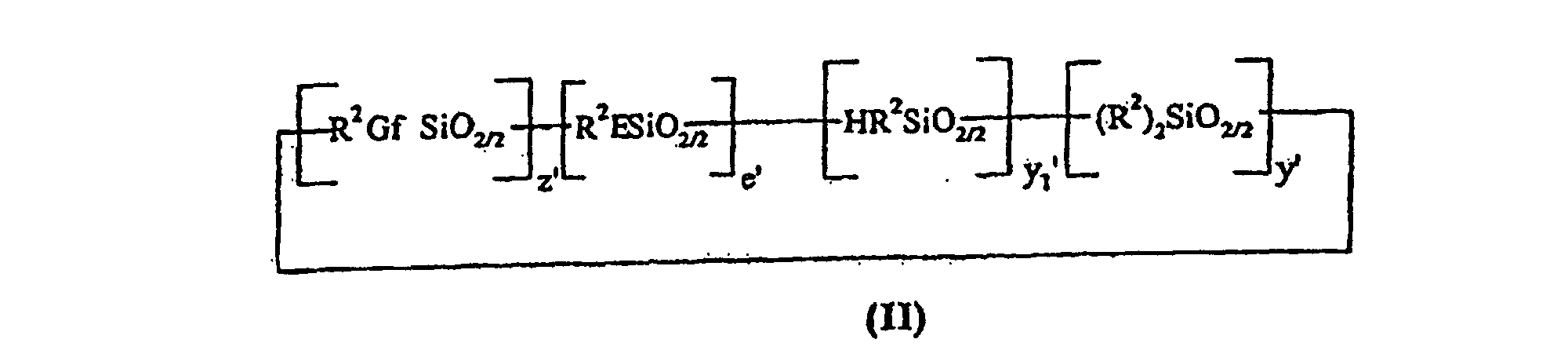 a + b + p = 3; a = 2, 3; b, p = 0,1;unter den Bedingungen, nach denen:z zwischen 0 und 200 umfasst ist, bevorzugt zwischen 1 und 90,y1 zwischen 0 und 10 umfasst ist, bevorzugt zwischen 0 und 5,y zwischen 0 und 50 umfasst ist, bevorzugt 0 und 25,e zwischen 1 und 200 umfasst ist, bevorzugt zwischen 1 und 90,wenn z ≠ 0, dann 5 ≤ z + y1 + y + e ≤ 200, bevorzugt 10 ≤ z + y1 + y + e ≤ 100 und [z/(z + y + y1 + e + 2)]. 100 ≥ 3, bevorzugt 5,wenn z = 0, dann 5 ≤ y + y1 + e ≤ 100, b ist ≠ 0 in mindestens einem der terminalen M monovalenten Siloxylmotive,wenn e ≠ 0, dann 5 ≤ z + y1 + y + e ≤ 200, bevorzugt 10 ≤ z + y1 + y + e ≤ 100 und [z/(z + y + y1 + e + 2)]. 100 ≥ 3, bevorzugt 5,und wenn e = 0, dann 5 ≤ y + y1 + z ≤ 100, p ist ≠ 0 in mindestens einem der M Motive,1 ≤ z' ≤ 9; bevorzugt 1 ≤ z' ≤ 4,5;0 ≤ y'1 ≤ 0,5; bevorzugt 0 ≤ y'1 ≤ 0,25;0 ≤ y' ≤ 5; bevorzugt 0 ≤ y' ≤ 0,5;jedes Radikal R1, R2 ist einerseits identisch mit oder verschieden von seinen Analoga, des gleichen Exponenten, und dem anderen Radikal mit unterschiedlichem Exponenten, und andererseits, eine lineare oder verzweigte C1-C12-, bevorzugt C1-C6-(Cyclo)alkyl-Gruppe darstellt, ein Aryl, ein Aralkyl, ein Alkylaryl, wobei diese Gruppen gegebenenfalls substituiert sind,Gf ein monovalenter funktioneller gegebenenfalls (per)fluorierter Rest ist, der von gleicher Art oder verschieden in den z- oder z'-Siloxylmotiven D und/oder den beiden Siloxylmotiven M, in denen er vorhanden ist, und der nachstehenden mittleren Formel entspricht:
 mit h = 0,1; g = 0,1; j = 0,1 und k = 1 oder 2;unter der Bedingung, nach der mindestens ein Gf-Rest in dem POS (I) oder (II) vorhanden ist, bevorzugt sind die Gf-Reste mindestens in einer Größenordnung von 60 Mol-% vorhanden;Z1 ein divalentes Radikal der Formelist, mit m ≥ 2;
 Z2 ein mono-, di- oder trivalentes Radikal der Formelα.ist, wobei eine oder beide freie Valenzen des Carbonyls (oder der Carbonyle) mit -Z3Rf verbunden ist/sind, und, im Fall, dass nur eine der oben erwähnten freien Valenzen mit -Z3Rf verbunden ist, dann ist die andere mit einem Hydroxyl verbunden,
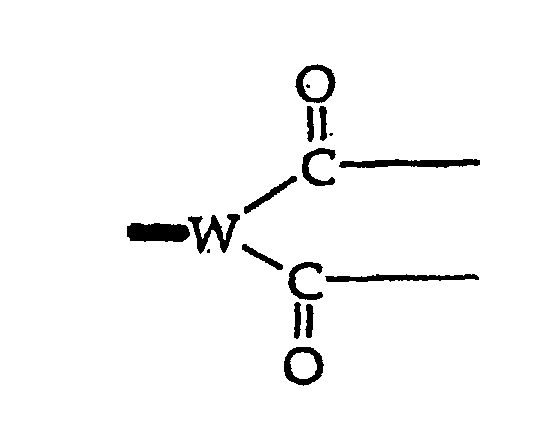 β.mindestens eine der freien Valenzen der Carbonyle mit -Z3-Rf verbunden ist, und im Fall, dass nur eine dieser freien Valenzen mit -Z3-Rf verbunden ist, dann ist die andere mit einem linearen oder verzweigten C1-C6-Alkoxyl verbunden.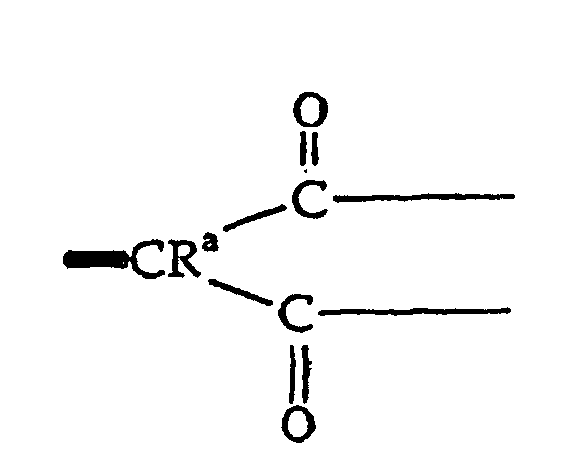
Ra = H, Aryl oder ein verzweigtes oder lineares C1-C6- Niederalkyl, bevorzugt CH3;γ.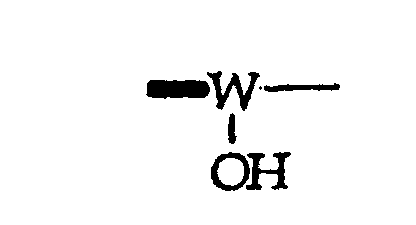 δ.
δ. ε.
ε.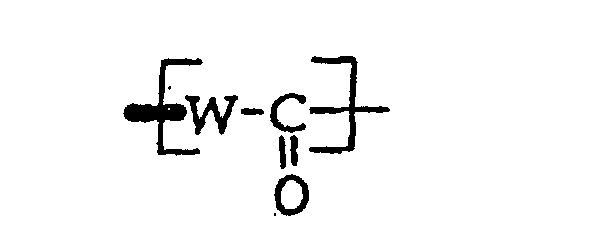 η.
η.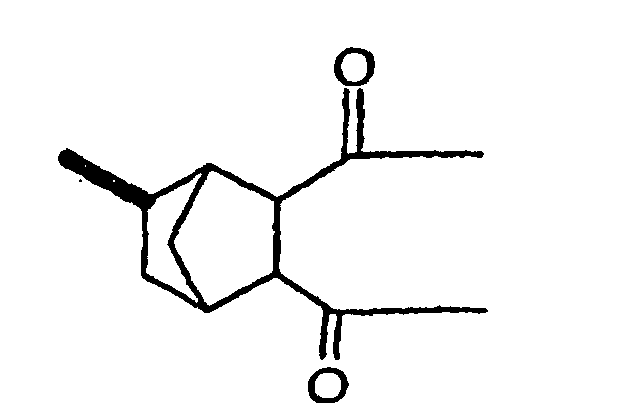 h = 0 in Gf,eine oder beide freie Valenzen des Carbonyls (oder der Carbonyle) mit -Z3-Rf verbunden ist, und im Fall, dass nur eine der obengenannten freien Valenzen mit -Z3Rf verbunden ist, dann ist die andere mit einem Hydroxyl oder einem linearen oder verzweigten C1-C6-Alkoxyl verbunden,.
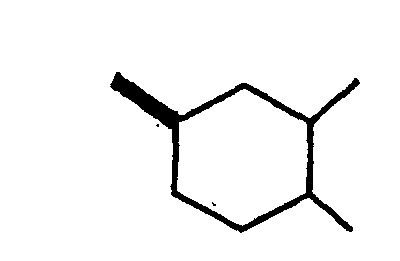 die eine und/oder die andere der beiden verschiedenen freien Valenzen der Valenz -- mit Z3-Rf verbunden ist/sind, und im Fall, dass nur eine dieser zwei Valenzen mit -Z3-Rf verbunden ist, dann ist die andere mit einem OH oder einem linearen oder verzweigten C1-C6-Alkoxyl verbunden;λ.
 die eine und/oder die andere der zwei verschiedenen freien Valenzen der Valenz --, mit Z3-Rf verbunden ist/sind, und in dem Fall, dass nur eine dieser zwei Valenzen mit -Z3-Rf verbunden ist, dann ist die andere mit -OH oder mit einem linearen oder verzweigten C1-C6-Alkoxyl verbunden;Rb = H oder ein lineares oder verzweigtes C1-C6-Niederalkyl; Methyl ist bevorzugt,W stellt ein zyklisches oder nichtzyklisches Kohlenwasserstoffradikal dar, insbesondere ein aliphatisches und/oder Alkenyl und/oder Alkinyl und/oder aromatisch, wobei W außerdem frei von einer Etheroxid-O-Verbindung ist;Z3 ein divalentes Radikal der Formel:ist,
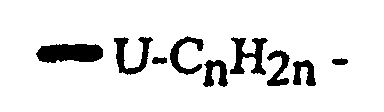 wobei n ≥ 1 und U = O, S, NH, NHSO2, bevorzugt O;und Rf ein perfluoriertes Radikal ist, und noch mehr bevorzugt ein lineares oder verzweigtes Perfluoralkylradikal entsprechend einer der folgenden Formeln:CqF2q - CF3 mit q ≥ 0,
 Z1 der gleichen Definition entspricht, die oben für die Definition von Gf gegeben wurde, mit m ≥ 2,Z2 entspricht:αe.mit mindestens einer mit einem OH verbundenen freien Valenzen eines Carbonyls, oder noch besser sind diese zwei freien Valenzen beide mit dem gleichen Sauerstoffatom verbunden,
 β.e.mit den beiden freien Carbonylvalenzen, die jeweils mit einem linearen oder verzweigten C1-C6-Alkoxyl verbunden sind,
 γe.
γe. δe.oder
 ε.e.wobei die freie Carbonylvalenz mit einem linearen oder verzweigten C1-C6-Alkoxyl verbunden ist, oder noch besser mit einem OH,
 ηe.mit mindestens einer der freien Carbonylvalenzen, die mit einem OH an einem linearen oder verzweigten C1-C6-Alkoxyl verbunden ist, oder besser noch sind diese zwei freien Valenzen beide mit dem gleichen Sauerstoffatom verbunden;
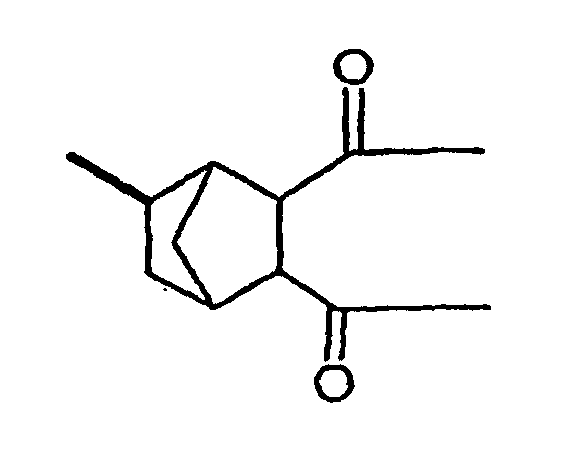 e.
e. die eine und/oder die andere der verschiedenen freien Valenzen der Valenz ― mit Z3-Rf verbunden ist, und im Fall, dass nur eine dieser Zwei Valenzen mit -Z3-Rf verbunden ist, die andere mit einem OH oder einem linearen oder verzweigten C1-C6-Alkoxyl verbunden ist;λe.
 Rb = H oder ein lineares oder verzweigtes C1-C6 Niederalkyl; Methyl ist bevorzugt,Z1, Z2 sind identisch oder verschieden von ihren Analoga, die im darüber beschriebenen Gf vorkommen,W ist wie oben für Gf beschrieben;E2 = Amin; E3 = Alkoxyl; E6 = Hydroxy; E, = Trialkoxysilyl; E8 = Amid; E9 = Ester, E10 = Phenol, E11 = Arylalkoxy; E12 = Aryloxy, E13 = Etherhydroxy.
 - POS gemäß Anspruch 1, dadurch gekennzeichnet, dass sie der folgenden mittleren Formel entsprechen (I.1):in der:
 Gf der Definition gemäß Anspruch 1 entspricht, mit h = g = 1 oder h = 1 und g = 0,E = E1 bis E13,R1, R2 sind wie im Anspruch 1 beschrieben, bevorzugt Methyl, Propyl oder Butyl,c1 und d1 = 3 und bevorzugt c1 = 2, d1 = 1;c2 + d2 = 3 und bevorzugt c2 = 2, d2 = 1;1 ≤ z ≤ 90, bevorzugt 1 ≤ z ≤ 50,1 ≤ e ≤ 100, bevorzugt 1 ≤ e ≤ 60,0 ≤ y1 ≤ 10, bevorzugt 0 ≤ y1 ≤ 5,0 ≤ y ≤ 50, bevorzugt 0 ≤ y ≤ 25.
 - POS gemäß Anspruch 2, dadurch gekennzeichnet, dass sie der folgenden Formel (I1.1) entsprechen:wobei Gf und E wie in Anspruch 1 definiert sind, y, y1, z und e wie in Anspruch 2 definiert sind und Rα, Rω identisch oder verschieden sind, und H oder ein C1-C6-Alkyl darstellen.

- POS gemäß Anspruch 1, dadurch gekennzeichnet, dass sie der folgenden Formel (I.1.2) entsprechen:in der:
 Gf wie in Anspruch 1 definiert istR1 identisch mit oder verschieden von seinen Analoga des gleichen Exponenten = R1 wie in Patentanspruch 1 definiert,
oder aber einer Funktion (E) entspricht, wie sie im Patentanspruch 1 beschrieben wurde, bevorzugt einem epoxyfunktionalen Radikal;R2 identisch oder verschieden von seinen Analoga des gleichen Exponenten ist und der gleichen Definition entspricht, die in Anspruch 1 gegeben wurde;a1 + b1 = a2 + b2 = 3;a1, a2 = 2 oder 3; b1, b2 = 0 oder 1;+ 10 ≤ y ≤ 100, bevorzugt 0 ≤ y ≤ 10;0 ≤ p ≤ 50, bevorzugt 0 ≤ p ≤ 5;wenn p = 0, dann 5 ≤ y ≤ 100 und b1 und/oder b2 ≠ 0;die Formel in der R1 = CH3, b1 = 1 und b2 = 0,mit R10, R11 = oder ≠ und OH, C1-C6-Alkoxyl oder Z3Rf gemäß Anspruch 1 darstellen, wobei mindestens eines der Radikale R10, R11 = Z3Rf, p = 0 und y = 0 oder 1 ist, und die Formel, in der R1 = CH3, b1 = b2 = 0 ist,y = 0 und p = 1 bis 10, bevorzugt 1;
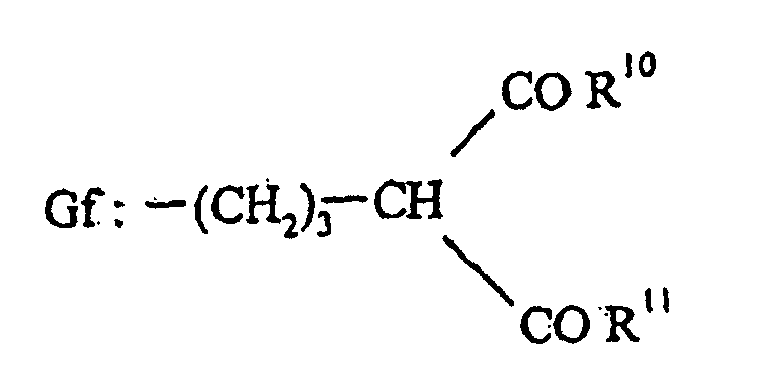 sind besonders bevorzugt.
 - POS gemäß einem der Ansprüche 1 bis 4, dadurch gekennzeichnet, dass sie mindestens eine Sorte (I) und/oder (II), die zumindest durch einen perforierten Rest substituiert sind, die aus der Untergruppe der folgenden Radikale ausgewählt sind:(i)mit
 Ra, R9 unabhängig = H oder lineares oder verzweigtes C1-C6 Niederalkyl, bevorzugt CH3;R10, R11 unabhängig = OH, lineares oder verzweigtes C1-C6-Alkoxyl, oder Z3-Rf; mindestens eines der Radikale R10, R11 stellt -Z3Rf dar;i = 0 bis 10, bevorzugt 0 bis 3, und noch mehr bevorzugt ist i = 1;(ii)mit R9, Ra, R10, R11 und i wie oben definiert;
 (iii)mit R9, R10, R11 und i wie oben definiert; der Hexylring kann gegebenenfalls substituiert sein.
 und die Gemische der obengenannten Radikale.
 - POS gemäß Anspruch 5, dadurch gekennzeichnet, dass sie mindestens eine Art (I) und/oder (II) umfassen, substituiert durch:o mindestens einen perfluorierten Gf-Rest, der der Formel (i), (ii) oder (iii) gemäß Anspruch 5, entspricht,
die Radikale R10 und R11 der jeweiligen Formel, entsprechend Z3Rf, bevorzugtoder
 o und gegebenenfalls durch mindestens einen Gf (i), (ii) oder (iii) Rest, in dem eines der Radikale R10, R11, Z3Rf ist,
und das andere dieser Radikale R10, R11 anders ist als Z3Rf und bevorzugt OH, einem linearen oder verzweigten C1-C6-Alkoxyl entspricht. - POS gemäß einem der Ansprüche 1 bis 6, dadurch gekennzeichnet, dass sie mindestens eine Art (I) und/oder (II) umfassen, die mindestens durch einen Rest E substituiert ist, der ausgewählt ist aus der Untergruppe der Radikale E (ie ), (iie ) und (iiie ) entsprechend den Radikalen Gf (i), (ii) und beziehungsweise (iii) gemäß Anspruch 5, abgesehen von dem Unterschied, dass R10, R11 = oder ≠ sind und nur OH, einem linearen oder verzweigten C1-C6-Alkoxyl entsprechen.
- POS gemäß einem der Ansprüche 1 bis 7, dadurch gekennzeichnet, dass sie unter anderem umfassen:Siloxylmotive:mit den voneinander verschiedenen oder identischen Motiven der Radikale R8 ,die der gleichen Definition entsprechen, wie R1, R2, Gf oder E, die oben gegeben wurde,
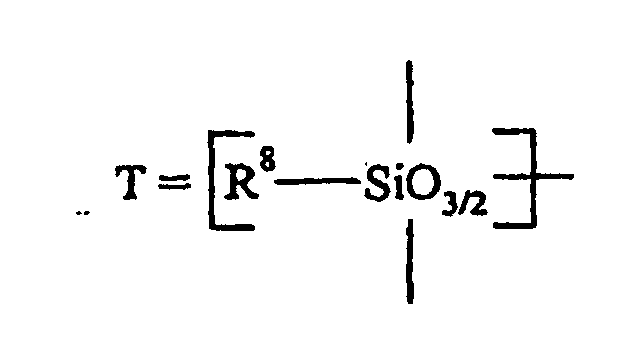 und gegebenenfalls den Motiven:
- Verfahren zur Herstellung von (per)fluoriertem POS gemäß einem der Ansprüche 1 bis 8, dadurch gekennzeichnet, dass es im wesentlichen daraus besteht:A) mindestens ein Polyalkylhydrogensiloxanöl, - bevorzugt Polymethylhydrogensiloxan-,B) mit mindestens einem (per)fluoriertem Vorläuferolefin von Gf und mit der Formel (Gfp) : Z1pRF,
in der:Z1p = olefinischer Vorläufer von Z1,Rf wie in Anspruch 1 definiertC) und/oder mit mindestens einem (per)fluoriertem Olefin der Formel: Z1pZ2P, in der:Z1p = olefinischer Vorläufer von Z1,Z2p = olefinischer Vorläufer von Z2,D) in Gegenwart einer wirksamen Menge eines metallischen Katalysators zur Hydrosylierung, bevorzugt auf Grundlage von Platin umzusetzen; wobei das Umsetzungsprodukt A + C in Gegenwart eines Reaktionsteilnehmers vom Typ Z3p Rf gebracht wird, wobei Z3p = der Vorläufer von Z3 ist, und Rf wie oben definiert ist,
derart, dass man die Übertragungen Gf = -Z1Rf und/oder = -Z1Z2Z3Rf erhält;E) und dann mit einem Reaktionsteilnehmer Ep, der aus einem olefinischen Vorläufer von E gebildet wird, wobei Ep in der Lage ist durch ≡SiH von POS in Gegenwart von D hydrosyliert zu werden. - Verfahren gemäß Anspruch 9, dadurch gekennzeichnet, dassder Vorläufer Ep vom Typ Z1pZ2p ist, wobei Z1p der olefinische Vorläufer von Z1 und Z2p der Vorläufer von Z2 ist; Z1, Z2, Z1p, Z2P identisch oder unterschiedlich von ihren in Gf auftretenden Analoga sind, die oben beschrieben wurden,und dadurch, dass man die Radikale Z1Z2P, die auf POS übertragen wurden, mit mindestens einem reaktiven Bestandteil, der eine Gruppe trägt, die mindestens eine E-Funktion hat, zusammenbringt, um Übertragungen: -Z1Z2E zu produzieren.
- Verfahren gemäß Anspruch 9 oder 10, dadurch gekennzeichnet, dassmindestens ein Teil der Vorläufer Z2p der Z2, die auf das Öl A) übertragen wurden, Säureanhydride sind,dadurch, dass man mindestens einen Teil dieser Anhydridfunktionen einer Hydrolyse unterwirft, umdadurch freie Carboxylendungen zu erzeugen, unddadurch dass man mindestens einen Teil der Carboxylendungen verestert:entweder mit Hilfe der Reaktionsteilnehmer vom Typ Z3p-Rf, wobei Z3p ein Vorläufer von Z3 ist, und Z3 und Rf wie im Anspruch 1 definiert sind,oder mit Hilfe mindestens eines reaktiven Bestandteils, der eine Gruppe trägt, die mindestens eine E-Funktion aufweist.
- Verfahren zur Herstellung von (per)fluorierten zyklischen oder linearen POS, gemäß einem der Ansprüche 1 bis 8, dadurch gekennzeichnet, dass es im wesentlichen daraus besteht umzusetzen:A) mindestens ein Polyalkylhydrogensiloxan - bevorzugt Polymethylhydrogenosiloxan - ,F) mit mindestens einem (per)fluoriertem Vorläuferolefin von Gf und mit der Formel (Gf p):in der:
 Z1p der olefinische Vorläufer des Radikals Z1 wie oben in Anspruch 1 definiert ist,Z2, Z3, Rf, h, g, j und k sind ebenfalls in Anspruch 1 definiert, unter der Bedingung, dass falls h = 0, dann g =1 und Z2 wird ein olefinischer Vorläufer Z2p;G) und/oder mindestens einen olefinischen Vorläufer Ep von E;D) in Gegenwart einer wirksamen Menge eines metallischen Katalysators zur Hydrosylierung, bevorzugt auf Grundlage von Platin.
 - Verfahren gemäß Anspruch 12, dadurch gekennzeichnet, dass der Vorläufer Gfp von Gf mindestens einer der folgenden Formeln entspricht:(ip)
 mit Ra, R9 unabhängig = H oder ein verzweigtes oder lineares C1-C6-Alkyl, bevorzugt CH3;R10, R11 unabhängig = OH, lineares oder verzweigtes C1-C6-Alkoxyl oder Z3-Rf;i = 0 bis 10, bevorzugt 0 bis 3, und noch mehr bevorzugt ist i = 1;(iip)mit R9, Ra, R10, R11 und i wie oben definiert;
 (iiip)mit R9, R10, R11 und i wie oben definiert; der Hexylring kann gegebenenfalls substituiert sein.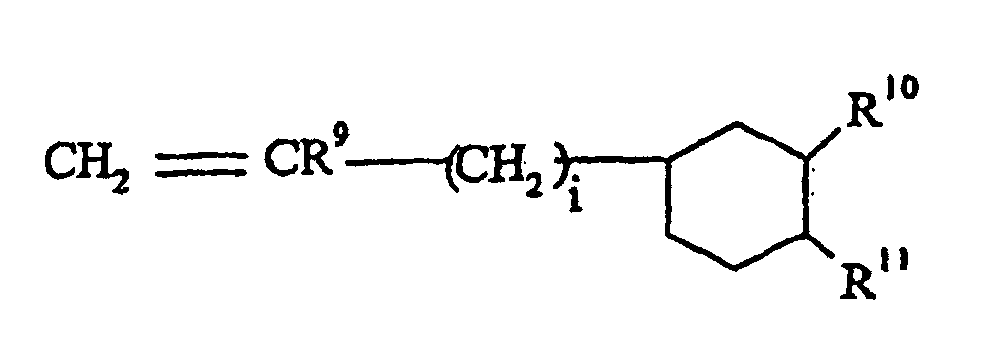
- Verfahren gemäß Anspruch 13, dadurch gekennzeichnet, dass die Vorläufer Gfp der Übertragungen Gf ein oder zwei perfluorierte Gruppen R10, R11 aufweisen (R10 und/oder R11 = Z3Rf) und erhalten werden durch die Umsetzung nach einem Transesterifizierungsverfahren:von mindestens einem mobilen Hydrogenbestandteil, der durch das hydrogenierte Radikal Z3Rf gebildet wird, d.h.: H-Z3Rf, gemäß Anspruch 1; bevorzugt ein Alkohol oder ein Thiol;mit Ausgangsprodukten, die aus Verbindungen der Formel (ip) (iip) oder (iiip) wie in Anspruch 11 definiert gebildet sind, und in denen mindestens eines der Radikale R10, R11 ein lineares oder verzweigtes C1-C6-Alkoxyl ist.
- Verfahren gemäß einem der Ansprüche 9 bis 14, dadurch gekennzeichnet, dass der olefinische Vorläufer Ep der Übertragung E mindestens einer der Formeln (iep), (iiep) und (iiiep), bzw. den Formeln (ip), (iip) und (iiip) entspricht, die in dem Anspruch 13 für Gfp angegeben wurden, außer mit dem Unterschied, dass R10, R11 = oder ≠ sind und nur OH, verzweigtem oder linearem C1-C6-Alkoxyl entsprechen.
- Reaktionszwischenprodukt (Synthon), das dafür geeignet ist, insbesondere in dem Verfahren gemäß den Ansprüchen 12, 13, 14 oder 15 eingesetzt werden kann, dadurch gekennzeichnet, dass es mindestens einer der folgenden Formeln entspricht :(ip)mit
 Ra, R9 unabhängig = H oder lineares oder verzweigtes C1-C6-Niederalkyl, bevorzugt CH3;mindestens eines der Radikale R10, R11 entspricht einem linearen oder verzweigten C1-C6-Alkoxyl, dem Methoxyl und Ethoxyl und dem Propyl;(iip)mit R9, Ra, R10, R11 und i wie oben definiert;
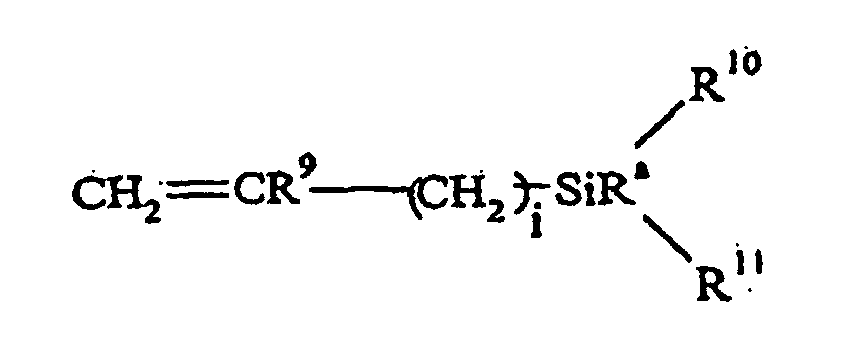 (iiip)mit R9, R10, R11 wie oben definiert; der Hexylring kann gegebenenfalls substituiert sein.
- Wässrige Emulsion, dadurch gekennzeichnet, dass sie enthält:mindestens ein POS gemäß einem der Ansprüche 1 bis 8 oder erhalten durch das Verfahren gemäß einem der Ansprüche 9 bis 15;Wasser;und mindestens ein Tensid.
- Verwendung eines POS gemäß einem der Ansprüche 1 bis 8 oder erhalten durch das Verfahren gemäß einem der Ansprüche 9 bis 15 für:ein Antischaummittel,ein Schmiermittel,ein Antihaftmittel,ein Oberflächenspannungssenker,einem Fäulnisschutzmittel,einem oleophoben und/oder hydrophoben Mittel,einem Ausgangsmaterial zur Herstellung von Elastomeren oder Schichten, die gegenüber chemischen Aggressionen uns Lösungsmitteln resistent sind.
- Antifäulniszusammensetzung, dadurch gekennzeichnet, dass sie umfasst:mindestens eine POS gemäß einem der Ansprüche 1 bis 8 oder erhalten durch das Verfahren gemäß einem der Ansprüche 9 bis 15;und/oder mindestens einer Emulsion gemäß Anspruch 7,wobei das oder die obengenannten POS, das verwendet wird, bevorzugt POS sind, die Träger sind von:bifiden Gf-Übertragungen, die durch perfluorierte Radikale bifunktionalisiert sind, wie in Anspruch 5 definiert,andere E-Übertragungen, die andere Funktionen als die bi- oder monoperfluorierten Funktionen funktionalisiert sind, wie in Anspruch 7 definiert,und schließlich bifiden Gf-Übertragungen, die durch perfluorierte Radikale monofunktionalisiert sind, wobei auch diese in Anspruch 5 definiert sind.
Applications Claiming Priority (2)
| Application Number | Priority Date | Filing Date | Title |
|---|---|---|---|
| FR9509268A FR2737214B1 (fr) | 1995-07-25 | 1995-07-25 | Polyorganosiloxanes perhalogenes polyfonctionnels et leurs procedes d'obtention |
| FR9509268 | 1995-07-25 |
Publications (2)
| Publication Number | Publication Date |
|---|---|
| EP0755960A1 EP0755960A1 (de) | 1997-01-29 |
| EP0755960B1 true EP0755960B1 (de) | 2002-11-27 |
Family
ID=9481536
Family Applications (1)
| Application Number | Title | Priority Date | Filing Date |
|---|---|---|---|
| EP96420251A Expired - Lifetime EP0755960B1 (de) | 1995-07-25 | 1996-07-25 | Polyfunktionelle perfluorierte Polyorganosiloxane und Verfahren zu deren Herstellung |
Country Status (19)
| Country | Link |
|---|---|
| US (2) | US6184329B1 (de) |
| EP (1) | EP0755960B1 (de) |
| JP (2) | JP3150288B2 (de) |
| AT (1) | ATE228540T1 (de) |
| AU (1) | AU707197B2 (de) |
| BR (1) | BR9604020A (de) |
| CA (1) | CA2182109C (de) |
| CZ (1) | CZ220796A3 (de) |
| DE (1) | DE69624987T2 (de) |
| DK (1) | DK0755960T3 (de) |
| ES (1) | ES2187630T3 (de) |
| FR (1) | FR2737214B1 (de) |
| HU (1) | HUP9602030A3 (de) |
| IL (1) | IL118953A0 (de) |
| PL (1) | PL315410A1 (de) |
| PT (1) | PT755960E (de) |
| SG (1) | SG64942A1 (de) |
| SK (1) | SK98496A3 (de) |
| TR (1) | TR199600615A2 (de) |
Families Citing this family (19)
| Publication number | Priority date | Publication date | Assignee | Title |
|---|---|---|---|---|
| FR2781491B1 (fr) * | 1998-07-21 | 2002-12-20 | Rhodia Chimie Sa | Utilisation d'une composition silicone fonctionnalisee pour la realisation de revetement et/ou d'impregnation hydrophobe et/ou oleophobe, a faible energie de surface |
| JP2000248183A (ja) * | 1999-02-26 | 2000-09-12 | Dow Corning Toray Silicone Co Ltd | シリコーンゴム組成物 |
| FR2796862A1 (fr) * | 1999-07-26 | 2001-02-02 | Centre Nat Rech Scient | Composition de polymere et son utilisation pour l'elaboration d'une membrane permselective |
| JP4725986B2 (ja) * | 2000-08-22 | 2011-07-13 | Jnc株式会社 | 変性ポリオルガノシロキサンおよびその製造方法 |
| DE10012913A1 (de) | 2000-03-16 | 2001-09-20 | Ciba Sc Pfersee Gmbh | Polyorganosiloxane mit alkoxilierten Seitenketten |
| GB0112525D0 (en) * | 2001-05-23 | 2001-07-11 | Dow Corning | Polysiloxanes and gels and pastes containing them |
| CA2538860A1 (en) * | 2006-03-08 | 2007-09-08 | Jian Liu | Conversion 9-dihydro-13-acetylbaccatin iii to 10-deacetylbaccatin iii |
| US7435537B2 (en) * | 2006-06-21 | 2008-10-14 | International Business Machines Corporation | Fluorinated half ester of maleic anhydride polymers for dry 193 nm top antireflective coating application |
| JP5110630B2 (ja) * | 2007-03-26 | 2012-12-26 | 旭化成ケミカルズ株式会社 | エポキシ変性シリコーンの製造方法 |
| JP2009256616A (ja) * | 2008-03-21 | 2009-11-05 | Shin Etsu Chem Co Ltd | グリセリン変性シリコーン及びそれを含む化粧料 |
| JP5532648B2 (ja) * | 2008-04-03 | 2014-06-25 | 信越化学工業株式会社 | カルボキシル基を有するオルガノポリシロキサンで表面処理された粉体、該粉体の分散物および該粉体を含む化粧料 |
| JP5353357B2 (ja) * | 2008-04-03 | 2013-11-27 | 信越化学工業株式会社 | カルボキシル基を有するオルガノポリシロキサン |
| CN102209685A (zh) | 2008-09-30 | 2011-10-05 | 赫姆洛克半导体公司 | 测定污染高纯硅的污染材料中杂质的量的方法和用于处理高纯硅的炉子 |
| JP5828292B2 (ja) * | 2011-11-25 | 2015-12-02 | 信越化学工業株式会社 | 酸無水物基含有オルガノシロキサン及びその製造方法 |
| JP5790480B2 (ja) * | 2011-12-20 | 2015-10-07 | 信越化学工業株式会社 | 酸無水物基含有オルガノシロキサン及びその製造方法 |
| US20140303284A1 (en) * | 2013-03-15 | 2014-10-09 | The Sherwin-Williams Company | Expoxyfluorosilicones and modified polyacrylic resins for coating compositions |
| CN104086776B (zh) * | 2014-06-19 | 2018-07-27 | 巨化集团技术中心 | 一种含官能团氟改性硅油及其制备方法 |
| US11492448B2 (en) | 2017-06-26 | 2022-11-08 | Dow Silicones Corporation | Method for hydrosilylation of aliphatically unsaturated alkoxysilanes and hydrogen terminated organosiloxane oligomers to prepare alkoxysilyl terminated polymers useful for functionalizing polyorganosiloxanes using a cobalt catalyst |
| US11311907B2 (en) * | 2017-12-22 | 2022-04-26 | Ut-Battelle, Llc | Superomniphobic coatings and methods of preparation |
Family Cites Families (19)
| Publication number | Priority date | Publication date | Assignee | Title |
|---|---|---|---|---|
| US3455878A (en) * | 1964-10-09 | 1969-07-15 | Dow Corning | Adducts of silicon hydrides polysiloxanes and hydrolyzable silanes having alkenyl radicals |
| US4036807A (en) * | 1972-05-22 | 1977-07-19 | Imperial Chemical Industries Limited | Fluorine-containing organosilicon compounds |
| JPS6017416B2 (ja) * | 1980-05-28 | 1985-05-02 | 信越化学工業株式会社 | オルガノポリシロキサン化合物 |
| JPS62277470A (ja) * | 1986-05-23 | 1987-12-02 | Shin Etsu Chem Co Ltd | 合成樹脂用改質剤 |
| US5140087A (en) * | 1988-04-22 | 1992-08-18 | Chisso Corporation | Organosiloxane and process for preparing the same |
| JPH0618880B2 (ja) * | 1989-02-21 | 1994-03-16 | 信越化学工業株式会社 | フルオロオルガノポリシロキサン及びその製造方法 |
| JPH0668077B2 (ja) * | 1989-10-20 | 1994-08-31 | 信越化学工業株式会社 | シリコーンゴム組成物 |
| JPH07119364B2 (ja) * | 1990-08-03 | 1995-12-20 | 信越化学工業株式会社 | 硬化性シリコーン組成物およびその硬化物 |
| JP2669948B2 (ja) * | 1991-02-18 | 1997-10-29 | 信越化学工業株式会社 | 硬化性フルオロシリコ−ンポリマ−組成物 |
| US5178959A (en) * | 1991-03-27 | 1993-01-12 | General Electric Company | Epoxy-functional fluorosilicones |
| US5244947A (en) | 1991-12-31 | 1993-09-14 | Kimberly-Clark Corporation | Stabilization of polyolefin nonwoven webs against actinic radiation |
| WO1993018085A1 (fr) * | 1992-03-10 | 1993-09-16 | Kao Corporation | Derive de silicone modifie par le fluor, production de ce derive et cosmetique en contenant |
| US5233071A (en) * | 1992-03-17 | 1993-08-03 | E. I. Du Pont De Nemours And Company | Hydrosilation of fluorinated olefins with cobalt catalysts |
| DE4240274B4 (de) * | 1992-12-01 | 2004-02-12 | Minnesota Mining And Manufacturing Co., Saint Paul | Polysiloxane mit fluoraliphaten- und carboxylhaltigen terminalen Gruppen, ihre Herstellung und ihre Verwendung bei der Behandlung von Fasersubstraten |
| DE4244951C2 (de) * | 1992-12-01 | 1998-08-06 | Minnesota Mining & Mfg | Fasersubstrat mit Wasser-, Öl-, Schmutzabweisungsvermögen und Weichgriffigkeit |
| DE4329262A1 (de) * | 1993-08-31 | 1995-03-02 | Bayer Ag | Fluoratome enthaltende Alkoxysilanverbindungen |
| US5461173A (en) * | 1993-12-27 | 1995-10-24 | Shin-Etsu Chemical Co., Ltd. | Fluorine-containing organosilicon compound and its manufacture |
| DE4443824A1 (de) * | 1994-12-09 | 1996-06-13 | Huels Chemische Werke Ag | Organopolysiloxan-haltige Zusammensetzungen auf Wasserbasis, Verfahren zu deren Herstellung sowie deren Verwendung |
| US9929475B2 (en) | 2010-05-10 | 2018-03-27 | Korea Institute Of Machinery & Materials | Waveband electromagnetic wave absorber and method for manufacturing same |
-
1995
- 1995-07-25 FR FR9509268A patent/FR2737214B1/fr not_active Expired - Fee Related
-
1996
- 1996-07-25 CA CA002182109A patent/CA2182109C/fr not_active Expired - Fee Related
- 1996-07-25 CZ CZ962207A patent/CZ220796A3/cs unknown
- 1996-07-25 AU AU60711/96A patent/AU707197B2/en not_active Ceased
- 1996-07-25 IL IL11895396A patent/IL118953A0/xx unknown
- 1996-07-25 US US08/687,044 patent/US6184329B1/en not_active Expired - Fee Related
- 1996-07-25 AT AT96420251T patent/ATE228540T1/de not_active IP Right Cessation
- 1996-07-25 DE DE69624987T patent/DE69624987T2/de not_active Expired - Fee Related
- 1996-07-25 PL PL96315410A patent/PL315410A1/xx unknown
- 1996-07-25 ES ES96420251T patent/ES2187630T3/es not_active Expired - Lifetime
- 1996-07-25 SK SK984-96A patent/SK98496A3/sk unknown
- 1996-07-25 TR TR96/00615A patent/TR199600615A2/xx unknown
- 1996-07-25 BR BR9604020A patent/BR9604020A/pt not_active IP Right Cessation
- 1996-07-25 DK DK96420251T patent/DK0755960T3/da active
- 1996-07-25 SG SG1996010337A patent/SG64942A1/en unknown
- 1996-07-25 PT PT96420251T patent/PT755960E/pt unknown
- 1996-07-25 HU HU9602030A patent/HUP9602030A3/hu unknown
- 1996-07-25 EP EP96420251A patent/EP0755960B1/de not_active Expired - Lifetime
- 1996-07-25 JP JP22578496A patent/JP3150288B2/ja not_active Expired - Fee Related
-
1999
- 1999-02-09 US US09/247,099 patent/US6197987B1/en not_active Expired - Fee Related
-
2000
- 2000-03-21 JP JP2000078199A patent/JP3398643B2/ja not_active Expired - Fee Related
Also Published As
| Publication number | Publication date |
|---|---|
| DE69624987T2 (de) | 2003-08-21 |
| JP3398643B2 (ja) | 2003-04-21 |
| FR2737214B1 (fr) | 1997-10-24 |
| JP2000297064A (ja) | 2000-10-24 |
| JP3150288B2 (ja) | 2001-03-26 |
| SG64942A1 (en) | 1999-05-25 |
| IL118953A0 (en) | 1996-10-31 |
| US6197987B1 (en) | 2001-03-06 |
| HUP9602030A3 (en) | 1997-08-28 |
| HU9602030D0 (en) | 1996-09-30 |
| PL315410A1 (en) | 1997-02-03 |
| ATE228540T1 (de) | 2002-12-15 |
| DE69624987D1 (de) | 2003-01-09 |
| AU707197B2 (en) | 1999-07-08 |
| CA2182109C (fr) | 2001-04-24 |
| US6184329B1 (en) | 2001-02-06 |
| ES2187630T3 (es) | 2003-06-16 |
| CZ220796A3 (en) | 1997-02-12 |
| FR2737214A1 (fr) | 1997-01-31 |
| TR199600615A2 (tr) | 1997-02-21 |
| BR9604020A (pt) | 1998-06-09 |
| JPH09104758A (ja) | 1997-04-22 |
| PT755960E (pt) | 2003-04-30 |
| SK98496A3 (en) | 1997-04-09 |
| AU6071196A (en) | 1997-01-30 |
| EP0755960A1 (de) | 1997-01-29 |
| DK0755960T3 (da) | 2003-03-24 |
| CA2182109A1 (fr) | 1997-01-26 |
| HUP9602030A2 (en) | 1997-04-28 |
Similar Documents
| Publication | Publication Date | Title |
|---|---|---|
| EP0755960A1 (de) | Polyfunktionelle perhalogenierte Polyorganosiloxane und Verfahren zu deren Herstellung | |
| EP0792322B1 (de) | Funktionalisierte polyorganosiloxane und verfahren zu deren herstellung | |
| JP3086259B2 (ja) | 官能化ポリオルガノシロキサン及びその一つの製造方法 | |
| CN109475489A (zh) | 制备含有甘油取代基的硅氧烷的方法 | |
| FR2573083A1 (fr) | Copolymeres organosiloxane-oxyalkylene, leur preparation et leur utilisation | |
| JPH02276824A (ja) | 新規なオルガノポリシロキサン及びその製造方法 | |
| EP1115802B1 (de) | Verwendung einer funktionalisierten siliconzusammensetzung zur herstellung von wasser- und/oder ölabweisenden beschichtungen und /oder imprägnierungen mit einer niedrigen oberflächenenergie | |
| FR2717179A1 (fr) | Polyéther-silicones carboxylés et leurs sels, procédé pour les préparer, polyéther-silicones servant de produits de départ pour les préparer, et formulations de soins personnels contenant ces composés. | |
| EP0755961B1 (de) | Halogenierte Polyorganosiloxane und Verfahren zu deren Herstellung | |
| JP2026505816A (ja) | 新規な官能化オルガノポリシロキサン化合物、その製造方法及び用途 | |
| MXPA96002966A (en) | Perthalogenated polygerganosiloxanes and obtenc susprocediments | |
| FR2616152A1 (fr) | Nouveaux polysilanes, polysilanes modifies correspondants, leur preparation et leur application dans des compositions reticulables | |
| FR2546171A1 (fr) | Copolymeres organosiloxane/oxyalkylene | |
| MXPA96002965A (en) | Polifunctional perhalogenic polygenagroxilians and their obtenc procedures | |
| FR2704228A1 (fr) | Copolymères de siloxanes à groupes oxaalkylenestyrene réticulables et revêtement anti-adhésifs pour papier formés à partir de ces copolymères. | |
| JPH11228701A (ja) | ポリシロキサン |
Legal Events
| Date | Code | Title | Description |
|---|---|---|---|
| PUAI | Public reference made under article 153(3) epc to a published international application that has entered the european phase |
Free format text: ORIGINAL CODE: 0009012 |
|
| AK | Designated contracting states |
Kind code of ref document: A1 Designated state(s): AT BE CH DE DK ES FI FR GB GR IE IT LI NL PT SE |
|
| 17P | Request for examination filed |
Effective date: 19970609 |
|
| RAP1 | Party data changed (applicant data changed or rights of an application transferred) |
Owner name: RHODIA CHIMIE |
|
| 17Q | First examination report despatched |
Effective date: 20000721 |
|
| GRAG | Despatch of communication of intention to grant |
Free format text: ORIGINAL CODE: EPIDOS AGRA |
|
| RTI1 | Title (correction) |
Free format text: POLYFUNCTIONAL PERFLUORINATED POLYORGANOSILOXANES AND PROCESSES FOR THEIR PREPARATION |
|
| RTI1 | Title (correction) |
Free format text: POLYFUNCTIONAL PERFLUORINATED POLYORGANOSILOXANES AND PROCESSES FOR THEIR PREPARATION |
|
| GRAG | Despatch of communication of intention to grant |
Free format text: ORIGINAL CODE: EPIDOS AGRA |
|
| GRAH | Despatch of communication of intention to grant a patent |
Free format text: ORIGINAL CODE: EPIDOS IGRA |
|
| GRAH | Despatch of communication of intention to grant a patent |
Free format text: ORIGINAL CODE: EPIDOS IGRA |
|
| GRAA | (expected) grant |
Free format text: ORIGINAL CODE: 0009210 |
|
| AK | Designated contracting states |
Kind code of ref document: B1 Designated state(s): AT BE CH DE DK ES FI FR GB GR IE IT LI NL PT SE |
|
| REF | Corresponds to: |
Ref document number: 228540 Country of ref document: AT Date of ref document: 20021215 Kind code of ref document: T |
|
| REG | Reference to a national code |
Ref country code: GB Ref legal event code: FG4D Free format text: NOT ENGLISH |
|
| REG | Reference to a national code |
Ref country code: CH Ref legal event code: EP |
|
| REG | Reference to a national code |
Ref country code: IE Ref legal event code: FG4D Free format text: FRENCH |
|
| REF | Corresponds to: |
Ref document number: 69624987 Country of ref document: DE Date of ref document: 20030109 |
|
| REG | Reference to a national code |
Ref country code: CH Ref legal event code: NV Representative=s name: BOVARD AG PATENTANWAELTE |
|
| REG | Reference to a national code |
Ref country code: DK Ref legal event code: T3 |
|
| REG | Reference to a national code |
Ref country code: GR Ref legal event code: EP Ref document number: 20030400659 Country of ref document: GR |
|
| GBT | Gb: translation of ep patent filed (gb section 77(6)(a)/1977) |
Effective date: 20030326 |
|
| REG | Reference to a national code |
Ref country code: PT Ref legal event code: SC4A Free format text: AVAILABILITY OF NATIONAL TRANSLATION Effective date: 20030226 |
|
| REG | Reference to a national code |
Ref country code: ES Ref legal event code: FG2A Ref document number: 2187630 Country of ref document: ES Kind code of ref document: T3 |
|
| PLBE | No opposition filed within time limit |
Free format text: ORIGINAL CODE: 0009261 |
|
| STAA | Information on the status of an ep patent application or granted ep patent |
Free format text: STATUS: NO OPPOSITION FILED WITHIN TIME LIMIT |
|
| 26N | No opposition filed |
Effective date: 20030828 |
|
| PGFP | Annual fee paid to national office [announced via postgrant information from national office to epo] |
Ref country code: PT Payment date: 20040630 Year of fee payment: 9 |
|
| PGFP | Annual fee paid to national office [announced via postgrant information from national office to epo] |
Ref country code: SE Payment date: 20040706 Year of fee payment: 9 |
|
| PGFP | Annual fee paid to national office [announced via postgrant information from national office to epo] |
Ref country code: AT Payment date: 20040713 Year of fee payment: 9 |
|
| PGFP | Annual fee paid to national office [announced via postgrant information from national office to epo] |
Ref country code: IE Payment date: 20040714 Year of fee payment: 9 Ref country code: FI Payment date: 20040714 Year of fee payment: 9 |
|
| PGFP | Annual fee paid to national office [announced via postgrant information from national office to epo] |
Ref country code: DK Payment date: 20040715 Year of fee payment: 9 |
|
| PGFP | Annual fee paid to national office [announced via postgrant information from national office to epo] |
Ref country code: GR Payment date: 20040727 Year of fee payment: 9 |
|
| PG25 | Lapsed in a contracting state [announced via postgrant information from national office to epo] |
Ref country code: FI Free format text: LAPSE BECAUSE OF NON-PAYMENT OF DUE FEES Effective date: 20050710 |
|
| PG25 | Lapsed in a contracting state [announced via postgrant information from national office to epo] |
Ref country code: IE Free format text: LAPSE BECAUSE OF NON-PAYMENT OF DUE FEES Effective date: 20050725 Ref country code: AT Free format text: LAPSE BECAUSE OF NON-PAYMENT OF DUE FEES Effective date: 20050725 |
|
| PG25 | Lapsed in a contracting state [announced via postgrant information from national office to epo] |
Ref country code: SE Free format text: LAPSE BECAUSE OF NON-PAYMENT OF DUE FEES Effective date: 20050726 |
|
| PG25 | Lapsed in a contracting state [announced via postgrant information from national office to epo] |
Ref country code: DK Free format text: LAPSE BECAUSE OF NON-PAYMENT OF DUE FEES Effective date: 20050801 |
|
| PG25 | Lapsed in a contracting state [announced via postgrant information from national office to epo] |
Ref country code: PT Free format text: LAPSE BECAUSE OF NON-PAYMENT OF DUE FEES Effective date: 20060125 |
|
| PG25 | Lapsed in a contracting state [announced via postgrant information from national office to epo] |
Ref country code: GR Free format text: LAPSE BECAUSE OF NON-PAYMENT OF DUE FEES Effective date: 20060202 |
|
| EUG | Se: european patent has lapsed | ||
| REG | Reference to a national code |
Ref country code: DK Ref legal event code: EBP |
|
| REG | Reference to a national code |
Ref country code: IE Ref legal event code: MM4A |
|
| PGFP | Annual fee paid to national office [announced via postgrant information from national office to epo] |
Ref country code: ES Payment date: 20080716 Year of fee payment: 13 Ref country code: DE Payment date: 20080807 Year of fee payment: 13 Ref country code: CH Payment date: 20080815 Year of fee payment: 13 |
|
| PGFP | Annual fee paid to national office [announced via postgrant information from national office to epo] |
Ref country code: NL Payment date: 20080703 Year of fee payment: 13 Ref country code: IT Payment date: 20080728 Year of fee payment: 13 Ref country code: FR Payment date: 20080718 Year of fee payment: 13 |
|
| PGFP | Annual fee paid to national office [announced via postgrant information from national office to epo] |
Ref country code: GB Payment date: 20080806 Year of fee payment: 13 |
|
| PGFP | Annual fee paid to national office [announced via postgrant information from national office to epo] |
Ref country code: BE Payment date: 20090126 Year of fee payment: 13 |
|
| BERE | Be: lapsed |
Owner name: *RHODIA CHIMIE Effective date: 20090731 |
|
| REG | Reference to a national code |
Ref country code: CH Ref legal event code: PL |
|
| GBPC | Gb: european patent ceased through non-payment of renewal fee |
Effective date: 20090725 |
|
| NLV4 | Nl: lapsed or anulled due to non-payment of the annual fee |
Effective date: 20100201 |
|
| REG | Reference to a national code |
Ref country code: FR Ref legal event code: ST Effective date: 20100331 |
|
| PG25 | Lapsed in a contracting state [announced via postgrant information from national office to epo] |
Ref country code: LI Free format text: LAPSE BECAUSE OF NON-PAYMENT OF DUE FEES Effective date: 20090731 Ref country code: FR Free format text: LAPSE BECAUSE OF NON-PAYMENT OF DUE FEES Effective date: 20090731 Ref country code: CH Free format text: LAPSE BECAUSE OF NON-PAYMENT OF DUE FEES Effective date: 20090731 |
|
| PG25 | Lapsed in a contracting state [announced via postgrant information from national office to epo] |
Ref country code: GB Free format text: LAPSE BECAUSE OF NON-PAYMENT OF DUE FEES Effective date: 20090725 |
|
| PG25 | Lapsed in a contracting state [announced via postgrant information from national office to epo] |
Ref country code: DE Free format text: LAPSE BECAUSE OF NON-PAYMENT OF DUE FEES Effective date: 20100202 Ref country code: BE Free format text: LAPSE BECAUSE OF NON-PAYMENT OF DUE FEES Effective date: 20090731 |
|
| REG | Reference to a national code |
Ref country code: ES Ref legal event code: FD2A Effective date: 20090727 |
|
| PG25 | Lapsed in a contracting state [announced via postgrant information from national office to epo] |
Ref country code: ES Free format text: LAPSE BECAUSE OF NON-PAYMENT OF DUE FEES Effective date: 20090727 |
|
| PG25 | Lapsed in a contracting state [announced via postgrant information from national office to epo] |
Ref country code: IT Free format text: LAPSE BECAUSE OF NON-PAYMENT OF DUE FEES Effective date: 20090725 |
|
| PG25 | Lapsed in a contracting state [announced via postgrant information from national office to epo] |
Ref country code: NL Free format text: LAPSE BECAUSE OF NON-PAYMENT OF DUE FEES Effective date: 20100201 |