EP0753478B1 - Verfahren zum Anhalten eines Aufzuges in einem Stockwerk - Google Patents
Verfahren zum Anhalten eines Aufzuges in einem Stockwerk Download PDFInfo
- Publication number
- EP0753478B1 EP0753478B1 EP96111176A EP96111176A EP0753478B1 EP 0753478 B1 EP0753478 B1 EP 0753478B1 EP 96111176 A EP96111176 A EP 96111176A EP 96111176 A EP96111176 A EP 96111176A EP 0753478 B1 EP0753478 B1 EP 0753478B1
- Authority
- EP
- European Patent Office
- Prior art keywords
- velocity
- deceleration
- elevator
- distance
- dmin
- Prior art date
- Legal status (The legal status is an assumption and is not a legal conclusion. Google has not performed a legal analysis and makes no representation as to the accuracy of the status listed.)
- Expired - Lifetime
Links
Images
Classifications
-
- B—PERFORMING OPERATIONS; TRANSPORTING
- B66—HOISTING; LIFTING; HAULING
- B66B—ELEVATORS; ESCALATORS OR MOVING WALKWAYS
- B66B1/00—Control systems of elevators in general
- B66B1/34—Details, e.g. call counting devices, data transmission from car to control system, devices giving information to the control system
- B66B1/36—Means for stopping the cars, cages, or skips at predetermined levels
- B66B1/44—Means for stopping the cars, cages, or skips at predetermined levels and for taking account of disturbance factors, e.g. variation of load weight
Definitions
- the present invention relates to a procedure for decelerating an elevator by the methods defined in the preambles of claims 1 and 5.
- An important aim in the control of an elevator drive is to ensure that, when the elevator comes to a standstill, the floor of the elevator car is as closely as possible at the same level with the landing floor.
- Advanced elevator control systems employ distance and speed feedback to bring the elevator to the landing.
- the speed curve of the elevator car is optimized by adjusting the values of velocity, acceleration and change of acceleration in advance or during operation. In addition to complicated control equipment, these systems also require accurate and fast measuring apparatus to achieve the results aimed at.
- Elevator drives used in low-rise buildings, where the elevators travel at low speeds, are generally simple and without a full regulation capability.
- elevators e.g. one-speed or two-speed squirrel cage motor drives or motor drives controlled by simple regulators are used.
- simple regulators simple regulators
- EP A1 582 170 presents a prior-art solution based on the change occurring in the slip of a squirrel cage motor due to the load. The onset of deceleration is delayed depending on how much lower the car speed is than the car speed when the elevator is being driven in the up direction with an empty car or in the down direction with a full car, which represents the lightest load situation.
- the elevator control system reacts to the signal requiring the elevator to stop at a landing by measuring the speed of the elevator car and comparing the measured speed with the car speed corresponding to the highest possible speed and delaying the onset of deceleration until the measured speed and the deceleration curve defined for the elevator intersect, at which point deceleration is started in accordance with a constant decelation curve.
- Changes in the properties of the equipment are taken into account by changing the deceleration.
- variations in normal operating conditions are not considered, but the same deceleration value is always used.
- Variations in operating or environmental conditions cause errors in the control of levelling the car with the landing. In this case, in consequence of a slight overload, the elevator speed exceeds the highest or is below the lowest design speed.
- an exceptionally abnormal load may produce changes in the friction between the guide rails and the guides. Changes in the variation of the operating voltage affect the operating point, with the result that the slip and the torque differ from the calculated values.
- the object of the present invention is to achieve a new solution for controlling the levelling of an elevator car with a landing that eliminates the drawbacks present in earlier solutions.
- the invention is based on the observation that the speed of an elevator car is different when the elevator is operated in different load conditions and, in addition, that the deceleration and stopping distances are different in different load conditions. Furthermore, it has been established that a substantially linear dependence prevails between elevator speed and deceleration and stopping distance.
- the procedure of the invention is characterized by what is presented in the characterization parts of claim 1 and claim 5.
- the creeping distance of the elevator is considerably shorter than before and the performance of the elevator is improved.
- the levelling accuracy of the elevator is also improved.
- the quantity to be measured and monitored is the movement of the car itself in the elevator shaft, which is also influenced by controlled variables. Therefore, changes in the operating conditions affect both the reference values and the controlled variables in the same way, with the result that the total error produced by the changes will be as small as possible, without the need to monitor and consider each factor separately. For instance, an increase in the friction produces a decrease in the speed and a corresponding decrease in the stopping distance. The cause of the change is "included" in both with equal value, so its effect will be taken into account.
- the feedback loop consists the car, the ropes, the traction sheave, the motor, control unit of the motor and the car speed measuring arrangement.
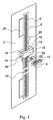
- Fig. 1 presents part of the shaft equipment installed in the elevator shaft, showing only the equipment required for the description of the present invention.
- a perforated tape 6 with perforations at regular intervals is mounted in the elevator shaft 2. It is also possible to use some other kind of tape with corresponding markings at regular intervals throughout the length of the elevator shaft.
- the perforated tape 6 is made of metal and attached to the shaft walls and/or guide rails at least in the upper and lower parts of the shaft.
- Mounted on a supporting structure of the car on the top of the elevator car is a reader device 12 fitted to travel along the perforated tape throughout the length of the shaft. In practical applications of the present invention, the reader device may also be placed in a different location on the car.
- the reader device 12 consists of a U-shaped structure with its two legs 14 and 16 fitted to extend across each broad side of the perforated tape.
- the reader device 12 is fixed by the base part 18 of the U-shaped structure to a frame 20 joined with fixing devices 22 to a supporting structure 10 of the car.
- a read head 15 mounted on leg 14 of the reader device is a read head 15 designed to detect the perforations 8 in the perforated tape when the car is moving in the shaft.
- the read head 15 is e.g. optically implemented and it provides an output consisting of a pulse train in which each pulse interval corresponds to the distance between two perforations in the shaft.
- the output of the reader device 12 is passed to the elevator control system, to be processed in a manner described later on.
- the reading device is provided with door zone detectors 26 placed in corresponding locations.
- a pulse signal representing door zone information is transmitted to the elevator control system.
- the perforated tape 6 is provided with positive deceleration switches 28 and 30 mounted at a distance from the top and bottom of the shaft, respectively.
- the switches 28 and 30 are implemented as magnets which are detected by a corresponding detector in the reader device and induce a signal in the positive deceleration input of the reader device.
- the elevator control system begins to decelerate the elevator to stop it at the bottom floor or the top floor, respectively.
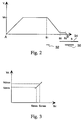
- Fig. 2 depicts the elevator speed as a function of distance when the elevator drives from floor A to floor B. The figure also shows where the marks used for deceleration and stopping control of the elevator are placed on the path of the car.
- the elevator drives at a constant velocity v N , until the elevator control system produces a so-called pick-up signal at point s 1 .
- the elevator is retarded with constant deceleration until reaching point s s , where the creeping distance s r begins.
- levelling is started, the elevator car being retarded through the stopping distance s s down to zero speed at floor B.
- the signals controlling the stopping of the elevator, the pick-up signal 32, the levelling start signal 34 and door zone signal 36 are also indicated.
- a so-called set-up drive during which the elevator is driven at normal speed from end to end of the shaft. Deceleration is started by the positive deceleration switches 28 and 30. During this drive, the locations of the door zones are stored in memory. The deceleration distance of the elevator from the positive deceleration switch to the creep velocity or stopping is measured using pulse signals and stored in memory.
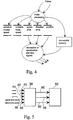
- Fig. 4 shows a status diagram for the determination of speed and position and generation of deceleration and stop signals, while Fig. 5 presents corresponding hardware.
- the output signals from the reader device are applied to the inputs 40 and 42 of a stopping control unit 38. From the pulse signals, this unit determines the velocity and position of the elevator.
- the door zone signal is applied to input 44 of unit 38.
- the positive deceleration signals from switches 28 and 30 are applied to inputs 46 and 48, respectively.
- the stopping control unit In addition to determining the elevator's speed and position, the stopping control unit also establishes the travelling direction from the pulses and determines whether the elevator has reached the normal steady travelling speed or the steady creeping speed. The locations of the door zones are stored in a memory provided in unit 38.
- Fig. 3 illustrates the dependence of the deceleration distance on the steady travelling speed when the elevator is decelerated from the travelling speed to zero speed with constant deceleration. Accordingly, the minimum velocity v dmin corresponds to deceleration distance s dmin and the maximum velocity v dmax to deceleration distance s dmax . In a corresponding manner, we also obtain velocity-distance dependencies for stopping velocity and stopping distance when the elevator is stopped from the steady creeping speed to zero speed. For the constant travelling speed v d , from which the deceleration is started, the distance s d required for stopping is calculated, using variable designations as in Fig.
- s d s dmin + (v d - v dmin ) * (s dmax - s dmin ) / (v dmax - v dmin ), where the distance required for stopping is larger than the distance s dmin required at the minimum speed v dmin .
- the difference between the distances is proportional to the difference between the travelling speed v d and the minimum speed used as a reference velocity as well as to the coefficient of proportionality ⁇ s, which is obtained as the ratio of the minimum and maximum velocities and the differences between the corresponding stopping distances.
- the minimum velocity corresponds to the speed when driving in the heaviest direction, and the maximum velocity to the speed when driving in the lightest direction.
- the application of the procedure is not restricted to these velocities, but the velocity may also be outside these limits.
- a reference speed and, correspondingly, a coefficient of proportionality can be defined for other velocities as well.
- s tot s d + s c + s s
- v c creeping velocity
- the deceleration control unit When the deceleration control unit detects that the deceleration point defined above has been reached, the deceleration unit generates a pick-up signal 50 to the elevator control system 52 and, correspondingly, when the elevator reaches the stopping point s 3 (Fig. 2), stop signals up 54 and down 56, depending on the travelling direction.
Landscapes
- Engineering & Computer Science (AREA)
- Automation & Control Theory (AREA)
- Computer Networks & Wireless Communication (AREA)
- Elevator Control (AREA)
- Indicating And Signalling Devices For Elevators (AREA)
Claims (9)
- Verfahren zum Halten einer Aufzugskabine an einem Stockwerk, in welchem Verfahren die Fahrgeschwindigkeit der Aufzugskabine und ihre Position im Schacht gemessen werden, wobei der Abstand vom Stockwerk, d.h. der Abbremspunkt, von welchem an das Bremsen begonnen wird, für eine Fahrgeschwindigkeit der Aufzugskabine bestimmt wird, d.h. eine Referenzgeschwindigkeit, dadurch gekennzeichnet, dass der Abbremspunkt geändert wird, indem zur Bremsdistanz entsprechend der Referenzgeschwindigkeit das Produkt eines Proportionalitätskoeffizienten mit dem Unterschied zwischen der Fahrgeschwindigkeit und der Referenzgeschwindigkeit hinzuaddiert wird, welcher Proportionalitätskoeffizient aus folgender Formel bestimmt wird:ist und der Proportionalitätskoeffizient im Speicher gespeichert wird, und dass der Abbremspunkt proportional zur Differenz zwischen der gemessenen Fahrgeschwindigkeit und der Referenzgeschwindigkeit geändert wird.vdmax = die höchstmögliche Geschwindigkeit,vdmin = die geringstmögliche Geschwindigkeit,sdmax = die Bremsdistanz für die höchstmögliche Geschwindigkeit,sdmin = die Bremsdistanz für die geringstmögliche Geschwindigkeit
- Verfahren nach Anspruch 1,
dadurch gekennzeichnet, dass der Motor durch eine Steuereinheit gesteuert wird, die keine Regelschleife für die Motorgeschwindigkeit aufweist. - Verfahren nach Anspruch 1 oder 2,
dadurch gekennzeichnet, dass die Referenzgeschwindigkeit und der korrespondierende Abbremspunkt während einer vorläufigen Fahrt mit dem Aufzug bestimmt werden, die das Fahren mit einer leeren Aufzugskabine in der leichten Richtung umfasst, d.h. in Aufwärtsrichtung, und Messen der von dem Aufzug zurückgelegten Distanz, d.h. Bremsdistanz, wenn die Kabinengeschwindigkeit von der Referenzgeschwindigkeit auf Null abnimmt, und dass die Referenzgeschwindigkeit und der korrespondierende Abbremspunkt im Speicher gespeichert werden. - Verfahren nach einem der vorhergehenden Ansprüche,
dadurch gekennzeichnet, dass die Geschwindigkeit der Aufzugkabine kontinuierlich gemessen wird, und dass wenn das Aufzugsteuerungssystem einen Stop des Aufzugs vorgibt, der Proportionalitätskoeffizient und die Referenzgeschwindigkeit aus dem Speicher gelesen werden und der Abbremspunkt aus folgender Formel errechnet wird:
vd = Geschwindigkeit zu Beginn des Abbremens ist, und dass, wenn die Aufzugskabine den Abbremspunkt erreicht, ein Abbremsbefehl abgegeben wird. - Verfahren zum Halten einer Aufzugskabine an einem Stockwerk, in welchem Verfahren die Fahrgeschwindigkeit der Aufzugskabine und ihre Position in dem Schacht gemessen werden und bei dem die Kabinengeschwindigkeit zuerst auf eine Kriechgeschwindigkeit abgebremst und dann auf Null gestoppt wird, und in welchem eine Entfernung von einem Stockwerk, d.h. der Abbremspunkt, von dem aus der Bremsvorgang begonnen wird, für eine Fahrgeschwindigkeit der Aufzugskabine bestimmt wird, d.h. eine Referenzgeschwindigkeit und ein Haltepunkt, von dem aus das Anhalten des Aufzugs auf Null beginnt, für eine Kriechgeschwindigkeit bestimmt wird, d.h. eine Referenzkriechgeschwindigkeit, dadurch gekennzeichnet, dass der Abbremspunkt geändert wird durch Hinzuaddieren des Produkts eines ersten Proportionalitätskoeffizienten mit der Differenz zwischen der Fahrgeschwindigkeit und der Referenzgeschwindigkeit zur Bremsdistanz entsprechend der Referenzgeschwindigkeit, wobei der Proportionalitätskoeffizient Δs aus folgender Formel bestimmt wird:und dass der Haltepunkt in entsprechender Weise geändert wird durch Hinzuaddieren des Produkts eines zweiten Proportionalitätskoeffizienten mit der Differenz zwischen der Fahrgeschwindigkeit und der Referenzgeschwindigkeit, welcher zweite Proportionalitätskoeffizient aus folgender Formel bestimmt wird:Vdmax = die höchstmögliche Geschwindigkeit,vdmin = die geringstmögliche Geschwindigkeit,sdmax = die Bremsdistanz für die höchstmögliche Geschwindigkeit,sdmin = die Bremsdistanz für die geringstmögliche Geschwindigkeit ist,dass der Proportionalitätskoeffizient im Speicher gespeichert wird, und dass der Bremspunkt proportional zur Differenz zwischen der gemessenen Fahrgeschwindigkeit und der Referenzgeschwindigkeit geändert wird und dass der Haltepunkt proportional zur Differenz zwischen der gemessenen Kriechgeschwindigkeit und der Referenzkriechgeschwindigkeit geändert wird.vsmax = die höchstmögliche Kriechgeschwindigkeit,vsmin = die geringstmögliche Kriechgeschwindigkeit,ssmax = die Bremsdistanz für die Geschwindigkeit vsmax, undssmin = die Bremsdistanz für die Geschwindigkeit vsmin ist,
- Verfahren nach Anspruch 5,
dadurch gekennzeichnet, dass die Referenzgeschwindigkeit und der korrespondierende Abbremspunkt und in entsprechender Weise die Referenzkriechgeschwindigkeit und der entsprechende Haltepunkt in einer vorläufigen Fahrt mit der Kabine bestimmt werden, welche das Fahren mit einer leeren Aufzugskabine in der leichteren Richtung umfasst, d.h. in Abwärtsrichtung, und Messen der von dem Aufzug zurückgelegten Entfernung, d.h. Bremsdistanz, wenn die Kabinengeschwindigkeit von der Referenzgeschwindigkeit auf die Referenzkriechgeschwindigkeit abnimmt und in gleicher Weise Messen der von der Aufzugskabine zurückgelegten Entfernung, d.h. Haltedistanz, wenn die Kabinengeschwindigkeit von der Referenzkriechgeschwindigkeit auf Null Geschwindigkeit abnimmt, und dass die Referenzgeschwindigkeit und der korrespondierende Abbremspunkt und in entsprechender Weise die Referenzkriechgeschwindigkeit und der korrespondierende Haltepunkt im Speicher gespeichert werden. - Verfahren nach Anspruch 5 oder 6,
dadurch gekennzeichnet, dass die Geschwindigkeit vd der Aufzugskabine kontinuierlich gemessen wird und dass, wenn das Aufzugsteuerungssystem anordnet, dass der Aufzug gestoppt werden muss, der erste Proportionalitätskoeffizient und die Referenzgeschwindigkeit aus dem Speicher gelesen werden und der Abbremspunkt aus der Formel sd = sdmin + Δsd * (vd - vdmin) errechnet wird, und, dass wenn die Aufzugskabine mit Kriechgeschwindigkeit vc fährt, der zweite Proportionalitätskoeffizient und die Referenzkriechgeschwindigkeit aus dem Speicher gelesen werden und der Haltepunkt aus der Formel ss = ssmin + Δss * (vc - vsmin) errechnet wird. - Verfahren nach einem der Ansprüche 5 bis 7,
dadurch gekennzeichnet, dass, wenn über eine gegebene Entfernung zwischen den Stockwerken eine konstante Fahrgeschwindigkeit nicht erreicht werden kann, während der vorläufigen Fahrt ein spezifischer Abbremspunkt für diese Fahrdistanz zwischen den Stockwerken ermittelt wird. - Verfahren nach einem der vorhergehenden Ansprüche,
dadurch gekennzeichnet, dass die Position und Geschwindigkeit der Kabine bestimmt wird durch eine kabinenseitige Leseeinrichtung (12), die geeignet ist, ein Band (6) zu lesen, das über die Schaftlänge mit Markierungen in gleichmäßigen Abständen versehen ist.
Applications Claiming Priority (2)
| Application Number | Priority Date | Filing Date | Title |
|---|---|---|---|
| FI953434A FI112857B (fi) | 1995-07-14 | 1995-07-14 | Menetelmä hissin pysäyttämiseksi tasolle |
| FI953434 | 1995-07-14 |
Publications (2)
| Publication Number | Publication Date |
|---|---|
| EP0753478A1 EP0753478A1 (de) | 1997-01-15 |
| EP0753478B1 true EP0753478B1 (de) | 2001-11-28 |
Family
ID=8543787
Family Applications (1)
| Application Number | Title | Priority Date | Filing Date |
|---|---|---|---|
| EP96111176A Expired - Lifetime EP0753478B1 (de) | 1995-07-14 | 1996-07-11 | Verfahren zum Anhalten eines Aufzuges in einem Stockwerk |
Country Status (5)
| Country | Link |
|---|---|
| US (1) | US5848671A (de) |
| EP (1) | EP0753478B1 (de) |
| DE (1) | DE69617329T2 (de) |
| ES (1) | ES2169176T3 (de) |
| FI (1) | FI112857B (de) |
Families Citing this family (11)
| Publication number | Priority date | Publication date | Assignee | Title |
|---|---|---|---|---|
| US6032761A (en) * | 1998-04-27 | 2000-03-07 | Otis Elevator | Elevator hoistway terminal zone position checkpoint detection apparatus using a binary coding method for an emergency terminal speed limiting device |
| US6028402A (en) * | 1999-01-25 | 2000-02-22 | General Electric Company | Automatic rail characterization for adhesion system evaluation for AC locomotives |
| US6401351B1 (en) | 2000-06-09 | 2002-06-11 | Trilogy Technologies, Inc. | Sensor system for determining relative displacement of an object using a flexible retractable activation member |
| US6351994B1 (en) * | 2000-06-09 | 2002-03-05 | Trilogy Technologies, Inc. | Sensor system for determining relative displacement of an object using an activation member |
| US20030070883A1 (en) * | 2001-08-23 | 2003-04-17 | Foster Michael M. | Elevator selector |
| FI118640B (fi) * | 2004-09-27 | 2008-01-31 | Kone Corp | Kunnonvalvontamenetelmä ja -järjestelmä hissikorin pysähtymistarkkuuden mittaamiseksi |
| FI122183B (fi) * | 2010-03-15 | 2011-09-30 | Kone Corp | Menetelmä ja laite hissin sähkökäytön käyntiinajamiseksi |
| CN108622746B (zh) | 2017-03-24 | 2022-07-05 | 奥的斯电梯公司 | 用于电梯系统的动态补偿控制 |
| CN107244595B (zh) * | 2017-05-16 | 2020-08-25 | 深圳市海浦蒙特科技有限公司 | 电梯控制方法和系统 |
| CN111056388A (zh) * | 2019-12-28 | 2020-04-24 | 福建快科城建增设电梯股份有限公司 | 防倾覆重载货梯及其工作方法 |
| CN117361250A (zh) * | 2023-09-07 | 2024-01-09 | 苏州英威腾电力电子有限公司 | 电梯自学习方法、装置及磁栅尺电梯 |
Family Cites Families (7)
| Publication number | Priority date | Publication date | Assignee | Title |
|---|---|---|---|---|
| BR5800987U (pt) * | 1978-07-28 | 1979-03-13 | M Vidal | Chave cintada regulavel para porcas,parafuso e tubos |
| WO1980002135A1 (en) * | 1979-04-05 | 1980-10-16 | Otis Elevator Co | Modified slowdown and braking of an elevator car |
| FI66328C (fi) * | 1979-10-18 | 1984-10-10 | Elevator Gmbh | Foerfarande och anordning foer att stanna en laengs med en styrd bana gaoende anordning saosom en hiss |
| FI62515C (fi) * | 1981-03-04 | 1983-01-10 | Elevator Gmbh | Foerfarande och maetkrets foer reglering av stannande av en his |
| FR2577329B1 (fr) * | 1985-02-12 | 1988-04-29 | Logilift Sarl | Procede de commande regulee d'un moteur electrique pour le deplacement d'un mobile et dispositif de commande pour la mise en oeuvre du procede |
| FI88012C (sv) * | 1990-06-04 | 1993-03-25 | Kone Oy | Förfarande och anordning för styrning av en hydraulhiss vid inkörning till plan |
| IT1257416B (it) * | 1992-08-05 | 1996-01-15 | Metodo ed apparato per il controllo e la correzione automatica del comando di decelerazione-arresto della cabina di un ascensore o di un montacarichi al variare dei dati di funzionamento dell'impianto. |
-
1995
- 1995-07-14 FI FI953434A patent/FI112857B/fi active
-
1996
- 1996-07-11 EP EP96111176A patent/EP0753478B1/de not_active Expired - Lifetime
- 1996-07-11 ES ES96111176T patent/ES2169176T3/es not_active Expired - Lifetime
- 1996-07-11 DE DE69617329T patent/DE69617329T2/de not_active Expired - Lifetime
- 1996-07-12 US US08/679,143 patent/US5848671A/en not_active Expired - Lifetime
Also Published As
| Publication number | Publication date |
|---|---|
| FI112857B (fi) | 2004-01-30 |
| EP0753478A1 (de) | 1997-01-15 |
| ES2169176T3 (es) | 2002-07-01 |
| US5848671A (en) | 1998-12-15 |
| DE69617329T2 (de) | 2002-05-08 |
| FI953434L (fi) | 1997-04-18 |
| DE69617329D1 (de) | 2002-01-10 |
| FI953434A0 (fi) | 1995-07-14 |
Similar Documents
| Publication | Publication Date | Title |
|---|---|---|
| US9776827B2 (en) | Elevator system including monitoring arrangement to activate multiple emergency braking procedures associated with different decelerations and method of operating the same | |
| EP1980519B1 (de) | Türenvorrichtung für aufzüge | |
| US8371420B2 (en) | Elevator system for reducing collision shock | |
| AU2008277684B2 (en) | Elevator system with an elevator car, a braking device for stopping an elevator car in a special operating mode and a method for stopping an elevator car in a special operating mode | |
| JP4335511B2 (ja) | エレベータ装置 | |
| KR100969047B1 (ko) | 엘리베이터 장치 | |
| EP0753478B1 (de) | Verfahren zum Anhalten eines Aufzuges in einem Stockwerk | |
| US4936136A (en) | Method for checking the friction between the traction sheeve and the suspension ropes of an elevator | |
| US6050368A (en) | Procedure and apparatus for controlling the hoisting motor of an elevator | |
| US4995478A (en) | Start compensation device for elevators | |
| US5635689A (en) | Acceleration damping of elevator resonant modes and hydraulic elevator pump leakage compensation | |
| CN110002298B (zh) | 一种电梯启动控制方法和系统 | |
| JP4566587B2 (ja) | エレベータの制御装置 | |
| KR20180042314A (ko) | 엘리베이터 조절 시스템 및 엘리베이터 시스템 작동 방법 | |
| EP1930277A1 (de) | Steuervorrichtung für aufzug | |
| US5777280A (en) | Calibration routine with adaptive load compensation | |
| JPS6251861B2 (de) | ||
| FI96673B (fi) | Hissikäyttö, jossa on säätölaite nykäyksetöntä liikkeellelähtöä varten | |
| JPH0446877B2 (de) | ||
| EP1927567A1 (de) | Aufzugsvorrichtung | |
| JP4115743B2 (ja) | エレベータ装置 | |
| JPH1160089A (ja) | 駆動の調節方法および装置 | |
| US5889238A (en) | Deceleration time for an elevator car | |
| JPS6223711B2 (de) | ||
| JP7826797B2 (ja) | エレベータの停電時運転装置 |
Legal Events
| Date | Code | Title | Description |
|---|---|---|---|
| PUAI | Public reference made under article 153(3) epc to a published international application that has entered the european phase |
Free format text: ORIGINAL CODE: 0009012 |
|
| AK | Designated contracting states |
Kind code of ref document: A1 Designated state(s): DE ES FR GB IT |
|
| 17P | Request for examination filed |
Effective date: 19970714 |
|
| RAP1 | Party data changed (applicant data changed or rights of an application transferred) |
Owner name: KONE CORPORATION |
|
| 17Q | First examination report despatched |
Effective date: 19991210 |
|
| GRAG | Despatch of communication of intention to grant |
Free format text: ORIGINAL CODE: EPIDOS AGRA |
|
| GRAG | Despatch of communication of intention to grant |
Free format text: ORIGINAL CODE: EPIDOS AGRA |
|
| GRAH | Despatch of communication of intention to grant a patent |
Free format text: ORIGINAL CODE: EPIDOS IGRA |
|
| GRAH | Despatch of communication of intention to grant a patent |
Free format text: ORIGINAL CODE: EPIDOS IGRA |
|
| GRAA | (expected) grant |
Free format text: ORIGINAL CODE: 0009210 |
|
| AK | Designated contracting states |
Kind code of ref document: B1 Designated state(s): DE ES FR GB IT |
|
| REG | Reference to a national code |
Ref country code: GB Ref legal event code: IF02 |
|
| REF | Corresponds to: |
Ref document number: 69617329 Country of ref document: DE Date of ref document: 20020110 |
|
| ET | Fr: translation filed | ||
| REG | Reference to a national code |
Ref country code: ES Ref legal event code: FG2A Ref document number: 2169176 Country of ref document: ES Kind code of ref document: T3 |
|
| PLBE | No opposition filed within time limit |
Free format text: ORIGINAL CODE: 0009261 |
|
| STAA | Information on the status of an ep patent application or granted ep patent |
Free format text: STATUS: NO OPPOSITION FILED WITHIN TIME LIMIT |
|
| 26N | No opposition filed | ||
| PGFP | Annual fee paid to national office [announced via postgrant information from national office to epo] |
Ref country code: IT Payment date: 20080620 Year of fee payment: 13 |
|
| PGFP | Annual fee paid to national office [announced via postgrant information from national office to epo] |
Ref country code: ES Payment date: 20080709 Year of fee payment: 13 |
|
| PGFP | Annual fee paid to national office [announced via postgrant information from national office to epo] |
Ref country code: FR Payment date: 20080613 Year of fee payment: 13 |
|
| REG | Reference to a national code |
Ref country code: FR Ref legal event code: ST Effective date: 20100331 |
|
| PG25 | Lapsed in a contracting state [announced via postgrant information from national office to epo] |
Ref country code: FR Free format text: LAPSE BECAUSE OF NON-PAYMENT OF DUE FEES Effective date: 20090731 |
|
| REG | Reference to a national code |
Ref country code: ES Ref legal event code: FD2A Effective date: 20090713 |
|
| PG25 | Lapsed in a contracting state [announced via postgrant information from national office to epo] |
Ref country code: ES Free format text: LAPSE BECAUSE OF NON-PAYMENT OF DUE FEES Effective date: 20090713 |
|
| PG25 | Lapsed in a contracting state [announced via postgrant information from national office to epo] |
Ref country code: IT Free format text: LAPSE BECAUSE OF NON-PAYMENT OF DUE FEES Effective date: 20090711 |
|
| PGFP | Annual fee paid to national office [announced via postgrant information from national office to epo] |
Ref country code: GB Payment date: 20150721 Year of fee payment: 20 Ref country code: DE Payment date: 20150721 Year of fee payment: 20 |
|
| REG | Reference to a national code |
Ref country code: DE Ref legal event code: R071 Ref document number: 69617329 Country of ref document: DE |
|
| REG | Reference to a national code |
Ref country code: GB Ref legal event code: PE20 Expiry date: 20160710 |
|
| PG25 | Lapsed in a contracting state [announced via postgrant information from national office to epo] |
Ref country code: GB Free format text: LAPSE BECAUSE OF EXPIRATION OF PROTECTION Effective date: 20160710 |