EP0752915B1 - Catalyst for vapor phase oxidation of alkane hydrocarbons - Google Patents
Catalyst for vapor phase oxidation of alkane hydrocarbons Download PDFInfo
- Publication number
- EP0752915B1 EP0752915B1 EP95914044A EP95914044A EP0752915B1 EP 0752915 B1 EP0752915 B1 EP 0752915B1 EP 95914044 A EP95914044 A EP 95914044A EP 95914044 A EP95914044 A EP 95914044A EP 0752915 B1 EP0752915 B1 EP 0752915B1
- Authority
- EP
- European Patent Office
- Prior art keywords
- catalyst
- butane
- formula
- air
- reactor
- Prior art date
- Legal status (The legal status is an assumption and is not a legal conclusion. Google has not performed a legal analysis and makes no representation as to the accuracy of the status listed.)
- Expired - Lifetime
Links
- 239000003054 catalyst Substances 0.000 title claims abstract description 129
- 230000003647 oxidation Effects 0.000 title claims abstract description 21
- 238000007254 oxidation reaction Methods 0.000 title claims abstract description 21
- -1 alkane hydrocarbons Chemical class 0.000 title claims abstract description 12
- 229930195733 hydrocarbon Natural products 0.000 title claims abstract description 8
- 239000012808 vapor phase Substances 0.000 title description 5
- 150000001768 cations Chemical group 0.000 claims abstract description 30
- IJDNQMDRQITEOD-UHFFFAOYSA-N n-butane Chemical compound CCCC IJDNQMDRQITEOD-UHFFFAOYSA-N 0.000 claims description 79
- 238000000034 method Methods 0.000 claims description 56
- 238000002360 preparation method Methods 0.000 claims description 32
- 229910052787 antimony Inorganic materials 0.000 claims description 28
- FPYJFEHAWHCUMM-UHFFFAOYSA-N maleic anhydride Chemical compound O=C1OC(=O)C=C1 FPYJFEHAWHCUMM-UHFFFAOYSA-N 0.000 claims description 23
- QVGXLLKOCUKJST-UHFFFAOYSA-N atomic oxygen Chemical compound [O] QVGXLLKOCUKJST-UHFFFAOYSA-N 0.000 claims description 18
- 229910052760 oxygen Inorganic materials 0.000 claims description 18
- 239000001301 oxygen Substances 0.000 claims description 18
- 229910052720 vanadium Inorganic materials 0.000 claims description 14
- 239000007787 solid Substances 0.000 claims description 12
- LEONUFNNVUYDNQ-UHFFFAOYSA-N vanadium atom Chemical compound [V] LEONUFNNVUYDNQ-UHFFFAOYSA-N 0.000 claims description 12
- 230000008569 process Effects 0.000 claims description 9
- 239000006104 solid solution Substances 0.000 claims description 7
- LEABNKXSQUTCOW-UHFFFAOYSA-N [O].[P].[V] Chemical compound [O].[P].[V] LEABNKXSQUTCOW-UHFFFAOYSA-N 0.000 claims description 4
- 229910052796 boron Inorganic materials 0.000 claims description 3
- 150000004820 halides Chemical class 0.000 claims description 3
- 239000012429 reaction media Substances 0.000 claims description 3
- 150000003839 salts Chemical class 0.000 claims description 3
- POILWHVDKZOXJZ-ARJAWSKDSA-M (z)-4-oxopent-2-en-2-olate Chemical compound C\C([O-])=C\C(C)=O POILWHVDKZOXJZ-ARJAWSKDSA-M 0.000 claims description 2
- QTBSBXVTEAMEQO-UHFFFAOYSA-M Acetate Chemical compound CC([O-])=O QTBSBXVTEAMEQO-UHFFFAOYSA-M 0.000 claims description 2
- 150000004703 alkoxides Chemical class 0.000 claims description 2
- 230000003134 recirculating effect Effects 0.000 claims description 2
- CAUHCBDRRFADDB-UHFFFAOYSA-A [V+5].[V+5].[V+5].[V+5].[O-]P([O-])(=O)OP([O-])([O-])=O.[O-]P([O-])(=O)OP([O-])([O-])=O.[O-]P([O-])(=O)OP([O-])([O-])=O.[O-]P([O-])(=O)OP([O-])([O-])=O.[O-]P([O-])(=O)OP([O-])([O-])=O Chemical compound [V+5].[V+5].[V+5].[V+5].[O-]P([O-])(=O)OP([O-])([O-])=O.[O-]P([O-])(=O)OP([O-])([O-])=O.[O-]P([O-])(=O)OP([O-])([O-])=O.[O-]P([O-])(=O)OP([O-])([O-])=O.[O-]P([O-])(=O)OP([O-])([O-])=O CAUHCBDRRFADDB-UHFFFAOYSA-A 0.000 abstract description 3
- 239000001273 butane Substances 0.000 description 59
- OFBQJSOFQDEBGM-UHFFFAOYSA-N n-pentane Natural products CCCCC OFBQJSOFQDEBGM-UHFFFAOYSA-N 0.000 description 59
- NBIIXXVUZAFLBC-UHFFFAOYSA-N Phosphoric acid Chemical compound OP(O)(O)=O NBIIXXVUZAFLBC-UHFFFAOYSA-N 0.000 description 51
- VYPSYNLAJGMNEJ-UHFFFAOYSA-N Silicium dioxide Chemical compound O=[Si]=O VYPSYNLAJGMNEJ-UHFFFAOYSA-N 0.000 description 45
- GNTDGMZSJNCJKK-UHFFFAOYSA-N divanadium pentaoxide Chemical compound O=[V](=O)O[V](=O)=O GNTDGMZSJNCJKK-UHFFFAOYSA-N 0.000 description 37
- 239000000126 substance Substances 0.000 description 35
- XEEYBQQBJWHFJM-UHFFFAOYSA-N iron Substances [Fe] XEEYBQQBJWHFJM-UHFFFAOYSA-N 0.000 description 34
- 239000002245 particle Substances 0.000 description 28
- 230000000052 comparative effect Effects 0.000 description 27
- 238000010992 reflux Methods 0.000 description 27
- IJGRMHOSHXDMSA-UHFFFAOYSA-N Atomic nitrogen Chemical compound N#N IJGRMHOSHXDMSA-UHFFFAOYSA-N 0.000 description 26
- 229910000147 aluminium phosphate Inorganic materials 0.000 description 25
- 239000002243 precursor Substances 0.000 description 25
- 238000006243 chemical reaction Methods 0.000 description 24
- 239000000377 silicon dioxide Substances 0.000 description 20
- 239000012018 catalyst precursor Substances 0.000 description 19
- WVDDGKGOMKODPV-UHFFFAOYSA-N Benzyl alcohol Chemical compound OCC1=CC=CC=C1 WVDDGKGOMKODPV-UHFFFAOYSA-N 0.000 description 18
- RBTARNINKXHZNM-UHFFFAOYSA-K iron trichloride Chemical compound Cl[Fe](Cl)Cl RBTARNINKXHZNM-UHFFFAOYSA-K 0.000 description 17
- 239000012071 phase Substances 0.000 description 15
- 229910052681 coesite Inorganic materials 0.000 description 14
- 229910052906 cristobalite Inorganic materials 0.000 description 14
- ZXEKIIBDNHEJCQ-UHFFFAOYSA-N isobutanol Chemical compound CC(C)CO ZXEKIIBDNHEJCQ-UHFFFAOYSA-N 0.000 description 14
- 239000000203 mixture Substances 0.000 description 14
- 229910052682 stishovite Inorganic materials 0.000 description 14
- 229910052905 tridymite Inorganic materials 0.000 description 14
- 239000011651 chromium Substances 0.000 description 13
- 238000001694 spray drying Methods 0.000 description 13
- 229910021578 Iron(III) chloride Inorganic materials 0.000 description 12
- 229910001873 dinitrogen Inorganic materials 0.000 description 12
- 239000007789 gas Substances 0.000 description 11
- 239000007921 spray Substances 0.000 description 11
- 239000011572 manganese Substances 0.000 description 9
- 239000002253 acid Substances 0.000 description 8
- 230000004913 activation Effects 0.000 description 8
- 239000013078 crystal Substances 0.000 description 8
- 229910052742 iron Inorganic materials 0.000 description 8
- 150000001298 alcohols Chemical class 0.000 description 7
- 235000019445 benzyl alcohol Nutrition 0.000 description 7
- 239000010949 copper Substances 0.000 description 7
- YWEUIGNSBFLMFL-UHFFFAOYSA-N diphosphonate Chemical compound O=P(=O)OP(=O)=O YWEUIGNSBFLMFL-UHFFFAOYSA-N 0.000 description 7
- 238000002156 mixing Methods 0.000 description 7
- 229910052757 nitrogen Inorganic materials 0.000 description 7
- DLYUQMMRRRQYAE-UHFFFAOYSA-N phosphorus pentoxide Inorganic materials O1P(O2)(=O)OP3(=O)OP1(=O)OP2(=O)O3 DLYUQMMRRRQYAE-UHFFFAOYSA-N 0.000 description 7
- 239000000047 product Substances 0.000 description 7
- 239000002002 slurry Substances 0.000 description 7
- 239000010419 fine particle Substances 0.000 description 6
- 229940035429 isobutyl alcohol Drugs 0.000 description 6
- 238000010926 purge Methods 0.000 description 6
- YGBFTDQFAKDXBZ-UHFFFAOYSA-N tributyl stiborite Chemical compound [Sb+3].CCCC[O-].CCCC[O-].CCCC[O-] YGBFTDQFAKDXBZ-UHFFFAOYSA-N 0.000 description 6
- 229910017775 (VO)2P207 Inorganic materials 0.000 description 5
- 238000002441 X-ray diffraction Methods 0.000 description 5
- 238000005299 abrasion Methods 0.000 description 5
- 238000004458 analytical method Methods 0.000 description 5
- VMPVEPPRYRXYNP-UHFFFAOYSA-I antimony(5+);pentachloride Chemical compound Cl[Sb](Cl)(Cl)(Cl)Cl VMPVEPPRYRXYNP-UHFFFAOYSA-I 0.000 description 5
- 150000001875 compounds Chemical class 0.000 description 5
- 238000002173 high-resolution transmission electron microscopy Methods 0.000 description 5
- 229910052698 phosphorus Inorganic materials 0.000 description 5
- 239000011574 phosphorus Substances 0.000 description 5
- 239000000523 sample Substances 0.000 description 5
- 238000001350 scanning transmission electron microscopy Methods 0.000 description 5
- VEXZGXHMUGYJMC-UHFFFAOYSA-N Hydrochloric acid Chemical compound Cl VEXZGXHMUGYJMC-UHFFFAOYSA-N 0.000 description 4
- OAICVXFJPJFONN-UHFFFAOYSA-N Phosphorus Chemical compound [P] OAICVXFJPJFONN-UHFFFAOYSA-N 0.000 description 4
- WYURNTSHIVDZCO-UHFFFAOYSA-N Tetrahydrofuran Chemical compound C1CCOC1 WYURNTSHIVDZCO-UHFFFAOYSA-N 0.000 description 4
- JHXKRIRFYBPWGE-UHFFFAOYSA-K bismuth chloride Chemical compound Cl[Bi](Cl)Cl JHXKRIRFYBPWGE-UHFFFAOYSA-K 0.000 description 4
- 229910052804 chromium Inorganic materials 0.000 description 4
- 229910052802 copper Inorganic materials 0.000 description 4
- 238000001030 gas--liquid chromatography Methods 0.000 description 4
- 238000010438 heat treatment Methods 0.000 description 4
- 229910052748 manganese Inorganic materials 0.000 description 4
- PXHVJJICTQNCMI-UHFFFAOYSA-N nickel Substances [Ni] PXHVJJICTQNCMI-UHFFFAOYSA-N 0.000 description 4
- 230000009467 reduction Effects 0.000 description 4
- QTBSBXVTEAMEQO-UHFFFAOYSA-N Acetic acid Chemical compound CC(O)=O QTBSBXVTEAMEQO-UHFFFAOYSA-N 0.000 description 3
- LYCAIKOWRPUZTN-UHFFFAOYSA-N Ethylene glycol Chemical compound OCCO LYCAIKOWRPUZTN-UHFFFAOYSA-N 0.000 description 3
- 229910052765 Lutetium Inorganic materials 0.000 description 3
- OKKJLVBELUTLKV-UHFFFAOYSA-N Methanol Chemical compound OC OKKJLVBELUTLKV-UHFFFAOYSA-N 0.000 description 3
- MUBZPKHOEPUJKR-UHFFFAOYSA-N Oxalic acid Chemical compound OC(=O)C(O)=O MUBZPKHOEPUJKR-UHFFFAOYSA-N 0.000 description 3
- 229910052776 Thorium Inorganic materials 0.000 description 3
- GLMOMDXKLRBTDY-UHFFFAOYSA-A [V+5].[V+5].[V+5].[O-]P([O-])([O-])=O.[O-]P([O-])([O-])=O.[O-]P([O-])([O-])=O.[O-]P([O-])([O-])=O.[O-]P([O-])([O-])=O Chemical compound [V+5].[V+5].[V+5].[O-]P([O-])([O-])=O.[O-]P([O-])([O-])=O.[O-]P([O-])([O-])=O.[O-]P([O-])([O-])=O.[O-]P([O-])([O-])=O GLMOMDXKLRBTDY-UHFFFAOYSA-A 0.000 description 3
- XYQQGESWGNLKIO-UHFFFAOYSA-N acetic acid;chromium;dihydrate Chemical compound O.O.[Cr].[Cr].[Cr].CC(O)=O.CC(O)=O.CC(O)=O.CC(O)=O.CC(O)=O.CC(O)=O.CC(O)=O XYQQGESWGNLKIO-UHFFFAOYSA-N 0.000 description 3
- 229910052784 alkaline earth metal Inorganic materials 0.000 description 3
- 229910052782 aluminium Inorganic materials 0.000 description 3
- WATWJIUSRGPENY-UHFFFAOYSA-N antimony atom Chemical compound [Sb] WATWJIUSRGPENY-UHFFFAOYSA-N 0.000 description 3
- 229910052797 bismuth Inorganic materials 0.000 description 3
- 239000011248 coating agent Substances 0.000 description 3
- 238000000576 coating method Methods 0.000 description 3
- 239000010432 diamond Substances 0.000 description 3
- 238000011156 evaluation Methods 0.000 description 3
- 230000006872 improvement Effects 0.000 description 3
- 229910052744 lithium Inorganic materials 0.000 description 3
- ZQZQURFYFJBOCE-FDGPNNRMSA-L manganese(2+);(z)-4-oxopent-2-en-2-olate Chemical compound [Mn+2].C\C([O-])=C\C(C)=O.C\C([O-])=C\C(C)=O ZQZQURFYFJBOCE-FDGPNNRMSA-L 0.000 description 3
- 239000004005 microsphere Substances 0.000 description 3
- 229910052750 molybdenum Inorganic materials 0.000 description 3
- 229910052758 niobium Inorganic materials 0.000 description 3
- 239000010955 niobium Substances 0.000 description 3
- 239000000843 powder Substances 0.000 description 3
- 238000005070 sampling Methods 0.000 description 3
- 239000011734 sodium Substances 0.000 description 3
- 230000009897 systematic effect Effects 0.000 description 3
- 229910052721 tungsten Inorganic materials 0.000 description 3
- 239000012002 vanadium phosphate Substances 0.000 description 3
- 229910052725 zinc Inorganic materials 0.000 description 3
- 229910052726 zirconium Inorganic materials 0.000 description 3
- 229910052684 Cerium Inorganic materials 0.000 description 2
- 229910052692 Dysprosium Inorganic materials 0.000 description 2
- 229910052691 Erbium Inorganic materials 0.000 description 2
- 229910052693 Europium Inorganic materials 0.000 description 2
- 229910052688 Gadolinium Inorganic materials 0.000 description 2
- AEMRFAOFKBGASW-UHFFFAOYSA-N Glycolic acid Chemical compound OCC(O)=O AEMRFAOFKBGASW-UHFFFAOYSA-N 0.000 description 2
- 229910052689 Holmium Inorganic materials 0.000 description 2
- 229910052779 Neodymium Inorganic materials 0.000 description 2
- 229910052777 Praseodymium Inorganic materials 0.000 description 2
- 229910052774 Proactinium Inorganic materials 0.000 description 2
- 229910052772 Samarium Inorganic materials 0.000 description 2
- 229910052771 Terbium Inorganic materials 0.000 description 2
- 229910052775 Thulium Inorganic materials 0.000 description 2
- 229910052770 Uranium Inorganic materials 0.000 description 2
- 229910052769 Ytterbium Inorganic materials 0.000 description 2
- 150000001342 alkaline earth metals Chemical class 0.000 description 2
- SMZOGRDCAXLAAR-UHFFFAOYSA-N aluminium isopropoxide Chemical compound [Al+3].CC(C)[O-].CC(C)[O-].CC(C)[O-] SMZOGRDCAXLAAR-UHFFFAOYSA-N 0.000 description 2
- 239000003125 aqueous solvent Substances 0.000 description 2
- 229910052785 arsenic Inorganic materials 0.000 description 2
- 229910052790 beryllium Inorganic materials 0.000 description 2
- 239000011230 binding agent Substances 0.000 description 2
- 230000015572 biosynthetic process Effects 0.000 description 2
- NUMHJBONQMZPBW-UHFFFAOYSA-K bis(2-ethylhexanoyloxy)bismuthanyl 2-ethylhexanoate Chemical compound [Bi+3].CCCCC(CC)C([O-])=O.CCCCC(CC)C([O-])=O.CCCCC(CC)C([O-])=O NUMHJBONQMZPBW-UHFFFAOYSA-K 0.000 description 2
- 229910052793 cadmium Inorganic materials 0.000 description 2
- 229910052792 caesium Inorganic materials 0.000 description 2
- 238000001354 calcination Methods 0.000 description 2
- 229910052791 calcium Inorganic materials 0.000 description 2
- 230000003197 catalytic effect Effects 0.000 description 2
- 238000006555 catalytic reaction Methods 0.000 description 2
- 239000003638 chemical reducing agent Substances 0.000 description 2
- KRKNYBCHXYNGOX-UHFFFAOYSA-N citric acid Substances OC(=O)CC(O)(C(O)=O)CC(O)=O KRKNYBCHXYNGOX-UHFFFAOYSA-N 0.000 description 2
- XLJKHNWPARRRJB-UHFFFAOYSA-N cobalt(2+) Chemical compound [Co+2] XLJKHNWPARRRJB-UHFFFAOYSA-N 0.000 description 2
- 239000008119 colloidal silica Substances 0.000 description 2
- 230000001143 conditioned effect Effects 0.000 description 2
- 230000003750 conditioning effect Effects 0.000 description 2
- 230000002939 deleterious effect Effects 0.000 description 2
- 238000001914 filtration Methods 0.000 description 2
- 238000005243 fluidization Methods 0.000 description 2
- 229910052733 gallium Inorganic materials 0.000 description 2
- 229910052732 germanium Inorganic materials 0.000 description 2
- 229910052741 iridium Inorganic materials 0.000 description 2
- FBAFATDZDUQKNH-UHFFFAOYSA-M iron chloride Chemical compound [Cl-].[Fe] FBAFATDZDUQKNH-UHFFFAOYSA-M 0.000 description 2
- 230000001788 irregular Effects 0.000 description 2
- 229910052745 lead Inorganic materials 0.000 description 2
- 239000007788 liquid Substances 0.000 description 2
- 229940031993 lithium benzoate Drugs 0.000 description 2
- LDJNSLOKTFFLSL-UHFFFAOYSA-M lithium;benzoate Chemical compound [Li+].[O-]C(=O)C1=CC=CC=C1 LDJNSLOKTFFLSL-UHFFFAOYSA-M 0.000 description 2
- 229910052749 magnesium Inorganic materials 0.000 description 2
- 229910052759 nickel Inorganic materials 0.000 description 2
- 229910052762 osmium Inorganic materials 0.000 description 2
- 229910052763 palladium Inorganic materials 0.000 description 2
- 239000008188 pellet Substances 0.000 description 2
- 229910052697 platinum Inorganic materials 0.000 description 2
- 229910052700 potassium Inorganic materials 0.000 description 2
- 229910052702 rhenium Inorganic materials 0.000 description 2
- 229910052703 rhodium Inorganic materials 0.000 description 2
- 229910052701 rubidium Inorganic materials 0.000 description 2
- 229910052707 ruthenium Inorganic materials 0.000 description 2
- 229910052706 scandium Inorganic materials 0.000 description 2
- RMAQACBXLXPBSY-UHFFFAOYSA-N silicic acid Chemical compound O[Si](O)(O)O RMAQACBXLXPBSY-UHFFFAOYSA-N 0.000 description 2
- 229910052710 silicon Inorganic materials 0.000 description 2
- 239000010703 silicon Substances 0.000 description 2
- 235000012239 silicon dioxide Nutrition 0.000 description 2
- 229910052709 silver Inorganic materials 0.000 description 2
- 229910052708 sodium Inorganic materials 0.000 description 2
- 229910052712 strontium Inorganic materials 0.000 description 2
- 229910052715 tantalum Inorganic materials 0.000 description 2
- GUVRBAGPIYLISA-UHFFFAOYSA-N tantalum atom Chemical compound [Ta] GUVRBAGPIYLISA-UHFFFAOYSA-N 0.000 description 2
- YLQBMQCUIZJEEH-UHFFFAOYSA-N tetrahydrofuran Natural products C=1C=COC=1 YLQBMQCUIZJEEH-UHFFFAOYSA-N 0.000 description 2
- 229910052716 thallium Inorganic materials 0.000 description 2
- 229910052727 yttrium Inorganic materials 0.000 description 2
- 239000011701 zinc Substances 0.000 description 2
- SMZOUWXMTYCWNB-UHFFFAOYSA-N 2-(2-methoxy-5-methylphenyl)ethanamine Chemical compound COC1=CC=C(C)C=C1CCN SMZOUWXMTYCWNB-UHFFFAOYSA-N 0.000 description 1
- NIXOWILDQLNWCW-UHFFFAOYSA-N 2-Propenoic acid Natural products OC(=O)C=C NIXOWILDQLNWCW-UHFFFAOYSA-N 0.000 description 1
- PXRKCOCTEMYUEG-UHFFFAOYSA-N 5-aminoisoindole-1,3-dione Chemical compound NC1=CC=C2C(=O)NC(=O)C2=C1 PXRKCOCTEMYUEG-UHFFFAOYSA-N 0.000 description 1
- LSNNMFCWUKXFEE-UHFFFAOYSA-M Bisulfite Chemical compound OS([O-])=O LSNNMFCWUKXFEE-UHFFFAOYSA-M 0.000 description 1
- OKTJSMMVPCPJKN-UHFFFAOYSA-N Carbon Chemical compound [C] OKTJSMMVPCPJKN-UHFFFAOYSA-N 0.000 description 1
- 239000004215 Carbon black (E152) Substances 0.000 description 1
- VYZAMTAEIAYCRO-UHFFFAOYSA-N Chromium Chemical compound [Cr] VYZAMTAEIAYCRO-UHFFFAOYSA-N 0.000 description 1
- QPLDLSVMHZLSFG-UHFFFAOYSA-N Copper oxide Chemical compound [Cu]=O QPLDLSVMHZLSFG-UHFFFAOYSA-N 0.000 description 1
- 239000005751 Copper oxide Substances 0.000 description 1
- JPVYNHNXODAKFH-UHFFFAOYSA-N Cu2+ Chemical compound [Cu+2] JPVYNHNXODAKFH-UHFFFAOYSA-N 0.000 description 1
- FEWJPZIEWOKRBE-JCYAYHJZSA-N Dextrotartaric acid Chemical compound OC(=O)[C@H](O)[C@@H](O)C(O)=O FEWJPZIEWOKRBE-JCYAYHJZSA-N 0.000 description 1
- 229910005267 GaCl3 Inorganic materials 0.000 description 1
- WHXSMMKQMYFTQS-UHFFFAOYSA-N Lithium Chemical compound [Li] WHXSMMKQMYFTQS-UHFFFAOYSA-N 0.000 description 1
- 229910003206 NH4VO3 Inorganic materials 0.000 description 1
- VEQPNABPJHWNSG-UHFFFAOYSA-N Nickel(2+) Chemical compound [Ni+2] VEQPNABPJHWNSG-UHFFFAOYSA-N 0.000 description 1
- 229910019142 PO4 Inorganic materials 0.000 description 1
- 208000034809 Product contamination Diseases 0.000 description 1
- 239000004115 Sodium Silicate Substances 0.000 description 1
- FEWJPZIEWOKRBE-UHFFFAOYSA-N Tartaric acid Natural products [H+].[H+].[O-]C(=O)C(O)C(O)C([O-])=O FEWJPZIEWOKRBE-UHFFFAOYSA-N 0.000 description 1
- RTAQQCXQSZGOHL-UHFFFAOYSA-N Titanium Chemical compound [Ti] RTAQQCXQSZGOHL-UHFFFAOYSA-N 0.000 description 1
- 229910000540 VOPO4 Inorganic materials 0.000 description 1
- BHNNQDMHEYBMIJ-UHFFFAOYSA-N [Mn].CC(=O)OC(C)=O Chemical compound [Mn].CC(=O)OC(C)=O BHNNQDMHEYBMIJ-UHFFFAOYSA-N 0.000 description 1
- TXTQARDVRPFFHL-UHFFFAOYSA-N [Sb].[H][H] Chemical compound [Sb].[H][H] TXTQARDVRPFFHL-UHFFFAOYSA-N 0.000 description 1
- 238000000184 acid digestion Methods 0.000 description 1
- 239000003905 agrochemical Substances 0.000 description 1
- 239000003513 alkali Substances 0.000 description 1
- 229910052783 alkali metal Inorganic materials 0.000 description 1
- 150000001340 alkali metals Chemical class 0.000 description 1
- XAGFODPZIPBFFR-UHFFFAOYSA-N aluminium Chemical compound [Al] XAGFODPZIPBFFR-UHFFFAOYSA-N 0.000 description 1
- 150000001450 anions Chemical class 0.000 description 1
- 150000003938 benzyl alcohols Chemical class 0.000 description 1
- JCXGWMGPZLAOME-UHFFFAOYSA-N bismuth atom Chemical compound [Bi] JCXGWMGPZLAOME-UHFFFAOYSA-N 0.000 description 1
- CETPSERCERDGAM-UHFFFAOYSA-N ceric oxide Chemical compound O=[Ce]=O CETPSERCERDGAM-UHFFFAOYSA-N 0.000 description 1
- 229910000422 cerium(IV) oxide Inorganic materials 0.000 description 1
- 230000005465 channeling Effects 0.000 description 1
- 239000007795 chemical reaction product Substances 0.000 description 1
- 239000003153 chemical reaction reagent Substances 0.000 description 1
- 238000010960 commercial process Methods 0.000 description 1
- 238000007796 conventional method Methods 0.000 description 1
- 238000001816 cooling Methods 0.000 description 1
- 229910000431 copper oxide Inorganic materials 0.000 description 1
- 238000012937 correction Methods 0.000 description 1
- 230000007547 defect Effects 0.000 description 1
- 238000011161 development Methods 0.000 description 1
- 150000004683 dihydrates Chemical class 0.000 description 1
- 230000008034 disappearance Effects 0.000 description 1
- 238000009826 distribution Methods 0.000 description 1
- 230000000694 effects Effects 0.000 description 1
- 238000005516 engineering process Methods 0.000 description 1
- XCKWFNSALCEAPW-UHFFFAOYSA-N ethanolate;tin(2+) Chemical compound [Sn+2].CC[O-].CC[O-] XCKWFNSALCEAPW-UHFFFAOYSA-N 0.000 description 1
- 239000002360 explosive Substances 0.000 description 1
- 235000013373 food additive Nutrition 0.000 description 1
- 239000002778 food additive Substances 0.000 description 1
- 229910021485 fumed silica Inorganic materials 0.000 description 1
- UPWPDUACHOATKO-UHFFFAOYSA-K gallium trichloride Chemical compound Cl[Ga](Cl)Cl UPWPDUACHOATKO-UHFFFAOYSA-K 0.000 description 1
- 239000010439 graphite Substances 0.000 description 1
- 229910002804 graphite Inorganic materials 0.000 description 1
- 229910052735 hafnium Inorganic materials 0.000 description 1
- XLYOFNOQVPJJNP-ZSJDYOACSA-N heavy water Substances [2H]O[2H] XLYOFNOQVPJJNP-ZSJDYOACSA-N 0.000 description 1
- 239000001307 helium Substances 0.000 description 1
- 229910052734 helium Inorganic materials 0.000 description 1
- SWQJXJOGLNCZEY-UHFFFAOYSA-N helium atom Chemical compound [He] SWQJXJOGLNCZEY-UHFFFAOYSA-N 0.000 description 1
- 239000010514 hydrogenated cottonseed oil Substances 0.000 description 1
- 238000003384 imaging method Methods 0.000 description 1
- 238000005470 impregnation Methods 0.000 description 1
- 229910052738 indium Inorganic materials 0.000 description 1
- APFVFJFRJDLVQX-UHFFFAOYSA-N indium atom Chemical compound [In] APFVFJFRJDLVQX-UHFFFAOYSA-N 0.000 description 1
- 239000003701 inert diluent Substances 0.000 description 1
- 239000011261 inert gas Substances 0.000 description 1
- 150000002484 inorganic compounds Chemical class 0.000 description 1
- 229910010272 inorganic material Inorganic materials 0.000 description 1
- 125000000959 isobutyl group Chemical group [H]C([H])([H])C([H])(C([H])([H])[H])C([H])([H])* 0.000 description 1
- 125000001449 isopropyl group Chemical group [H]C([H])([H])C([H])(*)C([H])([H])[H] 0.000 description 1
- 239000000314 lubricant Substances 0.000 description 1
- 229940071125 manganese acetate Drugs 0.000 description 1
- UOGMEBQRZBEZQT-UHFFFAOYSA-L manganese(2+);diacetate Chemical compound [Mn+2].CC([O-])=O.CC([O-])=O UOGMEBQRZBEZQT-UHFFFAOYSA-L 0.000 description 1
- 238000004519 manufacturing process Methods 0.000 description 1
- 229910044991 metal oxide Inorganic materials 0.000 description 1
- 150000004706 metal oxides Chemical class 0.000 description 1
- WSFSSNUMVMOOMR-NJFSPNSNSA-N methanone Chemical compound O=[14CH2] WSFSSNUMVMOOMR-NJFSPNSNSA-N 0.000 description 1
- 125000004108 n-butyl group Chemical group [H]C([H])([H])C([H])([H])C([H])([H])C([H])([H])* 0.000 description 1
- 125000004123 n-propyl group Chemical group [H]C([H])([H])C([H])([H])C([H])([H])* 0.000 description 1
- GUCVJGMIXFAOAE-UHFFFAOYSA-N niobium atom Chemical compound [Nb] GUCVJGMIXFAOAE-UHFFFAOYSA-N 0.000 description 1
- 150000002894 organic compounds Chemical class 0.000 description 1
- 239000003973 paint Substances 0.000 description 1
- 239000000123 paper Substances 0.000 description 1
- 238000005453 pelletization Methods 0.000 description 1
- XNQULTQRGBXLIA-UHFFFAOYSA-O phosphonic anhydride Chemical compound O[P+](O)=O XNQULTQRGBXLIA-UHFFFAOYSA-O 0.000 description 1
- 150000003018 phosphorus compounds Chemical class 0.000 description 1
- 229920001467 poly(styrenesulfonates) Polymers 0.000 description 1
- 238000011165 process development Methods 0.000 description 1
- 230000005855 radiation Effects 0.000 description 1
- 239000002994 raw material Substances 0.000 description 1
- 239000000376 reactant Substances 0.000 description 1
- 238000011160 research Methods 0.000 description 1
- 229920005989 resin Polymers 0.000 description 1
- 239000011347 resin Substances 0.000 description 1
- 239000011369 resultant mixture Substances 0.000 description 1
- 230000000717 retained effect Effects 0.000 description 1
- 238000012552 review Methods 0.000 description 1
- 238000004513 sizing Methods 0.000 description 1
- 238000009491 slugging Methods 0.000 description 1
- NTHWMYGWWRZVTN-UHFFFAOYSA-N sodium silicate Chemical compound [Na+].[Na+].[O-][Si]([O-])=O NTHWMYGWWRZVTN-UHFFFAOYSA-N 0.000 description 1
- 229910052911 sodium silicate Inorganic materials 0.000 description 1
- 239000000243 solution Substances 0.000 description 1
- 239000002904 solvent Substances 0.000 description 1
- 238000001228 spectrum Methods 0.000 description 1
- 239000012798 spherical particle Substances 0.000 description 1
- 229910001220 stainless steel Inorganic materials 0.000 description 1
- 239000010935 stainless steel Substances 0.000 description 1
- 229910052717 sulfur Inorganic materials 0.000 description 1
- 229920003002 synthetic resin Polymers 0.000 description 1
- 239000000057 synthetic resin Substances 0.000 description 1
- 239000011975 tartaric acid Substances 0.000 description 1
- 235000002906 tartaric acid Nutrition 0.000 description 1
- 229910052718 tin Inorganic materials 0.000 description 1
- 229910052719 titanium Inorganic materials 0.000 description 1
- 239000010936 titanium Substances 0.000 description 1
- 230000007704 transition Effects 0.000 description 1
- 229910052723 transition metal Inorganic materials 0.000 description 1
- 150000003624 transition metals Chemical class 0.000 description 1
- 229940007392 tylan Drugs 0.000 description 1
- WBPYTXDJUQJLPQ-VMXQISHHSA-N tylosin Chemical compound O([C@@H]1[C@@H](C)O[C@H]([C@@H]([C@H]1N(C)C)O)O[C@@H]1[C@@H](C)[C@H](O)CC(=O)O[C@@H]([C@H](/C=C(\C)/C=C/C(=O)[C@H](C)C[C@@H]1CC=O)CO[C@H]1[C@@H]([C@H](OC)[C@H](O)[C@@H](C)O1)OC)CC)[C@H]1C[C@@](C)(O)[C@@H](O)[C@H](C)O1 WBPYTXDJUQJLPQ-VMXQISHHSA-N 0.000 description 1
- 235000019375 tylosin Nutrition 0.000 description 1
- 150000003682 vanadium compounds Chemical class 0.000 description 1
Images
Classifications
-
- B—PERFORMING OPERATIONS; TRANSPORTING
- B01—PHYSICAL OR CHEMICAL PROCESSES OR APPARATUS IN GENERAL
- B01J—CHEMICAL OR PHYSICAL PROCESSES, e.g. CATALYSIS OR COLLOID CHEMISTRY; THEIR RELEVANT APPARATUS
- B01J23/00—Catalysts comprising metals or metal oxides or hydroxides, not provided for in group B01J21/00
- B01J23/002—Mixed oxides other than spinels, e.g. perovskite
-
- B—PERFORMING OPERATIONS; TRANSPORTING
- B01—PHYSICAL OR CHEMICAL PROCESSES OR APPARATUS IN GENERAL
- B01J—CHEMICAL OR PHYSICAL PROCESSES, e.g. CATALYSIS OR COLLOID CHEMISTRY; THEIR RELEVANT APPARATUS
- B01J27/00—Catalysts comprising the elements or compounds of halogens, sulfur, selenium, tellurium, phosphorus or nitrogen; Catalysts comprising carbon compounds
- B01J27/14—Phosphorus; Compounds thereof
- B01J27/186—Phosphorus; Compounds thereof with arsenic, antimony, bismuth, vanadium, niobium, tantalum, polonium, chromium, molybdenum, tungsten, manganese, technetium or rhenium
- B01J27/195—Phosphorus; Compounds thereof with arsenic, antimony, bismuth, vanadium, niobium, tantalum, polonium, chromium, molybdenum, tungsten, manganese, technetium or rhenium with vanadium, niobium or tantalum
- B01J27/198—Vanadium
-
- C—CHEMISTRY; METALLURGY
- C07—ORGANIC CHEMISTRY
- C07C—ACYCLIC OR CARBOCYCLIC COMPOUNDS
- C07C51/00—Preparation of carboxylic acids or their salts, halides or anhydrides
- C07C51/16—Preparation of carboxylic acids or their salts, halides or anhydrides by oxidation
- C07C51/21—Preparation of carboxylic acids or their salts, halides or anhydrides by oxidation with molecular oxygen
- C07C51/215—Preparation of carboxylic acids or their salts, halides or anhydrides by oxidation with molecular oxygen of saturated hydrocarbyl groups
-
- B—PERFORMING OPERATIONS; TRANSPORTING
- B01—PHYSICAL OR CHEMICAL PROCESSES OR APPARATUS IN GENERAL
- B01J—CHEMICAL OR PHYSICAL PROCESSES, e.g. CATALYSIS OR COLLOID CHEMISTRY; THEIR RELEVANT APPARATUS
- B01J2523/00—Constitutive chemical elements of heterogeneous catalysts
Definitions
- This invention relates to cation substituted catalysts, preferably in the form of solid solutions, based primarily upon vanadium pyrophosphate, useful as catalysts for the oxidation of alkane hydrocarbons, particularly the production of maleic anhydride by the vapor phase oxidation of n-butane.
- VPO vanadium-phosphorus-oxygen
- VPO catalysts are hydrochloric acid digestion of V 2 O 5 and H 3 PO 4 in either an aqueous solvent or non aqueous solvent, such as methanol, tetrahydrofuran (THF) or isobutanol, followed by solvent removal to give what is termed the catalyst precursor, which is then activated by heating.
- an aqueous solvent or non aqueous solvent such as methanol, tetrahydrofuran (THF) or isobutanol
- Vanadium, phosphorus and oxygen can form a large number of distinct compounds which have been well characterized, e.g., ⁇ -VOPO 4 , ⁇ -VORPO 4 , (VO) 2 P 2 0 7 , VO(PO 3 ) 2 and VO(H 2 PO 4 )2, the most active catalytic phase believed to be (VO) 2 P 2 O 7 . While the predominant oxide phase in VPO catalysis is (VO) 2 P 2 O7, the VPO catalysts are usually referred to as "mixed oxides" in recognition of the probable presence of other oxide phases. VPO catalysts have V:P atomic ratios typically in the range of 1:1-1.2 and average, bulk vanadium oxidation states in the range of 4.0-4.3. One of the major methods employed to improve the performance of VPO catalysts involved the use of promoters.
- Promoter compounds can be added either (a) together with the vanadium and phosphorus compounds prior to the preparation of the catalyst precursor, or (b) by impregnation of the catalyst precursor prior to formation of the final catalyst by heat treatment.
- Vanadium/phosphorus/silicon catalyst compositions made in an organic medium are known.
- processes for preparing high surface area VPO catalysts Such catalysts containing up to 0.2 mole, per mole of vanadium, of a transition, alkali or alkaline earth metal, for example, tantalum, titanium, niobium, antimony, bismuth or chromium have also been disclosed.
- An improved VPO catalyst containing the promoter comprising silicon and at least one of indium, antimony, and tantalum has also been taught.
- U.S. Patent 4,219,484 discloses a promoted VPO catalyst containg optional promoter elements Ta, Ce, Cr, Mn, Co, Cu, Sb, Fe, Bi, W, Mo, alkaline earth metal, alkali metal, Hf, Zr, Th and S.
- a number of cations, eg., Co, Fe, Li, Zn, Ce, Mm, Sn and Lu, are believed to form solid solutions in (VO) 2 P 2 O 7 .
- Patent 4,337,173 discloses a promoted VPO comprising a substitutional solid-solution type crystalline oxide represented by the general formula [(V 1-x-y-z Fe x Cr y Al z )0] 2 P 2 0 7 , wherein 0 ⁇ x ⁇ 0.40, 0 ⁇ y ⁇ 0.40, 0 ⁇ z ⁇ 0.40, and x + y + z ⁇ 0.40, which has the same crystal structure as (VO) 2 P 2 O 7 . Promoters which these authors propose could be in solid solution with the (VO) 2 P 2 O 7 phase appear to be effective in very low concentrations.
- the invention provides for an improved VPO catalyst for the oxidation of alkane hydrocarbons comprising a crystalline oxide of formula I through IV: I (V 1-x-y A x B y O) 2 P 2 O 7 ⁇ II (V 1-x A x O) 2 P 2-y B y O 7 ⁇ III (V 1-y B y O) 2 P 2-x A x O 7 ⁇ IV (VO) 2 P 2-x-y A x B y O 7 ⁇ wherein A is at least one of the cations selected from the group consisting of Sb, As, and Bi; B is at least one of the cations selected from the group consisting of Ge, Sb, Pb, Al, Ga, Tl, Sc, V, Cr, Mn, Fe, Co, Ni, Cu, Zn, Y, Zr, Nb, Mo, Ru, Rh, Pd, Ag, Cd, La, Hf, W, Re, Os, Ir, Pt, Au, Ho, Be, Mg, Ca, Sr, Ba, Ra, Li,
- the present invention provides a vanadium phosphorus oxygen catalyst for the oxidation of alkane hydrocarbons wherein said vanadium phoshorus oxygen further comprises the presence of two different promoters A and B in the catalyst, and said catalyst further comprises a crystalline oxide of formula I through IV (V 1-x-y A x B y O) 2 P 2 O 7 ⁇ (V 1-x A x O) 2 P 2-y B y O 7 ⁇ (V 1-y B y O) 2 P 2-y A y O 7 ⁇ (VO) 2 P 2-x-y A x B y O 7 ⁇ wherein
- the catalyst in accordance with this invention is believed to provide increased oxygen capacity in the catalyst's crystal lattice, i.e., the mobile or "reactive" oxygen contained in the catalyst.
- the catalyst in accordance with this invention is believed to be selective to maleic anhydride and/or to provide increased selectivity towards maleic anhydride by the oxidation of n-butane in the absence of gas phase oxygen.
- Increases in selectivity towards maleic anhydride by, for instance, an increase in the selective "reactive" oxygen in the crystalline lattice ultimately leads to overall improvements in the yields of maleic anhydride from the n-butane oxidation process.
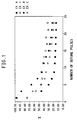
- Figure 1 is a chart of the percent conversion of n-butane to maleic anhydride versus the number of n-butane pulses utilized in a pulsed micro-reactor generated as described in Example 29.
- the white box represents a catalyst of the present invention, (V 0.9 Sb 0.05 Fe 0.05 O) 2 P 2 O 7 prepared as described in Example 1.
- the black box represents (VO) 2 P 2 0 7 prepared as in Comparative Example A.
- the black diamond represents (V 0.9 Cr 0.1 O 2 )P 2 0 7 prepared as in Comparative Example B.
- the white diamond represents (V 0.9 Cr 0.05 Fe 0.05 0) 2 P 2 O 7 prepared as in Comparative Example C.
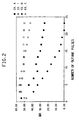
- Figure 2 is a chart of the selectivity to maleic anhydride versus the number of n-butane pulses utilized in a pulsed micro-reactor generated as described in Example 29.
- the white and black boxes and diamonds represent the same compounds as described above for Figure 1.
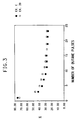
- Figure 3 is a chart of the percent conversion of n-butane to maleic anhydride versus the number of n-butane pulses utilized in a pulsed micro-reactor for spray dried catalyst with 10 wt % silica generated as described in Example 39.
- the white box represents a catalyst of the present invention, (V 0.9 Sb 0.05 Fe 0.05 O) 2 P 2 0 7 /SiO 2 prepared as in Example 39.
- the black box represents (VO) 2 P 2 0 7 /SiO 2 prepared as in Comparative Example E.
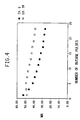
- Figure 4 is a chart of the selectivity to maleic anhydride versus the number of n-butane pulses utilized in a pulsed micro-reactor for spray dried catalyst with 10 wt % silica generated as described in Example 39.
- the white and black boxes represent the same compounds as described above for Figure 3.
- the improved VPO catalyst of present invention as described above as formula I through IV is made by a process similar to that described in U.S. Patent 4,442,226, wherein the vanadium is in the +5 oxidation state, such as in V 2 0 5 or NH 4 VO 3 , and is initially reduced to a substantial degree to the +4 oxidation state by reaction in either an aqueous or organic liquid medium.
- the reductant can comprise a soluble inorganic compound, such as a halide acid, for example, concentrated hydrochloric acid; a reduced acid of phosphorus, for example, H 3 PO 3 ; or a soluble organic compound, for example, formaldehyde, ethylene glycol, or glycolic, oxalic, citric or tartaric acid.
- the reductant can comprise one or more alcohols selected from such species as n-propyl, isopropyl, n-butyl, isobutyl, and benzyl alcohols.
- the reduction can be brought about by slurrying the pentavalent vanadium compound in the liquid medium, followed by heating under reflux for the time necessary to bring about the reduction.
- the improvement in the VPO catalyst of this invention which leads to enhanced productivity of maleic anhydride, results from the introduction of promoter AB into the (VO) 2 P 2 O 7 crystal structure, preferably introduced in a specific order and chemical form, i.e., solid solution, following the reduction step in which the tetravalent vanadium is formed.
- the promoter cation moieties comprise at least one of As, Sb and Bi with at least one of Ge, Sb, Pb, Al, Ga, Tl, Sc, V, Cr, Mn, Fe, Co, Ni, Cu, Zn, Y, Zr, Nb, Mo, Ru, Rh, Pd, Ag, Cd, La, Hf, W, Re, Os, Ir, Pt, Au, Ho, Be, Mg, Ca, Sr, Ba, Ra, Li, Na, K, Rb, Cs, and the rare earths, including Ce, Pr, Nd, Sm, Eu, Gd, Tb, Dy, Ho, Er, Tm, Yb, Lu, Th, Pa, U.
- the most preferred combination is Sb and Fe.
- the formulae used herein above to describe the catalysts of this invention are intended to clarify that the specific placement of the cation substituents in the crystal lattice can vary.
- the cations can be placed in whole or in part on a vanadium site in the crystal lattice, or the cations can be placed in whole or in part on a phosphorus site.
- this method of introduction of cation substituent into the crystal lattice is distinguished from those in the art where one or more cation substituents are post-deposited on the surface of the VPO composition.
- X-ray diffraction data detailed below in the Examples, show that many of the catalysts in accordance with this invention crystallize as a vanadium pyrophosphate or pyrophosphate-like structure.
- the cation substituents be introduced into the reaction medium as the inorganic salts, and not the metal oxides.
- they can be added as a cation with an appropriate attendant anion, for example, an acetate, alkoxide, anhydrous halide or acetylacetonate.
- the catalyst precursor is formed by the addition of any commonly used appropriate phosphorus compound, for example, anhydrous phosphoric acid with the continued heating of the resultant mixture under reflux to give the catalyst precursor composition that can be isolated by filtration, following cooling of the slurry to room temperature.
- This product is subsequently dried at about 125°C to about 200°C in a flowing inert atmosphere, such as nitrogen, for approximately 12 hours. At this point, oftentimes it is a crystalline species having an x-ray diffraction pattern similar to that of VO(HPO 4 ) 1/2H 2 O, the precursor to vanadium phosphate catalyst.
- This catalyst precursor is then calcined and activated in a fluidized reactor to generate the active catalyst phase.
- a typical activation procedure is detailed below:
- This catalyst precursor is then formed into a convenient catalyst shape, for ultimate charge into a reactor, by pelletizing the catalyst typically at about 30,000 psi (2.07 X 10 8 Pa) or less, to form small disks and crushing the pellet through sieves.
- pelletizing the catalyst typically at about 30,000 psi (2.07 X 10 8 Pa) or less, to form small disks and crushing the pellet through sieves.
- typically 250 to 425 micrometer particles are used; i.e., particles screen through a 40 mesh and retained on a 60 mesh (U.S. Sieve Series).
- a die lubricant and pellet binder such as graphite or Sterotex®, a hydrogenated cottonseed oil, commercially available from Capital City Products Company, Columbus, Ohio, before tabletting.
- catalysts prepared in the above manner may not have the optimum particle size range for such a reactor. Hence, they must be formed in the correct particle size range. Attrition by abrasion and/or fracture of the particles is a frequent problem in fluidized reactors, which necessitates the addition of a binder to the catalyst particles. Excessive particle attrition in these reactors is caused, for example, by particle-to-particle contact, abrasion with bed walls and bed internals, as well as distributor jet impingement and abrasion in circulation conduits leading to and from the reactor bed.
- High particle attrition contributes to product contamination and catalyst loss, plugging of down stream equipment, high filtration costs, and unstable fluidization behavior such as channeling, slugging or increased entrainment of reactants.
- the deleterious effects of fluidized bed operations can be exacerbated by high temperature conditions.
- These catalysts, by themselves, cannot be formed in the correct particle size range with sufficient mechanical strength to be attrition resistant.
- particle shape can also have an impact on attrition.
- Spheroidal particles with smooth surfaces will have lower attrition losses than particles with irregular shapes and rough edges.
- Spheroidal is defined herein to include spherical and nearly spherical particles, so long as there are no irregular or sharp edges that would likely cause attrition during handling or fluidization.
- a silica coating is applied by (a) forming a slurry comprised of catalyst or catalyst precursor particles dispersed in an aqueous Silic acid solution equivalent to a weight of SiO 2 not exceeding about 6% by weight, the relative amounts of the particles and silicic acid chosen so that the weight of the SiO 2 formed is about 3-15% of the total weight of the particles and the SiO 2 , (b) spray drying the slurry to form porous microspheres of attrition resistant catalyst or catalyst precursor and (c) calcining the spray dried microspheres at an elevated temperature which is below the temperature which is substantially deleterious to the catalyst, to produce attrition resistant SiO 2 coated catalyst.
- the silicic acid is polysilicic acid having an equivalent concentration of SiO 2 not exceeding about 5% by weight; the catalyst or catalyst precursor particles are less than about 10 ⁇ m in diameter; the microporous spheroidal particles produced by spray drying have diameters of from about 10 ⁇ m to about 300 ⁇ m, and the relative amounts of particles to be spray dried and SiO 2 are chosen so that the weight of the SiO 2 is about 5-12% of the total weight of the particles and the SiO 2 . It is preferred that the size of the particles used in step (a) above are from about 0.5 ⁇ m to about 10 ⁇ m and most preferably from about 0.5 ⁇ m to about 3 ⁇ m.
- the catalyst of the invention can be utilized advantageously with regard to conversion and selectivity in the wide variety of conventional techniques and reactor configurations employed to conduct the vapor phase oxidation of alkane hydrocarbons, particularly n-butane to maleic anhydride.
- the conversion can be conducted in a fixed-bed reactor, whereby the catalyst particles are maintained in a fixed position and are contacted with alkane hydrocarbon and oxygen in appropriate amounts, in the presence of one or more inert diluent gases.
- the greatest advantages of using the catalyst of this invention are realized when the conversion of n-butane to maleic anhydride is carried out in a recirculating solids reactor, such as that described in U.S. Patent 4,668,802.
- This patent discloses an improved process for the selective vapor phase oxidation of n-butane to maleic anhydride over a VPO catalyst, whereby the amount of oxygen in the feed gas to the VPO catalyst is limited to less than the stoichiometric amount required for the total amount of n-butane converted in the process.
- the reduced catalyst resulting from the oxidation is separated from the gaseous product stream; and is reoxidized, optionally in a separate reaction zone, before being contacted with n-butane.
- the present invention is not bound by theory of, it is believed that the increased oxygen capacity of the catalyst of this invention, selective to maleic anhydride, allows this catalyst to effectively catalyze high conversion to maleic anhydride, even under conditions where the catalyst is completely reduced or is the only source of oxygen for n-butane.
- This behavior is contrasted with prior art catalysts and promoted catalysts, such as that described in U.S. Patent 4,442,226, wherein the VPO or promoted VPO catalysts are sensitive to the partial pressure of oxygen with respect to their catalytic activity and it is recommended that the partial pressure of oxygen in the feed be maximized within the limits of safe operability.
- Use of the catalyst of the present invention consequently, provides advantages in safety of operation as well as conversion, because one can operate at levels of oxygen in the feed which are well outside the explosive range of conventionally required butane/oxygen/inert gas mixtures.
- Catalysts used in most oxidation systems can comprise particles in the approximate size range from 150 micrometer particles to 45 micrometer particles (i.e., 100-325 mesh, U.S. Sieve Series).
- the desired particle size distribution for the catalyst of the present invention may also be achieved by spray drying slurries of the catalyst precursor at appropriate concentrations.
- variable amounts of support such as silica
- colloidal silica sol for example, as one of the Ludox® colloidal silica compositions commercially available from E. I. du Pont de Nemours and Company, Wilminington, Delaware, or a very fine silica powder, such as one of the Cab-O-Sil® fumed silica commercially available from Cabot Corporation, Tuscoloa, Illinois.
- a 3 liter round bottom flask was equipped with an addition funnel, mechanical stirrer and a reflux condenser. For the duration of the reflux, nitrogen gas was used to purge the apparatus.
- nitrogen gas was used to purge the apparatus.
- 81.85 g of air micronized vanadium pentoxide (Aldrich Chemicals, Milwaukee, WI) was added to the round bottom flask.
- 8.11 g of anhydrous iron (III) chloride Johnson, Matthey - Alfa Chemicals, Ward Hill, MA
- 17.06 g of antimony (III) butaxide JM, Alfa Chemicals
- the precursor was directly calcined and activated in a small, 4 cm fluidized bed reactor. Prior to the activation, fine particles of less than 38 micrometer were sieved out by using a 400 mesh screen.
- the calcination/activation procedure generated the active catalyst phase by subjecting the precursor to the thermal conditions detailed below:
- the resulting catalyst was analyzed by Scanning Transmission Electron Microscopy (STEM) and High Resolution Transmission Electron Microscopy (HREM) using a commercially available Philips CM30 Super Twin HREM/STEM system operated at 300 keV for atomic scale imaging and high spatial resolution chemical composition analysis with the energy dispersive X-ray analyzer (EDX) and a STEM probe size of about 5 nanometers.
- STEM Scanning Transmission Electron Microscopy
- HREM High Resolution Transmission Electron Microscopy
- Philips CM30 Super Twin HREM/STEM system operated at 300 keV for atomic scale imaging and high spatial resolution chemical composition analysis with the energy dispersive X-ray analyzer (EDX) and a STEM probe size of about 5 nanometers.
- EDX energy dispersive X-ray analyzer
- STEM probe size about 5 nanometers.
- the catalyst sample was supported on a carbon-filmed microscope grid. Chemical analyses spectra were obtained from a large number of crystals and from a number of regions within each crystal
- the corresponding HREM lattice images showed regular periodicity with lattice lines extending directly to the surface with no evidence of an amorphous surface phase, line dislocations or stacking defects.
- the HREM/STEM data supported the formation of a solid solution in this catalyst.
- a 3 liter round bottom flask was equipped with an addition funnel, mechanical stirrer and a reflux condenser. For the duration of the reflux, nitrogen gas was used to purge the apparatus.
- nitrogen gas was used to purge the apparatus.
- 89.12 g of air micronized vanadium pentoxide (Aldrich Chemicals, Milwaukee, WI) was added to the round bottom flask.
- 1.62 g of anhydrous iron (III) chloride Johnson, Matthey - Alfa Chemicals, Ward Hill, MA
- 3.41 g of antimony (III) butoxide JM, Alfa Chemicals
- the precursor was directly calcined and activated in a small, 4 cm fluidized bed reactor, to generate the active catalyst phase by subjecting the precursor to the thermal conditions detailed below:
- Example 2 The procedure described in Example 2 was used to prepare additional catalysts.
- the cation sources shown in Table I were employed in the molar ratios shown.
- the formula of the catalysts produced were (V 0.8 Sb 0.1 Fe 0.1 0) 2 P 2 0 7 ⁇ , (V 0.9 Sb 0.025 Fe 0.075 O) 2 P 2 O 7 , and (V 0.9 Sb 0.075 Fe 0.025 O) 2 P 2 O 7 ⁇ .
- Example 2 A procedure similar to that of Example 1 was used.
- a 3 liter round bottom flask was equipped with an addition funnel, mechanical stirrer and a reflux condenser. For the duration of the reflux, nitrogen gas was used to purge the apparatus. Vanadium pentoxide was air micronized to prior to use.
- 89.89 g of vanadium pentoxide (Aldrich Chemicals, Milwaukee, WI) was added to the round bottom flask. 8.91 g of anhydrous iron (III) chloride (Johnson, Matthey - Alfa Chemicals, Ward Hill, MA) and 16.45 g of antimony pentachloride (anhydrous) (JM, Alfa Chemicals) were then added.
- the precursor was directly calcined and activated in a small, 4 cm fluidized bed reactor, to generate the active catalyst phase by subjecting the precursor to the thermal conditions detailed below:
- Example 2 A procedure similar to that of Example 1 was used.
- a 3 liter round bottom flask was equipped with an addition funnel, mechanical stirrer and a reflux condenser. For the duration of the reflux, nitrogen gas was used to purge the apparatus. Vanadium pentoxide was air micronized prior to use.
- 89.89 g of vanadium pentoxide Aldrich Chemicals, Milwaukee, WI
- 8.91 g of anhydrous iron (III) chloride Johnson, Matthey - Alfa Chemicals, Ward Hill, MA
- 18.73 g of antimony butoxide JM, Alfa Chemicals
- the precursor was directly calcined and activated in a small, 4 cm fluidized bed reactor, to generate the active catalyst phase by subjecting the precursor to the thermal conditions detailed below:
- Example 7 The procedure described in Example 7 was used to prepare additional catalysts.
- the cation sources were as shown in Table I and were used in the molar ratios shown.
- the formula of the catalysts produced were (V 0.9 Sb 0.05 Fe 0.05 0) 2 P 2 0 7 ⁇ , (V 0.8 Sb 0.1 Fe 0.1 O) 2 P 2 0 7 ⁇ , (V 0.8 Sb 0.15 Fe 0.05 O) 2 P 2 0 7 ⁇ , (V 0.9 Sb 0.05 Cu 0.05 O) 2 P 2 0 7 , (V 0.9 Sb 0.05 Cu 0.05 O) 2 P 2 0 7 ⁇ , and (V 0.9 Sb 0.05 Mn 0.05 O) 2 P 2 0 7 ⁇ .
- the vanadium pentoxide and alcohols were held at reflux temperatures for one hour.
- Anhydrous phosphoric acid was then added dropwise over a period of two hours. Following this procedure, the reflux continued for a period of fifteen additional hours.
- the precipitated solids are then filtered in a buchner funnel and dried in flowing nitrogen at 125°C for a period of 16 hours to yield the catalyst precursor.
- the precursor was directly calcined and activated in a small, 4 cm fluidized bed reactor, to generate the active catalyst phase by subjecting the precursor to the thermal conditions detailed below:
- Example 7 The procedure described in Example 7 was used to prepare additional catalysts.
- the cation sources were as shown in Table I and were used in the molar ratios shown.
- the formula of the catalysts produced were (V 0.9 Sb 0.05 Al 0.05 0) 2 P 2 0 7 ⁇ , (V 0.6 Sb 0.2 Al 0.2 O) 2 P 2 0 7 ⁇ , and (V 0.8 Sb 0.05 Li 0.1 Fe 0.05 ) 2 P 2 0 7 ⁇ .
- Example 14 The procedure described in Example 14 were used.
- the cation sources were as shown in Table I and were used in the molar ratios shown.
- the formula of the catalyst produced was (V 0.81 Sb 0.09 Ce 0.1 O) 2 P 2 O 7 ⁇ .
- Example 7 The procedure described in Example 7 was used.
- the cation sources were as shown in Table I and were used in the molar ratios shown.
- the formula of the catalyst produced was (V 0.09 Sb 0.05 Ni 0.05 O) 2 P 2 O 7 ⁇ .
- Example 2 The procedure described in Example 2 was used.
- the cation sources were as shown in Table I and were used in the molar ratios shown.
- the formula of the catalyst produced was (V 0.9 Sb 0.05 Cr 0.05 O) 2 P 2 O 7 ⁇ .
- Example 6 A procedure similar to that described in Example 6 was used.
- a 3 liter round bottom flask was equipped with an addition funnel, mechanical stirrer and a reflux condenser. For the duration of the reflux, nitrogen gas was used to purge the apparatus.
- 89.89 g of vanadium pentoxide Aldrich Chemicals, Milwaukee, WI
- the vanadium pentoxide was then air micronized. 17.32 g of BiCl 3 (Johnson, Matthey - Alfa Chemicals, Ward Hill, MA) and 16.43 g of SbCl 5 (JM, Alfa Chemicals) were then added.
- the vanadium pentoxide and alcohols were held at reflux temperatures for one hour.
- Anhydrous phosphoric acid was then added dropwise over a period of two hours. Following this procedure, the reflux continued for a period of fifteen additional hours.
- the precipitated solids are then filtered in a buchner funnel and dried in flowing nitrogen at 125°C for a period of 16 hours to yield the catalyst precursor.
- the precursor was directly calcined and activated in a small, 4 cm fluidized bed reactor, to generate the active catalyst phase by subjecting the precursor to the thermal conditions detailed below:
- Example 21 The procedure described in Example 21 was used.
- the cation sources were as shown in Table I and were used in the molar ratios shown.
- the formula of the catalyst produced was (V 0.9 Bi 0.05 Sb 0.05 O) 2 P 2 O 7 ⁇ .
- Example 7 The procedure described in Example 7 was used.
- the cation sources were as shown in Table I and were used in the molar ratios shown.
- the formula of the catalysts produced were (V 0.9 Bi 0.05 Sb 0.05 O) 2 P 2 O 7 ⁇ , (V 0.9 Bi 0.05 Sb 0.05 O) 2 P 2 O 7 ⁇ , (V 0.9 Sb 0.05 Sn 0.05 O) 2 P 2 O 7 , (V 0.9 Sb 0.05 Ga 0.05 O) 2 P 2 O 7 , (V 0.9 Sb 0.05 Co 0.05 O) 2 P 2 O 7 ⁇ , and (V 0.8 Sb 0.1 Co 0.1 O) 2 P 2 O 7 ⁇ .
- Example 7 The procedure of Example 7 was followed except that no antimony butoxide nor iron chloride were used.
- the formula of the catalyst produced was (VO) 2 P 2 O 7 .
- Example 2 The procedure of Example 2 was followed except that Chromium(III) acetate hydroxide alone was used instead of antimony butoxide and iron chloride.
- the formula of the catalyst produced was (V 0.9 Cr 0.1 O) 2 P 2 O 7 .
- Example 14 The procedure of Example 14 was followed except that Chromium(III) acetate hydroxide was used instead of manganese acetyl acetoate.
- the formula of the catalyst produced was (V 0.9 Fe 0.05 Cr 0.05 O) 2 P 2 O 7 .
- Example 1 Comparative Example A, Comparative Example B and Comparative Example C prepared above were utilized in the pulsed microreactor described below to catalyze the conversion of butane to maleic anhydride.
- Pulse reactor evaluation of the catalysts was carried out by injecting 0.05 ml pulses of butane by means of a gas sampling valve contained in an oven at 170°C into a stream of helium flowing at 10 ml/min that passed over 0.5 grams of catalyst in a reactor made from 1/8" (3.2 mm) tubing and heated in a tube furnace to 380°C.
- the effluent of the reactor passed through a thermal conductivity detector and then through a sample loop. When the pulse was in the sample loop, as determined by the thermal conductivity detector, it was injected into a gas chromatograph for analysis of the reaction products. Butane pulses were passed over the catalyst every 10 min, with alternate pulses being analyzed.
- Pulsed microreactor evaluations of these catalysts showed differences between substituted vanadium phosphates and their parent compounds as shown in Figures 1 and 2.
- Figure 1 shows that the catalyst was reduced with successive butane pulses.
- the catalyst of Example 1 maintained conversion levels relative to the Comparative Example A, Comparative Example B and Comparative Example C catalyst.
- Figure 2 showed that as the catalyst was reduced with successive butane pulses, the catalyst of Example 1 maintained selectivity relative to the Comparative Example A, Comparative Example B and Comparative Example C catalyst.
- Vanadium phosphate precursor prepared as described in Example 7 (correcting for the stoichiometry by replacing Fe and Sb with an equimolar amount of vanadium to make a VPO catalyst), was repeated 14 times to yield 14 combined batches.
- This precursor was air micronized to a particle size less than 5 microns in diameter. 2000 g of this precursor was then slurried in 5% (wt % as SiO 2 ) of polysilicic acid (PSA).
- PSA polysilicic acid
- the 5% PSA was prepared by mixing 1014 g of sodium silicate with 5000 g of H 2 0.
- the Na was then removed by combining with DOWEX HCR-W2 sulfonic acid resin (Dow Chemicals, Midland Michigan).
- the appropriate amount of PSA was used fresh.
- the time of contact of the slurry with the polysilicic acid was kept to less than about 30 minutes.
- the catalyst slurry was then spray dried to produce a final catalyst composition containing 10 wt
- This slurry was then poured through a cheesecloth, to filter out any very large clumps of catalyst, and then pumped into a commercially available spray dryer (Bowen Dryer, available from Bowen Engineering Corporation, Columbia, Maryland).
- This spray dryer is a 1.22 meter (4 ft) diameter, 2.44 meter (8 ft) straight end electrically fired dryer.
- Typical spray drying conditions include a feed rate of 160 m./min, an inlet temperature of 376°C to the dryer and outlet temperatures of 160-170°C.
- the catalyst was then calcine activated in accordance with the procedure of Example 1.
- Example 7 The procedure of Example 7 was followed for the preparation of the precursor, correcting for the stoichiometry of iron and antimony.
- the resulting catalyst precursor was then treated in accordance with the procedure of Comparative Example D, except that 350 g of micronized precursor was slurried with 700.4 g of 5% polysilicic acid prior to spray drying.
- Example 31 The procedure of Example 31 was followed except for correcting for the stoichiometry of the catalyst precursor. Lithium benzoate was used for the source of lithium.
- Example 31 The procedure of Example 31 was followed except for correcting for the stoichiometry of the catalyst precursor.
- Manganese acetate and antimony butoxide were the sources of Mn and Sb.
- Example 16 The procedure of Example 16 was followed to prepare two batches of the precursor which were subsequently micronized. They were spray dried and then calcined/activated in accordance with the procedure of Comparative Example 31.
- Example 11 The procedure of Example 11 was followed to prepare two batches of the precursors which were subsequently micronized. The precursor was spray dried and then calcined/activated in accordance with the procedure of Comparative Example 31.
- Example 7 Two batches of the commercial precursor was prepared using the 3 liter reflux apparatus described in Example 7. The procedure used was similar to Example 7, except for the reagents. 89.89 g of vanadium pentoxide, 17.82 g of iron trichloride (anhydrous), 77.93 g of bismuth 2-ethylhexanoate were used. The amount of phosporic acid and phosphorus pentoxide used were 29.88 and 29.88 g, respectively.
- a fixed bed micro-reactor was used to evaluate the catalysts from Comparative Example D and Examples 30-36, inclusive.
- the microreactor consisted of a 40.64 cm by 0.64 cm stainless steel tube enclosed by an aluminum sheath (3.12 cm thick, to assist in minimizing thermal gradients) which itself was enclosed in a tube furnace.
- the reactor was mounted vertically with the direction of the of gas flow from top to bottom.
- Pressure gauges were mounted near both the entrance and exit of the reactor to monitor pressure changes.
- a bypass valve installed near the reactor entrance allowed the entering gas stream to pass through either the reactor or to bypass the reactor and pass directly to the sampling valve system, allowing analysis of the reactor feed gases prior to reaction.
- thermocouple mounted such that it monitored the temperature at the entrance to the packed catalyst bed.
- Commercially available mass flowmeters (Tylan Model FC-260) of ranges 0-100 and 0-10 cc/minute, respectively, fed the reactor.
- the heated exit gas stream (200°C) passed through a heated sampling valve allowing the selection of a gas sample (250 ⁇ l) of the stream for analysis by gas-liquid chromatography (GLC), using a commercially availablke instrument (Gow-Mac Series 740P FID GLC).
- the GLC was used to analyze for butane and for products to maleic anhydride, acetic acid and acrylic acid.
- the rate constant k included several other factors including the dependence of the reaction rate on oxygen concentration (which remained relatively constant under our conditions) and the concentration of catalyst active sites (also assumed constant).
- Rate constants and selectivity at 40% conversion is shown in Table 2.
- Spray Dried Catalysts Example Mole Ratio of V:A:B:P k (sec) -1 Selectivity at 40% conversion D 1:0:0: ⁇ 1 1.15 49 30 0.9:0.05:0.05: ⁇ 1 1.18 74 31 0.8:0.1:0.1: ⁇ 1 1.25 65 32 0.0.05:8:0.1:0.05: ⁇ 1 0.53 46 33 0.9:0.05:0.05: ⁇ 1 1.00 52 34 0.6:0.2:0.2: ⁇ 1 0.66 19 35 0.9:0.05:0.05: ⁇ 1 2.54 67 36 1.8:0.2:0.2: ⁇ 1.8 0.63 15
- X-ray data were obtained at room temperature on the catalysts prepared in accordance with Examples 1, 4, 21, 20, 11, 25, 26 and Comparative Example A using a conventional commercially available diffractometer (Philips XRD 3600 powder diffractometer with CuKalpha radiation), using 0.02 C 2 ⁇ steps and 0.5 seconds count time per step. Cell parameters were refined with the aid of a least squared fitting program which corrected for random errors, as well as the systematic error effects of the diffractometer. All d-spacings; were calculated on the basis of the CuK ⁇ 1 line, 0.15405 nm (i.e., 1.54O5 ⁇ ), and included the systematic error corrections. The listed 2-theta values are uncorrected for the systematic errors.
- the x-ray diffraction data analyisis showed the activated catalysts in accordance with this invention closely resembled single phase ⁇ -(VO) 2 P 2 0 7 , with substantially no trace of separate promoter phases.
- Comparative Example D The procedure of Comparative Example D was followed, except that the catalyst was further conditioned in a circulating solids reactor as described in U.S. 4,668,802, wherein the amount of oxygen in the feed gas to the catalyst was limited to less than the stoichiometric amount required for the total amount of n-butane converted in the process.
- the reduced catalyst resulting from the oxidation was separated from the gaseous product stream; and was reoxidized, optionally in a separate reaction zone, before being contacted with n-butane in a pulsed micro reactor as described in Example 29.
- Example 30 The procedure of Example 30 was followed, except that the catalyst was further conditioned in a circulating solids reactor in accordance with Comparative Example D.
Landscapes
- Chemical & Material Sciences (AREA)
- Organic Chemistry (AREA)
- Engineering & Computer Science (AREA)
- Materials Engineering (AREA)
- Chemical Kinetics & Catalysis (AREA)
- Oil, Petroleum & Natural Gas (AREA)
- Catalysts (AREA)
- Organic Low-Molecular-Weight Compounds And Preparation Thereof (AREA)
- Furan Compounds (AREA)
Applications Claiming Priority (3)
| Application Number | Priority Date | Filing Date | Title |
|---|---|---|---|
| US221292 | 1994-03-31 | ||
| US08/221,292 US5543532A (en) | 1994-03-31 | 1994-03-31 | Catalyst and method for vapor phase oxidation of alkane hydrocarbons |
| PCT/US1995/003204 WO1995026817A1 (en) | 1994-03-31 | 1995-03-23 | Catalyst for vapor phase oxidation of alkane hydrocarbons |
Publications (2)
| Publication Number | Publication Date |
|---|---|
| EP0752915A1 EP0752915A1 (en) | 1997-01-15 |
| EP0752915B1 true EP0752915B1 (en) | 2001-01-24 |
Family
ID=22827193
Family Applications (1)
| Application Number | Title | Priority Date | Filing Date |
|---|---|---|---|
| EP95914044A Expired - Lifetime EP0752915B1 (en) | 1994-03-31 | 1995-03-23 | Catalyst for vapor phase oxidation of alkane hydrocarbons |
Country Status (7)
| Country | Link |
|---|---|
| US (1) | US5543532A (enExample) |
| EP (1) | EP0752915B1 (enExample) |
| JP (1) | JP3871067B2 (enExample) |
| AT (1) | ATE198841T1 (enExample) |
| DE (1) | DE69519985T2 (enExample) |
| ES (1) | ES2155127T3 (enExample) |
| WO (1) | WO1995026817A1 (enExample) |
Cited By (1)
| Publication number | Priority date | Publication date | Assignee | Title |
|---|---|---|---|---|
| US7087767B2 (en) | 2002-08-02 | 2006-08-08 | Basf Aktiengesellschaft | Method for producing maleic anhydride |
Families Citing this family (35)
| Publication number | Priority date | Publication date | Assignee | Title |
|---|---|---|---|---|
| US5945368A (en) * | 1995-10-02 | 1999-08-31 | Huntsman Petrochemical Corporation | Molybdenum-modified vanadium-phosphorus oxide catalysts for the production of maleic anhydride |
| US5932746A (en) * | 1996-04-29 | 1999-08-03 | E. I. Du Pont De Nemours And Company | Vanadium catalysts and their precursors |
| US7066973B1 (en) | 1996-08-26 | 2006-06-27 | Nuvera Fuel Cells | Integrated reformer and shift reactor |
| US5840648A (en) * | 1997-09-02 | 1998-11-24 | The Standard Oil Company | Catalyst for the manufacture of acrylonitrile and hydrogen cyanide |
| US6660681B1 (en) * | 1999-04-15 | 2003-12-09 | E. I. Du Pont De Nemours And Company | Vanadium phosphorus oxide catalyst having a thermally conductive support |
| US6641625B1 (en) | 1999-05-03 | 2003-11-04 | Nuvera Fuel Cells, Inc. | Integrated hydrocarbon reforming system and controls |
| US6698431B1 (en) * | 1999-09-01 | 2004-03-02 | Compass Institute, Inc. | Apparatus and method for supporting human body during itimate activity |
| WO2001052983A1 (en) * | 2000-01-20 | 2001-07-26 | E.I. Dupont De Nemours And Company | Vanadium-phosphorus oxide catalysts with promoter reagents |
| DE10011307A1 (de) | 2000-03-10 | 2001-09-13 | Basf Ag | Katalysator und Verfahren zur Herstellung von Maleinsäureanhydrid |
| DE10211445A1 (de) | 2002-03-15 | 2003-10-02 | Basf Ag | Katalysator-Precursor für die Herstellung von Maleinsäureanhydrid und Verfahren zu dessen Herstellung |
| DE10211449A1 (de) | 2002-03-15 | 2003-09-25 | Basf Ag | Katalysator-Precursor für die Herstellung von Maleinsäureanhydrid und Verfahren zu dessen Herstellung |
| US7507384B2 (en) | 2002-06-13 | 2009-03-24 | Nuvera Fuel Cells, Inc. | Preferential oxidation reactor temperature regulation |
| US6858561B2 (en) * | 2003-05-15 | 2005-02-22 | Scientific Design Company, Inc. | Phosphorus/vanadium catalyst preparation |
| DE10334582A1 (de) | 2003-07-28 | 2005-02-24 | Basf Ag | Verfahren zur Herstellung von Maleinsäureanhydrid |
| DE102005035978A1 (de) * | 2005-07-28 | 2007-02-01 | Basf Ag | Katalysator und Verfahren zur Herstellung von Maleinsäureanhydrid |
| US7365217B2 (en) * | 2006-01-25 | 2008-04-29 | Lyondell Chemical Technology, L.P. | Oxidation process |
| US8298981B2 (en) * | 2007-11-09 | 2012-10-30 | Universiti Putra Malaysia | Process to produce high surface area nanoparticle vanadium phosphorus oxide catalyst and product derives thereof |
| US20100116714A1 (en) * | 2008-11-12 | 2010-05-13 | Lapinski Mark P | Process and System for the Addition of Promoter Metal In Situ in a Catalytic Reforming Unit |
| ES2700658T3 (es) | 2008-12-22 | 2019-02-18 | Basf Se | Catalizador y procedimiento para la preparación de anhídrido maleico |
| CN102325593A (zh) | 2008-12-22 | 2012-01-18 | 巴斯夫欧洲公司 | 用于生产马来酸酐的催化剂成型体及方法 |
| EP2470301A1 (de) | 2009-08-26 | 2012-07-04 | Basf Se | Katalysator-precursor für die herstellung von maleinsäureanhydrid und verfahren zu dessen herstellung |
| DE102010040921A1 (de) | 2010-09-16 | 2012-03-22 | Basf Se | Verfahren zur Herstellung von Acrylsäure aus Methanol und Essigsäure |
| DE102010040923A1 (de) | 2010-09-16 | 2012-03-22 | Basf Se | Verfahren zur Herstellung von Acrylsäure aus Ethanol und Formaldehyd |
| US8785344B2 (en) | 2012-02-20 | 2014-07-22 | Basf Se | Gas phase oxidation catalyst with low charge transport activation energy |
| US9266091B2 (en) | 2012-03-29 | 2016-02-23 | Uop Llc | Reforming catalysts with tuned acidity for maximum aromatics yield |
| US8912110B2 (en) | 2012-03-29 | 2014-12-16 | Uop Llc | Catalyst for conversion of hydrocarbons |
| DE102013008206A1 (de) | 2013-05-14 | 2014-11-20 | Basf Se | Verfahren zur Herstellung von Vinylidencarbonsäure(ester)n durch Umsetzung von Formaldehyd mit Alkylcarbonsäure(estern)n |
| DE102013008207A1 (de) | 2013-05-14 | 2014-11-20 | Basf Se | Verfahren zur Herstellung von Acrylsäure mit hoher Raum-Zeit-Ausbeute |
| US9073846B2 (en) | 2013-06-05 | 2015-07-07 | Celanese International Corporation | Integrated process for the production of acrylic acids and acrylates |
| US9120743B2 (en) | 2013-06-27 | 2015-09-01 | Celanese International Corporation | Integrated process for the production of acrylic acids and acrylates |
| US9675966B2 (en) * | 2015-07-16 | 2017-06-13 | Ineos Europe Ag | Catalyst for n-butane oxidation to maleic anhydride |
| CN105618094A (zh) * | 2016-03-21 | 2016-06-01 | 唐伟 | 一种氧化型催化剂的制备设备及其工艺 |
| CN106278865B (zh) * | 2016-08-03 | 2018-08-21 | 江苏大学 | 一种醋酸甲醛缩合制备丙烯酸的方法 |
| CN109046412B (zh) * | 2018-08-23 | 2021-05-25 | 常州新日催化剂股份有限公司 | 一种正丁烷氧化制顺酐催化剂及其制备方法 |
| CN116060061B (zh) * | 2021-10-31 | 2024-05-31 | 中国石油化工股份有限公司 | 一种钒磷氧催化剂前驱体粉末及由其制备的催化剂 |
Family Cites Families (20)
| Publication number | Priority date | Publication date | Assignee | Title |
|---|---|---|---|---|
| US3985775A (en) * | 1971-11-22 | 1976-10-12 | Chevron Research Company | Vanadium-phosphorus oxide oxidation of N-butane to maleic anhydride |
| US3864280A (en) * | 1972-06-19 | 1975-02-04 | Chevron Res | Catalyst for a n-butane oxidation to maleic anhydride |
| US4187235A (en) * | 1972-09-18 | 1980-02-05 | Chevron Research Company | Method for preparing maleic anhydride |
| US4132670A (en) * | 1974-11-06 | 1979-01-02 | Chevron Research Company | Method of preparing vanadium (IV) phosphate composition with high intrinsic surface area |
| US4111963A (en) * | 1973-02-07 | 1978-09-05 | Monsanto Company | Method for preparing maleic anhydride |
| US4043943A (en) * | 1974-11-06 | 1977-08-23 | Chevron Research Company | Process for producing a mixed oxide of vanadium and phosphorus having an improved intrinsic surface area |
| US4064070A (en) * | 1974-12-23 | 1977-12-20 | Chevron Research Company | Catalyst for producing maleic anhydride |
| GB1591307A (en) * | 1976-11-11 | 1981-06-17 | Ici Ltd | Production of maleic anhydride and catalysts therefor |
| US4178304A (en) * | 1978-03-13 | 1979-12-11 | Efendiev Medzhid R O | Method of producing ortho-aminobenzonitrile |
| US4219484A (en) * | 1978-10-23 | 1980-08-26 | Standard Oil Company (Ohio) | Production of maleic anhydride from four-carbon hydrocarbons using catalysts prepared by water reflux techniques |
| US4337173A (en) * | 1980-09-22 | 1982-06-29 | Mitsubishi Chemical Industries, Ltd. | Solid-solution type crystalline oxides and their precursors |
| US4567314A (en) * | 1981-12-07 | 1986-01-28 | Union Oil Company Of California | Process for producing diolefins |
| US4442226A (en) * | 1982-02-16 | 1984-04-10 | E. I. Du Pont De Nemours And Company | Catalyst for vapor phase oxidation of n-butane to maleic anhydride |
| US4371702A (en) * | 1982-02-16 | 1983-02-01 | E. I. Du Pont De Nemours And Company | Vapor phase oxidation of n-butane to maleic anhydride |
| US4647673A (en) * | 1982-09-23 | 1987-03-03 | The Standard Oil Company | Maleic anhydride process |
| US4668802A (en) * | 1985-01-18 | 1987-05-26 | E. I. Du Pont De Nemours And Company | Improved vapor phase catalytic oxidation of butane to maleic anhydride |
| US5021588A (en) * | 1985-01-18 | 1991-06-04 | E.I. Du Pont De Nemours And Company | Vapor phase catalytic oxidation of butane to maleic anhydride |
| US4677084A (en) * | 1985-11-27 | 1987-06-30 | E. I. Du Pont De Nemours And Company | Attrition resistant catalysts, catalyst precursors and catalyst supports and process for preparing same |
| US5300682A (en) * | 1991-06-10 | 1994-04-05 | The Standard Oil Co. | Catalytic oxidation of ethane to acetic acid |
| US5364824A (en) * | 1992-12-08 | 1994-11-15 | Huntsman Specialty Chemicals Corporation | Catalysis for the production of maleic anhydride containing vanadium-phosphorus oxide with selected promoter elements |
-
1994
- 1994-03-31 US US08/221,292 patent/US5543532A/en not_active Expired - Lifetime
-
1995
- 1995-03-23 AT AT95914044T patent/ATE198841T1/de not_active IP Right Cessation
- 1995-03-23 DE DE69519985T patent/DE69519985T2/de not_active Expired - Lifetime
- 1995-03-23 EP EP95914044A patent/EP0752915B1/en not_active Expired - Lifetime
- 1995-03-23 ES ES95914044T patent/ES2155127T3/es not_active Expired - Lifetime
- 1995-03-23 WO PCT/US1995/003204 patent/WO1995026817A1/en not_active Ceased
- 1995-03-23 JP JP52570995A patent/JP3871067B2/ja not_active Expired - Lifetime
Cited By (1)
| Publication number | Priority date | Publication date | Assignee | Title |
|---|---|---|---|---|
| US7087767B2 (en) | 2002-08-02 | 2006-08-08 | Basf Aktiengesellschaft | Method for producing maleic anhydride |
Also Published As
| Publication number | Publication date |
|---|---|
| ES2155127T3 (es) | 2001-05-01 |
| US5543532A (en) | 1996-08-06 |
| WO1995026817A1 (en) | 1995-10-12 |
| JPH09511177A (ja) | 1997-11-11 |
| ATE198841T1 (de) | 2001-02-15 |
| EP0752915A1 (en) | 1997-01-15 |
| DE69519985D1 (de) | 2001-03-01 |
| DE69519985T2 (de) | 2001-09-06 |
| JP3871067B2 (ja) | 2007-01-24 |
Similar Documents
| Publication | Publication Date | Title |
|---|---|---|
| US5543532A (en) | Catalyst and method for vapor phase oxidation of alkane hydrocarbons | |
| US5364824A (en) | Catalysis for the production of maleic anhydride containing vanadium-phosphorus oxide with selected promoter elements | |
| US7504357B2 (en) | Catalyst composition for the selective conversion of alkanes to unsaturated carboxylic acids, method of making and method of using thereof | |
| EP3337775B1 (en) | Improved oxidative dehydrogenation catalyst | |
| US5296436A (en) | Phosphorous/vanadium oxidation catalyst | |
| EP1424125B1 (en) | Process for preparing an antimony based mixed metal oxide catalyst and catalyst obtained | |
| US11161096B2 (en) | Synthesis of a MoVNbTe catalyst having an increased specific surface and higher activity for the oxidative dehydrogenation of ethane to ethylene | |
| US8298981B2 (en) | Process to produce high surface area nanoparticle vanadium phosphorus oxide catalyst and product derives thereof | |
| EP0799642A1 (en) | Process for the preparation of supported catalyst for synthesis of methacrolein and methacrylic acid | |
| US11638915B2 (en) | Double peroxide treatment of oxidative dehydrogenation catalyst | |
| EP0319192B1 (en) | Process for producing a phosphorus-antimony-containing cata- lyst for oxidation of organic compounds | |
| US4981830A (en) | Process for preparing iron-antimony-phosphorus-containing catalyst for fluidized bed process | |
| EP0787118B1 (en) | Cation and vanadium substituted heteropolyacid catalysts for vapor phase oxidation | |
| US6841686B2 (en) | Molybdenum based oxidation catalysts | |
| US4219484A (en) | Production of maleic anhydride from four-carbon hydrocarbons using catalysts prepared by water reflux techniques | |
| US6903047B2 (en) | Vanadium-phosphorus oxide catalysts with promoter reagents | |
| EP0215553A1 (en) | Fumed silica modified catalyst and process for oxidation of n-butane to maleic anhydride | |
| JPH08238433A (ja) | メタクロレイン及びメタクリル酸合成用担持触媒の製造法 | |
| JP3603352B2 (ja) | リン−バナジウム酸化物触媒の製造方法 | |
| US20030162981A1 (en) | Catalyst and process for the oxidation of hydrocarbons | |
| Nilsson et al. | Formation of active phases in the Sb-V-, Al-Sb-V-, and Al-Sb-VW-oxide systems for propane ammoxidation | |
| JP3500676B2 (ja) | リン−バナジウム酸化物触媒前駆体の製造方法 | |
| JPH07124474A (ja) | バナジウム及びリンの酸化物を含む流動触媒の製造法 |
Legal Events
| Date | Code | Title | Description |
|---|---|---|---|
| PUAI | Public reference made under article 153(3) epc to a published international application that has entered the european phase |
Free format text: ORIGINAL CODE: 0009012 |
|
| 17P | Request for examination filed |
Effective date: 19960830 |
|
| AK | Designated contracting states |
Kind code of ref document: A1 Designated state(s): AT BE CH DE DK ES FR GB GR IE IT LI LU NL PT SE |
|
| RIN1 | Information on inventor provided before grant (corrected) |
Inventor name: SONNICHSEN, GEORGE, CARL Inventor name: KOURTAKIS, KOSTANTINOS |
|
| 17Q | First examination report despatched |
Effective date: 19990527 |
|
| GRAG | Despatch of communication of intention to grant |
Free format text: ORIGINAL CODE: EPIDOS AGRA |
|
| 17Q | First examination report despatched |
Effective date: 19990527 |
|
| GRAG | Despatch of communication of intention to grant |
Free format text: ORIGINAL CODE: EPIDOS AGRA |
|
| GRAH | Despatch of communication of intention to grant a patent |
Free format text: ORIGINAL CODE: EPIDOS IGRA |
|
| GRAH | Despatch of communication of intention to grant a patent |
Free format text: ORIGINAL CODE: EPIDOS IGRA |
|
| GRAA | (expected) grant |
Free format text: ORIGINAL CODE: 0009210 |
|
| AK | Designated contracting states |
Kind code of ref document: B1 Designated state(s): AT BE CH DE DK ES FR GB GR IE IT LI LU NL PT SE |
|
| PG25 | Lapsed in a contracting state [announced via postgrant information from national office to epo] |
Ref country code: SE Free format text: THE PATENT HAS BEEN ANNULLED BY A DECISION OF A NATIONAL AUTHORITY Effective date: 20010124 Ref country code: NL Free format text: LAPSE BECAUSE OF FAILURE TO SUBMIT A TRANSLATION OF THE DESCRIPTION OR TO PAY THE FEE WITHIN THE PRESCRIBED TIME-LIMIT Effective date: 20010124 Ref country code: LI Free format text: LAPSE BECAUSE OF FAILURE TO SUBMIT A TRANSLATION OF THE DESCRIPTION OR TO PAY THE FEE WITHIN THE PRESCRIBED TIME-LIMIT Effective date: 20010124 Ref country code: IT Free format text: LAPSE BECAUSE OF FAILURE TO SUBMIT A TRANSLATION OF THE DESCRIPTION OR TO PAY THE FEE WITHIN THE PRE;WARNING: LAPSES OF ITALIAN PATENTS WITH EFFECTIVE DATE BEFORE 2007 MAY HAVE OCCURRED AT ANY TIME BEFORE 2007. THE CORRECT EFFECTIVE DATE MAY BE DIFFERENT FROM THE ONE RECORDED.SCRIBED TIME-LIMIT Effective date: 20010124 Ref country code: FR Free format text: LAPSE BECAUSE OF FAILURE TO SUBMIT A TRANSLATION OF THE DESCRIPTION OR TO PAY THE FEE WITHIN THE PRESCRIBED TIME-LIMIT Effective date: 20010124 Ref country code: CH Free format text: LAPSE BECAUSE OF FAILURE TO SUBMIT A TRANSLATION OF THE DESCRIPTION OR TO PAY THE FEE WITHIN THE PRESCRIBED TIME-LIMIT Effective date: 20010124 Ref country code: AT Free format text: LAPSE BECAUSE OF FAILURE TO SUBMIT A TRANSLATION OF THE DESCRIPTION OR TO PAY THE FEE WITHIN THE PRESCRIBED TIME-LIMIT Effective date: 20010124 |
|
| REF | Corresponds to: |
Ref document number: 198841 Country of ref document: AT Date of ref document: 20010215 Kind code of ref document: T |
|
| REG | Reference to a national code |
Ref country code: CH Ref legal event code: EP |
|
| REF | Corresponds to: |
Ref document number: 69519985 Country of ref document: DE Date of ref document: 20010301 |
|
| REG | Reference to a national code |
Ref country code: IE Ref legal event code: FG4D |
|
| PG25 | Lapsed in a contracting state [announced via postgrant information from national office to epo] |
Ref country code: LU Free format text: LAPSE BECAUSE OF NON-PAYMENT OF DUE FEES Effective date: 20010323 Ref country code: IE Free format text: LAPSE BECAUSE OF NON-PAYMENT OF DUE FEES Effective date: 20010323 |
|
| PG25 | Lapsed in a contracting state [announced via postgrant information from national office to epo] |
Ref country code: PT Free format text: LAPSE BECAUSE OF FAILURE TO SUBMIT A TRANSLATION OF THE DESCRIPTION OR TO PAY THE FEE WITHIN THE PRESCRIBED TIME-LIMIT Effective date: 20010424 Ref country code: DK Free format text: LAPSE BECAUSE OF FAILURE TO SUBMIT A TRANSLATION OF THE DESCRIPTION OR TO PAY THE FEE WITHIN THE PRESCRIBED TIME-LIMIT Effective date: 20010424 |
|
| PG25 | Lapsed in a contracting state [announced via postgrant information from national office to epo] |
Ref country code: GR Free format text: LAPSE BECAUSE OF FAILURE TO SUBMIT A TRANSLATION OF THE DESCRIPTION OR TO PAY THE FEE WITHIN THE PRESCRIBED TIME-LIMIT Effective date: 20010427 |
|
| REG | Reference to a national code |
Ref country code: ES Ref legal event code: FG2A Ref document number: 2155127 Country of ref document: ES Kind code of ref document: T3 |
|
| EN | Fr: translation not filed | ||
| NLV1 | Nl: lapsed or annulled due to failure to fulfill the requirements of art. 29p and 29m of the patents act | ||
| REG | Reference to a national code |
Ref country code: CH Ref legal event code: PL |
|
| PLBE | No opposition filed within time limit |
Free format text: ORIGINAL CODE: 0009261 |
|
| STAA | Information on the status of an ep patent application or granted ep patent |
Free format text: STATUS: NO OPPOSITION FILED WITHIN TIME LIMIT |
|
| REG | Reference to a national code |
Ref country code: GB Ref legal event code: IF02 |
|
| REG | Reference to a national code |
Ref country code: IE Ref legal event code: MM4A |
|
| 26N | No opposition filed | ||
| PGFP | Annual fee paid to national office [announced via postgrant information from national office to epo] |
Ref country code: ES Payment date: 20140211 Year of fee payment: 20 |
|
| PGFP | Annual fee paid to national office [announced via postgrant information from national office to epo] |
Ref country code: GB Payment date: 20140319 Year of fee payment: 20 |
|
| PGFP | Annual fee paid to national office [announced via postgrant information from national office to epo] |
Ref country code: BE Payment date: 20140312 Year of fee payment: 20 |
|
| PGFP | Annual fee paid to national office [announced via postgrant information from national office to epo] |
Ref country code: DE Payment date: 20140417 Year of fee payment: 20 |
|
| REG | Reference to a national code |
Ref country code: DE Ref legal event code: R071 Ref document number: 69519985 Country of ref document: DE |
|
| REG | Reference to a national code |
Ref country code: DE Ref legal event code: R071 Ref document number: 69519985 Country of ref document: DE |
|
| REG | Reference to a national code |
Ref country code: GB Ref legal event code: PE20 Expiry date: 20150322 |
|
| PG25 | Lapsed in a contracting state [announced via postgrant information from national office to epo] |
Ref country code: GB Free format text: LAPSE BECAUSE OF EXPIRATION OF PROTECTION Effective date: 20150322 |
|
| REG | Reference to a national code |
Ref country code: ES Ref legal event code: FD2A Effective date: 20150826 |
|
| PG25 | Lapsed in a contracting state [announced via postgrant information from national office to epo] |
Ref country code: ES Free format text: LAPSE BECAUSE OF EXPIRATION OF PROTECTION Effective date: 20150324 |