EP0743372B1 - Method and apparatus for simplified production of heat-treatable aluminum alloy - Google Patents
Method and apparatus for simplified production of heat-treatable aluminum alloy Download PDFInfo
- Publication number
- EP0743372B1 EP0743372B1 EP96107997A EP96107997A EP0743372B1 EP 0743372 B1 EP0743372 B1 EP 0743372B1 EP 96107997 A EP96107997 A EP 96107997A EP 96107997 A EP96107997 A EP 96107997A EP 0743372 B1 EP0743372 B1 EP 0743372B1
- Authority
- EP
- European Patent Office
- Prior art keywords
- casting
- aluminum alloy
- temperature
- heat
- castings
- Prior art date
- Legal status (The legal status is an assumption and is not a legal conclusion. Google has not performed a legal analysis and makes no representation as to the accuracy of the status listed.)
- Revoked
Links
Images

Classifications
-
- C—CHEMISTRY; METALLURGY
- C22—METALLURGY; FERROUS OR NON-FERROUS ALLOYS; TREATMENT OF ALLOYS OR NON-FERROUS METALS
- C22F—CHANGING THE PHYSICAL STRUCTURE OF NON-FERROUS METALS AND NON-FERROUS ALLOYS
- C22F1/00—Changing the physical structure of non-ferrous metals or alloys by heat treatment or by hot or cold working
- C22F1/04—Changing the physical structure of non-ferrous metals or alloys by heat treatment or by hot or cold working of aluminium or alloys based thereon
- C22F1/047—Changing the physical structure of non-ferrous metals or alloys by heat treatment or by hot or cold working of aluminium or alloys based thereon of alloys with magnesium as the next major constituent
-
- C—CHEMISTRY; METALLURGY
- C22—METALLURGY; FERROUS OR NON-FERROUS ALLOYS; TREATMENT OF ALLOYS OR NON-FERROUS METALS
- C22F—CHANGING THE PHYSICAL STRUCTURE OF NON-FERROUS METALS AND NON-FERROUS ALLOYS
- C22F1/00—Changing the physical structure of non-ferrous metals or alloys by heat treatment or by hot or cold working
- C22F1/04—Changing the physical structure of non-ferrous metals or alloys by heat treatment or by hot or cold working of aluminium or alloys based thereon
- C22F1/043—Changing the physical structure of non-ferrous metals or alloys by heat treatment or by hot or cold working of aluminium or alloys based thereon of alloys with silicon as the next major constituent
-
- C—CHEMISTRY; METALLURGY
- C22—METALLURGY; FERROUS OR NON-FERROUS ALLOYS; TREATMENT OF ALLOYS OR NON-FERROUS METALS
- C22F—CHANGING THE PHYSICAL STRUCTURE OF NON-FERROUS METALS AND NON-FERROUS ALLOYS
- C22F1/00—Changing the physical structure of non-ferrous metals or alloys by heat treatment or by hot or cold working
- C22F1/04—Changing the physical structure of non-ferrous metals or alloys by heat treatment or by hot or cold working of aluminium or alloys based thereon
- C22F1/053—Changing the physical structure of non-ferrous metals or alloys by heat treatment or by hot or cold working of aluminium or alloys based thereon of alloys with zinc as the next major constituent
-
- C—CHEMISTRY; METALLURGY
- C22—METALLURGY; FERROUS OR NON-FERROUS ALLOYS; TREATMENT OF ALLOYS OR NON-FERROUS METALS
- C22F—CHANGING THE PHYSICAL STRUCTURE OF NON-FERROUS METALS AND NON-FERROUS ALLOYS
- C22F1/00—Changing the physical structure of non-ferrous metals or alloys by heat treatment or by hot or cold working
- C22F1/04—Changing the physical structure of non-ferrous metals or alloys by heat treatment or by hot or cold working of aluminium or alloys based thereon
- C22F1/057—Changing the physical structure of non-ferrous metals or alloys by heat treatment or by hot or cold working of aluminium or alloys based thereon of alloys with copper as the next major constituent
Definitions
- the present invention relates to improved methods and simplified apparatus for heat treatment to harden aluminum castings, more particularly, castings made from heat-treatable aluminum alloys, preferably such as the copper-containing 300 series, including for example those used to cast aluminum parts of the type utilized in the manufacture of automobile and aviation internal combustion engines: cylinder heads, engine blocks and the like; whereby according to this invention the castings are directly quenched immediately after demolding to obtain superior aluminum castings without undergoing the conventional step of "solution" heat treatment (previously thought necessary to produce castings of such quality), thereby eliminating expensive equipment and related energy and production time.
- heat-treatable aluminum alloys preferably such as the copper-containing 300 series
- the castings are directly quenched immediately after demolding to obtain superior aluminum castings without undergoing the conventional step of "solution" heat treatment (previously thought necessary to produce castings of such quality), thereby eliminating expensive equipment and related energy and production time.
- this invention is applicable to any aluminum alloy system having significant precipitation hardening with meaningful benefit from "solution” heat treating.
- solution heating has proven to be useful
- the prior art teaches this step to be a requisite in the casting finishing process to achieve proper hardening.
- These would include aluminum alloys with magnesium combined with copper, or zinc, or all three, or silicon). These aluminum alloys are termed "heat-treatable” alloys to distinguish them from those alloys for which the solution heating gives no significant strengthening. Only for such non-heat-treatable alloys does the prior art recognize precipitation heat treating without prior solution heat treatment (these latter would include thin extrusion alloys 6061, 6063, 6463 and 7005; which notably are not casting alloys).
- the invention provides a process which considerably simplifies the manufacturing of such castings and decreases the capital and operational costs thereof.
- the inventive process for simplified heat treating of castings unexpectedly also has the additional benefit of avoiding silicon spheroidization and keeps a modified structure in the alloy resulting in improved machining properties, due to elimination of the conventional solution heat treating of said castings.
- Metal castings are heat treated to produce a change in mechanical properties by changing the type and proportion of phases present in the solid state, the morphology of the microconstituents, and the concentration and distribution of crystal defects.
- Such aluminum alloys (which may contain, for example, generally on the order of up to 5% copper) are currently heat treated for the purpose of improving their mechanical properties by precipitation hardening involving a solution and aging treatment sequence.
- the next manufacturing step is rapidly to quench said castings, without interruption, from the solution heat treatment temperature, e.g. about 480°C, down to a temperature around 85°C, thus maintaining the copper precipitates in the adequate amount and homogeneous distribution in solid solution.
- Quench cooling may commonly carried down to any of a number of different temperatures and at different rates according to the final properties of the alloy to be emphasized (see "Quenching" discussed in the ASM Handbook, Volume 4 (1991), infra at page 851 et seq. which discloses use of cold water, for near ambient temperatures; boiling water, for 100°C; polyalkaline glycol, for even higher temperatures; forced air or mist; etc.).
- This quenching step produces a supersaturated solid solution that causes the alloy to harden naturally as time passes.
- the castings are maintained at temperatures of about 200 °C in an "aging" furnace. The time spent in the "aging” furnace brings the alloy to at least a partial coherency in its structure giving it the required hardness and strength properties.
- the present invention is based on the applicants' finding that by directly quenching the heat-treatable aluminum casting after demolding, contrary to the current practice of heat treating previously cooled aluminum castings in a solution furnace, the essentially same properties of hardness and strength can be obtained. Some properties may improve and others slightly decrease, but usually not more so than would occur in variations resulting from adjustments in the heat solution treatment made to emphasize one property trait over another (in the usual compromises made in such treatments to achieve the best balance of desirable properties). Even where there may be some decrease, this has been found to be within the usual tolerance levels normally required for the final product.
- This invention thus results in multimillion dollar savings in capital investment and upkeep costs of the solution heating treatment furnace and the operational energy costs of such treatment.
- the casting plants are therefore greatly simplified.
- This new and simplified heat treating process thus constitutes a significant breakthrough in the art of heat-treatment aluminum alloy casting.
- the present invention provides a process which eliminates the traditional "solution furnaces" and produces aluminum alloy castings with similar properties of hardness and strength as those of the prior art.
- Another advantage of the invention is that silicon spheroidization is avoided improving the machining properties of castings.
- the effect is that the castings produced according to the invention improve to class A from class B in the classification for aluminum alloys.
- Aluminum alloys are classified from A to E in increasing order of chip length and decreasing order of quality of finish. Class A is characterized as free cutting, very small broken chips and excellent finish; class B is characterized as curled or easily broken chips and good to excellent finish.
- the silicon morphology in the castings is responsible for the machining properties. Silicon takes the form of plates in the naturally solidified alloy, but when the alloy is heated to the solution temperature, after it has been cooled down, then silicon changes to spheroid form which produces continuous curled chips. If the alloy is quenched and aged in accordance with the invention without the solution heating step, the silicon keeps the fibrous structure which advantageously produces short chips.
- GB 390 244 discloses a heat treatment of aluminum alloys having a low silicon content, wherein the casting is directly quenched without a solution heat treatment.
- a method of producing hardened aluminum alloy castings comprising directly quenching newly formed still-hot heat-treatable aluminum alloy metal, then age hardening (without solution heat treatment).
- This typically involves the steps of filling a mold with liquid heat-treatable aluminum alloy, cooling sufficiently to form a solidified casting, extracting said casting from said mold at a temperature preferably in the range between 490°C and 500°C, optionally maintaining the surface temperature of said casting in the range between 490°0 and 400°C and at a temperature lower than and/or a time less than for a solution heat treatment thereof (such as less than 470°C and/or from zero to two hours), then immediately quenching said casting, preferably with water, to a temperature generally in the range between 65°C and 90°C, and without any heat treating step between said mold extraction and said quenching, and aging said casting, preferably in an aging furnace at a temperature between 140°C and 250°C for a period of time
- the conventional method of casting aluminum parts comprises the following steps: 1) casting liquid aluminum into a suitable mold, usually made of cast iron and having sand cores to form the interior surfaces of the casting; 2) after the aluminum alloy has solidified, removing the castings from the mold at a temperature between 490°C to 500°C; 3) normally, allowing castings to cool naturally (usually to ambient temperature) and eventually removing the sand cores (which removal may be carried out after cooling of the castings or during the next heat treating step); 4) heat treating the castings in a tunnel furnace, known as solution furnace, to heat the castings to a predetermined temperature above 470°C for a given time (normally being at least two hours for a casting of any bulk).
- a tunnel furnace known as solution furnace
- the time can be shortened by treating at a higher non-melting temperature, but usually at some sacrifice of overall desirable properties (for some cost saving, where such properties are not so critical in the end use).
- This heat treatment is intended to avoid (if not cooled) or to revert the uncontrolled precipitation of large particles of CuAl 2 occurring naturally when the alloy is slowly cooled down (e.g.
- the dissolved copper at atomic level precipitates as CuAl 2 but forms small submicroscopic particles in the alloy; and 7) finishing the castings comprising for example: riser cutting, cubing, decoring, machining, deburring, cleaning, etc.as required for delivering the final product.
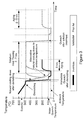
- the present invention provides a simplified method of producing heat-hardened aluminum alloys castings with significant savings in capital and operational costs illustrated in figure 2 for comparison with the process of the prior art, which method comprises 1) introducing liquid heat-treatable aluminum alloy, of a desired composition comprising copper, into a mold to produce a casting; 2) removing from said mold the casting after it has been cooled sufficiently to become solid; 3) quenching said casting, without subjecting it to the solution heat treating of the prior art, while the alloy still has a surface temperature above 350°C, i.e. not permitting said temperature to fall below 350°C before initiating the quench in order to avoid the formation of large precipitates of CuAl 2 .
- This quenching is carried out with liquid water at a temperature between 65°C and 95°C in the same manner as in the prior art; 4) aging said casting, for a period normally less than needed for the prior art (though here shown in the range of 2 to 5 hours) at a temperature between 140°C and 250°C; 5) removing the sand cores.
- This step can conveniently be carried out after the aging treatment, because the alloy can now be cooled down without interfering with the hardening process; and 6) finishing the castings, for example, riser cutting, cubing, decoring, machining, etc., as required for delivering the final product.
- the advantages of the invention over the prior art can be readily appreciated in a plot of temperature of the alloy casting vs time.
- the prior art method is shown as a dotted line and the method of the preferred embodiment of the invention is shown as a solid black line.
- the invention shortens the manufacturing process of the aluminum alloys by a period of time in the range of at least 2 to 7 hours, which is the time spent by the castings in the conventional solution furnace.
- Tests were made with an aluminum Alloy A-319 with the following conditions: Test Conditions: Units Invention Prior Art Temperature at surface of casting before quenching (°C ) 430 480 Aging time (hrs) 2 4 Aging temperature (°C) 240 240 Test Results (Property): Brinell Hardness ( B ) 109 100 Ultimate Tensile Stress (MPa) 230 240 Elongation (%) 1.4 1.8 Tensile Yield (MPa) 207 205 Compression Yield (MPa) 203 210
- the simplification of the heat-treating process by eliminating the large solution heat treating furnace is so advantageous that this invention is still a significant improvement even in the case when a small furnace is used for holding the castings after demolding (the only purpose thereof being to prevent the temperature of the casting from falling down below 400°C, such as to accommodate delay in the processing line or for short term maintenance). If the temperature of the castings falls down below 400°C (without the direct precipitation quench step, contrary to the present invention), then the precipitation of large particles of CuAl 2 occurs, and it then becomes mandatory to subject the castings to the normal solution heat treating step in order to revert these precipitates to a solid solution of copper in aluminum at the atomic level.
- a solution furnace eliminated by the invention, is a piece of equipment costing several millions of dollars. Its omission decreases the capital costs of a casting plant by about 50%. Furthermore, the energy saved by not operating such a furnace is a significant amount considering the cost of heating, for example 800,000 pieces per year, each weighing about 30 Kg, plus the weight of the casting holding basket, 20 to 30 Kg, from ambient temperature, i.e. 25°C to 35°C, to the solution temperature of about 480°C and maintaining such temperature for several hours.
- this invention is appropriate to aluminum alloys of the 300 series of the AAA classification for cast aluminum (American Aluminum Association).
- a feature of the preferred embodiments of this invention is that the properties of the castings are within the range required of castings having a T6 temper (as defined by the American Aluminum Association), but achieved without the solution heat treatment required of castings that meet the T6 designation.
- Aluminum alloys produced according to the present invention have at least an 0.5 wt% copper content (and more preferably, above a 1.6 wt% copper content), unless there is a significant amount of silicon (e.g. above about 6.5 wt%).
- the typical 300 series compositions effective in this process would be one within the following ranges: Mg 0.05 - 0.1 wt% Si 5.5 - 6.5 Cu 2.0 - 4.0 Fe 1.0 - 1.2
Landscapes
- Chemical & Material Sciences (AREA)
- Physics & Mathematics (AREA)
- Thermal Sciences (AREA)
- Crystallography & Structural Chemistry (AREA)
- Engineering & Computer Science (AREA)
- Materials Engineering (AREA)
- Mechanical Engineering (AREA)
- Metallurgy (AREA)
- Organic Chemistry (AREA)
- Continuous Casting (AREA)
- Cylinder Crankcases Of Internal Combustion Engines (AREA)
Applications Claiming Priority (2)
| Application Number | Priority Date | Filing Date | Title |
|---|---|---|---|
| US44440095A | 1995-05-19 | 1995-05-19 | |
| US444400 | 1995-05-19 |
Publications (2)
| Publication Number | Publication Date |
|---|---|
| EP0743372A1 EP0743372A1 (en) | 1996-11-20 |
| EP0743372B1 true EP0743372B1 (en) | 2002-01-23 |
Family
ID=23764714
Family Applications (1)
| Application Number | Title | Priority Date | Filing Date |
|---|---|---|---|
| EP96107997A Revoked EP0743372B1 (en) | 1995-05-19 | 1996-05-20 | Method and apparatus for simplified production of heat-treatable aluminum alloy |
Country Status (7)
| Country | Link |
|---|---|
| US (1) | US5922147A (pt) |
| EP (1) | EP0743372B1 (pt) |
| JP (1) | JP4035664B2 (pt) |
| BR (1) | BR9602348A (pt) |
| CA (1) | CA2177019C (pt) |
| DE (1) | DE69618710T2 (pt) |
| ES (1) | ES2169173T3 (pt) |
Families Citing this family (22)
| Publication number | Priority date | Publication date | Assignee | Title |
|---|---|---|---|---|
| EP0933441B1 (de) * | 1998-01-29 | 2002-10-16 | Alcan Technology & Management AG | Verfahren zur Herstellung eines Bauteiles aus einer Aluminiumlegierung durch Druckgiessen |
| US6419769B1 (en) * | 1998-09-08 | 2002-07-16 | The United States Of America As Represented By The Administrator Of The National Aeronautics And Space Administration | Aluminum-silicon alloy having improved properties at elevated temperatures and process for producing cast articles therefrom |
| US6224693B1 (en) | 1999-12-10 | 2001-05-01 | Tenedora Nemak, S.A. De C.V. | Method and apparatus for simplified production of heat treatable aluminum alloy castings with artificial self-aging |
| GB2361710A (en) * | 2000-02-11 | 2001-10-31 | Ford Global Tech Inc | Precipitation hardening of aluminium castings |
| EP1409759A4 (en) * | 2000-10-20 | 2004-05-06 | Pechiney Rolled Products Llc | HIGH RESISTANCE ALUMINUM ALLOY |
| CA2398600A1 (en) * | 2000-12-14 | 2002-06-20 | Tenedora Nemak, S.A. De C.V. | Method and apparatus for simplified production of heat treatable aluminum alloy castings with artificial self-aging |
| KR100441212B1 (ko) * | 2001-07-09 | 2004-07-22 | 대신금속 주식회사 | Sn 함유 고강도·고연성 알루미늄 주조합금 및 그제조방법 |
| CA2470127C (en) * | 2001-12-13 | 2009-02-17 | Jerzy H. Sokolowski | Method and apparatus for universal metallurgical simulation and analysis |
| US7503986B2 (en) * | 2003-01-21 | 2009-03-17 | Alcoa, Inc. | Method for shortening production time of heat treated aluminum alloys |
| US20040140026A1 (en) * | 2003-01-21 | 2004-07-22 | Kamat Rajeev G. | Method for shortening production time of heat treated aluminum alloy castings |
| US20050167012A1 (en) * | 2004-01-09 | 2005-08-04 | Lin Jen C. | Al-Si-Mn-Mg alloy for forming automotive structural parts by casting and T5 heat treatment |
| DE102005019961A1 (de) * | 2005-04-29 | 2006-11-02 | Audi Ag | Verfahren zur Herstellung eines Gussteiles im Verbundguss |
| DE102005039049A1 (de) * | 2005-08-18 | 2007-02-22 | Ks Aluminium-Technologie Ag | Verfahren zur Herstellung eines Gussteils und Zylinderkurbelgehäuse |
| US8083871B2 (en) | 2005-10-28 | 2011-12-27 | Automotive Casting Technology, Inc. | High crashworthiness Al-Si-Mg alloy and methods for producing automotive casting |
| JP5175905B2 (ja) * | 2010-08-31 | 2013-04-03 | トヨタ自動車株式会社 | 軽合金の鋳造方法 |
| JP5907272B2 (ja) * | 2012-09-06 | 2016-04-27 | 日産自動車株式会社 | アルミニウム合金製鋳物の製造方法 |
| US9951396B2 (en) | 2014-09-18 | 2018-04-24 | Consolidated Engineering Company, Inc. | System and method for quenching castings |
| US10308993B2 (en) | 2015-06-12 | 2019-06-04 | Consolidated Engineering Company, Inc. | System and method for improving quench air flow |
| WO2021216411A1 (en) | 2020-04-20 | 2021-10-28 | Enlight Medical Technologies (Shanghai) Co., Ltd. | Catheter with electrically-actuated articulation |
| TR2022021830A1 (tr) * | 2022-12-30 | 2024-07-22 | Gazi Ueniversitesi Rektoerluegue | Alüminyum alaşımlarında küresel silisyum fazının elde edilmesini sağlayan yöntem. |
| CN116397182A (zh) * | 2023-02-07 | 2023-07-07 | 江苏信轮美合金发展有限公司 | 一种铝合金热处理工艺 |
| CN117127128B (zh) * | 2023-08-24 | 2025-11-25 | 东风汽车股份有限公司 | 一种快速风冷的铝合金缸盖热处理方法及铝合金缸盖 |
Family Cites Families (8)
| Publication number | Priority date | Publication date | Assignee | Title |
|---|---|---|---|---|
| US1732573A (en) * | 1924-08-02 | 1929-10-22 | Aluminum Co Of America | Piston and process of making same |
| GB390244A (en) * | 1931-11-14 | 1933-04-06 | Horace Campbell Hall | Improvements in the heat treatment of aluminium alloys |
| US2062329A (en) * | 1932-04-21 | 1936-12-01 | Aluminum Co Of America | Thermal treatment of aluminum alloys containing copper |
| GB547217A (en) * | 1939-12-06 | 1942-08-19 | Nat Smelting Co | Improvements in or relating to heat treatment of aluminium base alloy castings |
| JPS55110753A (en) * | 1979-02-20 | 1980-08-26 | Furukawa Electric Co Ltd:The | Aluminum alloy conductor and producing method of the same |
| US4419143A (en) * | 1981-11-16 | 1983-12-06 | Nippon Light Metal Company Limited | Method for manufacture of aluminum alloy casting |
| JPH0791624B2 (ja) * | 1988-05-11 | 1995-10-04 | 本田技研工業株式会社 | アルミニウム合金鋳物品の製造方法 |
| US5120372A (en) * | 1990-11-08 | 1992-06-09 | Ford Motor Company | Aluminum casting alloy for high strength/high temperature applications |
-
1996
- 1996-05-20 JP JP16227196A patent/JP4035664B2/ja not_active Expired - Fee Related
- 1996-05-20 ES ES96107997T patent/ES2169173T3/es not_active Expired - Lifetime
- 1996-05-20 EP EP96107997A patent/EP0743372B1/en not_active Revoked
- 1996-05-20 DE DE69618710T patent/DE69618710T2/de not_active Revoked
- 1996-05-20 BR BR9602348A patent/BR9602348A/pt not_active IP Right Cessation
- 1996-05-21 CA CA002177019A patent/CA2177019C/en not_active Expired - Fee Related
-
1997
- 1997-01-30 US US08/790,812 patent/US5922147A/en not_active Expired - Fee Related
Also Published As
| Publication number | Publication date |
|---|---|
| CA2177019A1 (en) | 1996-11-20 |
| ES2169173T3 (es) | 2002-07-01 |
| EP0743372A1 (en) | 1996-11-20 |
| US5922147A (en) | 1999-07-13 |
| BR9602348A (pt) | 1998-09-01 |
| JPH09228010A (ja) | 1997-09-02 |
| DE69618710D1 (de) | 2002-03-14 |
| CA2177019C (en) | 2008-07-29 |
| DE69618710T2 (de) | 2002-09-12 |
| JP4035664B2 (ja) | 2008-01-23 |
Similar Documents
| Publication | Publication Date | Title |
|---|---|---|
| EP0743372B1 (en) | Method and apparatus for simplified production of heat-treatable aluminum alloy | |
| US8168015B2 (en) | Direct quench heat treatment for aluminum alloy castings | |
| US10450640B2 (en) | Aluminum alloy products having improved property combinations and method for artificially aging same | |
| US4863528A (en) | Aluminum alloy product having improved combinations of strength and corrosion resistance properties and method for producing the same | |
| US6224693B1 (en) | Method and apparatus for simplified production of heat treatable aluminum alloy castings with artificial self-aging | |
| JP7709267B2 (ja) | アルミニウム合金鍛造材の製造方法 | |
| CN109161828B (zh) | 一种用于降低t5状态铝合金型材表面粗晶的加工工艺 | |
| CN112553550B (zh) | 一种高损伤容限低淬火敏感性7系铝合金厚板生产工艺 | |
| CN110073017B (zh) | 铝合金及其制作方法 | |
| JPS63235454A (ja) | アルミニウムベース合金の平圧延製品の製造方法 | |
| CN116529412A (zh) | 制造2xxx系列铝合金产品的方法 | |
| EP1530651B1 (en) | Method and apparatus for simplified production of heat treatable aluminum alloy castings with artificial self-aging | |
| JPH04341546A (ja) | 高強度アルミニウム合金押出形材の製造方法 | |
| JPH1112675A (ja) | 熱間鍛造用アルミニウム合金及び熱間鍛造品の製造方法 | |
| KR102277133B1 (ko) | 고력 알루미늄 합금 단조 플레이트의 제조 방법 | |
| CN115717206A (zh) | 一种高强高耐蚀Al-Mg-Si合金及其制备方法 | |
| CN118895444B (zh) | 一种高强韧高塑性的铝合金及其铸锻复合制备方法 | |
| CN120442971A (zh) | 一种调控高Fe含量6016再生铝合金组织与性能的方法 | |
| CN119932370A (zh) | 一种强塑性稀土y改性adc12再生铝合金及其制备方法 | |
| CN118417822A (zh) | 一种6061-t651铝合金厚板的生产方法 | |
| CN121087308A (zh) | 铝合金板材及其制备方法 | |
| CN117488117A (zh) | 一种控制6000系铝合金中AlFeSi相的方法及铝合金 | |
| CN114990401A (zh) | 一种高性能铸造镁合金及其制备方法 | |
| Chaudhury | Heat Treatment | |
| Murza-Mucha et al. | The influence of the method of supersaturation on the course of precipitation hardening of chill castings made of aluminium silicon alloys |
Legal Events
| Date | Code | Title | Description |
|---|---|---|---|
| PUAI | Public reference made under article 153(3) epc to a published international application that has entered the european phase |
Free format text: ORIGINAL CODE: 0009012 |
|
| AK | Designated contracting states |
Kind code of ref document: A1 Designated state(s): DE ES FR GB IE IT |
|
| 17P | Request for examination filed |
Effective date: 19970515 |
|
| 17Q | First examination report despatched |
Effective date: 19970613 |
|
| GRAG | Despatch of communication of intention to grant |
Free format text: ORIGINAL CODE: EPIDOS AGRA |
|
| GRAG | Despatch of communication of intention to grant |
Free format text: ORIGINAL CODE: EPIDOS AGRA |
|
| GRAG | Despatch of communication of intention to grant |
Free format text: ORIGINAL CODE: EPIDOS AGRA |
|
| GRAH | Despatch of communication of intention to grant a patent |
Free format text: ORIGINAL CODE: EPIDOS IGRA |
|
| GRAH | Despatch of communication of intention to grant a patent |
Free format text: ORIGINAL CODE: EPIDOS IGRA |
|
| GRAA | (expected) grant |
Free format text: ORIGINAL CODE: 0009210 |
|
| REG | Reference to a national code |
Ref country code: GB Ref legal event code: IF02 |
|
| AK | Designated contracting states |
Kind code of ref document: B1 Designated state(s): DE ES FR GB IE IT |
|
| REG | Reference to a national code |
Ref country code: IE Ref legal event code: FG4D |
|
| REF | Corresponds to: |
Ref document number: 69618710 Country of ref document: DE Date of ref document: 20020314 |
|
| ET | Fr: translation filed | ||
| REG | Reference to a national code |
Ref country code: ES Ref legal event code: FG2A Ref document number: 2169173 Country of ref document: ES Kind code of ref document: T3 |
|
| PLBI | Opposition filed |
Free format text: ORIGINAL CODE: 0009260 |
|
| PLBQ | Unpublished change to opponent data |
Free format text: ORIGINAL CODE: EPIDOS OPPO |
|
| PLBI | Opposition filed |
Free format text: ORIGINAL CODE: 0009260 |
|
| 26 | Opposition filed |
Opponent name: HYDRO ALUMINIUM DEUTSCHLAND GMBH Effective date: 20021022 |
|
| 26 | Opposition filed |
Opponent name: MONTUPET SA Effective date: 20021022 Opponent name: HYDRO ALUMINIUM DEUTSCHLAND GMBH Effective date: 20021022 |
|
| PLBF | Reply of patent proprietor to notice(s) of opposition |
Free format text: ORIGINAL CODE: EPIDOS OBSO |
|
| PLBF | Reply of patent proprietor to notice(s) of opposition |
Free format text: ORIGINAL CODE: EPIDOS OBSO |
|
| PLAX | Notice of opposition and request to file observation + time limit sent |
Free format text: ORIGINAL CODE: EPIDOSNOBS2 |
|
| PLAX | Notice of opposition and request to file observation + time limit sent |
Free format text: ORIGINAL CODE: EPIDOSNOBS2 |
|
| PLAX | Notice of opposition and request to file observation + time limit sent |
Free format text: ORIGINAL CODE: EPIDOSNOBS2 |
|
| PLBB | Reply of patent proprietor to notice(s) of opposition received |
Free format text: ORIGINAL CODE: EPIDOSNOBS3 |
|
| APBP | Date of receipt of notice of appeal recorded |
Free format text: ORIGINAL CODE: EPIDOSNNOA2O |
|
| APBQ | Date of receipt of statement of grounds of appeal recorded |
Free format text: ORIGINAL CODE: EPIDOSNNOA3O |
|
| APAH | Appeal reference modified |
Free format text: ORIGINAL CODE: EPIDOSCREFNO |
|
| PLBP | Opposition withdrawn |
Free format text: ORIGINAL CODE: 0009264 |
|
| APBU | Appeal procedure closed |
Free format text: ORIGINAL CODE: EPIDOSNNOA9O |
|
| PGFP | Annual fee paid to national office [announced via postgrant information from national office to epo] |
Ref country code: ES Payment date: 20080619 Year of fee payment: 13 Ref country code: DE Payment date: 20080529 Year of fee payment: 13 |
|
| PGFP | Annual fee paid to national office [announced via postgrant information from national office to epo] |
Ref country code: IE Payment date: 20080515 Year of fee payment: 13 |
|
| RDAF | Communication despatched that patent is revoked |
Free format text: ORIGINAL CODE: EPIDOSNREV1 |
|
| RDAG | Patent revoked |
Free format text: ORIGINAL CODE: 0009271 |
|
| STAA | Information on the status of an ep patent application or granted ep patent |
Free format text: STATUS: PATENT REVOKED |
|
| PGFP | Annual fee paid to national office [announced via postgrant information from national office to epo] |
Ref country code: GB Payment date: 20080521 Year of fee payment: 13 |
|
| 27W | Patent revoked |
Effective date: 20080204 |
|
| GBPR | Gb: patent revoked under art. 102 of the ep convention designating the uk as contracting state |
Effective date: 20080204 |
|
| PGFP | Annual fee paid to national office [announced via postgrant information from national office to epo] |
Ref country code: IT Payment date: 20090516 Year of fee payment: 14 |
|
| PGFP | Annual fee paid to national office [announced via postgrant information from national office to epo] |
Ref country code: FR Payment date: 20080514 Year of fee payment: 13 |